1 * 3 8 ^
R E -0 ñ G A r^ i2 A V ? 0 M O r S Ü f^ S a B Λ ^ íK
A . S í 2 ¿ . d y €Sf S S ä - i i ö g i iSÂpObiCvîş to 5nvïircr.;T.ar.îs.E C h s r'g s
Λ Г ¿r- ";ü B M iT T £ D TC TH E O E R A R T ^ g i^ T О? МАЫЛЛёгЕШШЫГ
^=üw¿\IΉ£ GRADUATE S C -C C O C F BüSiacôSS Л С ^ ^ Ш ІС Т а л Т ІО A
BELK£^T y^lV£RS!TY
F
a
^ .
c
AL rCLTr¿>LCi¿^,\T C F THF :T£QüSRs%b-v.·-.-^
'îÛ l A v , R f " I , .1 '-'S - .--'* ,-*-^ .— ,—. ^ ¿ m t u iZ U i Z ^ »\ Z 'C, wáSASTSa OF S Ö SÜ ^E SS À Û A î
k Ú M I x I E í п л Т і О ^
C s h 'g n E r k u ï F e b m £ ? y 1 s e sRE-ORGANIZATION OF SUMERBANK
A Study of Strategic Responses to Environmental Change
A THESIS
SUBMITFED TO THE DEPARTMENT OF MANAGEMENT AND
THE GRADUATE SCHOOL OF BUSINESS ADMINISTRATION OF
BILKENT UNIVERSITY
IN PARTIAL FULFILLMENT OF THE REQUIREMENTS FOR THE DEGREE OF
MASTER OF BUSINESS ADMINISTRATION
By
Clhan Erkul
""TVeVîs
WO
i m
I certify that I have read this thesis and that in my opinion it is fully adequate, in scope and quality, as a thesis for the degree of Master of Business Administration.
Prof. Dr. Umit Berkman (Principal
Advis-I certify that Advis-I have read this thesis and that in my opinion it is fully adequate, in scope and quality, as a thesis for the degree of Master of Business Administration.
Assist. Prof. Dilek Yeldan
I certify that I have read this thesis and that in my opinion it is fully adequate, in scope and quality, as a thesis for the degree of Master of Business Administration.
Approved for the Graduate School of Business Administration
\ f w
4
;
Prof. Dr. Subidey Togan, Director of Graduate School of Business Administration
ABSTRACT
RE-ORGANIZATION OF SUMERBANK
A Study of Strategic Responses to Environmental Change
Cihan ErkulMaster of Business Administration
Supervisor: Prof. Dr. lim it Berkman
February, 1989, v + 46 pages
The new economic environment in Turkey after the 1980 reforms posed strategic challenges to firms. The study of these challenges and of the actual responses of firms to these challenges in the form of new strategies may provide interesting case studies for management theory. In this thesis the strategic responses of a state economic enterprise, Sumerbank, to environmental changes are investigated. Sumerbank's strategy, formulated and implemented after 1982, was successful in many respects. However, it was not possible to procure the funds required for modernization investments because of governmental policies. As a result, the new strategy failed to enhance the profitability and viability of Sumerbank.
Keywords: Environment, Environmental Change, Strategy, State Economic Enterprises, Sumerbank.
ÖZET
SUMERBANK’IN RE-ORGANİZASYONU
Ortamdaki Değişime Stratejik Tepkiler Üzerine Bir Çalışma
Cihan Erkul
MBA Yüksek Lisans Tezi
Tez Danışmanı: Prof. Dr. Ümit Berkman
Şubat 1989, v + 46 sayla
'l'ürkiye’de 1980 reformliirııuhın sonra oluşan yeni ekonomik ortam firmaları stratejilerini değiştirm elerine neden olm uştur. Ortamdaki değişiklerin firmalar üzerindeki etkilerinin ve firmaların bu etkilere gösterdikleri stratejik tepkilerin incelenm esi işletm e yönetimi kuramı açısından ilginç olacaktır. Bu tezde, Türkiye’deki bir kamu iktisadi teşebbüsünün, Sümerbank’ın, ortamdaki değişiklere gösterdiği stratejik tepkiler incelenmiştir. Sümerbank’ın 1982 sonrası geliştirdiği yeni strateji bir çok bakımdan başarılı olm uştur. Ancak, bu dönemdeki hükümet politikaları nedeniyle, modernizasyon yatırımları için gerekli kaynaklar bulunam am ıştır. Bu nedenle, yeni strateji Sümerbank’ın karlılığının artırılmasını sağlayam am ıştır.
Analılar kelimeler; Ortam, Ortamdaki Değişim, Strateji, Kamu İktisadi Teşebbüsleri,
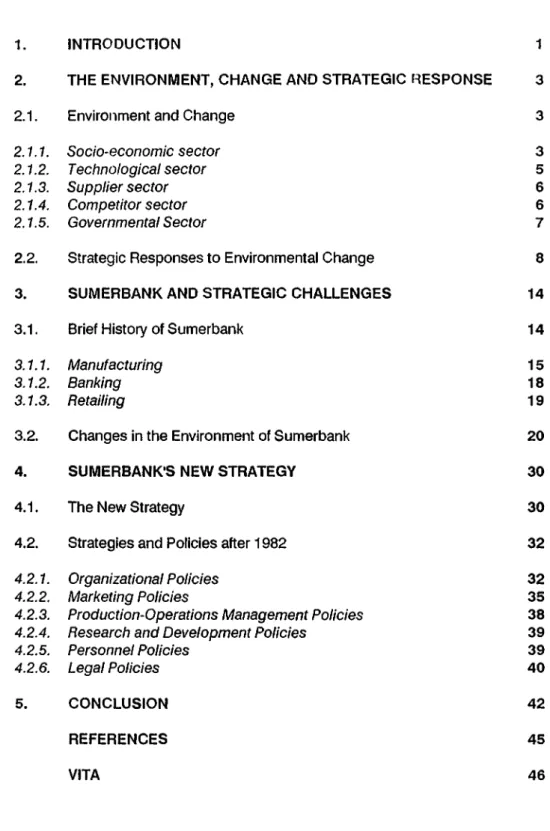
TABLE OF CONTENTS
1. INTRODUCTION 1
2. THE ENVIRONMENT, CHANGE AND STRATEGIC RESPONSE 3
2.1. Environment and Change 3
2.1.1.
Socio-economic sector
32.1.2.
Technological sector
52.1.3.
Supplier sector
62.1.4.
Competitor sector
62.1.5.
Governmental Sector
72.2. Strategic Responses to Environmental Change 8
3. SUMERBANK AND STRATEGIC CHALLENGES 14
3.1. Brief History of Sumerbank 14
3.1.1.
Manufacturing
153.1.2.
Banking
183.1.3.
Retailing
193.2. Changes in the Environment of Sumerbank 20
4. SUMERBANK’S NEW STRATEGY 30
4.1. The New Strategy 30
4.2. Strategies and Policies after 1982 32
4.2.1.
Organizational Policies
324.2.2.
Marketing Policies
354.2.3.
Production-Operations Management Poiicies
384.2.4.
Research and Development Policies
394.2.5.
Personnel Policies
394.2.6.
Legal Policies
405. CONCLUSION 42
REFERENCES 45
1. INTRODUCTION
The firms operate in a dynamic environment. Socio-economic, technological,
competitive and governmental factors which characterize the environment of a firm
change continuously. A successful firm should revise its strategies in the face of
these changes. A failure to adapt to environmental changes may lead to stagnation
and finally to the bankruptcy of the firm.
The study of the responses of firms to environmental change is one of the most
important fields of management research. Such studies show how firms alter their
strategies in the face of new environmental factors and serve to demonstrate the
effects of new strategies on the operations of the firm. In these studies, the
management theory is applied to facts of business life.
The new economic environment in Turkey after the 1980 reforms posed strategic
challenges to firms. The study of these challenges and of the actual responses of
firms to these challenges in the form of new strategies may provide interesting case
studies for the management theory.
In this thesis, a state economic enterprise, Sumerbank, is selected for this type of
analysis. Sumerbank is one of the oldest state economic enterprises in Turkey. It
recently developed and partly implemented a new strategy which generated
substantial interest in the general public and academic circles. This thesis is a
No report or study is available on the assumptions and targets of Sumerbank's new
strategy . Actually it was not developed as a result of a detailed strategic analysis
and design, but as policy responses of a new management team to some urgent
problems. It is usually called the 're-organization' of Sumerbank, but it is actually a
strategic change in the orientation of Sumerbank.
As the process is not documented, the main information source of the thesis is a set
of interviews conducted with the members of the new team. This information was
supplemented with some unpublished reports on the operations of Sumerbank. The
're-organization' of Sumerbank continues at present. There are plans to substantially
re-structure and privatize Sumerbank. The results of this re-structuring operation on
the part of the government is difficult to guess at present.
The thesis is organized into five sections including this introduction. In the next
section, the concepts of environment, environmental change and strategic
responses to such changes are discussed. The third section gives a history of
Sumerbank and discusses the environmental changes it faced in the recent past.
The fourth section gives an account of the policy actions adopted by Sumerbank
after 1984 in response to these changes. Finally, the thesis concludes with a
2. THE ENVIRONMENT, CHANGE AND STRATEGIC RESPONSE
2.1. Environment and Change^
A large number of factors affect the firm within a given environment. Moreover, these
factors interact with each other. There are many ways to organize different
environmental factors for analysis and diagnosis. One approach is to divide the
environment into a number of 'sectors'. Such categories as socio-economic,
technological, supplier, competitor and governmental 'sectors' are used commonly.
In what follows, we briefly describe the factors which affect the firm in each of these
sectors.
2.1.1. Socio-economic sector
There are a variety of factors which affect the demand for products and services and
the costs of producing them. These factors may be classified as economic,
demographic, geographical and social factors.
Economic factors:
The state of the economy at present and in the future can affectthe prospects and the strategies of the firm. The specific economic factors that the
firms should analyze include the following:
The stage of the business cycle, that is whether the economy is in a depression, recession, recovery or boom;
The inflationary or deflationary trends;
Economic policies, especially monetary and fiscal policies; Fiscal policies, especially corporate and income taxes; Trade policies, especially tariffs and exchange rate policies.
Each of the above factors can help or hinder the achievement of the objectives of a
firm and lead to success and failure of a particular strategy.
Demographic factors:
The analysis of demographic factors is important indetermining the demand for products and services. Economists and marketing
experts often refer to demographic factors as
primary demand lectors.
Among theimportant characteristics of the population which should l)e analyzed while
developing a strategy for a firm are the following:
The growth rate of the population and its segments;
The age, employment, income distribution of the population: Urban and rural distribution of the population.
Geographical factors:
A firm produces and distributes in different geographicallocations. An effective strategist should hence continuously evaluate the locations in
which the firm operates to identify opportunities and problems. According to this
evaluation, the strategist may propose
New locations to add to present locations; Relocation of certain premises to new locations; Closing of certain premises;
Moving corporate headquarters to a new region.
The above types of decisions will naturally involve a careful analysis of economic,
business, demographic and physical factors which characterize a geographical
location.
Social factors:
The last group of socio-economic factors which should beconsidered relates to the values and attitudes of the customers and employees.
services. The values and attitudes are also important in the behavior of the
employees.
A successful strategy should take into account these values and attitudes. The firm
should monitor the changes in educational levels, social trends, new ideas and even
fashions in order to assess their likely impact. The firm may then consider modifying
its product and marketing strategies. The firm may also attempt to influence its
customers to adopt desirable values and attitudes through public relations efforts. A
particular strategy may also call for the changes in the behavior of the managers and
the employees, especially of those having direct relations with customers.
2.7.2.
Technological sector
Besides examining socio-economic factors for their possible impact on products,
markets or ways of conducting business, the firm should also search rhe
environment for new technologies relating to its raw materials, operations, products
and services. New technologies can offer major opportunities for the profitability of
the firm. Conversely, new technologies, if employed by the competitors, may
threaten the market share or even the very existence of the firm.
Not all industries are likely to be equally affected by technological change. Some
industries are more volatile in technology than others. Strategists in industries
subject to rapid technological change should be more alert in assessing the impacts
2.1.3. Supplier sector
A firm procures the inputs it employs in production of goods and services from
many suppliers. As the complexity of the product increases, as exemplified by the
automotive industry, the number of such suppliers may reach hundreds.
The common practice in modern industries is to sub-contract for most of the parts of
a particular product and produce those parts which may be produced with least cost
and/or higher quality. This mode of operation provides a flexibility in production
planning and cost control.
Hence, a firm should keep under constant review the costs and availability of inputs
it procures (or it might procure) from suppliers. As a result of these reviews,
following actions may be considered:
Sub-contracting certain parts of a particular product to suppliers which may produce it with least cost or with better quality;
Shift from a particular supplier to another if the latter Is expected to provide a better service;
Changes in relations with existing suppliers, e.g. in prices, payment terms, delivery schedules, quality standards.
2.1.4. Competitor sector
The state of competition a firm faces is an important dimension of the environment.
Three factors need to be examined regarding competition: entry and exit of major
competitors; substitutes for current products and services; and strategic changes
implemented by major competitors.
Entry and exit of competitors:
Competitors do come and go. The firm shouldcase of new competitors the firm should consider actions to guard its market share,
technological position and its image in the minds of its customers. If a competitor
exits from the industry, the firm should consider actions to capture the market share
of that particular firm. Moreover, the firm should (i) carefully analyze the strategic
reasons affecting the entry and exit of competitors, and (ii) modify its own strategies
according to this analysis.
Substitutes for current products:
The competitors of the firm are not only confinedto the other firms producing the same product as the firm, but also to those
producing substitutes. In the case of substitutes, the characteristics of the substitute
may be changed by the other firm in such a way to increase the 'degree of
substitution' with the product of the firm. Hence the consumers may select this
substitute which became more similar to the product the firm is selling and capture
part of its market share.
Strategies of competitors:
Product, market, pricing and advertising strategies of thecompetitors should also be continuously monitored for their likely impacts. A
competitor may target a particular market segment, population group etc and may
intensify its investments, product development, marketing efforts in that direction.
An early understanding of such strategic decisions will help the firm to develop
counter-strategies.
2.1.5. Governmental Sector
Governmental policies affect the way a business operates through legislation and
regulations in such matters as wages and prices, taxes, employment conditions,
etc. These laws and regulations change continuously forcing the firm to devote
substantial resources to following, evaluating, and implementing them.
Apart from these general governmental actions, governments do have industrial
policies which favour certain industries and types of businesses. They provide
explicit or implicit subsidies to these industries and they protect these industries
through tariffs and other measures. Such actions of the governments increase or
decrease the opportunity set of a particular firm.
The governments are also big consumers of products and services. Hence the level
and composition of governmental spending directly affects the demand for the
products of a particular firm. This effect may be direct or indirect. The government
may either directly purchase the products of the firm or the governmental purchases
may indirectly induce an increase in the demand through input-output relations
between firms.
2.2. Strategic Responses to Environmental Change
Every firm has some sort of a strategy or a set of strategies. Whether the strategy is
a detailed document or implicit in the minds and practices of the managers, it
depends on certain assumptions about the environment.
As evident from the above discussion, the environment of a firm changes
continuously. These changes are also interrelated, one change leading to others in
A business firm should continuously monitor these changes in the environment and
their interrelations and analyze which strategic assumptions are invalidated with the
advent of these changes. New assumptions should then be formulated and the
overall strategy should be modified accordingly.
Hence, strategy development and.updating is also a continuous and complex
process. Its complexity increases with the complexity of the business itself and
frequency of change in environmental factors.
Different sets of assumptions produce different strategies. It is the task of the
management to make a detailed analysis of these strategic alternatives and choose
the most appropriate strategy given the new environmental factors.
Once a strategy is chosen, new resources should be allocated to the business and
new otganizaliorial structures should be designed and put irito use. The planning
and design of the latter is an important stage of the implementation of the chosen
strategy.
Most of the above steps of strategy development and implementation is undertaken
by the strategists. The strategists may be experts specialized in this field and/or the
top management of the firm. Then comes the most important stage of strategy
implementation, that is policy development and implementation.
Policy development is a process where the strategy is communicated to other parts
of the firms, especially to subordinate managers.^ Policies are developed to ensure
that
The strategy is implemented;
There is a basis for control;
The amount of time top management spend making decisions is reduced:
Similar situations are handled consistently;
Coordination across units will occur where necessary.
Policy development is a crucial part of the strategy implementation. Without policies
a well-formulated strategy may be implemented in a faulty way, hence damaging the
objectives of the firm incorporated in the strategy. The lack of policies may lead to
confusion among the managers about the direction the firm has to take, about the
proper course of action in a particular situation.
Policies should be practical, workable and compatible with other policies. They
should reflect present or desired company practices. Policies should be developed
in areas critical to firm's success. Moreover, the amount of policy-making should
reflect the present and future size and complexity of the busirress. A small business
may operate with a few policies. However if it is a small business growing rapidly it
should start formulating a greater number of policies in crucial business areas. A big
firm will have a large set of policies in place. These policies should be kept under
constant review so that they are in conformity with the strategy of the firm. Any
problems emerging because of inappropriate policies should be dealt with quickly.
Policies may classified into a number of areas: financial and accounting, marketing,
production-operations management, research and development, personnel, legal
and public relations policies.
Financial and accounting policies:
These policies relate to financing of the firms'activities and projects and to accounting methods to be employed.
Among the financial policies, the most important ones relate to capital employed in
the business. The capital may be acquired in the form of short-term and long-term
debt or in the form of equity. The firm should have a set of policies about the
composition of its capital in terms of above instruments. These policies should also
be compatible with policies regarding to uses of capital. The firm should consider
whether to buy or lease fixed assets. In the case of leasing, the working capital will
increase, or alternatively, the need to borrow will decrease.
The firm must also chose among different accounting methods and practices. It may
select LIFO (Last-In-First-Out), FIFO (First-In-First-Out) in the case of inventory
accounting, or book value or market value of fixed assets. These accounting policies
will have an impact on the after-tax profits of the firm.
Marketing policies:
Marketing policies relate to the products, markets, distributionand promotion, and pricing.
The firm should develop policies about the products to be focused on, the new
products to be developed, the markets to be targeted, the distribution channels, and
the composition of promotional activities in terms of different media channels such
as TV, newspapers, radio, direct-mail.
The most important set of marketing policies are related to pricing. In the case of
new product, the firm should consider whether to price it below-cost to gain rapid
sales volume or sufficiently above-cost to cover development expenses. In the case
of established products, such policies as volume-discounts or different prices in
different locations may be considered.
Production-operations management policies:
The firm should develop policiesrelating to existing capacity and its level of utilization. If the current production
capacities are inadequate under the new strategy, investments in new capacity
should be considered. A related question arises in the latter case, that is where to
locate new facilities. Policies should also be developed on equipment purchases for
both the old and new production facilities.
Another area of policy-making in production management relates to sourcing of
inputs. The important decision in this regard is the make or buy question. This
decision depends on comparative costs of making or buying and the availability of
reliable suppliers.
Research and development policies:
In the case of a business firm, research anddevelopment relating to new products and processes is an important function. The
firm should have a detailed R & D policy which specifies whether tl le R & D efforts
should be confined to products or processes, whether research should be basic or
applied, whether the R & D should be offensive aiming at introducing new products
to the market or be defensive following what the other firms has already introduced.
The above R & D policies should be compatible with the policies about the
resources to be devoted to R & D. The latter may be set as a percentage of sales,
gross profits etc.
Personnel, legal and public relations policies:
These last three policy areas are alsoimportant for the smooth operation of a particular strategy.
A successful strategy should have a detailed human resources component. The firm
should first consider whether the existing level and composition of human
resources is adequate for the strategy. If new recruitment is needed the availability
of the necessary work force with the required skills should be considered. The firm
should than look into its policies regarding salaries, benefits, job evaluation and
performance appraisal and consider the necessary revisions in these policies under
the new strategy.
Possible legal issues should also be considered before the implementation of a
particular strategy or policy. There may be cases where the legal position of a
particular action is not clear-cut and the firm may wish to seek legal opinion or
instructions from the authorities. In other cases, if the firms thinks that a particular
legal question will cause problems it may decide to drop the policy concerned.
Public relations policies have an impact on the image of the firm in the minds of the
general public, not only in the minds of its customers. Every firm of a respectable
size should have a set of public relations policies. Some of these policies may be
directed to the community where the facilities are located. Other policies may be
directed to general public or policy-makers in the government.
Another set of public relations policies may be needed in the case of bad publicity. A
firm may be involved in the production of a dangerous product, its research and
selling policies may raise ethical questions, and it may receive the attention of media
and general public for these practices. The firm should react quickly to these issues
and present its viewpoint to the public to limit the damage to its public image.
3.SUMERBANK AND STRATEGIC CHALLENGES
3.1. Brief History of Sumerbank^
/
Sumerbank was established on July 11, 1933. The law establishing Sumerbank
assigned it a very broad task: To manage the existing state industrial enterprises on
the one hand and to establish new enterprises on the other hand. Given this task,
the law stated the following objectives for Sumerbank:
To assist in the industrialization of Turkey by utilizing national resources:
To cooperate with other state and private enterprises in establishing industries which are given high priority in the industrialization programme of the State;
To take the necessary actions to train the personnei needed in industrial enterprises:
To prepare studies and projects of industrial enterprises to be established with the equity participation of the State.
As evident from above, Sumerbank was established as the principal instrument for
the realization of the industrialization strategy of the Republic. Its task was not
limited to a particular industry or a given set of projects.
Sumerbank had also a unique structure. As its name implies, it was established as a
bank instead of an industrial holding company. The principal purpose of this
arrangement was to mobilize deposits from the general public and to use these
funds for industrial investments. Hence Sumerbank established a separate banking
division with its own branch network.
This section draws on Sumerbank (1986).
The original plan for Sumerbank also included retail activities in the form of a chain
of stores. These stores were established to sell the products of Sumerbank.
Hence Sumerbank may be best analyzed in three divisions, namely manufacturing,
banking and retailing.
3.1.1. Manufacturing
At the very start, four existing industrial enterprises were transferred to Sumerbank.
These were
Bakirkoy Cotton Mill; Feshane Woolen
Min'*;
Hereke Silk and Woolen Mill^; Beykoz Leather and Shoe Factory.The above four enterprises were quite old, all established in 19th century. Feshane
started its operations in 1836, Hereke in 1843, and Bakirkoy in 1850.
The fifth industrial enterprise, the ownership of which was transferred to Sumerbank
in 1934, was Bünyan Carpet Factory. Bünyan was established in 1927 and was one
of the first industrial enterprises of the new Republic.
After this initial stage, Sumerbank started its own industrial investments and
established a number of factories:
Kayseri Cotton Mill, 1935;
The first paper factory in Turkey, İzmit Paper Factory, which started its operations in 1936;
The first printed cotton fabric factory, Nazilli Printed Fabric Mill, 1937;
4 Feshane is now called as Defterdar Woolen Mill.
5 As of 1986 Hereke operates as two enterprises. One is called the Hereke Woolen Mill, the other
Hereke Carpets.
Ereğli Cotton Mill, 1937;
The first modern woolen mill, Merinos (Bursa) Woolen Mill, 1938; Gemlik Artificial Silk and Viscose Factory, 1937
Malatya Printed Fabric Mill, 1939.
As evident from above, in the first 6 years [1934-1939] of its operation, Sumerbank
had implemented an active policy of investment and had established seven modern
industrial enterprises. Moreover its investments were not oniy limited to textiles, but
also covered paper, iron and steel.®
The Second World War slowed the investment programme of Sumerbank.
Sumerbank was able to include the following four enterprises in its portfolio in
1940s:
İsparta Carpet Factory, 1943 Adana Cotton Mill, 1946 Taskopru Jute Mill, 1947 Adana Cotton Ginning Mill, 1949
The İsparta Carpet was first established in 1926 and was transferred to Sumerbank
in 1943. Adana Cotton Mill was also a transfer. Hence Sumerbank established only
two enterprises in this period, Taskopru and Adana Ginning, and these represented
a relatively small capital outlay.
1950s was the second expansion period of Sumerbank. It established the following
7 enterprises in this period;
Denizli Cotton Miii, 1953 Izmir Printed Fabric Mill, 1953 Erzincan Cotton Mill, 1954
Diyarbakir Wool and Carpet Factory, 1954. Bergama Cotton Industry, 1954
6 İzmit Paper Factory was later transferred to SEKA. Sumerbank also established the Karabük
Steel Works which remained under Sumerbank ownership until its transfer to TDCI.
Karaman Cotton Mill, 1955
Turkey Raw Wool and Mohair Corporation, 1955^.
The Bergama Cotton in the above iist represented a new trend on the part of
Sumerbank. Sumerbank established this modern plant with the equity participation
of local interests. Sumerbank hoids a 72.3 % stake in this corporation.
Sumerbank further expanded its operations in the 1960s with the foilowing 9
enterprises:
Manisa Cotton Industry, 1960° Salihli Valonia and Valex Plant, 1961° Antalya Cotton Industry, 1961^° Yildiz Porcelain Factory, 1962^ ^ Kahraman Maras Cotton Mill, 1963’ ^ Eskişehir Printed Fabric Mill, 1965 Tarsus Textile Dyes Factory, 1966 Adiyaman Cotton Mill, 1967 Nevşehir Cotton Mill, i967.
With the completion of above investments, Sumerbank had a manufacturing
portfolio of 31 enterprises. The investments in 1970s and early 1980s were confined
to technological modernization for the purpose of vertical integration of these
enterprises. Hence, the investment in new plants was limited to three small shoe
7 This enterprise Is owned 99 % by Sumerbank. It started operations In 1955 and was
incorporated In 1984. It has two factories, Sanll Urfa Wool Scouring and Yarn Spinning [Yapagi Yikama ve Yun Ipligi] Factory and Afyon/Sincanll Mohair [Tiftik] Tops Factory. It Is the largest purchaser of raw wool and mohair in Turkey.
8 Sumerbank has a 84.5 % share in this corporation.
9 This plant was originally established in 1955. It was transferred to Sumerbank in 1961. It
produces valex from valonia [palamut] which is used as a chemical In leather Industry.
10 Sumerbank has a 81.6 % share in this corporation.
11 Yildiz Porcelain was established in 1892 by Sultan Abdulhamid the Second and remained
operational until 1908. It remained closed between 1908-1960. In 1960 it was transferred to Sumerbank which opened it in 1962 after a complete rehabilitation.
12 This factory was established In 1963 by local interests and the ownership was transferred to
Sumerbank in 1968.
factories, one artificial leather factory, a small cotton mill which only produces cotton
yarn, and a wool yarn factory:
Diyarbakir Cotton Mill, 1978
Van Leather and Shoe Factory, 1982 Çanakkale Artificial Leather Factory, 1982 Sarikamis Shoe Factory, 1982
Tercan Shoe Factory, 1982
Pertek Wool Yarn (Carpet Yarn) Plant, 1983
As evident from the above list of enterprises, Sumerbank is a formidable industrial
conglomerate. Its industrial portfolio is not limited to the above list of enterprises. It
has equity participations in 32 other companies in which it owns different
percentages of the shares.^®
Sumerbank is the largest textile producer in Turkey. Its share in total cotton yarn
production of Turkey is 16.4 %, 16 % in cotton fabrics, 8 % in wool yarns, 15 % in
woolen fabrics, 2 % in hand-woven carpets and 2.5 % in machine-woven carpets. It
also produces 11 % of shoes. It employs around 28,000 workers in its
manufacturing establishments.
3.1.2. Banking
As said previously, Sumerbank was established as a deposit-taking bank. It was
given the task of collecting deposits from the general public and employing them in
industrial investments.
13 Significant Sumerbank equity participations are Van Yun Ipligi Sanayii A.S. (48%). SUTI
Sumerbank Tekstil İsletme A.S. (40%), Oralgim Orta Anadolu Giyim Sanayi A.S. (40%), BASF-Sumerbank Kimya Sanayi A.S. (40%). Mannesman-Sumerbank Boru Endüstri A.S. (35.7%), Balikesir Pamuklu Dokuma Sanayi A.S. (21%), Yifas Yeşilyurt Tekstil Sanayi A.S. (15.3%), Koyteks Yatirim Holding A.S. (15%), and Sidas Sivas Dokuma Sanayi A.S. (15%).
However, Sumerbank management never acted as a banker and was unsuccessful
in realizing the above objective. The bank remained a small in-house bank serving
only to Sumerbank industrial and retail activities. The bank had only three branches
until 1950 which increased to 16 between 1950-60 and to 23 between 1960-75. As a
result, its deposits remained quite small. The bank provided short-term credits and
banking facilities to Sumerbank enterprises. For this reason, branches were
established near the manufacturing enterprises.
The number of branches increased quite rapidly after 1975 and reached 42 in 1980
and 44 in 1988. The banking division became relatively more active in 1980s and the
total assets of the bank have grown rapidly. However, this expansion was mainly
due to the increase in time-deposits which Sumerbank attracted with high interest
rates.
3.1.3. Retailing
Sumerbank established its first shops under the title of 'Domestic Goods Markets'
[Yerli Mallar Pazari]. These shops proved quite popular and Sumerbank increased
their number under the "Sumerbank" name. The shops were dedicated to selling
only Sumerbank products, namely textiles, shoes and carpets.
The number of shops was 39 in 1940, 50 in 1950, 151 in 1960, 194 in 1970. A rapid
expansion occurred in 1970s and the number of shops reached 458 in 1980.
As of 1988, Sumerbank has 465 shops all over Turkey. The Sumerbank chain is the
biggest in Turkey. The retail network covers 87.2 % of the Turkish population. No
other chain reaches even one-tenth of its size. In 1987, total sales of Sumerbank
through these retail network was 189 billion T L
3.2. Changes in the Environment of Sumerbank
Sumerbank is one of the oiclest state economic enterprises in Turkey. As
summarized above, it inherited industriai enterprises estabiished in tiie Ottoman
times and in the first years of Republic. Subsequently, it was active as an industrial
conglomerate and as a retailer in every period of the Republican era.
As the Turkish economy and society transformed itself, the environment of
Sumerbank has changed quite rapidly. Sumerbank experienced many strategic
challenges due to this rapid transformation. It was successful in meeting some of
these challenges with new strategies and policies in the past. However, as a state
economic enterprise under heavy government control, its efforts in this direction
were constrained by many factors. As a result, it was unable to adapt itself to its new
environment especially after the 1960s - a period of rapid industrialization in Turkey.
At the end of 1970s, Sumerbank was regarded as an old-fashioned state economic
enterprise which accomplished its economic mission. With its plants located in less-
developed parts of the country, with product range and prices appealing to low-
income customers, it was at best fulfilling a social mission.
The economic reforms of 1980 again substantially changed the environment of
Sumerbank. The new policy was forcing the state economic enterprises to be more
profit-oriented. In this new environment, Sumerbank could not receive subsidies
from the government, and, especially after 1983, could not obtain cheap credits from
the Central Bank. The governmental policies were giving preference to exports, an
area where Sumerbank had little experience.
Moreover, Sumerbank was in need of substantial new investment funds in the
1980s. Its plants were employing technologies dating back to 1930s. It still had
some uncompleted investment projects especially in less-developed parts of
Turkey. The government was reluctant to provide the required funds and was
forcing Sumerbank to generate the funds internally or from international sources.
The new economic environment, hence, was not very supportive of Sumerbank.
Moreover, as Sumerbank was unable to implement the necessary policies starting
with 1960s, it had an accumulated stock of problems. The new environment
increased the negative effect of these accumulated problems on the profitability and
viability of Sumerbank. In what follows, the new environmental factors affecting
Sumerbank in early 1980s are summarized.
Economic factors:
The Turkish economy experienced an economic crisis in late1970s. As a result, the government put into effect a series of economic measures in
January 1980. These measures were followed by new measures and policies in the
latter years. The Turkish Lira was devaluated continuously and the interest rates
were increased substantially. The prices of goods and services produced by state
economic enterprises were increased to reflect the costs and to eliminate
government subsidies. The policies also aimed at limiting domestic demand and
increasing the exports. The government subsequently reduced import protection by
decreasing tariffs and eliminating import quotas.
The effect of these measures on industry as well as on Sumerbank was quite
substantial. The decrease in domestic demand limited the possibility of selling
goods to a protected domestic market. Most of the enterprises were not equipped to
export goods abroad. The constant devaluation of TL increased the cost of imported
inputs. The interest rates were kept above inflation which increased the cost of
credit. Simultaneously, the government reduced the amount of cheap credits given
to state economic enterprises and private sector through Central Bank and other
state banks. As Turkish enterprises were under-capitalized, in need of credits for
both working capital and investment projects, this last measure had substantial
effects on their costs and investment plans.
The new economic policies hence changed the environment of Sumerbank in a
negative direction. Sumerbank was accustomed to selling goods to domestic
market, not to export markets. It was depending on cheap state credits for working
capital and investment projects.
However, the new economic policy also had a beneficial effect on Sumerbank. It
liberated the state economic enterprises from price controls. Hence Sumerbank was
now able to set its prices according to costs.
Demographic factors:
Sumerbank was established in a period when the majority ofthe Turkish population was in rural areas. Its product range was determined
according to the demands of this largely rural population. With the subsequent
urbanization in Turkey, Sumerbank was faced with changing demands which it was
unable to meet with its oid product range.
The increase in the per-capita income of the population further decreased the
demand for Sumerbank's products. Hence while Sumerbank was serving the
demands of larger proportion of the population in the 1940s and 1950s, its customer
base was more limited in the later years. Typical Sumerbank customers were
basically from the low-income and middle-aged segments of the population.
Demographic factors also affected the retail network of Sumerbank. In the past,
Sumerbank followed a strategy of opening a store in every small town of Turkey.
Subsequent changes in the relative population of towns and cities and the above-
mentioned changes in demand led to a decline in the demand of small shops.
Sumerbank was under-represented in big cities with few big stores in Istanbul,
Ankara and Izmir.
Geographic factors:
Sumerbank from the very start followed a policy of locating itsplants and stores all over Turkey. The government has given Sumerbank the task of
investing in developing parts of the country. It became the main employer in most of
the towns and hence contributed substantially to local economies.^'*
In the early sateges, the selection of locations for plants was based on economic
reasons. For instance, Merinos Factory was located in Bursa because the region
was an important wool production center. Cotton Mills were located in cotton-
producing regions. However, subsequently, Sumerbank was forced to invest in
some small towns without much economic reason. Moreover, under political
demands, it established very small plants in some locations which proved to be un
economical.
One beneficial side-effect of this policy of spreading investments to different
locations was acquiring a large land portfolio. As a result of rapid urbanization and
the increase in real estate prices, the lands of some Sumerbank factories are now
more valuable than the plants located on them.
14 Sumerbank plants were also seen as 'civilization centers' In the early years. They had modern
housing, restaurants, ball-rooms, tennis courts etc. Hence they introduced modern ways of life to local populations.
As a result, Sumerbank has a geographically dispersed set of factories some of
which are un-economical and as a by-product a very valuable real estate portfolio. A
successful strategy for Sumerbank should take into account the problem of un
suitable locations and opportunities provided by the real-estate portfolio.
Social factors:
Some of the ■ social factors affecting Sumerbank are related todemographic factors discussed above. Basically, as a result of population and
income growth, the values, demands and life styles of the population changed
drastically in the past decades and Sumerbank was very slow in adapting to these
changes. Hence, it became a supplier to lower income groups and rural areas, and
its consumer base in urban population contracted continuously. It was very
unpopular among the higher income groups and especially urban youth.
A social trend which Sumerbank tried to respond to in the past was the preference
of the people for ready-made garments. It made attempts after 1960s to add ready
made garment lines to its cotton and wool plants. But since it was short of
necessary funds to invest in modern garment technology while the private sector
was establishing modern plants, its products were not of high standards. Hence
these products also appealed to its lower income customers.
The corporate culture of Sumerbank was also out-of-date. It was run by civil servants
who were not profit- and customer-oriented. Even the lower-level employees were
regarding themselves as public servants and not part of a business establishment.
The level of customer service in the retail shops was very low compared to private
shops.
The social factors hence posed another challenge to Sumerbank management. The
management should have taken the new social trends into account to widen the
customer base and simultaneously change the corporate culture in a way to better
serve the customers.
Technological factors:
Sumerbank was the pioneer in the Turkish textile industry inthe early years. However, the private textile industry developed quite rapidly after
1950s. The Sumerbank was slow in investing in new technologies in this period. As
a result, the technology of Sumerbank is quite old now.
Sumerbank had responded to its technological problems with a modernization
programme, called Rationalisation and Modernization Programme (RMP) developed
in the late 1970s. This programme was partly implemented with World Bank loans.
The following quotations from BCG (1985) study reflect the state of technology in
Sumerbank cotton plants after the implementation of RMP:
Sumerbank has eighteen cotton mills... These mills have, over the past few years, benefitted from an $ 85 million RMP programme... Cotton spinning: Sumerbank mills suffer by comparison with the private sector in that their spindles are somewhat older than those operating in the private sector... A detailed analysis of labour productivity in 1984 shows Sumerbank mills considerably under- performing the private sector...
Cotton weaving: Sumerbank's cotton weaving operations are handicapped by its looms. In comparison to looms in the organized private sector, these are both narrower (with 80% less than 1.6m wide, compared to 50% in the private sector) and older (with 55% over 20 years old, as against 20% in the private sector.
Cotton finishing: There has been considerable evolution in finishing technology in recent years ... the [Turkish] private sector has invested very heavily in finishing, and their finishing equipment is generally modern. In Sumerbank the opposite is true: finishing has suffered from a lack of investment and older than both spinning and weaving.
15 The Boston Consulting Group study, hereafter referred as BCG (1905), emphasizes this point
by calling for 'large scale cultural changes in organization'.
Ready-made Garments: ...Sumerbank's RMG machinery is between 6 and 12 years old. This means that it is somewhat older than average for the subsector, but despite this should be reasonably competitive, as RMG production depends on work flow organisation and worker skills, as on machinery age.
Knitting: Sumerbank has a knitting operation in Adiyaman, which relative to private sector is
large (about twice typical private sector scale) and modern (seven years old).
Adiyaman achieves high productivity levels..
Similar observations are made in the case of wool mills of Sumerbank in the BCG
report. Hence, in summary, most Sumerbank operations are employing older
technology compared to private sector and are recording lower productivity levels.
This fact poses a major challenge for the Sumerbank management.
Suppliers:
Sumerbank emphasized vertical-integration in its operations. Hence bothcotton and wool operations are integrated and factories eiii'-;r produ-^e tffei; uwn
raw material or obtain it from other Sumerbank factories. As the technology of
Sumerbank operations are quite old and the factories are over-staffed, the
production costs in most cases are higher than private operations. Hence, it is
possible for some plants to reduce input costs if they are left free to obtain their
inputs from outside suppliers. However, Sumerbank factories are not independent in
their sourcing decisions. It is the policy of Sumerbank management to keep all its
production lines operating, hence profitable factories use inputs from unprofitable
factories to keep the latter in operation.
Sumerbank has also refrained from sub-contracting to lower cost producers. The
only exception in this regard is ready-made garments. Sumerbank has seven mills
with ready-made garment production capacity, but subcontracts most of its
production to lower cost private producers. This has proved very profitable for
Sumerbank. However, as observed in BCG (1985) report, this profitability derives
from the state contracts. Such large buyers as army and police are, by government
rules and regulations, forced to buy ready-made garments from Sumerbank. BCG
concluded that if such rules change or Sumerbank is privatized, subcontracting may
not be profitable.’®
In conclusion, another strategic challenge for Sumerbank management is whether
to continue to source inputs from its own operations or to use outside sources,
including subcontracting.
Competitors:
It is already observed that Sumerbank, the pioneer in Turkish textilesindustry, has now quite formidable competitors in the private sector. Private textile
operations employ more modern technology, are not over-staffed, and hence more
productive. They respond to fashion trends and market demands more quickly. In
the 1980s the private textile producers became more export-oriented and now
account for a major portion of Turkish exports. In contrast, Sumerbank is burdened
with old plants, unprofitable operations, and a bureaucratic corporate cuiture.
The competitive Turkish textiles industry posed another challenge to Sumerbank
management. A successful strategy was needed to strengthen the competitive
position of Sumerbank.
Government:
Sumerbank is affected by the governmental decisions at two levels. Atthe first level the governmental policies, especially economic ones, change the
environment of Sumerbank substantially as they do change the enviroment of other
16 This happened in 1988 when army and police was left free in their purchasing decisions. Private
producers offered lower prices to the Army for army boots, and Army decided to supply part of its requirement from these producers.
public and private firms. This was already discussed above. The second level of
governmental actions that affect Sumerbank are those relating to state economic
enterprises (SEEs). As Sumerbank is a SEE, it is regarded as an agent of
government's economic and social policies. Its actions should take this fact into
account.
The governmental policies limited every action of Sumerbank in the past. The
locations of its plants were determined by government preferences. Its investment
projects were subject to government approval, and it depended on government
approved funds for investments. The management was not given the authority of
closing unprofitable plants. It was not free to set prices without consulting the
government. It was over-staffed because of the social policies of government, and it
is was not free to hire and fire its employees. The salaries of Sumerbank staff was
detei mined according to the state salary systam, asvJ !'er.oc the .■•..eng.-'ement could
not offer market salaries to staff. As a result, the professional staff was leaving
Sumerbank for higher-paying jobs in the private sector.
The above list of factors which limited the independence of Sumerbank
management in taking business decisions was common to all SEEs. With the 1980
reforms, the situation changed substantially. SEEs were requested to become more
market-oriented and business-like. Price controls were abolished, the SEE
managements were given more freedom in their decisions, and certain flexible
arrangements were introduced for staffing and salaries. However, the reforms had
also a negative side for SEEs. The subsidies they were getting from the state were
reduced and they were forced to depend on internal funds for growth and
investments. This was rather difficult for SEE managements who were accustomed
to cheap credits for investments and working-capital. The n e w policies needed a
new management culture and policies on the part of SEE managements.
Hence, the last strategic challenge posed to Sumerbank management was to adapt
to this new environment which provided both freedom of action and formidable
constraints.
4.SUMERBANK'S NEW STRATEGY
4.1. The New Strategy
The new environment created by 1980 economic reforms created a series of
responses on the part of Sumerbank management in early 1980s. The management
immediately realized that it could not continue with its substantial investment
programme without state credits and therefore, reduced the number of new
projects. It even left some projects under construction un-finished and completed
only those small projects which were in advanced stages, such as the three shoe
factories in Van, Sarikamis and Tercan.^^ The modernization of existing plants was
given high priority and a Rationalisation and Modernization Programme (RMP) was
developed. The RMP was implemented with funds frotr. a World Bank loan. The
number of shops were kept almost at their 1980 level. (Sumerbank actually opened
9 new shops between 1980 and 1985, in contrast to 264 new shops between 1970
and 1980.) The banking operations was given a high priority to collect deposits to be
used as credit in Sumerbank manufacturing and retail operations. The employment
growth was limited and Sumerbank was able to reduce its total number of
employees from its 1980 peak of 46,897 to 42,177 in 1985.
Despite these operations the profitability of Sumerbank decreased. While it recorded
a profit of around 417 million TL in 1981, it recorded a loss of 2,305 million TL in
1982. The loss was reduced to 121 million TL in 1983.
17 Some of the un-finished plants were either leased or sold to private sector by the government.
1984 was an important year in Sumerbank history. The new government completely
cut the cheap credits Sumerbank was drawing from the Central Bank. These credits
were reduced relatively after 1980 but still reached the level of 26 billion TL in 1983.
Hence Sumerbank was cut short of an important source of credit. On the other
hand, its exports reached to around 39 million US dollars, a considerable success
compared to around 20 million in 1980 and 9 million in 1981.
The year 1984 also saw a management change in Sumerbank. In November 1984
the government appointed a new General Manager, Dr. Erkan Tapan. He was the
first General Manager from outside Sumerbank and state bureaucracy. He brought
to Sumerbank substantial managerial experience acquired in the Turkish private
sector. Dr. Tapan assembled a new management team and immediately started a
highly visible re-organisation plan.
The strategy of the new management team was basically oriented to change the
corporate culture in Sumerbank and to restore its profitability through a marketing
campaign.
An
organizational restructuring was first implemented in the headquartersand a successful public relations campaign was started to enhance the image of
Sumerbank in the eyes of the general public. New lines of merchandise were added
to the traditional product range and new consumer segments such as youth and
children were targeted for sales expansion. The strategy was successful in
addressing some of the strategic challenges summarized in the previous section.
In what follows, the actions of the new management team are discussed briefly.
4.2. Strategies and Policies after 1984
4.2.1. Organizational Policies
The management first analyzed the organizational set-up of Sumerbank and
substantially re-structured it to better coordinate the activities of the conglomerate.
As part of this re-organization, the number of Assistant General Managers (AGMs)
were increased from 2 to 5. One AGM was made responsible from Manufacturing,
the second AGM from Administrative and Financial Affairs, the third AGM from
Marketing, the fourth from Banking, and the fifth AGM from Carpets and Developing
Regions.
12 departments were also established to achieve better coordination of operations:
Planning Department, reporting to the General Manage.^ responsible from production planning, cost effectiveness studies, purchasing, computer systems, and organization and method studies.
Textiles Department, reporting to AGM (Manufacturing), responsible from all cotton and wool operations of Sumerbank. These operations are grouped into 5 groups, each headed by a Group Head.
Leather and Chemicals Department, repotting to AGM (Manufacturing), responsible from shoe and leather factories. The factories report to two Group Heads. Yildiz Porcelain is also coordinated by this Department.
Projects and Investments Department, reporting to AGM (Manufacturing), responsible from investment projects, construction, engineering services, and industrial engineering. Administration Department, reporting to AGM (Administration and Finance), responsible from personnel, training, public relations, communications, health and welfare.
Finance Department, reporting to AGM (Administration and Finance), responsible from accounting, finance, budgeting, cash flow planning, and equity participations.