A First-Principles Study of the Structure and Dynamics of C
8H
8, Si
8H
8, and Ge
8H
8Molecules
C¸ . Kılıc¸,† T. Yildirim,*,‡H. Mehrez,†,§and S. Ciraci†
Department of Physics, Bilkent UniVersity, Bilkent 06533, Ankara, Turkey, NIST Center for Neutron Research, National Institute of Standards and Technology, Gaithersburg, Maryland 20899, and Department of Physics, McGill UniVersity, Quebec, Canada
ReceiVed: July 30, 1999; In Final Form: October 29, 1999
We present a first-principles study to elucidate the nature of the bonding, stability, energetics, and dynamics of individual X8H8 molecules (X ) C, Si, Ge). The results obtained from both “local basis” and “pseudopotential” ab initio methods are in good agreement with the experimental data that exists for cubane (C8H8). The trends among these molecules are reminiscent of those prevailing in the bulk solids of C, Si, and Ge. High-temperature dynamics and fragmentation of X8H8were studied by the quantum molecular dynamics method which shows that at high temperatures cubane is transformed to the 8-fold ring structure of cyclooctotetraene.
Introduction
Cubane (C8H8)1,2is one of the most interesting and unique cagelike structures of carbon-based molecules. As the name “cubane” implies, eight carbon atoms are arranged at the corners of a cube with single hydrogen atoms bonded to each carbon atom along the cube body diagonals. The C-C-C bond angle is therefore 90°rather than the 109.5°normally found in the tetrahedral sp3bonding of group IV elements. This bond bending introduces a high strain energy of 6.5 eV in each cubane molecule.3The cubane structure corresponds to a local minimum on the Born-Oppenheimer energy surface, so that transitions to other structures with lower lying minima would be extremely exothermic. Because of their high heat of formation and high density, the cubane molecule and its derivatives have been considered to be ideal candidates for novel high energetic materials. As a result, the structural and dynamical properties of solid cubane and related materials have recently attracted renewed interest in areas of physics, inorganic chemistry, and organometallics.4,7,8Since silicon and germanium exhibit bulk properties similar to diamond, we may expect Si8H8and Ge8H8 to have equally interesting properties. In fact, Si8H8and Ge8H8 have yet to be synthesized, though analogies with other chemical groups replacing the hydrogens are known in inorganic chem-istry.4 For example, the highly symmetrical octahydridosila-sesquioxane, Si8H8O12, has a structure very similar to that of cubane but distorted due to additional oxygen atoms located between Si atoms.5,6
In this paper, we have performed first-principles calculations that elucidate the nature of the bonding, stability, energetics, and dynamics of individual X8H8(X ) C, Si, Ge) molecules. Furthermore we have carried out constant-temperature quantum molecular dynamics calculations to examine the behavior of these molecules at high temperatures. In this way, we expect to reveal transformations of X8H8to more stable structures. Our
work contributes to the understanding of the design and control of strained molecular systems and corroborates continuing attempts to create new cubane-based materials with novel properties.
Method
Our study includes first-principles calculations using both local orbitals and pseudopotential plane wave basis sets. In the first category, we used either standard Gaussian basis sets (e.g., 6-31G*) or others suitable for effective core potentials (i.e. LanL2DZ and CEP-31G*). Using the Gaussian 94 package,9,10 we performed (a) self-consistent-field (SCF) calculations with restricted Hartree-Fock (RHF) and perturbation theory to second order (MP2) and (b) density functional theory (DFT) methods within the local spin density approximation (LSDA) with Slater exchange and correlation potential given by Vosko et al.11Other forms of correlation potential given by Lee et al. (nonlocal, LYP)12and Perdew (gradient corrected, P86)13were also used. Further variations on these calculations employed Becke’s three-parameter hybrid form (B3LYP)14which also has some nonlocal corrections for correlation. In the second category of calculations, an artificial periodicity, and hence a reciprocal lattice, was introduced by placing the molecule in a large cubic supercell (20 au on a side) that was repeated periodically in three dimensions. The wave functions were expressed as a linear combination of plane waves, Ψ(k,r) ) ∑GCk+Gei(k+G)‚r, in momentum space with a kinetic energy cutoff,|k + G|2
e 50
Ry. Generalized norm-conserving ionic pseudopotentials15with Kleinman-Bylander projectors18 and a simplified form of generalized gradient approximation given by Perdew et al. (PBE) were used.19
The optimum size of the supercell and the value of the cutoff energy were determined by our extensive analysis. For example the optimized C-C and C-H bond lengths changed only 0.3% upon increasing the cutoff energy to 60 Ry. The calculated values of these bond lengths are also in very good agreement with those calculated by other techniques.16,17
In the calculations with a Gaussian basis, the molecular X8H8 structures were optimized by keeping the Ohsymmetry invariant
* Corresponding author. Phone: +1 301 975-6228. Fax: +1 301 921-9847. E-mail: [email protected]. Web: http://webster.ncnr.nist.gov/staff/taner/.
†Bilkent University. ‡NIST.
§McGill University.
10.1021/jp992705x CCC: $19.00 © 2000 American Chemical Society Published on Web 03/01/2000
while varying the bond lengths, dXXand dXH. The electronic states and the total energy, EX8H8, were calculated for the optimized structures, and from these the formation energy at T
) 0 K, EF) EX8H8- 8 (EX+ EH), and the gap, Eg, between LUMO and HOMO were obtained. The vibrational modes were also calculated and their symmetry assignments were determined by analyzing the displacement eigenvectors of the modes. In the pseudopotential plane-wave calculations the structures were optimized using the quantum molecular dynamics method,20 where no constraint on the symmetry was imposed.
Results
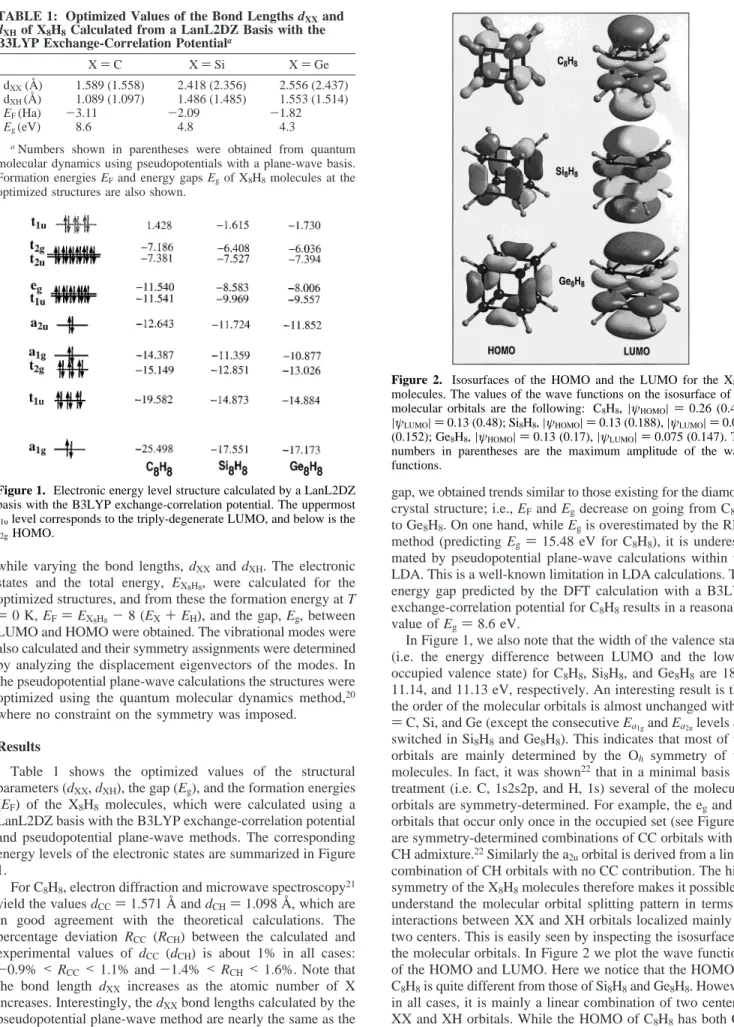
Table 1 shows the optimized values of the structural parameters (dXX, dXH), the gap (Eg), and the formation energies (EF) of the X8H8 molecules, which were calculated using a LanL2DZ basis with the B3LYP exchange-correlation potential and pseudopotential plane-wave methods. The corresponding energy levels of the electronic states are summarized in Figure 1.
For C8H8, electron diffraction and microwave spectroscopy21 yield the values dCC) 1.571 Å and dCH) 1.098 Å, which are in good agreement with the theoretical calculations. The percentage deviation RCC (RCH) between the calculated and experimental values of dCC (dCH) is about 1% in all cases:
-0.9% < RCC< 1.1% and -1.4% < RCH< 1.6%. Note that the bond length dXX increases as the atomic number of X increases. Interestingly, the dXXbond lengths calculated by the pseudopotential plane-wave method are nearly the same as the tetrahedral bond lengths in the corresponding diamond struc-tures. The bond lengths are slightly overestimated by the local basis set calculations. For the energy of formation and the band
gap, we obtained trends similar to those existing for the diamond crystal structure; i.e., EFand Egdecrease on going from C8H8 to Ge8H8. On one hand, while Egis overestimated by the RHF method (predicting Eg) 15.48 eV for C8H8), it is underesti-mated by pseudopotential plane-wave calculations within the LDA. This is a well-known limitation in LDA calculations. The energy gap predicted by the DFT calculation with a B3LYP exchange-correlation potential for C8H8results in a reasonable value of Eg) 8.6 eV.
In Figure 1, we also note that the width of the valence states (i.e. the energy difference between LUMO and the lowest occupied valence state) for C8H8, Si8H8, and Ge8H8are 18.3, 11.14, and 11.13 eV, respectively. An interesting result is that the order of the molecular orbitals is almost unchanged with X
) C, Si, and Ge (except the consecutive Ea1gand Ea2ulevels are switched in Si8H8and Ge8H8). This indicates that most of the orbitals are mainly determined by the Oh symmetry of the molecules. In fact, it was shown22that in a minimal basis set treatment (i.e. C, 1s2s2p, and H, 1s) several of the molecular orbitals are symmetry-determined. For example, the egand t2u orbitals that occur only once in the occupied set (see Figure 1) are symmetry-determined combinations of CC orbitals with no CH admixture.22Similarly the a
2uorbital is derived from a linear combination of CH orbitals with no CC contribution. The high symmetry of the X8H8molecules therefore makes it possible to understand the molecular orbital splitting pattern in terms of interactions between XX and XH orbitals localized mainly on two centers. This is easily seen by inspecting the isosurface of the molecular orbitals. In Figure 2 we plot the wave functions of the HOMO and LUMO. Here we notice that the HOMO of C8H8is quite different from those of Si8H8and Ge8H8. However, in all cases, it is mainly a linear combination of two centered XX and XH orbitals. While the HOMO of C8H8has both CC and CH contributions, the HOMO’s of Si8H8and Ge8H8 are derived mainly by eight XX mixtures. We also note that, in Si8H8and Ge8H8, the isosurface of the HOMO is pushed away
TABLE 1: Optimized Values of the Bond Lengths dXXand
dXHof X8H8Calculated from a LanL2DZ Basis with the
B3LYP Exchange-Correlation Potentiala
X ) C X ) Si X ) Ge
dXX(Å) 1.589 (1.558) 2.418 (2.356) 2.556 (2.437) dXH(Å) 1.089 (1.097) 1.486 (1.485) 1.553 (1.514)
EF(Ha) -3.11 -2.09 -1.82
Eg(eV) 8.6 4.8 4.3
aNumbers shown in parentheses were obtained from quantum
molecular dynamics using pseudopotentials with a plane-wave basis. Formation energies EFand energy gaps Egof X8H8molecules at the optimized structures are also shown.
Figure 1. Electronic energy level structure calculated by a LanL2DZ
basis with the B3LYP exchange-correlation potential. The uppermost t1ulevel corresponds to the triply-degenerate LUMO, and below is the
t2gHOMO.
Figure 2. Isosurfaces of the HOMO and the LUMO for the X8H8
molecules. The values of the wave functions on the isosurface of the molecular orbitals are the following: C8H8,|ψHOMO| ) 0.26 (0.45), |ψLUMO| ) 0.13 (0.48); Si8H8,|ψHOMO| ) 0.13 (0.188), |ψLUMO| ) 0.075
(0.152); Ge8H8,|ψHOMO| ) 0.13 (0.17), |ψLUMO| ) 0.075 (0.147). The
numbers in parentheses are the maximum amplitude of the wave functions.
from the line connecting the X atoms, a clear indication of weak bonding and highly strained cubane structure. By contrast, the LUMO’s of the three X8H8molecules look somewhat similar. The energies of the vibrational modes and their symmetry assignments, calculated using the LanL2DZ basis with the B3LYP exchange correlation, are shown in Figure 3. A cubic X8H8molecule has 42 internal degrees of freedom and therefore has 42 individual vibrational eigenmodes. As a result of their highly symmetric molecular structure with Oh point group symmetry, the vibrational spectrum has only 18 distinct frequencies i.e., 2× (2A + 5T + 2E). Recently, the vibrational spectrum of C8H8was measured using inelastic neutron scat-tering methods,24 with the experimental data used to test the transferability of various phenomenological potential models by Yildirim et al.24The results reported here are in good agreement with the neutron scattering data.
In Figure 3 we show the spectrum of X8H8 molecules consisting of four different kind of vibrational modes, assigned to X-X-X bending, X-X stretching, X-X-H bending, and X-H stretching modes; the latter vibrations have the highest energies in the spectrum. We observe that the energy range of these four types of modes and the range of the entire spectrum decreases with increasing atomic number of the element X in the molecule much faster than the expected rate (i.e. 1/xM for a harmonic X-X stretch). For example, the ratio of the X-X stretch modes of cubane to that of Si8H8and Ge8H8are about 2.3 and 3.8, respectively. These values are much higher than the expected ratios from mass renormalization of 1.53 and 2.44, respectively. This is a clear indication that the X-X bonding is becoming considerably weaker as the atomic mass increases from C to Ge. Similarly, there is a considerable decrease in the energies of the X-H stretch modes (∼42%) of Si8H8and Ge8H8 that is solely due to weak bonding between X and H. However unlike the X-X bonding, the X-H bond strengths are very similar in the cases of Si and Ge. We also note that the X-H stretching mode energies are roughly inversely proportional to the corresponding X-H bond lengths.
As discussed above, the results of the calculations with various basis sets and different exchange-correlation potentials for the optimized structure of cubane agree with the experimental data to within a few percent. To compare the accuracy of these
methods in a systematic way, we define an overall error factor R )∑i|(ωcalc i - ω exp i )/ωexpi |2, whereω calc(exp) i is the calculated (experimental) frequency of the ith mode of cubane. Clearly R vanishes if the calculation agrees exactly with experiment. The RHF calculation with a 6-31G* basis gives R ) 0.31, a rather large value that is probably due to the absence of any correlation corrections. Adding second-order corrections with MP2 im-proves the error factor to R ) 0.02. The LSDA result is even better with R ) 0.01 for the 6-31G* basis set with VWN exchange-correlation potential, while the B3LYP potential yields slightly less accurate results with R ) 0.03. Because our values of R is quite small (∼0.01), we can say that the accuracy of all of our calculations (excluding the RHF) are acceptable. More-over, we investigated the effect of the basis set in the case of the B3LYP potential. While the CEP-31G* basis improves the error further (R ) 0.02), the LanL2DZ yields slightly less accurate results (R ) 0.04). We conclude that calculations in LanL2DZ with B3LYP exchange-correlation potential are on the same level of accuracy with other first-principles methods. High-Temperature Quantum Molecular Dynamics
The stabilities of the X8H8molecules were further examined by high-temperature calculations of the total energy.
The optimized structures of X8H8 molecules were first obtained by the minimization of the total energy using a dissipative molecular-dynamics algorithm which allows the geometry optimization without any symmetry constraints im-posed. The optimized structures were then relaxed at higher temperatures using a Nose´ thermostat25 fixed to a desired temperature T.
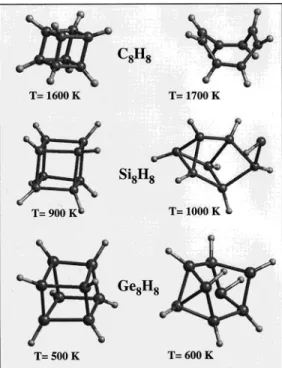
Calculations were performed by using the QMD method with a plane-wave basis set.20In the structure optimizations, we found the bond lengths came out to be relatively closer to the experimental data when the PBE potential18was used in place of the LDA form given by Ceperley and Alder.26Thus, we used the PBE form in the quantum molecular dynamics simulations. The structures of the molecules before and after the structural transformation at high temperatures are shown in Figure 4. It appears that while the C8H8, Si8H8, and Ge8H8molecules are deformed, they are still stable, and the overall features of their cube-based structures are maintained at 1600, 900, and 500 K, respectively. Once the thermostat temperature is increased by 100 K, the cube-based structures of C8H8, Si8H8, and Ge8H8 are modified.
In Figure 4 we first present the snapshots from these modified structures. While the cubane structure is transformed to a stable structure at 1700 K, Si8H8and Ge8H8are not trapped in such a stable structure (at 1000 and 600 K, respectively) within 1 ps relaxation time. Here we did not continue the simulations further to determine the equilibrium high-temperature structures (or the fragmented forms) of Si8H8 and Ge8H8 since it would take excessive computer time.
We also note that the temperatures at which the structural transformations occur can be lower given a longer relaxation time. Hence, they should be considered as an upper limit to the barrier between the cubane structure and the low-energy less-strained structures shown in Figure 4. Below we concentrate on the relaxed high-temperature structure of C8H8to examine it further.
The structure of C8H8shown at T ) 1700 K becomes more flattened as T increases, and its 8-fold ring structure is eventually destroyed when T exceeds 2000 K. This 8-fold ring structure of C8H8has been known since 1911 and is named as cyclo-octotetraene.4According to the Hu¨ckel (4n + 2) rule the ideal Figure 3. Vibrational mode frequencies (in cm-1) and their symmetry
assignments calculated with the LanL2DZ basis and the B3LYP exchange-correlation.
planar form of the 8-fold ring that results in C-C-C bond angles of φ ) 135°is nonaromatic, and because the molecular π-orbitals do not form a closed shell, the ring is buckled to shape itself like a tub. Then, each C atom on this buckled ring forms one double bond and one single bond with the neighboring C atoms (all together there are 4 single and 4 double C-C bonds in comparison to the 12 single C-C bonds of cubane) and also one C-H bond with the hydrogen atom.
We further explored the energetics of the 8-fold ring by using a dissipative QMD method at zero temperature. As described in the inset to Figure 5, the buckling of the 8-fold ring is characterized by the C-C-C bond angle φ and three different bonds, i.e., dCCl , dCCs , and dCH. In the course of optimization the structure returned to the cubane structure when φ e 105°.
As the bond angle varies in the range 115°< φ < 135°, the 8-fold ring structure traced the parabola; each time it was trapped in a local minimum for the values of the bond angles indicated by the diamonds in Figure 4. The bond lengths dCC
l , dCC
s , and dCHremain practically unaltered. Since∆E(φ) at the minimum φ0 is negative, the 8-fold buckled ring with φ0 ∼ 127°, i.e., cyclooctatetraene, corresponds to a local minimum of the Born-Oppenheimer surface and is found to be more stable than cubane with |∆E| ) 2.66 eV. Calculations of φ0 (via structure optimization) and ∆E using the 6-31G* Gaussian basis set
provide agreement with the pseudopotential plane wave calcula-tions. RHF and DFT using the B3LYP potential yield respec-tively 3.5 and 3.3 eV for ∆E and 127.3°and 127.7°for φ0. However, a DFT calculation using Slater exchange and P86 correlations yields a rather small energy (∆E∼ 1.0 eV) and φ0
) 126°. Recently, seven different structures with the chemical formula C8H8were located on the potential energy surface of cyclooctatetraene.27The relationship between cubane and cy-clooctatetraene is established in the present work. This finding could be useful in designing new routes to synthesize cubane based materials.
Conclusion
In summary, we have investigated various aspects of the structural, electronic, and dynamical and high-temperature behavior of individual X8H8molecules. Calculations for cubane are in good agreement with the available experimental data. Our results indicate that as the atomic number of X increases, the gap between LUMO and HOMO, formation energy, width of the valence electronic states, and frequencies of the vibrational modes all decrease, while their volume and bond lengths increase. The temperature-dependent quantum molecular dy-namics calculations predict that the cubane molecule transforms to the more stable cyclooctotetraene molecule at a temperature 1600 K < T < 1700 K. Si8H8and Ge8H8are also metastable at two local minima of the Born-Oppenheimer surface, which are separated by small energy barriers from other more stable structures.
Acknowledgment. We thank U. Salzner for stimulating discussions. The authors acknowledge partial supports from the National Science Foundation under Grant No. INT97-31014 and TU¨ BI˙TAK under Grant No. TBAG-1668(197 T 116). The quantum molecular-dynamics calculations were performed by using the code JEEP provided by F. Gygi.
References and Notes
(1) Eaton, P. E.; Cole, T. W., Jr. J. Am. Chem. Soc. 1964, 86, 962. (2) Eaton, P. E. Angew. Chem. 1992, 31, 1421.
(3) Kybett, B. D.; Carroll, S.; Natollis, P.; Bonnell, D. W.; Margrave, J. L.; Franklin, J. L. J. Am. Chem. Soc. 1966, 88, 626. Borman, S. Chem.
Sci. Eng. News 1994, 72, 34.
(4) Cotton, F. A. AdVanced Inorganic Chemistry; Wiley: New York, 1988.
(5) Bartsch, M.; Bornhauser, P.; Calzaferri, G.; Imhof, R. Vib.
Spectrosc. 1995, 8, 305.
(6) Marcolli, C.; Laine, P.; Buhler, R.; Calzaferri, G.; Tomkinson, J.
J. Phys. Chem. B 1999, 101, 1171.
(7) Liu, W.; Dolg, M.; Fulde, P. J. Chem Phys. 1997, 107, 3854. (8) Yildirim, T.; Gehring, P. M.; Neumann, D. A.; Eaton, P. E.; Emrick, T. Phys. ReV. Lett. 1997, 78, 4938; 1998, 36, 809; Phys. ReV. B 1999, 60, 314.
(9) Gaussian 94; Gaussian, Inc.: Pittsburgh, PA, 1995.
(10) Identification of commercial products does not imply recommenda-tion or endorsement by the Narecommenda-tional Institute of Standards and Technology. (11) Vosko, S. H.; Wilk, L.; Nusair, M. Can. J. Phys. 1980, 58, 1200. (12) Lee, C.; Yang, W.; Parr, R. G. Phys. ReV. B 1988, 37, 785. (13) Perdew, J. P. Phys. ReV. B 1986, 33, 8822.
(14) Becke, A. D. J. Chem. Phys. 1993, 98, 5648. (15) Hamann, D. R. Phys. ReV. B 1989, 40, 2980. (16) Yildirim, T.; et al. Phys. ReV. B, in press.
Figure 4. High-temperature structures of the X8H8molecules calculated
by quantum molecular dynamics with a plane-wave basis set. The first column shows the structures before transformation, while the second column illustrates how the structure is transformed after a 1 ps relaxation of the original molecule at the given temperature.
Figure 5. Top: Variations of the bond lengths (long C-C bond dCCl , short C-C bond dCCs , and C-H bond dCH) as a function of the angle φ. Bottom: Variation of the total energy relative to cubane∆E with the angle φ. Relevant structural parameters are shown in the inset.
(17) Richardson, S. L.; Martins, J. L. Phys. ReV. B 1998, 58, 15307. (18) Kleinman, L.; Bylander, D. M. Phys. ReV. Lett. 1982, 48, 1425. (19) Perdew, J. P.; Burke, K.; Ernzerhof, M. Phys. ReV. Lett. 1982, 77, 3865.
(20) Car, R.; Parrinello, M. Phys. ReV. Lett. 1985, 55, 2471. (21) Hedberg, L.; Hedberg, K.; Eaton, P. E.; Nodari, N.; Robiette, A. G. J. Am. Chem. Soc. 1991, 113, 1514.
(22) Schulman, J. M.; Fischer,C. R.; Solomon, P.; Venanzi, T. J. J. Am.
Chem. Soc. 1978, 100, 2949.
(23) Cole, T. W., Jr.; Perkins, J.; Putnam, S.; Pakes, P. W.; Strauss, H. L. J. Am. Chem. Soc. 1981, 85, 2185.
(24) Yildirim, T.; Kılıc¸, C¸ .; Ciraci, S.; Gehring, P. M.; Neumann, D. A.; Eaton, P. E.; Emrick, T. Chem. Phys. Lett. 1999, 309, 234-240.
(25) Nose´, S. J. Chem. Phys. 1984, 81, 511.
(26) Ceperley, D. M.; Alder, B. J. Phys. ReV. Lett. 1980, 45, 556. (27) Andre´s, J. L.; Castano, O.; Morreale, A.; Palmeiro, R.; Gomperts, R. J. Chem. Phys. 1998, 108, 203.