KADIR HAS UNIVERSITY
GRADUATE SCHOOL OF SOCIAL SCIENCES BUSINESS ADMINISTRATION DISCIPLINE AREA
IMPACT OF EMPOWERING LEADERSHIP AND WORK
ENGAGEMENT ON EMPLOYEES ADAPTIVE
BEHAVIORS
AHSAN KHALID KHAN
SUPERVISOR: ASSOC. PROF. CEYDA MADEN EYİUSTA
MASTER’S THESIS
IMPACT OF EMPOWERING LEADERSHIP AND WORK
ENGAGEMENT ON EMPLOYEES ADAPTIVE
BEHAVIORS
AHSAN KHALID KHAN
SUPERVISOR: ASSOC. PROF. CEYDA MADEN EYİUSTA
MASTER’S THESIS
Submitted to the Graduate School of Social Sciences of Kadir Has University in partial fulfillment of the requirements for the degree of Master’s in the Discipline Area of
Business Administration under the Program of Business Administration
ACKNOWLEDGEMENTS
In the name of all mighty ALLAH, the most merciful and gracious, seek his countless blessings and salutations for his noble prophet MUHAMMAD (PBUH), his companions and all those who follow him in upholding the cause of right religion, pray to his greatness for right directional inspiration to his content, and to enable me to continue the work started in this thesis.
I am very grateful for the inspiring course and fruitful period spent working on this thesis. I would like to pay my sincere thankfulness to my supervisor Associate Prof. Ceyda Maden Eyiusta, it is truly an honor. Your wealth of knowledge in the field of management in particular is inspiring.
I would like to express my whole hearted gratitude to all my honorable teachers for their remarkable advices and encouragements.
I must express my very profound gratitude to my parents and friends for providing me with unfailing support throughout my years of study and through the process of researching and writing in this thesis. This accomplishment would not have been possible without them.
I
TABLE OF CONTENTS
LIST OF FIGURES ... III LIST OF TABLES ... IV ABSTRACT ... V ÖZET ... VI 1. INTRODUCTION ... 1 2. LITERATURE REVIEW ... 5 2.1 Adaptive Behaviors ... 5
2.2 Adaptive Behaviors In Service Offerings ... 7
2.3 Empowering Leadership ... 8
2.4 Relationship between Leadership Style And Adaptive Behaviors ... 11
2.5 Work Engagement ... 12
2.5.1 Factors Associated With Work Engagement ... 14
Leadership Behavior ... 14
Organizational Culture and Peer Groups ... 14
Role Clarity ... 15
Age ... 15
Race ... 15
Gender ... 15
Tenure ... 16
2.6Relationship Between Work Engagement And Adaptive Behaviors ... 16
2.7 Research Hypothesis ... 17
3. METHODOLOGY ... 18
3.1 Sample And Data Collection ... 18
3.2 Instruments ... 19 3.3 Work Engagement ... 20 3.4 Adaptive Behaviors ... 20 3.5 Empowering Leadership ... 20 3.6 Ethical Aspect ... 21 4. DATA ANALYSIS ... 22
II
4.1 Reliability Analysis ... 22
4.2 Exploratory Factor Analysis ... 22
4.3 Correlation Analysis ... 25
4.4 Regression Analysis ... 26
4.4.1 Regression Analysis for Empowering Leadership and Interpersonal Adaptive Behaviors ... 26
4.4.2 Regression Analysis for Empowering Leadership and Service Offering Adaptive Behaviors ... 27
4.4.3 Regression Analysis for Empowering Leadership and Work Engagement ... 28
4.4.4 Regression Analysis for Work Engagement and Interpersonal Adaptive Behaviors ... 29
4.4.5 Regression Analysis for Work Engagement and Service Offering Adaptive Behaviors ... 29
4.4.6 Mediation Analysis for Work Engagement ... 31
4.5 Hypothesis Evaluation Summary ... 32
5. DISCUSSIONS AND CONCLUSIONS ... 33
5.1 Recommendations ... 36
5.2 Limitation And Future Research ... 39
SOURCES ... 40
III LIST OF FIGURES
IV LIST OF TABLES
Table 3.1 Characteristics of Respondents... 19
Table 4.1 Reliability Analysis (Cronbach’s Alpha) ... 22
Table 4.2 KMO and Bartlett’s Test ... 23
Table 4.3 Total Variance Explained for Work Engagement ... 23
Table 4.4 Rotated Component Matrix for Work Engagement ... 24
Table 4.5 KMO and Bartlett’s Test ... 24
Table 4.6 Total Variance Explained for Adaptive Behaviors ... 25
Table 4.7 Correlation Analysis ... 26
Table 4.8 Multiple Regression Analysis for Empowering Leadership and Interpersonal Adaptive Behaviors ... 27
Table 4.9 Multiple Regression Analysis for Empowering Leadership and Service Offering Adaptive Behaviors... 28
Table 4.10 Model Summary for Regression Analysis Empowering Leadership and Work Engagement ... 28
Table 4.11 Model Summary Regression Analysis Work Engagement and Interpersonal Adaptive Behaviors ... 29
Table 4.12 Model Summary of Regression Analysis Work Engagement and Service Offering Adaptive Behaviors... 30
Table 4.13 Model Summary for Mediation Analysis (Interpersonal Adaptive Behavior as the Dependent Variable) ... 31
Table 4.14 Model Summary of Mediation Analysis for Work Engagement and Empowering Leadership (Service Offering Adaptive Behavior as the Dependent Variable) ... 32
V
ABSTRACT
AHSAN KHALID KHAN. IMPACT OF EMPOWERING LEADERSHIP AND WORK ENGAGEMENT ON EMPLOYEES ADAPTIVE BEHAVIORS, MASTER’S THESIS, Istanbul, 2018.
The main purpose of this dissertation is to scrutinize the impact of empowering leadership and work engagement on employee’s adaptive behaviors, namely interpersonal adaptive behaviors and service offering adaptive behaviors. In line with the nature of research objectives, data were collected through an online survey from 200 individuals working at different 4 star hotels in Pakistan. Multiple regression analyses were performed to test the hypothesized relationships. The findings indicated that empowering leadership and work engagement have a positive impact on employees’ adaptive behaviors, and that work engagement acts as a mediator between empowering leadership and adaptive behaviors. These results draw attention to the major importance of empowering leadership and work engagement to boost employees’ adaptive behaviors in today’s service organizations. Other contributions and implications of the findings are presented in the discussion and conclusion section.
Keywords: Empowering Leadership, Work Engagement, Interpersonal Adaptive Behaviors, Service Offering Adaptive Behaviors.
VI ÖZET
AHSAN KHALID KHAN, GÜÇLENDİRİCİ LİDERLİĞİN VE İŞE ADANMIŞLIĞIN ÇALIŞANLARIN UYUM SAĞLAMA DAVRANIŞLARINA ETKİSİ. YÜKSEK LISANS TEZI. Istanbul 2018
Bu tezin temel amacı, güçlendirici liderliğin ve işe adanmışlığın çalışanların uyum sağlama davranışlarına (kişilerarası ilişkilerde ve hizmet önerilerinde uyum sağlama) olan etkisini incelemektir. Kapsamlı bir yazın taramasının ardından, araştırma hedeflerinin doğası uyarınca, on-line bir anket formu hazırlanmış ve bu anket yoluyla Pakistan'daki 4 yıldızlı otellerde çalışan 200 kişiden veri toplanmıştır. Araştırma modelinde önerilen ilişkileri test etmek için çoklu regresyon analizleri yapılmıştır. Bulgular, güçlendirici liderliğin, çalışanların uyum sağlama davranışları üzerinde olumlu bir etki yarattığı ve bu ilişkide işe adanmışlığın aracılık rolü oynadığı bulunmuştur. Bulgular, güçlendirici liderliğin ve işe adanmışlığın günümüzde hizmet sektöründe faaliyet gösteren çalışanlarının uyum sağlama davranışlarını artırmadaki önemli rolüne dikkat çekmektedir. Araştırmanın diğer katkıları, tartışma ve sonuç bölümünde sunulmuştur.
Anahtar Sözcükler: Güçlendirici Liderlik, İşe Adanmışlık, Kişilerarası İlişkilerde Uyum Sağlama Davranışları; Hizmet Önerilerinde Uyum Sağlama Davranışları
1
1. INTRODUCTION
The business environment has dynamically transformed into a digitalized and customer based market place with the presence of intense competition and complexity. In this context, employees’ adaptive behaviors tend to play a very important role in the effective execution of services and customer satisfaction in the work environment. Previous research has consistently shown that employee’s work engagement is a critical issue especially as businesses are recovering from the trauma of global recession. Work engagement is a construct naturally subsumed within the increasingly popular domain of positive employee behaviors, which aim to enhance employees’ positive experiences at work. Besides, employees work engagement is a desirable condition related to organizational commitment, passion, enthusiasm, focused effort, and energy and it has both an attitudinal and a behavioral component (Mills, 2012). Similar to work engagement, adaptive behaviors are desirable and/or appreciated outcomes in different work settings, including particularly service organizations.
Adaptive behaviors are described as typical performance of daily activities demonstrating cognitive potential to adapt to different circumstances (Sparrow & Cicchetti, 1984). Employee’s adaptive behaviors in the workplace includes every day skills that are independently initiated, such as effectively communicating with other employees, overall participating in various work activities, and developing meaningful relationships with others (Klin et al,. 2007).
Considerable research has emphasized the important impact of empowering leadership on employees’ performance-related outcomes (Ahearne et al., 2005). Empowering leadership refers to a process of sharing power, and allocating more autonomy and responsibilities to followers through a specific set of leader behaviors that entail enhancing the meaningfulness of work, fostering participation in decision making, expressing confidence in high performance, and providing autonomy from bureaucratic constraints (Netemeyer, Maxham III, & Pullig, 2005). Highly empowered leaders share power with their employees by delegating authorities to employees, holding employees accountable, involving employees in decision making, encouraging self-management of work and conveying confidence in employees’ capabilities to handle challenging work (Kirkman & Rossen, 1990; Konczak et al., 2000). Chen and Kanfer (2006) discussed that empowering leadership enhances followers’ willingness to contribute to their work environment through affective commitment. The concept of empowering leadership has
2 been developed in line with the research stream of supportive leadership. It has been considered that most of the empowered leaders are more likely to be adaptive to the changing business environment.
Among all different settings in which adaptive behaviors are desirable, in the service encounters, employees’ adaptive behaviors carry high importance for interactive as well as customized service, such as the case in health care organizations or other organizations providing a personal service. On the other hand, Yim, Chan, and Lam (2012) emphasized that employees’ attitudes and behaviors needs to be really positive and adaptive regardless of whether an organization is product based or service based. Liao, Toya, and Hong (2009) illustrated that in the service situations, in particular, employee’s behavior is the major aspect that either attracts the customers to revisit again or completely changes his mind to the retaking their service.
Adaptive behaviors can be categorized into two groups in service situations: Interpersonal adaptive behavior and service offering adaptive behavior. Interpersonal adaptive behaviors can be described as of those skills learned through development and performed in response to the expectations placed on us from our community and society at large. Service offering adaptive behaviors refer to the aspects of offering services according to the changes in the customer’s tastes and needs. Previous research has shown that there are several individual factors, for example, job satisfaction, public service motivation, organizational citizenship behavior and affective commitment and organizational level factors (e.g., organizational culture, technology, organizational structure, cultural diversity, conflict,) that influence the occurrence of interpersonal and service offering adaptive behaviors in service encounters.
Since the recent couple of years, researchers have entirely emphasized and increasingly focused on highlighting the importance of understanding and studying empowering leadership and work engagement to predict different employee behaviors. Although the interest on the antecedents of interpersonal and service offering adaptive behaviors has increased, scope of the studies tends to remain narrow, excluding leader-related and attitudinal issues.
In light of the above information, this dissertation aims to investigate the impacts of empowering leadership and work engagement on employee’s adaptive behaviors. Specifically, it focuses on the mediating role of the work engagement on the relationship between empowering leadership and adaptive behaviors (interpersonal and service
3 offering adaptive behaviors). The main research questions of the dissertation can be stated as:
How do empowering leadership and work engagement affect employees’
interpersonal adaptive behaviors?
How do empowering leadership and work engagement affect employees’
service offering adaptive behaviors?
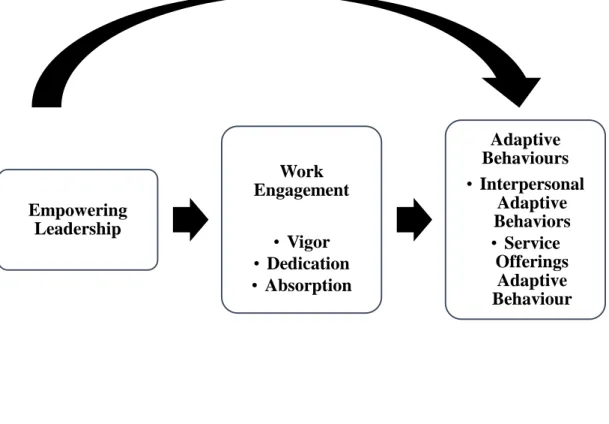
As demonstrated in Figure 1.1, the research model of this dissertation proposes that work engagement (represented by the dimensions of vigor, dedication and absorption) mediates the relationship between empowering leadership and employee’s adaptive behaviors (e.g., interpersonal and service offering adaptive behaviors).
Figure 1.1 Research Model
The following section includes the literature review in which the focus is laid on the findings of the previous research. The next chapter (Chapter 3) describes the research methodology which involves the major research design opted for the research. Fourth chapter is the data analysis and discussion which aim to summarize the sampling, data
Empowering Leadership Work Engagement • Vigor • Dedication • Absorption Adaptive Behaviours • Interpersonal Adaptive Behaviors • Service Offerings Adaptive Behaviour
4 collection procedures, and statistical analysis. In this chapter, the acceptance/non-acceptance of research hypotheses are presented as well. In the last chapter, which is conclusion, major contributions of the study and the recommendations for future research are presented.
5
2. LITERATURE REVIEW
2.1 Adaptive Behaviors
Today, business environments have dynamically transformed from the traditional work systems to increasingly complex work systems, in which the organizations are facing a number of challenges in the context of managing human resource at organizational levels. This gives importance to integration of leadership to improve the employee performance. Leadership has engaged as a new effective approach for managing employees and performing organizational tasks at large scale. In this context, the importance of employees’ adaptive behaviors cannot be ignored at any instance. In particular, routine based operations are effectively maintained by the aspect of the employees’ ability to adapt their behavior to the dynamically changing situation demands (Kirschenbaum & Rapaport, 2014).
Adaptive behaviors are defined as a compendium of the social, practical, and conceptual skills that have been learned by the people enabling them to function in their routine (Rapp et al., 2006). Adaptive behaviors have been also defined by Roberts, Strayer, & Denham (2014) as collection of the practical, hypothetical and social skills that are understood, learned and performed by the people. Basically, practical skills refer to activities and tasks of the daily living such as daily routines, safety, use of telephone, use of money, health care, transportations (Horner & Sugai, 2015). Conceptual skills indicate literacy and language, money, self-direction, numerous other cognitive skills. Similarly, social skills refer to the interpersonal skills such as self-esteem, wariness, gullibility, resolving of social problems, and ability of following the rules or obeying laws, and avoiding to be victimized (Goleman, 2011).
Clark & Mils (1993) argued that interpersonal adaptive behavior emphasized the communicative aspect of behavioral interaction. It is defines as varying manner of employee during the personal interaction of the service delivery (Gwinner et al.,1993). Interpersonal adaptive behavior reflects the employee’s communication approach followed by effective interaction with customer (Weitz et al., 1986). This defination of interpersonal adaptive behavior implies that the adaptation of frontline employees is demonstrated through adjustment style of communication. Previous research has suggested that frontline employees exert efforts to implement adaptive behavior and intentionally refrain from doing work the same way repeatedly (Hartline & Ferrell, 1996).
6 Previous research has found it challenging to define and determine the factors behind adaptive behaviors. However, a group of researchers (Coulter & Morrow, 1987; Thurlow & Gilmore, 1987; Harrison, 1987; Kamphaus, 1987) with reference to the definition of adaptive behaviors, have highlighted six common elements according to the previous available definitions of adaptive behaviors. These common elements were (a) the learning and performance of skills needed to successfully meet society’s expectation; (b) an individual’s actions of behaviors expected from someone of his/her age; (c) an individual’s performance in regards to physical needs and community engagement; (d) an individual’s ability to maintain responsible for social relationships; (e) the developmental nature of adaptive behavior includes increase complexity with age; and (f) adaptive behavior reflected in an individual’s typical, every day behavior rather than poster of individual’s overall performance.
Jundt, Shoss, & Huang (2015) have interlinked the concept of adaptive behaviors with the adaptive performance of the employees and stated that in the existing modern work environment, that adaptive performance has become really crucial for the employees. Previous research has also highlighted that the overall employee performance cannot be enhanced and improved if the employees are unable to exhibit adaptive behaviors. For instance, Xue, Bradley, & Liang, (2011) have regarded adaptive behavior as the major aspect of employee performance and credibility.
For improving the job performance, showing adaptive performance is increasingly important, especially in the services jobs (Naami et al., 2014). To illustrate, Sweet, Witt, & Shoss (2015) have reported that higher focus needs to be laid on the adoption of adaptive behavior amongst the leaders, especially in the service industry, where the focus is entirely laid on performance of the employees and satisfaction of the consumers. Moreover, according to Xue et al. (2011) adaptive behavior is necessary to provide the consumers with high quality services in the service industry.
Previous research has reflected that the adaptive behavior of employees is impacted by the predictors of a social process that includes pro-social process and emergent behaviors and leads to enhanced employee performance. Social processes commonly can be defined as the ways in which individuals or groups interact, adjust or readjust and establish relationship and pattern of behaviors which are again modified through social interaction. Social interaction usually takes place in the forms of cooperation, competition, conflict,
7 accommodation and assimilation. Sharing, volunteering, donating, and helping are some of the forms of pro-social process that can take place in work settings.
2.2 Adaptive Behaviors In Service Offerings
It has been argued by Ngoc Tram Anh et al. (2016) that in service context, adaptive behavior represents deliberate modification of service offerings and inter-personal behaviors of the employees to meet the perceived consumer demands and needs. This presents an implication that adaptive behaviors of frontline employees can be demonstrated through adjustment of the communication style as well as customization of service offers. Accordingly, it stands to reason that frontline employees exert lots of efforts to be adaptive in their jobs and refrain from doing their work in the same, repeated manner (Ray-Subramanian, Huai, & Weismer, 2011).
Humphrey & Ashforth (2000) argue that adaptive behaviors are really crucial in the services that are characterized by high level of customization and interaction, especially in health care sector. As described before, adaptive behavior of frontline employees can take two forms which are service offering adaptive behaviors and interpersonal behaviours.
Tziner & Tanami, (2013) stated that the interpersonal adaptive behavior focuses on communicative aspects and perspectives of interaction (Wang, Minor, & Wei, 2011) and represents various communicational approaches of employees during the personal interaction of service delivery.Employees’ modification of the communication approach may provide highly effective interaction with certain customers (Javed, et al, 2018) as it enhances personal intimacy during service encounters.In line with these arguments, some scholars have noted that interpersonal behavior is really important in sectors, such as healthcare, which require establishment of close relationships with customers, as it increases the patient’s satisfaction and decreases the patient’s stress level (Jundt, Shoss, & Huang, 2015).
Additionally, adaptive behaviors related to service offerings represent the modification of the services that are offered to specific customers. In their survey-based research, Kirschenbaum & Rapaport (2014) report that good employees are able to effectively modify and customize the services offerings according to the needs of the consumers in the service communications. According to Shogren, Faggella-Luby & Wehmeyer (2004)
8 employees that show service-offering adaptive behaviors are able to customize the services offers at the purchase point and might either develop or select means for the accomplishment of the tasks that can change the final outcome of the service offered. Previous research on adapting or customizing a service has focused much of its attention on the personal characteristics, internal motivations or pre-dispositions of frontline employees to adapt a service. For instance, the research by Leischnig & Kasper-Brauer (2015) deepens the understanding of causal patterns of factors stimulating employees to perform adaptive behaviors in service encounter situations. Drawing on motivation literature and configuration theory, their research was developed and tested research propositions based on a sample of 228 employees from the insurance industry. Findings from the comparative analysis indicated the three configurations of personal characteristics, namely resilient, over controlled and under controlled personalities. Resilience refers to bounce back from adverse events or cope successfully (Rutter, 1985). Resilience is related to the process of adaptation under stress, or the capacity to keep positive outcomes in the face of negative life events (Ryff & Singer, 1996). Resilient personalities are characterized by positive orientation towards others and self-confidence. Over controlled personalities are emotionally brittle and introverted whereas under controlled personalities are often disagreeable and lack self-control.
Work perceptions also explain employee adaptive behavior. Previous research has revealed that the significance of the adaptive behavior in the service offering context cannot be neglected at any instance.
2.3 Empowering Leadership
Empowering leadership refers to a leadership style that includes the behaviors of understanding people, effective communication with people, inspiring others, and showing them the interest and care (Javed et al., 2018). Numerous researches have been conducted in the area of empowering leadership and their main focus is whether and how empowering leadership behaviours can impact the team performance, employee performance and credibility of the employees, which overall lead to the productive outcomes. For instance, Xue, Bradley, & Liang, (2011) examined the influence of the team climate and empowering leadership on the overall knowledge sharing behavior of the team members. The research findings reflected that the empowering leadership and
9 team climate significantly influence the individual’s attitudes towards knowledge sharing and their actual knowledge sharing behavior. According to Arnold et al. (2000), empowering leadership represents the different roles and responsibilities of the leaders in the work environment. In simple terms, these constructs have important and direct effects on employees’ behavior.
Arnold et al. (2000) proposed that following dimensions have a key role to enhance empowering leadership, which leads to successful outcomes:
Coaching (the extent to which leader are empowered for personal development).
Informing (the extent to which leader provides information to employees about the policies and rules).
Leading by example (the extent to which empowered leader portraits himself as an example for others to follow).
Showing concerns or interacting with team (the degree to which a leadership empowerment is concerned with others in the work environment)
Participative decision making (the level to which a leader empowers others by taking the followers’ comments into account in terms of proposing solutions to problems).
Previous research has shown that these practical virtues significantly contribute to employees’ effective performance. Hattie (2012) argued that coaching involves self-directed learning, personal growth, and improved performance. Accordingly, Hargreaves (2011) stated that mentoring and coaching are of particular importance in leadership development, since employees learn best with and from outstanding leaders. Effective and accurate communication act as important practice to grow efficiency and achieve professional success. Other studies have also explained that the utmost essential key to great communication by leaders is the art of sharing information to others (Towler 2003). All in all, empowering leadership is all about making influences and previous research has shown that followers respond strongly to the examples which is already set by leader (Moxnes, 2003; Levati et al., 2007).
Sibert et al. (2004) and Conger and Kaunungo (1988) argued that leader empowerment is positively associated with individual behavior.According to Chen et al. (2011), it is really important to consider the impacts of empowering leadership. Companies need to focus
10 on developing empowering leaders as the followers will copy the behaviors of their leaders. The cross-cultural research by Chen et al. (2011) which was conducted with a sample of employees, students and leaders, revealed that empowering leadership enhances the overall teamwork in organizations and motivates the team members to enhance their performance to complete certain tasks or project. Jundt et al. (2015) also mentioned that empowering leadership enhanced the team performance in an organization. In a very recent study, Javed et al. (2018) found that empowering leadership enhanced and promoted creativeness at the workplace with the aspect of maintaining high trust on the leaders. They also indicated that when the employees are empowered, they like to participate in the discussions and are really focused to their work tasks efficiently and effectively.
Empowered leaders have the ability to improve employees’ work engagement, determination, dedication, fulfilment (McFall & Richard , 2012) and relying upon empowering leaders can result in a variety of essential organizational outcomes, such as dedication, organizational citizenship, and purpose to settle. Chen and Kanfer (2006) theorized empowering leadership as team-level stimuli, that enhanced team members’ willingness to contribute to their team indirectly. Previous research has also emphasized that this indirect contribution through members is attained by motivational state such as affective commitment and leadership empowerment. Empowering leadership behavior also positively influences members’ affective commitment, because empowered leadership behavior leads members to feel more personally and emotionally engaged with work environment of the organization.
Empowered leaders often see themselves competent and able to influence their work environment in meaningful ways. Empowered leaders proactively execute their work responsibilities, for instance anticipating problems and acting independently, hence they are likely to be seen as effective in performances. Thomas and Velthouse (1990) argued that empowering leaders will increase concentration, initiative and resiliency and thus magnify empowered employees’ behaviors and practices at the given work environment.
11 2.4 Relationship between Leadership Style And Adaptive Behaviors
Empowering leadership carries immense significance for different employee outcomes (Luthans, Luthans, & Palmer, 2016). Pearce et al. (2003) argued that empowering leaders’ main focus is on self-development of followers encouraging behaviors such as participative goal setting, self-leadership, and group work. These scholars have emphasized that a leader fails if he or she is unaware of the right leadership style in terms of changing work situation, and team leading.
Although a lot of the research in past have been conducted on the domain of the leadership, very few of these research has examined the relationship between the leadership styles and the adaptive behaviours. According to Khan, Rehman, & Fatima (2009), leadership style has really strong relationship with the adaptive behaviors in the service companies. This is mainly because, if the leaders are not adaptive in the context of changing and challenging situations, it would be really difficult for them to handle the situation and manage team.
Previous research has also indicated that there are different leadership styles such as participative, democratic and autocratic. Olafemi & Bature, (2014) argued that there is significant relationship between participative leadership style and employee’s behavioral growth and personal development. Therefore, such leadership style generally impacts behaviors and performance of employees in organization (Dixon & Hart, 2010). The main emphasis of this leadership style is that when an organization starts decision-making process, the outcomes of decisions can make great impact on both organizational stability as well as impacting employees’ adaptability.
Empirical research has also put emphasis on the importance of democratic leadership style for employees’ adaptive behaviors. Past studies have suggested that democratic leadership style creates strong spirit that motivates behavioral aspects and raises satisfaction in job and profession (Ngai, 2005). However, in autocratic leadership, the leader unilaterally exercises all decision-making authority and shows dominant behaviors to their followers at work (Mullins, 1990).
Burke et al. (2006) have indicated that it is very important for a leadership to take into consideration the adaptive behaviours, especially among different performance indicators of the team. The authors also argue that that leaders should focus on where the team is currently standing and how the changes in attitudes and behaviours can overall enhance
12 the credibility of the team. Wang, Lu & Siu (2015) have emphasized that the leadership style and its interconnection with the adaptive behaviours are really important. It is mainly because if the leadership style does not support the adaptive behaviours, employees and teams would experience different problems in the accomplishment of the goals and objectives. On the other hand, if the leader does not adapt their behaviours in changing situations, his/her follower would not do so (Stebbings, Taylor, & Spray, 2015).
With the recent dynamic changes in work environment shaped with increased competition and higher performance expectations from employees, employee leadership tactics have noticeably received high attention in the organizational practice as it help employees cope with the consistent changes in external environment (Sweet, Witt, & Shoss, 2015). Today, employees are expected in engaging in the proactive and adaptive behaviors and go beyond their formal work roles as (Naami et al., 2014). Based on the discussion on empowering leadership, leadership empowerment can be considered as a mechanism that stimulates employees to go beyond their formal work roles by fostering of autonomy, self-responsibility and show adaptive behavior (Xue, Bradley, & Liang, 2011).
2.5 Work Engagement
Since the last couple of years, numerous discussions and analyses have been conducted within the domain of employee engagement. Studies have increasingly focused on how the work engagement impacts the organization. Work engagement can be defined as an emotional state that includes increased dedication, absorption and vigour (Bakker, 2011). The concept has been also defined as a positive, increasingly fulfilling, work related mind, that is been characterized by dedication, absorption and vigour (Naithani et al., 2009). Vigour indicates high levels of the energy and the increases mental resilience while working and enhances willingness to invest efforts in the work. Dedication means remaining highly persistent in the face of difficulties and challenges. Engagement is also interlinked with the concept of the absorption or the flow, that is characterized by being completely concentrated engrossed in the work.
According to Bakker’s (2011) study, an evidence-based model of work engagement, major predictors of the work engagement are personal resources (e.g., optimism, resilience, hope and self-efficacy) and job resources (e.g., stimulation of personal growth, learning, and development).
13 Previous studies have consistently shown that job resources such as social support from colleague and supervisor, performance feedback, skill variety, autonomy and learning opportunities are positively associated with work engagement (Bakker & Demerouti, 2007). In addition to job resource context, physical, social and organizational aspect of job that (a) reduce job demand and associated physiological and psychological costs; (b) functional in achieving job task; (c) stimulate personal growth, learning and development (Schaufeli & Bakker, 2004). Bakker (2011) have also highlighted that most of these resources can gain overall salience when job demands such as work load, emotional demand and mental demand are high.
Previous studies have indicated a positive relationship between work engagement and similar constructs including organizational commitment, extra-role behavior, job involvement, personal initiative and the workaholic (Rapp, Mathieu, & Schillewaert, 2006). Studies have also showed that engaged workers generally report low burnout rate, their neuroticism level is low, and their extraversion level is really high. Their physical and mental health is found to be better than the workers who are less engaged (Chen, Sharma, & Farh, 2011).
Bakker (2011) stated that engaged employees are highly connected with their work roles in their tasks. They have a lot of energy, great dedication to work and are immersed in the work activities. The research has considered that engaged employees focus on their work tasks, are open to the new information and highly productive and are willing to pivot all possible changes within the organization.
Research has so far revealed that work engagement influences employee outcomes either directly or indirectly and contributes positively to the organizational goals and objectives (Derks et al. 2015). This is because engaged workers and employees are more creative, more motivated and more productive in comparison to the less engaged workers. Bakker & Demerouti (2008) have stated that an organization plays an immense role in enhancing engagement of employees at work. The authors introduced many ways and perspectives through which employees’ work engagement can be improved, such as empowering the employees and providing them comfortable working environment.
Previous research has also provided reasoning and explanations about why engaged employees perform well. Researchers have emphasized that engaged employees often tends to have, (a) positive emotions, (b) good health, (c) ability to mobilize resources, and (d) cross over of engagement.
14 Scholars have emphasized that employees who are more engaged will experience real emotions while performing any given task (Schaufeli and Van Rhenen, 2006). Employees with good intentions and happy mood are sensitive to work opportunity and such employees are found to be more outgoing and helpful to others. (Crapanzano and Wright, 2001). Positive emotions could be joy, employee interest, and contentment. Fredrickson and Losada, (2005) showed that when employees experience positive emotions, they ask more questions, resulting in better performance.
Previous studies have also indicated that highly engaged employees positively influence employee health. Schaufeli and Bakker, (2004) found in their research that more engaged employees have better health. In addition to these studies, it has been argued that one of the work engagement dimensions (i.e., vigor) has a positive impact on physical and mental health (Shirom, 2003). Another important reason behind why engaged employees bring productivity is that engaged employees have a special ability to create their own resources (Xanthopoulu et al., 2007). Scholars have found that engaged employees exhibit more effective performance.
2.5.1 Factors Associated With Work Engagement
In the current world of work, organizations expect their employees to be as highly engaged as possible and take responsibilities in the work environment. Therefore, it is crucial to have a clear understanding of what employee work engagement entails as well as those factors associated with it (Mendes & Stander, 2011).
Leadership Behavior
Leadership behaviors influence many different employee attitudes within organizations (Alarcon, Lyon & Tartagla, 2010). Previous research by Mendes and Stander (2011) suggested that leadership behavior might also influence work engagement. They argued that the extent to which a leader enhances meaningfulness of work, facilitates task accomplishment, participates in decision making and provides autonomy would definitely enhance employee work engagement.
Organizational Culture and Peer Groups
Organizational culture represents an active phenomenon by which employees in organization create shared meaning, perceptions, and beliefs (Alarcon et al., 2010).
15 Positive, shared beliefs about the work environment are likely to forecast employee work engagement. Previous research has also argued that peer groups are often a source of social fulfilment amongst employees (Alarcon et al., 2010). Therefore, employees work engagement may be facilitated by commonalities among such peer groups
Role Clarity
Role clarity is described as the extent to which employees in the work environment have adequate information and guidance about their job description and expected performance form them. Mandes & Stander (2011) states that role clarity consists of two attributes (a) role conflict; (b) role ambiguity. Role conflict occurs when conflicting job requirements arise, whereas role ambiguity refers to the lack of clarity of outcomes of behaviors. Previous studies illustrated that low conflict and low ambiguity often results in enhancing role clarity which increases employees’ work engagement.
Age
Although there are no specific research findings on the relationship between age and employee engagement (Peter, 2008), few findings have reported that older employees generally demonstrate more work engagement than young employees (Bakker, 2003). Similarly, Mostert & Rothmann, (2006) argued that there is marginal difference in vigor and dedication, based on age factor. However, there are also other studies which suggested that there is no difference in employees’ engagement levels in relation to age (Bakken & Holzemer, 2000; Salamonson, Andrew & Evertte, 2009).
Race
Previous studies have not illustrated any specific explanation of work engagement with regard to racial differences. Despite some studies revealing some few racial differences in South Africa, existing studies found no significant differences in employees’ work engagement levels in different racial groups (Bakken, 2000).
Gender
Researchers have argued that gender differences in relation to work engagement may exist. Research by Peter (2008) also suggested that employees’ work engagement is gender sensitive. Bakker (2009) also found gender-based differences in experiences of employee engagement. Other researchers also found marginal differences in vigor and dedication, between males and females (Mostert & Rothmann, 2006). Archor, (2007) found higher level of vigor among females in comparison to males.
16 Tenure
Past research suggested that engaged employees have social, physical and organizational resources needed to enable them to deal with their job demands. Engaged employees always invest their energy and time, with their intentions to develop vigor and dedication over a period time (Halbesleben & Wheeler, 2008). Therefore, researchers argued that employees who have been employed in an organization for longer period, remain more engaged. Similarly, few studies suggested that employees who have been working for a longer period of time tend to experience lower levels of work engagement (De Wette, 2008).
2.6 Relationship Between Work Engagement And Adaptive Behaviors
Scholars have emphasized work engagement and adaptive behaviour are two important employee assets in the service sector (Archambault, et al. 2016; Paterson et al.; 2000) because if the employees are not well engaged and do not show adaptive behaviours then they might not be able to satisfy their customers.
On the other hand, to the best of author’s knowledge, none of the previous studies have so far focused on the relationship between work engagement and adaptive behavior of employees. Only Khan’s (1990) research managed to illustrate the relationship between work engagement and adaptive behaviours of employees. According to this study, as workers fit the roles in their jobs, they display physical, cognitive and mental performance with changes in adaptive behaviours for the sake of adapting their working environment. There is some theoretical support for the proposition that engaged employees may show adaptive behaviors (Sonnentag, 2003) by showing discretionary behaviours directed at their organization (Schaufeli et al. 2006). In addition to these direct relationship effects, research emphasized certain mechanism linking work engagement to employee’s outcomes. Adaptive behaviour typically involves multiplicity of performances related to different work environment (e.g., creative problem solving, coping with complex work situations and interpersonal adaptability). For instance, empirical findings consistently suggested that service employee’s need to adjust their behavior to properly manage customer complaints (Halstead, Droge, & Cooper, 1993).
17 Rayton and Yalabik’s (2014) research focused on work engagement dimensions (i.e. vigor, dedication and absorption). Vigor implies high level of energy and resilience while working. Dedication is about being highly involved in your job being inspired and enthusiastic (Song et al. 2012). Absorption refers to sense of detachment from your surroundings, a high degree of concentration on your job. Based on the impact of work engagement dimensions and their relationships, it is found that mechanism of work engagement impacts employee’s interpersonal and service offering adaptive behaviours in every aspect at work environment.
Since engaged workers also seem to be engaged outside work life, it makes sense to examine the relationship between adaptive behaviors and work engagement. Doornen & Schaufeli (2006) related work engagement to temperament and personality factors neuroticism and extraversion. Research findings also revealed engaged workers are well able to respond adequately to changes in environmental demands, they show quick adaptability to new surroundings and switch easily between activities. In addition, highly engaged employees do not have the tendency to experience distressing emotions such as, depression and frustration that is characteristic of neurotics. In contrast they seem to have a disposition towards cheerfulness, sociability and high activity (extra version).
2.7 Research Hypothesis
Based on the inferences made from literature review above, the following hypotheses are developed:
Hypothesis 1: Empowering leadership influences adaptive behaviours positively. Hypothesis 2: Empowering leadership influences work engagement positively. Hypothesis 3: Work engagement influences adaptive behaviours positively.
This research proposes that work engagement will play a mediating role on the relationship between empowering leadership and adaptive behaviours of the employees. That’s why, the following hypothesis is also developed:
Hypothesis 4: Work engagement meditates relationship between empowering leadership and adaptive behaviours.
18
3. METHODOLOGY
Significance of adopting and integrating the appropriate research methodology in the execution and conduction of the research cannot be neglected at any instance. As mentioned by Mugenda (1999), there are numerous research methods and approaches that can be integrated and adopted, however, selection of the method depends on the researcher. In this section of the report, research methods and approaches that have been utilized in this research are explained.
3.1 Sample And Data Collection
The participants of the existing research are the employees that are working in the hotel industry in Pakistan. The total number of the participants in the research are 200 working in the four star hotels. Data were collected through printed and on-line surveys. Initially surveys were distributed to 230 employees, and 200 of them answered the questions in full. Thus the overall response rate was 87 per cent.
As nature of research is quantitative study, convenience sampling is considered to be most frequent tool for data collection. Convenience sampling technique was used to extract desired information based on the ease of accessibility, willingness, and availability of participants at given time. The convenience sample in this study consist of the group of employees working in hotel industry in Pakistan. Data collection lasted for three weeks between April 15 and May 10. Demographic characteristics of the respondents are shown in the following table:
19 Table 3.1 Characteristics of Respondents
Frequency Percent Gender Female 79 39.5 Male 121 60.5 Total 200 100 Age 21-28 141 70.5 29-36 25 12.5 37-46 34 17 Total 200 100 Education High School 67 33.5 University 55 27.5 Graduate 68 34.0 PhD 10 5.0 Total 200 100 Marital Status Single 172 86.0 Married 28 14.0 Monthly Income 600 $ 68 34.0 700-900 $ 51 25.5 1000 – 3000 $ 81 40.5 Total 200 100 3.2 Instruments
Selecting of the research instrument was a difficult and challenging task as the complete research outcomes and accuracy were based on it. After considering several similar researches and considering the existing type of the research, questionnaire has been selected as an instrument. The questionnaire of this study was comprised of the questions to measure adaptive behaviours (dependent variable), work engagement (mediating variable) and empowering leadership (independent variable) that have been investigated in the research model. Five-points likert scale (1= strong disagree, 5=strongly agree) was used to measure the respondents’ agreement with the statements provided The questionnaire had two main sections: The first section included participant information, while the second section involved the questions regarding the variable in the model. The
20 second section was comprised of four main parts, and each part included eight to nine questions.
3.3 Work Engagement
Work engagement was measured with nine item of Utrecht Work Engagement Scale that has been developed by the Schaufeli, Bakker, & Salanova, 2006. The instrument comprises of three sub-dimensions of the work engagement that includes vigor, dedication, and absorption. Each of the dimensions is well represented by three items. Sample items for work engagement scale are “At work, I feel full of energy” (vigor), “My job inspires me “(dedication), and “I feel happy when I am working intensely” (absorption).
3.4 Adaptive Behaviors
Many research in the past has adopted the scale of Pugliese et al. (2015) to measure adaptive behaviors. Zhang, Waldman, & Li (2015) have adopted the same scale to measure the adaptive behaviors by conducting discussions with the management, supervisors and customer contacting employees. The questions in this scale aim to measure interpersonal adaptive behaviour (“I often adjust my personality from one person to next”) and service offering adaptive behaviour (“I believe that each customer requires a unique approach”).
3.5 Empowering Leadership
Empowering Leadership is measured by using Ahearne et al. (2005). Which is available in Zhang et al. (2010). The instrument comprises of four sub dimensions of empowering leadership that includes, Enhancing meaningfulness of work (“My manager helps me understand how may job fits into bigger picture”), fostering participation in decision making (“My manager often consults me on strategic decisions”), expressing confidence in high performance (“My manager believes that I can handle demanding tasks”) and providing autonomy from bureaucratic constraints (“My manager allows me to do my job my way”).
21 3.6 Ethical Aspect
In the research process confidentiality of the participants was maintained to high extent and the ethical code of the conduct was highly considered. In the data collection process, participants were ensured that their information collected would be only used for the research purpose, and it would not be considered for any other purpose
22
4. DATA ANALYSIS
4.1 Reliability Analysis
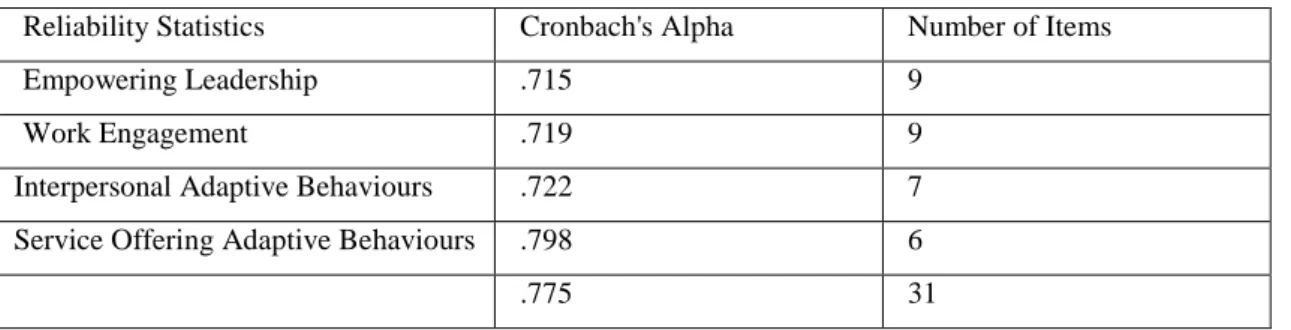
Reliability analysis measures the overall consistency of the items that are used to define a scale. A measure is said to have a high reliability, if it produces similar results under consistent conditions. In this study, reliability analysis is conducted by using SPSS software to check whether the items representing each construct measure these constructs accurately. Table 4.1 shows that alpha values associated with each scale measurement. Descriptive statistics for the survey items can be seen in Appendix B.
Table 4.1 Reliability Analysis (Cronbach’s Alpha)
Reliability Statistics Cronbach's Alpha Number of Items
Empowering Leadership .715 9
Work Engagement .719 9
Interpersonal Adaptive Behaviours .722 7
Service Offering Adaptive Behaviours .798 6
.775 31
4.2 Exploratory Factor Analysis
Main objective of the exploratory factor analysis is to uncover the underlying association between measured variables. Two exploratory factor analyses were conducted in this dissertation: The first one is conducted to scrutinize whether the factor structure of work engagement complies with the one in the literature and the second one is done for the adaptive behaviours to see whether interpersonal adaptive behavior and service offering adaptive behaviour fall under different dimensions.
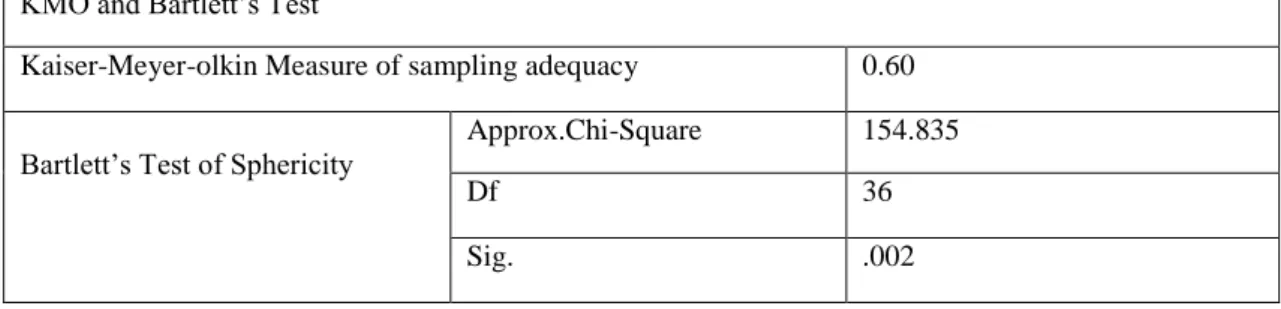
For the work engagement scale KMO value was 0.60 (Table 4.2) which exceeded the accepted value of 0.50. The following tables show the primary findings in the exploratory factor analysis for work engagement.
23 Table 4.2 KMO and Bartlett’s Test
KMO and Bartlett’s Test
Kaiser-Meyer-olkin Measure of sampling adequacy 0.60
Bartlett’s Test of Sphericity
Approx.Chi-Square 154.835
Df 36
Sig. .002
Total variance analysis results in Table 4.3 highlights that instead of three dimensions that we observe in literature, four dimensions are observed with a variance of 18.9% for first, 14.4% for second,12.74% for the third, and 12.50% for the fourth dimension.
Table 4.3 Total Variance Explained for Work Engagement Total Variance Explained
Initial Eigenvalues Extraction Sums of Squared Loadings Rotation Sums of Squared Loadings Total % of Variance Cumulative % Total % of Variance Cumulative % Total % of Variance 1 1.706 18.955 18.955 1.706 18.955 18.955 1.688 18.758 2 1.297 14.408 33.364 1.297 14.408 33.364 1.262 14.021 3 1.147 12.742 46.106 1.147 12.742 46.106 1.145 12.722 4 1.070 11.892 57.998 1.070 11.892 57.998 1.125 12.497 5 1.000 11.109 69.107 6 .970 10.777 79.884 7 .843 9.367 89.251 8 .657 7.305 96.556 9 .310 3.444 100.000
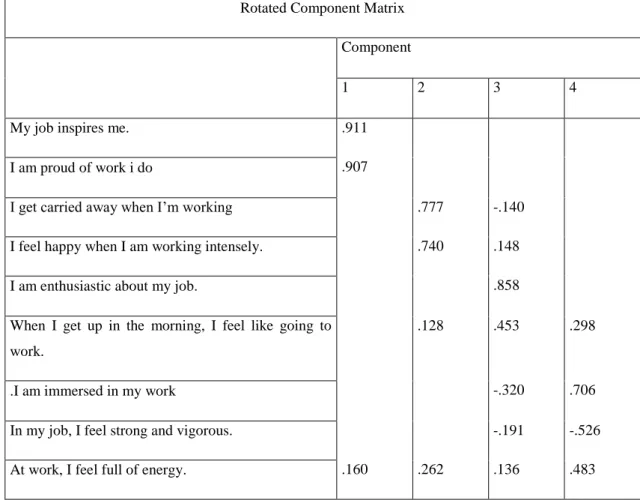
24 Rotated component matrix (Table 4.3) shows that most of the vigor, dedication, and absorption items are correctly distributed under these dimensions while few items are loaded on a fourth, irrelevant factor. Thus, it can be concluded that factor distribution in the data approximates the dimensions found in the literature.
Table 4.4 Rotated Component Matrix for Work Engagement
Rotated Component Matrix
Component
1 2 3 4
My job inspires me. .911
I am proud of work i do .907
I get carried away when I’m working .777 -.140
I feel happy when I am working intensely. .740 .148
I am enthusiastic about my job. .858
When I get up in the morning, I feel like going to work.
.128 .453 .298
.I am immersed in my work -.320 .706
In my job, I feel strong and vigorous. -.191 -.526
At work, I feel full of energy. .160 .262 .136 .483
Results of the exploratory factor analysis for adaptive behaviors reveal that the data is suitable for factor analysis as KMO value is above .50 (Table 4.5).
Table 4.5 KMO and Bartlett’s Test
KMO and Bartlett’s Test
Kaiser-Meyer-olkin Measure of sampling adequacy 0.60
Bartlett’s Test of Sphericity
Approx.Chi-Square 112.534
Df 78
25 Table 4.5 and Table 4.6 highlight that instead of two dimensions (types) of adaptive behaviors found in literature, seven dimensions are observed in the data. However, to conform with the theoretical background, factor structure with two dimensions (two types of adaptive behaviors) is used in the subsequent analyses.
Table 4.6 Total Variance Explained for Adaptive Behaviors Total Variance Explained
Initial Eigenvalues Extraction Sums of Squared
Loadings
Rotation Sums of Squared Loadings Total % of Variance Cumulative % Total % of Variance Cumulative % Total % of Variance Cumulative % 1 1.413 10.868 10.868 1.413 10.868 10.868 1.292 9.940 9.940 2 1.323 10.174 21.042 1.323 10.174 21.042 1.230 9.463 19.402 3 1.225 9.426 30.468 1.225 9.426 30.468 1.214 9.337 28.740 4 1.181 9.086 39.554 1.181 9.086 39.554 1.208 9.296 38.036 5 1.112 8.556 48.110 1.112 8.556 48.110 1.147 8.822 46.857 6 1.079 8.296 56.406 1.079 8.296 56.406 1.137 8.743 55.601 7 1.017 7.819 64.225 1.017 7.819 64.225 1.121 8.625 64.225 8 .910 7.000 71.225 9 .871 6.701 77.926 10 .854 6.571 84.497 11 .837 6.435 90.932 12 .626 4.817 95.749 13 .553 4.251 100.000 4.3 Correlation Analysis
Correlation analysis is used to measure the present level of association among variables. Correlation coefficient value always varies between the range of -1 to +1and these values show whether the association between two variables are positive (close to +1) positive, neutral (0), or negative (close to -1). Correlation analysis, which shown in Table 4.7, reveals that empowering leadership is positively correlated with work engagement (r = 0.514, p < 0.01) and service offering adaptive behaviors (r = 0.740, p < 0.05). Work engagement is also positively correlated with service offering adaptive behavior (r = .818, p < 0.01). Finally, as expected, interpersonal adaptive behavior is significantly and positively correlated with service offering adaptive behavior (r = 0.761, p < 0.01).
26 Table 4.7 Correlation Analysis
Correlations Empowering Leadership Work Engagement Interpersonal Adaptive Behaviours Service Offering Adaptive Behaviours Empowering Leadership Pearson Correlation .514* .619 .740* Work Engagement Pearson Correlation .414* .074 .818** Interpersonal AB Pearson Correlation .419 .745* .761** Service Offering AB Pearson Correlation .740* .818** .761** ** p<0.01, *p<0.05 4.4 Regression Analysis
Regression analysis is used to predict a dependent variable, based on a single or group of independent variables. In this dissertation, enter method was used while conducting the regression analysis. The outcome of regression analysis was evaluated with, R square, F test and standardized beta values R square indicates the percentage of dependent variable which is explained by independent variable. F value shows variance in the model. In the regression model, linearity is evaluated through collinearity statistics (VIF and having tolerance value). Results of the regression analyses to scrutinize the relationship between empowering leadership, work engagement, and adaptive behaviors are demonstrated in the following sections.
4.4.1 Regression Analysis for Empowering Leadership and Interpersonal Adaptive Behaviors
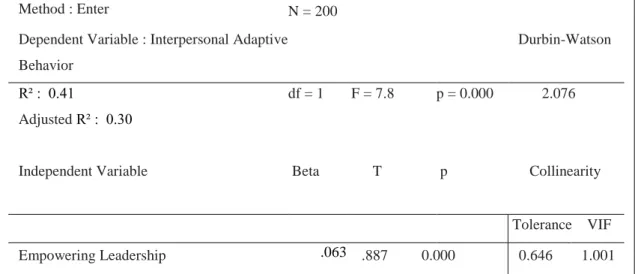
Multiple regression analysis in Table 4.8 indicates that the model explains 30% of the variance in interpersonal adaptive behaviors. In this part of the regression analysis empowering leadership is entered as the independent variable and interpersonal adaptive behaviors is entered as dependent variable. The overall F-test for the model reveals that the regression model is statistically significant. Durbin Watson value is within the
27 acceptable range (1.5 and 2.5) and avoids collinearity. As it is seen in Table 4.8 that empowering leadership has a significant impact (β = 0.63, p < .01) on interpersonal adaptive behaviors.
Table 4.8 Multiple Regression Analysis for Empowering Leadership and Interpersonal Adaptive Behaviors
Method : Enter N = 200
Dependent Variable : Interpersonal Adaptive Behavior
Durbin-Watson
R² : 0.41 df = 1 F = 7.8 p = 0.000 2.076
Adjusted R² : 0.30
Independent Variable Beta T p Collinearity
Tolerance VIF Empowering Leadership .063 .887 0.000 0.646 1.001
4.4.2 Regression Analysis for Empowering Leadership and Service Offering Adaptive Behaviors
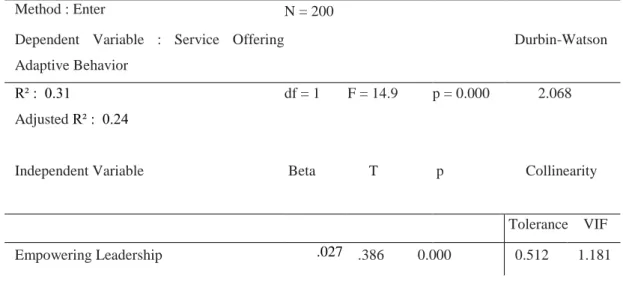
Multiple regression analysis in Table 4.9 indicates that the model explains 24% of the variance in service offering adaptive behaviours. In this part of the regression analysis empowering leadership is entered as the independent variable and service offering adaptive behaviors is entered as dependent variable. The overall F-test for the model reveals that the regression model is statistically significant. Durbin Watson value is within the acceptable range (1.5 and 2.5) and avoids collinearity. As it is seen in Table 4.9 that empowering leadership has a significant impact (β = 0.027, p < .01) on service offering adaptive behaviors.
28 Table 4.9 Multiple Regression Analysis for Empowering Leadership and Service
Offering Adaptive Behaviors
Method : Enter N = 200
Dependent Variable : Service Offering Adaptive Behavior
Durbin-Watson
R² : 0.31 df = 1 F = 14.9 p = 0.000 2.068
Adjusted R² : 0.24
Independent Variable Beta T p Collinearity
Tolerance VIF Empowering Leadership .027 .386 0.000 0.512 1.181
4.4.3 Regression Analysis for Empowering Leadership and Work Engagement
The overall F-test for this regression model shows that the model is statistically significant explaining 41% of the variance in the respondents. As it is seen in Table 4.10, empowering leadership has a powerful significant impact (β= 0.063, p < .01) on work engagement.
Table 4.10 Model Summary for Regression Analysis Empowering Leadership and Work Engagement
Method : Enter N = 200
Dependent Variable : Work engagement Durbin-Watson
R² : 0.65 df = 1 F = 7.8 p = 0.000 2.065
Adjusted R² : 0.41
Independent Variable Beta T p Collinearity
Tolerance VIF Empowering Leadership .063 .887 0.000 0.646 1.001
29 4.4.4 Regression Analysis for Work Engagement and Interpersonal Adaptive Behaviors
F-test for this regression model shows that the model is statistically significant explaining 57% of the variance in the respondents. Work Engagement is showing significant impact (β= 0.0712, p < .01) on interpersonal behaviors as shown in Table 4.11.
Table 4.11 Model Summary Regression Analysis Work Engagement and Interpersonal Adaptive Behaviors
Method : Enter N = 200
Dependent Variable : Interpersonal Adaptive Behaviors
Durbin-Watson
R² : 0.858 df = 1 F = 9.5 p = 0.000 2.057
Adjusted R² : .57
Independent Variable Beta T p Collinearity
Tolerance VIF
Work Engagement .0712 .872 0.000 0.650 1.021
4.4.5 Regression Analysis for Work Engagement and Service Offering Adaptive Behaviors
The overall F-test for this regression model shows that the model is statistically significant explaining 49% of the variance in the respondents. Work Engagement is showing significant impact (β= 0.069, p < .01) on service offering adaptive behaviors as shown in Table 4.12
30 Table 4.12 Model Summary of Regression Analysis Work Engagement and Service
Offering Adaptive Behaviors
Method : Enter N = 200
Dependent Variable : Service Offerings Adaptive Behaviors
Durbin-Watson
R² : 0.67 df = 1 F = 8.3 p = 0.000 2.076
Adjusted R² : .49
Independent Variable Beta T p Collinearity
Tolerance VIF
31 4.4.6 Mediation Analysis for Work Engagement
Mediation analysis for work engagement demonstrates that the model, in which work engagement and empowering leadership are entered as independent variables, is statistically significant explaining 56% of the variance in the interpersonal adaptive behaviors. As it is seen in Table 4.13, when work engagement is included in the model, the direct impact of empowering leadership on interpersonal adaptive behaviors decreases (β=0.048, p < .01). This finding reveals that work engagement acts as a partial mediator between empowering leadership and interpersonal adaptive behaviors.
Table 4.13 Model Summary for Mediation Analysis (Interpersonal Adaptive Behavior as the Dependent Variable)
Method : Enter N = 200
Dependent Variable : Interpersonal Adaptive Behavior
Durbin-Watson
R² : 0.64 df = 1 F = 8.6 p = 0.000 2.050
Adjusted R² : 0.56
Independent Variable Beta T p Collinearity Tolerance VIF Empowering Leadership Work Engagement .048 .083 .411 0.000 .715 0.001 0.588 0.782 1.012 1.048
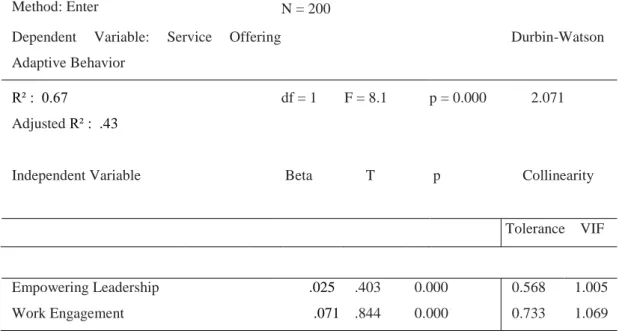
Similar to the previous mediation analysis, regression model in Table 4.14 demonstrates that this model is also statistically significant explaining 43% of the variance in service offering adaptive behaviors. Table 4.14 indicates that when work engagement is included in the model, the direct impact of empowering leadership on service offering adaptive behaviors decreases (β=0.025, p < .01). This finding reveals that work engagement acts as a partial mediator between empowering leadership and service offering adaptive behaviors.
32 Table 4.14 Model Summary of Mediation Analysis for Work Engagement and Empowering Leadership (Service Offering Adaptive Behavior as the Dependent
Variable)
Method: Enter N = 200
Dependent Variable: Service Offering Adaptive Behavior
Durbin-Watson
R² : 0.67 df = 1 F = 8.1 p = 0.000 2.071
Adjusted R² : .43
Independent Variable Beta T p Collinearity Tolerance VIF Empowering Leadership Work Engagement .025 .071 .403 0.000 .844 0.000 0.568 0.733 1.005 1.069
4.5 Hypothesis Evaluation Summary
Table 4.15 Hypothesis Summary
No Hypothesis Result
H1 Empowering leadership influences adaptive behaviors positively. Accepted
H2 Empowering leadership influences work engagement positively. Accepted
H3 Work engagement influences adaptive behaviours positively Accepted
H4
Work engagement meditates relationship between empowering
33
5. DISCUSSIONS AND CONCLUSIONS
The present study investigates the impact of empowering leadership and work engagement on employees’ adaptive behaviors. The research was based on strong arguments that work engagement shows mediating effect between empowering leadership and employees’ adaptive behaviors. To support these arguments, a comprehensive study of previous research was made. Previous studies provided valuable theoretical evidence for the relationship between empowering leadership, work engagement, and adaptive behaviors. Based on the review of existing scales to measure the constructs in the research model, an online survey involving the measurement scales of study variables was created. This survey was filled by 200 hotel employees working at different four star hotels in Pakistan.
Findings of this study have many theoretical and practical implications regarding impact of empowering leadership and role of work engagement on adaptive behaviors. Previous studies considered the importance of empowering leadership as a new concept that is likely to predict numerous employee outcomes and achieve desirable outputs. This research underlines the impact of empowering leadership in predicting employee engagement as well as interpersonal and service offering behaviors in service organizations (i.e., All research hypotheses related to the impact of empowering leadership were accepted). These findings carry immense importance as they support the dynamical role of empowering leadership on employees’ adaptive behaviors. Besties, they are consistent with the research conducted by McFall & Richard (2012) revealing that empowered leaders have the ability to improve employees’ work engagement, determination, dedication, fulfilment.
In this study, work engagement is considered as a crucial factor that directly as well as indirectly yields to produce a productive work environment, leading to the accomplishment of the organizational goals and objectives. Previous studies illustrate work engagement as an emotional state that includes increased dedication, absorption and vigour (Bakker, 2011). In addition to these positive aspects, this research also highlights that engaged employees do accomplish all their tasks with the full interest by being adaptive, that leads to the effective performance. Furthermore, it has been analyzed that in the existing work environment, engaged employees behave really well, and are very much adaptive to the existing and changing business environment. These assumptions are also consistent with the recent research by Javed et al. (2018) revealing that employees’