Asian Pacific Journal of Cancer Prevention, Vol 15, 2014
8937
DOI:http://dx.doi.org/10.7314/APJCP.2014.15.20.8937 Prostate Biopsy in the Elderly: Histologic Findings and Treatment NecessityAsian Pac J Cancer Prev, 15 (20), 8937-8939
Introduction
According to cancer statistics of 2013, prostate cancer is still at the top of estimated new cancer cases and it is the second cause of death due to cancer(Arshad and Ahmad, 2013; Siegel et al., 2013). Therefore, early diagnosis and treatment is utmost importance in the management of prostate cancer. In our practice, PSA analysis in the elderly depends mainly on either physical examination and/or lower urinary tract symptom driven suggestion, or patient’s own will as a continuation of yearly PSA screening. However, this practice brings out another question: to perform or not to perform biopsy for high PSA levels in the elderly, as well any cut off age or cut off PSA level for biopsy, keeping medico-legal issues in mind.
In this retrospective study, we aimed to determine results of high PSA or abnormal digital rectal examination driven prostate biopsies performed in our department in men aged 75 or more and to show the characteristics of pathology results and demographics of the patients.
Materials and Methods
In three common university based research hospitals,
Department of Urology, Başkent University, School of Medicine, 1Istanbul Hospital, Istanbul, 2Ankara, 3Adana Hospital, Adana,
Turkey *For correspondence: [email protected]
Abstract
The aim of this study is to determine results of high prostate specific antigen (PSA) or abnormal digital rectal examination driven prostate biopsies performed in our Department in men aged 75 or more and to show the characteristics of pathology results. The hospital records of the patients who had high PSA or abnormal digital rectal examination driven prostate biopsy in two common university based research hospitals have been reviewed retrospectively. Patients aged 75 years or older at the date of biopsy whose records provided pathology results and full medical history were evaluated for the study. A total of 103 patients were evaluated with a mean age of 79.4 ±3.4 years. More than half of the patients (55.1%) were in their seventh decade and the rest were in the eighth decade. Median PSA value was 15.0 (range 2.1-4500) ng/ml. In most of the biopsies (67%), PSA levels were lower than 20 ng/ml. In almost half of the patients (48%), digital rectal examination was abnormal. In 68.9% of the patients, there were at least one or more associated co-morbid diseases. Gleason scores were 7 or higher in 73%, and 8 or higher in 37% of the patients with prostate cancer. Four of the 70 (6%) patients had bone metastases. Castrations were applied to most of the patients with prostate adenocarcinoma (%79). High percentage of high grade (Gleason 7 or more) prostate adenocarcinoma in the elderly refutes the perception of prostate cancer in this age group as clinically insignificant. Therefore, it is to be kept in mind that prostate cancer in the elderly an be clinically significant and prostate biopsies are to be performed when necessary.
Keywords: Prostate - adenocarcinoma - elderly - biopsy - treatment
RESEARCH ARTICLE
Prostate Biopsy in the Elderly: Histologic Findings and
Treatment Necessity
Ramazan Yavuz Akman
1*, Hikmet Koseoglu
1, Ahmet Ibrahim Oguzulgen
2, Erhan
Sen
2, Ozgur Yaycıoglu
3the hospital records of patients who had high PSA or abnormal digital rectal examination driven prostate biopsy between dates of January 2010 and June 2013 have been reviewed retrospectively. Records providing pathology results and full medical history of patients who are aged 75 and over at the date of biopsy were included in data analyses.
The patients were also compared according to their age decades for their pathology results and treatments. For statistical analyses, SPSS statistics version 17 was used. For group comparisons, chi-square test was used. Tests with p-value less than < 0,05 was set as statistically significant.
Results
A total of 103 patients’ records have been included in the data analyses. The mean age was 79.42 ±3.4 years. More than half of the patients (55.1%) were in the seventh decade and the rest were in the eighth decade . Median PSA value was 15.0 (range 2.1- 4500) ng/ml. In most of the biopsies (67%), PSA levels were lower than 20 ng/ml. In almost half of the patients (48%), digital rectal examination was abnormal. LUTS was present
Ramazan Yavuz Akman et al
Asian Pacific Journal of Cancer Prevention, Vol 15, 2014
8938
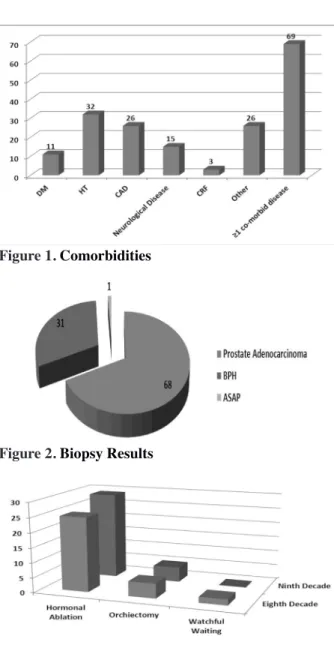
in 62.1% of the patients. In 68.9% of the patients, there were at least one or more associated co-morbid diseases. Of these patients, 11% had Diabetes Mellitus, 32% had hypertension, 26% had coronary artery disease, 15% had neurological disease, 3% had chronic renal failure, and 26% had other kinds of co-morbid diseases (Figure 1).
One third of the patients were taking anti-coagulant medications. The pathology results of the prostate biopsies were prostate adenocarcinoma in 68%, ASAP in 1%, and BPH in the rest of the patients (Figure 2).
Gleason scores were 7 or higher in 73%, and 8 or higher in 37% of the patients with prostate cancer. Four of the 70 (6%) patients had bone metastases. Ones with benign pathology results were followed with PSA measurements. Most of the patients with prostate adenocarcinoma (%79) were applied castration. In these cases, medical castration was mostly preferred (82%). When compared in terms of modality of hormone ablation therapy between age groups, similar rates of surgical and medical castration were present in both eighth and ninth decades (Figure 3). In addition, LUTS was more frequent in ones with PSA levels lower than 20 ng/ml (71% vs. 44% with p < 0.01).
Discussion
Prostate cancer, being a common cancer in men and second cause of death due to cancer, necessitates early diagnosis and treatment (Arshad and Ahmad, 2013; Siegel et al.). Although both major authorities, namely EAU and AUA, offered clinical guidelines for diagnosis, yet they are somewhat unclear on the subject of treatment and follow up of prostate cancer in elderly (Carter et al., 2013; Heidenreich et al., 2014). As well the US Preventive Services Task Force (USPSTF) has recommended against routine PSA screening for prostate cancer and claimed upper limit of age as 75 in an earlier version (Moyer, 2012). However, this lack of clear guidance on this point is well reflected by the treatment practices of urologists which show a great variance (Lipinski et al., 2013; Situmorang et al., 2013; Verim et al., 2013). In our practice, PSA analysis in the elderly depends mainly on either physical examination and/or lower urinary tract symptom driven suggestion, or patient’s own will as a continuum of yearly PSA screening. Likewise, a recent analysis of Medicare Health system related to prostate cancer diagnosis and treatment showed that PSA screening rate was 32,6% in men aged between 66-74 years and 28,7% in men aged between 75-84, where half of screened population was over 75 years (Ma et al.). Additionally, in the cost effectiveness analyses, an inverse relation between age and screening cost was found (Ma et al.).
On the contrary, a recent meta-analysis on PSA screening regardless of age was found to be related to overdiagnosis and overtreatment (Ilic et al.). However, rather than screening, ad hoc PSA testing has been suggested to be related to low levels of over-treating (Samaratunga et al.).
In a report, patients aged 70 or older were reported to have more than a three-fold increased risk of Gleason score of 7 or greater cancer (Hanson et al., 2007). This finding is supported with our study, with Gleason scores ≥ 7 in 85% and ≥ 8 in 64% of the patients. In a series of 1446 needle biopsies of the prostate in men aged 75 or older, where the mean serum PSA level for patients biopsied was 10.4 mug/L, prostate cancer detection rate was 53%, and of these 78% was defined as clinically significant cancer (Mistry et al., 2009). This increased risk of tumour aggressiveness is also well reflected in the radical prostatectomy series where 90% men aged >70-year-old showed approximately Gleason score ≥7 in prostatectomy specimen, and significant failure rate compared to the matched younger patients (Ko et al., 2013). However, in another retrospective study, which analyzed 386 operated men aged between 70-81, it was concluded that when appropriate patients is chosen for radical prostatectomy, the prostate cancer-specific survival rate was 97.6%, 94.0%, and 90.2% at 5, 10 and 15 years respectively after RP (Pierorazio et al.).
Therefore, whether definitive treatment is appropriate or not, all elderly who is definitively under risk of high grade prostate cancer seem to deserve diagnostic work up when suspected, including prostate biopsy.
Figure 1. Comorbidities
Figure 2. Biopsy Results
Asian Pacific Journal of Cancer Prevention, Vol 15, 2014
8939
DOI:http://dx.doi.org/10.7314/APJCP.2014.15.20.8937 Prostate Biopsy in the Elderly: Histologic Findings and Treatment NecessityReferences
Arshad H, Ahmad Z (2013). Overview of benign and malignant prostatic disease in Pakistani patients: A clinical and histopathological perspective. Asian Pac J Cancer Prev,
14, 3005-10.
Carter HB, Albertsen PC, Barry MJ, et al (2013). Early detection of prostate cancer: AUA Guideline. J Urol, 190, 419-26. Hanson G, Wright J, Kim J, et al (2007). Is age an independent
predictor of clincially significant prostate cancer in a referral population? A case for needle biopsy in the elderly ASCO Meeting, 5142.
Heidenreich A, Bastian PJ, Bellmunt J, et al (2014). EAU Guidelines on Prostate Cancer. Part 1: Screening, Diagnosis, and Local Treatment with Curative Intent-Update 2013. Eur
Urol, 65, 124-37.
Ilic D, Neuberger MM, Djulbegovic M, et al (2013). Screening for prostate cancer. Cochrane Database Syst Rev, 1, 4720. Ko J, Falzarano SM, Walker E, et al (2013). Prostate cancer
patients older than 70 years treated by radical prostatectomy have higher biochemical recurrence rate than their matched younger counterpart. Prostate, 73, 897-903.
Lipinski MO, Siemens DR, Groome PA (2013). Variations in prostate biopsy practice: A quantitative questionnaire-based study. Can Urol Assoc J, 7, 732-9.
Ma X, Wang R, Long JB, et al (2013). The cost implications of prostate cancer screening in the Medicare population.
Cancer, 120, 96-102.
Mistry S, Mayer W, Khavari R, et al (2009). Who’s too old to screen? Prostate cancer in elderly men. Can Urol Assoc J,
3, 205-10.
Moyer VA (2012). Screening for prostate cancer: U.S. Preventive Services Task Force recommendation statement. Ann Intern
Med, 157, 120-34.
Pierorazio PM, Humphreys E, Walsh PC, et al (2010). Radical prostatectomy in older men: survival outcomes in septuagenarians and octogenarians. BJU Int, 106, 791-5. Samaratunga H, Delahunt B, Yaxley J, et al (2013). Clinical
significance of cancer in radical prostatectomy specimens: analysis from a contemporary series of 2900 men. Pathology,
46, 11-4.
Siegel R, Naishadham D, Jemal A (2013). Cancer statistics, 2013.
CA Cancer J Clin, 63, 11-30.
Situmorang GR, Umbas R, Mochtar CA, et al (2013). Prostate cancer in younger and older patients: do we treat them differently? Asian Pac J Cancer Prev, 13, 4577-80. Verim L, Yildirim A, Basok EK, et al (2013). Impact of PSA and
DRE on histologic findings at prostate biopsy in Turkish Men over 75 Years of Age. Asian Pac J Cancer Prev, 14, 6085-8.