栽藻造押8629原愿圆圆源缘员苑圆 8629-82210956 耘皂葬蚤造押ijopress岳员远猿援糟燥皂
Choroidal thickness measurements with optical
coherence tomography in branch retinal vein occlusion
1Department of Ophthalmology, Baskent University School
of Medicine, Adana 01250, Turkey
2Department of Ophthalmology, Cukurova University School
of Medicine, Adana 01330, Turkey
3Division of Biostatistics, Baskent University Adana Clinic
and Research Center, Adana 01250, Turkey
Correspondence to: Muge Coban-Karatas. Department of Ophthalmology, Baskent University School of Medicine, Adana Clinic and Research Center, Dadaloglu Mah. 39 st.
No:6 Y俟regir,Adana 01250, Turkey. [email protected]
Received: 2014-09-12 Accepted: 2015-08-20
Abstract
·
AIM: To evaluate central macular thickness (CMT) and mean choroidal thickness (MCT) in eyes with branch retinal vein occlusion (BRVO), before and after ranibizumab treatment using spectral domain -optical coherence tomography (SD-OCT).·
METHODS: Forty -two patients with unilateral BRVO and macular edema were included in this study. There were 25 men and 17 women. Using SD -OCT, choroidal thickness was measured at 500 滋m intervals up to 1500 滋m temporal and nasal to the fovea. MCT was calculated based on the average of the 7 locations. All the eyes with BRVO were treated with intravitreal ranibizumab (0.5 mg/0.05 mL). Comparisons between the BRVO and fellow eyes were analyzed using Mann-Whitney test . Pre-injection and post-Pre-injection measurements were analyzed using Wilcoxon test and repeated measure analysis.·
RESULTS: At baseline, there was a significant difference between the BRVO and fellow eyes in MCT [BRVO eyes 245 (165-330) 滋m, fellow eyes 229 (157-327) 滋m] and CMT [BRVO eyes 463 (266-899) 滋m, fellow eyes 235 (148-378) 滋m (P=0.041, 0.0001, respectively)]. Following treatment, CMT [295 (141-558) 滋m] and MCT [229 (157-329) 滋m] decreased significantly compared to the baseline measurements ( =0.001, 0.006, respectively). Also BCVA (logMAR) improved significantly ( =0.0001) in the BRVO eyes following treatment. After treatment CMT [BRVO eyes 295 (141-558) 滋m, fellow eyes 234 (157-351) 滋m] and MCT [BRVO eyes 229 (157-329) 滋m, fellow eyes 233 (162 -286) 滋m] values did not reveal any significant difference in BRVO eyes and fellow eyes ( =0.051, 0.824, respectively).·
CONCLUSION: In eyes with BRVO, CMT and MCT values are greater than the fellow eyes, and decrease significantly following ranibizumab injection.·
KEYWORDS: branch retinal vein occlusion; choroidal thickness; macular edema; optical coherence tomography; ranibizumabDOI:10.18240/ijo.2016.05.16
Coban-Karatas M, Altan-Yaycioglu R, Ulas B, Sizmaz S, Canan H, Sariturk C. Choroidal thickness measurements with optical coherence tomography in branch retinal vein occlusion. 2016; 9(5):725-729
INTRODUCTION
R
etinal vein occlusion (RVO) is one of the most frequentmajor retinal vascular disease after diabetic retinopathy[1].
Venous thrombus formation as a result of RVO and leads to poor venous drainage, dilation and tortuosity of the large retinal veins and increased retinal capillary pressure. These changes result in exudation of blood, fluid, lipid into retina,
leading to macular edema [2]. Macular edema is a frequent
cause of visual loss that should be the main treatment target[3].
Treatment strategies for macular edema consist of focal laser
photocoagulation [4-5], intravitreal steroids [6], and injection of
anti-vascular endothelial growth factor (VEGF) protein
compounds [7-8]. Macular edema in patients with RVO seems
to be closely related to VEGF levels in the vitreous[9-10]. Thus,
inhibiting VEGF seems to be a reasonable therapeutic approach[8,11].
The choroid is a highly vascular tissue that is directly influenced by intraocular pressure as well as perfusion
pressure [12]. Choroidal blood flow is the highest of any tissue
in the body to satisfy the normal metabolic demands of the
outer retina [13]. RVO is accompanied with retinal hypoxia
which leads to increased VEGF expression in the retinal pigment epithelium, pericytes and microvascular endothelial
cells[14]. VEGF induces vessel dilatation and increased ocular
blood flow through a mechanism involving nitric oxide production, and is proposed to increase the choroidal thickness[15].
The aim of this study was to compare the mean choroidal thickness (MCT) and central macular thickness (CMT) in eyes with branch retinal vein occlusion (BRVO) before and
after the treatment with intravitreal ranibizumab, and compare the results with the unaffected fellow eyes.
SUBJECTS AND METHODS
In this retrospectively designed cross-sectional study, the data of consecutive patients with unilateral BRVO and macular edema, who were diagnosed between January 2012 and June 2015, were evaluated. This study adhered to the tenets of Decleration of Helsinki and was approved by the Baskent University Institutional Review Board and Ethics Committee (KA13/272).
The primary outcome measure was to evaluate the changes in MCT and CMT, before and after intravitreal injection of ranibizumab in patients with BRVO. Secondary outcome measure was to compare these values with the normal fellow eyes.
Ophtalmologic examination included best corrected visual
acuity (BCVA), slit lamp biomicroscopy, and retinal
examination, in addition to fundus fluorescein angiography (FFA) and spectral domain-optical coherence tomography (SD-OCT) examinations. The diagnosis of BRVO was determined according to the clinical picture and FFA as dilated and tortuous veins, flame-shaped hemorrhages, dot and blot hemorrhages, retinal edema and cotton wool spots affecting the part of the retina drained by the obstructed vein. The BRVO eyes with macular edema, exceeding 250 microns were included in the study and compared with the fellow eyes without any macular or retinal disease. The exclusion criterias were any history of vitreous surgery, intravitreal injection of either any anti-VEGF agent or steroid, and findings of vitreo-macular traction or epiretinal membrane, as well as macular edema due to any reason other than BRVO. BRVO eyes were treated with 3 doses of intravitreal injection of ranibizumab (Lucentis; Genentech; San Francisco, CA, USA) (0.5 mg/0.05 mL) at one month intervals.
Optical coherence tomography (OCT) measurements were performed by the same experienced technician using a high
speed and high resolution SD-OCT device (姿=840 nm, 26 000
A-scans/s and 5 滋m axial resolution), Optovue RTVue
software V.3.5 (Optovue Inc., Fremont, California, USA). Macular thickness analysis were performed by the MM5
(5伊5 mm2grid of 11 horizontal and 11 vertical lines with 668
A-scans each and an inner 3伊3 mm2grid of 6 horizontal and
6 vertical lines with 400 A-scans each). For choroidal analysis, horizontal B-scan images centered on the fovea were selected. Each B-scan image is constructed from a number of line scans through the same retinal locations and each line scan consists of 1024 A-scans. By automatically inverting the image, the chorioretinal interface became adjacent to zero delay. The retina cross-line scan has 32
frames averaged, 16 per direction without tracking[16].
The choroidal thickness was measured from the posterior
edge of the retinal pigment epithelium (RPE) to the
choroid-sclera junction at the fovea and at 500滋m intervals
up to 1500 滋m temporal as well as nasal to the fovea at 7
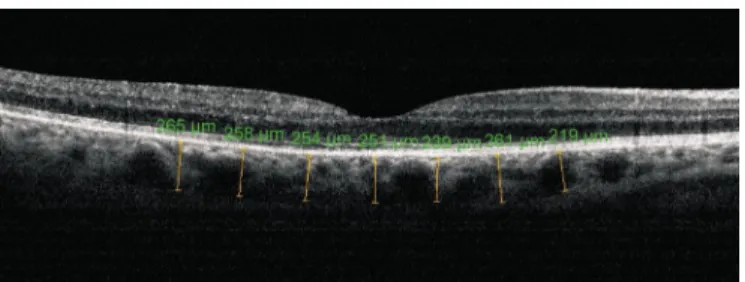
locations (Figure 1). The MCT was calculated based on all 7
measurements for each eye (Figures 1, 2). Choroidal
thickness measurements were performed by two masked physicians (Coban-Karatas M and Ulas B). The average of two measurements was taken for the analysis. Also reliability statistics for two examiners was performed. The BCVA (in logMAR) and CMT as well as MCT measurements were evaluated at baseline (zero visit) and 1mo following the third intravitreal injection (follow-up visit), and the measurements at each time point were compared.
Statistical Aanalysis Statistical analysis was performed using the statistical package SPSS software (Statistical Package for the Social Sciences, version 17.0, SPSS Inc, Chicago, III, USA). For each continuous variable, normality was checked by Kolmogorov Smirnov and Shapiro-Wilk tests and by histograms. Comparisons between the eye with BRVO and fellow eye were performed with Mann-Whitney test for the data not normally distributed. Pre-injection and post-injection measurements were analyzed using
Wilcoxon test. Values of less than 0.05 were considered
statistically significant. Reliability statistics and inter-observer correlation was evaluated by Cronbach's alpha. RESULTS
There were 42 patients with unilateral BRVO, with a mean
age of 59.2依7.5y (range 42 to 81y). Twenty-five (59.5%)
were male and 17 (40.5% ) were female. Systemic disease questioning revealed hypertension in 28 patients (66.7%) and diabetes mellitus in 6 patients (14.3%). None of the patients had retinopathy in the fellow eye.
Figure 1 Baseline choroidal thickness measurements of a patient with BRVO.
Figure 2 Choroidal thickness measurements of a patient with BRVO after intravitreal ranibizumab treatment.
栽藻造押8629原愿圆圆源缘员苑圆 8629-82210956 耘皂葬蚤造押ijopress岳员远猿援糟燥皂
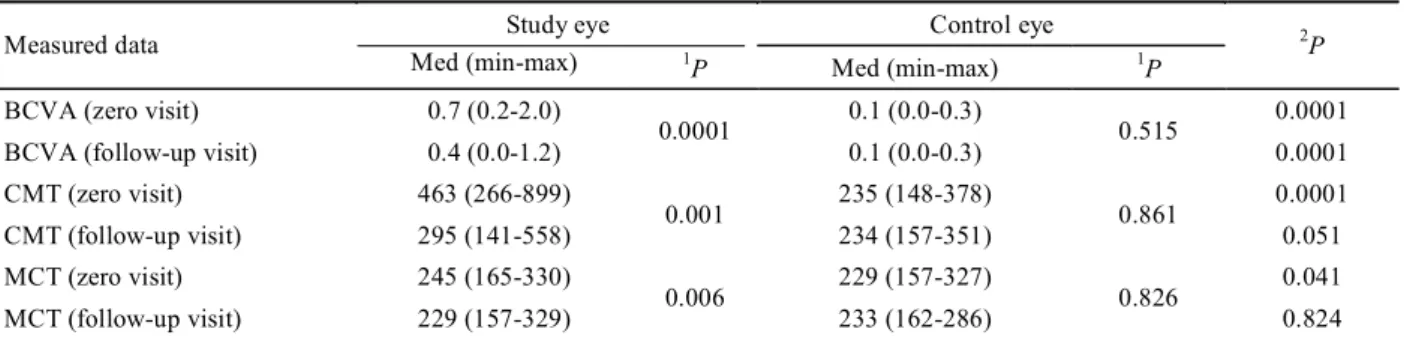
At the zero visit BCVA ranged from 2.0 to 0.2 (logMAR) (median, 0.7), and at the follow-up visit it improved to 1.2 to 0.0 (logMAR) (median 0.4) ( =0.0001; Figure 3).
At the zero visit, the median (min-max) MCT was 245 滋m
(165-330滋m) in BRVO eyes, and 229 滋m (157-327 滋m) in
the fellow eyes. The study eyes showed greater MCT compared to the control eyes ( =0.041). Similarly, study eyes showed greater CMT compared to the control eyes ( =
0.0001). The median (min-max) of CMT was 463 滋m
(266-899滋m) in the study eyes and 235 滋m (148-378 滋m) in
the control eyes (Table 1).
At the follow-up visit CMT and MCT improved significantly
in the study eyes ( =0.001, 0.006, respectively) compared
to the measurements at zero visit (Figures 4, 5). The median
(min-max) values for MCT was 229滋m (157-329 滋m), and
for CMT was 295滋m (141-558 滋m) at the follow-up visit.
There was no difference at the follow-up visit between the study and the control eyes for CMT and MCT values ( = 0.051, 0.824 respectively) (Table 1). In the control eyes, also no difference was found in CMT and MCT values at zero visit and follow-up visit ( =0.861, 0.826 respectively).
The reliability statistics of two masked physicians were evaluated by Cronbach's alpha (Cronbach's alpha=0.934,
Table 1 Comparison of median (minumum and maximum) values of eyes with BRVO and fellow eyes before and after treatment
Study eye Control eye Measured data
Med (min-max) 1P Med (min-max) 1P
2P
BCVA (zero visit) 0.7 (0.2-2.0) 0.1 (0.0-0.3) 0.0001 BCVA (follow-up visit) 0.4 (0.0-1.2) 0.0001 0.1 (0.0-0.3) 0.515 0.0001 CMT (zero visit) 463 (266-899) 235 (148-378) 0.0001 CMT (follow-up visit) 295 (141-558) 0.001 234 (157-351) 0.861 0.051 MCT (zero visit) 245 (165-330) 229 (157-327) 0.041 MCT (follow-up visit) 229 (157-329) 0.006 233 (162-286) 0.826 0.824 BCVA: Best corrected visual acuity; CMT: Central macular thickness; MCT: Mean choroidal thickness. 1Comparison between pre and post values using Wilcoxon test; 2Comparison of the eye with BRVO and fellow eye using Mann-Whitney U test. Values of P
less than 0.05 were considered statistically significant.
Figure 3 BCVA (LogMAR) improved significantly at the follow-up visit in BRVO eyes.
Figure 4 CMT improved significantly at the follow-up visit in BRVO eyes In the control eyes, no difference was found in CMT values at zero visit and follow-up visit.
Figure 5 MCT improved significantly at the follow-up visit in BRVO eyes In the control eyes, no difference was found in MCT values at zero visit and follow-up visit.
95% CI 0.90-0.05). Inter-observer correlation was higher than 90%. The differences between the measurements of two masked physicians were not more than 5%.
DISCUSSION
Until recently, the choroid could only be evaluated with
indocyanine green angiography[17-18], laser Doppler flowmetry[19]
and ultrasound[20]. Although, it is possible to diagnose choroid
vessel abnormalities and changes in the blood flow with these techniques, SD-OCT enabled us to achieve 3-dimensional
anatomic information about RPE and choroid layers[21-22].
OCT is a noninvasive imaging modality used to acquire high-resolution cross sectional scans of the retina. Recently,
Spaide [21] described a new acquisition technique,
namely enhanced depth imaging (EDI), using Spectralis OCT
device (Heidelberg Engineering, Heidelberg, Germany).
Herein, placing the acquired structures deeper close to zero
delay, allowed a better visualization of the choroid[21].
Due to increased interest in choroidal imaging with OCT, other methods have been used to try to better visualize and and measure the choroid, including use of swept-source
OCT [23] and longer wavelength OCT [24-25]. All of these
methods, however, potentially cause loss of clear
visualization of the retinal surface where other pathologies such as vitreo-macular traction or epiretinal membrane might
be present and contributing to poor vision[26].
A high reliability and reproducibility of choroidal thickness measurements across three SD-OCT systems (Cirrus
Spectralis, Cirrus RTVue, Spectralis RTVue) in normal
subjects [16]. Twenty-eight subjects of young healthy adults
with no retinal and choroidal pathology and normal vision were analyzed. Choroidal thickness in normal eyes was manually measured in 5 areas. Measurements from any pair of three instruments were strongly correlated. There was good reproducibility between choroidal thickness of images
acquired by Cirrus, Spectralis and RTVue[16].
In RTVue software "chorioretinal" mode achieves the same
purpose as EDI described by Spaide [21]with a slightly
different approach. RTVue's 'chorioretinal' mode moves the zero delay closer to the choroid and achieves the same effect
as EDI without inverting the retinal image [27]. Using this
technique, we found that eyes with BRVO showed significantly greater MCT and CMT compared to the fellow
control eyes before the treatment (zero visit). At the
follow-up visit (one month following the third injection) CMT and MCT values improved in the BRVO eyes compared to the zero visit measurements. In the control eyes, however, no difference in CMT and MCT between zero and follow-up visit was found. This could be explained by increased expression of VEGF leading to increased thickness of choroid in patients with BRVO.
Several studies focused on choroidal thickness measurements in various diseases of the retina and choroid such as
Vogt-Koyanagi-Harada disease [28], polypoidal choroidal
vasculopathy [29]and central serous chorioretinopathy [30]. It
was demonstrated that choroidal thickness can be measured by SD-OCT, and choroidal thickness disparity exists among patients with the clinical diagnosis of wet and dry age-related
macular degeneration [12]. Imamura [30]reported that the
choroidal thickness in central serous chorioretinopathy was significantly greater than the choroidal thickness in normal eyes. EDI SD-OCT revealed a very thick choroid in patients with central serous chorioretinopathy. This finding provides additional evidence that central serous chorioretinopathy may be caused by increased hydrostatic pressure in the choroid. In a recent study, subfoveal choroidal thickness in patients with central retinal vein occlusion (CRVO) using EDI OCT was evaluated retrospectively. Thirty-six patients with macular oedema were treated with intravitreal bevacizumab (1.25 mg /0.05 mL). Mean subfoveal choroidal thickness after
intravitreal bevacizumab was 227.7依65.1 滋m, which was
thinner than that before intravitreal bevacizumab therapy
(266.9依79.0 滋m; <0.01, paired test). Subfoveal choroidal
thickness of CRVO eyes was significantly greater than that of fellow eyes and decreased significantly after intravitreal bevacizumab treatment. Enhanced depth imaging optical coherence tomography can be used to evaluate choroidal involvement in CRVO and may assist noninvasive diagnosis
and management of this disease[31].
In the present study, with SD-OCT we demonstrated that both MCT and CMT parameters were greater in BRVO patients and decreased significantly after ranibizumab treatment. Choroidal thickness significantly increases in eyes with unilateral BRVO and can return to normal levels following anti-VEGF treatment. This could be explained by increased expression of VEGF leading to increased thickness of choroid in patients with BRVO.
Being a retrospective study, with a small sample size are the shortcomings of this study. However, we believe that our results could be a sample for future studies on BRVO. In conclusion, using the SD-OCT software, which enables the measurement of choroidal thickness, this study demonstrated that choroidal thickness in BRVO eyes with macular edema was significantly greater than the fellow eyes and decreased following the treatment with three doses of an anti-VEGF agent (ranibizumab). According to our results, we believe that SD-OCT is an effective non-invasive tool to evaluate the choroid and detect choroidal changes in pathologic states such as BRVO. Future studies with larger patient numbers are needed to support our findings.
ACKNOWLEDGEMENTS
Conflicts of Interest: Coban-Karatas M, None; Altan-Yaycioglu R, None; Ulas B, None; Sizmaz S, None; Canan H, None; Sariturk C, None.
栽藻造押8629原愿圆圆源缘员苑圆 8629-82210956 耘皂葬蚤造押ijopress岳员远猿援糟燥皂
REFERENCES
1 Hayreh SS. Prevalent misconceptions about acute retinal vascular occlusive disorders. 2005;24(4):493-519.
2 Pieramici DJ, Rabena M, Castellarin AA, Nasir M, See R, Norton T, Sanchez A, Risard S, Avery RL. Ranibizumab for treatment of macular edema associated with perfused central retinal vein occlusions.
2008;115(10):e47-54.
3 Margolis R, Singh RP, Kaiser PK. Branch retinal vein occlusion: clinical findings, natural history, and management.
2006;7(6):265-276.
4 Argon laser photocoagulation for macular edema in branch vein occlusion. The branch vein occlusion study group. 1984: 98(3):271-282.
5 Klein ML, Finkelstein D. Macular grid photocoagulation for macular edema in central retinal vein occlusion. 1989:107 (9): 1297-1302.
6 Jonas JB, Akkoyun I, Kamppeter B, Kreissig I, Degenring RF. Intravitreal triamcinolone acetonide for treatment of central retinal vein occlusion.
2005;15(6):751-758.
7 Costa RA, Jorge R, Calucci D, Melo LA Jr, Cardillo JA, Scott IU. Intravitreal bevacizumab (avastin) for central and hemicentral retinal vein occlusion: IBeVO study. 2007;27(2):141-149.
8 Gallego-Pinazo R, Dolz-Marco R, Mar侏n-Lambíes C, D侏az-Llopis M. Safety and efficacy of ranibizumab in macular edema following retinal vein occlusion. 2012;4:15-21.
9 Noma H, Mimura T, Yasuda K, Shimura M. Role of soluble vascular endothelial growth factor receptors-1 and -2 their ligands, and other factors in branch retinal vein occlusion with macular edema.
2014;55(6):3878-3885.
10 Noma H, Funatsu H, Mimura T, Eguchi S, Shimada K. Role of soluble vascular endothelial growth factor receptor-2 in macular oedema with central retinal vein occlusion. 2011;95(6):788-792. 11 Stahl A, Struebin I, Hansen LL, Agostini HT, Feltgen N. Bevacizumab in central retinal vein occlusion: a retrospective analysis after 2 years of treatment. 2010;20(1):180-185.
12 Manjunath V, Goren J, Fujimato JG, Duker JS. Analysis of choroidal thickness in age-related macular degeneration using spectral-domain optical coherence tomography. 2011;152(4):663-668. 13 Linsenmeier RA, Padnick-Silver L. Metabolic dependence of photoreceptors on the choroid in the normal and detached retina.
2000;41(10):3117-3123.
14 Aiello LP, Northrup JM, Keyt BA, Takagi H, Iwamoto MA. Hypoxic regulation of vascular endothelial growth factor in retinal cells.
1995;113(12):1538-1544.
15 Tilton RG, Chang KC, LeJeune WS, Stephan CC, Brock TA, Williamson JR. Role for nitric oxide in the hyperpermeability and hemodynamic changes induced by intravenous VEGF. 1999; 40(3):689-696.
16 Branchini L, Regatieri CV, Flores-Moreno I, Baumann B, Fujimato JG, Duker JS. Reproducibility of choroidal thickness measurements across the three spectral domain optical tomography systems. 2012; 119(1):119-123.
17 Inoue R, Sawa M, Tsujikawa M, Gomi F. Association between the efficacy of photodynamic therapy and indocyanine green angiography
findings for central serous chorioretinopathy. 2010;149 (3):441-446. e1-2.
18 Shiraki K, Moriwaki M, Kohno T, Yanagihara N, Miki T. Age-related scattered hypofluorescent spots on late-phase indocyanine green angiograms. 1999;23(2):105-109.
19 Nagaoka T, Kitaya N, Sugawara R, Yokota H, Mori F, Hikichi T, Fujio N, Yoshida A. Alteration of choroidal circulation in the foveal region in patients with type 2 diabetes. 2004;88(8):1060-1063. 20 Malhotra A, Minja FJ, Crum A, Burrowes D. Ocular anatomy and cross-sectional imaging of the eye. 2011;32(1): 2-13.
21 Spaide RF, Koizumi H, Pozzoni MC. Enhanced depth imaging spectral-domain optical coherence tomography. 2008; 146(4):496-500.
22 Regatieri CV, Branchini L, Fujimoto JG, Duker JS. Choroidal imaging using spectral-domain optical coherence tomography. 2012;32 (5): 865-876.
23 Hirata M, Tsujikawa A, Matsumoto A, Hangai M, Ooto S, Yamashiro K, Akiba M, Yoshimura N. Macular choroidal thickness and volume in normal subjects measured by swept-source optical coherence tomography.
2011;52(8):4971-4978.
24 Povazay B, Hermann B, Unterhuber A, Hofer B, Sattmann H, Zeiler F, Morgan JE, Falkner-Radler C, Glittenberg C, Blinder S, Drexler W. Three-dimensional optical coherence tomography at 1050 nm versus 800 nm in retinal pathologies: enhanced performance and choroidal penetration in cataract patients. 2007(4):041211.
25 Esmaeelpour M, Povazay B, Hermann B, Hofer B, Kajic V, Kapoor K, Sheen NJ, North RV, Drexler W. Three-dimensional 1060-nm OCT: choroidal thickness maps in normal subjects and improved posterior segment visualization in cataract patients. 2010; 51(10):5260-5266.
26 Verner-Cole EA, Campbell JP, Hwang TS, Klein ML, Lauer AK, Choi D, Bailey ST. Retinal and choroidal imaging with 870-nm Spectral-Domain OCT compared with 1050-nm Spectral-Spectral-Domain OCT, with and without enhanced depth imaging. 2014;3(3):3. 27 Corcas G, Zhou Q, Corcas F Zucchiatti I, Rispoli M, Uzzan J, De Benedetto U, Savastano MC, Soules K, Goldenberg D, Loewenstein A, Lumbroso B. Choroid thickness measurement with RTVue optical coherence tomography in emmetropic eyes, mildly myopic eyes, and highly myopic eyes. 2012;22(6):992-1000.
28 Maruko I, Iida T, Sugano Y, Oyamada H, Sekiryu T, Fujiwara T, Spaide RF. Subfoveal choroidal thickness after treatment of Vogt-Koyonagi-Harada disease. 2011;31(3):510-517.
29 Nishide T, Hayakawa N, Nakanishi M, Ishii M, Okazaki S, Kimura I, Shibuya E, Mizuki N. Reduction in choroidal thickness of macular area in polypoidal choroidal vasculopathy patients after intravitreal ranibizumab therapy. 2013;251(10):2415-2420. 30 Imamura Y, Fujiwara T, Margolis R, Spaide RF. Enhanced depth imaging optical coherence tomography of the choroid in central serous chorioretinopathy. 2009;29(10):1469-1473.
31 Tsuiki E, Suzuma K, Ueki R, Maekawa Y, Kitaoka T. Enhanced depth imaging optical coherence tomography of the choroid in central retinal vein occlusion. 2013;156(3):543-547. e1.