O R I G I N A L P A P E R
UROLITHIASIS
A clinical evaluation of the new digital single-use flexible
ureteroscope (UscopePU3022): an international prospective
multicentered study
Cent European J Urol. 2018; 71: 453-461 doi: 10.5173/ceju.2018.1787
Thomas James Johnston
1, Joyce Baard
2, Jean de la Rosette
3, Steeve Doizi
4, Guido Giusti
5, Thomas Knoll
6,
Silvia Proietti
5, Marianne Brehmer
7, Esteban Emiliani
8, Daniel Pérez-Fentes
9, Palle Jorn Sloth Osther
10,
Christian Seitz
11, Naomi Neal
12, Ben Turney
12, Mudhar Hasan
7, Olivier Traxer
4, Oliver Wiseman
11Cambridge University Hospitals, Department of Urology, Cambridge, United Kingdom 2AMC University Hospital, Department of Urology, Amsterdam, The Netherlands 3Istanbul Medipol University, Department of Urology, Istanbul, Turkey
4Orbonne Université, Groupe de Recherche Clinique sur la Lithiase Urinaire, Hôpital Tenon Paris, France 5San Raffaele-Turro Hospital, Department of Urology, Milan, Italy
6Sindelfingen-Boeblingen Medical Center, Department of Urology, University of Tuebingen, Germany 7Danderyd University Hospital, Department of Surgery and Urology, Stockholm, Sweden
8Fundació Puigvert, Endourology and Urolithiasis Unit, Department of Urology, Barcelona, Spain 9Santiago de Compostela Hospital, Department of Urology, Santiago de Compostela, Spain 10Lillebaelt Hospital, Department of Urology, Vejle, Denmark
11Medical University of Vienna, Department Urology, Vienna, Austria 12Oxford University Hospitals, Department of Urology, Oxford, United Kingdom
Article history
Submitted: Sept. 14, 2018 Accepted: Sept. 30, 2018 Published online: Oct. 2, 2018
Introduction We assessed the clinical performance of a new digital single-use flexible ureteroscope (UscopePU3022).
Material and methods A prospective cohort study was carried out across 11 centers (July–Oct. 2017). The UscopePU3022 was assessed regarding ease of insertion; deflection, image quality, maneuverability and overall performance using either a visual analog* or Likert scale.
Results A total of 56 procedures were performed in 11 centers (16 surgeons) with the indication being renal stones in 83%. The median score for ease of scope insertion was 10 (3–10). Intraoperative maneuverability was rated as ‘good’ in 38% and ‘very good’ in 52%. Visual quality was rated as ‘poor or bad’ in 18%, ‘fair’ in 37% and ‘good or very good’ in 43%. Two scopes failed intraoperatively (4%). Preoperative and postoperative median upward and downward deflection was 270 degrees. Compared to standard flexible ureteroscopy (f-URS) maneuverability was rated as ‘equivalent’ in 30% and ‘better’ in 60%; visual quality was ‘worse’ in 38% and ‘equivalent or better’ in 62%; limb fatigue scores were ‘better’ in 86%; and overall performance was ‘worse’ in 55% and ‘equivalent or better’ in 45%.
Conclusions UscopeTM3022 performed well with regards to maneuverability, deflection and limb fatigue and appears to be at least non-inferior to standard f-URS with regards to these parameters. Poor image quality is a concern for UscopePU3022 with it receiving a low overall performance rating when compared to standard f-URS. Despite this it scored highly when investigators were asked if they would use it in their practice if it was cost-effective to do so.
Corresponding author
Thomas James Johnston Cambridge University Hospitals Department of Urology 43 Hills Road CB2 0QQ Cambridge, UK [email protected]
Key Words:
digital
‹›
flexible ureteroscope
‹›
disposable
‹›
single-use
Citation: Johnston TJ, Baard J, De la Rosette J, et al. A clinical evaluation of the new digital single-use flexible ureteroscope (UscopePU3022): an international prospective multicentered study. Cent European J Urol. 2018; 71: 453-461.
INTRODUCTION
Over the past 30 years there has been considerable technological advancements in flexible ureteroscopy (f-URS), resulting in its widespread use in the diag-nosis and treatment of upper urinary tract disease, mainly urolithiasis [1, 2]. F-URS has now surpassed external shockwave lithotripsy as the most common treatment modality for the management of renal stones with high success rates and low morbidity [3, 4]. There are a wide range of fiber optic and digi-tal reusable flexible ureteroscopes used in current practice, but despite technological advancements there remains major concerns about their durabil-ity, potential risk of cross- contamination and sig-nificant costs associated with sterilization and repair [5–8]. For these reasons, as well as delays in reuse-able f-URS repairs resulting in lack of scope avail-ability, single-use f-URS have been introduced in some countries in an attempt to offer a reliable, clin-ically non-inferior, user friendly and cost-effective alternative [9].
A number of single-use f-URS are now available for commercial use (Polyscope™, SemiflexM, Flexor-Vue™, Neoflex™, Lithovue™, and UscopePU3022) but there remains limited robust data available assessing their technological design and clinical performance [9, 10]. Lithovue™ (Boston Scientif-ic, USA) is the first digital single-use f-URS with initial laboratory and clinical performance studies confirming its performance and safety profile to be at least equivalent to the standard reusable scopes [11, 12, 13]. The UscopePU3022 digital single-use f-URS (Zhuhai Pusen Medical Technology Com-pany Limited, China) has recently been introduced as a potential competitor to Lithovue™ with the promise of delivering equivalent clinical perfor-mance, but at a reduced cost. UscopePU3022 was evaluated for the first time in vivo by Marchini et al. [14] who compared it and Lithovue to the reusable Flex-X2 (Karl Storz,Germany) standard scope. They reported UscopePU3022 to be lighter and have higher irrigation rates (without instru-ments) compared to the other ureteroscopes, but Lithovue™ performed better overall in terms of optical resolution, field of view and deflection. Sal-vado and colleagues have recently published the first clinical evaluation of UscopePU3022 report-ing stone free rates up to 95% in 71 patients with a mean stone size of 11.4 mm [15].
The purpose of this study was to perform a prelimi-nary clinical evaluation of UscopePU3022 perfor-mance with regards to visual quality, maneuverabil-ity, deflection, limb fatigue and overall performance in the diagnosis and treatment of upper tract disease.
MATERIAL AND METHODS
Study design and patient participation
A prospective cohort study was carried out across 11 international tertiary hospitals (Austria, Den-mark, France, Germany, Italy, the Netherlands, Sweden and two centers within Spain and the Unit-ed Kingdom) between July and October 2017. All consecutive patients (17 years or older) underwent a flexible ureteroscopy (UscopePU3022) performed by an expert endourologist for the treatment of a uri-nary stone or the suspected diagnosis of a tumor in the upper tract. All patients provided informed con-sent for the procedure. Using a structured proforma (see appendix) preoperative data was collected on pa-tient demographics (age and gender), indication (di-agnostic or treatment), tumor or stone characteristics (number, size, location, density) and prior placement of a ureteric stent, and clinical and performance data on the ureteroscope was collected prospectively.
UscopePU3022
UscopePU3022 is a single-use digital flexible ure-teroscope (Zhuhai Pusen Medical Technology Co, Ltd.Zhuhai, China) with a 650 mm working length, 9Fr distal tip (9.5Fr maximum insertion diameter), a 3.6Fr working channel for irrigation and insertion of instruments. It weighs 147 grams and can deflect 270 degrees in the upward and downward direction. At the distal tip it has a complementary metal ox-ide semiconductor (CMOS) which provox-ides a 00 line of vision, 3–50 mm visible range, a 1200 field of view and has no lock-out time. UscopePU3022 can be con-nected to own ‘plug and play’ monitor (UTV 100) or to a standard theater stack monitor via a HDMI connection. The UTV 100 monitor can store intra-operative photos and videos. Two former versions in-clude the Uscope UE3011 and UE5011. http://www. aquilantendoscopy.com/assets/aquilantendoscopy/ Products/brochures/90501/PUSEN_Fully_Flexible_ Single_Use_Ureteroscope_-_PU3022.pdf
Performance measures
The UscopePU3022 was assessed across a range of measures using a standard proforma (see appendix). Intraoperative data was collected on the ease of in-sertion using a visual analog scale (VAS, 1 = difficult and 10 = easy), use of a guide wire, use of an ac-cess sheath (size, type, sucac-cess), laser characteristics (laser fiber type and size, frequency, energy and la-ser time), use of a basket (type and size) and break-age/failure of scope. Intraoperative scope image
quality, maneuverability and overall performance was assessed using a visual analog scale (12 = poor, 3–4 = bad, 5–6 = satisfactory, 7–8 = good, 9–10 = very good). A Likert scale (none, occasional not bothersome, occasional bothersome and frequently bothersome) was used to assess laser interference. Pre- and postoperative data was collected on maxi-mal scope deflection (upward and downward) by two independent urologists experienced in endourology. Deflection angle was measured between the tangents to the active deflection segment and the deflected tip with a protractor using a photograph taken at the start and the end of the procedure while completely deflected in both directions. No data was recorded on stone free rates and postoperative complications. The experts at each center were also asked to rate the performance of the UscopePU3022 compared to the standard reusable ureteroscopes (fiber optic and/or digital) used at each institution (Supplemen-tary Table 1), using a visual analog scale (1–4 = worse, 5–6 = equivalent and 7–10 = better) with regards to image quality, maneuverability, wrist and thumb fatigue and overall performance. The institutions were also asked if they would use UscopePU3022 in their clinical practice if costs compared to your current scope were equivalent or better using a visu-al anvisu-alog scvisu-ale (1 = absolutely not; 10 = definitely).
Statistical analysis
Data are presented as the median and range for con-tinuous variables, and the number and percentage for categorical variables. The Wilcoxon rank sum test
was used to compare repeated measures. χ2 test was
used to compare the difference between categorical data. All tests were two-sided, with statistical signifi-cance set at p <0.05. All analyses were performed us-ing IBM SPSS for Windows, version 22.
RESULTS
There were 56 UscopePU3022 flexible ureterosco-pies performed in 11 centers. The median age of pa-tients was 57 years (17–84), 31 (55%) were male and 54 (96%) were performed for the treatment of urinary stones. Stones were located in the kidney in 45/54 (80%) and in the ureter in 9/54 (20%) with 24/54 (44%) being stented preoperatively. The median stone size and density was 10 mm (5–25) and 900 (380–1410) Hounsfield units, respectively (Table 1). One proce-dure was abandoned because the ureter was too tight to insert the UscopePU3022 safely and in another the stone had already passed spontaneously.
The median score for ease of scope insertion was 10 (2–10) with 16/56 (28%) being passed over a guide
wire alone and 40/56 (72%) using an access sheath (10/12Fr in 70%, 11/13 Fr in 28% and 12/14 in 2%). Laser lithotripsy was performed in 47/54 (87%) of the stone procedures using a 200-272um fiber in 89% (42/47) of cases. The median laser time, en-ergy used, and frequency was 10 minutes (1–60), 0.9 Joules (0.4–1.5) and 15 Hertz (3–70), respective-ly. A stone basket was used in 30/54 (55%) of stone procedures (1.7Fr in 17%, 1.9Fr in 47% and 2.2Fr in 37%). An upper tract diagnostic procedure was performed in two cases (4%) (Table 2).
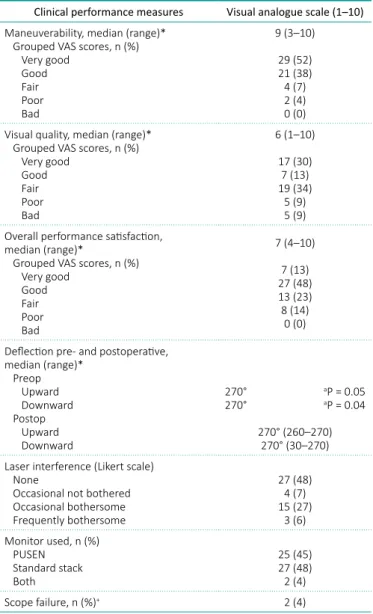
The UscopePU3022 median intraoperative maneu-verability score was 9/10 (3–10) of which 38% were rated as ‘good’ and 52% as ‘very good’. The median visual quality score was 6/10 (1–10) of which 18% were rated as ‘poor’ (9%) or ‘bad’ (9%), 37% as ‘fair’ and 43% as ‘good’ (13%) or ‘very good’ (30%). The median overall performance score was 7/10 (4–10) of which 14% were rated as ‘poor’, 23% as ‘fair’ and 61% as ‘good’ (48%) or ‘very good’ (13%). Laser inter-ference was reported as bothersome in 33% and not bothersome in 67%. The UscopePU3022 UTV 100 monitor was utilized in 45% of procedures, whereas the standard stack monitor was used in 48% with most investigators reporting a better view with their standard monitor (Table 3). Two UscopePU3022
Table 1. Baseline demographics
Characteristics Total
Number of patients 56
Gender (M: F ratio) 31: 25
Age (years) 57 (17–84)
Indication for ureteroscopy, n (%) Stone disease Diagnostic 54 (96)2 (4) Stone location, n (%)*+ Kidney Upper-pole Mid-pole Lower-pole Pelvis Ureter Upper Middle Lower 45 (83) 7 3 22 13 9 (17) 5 3 1 No. of stones, n (%)+ Single Multiple 33 (59)22 (39) Stone size (mm), n (%)+ <10 10–20 >20 21 (38) 29 (52) 1 (2) Stone density (Hounsfield units)+ 900 (380–1410)
Preoperative stenting, n (%) 24 (44) *One patient’s stone had passed spontaneously.
Sub-group (n = 25) analysis of UscopePU3022 per-formance measures in centers who only used a fiber optic (n = 10) or a digital reuseable scope as stan-dard (n = 15) showed that there was no statistical difference in the UscopePU3022 rating for maneu-verability, visual quality and overall performance. There was a trend towards UscopePU3022 vision rating being better when compared to the reuseable fiber optic than reusable digital over f-URS. (Supple-mentary Table 2).
procedures were terminated due to failure of scope deflection in one case and spontaneous loss of vi-sion in another. Both these cases were subsequently successfully completed with the standard f-URS at that center. Preoperative and postoperative median upward and downward deflections were 2700 and 2700, respectively.
UscopePU3022 performance was compared to the standard f-FURS (fiber optic and/or digital) at each center (Table 4). The median maneuverabil-ity score when compared to standard f-URS was 8/10 (4–10) of which 30% were rated as ‘equiva-lent’ and 60% as ‘better’. Median visual quality score was 5/10 (2–10) with 38% rating it as ‘worse’, 23% as ‘equivalent’ and 39% as ‘better’ than their standard f-URS. Median thumb and wrist fatigue scores were 10/10 (5–10) of which 84% and 87%, re-spectively, rated UscopePU3022 to be ‘better’ than their standard f-URS (Table 4). Investigators com-monly reported UscopePU3022 to be much lighter than their standard f-URS. The median overall score on UscopePU3022 performance when comparing to standard f-URS was 4/10 (2–10) with 55% reporting it as ‘worse’, 16% as ‘equivalent’ and 29% as ‘bet-ter’. When asked if they would use UscopePU3022 in their daily practice if the cost was equivalent or less, the median score was 7/10 (2–10).
Table 3. UscopePU3022 clinical performance measures
Table 2. Intra-operative procedure characteristics
Clinical performance measures Visual analogue scale (1–10) Maneuverability, median (range)*
Grouped VAS scores, n (%) Very good Good Fair Poor Bad 9 (3–10) 29 (52) 21 (38) 4 (7) 2 (4) 0 (0) Visual quality, median (range)*
Grouped VAS scores, n (%) Very good Good Fair Poor Bad 6 (1–10) 17 (30) 7 (13) 19 (34) 5 (9) 5 (9) Overall performance satisfaction,
median (range)*
Grouped VAS scores, n (%) Very good Good Fair Poor Bad 7 (4–10) 7 (13) 27 (48) 13 (23) 8 (14) 0 (0) Deflection pre- and postoperative,
median (range)* Preop Upward Downward Postop Upward Downward 270° aP = 0.05 270° aP = 0.04 270° (260–270) 270° (30–270) Laser interference (Likert scale)
None
Occasional not bothered Occasional bothersome Frequently bothersome 27 (48) 4 (7) 15 (27) 3 (6) Monitor used, n (%) PUSEN Standard stack Both 25 (45) 27 (48) 2 (4) Scope failure, n (%)+ 2 (4)
Data presented with median (range) for each parameter VAS = Visual Analog Scale
Missing data: visual quality (n = 3), overall performance (n = 1), monitor used (n = 2), laser interference (n = 7), deflection (n = 6), visual quality pre- and postoperatively (n = 27).
* Visual Analog Scale: bad = 1–2, poor = 3–4, fair = 5–6, good = 7–8 and very good = 9–10.
a Wilcoxon rank sum test comparing preop to postop deflection
+ Scope failure due to failure of hand piece (n = 1) and poor views (n = 1)
Intra-operative characteristics Median (range) Ease of insertion, median (Range)* 10 (2–10) PUSEN insertion, n (%)
Guide wire alone
Access sheath 16 (28)40 (72) Type of guide wire, n (%)
Sensor Terumo PTFE 16 (28) 10 4 2 Ureteral access sheath, n (%)
10/12 11/13 12/14 40 (70) 28 11 1 Laser characteristics in stone procedures (n = 54)
Laser used, n (%) Laser type 200–272 365 Frequency (Hertz) Energy (Joules) Laser time (minutes)
47 (87) 42 5 15 (3–70) 0.9 (0.4–1.5) 10 (1-60) Basket characteristics in stone procedures (n = 54)
Use of basket, n (%) Basket size (Fr) 1.7 1.9 2.2 30 (55) 5 14 11 * Visual Analog Scale, 1 = difficult insertion and 10 = easy insertion
with a lateral deflection lever, a 6.3fr shaft and 3.3F working channel. An in vitro study by Bolyu et al. 10 reported SemiflexM to have a comparable field of view (720) and the highest active defection (300/265 degrees) compared to six standard reusable scopes, but experienced the highest loss in deflection with a working instrument (up to 39%) and had sig-nificantly lower flow rates. The second generation SemiflexM is completely disposable, has improved 900 field of view, a 3.4 Fr working channel and an increased shaft diameter of 8.3 Fr. To our knowl-edge, no laboratory or clinical evaluations have been published on its performance.
Polyscope™ is another semi-disposable f-URS intro-duced in 2010 with a reusable fiber optic core, dis-posable 8Fr outer sheath, a syringe-like handle for 2650 unidirectional active deflection and a 3.6Fr working channel. Bader et al. performed an in vi-tro and clinical assessment of the Polyscope™ [17]. They measured its maximal active deflection to be 2600 which reduced by 1000 when inserting a 3Fr basket and reported a 50% loss in flow rate using a 220 um laser fiber. The field of view (960) and im-age quality were reported as comparable to standard f-URS. During clinical evaluation they described it as being easy to insert over a guide wire or through an access sheath, a 89.5% stone free rates in 40 la-ser lithotripsy procedures (mean stone size 1 cm), a mean op time of 26 minutes and no intra-opera-tive complications. The scope failure rate was 12.5% (5/40). Gu et al. reported a primary stone free rate of 89.5% in 86 patients (median stone size 1.23 cm) with nine patients requiring secondary procedures [18]. Giusti and colleague's initial clinical experience with the Polyscope™ reported the maneuverability or quality of vision was not appropriate to perform a satisfactory procedure [19]. Despite the SemiflexM and Polyscope™ being available on the market for the last ten years neither have been able to match the performance of current standard reusable f-URS and despite them being a cheaper alternative, they have not been integrated in current clinical practice. The introduction of LithoVue™ to the commercial market in 2015 has been a major step towards sin-gle-use f-URS becoming the next standard of care. LithoVue™ is the first single-use digital f-URS (EMA and FDA approved) which provides a 850 field of view, 2700 bidirectional active defection, a 3.6 Fr working channel, a 9.5 Fr shaft, a 7.7 Fr distal tip, measures 68cm in length and has a 4 hour usage time per scope. In the laboratory setting Prioetti et al. [11] compared LithoVue™ to a fiber optic (URF-V) and digital (URF-P5) reusable f-URS in four cadav-eric models. They reported it to be comparable across a wide range of parameters, including: ureteral
DISCUSSION
Single-use digital flexible ureteroscopes have the potential to be a cost-effective alternative to stan-dard reuseable f-URS and help address the ma-jor concerns regarding their durability and risk of cross-infection. Disposable f-URS are expected to be non-inferior to standard reusable scopes and should have the following properties: ergonomic, high quality image, optimal maneuverability and torque to access the entire collecting system, good irrigation flow with instruments inside the working channel (requires a 3.6Fr channel) and adequate bidirec-tional active deflection (270:270 degrees) [9, 11, 16]. Before disposable f-URS are considered as a viable alternate to standard reusable f-FURS, it is impera-tive they undergo comprehensive evaluation regard-ing their technological design, clinical efficacy and cost-effectiveness.
First generation fiber optic reuseable scopes such as SemiflexM and Polyscope™ underwent their ini-tial evaluation as early as 2009. The original model of SemiflexM was a semi disposable scope consisting of a reusable eye piece attached to a straight handle
Table 4. Rated UscopePU3022 performance compared to standard reusable ureteroscope
Comparative performance measures Maneuverability
Grouped VAS scores, n (%) Better Equivalent Worse 8 (4–10) 36 (64) 17 (30) 3 (6) Visual quality
Grouped VAS scores, n (%) Better Equivalent Worse 5 (2–10) 22 (39) 13 (23) 21 (38) Wrist fatigue
Grouped VAS scores, n (%) Better Equivalent Worse 10 (5–10) 49 (87) 7 (13) 0 (0) Thumb fatigue
Grouped VAS scores, n (%) Better Equivalent Worse 10 (5-10) 47 (84) 9 (16) 0 (0) Overall UscopePU3022 performance
Grouped VAS scores, n (%) Better Equivalent Worse 4 (2–10) 16 (29) 9 (16) 31 (55) Would you use UscopePU3022 in your clinical
practice if costing was equivalent or better? 7 (2–10) VAS – Visual Analog Scale
Data presented with median (range) for each parameter
their satisfaction with UscopePU3022 overall perfor-mance as ‘good’ or ‘very good’. The UscopePU3022 intraoperative failure rate was 4% (2/56) which is comparable to the initial evaluation of LithoVue™ (5%) [12]. The reasons for failure were also simi-lar with one due to loss of vision and the other due to active deflection failure.
access, maneuverability, image quality, navigation time to reach the calyces and deflection with or without a 1.9 Fr basket or 275 um laser fiber. A further study in a live porcine model by Wiseman et al. [20] com-pared LithoVue™ to a standard fiber optic reusable f-URS and reported excellent image quality, ma-neuverability and navigation in a complex calyceal system. The first clinical evaluation of Lithovue was performed by Doizi et al. [12] as part of a mul-ticentric European feasibility study which assessed its preoperative and postoperative performance with regards to image quality, maneuverability and over-all performance in 40 patients (5 per institution) treating renal stones in 92% of cases. Preoperative image quality and maneuverability were rated as ‘good’ or ‘very good’ in 95% of patients with no sta-tistical differences in these measures when assessed postoperatively. At final evaluation the median bidi-rectional active deflection was 2700 before and after use with only one scope not maintaining this at the end. The overall performance satisfaction was ‘ac-ceptable’ in 12.5%, ‘good’ in 17.5% and ‘very good’ in 70%. The scope failure rate was 5% (2/40) with one breaking after forced deflection and the other having spontaneous loss of vision.
LithoVue™ is the first single-use digital scope to be extensively evaluated in the laboratory and clinical setting with initial data showing it to be equivalent to standard reuseable f-URS. Although its commer-cial use is growing internationally its widespread use has been limited due to its current cost with a recent cost-benefit analysis by Martin et al. fa-voring reuseable scopes compared to Lithovue™ in high volume centers (>99 f-URS per year) [21]. The UscopePU3022 is a new single-use digital f-URS which has promised equivalent clinical perfor-mance to Lithovue™ and standard f-URS, but deliv-ered at a more affordable cost.
This study reports on the initial clinical experience of the UscopePU3022 by international experts working in high volume centers. UscopePU3022 performed very well intraoperatively with regards to maneu-verability and active deflection. There were mixed reviews regarding intraoperative image quality with 52% rating UscopePU3022 as ‘fair’ to ‘bad’ and 48% rating it as ‘good’ or ‘very good’. The investigator’s main complaint was that the image was too dark, es-pecially at the periphery, which was even more pro-nounced when navigating the renal pelvis. In fact, one procedure was abandoned due to poor views without any report of bleeding. Interestingly, the au-thors reported better image quality when using their own standard monitor stack compared to using the Uscope UTV 100 monitor. Despite the reported is-sues with image quality, 61% of investigators rated
Supplementary table 1. Summary of standard flexible ure-teroscopes used at each center
Standard reusable scope Fiber optic or digital Austria Wolf Cobra vision Digital Denmark Olympus URF-P2 and Storz Flex X2/Xc Fiber optic and digital
France Olympus URF-P2 and Storz Flex Xc Fiber optic and digital
Germany Stortz Flex X2/Xc Fiber optic and digital
Italy Stortz Flex X2/Xc Fiber optic and digital
Spain (Santiago
de Compostela) Olympus URF-P5 Fiber optic Spain (Barcelona) Stortz Flex Xc Digital
Netherlands Olympus URF-P2 and Storz Flex Xc Fiber optic and digital
Sweden Storz Flex Xc Digital
UK (Cambridge) Stortz Flex X2 Fiber optic
UK (Oxford) Olympus URF-P2 and Stortz Flex X2/Xc Fiber optic and digital
Supplementary table 2. Sub-group analysis (n = 25) compar-ing UscopePU3022 rated performance to centers who used either a fiber optic or digital standard reusable ureteroscope
Comparative performance measures Standard scope Fiber optic n = 10 Digitaln = 15 P-value UscopePU3022 maneuverability
Grouped VAS scores, n (%) Better Equivalent Worse 5 (50) 4 (40) 1 (10) 5 (33) 9 (60) 1 (7) aP = 0.62
UscopePU3022 visual quality Grouped VAS scores, n (%)
Better Equivalent Worse 4 (40) 1 (10) 5 (50) 3 (20) 2 (13) 10 (67) aP = 0.55
Overall UscopePU3022 performance Grouped VAS scores, n (%)
Better Equivalent Worse 4 (40) 1 (10) 5 (50) 5 (33) 2 (13) 8 (54) aP = 0.93
Centers which used both a reusable fiber optic and a digital f-URS as standard were excluded (n = 31)
VAS = Visual Analog Scale
Grouped VAS scores: 1–4 = worse, 5–6 = equivalent and 7–10 = better
aχ2 test assessing for a difference in the UscopePU3022 performance rating when
Osther PJ: Boston Scientific, Coloplast, Bonvisi, Olympus. Seitz C: None.
Neal N: None.
Turney B: Boston Scientific. Hasan M: None.
Traxer: Boston Scientific, Coloplast, Olympus, Rocamed, EMS. Wiseman: Boston Scientific, Coloplast, Olympus, EMS, Uroscreen Ltd. ACkNOwLEDgMENTS
The flexible ureteroscopes (UscopePU3022) used in this study were supplied by Zhuhai Pusen Medical Technology Company Limited. The company had no influence on design, data collection and inter-pretation of the study.
USCoPe ASSeSSMenT PUSen Date of procedure: Operator: Location: Patient information: Patient age: Patient gender: Indication for FURS: Location of stone Ureter :
Number of stones:
Size of largest stone (if applicable: measure largest diameter on axial image):
HU of largest stone: Was the patient prestented?
Vision preop (use image provided to assess quality)
Please capture digital image of picture supplied and send after case with this proforma
Deflection preop:
Please take photo prior to use in this case showing maximal deflec-tion in both direcdeflec-tions (We will measure actual deflecdeflec-tion from the images)
Up deflection:……….degrees Down deflection:………degrees
Insertion of the device:
Over wire alone:
If Yes, please state wire type: Ease of insertion (1: difficult, 10 easy)
1 2 3 4 5 6 7 8 9 10
Comment ………
Access Sheath
Was insertion of an access sheath attempted (even if failed)? Size of access sheath attempted ……… Type (brand) of access sheath attempted ……… Was the access sheath inserted successfully? Yes/No
Procedural details
Was a laser fibre used: Yes If Yes, size of fibre: Laser settings: Frequency Energy Lazing time:
This study also rated the UscopePU3022 clinical performance compared to the standard f-URS (see supplementary Table 1) used at each center. Usco-pePU3022 performed very well with regards to ma-neuverability and limb fatigue, with these being re-ported as ‘equivalent’ or ‘better’ in 94% and 100% of cases, respectively. Once again image quality had a varied rating with 38% rating it as ‘worse’ and 62% as ‘equivalent’ or ‘better’. The UscopePU3022 overall clinical performance when compared to the standard f-URS was rated as ‘worse’ in 55% of cases. However, when the investigators were asked if they would use UscopePU3022 in their clinical practice, if it was cost equivalent or more cost effective, it re-ceived high scores.
Our study has several limitations. Although we are the first study to compare Uscope™3022 to standard f-URS we did not perform specific head-to-head compar-isons as the type of standard scope varied from center to center. This study, however, should be considered as the preliminary evaluation in this respect. The small number of procedures are also a limiting factor but are similar in frequency to the initial evaluations of alternate single-use f-URS available in the market [10, 11, 18]. We also did not measure the stone free rate or postoperative complications which are important pa-rameters to be assessed in future studies.
CONCLUSIONS
UscopePU3022 is a new single-use flexible uretero-scope, which on testing performed well with regards to maneuverability, deflection and limb fatigue and appears to be at least non-inferior to standard flex-ible ureteroscopy (f-URS) with regards to these pa-rameters. Poor intraoperative image quality is a sig-nificant concern for UscopePU3022 and overall most investigators rated it as worse than standard f-URS. Despite this UscopePU3022 scored highly when in-vestigators were asked if they would use it in their practice and if it was cost-effective to do so. Further research is required to assess its surgical outcomes and cost-effectiveness.
CONfLICTS Of INTEREST Johnston TJ: None.
Baard J: Boston Scientific, Coloplast, Storz. De la Rosette J: None.
Doizi S: None. Giusti G: None.
Knoll T: Boston Scientific, Olympus, Karl Storz, Dornier, Lumenis. Proietti S: None.
Brehmer M: None.
Emiliani E: Boston Scientific, Cook. Pérez Fentes DA: None.
What flexible ureteroscope do you usually use?
How would you rate the UScope vision compared to the flexi scope you usually use?
1–4 = worse, 5–6 = equivalent and 7–10 = better
1 2 3 4 5 6 7 8 9 10
How would you rate the UScope manoeuvrability compared to the flexi scope you normally use?
1–4 = worse, 5–6 = equivalent and 7–10 = better
1 2 3 4 5 6 7 8 9 10
How would you rate wrist fatigue with the UScope, compared to the flexi scope you usually use?
1–4 = worse, 5–6 = equivalent and–7-10 = better
1 2 3 4 5 6 7 8 9 10
How would you rate thumb fatigue with the UScope compared to the flexi scope you usually use?
1–4 = worse, 5–6 = equivalent and 7–10 = better
1 2 3 4 5 6 7 8 9 10
Overall, how does this scope rate compared to the flexi scope which you normally use?
1–4 = worse, 5–6 = equivalent and 7–10 = better
1 2 3 4 5 6 7 8 9 10
Would you be willing to use this scope regularly if costing compared to your current scope were equivalent or better?
1: Absolutely not, 10: definitely
1 2 3 4 5 6 7 8 9 10
Any other comments: Total energy……….
Was there any interference of the image when using the laser? none, occasional not bothersome, occasional bothersome or frequently bothersome Use of basket: If Yes, then Size:
Manoeuvrability during the procedure
1: poor / difficult, 10: excellent, easy
1 2 3 4 5 6 7 8 9 10
Comment: ………
Quality of Vision during the procedure
1: poor, 10 very good
1 2 3 4 5 6 7 8 9 10
What viewing monitor did you use during the case? Comment:
Postprocedure details
Vision postop / at end of procedure
Please capture digital image of picture supplied and email back with this form.
Deflection postop/ at end of procedure:
Please take photo after use in this case showing maximal deflection in both directions (We will measure actual deflection from the images)
Up deflection:………..………… degrees Down deflection:………. degrees Did the scope fail during the procedure?
Comment: ………
Overall assessment
How would you rate the UScope overall? 1: poor, 10: very good
1 2 3 4 5 6 7 8 9 10
1. Ordon M, Urbach D, Mamdani M, Saskin R, Honey RJ, Pace KT. A population based study of the changing demographics of patients undergoing definitive treatment for kidney stone disease. J Urol. 2015; 193: 869-874.
2. Turney BW, Reynard JM, Noble JG, Keoghane SR. Trends in urological stone disease. BJU Int. 2012; 109: 1082-1087. 3. Ghani KR, Sammon JD, Karakiewicz PI,
et al. Trends in surgery for upper urinary tract calculi in the USA using the Nationwide Inpatient Sample: 1999-2009. BJU Int. 2013; 112: 224-230. 4. Eisner BH, Kurtz MP, Dretler SP.
Ureteroscopy for the management of stone disease. Nat Rev Urol. 2010; 7: 40-45.
5. Monga M, Best S, Venkatesh R, et al. Durability of flexible ureteroscopes:
a randomized, prospective study. J Urol. 2006; 176: 137-141.
6. Karaolides T, Bach C, Kachrilas S, Goyal A, Masood J, Buchholz N. Improving the durability of digital flexible ureteroscopes. Urology. 2013; 81: 717-722.
7. Carey RI, Gomez CS, Maurici G, Lynne CM, Leveillee RJ, Bird VG. Frequency of ureteroscope damage seen at a tertiary care center. J Urol. 2006; 176: 607-610. 8. Chang CL, Su LH, Lu CM, Tai FT, Huang YC,
Chang KK. Outbreak of ertapenem-resistant Enterobacter cloacae urinary tract infections due to a contaminated ureteroscope. J Hosp Infect. 2013; 85: 118-124.
9. Emiliani E, Traxer O. Single use and disposable flexible ureteroscopes. Curr Opinin Urol. 2017; 27: 176-181.
10. Boylu U, Oommen M, Thomas R, Lee BR. In vitro comparison of a disposable flexible ureteroscope and conventional flexible ureteroscopes. J Urol. 2009; 182: 2347-2351. 11. Proietti S, Dragos L, Molina W, Doizi S,
Giusti G, Traxer O. Comparison of New Single-Use Digital Flexible Ureteroscope Versus Nondisposable Fiber Optic and Digital Ureteroscope in a Cadaveric Model. J Endourol. 2016; 30: 655-659.
12. Doizi S, Kamphuis G, Giusti G, et al. First clinical evaluation of a new single-use flexible ureteroscope (LithoVue): a European prospective multicentric feasibility study. World J Urol. 2017; 35: 809-818.
13. Usawachintachit M, Isaacson DS, Taguchi K, et al. A Prospective Case-Control Study Comparing LithoVue, a Single-Use, Flexible Disposable Ureteroscope, with Flexible, Reusable Fiber-Optic Ureteroscopes. J Endourol. 2017; 31: 468-475.
14. Marchini GS, Batagello CA, Monga M, et al. In Vitro Evaluation of Single-Use Digital Flexible Ureteroscopes: A Practical Comparison for a Patient-Centered Approach. J Endourol. 2018; 32: 184-191. 15. Salvadó JA, Olivares R, Cabello JM, et al.
Retrograde intrarenal surgery using the single – use flexible ureteroscope Uscope 3022 (Pusen™): evaluation of clinical results. Cent European J Urol. 2018; 71: 202-207.
16. Traxer O. Flexible ureterorenoscopic management of lower-pole stone: does the scope make the difference? J Endourol. 2008; 22: 1847-1850.
17. Bader MJ, Gratzke C, Walther S, et al. The PolyScope: a modular design, semidisposable flexible ureterorenoscope system. J Endourol. 2010; 24: 1061-1066. 18. Gu SP, Huang YT, You ZY, et al. Clinical
effectiveness of the PolyScope endoscope system combined with holmium laser lithotripsy in the treatment of upper urinary calculi with a diameter of less than 2 cm. Exp Ther Med. 2013; 6: 591-595. 19. Giusti G, Taverna G, Zandegiacomo S,
et al. POLYSCOPETM, the first disposable flexible ureteroscope: a breakthrough
in flexible endoscopy. Eur Urol Suppl. 2011; 10: 351.
20. Wiseman O, Keeley F, Traxer O, Giusti G, Lipkin M, Preminger G. A single-use disposable digital flexible ureteroscope (Lithovue™) compared to a non-disposable fibre-optic flexible ureteroscope in a live porcine model. Eur Urol Suppl. 2016; 15: eV76.
21. Martin C J, McAdams SB,
Abdul-Muhsin H, et al. The Economic Implications of a Reusable Flexible Digital Ureteroscope: A Cost-Benefit Analysis. J Urol. 2017; 197: 730-735.