*Asst. Prof. Dr., The University of Bingol, Bingol, Turkey, [email protected]
Learners’ Perceptions towards Interactive Multimedia Environments
Dil Öğrenenlerin Etkileşimli Çoklu Ortama Yönelik Algıları
Vehbi TÜREL*
ABSTRACT: In this study, 113 participants’ (N= 113) perceptions of a specific Interactive Multimedia Environment (IME) (i.e. World Talk English software) and any differences between their perceptions in terms of gender, age, job and Foreign Language Learning (FLL) period were investigated thoroughly in the spring of 2012. The study was both quantitative and qualitative in nature. The results were analysed with SPSS (i.e. Mean, Std. Deviation, Independent Samples t Test, ANOVA, Chi-square). The results revealed that the language learners (LLs) were overwhelmingly in favour of the use of the IME for FLL. The LLs believed that not only did the IME benefit them in different ways, but it also contributed to the enhancement of their learning. They also felt that the IME could and should have been further improved. Moreover, the results revealed that there were some significant differences between their perceptions in terms of gender, age and job.
Keywords: multimedia, language software, CALL, perceptions, language learners
ÖZ: Bu çalışmada, 2012 yılının ilkbaharında 113 katılımcının (N=113) bir dil öğrenme programına (World Talk English) yönelik algıları ve bu algılar ile cinsiyet, yaş-grubu, meslek ve yabancı dil öğrenme süresi arasında bir farklılık olup olmadığı araştırıldı. Çalışmada hem nicel hem de nitel yöntem kullanılmıştır. Çalışmanın sonuçları SPSS programı ile (Ortalama, Standart Sapma, Bağımsız Örnekleme t Testi, Yüzde, Varyans Analizi, Ki-kare) analiz edildi. Katılımcılar, programı İngilizceyi yabancı dil olarak öğrenme konusunda çok olumlu gördüklerini ifade ettiler. Katılımcılar, programın hem değişik şekillerde kendilerine faydalı olduğunu hem de İngilizcelerini ilerletme konusunda yardımcı olduğunu belirttiler. Katılımcılar, aynı zamanda, World Talk English programının daha iyi bir şekilde hazırlanabileceğini ve hazırlanması gerektiğini ifade ettiler. İlave olarak, katılımcıların algıları ile cinsiyet, yaş grubu ve meslek arasında istatistiksel olarak önemli farklılıkların olduğu ortaya çıktı.
Anahtar sözcükler: çoklu ortamlı medya, dil öğrenme programı, bilgisayar destekli dil öğrenimi (BDDÖ), algılar, dil öğrenenler
1. INTRODUCTION
The foremost distinctions between interactive multimedia environments (IMEs) and conventional materials (CMs), and the positive aspects of the former are already well-known (Chou, 2012; Mosalanejad et al., 2012; Turel, 2011; Baturay et al., 2010; Yu et al., 2010). Here, the positive aspects of IMEs are briefly examined and aligned with foreign language learning (FLL) hypotheses and theories first and then their limitations are summarised.
IMEs enable materials writers to combine and deliver a wide range of digital elements on the same computer platform more efficiently (Heron et al., 2002; Ridgway, 2000). Such a combination and delivery provides a multidimensional, multi-sensory environment in which rich, efficient, instant, comprehensible, optimum and meaningful input and feedback can be presented (Turel, 2012). Moreover, LLs’ attention can be drawn to forms and meaning in input. Such aspects correspond with the dual-coding theory, the generative theory of multimedia (Ginther, 2002; Mayer, 1997), the redundancy hypothesis (Al-Seghayer, 2001; Sherwood et al., 1987), the comprehensible input hypothesis and theory (Tschirner 2001, p.311; Schmidt, 1990, p.139) and the noticing hypothesis (Nicholas et al. 2001, p.721; Schmidt 1990, p.141).
IMEs enable user control; ease of use; and a navigational and tension-free environment, especially during self-study. This is a requirement of both person perception theory and social learning theory, which suggest that ‘people’s judgement about their potential ability to perform well or to cope in a situation actually affects their efforts…’ (Robinson, 1991, p.157).
IMEs provide the opportunity to produce immediate, multidimensional and multi-sensory output (Turel, 2012), which is a requirement for comprehensible output. The opportunity to produce comprehensible output further promotes noticing, contributes to FLL through ‘hypothesis
testing’ and serves as a metalinguistic function (i.e. the ability/opportunity to think about and analyse the produced forms and structures) (Shehadeh, 2002, p.608; Tschirmer, 2001, p.311).
Such aspects of IMEs can motivate language learners (LLs), are appreciated by them (Türel, 2010), and praised (Herron et al., 2002) and considered 'very helpful' (Tschirner, 2001, pp.312-3). Such aspects are also a requirement of social-psychological theory and the socio-educational model, which focus on the role of attitudes and motivation in FLL (Gardner, 1985, p.158).
IMEs provide a non-linear editing facility. Thus, digitised audio/video can be cut and presented in any order and form. This brings advantages such as the option of instantly accessing clips in non-linear form; the facilities of stepping and isolating; instant record, replay and comparison and the ability to synchronise text and graphics. Such aspects meet the needs of LLs, who vary in their learning-style preferences (Dunn, 1983; Reid, 1987), and they can also make learning enjoyable and the provided input more comprehensible (Al-Seghayer, 2001, p.224). It is due to these features that LLs see IMEs as the most popular choice and fun and consider IMEs as the media type that helps them understand the input best (Brett, 1997; Stevens, 1995). LLs show increasingly positive attitudes with increasing exposure to IMEs and prefer IMEs to CMs (Deville et al., 1996; Crosby et al., 1994).
Hyperlinks and efficient combinations grant interactivity. LLs can access dictionaries, syntax, subtitles, feedback or re-listen to texts without losing time, which can present most advantageous combinations in dissimilar forms that can contribute in terms of comprehension and retention of information (Turel, 2012; Moreno & Mayer, 2002). These aspects can enable LLs to discover the difficulties, the right solutions, what the rules are; to evaluate their mistakes and weaknesses; and to detect the underlying reasons by assessing their answers, recording and scoring them, identifying and elucidating mistakes (Mangiafico, 1996). Such functions make available more real-world learning contexts and more authentic and interactive tasks (Ashworth, 1996). Such aspects are a requirement of autonomous learning theory, which posits that LLs should take control of their learning and prepare for real-life (Voller, 1997, p.106).
Presenting LLs with many alternatives makes IMEs highly motivating. Even when LLs make mistakes, this does not de-motivate them as they have the opportunity to receive instantaneous and meaningful feedback, which is appreciated (Gillespie & McKee, 1999; Herrington & Oliver, 1997). Feedback can be made up of differing components (i.e. audio, video, visuals, text or optimum combinations) which meet LLs’ both visual and acoustic needs, and it can be provisional (Turel, 2012). Such feedback can help LLs to (1) discover what and why they could not understand and (2) overcome the difficulties (ibid). This can channel and lead LLs to develop effective strategies, which is what material-writers need to accomplish.
IMEs can prepare LLs more efficiently for the tasks (Chung & Huang, 1998) and equip them to overcome difficulties such as unfamiliar items, proper names, cultural difficulties, syntax, fast speech, and unfamiliar accents. For example, unfamiliar syntax and lexis can be explained through hypertexts such as dictionaries (De Ridder, 2002). Similarly, cultural differences can be expressed in plain words and illustrated through simple interactive samples, pictures or video clips in the form of annotations, feedback or advance organisers (Turel, 2014; Turel & McKenna, 2013). Such a provision is also a requirement of socio-cultural theory, which focuses on and emphasises the importance of culture in FLL (Platt & Brooks, 2002, p.369; Vygotsky, 1978). Likewise, unknown accents and fast speech can be overcome by providing subtitles, giving control of the speech rate, or by providing slow versions (Zhao, 1997). This is also a requirement of the cognitive load theory and working memory. LLs have limited processing capacity and thus proper allocation of cognitive information is critical to learning (Kalyuga, 2000, p.161).
IMEs also had their own limitations a decade ago due to the limitations in the field of educational technology. For example, the quality of compressed video clips would diminish (Soboleva & Tronenko, 2002). Some IMEs on the market even used to be called 'shovelware'
(Clifford, 1998, pp.2-8; Le Mon, 1988, p.39). However, very rapid development has occurred in the field of educational technology since then. Thus, the technological dimension is no longer the main problem (Turel & McKenna, 2013). Despite rapid development in the field of educational technology and extensive research in the field of IMEs (Hwa et al., 2012; Abobaker & Hussein, 2012; Godwin-Jones, 2010), there are still many IMEs on the market some aspects of which are not sophisticated pedagogically or psychologically (Turel, 2010; Türel, 2000; Draper 2009; Trinder, 2002). Some IMEs even feature spelling errors (TES Teacher, 2004). The limitations of IMEs at present essentially stem from materials writers, not the technology itself. To be able to design and develop cost effective and professional IMEs, there are certain scientific educational findings and implications that need to be implemented at every single stage of programme design and development and teams of experts are needed (Turel & McKenna, 2013; Türel, 2004; Draper, 2009; Peter, 1994). Therefore, the research questions are:
1. What are the participants’ general perceptions of the IME? 2. For which skills do the participants think that the IME is suitable? 3. How good is the IME for self-study?
4. How can the IME be further improved?
5. Are there any differences between their perceptions in terms of gender, age, job and FLL period?
2. THE STUDY
2.1. The Aim of the StudyThis study attempted to find out how the LLs valued the use of IME (1) in general, (2) in terms of which skills it was useful, and (3) in terms of self-study. It also aimed to find out (4) whether the participants thought that IME could be further improved or not and (5) whether there were any differences between their perceptions in terms of gender, age, job and FLL period. 2.2. The Participants
The LLs were 113 non-native speakers (58.4% male, 40.7% female). Their level in listening was intermediate. 70.8 % were undergraduate students and 29.2% were teaching staff. They were computer literate and were learning English as a foreign language. Their age-range was: 20 and below group: 31%, 21-30 group: 46%, 31-40 group: 20.4%, 41-50 age-group: 1.8% and 51-60 age-age-group: 0.9%.
2.3. The Software
World Talk English software was used in this study. The underlying assumptions were: (1) it was the right level for the LLs (i.e. intermediate). (2) It aimed to develop and practise LLs’ listening and speaking skills as a part of FLL, which the LLs needed most. (3) It was professional software. (4) It was created by a professional international software company.
The software consists of four sections: (1) The main section features 10 interactive games featuring topics such as food, weather, directions, sentence construction, numbers, descriptions, animals and so on. These gradual activities cover a wide range of subjects and give LLs important practical skills that they can use immediately. (2) Listening to Dialogues (Recording Studio) section enables LLs to record themselves and compare their pronunciation with that of native speakers. (3) The TV Quiz section allows LLs to compete with a native speaker. (4) The Stories (Dictation and Worksheets) section provides LLs with the opportunity to listen to stories and dictate, and then compare their dictation with the provided transcriptions and answer the pertinent reading questions. While LLs play interactive language games and complete the pertinent tasks correctly, they earn points for every correct answer. High score winners can go on to win bronze, silver and gold awards, which they can also print out as a record of their achievement.
Although the IME is advertised as aiming to help LLs to further develop their speaking and listening, the Stories (Dictation and Worksheets) section also improves their reading and writing skills. The IME prepares LLs for real-life situations with very motivating listening. It teaches them to recognise key words in everyday situations and broaden their vocabulary.
2.4. The Procedure
The participants accessed the IME in the same class at different times. The lab had 24 PCs. Thus, a maximum of 24 participants could use the IME at one time. The LLs were introduced to the IME in the first ten minutes of the first session. They were then requested to complete the LLs’ profiles questionnaire. Following that, they were free to use the IME as they wished. They used the IME at least for two sessions.
2.4. Methodology
Quantitative and qualitative researches were used (Tseng & Yeh, 2013; Masgoret & Gardner, 2003). The research required the use of questionnaires, reflective journals, observations and interviews (Tseng & Yeh, 2013; Nunan, 1993; Dunkel, 1991). Brett's data collecting procedures (1999) were used. New items were added. All were further improved and tested.
The LLs’ pre-exposure personal profile questionnaire consisted of 10 multiple-choice and 13 Likert scale items. The questionnaire about the IME (ɑ = .89) included 41 multiple-choice and Likert scale items from strongly disagree to strongly agree. It also featured multiple measures of similar attitudes so that inaccurate answers could be guarded against. The questionnaire was further classified along with the existing literature into themes to provide a better understanding of the LLs’ perceptions. The themes are (a) general perceptions of the IME (ɑ = .894), (b) perceptions in terms of the usability of the IME for the three skills (i.e. listening, speaking and writing) (ɑ = .847), and (c) perceptions in terms of the usability of the IME for self-study (ɑ = .863). It was decided that it was also necessary to add the option of ‘writing’ to the question about the usability of the IME for developing skills (in addition to ‘listening’ and ‘speaking’), although the IME is advertised as aiming to help LLs to further develop their speaking and listening of the language. The underlying assumptions were two-fold: (1) The IME features some good aspects which can further improve the target LLs’ writing, as emphasised above. (2) Adding another option to the questionnaire can further avoid channelling the LLs to certain available options.
113 LLs answered the questionnaire about the IME, which was administered immediately after using the IME. 89 (out of 113) LLs answered the open-ended questions. Answering the open-ended questions required more time and effort in comparison to ticking one or a few available options out of a group of options. Therefore, it is assumed that this was the reason why not all participants answered the open-ended questions. The LLs were also requested to keep a reflective journal by writing down the positive and negative aspects of the IME and how it could be further improved while they were using it. 13 (out of 113) LLs wrote down what they thought of the IME and how it could be further developed. It is assumed that the LLs preferred to focus on the IME, rather than writing down what they thought of the IME, which is particularly difficult while working with the IME. After completing the questionnaires, the LLs were invited to participate in a focus group (i.e. post-hoc interview) to further discuss the emerging as well as relevant issues, which lasted half an hour. 15 (out of 113) LLs attended and were interviewed in a group, as this allowed the interviewees to reflect on what the others in the group revealed and build upon their opinions. All data collection was anonymous and the collected data were not shared with anyone who knew the participants. The data were analysed by three different researchers to avoid subjective interpretation and were categorised according to categories that were extracted from the data itself and then applied.
3. FINDINGS
The results were presented in five parts, corresponding to the five research questions. The quantitative data was analysed with SPSS. The analysis of the qualitative data was conducted by examining the participants’ responses gathered from the reflective journals, open-ended questions and post-hoc interviews. It focussed on the shared themes among the responses. In the analysis and discussion of the qualitative data, ranges of themes emerging from the qualitative data were identified, which were consistent with the results of the quantitative data.
3.1. World Talk English is Useful
The observations, which were carried out by two non-participating observers, confirmed that the participants were attentive, engaged and interested. They used all sections of the IME. However, some participants’ concentration began to wane a little towards the end. While certain sections were found not challenging, some were found very difficult. Some LLs had technical difficulties such as not being able to (a) hear their recorded voice and (b) adjust the volume level or (c) due to malfunctioning computers. Such teething problems were dealt with by the observers. Many LLs wanted to re-use the IME. Most participants asked if there were similar IMEs that they could work with. Many made repeated use of the TV Quiz. The majority loved the TV Quiz. One participant was heard to have said: “If I knew the software was so entertaining and useful, I would come earlier”. The majority wanted to have a copy of the IME. A few participants were not keen to use the IME. The reason given was a lack of free time.
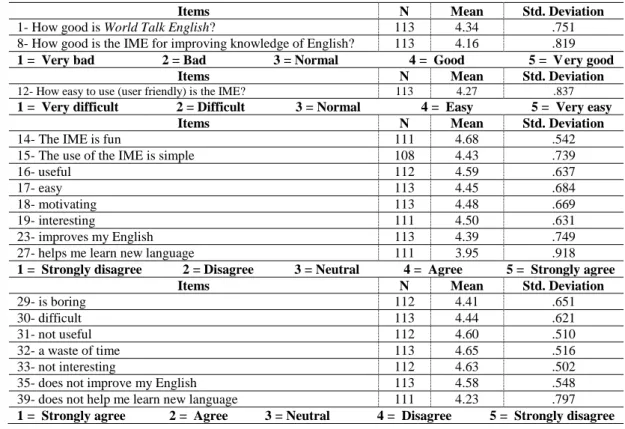
The analysed results indicated that the LLs’ general perceptions of the IME were very positive (Table 1). The LLs believed that the IME (a) was very good and useful (M = 4.34), (b) improved their knowledge of English (M = 4.16), their English (M = 4.39), helped them learn new language (M = 3.95), and (c) was user friendly (M = 4.27), fun (M = 4.68), simple (M = 4.43), useful (M = 4.59), easy (M = 4.45), motivating (M = 4.48), and interesting (M = 4.50). Table 1: Mean Score for the Participants’ General Perceptions of the IME
Items N Mean Std. Deviation
1- How good is World Talk English? 113 4.34 .751
8- How good is the IME for improving knowledge of English? 113 4.16 .819 1 = Very bad 2 = Bad 3 = Normal 4 = Good 5 = V ery good
Items N Mean Std. Deviation
12- How easy to use (user friendly) is the IME? 113 4.27 .837
1 = Very difficult 2 = Difficult 3 = Normal 4 = Easy 5 = Very easy
Items N Mean Std. Deviation
14- The IME is fun 111 4.68 .542
15- The use of the IME is simple 108 4.43 .739
16- useful 112 4.59 .637
17- easy 113 4.45 .684
18- motivating 113 4.48 .669
19- interesting 111 4.50 .631
23- improves my English 113 4.39 .749
27- helps me learn new language 111 3.95 .918
1 = Strongly disagree 2 = Disagree 3 = Neutral 4 = Agree 5 = Strongly agree
Items N Mean Std. Deviation
29- is boring 112 4.41 .651
30- difficult 113 4.44 .621
31- not useful 112 4.60 .510
32- a waste of time 113 4.65 .516
33- not interesting 112 4.63 .502
35- does not improve my English 113 4.58 .548
39- does not help me learn new language 111 4.23 .797 1 = Strongly agree 2 = Agree 3 = Neutral 4 = Disagree 5 = Strongly disagree
The IME was not boring (M = 4.41, Table 1). The use of the IME was neither difficult (M = 4.44) nor a waste of time (M = 4.65). The IME was beneficial (M = 4.60), and interesting (M = 4.63). The IME improved their English (M = 4.58), helped them learn new language (M = 4.23). 97% thought that IME was mostly suitable for the intermediate level. The quantitative results were supported by most of the qualitative data. When they were asked: “What do you think of the IME?” the following reactions were revealed:
The IME is very useful (79 times mentioned).
“I really liked the software. I think the program can be useful in particular for listening and speaking. …” (Subject T02)
“The software is definitely useful, except for grammar. I feel as if I went and spoke to the native speakers in the target country” (ST02)
Entertaining (35 times mentioned)
“Using the software is a pleasure and entertaining” (ST04)
“It was pleasure giving software. I did not realise how quickly the time passed while I was using the software. It was making me more willing to learn the language” (SS064). (The software) is easy to use (18 times mentioned)
“… Students can access what they want very easily” (SS010)
“The software is very usable and easy to use. Being entertaining further makes the software more useful.” (SS059)
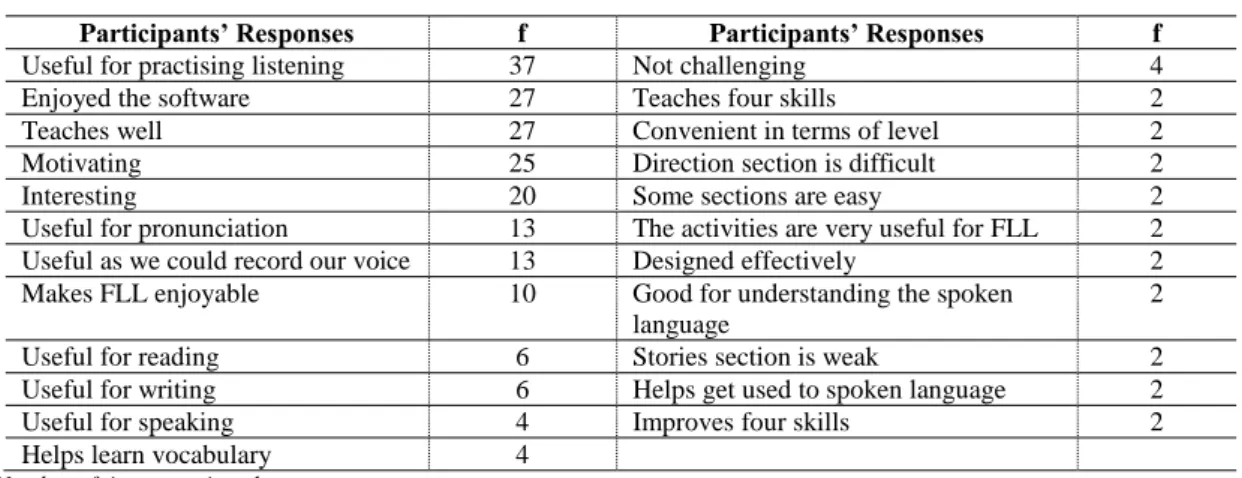
Moreover, the following comments emerged from the qualitative data (Table 2) Table 2: Further Comments about the IME
Participants’ Responses f Participants’ Responses f
Useful for practising listening 37 Not challenging 4
Enjoyed the software 27 Teaches four skills 2
Teaches well 27 Convenient in terms of level 2
Motivating 25 Direction section is difficult 2
Interesting 20 Some sections are easy 2
Useful for pronunciation 13 The activities are very useful for FLL 2 Useful as we could record our voice 13 Designed effectively 2 Makes FLL enjoyable 10 Good for understanding the spoken
language
2
Useful for reading 6 Stories section is weak 2
Useful for writing 6 Helps get used to spoken language 2
Useful for speaking 4 Improves four skills 2
Helps learn vocabulary 4
f: Number of times mentioned
The LLs were asked what the strengths of the IME were. The following reactions were revealed (Table 3).
Table 3: The Strengths of the IME
Participants’ Responses f Participants’ Responses f
Improves and very useful for listening skills 70 Enable LLs to revise 6 Being visual 38 Very good for daily life vocabulary and
expressions 6
Entertaining aspect of the software 34 Improving listening and speaking 5 Learn while you get entertained 16 Improves listening, reading & writing
Improves all skills 5
Improves writing 15 Directions 4
Quiz 13 Being visual and kinaesthetic 4
comparing with that of the native speaker
Motivating & Easy to use 12 Activities are very good / useful 4 Self-control 12 Activities meet the needs of all senses 4 Improves speaking 11 Teaching through games is the most
effective aspect 4
Contents 11 You feel as if you are in England and
encounter the daily life English 3
Teaches effectively 10 Targets a wide range of LLs 2
Improves vocabulary 9 Level 2
Being visual and acoustic 7 Design 2
Improves listening and writing 6 Improving more than one skill 2 Being able to revise as many times as you want 6 Being gradual 2
f: Number of times mentioned
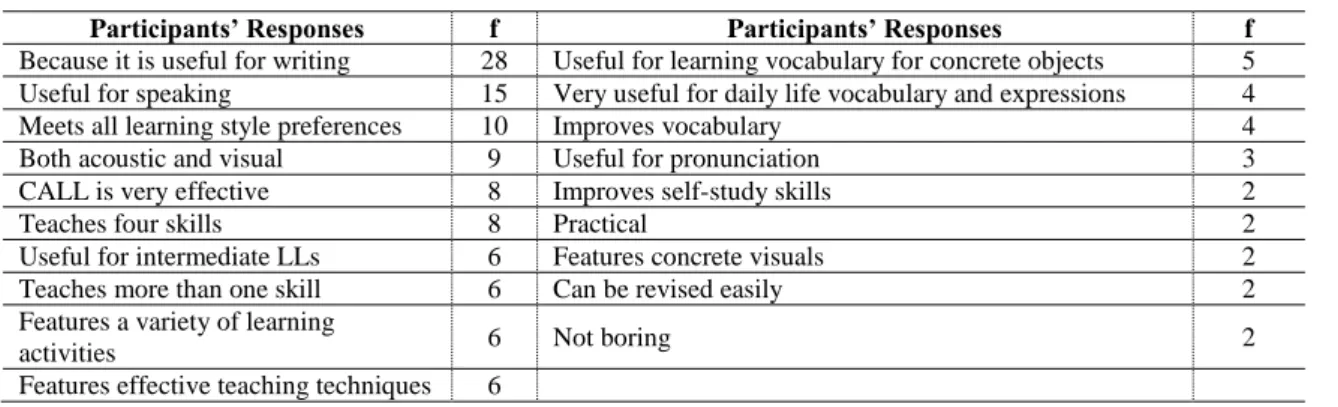
When the participants were asked why they thought the IME was useful for FLL, the following reactions were revealed (Table 4). However, two LLs felt that the IME was not good enough to improve their language.
Table 4: Why the Participants Think the IME is Good for FLL
Participants’ Responses f Participants’ Responses f
Because it is useful for writing 28 Useful for learning vocabulary for concrete objects 5 Useful for speaking 15 Very useful for daily life vocabulary and expressions 4 Meets all learning style preferences 10 Improves vocabulary 4
Both acoustic and visual 9 Useful for pronunciation 3
CALL is very effective 8 Improves self-study skills 2
Teaches four skills 8 Practical 2
Useful for intermediate LLs 6 Features concrete visuals 2
Teaches more than one skill 6 Can be revised easily 2
Features a variety of learning
activities 6 Not boring 2
Features effective teaching techniques 6
f: Number of times mentioned
3.2. World Talk English is more useful for Certain Skills
The results revealed that the IME was very good for practising listening (M = 4.44), improving listening skills (M = 4.27), practising speaking (M = 3.95), improving speaking skills (M = 3.96), practising writing (M = 4.11) and improving writing skills (M = 4.08, Table 5). The IME improved their listening (M = 4.55), speaking (M = 4.00), and writing (M = 3.96). When asked the same questions in the negative form, they thought the IME improved their listening (M = 4.57), speaking (M = 4.24), and writing (M = 4.23). 85% thought it helped listening most. Table 5: Mean Score for the Participants’ Perception of which Skills the IME is Suitable
N Mean Std. Deviation 2- How good is World Talk English for practising listening? 113 4.44 .694 3- How good is the IME in improving listening skills? 113 4.27 .747 4- How good is the IME for practising speaking? 113 3.95 .864 5- How good is the IME in improving speaking skills? 113 3.96 .839 6- How good is the IME for practising writing? 113 4.11 .859 7- How good is the IME in improving writing skills? 113 4.08 .888 1 = Very bad 2 = Bad 3 = Normal 4 = Good 5 = Very good
N Mean Std. Deviation
24- The IME improves my listening 113 4.55 .655
25- improves my speaking 113 4.00 .935
26- improves my writing 112 3.96 1.043
1 = Strongly disagree 2 = Disagree 3 = Neutral 4 = Agree 5 = Strongly agree N Mean Std. Deviation
36- The IME does not improve my listening 113 4.57 .625
37- does not improve my speaking 112 4.24 .928
38- does not improve my writing 113 4.23 .906
1 = Strongly agree 2 = Agree 3 = Neutral 4 = Disagree 5 = Strongly disagree The qualitative data supported the quantitative results. When the LLs were asked: “What are the strengths of the IME?” the following reactions were revealed in terms of which skills it helped most (Table 6).
Table 6: Further Comments about the IME
f f
Improves and very useful for improving listening skills
69 Improves all skills 4
Improves writing 15 Very good for daily life vocabulary and expressions 6 Improves speaking 11 Improving listening and speaking 5 Improves vocabulary 8 Improves listening, reading & writing 5 Improves listening and writing 6
f: Number of times mentioned
When the participants were asked: “Is the IME useful for FLL? Why?” the following reactions were revealed:
The software is very useful for improving listening skill (63 times mentioned) “[The software] is useful in particular in improving listening” (ST05)
“…because we hear a wide range of native speakers. … it is both auditory and visual and this helps us learn better.” (SS061)
The software is definitely very useful for FLL (79 times mentioned) “… because it is not boring, and it entertains while teaches” (SS050) “…because it is gradual and features a wide range of topics. …” (SS054)
3.3. World Talk English is Convenient for Self-study
With regard to the suitability of the software for self-study, 85.8% believed that the IME was very good (M = 4.37, Table 7). The IME gave them flexibility (M = 4.25), allowed them to work at their own pace (M = 4.31), encouraged them to study alone more (M = 4.39), and gave them the control of their own learning (M = 4.24). The LLs were asked the same questions in the negative form. They revealed that the IME allowed them to work at their own time (M = 4.45), gave them control over their learning (M = 4.42), and encouraged them to work alone (M = 4.45). Table 7: Mean Score for the Participants’ Perception of the IME for Self-study
N Mean Std. Deviation 9- How good is the IME for self-study? 113 4.37 .770 1 = Very bad 2 = Bad 3 = Normal 4 = Good 5 = Very good
N Mean Std. Deviation
21- The IME gives me flexibility 112 4.25 .854
22- allows me to work at my pace 110 4.31 .865
22- encourages me to study alone more 111 4.39 .822
28- gives me control of learning 112 4.24 .786
1 = Strongly disagree 2 = Disagree 3 = Neutral 4 = Agree 5 = Strongly agree N Mean Std. Deviation 34- does not allow me to work at my time 110 4.45 .749 40- gives me no control over my learning 112 4. 42 .680 41- does not encourage me to work alone more 110 4.45 .672 1 = Strongly agree 2 = Agree 3 = Neutral 4 = Disagree 5 = Strongly disagree
When the LLs were asked: “What are the strengths of the IME?” the following reactions were revealed in terms of the suitability of the software for self-study: Entertaining aspect of the software (34 times mentioned), motivating (13 times), easy to use (12 times), self-control (12 times), being able to revise as many times as you want (10 times), meets the needs of all senses (4 times) and being visual avoids you getting bored (4 times)
3.4. World Talk English can be further improved.
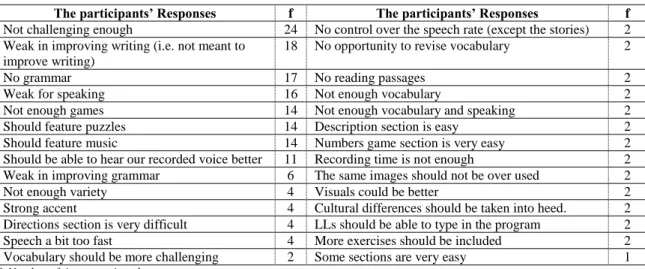
When the LLs were asked: “What are the weaknesses of the IME?” the followings were revealed (Table 8):
Table 8: The Weaknesses of the IME
The participants’ Responses f The participants’ Responses f Not challenging enough 24 No control over the speech rate (except the stories) 2 Weak in improving writing (i.e. not meant to
improve writing)
18 No opportunity to revise vocabulary 2
No grammar 17 No reading passages 2
Weak for speaking 16 Not enough vocabulary 2
Not enough games 14 Not enough vocabulary and speaking 2
Should feature puzzles 14 Description section is easy 2
Should feature music 14 Numbers game section is very easy 2 Should be able to hear our recorded voice better 11 Recording time is not enough 2 Weak in improving grammar 6 The same images should not be over used 2
Not enough variety 4 Visuals could be better 2
Strong accent 4 Cultural differences should be taken into heed. 2 Directions section is very difficult 4 LLs should be able to type in the program 2 Speech a bit too fast 4 More exercises should be included 2 Vocabulary should be more challenging 2 Some sections are very easy 1
f: Number of times mentioned
When the LLs were asked: “To further improve the IME, what do you suggest?” the following suggestions were revealed: The software should be more challenging (34 times mentioned). It should feature levels (18 times), more variety (18 times), more grammar (18 times), more vocabulary (14 times), more sections (12 times), more speaking (8 times), more activities (6 times), more writing (4 times), self-assessment tests (4 times), video (2 times) and (3) be longer (i.e. include more topics) (10 times). Moreover, one student wrote: “Learning English does not consist of only simple present tense”. It was also said: writing section should be improved. They should be able to type the text and get it checked in the program (6 times). Directions section should be made understandable (4 times). The software should feature more variety, be gradual in the stories (4 times).
The LLs wanted: more challenging activities, more daily life topics, more difficult categories of the topics, activities to teach concrete words, the IME be practical and feature more vocabulary about the target culture. They would have preferred more visuals. They wanted an ‘adult version of the same program’ to be made.
They also wanted: sections should enable users to find out how much time they had spent on each section. The IME should feature: cartoons, conversations on work/jobs, English songs, animations, puzzles, more competition, reading passages and pertinent activities, synonyms, timed activities and translation sections. Speech rate should be slower and sections should be shorter. The LLs also claimed that the IME was not convenient for lab use. Presumably when they recorded their own voice, this made considerable noise, as (maximum) 24 of them were using the lab at the same time. This might have hindered the participants’ concentration.
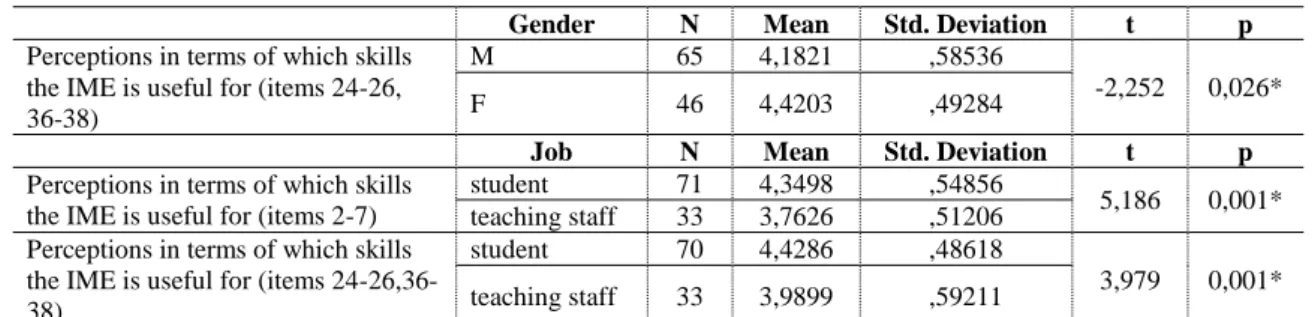
3.5. Differences between Their Perceptions in terms of Gender, Age, Job and FLL Period In terms of general perceptions of the IME, the differences between male and female LLs, and the student and the teaching-staff LLs were statistically significant (Tables 9 and 10). Female
and the student LLs seemed to have more positive general perceptions of the IME. Their perceptions scores in terms of which skills the IME was useful for were also more positive. Table 9: α=0.05;* Independent Samples t Test for General Attitudes of the software in
terms of Gender and Job
Gender N Mean S.D t p General perception s of the IME M 58 4,3839 ,40816 -2,687 0,008* F 42 4,5952 ,35837 Job N Mean S.D t p Student 59 4,6045 0,33192 4,480 0,001* Teaching Staff 32 4,2396 0,43498
* α = 0.05; differences are statistically significant
Table 10: α=0.05;* Independent Samples t Test for Perceptions in terms of Gender and Job
Gender N Mean Std. Deviation t p
Perceptions in terms of which skills the IME is useful for (items 24-26, 36-38)
M 65 4,1821 ,58536
-2,252 0,026*
F 46 4,4203 ,49284
Job N Mean Std. Deviation t p
Perceptions in terms of which skills the IME is useful for (items 2-7)
student 71 4,3498 ,54856
5,186 0,001* teaching staff 33 3,7626 ,51206
Perceptions in terms of which skills the IME is useful for (items 24-26,36-38)
student 70 4,4286 ,48618
3,979 0,001* teaching staff 33 3,9899 ,59211
* α = 0.05; differences are statistically significant
The difference between age-groups was statistically significant in terms of the perceptions score for which skills the IME was useful (items 2-7, Table 11). The younger age-group seemed to have more positive perceptions. The older the age-group, the less positive perceptions the LLs seemed to have.
Table 11: α=0.05;* ANOVA for Perceptions in terms of Age-group
Perceptions in terms of which skills the
software is useful for (item 2-7) N Mean Std. Deviation f p
20 and below age 35 4,3714 ,49190
3,124 0,018* 21-30 52 4,1122 ,63032 31-40 23 3,8841 ,53757 41-50 2 3,6667 ,70711 51-60 1 3,6667 . Total 113 4,1342 ,59339
* α = 0.05; differences are statistically significant
The youngest age-group seemed to have more positive perceptions score on which skills the IME was useful for (Table 12). On the other hand, there was no significant relationship between the LLs’ FLL period and their perceptions.
Table 12: α=0.05;* ANOVA for Perceptions in terms of Age-group
Perceptions in terms of which skills the
software is useful for (items 24-26, 36-38) N Mean Std. Deviation f p
20 and below 35 4,5000 ,46967 2,665 0,036* 21-30 Age 51 4,1797 ,60170 31-40 Age 23 4,2029 ,53171 41-50 Age 2 3,6667 ,00000 51-60 Age 1 4,0000 . Total 112 4,2738 ,56147
* α = 0.05; differences are statistically significant
Table 13: α=0.05;* Independent Samples t Test for Perceptions in terms of Gender and Job
Gender N Mean Std. Deviation t p
Perceptions in terms of self-study (items 20-22, 28, 34, 40-41) M 62 4,2488 ,55052 -2,368 0,020* F 38 4,5301 ,61683
Job N Mean Std. Deviation t p
student 60 4,5929 ,44777
teaching staff 31 3,8894 ,61689 6,223 0,001*
* α = 0.05; differences are statistically significant
In general, the younger the age-group, the higher the perceptions score on the usefulness of the IME for self-study (Table 14).
Table 14: α=0.05;* ANOVA for Perceptions in terms of Self-study and Age-group
Attitudes in terms of self-study (items 20-22, 28,
34, 40-41) N Mean Std. Deviation f p
20 and below age 29 4,6108 ,52890
3,497 0,010* 21-30 47 4,3617 ,51667 31-40 21 4,0544 ,70200 41-50 2 3,8571 ,20203 51-60 1 4,0000 . Total 100 4,3557 ,58971
* α = 0.05; differences are statistically significant
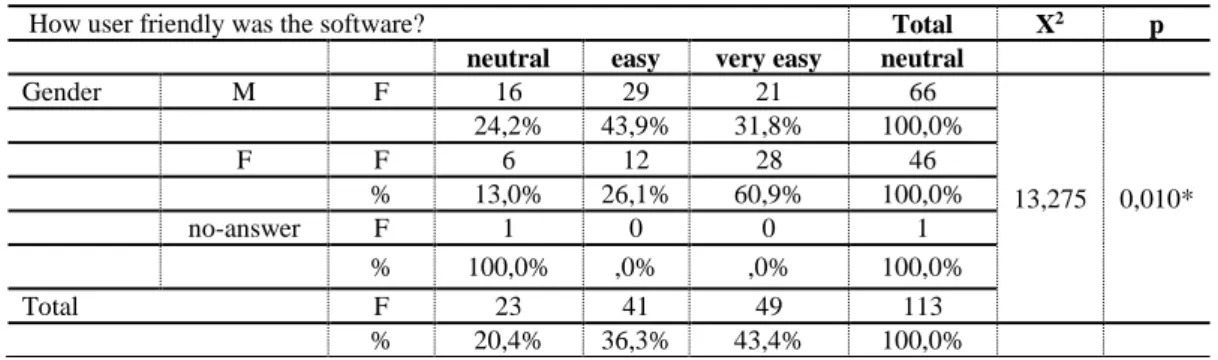
In terms of gender, female LLs, and in terms of job category, student LLs had more positive perceptions of the IME (item 12; Table 15, 16).
Table 15: α=0.05;* Chi-square for Perceptions in terms of Gender
How user friendly was the software? Total X2 p
neutral easy very easy neutral
Gender M F 16 29 21 66 13,275 0,010* 24,2% 43,9% 31,8% 100,0% F F 6 12 28 46 % 13,0% 26,1% 60,9% 100,0% no-answer F 1 0 0 1 % 100,0% ,0% ,0% 100,0% Total F 23 41 49 113 % 20,4% 36,3% 43,4% 100,0%
* α = 0.05; differences are statistically significant
Table 16: α=0.05;* Chi-square for Perceptions in terms of Job
How user friendly was the software? Total X2 p
neutral easy very easy neutral
12,512 0,014* Job student F 10 22 39 71 % 14,1% 31,0% 54,9% 100,0% teaching staff F 9 15 9 33 % 27,3% 45,5% 27,3% 100,0% no answer F 4 4 1 9 % 44,4% 44,4% 11,1% 100,0% Total F 23 41 49 113 % 20,4% 36,3% 43,4% 100,0%
4. DISCUSSION and IMPLICATIONS
4.1. In terms of Positive Perceptions of IMEsThe results match the existing findings of similar studies (Türel, 2010; Ayres, 2002; Brett, 1999; Herrington & Oliver, 1997). The results contribute to the existing body of knowledge about perceptions of IMEs in general and CALL in particular.
In the IME, more than one concurrent digital element on the same computer platform, which aims to teach one thing (thus, at least one element is redundant) is provided and therefore provides more paths of recall (Al-Seghayer, 2001; Paivio, 1986). For example, pictures and audio in the Main section, visuals + audio + an animated person in the TV Quiz section, pictures + audio + animation in the Recording Studio section, and pictures + audio + reading texts + activities in the Dictation and Worksheets section are provided. This corresponds with the dual-coding theory and the generative theory of multimedia (Ginther, 2002; Mayer, 1997) and the redundancy hypothesis (Al-Seghayer, 2001; Sherwood et al., 1987).
The IME featured different media elements (i.e. audio, text, animation, visuals or their optimum combinations). It also provided the opportunity to work and answer in different ways, which pedagogically matches the findings in the field of LLs’ learning style preferences (Carson & Longhini, 2002; Reid, 1987), as LLs may be visual, auditory, kinaesthetic or tactile. Thus, it is said that in the design of IMEs, ‘a more enriched learning experience occurs when LLs are presented with different styles of learning in both content and teaching style' (Brickell, 1993, p.2), a challenge which is 'often neglected' by instructional designers (McLoughlin, 1999, p.1). These might be the reasons why the LLs overwhelmingly appreciated the IME.
The inclusion of more than one concurrent element in the IME corresponds with the requirements of working memory, as it consists of separate processors for auditory and visual information (Kalyuga, 2000; Baddeley, 1992). Providing information sources that can be processed using senses of both hearing and vision can expand limited working memory. Since the IME used in this study features sources that require the use of both hearing and vision, the results match the cognitive load theory (Kalyuga, 2000; Sweller, 1999), as the media types provided in the IME decrease cognitive load because they consist of two different information sources (i.e. audio, visuals) each of which requires the use of a separate learning processor (i.e. hearing, visual). Moreover, the IME is designed effectively, as it features a combination of both learner control and program control, which is considered more beneficial for learner-acquisition (Robinson, 1989; Trinder, 2002). These might be reasons why the IME was appreciated by the LLs.
Today’s students, who are digitally-fluent and competitive, enjoy working with IMEs. Thus, the use of the IME for FLL responds to such learning demands and differences to accommodate the digitally-literate, wise and efficient learning style preferences (Türel, 2013; Duncan-Howell, 2012). This might be another reason why the IME was appreciated by the LLs. 4.2. In terms of Better Developing IMEs
Although (1) the IME was appreciated by the LLs and (2) the weaknesses mentioned above are only relevant to the IME used in this study, newer versions need to be better developed, as revealed by the results. Therefore, the implications for future IMEs for FLL are:
(1) IMEs need to feature self-assessment tests, as they are an essential element of autonomous IMEs (Hurd et al., 2001; Gardner, 1996). The objective is to enable LLs to determine their level and assess whether they are making any progress or not. This was also emphasised by some participants in this study. This shows that there is still a gap between what is already known in the literature and what materials writers are implementing.
(2) The level of exercises in IMEs should be changeable. After completing level 1, LLs should be able to access higher-level activities about the same input. The lack of lower and higher
levels in the IME was mentioned 18 times by the LLs. This can be managed easily with authoring programs and has already been mentioned in the literature (Türel, 2004, p.195). This aspect can gradually move LLs along from the easiest exercises to more difficult ones. Such an aspect helps avoid boredom and motivate LLs, which is necessary for (autonomous) LLs.
4.3. In terms of Access to IMEs
(1) IMEs should be integrated into FLL programmes for (class and) self-study use alongside CMs. It is striking that IMEs are still not widely used. 93.8% in this study had never used such IMEs before. This matches what Bax (2003) claimed, that not only were IMEs uncommon in FLL, but they were also not integrated into most classrooms and FLL centres.
(2) In providing access to IMEs, priority should be given to young learners, as the youngest group had more positive perceptions in terms of self-study and usefulness. The older the age-group, the less positive perceptions they seemed to have.
(3) The student participants had more positive perceptions of IMEs in comparison to the teaching-staff. The implication is to provide IMEs for today’s students, who are in general digitally fluent and competitive (Duncan-Howell, 2012).
5. REFERENCES
Abobaker, R., & Hussein, I. (2012). Assessing language through computer technology. International Journal of
Computer-Assisted Language Learning and Teaching, 2(2), 61–63.
Al-Seghayer, K. (2001). The effect of multimedia annotation modes on L2 vocabulary acquisition: A comparative study. Language Learning & Technology, 5(4), 202-232.
Ashworth, D. (1996). Hypermedia and CALL. In Pennington, M.C. (Ed.), The Power of CALL. (pp. 79-95). USA: Athelstan.
Ayres, R. (2002). Learner attitudes towards the use of CALL. Computer Assisted Language Learning, 15(3), 241-249. Baddeley, A. (1992). Working memory. Science, 255, 556-59
Baturay, M. H., Daloğlu, A., & Yıldırım, S. (2010). Language practice with multimedia supported web-based grammar revision material. ReCALL, 22(3), 313-31.
Bax, S. (2003). CALL - Past, present and future. System, 31, 13-28.
Brett, P. (1997). A comparative study of the effects of the use of multimedia on listening comprehension. System, 25(1), 39-53.
Brett, P. (1999). The design, implementation and evaluation of a multimedia application for second language listening
comprehension. (Unpublished Ph.D. thesis) The University of Wolverhampton. Wolverhampton, UK.
Brickell, G. (1993). Navigation and learning style. Australian Journal of Educational Technology, 9(2), 103-114. Carson, J. G., & Longhini, A. (2002). Focussing on learning styles and strategies: A diary study in an immersion
setting. Language Learning, 52(2), 401-38.
Chung, J. M., Huang, S.C. (1998). The effects of three aural advance organisers for video viewing in a foreign language classroom, System, 26, 553-565.
Chou, C. (2012). Understanding on-screen reading behaviours in academic contexts: A case study of five graduate english-as-a-Second-language students. Computer Assisted Language Learning, 25(5), 411-33.
Clifford, R. (1998). Mirror, mirror, on the wall: Reflections on computer assisted language learning. CALICO Journal, 16(1), 1-11.
Crosby, M. C., Stelovsky, J., & Ashworth, D. (1994). Hypermedia as a facilitator for retention: A Case Study Using Kanji City. Computer Assisted Language Learning, 7(1), 3-13.
De Ridder, I. (2002). Are we conditioned to follow links? Highlights in CALL materials and their impact on the reading process. Computer Assisted Language Learning, 13(2), 183-195.
Deville, G., Kelly, P., Paulussen, H., Vandecasteele, M., & Zimmer, C. (1996). The use of a multi-media support for remedial learning of English with heterogeneous groups of ‘false Beginners’. Computer Assisted Language
Learning, 9(1), 75-84.
Draper, S. W. (2009). What are learners actually regulating when given feedback? British Journal of Educational
Duncan-Howell, J. (2012). Digital mismatch: Expectations and realities of digital competency amongst pre-service education students. Australasian Journal of Educational Technology, 28(5), 827-840. http://www.ascilite.org.au/ajet/ajet28/duncan-howell.html. Retrieved on Feb 9, 2013.
Dunkel, P. (1991). The effectiveness research on computer-assisted instruction and computer assisted language learning. In P. Dunkel (Ed.), Computer-Assisted Language Learning and Testing: Research Issues and Practice (pp. 5-36). Newbury House.
Dunn, R. (1983). Learning style and its relation to exceptionality at both ends of the spectrum. Exceptional Children,
49, 496-506.
Gardner, D. (1996). Self-assessment for self-access learners. TESOL JOURNAL, Spring, 18-23.
Gardner, R. C. (1985). Social psychology and second language learning: The role of attitudes and motivation. Baltimore: Edward Arnold.
Gillespie, J., & McKee, J. (1999). Resistance to CALL: degrees of student reluctance to use CALL and ICT. ReCALL,
11(1), 38-46.
Ginther, A. (2002). Context and content visuals and performance on listening comprehension stimuli. Language
Testing, 19(2), 133-67.
Godwin-Jones, R. (2010). Emerging technologies: From memory palaces to spacing algorithms: Approaches to second-language vocabulary learning. Language Learning & Technology, 14(2), 4–11.
Herrington, J., & Oliver, R. (1997). Multimedia, magic and the way students respond to a situated learning environment. Australian Journal of Educational Technology, 13(2), 127-143.
Herron, C., Dubreil, S., Corrie, C., &, Cole, S. P. (2002). A classroom investigation: Can video improve intermediate-level French language Students' Ability to Learn about a Foreign Culture? The Modern Language Journal, 86, 36-53.
Hwa, S. P., Weei, P. S., & Len, L. H. (2012). The effects of blended learning approach through an interactive multimedia e-book on students’ achievement in learning Chinese as a second language at tertiary level.
International Journal of Computer-Assisted Language Learning and Teaching, 2(2), 35–50.
Hurd, S., Beaven, T., & Ortega, A. (2001). Developing autonomy in a distance language learning context: Issues and dilemmas for course writers. System, 29, 341-355.
Kalyuga, S. (2000). When using sound with a text or picture is not beneficial for learning. Australian Journal of
Educational Technology¸16(2),161-72.
Le Mon, R. (1988). Cultural differences affecting the international transfer of computerised language learning. System,
16(1), 37-40.
Mangiafico, L. F. (1996). The Relative effects of classroom demonstration and individual use of interactive multimedia
on second language listening comprehension. Unpublished Ph.D. thesis Faculty of Graduate School of Vanderbilt
University.
Masgoret, A. M., & Gardner, R. C. (2003). Attitudes, motivation, and second language learning: A meta-analysis of studies conducted by Gardner and associates. Language Learning, 53(1), 123-63.
Mayer, E. (1997). Multimedia learning: Are we asking the right questions? Educational Psychologist, 32(1), 1-19. McLoughlin, C. (1999). The implications of the research literature on learning styles for the design of instructional
material. Australian Journal of Educational Technology, 15(3), 222-241.
Moreno, R., & Mayer, R. E. (2002). Verbal redundancy in multimedia learning: When reading helps listening, Journal
of Educational Psychology, 94(1), 156-163.
Mosalanejad, L., Shahsavari, S., Sobhanian, S., & Dastpak, M. (2012). The Effect of virtual versus traditional learning in achieving competency-based skills. Turkish Online Journal of Distance Education, 13 (2),
http://tojde.anadolu.edu.tr/tojde47/index.htm. Retrieved on 27 Jan. 2013.
Nicholas, H., Lightbown, P. M., & Spada, N. (2001). Recasts as Feedback to Language Learners, Language Learning,
51(4), 719-758.
Nunan, D. (1993). Research methods in language learning. USA: CUP.
Paivio, A. (1986). Mental representation: A dual coding approach, New York: OUP.
Peter, M. (1994). Investigation into the design of educational multimedia: Video, interactivity and narrative. Unpublished Ph.D. thesis OU, UK
Platt, E. & F. B. Brooks. (2002). Task engagement: A turning point in foreign language development. Language
Learning, 52(2), 365-400.
Reid, J. M. (1987). The learning style preferences of ESL students. TESOL Quarterly, 21(1), 87-111. Ridgway, T. (2000). Listening strategies - I beg your pardon? ELT Journal, 54(2), 179-185.
Robinson, G. L. (1989). The CLCCS CALL study: Methods, error feedback, attitudes, and achievement. In W. M. Flint Smith (Ed.): Modern Technology in FLE: Applications and Project (pp. 119-33). Lincolnwood, IL: National Textbook Co.
Robinson, G. L. (1991). Effective feedback strategies in CALL: Learning theory and empirical research. In P. Dunkel (Ed.) Computer-Assisted Language Learning and Testing: Research Issues and Practice (pp. 155-68). USA, New York: Newbury House.
Schmidt, R. W. (1990). The role of consciousness in second language learning. Applied Linguistics, 11(2), 129-158. Sherwood, R. D., Kinzer, C. K., Hasselbring, T. S., & Bransford, J. D. (1987). Macro-contexts for learning: Initial
findings and issues. Applied Cognitive Psychology, 1(2), 93-108.
Soboleva, O., & Tronenko, N. (2002). A Russian multimedia learning package for classroom use and self-study,
Computer Assisted Language Learning, 15(5), 483-499.
Stevens, V. (1995). A study of student attitudes toward CALL in a self-access student resource centre. System, 19(3), 289-299.
Sweller, J. (1999). Instructional Design. Melbourne: ACER. TES Teacher. (2004). April 23 2004. p. 18
Trinder, R. (2002). Forum: Multimedia in the business English classroom: The learners' point of view. Computer
Assisted Language Learning, 15(1), 69-84.
Tschirner, E. (2001). Language acquisition in the classroom: The role of digital video. Computer Assisted Language
Learning, 14(3-4), 305-19.
Tseng, H. W., & Yeh, H. (2013) Team members’ perceptions of online teamwork learning experiences and building teamwork trust: A qualitative study. Computers & Education, 63, 1–9.
Turel, V. (2014). Design of cultural differences in hypermedia environments. International Journal of Human Rights
and Constitutional Studies, 2(2), 150-170. DOI: 10.1504/IJHRCS.2014.062766
Turel, V. (2011). Learners' attitudes to repetitious exposure in multimedia listening software. EUROCALL Review, 19 (September), 57-83. http://www.eurocall-languages.org/wordpress/wp-content/uploads/2014/01/review19.pdf.
Retrieved on Jan 10, 2013
Turel, V. (2010). Advanced Turkish. ReCALL, 22(3), 396-401. http://cls.arizona.edu/resources/review-recall-tur3.htm. Retrieved on Jan 7, 2013.
Turel, V., & McKenna, P. (2013). Design of language learning software. In Bin Zou et al. (Eds.). Computer-Assisted
Foreign Language Teaching and Learning: Technological Advances (pp. 188-209). USA, Hershey: IGI-Global.
Türel, V. (2013). The use of educational technology at tertiary level. Hacettepe Üniversitesi Eğitim Fakültesi Dergisi
[Hacettepe University Journal of Education], 28(2), 482-496. http://www.efdergi.hacettepe.edu.tr/201328-2VEHBİ%20TÜREL.pdf. Retrieved on July 10, 2014.
Türel, V. (2012). Design of feedback in interactive multimedia language learning environments. Linguistik Online,
54(4), 35-49. http://www.linguistik-online.de/54_12/tuerel.pdf. Retrieved on 10 July 2013.
Türel, V. (2010). Learners’ attitudes towards the use of CALL for listening enhancement, Proceedings Book, Volume II, IETC – April 26-28, pp. 891-901, Istanbul, Turkey. http://www.iet-c.net/publications.php. Retrieved on July 9, 2013.
Türel, V. (2004). Design of multimedia software: Investigating the design of some elements of interactive multimedia
listening software for autonomous intermediate language learners. (Unpublished Ph.D. Thesis) The University of
Manchester, UK.
Türel, V. (2000). Talk Now! Learning Turkish. CALICO Journal, 18(1), 91-100. https://calico.org/p-137-Talk%20Now!%20Turkish%20(111999).html. Retrieved on Jan 9, 2013.
Voller, P. (1997). (Ed.), Autonomy & Independence in language learning, New York: Addison Wesley Longman Limited.
Vygotsky, L. (1978). Mind in society: The development of higher psychological processes. Cambridge MA: Harvard University Press.
Yu, W-K., Sun, Y-C., & Chang, Yu-J. (2010). When technology speaks language: An evaluation of course management systems used in a language learning context. ReCALL, 22(3), 332-355.
Zhao, Y. (1997). The effects of listeners’ control of speech rate on second language comprehension. Applied
Linguistics, 18(1), 49-68.
Uzun Özet
Bu çalışmada, 2012 yılının ilkbaharında 113 katılımcının (N=113) bir dil öğrenme programına (World Talk English software) yönelik algıları ve bu algılar ile cinsiyet, yaş-grubu, meslek ve yabancı dil
öğrenme süresi arasında bir farklılık olup olmadığı araştırıldı. Çalışmada hem nicel hem de nitel yöntem kullanılmıştır. Çalışmanın sonuçları SPSS programı ile (Ortalama, Standart Sapma, Bağımsız Örnekleme t Testi, Yüzde, Varyans Analizi, Ki-kare) analiz edildi. Katılımcılar, World Talk English programını bireysel olarak bir dil laboratuvarında kullandılar.
Katılımcılar, ana dili İngilizce olmayan 113 kişiden oluşmaktadır (% 58,4 erkek, % 40,7 kadın). Katılımcılar, dinleme becerileri açısından orta (intermediate level in listening) seviyededirler. Katılımcıların % 70,8’i lisans öğrencisi; % 29,2’si öğretim elemanıdır. Katılımcıların hepsi bilgisayar kullanmayı biliyor, yabancı dil olarak İngilizceyi öğrenmeye çalışıyorlar. Bu çalışmaya gönüllü katılmışlardır.
World Talk English programı, bu çalışmada kullanıldı. Bu programın tercih edilmesinin sebepleri: (1) Programın katılımcıların seviyesine uygun olması. (2) Programın katılımcıların (en çok ihtiyaç duyduğu) dinleme ve konuşma yeteneklerini geliştirmeye yönelik bir program olması. (3) Profesyonel bir dil öğrenme programı olması. (4) Programın uluslararası dil öğrenme programı şirketi olan EuroTalk tarafından uzman kişilerce yazılmış olması.
Sonuçlar, katılımcıların program hakkındaki düşüncelerinin çok olumlu olduğunu gösterdi. Katılımcılar, programın İngilizceyi yabancı dil olarak öğretmede olumlu katkılar sağladığını söylediler. Katılımcılar, World Talk English programının hem dinleme, konuşma, yazma, okuma ve kelime öğrenme konularında kendilerine faydalı olduğunu hem de İngilizcelerini ilerletme konusunda kendilerine yardımcı olduğunu belirttiler.
Katılımcılar, programın çok iyi ve faydalı olduğunu, İngilizcelerini geliştirdiğini, kullanımının kolay, eğlenceli, basit, ilgi çekici ve teşvik edici olduğunu ifade ettiler. Programın İngilizcelerin geliştirdiğini ve yeni kelime ve kavramlar öğrenmelerini sağladığını belirtiler. Programın sıkıcı ve zor olmadığını vurguladılar. Katılımcıların % 97’si programın en çok orta (intermediate) seviyedeki adaylar için uygun olduğunu söylediler.
Sonuçlar, programın katılımcıların dinleme yetenek ve becerilerini geliştirmeleri için çok iyi olduğunu gösterdi ve en çok dinleme yeteneklerini geliştirdiğini belirtti. Bunun yanında, konuşma, yazma ve okuma becerilerini de geliştirdiğini gösterdi. Katılımcıların % 85,8’i World Talk English programının bireysel çalışma için çok iyi olduğunu belirttiler. Programın esneklik sağladığını, istedikleri gibi çalışmalarına müsaade ettiğini, daha fazla çalışmaya teşvik ettiğini ve kontrolü kendilerine verdiğini ifade ettiler.
Katılımcılar, World Talk English programının daha etkili ve öğretici bir şekilde tasarlanıp yazılabileceğini söyleyip eksikliklerini şu şekilde ifade ettiler. Programdaki bazı kısımların yeterince zor olmadığını, Directions (Yönler) gibi bazı kısımların ise çok zor olduğunu, konuşma yeteneğinin gelişmesi için zayıf olduğunu, yeterince veya hiç oyun, bulmaca, video ve müzik içermediğini belirtiler. Ayrıca, programın kolaydan zora seviye içermesi gerektiğini ve seviye seçme seçeneğinin olmadığını, içerik açısından daha çok çeşitliliğe yer vermesi, daha fazla kelime ve dilbilgisini içermesi ve seviye belirleme testleri içermesi gerektiğini belirttiler.
Algılar ile bazı bağımlı değişkenler arasındaki farklılık ilişkisi istatistiksel olarak önemlidir. Kadınların World Talk English programına yönelik daha olumlu algıları vardır. Meslek açısından ise, öğrenciler, öğretim elemanlarına göre World Talk English programına karşı daha olumlu algılara sahipler. Yaş olarak, en genç yaş grubuna girenler, programın belirli yetenekler için daha faydalı olduğu algısına sahipler. Bireysel çalışma açısından ise, kadın ve öğrenci olanlar programa karşı daha olumlu görüşlere sahipler. Aynı şekilde, genç yaş grubuna girenler programın genel olarak daha iyi olduğu görüşüne sahipler. Bununla beraber, bu günkü gençlik bilişim teknolojisine aşina ve günlük yaşamda bunu sık sık kullanan kişilerdir. Böyle bir durumda, dijital öğrenme programlarını onlara temin etmemiz ve bunun kullanımını kolaylaştırıp yaygınlaşmasını sağlayan imkânları temin etmemiz hayati derecede önemlidir. Bu, aynı zamanda onları öğrenmeye daha fazla teşvik edecektir.
Sonuçlar bu alanda yapılan diğer çalışmalarla uyum içindedir. Sonuçlar, böyle programların dil öğretme ve öğrenmede çok yaygın olarak kullanılması gerektiğini göstermektedir. Aynı zamanda, böyle programların 1990 yıllından beri piyasada olmalarına rağmen, bu programlara erişimin çok düşük olduğunu göstermektedir. Örneğin, katılımcılar öğrenci ve öğretim elemanı olmasına rağmen onların % 93,8’inin böyle bir programı daha önce kullanmadığı ortaya çıktı. Özellikle bu çalışmada görüldüğü gibi genç yaş grubuna girenler ve öğrenci olanların böyle programlara karşı olumlu algılara sahip olmaları, bu tür programların ne kadar yoğun bir şekilde kullanılması gerektiğini göstermektedir. Böyle programların kullanımında öncelik, bu sebeplerden dolayı genç ve öğrenci olanlara verilmelidir.
İlave olarak, teknik açıdan mümkün olmasına rağmen, literatürde çok iyi bilinen bazı etkili öğretme ve öğrenme teknik ve yöntemlerinin program tasarım ve yazılım aşamasında uygulanılmadığı görünmektedir. Bu nedenle, gelecekte böyle programların daha iyi ve etkili bir şekilde tasarlanıp yazılması gerekmektedir. Örneğin, literatürde böyle programların kolaydan zora değişik seviyeler içermesi gerektiği ve kullanıcıların da kendi ihtiyaçlarına göre seviyeler seçerek kendilerine uygun alıştırma ve soruları cevaplandırıp tamamlamaları gerektiği çok iyi bilinmektedir. Aynı şekilde, böyle programların seviye belirleme testleri içermeleri gerektiği ve böylece kullanıcıların bu testleri yaparak her hangi bir ilerleme sağlayıp sağlamadıklarını ve seviyelerini öğrenmeleri gerektiği konusu literatürde çok iyi bilinmektedir. Bilinen bu gerçeklere rağmen, maalesef bu özellikler programda mevcut değildir. Ayrıca, videonun faydaları çok iyi bilindiği halde program herhangi bir video içermemektedir.
Citation Information
Türel, V. (2014). Learners’ perceptions towards interactive multimedia environments. Hacettepe Üniversitesi Eğitim