Ozturk et al.
Volume 3 Issue 2, pp. 65-76
Date of Publication: 16th September 2017
DOI-https://dx.doi.org/10.20319/lijhls.2017.32.6576
This paper can be cited as: Ozturk, M.., Surucu, S. G., Ozel, T. E. & Inci, H., (2017). Evaluation to Adaptation of Motherhood in Postpartum Period. LIFE: International Journal of Health and Life-Sciences, 3(2), 65-76.
This work is licensed under the Creative Commons Attribution-NonCommercial 4.0 International License. To view a copy of this license, visit http://creativecommons.org/licenses/by-nc/4.0/ or send a letter to Creative Commons, PO Box 1866, Mountain View, CA 94042, USA.
EVALUATION TO ADAPTATION OF MOTHERHOOD
IN POSTPARTUM PERIOD
Melike Ozturk
The Faculty of Health Sciences, Midwifery Department, Cukurova University, Adana, Turkey
Sule Gokyildiz Surucu
The Faculty of Health Sciences, Midwifery Department, Cukurova University, Adana, Turkey
Tugce Esra Ozel
Samiye Nadiye Erdem Family Health Center, Adana, Turkey
Halide Inci
Midwife, Dogalpark Family Health Center, Adana, Turkey
Abstract
The purpose of this study was to examine women’s adaptation to motherhood and factors associated with adaptation to role of motherhood in the postpartum period. This research was a descriptive study. Study population included 125 women who were in the postpartum period of 30-40th day in Adana-Turkey. Data collection took place at three family medicine centers between February 2016-March 2016. Data were collected using a demographic questionnaire
and Postpartum Self Evaluation Questionnaire and analyzed on IBM SPSS Statistics version 20, with descriptive statistics, independent-samples t test, Mann-Whitney U test and Kruskal-Wallis test. Average age of the participants is 22.19±4.17 (min:18-max:44) and average length of marriage is 6.21±5.48 (min:1-max:25). It is found that 33.3% of puerperant women is primary school graduate, 86.1% of them is housewife, 66.7% of them has elementary family and 76.4% of them has intended pregnancy. Postpartum Self Evaluation Questionnaire means score of 154.82±27.43 was found. Women who were high school or university graduates (p<0.01), employed (p<0.05), living in families (p<0.05), having high or good income levels (p<0.01), social security (p<0.01), willingly pregnant (p<0.01) and take-in information about the pregnancy (p<0.01) were found to be more compatible. As a result of the research, it has been found that the adaptation to Motherhood of Women at Postpartum Period is intermediate. In our study, it was shown that the sociodemographic and obstetric attributes have roles determining the adaptation to Motherhood of Women at Postpartum Period. Adaptation to motherhood of women’s is affected by many variables and given perinatal care is a great importance in ensuring compliance. All health care professionals who serve pregnant and puerperal women with caring for their involvement in the psychosocial as well as physical care may be required
Keywords
Postpartum Period, Role of Motherhood, Postpartum Self Evaluation Questionnaire
1. Introduction
The period after birth is a new settlement period for the family because of the adaptation of a new member joining to the family (Ozturk, Sirin 2000). This period is a transition period for the mother where she has to adapt to inconveniences after birth, the new order in the family, and the changes in her body image (Hung 2001). Postpartum period is the complicated six-week period after birth, where mother, baby and family needs to adopt to new situations (Benson 1994, Guler 1998). Postpartum period is a period where the parents needs to take care of the baby, form a secure place for the baby, communicate with the baby, learn their new roles, improve the family sensitivity, and handle the baby’s problems. The family bonds might improve in this period and it might be very positive and satisfying for the family. On the other hand, crisis might happen in the postpartum period (Balcombe 1992). The factors associated with bonding a successful relationship between the mother and the baby are mother’s health condition,
uncertainty of her roles, her feelings about being isolated, father’s relationship with the baby, mother’s image of her own body, and her satisfaction level of being sufficient in the baby care (Golbasi 2000, Baser, et al, 2005, Leifer 2005). The transition to motherhood is affected positively by the natural social support sources such as the spouse, friends and family relatives. In some of the researches, mothers described this period as a process causing huge problems and functional situational changes both for the family and herself (Eksi 1999). The functional situation after birth consists of mother’s preparedness on handling the responsibilities of taking care of the baby, her own self-care, and household, societal and occupational roles. The traditional definition of healing process after birth focuses on physiological adaptation and recovery of reproductive organs.
In our country, mothers are usually discharged from the hospital after 24 hours they give birth. The first 24 hours might be seen sufficient to prevent emergent compliances, but this time period is not enough to support mother’s adaptation to her new situation. Mother has been in intense interaction with the healthcare personnel, that is why in the first day after birth the care from the midwife nurse is really important as well as the care from the family for the adaptation to the postpartum period (Guler 1998). Postpartum care has major place in the mother-children health services and it is essentially a protective health service. In our country, according to the policies of Health Ministry, puerperal controls, are done three times in total; once after the first 48 hours, then later again once on the 15th and 40th days (Guideline on the Execution of Health Services in Turkey, 2008). The purpose of the qualified controls of puerperality; according to the expectations of mother and father providing positive experiences both biological and psychological as much as it is possible, preparing supportive surroundings at the home, supporting the family in the situations of crisis, and fastening the process healing on functional situation of women. That is why the evaluations are really important at this time period (Beydag 2007, Ersoy 2000). The adaptation process affects mother’s own health and returning to her functional state before birth, as well as it has important effects on the children and family’s well-being.
Most support comes from the spouse and other family members to the mother after she comes to home and becomes passive and dependent. If there is not sufficient support to mother during the postpartum period, there might be compliances adopting to the new situations, and mother might face physiological and psychological problems. (Crow and Von Baeyer 1989,
Hodnett 1996). Especially the first week of puerperality is a transition period both physiologically and psychological. Additional to the sudden changes in the systems and hormones, being unable to adapt to the new conditions might cause emotional issues for mother, baby and the spouse. That is why the care given to the mother at home is crucially important to prevent those issues (Moore 1983, Rubin 1986). The changes start in parent’s relationship between each other and in their social life after having a child. The order in the relationship between the spouse might endamage, the expectation from each other might change, and their roles and responsibilities might increase (Taskin 2016).
Mother might not be able to take sufficient care of the baby in this critical period. The ignored physical and emotional problems in postpartum period might bother her later in her life and cause unwanted issues. That is why; mother’s physical and emotional well-being needs to be followed closely after six weeks she is discharged from the hospital. In this case, some of midwifes’ responsibilities are; according to the expectations of mother and father providing positive experiences both biological and psychological as much as it is possible, preparing supportive surroundings at the home, supporting the family in the situations of crisis. That is why the evaluations are really important at this time period (Hodnett 1996).
Midwifes are together with mothers in primary health services, prenatal and postpartum clinics and they have important place in the transition to motherhood for women impacting them in the long term. The adaptation problems in the postpartum period happen when the mother leaves the health institutions after birth. In this period, when the mother in at home, it is possible that the symptoms might be overlooked and the early diagnosing is impossible. That is why, to evaluate mother after birth in terms of the risk factors and take the necessary steps are important in the early period. For mother candidates to develop successful motherhood behaviors, women need to be prepared to transit motherhood roles during prenatal period, birth, and postpartum period. The aim of this study is to evaluate womens’ adaptability to motherhood and the factors affecting the adaptation during postpartum period.
2. Methodology
This research has been done definitive and analytically aiming to evaluate womens’ adaptability to motherhood and the factors affecting the adaptation during postpartum period. The population has been selected as the Adana city center’s family health clinics. The sample of
the research consists of randomly selected women recorded to three family health clinics as 6-8 weeks on their postpartum period. Size of the sample has been decided according to the equation used when the population is known. According to the equation it is 125 because of %95 trust gap and %5 sampling mistake (Kocacaliskan, Bingol 2008). The criteria for the selected women were; who gave timely vaginal birth or caesarean delivery, who is in their 6-8 weeks after birth, who does not have mental deficiency, who does not have a chronical illness or disability, who is able to write and read, and who accepted to participate in the research. For the study to run, necessary approvals were obtained from Adana Public health institution and Cukurova University Faculty of Medicine Unentrepreneurial Clinical Research Ethic Committee. The data has been collected during February 1st- March 31st 2016. The purpose of the study has been explained to women, and written and verbal approvals were obtained from the women who accepted to participate in the study.
The data of this study has been collected using Mothers’ Descriptive Informative Form and Postpartum Self Evaluation Questionnaire (PSEQ). Mothers’ Descriptive Informative Form questions; the family health clinic where the woman was followed, age of the mother, educational status, occupational status, marriage age, obstetric story, place of birth, technique of the birth, number of birth given, whether the pregnancy was intended or not, antenatal education, social security, how many day has been past after giving birth, age of spouse, educational status of spouse, with whom the mother lives at home, with whom she has been staying after she gave birth, whether there is someone to help her to take care of the baby. Postpartum Self Evaluation Questionnaire; has been developed by Lederman and Weingarten (1981) to evaluate the adaptability of women for motherhood. It consists of 82 articles and it is a type 4 Likert questionnaire. In our country validity and dependability tests has been done by Tasci and Mete (2007). PSEQ has 7 sub questionnaire, which are grouped as; the quality of the relationship between spouses, the perspectives of the partners participating in taking care of the baby, satisfactory level of giving birth experience, contentment to continue life, to rely on the power handling motherhood duties, satisfactory level from motherhood and the newborn, support from family and friends for motherhood. Each sub questionnaire consists of 10 or 13 article. 39 of the article in the questionnaire is oppositely directed. The order of the oppositely directed articles are as follows: 1, 2, 4, 6, 9, 10, 14, 15,16, 22, 29, 30, 32, 33, 36, 38, 40, 41, 42, 43, 44, 46, 47, 49, 51, 53, 54, 59, 61, 62, 67, 69, 71, 73, 77, 78, 79, 81, 82.The questions were evaluated under 4
option. It is evaluated according to variable points from “1” to “4” (4: “Explains exactly”, 3: “Explains partially”, 2: “Explains somewhat”, 1: “Does not explain”). In opposite articles grading has been done oppositely. For the whole questionnaire the minimum point is 82, the maximum point is 328. The lower point shows higher adaptation to postpartum period. The coefficient of the Cronbach alpha for the questionnaire has been declared as 0.92. Dates were analyzed on IBM SPSS Statistics version 20, with descriptive statistics, independent-samples t test, Mann-Whitney U test and Kruskal-Wallis test. Statistical significance has been defined as p<0.05.
3. Findings and Discussion
Average age of the participants is 22.19±4.17 (min:18-max:44) and average length of marriage is 6.21±5.48 (min:1-max:25). It is found that 33.3% of puerperant women is primary school graduate, 86.1% of them is housewife, 66.7% of them has elementary family and 76.4% of them has intended pregnancy, 94.9% of them were informed about pregnancy, 32.6% of them were having their first pregnancy, from 29.6% the babies 2 of them were alive, and 74.5% did not have abortion, 82.1% of them did not have inconveniences during pregnancy, 56.4% of the had normal birth deliveries, 89% of them did not have problems during birth delivery. 87.7% of the women have elementary family and 75.9% of them have middle or low income. Examining their social security status, 92.3% of them have social security.
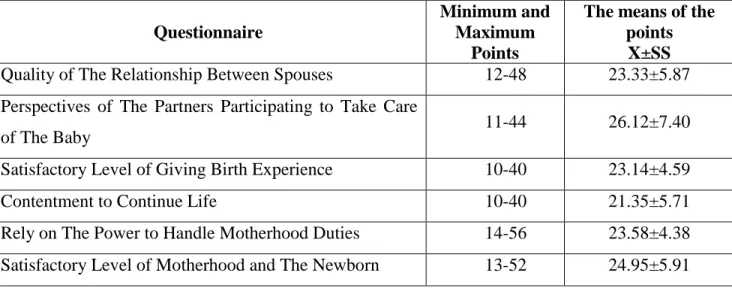
Table 1: Postpartum Self Evaluation Questionnaire and the means of sub-questionnaire points Questionnaire
Minimum and Maximum
Points
The means of the points
X±SS
Quality of The Relationship Between Spouses 12-48 23.33±5.87
Perspectives of The Partners Participating to Take Care
of The Baby 11-44 26.12±7.40
Satisfactory Level of Giving Birth Experience 10-40 23.14±4.59
Contentment to Continue Life 10-40 21.35±5.71
Rely on The Power to Handle Motherhood Duties 14-56 23.58±4.38
Support from Family and Friends for Motherhood 12-48 18.35±5.60
Total of Postpartum Self Evaluation Questionnaire 82-328 154.82±27.43
Postpartum Self Evaluation Questionnaire means score of 154.82±27.43 was found. The findings on PSEQ are: The means of Quality of The Relationship Between Spouses sub-questionnaire is 23.33±5.87 on the basis of 48, The means of Perspectives of The Partners Participating to Take Care of The Baby sub-questionnaire is 26.12±7.40 on the basis of 44, The means of Satisfactory Level of Giving Birth Experience sub-questionnaire is 23.14±4.59 on the basis of 40, The means of Contentment to Continue Life sub-questionnaire is 21.35±5.71 on the basis of 40, The means of the Rely on The Power to Handle Motherhood Duties sub-questionnaire is 23.58±4.38 on the basis of 56, The means of Satisfactory Level of Motherhood and The Newborn sub-questionnaire is 24.95±5.91 on the basis of 48, and The means of the Support From Family and Friends for Motherhood sub-questionnaire is 18.35±5.60 on the basis of 40.
Table 2: Comparison of the Postpartum Self Evaluation Questionnaire according to independent
variables
Variables Groups Median (%25-%75) Min.-Max. p
Age Age 18-29 148 (132.00-162.00) 89-239 0.744
Age 30-44 140 (125.00-166.00) 90-232
Educational status Primary/Middle 153 (135.00-177.00) 89-233 0.001
High school/University 140 (127.00-156.00 91-238
Occupational Status Employed 140 (129.50-154.00) 96-220 0.024
Unemployed 147 (129.00-167.50 89-238
Age of the Marriage <5 years 146 (131.50-162.00) 90-238 0.841
≥5 years 143 (128.00-166.50) 89-223
Type of family Nuclear Family 144 (129.00-162.00) 90-232 0.021
Extended Family 156 (135.50-180.75) 89-229
Income Status High/Well 138 (119.00-153.00) 89-212 0.019
Medium/Low 147 (132.00-167.75) 90- 229
Don’t Have 162 (144.75-186.25) 98-222 Intention of the pregnancy Intentional 142 (128.00-158.00) 89-220 0.000 Unintentional 191 (174.00-205.00) 100-229 Number of pregnancy 1. pregnancy 156 (134.00-181.50) 89-220 0.011 ≥2 pregnancy 144 (128.00-166.00) 89-229 Being informed before pregnancy Informed 143 (129.00-163.00) 89-222 0.001 Uninformed 161 (151.75-192.25) 113-229
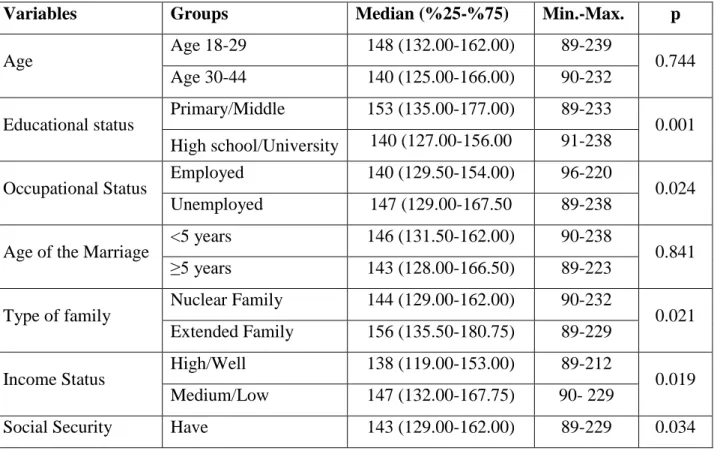
Postpartum Self Evaluation Questionnaire was compared based on some independent variables. According to the comparison, high school/university graduate women adapts to motherhood better than primary/middle school graduated women (p<0.05). Employed women have better adaptation to motherhood than unemployed women (p<0.05). Women living in the elementary family have better adaptation rates than women living in the crowded families (p<0.05). Women with high or well income status have better adaptation than women middle/low income status (p<0.05). Women who have social security adopts to motherhood better than women who do not have social security. Women who are informed about pregnancy adopts to motherhood better. PSEQ point averages did not show any statistical correlation on the age of the woman and the duration of the marriage (p<0.05).
Main factors determining women’s sociological position are; education, occupation, income level, and social security (Taskin 2016). These attributes are crucial factors affecting the motherhood role that a woman is going to have. In Sezer’s study (2005), it is pointed out that as women’ educational level increase, the adaptation level to both herself and her surroundings increase. Ergin et al. (2010) indicated that 69.3% of pregnancy of women who do not have an occupation define as good. On the other hand, this rate increases to 88.2% on the pregnant women who have jobs that supplies income. As a contrary to this study, in Yildizoglu and Okten’s (2001) studies it is indicated that having an occupation affects women’s prenatal period negatively. As our research findings are parallel to the literature, we conclude that as women’s education and income level increase they acknowledge the motherhood roles easier, women who work and have social security have better adaptation rates to motherhood.
The other factor affecting a woman’s adaptation to pregnancy is the family structure. The intimate relationship between the partners is precluded, and unity and solidarity bonds weaken because of the increase in the family member number (Tortumluoglu 2003, Kilicaslan 2008). In the literature, it is indicated that women who live in the nuclear families are better in adapting the motherhood roles than women who live in the extended families (Kiehl, White 2003, Mermer, et al, 2010, Taner 2014). In our study, it has been found that the adaptation levels of women who live in the nuclear families are better. Reasons of these findings are thought to be the insufficient level of care of the woman based on the number of members living at the house, weakened bonds between the partners and insufficient level of care from the partner.
Planning of the pregnancy has effects on women’s adaptation to pregnancy and motherhood. It has been found that the women who had intentional pregnancies have better adaptation rates to motherhood. In the literature, it is indicated that factors such as; planned pregnancy, intentional pregnancy, high self-efficacy in pregnancy, having the first child or not having many children increase the partner’s support and besides that pregnant woman feels readier to become a mother because both the partner and the woman plan more and inform their selves about incoming baby (Kilicarslan 2008, Yekenkunrul 2011, Taner 2014, Ashtarian et al 2016).
Aim of the prenatal care is to end every intended pregnancy with health birth without risking the mother and baby (Drazancic 2001, Durusoy, et al, 2011). In prenatal period, expectant mother who had difficulties claiming her motherhood roles expands the acceptance period of pregnancy. And because of the physical sufferings that she had, she might have negative attitudes towards pregnancy and towards baby. For this reason, most critical point in prenatal care is to evaluate mother on her adaptation to pregnancy both physically and psychologically (Weis 2006, Kilic, et al, 2007, Katz 2010). Data of Turkey Demographic and Health Survey (TDHS, 2013) show that 92.0% of mothers had prenatal care from medical personnel. As similar to this finding, our results indicate that 94.9% of pregnant women had inform themselves about pregnancy during the prenatal period and those mothers have better adaptation rates to motherhood roles. But, both our study and TDHS’s (2013) study did not evaluate the quality of the prenatal care.
Research is limited that the study was conducted on women who were at 6-8 weeks postpartum enrolled in three family health centers and that the data were obtained in a single
interview. It is recommended that the study be repeated on a large scale with repeated interviews with more participants at certain intervals.
4. Conclusion
As a result of the research, it has been found that the adaptation to Motherhood of Women at Postpartum Period is intermediate. In our study, it was shown that the sociodemographic and obstetric attributes have roles determining the adaptation to Motherhood of Women at Postpartum Period. Adaptation to motherhood of women’s is affected by many variables and given perinatal care is a great importance in ensuring compliance. All health care professionals who serve pregnant and puerperal women with caring for their involvement in the psychosocial as well as physical care may be required.
Some of the women who accepted to participate left our study, because of the number of the questions in PSEQ. For this reason, there might be study about shorter version of this evaluation form based on its validity and reliability. Studies with higher number of sample and PSEQ might be conducted to have more comprehensive research.
References
Ashtariana, H., Ghanbarib, M., Moradic A., Baigic, L. (2016). Self-efficacy in Pregnant Women Referred to Health Centers in Delfan, Iran. Inter J Health Life Sci. (Vol.2 (1), pp 15-20). Balcombe, J. (1992). Postnatal depression how can the distress be alleviated. Nursing Times.
(vol.19 (1), pp 29-33).
Baser, M., Mucuk, S., Korkmaz, Z., Sevig, U. (2005). The determination of mother and father newborn care needs in postpartum period. Journal of Health Sciences. (vol.1, pp 54-58). Benson, R. C. (1994). Obstetrics and Gynecology. 7th Ed, Lange Medical Publication, 235. Beydag, K. (2007). Adaptation to motherhood in the postpartum period and the nurse’s role.
Journal of Preventive Medicine; 6(6):479-84.
Crow, K., Von Baeyer, C. (1989). Predictors of a positive childbirth experience, Birth 16(2):59
https://doi.org/10.1111/j.1523-536X.1989.tb00862.x
Data of Turkey Demographic and Health Survey. Hacettepe University Institute of Population Studies, Ankara; 2013.
Drazancic, A. (2001). Antenatal care in developing countries. What should be done? J Perinat Med; 29(3):188-98 https://doi.org/10.1515/JPM.2001.028
Durusoy, R., Davas, A., Ergin, I., Hassoy, H., Tanik, F.A. (2011). The incidence of the pregnancies of the second and third level health institutions in İzmir by the family physician and the affecting factorsr. Turkey Journal of Public Health; 9(1):1-15
https://doi.org/10.20518/tjph.173051
Eksi, A. (1999). I'm not ill. Nobel Medical Bookstores. Istanbul.
Ergin, F., Aksu, H., Demiroz, H. (2010). The quantity and quality of prenatal and postnatal care services. Anatolian Journal of Nursing and Health Sciences; 13(4):1-9.
Ersoy, M. (2000). Current emotional fluctuations of the mother and that the confinement of factors affecting the determination period. Istanbul Universities Institute of Health Sciences Obstetrics and Gynecology Nursing, Unpublished Undergraduate Thesis, Istanbul; 11-20.
Golbası, Z. (2000). Early postpartum discharge home care services and nursing. Journal of Cumhuriyet University School of Nursing. (Vol. l;7, pp 15-22).
Guideline on the Execution of Health Services, Access Address: (www.saglik.gov.tr.)
Guler, K. (1998). An epidemiological study of factors affecting prenatal care. Nursing Bulletin. (vol 2, pp 3-12).
Hodnett, E. D. (1996). Nursing support of the laboring woman. Journal of Obstetrics and Gynecology Nursing 25(3):257-264 https://doi.org/10.1111/j.1552-6909.1996.tb02434.x
Hung, C. H., Chung, H. H. (2001). The effects of postpartum stress and social support on
postpartum women health status, J Adv Nurs. (vol. 36, pp 676-84)
https://doi.org/10.1046/j.1365-2648.2001.02032.x
Katz, V.L. (2010) Prenatal Care. In: Danforth’s Obstetrics and Gynecology. Eds:Gibbs SR, Karlan YB, Haney FA, Nygonard I. İstanbul: Gunes Medical Bookstore.
Kiehl, E.M., White, M.A. (2003). Maternal adaptation during childbearing in Norway, Sweden and United States, Scandinavian. Journal of Caring Sciences 17(2):96-103
https://doi.org/10.1046/j.1471-6712.2003.00116.x
Kılıc, S., Ucar, M., Temir, P., Erten, U., Sahin, E., Karaca, B., Yuksel, S., Ozkır, F. (2007). Prenatal care in pregnant women and the factors effecting it. Turkish Armed Forces Preventive NEW physician Bulletin; 6(2):91-97.
Kilicarslan, S. (2008). The sociodemographic characteristics, quality of life, anxiety levels of the last trimester geographies in Edirne city center. Family Medicine Thesis: Trakya University.
Kocacaliskan, I., Bingol, N.A. (2008). Biostatistics. Nobel Publication, Ankara; 9-11.
Lederman RP, Raff, BS, Carroll P (1981). Prenatal Parental Behavior: Nursing Research and Implications for Newborn Health, March of Dimes Birth Defects Foundation, Birth Defects: Original Article Series. New York 17(6): 200-231.
Leifer, G. (2005). Maternity nursing; postpartum assessment and nursing Care, 9th ed, Elsevier Saunders, America. pp191-211.
Mermer, Gulengul, et al. (2010). Evaluation of perceived social support levels in pregnancy and postpartum periods. Journal of Psychiatric Nursing. (vol. 1, no. 2).
Moore, M. (1983). Realities in Childbearing, Philadelphia, W.B.Saunders Company, 895.
Ozturk, H., Sirin, A. (2000). These mothers giving birth and influencing factors of perceived social Support. Journal of Ege University Nursing Collage. (vol. 16(2-3) pp 31-40).