14 BUCA EĞİTİM FAKÜLTESİ DERGİSİ 33 (2012)
THE CONTRIBUTION OF SOCIO CULTURAL INFLUENCE TO STUDENTS’ SELF EFFICACY
SOSYO KÜLTÜREL ETKİNİN ÖĞRENCİLERİN ÖZ- YETERLİLİK İNANCINA ETKİSİ
Nurcan Kahraman*
Abstract
This study aimed to investigate how well socio cultural influence (perceived parents’ achievement goals, and perceived teachers’ achievement goals) predict elementary students’ self efficacy in science. Motivated Strategies for Learning Questionnaire, Perceived Parent Goal Emphases Scale, and Perceived Teacher Goal Emphases Scale were administered to 977 elementary school students. Results demonstrated that the elementary students, who perceive the importance of self improvement, perceive mastery goals, from their parents and teachers tend to have high self efficacy in science.
Keywords: self efficacy, socio cultural influence, science Özet
Bu çalışmanın amacı sosyo kültürel etkinin, öğretmenlerden ve ailelerden algılanan hedef yöneliminin, ilköğretim öğrencilerinin Fen ve Teknoloji dersindeki öz yeterlilik inançlarına olan etkisini araştırmaktır. Bu amaçla, 977 ilköğretim öğrencisine Öğrenmede Güdüsel Stratejiler Anketi, Ailelerden Algılanan Hedefler Anketi, ve Öğretmenlerden Algılanan Hedefler Anketi uygulanmıştır. Bu çalışmanın sonuçlarına göre, ailelerinden ve öğretmenlerinden Fen ve Teknoloji dersinde bireysel gelişimin önemini, yani ustalık hedeflerini algılayan öğrenciler daha yüksek öz yeterlilik inancına sahip olmaktadırlar.
Anahtar Sözcükler: Özyeterlilik, sosyo kültürel etki, fen
15 BUCA EĞİTİM FAKÜLTESİ DERGİSİ 33 (2012)
INTRODUCTION
One of the most widely known theories in education is Bandura’s (1986) Social Cognitive Theory (SCT). Self efficacy, a key component for the SCT, refers to judgments of individuals about their own capacities to accomplish a task and makes a great contribution to a persons’ self motivation (Bandura, 1982, 1999). Self efficacy includes feelings, and emotions for an oncoming situation (Bandura, 1977; 1981). A person’s perceptions about how well they organize required activities for an ambiguous situation are addressed by self efficacy beliefs (Bandura, 1977; Bandura& Schunk, 1981). Therefore, self efficacy beliefs are factors that directly effects people’s engagement in an activity (Bandura, 1977; 1981; Tipton& Worthington, 1984).
People’s judgments of themselves about whether they achieve the task or not is a process which is based on four types of information: performance attainments; vicarious experiences of observing the performances of others; verbal persuasion; and physiological states (Bandura, 1982; Schunk, 1984). Performance attainments refer to past performance of people. In other words, if a person achieves a task in the past, the next time he or she will believe himself/herself to accomplish the oncoming task. Additionally, performance attainments present valid efficacy information for people (Schunk, 1984). The second source, verbal persuasion, refers to observing others who are similar or whose tasks are similar. In other words, people can decide whether or not they can accomplish the task by observing other people. In the third information source, verbal persuasion, people judge their capacity for a task by others’ accounts or advice. In the last source, physiological states, people get assistance from their physiological conditions. For instance, if a person feels relaxed, he or she will be more confident, and they will infer from this that they can succeed (Bandura, 1982; Siegel& McCoach, 2007).
Self efficacy is a multidimensional construct that varies in strength, and difficulty level and also has significant effects on persons’ achievement behavior. It can even be seen as the best predictor of a specific behavior (Schunk, 1991; Pintrich, & Schunk, 2002). For instance, if people think the task is very difficult and that it exceeds their capacity, their judgment is negative, and they may avoid the task (Baundra 1977). Because having capacity is not enough to achieve a task, students also need to believe that they can achieve it (Hsieh, Sullivan and Guerra, 2007). Moreover, related researches suggested that many factors can effect students’ self efficacy beliefs. One of the factors that underline self efficacy is socio cultural influence. According to the researchers, students’ perceptions of social environment, both the school environment and home environment, is an important factor that influences not only students’ achievements and behaviors, but also students’ motivational beliefs like self efficacy (Eccles et al., 1983; Eccles et al., 1998; Wigfield & Eccles 1992; Eccles & Wigfield, 2000; Pintrich & Schunk, 2002). Therefore this study aimed to investigate the effects of socio cultural influences on students’ self efficacy in science.
16 BUCA EĞİTİM FAKÜLTESİ DERGİSİ 33 (2012)
Socio cultural influence
Students’ perceptions about social environment play a crucial role on students’ motivation, cognition, affects, and behaviors. The social environment includes both the learning environment and home environment. Moreover, students’ perceptions about the environment shape according to the beliefs and behaviors of the people around them (Ames, 1992; Anderman & Maehr, 1994). Nowadays researchers investigate learning and home environment in achievement goal framework (Bong 2005; Friedel, Cortina, Turner& Midgley, 2007). Achievement goals concerns students’ reasons while engaging in a task. According to the theory, students can study for learning new things, understanding the task, and developing new skills as mastery goals, or they can study for demonstrating their ability, getting high grades as performance goals (Anderman, Urdan, & Roeser, 2003; Eliot& Harackiewicz, 1996; Midgley, Kaplan& Middleton 2001; Pintrich, 2000a). In the same manner, goal researchers also distinguished students’ perceptions of their environment as perceive mastery goals and perceive performance goals. In other words, the social environment created by people around students can emphasize either mastery goals, by focusing on improving knowledge, skills, or abilities, or performance goals, by focusing on showing abilities to others (Nicholls, 1989; Garner, 1990; Ames, 1992; Kaplan et al., 2002; Meece, Anderman& Anderman, 2006). Therefore, perceived parents’ achievement goals and perceived teachers’ achievement goals can be examined as socio-cultural influences on student-related outcomes including self efficacy. To illustrate, Roeser, Midgley, and Urdan, (1996) investigated how the goal structures in learning environments affect students’ motivation in math classes. Two hundred ninety six, middle school students participated in the study. The results suggested that there is a relationship between students’ self efficacy and their perceptions of classroom goals. In other words, students who think that understanding and learning new things is important for their teachers in the classroom have high self-efficacy for math lessons. Moreover, Gutman (2006) examined the effects of students’ perceptions of classroom goals on their self-efficacy during the high school transition with a longitudinal study. The researcher administered the survey during the last year of elementary school and then again the first year of high school. According to the results, students who perceive more mastery and less performance goals in their classroom have more positive changes in their self-efficacy than their peers.
Although, there are a number of researches on perceived classroom goal structures and their effects on students’ motivations, there is a gap in terms of the role of perceived parents’ goals (Kim, Schallert& Kim, 2010; Friedel, Cortina, Turner, and Midgley, 2010). For this reason, in the light of the above mentioned literature, the present study aimed to investigate effects of perceived teachers’ goals, and perceived parents’ goals on students’ self efficacy in science.
METHOD Sample
Nine hundred seventy seven, 494 (50. 6 %) girls and 482 (49. 4 %) boys participated in the study. All students are 7th grade, public school students from Kutahya, a city of Turkey.
17 BUCA EĞİTİM FAKÜLTESİ DERGİSİ 33 (2012)
Instruments
Motivated Strategies for Learning Questionnaire (MSLQ)
MSLQ is a self-reported questionnaire developed by Pintrich, Garcia, and McKeachie (1991). Students rate themselves on a seven point Likert scale from “not at all true of me” to very true of me” concerning different aspects of their motivation and learning strategy use. In the present study, a Turkish version of the MSLQ, translated and adopted in to Turkish by Sungur (2004), was used to assess students’ self efficacy (8 items) and metacognition (12 items) in science. The reliabilities of self-efficacy sub-scales were found to be. 89.
Perceived Parent Goal Emphases Scale
It is a self-report instrument developed by Friedel, Cortina, Turner and Midgley (2007). It is a five point Likert scale ranging from 1 “do not believe at all” to 5 “completely true”. The questionnaire was designed to assess students’ perceptions about their parents’ goal emphases. It consists of 11 items in two sub-scales: mastery goals (6 items) and performance goals (5 items). While perceptions of parents mastery goal emphasis focus on assessing whether parents want their children to understand science, or to learn from mistakes (e.g. “My parents want me to understand science concepts, not just do the work”), perceptions of parent performance goal emphasis focus on assessing whether parents want their children to show their abilities to others, or whether they dislike mistakes (e.g. “My parents don’t like it when I make mistakes in science”).
Perceived Parent Goal Emphases Scale translated and adapted to Turkish by the researchers of the present study. During its validation for Turkish sample, a series of confirmatory factor analyses were conducted. Additionally, cronbach’s alpha coefficients were computed to assess internal consistencies of the sub-scales. The internal consistency reliabilities were found to be .75 for the perceptions of parent mastery goal emphasis, .61 for the perceptions of parent performance goal emphasis, for the current study.
Perceived Teacher Goal Emphases Scale
It is a self-report instrument adopted from the Patterns of Adaptive Learning Survey (PALS; Midgley et al., 1997) by Friedel, Cortina, Turner and Midgley (2007). The questionnaire was designed to assess students’ perceptions about their teachers’ goal emphases in the classroom. It is a five point Likert scale ranging from 1 “do not believe at all” to 5 “completely true”. It consists 10 items in two sub scales: perceived mastery goals (5 items), and perceived performance goals (5 items). Items in the perceived mastery goals scale were designed to assess if teachers focus on learning, and understanding in the class (e.g. “My teacher gives us time to really explore and understand new ideas in science”), whereas, items in the perceived performance goals scale were developed to assess if teachers focus on highest grades in the class (e.g. “My teacher points out those students who get good grades in science as an example to all of us”).
18 BUCA EĞİTİM FAKÜLTESİ DERGİSİ 33 (2012)
Perceived Teacher Goal Emphases Scale translated and adapted to Turkish by the researchers of the present study. During its validation for Turkish sample, a series of confirmatory factor analyses were conducted. Additionally, cronbach’s alpha coefficients were computed to assess internal consistencies of the sub-scales. The internal consistency reliabilities were found to be .83 for the perceptions of teachers’ mastery goal emphasis, .78 for the perceptions of teacher performance goal emphasis, for the current study.
RESULTS
Descriptive Statistics
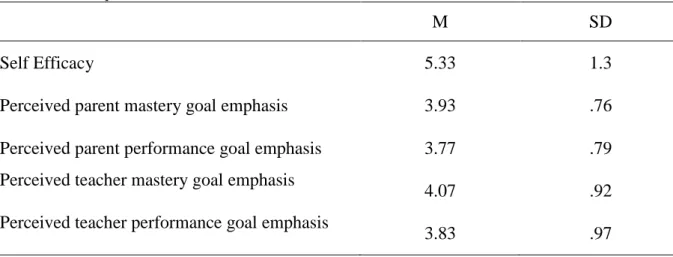
Mean and standard deviation for students’ self-efficacy, perceptions of their teachers’ and parents’ achievement goals are presented in Table 1.
Table 1 Descriptive Statistics
M SD
Self Efficacy 5.33 1.3
Perceived parent mastery goal emphasis 3.93 .76 Perceived parent performance goal emphasis 3.77 .79 Perceived teacher mastery goal emphasis
4.07 .92
Perceived teacher performance goal emphasis
3.83 .97
As seen in Table 1, elementary students appear to have higher levels of self efficacy beliefs in science. Additionally, according to the descriptive results students generally perceive mastery goals from both their parents and teachers compared to performance goals in science. This implies that, students think that their parents and teachers focus on learning new things and developing skills in science.
Inferential Statistics
In order to examine how well elementary socio cultural influence predict students’ self efficacy in science, multiple linear regression analysis was conducted. Results showed that the linear combination of predictor variables significantly accounted for 12. 5 % of variance in self efficacy, (R= .35, F= 31.05, p< .05). More specifically, it was found that students’ perceptions about their teachers’ and parents’ mastery goals each made a statistically significant contribution to the prediction of students’ self efficacy (p <0.05), while other
19 BUCA EĞİTİM FAKÜLTESİ DERGİSİ 33 (2012)
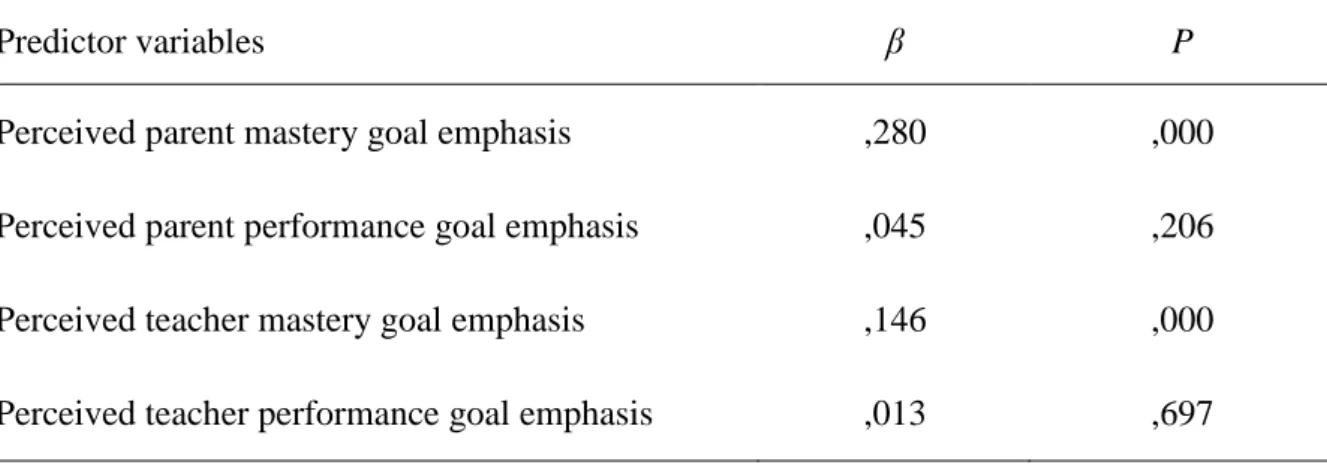
variables failed to achieve significance (p > 0.05). Beta coefficients, and related significance values are presented in Table 2. The largest beta coefficient was .28, which was for the perceived parent mastery goal emphasis indicating that this variable made the strongest unique contribution to explaining the dependent variable.
Table 2 Contribution of Socio Cultural Influence to Students’ Self-efficacy
Predictor variables β P
Perceived parent mastery goal emphasis ,280 ,000 Perceived parent performance goal emphasis ,045 ,206 Perceived teacher mastery goal emphasis ,146 ,000 Perceived teacher performance goal emphasis ,013 ,697
DISCUSSION
The present study aimed to investigate how socio cultural influence affects students’ self efficacy in science. Students’ perceptions of parents’ and teachers’ achievement goals are examined as socio cultural influence. According to the results, students’ perceptions of teachers’ and parents’ mastery goals in science have significant roles in prediction of self efficacy in science. These results suggest that students who think that their teacher and parents focus on learning new things and understanding the course material in science tend to have positive judgments about their capacity to learn science. The literature also indicates similar results about effects of socio cultural influence on the students’ self efficacy. For instance, Rooser, Midgley and Urdan (1996) investigated the relationship between students’ perceptions of classroom goals and their self efficacy and suggested positive relationship between self efficacy and students’ perception of classroom mastery goals. In another study, Gutman (2006) examined the same relations and reported that students’ perception of classroom mastery goals was positively linked to their self efficacy. In other words, students who perceive an emphasis on learning and understanding the course material in science classrooms have more positive beliefs about their capacity to learn the material than others. Therefore, it is suggested that to parents and teachers emphasize mastery goals in science to improve students’ self efficacy. Accordingly, teachers can focus on students’ effort, design meaningful and challenging tasks, involve students in decision making, and individual improvement and progress. Furthermore, explaining the reasons of the task, and what the task contribute them can also help teachers to emphasize the importance of learning and understanding science (Ames, 1992; Pintrich& Schunk, 2002).
20 BUCA EĞİTİM FAKÜLTESİ DERGİSİ 33 (2012)
Regarding to parents’ goals, the results also suggest that perceived parents’ mastery goals have significant effect on students’ self efficacy. Hence, creating a mastery oriented home can make students more efficious. To create mastery oriented home environment, parents can emphasize the importance of self improvement in science to their children. Besides that, avoiding comparisons to their children with the peers, and focusing only grades can also be helpful for the parents.
REFERENCES
Ames, C., & Archer, J. (1988). Achievement goals in the classroom: Student’s learning strategies and motivation processes. Journal of Educational Psychology, 80 (3), 260– 267.
Ames, C. (1992). Classrooms: goals, structures, and student motivation. Journal of
Educational Psychology, 84, 261-271.
Anderman, E.M., & Maehr, M.L. (1994). Motivation and schooling in the middle grades.
Review of Educational Research, 64, 287-309.
Anderman, E.M. & Midgley, C. (1997). Changes in achievement goal orientations, perceived academic competence, and grades across the transition to middle-level schools.
Contemporary Educational Psychology,22, 269-298.
Anderman, E.M. (2001). Learning to value mathematics and reading: relations to mastery and performance-oriented instructional practices. Contemporary Educational Psychology,
26, 76-95.
Anderman, E.M. & Urdan, T. & Roeser, R. (2003). The patterns of adaptive learning survey: History, development, and psychometric properties. For Indicators of Positive
Development Conference, March 12-13, 2003
Anderman, E. R., & Midgley, C. (2004). Changes in self-reported academic cheating across the transition from middle school to high school. Contemporary Educational
Psychology, 29, 499-517.
Anderman, L.H. & Anderman, E.M. (1999). Social predictors of changes in students’ achievement goal orientations. Contemporary Educational Psychology, 25, 21-37. Bandura, A., & Adams, N.E. (1977). Analysis of self-efficacy theory of behavioral change.
Cognitive Therapy and Research, 1(4), 287-310.
Bandura, A. & Shunk (1981). Cultivating competence, self-Efficacy, and intrinsic interest through proximal self-motivation. Journal of Personality and Social Psychology,
41(3), 586-598.
Baundra, A. (1982). Self-efficacy mechanism in human agency. American Psychologist, 37 (2). 122- 147.
Bandura, A., & Cervone, D. (1983). Self-evaluative and self-efficacy mechanisms governing the motivational effects of goal systems. Journal of Personality and Social
21 BUCA EĞİTİM FAKÜLTESİ DERGİSİ 33 (2012)
Bandura, A. (1993). Perceived self-efficacy in cognitive development an functioning.
Educational Psychologist, 28(2), 117-148.
Bandura, A. (1999). A sociocognitive analysis of substance abuse: An agentic perspective.
Psychological Science, 10(3), 214-217.
Bandura, A. (1999). Social cognitive theory: an agentic perspective. Asian Journal of Social
Psychology, 2, 21-41.
Bandura, A., & Locke, E.A. (2003). Negative self-efficacy and goal effects revisited. Journal
of Applied Psychology, 88(1), 87-99.
Bong, M. (2005). Within-Grade changes in Korean Girls’ motivation and perceptions of the learning environment across domains and achievement levels. Journal of Educational
Psychology. 97(4),656-672.
Eccles, J.& Wigfield, A. (1990). Changes in academic motivation and self- perception during early adolescence. Examining Development in Social Context, 134- 155. Beverly Hills, CA: Sage Publishing Co.
Eccles, J, Wigfield, A., Harold Rena D., & Blumenfeld, P. (1993). Age and gender differences in children’s self- and task perceptions during elemantary school. Child
Development, 6, 830-847.
Eccles, J.S. & Wigfield Allan. (1995). In the mind of the actor: the structure of adolescents’ achievement task values and expectancy-related beliefs. Personality and Social
Psychology Bulletin, 21(3), 215-225.
Eccles, J.& Wigfield, A. (2002.). Motivational beliefs, values and goals. Annual Review of
Psychology, 53 , 109–132.
Eccles, J.S., Susan A. O'Neill, S.A., & Wigfield, A. (2005). Ability self-perceptions and subjective task values in adolescents and children. The Search Institute Series on Developmentally Attentive Community and Society, 3(4), 237-249.
Eccles, J. (2009). Who am I and what am I going to do with my life? Personal and collective identities as motivators of action. Educational Psychologist, 44(2), 78-89.
Friedel, J. M., Cortina, K. S., Turner, J. C., & Midgley, C. (2007). Achievement goals, efficacy beliefs and coping strategies in mathematics: The roles of perceived parent and teacher goal emphases. Contemporary Educational Psychology, 32 (3), 434-458. Gutman, L.M. (2006). How student and parent goal orientations and classroom goal structures
infuence the math achievement of African Americans during the high school transition. Contemporary Educational Psychology,31, 44-63.
Hsieh, P., Sullivan, J.R., Guerra, N.S. (2007). A closer look at college students: self-efficacy and goal orientation. Journal of Advanced Academics, 18(3), 454-476.
Kaplan, A., & Midgley, C. (1997). The effect of achievement goals: does level of perceived academic competence make a difference?. Contemporary Educational Psychology, 22, 415-435.
22 BUCA EĞİTİM FAKÜLTESİ DERGİSİ 33 (2012)
Kim, J., Schallert, D., L., & Kim, M. (2010). An integrative cultural view of achievement motivation: Parental and classroom predictors of children’s goal orientations when learning mathematics in Korea. Journal of Educational Psychology, 102 (2), 418–437 Meece, J., Anderman E. M., & Anderman, L. H. (2006).Classroom goal structure, student
motivation, and academic achievement. Annual Review of Psychology, 57, 505-528. Midgley, C., Kaplan, A., & Middleton, M. (2001). Performance-approach goals: Good for
what, for whom, under what circumstances, and at what cost? Journal Educational
Psychology, 93, 77-86.
Nicholls, J.G. (1984). Achievement motivation: conceptions of ability, subjective experience, task choice, and performance. Psychological Review, 91(3), 328-346.
Pintrich, P.R. (2000). Multiple goals, multiple pathways: the role of goal orientation in learning and achievement. Journal of Educational Psychology, 92(3), 544-555.
Printrich, P.,,R.& Schunk, D., H. (2002). Motivation in education: theory, research and
applications. Ohio: Merrill Prentice Hall.
Roeser, R.W., Midgley, C., & Urdan, T.C. (1996). Perceptions of the School Psychological Environment and Early Adolescents' Psychological and Behavioral Functioning in School: The Mediating Role of Goals and Belonging.
Schunk, D.H. (1984). Enhancing self-efficacy and achievement through rewards and goals: motivational and informational effects. Journal of Educational Research, 78(1), 29-34.
Schunk, D. H. (1991). Self-efficacy and academic motivation. Educational Psychologist, 26, 207–232.
Siegle, D. & McCoach, D., B. (2007). Increasing student mathematics self-efficacy through teacher training. Journal of Advanced Academics, 18(2), 278-312.
Tipton, R.M., & Worthington, E.L. (1984). The measurement of generalized self-efficacy: a study of construct validity. Journal of Personality Assessment, 48(5), 545-548.
Wigfield, A., & Eccles, J. S. (1992). The development of achievement task values: A theoretical analysis. Developmental Review, 12, 1- 46.
GENİŞLETİLMİŞ ÖZET
Eğitim araştırmalarında en çok bilinen teorilerden bir Bandura’ nın Sosyal Bilişsel kuramıdır. Bu kuramın anahtar elemanı olan öz yeterlilik öğrencinin öğrenme ve başarı için kendi kabiliyetleri ve yeterliliği ile ilgili düşünceleridir. Bir diğer deyişle öz yeterlilik kişinin bir görevi yerine getirmede kendini sorgulaması ve yetenekleri hakkında yargıya varmasıdır. Bu yüzden öz yeterlilik görevin zorluk derecesine göre değişiklik gösterebilir. (Bandura, 1982, 1999; Zimmerman, 2000). Öz yeterlilik kişinin bir görevi yerine getirmede ısrarını ve çabasını etkiler. Öğrencinin bir görevdeki öz yeterliliği düşük ise o görevden bırakma eğiliminde bulunabilir. Diğer yandan öz yeterliliği yüksek insanlar zor görevlerde daha yüksek çaba ve uzun ısrar gösterirler. (Baundra 1977; Bandura, 1982; Schunk, 1990; Bandura, 1999; Pintrich, & Schunk, 2002). Ayrıca kişinin kendi hakkındaki yargıları geçmişindeki
23 BUCA EĞİTİM FAKÜLTESİ DERGİSİ 33 (2012)
başarı ve başarımına, başkalarının başarı ve başarımını dışarıdan gözlemlemesine, başkalarının verdiği tavsiyelere ve psikolojik durumuna (rahat ya da gergin olma) bağlıdır. (Bandura, 1982; Schunk, 1984; Pintrich, & Schunk, 2002). Bunların yanı sıra ilgili araştırmalar birçok etkenin öz yeterlilik inancını etkilediğini göstermektedir. Bunlardan birisi de sosyo kültürel etkidir. Araştırmalara göre öğrencilerin ev veya öğrenme ortamı hakkındaki düşünceleri sadece davranışlarını değil, aynı zaman da öz yeterlilik gibi motivasyonel inançlarını da etkilemektedir (Eccles et al., 1983; Eccles et al., 1998; Wigfield & Eccles 1992; Eccles & Wigfield, 2000; Pintrich & Schunk, 2002). Bu sebepten dolayı bu araştırma soyo kültürel etkinin Türk öğrencilerinin fen bilgisi dersindeki öz yeterlilikleri üzerindeki etkisini araştırmayı amaçlamaktadır. Bu çalışmada sosyo kültürel etki hem ev hem de okul gibi sosyal çevrelerdeki hedef yöneliminin etkisi olarak ele alınmıştır. Hedef yönelimi teorisi öğrencilerin herhangi bir görevi başlama, başarma nedenleri ile ilgilidir. Bu teoriye gore, kimi öğrenciler bilgi ve becerilerini arttırmak gibi ustalık hedeflerini benimserken, kimileri de başkalarına başarı ve becerilerini göstermek, yüksek not almak gibi sebeplerden dolayı çalışmak gibi başarım hedeflerini benimsemektedirler (Anderman, Urdan, & Roeser, 2003; Eliot& Harackiewicz, 1996; Midgley, Kaplan& Middleton 2001; Pintrich, 2000a). Teori araştırmacıları aynı şekilde öğrencilerin çevrelerinden algıladıkları hedefleri de ustalık ve başarım hedefleri olarak ikiye ayırmıştır. Diğer bir değişle, okulda öğretmenler, evde ebeveynler öğrenmenin önemine ve kabiliyetleri geliştirmenin önemine değinerek öğrencilerin ustalık hedeflerini, öğrenciyi arkadaşlarıyla kıyaslayarak başarım hedeflerini vurgulayabilirler (Nicholls, 1989; Anderman & Maehr, 1994; Kaplan& Maehr, 2002; Friedel, Cortina, Turner and Midgley, 2007). Çoğu araştırmacı öğrencilerin öğretmelerinden algıladıkları ustalık hedeflerinin öz yeterlilik inançlarında önemli bir etkisi olduğunu göstermiştir (Roeser, Midgley, & Urdan, 1996; Gutman, 2006). Literatürde öğretmenlerden, öğrenme ortamından algılanan hedefler üzerinde çalışmalar mevcutken, öğrencilerin aileerinden algıladakları hedeflerin etkisi konusunda bir eksiklik göze çarpmaktadır (Kim, Schallert& Kim, 2010; Friedel, Cortina, Turner, and Midgley, 2010). Bu sebeple, bahsedilen literature ışığında bu çalışma fen bilgisi dersinde öğretmenlerden ve ailelerden algılanan hedeflerin öğrencilerin öz yeterlilikleri üzerine olan etkisini araştrmayı amaçlamaktadır.
Bahsedilen amaç doğrultusunda Kütahya’ daki 977, 7. Sınıf öğrencisine Öğrenmede Güdüleyici Stratejiler, Öğretmenlerden Algılanan Hedefler, ve Ailelerden Algılanan Hedefler ölçekleri uygulanmıştır. Bu ölçeklerden öğrenmede güdüleyici stratejiler ölçeği Sungur tarafından (2004) Türkçeye çevrilirken, diğer iki ölçek bu çalışmanın araştırmacısı tarafından Türkçe’ ye çevrilmiştir.
Sosyo kültürel etkinin öğrencilerin öz yeterlilikleri üzerindeki etkisini araştırmak için çoklu, doğrusal regresyon analizi yapılmıştır. Bu analizin sonuçarına gore bağımsız değişkenlerin kombinasyonu öz yeterlilik varyansının % 12,5’ unu açıklamaktadır , (R= .35,
F= 31.05, p< .05). Sonuçlara göre, öğrencilerin ailelerinden ve fen öğretmenlerinden
algıladıkları ustalık hedefleri, öz yeterliliklerine istatistiksel olarak anlamlı bir katkıda bulunmaktadır (p <0.05), algılanan başarım hedeflerinin ise istatiksel bir etkisi görülmemiştir (p > 0.05). Bu bulgular öğretmenleri ve aileleri için fen bilgisinde yeni şeyler öğrenmenin, dersi anlamanın, kişisel gelişimin önemli olduğunu düşünen öğrencilerin, fen bilgisi anlama kapasiteleri konusunda daha pozitif düşüncelere sahip olduklarını göstermiştir. Buna dayanarak, öğretmenlere ve ailelere fen bilgisi dersinde ustalık hedeflerini vurgulamaları önerilmektedir. Öğretmenler öğrencilerin gösterdikleri çabalara odaklanarak, konu ile ilgili anlamlı ve zorlayıcı ödevler tasarlayarak, öğrenciyi sınıf içinde karar alma sürecine dâhil
24 BUCA EĞİTİM FAKÜLTESİ DERGİSİ 33 (2012)
ederek öğrencilere fen bilgisini anlamanın, öğrenmenin önemini vurgulayabilirler (Ames, 1992; Pintrich& Schunk, 2002). Ailelerde evde ustalık hedeflerinin üzerinde durarak öğrencilerin öz yeterlilikleri üzerinde olumlu etkiye sahip olabilirler. Bunun için, anne ve babalar çocuklarını diğer öğrenciler ile kıyaslamak yerine fen bilgisinde kişisel gelişimin önemi üzerinde durmalıdırlar.