Isotretinoin treatment in nodulocystic acne with and without
polycystic ovary syndrome: efficacy and determinants of
relapse
Gul Aslihan Cakir
1,
MD, Fatma Gulru Erdogan
2,
MD, MPH,and Aysel Gurler
2,
MD1Department of Dermatology, Etimesgut
State Hospital, and2Department of
Dermatology, School of Medicine, Ufuk University, Ankara, Turkey
Correspondence
Fatma Gu¨lru Erdogan,MD, MPH
Sanatkarlar cad. No: 5 Angora Evleri Beysukent Ankara
Turkey
E-mail: [email protected]
Conflicts of interest: None.
Abstract
Background Isotretinoin is the most efficacious long-lasting treatment for acne; however, some factors, including polycystic ovary syndrome (PCOS), patient age, family history, and type and number of acne lesions, may lead to treatment resistance or relapse following treatment. The aim of this study was to compare the efficacy and permanence of systemic isotretinoin (SI) in nodulocystic acne patients with and without PCOS and to evaluate the factors associated with relapse during the first and second post-treatment years.
Methods and Materials The study included 96 female patients with nodulocystic acne. SI 0.5-1 mg/kg/dl was given, with a total cumulative dose of 120–150 mg/kg. Response to treatment and relapse during the first and second post-treatment years were evaluated. Results In all, the 50 non-PCOS and 46 PCOS acne patients were similar. SI was similarly efficacious in both groups. In total, eight patients relapsed during the first post-treatment year, versus 16 during the second. Relapse during the first year was associated with the number of nodules at the start of treatment and the number of papulopustular lesions at the end of treatment, whereas PCOS, patient age, and the number of nodules at the start of treatment were associated relapse during the second year.
Conclusion Regardless of its association with PCOS, SI was effective in the treatment of nodulocystic acne. The factors associated with relapse during the 1stand 2nd
post-treatment years differed, except for the number of nodules at the start of post-treatment.
Introduction
Acne is a common skin disease associated with various psychological morbidities. In particular, in the susceptible age group it causes various psychopathological symptoms associated with low self-esteem, and it is known to nega-tively affect personal and professional aspects of a patient’s life.1 Polycystic ovary syndrome (PCOS), on the other
hand, is a chronic condition that affects various organs, including skin, for which there is no known cure.2Usually,
oral contraceptives – with or without anti-androgenic steroids – are the treatment of choice for PCOS-associated acne; however, even though the treatment ameliorates acne lesions, relapse occurs within 3–6 months after treatment cessation, and there can be side effects that negatively affect vascular stability and coagulation.3,4
Systemic isotretinoin (SI) is the longest lasting treatment for acne;5–7 however, the efficacy of SI in patients with acne and PCOS remains unclear, and unresponsiveness to hormonal and/or systemic antibiotic treatment are among
the indications for SI treatment.5Although relapse post-SI
treatment occurs in 14–52% of patients, almost 50% of patients do not experience relapse. Moreover, relapses usually occur after 1–2 years of remission, which is longer than that associated with oral contraceptives and metfor-min.6,7On the other hand, as PCOS is recurrent and with-out a definitive cure, it may be a risk factor for relapse after SI treatment. Nevertheless, relapse following SI treat-ment has also been reported to be associated with factors other than PCOS, such as patient age; duration, grade, and distribution of acne; and family history of acne, seborrhea, and abdominal obesity (defined by waist circumference) via secretion of certain adipokines as a possible aggravating factor of PCOS.3
The present study aimed to compare the efficacy of SI in adult female patients with nodulocystic acne with and without PCOS and to assess the effect of PCOS and other previously defined risk factors for resistance to SI
treat-ment and relapse during the first and second
post-treatment years. Therefore, we determined if SI could
be considered a first-line treatment for PCOS-associated nodulocystic acne.
Materials and methods
This prospective study was conducted at a university hospital between 2007 and 2010. Adult Caucasian female patients aged 17–40 years with nodulocystic acne (Burke and Cunliffe [B&C]8
grade‡3) were included. Pregnant or breastfeeding women and all treatment or follow-up dropouts were excluded from the study. Each patient signed an informed consent form, and the study protocol was approved by the local Ethics Committee.
At the initial visit, a detailed history, including age, weight, height, concomitant diseases, family history of acne (father, mother, or both), duration of acne, age at onset of acne, and regularity of the menstrual cycle, was recorded. Seborrhea was assessed using a semiquantitative scale, ranging from 0 to 3 (0: none; 1: mild; 2: moderate; 3: severe). All patients were investigated for clinical signs of hyperandrogenism (androgenic alopecia and hirsutism) by the same physician; however, as hirsutism may be familial without an underlying cause in certain populations, all patients are evaluated for the presence of PCOS. Diagnoses were confirmed by the department of endocrinology, to exclude such etiologies as androgen-secreting tumors, hyperprolactinemia, and/or non-classical congenital adrenal hyperplasia. Patients were diagnosed as PCOS according to the European Society of Human Reproduction and Embryology, and American Society for Reproductive Medicine criteria, based on the presence of any two of the following three criteria: polycystic ovaries on ultrasound examination, clinical or biochemical hyperandrogenism, and menstrual dysfunction with anovulation.
For the evaluation of acne, all types of acne lesions (papules, pustules, comedones, and nodules/cysts) and scars were individually counted in six regions (face, neck, chest, upper part of the back, lower part of the back, and arms). Before initiating SI treatment, both B&C acne grade and E´ chelle de Cotation des Le´sions d’Acne´ (ECLA) scores in all patients were determined. All patients received 0.5–1 mg/kg per day of SI, and the total cumulative dose was 120–150 mg/kg, depending on the response to treatment. During follow-up, each acne lesion in all defined localizations was counted, and drug-related side effects were evaluated every two months. Patients regularly used sunscreens and moisturizers to minimize the side effects of SI. Following SI treatment, ECLA score, B&C acne grade, and number of acne lesions were re-evaluated. According to the post-treatment number of lesions and B&C acne grade, patient response treatment was classified as complete remission (100% recovery of all types of lesions, B&C grade 0), partial remission (recovery of 80–99% of lesions, B&C grade 1 or 2), and treatment resistant (no change, <80% recovery of lesions or advance in B&C grade). In addition, remission was evaluated according to all types of lesions.
Post-SI treatment, all patients were prescribed topical retinoids as maintenance therapy and were followed-up every two months to monitor for relapse; however, patients were told to present immediately if any acne lesions appeared (relapse) between follow-up visits. Criteria used to define relapse vary by study, and there is yet no standard definition of relapse.6,7In the
present study, relapse was considered with an ECLA papulopustular lesion score‡2 (>4 papules, pustules), comedonal lesion score >3 (>9 open or closed comedones), or the presence of‡1 nodules.
Data were collected pretreatment and 10 ± 3 and
21 ± 3 months post-treatment. Data were analyzed using SPSS v.16.0 software (Chicago, IL, USA). The Mann–Whitney test was used for quantitative variables, such as age, body mass index, waist circumference, and duration of acne, and Pearson’s chi-square test was used for qualitative variables, such as the presence of depressed scars, and family history of acne, and seborrhea. The Friedman test was used to assess change in each acne lesion during treatment. The Wilcoxon signed rank test was used to investigate change in the number of acne lesions and acne grade during treatment, whereas the Mann–Whitney test was used to compare patient groups, in terms of the number of acne lesions and acne grade post-treatment. Factors associated with relapse were studied using the Cox model, as a two-step procedure described below.
First, we compared patients with and without PCOS, in terms of the efficacy of SI treatment. Then, we evaluated the impact of risk factors on relapse, including PCOS, current age, age at onset of acne, duration of acne, family history of acne, seborrhea, maintenance treatment with topical retinoids, extrafacial lesions, number of lesions pre- and post-treatment, and B&C grade and ECLA score pre- and post-treatment, using a univariate Cox model. Finally, we evaluated all possible factors together using a multivariate Cox model to identify the major factors associated with relapse.
Results
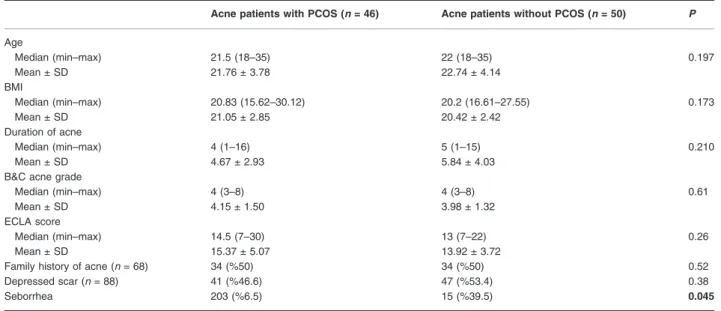
Patient demographic data are shown in Table 1. The PCOS and non-PCOS groups did not differ in any of the study parameters, except for seborrhea, which was more preva-lent in the PCOS group (P = 0.045) (Table 1). The presence of extrafacial acne lesions was also similar in both groups, in terms of lesions on the neck (P = 0.06), chest (P = 0.06), arms (P = 0.25), upper back (P = 0.29), and lower back (P = 0.46). The most common side effect of SI treatment was cheilitis (90%); no serious side effects were noted.
Among the 96 patients that completed the treatment, 88 (91.6%) had complete remission, seven (7.3%) had partial remission, and only one patient was treatment resistant. There was no significant difference in the com-plete remission rate between the PCOS and non-PCOS groups (P > 0.05). The decrease in the number of acne
lesions during treatment was statistically significant in both groups (Friedman test, P < 0.001). Post treatment, the number of comedonal and papulopustular lesions and acne grade were similar in the PCOS and non-PCOS groups; however, the number of nodular lesions was higher in the PCOS group (Table 2). Additionally, four of seven partial responders and one treatment-resistant case were in the PCOS group.
Determinants of early relapse
During a mean follow-up period of 10 ± 3 months relapse was observed in eight patients (PCOS group: n = 5 [11%]; non-PCOS group: n = 3 [6%]). The small number of patients that relapsed hindered statistical evaluation. No relapses occurred before the third post-treatment month, whereas three patients relapsed between the third and sixth post-treatment months. Relapse occurred in two of seven
Table 1 Patient demographic data
Acne patients with PCOS (n = 46) Acne patients without PCOS (n = 50) P
Age Median (min–max) 21.5 (18–35) 22 (18–35) 0.197 Mean ± SD 21.76 ± 3.78 22.74 ± 4.14 BMI Median (min–max) 20.83 (15.62–30.12) 20.2 (16.61–27.55) 0.173 Mean ± SD 21.05 ± 2.85 20.42 ± 2.42 Duration of acne Median (min–max) 4 (1–16) 5 (1–15) 0.210 Mean ± SD 4.67 ± 2.93 5.84 ± 4.03
B&C acne grade
Median (min–max) 4 (3–8) 4 (3–8) 0.61
Mean ± SD 4.15 ± 1.50 3.98 ± 1.32
ECLA score
Median (min–max) 14.5 (7–30) 13 (7–22) 0.26
Mean ± SD 15.37 ± 5.07 13.92 ± 3.72
Family history of acne (n = 68) 34 (%50) 34 (%50) 0.52
Depressed scar (n = 88) 41 (%46.6) 47 (%53.4) 0.38
Seborrhea 203 (%6.5) 15 (%39.5) 0.045
min, minimum; max, maximum; BMI, body mass index; SD, standard deviation, B&C, Burke and Cunliffe; ECLA, Échelle de Cotation des Lésions d’Acné.
Table 2 The number of acne lesions, B&C grade, and ECLA score at the end of treatment
Acne patients with PCOS (n = 46)
Acne patients without PCOS (n = 50)
P (Mann– Whitney U)
Comedone at the end of treatment
Mean ± SD 0.63 ± 2.54 0.10 ± 0.50 0.32
Median (min–max) 0 (0–15) 0(0–3)
Papule/pustule at the end of treatment
Mean ± SD 0.39 ± 1.59 0.08 ± 0.39 0.19
Median (min–max) 0 (0–10) 0 (0–2)
Nodule at the end of treatment
Mean ± SD 0.15 ± 0.55 0 ± 0 0.03
Median (min–max) 0 (0–3) 0 (0–0)
B&C acne grade at the end of treatment
Mean ± SD 0.22 ± 0.72 0.06 ± 0.24 0.35
Median (min–max) 0 (0–4) 0 (0–1)
ECLA score at the end of treatment
Mean ± SD 1.39 ± 1.85 0.88 ± 1.003 0.54
Median (min–max) 1 (0–7) 0 (0–5)
SD, standard deviation; min, minimum; max, maximum; B&C, Burke and Cunliffe; ECLA, Échelle de Cotation des Lésions d’Acné.
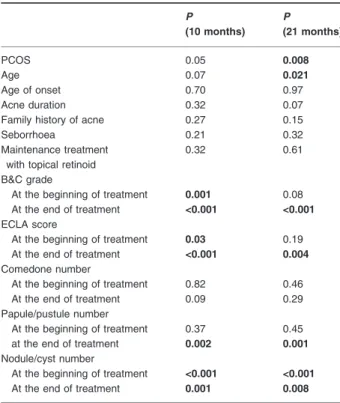
patients with partial remission, in one treatment-resistant case, and in five patients with complete remission. Vari-ables associated with the risk of relapse are shown in Table 3. Two factors strongly associated with the risk of relapse were superficial inflammatory lesions post treat-ment and the initial number of nodules (Table 4).
Determinants of late relapse
During a mean follow-up of 21 ± 3 months, 13 patients in the PCOS group and three in the non-PCOS group had
relapse. The relapse rate was significantly higher in the PCOS group (P = 0.003). The major factors associated with late relapse were younger age and higher nodulo-cystic lesion count pretreatment; however, comedones, papulopustular lesions, age at onset of acne, duration of acne, seborrhea, family history of acne, acne localization beyond the face, and presence or absence of maintenance treatment were not associated with relapse (Table 4).
Discussion
Acne is a common skin disease associated with psycho-logical morbidity. Although isotretinoin is the most effec-tive long-lasting treatment for nodulocystic acne, some risk factors associated with a lack of efficacy and relapse have been identified and studied.6,7,9,10 In the present study, factors associated with the efficacy of SI treatment and relapse were evaluated. Although it was previously reported that patients with acne and PCOS have more severe forms of acne than those without PCOS, patients with and without PCOS in the present study had similar B&C grades, ECLA scores, and extrafacial lesions. Efficacy of systemic isotretinoin
In total, 91% of the present study’s patients had total clearance of lesions. Previous studies have reported clear-ance rates of 46–95%.6,7,9 In the present study, the response to SI was similar in the PCOS and non-PCOS groups, according to statistical analysis; however, one treatment-resistant case and four of seven patients with partial response had PCOS. Moreover, patients with PCOS had significantly more nodular lesions post-treatment. Hyperandrogenism was previously defined as a factor that limits the efficacy of SI. Treatment of hyperandrogenism before or during SI has been recommended as a way to increase treatment efficacy.6The present results also show
that PCOS may lead to resistance to SI treatment, though not statistically significant. The number of non-inflammatory lesions was not associated with resistance to SI treatment in the present study, which is in contrast to a
Table 3 Factors associated with relapse during the first and second post-treatment years, based on a univariate Cox model (all possible offenders)
P (10 months) P (21 months) PCOS 0.05 0.008 Age 0.07 0.021 Age of onset 0.70 0.97 Acne duration 0.32 0.07
Family history of acne 0.27 0.15
Seborrhoea 0.21 0.32
Maintenance treatment with topical retinoid
0.32 0.61
B&C grade
At the beginning of treatment 0.001 0.08 At the end of treatment <0.001 <0.001 ECLA score
At the beginning of treatment 0.03 0.19 At the end of treatment <0.001 0.004 Comedone number
At the beginning of treatment 0.82 0.46 At the end of treatment 0.09 0.29 Papule/pustule number
At the beginning of treatment 0.37 0.45 at the end of treatment 0.002 0.001 Nodule/cyst number
At the beginning of treatment <0.001 <0.001 At the end of treatment 0.001 0.008
PCOS; polycystic ovary syndrome, B&C, Burke and Cunliffe; ECLA, Échelle de Cotation des Lésions d’Acné.
Table 4 Factors associated with relapse during the first and second post-treatment years, based on a multivariate Cox model (offenders)
B SE HR %95 CI P
At the end of 10 months
Nodule number at the beginning of the treatment 0.403 0.104 1.497 1.222–1.834 <0.0001 Papule/pustule number at the end of the treatment 2.062 0.619 7.865 2.337–26.476 0.001 At the end of 21 months
PCOS 1.343 0.669 4.028 1.032–14.210 0.045
Age at treatment initiation –0.328 0.153 4.623 0.534–0.971 0.032 Nodule number at the beginning of treatment 0.119 0.057 4.277 1.006–1.260 0.039
previous report.6Seborrhea, which was more common in the PCOS group pretreatment, was not associated with resistance to SI treatment.
Relapse
Relapse has been reported to occur mostly within the first two years post-SI treatment.10 In the present study,
relapse occurred in 8.3% of patients during the first post-treatment year and 16.6% of patients during the second post-treatment year. These may be considered relatively low where half of the patients had accompanying PCOS. Although there is no consensus on the definition of relapse, one study reported a much higher rate of relapse in patients with acne without PCOS using the same relapse criteria as used in the present study.7The relapse rate in the present study may have been lower due to the use of maintenance treatment with topical retinoic acids. Although the relapse rate was similar among patients that did and did not receive maintenance treatment (Table 3), maintenance treatment may still have been an important factor associated with the timing and/or incidence of relapse.11 Moreover, whereas it has been reported that
age <16 years and male gender were associated with relapse, all female patients aged >20 years may be less prone to relapse.9 All patients in the present study
received a total cumulative SI dose of 120–150 mg/kg (0.5–1.0 mg/kg per day), as suggested by previous studies to minimize relapse.6
Relapse during the first post-treatment year
The presence of papulopustular inflammatory lesions at the end of treatment was associated with relapse during the first post-treatment year and had the highest hazard ratio (HR: 7.87). Although persistent comedones and hyperan-drogenism were previously identified as risk factors for relapse, they were not associated with early relapse in the present study.6Patients with PCOS had statistically more stationary nodular lesions at the end of the treatment; how-ever, this was not associated with relapse. The present find-ings are in accordance with Quereux et al.,7who reported
that the presence of inflammatory lesions at the end of treatment is a risk factor for relapse. Persistence of inflam-matory lesions may indicate inadequate treatment and thus the need for prolongation of treatment, either with SI or some other agent. It was proposed that different isotretino-in schedules might have different biologic effects; isotretino-in patients with persistent inflammatory lesions, prolongation of SI with intermittent low-dose regimens could lead to total clearance.6 Various isotretinoin schedules may be undertaken in the future for such resistant cases.
In the present study, the initial number of nodulocystic lesions was also a factor associated with relapse. In a pre-vious study, the baseline number of nodules was higher in
the relapse group though not significantly;7however, the patient group included nodulocystic and milder cases. All of the patients in the present study had nodulocystic acne and a B&C grade >3. The initial number of nodular lesions may be a prognostic factor in this subset of patients with severe acne but would not be a factor in lower grade patients.
Relapse during the second post-treatment year
PCOS has been previously defined as a risk factor for refractoriness to SI and relapse, whereas PCOS is a chronic condition with no known long-lasting treatment. In patients with PCOS anovulation, insulin resistance, hir-sutism, and acne are apt to recur soon after treatment cessation, regardless of the treatment used.2 Although long-term oral contraceptives, rather than isotretinoin, have been recommended for acne associated with PCOS, clearance of acne lesions with these agents does not exceed 70%, and they are associated with high relapse rates approximately three months after the cessation of therapy.12 This may not be surprising considering that acne is a multifactorial disease rather than an isolated androgen-dependent condition. The primary goal of treat-ment with oral contraceptives is to lower serum androgen levels; however, it was recently proposed that androgen levels in the skin may be more important mediators of acne than circulating levels.2 Moreover, not all patients
with severe acne present with high androgen serum levels. SI, which has been shown effective on all factors involved in acne formation, usually results in higher clearance rates and longer remission than other treatments, as in the pres-ent study.
Recently, insulin resistance has become more important, and insulin sensitizers (i.e., metformin, rosiglitazone, piog-litazone) have become the first-line treatment agents for PCOS. These agents, via their effect on theca cells, are thought to reduce hyperandrogenism and thus have acne-relieving effects, as well as metabolic efficacy.13
Nonethe-less, their efficacy in treating acne is not well established, and they usually require a minimum treatment period of one year to be effective, are associated with early relapse post-treatment, and are not licensed for acne in PCOS;14
therefore, they may not be considered as an alternative treatment of nodulocystic acne in patients with PCOS.
Although the side effects of isotretinoin have received a great deal of attention, oral contraceptives and/or insulin sensitizers are not devoid of side effects.15–18Considering the fact that treatment duration for PCOS is thought to be prolonged due to high-relapse rates, the side effects might be more challenging as treatment progresses. In the present study, at the end of the second post-treatment year, 71% of the patients with nodulocystic acne and PCOS maintained clinical remission, which may still be considered a high
clear-ance rate, as compared with that achieved with other sys-temic treatment modalities for acne associated with PCOS.
Age has been reported to be a risk factor for relapse following SI treatment. Although the age defined in these studies was lower than 20 and 16, respectively, present results suggest the impact of younger age on relapse at a higher mean age (hazard ratio: 4.6).6,9The initial number
of nodular lesions was also a factor related to relapse during the second post-treatment year. Although not pre-viously reported to be a risk factor for relapse, the num-ber of nodular lesions pre-treatment was the only factor consistently associated with early and late relapse in the present study, with a hazard ratio that increased with time. Thus, in patients with nodulocystic acne the initial number of nodules seems to be an important factor asso-ciated with relapse, which might have been diluted and overlooked in milder cases in previous studies.
Conclusion
The present study’s findings show that nodulocystic acne of similar grade in adult women with and without PCOS responded similarly to SI treatment. Predictive factors for relapse during the first and second post-treatment years differed. Refractory inflammatory lesions at the end of treatment were a major factor associated with relapse during the first post-treatment year. A high number of pretreatment nodular lesions were associated with early and late relapse, with a hazard ratio that increased with time. Factors previously implicated in relapse, including seborrhea, family history of acne, extrafacial lesions, and prolonged history of acne, were not associated with relapse in the present study.7,19PCOS seems to be a late predictive factor for relapse after the first year. SI is a reasonable choice for patients with acne and PCOS and may prolong remission. As such, considering that the alternatives do not have long-lasting efficacy, isotretinoin may be a first-line treatment agent in patients with PCOS-associated nodulocystic acne.
References
1 Dunn LK, O’Neil JL, Feldman SR. Acne in adolescents: quality of life, self-esteem, mood, and psychological disorders. Dermatol Online J 2011; 17: 1.
2 Chuan SS, Chang RJ. Polycystic ovary syndrome and acne. Skin Therapy Lett 2010; 15: 1–4.
3 Rotterdam ESHRE/ASRM – sponsored PCOS consensus workshop group. Revised 2003 consensus on diagnostic criteria and long-term health risks related to polycystic ovary syndrome. Hum Reprod 2004; 19: 41–47.
4 Gonçalves de Moura HH, Costa DLM, Bagatin E, et al. Polycystic ovary syndrome: a dermatologic approach. An Bras Dermatol 2011; 86: 111–9.
5 Katsambas A, Papakonstantinou A. Acne: systemic treatment. Clin Dermatol 2004; 22: 412–418. 6 Lehucher-Ceyrac D, De la Salmoniere P, Chastang CI,
et al. Predictive factors for failure of isotretinoin treatment in acne patients: results from a cohort of 237 patients. Dermatology 1999; 198: 278–283.
7 Quereux G, Volteau C, N’Guyen JM, et al. Prospective study of risk factors after treatment of acne with oral isotretinoin. Dermatology 2006; 212: 168–176.
8 Burke BM, Cunliffe WJ. The assessment of acne vulgaris: the leeds technique. Br J Dermatol 1984; 111: 83–92. 9 Azoulay L, Oraichi D, Berard A. Isotretinoin therapy and
the incidence of acne relapse: a nested case-control study. Br J Dermatol 2007; 157: 240–248.
10 Liu A, Yang DJ, Gerhardstein PC, et al. Relapse of acne following isotretinoin treatment: a retrospective study of 405 patients. J Drugs Dermatol 2008; 7: 963–966. 11 Thiboutot DM, Shalita AR, Yamauchi PS, et al.
Adapelene gel 0.1% as maintenance therapy for acne vulgaris: a randomized controlled, investigator-blind follow-up of a recent combination study. Arch Dermatol 2006; 142: 597–602.
12 Wishart JM. An open study of Triphasil and Diane 50 in the treatment of acne. Australas J Dermatol 1991; 32: 51–54.
13 Palomba S, Orio F, Falbo A, et al. Prospective parallel randomized, double-blind, double-dummy controlled clinical trial comparing clomiphene citrate and metformin as the first-line treatment for ovulation induction in nonobese anovulatory women with polycystic ovary syndrome. J Clin Endocrinol Metab 2005; 90: 4068–4074.
14 Muth S, Norman J, Sattar N, et al. Women with PCOS often undergo protracted treatment with metformin and are disinclined to stop: indications for a change in licensing arrangements? Hum Reprod 2004; 19: 2718–2720. 15 Duarte C, Ines L. Oral contraceptives and systemic lupus
erythematosus: what should we advice to our patients? Acta Reumatol Port 2010; 35: 133–140.
16 Asgari MM, Efird JT, Warton EM, et al. Potential risk factors for cutaneous squamous cell carcinoma include oral contraceptives: result of a nested case-control study. Int J Environ Res Public Health 2010; 7: 427–442. 17 Mahajan R, Gupta K. Revisiting Metformin. Annual
vitamin B12 supplementation may become mandatory with long term metformin use. J Young Pharm 2010; 2: 428–429.
18 Olivera-Gonzalez S, de Escalante-Yanguela B, Velila-Soriano C, et al. Metformin associated hepatotoxicity. Med Intensiva 2010; 34: 483–487.
19 Ballanger F, Baudry P, N’Guyen JMN, et al. Heredity. A prognostic factor for acne. Dermatology 2006; 212: 145–149.