İlköğretim Okularındaki Kalıcı Görsellerin Temalarına, Önemine ve Etkisine İlişkin Bir Çözümleme An Analysis of The Permanent Visuals in Primary Schools According Their Topic, Utility and Effectiveness
Yılmaz TONBUL, Aysun AKÇAY GÜNGÖR
Ege Üniversitesi, Eğitim Fakültesi, Eğitim Bilimleri Bölümü, İzmir, Türkiye Makale Geliş Tarihi: 27.11.2015 Yayına Kabul Tarihi: 13.06.2016
Özet
Bu araştırmanın amacı, ilköğretim okullarının koridorlarında ve dış duvarlarında yer alan görsel unsurların temalarına göre nasıl bir dağılım gösterdiğini ortaya koyarak öğretmen ve okul yöneticilerinin görüşleri üzerinden görsel unsurların önemini ve öğrenciler üzerindeki etkisini belirlemektir. Bütüncül çoklu durum deseninin kullanıldığı bu araştırmanın çalışma grubu, Türkiye’de İzmir ilinden amaçlı örnekleme yöntemi ve maksimum çeşitlilik örnekleme tekniği ile belirlenmiştir. Veriler, okullardan çekilen fotoğraflar ve odak grubu görüşmesi yoluyla elde edilmiştir. Bulgulara göre, okullarda ulusalcılık ve yurtseverlik değerlerini simgeleyen görsel unsurlar (resimler, büstler, özlü sözler vb.) baskındır. Bilim insanlarına, ulusal ve uluslararası edebi, felsefi, sanatçı şahsiyetlere, kadın figürlerine ve AB eğitim politikalarının yansımalarına görsellerde daha az yer verilmiştir. Görseller, sabit kalmaları, çeşitlendirilmemeleri, güncel olmamaları ve çocuğun gereksinimlerine odaklanmamaları gibi nedenlerden dolayı istenen etkiyi yapmamaktadır. Görsel unsurların önemine ilişkin farkındalık düşük, yasal düzenlemeler yetersizdir.
Anahtar Kelimeler: okullarda kalıcı görseller, yararlılık ve etkililik algısı, seçme ölçütleri Abstract
The aim of this study is to identify how permanent visuals in primary schools classified according their topic and the utility of those visuals on students. Multi-case design had been determined by purposeful sampling and maximum variation sam-pling techniques. The data for the analyses were obtained from interviews with the focus group and photographic images from the schools in Izmir, Turkey. According to the findings, visuals (pictures, sayings, etc.) representing nationalism and patriotism values are dominant in schools. Among the visuals, it is rarer to observe scientists, national and international literary, EU educational policies, philosophic people, artists and women figures. Visuals are not diversified, not up-to-date and won’t focus on chil-dren’s needs. Awareness to visuals is found as low and legal policies are insufficient.
Keywrods: Permanent visuals in schools, utility and effectiveness perception, se-lection qriteria.
1. Problem Statement
The idea that schools should serve as an important role for individuals’ in relating with the life, being capable with handling the problems, getting awareness to the time they are living in is mentioned frequently by many researchers (Balfanz and Byrenes, 2012; Balcı, 2007). When system approach is taken into consideration for reaching educational goals, all elements of the system are expected to configure coordinated and functional. Research findings (Udo, 2002; Veznedaroğlu, 2007) show that sup-porting far, general and specific targets mentioned in educational programs with vari-ous visuals (picture, sculpture, mask, slogan, saying, student works etc.) in the school (corridors, boards, doors, outer walls, etc.) has positive effects on students. Peterson and Deal (1998) points that by arranging the school physically (buildings, corridors, symbols, etc.) a message about “what is important and valuable” is given to students. Cohn and Frederikson’s (2009) research findings put forward that in positive atmo-spheres, students enjoy while learning and limbic system understands the information more positively and ready to learn. According to Bollman and Deal (2008), an orga-nizational culture reveals itself through symbols and therefore the symbolic frame play an important role to project the organizational behavior. The dominant values, desirable attitudes, institutional vision, heroes, myths and ceremonies establish this symbolic frame through visuals at many schools. Based on this information, general-izing visual materials around the school such as pictures, sculptures, educational texts, drawings, etc. will increase the possibility of a positive environment, it may contrib-ute to the education. As these elements may take part in the formal curriculum, mostly they can be assessed in hidden curriculum (McClung, 2000; Posner, 1995). Bourdieu (2013) who brings a different viewpoint to the hidden curriculum with the concept of Habitus, expressed that a part of elements that constitute the cultural inheritance are consolidated by the books and other learning experiences; mainly by putting forward the dominant group’s values and adopting to new generations.
It is observed that organizational culture is shaped by common values and beliefs, ceremonies, celebrations, symbols and stories that make up the organizational identity (Balcı, 2007; Çelik, 2004; Hoy & Miskel, 1991). Deal and Peterson (1990) expressed that while a principal developing the school he/she had to have, the knowledge that how was the school culture and its symbolic dimension make sense of by internal and external stakeholders. According to Purkey and Smith, the symbolic dimension of organizational culture is effective in innovation (Deal, 1985). In this respect, cere-monies, commemorations, stories at the school were built thanks to the school culture through myths of innovation plans and may have information about future revisions.
When the primary level educational programs are examined in Turkish Educa-tional System, it is observed that a major part of gains listed under general purposes are about the Turkish Republic’s founder Mustafa Kemal Atatürk; as well as values like Kemalism and patriotism, it can be seen that universal values and importance of scientific thinking are referred. Moreover, it is seen that the gains for those objectives
are placed in the curriculum of the courses. Up to now, when the regulations are inves-tigated, it can be seen that nationalism is more dominant in the visuals in the schools. In accordance with the perennialist philosophy, it is obviously understood that there is a tendency to emphasize the cultural remaining. In educational programs, the topics such as universality, cultural diversity, scientificity, environmental conscious, democ-racy and common rights are all mainly emphasized. It can be seen that there is not enough equivalent of these in Primary School Regulations (MEB, 2013). On the other hand, by the EU integration process in which Turkey is a candidate country since 2004, Turkey emphasizes the facts like capturing the European standards in educa-tional area as in all areas, having the European common values, hosting the multi-cul-tural structure and common life (Sağlam v.d., 2011). In the progress report of the EU, topics like identity conflict, not giving enough importance to democracy and human rights are mentioned about the countries such as Turkey, Greece, Armenia, Macedonia and Albania (European Union Progress Report, 2007). It is considered as important to give place to the visuals all around the school on this issue as well as classroom practices, in other words, the visuals that represent these values should be exhibited on school walls, corridors and classroom doors.
Since the visuals that will be represented are of the areas of different branches (historical symbols, scientists, literary figures, etc.), management of process requires consensus of branches inside of themselves and coordination along branches. When the Section 98 that arranges branch work (MEB, 2013) is examined, it is seen that there is not an explanation about giving place to visuals outside the classrooms ef-fectively. Moving from here, it can be evaluated as the visuals all around the schools of Turkey are a reflection of the person that wanted to be educated, so the education philosophy and paradigm of the country. Mittler (1994) expresses that visuals are quite important for development of aesthetic perception and development of taste, but visuals that will be exhibited at schools should not be chosen randomly, but be chosen by considering the effect of them on the target group.
When the literature is examined, researches about the visuals that constitute the school culture’s symbolic dimension are refer on the topics as architecture of school (Karasolak, 2009; Peterson&Deal, 2009), the physical environment of the class-room (Baretti and other, 2015; Karaküçük, 2008; Türedi, 2008); classclass-room visuals (Schratz&Löffler, 2005; Sosnuoski, 2003). Some studies are restricted by the visuals such as the branches like history lesson (Yiğittir&Bal, 2012) or physical arrangement of a classroom such as in the pre-school stage (Aksoy, 2009; Tarr, 2004); and some of them are with classroom visuals (Peterson&Deal, 2009). Out of these, there are also visuals about the research topic on the school corridor boards (Woolner, Clark&Hall, 2010) and handling of visuals in school books (Çayır, 2010) and works about certain days and weeks and educational club activities (Çubukçu, 2012).
Purpose of the study
In this study, the permanent visuals such as pictures, photographs, sculptures, awards, drawings, sayings represented in all over the school areas except classrooms were focused. Research is expected to show all the permanent visuals on the school walls would reflect the educational policies and targeted goals of the system to body of literature and appliers, and in this way, benefiting to the students and the educatio-nal activities and enhance the awareness of the appliers.
Problem Questions
The visuals in schools were analyzed and evaluated in order to answer the follo-wing questions:
1. How are permanent visuals in the schools classified according to their topics 2. What are the thoughts of the teachers and administrators about the utility of
those permanent visuals and how are those permanent visuals chosen? 2. Method
Design
In this research, integrated multi-case design is used. In this design there are situ-ations that can be evaluated as integrative on their own (school diversity; private-pub-lic, participant diversity; teacher and school principals; branch diversity) (Yin, 1994; Yıldırım and Şimşek, 2005).
Workgroup
Workgroup of the research is assigned by the purposive sampling method, one of the methods of maximum variation sampling technique. Studies (Cresswell, 2007; Patton, 1990; Yıldırım and Şimşek, 2005) put forward that when diverse situations (being private or state school, schools having different socio-economic environmental levels, branch diversity in interview groups) taken into consideration in determination of workgroup, it’s effective in taking attention to problem’s different dimensions and creating common schemas.
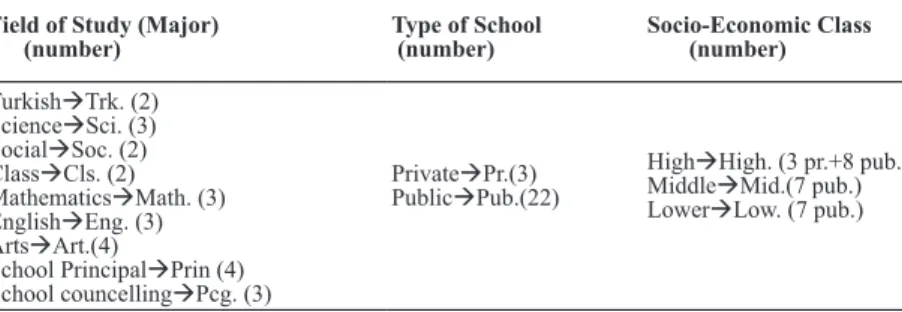
In scope of the research, 478 pictures are obtained from 25 schools located in central districts of Izmir in 2012-2013. Schools were determined according to criteria “school district”, “sub district” that designated by Ministry of Education. All of the schools in Izmir located in 1. school district. The number of schools, teachers and students which are used in this study are given in the Table 1.
Table 1. Abbreviations for schools type, socio-economic level and branches Field of Study (Major)
(number) Type of School (number) Socio-Economic Class (number) TurkishàTrk. (2) ScienceàSci. (3) SocialàSoc. (2) ClassàCls. (2) MathematicsàMath. (3) EnglishàEng. (3) ArtsàArt.(4) School PrincipalàPrin (4) School councellingàPcg. (3) PrivateàPr.(3) PublicàPub.(22) HighàHigh. (3 pr.+8 pub.) MiddleàMid.(7 pub.) LoweràLow. (7 pub.)
One private and three public primary schools are chosen for focus group intervi-ews. Public schools are chosen from different socio-economical environments which have low, middle and high socio-economic status. School districts changes at a level of provinces, districts and schools in Turkey. Izmir is the first district in the level of provinces. Districts and schools were separated into “sub district” according to their development level. “Sub districts” are determined according to the socio-economic development in the district. “1. sub district” areas indicate high level of socio-eco-nomic environment, “2. sub district” areas indicate middle level of socio-ecosocio-eco-nomic environment and “3. sub district” areas indicates low level of socio- economic envi-ronment. Because of taking part in high socio economic level all of the private schools are fallen into the category of state school’s 1. school discrict 1. sub discrict. In the interview within the scope of study, 3 schools were choosen, one of them is private school which is located in 1. sub district and the others were choosen from public schools from different socio-economical environments. The information of socio-eco-nomic environmental levels of schools was gotten by official website of the Ministry of Education. For focus group interviews, 3 public schools and 1 private school were choosen from different socio-economic levels. Focus groups consist of 5-7 persons. In these groups there are 26 people including Turkish, English, Classroom, Mathematics or Science, Social Studies Teachers and Guidance Counselor and every schools prin-cipal, 9 of them men and 17 of them are women. 4 of the participants have less than 10 years experience and 22 of them have more than 10 or more years experience. All of the teachers and principals have worked in different schools before. The schools to make the focus group interviews were determined by the easy accessibility criteria. While choosing the teachers are to be interviewed in focus groups, to be a teacher representing in each branch and to have different seniority levels of these teachers has been noted.
Validity and Reliability
478 photographs that are taken in scope of the research subjected to content analy-sis and categorized first under 12 different themes. Encodings were handed to 2 PhD lecturers that have qualitative research experience for expert confirmation and
backs were evaluated. While the categories were creating in the direction of feed-backs, some distinctions were seen between specialists and also between researchers and specialists and consequently has been introduced to a new classification. While some groups were reuniting, others were regrouped with different names. Results were shared in last focus group meeting, confirmation of participants were taken by comments to enhance internal validity (persuasiveness). In accordance with the opi-nions of the participants, in order to make broader, one of the categories has been renamed. The three categories are fully combined into one category because of not parsing. At least the analysis categorized under 10 different themes
For descriptive validity, detailed reporting of the workgroup and process had been chosen. To enhance external reliability in requested situations or crosschecking of data in a future research, raw data of the research has been kept. There had been used various data collection techniques (document review and focus group interview) in research. Also, data were gathered by schools from different socio-economic environ-mental levels, teachers and principals got together to the focus group interviews and paid attention to teachers’ major subject diversity. Participant views were reinforced with direct quotes and by this way responses were tried to be retraced. In the literature, it is emphasized that by taking expert opinion, locating direct quotes, going to path of diversity, sharing the results with participants and confirming the encodings to the ex-pert people in their fields’, validity and reliability of research can be enhanced (Glesne and Peshkin, 1992; Shenton, 2004; Yıldırım and Şimşek, 2005).
For confidentiality of participants, in direct quotes there had been made abbre-viations for schools type, socio-economic level and branches. School principals are coded as principals without looking majors. For instance, abbreviation “EngPubMid” means this: English teacher, State School, Middle Socio-Economic Level.
By this way, variation of workgroup enabling for transferability is provided. The-mes are created by classifying of answers given to interview questions. TheThe-mes had been given to 2 PhD lecturers for encoding. Hence, the internal reliability (consis-tency) of the research was provided.
Data Collection Tools
Data of this study consists of photos and printouts of the focus group interviews. One photo of each permanent award, sculpture, text, drawing pictures and paintings on the corridors, doors and walls of the study group schools were taken. Temporary visual elements such as students’ homeworks, visuals related to special occasions and club or communities were not included in this study. While collecting the interview data, semi-structured interview form was utilized. Seven question were asked in to-tal. Questions generally were about selection of visuals in schools, comparison of using visuals at schools and identify how are permanent visuals in primary schools classified according their topic and the utility of those visuals on students. During the
process of creating the questions in the interview form, findings that were collected by the analysis of the photos were taken into consideration and pre-interviews were made with school executives, teachers, scholars and postgraduate students in the field of educational administration. In the schools, literature based on the visuals from the outside of the class (Veznedaroğlu, 2007; Peterson & Deal, 1998) was reviewed and in addition to the related legal documents (MEB, 2013) subjects such as school cul-ture (Wren, 1999; Fyans&Maehr, 1990), educational policies (Kaplan, 1999; Slavin, 2002), hidden curriculum (Wren, 1999) were analyzed.
As a result of the photo analyses, literature review and pre-interviews, interview questions and probes in accordance with the purpose of the study were determined. Interview form was formed in accordance with the experts’ recommendations and 45-55 minute long focus group interviews were carried out face to face. Interviews were both recorded and noted.
Analyzing the Data
Images obtained under study are photos taken from the school’s interior and ex-terior walls. These images haven’t been hanged as a term, permanent visuals are po-sitioned in these walls in such a way that everyone can see at schools. Visuals and classroom activities that are periodical were not included in the study.
Photos for this study were categorized into 18 themes after having been analyzed for the content. These were later handed to two scholars experienced in qualitati-ve research, for the expert’s approval. Themes were reduced to 10 according to the feedbacks. For instance, all the visuals related to Turkish history, Atatürk and the Republic were combined under the title of “Turkish National Leaders and Sayings”, and foreign-based photos such as Commenius and eTwinning were combined under the theme of “European Union and Education.” Interviews were transferred from the recording device into scripts and were analyzed for the content. In the literature (Daymon&Holloway, 2003; Krippendorf, 2004) it is accepted that content analysis consists of coding, conceptualizing and category creating phases. In this study mea-ningful parts among the data were coded by using a word (i.e. Awareness, repetition, support) or a sentence (i.e. The opportunity to reinforce the in-class learning). In this stage it was tried to conceptualize the meaningful parts such as making the students maintain a positive attitude (being respectful, being tolerant, hygiene habit) adopt na-tional values (patriotism, love of the nana-tional flag, Kemalism, republic values); accep-ting the differences, lifestyles and values. Considering the relationships, the concepts were classified under a certain category and themes were created. The finding which are described and represented in detail were interpreted and ended up with certain results.
3. Findings
The permanent visuals at school are categorized in 10 thematic captions. These are as follow: (1) Turkish History and National Leaders; (2) Environment and Nature; (3) Culture- Arts- Literature; (4) Rewards; (5) Personal development and guidance; (6) Philanthropists; (7) Directing and warnings; (8) Scientists and thinkers; (9) Suppor-ting curriculum and (10) European Union/Comenius.
The most common theme in the schools is “Turkish National Leaders and Say-ings” (32%). Pictures of Atatürk, Ottoman leaders and other historical Turkish leaders such as Atilla the Hun, Genkhis Khan and Oghuz Khan the birth of the Turkish flag, acceptance of the Turkish National Anthem, Turkish War of Independence and Çanak-kale War are seen at most
.
96% of these schools had visuals themed as environment and nature. These visuals vary from dolphin pictures on the exterior walls of these schools to metaphors such as children painted as flowers.
52% of these schools had visuals themed as culture – arts- literature and it was seen that photos were 7% of all photos. Visuals related to poetry, painting, music, literature, theatre and ballet were included in this theme.
Also there were pictures of western cultures cartoon film heroes like Pink Panther, Superman and Caillou, students’ drawings and paintings on the classroom walls and schools’ names as graffiti arts on the exterior walls of schools.
In 80% of these schools had visuals related to the rewards. These visuals were mostly being exhibited in glass cabins where everybody can easily see them. Cups of sports competitions, plaquettes of knowledge competitions, and certificates of achie-vement and in-school competition awards were among these.
44% of these schools had visuals related to personal development and guidance theme. Some of the visuals belonging to this theme were directly sent by MEB (Mi-nistry of Education). Based on visuals of school counseling service. The views focus on moral values, communication, being a good person and coping with problems.
In half of the schools included in this study had information and pictures of people who contributed to the school (philanthropist) both in the construction process and afterwards.
Within the theme of directing and warning (28%), there were visuals of warning (such as fire, traffic signs, earthquake maps) and Education Call Line and Parental Information Bulletin Boards.
The rate of visuals about scientists, thinkers and artists was very low in these schools (only in 4 schools). These visuals mostly consisted of foreign thinkers such as Tzu, Disney, Moliere, Einstein etc.).
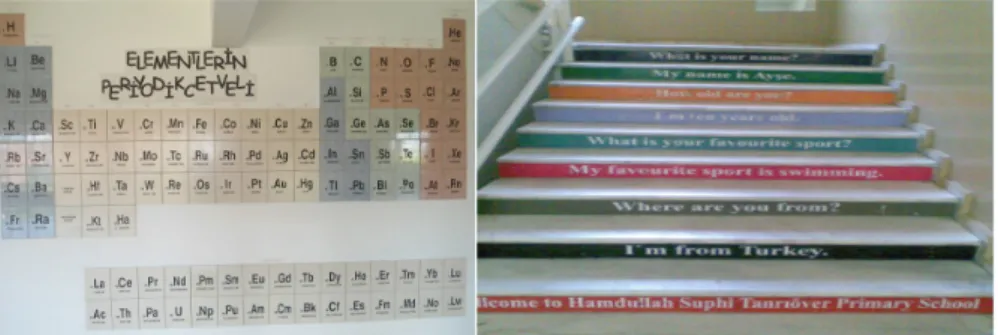
%2 of the schools had visuals related to supporting curriculum theme. They espe-cially are used in private schools (corridors, ceiling, furniture, stairs, doors, external walls, toilets etc.).
The European Union/Comenius theme was the rarest theme in the photos taken
for this study (only 3 schools). In addition, there was 1 visual about the “eTwin-ning” project which conveys a communication with Europe.
Table 2 Thoughts of the teachers and administrators about the utility of perma-nent visuals
Thema Quotation
Visibility Attention Diferent Aspect
SocPubMid: “I believe that permanent materials about Atatürk and other Turkish national leaders draw the children’s attention as well. I see children sharing opinions about these visuals on the corridors from time to time.” PriPubMid: “I believe we have to show Atatürk not only as a founder of Turkish Republic or as a hero. There should be pictures of Atatürk, about his scientific, musical and caring side of children”.
SocPubHigh: “There are many portraits of Turkish historical figures like Ibni Sina, Farabi or Yunus Emre as bearded and turbanned. Students are interested and they sometimes look at these portraits, but for raise in historical conscious-ness those people must also be shown with their different aspects. For example Ibni Sina as a surgeon, also Farabi as a scientist, and astronomer”.
Awareness environmental healthy life multiculturalism
attitude
TrkPriHigh: ‘’Nature-related images allow the students to respect nature and they create environmental awareness”.
SocPubLow: “Sports-related images and photos about a healthy diet are raising awareness students for a healthy life”.
Eng.Pub.Mid: “We prepare boards to compare the English and Turkish cultures to show the students cultural differences and multiculturalism”.
EngPriHigh: “We prepare a board about a concept each month to create an at-titude. This month we are emphasizing on the topic “courtesy” by stressing on prompts such as Thank you, please”.
Thema Quotation Belonging
belonging
adaptation
motivation
EngPubHigh: “There is a graffiti of our school’s name on the exterior wall. Students and teacher created it together. This helped them to have a sense of belonging.”
Principal: “You can easily see that when children contribute to the visuals their sense of adopting and belonging improve”.
ClsPriHigh: “The participation of student in the permanent visuals serves as a motivational instrument. Students experience the satisfaction of seeing their work being exhibited. These boards also encourage the children to make better projects and works since they know that they would be exhibited outside the class. Especially the exhibition of the rewards is very effective”.
Support curriculum
reinforce
spreading
permanancy
SciPubMid: “I believe that in order to impose the scientific thought to the child-ren visuals about scientists’ lives, inventions etc. should be placed on walls, doors and boards”.
MathPrHigh: “Mathematics curriculum is very hard, especially at the second grade. You are not allowed to teach outside the curriculum. You cannot teach anything about Cahit Arf for instance. Children can only learn these from the boards. We involve the information about Turkish and foreign mathematicians on our boards”.
Principal: “I believe that the visuals maintain the permanency of the learning process. They are attractive for the children and help the classes. I see these visuals as a necessity”.
Participants’ views on the factors to determine which visuals to use
Participants stated that regulation of these visuals is not a popular topic in meet-ings, there are articles about this in the school regulations and principals apply them actively. In addition they stated that this topic is mentioned group meetings. Coop-eration’s between groups were more commonly seen in Private schools, especially between the English and Turkish groups. According to the findings of this study, choices for the permanent visuals on the corridors and walls were mostly determined according to the circular order/legal regulation, by decision of the administrators and in a few of schools cooperation between groups, group decisions and students’ views. Many teachers stated that they rarely think about the priorities for choosing permanent visuals to be exhibited and this issue never appears as an agenda item in subbranch commissions or other school councils.
4. Discussion
At the school settings included to the study’s scope at the photographs taken fur-ther to stable visuals values such as nationalism, patriotism significantly reverberated over the creator of Republic of Turkey and MEB as Turkish holy entities. Atatürk was prominently concentrated in images which predominantly reflects his statesmanship and military particulars; in line with his various qualities images (his orientation to art, philosophical inclinations, scientific orientations, child affection...) are seen to be included infinitesimally. Such form of visual items is encountered at private schools and socio economically advanced high schools even in negligible magnitude. Under the name of remaining Turkish holy entities Atilla, Yavuz Sultan Selim, Gazi Osman Pasha likewise predominantly warrior-invader statesmen are included. Bal and Yiğit-tir (2012) confirmed that at the school settings, most common portrait pictures are
related to Atatürk and Ottoman history related, invader historical characters monu-mental images were more commonly revealed. During the Independence War era ef-fective symbolized national (Kubilay, Hasan Tahsin) entities related visuals were not encountered at the instruction units. Scientifically emerged historical entities (Farabi, İbni Sina etc.) were found at very few schools. Those entities were not revealed based on their scientific qualities (for example Farabi’s contributions to science or indicating İbni Sina in a medical operation) Turkish holy entities such as Atilla, Oğuz Kağan were shown between the portraits. Among the images well known historical women figures were absent. Among the examined stable visual issues consciousness concepts were predominantly anticipated to have been constructed over very strong military state and warrior man identities. At the instructional books of Ercilasun (2013) and at the instruction program in the studies in association with nationalist aspects especially literature, history related course programs stated out to be constituted concentrated on those nationalism philosophy and just initiating from the elementary and secondary school instructions children and juvenile individuals are strived to be educated as nationalistically oriented persons. As per educational program and covered program basis Turkish educational system there are some findings in the course revealing na-tionalistically conservative composition (Güven 2000; Kaplan 1999). On the other hand, visual images in that theme when evaluated Turkish history is found to be in-cluded very narrow portion and in a specific segment. Participant responds prove the fact that under the scope of those visual images there is no awareness considering the diversification. That circumstance, as identified in Bourdieu’s (2013) habitus concept and Lynch’s (1989) findings is associated with the approach concentrated on the fact that values of the dominant group in the society are being legitimized at the school settings. Turkish educational system is concentrated over a constructive instruction orientation from the years of 2005, master instructive philosophy on that approach when anticipated in terms of its multi cultural and diversified nature that constraint originated in visual images may be concerned in the way of controversy.
Although environmental concept is encountered over widespread of school set-tings, images are more frequently arouse an idealized world impression, predomi-nantly considering local environmental problems to the problems at international and global background, however images that are directed to those problems and to the advertisement of civilian social institutions which are sensitive to those problems are found underestimated. To the students also lack of images directed to make adequate advertisement of their residential district in terms of natural, cultural and sportive landscape when considered the principle of from near to far of education, settlement of environmental consciousness over the concretely experienced problems of the res-idence environment and awareness further to possible diseases may be considered not reverberated over the visual objects. Moreover, it is observed that the warning visuals for fire or earthquake are found as too small to read and the places for them are incon-venient to see. For earthquake region İzmir, only in one school an overall identifica-tion for earthquake is found. Their writings are found very small and failed to clearly
identify without putting to the locations that are available for everyone to discover. At the school settings that have constituted approximately half of the study cohort no vision was confirmed under the theme of Culture Art Literature. When covering visions of western cultures at private schools and socio economically sophisticated high schools (Leonardo Da Vinci, Sandro Boticelli, Claude Monet) only in one of the state school cultural identities likewise Hacivat-Karagöz, Nasreddin Hoca were en-countered. Over the several schools cartoon film hero (Caillou, Supermen, Pink Tiger) were taken place. That circumstance proves the fact that neither universal culture nor national culture was included in all diversity in depth (sculpture, theatre, drawing etc). Also images encompassing scientific people are found very seldom and predominant-ly found to be composed in recommendations related to instruction and education are found in more quantities and directions based on daily life are found negligibly. Im-ages that were generated by the international and Turkish scientists, intellectuals that are given to the humanity and country nearly never encountered. In that manner, all types of processes at the schools, cycles and life style being perceived as if designed accordingly with the scientific objects are assimilated to be failed in terms of penetrat-ing to the students satisfactorily. Also research findpenetrat-ings of Genç and Eryaman (2008); proves that instruction program does not adequately develop scientific and critical ideological skills on students. On the other hand, pursuant to school’s domestication function in terms of constituting universal identity in all segments of the school to sci-ence people, to internationally recognized literature, art and ideological people must be underestimated upon excluding from the coverage. As per negotiation records, in-structors set forth that those issues more frequently processed at the class settings. Underestimation of those images apart from class settings may be perceived as the abortion of the expansion pertaining to learning culture all over the school segments.
Rather than success concept cups that are won from knowledge contests and sport events certificates, documents are encountered. Prizes are more frequently seen at so-cio economically advanced school settings. At the schools documents that prove suc-cesses realized in cultural fields are more seldom. Success histories that are aimed to lure the other students and images encompassing students whom were accomplished successes were not seen. Excessive amount of the prizes gained by socio economic environmentally sophisticated schools identifies that those schools are supported by the environment and they have expectations in the same way. Researches in associa-tion with the support and expectaassocia-tions of school environment is being correlated with the student’s academic achievements, Shouse (1996) reveals that the perception ori-ented to school’s academic accomplishments strengthens belongings (Adelabu,2007). Visual images pertaining to the European Union are only found at schools that are participated at the EU projects. Images of schools and students originated from differ-ent schools and studdiffer-ents, again daily life examples are ignored and may be said that a perception in the way of the life is only composed of street and school where the child is occupied. Comenius (or Erasmus plus) practices are seen constrained over the
cer-tain schools and teachers Comenius committees those schools. Prominently, foreign languages instructors are encompassed in that process. When educational institution’s function of social transformation, to introduce the contemporary population to the structural values (the EU) that shall be occupied in the future the EU educational policies may not be said to be reflected at the physical environments of the schools.
In the proceeded focal group negotiations are stressed to be effective pertaining to the reinforcement of the existence of the visual objects that shall be imaged at schools, national value generation and reinforcement of the educational programs. Responses derived from the participants are found restricted in the manner of diversity. That out-come may be assimilated as if participants are not aware of the visual functions, that is assimilated and they expect an external solution. On the other hand, vast majority of the teachers perceived as if “learning” significantly is able to born in the class settings. Only 1 of every 3 schools had visuals related to the supporting curriculum theme. Related visuals were gathered within the titles of school corridors and bulletin boards (periodic table, numeration etc.) and visuals which teach the students how to behave in society.
Research findings in association with revealing the fact that the board in charge of determining the revealing visual objects more predominantly based on the provi-sions arrives to decision generation in the light of the proposals of the social class and prominently under the deterministic nature of school director and on the other way is understood to challenge to capture harmonization with educational politics. In pursuant to the fact that from instructive policies, philosophy, science and cultur-al components the type of educated individucultur-al over the societies and individucultur-als it plays impact over the long run. Searching out to mitigate negative impact of culture on the social transformation not only the dominant group also encompassing all oth-er social fractures in a reconciliation cultural framework decision genoth-eration shall be more convenient. In the choices of social classes for such an application instead of detailed measurements set under the restrictiveness of the educational program a precise selection is found to be decided. Gillborn and Youdell (2000), pertaining to the effectiveness of organizations in the success of educational policies they stress the significance of concerning entire variations in the society (ethnic, belief, gender, social class etc.) education polices by the assistance of educational programs (official, covered, extra) when thought to be converted into intra-school learning lives, related all differentials may be reflected to school framework. On the other way, also in the realization of the visual images causality is in predominance. Visual images that are put in the environmental places their impacts over the students, assessment of visual images in terms of content and formal manner are found to be ruled out. Mittler, (1994) stated out that visual images are too significant based on esthetical perception and appreciation development, to correctly evaluate the reflected visual objects on the students and teachers; anticipation, solving, comment and judgment stages must be taken into account at the time of decision making.
In conformity the findings of the present study instructive profession, organizatio-nal instructive belongings in the pursuit of restricting the instructive profession being responsible of intra-class environment processes; inadequate legislative structures; at the pre-service and post-service instructions underestimation of that matter are exhibi-ted as the source of the undesired outcomes that are experienced. Restructurings held in that field at the same time are shown to be the solution of those problems. Whereas, when the legal provisions are investigated none of restrictive status was observed, ho-wever, also any detailed directive subject to the issue is absent. Research findings of Karasolak (2009) with Yiğittir and Bal (2012) prove the fact that visual objects are not arouse interest, isolated from attention deriving issues and since regularly remained in suspended forms fails to arouse expected influence over the students.
According to the findings follow recommendations are done:
In teacher education and in use training programs, importance of the permanent visual objects that are exhibited at schools over the education may be stressed. Visual images and articles representing Atatürk with his unconventional traits such as his close interest toward children, with his literal, philosophical, scientific contributions may be submitted. In visual images belong to national culture and history, tolerance, sharing, cooperation, respect to strive, peace, science theme concentrated visual ima-ges and articles, also gender equality may be included. In the course of those issues at school establishments’ values, science, literature, philosophy or art corridor may be constructed. Also visuals from historical persons could be shown in their contribution context to the society (Yunus Emre contribution to toleration or humanity) or science (Farabi as astronomer). Furthermore, searching out to make individuals more sensiti-ve and aware persons to renewals visions from alternatisensiti-ve social segments, difficul-ties experienced by disabled people, human rights, children rights notifications and various success histories containing visual objects may be disclosed. In the pursuit of constructing Turkey’s education policy absorbing the EU unification process at schools from the EU symbols, the EU country visions, Comenius and other projects, cooperation visual images (photographs, discussions, videos etc.) may be displayed.
Either inside the social classes and in correlation with the other social segments and students the selection of visual images that shall be revealed, in terms of renew-ing frequency to make consensus, management of the school administration of that cooperation; acceptance of auditing system as an indicator for the measurement of instructor success may be accomplished. At the school settings emergence of creative, contemporary, variable visual images may enable student to take part in the decision making process; in terms of presentation of the visual objects and exhibition techno-logical (digital advertisement board) use may also reinforced for application. 5. References
achieve-ment among African American adolescents. Adolescence, 42(167), 525-538.
Aksoy, P. (2009). Okul öncesi eğitim kurumlarının eğitim ortamlarının niteliğinin bazı değişkenler açısından incelenmesi (Tokat İli Örneği),Yayımlanmamış yüksek lisans tezi, Ankara Üniversi-tesi, Eğitim bilimleri enstitüsü, Ankara.
Avrupa Birliği Bakanlığı. (2007). Avrupa Birliği İlerleme Raporu. <http://www.abgs.gov.tr/index. php?l=1&p=41014> (12.May 2012)
Bal,M.S.; Yiğittir,S.(2012). Okul duvarlarındaki görsellerin tarih öğretimi açısından incelenmesi. Kastamonu Eğitim Dergisi, 20(3). 999-1016.
Balfanz, R.; Byrnes, V. (2012). The importance of being in the school: A report on Absenteeism in teh nation’s public schools. Baltimore: Johns Hopkins University.
Balcı, A. (2007). Etkili okul ve okulu geliştirme. Ankara. Pegem Yayıncılık.
Barett, P., Zhang, Y., Davies, F. &Barett, L. (2015) Clever Classrooms. <https://www.salford.ac.uk/ cleverclassrooms/1503-Salford-Uni-Report-DIGITAL.pdf > (10. September 2015)
Bollman, L.G. & Deal, T., E. (2008) Organizasyonları yeniden yapılandırmak. Çevirenler: Ahmet Aypay; Abdurrahman Tanrıöğen, Ankara. Seçkin Yayıncılık.
Bourdieu, P. (2013). Bourdieu & Habitus, <from www.powercube.net/bourdieu-habitus> (19 june 2013) Cohn, M.,A.; Frederickson, B., L. (2009) . Positive emotions .Oxford handbook of positive
psychology.S.Y.Lopez&J.R.Snyder (ed.), pp.11-23. Oxford: Oxford University Press. Çelik,V. (2004). Örgütsel hikâyeler ve okul kültürünün analizi. XIII. Ulusal Eğitim Bilimleri
Kurultayı. İnönü Üniversitesi Eğitim Fakültesi. Malatya.
Çubukçu, Z. (2012). İlköğretim Öğrencilerinin Karakter Eğitimi Sürecinde Örtük Programın Etkisi. Kuram ve Uygulamada Eğitim Bilimleri, 12(2).
Daymon, C.; Holloway, I. (2003). Qualitative research methods in public relations and marketing communications. London: Rout ledge.
Deal, T.,E. (1985). The symbolism of effective schools.The Elementary School Journal . Vol. 85, No. 5.pp.601-620.
Deal, T.,E.; Peterson, K., D.(1990). The Principal’s Role in Shaping School Culture. <http://eric. ed.gov/?id=ED325914> (6. August 2013)
Fyans, L. J.; Maehr. M. L. (1990). School culture, student ethnicity, and motivation. Urbana, Illinois: The National Center for School Leadership .
Genç, S. Z.; Eryaman, M. Y. (2008). Değişen değerler ve yeni eğitim paradigması. Sosyal Bilimler Dergisi, 9(1), 89-102.
Gillborn, D.; Youdell, D. (2000). Rationing education: policy, practice, reform and equity. United Kingdom: Open University Press.
Glesne, C.; Peshkin, A. (1992). Becoming qualitative researchers an introduction. London: Long-man Group Ltd.Hoy, W. & Miskel, C.G. (2010). Education administration, theory research and practice. Mc Grauv Hill high education.
Kaplan, İ. (1999). Türkiye’de Milli eğitim ideolojisi. yayımlanmamış doktora tezi, Boğaziçi üni-versitesi, İstanbul.
Karaküçük,S.A. (2008). Okul Öncesi Eğitim Kurumlarında Fiziksel/Mekansal Koşulların İncelen-mesi: Sivas İli Örneği, C.Ü. Sosyal Bilimler Dergisi 32 (2), 307-320.
Karasolak, K. (2009). Mimari Özellikleri Farklı İlköğretim Okullarındaki Öğrenci Ve Öğretmen-lerin Okullarının Bina Ve Bahçeleri Hakkındaki GörüşÖğretmen-lerinin İncelenmesi. Yayımlanmamış yüksek lisans tezi, Çukurova Üniversitesi, Adana.
Krippendorf, K. (2004). Content analysis an introduction to its methodology. Sage Publications. MEB (2013) <http://mevzuat.meb.gov.tr/html/temkanun_0/temelkanun_0.html> (6. August 2014) McClung, A. C. (2000). Extramusical skills in the music classroom. Music Educators Journal. 86
(5). 37 – 42.
Mittler, G. (1994). Art in focus, Glencoe /McGrawHill.
Patton, M., K. (1990). Qualitative resaerch, evaluation methods. Sage Publication.
Peterson, K.; Deal, T.E. (1998). How Leaders Influence the Culture of Schools, Educational Lea-dership,56 (1), 28-30.
Peterson, K.; Deal, T.E.(2009). Shaping school culture fieldbook, San-Francisco: Jossey-Bass. Posner, J.G. (1995). Analyzing the Curriculum. New York: Mc Grac-Hill Inc.
Schratz,M.; Löffler, U.S. (2005). Pupils using photographs in school self evaluation (ed. Jon Prosser) Image-based Research A Sourcebook for Qualitative Researchers, 209-224. Falmer Press, UK. Slavin, R. E. (2002). Evidence-based education policies: Transforming educational practice and
research. Educational researcher, 31(7), 15-21.
Sağlam,M.; Özüdoğru, F.;Çıray,F. (2011). Avrupa Birliği eğitim politikaları ve Türk Eğitim Sistemi-ne etkileri. Yüzüncü yıl üniversitesi. Eğitim Fakültesi Dergisi.
Shenton, A. (2004). Strategies for ensuring trustworthiness in qualitative research projects. Educa-tion for InformaEduca-tion, 22, 63-75.
Shouse, R. (1996). Academic press and sense of community: Conflict, congruence, and implications for student achievement. Social Psychology of Education, 1, 47–68.
Sosnouski, A.L. (2003). Vizualising normality: Iconology and symbolism in United States school. Published Ph.D Dissertation,University of Wisconsin-Madison.
Tarr, P. (2004). Consider the walls. Young children. 59(3), 88-92.
Türedi ,H.(2008). Örtük programın eğitimde yeri ve önemi. Yayımlanmamış yüksek Lisans Tezi Sakarya Üniversitesi, Sakarya.
Udo, E.P. (2002). Symbols artifacts, rituels and ceremonies: Archetypes of community in a selected private highschool. Publisshed doctorate dissertation, Milwaukee, Wisconsin, U.S.A.
Veznedaroğlu , L. (2007). Okulda ve sınıfta örtük program (Bir Özel İlköğretim Okulu Örneği). Yayımlanmamış doktora Tezi. Ankara Üniversitesi, Ankara.
Wren, D. J. (1999). School culture: Exploring The Hidden Curriculum, Adolescense, 34 (135), 593 – 596.
Woolner, P.; Clark, J.; Hall, E.; Tiplady, L.; Thomas, U., and Wall, K. (2010). Pictures are necessary but not sufficient: using a range of visual methods to engage users about school design. Lear-ning Environments Research, 13(1), 1-22.
Yıldırım, A.; Şimşek, H. (2005). Sosyal bilimlerde nitel araştırma yöntemleri.[Qualitative research methods in social science] (5. Ed.). Ankara: Seçkin Yayıncılık.
Yin, R. (1994). Case study research: Design and methods (2nd ed.). Thousand Oaks, CA: Sage Publishing.