YAŞAR UNIVERSITY
GRADUATE SCHOOL OF SOCIAL SCIENCES BUSINESS ADMINISTRATION
DISSERTATION FOR THE DEGREE OF DOCTOR OF PHILOSOPHY
VALUE RELEVANCE OF ACCOUNTING MEASURES IN PRE- AND POST-FINANCIAL
CRISIS PERIODS: TURKEY CASE
ŞEVİN GÜRARDA
Co-Supervisor: Assist. Prof. Dr. M. Gürol Durak Co-Supervisor: Prof. Dr. Adnan Kasman
YAŞAR UNIVERSITY
GRADUATE SCHOOL OF SOCIAL SCIENCES BUSINESS ADMINISTRATION
DISSERTATION FOR THE DEGREE OF DOCTOR OF PHILOSOPHY
VALUE RELEVANCE OF ACCOUNTING MEASURES IN PRE- AND POST-FINANCIAL
CRISIS PERIODS: TURKEY CASE
ŞEVİN GÜRARDA
Co-Supervisor: Assist. Prof. Dr. M. Gürol Durak Co-Supervisor: Prof. Dr. Adnan Kasman
ii
YEMİN METNİ
Doktora Tezi olarak sunduğum “Value Relevance of Accounting Measures in Pre- and Post-Global Financial Crisis Periods: Turkey Case” adlı çalışmanın, tarafımdan bilimsel ahlak ve geleneklere aykırı düşecek bir yardıma başvurmaksızın yazıldığını ve yararlandığım eserlerin bibliyografyada gösterilenlerden oluştuğunu, bunlara atıf yapılarak yararlanılmış olduğunu belirtir ve bunu onurumla doğrularım.
..../..../... Şevin Gürarda
iii
T.C.
YAŞAR ÜNİVERSİTESİ
SOSYAL BİLİMLER ENSTİTÜSÜ DOKTORA TEZİ JÜRİ SINAV TUTANAĞI
1) Bu halde adaya 6 ay süre verilmiştir.
2) Bu halde öğrencinin kaydı silineceğinden jüri red kararı hakkında en az bir sayfalık bir gerekçe yazarak sınav tutanağına eklemelidir.
3) Bu halde sınav için yeni bir tarih belirlenir.
4) Bu halde varsa öğrencinin mazeret belgesi Enstitü Yönetim Kurulunda görüşülür.Öğrencinin geçerli mazereti olmaması halinde Enstitü Yönetim Kurulu kararı ile ilişiği kesilir.Mazereti geçerli sayıldığında yeni bir sınav tarihi belirlenir.
ÖĞRENCİNİN
Adı, Soyadı :
Öğrenci No :
Anabilim Dalı :
Programı :
Tez Sınav Tarihi : ……/…../201….. Sınav Saati :
Tezin Başlığı: ………...
Adayın kişisel çalışmasına dayanan tezini …... dakikalık süre içinde savunmasından sonra jüri üyelerince gerek tez konusu gerekse tezin dayanağı olan anabilim dallarından sorulan sorulara verdiği cevaplar değerlendirilerek, tezin :
BAŞARILI olduğuna (S) OY BİRLİĞİ
1 DÜZELTME gerekliliğine (I) ile karar verilmiştir. 2 BAŞARISIZ sayılmasına (F) OY ÇOKLUĞU 3 Jüri toplanamadığı için sınav yapılamamıştır.
4 Öğrenci sınava gelmemiştir. Başarılı Düzeltme Başarısız Üye: İmza: Başarılı Düzeltme Başarısız Üye İmza: Başarılı Düzeltme Başarısı Üye: İmza: Başarılı Düzeltme Başarısız Üye: İmza: Başarılı Düzeltme Başarısız Üye: İmza:
iv
ABSTRACT PhD Thesis
VALUE RELEVANCE OF ACCOUNTING MEASURES IN PRE- AND POST- GLOBAL FINANCIAL CRISIS PERIODS:
TURKEY CASE Şevin GÜRARDA
Yaşar University
Graduate School of Social Sciences PhD in Business Administration
Value relevance is a major area in capital market research where the minority of studies enhances value relevance and financial crisis. Therefore, it might shed light on the subject of value relevance to investigate the impact of the most disastrous global financial crisis in the human history on financial statements through accounting measures as employed in this dissertation. The current study investigates the value relevance of earnings and book values on market returns for pre, during and post-financial crisis period evaluating ISE-100 listed firms for the period 2006-2011.
Empirical results support a large number of previous studies suggesting that accounting information is value relevant by yearly analysis. In yearly analysis, in pre-global financial crisis period, book value per share is more relevant compared to earnings per share, but in the crisis time, earnings becomes value relevant by controlling negative earnings.
Additionally, ratios such as debt to equity, doubtful trade receivables to total trade receivables, goodwill impairment to total goodwill are value relevant in post-crisis period.
The present literature on value relevance shows that the effect of above ratios on market returns has not been sufficiently examined to date. Thus, this study significantly contributes to the value relevance literature as a leading study in Turkey that considers the above mentioned variables.
Key words: Value Relevance, Global Financial Crisis, Goodwill Impairment, Debt to Equity Ratio
v
Özet
Doktora Tezi
MUHASEBE KALEMLERİNİN GLOBAL FİNANSAL KRİZ ÖNCESİ VE SONRASI DÖNEMLERDE DEĞERLİLİĞİ: TÜRKİYE ÖRNEĞİ
Şevin GÜRARDA Yaşar Üniversitesi Sosyal Bilimler Enstitüsü İşletme Doktora Programı
Değer ilişkisi kavramı Sermaye Piyasası Çalışmalarında finansal kriz ve değer ilişkisi alanında az çalışmanın yapıldığı önemli bir alandır. Bu yüzden bu tez tarihteki en ağır küresel finansal krizin finansal tablolar üzerine etkisini muhasebe rakamları aracılığı araştırarak değer ilişkisi kavramına ışık tutmaktadır.Bu çalışmada öncelikle 2006-2011 yılları arasında kazanç ve özkaynağın hisse senedi getirilerindeki değer ilişkisi finansal kriz dönemi, öncesi ve sonrası IMKB-100 şirketleri değerlendirilerek yapılmıştır
Ampirik sonuçlar daha önce bu konu ile ilgili muhasebe bilgisinin ihtiyaca uygun olduğu sonucuna varan çalışmaları yıl bazında desteklemektedir. Yıl bazındaki kılırımda, kriz öncesi dönemde hisse başına düşen özkaynak kalemi, hisse başına düşen kazanca göre daha değerli bulunmasına karşın kriz döneminde hisse başına düşen kazanç zararların kontrol edilmesi ile istatistiksel olarak anlamlı hale gelmektedir.
Ek olarak, borcun özkaynağa oranı, şüpheli ticari alacakların toplam ticari alacaklara oranı ile şerefiye değer düşüklüğünün toplam şerefiyeye oranı da kriz sonrası dönemde hisse senedi getirilerinde etkilidir.
Değer ilişkisi ile ilgili literatür taramasında bu oranların hisse senedi getirisi üzerindeki etkisini inceleyen çalışmaya rastlanmamıştır. Bu nedenle bu tez Türkiye için değer ilişkisini bu değişkenleri göz önünde bulundurarak inceleyen ilk çalışma olması nedeniyle literatüre katkı yapmaktadır.
Anahtar kelimeler: Değer İlişkisi, Global Finansal Kriz, Şerefiyede Değer Düşüklüğü, Borç Özkaynak Oranı
vi
VALUE RELEVANCE OF ACCOUNTING MEASURES IN PRE- AND POST-FINANCIAL
CRISIS PERIODS: TURKEY CASE
TABLE OF CONTENTS YEMİN METNİ ii TUTANAK iii ABSTRACT iv ÖZET v TABLE OF CONTENTS vi
LIST OF TABLES viii
LIST OF ABBREVIATIONS ix
INTRODUCTION x
CHAPTER 1
GLOBAL FINANCIAL CRISIS
1.1. The Rising of the Global Financial Crisis 1
1.2. The Impact of the Global Financial Crisis in Turkey 2 CHAPTER 2
VALUE RELEVANCE
2.1. Economic Consequences of Financial Accounting 6
2.2. Accounting Information and the Users of Accounting Information 7 2.3. Concept of Relevance and Value Relevance
According to the IASB Framework 8
2.4. Definitions of Value Relevance 10
CHAPTER 3 LITERATURE REVIEW
3. 1.Value Relevance Literature 12
3.2. Value Relevance of Earnings and Book Values 15
3.3. Value Relevance of International Accounting Standards 19 3.4. Value Relevance of Goodwill and Goodwill Impairment 23
vii
3.5. Value Relevance and Crisis 26
3.6. Value Relevance of Other Accounting Measures 29
CHAPTER 4
DATA AND METHODOLOGY
4.1. Data 33
4.2. Methodology 36
CONCLUSION 53
REFERENCES 57
viii
LIST OF TABLES
Table 1: Selected Economic Indicators of Turkey 3
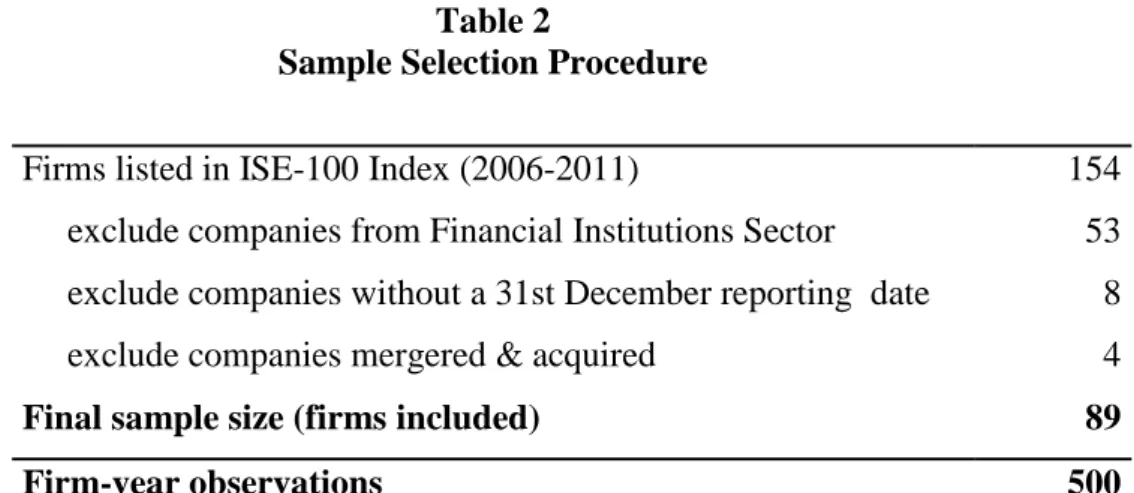
Table 2: Sample Selection Procedure 34
Table 3: Division of Sample by Subsectors 35
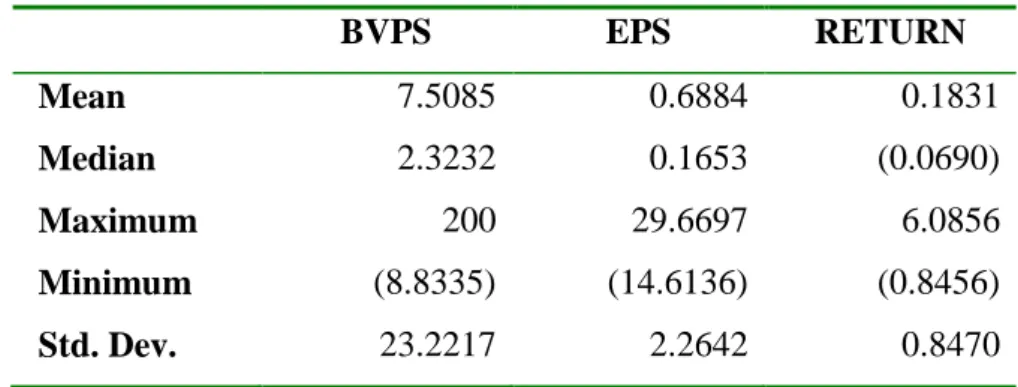
Table 4: Descriptive Statistics (n=500) 38
Table 5: Correlation Matrix between EPS, Return and BVPS 39
Table 6: Value Relevance of EPS and BVPS 39
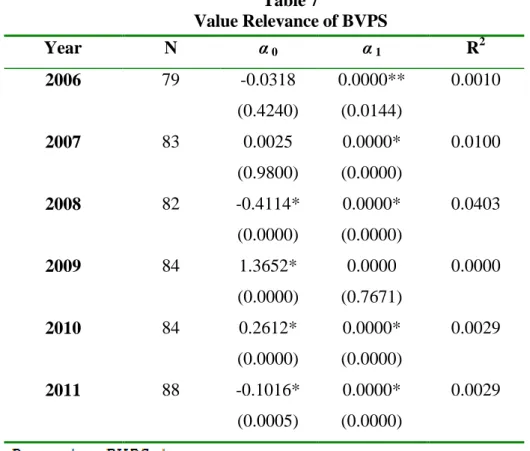
Table 7: Value Relevance of BVPS 40
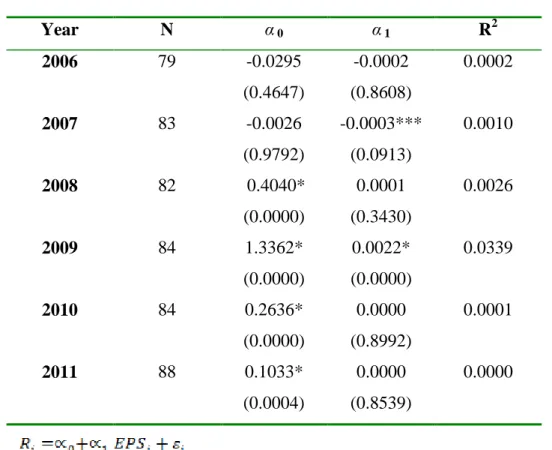
Table 8: Value Relevance of EPS 41
Table 9::Value Relevance of EPS and Negative EPS 42
Table 10: Value Relevance of BVPS and Negative BVPS 43
Table 11: Value Relevance of EPS, BVPS and Negative EPS 44 Table 12: Mean of the Doubt Rec. / Acc Rec. and T Debt / T Equity
for Each Year 47
Table 13: Descriptive Statistics for Ratios (n=500) 48
Table 14: Correlation Matrix for Ratios 49
Table 15: Value Relevance of selected Accounting Items for Risk 49 Table 16: Value Relevance of selected Accounting Items for Risk
ix
LIST OF ABBREVIATIONS
AccRec Accounts Receivables
AICPA American Institute of Certified Public Accountants BVPS Book Value Per Share
CDO Collateralized Debt Obligation CMB Capital Markets Board of Turkey DoubtRec Doubtful Receivables
EPS Earnings Per Share
EU European Union
GDP Gross Domestic Product GFC Global Financial Crisis GWI Goodwill Impairment
IASB International Accounting Standards Board IFRS International Financial Reporting Standards ISE Istanbul Stock Exchange
TASB Turkish Accounting Standards Board TDebt Total Debt
TEquity Total Equity TGW Total Goodwill
x
INTRODUCTION
Accounting, as defined by the American Institute of Certified Public Accountants (AICPA) is, "the art of recording, classifying, and summarizing in a significant manner and in terms of money, transactions and events which are, in part at least, of financial character, and interpreting the results thereof”. As a result of this recording, classifying and summarizing process, accounting provides information to decision makers in the form of financial statements. Analysis of these financial statements, which is the product of accounting information system, is the basis of decision making for information users such as present and potential investors, creditors, managers, customers, regulators and public.
Investors need information that enables them to make future forecasts of the firm while allocating their capital resources based on these forecasts. Creditors also benefit from the accounting information by using information for their risk assessment process. Managers need information about the company’s past performance and about the resources available for future performance. At this point, relevant and faithfully presented information is of great importance for their decisions. Hence, following questions recur to the mind. Is the accounting information useful for decision makers? Does accounting information influence the economic decisions of users by helping them to evaluate past, present and future performance? Or could we say that accounting information is related to market value?
Macroeconomic instability seen in crisis period may accelerate the financial collapse, which consequently has an impact on value relevance of accounting information. Many researchers investigate the association between financial health and value relevance of accounting information, but there are limited numbers of studies investigating value relevance of accounting measures during the Global Financial Crisis (GFC), which starts with the collapse of Lehman Brothers in 2008 that sent a wave of fear around World financial markets, including Turkish Financial Market.
In addition to the above mentioned questions, the following questions are also sought; what are the effects of GFC on the accounting information and its influence on
xi
decision makers? Do decision makers interpret accounting information as value relevant while global markets experience severe liquidity shortage and recession?
To some extent, the GFC is still unfolding. Therefore, there is limited empirical evidence addressing value relevance in the GFC period. Most studies that examine value relevance during the financial crisis period investigated the regional crises such as Asian Financial Crisis and Mexican Crisis. When recovery periods are compared, the recovery period of global financial crisis is expected to be longer than other regional crises because regional crises are recovered with the support of International Monetary Fund. But the GFC affects many countries, especially developed economies of the U.S. and European countries. Therefore, investigating the impact of the most disastrous financial crisis in the human history on financial statements through accounting figures as employed in this dissertation may shed light on the subject of value relevance.
In this study, we first investigate the value relevance of earnings and book values on market returns for pre, during and post-financial crisis period using ISE-100 listed firms for the period 2006-2011. The valuation model employed is based on Ohlson’s (1995) valuation model. In the first phase of empirical research, the value relevance of primary summary measures of balance sheet and incomes statement such as book value per share (BVPS) and earnings per share (EPS) are investigated by controlling negative earnings and book values on market returns. Then, ratios used for assessment of risk such as debt to equity ratio, doubtful receivables to total trade receivables and goodwill impairment to total goodwill are employed as dependent variables. These ratios are added by analyzing comments of independent auditors’ reports, new communiques announced by the Capital Markets Board of Turkey and the researcher’s observation and involvement in the preparation of financial statements of an international company. Therefore, this kind of analysis in this study differs from the work of other scholars in that it employs ratios becoming important in Turkish Market after 2007.
From an academic point of view, this study contributes to the value relevance literature as the first comprehensive Turkish study to date that investigates the impact of GFC on the value relevance. Unlike traditional value relevance studies, this study
xii
takes the value relevance of negative book values and earnings into account during the empirical analysis. The current literature on value relevance shows that the effect of ratios such as doubtful receivables to total trade receivables, goodwill impairment to total goodwill on value relevance have not been thoroughly examined before. Hence, this is the first study to use above mentioned ratios in the analysis of value relevance for the Turkish market. From the practical point of view, this study is expected to provide valuable insights for investors, regulators, standard setters and other participants in the Turkish Capital Market by enhancing the understanding of how a change in investors’ perception triggered by the GFC affects the value relevance of accounting information.
The dissertation proceeds as follows. The next section gives brief information about GFC the impact of the GFC in Turkey. The second section presents the concept of value relevance, while third section discusses the previous literature. The fourth section describes research design, data, methodology and analyses. The final section draws conclusions and summarizes the contribution of the study to the literature.
1
CHAPTER 1
GLOBAL FINANCIAL CRISIS
1.1. The Rising of the Global Financial Crisis
Many economists and analysts classify The Global Financial Crisis as the worst economic downturn that has happened since the Great Depression of the early twentieth century. The financial crisis is the result of unregulated mortgages and credit boom that were pushed by the low interest rate.
According to Banyte and Raisyte (2009), commercial banks increased their borrowing heavily because of the profitable results of leveraging, and investors also wanted to benefit from this situation. The benefit is set as connection of the mortgage lenders and investors through an investment bank, which obtains the mortgages and adds them up into collateralized debt obligation (CDO). With the low risk rate of credit risk agencies such as Moody’s, Standard & Poor, investors started to demand more CDOs. Investment bankers contacted mortgage lenders asking for more mortgages. Brokers underestimated the new home-buyers’ ability to repay and new financial instrument was created, thus leading to sub-prime mortgages being issued, which required no down-payment and no evidence of permanent income. This increased the risk of the instruments, during which process when lenders failed to pay, thereby causing the houses to become the asset of banks. However, more and more lenders failed to pay their debts and the supply of houses exceeded the demand. This caused considerable decrease in the selling of CDOs, and investors found themselves with worthless financial instruments. Therefore, mortgage lenders recognized the risk they were experiencing. All parties experienced heavy losses. With the collapse of Lehman Brothers in September 2008, the fear spread into world financial markets.
2
1.2. The Impact of the Global Financial Crisis in Turkey
The mortgage crisis and the bursting of other real estate bubbles around the world led to recession in the U.S. and a number of other countries in late 2008 and 2009.
As known, this crisis started with the problems in the payback of mortgage credits in the U.S. Market and increased when its effect was felt all around the world in a short period of time.
Its first influence was observed on the financial sector and spread to real sector. The global capital market experienced severe liquidity shortage, where the confidence of investors significantly declined and most of stock exchanges around the world fell down. In addition, the amount of Gross Domestic Product (GDP), decreased, and unemployment rates and bankruptcies of well-known companies including Lehman Brothers, Merill Lynch increased. The problems arising in the developed markets inevitably spilled over to the rest of the world and began to undermine the real sector activities. The pressure on real sector with increased costs affected their productivity, thus causing many businesses to adopt measures in order to reorganize their activities and reduce their costs. These adverse events, which were felt all around the world, definitely influenced Turkish Economy.
The Turkish Stock Exchange Market was unavoidably affected by Global Financial Crisis due to its integration with Global Economy. The ISE-100 index hit a bottom of 21.228 in November, 2008; it was 54.708 at the beginning of 2008. In Table 1, there is a summary of selected macroeconomic indicators of Turkey from 2001 to 2011.
3
Table 1
Selected Economic Indicators of Turkey
Source: World Bank Main Macroeconomic Indicators of Turkey
(1)After January 2005, CPI basket and base index replaced with 2003=100 (2) fob means free on board, (3) Weighted average of Treasury auction, (4) Equity Office Stock Price, January 1986=1(5) After January 2005, employment indicators based on moving averages of three months.
2001 2002 2003 2004 2005 2006 2007 2008 2009 2010 2011
CPI Inflation, year / year (1) (%)
68,5 29,7 18,4 9,35 7,72 9,65 8,39 10,06 6,5 6,4 10,4
GDP Growth (%) -5,7 6,2 5,3 9,4 8,4 6,9 4,6 0,7 -4,8 9,3 8,5
Nominal GDP (billion TL) 240,2 350,5 454,8 559 648,9 758,4 843,2 950,5 952,6 1098,1 1294,9
Gross Public Debt (% GDP) 78,9 73,3 65,4 59,5 54,1 48,2 42,2 42,9 48,9 45,2 42,2
Export, fob (mln. $) (2) 34.703 40.666 52.318 68.444 78.174 92.915 114.332 136.313 104.617 117.94 140.58
Import, fob (mln. $) 37.103 45.701 63.285 87.773 107.053 130.086 156.142 187.72 132.138 173.887 225.213
Capacity Utilization Rate (%) 71,7 76,2 78,5 81,5 80,3 81 80,2 76,7 65,2 72,6 75,4
Industrial Production y-o-y (%)
-8,7 9,4 8,8 9,8 5,5 7,9 7,2 -0,6 -8,9 13,3 9,1
Capital Adequacy Ratio (standard) (%)
25,1 30,9 28,2 23,7 21,9 18,9 18 20,6 19 16,5
Consumer Confidence Index 110,3 106,7 100,1 95,6 94,4 78,2 79,4 86,9 92,8
Real Sector Confidence Sector 111,4 90,1 87,4 110,3 110,5
T-Bill Rate (%) (3) 99,6 62,7 46 24,7 16,3 18 18,3 19,1 11,4 8,2 8,8
TRLIBOR (%) (O/N) 44,1 45,1 27,6 20,2 15,1 18 15,8 15 6,5 6,5 7,5
ISE National-100 (4) 13.783 10.37 18.625 24.972 39.778 39.117 55.538 26.864 52.825 66.004 51.267
4
After Economic Crisis in 2001, Turkey enjoyed positive growth in gross domestic product (GDP) until 2009 and also a decline in public debt, as a percentage of GDP. This positive growth depended mainly on improvements in macroeconomic policies and the strengthening of financing sector. After 2001 Financial Crisis, banking sector and supervision in this sector were enhanced. Therefore, these improvements starting after 2001 Economic Crisis partially decreased the effect of 2009 Global Financial Crisis. Another positive impact on investor’s confidence for Turkish Market is the improvement in the relationship with European Union that is combined with more stable macroeconomic and political environment compared to the one in 2001.
Prior to the Global Financial Crisis, Turkey showed some signs of growth in moderation, more specifically a growth of 7.3% between 2002 and 2005, however, GDP growth gradually decelerated to 4.6% in 2007.
Rawdanowicz (2010) states that this slowdown was particularly related to investment, and to a lesser extent to private consumption, and reflected a combination of three factors. The first factor was the “ongoing deterioration in the competitiveness of traditional labor–intensive export sectors” (notably the clothing industry). The second one was that monetary policy was tightened in the second half of 2006, following the inflationary shock stemming from exchange rate depreciation and higher food prices. The last was that in 2007, Turkey was hit by the oil price shock, which was particularly acute given its relative high energy intensity and a large dependence on imported energy.
The deterioration in the international environment and large uncertainties, combined with competitiveness losses before the peak of the crisis, led to sharp loss in consumer confidence index.
The main reasons for this decrease are listed by Rawdanowicz (2010) as follows:
i) the reaction of companies may have been affected by a combination of uncertainties about rolling over their debts in the face of the global liquidity squeeze,
5
ii) foreign investors’ risk appetite
iii) the cautious reaction of domestic banks in extending credit
In the second half of 2008, the Turkish lira depreciated by around 15% in effective terms, whereas in the past crises depreciation had been around 35% on average. In the course of 2009, the Turkish lira broadly stabilized against the euro and appreciated somewhat against the US dollar. The volatility of the Turkish lira also declined relative to currencies of other emerging markets, so limited nominal exchange rate changes and significantly lower inflation resulted in a much stronger real effective exchange rate (OECD, 2010).
In contrast to past experiences of Turkey, inflation increase was around 2% year-on-year analysis form 2007 to 2008. In 2009, it even declined compared with the one in 2008. This may be mainly related to monetary policy framework and small depreciation of the nominal effective exchange rate.
Export figures in 2009, show a decline by 23% compared to those of 2008, while the import figures decreased by 29%. Decline in domestic demand and foreign demand may be considered to be the reasons for this trend.
As in Table 1, the capacity utilization rate has declined from 80% to 66 % in one year. Decline in demand is one of the reasons for this decline.
Lastly, unemployment rate increased to 14 % in 2009, which is mainly related to decline in industrial production as well as in GDP Growth.
6
CHAPTER 2
VALUE RELEVANCE
This part introduces the concept of value relevance of accounting information starting with the economic consequences of financial accounting information followed by relevance concept and value relevance according to the conceptual framework of International Accounting Standards Board (IASB), definitions of value relevance.
2.1. Economic Consequences of Financial Accounting
According to Beaver (1998; cited in Hellström, 2009), eight potential economic consequences of financial reporting are as follows:
i) Adequacy of financial reporting and access to financial information has effect on the allocation of wealth among individuals and investors in their investment decisions process. Since financial information determines the distribution of investors’ resources, allocation of the risk and the aggregate level of risk are affected.
ii) With the help of information, investors and individuals can decide whether to consume today or invest for future. So, financial information has an effect on the total consumption and production.
iii) Financial reporting affects the allocation of resources among firms.
iv) Financial reporting affects the use of resources devoted to the production, certification, processing, analysis and interpretation of financial information.
v) Financial reporting affects the use of resources in the development, compliance, enforcement and litigation of regulations.
7
vi) Financial reporting affects the use of resources in search for information.
vii) Financial reporting can affect management’s action. The information could change the incentives of management to undertake certain projects due to competitive disadvantage of disclosure.
Thus principally, economic consequences can be classified under three classes:
i) Valuation of companies (decision makers are investors)
ii) Credit and loan giving (decision makers are creditors)
iii) Management, control and incentive systems (decision makers are the managers)
When three potential economic consequences are taken into account, for an investor, high quality accounting information enables better allocation of resources as mentioned in the first consequences. Investors evaluate the information presented by financial reporting. Creditors also benefit from a high quality accounting information concerning whether to give a loan to a company.
Management and employees have to be informed about previous performance of the company and should also be given information about the resources that will be used for future decisions and for future performance. Thus, the management must be sure that the information is correct and relevant for their decisions.
2.2. Accounting Information and the Users of Accounting Information
Accounting is the information system that measures business activity, processes the data into reports and communicates the results to decision makers. The key product of accounting output is a set of reports called financial statements. These
8
financial statements providing information for decisions should meet the common needs of users.
In IASB Framework approved in 1989, users are defined as present and potential investors, employees, lenders, suppliers and other trade creditors, customers, governments and their agencies and the public. Their needs can be summarized as follows:
(i) Investors need information to help them determine whether they should buy, hold or sell.
(ii) Employees need information about the stability and profitability of their employers.
(iii) Lenders need information whether their loans and interest related to the loan will be paid when due.
(iv) Suppliers and other trade creditors need information that enables them to determine whether the amounts owed to them will be paid on time (v) Customers have an interest in information about the continuance of
the company.
(vi) Government and agencies need information for determining taxes, regulating the activities of enterprises.
(vii) Public need information about the trends and recent developments in the prosperity of the enterprise and the range of its activities.
2.3. Concept of Relevance and Value Relevance According to the IASB Framework
As known, main objectives of IASB is to develop, in the public interest, a single set of high quality, understandable and enforceable global accounting standards that require high quality, transparent and comparable information in financial statements and other financial reports to help users of the information to make economic decisions. The IASB achieves this objective primarily by developing
9
and publishing international financial reporting standards (IFRS) and by promoting the use of these Standards in general purpose financial statements and other financial reports. Other financial reports include information not provided in financial statements that assists in the interpretation of a complete set of financial statements or improves users’ ability to make accurate economic decisions.1
According to Conceptual Framework for Financial Reporting (2010)2, relevance and faithful representation are defined as the fundamental qualitative characteristics of useful financial information. Comparability, verifiability, timeliness and understandability are defined as qualitative characteristics that enhance the usefulness of information that is relevant and faithfully represented.
The IASB Framework for the Preparation and Presentation of Financial Statements states in paragraph 26 that the information is relevant “when it influences the economic decisions of users by helping them evaluate past, present or future events or confirming, or correcting, their past evaluations.” FASB Concepts Statement No. 2, Qualitative Characteristics of Accounting Information, states in paragraph 47 that, to be relevant,
Accounting information must be capable of making a difference in a decision by helping users to form predictions about the outcomes of past, present, and future events or to confirm or correct expectations. Financial information is useful when it is relevant and represents faithfully what it purports to represent.
According to IASB framework, paragraph 31,
To be useful, information must also be reliable. Information has the quality of reliability when it is free from material error and bias and can be depended upon by users to represent faithfully that which it either purports to represent or could reasonably be expected to represent.
1 The IASB Framework was approved by the IASB Board in April 1989and adopted by IASB in 2001
so this version is quated in this thesis because this version has been in use, now.
2 The Conceptual Framework project is currently paused by the IASB. Objectives and qualitative
10
The IASB framework paragraph 43 states that
If there is undue delay in the reporting of information it may lose its relevance. Management may need to balance the relative merits of timely reporting and the provision of reliable information. To provide information on a timely basis it may often be necessary to report before all aspects of a transaction or other events are known, thus impairing reliability. Conversely, if reporting is delayed until all aspects are known, the information may be highly reliable but of little use to users who have had to make decisions in the interim. In achieving a balance between relevance and reliability, the overriding consideration is how best to satisfy the economic decision-making needs of users.
In other words, while it can be suggested that the speed of information for financial statements increases the value relevance, reliable information requirement should also be taken into account. Besides, it will be highly reliable information that is not affecting decisions of investors due to lack of timeliness.
Briefly, timeliness is the ability of financial statements to capture value-relevant events in the same time period as they occur.
So, financial information is useful when it is relevant and represents faithfully what it purposes to present. The usefulness of financial information is improved if it is comparable, verifiable, timely and understandable.
2.4. Definitions of Value Relevance
In line with the description above, users of financial statements need assistance of financial reports in valuing a company. If there is no association between accounting figures presented in financial statements and the company value, accounting information cannot be claimed to be value relevant. Many studies investigate the relationship between capital markets and accounting information presented in the financial statements. Empirical research analyzing the relationships between capital markets and financial statements are generally referred to as capital market-based accounting research (CMBAR). According to Beisland (2008), modern CMBAR originated with the articles of Ball and Brown (1968) and Beaver (1968).
11
Ball and Brown (1968) studied the association between earnings and share prices and concluded that the earnings have information value on share price.
Beaver (1968) directed the attention to investor’s reaction to earnings announcements, as reflected in the volume and price movements of common stocks in the weeks surrounding the announcement date. Beaver (1968) stated that the earnings announcement period is characterized by an increased flow of information compared to a non-earnings announcement period.
According to Barth et al. (2001), although the literature examining such associations dates back to more than 30 years like the study of Miller and Modigliani (1966), the term value relevance was firstly used by Amir et al. (1993). Amir et al. (1993) used this term while comparing US versus Non-U.S. GAAP accounting figures. They use the value relevance term while evaluating the associations between accounting earnings and security returns. According to Beaver (2002), the study of Miller and Modigliani (1966) is the oldest earnings approach that characterizes value as the present value of permanent future earnings.
Another definition belongs to Francis and Schipper (1999) who defined value relevance as “the ability of earnings to explain annual market-adjusted returns; and the ability of earnings and book values of assets and liabilities to explain market values of equity”.
According to Beaver (2002), Ohlson (1995) and Barth et al (2001), an accounting number is termed as "value relevant" if it is significantly related to the market value.
As seen, there are many definitions, and definitions of value relevance can be interpreted in many ways.
In line with the literature on value relevance, this study defines accounting information as value relevant if it is related to market return of the firm.
12
CHAPTER 3
LITERATURE REVIEW
3.1. Value Relevance Literature
One of the objectives of financial statements is to assist investors, lenders and creditors who evaluate the accounting information to make decisions about buying, selling or holding equity or providing a loan. Therefore, accounting measures stated on financial statements should be related to the current company value. If there is no association between accounting numbers and the company value, accounting
information cannot be termed as value relevant and financial reports are unable to fulfill one of their primary objectives.
Testing the usefulness of accounting information on financial statements is one of the main objectives of this thesis because the usefulness of accounting information is the focus of value relevance.
The value relevance on accounting literature is extensive and diverse. For example, Barth et al. (2001) simply state that “value relevance research examines the association between accounting numbers and equity market values”.
Many other studies also differ in their value relevance perspectives either by focusing on accounting measures, new regulations or in the research methods applied.
Francis and Schipper (1999) consider four different interpretations on studying the value relevance of accounting information. The first interpretation is that financial statement information influences stock prices by capturing intrinsic share values. Then, value relevance will be measured as the profits generated from implementing accounting-based trading rules. Under the second interpretation, Francis and Schipper (1999) state that financial information is value relevant if it contains the variables used in a valuation model. Thus, the value relevance of earnings for a discounted dividend valuation model or a discounted cash flow
13
valuation model might be measured by the ability of earnings to predict future dividends, future cash flows. The third and fourth interpretations are based on value relevance that is indicated by a statistical association between financial information and stock prices or returns. Under the third interpretation, the statistical association measures whether investors actually use the information in setting stock prices. Finally, the fourth interpretation is that accounting information and market values are correlated over a long window perspective. Under this view, regardless of source value relevance is measured by the ability of financial statement information to capture information, which affects share values.
By referring to Francis and Schipper (1999), Nilsson (2003) defines approaches in his study as:
i) the fundamental analysis view of value relevance,
ii) the prediction view of value relevance, iii) the information view of value relevance iv) the measurement view of value relevance.
According to Holthausen and Watts (2001), value relevance studies are divided into three categories. These are:
i) Relative association studies: they compare the association between stock
market values or changes in values and alternative bottom line measures. These studies usually test for differences in the R2 (the coefficient of determination) using different bottom line accounting numbers. With the greater R2 is being more value-relevant accounting number.
ii) Incremental association studies: They usually use regressions to
investigate whether the accounting number of interest is helpful in explaining value or returns (over long windows) given other specified variables. If the estimated regression coefficient of accounting number is significantly different from zero, it is defined as value relevant.
14
iii) Marginal information content studies: They investigate whether a
particular accounting number adds to the information set available to financial information users. They typically use event studies to determine if the release of an accounting number is associated with value changes.
Beaver (2002) introduced five perspectives in capital market research for the last decade. The perspectives represent research areas which have greatly contributed to accounting knowledge. These areas are:
i) Market efficiency,
ii) Feltham-Ohlson modeling, iii) Value relevance,
iv) Analyst’s behavior, v) Discretionary behavior.
Beaver (2002) characterizes the first two areas as the fundamentals of understanding accounting in capital markets. The last three areas implicitly introduce some form of accounting structure or individual behavior.
Beaver (2002) states that value relevance research in capital markets has two distinctive characteristics. The first characteristic represents the requirement of an in-depth knowledge about accounting institutions, accounting standards, and the specific features of the reported numbers. The second characteristic is timeliness. Value relevance studies focus on the stock price reaction over short windows of time surrounding the announcement date. On the other hand, timeliness characterizes market value at a point in time as a function of a set of accounting variables, such as assets, liabilities, revenues, expenses and net income. So the timing of the information is of primary concern in the event-study value relevance research design.
15
When the international literature is taken into account, the literature represents a variety of studies. Therefore, in line with the objective of this thesis, we classify the value-relevance studies into four categories. These categories are:
i) Value relevance of earnings and book values
ii) Value relevance of international accounting standards
iii) Value relevance of goodwill and goodwill accounting
iv) Value relevance of other accounting measures
3.2. Value Relevance of Earnings and Book Values
As known, earnings and book value are primary summary measures of
income statement and balance sheet. The book value of equity is considered the bottom line of balance sheet, whereas earnings per share are the bottom line of income statement. These two figures attract the attention of many value relevance researchers.
Most related studies have employed explanatory powers of book values and earnings. Either book value or earnings or both of them have been selected as independent variables.
Book value may figure into the price to pay for a closely-held company, whose stock is not publicly traded. Some investors compare the book value of a company with its market value. The idea is that a stock selling below its book value is a good choice to buy. But the book value/market value relationship is far from clear (Horngren, et al., 2010). Some investors assume that the market value is the expectation of investors related to the company’s future transactions.
Investigating the relationship between book value and market value has been the main interest of researchers for many years. Also there have been numerous studies comparing value relevance of book value and earnings. For instance, Collins et al. (1997) decompose the combined explanatory power of earnings and book
16
values into three components. The first component is the incremental explanatory power of earnings, while the second one is the incremental explanatory power of book values and the third one is the explanatory power common to both earnings and book values.
The common component takes into account that, to some extent, earnings and book values act as substitutes for each other in explaining prices. Collins et al. (1997) report three primary findings. First, contrary to the previous literature Lev (1997) and Ramesh and Thiagarajan (1995) which report a steady decline in the value relevance of earnings, the combined value-relevance of earnings and book values did not decline for the period 1953-1993 in the U.S. market. Second, while the incremental value relevance of earnings declined, it was replaced by increasing value relevance of book values. Finally, much of the shift in value-relevance from earnings to book values can be explained with reference to the increasing frequency and magnitude of one-time items, the increasing frequency of negative earnings, and changes in average firm size and intangible intensity across time.
While Collins et al. (1997) report that the value relevance of earnings has been replaced by increasing value relevance of book values for the years 1953-1993, Lev and Zarowin (1999) indicate that the usefulness of reported earnings, cash flows, and book values of the equity deteriorated over the 1978-1996 period in the U.S. Market.
Francis and Schipper (1999) investigate the popular claim that financial accounting information became less value relevant over time, by taking exchange-listed and NASDAQ firms over the period 1952-94. They divide sample as high-tech and low-technological firms. Their tests indicate that the explanatory power of earnings have significantly decreased over time. In contrast, the test of the explanatory power of book values of assets and liabilities for market equity values provides no evidence of a decline.
Easton and Harris (1991) provide evidence that beginning price-deflated earnings is associated with stock returns for the period 1969-1986 in the U.S. market In cross-sectional regressions of annual returns on both the levels and the change
17
variables, the coefficient on earnings levels is statistically significant in all years, while the coefficient on earnings changes is significant in less than half of the years.
In another research, Easton et al. (1992) analyzes the association between market returns and earnings for long return intervals. They hypothesize that the longer the intervals over which earnings are aggregated, the higher the cross-sectional correlation between earnings and returns. The empirical findings support their hypothesis.
Graham et al. (2000) examine the relation between stock prices, earnings and book values of equity in six Asian countries: Indonesia, South Korea, Malaysia, the Philippines, Taiwan, and Thailand for the period 1992-1997. They address two questions: (i) Are there systematic differences across countries in the value relevance of accounting and are these differences related to accounting differences? (ii) Are there systematic differences in the incremental and relative information content of book value per share (BVPS) and residual earnings per share (REPS) across the countries, and are such differences related to accounting differences? They find differences across the six countries in the explanatory power of BVPS and REPS for firm values. Explanatory powers for Taiwan and Malaysia are low, while those for Korea and the Philippines are relatively high. These differences are generally consistent with differences in accounting practice since Korean accounting practice is strongly influenced by tax law. The second result is that in all six countries REPSs have less explanatory power than BVPSs in most years. For their sample, the highest correlation between market and accounting number is observed when comparing prices at year-end, which shows that they also provide evidence for the sensitivity of the timing.
While Graham et al. (2000) provide evidence on the differences in the value relevance of earnings and book values across six Asian countries with different accounting systems, Ibrahim and Kamarudin (2005) examine the value relevance of earnings and book values in two Asian countries with a similar accounting system. This study provides evidence on the relative value relevance of earnings and book value in explaining market value of equity in Malaysia and Singapore. Results of the
18
study indicate that the relative value relevance of book value is greater than that of earnings in both countries.
Ryan and Zarowin (2003) investigate the reasons for the declining contemporaneous linear relation between annual stock returns and accounting earnings for the years 1966-2000 in the U.S. market. They report this decline as earnings increasingly reflecting news with a lag relative to stock prices and earnings increasingly reflecting good and bad news in an asymmetric manner. They find that earnings have a weaker association with current price changes and a stronger association with lagged price changes over time. They also state that annual earnings reflect price increases less strongly, but price decreases more strongly over time.
The results of Ryan and Zarowin (2003) may also be valid in Turkey Case because there is a lag in financial reporting. In Turkey, if listed in Istanbul Stock Exchange, the companies have ten weeks in consolidated case or eight weeks in stand- alone case to announce their year-end financial statements.
Ozkan and Balsarı (2010) investigate the value relevance of earnings and book value during 1992-2007 for non-financial firms listed in the Istanbul Stock Exchange. The sample period also covers two major economic crises that Turkey experienced. Their results suggest that both earnings and book values are value relevant when the whole sample is included in the analysis. When the 1994 crisis is introduced to the model, a decrease in value relevance of earnings is observed whereas increase in value relevance of book values is experienced. In the 2001 crisis, the significance of interaction between book values and crises diminished, crises interaction shows decline in value relevance of earnings. This shows that the 1994 crisis had a positive impact on return, but the 2001 crisis had a negative impact. This might be due to the different characteristics of these two economic crises.
Michalis et al. (2012) examine the impact of earnings and book values on the formulation of stock prices on a sample of 38 companies listed in the Athens Stock Market during the 1996-2008 periods. The resulting evidence suggests that the joint explanatory power of above parameters in the formation of stock prices increases
19
over time. However, the impact of earnings diminishes, compared to the book value, while investors strive to analyze the fundamental parameters of businesses.
3. 3. Value Relevance of International Accounting Standards
The financial reporting practices of companies in different countries vary. This leads to great complications for those preparing, consolidating, auditing and interpreting financial statements. In order to deal with these complications, organizations in different parts of the world have to harmonize or standardize accounting.
Undoubtedly, globalization makes universal accounting standards inevitable. Investors are naturally attracted by the markets that they understand and have confidence in. Besides, investors, analysts, employees, creditors, suppliers, customers, lenders and non-governmental organizations collectively express their needs of comprehensive information to give their decisions. They desire to compare the accounting information produced by a target company with its competitors located in its home country or other parts of the world. Therefore, countries which adopt internationally recognized accounting standards for financial reporting will be positioned at a significant advantage over those that do not.
According to Ball (2006), the advantages of International Financial Reporting Standards (IFRS) for investors are as follows;
i) More accurate, comprehensive and timely information compared to the national standards they replace in the countries adopting them.
ii) Increase in the quality of financial reporting that allows decrease in the risk.
iii) Elimination of many international differences in accounting standards and a standard reporting formats -which makes a company’s financial statements more internationally comparable.
20
iv) Reducing the cost of processing financial information and increasing the stock market efficiency by reflecting this information on prices.
v) With the decrease in international differences, removing barriers for potential cross-border acquisitions and mergers, thereby providing investors with increased takeover advantages.
In 2003, Capital Markets Board of Turkey (CMB) declared a communiqué serial XI, No: 25. With this communiqué, CMB announced that firms listed on Istanbul Stock Exchange (ISE) would be required to report their financial statements according to IAS/IFRS starting from 2005. The adoption of IAS/IFRS was discretionary starting from 2003 but in 2005 it became mandatory. Then IFRS was enforced in Turkey for the listed companies in the stock exchange with reporting periods of January 2005 onward. Currently all listed firms are preparing their financial statements and related disclosures in accordance with the Communiqué Serial: XI, No: 29 “Basis for Financial Reporting in the Capital Markets” (“Communiqué No: XI-29”) issued by CMB which is published at 9 April 2008. In accordance with the fifth paragraph of the Communiqué No: XI-29, the companies are required to prepare their financial statements in accordance with the International Financial Reporting Standards as accepted European Union (EU GAAP). However, until Turkish Accounting Standards Board (TASB)3 publishes the differences between the European Union accepted IAS/IFRS and International Financial Reporting Standards issued by International Accounting Standards Board (IASB), IAS/IFRS has to be applied by the companies in the application of the fifth paragraph.
Another crucial development in Turkey regarding financial reporting is the New Turkish Commercial Code. Once it is put into practice in 2013, companies in Turkey, listed or not, will adopt Turkish Financial Reporting Standards (TFRS) – IFRS in Turkish acronym while preparing their financial reports which will be presented to third parties.
3 Public Supervision, Accounting and Auditing Standards Agency is established in November, 2011
21
With adoption of internationally recognized accounting standards for financial reporting, an increase in accounting information quality is expected, because one of the main objectives of firms using IFRS is to report high quality, transparent and comparable information in financial statements. These requirements and considerations have been motivated many researchers for investigating the perception of investors who have adopted IFRS. One of the methods to measure this perception is testing value relevance of accounting information before and after the IFRS adoption. Researchers in this area test the ability of financial statements to capture changes in share values.
Harris and Muller (1999) investigate the market valuation of earnings and book value amounts prepared under IAS and US-GAAP for the years 1992-1996. They find evidence that the US-GAAP earnings reconciliation amounts are value-relevant after controlling for IAS amounts for market value and return models. They also find that earnings reconciliation amounts under IAS are more highly associated with price-per-share than US-GAAP amounts, and that US-GAAP amounts are more highly associated with security returns than IAS amounts.
Niskanen et al. (2000) examine the value relevance of earnings under Local Accounting Standards and their voluntarily disclosed reconciliations to the International Accounting Standards in Finland during 1984-1992. The findings suggest that earnings under Local Accounting Standards have significant value relevance to both domestic and foreign investors. Even after the earnings being controlled under Local Accounting Standards, the aggregate reconciliation of Local Accounting Standards to IAS earnings does not provide significant value relevance.
Bartov et al. (2005) investigate the comparative value relevance of earnings reported under German GAAP, US-GAAP and IFRS. The research sample included 417 German companies listed in local stock markets during the period 1998–2000. According to their sample, value relevance of US-GAAP based earnings is higher than that of IFRS based earnings, which in turn is more relevant than those produced under the German GAAP.
22
Lin and Chen (2005) investigate the incremental value relevance of the reconciliation of accounts from the Chinese Accounting Standards to the International Accounting Standards by those Chinese listed companies that have simultaneously issued A shares and B shares4 for the period 1995-2000. Their study shows that earnings and book values of equity determined under Chinese Stock Market Rules. The reconciliation of earnings and book values from Chinese Accounting Rules to IAS is partially value-relevant, mainly to stock prices in the B-share market, while the earnings reconciliation is generally not value-added to stock returns in either the A- or the B-share market. So the study of Lin and Chen (2005) suggests that accounting numbers based on Chinese Stock Market Rules in contrast to IAS are more value-relevant.
Focusing on adoption of IFRS in EU, Horton and Serafeim (2006) examine the market reaction to reconciliation adjustments of UK companies in the transition to IFRS in 2005. The authors employ an event study methodology and a market value model. They find the reconciliation adjustment from UK GAAP to IFRS to be value relevant with respect to earnings but not to shareholders’ equity. They also find statistically significant negative abnormal returns for firms reporting a negative reconciliation adjustment on UK GAAP earnings.
Schiebel (2006) examines the value relevance of IFRS and German GAAP for the period 2002-2004. He finds that German GAAP are significantly more value relevant than IFRS.
Another study in this area belongs to Gjerde et al.(2007). They test the value relevance of financial statements in Norway for 40 years between 1965-2004. In this period, Norwegian General Accepted Accounting Principles has been shaped by four major accounting events; the Accounting Act of 1977, open asset reserves in 1984, deferred taxes in 1992, and the Accounting Act of 1998, as well as by several minor changes through standard setting. They find that the time trend of overall value relevance has increased significantly after controlling for potential value relevance drivers such as firm size, intensity of losses and intangible assets, as well as the level and volatility of stock market return. Neither the value relevance of the balance sheet
4 A-shares are issued in China under Chinese law, B-shares are foreign invested shares issued
23
nor earnings have declined over time. The most significant event, Accounting Act of 1998, has contributed both to increased balance sheet and to earnings relevance.
Callao et al. (2007) investigate the impact of IFRS for 35 firms listed in the IBEX (Spanish Exchange Index) in 2005. The study reveals that local comparability is negatively affected if both IFRS and local accounting standards are applied in the same country at the same time. They also find that there has been no improvement in the relevance of financial reporting because the gap between book and market values is wider when IFRS are applied.
Paglietti (2009) analyzes the impact of IFRS on accounting quality in Italy from 2002 to 2007. The findings indicate that accounting quality after IFRS adoption decreases with respect to earnings management. Empirical evidence shows an increase in earnings smoothing and a decrease in earnings timeliness On the other hand, results of value relevance tests highlight an improvement in the ability of accounting numbers to make a decision. Findings of Paglietti (2009) have important implications. For example moving towards to high quality accounting standards is not sufficient, so there should also be a guarantee for improvement in accounting quality.
3.4. Value Relevance of Goodwill and Goodwill Impairment
The issue of goodwill impairment has been debated in many countries throughout the world. Adoption of IFRS introduced fundamental changes in accounting and impairment methods for goodwill. Since global stock markets declined in 2008, there has been much debate over the issue of goodwill impairment in US and European Stock Exchange Markets especially on how large the write-downs should be.
With the adoption of IFRS, one of the expectations of financial statement users is higher level transparency and more useful information for decision making. All of these expectations are related to fair presentation in financial statements. One of the standards that contribute fair value is International Accounting Standards 36, Impairment of Assets.
24
The objective of IAS 36 (IASB, 2003) is to prescribe the procedures by which an entity is applied to ensure that its assets are carried at no more than their recoverable amount. An asset is carried at more than its recoverable amount if its carrying amount exceeds the amount to be recovered through use or sale of the asset. If this is the case, the asset is described as being impaired, and the Standard requires the entity to recognize an impairment loss. This standard also specifies when an entity should reverse an impairment loss and prescribe disclosures.
Although the main principles of IAS 36 are very clear, the practical application of IAS 36 has always been challenging, and problems have emerged during the recent economic uncertainty.
During financial crisis in 2008, 68% of public companies in the US wrote down goodwill by taking impairment charges. Total charges were $260 billion according to a report issued by financial advisory firm Duff & Phelps and the Financial Executives Research Foundation (Holtzman et al. 2009). The report examined financial statements of nearly 6,000 publicly-held companies for the year 2008.
Goodwill and asset impairment charges are considered to be non-cash because they affect earnings rather than cash flows. However, large goodwill impairments decrease earnings and equity concomitantly. Therefore, this causes increase in debt to equity ratios.
According to the report of Ernst & Young (2011), goodwill impairment disclosure is a requirement as well as an opportunity and a threat. The key question is whether sufficient disclosure has been made about the uncertainty of the impairment calculation.
Among the studies analyzing the effect of goodwill impairment on stock prices or value relevance of goodwill impairment, Dahmash et al. (2009) examine the value relevance and reliability of reported goodwill and identifiable intangible assets under Australian GAAP from 1994 to 2003. Their findings suggest that for the average Australian company the information presented with respect to both goodwill
25
and identifiable intangible assets is value relevant but not reliable. In particular, goodwill tends to be conservatively reported while identifiable intangible assets are aggressively reported.
Li et al. (2010) test whether the market reacts negatively to the announcement of a goodwill impairment loss by calculating cumulative abnormal returns over a three-day window centered on the announcement date of financial statements during the period 1996-2006. Their evidence shows that investors as well as financial analysts revise their expectations downward on the announcement of a goodwill impairment loss, and this downward revision is related to the magnitude of the loss. According to their indirect evidence, some of these firms may have used their managerial discretion to avoid taking an impairment loss.
Oliveira, et al. (2010) assess the value relevance of the amounts for identifiable intangible assets and goodwill reported in the financial statements of all non-financial companies listed in the Portuguese Stock Exchange from 1998 to 2008. They find that net earnings, reported goodwill and other intangible assets are highly significantly associated with stock price. With the consideration of the subclasses of identifiable intangible assets in the study, evidence is found on the increase in value relevance of goodwill, other intangible assets, and research and development expenditures.
By taking into account all firm-year observations with goodwill impairment charges recognized between 2003-2006 in the US, Xu et al. (2011) find out that goodwill charges are negatively assessed by investors, on average, but financial health moderates the relation.
Abughazaleh, et al. (2012) assess the value relevance of goodwill impairment losses following the adoption of IFRS No. 3 “Business Combinations” for the top 500 UK listed firms for 2005 and 2006. Empirical results reveal a significant negative association between reported goodwill impairment losses and market value, suggesting that these impairments are perceived by investors to reliably measure a decline in the value of goodwill and incorporated in their firm valuation assessments. This study reinforces the argument that managers are more likely to use their
26
discretion to convey privately held information about the underlying performance of the firms.
Another issue about goodwill and its impairment process is the intention of the management. Do managements of firms believe that asset write-offs will signal less profitability or that they are aware of assets with low performance and they clear these assets by write-offs? Elliott and Shaw (1988) observe the period from 1982 to 1985 using a sample of 240 US companies that have disclosed an asset write-down. They measure financial performance in terms of returns on assets and returns on equity. They find that those companies with write-downs perform worse than those without write-downs.
Zucca and Campbell’s (1992) results confirm that write downs are being used to manage earnings. They also find no significant evidence of positive stock market reaction to the write down announcement.
According to Zucca and Campbell (1992) there are two possible patterns earnings management during the period in which the write down is announced: income smoothing and big baths. Income Smoothing describes an earnings pattern to maintain a steady rate of earnings growth. For maintaining steady growth, the management may try to record discretionary gains, losses or accruals. A second form of earnings management is referred to as big bath. Management might undertake a big bath to signal investors that bad times will be followed by better times through booking accruals or saving up discretionary losses.
3.5. Value Relevance and Crisis
The mortgage crisis and the bursting of other real estate bubbles around the world have led to recession in the U.S. and in a number of other countries in the late 2008 and 2009. The global credit market has experienced severe liquidity shortage, the confidence of investors significantly declined, thus causing most of stock exchanges around the world to experience dramatic falls.