Journal of the Hellenic Veterinary Medical Society
Vol. 68, 2017
Genetic Polymorphisms of Cyp19 and Myostatin Genes in Turkish Indigenous Sheep Breeds
AKIŞ I. Istanbul University, Faculty
of Veterinary Medicine, Department of Biochemistry ESEN GÜRSEL F. Istanbul University, Faculty
of Veterinary Medicine, Department of Biochemistry HACIHASANOĞLU
ÇAKMAK N.
Istanbul Medipol University, Vocational School of Health Services, Medical
Laboratory Techniques Program
ATMACA G. Istanbul University, Faculty
of Veterinary Medicine, Department of Biochemistry
YARDIBI H. Istanbul University, Faculty
of Veterinary Medicine, Department of Biochemistry
ATEŞ A. Istanbul University, Faculty
of Veterinary Medicine, Department of Biochemistry
DURAK M. Dicle University, Faculty of
Veterinary Medicine, Department of Biochemistry
ÖZTABAK K. Dicle University, Faculty of
Veterinary Medicine, Department of Biochemistry https://doi.org/10.12681/jhvms.15475
Copyright © 2018 I AKIŞ, F ESEN GÜRSEL, N
HACIHASANOĞLU ÇAKMAK, G ATMACA, H
YARDIBI, A ATEŞ, MH DURAK, K ÖZTABAK
Genetic Polymorphisms of Cyp19 and Myostatin Genes in Turkish
Indigenous Sheep Breeds
Akış, I.1, Esen Gürsel, F.1, Hacıhasanoğlu Çakmak, N.2, Atmaca, G.1, Yardibi, H.1, Ateş, A.1, Durak M.H.3, Öztabak, K.1
1 Istanbul University, Faculty of Veterinary Medicine, Department of Biochemistry, Avcılar, 34310, İstanbul, Turkey 2 Istanbul Medipol University, Vocational School of Health Services, Medical Laboratory Techniques Program,
İstanbul, Turkey
3 Dicle University, Faculty of Veterinary Medicine, Department of Biochemistry, 21280, Diyarbakır, Turkey
Corresponding Author:
Assos. Prof. Feraye Esen Gursel
Istanbul University,vFaculty of Veterinary Medicine, Department of Biochemistry, Avcılar-Istanbul, Turkey Ε-mail: [email protected]
Date of initial submission: 4.7.2016 Date of revised submission: 8.8.2016
Date of acceptance: 8.8.2016
Research article
Ερευνητικό άρθρο
J HELLENIC VET MED SOC 2017, 68(3): 313-318 ΠΕΚΕ 2017, 68(3): 313-318
ABSTRACT. Growth and meat production traits are very important in sheep breeding. Cyp19 gene has a major role in reproductive activity and growth due to its function in estrogen synthesis. Another gene affecting growth traits is Myostatin (MSTN) gene, which mainly regulates skeletal muscle growth. In this study allele frequencies of genetic poly-morphism in Cyp19 and Myostatin genes were identified by PCR-RFLP method in five indigenous Turkish sheep breeds, Chiose, Imroz, Kivircik, Zom and Morkaraman. Digestion of Cyp19 gene with HaeIII only revealed uncut AA genotype and digestion of MSTN with DraI also revealed only uncut AA genotype. Both loci analyzed in this study were found to be monomorphic in five Turkish indigenous sheep breeds. These highly conserved parts of the two genes can be useful for molecular evolutionary studies in sheep. Further studies regarding association analysis of Cyp19 and MSTN in sheep should be conducted.
J HELLENIC VET MED SOC 2017, 68(3) ΠΕΚΕ 2017, 68(3)
314 AKIŞ, I., ESEN GÜRSEL, F., HACIHASANOĞLU ÇAKMAK, N., ATMACA, G., YARDIBI, H., ATEŞ, A., DURAK M.H., ÖZTABAK, K.
INTRODUCTION
S
heep is one of the most important livestock animals bred in Turkey. Turkey has 31 million sheep and 10% of total meat production in the country consists of sheep meat (www.tuik.gov.tr). There are several indigenous sheep breeds in Turkey, which are bred for different production traits like meat, milk and wool (Yalcin, 1986).Growth and meat production traits are significant economic traits in sheep. In the past years many single nucleotide polymorphisms (SNPs) and in/del polymorphisms in livestock have been identified by genome-wide association studies in order to facilitate the potential utilization of genes involved in growth and meat production traits. But the number of quantitative trait loci (QTL) identified in sheep still remains limited (Zhang et al., 2013).
Oestrogen is an important endocrine, paracrine and autocrine acting hormone, which has a major role in the regulation of reproduction system. It is also involved in fat deposition and growth (Heine et al., 2000; Jones et al., 2000, Simpson et al., 2000). The aromatase cytochrome P450 enzyme encoded by the Cyp19 gene, is responsible for estrogen biosynthesis by conversion or aromatization of androgens into estrogens (Simpson et al., 1994).
In sheep, the Cyp19 gene that encodes the aromatase enzyme is located in chromosome 7 (Payen et al., 1995). It is transcribed by four different promoter regions that have organ-specific activities. The P2 promoter region is mostly active in granulosa cells, P1.5 and P1.1 in the placenta and P1.4 is active in the brain (Vanselow et al., 1999; Vanselow et al., 2001).
Myostatin (growth and differentiation factor - GDF8) is the major regulator of myogenesis in mammals. It is a member of the transforming growth factor-β superfamily and acts as a negative regulator of muscle growth. It directly affects muscular hypertrophy and carcass conformation (Nakev et al., 2013; Zhang et al., 2013). It has been reported, that mutations in MSTN gene located on OAR2, which encodes myostatin, are associated with increased skeletal muscle mass in sheep (Kijas et al. 2007). The MSTN gene has 3 exons and 2 introns (Bellinge et al., 2005) and encodes a glycoprotein which is widely expressed in skeletal muscle. The differentiations
in this protein may be responsible for changing the composition of muscle fibers and causing a variation of muscle weight (Chen, 2008). Increased levels of muscle myostatin protein may also have a role in mediating effects of estrogen on growth in skeletal muscle (Jung et al., 2007).
The aim of the present study is to determine allele frequencies of genetic polymorphisms for Cyp19 and MSTN genes in indigenous Turkish sheep breeds, namely Chios, İmroz, Kivircik, Zom and Morkaraman.
MATERIALS AND METHODS Animals and DNA isolation
In this study unrelated animals from Chiose (n=35), İmroz (n=35), Kivircik (n=38), Zom (n=35) and Morkaraman (n=33) sheep breeds were investigated. Blood samples were collected into 2 ml sterilized tubes with EDTA from V. jugularis. Genomic DNA was isolated by standard salt-out method (Miller et al., 1998).
The study had an approval from the Ethical Committee of Istanbul University, Faculty of Veterinary Medicine with number 30/04/2008- 39.
PCR-RFLP analysis
PCR was performed in a reaction volume of 25 μl using 1 U Taq DNA polymerase (Fermantas Life Sciences, Canada), 2-2.5 μl 10X PCR buffer, 1.5mM MgCl2, 50-100 ng genomic DNA, 100μM dNTP (Takara, Biotechnology Co, Ltd, Japan) and 10 pmol of each primer. Amplification was carried out with an initial denaturation at 94 oC for 5 min; 35 cycles of
94 oC for 1min, primer specific annealing temperature
for 1 min, 72 oC for 1 min; and a final extension at
72 oC for 10 min. Primer sequences used to amplify
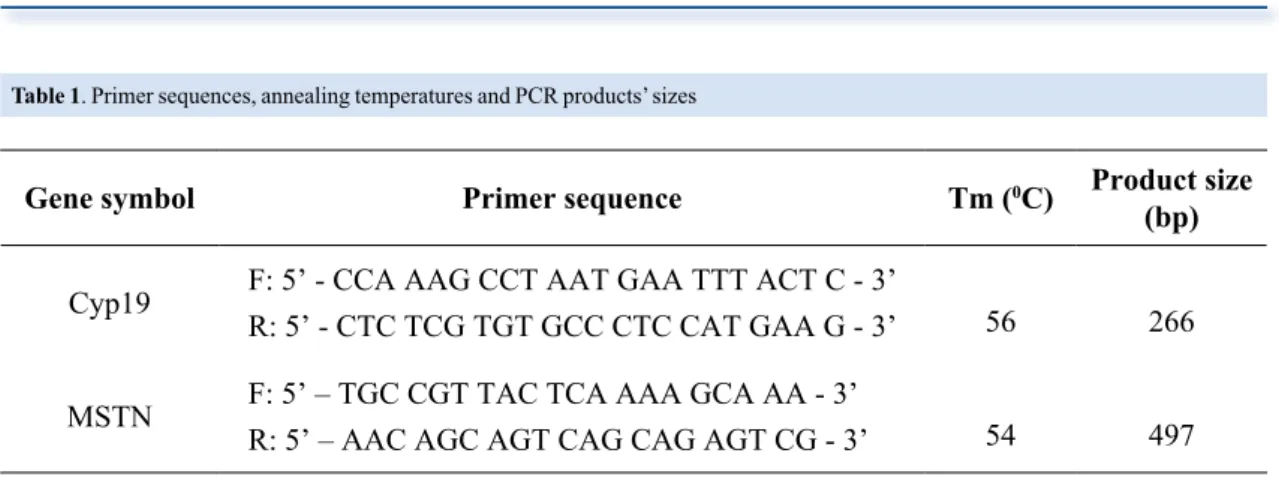
intron 9 of Cyp19 gene and 5’UTR of MSTN gene, their annealing temperatures (Tm) and product sizes were given in Table 1.
For RFLP analysis 10 μl of the PCR products were digested with 10 units of HaeIII and DraI restriction enzymes at 37oC overnight in order to genotype Cyp19
and MSTN polymorphisms, respectively. The digested DNA fragments were separated by electrophoresis in 2% agarose gel including ethidium bromide and visualized under UV light.
J HELLENIC VET MED SOC 2017, 68(3) ΠΕΚΕ 2017, 68(3)
AKIŞ, I., ESEN GÜRSEL, F., HACIHASANOĞLU ÇAKMAK, N., ATMACA, G., YARDIBI, H., ATEŞ, A., DURAK M.H., ÖZTABAK, K. 315
Table 1. Primer sequences, annealing temperatures and PCR products’ sizes
Gene symbol Primer sequence Tm (0C) Product size
(bp) Cyp19 F: 5’ - CCA AAG CCT AAT GAA TTT ACT C - 3’
R: 5’ - CTC TCG TGT GCC CTC CAT GAA G - 3’ 56 266
MSTN F: 5’ – TGC CGT TAC TCA AAA GCA AA - 3’
R: 5’ – AAC AGC AGT CAG CAG AGT CG - 3’ 54 497
Statistical analysis
Direct counting was used to estimate genotype and allele frequencies of the genetic variants for all loci. Genetic relationships regarding Cyp19 gene among populations analyzed in this study and seven sheep breeds from Europe (Zsolnai et al., 2002) were visualized in a dendrogram constructed by unweighted paired group cluster analysis (UPGMA), from a modified NEIGHBOR procedure implemented in PHYLIP version 3.5 software also using PopGene32 (Yeh et al., 2000). The UPGMA dendrogram of population was constructed based on Nei’s genetic distance (Nei, 1972). No further analysis was carried out, since the two loci analyzed in five sheep breeds were found to be monomorphic.
RESULTS
The SNP in intron 9 of Cyp19 gene could be assayed by RFLP analysis with HaeIII restriction enzyme. Digestion of the 266 bp PCR product reveals allele G (266 bp undigested fragment) and allele C (190 and 76 bp fragments). All of the breeds analyzed in this study were found to be monomorphic for this locus (Table 2). Only GG genotype was observed (Figure 1).
The digestion of 5’UTR of MSTN gene by DraI restriction enzyme results in two alleles, A (497 bp undigested fragment) and B (427 and 70 bp fragments). In this study only AA genotype was observed (Figure 1). The indigenous Turkish sheep breeds were found to be monomorphic for this locus (Table 2).
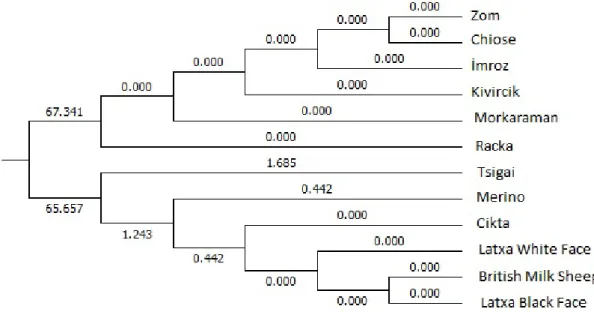
The phylogenetic tree based on G/C SNP in ovine Cyp19 gene presented two clusters among the sheep breeds analysed in this study and different European
breeds (Figure 2). All the Turkish sheep breeds were clustered in the same branch with the Racka breed from Hungary.
DISCUSSION
Due to its function in reproductive activity and growth, many studies have been conducted on ovine Cyp19 gene in different sheep breeds (Vanselow et al., 1999; Lobo et al., 2009; Tanamati et al., 2013).
The G/C transversion in intron 9 of ovine Cyp19 gene was firstly identified in Spanish breeds Carranzana, Latxa Black Face and Latxa White Face, the Merino and British Milk Sheep breeds and indigenous Hungarian breeds, Cikta, Racka and
Figure 1. PCR-RFLP fragments of two SNPs. M: 100 bp marker,
Lane 1, 2 and 3: Cyp19/HaeIII GG genotype (266 bp), Lane 4, 5 and 6: MSTN/DraI AA genotype (497 bp)
J HELLENIC VET MED SOC 2017, 68(3) ΠΕΚΕ 2017, 68(3)
316 AKIŞ, I., ESEN GÜRSEL, F., HACIHASANOĞLU ÇAKMAK, N., ATMACA, G., YARDIBI, H., ATEŞ, A., DURAK M.H., ÖZTABAK, K.
Tsigai. Allele C were observed more frequently in all the breeds with frequencies ranged between 0.650 and 0.988 (Zsolnai et al., 2002). In the present study the five indigenous Turkish sheep breeds, Chiose, Imroz, Kivircik, Zom and Morkaraman were found to be GG homozygous. Based on the analysis of this genetic locus the breeds from Turkey seem to be genetically apart from the breeds originated from Europe. The phylogenetic tree (Figure 2) obtained from the Cyp19 G/C polymorphism analysis of the five Turkish sheep breeds analyzed in the present study and seven European breeds mentioned above, presented two clusters. The Turkish breeds clustered with Racka breed from Hungary and the rest European breeds were grouped in the second cluster.
Absence of allele C in indigenous Turkish breeds may be due to a mutation exists in sheep from warmer regions. The geographic origin of the animals is an important factor regarding the sheep reproductive activity, as it determines the photoperiods (Sa and Sa, 2006), which affects melatonin synthesis. Melatonin
is an indoleamine derived from the serotonin secreted during darkness that acts as a natural inhibitor of the aromatases (Hafez and Hafez, 2003). The climatic and seasonal conditions of Turkey differ from the ones in Europe. Especially, three breeds in this study Kıvırcık, Zom and Morkaraman are raised mainly in central and south-eastern parts of Turkey, where the climate is semi-arid (Bilgili et al., 2013). We may suggest a relationship between Cyp19 G/C polymorphism and the geographical origin of sheep breeds.
Another gene, which is largely investigated in different sheep breeds is MSTN, which is associated with meat-related traits, especially muscle growth (Nakev et al., 2013).
A deletion of a small DNA fragment (TTTTA) in the 5’UTR of myostatin gene was identified in several goat breeds (Xianglong et al., 2008; Singh et al., 2014). Xianglong et al. (2008) suggested a relationship of this deletion with body weight and size in goats and that the heterozygote populations present
Figure 2. Genetic distance between Turkish and European sheep breeds according to Cyp19/HaeIII polymorphism. Dendrogram based
J HELLENIC VET MED SOC 2017, 68(3) ΠΕΚΕ 2017, 68(3)
AKIŞ, I., ESEN GÜRSEL, F., HACIHASANOĞLU ÇAKMAK, N., ATMACA, G., YARDIBI, H., ATEŞ, A., DURAK M.H., ÖZTABAK, K. 317
better growth traits than homozygotes. In a study on Indian goat breeds researchers observed that the allele A which presents TTTA deletion, is almost fixed with a frequency of 0.98 (Singh et al., 2014). The results of the study on Egyptian sheep breeds showed that this deletion is not unique for goats. The researchers could only observe AB genotype. Allele A had frequencies ranged between 0.07 and 0.23 in three Indian sheep breeds (Shafey et al., 2014). In the present study, five indigenous Turkish sheep breeds were found to be monomorphic for this deletion. All individuals analyzed had AA genotype. No association analysis of this deletion has been performed in sheep breeds until now. Regarding to its effects in goats, we may suggest that the Turkish breeds analyzed in the present study may have a disadvantage in terms of growth traits.
In addition, Khani et al. (2014) reported a significant association of TTTTA deletion in 5`UTR of MSTN gene with twining in goats. Although Chiose sheep breed has a higher twinning rate compared to the other indigenous breeds in this study, our
results did not present any difference among the five sheep breeds. Association analysis of this in/del polymorphism in sheep may provide results different than these found in goats.
CONCLUSION
Both loci analysed in this study were found to be monomorphic in five Turkish indigenous sheep breeds. Cyp19 and MSTN genes have highly conserved parts, which can be helpful for molecular evolutionary studies in sheep. Further analysis which will analyze the association between these polymorphisms and production traits in sheep should be conducted.
ACKNOWLEDGEMENT
This study was supported by Istanbul University, Faculty of Veterinary Medicine with project numbers VET-TB-16-1, VET-TB-16-2, BEK-2016-22550 and BEK-2017-24900
J HELLENIC VET MED SOC 2017, 68(3) ΠΕΚΕ 2017, 68(3)
318 AKIŞ, I., ESEN GÜRSEL, F., HACIHASANOĞLU ÇAKMAK, N., ATMACA, G., YARDIBI, H., ATEŞ, A., DURAK M.H., ÖZTABAK, K.
REFERENCES Bilgili AV, Güzel Y, İkinci A (2013) Modeling temporal variability of
soil CO_2 emissions from an apple orchard in the Harran Plain of southeastern Turkey. Turk J Agric For 37(6):744-761.
Zsolnai A, Anton I, Fésüs L, Estonba A, Schwerin M,Vanselow j (2002) Allele distributions of two novel SNPs within the sheep Cyp19 gene. J Anim Breed Genet 119(6): 402-405 Bellinge RH, Liberles DA, Iaschi SP, O’Brien PA, Tay GK (2005).
Myostatin and its implications on animal breeding: a review. Anim Genet 36:1-6.
Chen TT (2008) Polymorphisms of MSTN, IGFBP-3 gene and the related research with growth performance of Tianfu goat. Sichuan Agricultural University, Ya’an.
Hafez B, Hafez ESE (2003) Ciclos reprodutivos. In: WAHID H, HAFEZ ESE. Reprodução animal. 7th ed. São Paulo: Manole: pp 55-67. Heine PA, Taylor JA, Iwamoto GA, Lubahn DB, Cooke PS (2000)
Increased adipose tissue in male and female estrogen receptor-alpha knockout mice. P Natl Acad Sci USA 97(23):12729-12734. Jones ME, Thorburn AW, Britt KL, Hewitt KN, Wreford NG, Proietto
J, OZ OK, Leury BJ, Robertson KM, Yao S., Simpson ER (2000) Aromatase-deficient (ArKO) mice have a phenotype of increased adiposity. P Natl Acad Sci USA 97(23):12735-12740
Kijas JW, McCulloch R, Edwards JE, Oddy VH, Lee S.H, Van Der Werf J (2007) Evidence for multiple alleles effecting muscling and fatness at the ovine GDF8 locus. BMC Genet 8: 80-90.
Zhang L, Jiasen L, Fuping Z, Hangxing R, Lingyang X, Jian L, Shifang Z, Xiaoning Z, Caihong W, Guobin L, Youmin Z, Lixin D (2013) Genome-wide association studies for growth and meat production traits in sheep. Plos One 8(6): e66569.
Lôbo AMO, Lôbo RN, Paiva SR (2009) Aromatase gene and its effects on growth, reproductive and maternal ability traits in a multibreed sheep population from Brazil. Genet Mol Biol 32(3): 484-490. Miller M, Dykes DD, Polesky HF (1998) A simple salting out procedure
for extracting DNA from human nucleated cells. Nucl Acids Res 16: 1215.
Nakev G, Stamberov P, Dimitrova I, Stancheva N, Georgieva S, Hristova D, Angelov G, Mehmedov T, Genova K, Teneva A (2013) Growth and development of skeletal muscle in connection with the expression of the Myostatin Gene (MSTN). In: Proceedings of the 10th International Symposium Modern Trends in Livestock Production, Belgrade, Serbia: pp 640-647.
Payen E, Saidi-Mehtar N, Pailhoux E, Cotinot C (1995) Sheep gene mapping: Assignment of ALDOB, CYP19, WT and SOX2 by somatic cell hybrid analysis. Anim Genet 26: 331-333.
Sa CO, Sa JL (2006) Estacionalidade reprodutiva em ovinos Piracicaba. http://www.farmpoint.com.br/radares-tecnicos/reproducao/ estacionalidade-reprodutiva-em-ovinos-155n.aspx (accessed 14 February 2016)
Simpson ER, Mahendroo MS, Means GD, Kilgore MW, Hinshelwood MM, Graham-Lorence S, Amarneh B, Yuji I, Fisher CR, Michael MD, Mendelson CR, Bulun SE (1994) Aromatase cytochrome P450, the enzyme responsible for estrogen biosynthesis. Endocr Rev 15:342–355.
Simpson E, Rubin G, Clyne C, Robertson K, O’Donnell L, Jones M, Davis S. (2000) The role of local estrogen biosynthesis in males and females. Trends Endocrin Met 11(5):184-188.
Singh SP, Kumar R, Kumari P, Kumar S, Mitra A (2014) Characterization of 5’ upstream region and investigation of TTTTA deletion in 5’ UTR of myostatin (MSTN) gene in Indian goat breeds. Anim Biotech 25(1):55-68.
Tanamati F, Silva SCC, Mora NHAP, Schuroff GP, Macedo FAF, Gasparino E (2013) Efeito do polimorfismo no gene da aromatase sobre a característica peso vivo ao abate em ovinos Santa Inês. In: Anais do X Simpósio Brasileiro de Melhoramento Animal [online], Uberaba, MG. http://sbmaonline.org.br/anais/x/trabalhos/ pdf/6NKA.pdf (accessed 20 May 2016)
Vanselow J, Fürbass R, Zsolnai A, Kalbe C, Said HM, Schwerin M (2001) Expression of the aromatase cytochrome P450 encoding gene in cattle and sheep. J Steroid Biochem Mol Biol 79:279-288. Vanselow J, Zsolnai A, Fésus L, Schmidt P, Schwerin MA (1999)
Bsp143I PCR-RFLP in exon 3 of the ovine aromatase gene (CYP19). Anim Genet 30:382-405.
Li, X, Liu, Z, Zhou R, Zheng G, Gong Y,Li L (2008) Deletion of TTTTA in 5´UTR of goat MSTN gene and its distribution and genetic effect on body weight. Front Agric China 2(1):103-109.
Yalçın BC (1986) Sheep and goats in Turkey, Animal production and protection paper 60, Food and Agriculture Organisation of the United Nations, Rome http://www.fao.org/3/a-ah224e.pdf (accessed 20 May 2016)
Yeh F, Yang RC, Boyle T: Popgene (v. 1.32), Microsoft Windows based freeware for Population Genetic Analysis. Retrieved from http:// www.ualberta.ca/~fyeh/Pop32.exe. 2000.
Zhang ZJ, Ling YH, Wang LJ, Hang YF, Guo XF, Zhang YH, Ding JP, Zhang XR (2013) polymorphisms of the myostatin gene (MSTN) and its relationship with growth traits in goat breeds. Genet Mol Res 12(2): 965-971.