Cumhuriyet Science Journal
CSJ
e-ISSN: 2587-246X
ISSN: 2587-2680 Cumhuriyet Sci. J., Vol.40-3 (2019) 776-783
* Corresponding author. Email address: [email protected]
http://dergipark.gov.tr/csj ©2016 Faculty of Science, Sivas Cumhuriyet University
Assesment of outdoor radioactivity and health risk in Adıyaman Province
of Turkey
Muhammet KARATAŞLI
Beykent University, Faculty of Engineering and Architecture, Department of Electronics and Communication Engineering, İstanbul, TURKEY
Received: 09.03.2019; Accepted: 25.08.2019 http://dx.doi.org/10.17776/csj.537809
Abstract. This study was conducted to determine the outdoor absorbed gamma dose levels in and around Adiyaman province in the southeast of Turkey. Measurements were performed using a portable plastic scintillator at 94 different points (Eberline Smart Portable (ESP-2) model). Three readings were made for each measurement and the mean of these three values were determined and the gamma dose values were determined for each measurement region. External gamma irradiation velocities were measured between 63.5 (nGy/h) and 380.2 (nGy/h) levels in Adıyaman and surrounding areas and the mean value was calculated as 144.3 (nGy/h). This value corresponds to the average effective dose equivalent of 177 μSv per year. The lifetime averages of cancer risk values for ICRP 103, BEIR VII and ICRP 60 were found to be 0.071, 0.079 and 0.089, respectively. The results obtained with the results of similar studies in other provinces in Turkey and compared with the world average
Keywords:Cancer risk, gamma dose, annual effective dose, Adıyaman Province.
Adıyaman İlinde Dış Mekan Radyoaktivitesi ve Sağlık Risklerinin
Değerlendirilmesi
Özet. Bu çalışma Türkiye'nin güneydoğusunda bulunan Adıyaman ili ve çevresinde açık havada soğurulan gama radyasyon doz seviyesini belirlemek için yapılmıştır. Ölçümler önceden belirlenmiş 94 farklı noktada (Eberline Smart Portable (ESP-2) model) portatif bir plastik sintilatör kullanılarak yapıldı. Her ölçüm için üçer okuma yapılmış ve bu üç değerin ortalaması alınarak her bir ölçüm bölgesi için gama doz değerleri belirlendi. Adıyaman ve çevresinde dış gama dozu kullanılarak, dış gama ışınlanma hızları 63.5 (nGy/h) ile 380.2 (nGy/h) değerleri arasında ölçüldü ve ortalama değer 144.3 (nGy/h) olarak hesaplandı. Bu değer yıllık etkin doz eşdeğeri 177 μSv değerinde etkin doz ortalamasına karşılık gelmektedir. Adıyaman ve çevresinde yaşam boyu kanser risk değerleri ICRP 103, BEIR VII ve ICRP 60 için yüzdelik ortalamaları sırasıyla sırasıyla 0,071, 0,079 ve 0,089 olarak bulundu. Elde edilen sonuçlarla Türkiye’de diğer illerde yapılan benzer çalışmaların sonuçları ve dünya ortalamaları ile karşılaştırılmıştır.
AnahtarKelimeler:Kanser riski, gama doz., yıllık etkin doz, Adıyaman.
1.
INTRODUCTION
Although most people think that radiation is released only from man-made devices and structures (medicine, industry, research, nuclear power plants, agriculture and animal husbandry), they emit radiation to the environment in which we live in very long-lived radioactive elements that have taken place in nature since the formation of the
Karatasli/Cumhuriyet Sci. J., Vol.40-3 (2019) 776-783
universe. Natural radiation is the main source of radiation that people are exposed to in their environment. While living things are under the influence of a dose of 85% from natural radiation sources, they are under 15% of artificial radiation sources [1,2].
The major contribution to natural radiation is the naturally occurring U-238, Th-232 and their degradation products, Ra-226, Rn-222 and U-235, which are derived from radioactive elements such as K-40 [3]. The mass activity concentration is the radiation intensity corresponding to the absorbed dose in the air at a height of 1 m. Therefore, the radiation dose measured in the air is closely related to the radio-core concentrations in the soil [4,5].
The contribution of cosmic temperatures to natural radiation varies with height and is taken as constant at certain latitude values as they rise up from sea level [6,7].
Nuclear weapons experiments conducted on the earth from 1945 to the present day and the Chernobyl nuclear accident that occurred in 1986 caused the spread of radioactive elements to the environment. However, these radiations can also be called ground level radiation, and the geological and geographic, geographic and geographic region, so the soil and rocks with the geographic height, the level of the level of the level of radiation affect [9,10]. In order to determine whether the area inhabited in terms of natural radiation is healthy or not, it is necessary to determine the concentrations of radio-nuclei that constitute natural sources of radiation and the effect of radiation on human beings and to determine the effect of radiation on biological systems. Therefore, studies have been conducted to evaluate the doses and types of radiation caused by environmental factors, as well as the risks it may pose to human health [2].
In this study, determination of the dose level of gamma radiation absorbed in the outdoor in and around Adıyaman province is important in terms of determining the rate of exposure of the natural radiation to the radiation caused by various nuclear applications. The results presented in this study were compared with the results of Turkey's and the world average of similar studies conducted in different regions. The results of the study may serve as a reference for future assessments.
2.
MATERIALS AND METHODS
2.1. Geology of the survey area
Adiyaman, which has a surface area of 7614 km², is located between the northern latitudes of the 37° 25'-
38° 10' and the eastern longitudes of the 37° 27' – 39° 15'. The land structure of the province has a rugged
view that descends from north to south. Adıyaman and its surroundings are shown in Figure 1.
On the lands of Adıyaman, one of the oldest settlements in the world, findings about all phases of human
history have been obtained. Adıyaman, the 8th wonder of the world known as the Nemrut Mountain works,
the ruins of the Commagene civilization, the 4th largest dam in the world, the Atatürk Dam, the Çamgazi
dam, the winter camp organization, the world championship is a city with the world's first [11].
Figure 1. Map of the study area; Adıyaman province, Turkey [12].
The north of Adiyaman is mountainous and the south is ovalık. The plain runs from the south to the banks of
the EuphratesRiver and the Atatürk Dam. A few kilometers north of the province and the central district, the
mountainous areas begin to rise northward. These mountains, which are part of the southeastern Taurus,
extend in the east-west direction. In the mountainous areas to the north, which make up more than one third
of the face, the highland climate prevails [13].
There are several units of magmatic, metamorphic and sedimentary rocks formed in the geological time
period from Mesozoic to the present day. Mesozoic units are the oldest of these geological units. Eocene
limestones anticline structures are exposed in the eroded or faulted areas of Plio-Quaternary deposits. Apart
from this, the base area consists entirely of Plio-Quaternary fillings. The youngest formations are the
Quaternary alluviums in the valley floor and slab systems [14].
The number of stations with the altitude and catchment area of each district were given in Table 1. The
geographic coordinates of the stations were determined by using GPS devices.
2.2. Gamma Scintillation Detector
In this study, a device with Eberline Smart Portable (ESP-2) model, portable microcomputer and SPA-6
model plastic scintillation detector connected to the end was used for determination of gamma radiation
levels. The Eberline Smart Portable (ESP-2) is a portable radiation inspection instrument that can be
mounted with radiation detectors, a microcomputer-based and data-recording instrument. This instrument is
designed for use in routine radiation examinations and allows multiple readings and can be subsequently
connected to a computer and printer. ESP -2 is designed as an interface for the user, it has seven
multi-function on / off buttons and a liquid crystal display (LCD). The data is given either as scientific or moving
point recording and in selectable units of measurement. In addition, the instrument consists of an external
headset and speaker system for use in high radiation areas [15,16].
Table 1. Distribution of stations in the research region of Adıyaman
District Latitude (N) Longitude (E) Altitude (m) Catchment area (km2) Population (2017) Number of Stations AdıyamanCenter 37.759722 38.259722 669 1702 301589 33 Gölbaşı 37.7768518 37.6374277 867 784 49059 8 Kahta 37.7750854 38.6139386 750 1490 120859 14 Besni 37.6890364 37.8545142 930 1330 75499 13 Samsat 37.5762285 38.4677502 610 338 7530 6 Tut 37.7886992 37.9097588 1050 350 9936 6 Çelikhan 38.0255984 38.2366530 1388 584 15326 4 Gerger 38.0280715 39.0341811 750 702 18244 6 Sincik 38.0364507 38.6125706 1325 364 17034 4
4
Karatasli/Cumhuriyet Sci. J., Vol.40-3 (2019) 776-783
3.
RESULTS AND DISCUSSION
In order to determine the dose level of gamma radiation absorbed outdoors in 94 different regions in and around Adıyaman, the height of gonad (reproductive organs) in humans is approximately 1m above the ground. Measurements were taken with Eberline portable detector. Three different readings were made at a radius of 5 meters while the measurements were taken in each region and the mean of these three values were determined and gamma dose values were determined for each measurement region.
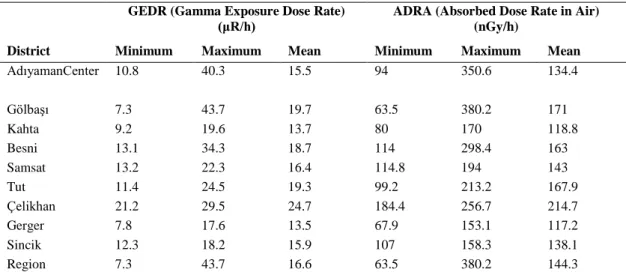
The results of the measurements of the external gamma dose obtained in the open air at a height of 1 meter from the ground in the 94 different regions of Adıyaman and around it are given in Table 2. During the determination of the gamma dose values, three readings were made at each measurement site. Gamma dose values were determined for each measurement point by taking the average of the three values. The results include both cosmic and terrestrial radionuclides.
While the contribution of terrestrial gamma radiation in the air is very large, space-based cosmic rays also contribute to the ratio. Measurements carried out at a height of 1 m from the ground are important in terms of measurement in the outdoors, in the level of reproductive organs in humans.The results of gamma irradiation rates were obtained in μR/h in the measurements performed for one minute in the open air. As can be seen in Table 2, the results obtained in the measurements were converted to nGy/h elde, which was the absorbed dose rate using a conversion factor (8.7 nGy / μR) from the definition of Rontgen [17].
Table 2. Gama exposure dose rate and absorbed dose rate for each districts of the Adıyaman GEDR (Gamma Exposure Dose Rate)
(μR/h)
ADRA (Absorbed Dose Rate in Air) (nGy/h)
District Minimum Maximum Mean Minimum Maximum Mean
AdıyamanCenter 10.8 40.3 15.5 94 350.6 134.4 Gölbaşı 7.3 43.7 19.7 63.5 380.2 171 Kahta 9.2 19.6 13.7 80 170 118.8 Besni 13.1 34.3 18.7 114 298.4 163 Samsat 13.2 22.3 16.4 114.8 194 143 Tut 11.4 24.5 19.3 99.2 213.2 167.9 Çelikhan 21.2 29.5 24.7 184.4 256.7 214.7 Gerger 7.8 17.6 13.5 67.9 153.1 117.2 Sincik 12.3 18.2 15.9 107 158.3 138.1 Region 7.3 43.7 16.6 63.5 380.2 144.3
By using a dose ratio of the gamma radiation absorbed in the air, the annual effective dose equivalent
(AEDE) may be the amount of exposure to which the human is exposed to radiation for one year. Using
the equation below, the annual effective dose equivalent is calculated [18,19].
AEDE=ADRA*DCF*OF*T (1)
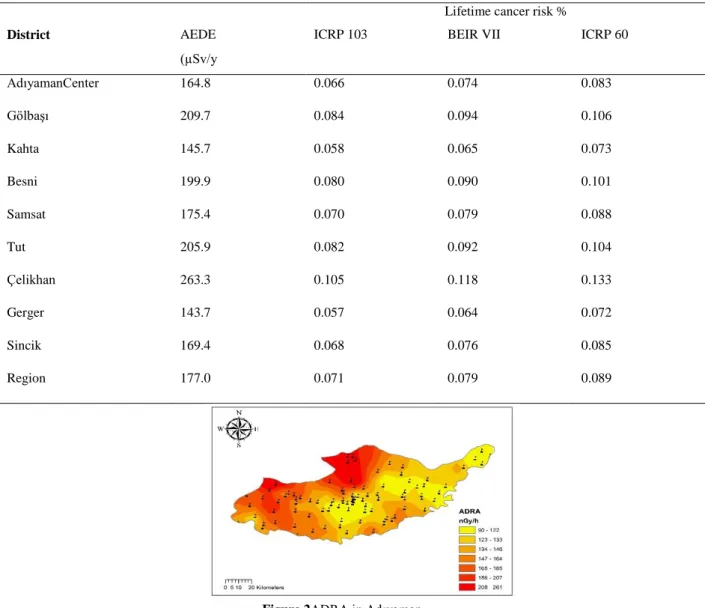
Here, the annual effective dose equivalent of AEDE, ADRA is the ratio of gamma radiation dose absorbed in the air; The environmental gamma dose conversion factor was determined to be 0.7 Sv/Gy to convert the absorbed dose ratio to the annual effective dose equivalent. In addition, when a person spent 20% of the time he was exposed to rays during a year (8760 h / y) he spent outside the home in open spaces, a coefficient of 0.2 was used as out-of-home occupation factor. In addition, lifetime risk of cancer ELCR Denk. (2)[20,22].
ELCR=AEDE*DL*RF (2)
5
Here, the AEDE is the annual effective dose equivalent, the average life expectancy of DL (average 70 years), and the risk factor for RF, and for stochastic effects, ICRP risk factors for lethal cancer in the whole population, respectively (1/Sv), RF ICRP 103, BEIR VII [23] (NRC, 2006) and for ICRP 60, 0.057, 0.064 and 0.072 are used [24].Table 3 shows the AEDE and the ELCR values of people who have been exposed for one year in Adıyaman and its surroundings, calculated by Equation1 and Equation2, and environmental gamma radiation for one year.
Table3. The average annual effective dose values and lifetime cancer risk
Lifetime cancer risk %
District AEDE
(µSv/y
ICRP 103 BEIR VII ICRP 60 AdıyamanCenter 164.8 0.066 0.074 0.083 Gölbaşı 209.7 0.084 0.094 0.106 Kahta 145.7 0.058 0.065 0.073 Besni 199.9 0.080 0.090 0.101 Samsat 175.4 0.070 0.079 0.088 Tut 205.9 0.082 0.092 0.104 Çelikhan 263.3 0.105 0.118 0.133 Gerger 143.7 0.057 0.064 0.072 Sincik 169.4 0.068 0.076 0.085 Region 177.0 0.071 0.079 0.089
Figure 2ADRA in Adıyaman
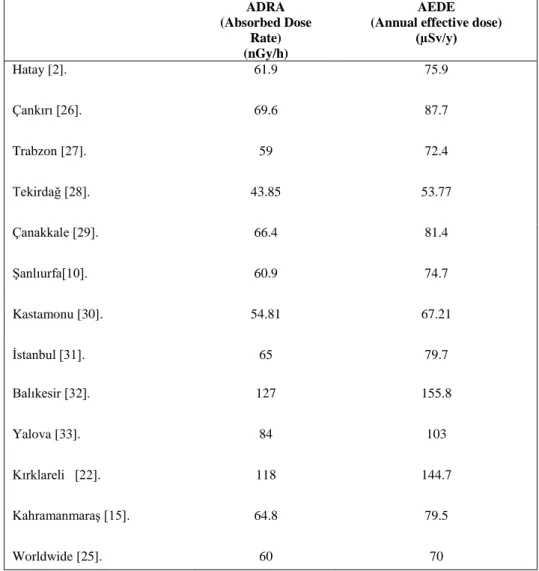
In addition, the absorbed gamma dose map obtained from the measurements for Adıyaman and its surroundings was drawn. Figure 2 shows the general distribution of the absorbed gamma dose rate across the province in the form of an isodose map. The dark regions represent areas with high abundance of absorbed gamma dose in Adıyaman and its vicinity.The arithmetic mean of the gamma dose measurements performed in 94 different regions in and around Adıyaman province was calculated as 144.3 nGy/s. The mean value of the annual effective dose equivalent calculated using the external gamma dose was found to be 177 µSv/y. This value is greater than the value of 73.6 µSv/y [25], which is determined as the world average of the annual effective dose equivalent, as shown in Table 4. Also it found was greater than the average annual effective dose equivalent in other provinces outside the studies
Karatasli / Cumhuriyet Sci. J., Vol.40-3 (2019) 776-783
carried out in the province of Adıyaman in the study average annual effective dose equivalent Balikesir province in Turkey.
Table 4. Absorbed dose rate in air (94 readings) and the corresponding annual effective doses for the districts of Adıyaman and
comparison with literature
ADRA (Absorbed Dose
Rate) (nGy/h)
AEDE (Annual effective dose)
(µSv/y) Hatay [2]. 61.9 75.9 Çankırı [26]. 69.6 87.7 Trabzon [27]. 59 72.4 Tekirdağ [28]. 43.85 53.77 Çanakkale [29]. 66.4 81.4 Şanlıurfa[10]. 60.9 74.7 Kastamonu [30]. 54.81 67.21 İstanbul [31]. 65 79.7 Balıkesir [32]. 127 155.8 Yalova [33]. 84 103 Kırklareli [22]. 118 144.7 Kahramanmaraş [15]. 64.8 79.5 Worldwide [25]. 60 70
4.CONCLUSİON
The arithmetic average of gamma dose measurements in Adıyaman and its vicinity is less than 1 mSv/y, as determined by the ICRP as the limit value of the annual effective dose equivalent of 144.3 nGy/h [34]. The lifetime averages of cancer risk values for ICRP 103, BEIR VII and ICRP 60 in Adıyaman and its vicinity were found to be 0.071, 0.079 and 0.089, respectively.
The issue of radiation has become one of the most controversial phenomena in the world after the unfortunate nuclear reactor accidents, and people's sensitivities to this issue are increasing day by day. In parallel with this awareness, people's demand for information on radiation is increasing. Therefore, it is extremely important for people to be informed about the natural radiation that they will be exposed to stay in according to their geographic and geological characteristics. Therefore, this study, environmental gamma dose measurements in Adıyaman and its districts can be used as baseline data for future studies and a reference for future evaluations
can be made. It will also be very useful in terms of radiation monitoring in the event of any nuclear accident in the future and in the evaluation of radiological risks to human health.
REFERENCES
[1] UNSCEAR, 2008. United Nations Scientific Committee on the Effects of Atomic Radiation, United
Nations Publication, New York, USA.
[2] Karataşlı, M. 2018. Hatay İli ve çevresinde gama radyasyon ölçümü, Afyon Kocatepe Üniversitesi
Fen ve Mühendislik Bilimleri Dergisi, 18, 3,780-785.
[3] Smith, J. and Beresford, N.A. 2005. Chernobyl, Catastrophe and Consequences. Springer, 310, New
York.
[4] Beck, H.L, 1982. The Natural Radiation Environment II. USERDA Conf.-720805-P2, The Physics of
Environmental Gamma Radiation Fields, 101-104.
[5] NCRP, Report No. 50, 1977. National Council on Radiation Protection and Measurements, (1977),
Environmental Radiation Measurement, ISBN. 0- 913392-32-4.
[6] Eisenbud, M. 1987. Environmental Radioactivity, Third Edition, ISBN. 0-12-235153, Academic
Pres, Inc., London.
[7] Karataşlı, M., and Özer, T. 2017. Investigation of Radiation Activity Growing Peanuts in Osmaniye,
Süleyman Demirel University Journal of Natural and Applied Sciences, 21, 3, 1017-1023.
[8] Karataşlı, M. 2018. Dozimeters in business safety, İstanbul Aydın Üniversitesi Dergisi,10 (1), 15-31.
[9] Karataşlı, M. 2018. Radionuclide and heavy metal content in the table olive (Olea europaea l.)from
the Mediterranean region of Turkey, Nuclear Technology & Radiation Protection, 33,4, 1-7.
[10] Bozkurt, A., Yorulmaz, N., Kam, E., Karahan, G. and Osmanlıoğlu, A. E. 2007. Assessment of
environmental radioactivity for Şanliurfa region of Southeastern Turkey. Radiation Measurements,
42, 8, 1387-1391.
[11] http://www.cografya.gen.tr/tr/adiyaman/ (24.01.2019).
[12] Aykut, M., and Taşar, G.E. 2018. Contributions To The Knowledge Of Adephagan Fauna In
Adiyaman Province, Turkey (Coleoptera: Dytiscidae, Gyrinidae, Haliplidae And Noteridae),Munis
Entomology & Zoology, 13, 1, 249-255.
[13] http://www.adiyamankulturturizm.gov.tr/TR-61334/genel-bilgiler.html (23.01.2019).
[14] Karadoğan, S., and Tonbul, S. 2013. Geomorphological properties of Adıyaman Basin, The Journal
of Academic Social Science, 1,1, 182-217.
[15] KARATAŞLI, M. 2019. Determination of outdoor absorbed gamma dose rates of Kahramanmaraş
Provınce, Turkey, Cumhuriyet University, Cumhuriyet Science Journal. 40 (1), 102-107.
[16] Değerlier, M. 2007. Determination ofEnviromental Natural Radioactivity of Adana and The Annual
Effective Dose Equivalent Due to Natural Radiation, Ph.D. Thesis, Department Of Physics Institute
Of Natural And Applied Sciences University of Çukurova, Adana
[17] Baykara, O. 2005. The determinations of natural radioactivity in the intersect zone of the North
Anatolian Fault and East Anatolian Fault. PhD thesis, Firat University Graduate School of Natural
and Applied Science, Physics Department, Elazig, Turkey (in Turkish).
[18] UNSCEAR, 2000. Report of the United Nations Scientific Committee on the Effects of Atomic
Radiation, Sources, Effects, and Risks of Ionizing Radiation. United Nations sales publication, New
York. United Nations.
[19] Karataşlı, M., Turhan, Ş., Varinlioğlu, A., and Yeğingil, Z. 2016. Natural and fallout radioactivity
levels and radiation hazard evaluation in soil samples. Environmental Earth Science, 75, 424, 1-9.
Karatasli / Cumhuriyet Sci. J., Vol.40-3 (2019) 776-783
![Figure 1. Map of the study area; Adıyaman province, Turkey [12].](https://thumb-eu.123doks.com/thumbv2/9libnet/3898461.43667/3.892.78.784.865.1161/figure-map-study-area-adıyaman-province-turkey.webp)