Abstract
This study aimed to determine the prevalence of clinical coccidiosis and to estimate the costs of disease control and treatment in broiler production. The study was performed with randomly selected poultry farms in Akşehir district of Konya Province. Each farm was visited for once at the day of 21 and over of the production period. Necropsy samples (5/10000) were collected from each farm for parasitological and histopathological examinations. The prevalence of clinical coccidiosis was found as 7.72%. A significant relationship was determined between the prevalence of clinical coccidiosis and age groups (P<0.05). Four Eimeria species: E. brunetti (35.48%), E. necatrix (35.48%), E. maxima (19.35%) and E. tenella (9.68%) were identified. Mixed infection was observed in 45.83% of the chicks. Disease control and treatment costs were estimated as 4604.17 $ and 2683.25 $ respectively. In conclusion, this multidisciplinary study showed that coccidiosis was still a serious disease for broiler production in the region. The costs of the control and treatment of coccidiosis may vary depending on its prevalence. Therefore, disease control strategies maintain its importance.
Keywords: Clinical coccidiosis, Broiler production, Disease control cost, Treatment cost
Broiler Üretiminde Klinik Koksidiyozisin Prevalansı ve
Hastalık Kontrol ve Tedavi Maliyetlerinin Tahmini
Özet
Bu araştırma, broiler üretiminde klinik koksidiyozisin prevalansını belirlemek, hastalığın kontrol ve tedavi maliyetlerini tahmin etmek amacıyla yapılmıştır. Çalışma, Konya İli Akşehir İlçesinde rastgele seçilen işletmelerde yürütülmüştür. Her işletme üretim sürecinin 21 ve üzerindeki günlerde bir kez ziyaret edilmiştir. Bu işletmelerden, parazitolojik ve histopatolojik incelemeler için nekropsi numuneleri (5/10.000) toplanmıştır. Klinik koksidiyozisin prevalansı %7.72 bulunmuştur. Klinik koksidiyozisin prevalansı ile yaş grupları arasında anlamlı bir ilişki belirlenmiştir (P<0.05). Dört adet Eimeria türü tespit edilmiştir: E. brunetti (%35.48), E. necatrix (%35.48), E. maxima (%19.35) ve E. tenella (9.68%). Piliçlerin %45.83’ünde miks enfeksiyon gözlenmiştir. Hastalığın kontrol ve tedavi maliyetleri sırasıyla 4604.17 $ ve 2683.25 $ tahmin edilmiştir. Sonuç olarak, multidisipliner özelliğe sahip bu araştırma koksidiyozisin broiler üretimi için bölgede halen ciddi bir hastalık olduğunu göstermiştir. Hastalık kontrol ve tedavi maliyetleri koksidiyozisin prevalansına bağlı olarak değişebilir. Dolayısıyla, hastalık kontrol stratejileri önemini korumaktadır.
Anahtar sözcükler: Klinik koksidiyozis, broiler üretimi, hastalık kontrol maliyeti, tedavi maliyeti
The Prevalence of Clinical Coccidiosis and the Estimation of the
Costs of Disease Control and Treatment in Broiler Production
[1]Hasan ÇİÇEK
1
Hatice ÇİÇEK
2Hikmet KELEŞ
3Murat TANDOĞAN
1Mustafa ESER
4[1] 1
2
3
4
This research was supported by Afyon Kocatepe University, Scientific Research Coordination Unit (Project no: 08.VF.10) Department of Animal Health Economics and Management, Afyon Kocatepe University, Faculty of Veterinary Medicine, TR-03200 Afyonkarahisar - TURKEY
Department of Parasitology, Afyon Kocatepe University, Faculty of Veterinary Medicine, TR-03200 Afyonkarahisar - TURKEY
Department of Pathology, Afyon Kocatepe University, Faculty of Veterinary Medicine, TR-03200 Afyonkarahisar - TURKEY
Anadolu University, Faculty of Open Education, Health Programs, TR-26470 Eskisehir - TURKEY
INTRODUCTION
Coccidiosis caused by protozoan parasites of the genus Eimeria, is the most important parasitic disease of
domestic poultry with substantial economic losses in the world. Commercial broiler production is mostly affected from coccidiosis. Production losses (mortality, decreased liveweight gain and increased feed conversion ratio-FCR)
İletişim (Correspondence) +90 533 6304103
[email protected]
KafKas Universitesi veteriner faKUltesi Dergisi
JoUrnal Home-Page: http://vetdergi.kafkas.edu.tr
online sUbmission: http://vetdergikafkas.org
Research Article
Kafkas Univ Vet Fak Derg 22 (4): 525-528, 2016
DOI: 10.9775/kvfd.2016.14973
526
The Prevalence of Clinical ...
were reported up to 81-96% while disease control and treatment expenditures have responsibility up to 4-18% in total production costs [1,2].
The clinical form of the disease manifests through prominent signs of mortality, morbidity, diarrhoea or bloody faeces [2]. The attempts to control and treatment
the disease can cause an increase in production costs [3,4].
Turkey, with an annual poultry meat production of 1.7 million tons has a 2% share in the world poultry meat market and has moved to 8th rank. In the last 12 years,
production capacity of sector increased about 158%, its annual turnover is 4.5 billion US$, and export of poultry meat is about 567 million US$. As a growing sector, 2.4 million people work for it [5].
The aim of this study was to determine the prevalence of clinical coccidiosis and to estimate the costs of disease control and treatment in broiler production in Akşehir district of Konya province in Turkey.
MATERIAL and METHODS
Study Area
This study was conducted from July to November in 2011 in Akşehir district of Konya province where has a significant potential in terms of broiler production in Turkey. It is located some 135 km south-west of the Konya province, at an altitude of 1050 m above sea level with latitude 38°22’N and 31° 26’E. The district has a continental climate: hot and dry summers, mild and rainy springs, cold and snowy winters. Broilers are reared in an intensive deep-litter system in this region.
Sampling
The material consisted of the farms that were allowed to give necropsy materials (approved by Afyon Kocatepe University, the Local Ethics Committee on Animal Experi-ments, 03/08/2011, B.30.2.AKÜ.0.8Z.00.00/76). Five necropsy sample per 10.000’s capacity were collected from each farm [6]. Each farm was visited only one time from starting
the 21st day of the production period (average slaughter
age of chickens is 42 days in this area). Randomly selected necropsy samples were subjected to the routine post-mortem examination according to the method described by Conway and Mckenzie [7]. Charecteristics of lesions
and sites were recorded. Mucosal scrapings were made from segments of intestine with gross lesions. Segments of intestines about 1-3 cm in length were taken for histo-pathology from parts of the intestine with gross lesions.
Parasitological Techniques
Mucosal scrapings were microscopically examined for developmental stages of coccidia. In positive samples, faeces were mixed thoroughly with a 2.5% potassium
dichromate solution. The mixture was poured in thin layers into petri dishes and left to sporulate at 29°C for morphological identification of oocysts.
Histopathological Examination
The tissue samples taken from parts of the intestine with gross lesions were fixed with buffered formalin solution for microscopic examination and were blocked with paraffin after routine laboratory follow-up. Sections taken from paraffin blocks with 5 µ thickness were stained with hematoxylin-eosin (HE). The prepared sections were examined at light microscope (Olympus CX41) mounted with a digital camera and analysis system (Kameram®).
Species İdentification
Coccidial species were identified according to the site of infection, the sporulation time, morphological features of sporulated oocysts, nature of gross lesions and histological changes in tissues [7,8]. Sporulated oocysts from each
sample were measured using a Nikon Eclipse i-Series 80i trinocular research microscope with 100x magnification and DS-5M-L1 digital camera system.
Estimation of the Costs of Disease Control and Treatment
The costs of disease control and treatment were calculated according to Williams [2] and Bera et al.[1].
General information of farms such as farmer’s name, farm location, flock age, flock size, production period and feed consumption were collected through questionnaires at the time of sampling for estimating the costs of disease control and treatment. Otherwise, it was interviewed with the veterinarians who was working in the research area for disease control (the use and the price of coccidiostats) and treatment (medicine usage and the price of medicine).
Statistical Analysis
Chi-square (X2) test was used for comparisons between
infection and age groups.
RESULTS
In this study, clinical coccidiosis was diagnosed in 24 chicks (7.72%) out of 311 necropsied chicks. Results showed that the prevalence of clinical coccidiosis has statistically significant effects on age groups (P<0.05). Chicks with 36-42. days of age showed the highest prevalence of infection
(Table 1).
Four Eimeria species: E. brunetti (35.48%), E. necatrix (35.48%), E. maxima (19.35%), E. tenella (9.68%) were identified (Table 2). Mixed infections with two species were found in 45.83% of the chickens (Table 3).
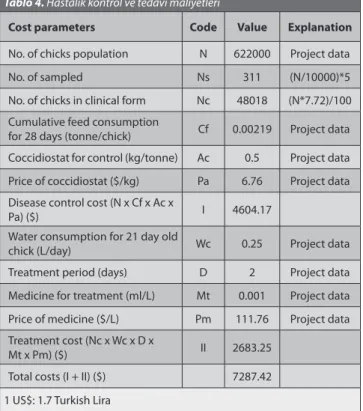
The cost of disease control and treatment were calculated as 4604.,17 $ and 2683.25 $ respectively (Table 4).
527 ÇİÇEK, ÇİÇEK, KELEŞ TANDOĞAN, ESER
DISCUSSION
A diagnosis of clinical coccidiosis is warranted if oocysts, merozoites, or schizonts are seen microscopically and if lesions are severe [9]. In this study, the prevalence of clinical
coccidiosis among examined broiler chicks was 7.72% (24/311). In the previous studies in different countries, the prevalence of coccidial infection in broiler chicks ranged between 21% and 92% [10-14]. In Turkey, there are
limited studies on poultry coccidiosis [4,15,16]. Karaer et al.[15]
suggested that prevalence of subclinical coccidiosis in broiler farms is 54.3% in different regions of Turkey.
In this study, the prevalence of clinical coccidiosis (7.72%) was very low compared to investigations in Turkey and other countries. Mismanagement, such as wet litter
that encourage oocysts sporulation, contaminated drinkers and feeders, poor ventilation, and high stocking density can exacerbate the clinical signs [17]. Coccidiosis can be
controlled by proper stocking density, the housing and handling of the chicks, the proper use of anticoccidial drugs [12,16]. In current investigation, this might be due
to good management practices, and the proper use of anticoccidial drugs (questionnaires).
It was noted that the highest rate of clinical coccidiosis (30.36%) was determined in the 36-42 days age group in the present study. This is in agreement with the findings reported by Lobago et al.[12], Karaer et al.[15] and Amare
et al.[18]. Hygienic measurements are not enough alone
for coccidiosis control. In order to prevent infection usually supplemental anticoccidial feeds and for the treatment of disease drugs including active ingredients of sulphonamide, amprolium and toltrazuril are used [3].
In this study, it has been found that anticoccidial feed additives were used except the last two weeks (between 28th-42nd days) of the production period. It was determined
that these drugs were mixed into the drinking water. We found pathogenic Eimeria species responsible for clinical coccidiosis: E.brunetti, E. necatrix, E.maxima, E.tenella. Previous studies reported that E.tenella was the most prevalent coccidial species in broiler chickens [13,17,19,20],
where as the findings of the present study showed that E. brunetti and E.necatrix were the most common. This inconsistency may be arised from which the anticoccidial drugs in general use are developed specifically to control this pathogenic species.
Table 1. Prevalence of clinical coccidiosis by age groups Tablo 1. Yaş gruplarına göre klinik koksidiyozisin prevalansı
Necropsy samples
Age Groups (days)
Total 21-28 29-35 36-42 No. of examined 102 153 56 311 No. of positive 5 2 17 24 Prevalence (%) 4.90 1.31 30.36 7.72 x2: 37.57, P<0.05
Table 2. Eimeria species by age groups Tablo 2. Yaş gruplarına göre Eimeria türleri
Eimeria species
Age Groups (days)
Total % 21-28 29-35 36-42 E. brunetti 3 0 8 11 35.48 E. necatrix 2 1 8 11 35.48 E. maxima 1 0 5 6 19.35 E. tenella 0 0 3 3 9.68 Total 6 1 24 31 100.00
Table 3. Frequency of Eimeria species according to single and mixed
infections
Tablo 3. Tek ve miks enfeksiyonlara göre Eimeria türlerinin dağılımı Single and Mixed İnfections Frequency %
E. brunetti 7 29.16 E. necatrix 6 25.00 E. brunetti + E. maxima 2 8.33 E. brunetti + E. tenella 1 4.17 E. brunetti + E. necatrix 1 4.17 E. necatrix + E. maxima 3 12.50 E. necatrix + E. tenella 1 4.17 E. maxima + E. tenella 1 4.17 Eimeria spp. 2 8.33 Total 24 100.00
Table 4. The costs of disease control and treatment Tablo 4. Hastalık kontrol ve tedavi maliyetleri
Cost parameters Code Value Explanation
No. of chicks population N 622000 Project data
No. of sampled Ns 311 (N/10000)*5
No. of chicks in clinical form Nc 48018 (N*7.72)/100 Cumulative feed consumption
for 28 days (tonne/chick) Cf 0.00219 Project data Coccidiostat for control (kg/tonne) Ac 0.5 Project data Price of coccidiostat ($/kg) Pa 6.76 Project data Disease control cost (N x Cf x Ac x
Pa) ($) I 4604.17
Water consumption for 21 day old
chick (L/day) Wc 0.25 Project data
Treatment period (days) D 2 Project data
Medicine for treatment (ml/L) Mt 0.001 Project data
Price of medicine ($/L) Pm 111.76 Project data
Treatment cost (Nc x Wc x D x
Mt x Pm) ($) II 2683.25
Total costs (I + II) ($) 7287.42
528
The Prevalence of Clinical ...
Bera et al.[1] suggested that the major economic losses
considered in relation to clinical coccidiosis in commercial broiler were expenses on control, therapy and mortality. Death in poultry is known to occur more often in situations where more than one pathogenic agent is combined. It has been reported that coccidiosis is seen with salmonella or gumboro [21]. However, lethal coccidiosis is becoming
rare, because of widely implemented prevention and control strategies [2,22].
According to Williams [2], the anticoccidial drugs used
constitute an extremely variable cost of chick production, both from drug to drug and from country to country. In this study, disease control was the most important parameter in broiler industry in Akşehir district of Konya province. This result was in consistent with the finding of Bera et al.[1] who
reported prevention of coccidiosis in India mainly depends on control. Prophylactic use of anticoccidial feed additives are primary means of controlling coccidiosis in the broiler industry. However, this leads to a further problem of drug resistance and drug residue in consumable meat [1].
In conclusion, the costs of disease control and treatment may vary due to the prevalence of coccidiosis which is affected by several factors such as geography and climate. This study that carried out in multidisciplinary manner showed that coccidiosis is still a serious disease for broiler production in the region. Therefore, disease control strategies are going to be the main issue about coccidiosis.
REFERENCES
1. Bera AK, Bhattacharya D, Pan D, Dhara A, Kumar S, Das SK:
Evaluation of economic losses due to coccidiosis in poultry industry in India. Agr Econ Res Rev, 23, 91-96, 2010.
2. Williams RB: A compartmentalised model for the estimation of
the cost of coccidiosis to the world’s chicken production industry. Int
J Parasitol, 29, 1209-1229, 1999. DOI: 10.1016/S0020-7519(99)00086-7
3. Hafez MH: Poultry coccidiosis: Prevention and control approaches.
Arch Geflügelk, 72 (1): 2-7, 2008.
4. Karaer Z, Pınar Z, Kar S, Güven E, Çakmak A, Nalbantoğlu S, Koçak A, Alçığır G, Emre Z: Vaccine production based on oocyst irradiation
at broiler coccidiosis I-studies on the quantitative determination and sporulation of oocysts in faeces present in litter of broilers with coccidiosis.
Kafkas Univ Vet Fak Derg, 15, 795-800, 2009. DOI: 10.9775/kvfd.2009.302
5. BESD-BİR: Piliç eti sektör raporu (Üretim, tüketim, dış ticaret, sorunlar,
görüşler). Beyaz Et Sanayicileri ve Damızlıkçıları Birliği Derneği, Yayın No:
12, pp.1-11, 2013.
6. Mattiellio R: Detect subclinical coccidiosis. World Poultry, 6, 82-83, 1990. 7. Conway DP, Mckenzie ME. Poultry coccidiosis. In, Diagnostic and
Testing Procedures. 2nd ed., Wiley-Blackwell, Ames, IA, 2007.
8. Levine ND: Veterinary Protozoology. 130-188, Iowa State University
Press, Ames, IA, 1985.
9. Soulsby EJL: Helminths, Arthropods and Protozoa of Domesticated
Animals. 7th ed., 809, Baillier Tindall, London, 1982.
10. Gari G, Tilahun G, Dorchies P: Study on poultry coccidiosis in Tiyo
District, Arsi Zone, Ethiopia. Int J Poult Sci, 7, 251-256, 2008. DOI: 10.3923/ ijps.2008.251.256
11. Györke A, Pop L, Cozma V: Prevalence and distribution of Eimeria
species in broiler chicken farms of different capacities. Parasite, 20, 50, 2013. DOI: 10.1051/parasite/2013052
12. Lobago F, Worku N, Wossene A: Study on coccidiosis in Kombolcha
poultry farm, Ethiopia. Trop Anim Health Prod, 37, 245-251, 2005. DOI: 10.1023/B:TROP.0000049302.72937.12
13. Muazu A, Masdooq AA, Ngbede J, Salihu AE, Haruna G, Habu AK, Sati MN, Jamilu H: Prevalence and identification of species of Eimeria
causing coccidiosis in poultry within Vom, Plateau State, Nigeria. Int J
Poult Sci, 7, 917-918, 2008. DOI: 10.3923/ijps.2008.917.918
14. Oljira D, Melaku A, Bogale B: Prevalence and risk factors of
coccidiosis in poultry farms in and around Ambo Town, Western Ethiopia.
AEJSR, 7, 146-149, 2012. DOI: 10.5829/idosi.aejsr.2012.7.4.65158
15. Karaer Z, Güven E, Akçay A, Kar S, Nalbantoğlu S, Çakmak A:
Prevalence of subclinical coccidiosis in broiler farms in Turkey. Trop Anim
Health Prod, 44, 589-594, 2012.
16. Sarı B, Çakmak A: Preventive effects of anticoccidial drug
supplementation in chicken feed against coccidiosis in broiler farming.
Kocatepe Vet J, 1, 1-10, 2008.
17. Al-Natour MQ, Suleiman MM, Abo-Shehada MN: Flock-level
prevalence of Eimeria species among broiler chicks in northern Jordan.
Prev Vet Med, 53, 305-310, 2002. DOI: 10.1016/S0167-5877(01)00281-1
18. Amare A, Mengistu A, Nazir S: Prevalence and aetiology of poultry
coccidiosis and associated risk factors in White Leghorn grower chickens at Kombolcha poultry farm, Ethiopia. J World’s Poult Res, 2, 54-59, 2012.
19. Bachaya HA, Abbas RZ, Raza MA, Iqbal Z, Rehman TU, Baber W, Hussain R: Existence of coccidiosis and associated risk factors in broiler
chickens in Southern Punjab, Pakistan. Pak Vet J, 35, 81-84, 2015.
20. Hadipour MM, Olyaie A, Naderi M, Azad F, Nekouie O: Prevalence
of Eimeria species in scavenging native chickens of Shiraz, Iran. Afr J
Microbiol Res, 5, 3296-3299, 2011.
21. Ruff MD: External and internal factors affecting the severity of avian
coccidiosis. Proceedings of 5th International Coccidiosis Conference, Guelph,
Ontario, Canada, 73-79, 1993.
22. Haug A, Gjevre AG, Thebo P, Mattsson JG, Kaldhusdal M:
Coccidial infections in commercial broilers: Epidemiological aspects and comparison of Eimeria species identification by morphometric and polymerase chain reaction techniques. Avian Pathol, 37, 161-170, 2008. DOI: 10.1080/03079450801915130