Dergi web sayfası:
www.agri.ankara.edu.tr/dergi www.agri.ankara.edu.tr/journalJournal homepage:
TARIM BİLİMLERİ DERGİSİ
—
JOURNAL OF AGRICUL
TURAL SCIENCES
22 (2016) 576-587
Cadmium Toxicity and its Effects on Growth and Metal Nutrient Ion
Accumulation in Solanaceae Plants
Yakup ÇIKILIa, Halil SAMETb, Sevda DURSUNa
aDüzce University, Çilimli Vocational School, Department of Crop and Animal Production, 81750, Düzce, TURKEY
bKocaeli University, Vocational School of Food and Agriculture, Department of Crop and Animal Production, 41285, Kocaeli, TURKEY ARTICLE INFO
Research Article
Corresponding Author: Yakup ÇIKILI, E-mail: [email protected], Tel: +90 (380) 681 73 12 Received: 14 July 2014, Received in Revised Form: 11 August 2015, Accepted: 20 August 2015
ABSTRACT
The effect of cadmium (Cd) toxicity was studied in four Solanaceae plants (tomato, Solanum lycopersicum L.; pepper, Capsicum annuum L.; eggplant, Solanum melongena L., and goldenberry, Physalis peruviana L.) grown in greenhouse under natural light conditions. The soil was treated with five levels of Cd (0, 2.5, 5, 10 and 20 mg kg-1). Except for the tomato, the shoot and root dry biomass decreased with increasing Cd. Plant growth, bioaccumulation and translocation of Cd and accumulation of metal nutrient ions [potassium (K), calcium (Ca), magnesium (Mg), sodium (Na), iron (Fe), manganese (Mn), copper (Cu) and zinc (Zn)] were investigated. On the basis of the percent reductions in the shoot dry biomass, the tomato was determined to be Cd-tolerant, and the other plants Cd-sensitive. The shoot and root Cd contents, uptakes, and total accumulation rate (TAR) were increased with increasing rate of Cd applied, except for the shoot Cd content and root uptake of the goldenberry. The bioconcentration factor (BCF) and the translocation factor (TF) of Cd diminished at all plants, with the exception of the TF for tomato. With respect to Cd translocation, plant species showed a ranking as follows: goldenberry<pepper<eggplant<tomato. The accumulation of all metal nutrient ions increased with Cd applications in the goldenberry shoots. While the accumulation of divalent metal nutrient ions, except for Zn and Cu, increased for the pepper and eggplant, the accumulation of K as monovalent metal nutrient ion decreased for only the pepper.
Keywords: Cadmium; Solanaceae; Accumulation; Bioconcentration; Translocation; Metal nutrient ions
Kadmiyum Toksisitesi ve Kadmiyumun Solanaceae Bitkilerinde
Gelişim ve Metal Besin İyonu Akümülasyonuna Etkisi
ESER BİLGİSİ
Araştırma Makalesi
Sorumlu Yazar: Yakup ÇIKILI, E-posta: [email protected], Tel: +90 (380) 681 73 12 Geliş Tarihi: 14 Temmuz 2014, Düzeltmelerin Gelişi: 11 Ağustos 2015, Kabul: 20 Ağustos 2015
ÖZET
Serada ve doğal ışık koşulları altında yetiştirilen dört farklı Solanaceae familyası bitkisinde (domates, Solanum lycopersicum L.; biber, Capsicum annuum L.; patlıcan, Solanum melongena L. ve altınçilek, Physalis peruviana L.)
1. Introduction
Cadmium which is a non-essential element for plants, animals and humans has been a major pollutant in both terrestrial and aquatic environments for decades. Recent advances in industry and agriculture have led to an increased level of Cd in agricultural soils. Cadmium enters agricultural soil primarily through various anthropogenic sources, such as phosphate fertilizers, waste water, sewage sludge, and manure (Alloway & Steinnes 1999), and in emissions from metal-working industries, cement industries, power stations and urban traffic (Sanitá di Toppi & Gabbrielli 1999; Wu et al 2004). The accumulation of Cd in soil is dangerous for most living organisms. Despite being a non-essential element for plants, Cd is easily absorbed and accumulates in different plant parts. The accumulation/mobility of Cd seems to depend on the plant species and growth stage, the concentration of added nutrients, plant growth conditions, and/or metal combinations used (Murillo et al 2002). In plants, the accumulation of Cd can cause many morphological, physiological, biochemical and structural changes including plant growth retardation, chlorosis, necrosis (Benavides et al 2005), reduction of root growth, biomass production (Sanitá di Toppi & Gabbrielli 1999; Moussa 2004), chlorophyll content (Fatoba & Udoh 2008), inhibition of photosynthesis and transpiration (Mobin & Khan 2007; Shi et al 2010), imbalance of water and mineral nutrition (Gouia et al 2000; Sengar
et al 2008), induction of oxidative stress (Shamsi et al 2007; Sandalio et al 2009), and affects on membrane structure and permeability (Sengar et al 2008).
Cadmium is easily taken up both active and passive pathways by plants and affects several metabolic activities in different cell compartments, especially in the chloroplasts. These deleterious effects include the inhibition of photosynthesis, such as biosynthesis of chlorophyll (Stobart et al 1985; Padmaja et al 1990; Ekmekçi et al 2008) and functioning of photochemical reactions (Krupa & Moniak 1998). Cadmium reduces plant growth by interrupting the plant photosynthetic activity and nutrient balance (Zhang et al 2002; Shamsi et al 2010) and also interferes with the uptake, translocation, and plant use of water and mineral nutrients (Shamsi et al 2007). Cadmium ions compete with most nutrients such as K, Ca, Mg, Fe, Mn, Cu, Zn, and nickel (Ni) across the same trans-membrane carriers (Clarkson & Luttge 1989; Rivetta et al 1997; Sanitá di Toppi & Gabbrielli 1999).
The accumulation of and tolerance to Cd differs considerably among plant species and their genotypes (Römer et al 2002; Metwally et al 2005). Variations in Cd accumulation have been observed among wheat cultivars (Stolt et al 2002), soybean (Shamsi et al 2008), pea (Belimov et al 2003), and maize cultivars (Ekmekçi et al 2008). According to the Cd accumulation level, Kuboi et al (1986) identified three general classes of plants: low accumulators kadmiyum (Cd) toksisitesinin etkisi ve bitki gelişimi, Cd’un biyoakümülayonu, Cd’un translokasyonu ile metal besin iyonlarının [potasyum (K), kalsiyum (Ca), magnezyum (Mg), sodyum (Na), demir (Fe), mangan (Mn), bakır (Cu) ve çinko (Zn)] akümülasyonu araştırılmıştır. Bunun için, deneme toprağına beş farklı düzeyde Cd (0, 2.5, 5, 10 ve 20 mg kg-1) uygulanmıştır. Domates hariç, diğer bitkilerin gövde ve kök kuru biyokütleleri artan Cd düzeylerine bağlı olarak azalmıştır. Gövde kuru biyokütlesindeki yüzde azalma temel alındığında; domatesin Cd’a toleranslı ve diğer bitkilerin ise Cd’a duyarlı olduğu tespit edilmiştir. Altınçilek bitkisinde gövde Cd içeriği ve kök Cd alımı hariç, bitkilerde gövde ve kökün Cd içerikleri, Cd alımları ve toplam akümülasyon oranları artan Cd düzeylerine bağlı olarak artmıştır. Domates için translokasyon faktörü hariç tüm bitkilerde, Cd’un biyokonsantrasyon faktörü ve translokasyon faktörü azalmıştır. Kadmiyumun translokasyonuna göre bitkiler; altınçilek<biber<patlıcan<domates olarak sıralanmıştır. Altınçileğin gövdesinde, tüm metal besin iyonlarının akümülasyonu Cd uygulamalarıyla artmıştır. Biber ve patlıcanda, Zn ve Cu hariç iki değerlikli metal besin iyonlarının akümülasyonu artarken, tek değerlikli metal besin iyonu olarak K akümülasyonu sadece biberde azalmıştır.
Anahtar Kelimeler: Kadmiyum; Solanaceae; Akümülasyon; Biyokonsantrasyon; Translokasyon; Metal besin iyonları © Ankara Üniversitesi Ziraat Fakültesi
(Leguminosae), moderate accumulators (Graminae,
Liliaceae, Cucurbitaceae and Umbelliferae) and
high accumulators (Solanaceae, Chenopodiaceae,
Cruciferae and Compositae). Many Solanaceae
plants with a high accumulation of Cd are demanding plants grown in areas of sensitive agriculture with a high input of organic and mineral fertilizer.
In this study, the accumulation of Cd was examined in four plants belonging to different genera of the Solanaceae family. The plants include three widely-grown vegetables, tomato, pepper, and eggplant, and goldenberry, a lesser-known plant that is being introduced in several regions as an alternative crop. The main objective of the current study was to determine the effects of Cd toxicity on plant growth, the bioaccumulation and translocation of Cd and the accumulation of metal nutrient ions in these plants.
2. Material and Methods
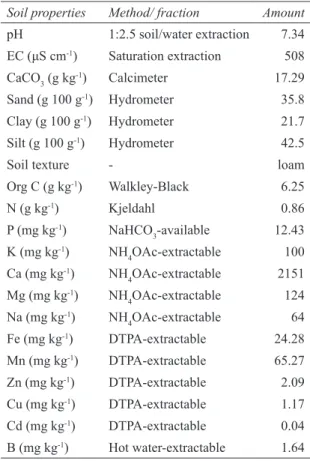
Tomato (Solanum lycopersicum L., cv. H-2274), pepper (Capsicum annuum L., cv. Yalova Çorbacı-12), eggplant (Solanum melongena L., cv. Kemer), and goldenberry (Physalis peruviana L.) were used for the experiment, which was carried out in a greenhouse under natural light conditions. Seeds of each plant were germinated in seedling vials filled with peat. Three-week-old seedlings were transplanted at a rate of one plant per pot filled with 2 kg of air-dried soil. Some physical and chemical characteristics of the soil used in the experiment are presented in Table 1. The soil characteristics were determined according to methods detailed in Page et al (1982).
In a factorial (Cd levels and plant genera) pot experiment, five levels of Cd (0, 2.5, 5, 10, and 20 mg kg-1) as cadmium chloride (CdCl
2) were
added to the soil. The experiment was designed as complete randomized design with three replications. For basal fertilization; N, P and K, as ammonium nitrate (NH4NO3), potassium dihydrogen phosphate (KH2PO4), and potassium sulfate (K2SO4), was applied at 150, 75 and 150 mg kg-1, respectively. All
the supplementary (CdCl2, NH4NO3, KH2PO4 and
K2SO4) were incorporated into the soil by spraying the solutions before the planting and thoroughly mixed. During the experiment, pots were watered daily to 70% of water holding capacity by weighing the pots randomly.
Table 1- Some physical and chemical characteristics of the soil used in experiment
Çizelge 1- Denemede kullanılan toprağın bazı fiziksel ve kimyasal özellikleri
Soil properties Method/ fraction Amount
pH 1:2.5 soil/water extraction 7.34 EC (μS cm-1) Saturation extraction 508 CaCO3 (g kg-1) Calcimeter 17.29 Sand (g 100 g-1) Hydrometer 35.8 Clay (g 100 g-1) Hydrometer 21.7 Silt (g 100 g-1) Hydrometer 42.5
Soil texture - loam
Org C (g kg-1) Walkley-Black 6.25 N (g kg-1) Kjeldahl 0.86 P (mg kg-1) NaHCO 3-available 12.43 K (mg kg-1) NH 4OAc-extractable 100 Ca (mg kg-1) NH 4OAc-extractable 2151 Mg (mg kg-1) NH 4OAc-extractable 124 Na (mg kg-1) NH 4OAc-extractable 64 Fe (mg kg-1) DTPA-extractable 24.28 Mn (mg kg-1) DTPA-extractable 65.27 Zn (mg kg-1) DTPA-extractable 2.09 Cu (mg kg-1) DTPA-extractable 1.17 Cd (mg kg-1) DTPA-extractable 0.04 B (mg kg-1) Hot water-extractable 1.64
A fresh leaf sample was taken from the youngest fully expanded leaf for photosynthetic pigment analysis before harvest. After six weeks of Cd treatment, the shoots were harvested, washed with running tap water and three-times rinsed with de-ionized water to remove any soil particles attached to the plant surfaces. The roots were carefully seperated from the soil and dipped into an aerated
0.5 mM CaCl2 solution for 15 minutes in order to eliminate adsorbed nutrients from the root surface. The roots were quikly washed with running tap water and then rinsed with de-ionized water. All shoot and root samples were dried at 65 °C to their constant weight, and weighed for dry weight (DW) determination and ground to powder for Cd and metal ion nutrient analysis.
The dried tissues were digested by dry-ashing method in a muffle furnace at 500 °C for 6 hours (Miller 2004). The concentrations of Cd and metal nutrient ions were determined by ICP-OES (Perkin-Elmer Optima 2100 DV; Waltham, MA).
The Cd distribution, the Cd uptake, bioconcentration factor (BCF), translocation factor (TF) and total accumulation rate (TAR) were calculated by the Equation 1, 2, 3, 4 and 5, respectively (Ait Ali et al 2002; Shi et al 2010). Cd distribution (%)= 100x([Cd]shoot or root/([Cd]shoot+[Cd]root)) (1)
Cd uptake (μg plant-1)= DW
shoot or rootx[Cd] shoot or root (2)
BCF= [Cd]shoot or root/[total Cd]soil (3)
Where; [total Cd]soil, present Cd concentration in experimental soil+added Cd concentration for each Cd level
TF (%)= 100x[Cd]shoot/[Cd]root (4)
TAR of Cd (μg g-1 DW day-1)= ([Cd]
shootxDWshoot)+([Cd]rootx
DWroot)/growth dayx(DWshoot+DWroot) (5)
Photosynthetic pigments were measured in fresh leaf samples before harvest. The fresh leaf samples (500 mg) were cut into small pieces and were extracted with 10 mL of acetone (90% v v-1)
in a homogenizer. After filtering with Whatman No. 4 filter paper, the absorbance of the extract was measured at 663, 645, and 470 nm using a UV-Vis spectrophotometer (Shimadzu UV-1201; Tokyo). The concentrations of chlorophyll a (Chl a), chlorophyll b (Chl b), chlorophyll a+b (Chl a+b), and carotenoids (Car) were calculated according to the formula of Lichtenthaler (1987).
Statistical analysis of the experimental data was performed by using ANOVA with the MINITAB
package program (Minitab Corp., State College, PA). Multiple comparisons of means among different Cd treatments were performed using Duncan’s Multiple Range Test at the significance level (α: 0.05).
3. Results and Discussion
3.1. Plant growth and biomass
Visual toxicity symptom of Cd occurred as reduction of shoots and root growth and discernible browning and decomposing in main roots in experimental plants, except for tomato. It was observed that these symptoms are intensified in pepper and goldenberry, especially at the 20 mg Cd kg-1 rate.
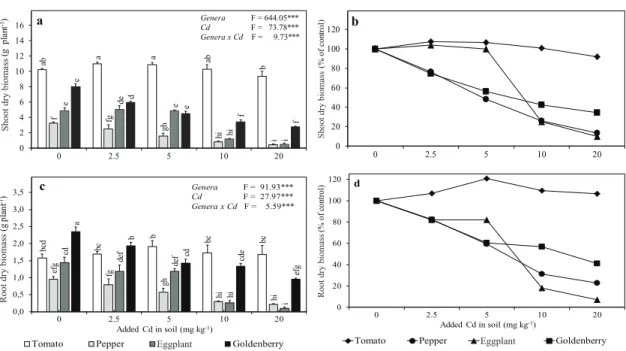
Both genera and Cd treatment significantly affected the shoot and root dry biomass (Figure 1). With the increasing applications of Cd, the changes in plant growth differed in the various Solanaceae plants. Except for tomato, the shoot and root dry biomass of the Solanaceae family plants significantly decreased with increasing of Cd in comparison with the control (Figures 1a and 1c). At 2.5 mg kg-1 Cd rate, shoot
biomass decreased by 23.5% and 26.5% for pepper and goldenberry, respectively, but increased by 7.4% and 3.9% for tomato and eggplant, respectively. Moreover, shoot biomass decreased by 8.2%, 86.4%, 90.1%, and 65.5% for tomato, pepper, eggplant and goldenberry, respectively, at the highest amounts of added Cd. Similarly, with increasing rate of Cd, the root biomass diminished for pepper, eggplant, and goldenberry, but increased for tomato (Figure 1b and 1d). The reduction of shoot and root dry biomass as a result of the increasing Cd supply might be attributed to prominent decreases in shoot height and root length and changes in the rate of net photosynthesis that reduces the supply of carbohydrates or proteins.
Major differences among Solanaceae plants in biomass production under increasing supply of Cd to the soil might be associated with the possible presence of differing mechanisms among plants in the accumulation and translocation process, and might be strongly related to genetics. On the basis of the reduction rate in the shoot dry biomass of the Solanaceae plants, tomato was determined to be Cd-tolerant and the other plants Cd-sensitive
according to the scale suggedted by Shahbaz et al (2011) as tolerant, moderately tolerant, and sensitive for the reduction rate of <30%, 30-60% and >60%, respectively. In support of these findings, the reduction of shoot and root dry biomass caused by Cd application has been demonstrated in many plants, including tomato (Haouari et al 2012), eggplant (Arao et al 2008), transgenic and wild type tobacco (Dağhan et al 2013), soybean (Shamsi et al 2010), safflower (Shi et al 2010), and maize (Ekmekçi et al 2008).
3.2. Cadmium accumulation
The shoot and root Cd contents of the four
Solanaceae plants significantly (P<0.001)
increased with elevated rates of Cd application as compared to the control, except for the shoot Cd content of goldenberry (Table 2). The shoot
Cd contents of goldenberry, pepper, tomato and eggplant increased in response to the increased additions of Cd and reached to 5.0, 32.1, 69.4 and 109.3 mg kg-1, respectively at the highest Cd
application rate. Obviously, the root Cd contents were much higher than those of the shoots. Considering the Cd distribution in shoots and roots, the goldenberry accumulated much lower Cd in the shoots than the other experimental plants with the increasing Cd supply (Table 2). Differences in Cd distribution among different plants could be explained by the presence of different mechanisms of tolerance, physiology of transport, and accumulation. Many researchers have reported that Cd is accumulated more in the roots than in the shoots of plants such as sunflower (De Maria et al 2013), tomato (Haouari et al 2012), safflower (Shi et al 2010), soybean (Shamsi
ab a a ab b f fg gh hi i e de e hi i c d e f f 0 2 4 6 8 10 12 14 16 0 2.5 5 10 20 Sho ot dr y bi om as s (g p la nt -1) Genera Cd F = 644.05***F = 73.78*** Genera x Cd F = 9.73*** a bc d bc b bc bc ef g fg gh hi hi cd de f de f hi i a b cd cde ef g 0,0 0,5 1,0 1,5 2,0 2,5 3,0 3,5 0 2.5 5 10 20 Root d ry b iom as s (g pl ant -1) Added Cd in soil (mg kg-1)
Tomato Pepper Aubergine Goldenberry
Genera F = 91.93*** Cd F = 27.97*** Genera x Cd F = 5.59*** c 0 20 40 60 80 100 120 0 2.5 5 10 20 Sh oot d ry bi om as s (% o f c on tro l) b 0 20 40 60 80 100 120 0 2.5 5 10 20 Root d ry b iom as s (% o f c on tro l) Added Cd in soil (mg kg-1)
Tomato Pepper Aubergine Goldenberry
d
Shoot dry biomass
Root dry biomass
Eggplant Eggplant
Shoot dry biomass
Root dry biomass
Figure 1- Effects of cadmium on shoot and root dry biomass of Solanaceae plants (mean±SE, n= 3). The bars followed by the same letter are not significantly different for genera x Cd interaction (Duncan’s Multiple Range Test, α: 0.05); ANOVA shows significant difference at ***, P<0.001
Şekil 1- Kadmiyumun Solanaceae bitkilerinin gövde ve kök kuru biyokütlelerine etkisi (ortalama±standart hata, n= 3). Çubukları izleyen aynı harfler, cins x Cd interaksiyonu için farkın önemli olmadğını gösterir (Duncan Çoklu Karşılaştırma Testi, α: 0.05). ANOVA’ya göre; ***, P<0.001
et al 2010), eggplant (Arao et al 2008), and some Solanaceae plants (Thiebeauld et al 2005). Furthermore, the shoot Cd uptake of tomato and eggplant significantly increased with increments of Cd supply (Table 2). The maximum shoot Cd uptake was observed in tomato, followed by eggplant, pepper, and goldenberry, respectively. At all Cd levels, the root Cd uptake significantly increased in tomato and goldenberry.
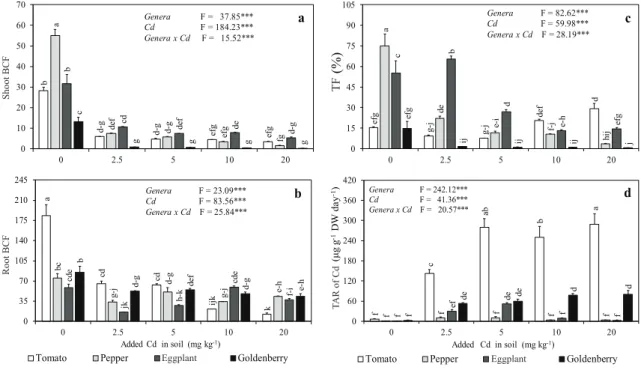
The shoot and root BCF significantly diminished at all Cd levels as compared to the control (Figure 2a). The present results showed that the BCF was greater in the roots than in the shoots (Figure 2b). Furthermore, except for the shoot BCF of goldenberry, both the shoot and the root BCF exceeded the critical level for a Cd-hyperaccumulator, currently accepted as BCF> 1 (Baker 1981; Ma et al 2001).
Table 2- Effects of cadmium on Cd content and Cd uptake in shoots and roots of Solanaceae plants Çizelge 2- Kadmiyumun Solanaceae bitkilerinde gövde ve kökün Cd içerikleri ve Cd alımlarına etkisi
Added Cd to soils (mg kg-1)
Cd content
(mg kg-1 DW) Cd distribution (%) (μg plantCd uptake -1)
Shoot Root Shoot Root Shoot Root
Tomato 0 1.1 j* 7.3 j 13.1 86.9 11.5 i 11.7 j 2.5 15.3 i 166.5 hi 8.4 91.6 168.3 d 280.4 de 5 24.3 gh 319.2 ef 7.1 92.9 264.4 c 611.8 b 10 43.8 d 215.1 gh 16.9 83.1 449.9 b 372.8 cd 20 69.4 c 247.6 fg 21.9 78.1 647.3 a 394.1 c Pepper 0 2.2 j 3.0 j 42.3 57.7 7.1 i 2.9 i 2.5 18.7 hi 86.2 ij 17.8 82.2 46.2 g 65.9 hij 5 28.7 fg 257.8 fg 10.0 90.0 43.4 gh 141.8 ghi 10 36.1 e 342.2 e 9.5 90.5 30.1 ghi 102.8 g-i 20 32.1 ef 873.0 a 3.5 96.5 14.3 hi 189.8 efg Eggplant 0 1.3 j 2.3 j 36.1 63.9 6.1 i 3.4 j 2.5 26.8 fg 40.9 j 39.6 60.4 135.1e 48.4 ij 5 37.5 e 139.4 hi 21.2 78.8 182.6 d 163.6 fgh 10 78.4 b 596.5 c 11.6 88.4 96.0 f 157.3 fgh 20 109.3 a 753.1 b 12.7 87.3 52.7 g 73.4 hij Goldenberry 0 0.5 j 3.4 j 12.8 87.2 4.1 i 7.9 j 2.5 2.1 j 132.7 hi 1.6 98.4 12.4 i 256.2 ef 5 3.1 j 274.5 efg 1.1 98.9 14.1 hi 388.4 c 10 4.3 j 483.2 d 0.9 99.1 14.3 hi 638.6 b 20 5.0 j 873.0 a 0.6 99.4 13.9 hi 843.6 a ANOVA: F values Genera 493.82*** 34.37*** 1049.90*** 132.04*** Cd 436.69*** 409.06*** 200.75*** 85.08*** Genera x Cd 87.27*** 35.79*** 181.78*** 21.84***
*, values are mean of three replicates and means followed by the same letter are not significantly different for genera x Cd interaction (Duncan’s Multiple Range Test, α: 0.05); ANOVA shows significant difference at ***, P<0.001
The TF can be described as the translocation of heavy metals in plants. Significant variations were found in the TF of the Solanaceae plants. The TF decreased from 74.5% to 3.6% for pepper, from 14.8% to 0.6% for goldenberry, and from 65.5% to 14.6% for eggplant with increasing Cd levels, but the TF of tomato increased at the higher Cd levels (Figure 2c). The TF of all plants was much lower than the critical level (TF> 100%). Similar results were found for safflower (Shi et al 2010) and sunflower (De Maria et al 2013). When the Solanaceae plants classified with respect to Cd translocation at the highest Cd level, plant species showed a ranking as follows: goldenberry<pepper<eggplant<tomato.
The total accumulation rate (TAR) of Cd differed among all the plants. While the TAR value
of tomato and goldenberry significantly increased with all Cd levels in comparison with the control, the TAR of pepper and eggplant increased up to the 5 mg kg-1 Cd treatment (Figure 2d). On the other
hand, the TAR for tomato was higher than for the other plants. Similar results were obtained by, Sharma & Agrawal (2006), who stated that the TAR and Cd uptake are significantly increased in carrot at the excess Cd level.
3.3. Photosynthetic pigments
Between 2.5 and 10 mg kg-1 Cd treatments,
non-significant changes in the photosynthetic pigment were observed for pepper and eggplant compared to the control (Figure 3). But the highest level of Cd significantly decreased the Chl a, Chl a+b
b d-g d-g ef g ef g a de f d-g ef g fg b cd def de d-g c g g g g 0 10 20 30 40 50 60 70 0 2.5 5 10 20 Sh oot B CF Genera F = 37.85*** Cd F = 184.23*** Genera x Cd F = 15.52*** a a cd cd ijk k bc g-j d-g g-j e-h cde jk h-k cde f-i b d-g def d-g e-h 0 35 70 105 140 175 210 245 0 2.5 5 10 20 Roo t B CF Added Cd in soil (mg kg-1)
Tomato Pepper Aubergine Goldenberry
Genera F = 23.09*** Cd F = 83.56*** Genera x Cd F = 25.84*** b ef g g-j g-j de f d a de e-i f-j hi j c b d e-h efg ef g ij ij ij j 0 15 30 45 60 75 90 105 0 2.5 5 10 20 TF (%) Genera F = 82.62*** Cd F = 59.98*** Genera x Cd F = 28.19*** c f c ab b a f f f ef f f f de f f f de de d d 0 60 120 180 240 300 360 420 0 2.5 5 10 20 TAR o f Cd (μg g -1DW da y -1) Added Cd in soil (mg kg-1)
Tomato Pepper Aubergine Goldenberry
d Genera F = 242.12*** Cd F = 41.36*** Genera x Cd F = 20.57*** Eggplant Eggplant Shoot BCF Root BCF TAR of Cd TF
Figure 2- Effects of cadmium on a, shoot BCF; b, root BCF; c, TF and d, TAR of Cd in Solanaceae plants (mean±SE, n= 3); the bars followed by the same letter are not significantly different for genera x Cd interaction (Duncan’s Multiple Range Test, α: 0.05); ANOVA shows significant difference at ***, P<0.001 Şekil 2- Kadmiyumun Solanaceae bitkilerinde a, gövde biyokonsantrasyon faktörü; b, kök biyokonsantrasyon faktörü; c, translokasyon faktörü ve d, toplam akümülasyon oranına etkisi; (ortalama±standart hata, n= 3); çubukları izleyen aynı harfler, cins x Cd interaksiyonu için farkın önemli olmadğını gösterir (Duncan Çoklu Karşılaştırma Testi, α: 0.05); ANOVA’ya göre ***, P<0.001
and Car content by 19.8%, 18.3%, 20.4% for tomato, and 21.2%, 21.4%, 22.8% for goldenberry, respectively. Additionally, any interaction of genera and Cd affecting the Chl b content was statistically non-significant in all plants. The reduction of chlorophyll content in Cd-treated plants is related to chlorophyll degradation of and/or disorders in its biosynthesis and with the reduction of thylakoid membrane integrity (Sandalio et al 2001). The present findings support other research which has revealed that reduction of photosynthetic pigments with an increasing Cd content occurs in some plants, including tomato (Haouari et al 2012), eggplant (Arao et al 2008) and some Solanaceae plants (Thiebeauld et al 2005).
3.4. Metal nutrient ion accumulation
Interaction of the genera and Cd resulted in significant variations in shoot K and Na contents for all plants (P<0.001) (Table 3). The shoot K content significantly increased for tomato, eggplant, and goldenberry, reaching to levels as high as 40.65, 59.24, and 66.92 g kg-1, respectively. A reduction
was observed in the shoot K content of pepper; however, this reduction was only significant for soil treated at the level of 10 mg Cd kg-1. The effect
of the interaction of the genera and Cd addition on the shoot Ca and Mg contents was not significant, whereas the effect of increasing Cd supply on shoot Ca content (P<0.05) and the effect of the genera on shoot Mg content (P<0.001) were found to be
cde ef cde bc d fg fgh fgh fg gh gh gh h gh gh gh ab a abc ab de 0 1 2 3 4 5 6 0 2.5 5 10 20 Chl a (m g g -1FW ) Genera F = 93.70*** Cd F = 5.79** Genera x Cd F = 2.45* a bc cd bc ab de ef ef def ef ef ef f ef ef ef a a ab a cd 0 1 2 3 4 5 6 7 0 2.5 5 10 20 Chl a + b (m g g -1FW ) Added Cd in soil (mg kg-1)
Tomato Pepper Aubergine Golden berry
Genera F = 82.03*** Cd F = 5.02** Genera x Cd F = 2.30* c 0,0 0,2 0,4 0,6 0,8 1,0 1,2 0 2.5 5 10 20 Chl b (m g g -1FW ) Genera F = 47.70*** Cd F = 2.27ns Genera x Cd F = 1.40ns b bc cd bc ab de de f de de f ef def de f g ef g ef g fg a a ab a cd 0,0 0,5 1,0 1,5 2,0 2,5 3,0 0 2.5 5 10 20 Ca r (m g g -1FW ) Added Cd in soil (mg kg-1)
Tomato Pepper Aubergine Golden berry
Genera F = 93.80*** Cd F = 6.47*** Genera x Cd F = 2.87** d Eggplant Eggplant Chl a+b Chl a Chl b Car
Figure 3- Effects of cadmium on the photosynthetic pigments in leaves of Solanaceae plants (mean±SE, n= 3). The bars followed by the same letter are not significantly different for genera x Cd interaction (Duncan’s Multiple Range Test, α: 0.05); ANOVA shows significant difference at ***, P<0.001; **, P<0.01; *, P<0.05; ns, not significant
Şekil 3- Kadmiyumun Solanaceae bitkilerinin yapraklarında fotosentetik pigmentlere etkisi; (ortalama±standart hata, n= 3). Çubukları izleyen aynı harfler, cins x Cd interaksiyonu için farkın önemli olmadğını gösterir (Duncan Çoklu Karşılaştırma Testi, α: 0.05); ANOVA’ya göre ***, P<0.001; **, P<0.01; *, P<0.05; ns, önemli değil
significant (Table 3). Except for tomato, all plants exhibited significant changes in shoot Na content. For instance, compared to the control, while there was no significant increase in shoot Na content of tomato at the highest level of Cd, this parameter in pepper, eggplant, and goldenberry significantly increased, by 2.2-, 1.9-, and 2.4-fold, respectively. In contrast, a significant reduction was observed in the shoot Na content of pepper at 5 and 10 mg Cd kg-1 treatments as compared to control.
Of all plants in soil untreated with Cd, the shoot Fe content was the highest in goldenberry, followed by tomato, pepper, and eggplant, respectively
(Table 3). The shoot Fe contents of tomato tended to decrease with increasing rate of Cd being significant only at 2.5 mg Cd kg-1 level. Significant increases
in the shoot Fe content were found for goldenberry and pepper at 2.5 and 20 mg Cd kg-1, respectively.
The shoot Mn content of pepper showed significant linear increases at all Cd levels and rose up to 232.5 mg kg-1, while those of tomato, eggplant, and
goldenberry significantly increased at the highest Cd treatment, and reached to 159.0, 192.1, and 89.3 mg kg-1, respectively (Table 3). On the other hand,
the shoot Mn content exhibited a slight decline in tomato and eggplant at 2.5-5 mg Cd kg-1 range.
Table 3- Effects of cadmium on shoot metal nutrient ion contents of Solanaceae plants Çizelge 3- Kadmiyumun Solanaceae bitkilerinin gövdesinde metal besin iyonu içeriklerine etkisi
Added Cd to soil (mg kg-1) K Ca Mg Na Fe Mn Zn Cu --- g kg-1 DW --- --- mg kg-1 DW ---Tomato 0 33.15 jx 13.25 3.69 673 c-f 97.8 de 129.7 def 33.1 hij 17.1 a
2.5 32.85 j 11.81 3.28 680 c-f 82.1 efg 116.3 e-h 35.4 gh 15.8 abc
5 35.53 ij 11.81 3.54 653 def 86.3 ef 101.7 gh 40.9 ef 14.5 bcd
10 39.86 hi 13.33 3.06 780 cd 87.1 ef 117.1 e-h 41.6 ef 14.5 bcd
20 40.65 ghi 14.24 4.35 840 c 85.1 efg 159.0 c 41.6 ef 15.2 a-d
Pepper
0 50.68 def 10.74 3.53 573 fg 86.7 ef 119.9 efg 59.2 a 13.1 de
2.5 51.76 cde 11.96 3.53 473 ghi 75.1 fgh 143.0 cde 36.3 gh 7.5 g
5 44.64 fgh 12.48 3.66 400 hi 84.7 efg 151.6 cd 34.7 ghi 5.2 h
10 41.96 gh 14.00 3.86 367 hi 78.3 fgh 154.0 cd 27.9 k 3.9 h
20 44.65 fgh 14.15 4.02 1282 a 107.5 cd 232.5 a 16.8 l 4.6 h
Eggplant
0 49.60 def 12.85 2.20 573 fg 77.3 fgh 113.3 fgh 51.4 bc 14.7 bcd
2.5 57.92 bc 14.15 2.56 593 efg 81.3 efg 101.1 gh 52.5 b 14.9 a-d
5 52.76 cde 13.56 2.61 560 fg 67.4 gh 91.4 hi 47.0 cd 13.0 de
10 59.32 b 14.09 2.62 760 cde 81.7 efg 155.3 cd 47.6 cd 15.5 abc
20 59.24 b 12.31 2.01 1084 b 61.8 h 192.1 b 45.5 de 10.4 f Goldenberry 0 46.60 efg 9.02 3.93 313 i 118.1 bc 45.5 k 30.2 ijk 11.3 ef 2.5 50.44 def 10.16 4.08 367 i 143.1 a 64.4 jk 38.9 fg 14.5 bcd 5 49.52 def 11.77 4.57 687 c-f 130.0 ab 53.6 k 35.6 gh 13.9 cd 10 53.80 bcd 13.77 4.49 527 fgh 126.9 ab 67.6 ijk 29.4 jk 16.4 ab
20 66.92 a 14.96 4.67 747 cde 122.9 bc 89.3 hij 29.1 jk 16.1 abc
ANOVA: F values
Genera 88.75*** 1.28ns 47.10*** 16.16*** 90.09*** 108.11*** 109.32*** 153.76***
Cd 9.16*** 3.30* 1.73ns 56.83*** 0.22ns 43.47*** 26.61*** 8.81***
Genera x Cd 5.89*** 1.18ns 1.66ns 10.80*** 3.86*** 4.72*** 32.11*** 13.01***
x, values are mean of three replicates and means followed by the same letter are not significantly different for genera x Cd interaction
While a significant reduction in shoot Zn and Cu content with increasing additions of Cd was observed in pepper, this reduction was significant only at 20 mg Cd kg-1 level for eggplant (Table
3). Compared to control, goldenberry shoot Cu content increased by all Cd treatments, but for Zn such increases were detected only at 2.5 and 5 mg Cd kg-1 levels. Although the shoot Cu content of
tomato showed a significant reduction at 5 and 10 mg Cd kg-1 levels, the shoot Zn content of tomato
significantly increased parallel with the Cd levels, except for 2.5 mg Cd kg-1 level.
Cadmium may interfere with nutrient uptake due to its effect on the permeability of plasma membranes. Toxic heavy metals, like Cd, are regarded as competitive ion with the transport systems operating for divalent cations such as Ca, Fe, Mg, Cu and Zn, as they use the same trans-membrane carriers (Llamas et al 2000; Roth et al 2006). Therefore, the sensitivity of some dicotyledonous plants to Cd toxicity might be associated with Cd effects on the influx and transport of Fe, Mn, Ca, and Mg (Yang et al 1996). Yang et al (1996) indicated that the influx and transport of Ca, Mg, Fe, Mn, Zn, and Cu in plants including ryegrass, maize, white clover, and cabbage were decreased by additional Cd. López-Millán et al (2009) stated that, with Cd treatment, Fe, Mn and Zn accumulation increased in tomato stems, while in the leaves only Mn accumulation increased. The same researchers determined a reduction of K, Fe and Cu accumulation in the leaves, and Cu accumulation in the stems of tomato. Moreover, Sandalio et al (2001) reported that K, Ca, Mg, Fe, Mn, Zn, and Cu contents of pea shoots decreased with increases of Cd in an aerated full-nutrient media. However, Zhang et al (2002) found that, while K, Fe, Mn, Zn, and Cu concentrations increased in wheat genotypes at the seedling stage, there was a reduction of Ca and Mg concentrations. As reported by Jiang et al (2004), the nutrients mainly affected by Cd in Indian mustard were K, Ca, Fe, and Zn in the roots, and K, Ca and Cu in the shoots. Obata & Umebayashi (1997) revealed that K concentrations decreased in Cd-sensitive kidney bean and pea with increasing of Cd, while
Mn concentrations decreased in semi-resistant rice and maize.
4. Conclusions
The response of plants to excess Cd varied. The phenomena of reduction of root and shoot biomass, uptake of Cd, and bioaccumulation and translocation of Cd were all dependant on Cd concentration and species. On the basis of the percent reductions in the shoot dry biomass of the four Solanaceae plants, tomato was determined to be Cd-tolerant, and the other plants Cd-sensitive. Moreover, when classified by translocation of Cd at the highest level, the order was observed as goldenberry<pepper<eg gplant<tomato. Goldenberry and pepper exhibited poor accumulation of Cd in their shoots. Thus, these plants might be appropriate for cultivation in Cd-contaminated soils. Moreover, the accumulation of all metal nutrient ions increased in the goldenberry shoots. The results showed that, except for Zn and Cu, there was an increment in accumulation of divalent metal nutrient ions for pepper and eggplant; however, the accumulation of K as monovalent metal nutrient ion decreased for only the pepper. Further investigation is needed to identify the mechanism depending on concentration and species which is responsible for the low Cd translocation.
References
Ait Ali N, Bernal M P & Ater M (2002). Tolerance and bioaccumulation of copper in Phragmites australis
and Zea mays. Plant and Soil 239: 103-111
Alloway B J & Steinnes E (1999). Anthropogenic additions of cadmium to soils. In: M J Laughlin & B R Singh (Eds), Cadmium in Soil and Plants, Kluwer Academic Publishers, Dordrecht (The Netherlands), pp. 97-123
Arao T, Takeda H & Nishihara E (2008). Reduction of cadmium translocation from roots to shoots in eggplant (Solanum melongena) by grafting onto Solanum torvum rootstock. Soil Science and Plant Nutrition 54: 555-559
Baker A J M (1981). Accumulators and excluders-strategies in the response of plants to heavy metals. Journal of Plant Nutrition 3: 643-654
Belimov A A, Safronova V I, Tsyganov V E, Borisov A Y, Kozhemyakov A P, Stepanok V V, Martenson A M, Gianinazz-Pearson V & Tikhonovich I A (2003). Genetic variability in tolerance to cadmium and accumulation of heavy metals in pea (Pisum sativum
L.). Euphytica 131: 25-35
Benavides M P, Gallego M S & Tomaro M L (2005). Cadmium toxicity in plants. Brazilian Journal of Plant Physiology 17: 21-34
Clarkson D T & Luttge U (1989). Mineral nutrition -Divalent cations, transport and compartmentalization. Progress in Botany 51: 93-112
Dağhan H, Uygur V, Köleli N, Arslan M & Eren A (2013). Transgenik ve transgenik olmayan tütün bitkilerinde ağır metal uygulamalarının azot, fosfor ve potasyum alımına etkisi. Tarım Bilimleri Dergisi-Journal of Agricultural Sciences 19: 129-139
De Maria S, Puschenreiter M & Rivelli A R (2013). Cadmium accumulation and physiological response of sunflower plants to Cd during the vegetative growing
cycle. Plant, Soil and Environment 59(6): 254-261
Ekmekçi Y, Tanyolaç D & Ayhan B (2008). Effects of cadmium on antioxidant enzyme and photosynthetic activities in leaves of two maize cultivars. Journal of Plant Physiology 165: 600-611
Fatoba P O & Udoh E G (2008). Effects of some heavy metals on chlorophyll accumulation. Ethnobotanical Leaflets 12: 776-783
Gouia H, Ghorbal M H & Meyer C (2000). Effects of cadmium on activity of nitrate reductase and on other enzymes of the nitrate assimilation pathway in bean. Plant Physiology and Biochemistry 38: 629-638
Haouari C C, Nasraoui A H, Bouthour D, Houda M D, Daieb C B, Mnai J & Gouia H (2012). Response of tomato (Solanum lycopersicon) to cadmium toxicity: Growth, element uptake, chlorophyll content and photosynthesis rate. African Journal of Plant Science
6(1): 1-7
Jiang X J, Lou Y M, Liu Q, Liu S L & Zhao Q G (2004). Effect of cadmium on nutrient uptake and translocation by Indian mustard. Environmental Geochemistry and Health 26: 319-324
Krupa Z & Moniak M (1998). The stage of leaf maturity implicates the response of the photosynthetic apparatus
to cadmium toxicity. Plant Science 138: 149-156
Kuboi T, Noguchi A & Yazaki J (1986). Family-dependent cadmium accumulation characteristics in higher
plants. Plant and Soil 92: 405-415
Lichtenthaler H K (1987). Chlorophylls and carotenoids: pigments of photosynthetic biometers. Methods in Enzymology 148: 350-382
Llamas A C, Ullrich I & Sanz A (2000). Cd2+ effects
on transmembrane electrical potential difference, respiration and membrane permeability of rice (Oryza sativa L.) roots. Plant and Soil 219(1-2): 21-28
López-Millán A, Sagardoy R, Solanas M, Abadía A & Abadía J (2009). Cadmium toxicity in tomato (Lycopersicon esculentum) plants grown in hydroponics. Environmental and Experimental Botany 65: 376-385
Ma L Q, Komar K M, Tu C, Zhang W, Cai Y & Kenelly E D (2001). A fern that hyper accumulates arsenic. Nature 409: 579-582
Metwally A, Safronova V I, Belimov A A & Dietz K J (2005). Genotypic variation of the response to cadmium toxicity in Pisum sativum L. Journal of Experimental Botany 56: 167-178
Miller R O (2004). High-temperature oxidation: Dry ashing. In: Kalra Y P (Eds), Handbook of Reference Methods for Plant Analysis. CRC Press, Boca Raton, Florida, pp. 53-56
Mobin M & Khan N A (2007). Photosynthetic activity, pigment composition and anti oxidative response of two mustard (Brassica juncea) cultivars differing in photosynthetic capacity subjected to cadmium stress. Journal of Plant Physiology 164: 601-610
Moussa H R (2004). Effect of cadmium on growth and oxidative metabolism of faba bean plants. Acta Agronomica Hungarica 52: 269-276
Murillo B, Troyo-Diéguez E, García-Hernández J L, Larrinaga-Mayoral J A, Nieto-Garibay A & López-Cortés A (2002). Efecto dela salinidad en genotipos de chicharo de vaca Vigna unguiculata (L.) Walp.
durante la etapa de plántula. Agrochimica 46(1-2):
73-87
Obata H & Umebayashi M (1997). Effects of cadmium on mineral nutrient concentrations in plants differing in tolerance for cadmium. Journal of Plant Nutrition
20(1): 97-105
Padmaja K, Parsad D D K & Parsad A R K (1990). Inhibition of chlorophyll synthesis in Phaseolus vulgaris L.
seedling by cadmium acetate. Photosynthetica 24:
399-404
Page A, Miller R & Keeney D (1982). Methods of Soil Analysis. American Society of Agronomy, Inc., Madison WI (USA)
Rivetta A, Negrini N & Cocucci M (1997). Involvement
of Ca2+-calmodulin in Cd2+ toxicity during the
early phases of radish (Raphanus sativus L.) seed
germination. Plant Cell and Environment 20: 600-608
Roth U, Roepenack-Lahaye E V & Clemens S (2006). Proteome changes in Arabidopsis thaliana roots upon
exposure to Cd2+. Journal of Experimental Botany
57(15): 4003-4013
Römer W, Egle K, Kang D K, Keller H & Gerke J (2002). L’absorption de Cd par différentes variétés de lupins (Lupinus albus et Lupinus angustifolius) comparéé á celle du ray-grass (Lolium multiflorum) en function
de la fertilisation phosphatéé. Agronomie 22: 431-442
Sandalio L M, Dalurzo H C, Gomez M, Romero-Puertas M C & del Rio L A (2001). Cadmium induced changes in the growth and oxidative metabolism of pea plants. Journal of Experimental Botany 52: 2115-2126
Sandalio L M, Rodríguez-Serrano M, Río L A & Romero-Puertas M C (2009). Reactive oxygen species and signaling in cadmium toxicity. In: L A del Rio & A Puppo (Eds), Reactive Oxygen Species in Plant Signaling, Springer-Verlag, Berlin, Heidelberg, pp. 175-189
Sanitá di-Toppi L & Gabrielli R (1999). Response to cadmium in higher plants. Environmental and Experimental Botany 41: 105-130
Sengar R S, Gautam M, Sengar R S, Garg S K, Sengar K & Chaudhary R (2008). Lead stress effects on physiobiochemical activities of higher plants. Reviews of Environmental Contamination and Toxicology 196:
73-93
Shahbaz M, Ashraf M, Akram N A, Hanif A, Hameed S, Joham S & Rehman R (2011). Salt-induced modulation in growth, photosynthetic capacity, proline content and ion accumulation in sunflower (Helianthus annuus L.). Acta Physiologiae Plantarum
33: 1113-1122
Shamsi I H, Wei K, Jilani G & Zhang G P (2007). Interactions of cadmium and aluminum toxicity in their effect on growth and physiological parameters in soybean. Journal of Zhejiang University Science B
8: 181-188
Shamsi I H, Wei K, Zhang G P, Jilani G & Hassan M J (2008). Interactive effects of cadmium and aluminum
on growth and antioxidative enzymes in soybean. Biologia Plantarum 52: 165-169
Shamsi I H, Jiang L, Wei K, Jilani G, Hua S & Zhang G P (2010). Alleviation of cadmium toxicity in soybean by potassium supplementation. Journal of Plant Nutrition 33: 1926-1938
Sharma R K & Agrawal M (2006). Single and combined effects of cadmium and zinc on carrots: Uptake and
bioaccumulation. Journal of Plant Nutrition 29:
1791-1804
Shi G, Liu C, Cai Q, Liu Q & Hou C (2010). Cadmium accumulation and tolerance of two safflower cultivars in relation to photosynthesis and antioxidative enzymes. Bulletin of Environmental Contamination and Toxicology 85: 256-263
Stobart A K, Griffiths W T, Ameen-Bukhari I & Sherwood
R P (1985). The effect of Cd+2 on the biosynthesis
of chlorophyll in leaves of barley. Physiologia Plantarum 63: 293-298
Stolt P, Hultin S & Asp H (2002). Genetic variation in wheat regarding cadmium accumulation in relation to soil, soil solution cadmium concentration and growing season. In: P Stolt (Eds), Cadmium, a Challenge for Organisms-Agricultural Perspectives, PhD thesis, Dept. of Crop Science, Swedish Uni. of Agric. Sci., Alnarp, Sweden.
Thiebeauld O, Soler S, Raigón M D, Prohens J & Nuez F (2005). Variation among Solanaceae crops in cadmium tolerance and accumulation. Agronomy for Sustainable Development 25: 237-241
Wu F B, Chen F K, Wei K & Zhang G P (2004). Effects of cadmium on free amino acids, glutathione, and ascorbic acid concentration in two barley genotypes (Hordeum vulgare L.) differing in cadmium tolerance. Chemosphere 57: 447-454
Yang X, Baligar V C, Martens D C & Clark R B (1996). Cadmium effects on influx and transport of mineral nutrients in plant species. Journal of Plant Nutrition
19(3-4): 643-656
Zhang G P, Fukami M & Sekimoto H (2002). Influence of cadmium on mineral concentrations and yield components in wheat genotypes differing in Cd
tolerance at seedling stage. Field Plants Research 77: