Evaluation of The Quality of Life of Patients with
Postmenopausal Osteoporosis
Postmenopozal Osteoporozlu Hastalarda Yaşam Kalitesinin Değerlendirilmesi
Yaşar Keskin
1, Özgür Taşpınar
21 Bezmialem Vakif University, Faculty of Medicine, Department of Physical Medicine and Rehabilitation, Istanbul, Turkey 2 Istinye University, Faculty of Medicine, Department of Physical Medicine and Rehabilitation, Istanbul, Turkey
Yazışma Adresi / Correspondence:
Yaşar Keskin
Bezmialem Vakif University, Faculty of Medicine, Department of Physical Medicine and Rehabilitation, Istanbul, Turkey
T: +90 212 523 22 88 E-mail : [email protected] Geliş Tarihi / Received : 14.01.2020 Kabul Tarihi / Accepted : 05.05.2020
Orcid :
Yaşar Keskin; https://orcid.org/0000-0003-4457-5917 Özgür Taşpınar ; https://orcid.org/0000-0002-9518-5030
( Sakarya Tıp Dergisi / Sakarya Med J 2020, 10(2):216-224 ) DOI: 10.31832/smj.674708
Abstract
Objective In our study, we aimed to determine the postmenopausal osteoporosis (PMO) effect on quality of life using The International Osteoporosis Society Quality of Life Survey (QUALEFFO-41).
Materials
and Methods A total of 123 patients and 49 healthy women with PMO participated to our study. Bone mineral density was measured using dual energy X-ray absorptiometry (DXA). The demographic characteristics, educational status, occupational activities, age at menopause, duration, physical activity level, presence of PMO in family, fracture history in family and hospital, presence of treatment for PMO, and presence of movement system and systemic disease and chronic drug usage history of the patients were assessed. QUALEFFO-41 was used to assess the quality of life.
Results The QUALEFFO-41 total score revealed a statistically significant correlation between exercise, age, age at menopause, menopause duration, and the t score and total score of the femur neck in DXA measurement. Age was the most important determinant of the quality of life.
Conclusion In our study, we found that there are many factors that affect the quality of life in patients with PMO. Therefore, it will be appropriate to evaluate the patients in many ways. When planning the treatment of patients with PMO, factors affecting exercise and other quality of life should be considered in addition to drug therapy.
Keywords Osteoporosis; Postmenopause; Quality of life. Öz
Amaç Çalışmamız Uluslararası Osteoporoz Derneği Yaşam Kalitesi Anketi (QUALEFFO-41) ile postmenopozal osteoporozun (PMO) yaşam kalitesi üzerindeki etkisinin anlaşılmasını amaçlamıştır. Gereç ve
Yöntemler Çalışmamıza PMO’lu toplam 123 hasta ve 49 sağlıklı kadın katıldı. Kemik mineral yoğunluğu dual energy X-ray absorptiometry (DXA) ile ölçüldü. Hastaların demografik özellikleri, eğitim durumu, mesleki faaliyetler, menopoz yaşı, süre, fiziksel aktivite düzeyi, ailede PMO varlığı, ailede ve hastanede kırık öyküsü, PMO için tedavinin varlığı, hareket sistemi ve sistemik hastalık varlığı ve kronik ilaç kullanım öyküsü sorgulandı. QUALEFFO-41 yaşam kalitesini değerlendirmek için kullanılmıştır.
Bulgular Hastalarımızın demografik ve klinik verileri ile yaşam kalitesi puanları arasındaki değerlendirme sonucunda; QUALEFFO-41 toplam skoruyla DXA ölçümünde egzersiz, yaş, menopoz yaşı, menopoz süresi, femur boynu T skoru ve femur boynu toplam skoru arasında istatistiksel olarak anlamlı bir ilişki vardı. Yaş, yaşam kalitesinin en önemli belirleyicisi olarak belirlendi. Sonuç Çalışmamızda PMO’lu hastalarda yaşam kalitesini etkileyen bir çok faktör olduğunu tespit ettik. Bu yüzden hastaların çok yönlu olarak değerlendirilmesi uygun olacaktır. PMO’lu hastaların
INTRODUCTION
Osteoporosis, which is the most common bone disease, is a systemic skeletal disease characterized by low bone mass and deterioration of the microstructure of the bone tissue, leading to an increase in bone fragility and fracture risk. Bone fractures are the most important complication of postmenopausal osteoporosis (PMO), most commonly aff ecting the vertebra, hip, and wrist.1,2
Osteoporosis is more common in the elderly population and is widely related to poor quality of life.3 In fact, 75% of fractures occurring aft er 45 years of age are due to PMO. Nontraumatic vertebral fractures occur in approximately 30% and 50% of women aged >75 and >85 years, respec-tively.4
Fractures associated with osteoporosis cause pain and low physical and social functions, thereby negatively aff ecting the quality of life.5
Th erefore, assessing the quality of life in PMO has be-come increasingly important. Th e International Osteopo-rosis Society OsteopoOsteopo-rosis Quality of Life Questionnaire (QUALEFFO), which comprises fi ve subscales, namely, pain, physical function, social function, general health as-sessment, and mental function, is used to assess the health status and quality of life associated with PMO.6
Th ere have been many studies evaluating the eff ects of os-teoporosis on quality of life and evaluating the eff ects on quality of life (13-15)7-9. However, the number of studies examining the factors that determine the quality of life is very low in patients with osteoporosis. In order to deter-mine the eff ectiveness and risk factors of treatment for os-teoporosis, the factors aff ecting the quality of life should be analyzed in detail.
MATERIALS and METHODS Participants
Th is study is a descriptive type, cross-sectional design
ap-proved by local ethics committee (Approval date-protocol number: 17/12/2018-18992) and conforms to the princi-ples of the Declaration of Helsinki. Informed consent was obtained from all the participants. Th e study was per-formed in the Physical Th erapy and Rehabilitation Out-patient Clinic at the Bezmialem Vakif University Medical Faculty Hospital from January 2019 to April 2019. Patient selection; Postmenopausal women, secondary osteoporo-sis excluded, patients with Dual Energy X-ray Absorpti-ometer (DXA) results were included in the study. Th ose who had a rheumatological, orthopedic and neurological problem, osteomalacia, hyperparathyroidism, malignancy, secondary osteoporosis that may have a signifi cant impact on quality of life, a history of menopause before the age of 40, a history of surgical menopause were excluded from the study. We included 123 consecutive female patients with osteoporosis and 49 femles with normal bone mineral density (BMD) measurements. Th e Inclusion criteria were as follows: female, age 45-75 years, and diagnosis of oste-oporosis based on BMD measurements and World Health Organization (WHO) criteria.10 Conversely, women diag-nosed with any recent fracture, secondary osteoporosis, metabolic bone disease, malignancy, or bone metastasis were excluded.
Patients’ demographic characteristics, educational status, occupational activities, smoking and alcohol use, age at menopause, menopause duration, exercise habit, PMO in-cidence in the family, fracture history in the family or the patient, PMO treatment history, orthopedic or systemic disease history, and chronic drug usage were questioned. Body mass index (BMI) was calculated as kg/m2 by meas-uring the height and body weight of the patients.
Measurements
BMD measurements of our patients were evaluated using dual energy X-ray absorptiometry (DXA) (Norland XR36, Norman Medical Systems, Inc., Fort Atkinson, USA) at the anterior–posterior projection, on the lumbar spine (L1–L4), and at proximal femur regions (consistency error
margin, 1%).
According to the WHO criteria, t scores of lower than −2.5 standard deviations in at least one of the regions to be measured (lumbar spine and hip) indicate osteoporosis, whereas those between −1 and −2.5 standard deviations suggest osteopenia. Meanwhile, t scores greater than −1 were considered normal.
We assessed the quality of life of patients using QUALEF-FO−41, one of the most widely used PMO disease assess-ment scales in the literature. QUALEFFO comprises 41 questions under the following fi ve subheadings: pain (5 questions), physical function (17 questions), social ac-tivities (7 questions), general health assessment (3 ques-tions), and mental function (9 questions). Total QUALEF-FO points were obtained by adding the scores of all the questions. QUALEFFO-41 total and subscale scores were scored between 0 and 100. For each subscale and total score, 0 indicates the best, whereas 100 indicates the worst situation. Th e Turkish version of QUALEFFO-41 was used in our study.6
Statistical Analyses
Statistical evaluations were performed using the IBM SPSS 22.0 version program (IBM Corporation, Armonk, NY, USA). Descriptive statistical results were represented as Avg. ± SD and Medyan (Min-Max). Th e consistency of nu-merical variables to the normal distributions in each group was examined by Shapiro-Wilk test. Th e diff erences in nu-merical parameters between the PMO and normal groups were analyzed by Mann–Whitney U test. Th eir correla-tion was examined by Spearman’s rho correlacorrela-tion analysis test. Correlation strength was rated as 0–0.49, 0.5–0.74, or 0.75–1, indicating weak, moderate, and strong relation-ship, respectively. Furthermore, the impact scores of the variables with the highest correlation on the quality of life of statistically signifi cant correlations were determined by multiple regression analysis. A p value of 0.05 indicated statistical signifi cance with 95% confi dence interval.
RESULTS
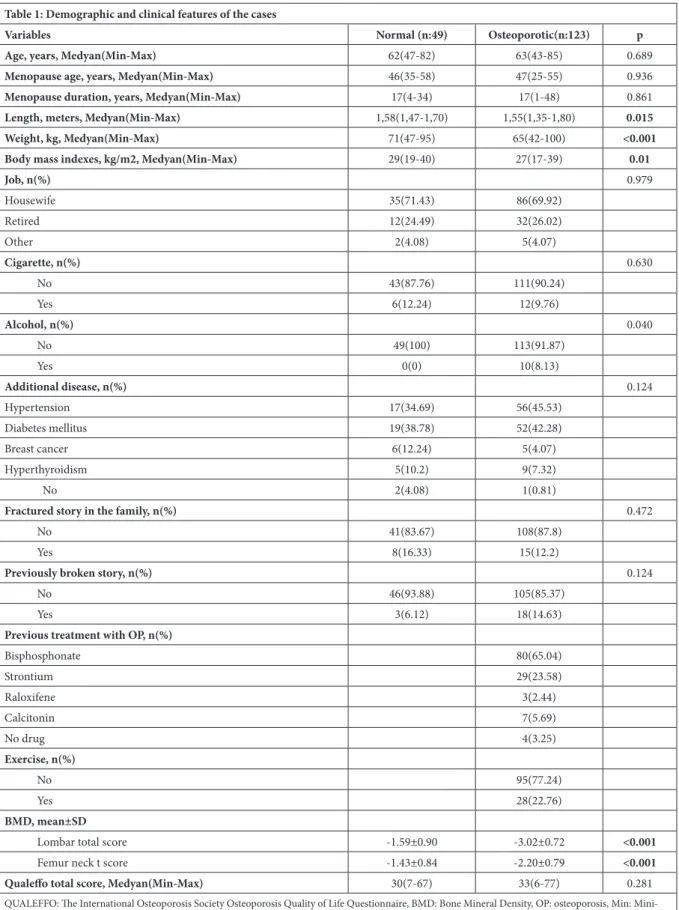
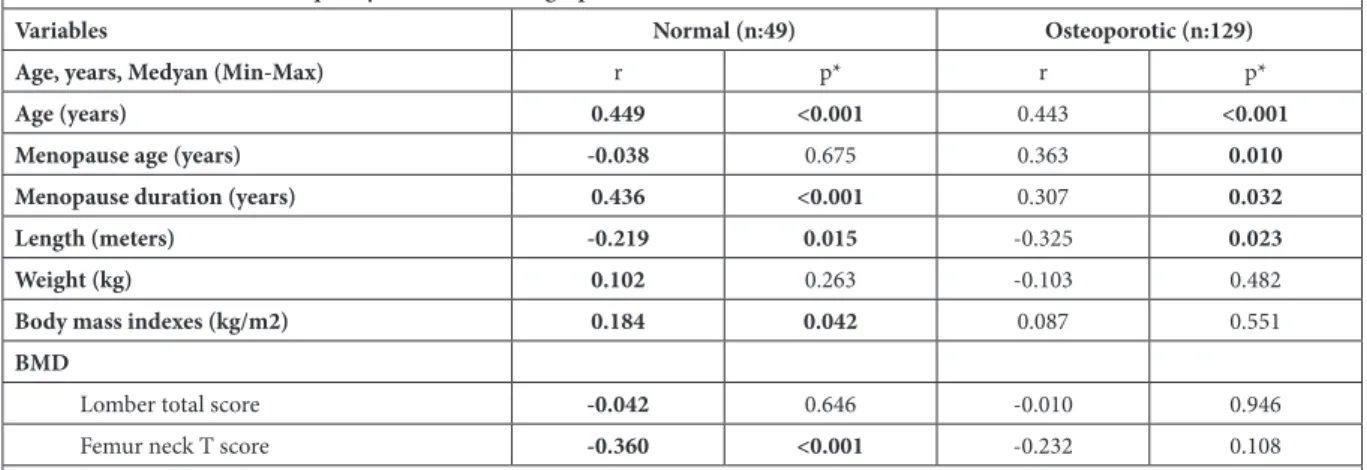
A total of 123 patients and 49 healthy women were in-cluded in the study. Th e median age of the patients was 63 (range, 43-85) years, and that of healthy participants was 63 (range, 43-85) years. Th e socio-demographic and clini-cal characteristics of our cases are summarized in Table 1. Mann–Whitney U test revealed that exercise alone pos-itively aff ected the quality of life (Table 2). In addition, when we grouped our cases as those with and those without osteoporosis, the presence of osteoporosis in the femoral neck region negatively aff ected the quality of life, whereas that in the lumbar region yielded no eff ect. Th is result was statistically signifi cant (Figures 1 and 2). In the analysis of correlation between demographic and clinical data and the quality of life scores of our cases, a statistically signifi cant weak positive correlation was found among age, age at menopause, and menopause duration; and a negative correlation between height (Table 3). In patients with PMO in our study, the level of effi cacy among the parameters related to the quality of life was de-termined by multiple regression tests. We found that the most important determinant of the quality of life was age (p < 0.001, p = 0.025) (Table 4).
Table 1: Demographic and clinical features of the cases
Variables Normal (n:49) Osteoporotic(n:123) p
Age, years, Medyan(Min-Max) 62(47-82) 63(43-85) 0.689
Menopause age, years, Medyan(Min-Max) 46(35-58) 47(25-55) 0.936
Menopause duration, years, Medyan(Min-Max) 17(4-34) 17(1-48) 0.861
Length, meters, Medyan(Min-Max) 1,58(1,47-1,70) 1,55(1,35-1,80) 0.015
Weight, kg, Medyan(Min-Max) 71(47-95) 65(42-100) <0.001
Body mass indexes, kg/m2, Medyan(Min-Max) 29(19-40) 27(17-39) 0.01
Job, n(%) 0.979 Housewife 35(71.43) 86(69.92) Retired 12(24.49) 32(26.02) Other 2(4.08) 5(4.07) Cigarette, n(%) 0.630 No 43(87.76) 111(90.24) Yes 6(12.24) 12(9.76) Alcohol, n(%) 0.040 No 49(100) 113(91.87) Yes 0(0) 10(8.13) Additional disease, n(%) 0.124 Hypertension 17(34.69) 56(45.53) Diabetes mellitus 19(38.78) 52(42.28) Breast cancer 6(12.24) 5(4.07) Hyperthyroidism 5(10.2) 9(7.32) No 2(4.08) 1(0.81)
Fractured story in the family, n(%) 0.472
No 41(83.67) 108(87.8)
Yes 8(16.33) 15(12.2)
Previously broken story, n(%) 0.124
No 46(93.88) 105(85.37)
Yes 3(6.12) 18(14.63)
Previous treatment with OP, n(%)
Bisphosphonate 80(65.04) Strontium 29(23.58) Raloxifene 3(2.44) Calcitonin 7(5.69) No drug 4(3.25) Exercise, n(%) No 95(77.24) Yes 28(22.76) BMD, mean±SD
Lombar total score -1.59±0.90 -3.02±0.72 <0.001
Femur neck t score -1.43±0.84 -2.20±0.79 <0.001
Qualeff o total score, Medyan(Min-Max) 30(7-67) 33(6-77) 0.281
QUALEFFO: Th e International Osteoporosis Society Osteoporosis Quality of Life Questionnaire, BMD: Bone Mineral Density, OP: osteoporosis, Min: Mini-mum, Max: MaxiMini-mum, SD: standard deviation.
Table 2: Comparison of quality of life in diff erent groups
Normal (n:49) Osteoporotic(n:123)
N Medyan Min-Max Z P* N Medyan Min-Max Z P*
Cigarette -0.061 0.964 -0.303 0.762
TQS of who don’t smoke 43 30 9-67 11 33 6-77
TQS of who smoke 6 33 7-52 12 37 11-74
Alcohol -0.162 0.871
TQS of nonalcoholic 49 30 7-67 11 33 6-77
TQS of alcoholic - - - 10 33 11-74
Additional disease -1.502 0.133 -1.133 0.257
TQS of without add. dis. 17 18 9-51 56 33 6-74
TQS of with add. dis. 32 30 7-67 67 32 7-77
Fracture history in family 0.787 0.801 -0.773 0.439
TQS of who haven’t 41 30 7-67 108 33 6-77
TQS of who have 8 29 20-45 15 37 14-65
Fracture history of patient 0.337 0.365 -0.401 0.689
TQS of who haven’t 46 30 7-67 105 33 6-77
TQS who have 3 41 20-52 18 35 12-61
Treated with OP -0.622 0.534 -0.300 0.764
TQS of who treated 31 30 7-67 80 33 6-74
TQS of who didn’t treat 18 27 9-52 43 35 7-77
Exercise 0.295 0.301 -2.437 0.015
TQS of who exercises 40 30 9-67 95 36 6-77
TQS of who don’t exercise 9 27 7-46 28 24 7-61
Table 3: Correlation between quality of life and demographic and clinical data
Variables Normal (n:49) Osteoporotic (n:129)
Age, years, Medyan (Min-Max) r p* r p*
Age (years) 0.449 <0.001 0.443 <0.001
Menopause age (years) -0.038 0.675 0.363 0.010
Menopause duration (years) 0.436 <0.001 0.307 0.032
Length (meters) -0.219 0.015 -0.325 0.023
Weight (kg) 0.102 0.263 -0.103 0.482
Body mass indexes (kg/m2) 0.184 0.042 0.087 0.551
BMD
Lomber total score -0.042 0.646 -0.010 0.946
Femur neck T score -0.360 <0.001 -0.232 0.108
*: Spearman rho correlation test, BMD: Bone Mineral Density, rho: Coeffi cient of correlation analysis, p<0.05: Statistical signifi cance level
Table 4: Impact ratings of variables with the highest correlation to the quality of life of PMO patients
Variables Normal (n:49) Osteoporotic (n:129)
QUALEFFO-41 (Th e dependent variable)
Independent Variables beta p*
Age 0,463 <0,001
Menopause age -0,125 0,137
length -0,022 0,797
*: Multiple regression test, p<0.05: Statistical signifi cance level.
Figure 2. QUALEFFO score and quality of life relationship of patient and control group according to femur neck BMD Figure 1. According to Lomber vertebra BMD, the quality
of life relationship between the patient and control group QUALEFFO score
DISCUSSION
Reduced bone density in osteoporosis is associated with chronic pain, movement restriction, and increased frac-ture risk, oft en causing disruption in daily life activities and decrease in the quality of life of elderly patients.11 Fractures can cause pain, deformation, disability, and even death. Spine and hip fractures are among the most destructive. Consequently, patients with fractures may develop loss of physical function and require long-term care.12,13 Hence, this study aimed to evaluate the impact of PMO on the quality of life by employing QUALEFFO and to identify the factors aff ecting the quality of life of patients with such condition.
Osteoporosis generally aff ects the quality of life.14 In our study, in the correlation analysis between demographic and disease-specifi c parameters and quality of life, a signif-icant correlation was found among age, age at menopause, menopause duration, height, and quality of life.
Old age plays a role in the development of PMO and reduc-es the quality of life. Advanced age has a negative impact on the quality of life, particularly because it increases the prevalence of vertebral fractures in patients with PMO.15, 16 Age of >65 years was associated with the loss of balance and increased risk of falls.17 Th erefore, osteoporosis should be treated, especially considering the increased risks in the elderly population. In our study, we considered variables with the highest correlation with quality of life as a regres-sion model to reveal the eff ect levels of the parameters that determine the quality of life. As a result of this analysis, the primary determinant of the quality of life in women was “age.” Th us, older age has a negative eff ect on the life quality of patients with PMO. In other studies, weight gain is considered as another factor that negatively aff ects the quality of life.
In participants with obesity, the quality of life worsened as
their BMI increased.18 In women with PMO, weight gain
and the quality of life were negatively correlated.19 In our
study, BMI aff ected the quality of life in normal individu-als, but in patients with PMO, no relationship was identi-fi ed. Hence, our case could be owing to narrow BMI range. Most patients with PMO have one or more chronic dis-eases owing to old age. Chronic disdis-eases, such as DM, HT, and hyperthyroidism, can cause deterioration in the quality of life. Van Schoor et al. found that patients with PMO presenting with chronic disease had a lower quality of life than those without chronic disease.20 In our study, the presence of chronic disease did not aff ect the quality of life in patients with PMO.
Menopause was also considered in this study. In postmen-opausal women, estrogen levels decrease. Th is decrement has a direct eff ect on BMD, triggering osteoporosis.21 In our study, the long menopausal period negatively aff ected the patients’ quality of life, consistent with previous stud-ies.22
Th e presence of low BMD is one of the most important risk factors causing fractures.23 Hip fractures is a common condition in patients with osteoporosis and has a negative eff ect on mortality and morbidity. It may also create ad-ditional burden for both patients and caregivers. In our study, low t score values of the femur neck had a negative impact on the quality of life. However, relationship was found between the L1–4 T score and the quality of life. In women with PMO, low BMD values of the femur neck and lumbar vertebrae negatively impact the quality of life.24,25 Th erefore, in patients with PMO in the hip area, the qual-ity of life is aff ected more than that in patients with osteo-porosis in the vertebral region.
Various exercise programs are recommended for patients with osteoporosis. Aerobic, weight-bearing, and resistance exercises increase vertebral bone density in women with PMO. Th ese activities are proven eff ective in improving bone density and reducing the risk of falls.26,27 Mack et al. reported that physical activity has a strong positive rela-tionship with the quality of life.28 In our study,
partici-pants who did not exercise had a signifi cantly lower qual-ity of life than those who exercised. Th erefore, physical activity has a positive eff ect on PMO.
Although the number of participants included in our study was high, there were some limitations. Th e control patients included in our study were relatively low. Anti-de-pressant and serum vitamin D levels that could aff ect the quality of life of the participants were not evaluated. It has also not been evaluated for diseases such as osteoarthritis and fi bromyalgia, which may aff ect patients’ quality of life. Our study included a limited number of patients compared to larger multinational investigations, but it is among fi rst to explore this public burden in our country. Th is is im-portant, as nutrition varies diff erently among races and geographical areas, and dietary intake of minerals and vi-tamins, especially Ca, P and vitamin D, is important for bone metabolism.
CONCLUSION
When planning the treatment of patients with PMO, apart from drug therapy, exercise and other factors aff ecting their quality of life should be considered.
Th is study is a descriptive type, cross-sectional design ap-proved by local ethics committee (Approval date-protocol number: 17/12/2018-18992) and conforms to the princi-ples of the Declaration of Helsinki.
Confl ict Report
Th ere is no confl ict of interest between the authors during the preparation and publication of this writing.
Funding
1. Lane NE. Epidemiology, etiology, and diagnosis of osteoporosis. American journal of obstet-rics and gynecology 2006;194:p3-11.
2. Papaioannou A, Joseph L, Ioannidis G, Berger C, Anastassiades T, Brown JP, et al. Risk factors associated with incident clinical vertebral and nonvertebral fractures in postmeno-pausal women: the Canadian Multicentre Osteoporosis Study (CaMos). Osteoporosis inter-national 2005;16:568-578.
3. Bianchi ML, Orsini MR, Saraifoger S, Ortolani S, Radaelli G, Betti S. Quality of life in post-menopausal osteoporosis. Health and Quality of Life Outcomes 2005;3:78. 4. Crans G, Silverman S, Genant H, Glass E, Krege J. Association of severe vertebral fractures
with reduced quality of life: reduction in the incidence of severe vertebral fractures by teripa-ratide. Arthritis & Rheumatology 2004;50:4028-4034.
5. Lips P, van Schoor NM. Quality of life in patients with osteoporosis. Osteoporosis Interna-tional 2005;16:447-455.
6. Kocyigit H, Gülseren Ş, Erol A, Hizli N, Memis A. Th e reliability and validity of the Turkish version of Quality of Life Questionnaire of the European Foundation for Osteoporosis (QU-ALEFFO). Clinical rheumatology 2003;22:18-23.
7. Oglesby AK, Minshall ME, Shen W, Xie S, Silverman SL. Th e impact of incident vertebral and non-vertebral fragility fractures on health-related quality of life in established postme-nopausal osteoporosis: results from the teriparatide randomized, placebo-controlled trial in postmenopausal women. Th e Journal of rheumatology 2003;30:1579-1583.
8. Oleksik AM, Ewing S, Shen W, van Schoor NM, Lips P. Impact of incident vertebral fractures on health related quality of life (HRQOL) in postmenopausal women with prevalent verteb-ral fractures. Osteoporosis international 2005;16:861-870.
9. Paker N, Bugdayci D, Dere D, Tekdöş D, Erbil E, Dere Ç. Relationship between bone den-sity and quality of life in postmenopausal osteoporosis. Turkish Journal of Geriatrics/Türk Geriatri Dergisi 2012;15.
10. Organization WH. Report of a WHO Scientific Group. Research on the Menopause in the 1990s. WHO technical report series 1996;866.
11. Fechtenbaum J, Cropet C, Kolta S, Horlait S, Orcel P, Roux C. Th e severity of vertebral frac-tures and health-related quality of life in osteoporotic postmenopausal women. Osteoporosis International 2005;16:2175-2179.
12. Borgström F, Lekander I, Ivergård M, Ström O, Svedbom A, Alekna V, et al. Th e Interna-tional Costs and Utilities Related to Osteoporotic Fractures Study (ICUROS)—quality of life during the first 4 months aft er fracture. Osteoporosis international 2013;24:811-823. 13. Petronijević M, Petronijević N, Ivković M, Stefanović D, Radonjić N, Glišić B, et al. Low
bone mineral density and high bone metabolism turnover in premenopausal women with unipolar depression. Bone 2008;42:582-590.
14. Silverman SL. Quality-of-life issues in osteoporosis. Current rheumatology reports 2005;7:39-45.
15. Ohta H, Uemura Y, Nakamura T, Fukunaga M, Ohashi Y, Hosoi T, et al. Serum 25-hydroxy-vitamin D level as an independent determinant of quality of life in osteoporosis with a high risk for fracture. Clinical therapeutics 2014;36:225-235.
16. Nuti R, Caff arelli C, Guglielmi G, Gennari L, Gonnelli S. Undiagnosed vertebral fractures infl uence quality of life in postmenopausal women with reduced ultrasound parameters. Clinical Orthopaedics and Related Research® 2014;472:2254-2261.
17. Buatois S, Gueguen R, Gauchard GC, Benetos A, Perrin PP. Posturography and risk of recur-rent falls in healthy non-institutionalized persons aged over 65. Gerontology 2006;52:345-352.
18. Kolotkin RL, Andersen JR. A systematic review of reviews: exploring the relationship betwe-en obesity, weight loss and health‐related quality of life. Clinical obesity 2017;7:273-289. 19. Al-Sari UA, Tobias J, Clark E. Health-related quality of life in older people with osteoporotic
vertebral fractures: a systematic review and meta-analysis. Osteoporos Int 2016;27:2891-2900.
20. Van Schoor N, Smit J, Twisk J, Lips P. Impact of vertebral deformities, osteoarthritis, and other chronic diseases on quality of life: a population-based study. Osteoporosis internati-onal 2005;16:749-756.
21. Krum SA, Brown M. Unraveling estrogen action in osteoporosis. Cell Cycle 2008;7:1348-1352.
22. Huff man F, Vaccaro J, Zarini G, Vieira E. Osteoporosis, Activities of Daily Living Skills, Qu-ality of Life, and Dietary Adequacy of Congregate Meal Participants. Geriatrics 2018;3:24. 23. Rizzoli R. Postmenopausal osteoporosis: assessment and management. Best Practice &
Rese-arch Clinical Endocrinology & Metabolism 2018.
24. Palacios S, Neyro J, Fernandez de Cabo S, Chaves J, Rejas J. Impact of osteoporosis and bone fracture on health-related quality of life in postmenopausal women. Climacteric 2014;17:60-70.
25. Guirant L, Carlos F, Curiel D, Kanis JA, Borgström F, Svedbom A, et al. Health-related quality of life during the first year aft er a hip fracture: results of the Mexican arm of the International Cost and Utility Related to Osteoporotic Fractures Study (MexICUROS). Os-teoporosis International 2018;29:1147-1154.
26. Preisinger E. Physiotherapie und Bewegung bei Osteoporose und Folgeerkrankungen. Zeits-chrift für Rheumatologie 2009;68:534-538.
27. Uhlemann C, Lange U. Diff erenzialindikative physikalische Th erapiestrategien der Osteo-porose–Empfehlungen für den Praxisalltag. Zeitschrift für Rheumatologie 2006;65:407-416. 28. Mack DE, Wilson PM, Gunnell KE. Land of confusion: unpacking the relationship between physical activity and well-being in individuals living with osteoporosis. International Review of Sport and Exercise Psychology 2017;10:212-229.