İSTANBUL BİLGİ UNIVERSITY INSTITUTE OF GRADUATE PROGRAMS
CULTURAL MANAGEMENT MASTER’S DEGREE PROGRAM
CULTURAL MANAGEMENT AND POLICIES OF THEATRE FOR CHILDREN:
İSTANBUL METROPOLITAN MUNICIPALITY CITY THEATRE CHILDREN’S UNIT
Emine Ak 112678010
İstanbul 2019
iii
ACKNOWLEDGEMENT
I would like to take this opportunity to thank first to the founders of this unique department, the only Cultural Management Graduate Program in Turkey. Thanks to their efforts in cultural management in Turkey, my department professors are not only the milestones in terms of democratization of culture in Turkey, but also the contributors to the equality in education through providing the students in need with scholarship, and letting them an invaluable chance to study in such a country as Turkey.
Secondly, I owe a very special thanks to my dear professors Esra Yıldız, Serhan Ada, and Bülent Sezgin. Without their assistance, this research would never be refined all that much as one of the pioneering works of its area in Turkey. In addition, thanks a lot to ITYARN, the International Theatre for Young Audiences Research Network who provided with diverse resources, and to the interviewees Ümit Denizer, Tamer Levent, Özer Tunca, Erhan Yazıcıoğlu who contributed in this study with their invaluable experiences in theatre of Turkey.
However, how this thesis came to life is thanks to my advisor from Boğaziçi University Department of Management Prof. Nur İrem Nuhoğlu who changed my mind when I had decided not to write this thesis last year, and thanks to my dear landlord Mrs. Ayla Uyar who offered her apartment with an affordable price to me, and I could find a peaceful place to sit and write when I have never fit into any spot on earth.
iv
DEDICATION
v CONTENTS
LIST OF ABBREVIATIONS ...vii
LIST OF TABLES ... viii
LIST OF FIGURES ... ix
ABSTRACT ... x
ÖZET ... xi
INTRODUCTION ... 1
1.THEATRE FOR CHILDREN ... 13
1.1. CONCEPT OF CHILD AND CHILDREN’S CULTURE ... 13
1.2 WHAT IS THEATRE FOR CHILDREN ... 16
1.3 THEATRE FOR CHILDREN IN THE WORLD ... 19
2. HISTORICAL BACKGROUND OF THEATRE FOR CHILDREN IN ... 25
CULTURAL POLICY CONTEXT IN TURKEY ... 25
2.1.1 Theatre for Children as a Tool (1930-1970) ... 26
2.1.2 Political Movements (1970-1980) ... 29
2.1.3 After 1980 Military Coup- Neoliberalism ... 31
2.1.4 After the 2000s: The Period of Justice and Development Party ... 34
2.2 CULTURAL POLICIES AND CHILDREN IN TURKEY ... 44
2.3 ECONOMICS OF THEATRE FOR CHILDREN... 59
2.4 MANAGEMENT OF THEATRE FOR CHILDREN ... 68
2.4.1 Making Policies ... 68
2.4.2 Finance of Theatre ... 70
2.4.4 Box Office ... 71
2.4.5 Theatre Saloon Management ... 72
2.4.6 Civic/Social Roles of Theatre for Children ... 72
3.CASE STUDY RESEARCH ... 74
3.1 MAPPING OF THEATRE SECTOR IN İSTANBUL ... 74
3.2 ANALYSIS OF IMMCT CHILDREN’S UNIT ... 79
3.2.1 Objectives of IMMCT ... 82
3.2.3 SWOT Analysis ... 85
vi 3.2.5 Theatre Halls ... 95 3.2.6 Audience... 97 3.2.9 Funding of IMMCT ... 101 3.2.10 Human Resources ... 102 3.3 FINDINGS ... 105
3.3.1 Legitimacy and Transparency ... 105
3.3.2 Accountability ... 106
3.3.3 Business Ethics ... 107
3.3.4 Inclusive Management ... 107
3.4 VARIABLES OF THEATRE FOR CHILDREN IN TURKEY ... 109
3.5 FACTORS THAT HAVE AN IMPACT ON THEESE VARIABLES... 110
3.5.1 Psychological Factors ... 110 3.5.2 Political Factors ... 112 3.5.3 Socioeconomic Factors ... 113 CONCLUSION ... 114 BIBLIOGRAPHY ... 1 APPENDIX ... 127
vii
LIST OF ABBREVIATIONS
IMM: İstanbul Metropolitan Municipality
IMMCT: İstanbul Metropolitan Municipality City Theatre AMMCT: Antalya Metropolitan Municipality City Theatre ACPC (AÇOK): Anatolia Children’s Play Club
ECoC: European Capital of Culture TYP: Theatre for Young People TIE: Theatre in Education
viii
LIST OF TABLES
Table 1. Cultural Participation in Live Performances (%)………...3
Table 2.1 The Regulation and Radical Change Dimension………..37
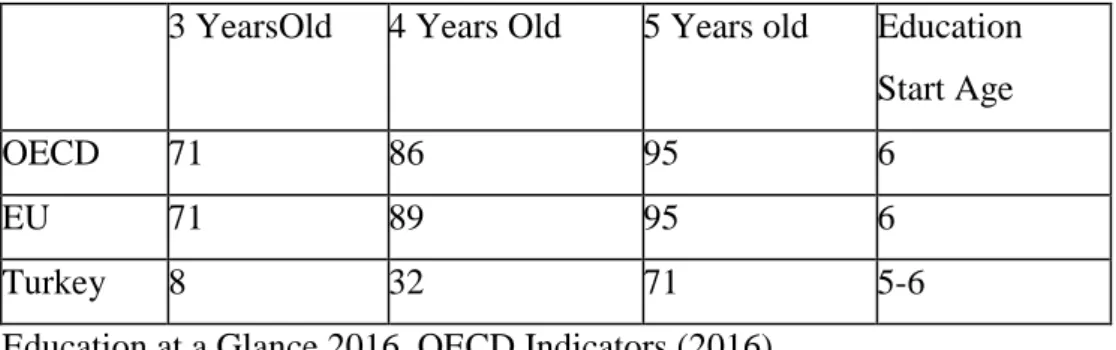
Table 2.2 Preschooling Rates of Turkey 2015-2016 (%) ……… …42
Table 2.3 Preschooling Rates2014 (%), Compulsory Education Age…... ..42
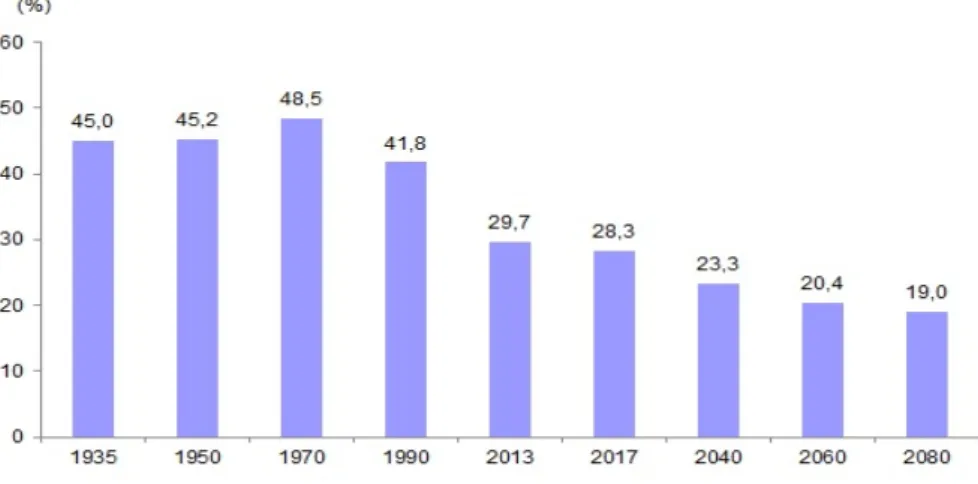
Table 2.4 Children Population………...50
Table 2.5 Cultural Expenditure of Turkey in 2017-2018………..61
Table 2.6 Distribution of Households' Total Cultural Expenditure in 2017.61 Table 2.7 Government Subsidies for Private Theatres……….……62
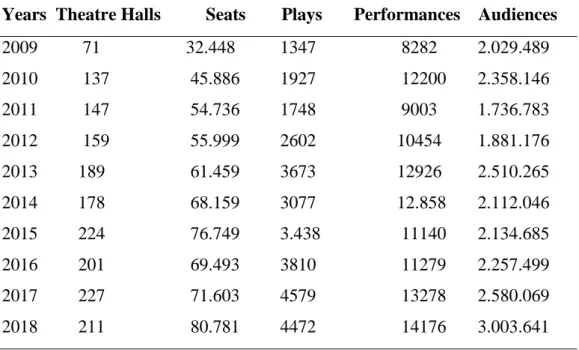
Table 2.8 Theatre Statistics of Turkey 2009-2019………..….64
Table 3.1 Theatre Statistics of İstanbul 2009-2019………...74
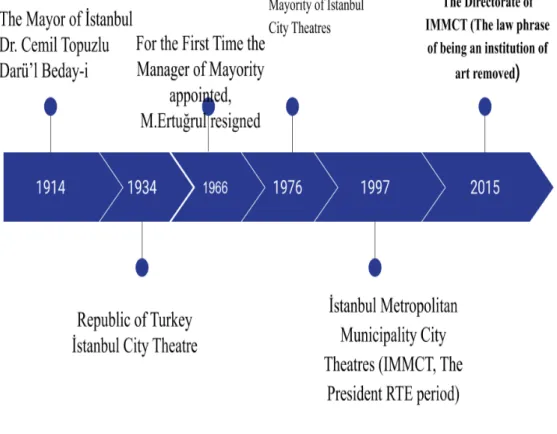
Table 3.2 List of General Art Directors of IMMCT………...80
Table 3.3 IMMCT 2018-2019 Season Children’s Plays …………..……..89
Table 3.4 Children’s Plays at IMM Culture Centers 2018-2019………….92
Table 3.5 IMMCT According to the Type of Play Performances/Plays...93
Table 3.6 IMMCT and IMM Culture Centers Performance/Plays……….. 93
Table 3.7 Touring Performances of IMM….………...95
Table 3.8 IMMCT 2018 Performance at IMMCT 2015-2019…….……....98
ix
LIST OF FIGURES
Figure 1. The Implications of Good Governance………...…... ... 9
Figure 2.1 Children Population/ Total Population of Turkey (%) ……….…... ... 49
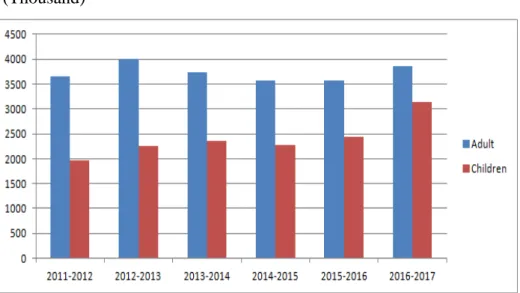
Figure 2.2 The Number of Spectators Children/Adult 2011-2017……… ... 64
Figure 2.3 Rates of Change in The Number of Theatre Spectators ………... 65
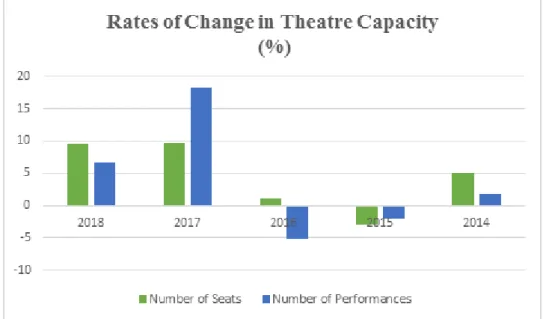
Figure 2.4 Rates of Change in Theatre Capacity 2014-2018………... ... 66
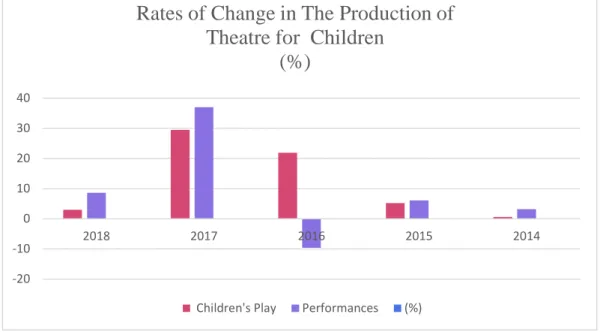
Figure 2.5 Rates of Change in The Production of Theatre for Children…... ... 67
Figure 3.1. Timeline of Institutional Memory of IMMCT………... ... 81
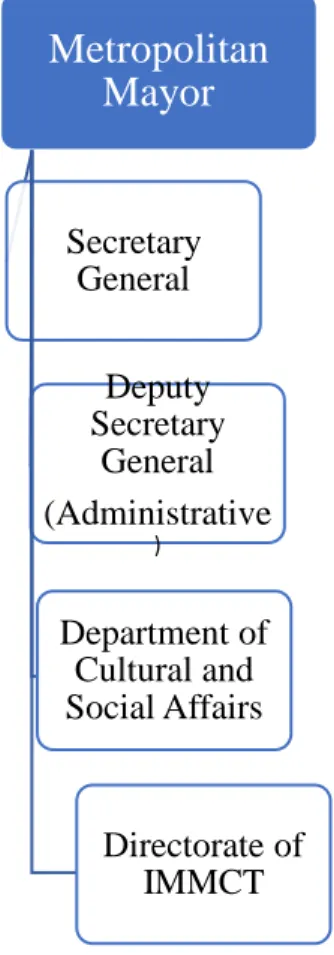
Figure 3.2 Organizational Structure of City Theatre in IMM………... ... 83
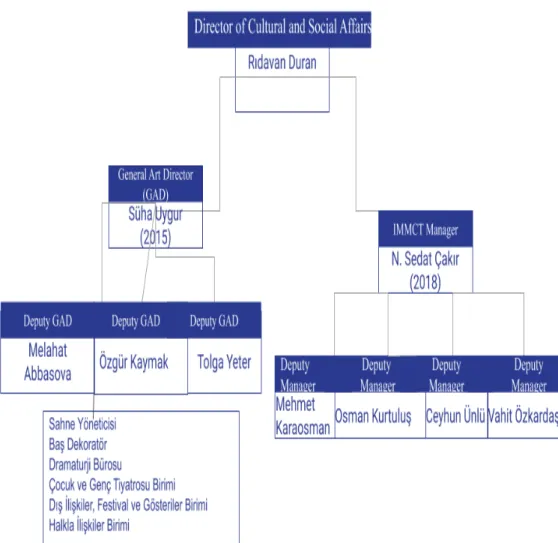
Figure 3.3 IMMCT Organizational Chart as of May, 2019………... ... 84
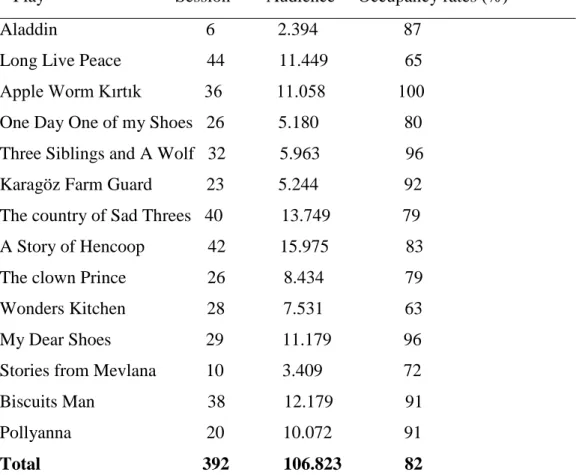
Figure 3.4 IMMCT Occupancy Rates of the 2017-2018 season…………... ... 99
Figure 3.5 Areas to Evaluate in a Theatre Management……….………….... ... 104
Figure A.1: The Replaced Child (5+), D: Özer Tunca, 2014 AMMCT…... ... 126
Figure A.2: The Replaced Child (5+), D: Özer Tunca, 2014 AMMCT ..…... ... 126
Figure A.3: The Replaced Child (5+), D: Özer Tunca, 2014 AMMCT..…… ... 128
Figure A.4: Rush to Freedom (8+), Director:Özer Tunca, 2015 AMMCT..… ... 128
Figure A.5: Secret (5+), Director: Soren Ovesen, 2016- Present AMMCT.... ... 129
Figure A.6: Phoenix (5+), Director: Ali Eyidoğan, 2017-Present AMMCT... ... 129
Figure A.7: Keloğlan, Director: Turgut Denizer, 1975-1983, ACPC ………. ... 130
Figure A.8: Keloğlan, Director: Turgut Denizer, 1975-1983, ACPC ………. ... 130
Figure A.9: Timur The Lame&Hodja Nasreddin, D:Turgut Denizer, 1979… ... 131
Figure A.10: Timur The Lame&Hodja Nasreddin, D:Turgut Denizer, 1979.. ... 131
Figure A.11: The Country of Happiness, D: Ümit Denizer, 1973, ACPC…... ... 132
Figure A.12: Stain, Spot, Line, Director: Ümit Denizer, 1978 ACPC……... ... 132
Figure A.13: GOP Ferih Egemen Children’ Stage ……….…. ... 133
Figure A.14: Sadabat Kemal Küçük Children’s Stage ………... ... 133
Figure A.15: Asja Lācis, Students with posters, 1925………..… ... 134
x ABSTRACT
This thesis analyzes the theatre for children in cultural management context in connection with the art and cultural policies for children and gives İstanbul Metropolitan Municipality Theatre Children Unit as a case example.
Impacts of cultural policy and management of theatre on the dynamics of theatre for children, such as programming/repertoire, location, architecture, design of theatre halls, use of technology, playwrights, education of actors, and the audience were investigated through case study research method. Istanbul Metropolitan Municipality City Theatre as a cultural institution was analyzed according to the ‘Implications of Good Governance’ by Jacques Bourgault, and variables that have impacts on the development of theatre for children in İstanbul were defined to understand the reasons behind why theatre for children could not be institutionalized in Turkey since its establishment in 1935. In addition, the answers to such questions as why governments and big corporations deal closely with cultural activities of children, theatre for children as a social engineering instrument, and if cultural policies follow the changing children’s culture in the information era were scrutinized. According to the findings, variables of both supply and demand functions of theatre for children were defined and constraints that have an impact on these variables were determined under three categories; psychological, political, and socioeconomic. As a result, the development of theatre for children in Turkey and efficiency in the management of theatre strictly depend on the resolution of these constraints.
Apart from the inadequacy the of tangible/intangible cultural infrastructures, today the biggest challenge of the theatre for children in Turkey is the problem of perception: the perception of ‘the child’ of policymakers, and the actors’/directors’ perception of the theatre for children.
Keywords: Theatre for Children, Cultural Management of Theatre for Children, Istanbul Metropolitan Municipality City Theatre Children’s Unit, Art and Cultural Policies for Children, Children’s Culture, Cultural Policies of Theatre for Children, Publicly Funded Repertoire Theatres
xi ÖZET
Bu tez, çocuk tiyatrolarını kültür yönetimi çerçevesinde çocuklar için sanat ve kültür politikalarıyla bağlantılı olarak ele alır ve İstanbul Büyükşehir Belediyesi Şehir Tiyatrosu Çocuk Birimi’ni kültür kurumu yönetimi açısından analiz eder. Bu doğrultuda sanat politikaları ve tiyatro yönetiminin, programlama/repertuar, yer, mimari, tiyatro salonlarının tasarımı, teknoloji kullanımı, oyun yazarlığı, oyuncu eğitimi ve seyirci gibi tiyatro/çocuk tiyatrosu dinamikleri üzerindeki etkilerini vaka çalışması yöntemi ile araştırır, İstanbul Büyükşehir Belediyesi Şehir Tiyatrosu’nu kültürel bir kurum olarak inceleyerek Jacques Bourgault'un “İyi Yönetişim Etkileri'ne” göre analiz eder ve çocuk tiyatrosunun 1935’te kuruluşundan bu yana kurumsallaşamamasının nedenlerini ortaya koyar. Ayrıca, hükümet ve büyük şirketlerin çocukların kültürel faaliyetleri ile neden ilgilendikleri, çocuk tiyatrosunu bir sosyal mühendislik aracı olarak nasıl kullandıkları, Türkiye’de kültür politikalarının bilgi çağında değişen çocuk kültürünü nasıl takip ettiği sorularının cevaplarını arar. Bulgulara göre çocuk tiyatrosunun arz ve talep fonksiyonlarının değişkenleri tanımlanmış ve bu değişkenler üzerinde etkisi olan kısıtlar psikolojik, politik ve sosyoekonomik olarak üç kategoride belirlenmiştir. Sonuç olarak, Türkiye'de çocuk tiyatrosunun gelişimi ve tiyatro yönetimindeki verimlilik bu kısıtların çözümüne bağlıdır. Taşınabilir ve taşınamaz kültürel altyapı yatırımlarının yetersizliği dışında, Türkiye’de çocuk tiyatrosunun en büyük problemi algı problemidir: Kanun koyucuların çocuk algısı ve oyuncuların/tiyatro yönetmenlerinin çocuk tiyatrosu algısı.
Anahtar Sözcükler: Çocuk tiyatrosu yönetimi, çocuk tiyatrosu kültür politikaları, çocuk kültürü, çocuklar için kültür ve sanat politikaları, kamu tarafından finanse edilen repertuar tiyatroları, İstanbul Büyükşehir Belediyesi Şehir Tiyatroları Çocuk Tiyatrosu Birimi
1
INTRODUCTION
Children are always the chief topic on the political agenda, especially whenever the world passes through a historical turning point. It happened when the printing press and other breakthroughs were invented, whenever empires have collapsed, and nation states arose; the governments for the social transformation concerns aimed to benefit from the instructive power of theatre for children. Indeed, this mindset, and to teach languages, religion or cultural values through the plays which accommodate both the joy and ritual at the same time have existed throughout the history of humanity according to the anthropologists and historians. Children reproduce their own culture through play. However, worldwide debates on playing are continuing due to the significant decrease in natural and free playing in contrast to increasing in playing under the control of governments and big corporations which are violating the UN Convention on the Rights of Child Article 31 about the right to play free (UN, 1989). Among many others, this cause to increase in demand for theatre –as one of the main social activities of children- which can be taken easily into the boundaries of control by the governments and the corporations.
For the last few decades thanks to the invention of the internet together with huge technological breakthroughs tied to its tail, the entire world has been reordered. In this era driven by change policy, makers and leaders are dealing with rapid changes in business models, competitive market forces, technology, resource scarcity, and global challenges. Business and societal troubles are not solely technological challenges or management ones but are systems challenges that require new types of solutions based on system strategies.
Whereas, Societal Transformation Lab was founded at MIT in 2006 (MIT Center for Organizational Learning, 2019). And, Japan launched Society 5.0 in 2016 as a vision for super-smart society (Keidanren, 2019). This new world is
2
the sum of connected cities, and the ones that have the strongest connections with the rest of the world are ‘Gateway Cities’ who have to include art and culture as its integral part of the ecosystem. İstanbul is one of the gateway cities who has no choice but has to take art seriously and invest in it.
Thus, is what’s happening in culture market now a coincidence? Giants like Facebook, Amazon are investing in the digital TV industry after the success of Netflix on which the average time spent is two hours per each member per day. In addition, Disney Company took over the 21st Century Fox becoming one of the most powerful actors of the family entertainment business. Children are the target population not only by giant corporations but also by the governments. So, why does the population policy of Turkey demand more children? In 2011, the Family and Social Politics Ministry was included in the cabinet. If we look at the citizen identity construction mechanisms of the states, we see that children are invested heavily as future citizens as had happened in the time of the invention of the printing press. Now, the question is how the identity of citizens of new Turkey is being defined.
Therefore, the cultural politics for children in Turkey or what happens to the children of the world need to be researched. The children (0-18) population of Turkey is 31%, 25.608.596 as of December 31, 2018 (Statistic Institute of Turkey, 2019). Thus, to some extent does Child Rights Policies of Turkey exist? The last debate about the children in parliament on February 2019 was the law for the minimum working age of 15. Obviously, there has been a huge gap between child rights, policies for children, and changing culture of children and societies of 21st century.
On the other hand, the ratio of attending a live performance, cultural participation out of the house is one of the most important indicators of socioeconomic status about a country, set aside the hot debates on closing State Theatres of Turkey through the last decade. According to the report of Cultural
3
Participation and Inclusive Societies by Council of Europe (Regina A. List, 2017) cultural participation is strongly related to the generalized trust, tolerance and other dimensions of a socially inclusive society. Indicator Framework on Culture and Democracy (IFCD) measures the correlation 0,75 between cultural participation and tolerance, and 0,83 between cultural participation and generalized trust within societies. For instance, in Canada 2016-2017, 60% attended at least one live performance according to the Arts and Heritage Access and Availability Survey, in 2015 the EU average on cultural participation (at least once in the previous 12 months) is 43%. (Eurostat, 2019). Turkey is 18% after Romania, Bulgaria.
Table 1. Cultural Participation in Live Performances (%)
Canada 60 EU 43 Romania 21 Bulgaria 22 Turkey 18 Resource: Eurostat, 2019
The latest rate on Turkstat was 1,5% for theatre participation in the reference month in 2006, and in 2017 The rate of Household (with at least one kid) who used to go to the cinema, theatre or sports events in Turkey is 9,8 % (Statistic Institute of Turkey). However, according to 2018 IPSOS Understanding Turkey Guide, 44% of us never go to the cinema; 35% of us do not read any books; 66% never attended an event like a concert, theater. 31% does not read a newspaper at all. The most common activity is watching television with 83 percent. And 72% believe in faith. (IPSOS, 2018)
Regarding childhood experiences as a powerful resource to contribute to the creation of acquired tastes, the very first experiences of young audience in theatre become decisive for their future relations with performing arts.
4
Recently, The New Victory Children’s Theatre in New York published the outcomes of a five-year longitudinal research about the impacts of arts on kids, and whether or not kids need theatre (The New Victory Theatre, 2019). According to their findings, the intense engagement and integration of theatre in a school community affect the perception of self and the hope about the future in children. As has been one of the most significant indicators of children’s socio-cultural life, theatre for children deserves to be scrutinized in academic research in all aspects for its instrumentality or its true functions as an art form.
Throughout the last few decades, the academic interests and researches on theatre for young audience has been increasing significantly in the world. Furthermore, just for this mission, some organizations have found such as the International Theatre for Young Audiences Research Network (ITYARN), which is the international research network of the International Association of Theatre for Children and Young People ASSITEJ, and Theatre for Children in the UK Research Network. However, theatre for children is a recent phenomenon and newly emerging in Turkey. Especially after the 2000s such cities as İstanbul, Ankara, İzmir, Bursa, Mardin, and Van have been hosting international festivals of theatre for children. Whereas, even in İstanbul which more than 3 million children live does not have a single private theatre designed and built for children. IMMCT has the only two stages with limited capacity.
Therefore, the purpose of this thesis is an analysis of theatre for children in İstanbul to elevate the study to cultural policy and management context, to generate empirical knowledge for understanding and evaluating the reasons why theatre for children is underestimated. For instance, İstanbul in which almost 4 million kids live does not have a single private theatre designed and built for children. And, İstanbul Metropolitan Municipality City Theatre (IMMCT) did not institutionalize since its establishment in 1935. In addition to
5
the conceptual development of theatre for children, to seek the trace of potential paths for policy and action, to shed light to sector professionals, actors, and policymakers were aimed. Through the in-depth interviews with theatre directors and sector professionals, current conditions and practices of contemporary theatre for children in Istanbul, the variables that affect the development of theatre for children, and cultural policymaking process are demonstrated in the light of changing culture of children and society.
So that, a case study conducted for children Unit in IMMCT. Because this subject is almost untouched in Turkey, dozens of questions has appeared to be researched such as:
• Correlations between the cultural policies, organizational efficiency, and development of theatre for children
• Financial and market performance of publicly funded IMMCT • The reasons behind the increase in the children’s plays after 2010 • Where and how theatre for children is produced and presented today,
where and how it is consumed today, how it is changed over the decade, subjects of the plays and how plays are selected to be performed • To what extent the repertoire policy is independent of the government’s
political view, how IMMCT as a public repertoire theatre can become inclusive in management, how representative IMMCT is,
• How to shift from the politically centralized public institutions in the cultural industry to the ones that guarantee autonomy in decision making about the arts
• What is the scale of performing arts for the young audience in the cultural economy
• How young audience acquire the taste of art or how they select the performance they see
• Current conditions of performing arts venues, actors, employees, independent theaters or imported live performances for youth
6
• To be able to catch today’s frenetic advancements in technology, what kind of rules or policies need to be set to understand the young audience and how to produce performing arts for them
So, this research aims to fulfill the need for information to some extent in the area. Because there are so rare qualitative research and limited quantitative data on the subject, the case study method used as pioneering research, so that in the light of the insights found, the hypothesis will be checked such as:
o ‘Government policies consider theatre for children as instrument’ o ‘Establishing a separate institution for theatre for children is related
with the vision of the general art manager’
o ‘Theatre for children is consumed just by some elite’
o ‘Use of technology to communicate with youth is a powerful tool to increase the participation rates’
o ‘Current performances have the capacity and the potential for giving a vision of art to children’
o ‘IMMCT can work effectively to fulfill its artistic functions’
o ‘IMMCT theatre management is well aware of the new design of the cultural organizations in the 21th century’
o ‘Organizational structure of the IMMCT, and procedures prevent it from adopting the innovations’
o ‘The reason behind not to participate in children performances is economic’
o ‘Theatre management is efficient to access the majority of children in Istanbul’
o ‘Quality of the performances are related the political procedures and mechanisms’
7
Qualitative research will be conducted on the topic. Among major research method, the subject of theatre for young audiences investigated best through pragmatism and symbolic interactionism.
Pragmatism, in the work of Dewey and Pierce, argues that all animal behavior -including human- is based upon a problem solving adaptation to the environment, but whereas in animals this behavior is ‘instinctive’, in human beings it is ‘a matter of thought and reflection’. Unlike animals, human beings are ‘conscious and sentient creatures’ and ‘their environment is a symbolic universe’ with which they engage in terms of their understanding as well as their senses (Seale, 2004).
Ontological assumptions of pragmatism are that the nature of the reality is ‘complex, rich’, and external ‘Reality’ is out of ‘’ideas, the flux of processes, experiences, and practices’’. Epistemological assumptions are that ‘’true theories and knowledge bear successful action, focus on problem solving and informed future practice as contribution’’. Axiological assumptions (role of values) of pragmatism are that research initiated and sustained by ‘’researcher’s doubts and beliefs, value-driven research, researcher is reflexive’’ (Saunders, Lewis, and Thornhill, 2016).
In addition, symbolic interactionism comes along with the research methodology pragmatism, apparently the best model researching the field of children. Human behavior is ‘neither mechanical nor explicable in terms of laws’. Symbolic interactionists argue that human action can be investigated most effectively by ‘gaining access to the meanings which guide it’. (Saunders, Lewis and Thornhill, 2016) This involves learning the culture or subculture of the people under study and means that the social world is best investigated in ‘naturally occurring situations rather than under artificial conditions’ (Seale, 2004). Three assumptions frame symbolic interactionism: individuals ‘construct meaning via the communication process’, ‘self-concept is a
8
motivation for behavior’, and ‘a unique relationship exists between the individual and society’ (Seale, 2004). Drama is strongly suggested in language development and communication skills, and theatre that demonstrates the relations between individual and society. Furthermore, theatre for children is a world of symbols. That’s why symbolic interactionism suits best for this research.
Case study as a method will be applied and as an example, the children unit of IMMCT will be studied in its value-free, objective, and natural environment with contextual variables including political, economic, social, cultural, historical, and organizational factors. The reflexivity capacity of the research for Turkey can be thought as highly significant because 18,3 percent of Turkey’s population (82.003.882) lives in Istanbul who is the 2010 European Capital of Culture (ECoC). And in the 2017-2018 season, 28% of theatre halls, 41% of the total audience, 51% of the plays produced, and 41% performances in Turkey took place in Istanbul (Turkstat, 2018). A similar tendency can be assumed for the theatre for children as well.
In 2007 the Ministry of Culture and Tourism of Turkey released the report of the third National Culture Council arguing why Turkey does not have a policy of children’s culture. First and foremost, the variables that affect the cultural policy making process for children need to be defined, so do the variables that affect the theatre for children management. The measurement of the current applications of IMMCT management as a publicly funded cultural organization is based on the logical framework of the good governance by Jacques Bourgault (Corkery, 1999).
9 Figure 1. The Implications of Good Governance
Resource: Governance: Concepts and Applications, 1999
Accountability
Question terms during the
freedom
of
speech
and
negotiations of the arbitration
committee
Reporting
about
the
performance targets of annual
reports
Auditing
by
independent
Auditors
Disclosure of the Audited
reports
Business Ethics
Already
existed
business
ethical rules
Conflict of interests voluntary
declaration
Administrative sanctions for
mismanagement
Reporting dishonesty
Legitimacy & Transparency
Suitable access to criteria and
decisions
Policies
directing
to
the
decisions and reasons
Access to information
Directors
responsible
to
deliver the public funds
Inclusive Management
Structural changes with the
new regulation in IMMCT
Efficient negotiations
360
degree
debates:
representation of the diversity
of actor’s backgrounds
Plurality of stakeholders
Continuing
interrogations
about management process
The
Implications
of Good
Governance
10
In free market conditions, the diminishing dualism rule between the artistic excellence and cultural entrepreneurship/management occurs. However, in public cultural institutions, artistic excellence plus independence are connected to the relationship between the general directorate of art and the culture, so in-depth interview questions outline prepared differently for these clashing stakeholders of management. Additional measurements were made for the theatre management: cost, box office sales, efficiency, leadership positioning of IMMCT, so were made for the General Art Director: leadership style, the competitiveness of the children’s plays with the globe, reactions to political interventions, connections with the international network for theatre for children, usage of technology.
Through cross sectional, illustrative case study methodology multilevel investigation of the policy context, and the theatre for children management were carried through semi-structured in-depth interview technics with the managers of IMMCT, and sector professionals approximately for 2h. Focus group method with children as audience, parents & children was applied. In addition, content analysis of some plays, observations of performances, and audience, ethnographic research with theatre halls, culture centers, were benefited from. A holistic approach was used to analyze the data. Secondary data were collected from Turkstat, Eurostat, ASSITEJ Global, Istanbul Metropolitan Municipality City Theatre website, social media pages, media sources, and theatre for children NGOs. The library of IMMCT also provided several historical documents that followed the establishment of the theatre for children in the organization.
At the very beginning of the research, the biggest difficulty was setting a meeting with the directors of IMMCT for the interview1. The General Art
1 I applied with a petition because IMMCT is a public institution, the directors were avoidant to set
11
Director Süha Uygur just arranged two artists responsible for the children unit for me to meet with. But, they also did not set a meeting for the in-depth interview. So, I ended up questionnaires on Google forms by Tolga Yeter, the Assistant General Art Director.
On the other hand, the statistical data set of Turkstat was another kind of limitation. First, to understand the developed countries and how the dynamics of the sector work, a bunch of foreign industry data sets were investigated such as, Arts Council England, UK Theatre and SOLT, the London Theatre Report, Purple Seven and the ITC, and EuroStat etc. Then, when Turkstat data were analyzed, significant limitations came across to be able to make meaningful inferences. For instance, data for ICT/internet and the changing role of passive audiences into active participants never exit – a trend that is widespread in the world. Even the demographic data does not exist for audience researches, set aside the level of education, household structure, income levels, art knowledge of the theatregoers. However, in 2015-2019 Strategic Plan of Ministry of Culture and Tourism, a Project states ‘in cooperation with TurkStat, setting a meeting/seminar with the participation of EUROSTAT and UNESCO to collect and compile cultural statistics at a comparable level internationally’. And this project is still in process with the collaboration of İstanbul Bilgi University (Ministry of Culture and Tourism, 2019).
Although the scope of this thesis is not audience research, it can be an insight for the cultural policy makers or future researchers. Time spent on cultural activities is the only statistical indicator taken into consideration by Turkstat, though it does not mention how frequent respondents participate in theatre, or the percentage of people who have attended at least one performance within the last 12 months. Turkstat says just the number of people, performances, and the theatre halls.
12
Besides the definition and historical background of theatre for children, to understand arts management and policy development on it, the concept of child and its change in time, emerge of ‘children’s culture’, children and cultural policy, children’s rights on access and participate equally in culture, rise of cultural economy, marketing/branding efforts through theatre for children will be analyzed in details.
Although most researches in the globe about theatre for children have argued its instrumentality for both governments and corporations, closer examination demonstrates that theatre for children issue was not evaluated seriously in Turkey. And its advancement is related to the perception of the child, and understanding the children’s culture in a contemporary way.
13
1. THEATRE FOR CHILDREN
1.1. CONCEPT OF CHILD AND CHILDREN’S CULTURE
The concept of the child conveys different meanings throughout the historical era, in various societies, even in diverse communities of the same society, so that it is social and cultural concept, which is formed according to the social norms and values (Tan, 1989). Ancient times leave almost no trace but the absolute authority of father about the child. Until the 12th century children were not involved in any form of art. On the drawings of child shorn of any features and expressions in manuscripts book from the 12th century the only difference appeared to be size compared to adult pictures (Daşçı, 2008). Postman says that childhood is the biggest discovery of the Renaissance (Postman, 1995). Together with the science, nation states, freedom of faith, childhood arose in the 16th century thanks to the printing press, because the printing press depicted a new symbolic world, which sets the borders separating the child from the adult world.
In all resources until the 19th century, the child has been considered not a separate being, but a young adult, for instance, Factory Acts which permitted 9 years old children could work 16 hours per day per cotton mills passed in UK parliament in 1833 (Cooper, 2019). And, child slave issue is argued in the book ‘Stolen childhood: slave youth in nineteenth-century America’ by Wilma King (King, 1995). And, Gander called the 20th century as ‘century of Child’. Modernism defined a protected world of the play, fantasy, and innocence for the child. According to Boyden:
‘Adult nostalgia for youthful innocence is symbolized by the whimsy of London’s Museum of Childhood, with its display cabinets full of mechanical toys, china dolls, hand painted dolls’ houses, tin soldiers,
14
electric train sets, and Dinky cars. There is no place in this kind of childhood for labor in the factory or mine’ (Boyden, 1990).
When it comes to the Turkish societies before Islam, children were taken seriously. Especially the education of boys was so important as depicted in the stories of Dede Korkut, and tutelage of the father on the child was not endless (Arı and Karatepe, 2010). In the middle age, Turkish Muslim society in Anatolia differentiates from Europe so that children were given special care in the context of innocence till the age of 7, and were educated till adolescence accompanying father authority (İnan, 1983). In the 10th century, Farabi influenced the understanding of childhood indicating the physical and mental differences, and İbn Tufayl examines the development of a child in the philosophical context in his book ‘Hayy İbn Yaqzan’. Later on Yunus Emre, Hacı Bektaşi Veli, Mevlâna, and Nasreddin Hodja handle the children in Anatolia (İnan, 1983). During ottoman times children were under the custody of the father, but mother and grandmother dealt with the education. Girls were not allowed to continue the education after the children school (Sübyan Mektebi) till the 1839, Tanzimat. (İnan, 1983)
In his notes playwright and poet Nurettin Sevin (1938) states that the 19th century prepared the 20th century through scientific developments, but separated it from the understanding of decency of old times. With the appearance of consumer child image under capitalism and neoliberal politics, the lost item play and loss of childhood argument started towards the end of the 20th century (Postman, 1995).
Besides the conceptual development of childhood, the notion of children’s culture in sociology started to emerge in the 1970s, and ever since numerous arguments have been continuing on it. Sociological literature demonstrates how ‘’children are actively involved in interpreting meaning in their social worlds, forming identities and negotiating the broader system of power’’ (Adler, 1998).
15
This knowledge provides with the wider perspective that children ‘interpret the cultural and structural environment and incorporate it into their lives and behaviors’. Yet children are actively engaged in ‘’constructing meaning’’ and do so from their unique perception of the social world that is different from that of adults (Corsaro, 2005). Accordingly, Katya Johanson states in her article Culture for or by the Child?:
“What has persisted throughout the arguments about children’s culture since the 1970s is the view that children should be seen as more than simply adults in training, and that their cultural production or expressions are as valid and interesting as those of adults. The radical change in thinking is that childhood is no longer seen ‘as being about learning to be the kind of person you are supposed (by appropriate adults) to be – socially acceptable and conforming to the prevailing norms of society’ (Catling, 2003, quoted in Wake, 2008, p. 429). There is a growing interest in children’s cultural expressions, and how children contribute to broader culture’’ (Johanson, 2002).
On the other hand, today through the social media sites like MySpace, Instagram, Facebook and YouTube children are not so much engaging with the culture they have inherited, but are rather creating a distinctly new culture unknown to adults, as quoted by Buckingham:
“The global scale of marketing to children’ threatens to construct ‘a homogenized global children’s culture, in which cultural differences are being flattened out and erased, and in which parents’ attempts to sustain their cultural values are increasingly in vain. The media is seen to have disrupted the process of socialization, upsetting the smooth transition from one generation to the next (Buckingham, 2007).”
16
YouTube Kids strongly supports this argument. Number one is Ryan’s Toys Review (7 years old), in Forbes' annual list of the highest-earning YouTube celebrities, with 18 million subscribers and more than 16.5 trillion video views (as of today) and makes $11 US million a year among top ten YouTubers according to Business insider. The example in Turkey is Princes Elif (5 years old) YouTuber. Her account was opened in 2016, and she has 2,8 million followers and more than 4 billion views.
It is historically confirmed that the culture of children derived from play, education, and oral & written traditions. Along the changes of culture from traditional, modern towards postmodern period childhood has been instrumentalized. Apparently, the generation gap is decreasing in childhood today. While each generation is fed by the previous one, they also reproduce their own culture. So according to the studies, children are not simply adults in training, but producers of culture in different and innovative ways.
1.2 WHAT IS THEATRE FOR CHILDREN
Because theatres that involve children are various such as theatre for children, theatre with children, or theatre by children, a number of definitions on term theatre for children exist. Here, theatre for children denotes the performance of plays by professional actors for the audience of children less than 12 years of age. According to Rosenberg and Prendergast theatre for children is largely predetermined theaters to be performed to the young people (Rosenberg and Prendergast, 1983), and it is classified as an art form by Maguire and Schuitema. (Maguire and Schuitema, 2012). Goldberg’s definition is ‘formal theatrical experience in which a play is presented for an audience of children. The goal of theatre for children is to provide the best possible theatrical experience for the audience’ (Goldberg, 1974). He claims that “theatre for children” is the same as the ‘adult theatre’. While saying so, he means professionalism and aesthetics. Otherwise, there exist so many differences such
17
that theatre for children tries to look through the children’s point of view, dig deep into their world, and talk to their imagination letting them experience a wonderful adventure. On the contrary to the adults, children do not force themselves into the stage by applying the willing suspension of disbelief. They simply believe in what they see like flying dragons, and talking flowers, far from judgment. And, children will not tolerate ‘poor’ production (Klein and Schonmann, 2009). They are open-minded. They do not just sit, and watch the performance as adults do. They can openly react to a change that attracts their attention or if they are bored. Children do not pretend.
The creative process for adult and children theatre is also different. Actors employ different techniques, tools and methods. The acting style for theatre for children is different. A melodramatic acting style including emotions, actions, movements, storyline, etc. are so important in theatre for children but this may not be good in adult theatre. Hence, they both may go through special and different training. Theatre for children needs to be seen as a discipline itself, a high level of professionalism must be part of its production by employing all the techniques and principles in theatre generally. Stanislavsky suggests that the only important difference between theatre for children and theatre for the adult is that theatre for children should be better (Goldberg, 2008).
In Homo Ludens, Huizinga describes the stage as a playground so as a magic circle; forbidden spots, hedged round, hollowed, within special rules obtained, a temporary world within the ordinary world. And he considers the magic circle as the ritual space demonstrating the play elements of ritual and the ritual elements of role playing (Huizinga, 2013). For the instructive aspect of the art of theatre, Aristoteles asks the question if the art of the poem can contribute to the education of a good citizen, and provides with favorable answers regarding theatre both as a tool of entertainment and education in Poetika. In the Roma period, Horatious in Ars Poetika suggests the use of theatre in the education of traditional values. (Sezgin, 2015) In the 18th century, the role of emotions in
18
reaching the human, which has widespread use in marketing today was already discovered. Diderot put forwards that theatre realizes instructive functions through the emotions because they are the shortest way to touch the people (Sezgin, 2015).
After 1945, in western developed countries like England, German, and the USA Theatre in Education (TIE) concept arose as a new genre in theatre for children which is constructed for school education. The professional actors orchestrate both spectacle and interactive performances with kids. According to Prof. Tony Jackson, after WW II in the need for reconstruction of society theatre was considered as a powerful education tool during the social transformation. Trial of political theatre by Brecht and Boal have influenced the emergence of TIE. (Jackson, 2013)
The education dimension of theatre is significant for also the development of the democratic society. So, Helen Nicholson emphasizes the impact of state politics, and education and culture policies on the theatre in education. For instance, instead of bringing school children to the theatre, the creative drama as a pedagogical tool was scheduled in the curriculum which allows children to express themselves spontaneously and freely. The philosophical background of creative drama was developed by John Dewey who illustrates the function of the experience of art through structured plays in the cognitive and emotional development of children. Art is a special place that combines seriousness and joy at the same time letting the children exercise their thoughts and emotions. It is accepted a breakthrough in the understanding of education. (Sezgin, 2015). In addition, Reason states that; theatre for children ‘’inevitably operates within contexts of education and learning” (Reason, 2010: 5)
According to Wolfgang Schneider, theatre is always an ‘education in aesthetics’. The theory of education recognizes three ways: Aesthetic experience comes along with ‘rational-scientific understanding’, in addition to
19
moral and ethical aspects. Theatre is just as much about ‘interpretation of patterns of meaning and symbolic interaction’ as it is about rational awareness. Children can acquire the artistic taste, because it delivers meanings in ‘multidimensional poetic images’ (Schneider, 2013).
1.3 THEATRE FOR CHILDREN IN THE WORLD
Plays have existed since Ancient Greece. There was never a time when adults did not play for the children, and the profession of acting for children has own history and tradition in every culture. In early modern theatre, around the 16th century, children were acting for companies, and Gertraude Dieke in his book about the history of theatre for children, describes the period 1740-1820 as ‘the blossom of theatre for children’ characterized by the pantomime with music. (Dieke, 1934)
One of the earliest incidences that a children’s theatre company became the subject of policy makers is Pollard’s Liliputian Opera Company in Australia, 1880 (Arrighi, 2017). In the article The Controversial Case of the Opera Children in the East, The Emigration Bill (1910) that prevents children performers from touring out of Australia is discussed. Children were employed in Victorian theatre, and child performers appeared to be a ‘social class of laborer’ across all genres spanning comic opera, variety, minstrelsy, circus, and main-stage drama, and all major theatres of western Europe applied this system. Since then, industrial and educational reforms had been gradually adjusting the cultural attitudes to children (Arrighi, 2017).
However, the development of the theatre for children which is the scope of this research has risen within the past century. In Russia, Simeon Polotsk and F. Prokopovich in the 17th and early the 18th century organized theatrical performances combining educational functions with ideological aims. A Russian actor, Natalie Sats, started the first theatre for the young to be
20
performed by adult professionals in Moscow, shortly before the 1917 revolution. The first theatre for children in modern terms established in Leningrad in 1922 by Alexander Brjanzew. (James, 2019) Also in that time, pedagogue Asja Lācis establishes Experimental Children’s Theater workshops in Orel, Latvia, in 1918 for the orphan and homeless children of the aftermath of WWI. Afterward, she collaborated with Bertolt Brecht, Max Reinhardt, Fritz Lang, Bernhard Reich, Erwin Piscator, Siegfried Kracauer, Walter Benjamin, Fyodor Komisarjevsky, Vladimir Mayakovsky, Vsevolod Meyerhold, Vladimir Bill-Belotserkovsky, Sergei Eisenstein, Victor Shestakov, Dziga Vertov, Sergei Tretyakov, Linards Laicens, Leons Paegle, and they created avant-garde theatre for children (Documenta14, 2014). (Figure A.15)
Later on, similar groups followed them in England, the US, and Europe in the years between the two world wars (James, 2019) For instance, Scottish theatre for children started to perform in the 1930s in the UK. Unicorn Theatre club and Midland Art Center, following Theatre in Education (TIY) can be considered the strong emphasis on theatre for children in England.
In the USA, New York Theatres began to produce adaptations of fairy tales that were very popular with family audiences (1878-1903). Broadway produced an average of one play for children per year for the next 30 years. J.M Barrie credited with writing the first original play for young audiences “Peter Pan” was written for the stage, not adapted, in 1905. During the great depression, the Works Progress Administration formed the project to create jobs for theatre professionals. In 1920s Constance D’Arcy Mackay published ‘How to’, and when it came to 1953 ‘Criteria for Evaluating plays’ developed by the Theatre for Children Committee. Professional actors and directors were also collaborating with acrobats and magicians and other variety performers. Today, almost every major city in the US has a resident theatre for the young audience (Scribd, 2019). Theatre for children conferences Association of Junior Leagues of America was held in Cleveland in 1932, in Baltimore in 1936. And
21
the American Educational Theatre Association was formed as a nonprofit organization encouraging the development of theatre in education. (American Alliance for Theatre and Education, 2019). Today Palo Alto, The New Victory Theatre, Florida University Department of Drama, Seattle Youth Programs, International Children’s Theatre, Minneapolis Children’s Theatre are the prominent ones for cultural policies in theatre for children in the US.
Joy Coghill and Myra Benson founded Holiday Theatre the first theatre for children in Vancouver, Canada in 1953. In 1977 Young People's Theatre (now Lorraine Kimsa Theatre for Young People) in Toronto became the first Canadian company to have own place devoted exclusively to young audiences. In the 1980s, limited resources and changing personnel led to the shift towards family series while the artistic direction committed for young people. And, contemporary issues have taken their place beside the archetype, and legend in the repertoire. Subjects have included ‘the prevention of sexual abuse, the issues of immigration and illiteracy and the concerns of peer pressure and schoolyard violence’ (Doolittle, 2019). The trend in the 1990s was the emergence of in-house programming for teenagers, and workshops with children for plays. Many companies rely on school touring, and touring imposes the economy of means to problems of ‘small casts, 45-minute plays and rudimentary technical resources’ (James, 2019). Long runs in original plays encourage neophyte actors to develop skills in creating and then sustaining characterizations for hundreds of repeat performances. Major problems:
• educational content is implied, if not dictated,
• extensive study guides required from companies with limited resources to research and write them,
• budgets often strike first at live theatre, • artists feel isolated,
22
• touring one-act plays for months of two-performance days in school gymnasiums is grueling and exhausting.
These companies needed to develop extensive workshops programs after the cutbacks in the education system. Schools are replacing the year-long commitments to week-long programs, and theatre for young people (TYP) companies are being asked to provide residencies rather than performances. The effect this will have on scripts and audience development remains to be seen. In particular, collaboration between playwrights, directors and designers produces striking results. ‘Improvisation, mime, mask work, collective creation and puppetry’ enrich the theatrical style. Distinctive Canadian styles of writing and production have developed (Doolittle, 2019).
In 1969 Grips Theatre was founded in Berlin, and still performs as one of the most influential groups today. When it comes to the non-Eurocentric countries; for instance, in Japan, as beginning to emerge in the 1930s, TYP has risen steadily increasing in the number of ensembles from 70 to over 200 between 1980 and 1995. This impressive growth was made possible not only by great enthusiasm of artists, parents and teachers but also by effective collaboration through special cultural associations. Parents-Children-Theatre, the marketing association to build theatre audiences was founded in 1966. The merger of all these theatres into the Japanese Union of Theatrical Companies for children and young people occurred in 1974 (Rubin, 2001). In China TYP has been tremendously respected and an integral part of performing arts, in which only the best actors would be allowed to act for children. This is due primarily to the respect that these countries hold for the minds and intellects of children. Therefore, only the most honest, most genuine and truthful, and best performances will satisfy and be beneficial to an audience of children (American Alliance for Theatre and Education, 2014).
23
International Association of Theatre for Children and Young People (Assitej) was founded in 1965 in France. It unites theatres, organizations and theatre for children professionals from 100 countries throughout the world. Assitej is dedicated to the artistic, cultural and educational rights of children and young people across the globe and advocates on behalf of all children regardless of nationality, cultural identity, ability, gender, sexual orientation, ethnicity, or religion (Assitej, 2019). Exchange programs among the member countries, touring groups across Europe and international festivals triggered the development of theatre for children in the world. In October 2006, the University of Agder, Norway, in collaboration with the University of Hildesheim Faculty of Cultural Sciences and Aesthetic Communication, Assitej International, and Norwegian Children’s and Young People Center SEBUT, organized a symposium in Kristiansand, Norway. Nine representatives from universities of six different countries (Japan, Korea, Norway, Germany, Turkey, and the US) were invited to examine the status of scholarship in the field of theatre for children and youth which was in short supply. So, the International Theatre for Young Audience Research Network (ITYARN) was established. (Assitej, 2019)
The initial efforts to develop TYP in Africa were made by the Assitej in 1999 in Zimbabwe. Ever since then many festivals, meetings and workshops were held in various parts of the region. These included: Durban (South Africa), Kampala (Uganda), Nairobi (Kenya), Mauritius, Windhoek (Namibia), Lusaka (Zambia), Cape Town (South Africa), Dar es Salaam (Tanzania), Ezulwini, Swaziland, Johannesburg, South Africa. In March 2007 the name African Children and Youth Theatre Arena (ACYTA) was adopted by the network. Assitej South Africa hosted the 19th World Congress for the first time in 2017. (Assitej, 2019)
International Festivals of theatre for children keep strategic importance in terms of the development of the theatre for children. Some of the prominent
24
festivals; Scotland Imaginate Fest, Holland Utrecht Tweetakt Fest during the whole April.
After the 2000s, family entertainment centers within malls started to emerge in the world, and the profitability is significantly higher in that product positioning. So, theatre for children is being produced targeting to entertain the whole family. Turkey is not out of this global trend. The actor of Tiyatrotem, Ayşe Selen states that although children are the primary consideration, they target all family in their artistic production. Entertaining all together is invaluable family times. So, they just determine the bottom line as 6 years old, there is no upper age limit to be able to have three generations together. Özer Tunca, the ex-actor of State Theatres says that there is now a family theater concept in the world. Mother, father, sister, grandfather, grandma is going to the theater not only during the day but also at soiree too. We need to make theatre for children as much seriously as adult theatre in Turkey (Tunca, 2019).
On the other hand, in the US there is a tendency towards professional touring companies among amateur theatres that get funds (Goldberg, 2008). Furthermore, recent developments in digital transformation and changes in education policy affect the sector. Spurred on by digital innovation, new forms of theatre production and performances, like live streaming and site-specific works, have also risen in recent years, creating new opportunities for some in the sector, and challenges for others. For Instance, according to the report of the Art Council of England, most theatre organizations currently engage in live broadcasting for audience development reasons due to streamed performances connect a wider audience, but there is concern about whether they displace existing audiences (Art Council of England, 2019).
So, it can be concluded that the highest advancement in theatre for children happened to be in Northern Europe during the last few decades.
25
2. HISTORICAL BACKGROUND OF THEATRE FOR CHILDREN IN CULTURAL POLICY CONTEXT IN TURKEY
Apart from the traditional Turkish puppet/shadow theatre Karagöz plays, theatre for children has first appeared during the times of Sultan Abdülhamid II in the westernization context. Tanzimat (1839) can be accepted for the beginning of modern theatre in the Ottoman Empire for which the local enterprises such as Vartaryan Theatre initiated the establishment of theatre groups (Güllü, 2008). Theatre was not considered just for fun but a tool for education so included in the school curriculum thanks to İsmail Hakkı Bey (Baltacıoğlu). Learned from poet and playwright Nurettin Sevin, theatre used to be in schools in those days. For the first time, Mr. İsmail Hakkı staged some historical plays at school Şemsülmekatip in 1903, the times of the first private schools in Ottoman state. During the Abdülhamit period, many schools such as Maarifli, Marifetli, İrfanlı were inviting prominent theatre groups at the end of the semester to recover budget deficit and promote their schools. After the Meşrutiyet constitution (1908), instead of inviting famous theatre groups school management let their children perform on the stage as has been in western countries. In 1914, the mayor of İstanbul doctor Cemil Topuzlu invited Andre Antoine to İstanbul for the education of actors, and out of their program, the first theatre Darü’l Beday-i Osmani was founded. Following these events, in 1915, a regulation of school performances called ‘Mektep Temsillerinin Usul-ü Tedris-i’ was released explaining in the first part theatre and education relations, and the second part how to do theatre at schools in details. The publication of first children’s books copyright and translation was seen in these times also. After the outbreak of
WW I, these practices stopped. İsmail Hakkı Baltacıoğlu has very important works on the theatre at school which preserves its validity today (Kuyumcu, 2016).
26
2.1.1 Theatre for Children as a Tool (1930-1970)
At the beginning of the 1900s, the emergence of theatre for children in today’s concept corresponds to the times that empires were collapsing, and new republican-nation states started to rise. As a consequence, children, as a ‘symbolically potent image’ in public policy (Best, 1990) have appeared to be an ‘instrumental figure’ in the view of the government’s eyes to invest in its future sovereignty. And, Mark Twain says that ‘it is my conviction that theatre for children is one of the very great inventions of the 20th century’ (Ward Theatre, 2019).
Throughout the second half of the nineteenth century and in the early decades of the twentieth century ‘’ad hoc interventions in the field of culture’’, can be considered defining the identity of the nation state in all of the world. The establishment of museums, galleries, and the publicly funded cultural institutions contributed to the social construction of national public culture (Roche, 1998).
Nevertheless, national identity construction policies are not peculiar to the 19th century, it continued even in the second half of the 20th century in any part of the world. For instance, according to the article Cultural Policy and the Performing arts in Southeast Asia, in Indonesia, Philippines, and Thailand, the government department for culture were established immediately after independence in 1945, it states that:
‘’The speed with which the new post-colonial Southeast Asian nations set up government portfolios specifically for culture indicates the importance placed on culture in establishing nationhood. From the outset, culture was identified as a state-directed tool of national identity. Religion-as-culture is encapsulated in the official Thai definition of culture as a 'way of life', and expressed in the official policy of
27
preservation and protection of a cultural identity that is largely defined through religion (Lindsay, 1995).”
So, the use of theatre for children in building national identity was widespread in all parts of the world in the past century, beginning mainly in the UK, US, Europe, Russia, and China. The Turkish Republic was no exception from this historical fact. When the Republic of Turkey was founded in 1923, the identity of the Turkish nation based on the synthesis formula of Ziya Gökalp which combined Turkish civilization with the western sciences. All the political mechanisms were put into action to construct the identity of the new State through the Kemalism and Republican ideology (Aksoy, 2015).
Within the cultural policy context, The National Stage (Milli Sahne) is the first private theatre which had government grants through the establishment of the NGO Society of Protection of Turkish Theatre (Türk Tiyatrosunu Himayet Cemiyeti) by Fikret Şadi after the foundation of Republic. And, in 1927 the Law of Exemption of Excise Duty for Theatre passed by Turkish Grand National Assembly thanks to the proposal of the Directorate of Fine Arts (Sanayi-i Nefise Müdürlüğü) under the Ministry of National Education. The first support of the Republic of Turkey thus realized in addition to the scholarship for the students of Darü’l-Bedayi (Sevengil, 2015).
Accordingly, in new Turkey the biggest task of the newly founded Republic was the education of the public in all areas, Muhsin Ertuğrul the director of İstanbul City Theatre deeply believed in theatre for this idea. During the debates of the repertoire policy of the theatre, for instance Hüseyin Rahmi (Gürpınar) claimed that if they perform the plays that conveys the aesthetics and artistic criteria the audience of İstanbul would snore in the theatre. So, education of the audience was a challenge. However, Muhsin Ertuğrul was deeply impressed by the Bulgarian theatre which was created from nothing and blossomed (Şeyben, 2009: 204)
28
In the 1930s, he was commissioned to establish the theatre for children. And, theatre for children branch was opened in 1935 by Muhsin Ertuğrul with the support of Kemal Küçük, Ferih Egemen. The first play ‘Our First lesson is Theatre’ was written and staged by Kemal Küçük. In 1947-48, children’s plays took place at Ankara University State Conservatory Practice Stage (Tatbikat Sahnesi), and continued with the foundation of State Theatres in 1949. State Theatre of Republic of Turkey were founded as the first public theater in the countrywide aiming to increase the cultural literacy and educational level of the public. However, it turned to a failed attempt because ‘theatre is an art form primarily’, and ‘imposing civic purposes does not necessarily coincide with the aesthetic dimensions’ (And, 2015).
The first private theatre for children, Karagöz and Puppet Theatre (Karagöz ve Kukla Tiyatrosu) was founded by the Institution of Child Protection in Ankara in 1940 but it could not survive long. In 1950, a few independent theatres for children who entered into the market for commercial interests is known. (Ergün, 2010) In 1954, the board of State Theatre accepted the regulation about permanent actors for children theatres, however, they could not have come to the realization.
During the 1960s, fluctuations in the political environment started to affect the State Theaters as well as the City Theaters. According to the party policies, even according to the personal preferences of the directors of Municipality, it is observed that IMMCT is intervened in the administration through structural changes in the regulations of the institution, and change of General Art Directors frequently according to the political power. (Ministry of Culture and Tourism, 2019).
29 2.1.2 Political Movements (1970-1980)
After Brecht and Boal, left-wing political movements rose towards the end of the 60s, and the first Theatre in Education (TIE) Belgrade Theatre was founded in 1965 at Coventry, England. Helen Nicholson states in Theatre and Education that the first groups of TIE were avoidant to adopt the commercial model rather in the influence of Marxism and Socialism. Social protests, peace movements, environmentalists, human rights, feminist and homosexual movements created the libertarian climate of cultural values of Generation ‘68 (Nicholson, 2009).
In the 1970s, in Turkey, theatre techniques in the west started to be adopted, while preserving own traditional style in the work of playwrights, directors, and in the ways of acting. And private theatres for children flourished thanks to the sponsorship of banks. For instance, some private theatres for children from this period are; Reha Bilgen's Tale Reality Theater, İdil Yazgın's İdil Abla Children's Theatre, Children’s Section of the Tevfik Gelenbe and Nokta Theatre in İstanbul, Ali Hürol Children’s Theatre, Çan Theatre, Children Section of the Folk Theatre and the Anatolian Art Center. Following, members of the Association of Short Period Artists established the "Çağdaş Sahne" (Modern Stage). Çağdaş Sahne operated as a multi-cultural institution administered by the Ankara Cinematique Association and arranged plays and concerts. This theatre gained a distinguished position by staging children's plays among certain age groups. (Turkish Cultural Foundation, 2019)
Muhsin Ertuğrul was impressed by the performance The King’s New Clothes on one of his trips in Europe. After his arrival, in 1973 he encouraged Ümit and Turgut Denizer to establish Anatolian Children’s Plays Club (ACPC) (Anadolu Çocuk Oyunları Kolu) as he has foreseen that the public theatres are not efficient in theatre for children. ACPC became one of the most prominent theatres for children who won the play of the year prize with Keloğlan in 1977 (Figure A.1).
30
ACPC understood that children’s plays have age categories when they tour in Europe fests in 1975, and they started to play tailored to the age intervals. Today producing plays for the proper ages still fails due to commercial reasons. For instance, there is no play for the children between the ages 10 and 14. (Denizer, 2019)
Besides, some other plays of ACPC are Hodja Nasreddin and Timur the Lame (Figure A.3), Country of Happiness (Figure A.4), Flying Umbrella (Figure A.5), and Stain, Line, Spot, Color (Figure A.12) which was adapted for the theatre play by Ümit Denizer from a poem by Bedri Rahmi Eyüboğlu. About Stain, Line, Spot, Color Denizer wrote in his journal (Denizer, 2015):
“October 1, 1978, Sunday at 11.00… Üsküdar Theater reopens with the play ‘Stain, Line, Spot, Color’ by ACPC after the bombing in the 1978-1979 season. The second note is: “November 17, 1978… Our brother Aziz Çolak from ACPC (AÇOK)… was shot while hanging the poster of the play at night…”
So, the political climate of the 1970s deadly affected not only the theatre for children but, all parts of life. As has been one of the immediate places to see the face of the society, the stage is like a reflection from the mirror. Between 1965 and 1980 general art directorate of IMMCT changes between Muhsin Ertuğrul and Vasfı Rıza Zobu, former as the representative of progressive/left party, and conservative party as the letter. Yazicioglu states that he worked under both of them, in times of the conservative management even some parts of Shakespeare’s plays were censored (Yazıcıoğlu, 2019).
31 2.1.3 After 1980 Military Coup- Neoliberalism
After the 1980s conservative governments came to power in the USA and England. And in Turkey, the article 64 of the 1982 constitution which came after the military coup of 1980 says that ‘'The State protects the art activities and the artist. The artists and artworks should be protected, supported and evaluated’. And, soon after the first government in 1984, grants started to be delivered regularly to the independent theatres (Alkan, 2008).
However, as a tradition in Turkey, laws and their implementations work in opposite ways. For the situation of the theatre environment in that time, Prof. And states that;
“After September 12, the salaries of the State Theater artists were raised to the highest state officials. The reason for this is that artists are given a privilege. This, however, is the product of a flawed understanding as if the actors who do not work for the State Theaters are not the ‘artist’. However, among the artists in the private theater, most of them do not take any money and work for almost toughness and can not find the theater to act, this is utter injustice. Moreover, many of the State Theater artists act only in one play in a year or never act in any play, there have long summer holidays. So, we see them on the television series rather than theatres.’’ (Alkan, 2008)
Indeed, in 1975 Muhsin Ertuğrul, the director of IMMCT wrote that nothing has changed since he had warned ten years ago in an article of a children magazine (Ertuğrul, 1989). Later, he declared in the 50th anniversary of theatre for children in 1985:
“In my point of view, the cities would not find audiences for their theatres unless they have started developing them from childhood.