A DYNAMIC CULTURAL PERSPECTIVE ON THE
FORMATION OF EMBEDDEDNESS IN SOCIAL NETWORK STRUCTURES
Thesis submitted to the Institute of Social Sciences in partial fulfillment of the requirements for the degree of
Doctor of Philosophy in
Organization Studies
by
Raif Serkan Albayrak
Istanbul Bilgi University 2007
ii
A Dynamic Cultural Perspective on the Formation of Embeddedness in Social Network Structures
The thesis of Raif Serkan Albayrak has been approved by
Prof. Dr. Ahmet Suerdem _______________________ (Thesis advisor)
Prof. Dr. Noyan Arsan _______________________
Prof. Dr. Oral Erdoğan _______________________
Assoc. Prof. Harald Scmidbauer _______________________
Assist. Prof. Ufuk Çakmakçı _______________________
iii
Thesis Abstract
Raif Serkan Albayrak, “A Dynamic Cultural Perspective on the Formation of Embeddedness in Social Network Structures”
Embeddedness approach combines organization theory with social network theory by focusing on the structure of social relations and argue that social ties among actors, individual or collective, shape economic action by creating unique opportunities and access to those opportunities. Although by now literature accumulated a huge knowledge base on the consequences of embeddedness, the emergence of embeddedness is neglected to a large extend.
The current study formalizes a cultural perspective to implement a dynamic model in an aim to investigate formation of embeddedness in social networks. Principles derived from contemporary definition of culture as a system of symbols and practices lead to a derivation of a deconstructionist algebra. This algebra permits an explanation of the actions of individuals in micro scale while maintaining a macro perspective. A simulation model that implements this logic is developed in order to elaborate the dynamics of embedded network formations.
The simulation model is conceptually validated by empirical data obtained from two businessmen associations, TÜSİAD and MÜSİAD in Turkey, that have embedded characteristics. The model is also verified and operationally validated. The outcomes of the simulation suggest that not only topological properties of emerged embedded network structures but also the stability of strategically superior
allocations in these networks depend on the cultural coherence of actors constituting the social group.
iv
Tez Özeti
Raif Serkan Albayrak, “Sosyal Ağ Yapılarında Yerleşikliğin Oluşumu Üzerine Dinamik Kültürel Bir Perspektif”
Yerleşiklik yaklaşımı, organizasyon ve sosyal ağ teorilerini birleştirip, sosyal ilişkilerin yapısına odaklanır ve aktörler arasındaki sosyal bağların, birey veya grup bazında, benzersiz fırsatlar ve bu fırsatlara erişimi tanımlayarak iktisadi davranışı betimlediğini iddia eder. Bugün, her ne kadar literatür yerleşikliğin önemi ve
sonuçları konusunda engin bir bilgi birikimi oluşturmuş olsa da, yerleşikliğin ortaya çıkışı soruları büyük ölçüde ihmal edilmiştir.
Mevcut çalışma, sosyal ağlarda yerleşikliğin ortaya çıkışını inceleyen dinamik bir model oluşturmak maksadıyla kültürel bir perspektife matematiksel bir somutluk kazandırdı. Kültürün sembol sistemleri ve uygulamalar şeklindeki çağdaş tanımının getirdiği prensiplerden faydalanarak bir yapı-bozum cebiri elde edildi. Bu cebir bireylerin davranışlarını mikro bazda açıklayabilirken aynı zamanda makro bir bakış açısına da sahiptir. Bu mantık çerçevesinde, yerleşik ağların oluşumunun dinamiklerini araştırmak üzere bir simülasyon modeli oluşturuldu.
Simülasyon modelinin kavramsal geçerliliği, yerleşik karakteristik gösteren iki Türk işadamları derneğinden, TÜSİAD ve MÜSİAD, elde edilen verinin nitel çözümleme yoluyla incelenmesiyle elde edildi. Model ayrıca teknik olarak doğrulandı ve operasyonelliği onaylandı. Simülasyon sonuçlarına göre, sosyal grubun kültürel tutarlılığı, sadece oluşan yerleşik ağ yapılarının topolojik
özelliklerini değil aynı zamanda bu yapılar içinde stratejik öneme sahip yerleşimlerin kararlılığını da etkilemektedir.
v
CURRICULUM VITAE
NAME OF AUTHOR: Raif Serkan Albayrak PLACE OF BIRTH: İzmir
DATE OF BIRTH: 1 April 1973
GRADUATE AND UNDERGRADUATE SCHOOLS ATTENDED: Boğaziçi University
İstanbul Bilgi University
DEGREES AWARDED:
Master of Arts in Economy, 1999, Boğaziçi University Bachelor of Science, 1997, Boğaziçi University
AREAS OF SPECIAL INTEREST: Social Simulations and Open systems
PROFESSIONAL EXPERIENCE:
Research Assistant, Department of Management, Boğaziçi University, 1997-2000 Teaching Assistant, Business Administration Department, Istanbul Bilgi University, 2000-2007
AWARDS AND HONORS: GRANTS:
Central Bank of the Republic of Turkey, 1991-1996 PUBLICATIONS:
Albayrak, R. S. (1999). A convexity definition for choice functions. Unpublished M.A. Thesis, Boğaziçi University.
Albayrak, R. S., & Aleskerov, F. (2000). Convexity of choice functions sets.Boğaziçi University Research Paper, ISS/EC 2000-01.
Erdoğan, O., Albayrak, R. S., & Tata, K. (forthcoming). Abnormal return analysis pre and after the secondary offerings of state owned corporations. Emerging Market
vi
ACKNOWLEDGEMENTS
The researcher would like to acknowledge the following persons, without whose helps and inputs this dissertation could not have been completed. First and foremost, it is my honor to be a student of late Prof Dr. Murat Sertel who, for me, has always been the incarnation of utmost intellectual and academic distinction. I feel fortunate for having the chance of being supervised by Prof. Dr. Ahmet Suerdem who inspired and guided me throughout the development of most of the ideas in this work.
I want to thank Prof. Dr. Noyan Arsan, at Koç University, for honoring me by his presence as a member of my dissertation committee. I am very grateful to Prof. Dr. Oral Erdoğan not only for his suggestions and comments on the earlier versions that helped to improve this dissertation but his continuous support. I would like also to thank Assoc. Prof. Harald Scmidbauer for sparing his valuable time with the discussions that this work has benefited a lot. I am grateful to Assist. Prof. Ufuk Çakmakçı for his critiques that urged me to keep my focus as particular as possible.
I want to send my gratitude to Prof. Dr. Selime Sezgin, at Bahçeşehir University, for her precious support and everlasting motivation. My special thanks are for Prof. Dr. Beyza Oba, head of business administration department of Istanbul Bilgi University. I am indebted to her for my seven year presence in an elite society.
This dissertation could not have been completed without the support of my friend Kenan Tata that we row in the same boat for more than a decade. My gratitude and appreciation go out to him and Burhan Can Karahasan.
My hearty thanks must go to my parents for their encouragement and emotional and on-going support. They have always been wonderful parents. They have been my role models for my maturation as a man and as a father. My most special thanks are for my brother for his enthusiasm and his belief in me. Without the strength and energy he has shared with me this dissertation could never be
completed.
Finally, this work is dedicated to my precious wife and daughter. There exist no words that I can use to explain my gratitude to them. I just want to say hereby to my daughter: “It is finally over my love. Let’s play some ball!”
vii
CONTENTS
CHAPTER 1 ... 1
CHAPTER 2 ... 6
Embeddedness Defined by Polanyi... 7
Embeddedness with Respect to Granovetter... 10
Elaborating Polanyi and Granovetter... 14
Contemporary Definitions of Embeddedness ... 19
Structural Embeddedness... 19 Political Embeddedness ... 23 Cognitive Embeddedness... 25 Cultural Embeddedness... 29 Interim Conclusion... 31 CHAPTER 3 ... 37 Culture... 37
Culture as a Latent Variable... 38
Cultural Frameworks... 45
Etic-Emic Distinction... 50
Culture as System and Practice... 52
Culture as System (of Symbols and Meanings) ... 52
Culture as Practice ... 59
Interim Conclusion... 63
Sewell’s Framework of Culture as System of Meanings and Practice ... 65
CHAPTER 4 ... 72
Symbol Systems – Opposition Relations - Meanings... 74
Opposition Relations... 74
Meaning Collection... 76
Meaning Generating Set... 77
Implementation of the Deconstructionist Framework... 83
CHAPTER 5 ... 94
Social Simulations... 98
The Stages of Simulation Based Research... 102
Designing the Model... 102
Building the Model ... 113
Verification and Validation... 116
THESIm ... 118
Habitat... 118
Agents ... 120
Cultural Practice... 124
Cultural Practice – Step One ... 124
viii
Cultural Practice – Step Three ... 129
Cultural Practice – Step Four ... 130
Reproduction... 131
Death ... 132
CHAPTER 6 ... 133
Conceptual Model Validation ... 136
TÜSİAD and MÜSİAD ... 137
Data ... 139
Interpretation with respect to Deconstructionist Algebra ... 146
Conceptual Validation of Binary Opposition Relations... 148
Computerized Model Verification ... 153
Globals ... 153
Immigration... 157
Initial Interactions ... 159
Recorded Interactions... 163
Operational Validation... 167
Triads and Complete Networks... 171
CHAPTER 7 ... 174
CHAPTER 8 ... 185
A Deconstructionist Cultural Approach to Structural Embeddedness... 185
Limitations and Future Research ... 190
Theoretical and Practical Implications... 193
REFERENCES... 195
APPENDICES ... 209
Appendix A. Decision Making ... 209
Rational Choice Theory ... 209
Axiomatic Setup... 212 Prospect Theory ... 213 Value Functions ... 214 Weighting Risk ... 216 Bounded Rationality ... 220 Knowledge ... 220
Preferences & Decision Rule ... 221
Actors ... 222
Mental Model Theory ... 223
Synthesis ... 224
Appendix B. Matlab Code of Ethnicity Simulation... 226
ix
TABLES
Table 1. Reliability Matrix of an Hypothetical Agent 124 Table 2. Share of TÜSİAD’s Member Companies in Total Exports of Turkey. 138 Table 3. Extracted Codes of TÜSİAD and MÜSİAD members. 142 Table 4. Proximity Table of the Code “Altruistic” for MÜSİAD Members. 146
Table 5: Random Matrix Created for Five Agents. 159
Table 6. A Distance Matrix Constructed for Five Agents 160 Table 7. Distance Adjusted Random Matrix of Agents 161
Table 8. Active and Passive Agent pairs in an Interaction. 161 Table 9. The Meaning Collection and Reliabilities of an agent. 162
Table 10. List of Agents, Symbol and the Corresponding Meaning. 162 Table 11. Symbol – Meaning Correspondence of Passive Agents. 163 Table 12. Pairs Added to the Recorded Interaction Matrix. 165 Table 13. Initial Endowments and Strategies of Agents. 165
Table 14. Pre and Post Interaction Data. 166
Table 15. Descriptive Statistics of SW Index. 173
Table 16. Descriptive Statistics 179
Table 17. Model Summary 180
Table 18. ANOVA 180
Table 19. Coefficients 180
Table 20. Crosstabulation of Closure versus Cultural Coherence. 181
Table 21. Chi Square Tests 182
Table 22. Symmetric Measures 182
Table 23. Decision Matrix. 210
x
FIGURES
Figure 1. Symmetric and asymmetric relations in a network. 20
Figure 2. Demonstration of a structural hole. 22
Figure 3. Interrelations of networks. 24
Figure 4. Closure in triads. 34
Figure 5. Parsons’ conception of Action, Interaction, and Institutionalization. 41 Figure 6. Parsons’ conception of Integration among Systems of Action. 42 Figure 7. The units of voluntaristic action according to Parsons. 43 Figure 8. Hofstede’s Onion metaphor to categorize symbols, heroes, rituals and
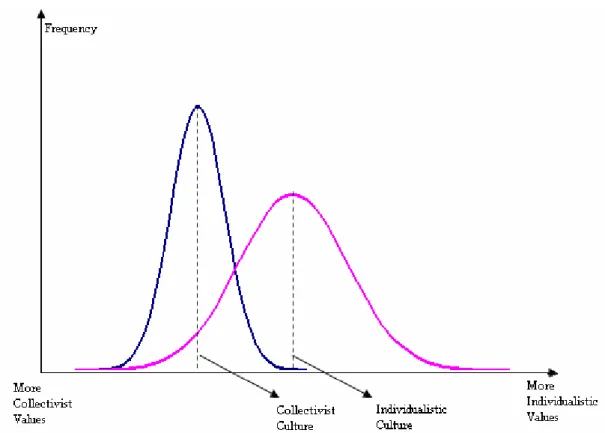
values. 44 Figure 9. Hypothetical distributions for two nations on individualism versus
collectivism dimension. 48
Figure 10. An example of a meaning collection 69
Figure 11. An example of a meaning collection 69
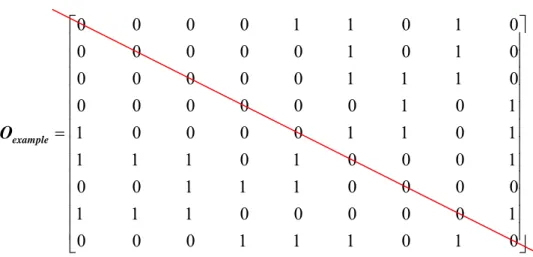
Figure 12. Relationship between symbols and meanings 73 Figure 13. Undirected graph representation an opposition relation. 75 Figure 14. Symmetric matrix representation of an opposition relation. 75 Figure 15. Graph representation of an opposition relation and its complement. 80
Figure 16. A clique. 81
Figure 17. The statistical framework. 99
Figure 18. Frames of a social research with statistical models. 100 Figure 19. Frames of a social research with simulation models. 101
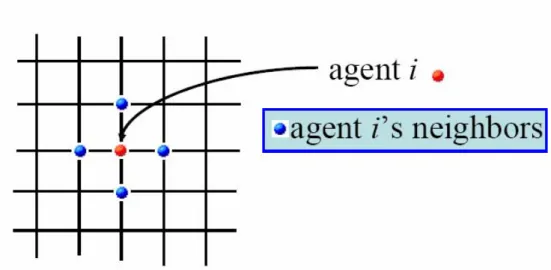
Figure 20. A cellular automaton model. 104
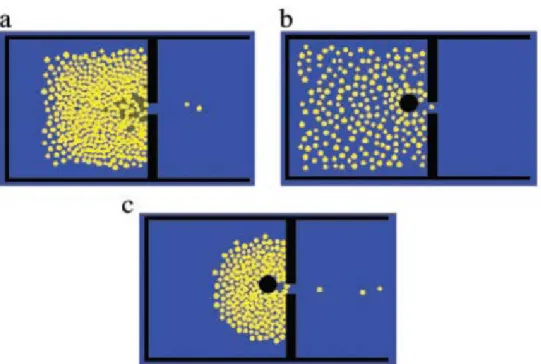
Figure 21. Instances from the simulation run of the model developed by Helbing et
al. 106 Figure 22. Representation of features and traits in Axelrod. 107
Figure 23. Representation of agents with heterogeneous cultural traits with color
codes in Axelrod. 107
Figure 24. Distributions of the agents in the initial step of the simulation run in
Axelrod. 108 Figure 25. The meachanism of the simulation of Axelrod. 108
Figure 26. Initial state and the final stable states of the simulation run in Axelrod. 109 Figure 27. The initial state of the Ethnocentrism simulation of Hammond and
Axelrod. 112 Figure 28. The ethnocentrism simulation of Hammond and Axelrod after 1000 steps.
112 Figure 29. The dynamic of ethnocentrism simulation of Hammond and Axelrod. 113
Figure 30. Habitat in THESIm. 119
Figure 31. A sample of oppositions relations used in THESIm. 122
Figure 32. Random matrix of agents. 125
Figure 33. Distance between agents. 126
Figure 34. Preparation of distance adjusted random matrix. 128
Figure 35. Simulation modeling process.. 133
Figure 36. Modeling process of THESIm. 134
Figure 37. Clustering of codes of MÜSİAD members. 144
Figure 38. Clustering of codes of TÜSİAD members. 145
Figure 39. Binary Opposition Relation of MÜSİAD members. 147 Figure 40. Binary Opposition Relation of TÜSİAD members. 148
xi
Figure 41. Run diagram of THESIm. 153
Figure 42. Opposition relation over the set of symbols. 154 Figure 43. An arbitrary binary opposition relation in Generate Globals module. 155
Figure 44. Run diagram of Immigration Module. 158
Figure 45. Run diagram of initial interactions module. 160 Figure 46. Run diagram of Recorded Interactions Module 164
Figure 47. Interaction network of strong ties. 168
Figure 48. An interaction network with both weak and strong ties. 169 Figure 49. The number of interactions between agents in THESIM versus simulation
steps. 170
Figure 50. Closure in triads. 175
Figure 51. Scatter plot of cultural coherence versus number of triads. 178 Figure 52. Scatter plot of minimum cultural coherence versus number of triads. 179 Figure 53. Graph of a value function according to Tversky and Kahneman. 216
Figure 54. Graphs of weight functions. 218
Figure 55. The individual as information processor framework. 219
Figure 56. Visions of rationality. 222
1
CHAPTER 1
INTRODUCTION
Traditional economic thought optimize efficiency by accessing the market
information and by averting situations that interfere with unilateral action and add needless coordination costs to interfirm exchanges (Granovetter, 1985; Uzzi, 1996). Later revisions to the theory, particularly within game theory setup, have made additions to these principles. Bounded rationality and imperfect information can cause the definitive efficiency of markets to be displaced by hierarchies or hybrid organizational forms (Uzzi, 1996). However these forms neither increase efficiency nor coordinate transactions or eliminate malfeasance.
On the other hand, social network theory assess that embeddedness shifts actors’ motivations away from narrow pursuit of immediate economic gains to the enriching of relationships through trust and reciprocity (Powell, 1990).
Embeddedness approach combines organization theory with social network theory by focusing on the structure of social relations and argue that social ties among actors, individual or collective, shape economic action by creating unique opportunities and access to those opportunities. Thus social organizations and social relations are introduced into the analysis of economic systems not as a structure that pops up into place to fulfill an economic function, but as a structure with history and continuity that give it an independent effect on the functioning of economic systems (Coleman, 1988).
Unlike oversocialized views (Wrong, 1961), embeddedness approach does not attribute all motives of action to the structure. The concept of social capital
2
clarifies the role of embeddedness in this respect. Social capital has two principle characteristics. First, it is a collection of entities that consist of some aspects of the social structure. Second, social capital facilitates certain actions of actors. “Like other forms of capital, social capital is productive, making possible the achievement of certain ends that in its absence would not be possible.”(p: 98, Coleman, 1988). However unlike other forms of capitals, social capital is recorded in the structure of relations between and among actors. Consequently embeddedness is the source of social capital which is an independent resource to attain certain goals.
Today the literature in embeddedness studies is vast. Studies focus on different aspects of embeddedness and successfully relate social phenomena to topological properties of the social structure. However, the constitution of
embeddedness is neglected to a large extent (Burt, 2007) which define the objective of this dissertation.
Inspiring from Coleman (1988) and DiMaggio (1994), this thesis seeks the cultural roots of embeddedness. Yet culture itself is a vague concept and if one is attributing a social phenomena (in this case embeddedness in social networks) to culture then this claim can only be tested within a cultural framework. In this regard the initial step of this thesis is to decide on and verify a cultural framework and develop a cultural model to analyze and interpret the constitution of embedded social networks.
In order to set the stage for the formal statement of the research question, Chapter 2 defines the embeddedness concept. Current literature in embeddedness subsumes two major interpretations; embeddedness according to Polanyi (1957) and embeddedness with respect to Granovetter (1985). Due to the fact that the model developed in this thesis is applicable to both interpretations, the next chapter starts
3
with a review of Polanyi and Granovetter, respecting the chronological order of these works and then compares and contrasts these perspectives. Recent literature has also benefited from the cataloguing of embeddedness studies introduced by Zukin and DiMaggio (1990). According to them embeddedness can be studied under four largely overlapping catalogues: structural embeddedness, political embeddedness, cognitive embeddedness and cultural embeddedness. Second chapter also reviews some representative studies in each of these catalogues.
Since culture plays such a crucial role in this setting, most of Chapter 3 is devoted to a literature review on culture studies that are focused on social action. Indisputably, Parsons’ (1951) Voluntaristic Theory of Action is the first instrumental cultural model of action. However this model has been severely criticized for its various shortcomings. Geertz’s (1973) interpretation of culture as system of symbols demonstrates a completely different perspective of culture. Similarly, Bourdieu developed yet another distinctive interpretation which is called culture as practice. While anthropologists accepted Geertz’s view and pursued “thick” form of culture studies, sociologists preferred Bourdieu’s (1978) culture as practice view as an inheritor of Parsons. Both of these perspectives have their own unique advantages in explaining cultural phenomena. Recent literature on culture studies underscores various advantages that can be obtained from a merged framework. After Swidler’s (1986) first attempt in merging symbol and practice views of culture in her culture as a toolkit approach, Sewell (1999) developed a framework with a deconstructionist stance in which both symbol and practice views of culture can be elaborated in coherence. Cultural theories of action have been reviewed in Chapter 3 by
4
the synthesis section, it is argued that Sewell’s perspective of culture is the ideal framework to develop a model to study the objective of the thesis.
In order to develop a model to study the objective of the thesis, Sewell’s cultural framework is formalized in Chapter 4. This formalization involves defining binary opposition relations over the set of symbols and describing the association between meanings and symbols. In this chapter it is argued that the model needs to be developed as a social simulation.
Chapter 5 reviews the social simulation literature. Simulations provide
naturalness as an ontology or representational formalism of social sciences. Since the qualitative data can be blended within the methodology, simulations make extensive use of enormous amount of data and knowledge expressed in verbal representations about the behavior, motivations, and relationships of social actors. Also, in contrast to mathematical formalism, social simulations do not necessarily use this information for aggregation purposes but rather exploit the dynamics of the system which is the main focus of many social sciences (Bankes, 2002). In this chapter two simulation models that are closely related to the simulation model in this thesis are discussed.
Chapter 5 also introduces the model to study thesis objective. “THESIm” is a social simulation governed by the principles described in Sewell (1999) and
formalization Chapter 4.
Credibility of simulation models depends on both the correctness of the model and accurate formulation of targeted social phenomenon (Balci, 1994). Sargent (2004, 2005) argues that the model development process in simulation studies involves conceptual model validation, computerized model verification and finally operational validation. In Chapter 6, conceptual model validation is
5
embedded businessmen associations in Turkey, TÜSİAD and MÜSİAD, and second, by comparing this opposition relation with the findings from the literature.
Computerized model verification requires an in – depth analysis of the components of the simulation. Operational validation requires comparing the outputs of THESIm with the characterization of social network structures in the literature.
Chapter 7 analyzes the formation of embedded social networks using the outputs of the social simulation model developed over the cultural framework defined by Sewell (1999). This chapter also involves statistical analyses of these outputs in order to achieve a conclusion in the objective of this dissertation.
Chapter 8 concludes with summarizing the perspective established in this thesis to reach the objective, findings, limitations, future research, and theoretical and practical implications.
6
CHAPTER 2
EMBEDDEDNESS
Organization theory has developed as a conceptual-analytical knowledge base that is empirically driven and integrating in character (Scott, 1961). Due to this character, predisposition of organization studies towards more contextualized approaches is still the rising trend. In this respect, theorists and researchers have engaged
“embeddedness” arguments to identify new frameworks, new variables of interest and new opportunities for multi-level analysis (Ducin et al., 1999).
The concept “embeddedness” refers to numerous perceptions and uses just like many other key concepts in organization theory such as structure, culture, incentives, and power. In a very brief description, embeddedness corresponds to the social context that limits, stabilizes and describes the purposive behaviors of
economic actors. Embeddedness is not a theoretical construct; on the contrary it is an observed social phenomenon that has been largely ignored by economic theories that describe and/or prescribe behaviors of actors.
In order to set the stage for the formal statement of the research question, this chapter defines the embeddedness concept. Current literature in embeddedness subsumes two major interpretations; embeddedness according to Polanyi (1957) and embeddedness with respect to Granovetter (1985). Chapter starts with a review of Polanyi and Granovetter, respecting the chronological order and then compares and contrasts these perspectives. Recent literature has also benefited from the cataloguing of embeddedness studies introduced by Zukin and DiMaggio (1990). According to them embeddedness can be studied under four largely overlapping catalogues:
7
structural embeddedness, political embeddedness, cognitive embeddedness and cultural embeddedness. This chapter also reviews some representative studies in each of these catalogues. The objective of this thesis is formally declared in the synthesis section of this chapter. In this section it is also explained that the development of a model that tests the objective of this dissertation stipulates a factor which introduces heterogeneousness to actors that interact in a social network. A previously mentioned endogenous variable, culture is manifested as an exogenous factor that initiates embeddedness.
Embeddedness Defined by Polanyi
The term embeddedness has been introduced1 to social science literature by Karl Polanyi in his classic work “The Great Transformation [1940]” (Granovetter 1985). Polanyi starts with criticizing traditional economic thought referring to Malthus and Ricardo who define the economy as an interlocking system of markets that
automatically adjust supply and demand through a price mechanism. He used the word “embeddedness” for the first time to express the idea that classical or neoclassical economy is not and can not be self-adjusting or in other words autonomous as it is dictated in economic theory but rather is governed by politics, religion and social relations (Block, 2001, 2003).
1 Literature shows that the concept of embeddedness had also been discussed by Weber and Merton
before Polanyi (Ghezzi and Mingione, 2007; Zukin and DiMaggio, 1990; Brinton and Nee, 1998). In this thesis I consider embeddedness term referring to its consequences not to its literal occurrence, thus it would be more appropriate to start with Polanyi for two reasons; first, contemporary literature attributes the concept of “embeddedness” to Polanyi (Granovetter 1985, p.9) and second it was Polanyi who offered a methodological approach in social studies (Rodrigues, 2004; Ghezzi and Mingione, 2007).
8
The basic theme behind Polanyi’s (1957) argument is the distinction between two meanings of economy”, formal meaning and substantive meaning. Formal meaning of economy refers to the autonomous, price-making market system in which all goods and services including labor, land and capital are available in the market with a corresponding price. Substantive meaning of economy, on the other hand is an instituted process that derives from, “…man’s dependence for his living upon nature and his fellows. It refers to the interchange with his natural and social environment.” (p.29)
According to Polanyi (1957) substantive concept is the empirical economy. He states that the empirical economy is “embedded” and enmeshed in institutions, economic and noneconomic. The embeddedness is crucial since economy needs unity and stability which is only achieved through “interdependence and recurrence of its parts” (p.35), that are; reciprocal exchange, redistributive exchange and market exchange. Reciprocity is the collective interests of small groups that have close relationships. In reciprocal exchange, sharing among individuals is common and group interest prevails over immediate self interests. Redistribution refers to membership to a large society in which resources are controlled by a legitimate authority such as the state. Market exchange refers to classical and neoclassical economists’ definition of exchange where economic agents are supposed to be rational decision makers.
Polanyi (1957) states that market exchange is socially disrupting because it exists independent of any type of social relationship and guided by universal rules of the game that are not “natural” in essence. In this respect reciprocal and
redistributive exchanges are embedded in but market exchange is disembedded from the society. The power Polanyi attached to the concept “embeddedness” makes it
9
possible to explain the co-existence of market exchanges and social order (Ghezzi and Mingione, 2007).
I present an example in order to clarify how embeddedness concept can be used for this purpose. In modern life, market sets the wages within the logic of a competitive relationship of supply and demand of workforce. This is where market exchange takes place. Now, first consider with respect to pure market exchange logic what happens to a worker that becomes disabled after a work accident and who would not be able to work anymore. In market exchange logic, the employer would obviously fire him as the disabled worker would make no benefit to the company anymore and/or decrease efficiency. However the disabled worker needs to satisfy his (increased) needs or maybe also his family’s needs. Meanwhile, when that worker is fired, other workers in that company would obviously get frustrated as a similar situation might occur for them. Clearly such a problem is unsolvable within market exchange logic. According to Polanyi, this is called disembeddedness. As a response (re-embeddedness) the adaptation process initiates through which solution external to market mechanism is traced. For instance that disabled worker might ask aid from his close relatives or neighbors (kin-network) that initiates reciprocal exchange. Alternatively, if it exists, he could make use of health insurance and/or healthcare opportunities institutionalized by the state or by the workers’ union that might have initiated to solve such issues which implies a redistributive exchange.
Hence within the embeddedness framework, it is possible to explain the different orientation of social and economic actors. According to Ghezzi and Mingione (2007),“In fact, the institutional configuration of (kinship) organization continues to be an important dimension of all contexts of industrial societies (in contrast with utilitarian assumptions)” (p.20).
10
This definition of embeddedness is usually applied by anthropologists that belong to the “substantivist” school and by scholars from organization studies that used path analysis techniques to elaborate on the discriminated institutional forms and their emergence across nations (Granovetter, 1985; Ghezzi and Mingione, 2007).
Embeddedness with Respect to Granovetter
In his widely cited work Granovetter (1985) challenged the utilitarian interpretation of economic action by borrowing embeddedness concept from Polanyi, but departed from him to a great extent by opposing the political dimension of the concept. Understanding Granovetter’s claims requires following his constructive logic in which he ends up with challenging the disembeddedness character of market exchanges2 and proposes conceptualizing economic behavior as embedded within social relations in some particular forms.
Granovetter starts with criticizing the under-socialized view of economic behavior. He argues that this tradition, by hypothesis leaves no room for any impact of social structure and social relations on production, distribution or consumption. According to classical and neoclassical tradition, human action is strictly atomized and functions without the requirement of any contact between parties under the rules of perfect competition.
Highly influenced with Dennis Wrong’s (1961) arguments, Granovetter defines over-socialized perspective, as actors that unquestioningly obey rules and
11
norms dictated by the society3. Furthermore, over-socialized individuals are essentially motivated by the desire to achieve a positive image of self by winning acceptance or status in the eyes of others. According to Granovetter, in over-socialized conceptions of economic behavior in modern sociology - which is in principle the anti-thesis to economists’ interpretation – society influences individual behavior in a mechanical way. He argues that “…once we know the individual’s social class…,everything else in behavior is automatic, since they are so well socialized.” (p.57).
Granovetter stresses that this property inferred from the definition of over-socialized individual behavior implies that social relations completely determine human actions and therefore paradoxically, “…he or she can be atomized as any
Homo economicus, though perhaps with different rules of decision making” (p.57).
In this manner the anticipated contrast between under and over-socialized views of economic behavior actually have a common conception of action and decision making that both refers to atomized actors. Granovetter used this important conclusion as a preliminary result to emphasize the failure of both views on
explaining “trust” issue in economics. In this respect, Granovetter refers to Hobbes’s concerns over the tension that leads to disorder; “conflict-free social and economic transactions depend on trust and malfeasance” (p.55). Hobbes’s solution was to superimpose a structure of authority. On the other hand the explanation of classical and neoclassical economy “…, is antithetical: repressive political structures are rendered unnecessary by competitive markets that make force or fraud unavailing” (p.56). This, in practice, depends on the free-mobility assumption in economics. However, according to Williamson (1981), solving “trust” issue by referring to
3 Wrong’s (1961) work covers not only a critique for over-socialized individual but also the
preliminaries of Granovetter’s embeddedness argument. Wrong emphasizes the role of individual and
12
mobility axiom is infeasible due to frictional costs. Unless there exists intrinsic motive(s) against malfeasance or for sustaining trust, atomistic self-interested actor assumption would imply that economic behavior embraces search for opportunism. Granovetter emphasizes this point,
What has eroded this confidence in recent years has been increased attention to the micro-level details of imperfectly competitive markets, characterized by small number of participants with sunk costs and specific human capital investments. In such situations, the alleged discipline of competitive markets cannot be called on to mitigate deceit, so the classical problem of how it can be that daily economic life is not riddled with mistrust and malfeasance has resurfaced (p.59).
Institutional economists offers a solution emphasizing that institutions, once thought to be spurious, are actually efficient solutions to certain economic problems, for example the trust issue. Granovetter argues that these institutions are not sources of trust but rather they functionalize trust through contracts. He stresses this point first by noting that the individual would then develop “ever more ingenious attempts at deceit” (p.60).
The answer from the over-socialized view is in the similar tone of new institutional economists’. Granovetter refers to Schotter’s (1981: cited from Granovetter, 1985) proposition that the presence of an institution implies the
existence of the evolutionary problem that caused the particular institution to emerge. But if their power lies in their taken-for-grantedness in the sense that they are
inefficient solutions to problems of coordination then actors would unveil their arbitrary character and jeopardize their sway (DiMaggio, 1994). In this respect any attempt that refers to atomistic conception of the individual is doomed to failure.
After pointing out the weaknesses of intrinsically atomistic conceptualization of both under-socialized and over-socialized views of economic behavior and thus setting the stage for the necessity of a new point of view, Granovetter offers an
13
alternative unit of analysis. For this purpose he borrows the embeddedness concept from Polanyi and states that economic agents can not be isolated from their concrete relations in economic life. These relations, in the form of networks, serve as proxy for trust by developing the necessary infrastructure for discouraging malfeasance. The dual interpretation is that, embeddedness of economic agents in relations is the source of trust4.
He refers to Prisoner’s Dilemma arguments and provides various examples from social and economic life to stress the trust generating role of social relations. An example is about human behavior in a burning theater panic. In such a case the typical behavior is a rush to the door, which he states is quite rational and refers to Roger Brown’s (1965: cited from Granovetter, 1985) analysis that the case is actually an n-person Prisoner’s Dilemma5. Since no one has the guarantee that everybody will walk out calmly - a strategy best for all - it is perfectly rational for each of them to rush. However such a case would not happen for a burning house, because family members are tied with close relationships and each is confident that the others can be counted on. In business life same argument prevails although with quite volatile confidence levels.
4 Granovetter warned that this does not imply that there will be no malfeasance within networks.
Networks are the necessary structures for the emergence of trust, not the sufficient for trust to prevail. 5
“n-person” Prisoners Dilemma is the generalization of standard Prisoners Dilemma game played by two players where each player has to choose one of two available strategies. Available strategies are {Defect, Cooperate}. If a player selects Defect while the other selects Cooperate, defecting player gets a huge payoff and the other gets very small payoff. If both players select Cooperate, both get moderate payoffs. If both players select Defect, both get small payoffs. In a single round of the n-person Prisoner's Dilemma game, n players simultaneously choose an action, cooperate or defect. Depending on the number i of others cooperating, you receive the score V(C | i) when you cooperate and the higher score V(D | i) when you defect. The scores V increase with an increasing number of cooperators, and also the total score given to all players increases if one player switches from defection to cooperation.
14
Granovetter continues by criticizing “markets and hierarchies”6 of Oliver Williamson (1975: cited from Granovetter, 1985) frequently referring to the embeddedness concept. In order to keep the focus on “embeddedness” and the meanings attached to the concept, it would be more fruitful to carry the discussion onto elaborating the main differences between Polanyi’s and Granovetter’s concepts.
Elaborating Polanyi and Granovetter
According to Polanyi, social relations are epiphenomenon of the market, and market and social stability is sustained within a dynamics of disembeddedness and re-embeddedness in modern societies. Polanyi arrives at this point by arguing that in pre-capitalist societies, markets’ role was secondary. Economic transactions were controlled and regulated by social authority which was embedded in society. Main forms of exchange (integration) were reciprocity and redistribution (Rodrigues, 2004). However during the nineteenth century, market pattern expanded and became the dominant form which caused reorganization in social life and hence initiated disembeddedness and thus necessitated re-embeddedness.
Granovetter totally disagrees with Polanyi on the role of the market in pre-capitalist societies. Referring to anthropology literature, he stresses that even in tribal societies, economic behavior was sufficiently independent, yet it was still embedded as it is in modern societies (Swedberg, 2004). In this respect attributing a
6
Markets and Hierarchies approach or transaction cost analysis (Williamson, 1991) is about bounded rational economic agents that act opportunistically. These agents establish organizations in order to minimize transaction costs with regard to frequency, uncertainty and demand specificity of the transactions. Stated otherwise, organizations are formed to provide solutions for specified needs that markets fail to satisfy.
15
disembedding role to economic behavior and apprehending it in a differentiated sphere out of the society is not necessary and/or cannot be justified.
According to Polanyi, market exchange mechanism requires purely rational individuals that act according to rational decision making processes (Polanyi, 1957: p. 31-32) which is totally inline with classical and neoclassical economist view. On the other hand, Polanyi states that a rational decision maker motivated with self – interest is not “natural” to man and causes diversified processes of disembeddedness (Polanyi, 1957; Block, 1990; Ghezzi and Mingione, 2007). The logic behind this argument rests on Polanyi’s distinction between real and fictitious commodities. Real commodity is produced through a process and can easily be attached a price.
Fictitious commodities are land, money and labor. Labor simply means the actions of the individuals. According to Polanyi, individual actions that were once embedded in social life through collective consciousness, used to be in harmony with individual faculty in pre-capitalist societies. Commodification of labor within a market
mechanism has an interfering effect on this harmony by virtually splitting the action from the faculty. Consequently, Polanyi argues that the embedded character of economic agent possess stable traits unless there is an exogenous impact which would trigger a re-embeddedness process in search for stability in the new “state of nature”.
Granovetter’s stance on individual decision making is completely different. Rational decision making individual is compatible with his setup7. The emphasis on
7 Prisoner’s Dilemma arguments discussed in this section. Also, Granovetter (1985) states that
“…they (rational choice arguments) are inconsistent with the embeddedness position presented here. In a broader formulation of rational choice, however, the two views have much in common.” (p. 74). Models of rationality and rational choice have progressed considerably in economics. For example Field (1984) discusses game theoretic situations that may end-up with norm like behaviors and emergence of trust. Game theory is particularly useful in describing individual choices within constrains, however as Nee (1998) points out game theory does not attempt to explain the sources or the dynamics of these constraints. According to Nee, these constraints can only be defined over an
16
Granovetter’s setup is on the empirical specificity of the structures of relations, namely networks. According to Granovetter (1985) networks do not only decrease transaction and information cost but networks are also instruments that generate many outcomes one of which is trust that prevents widespread8 malfeasance. Another way to read Granovetter’s thesis is that there is a causal link between actors’
entanglement in networks and their behaviors and actions. This unfolds the implication that, Granovetter9 actually offers an action model that belongs to the intersection of logic of appropriateness model of action and logic of consequentiality model of action defined by March and Olsen in (1998) 10. Logic of consequences refers to the choice of an alternative with respect to its expected consequence(s) that would provide optimum benefit or in other words the logic of rational action. On the other hand logic of appropriateness implies that individuals behave according to their identities specified by the context and obey the rules dictated by the institutions. As March and Olsen points out these rules of actions are not mutually exclusive and any particular action probably contains elements from each. Granovetter (2001) later clarifies this point:
Most sociologists have veered away from theoretical argument based on actors’ shared value commitments because of the excess of mid-twentieth century sociology. This view, which has been called over-socialized (Wrong, 1961; Granovetter, 1985), leaped from observing that such commitments were a significant force in social life to the conclusion that all social action flowed from them. The opposite extreme is to imagine that moral sense about the integrated framework of the totality of societal relations, like a framework which Granovetter offers. In this respect rational decision making used in game theory is compatible with Granovetter’s embeddedness. Nee (1998) has a similar position in defining context-bound rationality.
8 This point once again refers the necessity but not sufficiency of networks for trust. Granovetter
(1985) notes that:
“But I then risk rejecting one kind of optimistic functionalism for another, in which networks of relations, rather than morality or arrangements, are the structure that fulfills the function of sustaining order, the embeddedness position is less sweeping than either alternative argument, since networks of social relations penetrate irregularly and in differing degrees in different sectors of economic life, life, thus allowing for what we already know: distrust, opportunism, and disorder are by no means absent.” (p.61)
9 Pages 74-75 in Granovetter (1985).
17
economy is entirely subordinated to and derivative from some teleological quests for efficiency pursued by social systems, so that observed norms, though admitted to be important, can be assumed to have been selected out for their economic efficiency. The time has come to find a balanced account, to acknowledge the importance of such norms and conventions, while fitting them into a broader frame of social theory. (in press).
Amid the emergence of institutions and their embeddedness in social life,
Granovetter’s and Polanyi’s interpretation once again diverge. According to Polanyi, institutions are residuals of disembeddedness and re-embeddedness processes that are driven by adaptation and evolutionary dynamics. Obviously this formulation refers to institutions in modern capitalism era within which, as Polanyi stresses, economic institutions emerged due to deliberate political interventions (Block, 2000). Furthermore, same dynamics and processes (re)shape and explain the changes in existing institutional forms also. Polanyi claims that all institutions except for market itself are embedded in social life, are natural, and are byproducts of adaptation11.
Following Granovetter’s logic on the spread of trust in networks of actors and his argument:
…the long-term relations of contractors and subcontractors, as well as the embeddedness of those relations in a community…generate standards of expected behavior that not only obviate the need for but are superior to pure authority relations in discouraging malfeasance. (p.67)
It can be deduced that institutions can be defined as a network of networks –formal or informal- governing social relationships. Accumulating Granovetter’s ideas on embeddedness, this definition serves the function of reducing costs and increasing efficiency. Yet, it appears that the embeddedness framework defined by himself, was not sufficient for Granovetter to embrace institutions. Although Granovetter did not
11 Formal institutions have a special dual role for Polanyi, but concepts related to political
18
explicitly associate embeddedness to institutions in his 1985 article12, he proposed this association in his “Nature of Economic Relations” (1992) (Nee and Ingram, 1998). Here, Granovetter shifts the unit of analysis from network structure to behavior of individuals by arguing that institutions are results of actions taken by socially situated individuals, embedded in networks of personal relationship with non-economic as well as economic aims. Nonetheless, neo-institutionalist
sociologists credited Granovetter (1985) by defining institutions as a web of
interrelated norms that regulate networks to produce group performance and stability (Nee, 1998: Nee and Ingram, 1998).
As a conclusion, concepts of embeddedness followed from Polanyi’s and Granovetter’s arguments diverge in several fundamental respects that have been discussed in this section. Polanyi provides a socio-historical perspective that permits a clear explanation for the emergence and roles of institutions. In this explanation, embeddedness refers to a dynamic process that reshapes the structure of the society. Due to this characteristic, Polanyi’s setup is compatible with the principal law of nature, adaptation. Last, but not least, Polanyi’s arguments have a political
dimension. He insists that supply and demand of the fictitious commodities in actual market societies must be managed through political processes (Block, 2001).
Granovetter’s embeddedness is rapidly associated with a formal framework borrowed from graph theory and has been transformed into a prescriptive body widely applicable in organization theory and particularly in strategic management through new concepts like structural holes (Burt, 1992), cliques, coupling and decoupling (White, 1992: cited in Granovetter, 2001). According to Granovetter, embeddedness refers to structure of social relations, which he conceives as a stable
12 Granovetter does not explicitly refer institutions in his paper. “Institutions are largely bypassed in
19
trait. Granovetter’s framework is actually inappropriate for path dependence or dynamic studies, since in most if not all of the cases it would be impossible to interpret the deformation of the particular structure. In this respect, embeddedness defined in terms of Granovetter provides a solid snapshot of the society.
Correspondingly, the processes through which networks and bigger systems of social relations give rise to institutions and also in a similar vein the political aspects of behavior can hardly be explained by Granovetter’s embeddedness.
Contemporary Definitions of Embeddedness
Following Granovetter, embeddedness applications became a major stream through several social science disciplines including organization theory and strategic
management. Zukin and DiMaggio (1990) catalog contemporary embeddedness literature that grew in to a gigantic size into four forms: (1) structural embeddedness; (2) political embeddedness; (3) cognitive embeddedness; and (4) cultural
embeddedness.
Structural Embeddedness
Zukin and DiMaggio (1990) label structural embeddedness as the contextualization of economic action in social relationship patterns. Mainstream economic frameworks overlook the influence of social relation on economic actions when they assume that social ties affect economic behavior only minimally or reduce the efficiency of the price system (Knoke and Kuklinski, 1994; Uzzi 1996). Contemporary literature on
20
organization studies shows that embeddedness of organizations in social networks not only provides stability but also competitive advantage (Uzzi, 1996). To this end, network theory anchor social embeddedness research. For this purpose, a brief on basic terminology of network theory is required to review some influential
applications of social embeddedness concept in organization theory.
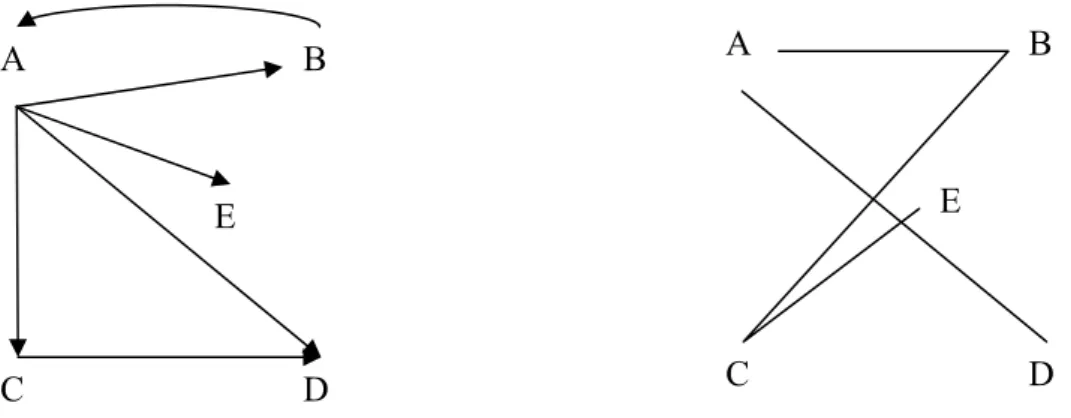
Relations –also called links or ties- are the building blocks of the networks which are basically dyadic mappings over the Cartesian product13 of the set of agents –also called nodes. Different types of relations identify different networks, even when implemented over the identical set. Relations such as partnership when defined over the Cartesian product of a set of organizations is symmetric in the sense that if for organizations A is a partner of organization B then the reverse is also true. On the other hand, relations that refer to superiority in status are asymmetric in nature. In this respect relations are either displayed by arrows or simply by lines corresponding to the type of the relation (Figure 1)
Figure 1. Graph on the left represents an asymmetric relation between nodes. Graph on the right represents a symmetric relation between nodes.
Structural embeddedness analysis over the network topology is typically carried over either one of four levels (Knoke and Kuklinski, 1994). The simplest level is the
13 Relations are defined over dyads of agents.
A B C D E A B C D E
21
egocentric network. Egocentric networks consist of a single node and its relations to other nodes. A typical example of research performed at this level has been
established by Podolny (1993, 1994). Through an analysis of egocentric networks, Podolny (1994) found that the status of the organizations in the market is an
important criterion in engaging exchange relationships in order to offset uncertainty. In this work, Podolny focused on primary securities markets in which investment banks serve as teams of underwriters for corporations and governmental agencies desiring to raise capital. He used the data that contains distribution of the offerings across banks. Particularly important for this dataset is that, investment banks are categorized with respect to an implicit hierarchy in terms of status in the market. Data is loaded into a relational matrix and hence the network structure is obtained. He used a centrality measure to construct a status index for all investment banks and associated the number partnerships with the status for each pair of banks.
Second level of analysis in structural embeddedness research is the analysis of dyads, formed by a pair of nodes. The focus of this analysis is the effects of absence or presence of links within dyads within the context of interest. For instance, Gulati (1995a, 1995b) studied the formation of interorganizational alliances within the context of prior alliances between firms. Alliances, direct or indirect, create a social network in which organizations are embedded. According to Gulati, this network structure contains valuable information to learn about new tie opportunities. His study is based on a longitudinal data in order to observe emergent network structures and results are reported for the relationships of pairs of organizations (dyads) not for the whole structure. Nevertheless, some of the hypotheses developed and tested in his study represent genuine efforts of employing structural
22
influence of indirect paths between two firms on the probability of forming a new alliance with each other. This is in essence a transitivity property and controls for the flow of information within the network. Gulatti reports that, networks of alliances indeed, at least for his database, satisfy transitivity property.
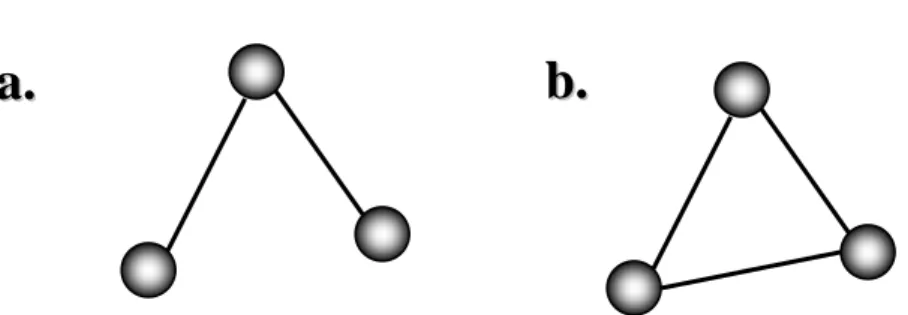
The most important level of analysis is the complete network. In this level, topologic properties of the network is associated with relevant characteristics of the context. Relative positioning of agents sometimes give rise to positionings that have strategic superiority for an agent or a group of agents. In this respect the concept of “structural role” is widely studied after Burt (1992). Structural holes correspond to positions that link actors that are not linked otherwise. In Figure 2, E is a structural hole for agents A and B and also for A and [C, D] and for B and [C, D]. On the other hand the concept “clique” refers to a group property. A clique is a subgroup of agents that are tied to each other and is not a proper subset of another clique. In Figure 2, [C, D, E] is a clique. Other than “structural hole” and “cliques”, researchers developed various indices to summarize structural properties of a network. These indices are basically used as a proxy to measure density, centrality and betweenness of a network or a subgroup of a network.
Figure 2. E is a structural hole for agents A and B and also for A and [C, D] and for B and [C, D].
A B
C D E
23
Political Embeddedness
Political embeddedness refers to the political context defined by the factors that influence the interaction of corporate actors and overall industry dynamics (Murtha et al., 1996; Barnett and Carroll, 1993; Hardy et al., 2005). The influence of political embeddedness can take diverse forms such as impact on the probability of profit from technological innovation via administrating patent policies (Murtha et al., 1996) to tax laws and government procurement policies that affect the emergence or
sustainability of national industries (Zukin and DiMaggio, 1990). Additionally, political embeddedness also points to the complex network of interrelations on competing macroeconomical claims and expectations.
Political embeddedness in the largest sense explains how power relations within society, institutions and across borders shape economic exchange and stratify rewards among economic actors (Tzeng and Uzzi, 2000; Hardy et al. 2005). In this sense, political embeddedness research follows Polanyi’s idea in the framework of Granovetter such that the institutional settings, states and other political institutions provide a socially constructed framework of formal rules, regulations and even certain identities.
Welch and Wilkinson (2004) offer a taxonomy for political embeddedness that consist of four dimensions: political institutions, political actors, political activities and political resources. Political institutions are rule and regulation setters and therefore can be identified with ideological dimensions. Political actors are the members of political institutions such as political parties, bureaucrats, ministries, universities, media, interest groups, business groups, and organizations. Political
24
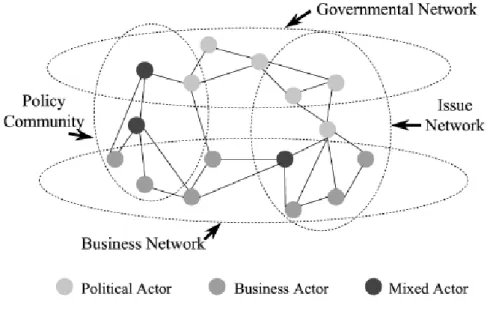
activities are the actions and interactions of political actors. In this respect, economic activities that have nationwide consequences have also political remainders and hence considered under political activity dimension. Finally the last dimension is the political resources. The list is too huge to display here. Any means that has the potential to provide benefit belongs to this topic: information, regulations, rules, flow of capital, tax, quotas, licenses, and many more. The conceptual chart represented in Figure 3 is reproduced from Welch and Wilkinson (2004) in which they have
analyzed the activities of an international sugar producer corporation by case study methodology.
Figure 3. Reproduced from Welch and Wilkinson (2004). Interrelations of various networks.
There is no doubt that macroeconomic policies administered by the state have
immense effects in domestic markets and also depending on the size of the industries effects might be observed in global bases. While macroeconomic theory and the theory of finance study the dynamic relationship within the conflicting benefits of
25
economic actors, political embeddedness research focuses on how these conflicts have been resolved by extracting the relationships of the actors, national or international.
Cognitive Embeddedness
The concept of embeddedness is usually treated as synonymous with the notion that organizations and economy are related parts of a larger institutional structure and it defines the context that restricts the rational action (Baum et al. 2003). According to Zukin and DiMaggio (1990), cognitive embeddedness refers the ways in which the structured regularities of mental processes constrain behaviors of economic actors. These structured regularities have been studied under the domain of decision theory and cognitive psychology (Zukin and DiMaggio, 1990; Tzeng and Uzzi, 2000; Dequech, 2006). Results of these studies discredit rational choice theory by asserting the impossibility of the maximizing behavior due to cognitive incompetence and environmental constraints. For instance, Simon’s (1957) formulation of the
satisficing model of decision making lead the way for bounded rational theories to emerge which Zukin and DiMaggio directly associates with cognitive embeddedness. Bounded rationality emphasize four aspect of individual decision making process that distinguish from rational decision making (March, 1994): (1) Actors are limited in their cognitive capacities in both comprehending and interpreting knowledge; (2) Preferences of the actors are not necessarily exhaustive; (3) Agents do not maximize but rather satisfice or use readily available heuristics; (4) Agents are not anonymous. Their decisions are affected by their social status.
26
For instance, in his ethnographic study of embeddedness relationships on the exchange between manufacturers and contractors in the New York garment industry, Uzzi (1996, 1997) reports that embeddedness is a unique logic of exchange that results from both social structure and the microbehavioral decision-making processes they promote. On a microbehavioral level, actors follow heuristics rather than
intensely calculative ones for at least three reasons: (1) heuristics are decision making processes that economize on cognitive resources but do not necessarily jeopardize the quality of the decisions in terms of speed and accuracy; (2) heuristics are especially useful when uncertainty is high and decision cues are socially defined; (3) the embeddedness of information within networks is consistent with employing heuristics. Furthermore, Montgomery (1998) made an effort to formalize the class of heuristics that are compatible with Uzzi’s findings.
Another empirical work by Scharfstein and Stein (1990) outlines the tendency of financial analysts to imitate each other to extreme points of ignoring their own private information when it is inconsistent with the view of the majority. According to Scharfstein and Stein, this behavior pattern can be explained by referring to the fact that firing and promotion of analysts are based on their relative performance in the industry. Their research has been replicated in various regions and received extensive empirical support (Banerjee, 1992; Hong, Kubik and Solomon, 2000). In this respect, the reported behaviors of financial analysts are compatible with the idea of “reference points” and “framing effects” that are discussed in Prospect Theory (Kahneman and Tversky, 1979).
Another interpretation of cognitive embeddedness is the similarity in the representations, interpretations, and systems of meaning among firms (Nahapiet and Ghoshal, 1998; Simsek et al. 2003). Simsek et al. (2003) stated that there is a positive
27
association between structural embeddedness and cognitive embeddedness. Furthermore, as network closure increases so does the cognitive similarity among central actors. The basic motivation behind this statement is that common
socialization practices promotes interaction so that closed networks are more likely to develop a common sense of identity and shared mental models which shape their actions and interpretation of future events.
Porac and Rosa’s (1996) detailed analysis on strategic aspects of cognitive embeddedness over the networks of organizations that are linked to each other by rivalry ties provides an alternative explanation for the statements put forward by Simsek et al. (2003).
In order to set the stage for the strategic implications of cognitive
embeddedness, Porac and Rosa (1996) first explain their interpretation of market boundaries. They refer to White’s (1981) argument on market ambiguity and suggest that market boundaries are defined by market players themselves; hence market is actually socially constructed. In this sense, market players try to reduce market ambiguity by establishing a “frame of comparability” (Leifer, 1985: cited from Porac and Rosa, 1996) that includes some as members of the same market and excludes others. Consequently, markets consist of clique like groups of organizations who define each others as rivals. The intuition behind this according to Porac and Rosa is that, since information is too costly and hard to process, rather than extracting supply – demand relationship within an industry, market players try to establish protected domains that they can exploit monopolistically. Consequently, instead of dealing with tremendous amount of information which may also involve uncertainty, market players develop a framework for describing variations among firms. Using simple routines they discriminate boundaries of competitive markets. These routines can be
28
as simple as some taxonomic trees – a basic cognitive structure (D’Andrade, 1995). Then, the market player sets a position in the market for himself from the outcome of a trade-off between isomorphism and differentiation. Isomorphism is necessary to stay as a legitimate market player, whereas differentiation is required to find a market niche in order to act monopolistically.
Thus, Porac and Rosa (1996) and Simsek et al. (2003) bring incompatible explanations for the observation of clique like structures and shared mental models. In studies where embeddedness concept is used, relationships between agents are typically considered to carry a “positive” meaning such as exchange relationship or alliance. Consequently, network terminologies like centrality or structural holes are all based on this fact and interpreted accordingly. Actually, the very definition of “embeddedness” concept by Granovetter (1985) has been put forward to explain the “trust” issue. It has been previously stated that relationships in the form of networks, serve as proxy for “trust” by developing the necessary infrastructure for discouraging malfeasance. Hence ties necessarily carry “positive” meanings at least for one party. Furthermore, Porac and Rosa (1996) use the term “clique like” a couple of times in their article but they never discuss any relationship between market players within that “clique like” structure. A clique is a subgroup of agents that are tied to each other and is not a proper subset of another clique. In this sense, Porac and Rosa (1996) used “cognitive embeddedness” in the absence of “structural embeddedness” whereas Simsek et al. (2003) assumed “structural embeddedness” also. The disparity in their interpretations results from this fact.
29
Cultural Embeddedness
Zukin and DiMaggio (1990) define cultural embeddedness as collective
understandings that shape economic strategies and goals. For instance, culture limits market exchange of sacred objects such as human beings and body organs. Culture also sets limits to market exchange between ritually classified groups. Furthermore, in the form of beliefs and ideologies, culture guides strategies, legitimacy for particular class of actors.
According to DiMaggio (1994) economic processes have an irreducible cultural component that enriches the understanding of cultural phenomena. But culture would have an effect on economic processes if it varies within the population or across the time span studied. On the other hand, literature embraces several definitions for culture that prescribes distinguished analysis methodologies and interpretations. For instance the classical definition discriminates cognitive,
expressive and valuative aspects of culture such as beliefs about the physical world, emotionally laden symbols, and value orientations (Parsons and Shil, 1951: cited from DiMaggio, 1994). Another definition of culture underlines strategies or means rather than values or goals (Swidler, 1986). DiMaggio analyzes the effects of culture in production, exchange and consumption. Most relevant to the ongoing discussion is the constitutive and regulatory effects of culture on market exchange.
As the constitutive role of culture on market, DiMaggio cites Polanyi (1944: cited from DiMaggio, 1994) for adoption of the view that land and labor as
commodities had been a necessary shift for the evolution of self regulating market mechanism. In this vein, culture has evolved in tandem with market. For example,
30
financial institutions such as banks, insurance system, stock exchange markets require previously unfamiliar perceptions of risk that classifies economic agents according to their averseness for risk.
DiMaggio attributes emergence of institutions to the regularity effects of culture on markets. In this respect he reviews cross-national research that applied path dependence methodology and conclude that culture can explain the origins of distinct institutional forms in various national markets.
Furthermore, related to “structural embeddedness” concept culture has a regularity effect in the establishment of new ties between actors that had little previous contact. Coleman (1988) calls this effect as “social capital” of markets. Availability and understanding of cultural signals is the primary constituent of social capital. Actors typically make use of these symbols such as prestigious forms of knowledge or style or for example distinctive speech forms for interpreting one’s character or intentions (Bourdieu, 1986: cited from DiMaggio, 1994). Hence DiMaggio concludes with stating:
Without adding a cultural dimension to structural accounts of embeddedness, it is difficult to understand the negotiated, emergent quality of trust in many concrete settings, and the ability of entrepreneurs to construct networks out of diverse regions of their social worlds. (p. 39)
In a similar vein, Herrman-Pillath (2006) underlines the importance of “cultural embeddedness” and criticizes the heavy emphasis on using analytical tools such as transaction costs, rents and structural embeddedness to explain economic
phenomena. According to the author, even the meaning of these concepts in terms of their specific behavioral consequences is dependent on the cultural setting. In this respect the significance of cultural embeddedness is related with the role of collective action for a particular study. Consequently, there is no single relation