33 JOURNAL OF HEALTH SCIENCES
A. J. Health Sci. Volume 2 Supplement 1/ 2020, 33-36
Review
The Use of Therapeutic Ultrason in Control of Biofilm InfectionsSelma Sezgin1
1Institute of Health Sciences Microbiology Doctorate Training Program, Dokuz Eylul University, Izmir, Turkey
Abstract: The purpose of this study is to evaluate the effectiveness of the antibiofilm feature of ultrasound by compiling
researches on the use of therapeutic ultrasound in biofilm removal. The literature was scanned with the keywords “biofilm removal”, “therapeutic ultrasound”. Therapeutic ultrasound application can generate two possible bacterial responses, in the form of inducing bactericidal and bacterial growth. The bactericidal effect has been reported in different studies where high intensity occurs at low frequency, induction of bacterial growth occurs at low intensity and low frequency. For bactericidal effect with antibiofilm properties, ultrasound should be applied at high intensity and low frequency. The combined use of ultrasound with other methods, especially antimicrobials, ensures effective destruction of biofilms and prevents the development of antibiotic resistance.
Keywords: Therapeutic ultrasound; biofilm removal; antibiotic resistance; antibiofilm; microbubble; cavitation effect
Address of Correspondence: Selma Sezgin- [email protected] 0000-0001-6452-5613, Institute of Health Sciences Microbiology Doctorate Training Program, Dokuz Eylul University, İnciraltı Mahallesi Mithatpaşa Caddesi no: 1606 Balçova, Izmir, Turkey
1. Introduction
Biofilm is a form of living together by attaching to a surface or each other with exopolysaccharide (EPS) created by microorganisms themselves. The concept of biofilm was first expressed in Costerton’s studies (Costerton et al., 1987). Biofilm structure can be found on various surfaces such as water systems, living tissues, medical devices (Bayrakal and Baskın, 2018). Biofilms, it can show high tolerance against external threats such as mechanical stress, heat, UV radiation, disinfectants, antimicrobials and host immune system. Due to this tolerance, bacteria in a biofilm are a thousand-times more resistant to antibiotics (Mah, 2012). The National Institutes of Health (NIH) has suggested that 80 percent of human infections are related to biofilms. İn addition to this the Centers for Disease Control and Prevention (CDC) has announced that more than 65 percent of infections, transmitted from the emergency clinic, are inferable from biofilms (Percival, 2017). Various hypotheses describing antimicrobial resistance mechanisms in biofilm are presented in Figure 1A and 1B (Harrison et al., 2005; Stewart, 2001). Negatively charged EPS
34
The Use of Therapeutic Ultrason in Control of Biofilm Infections
ties to positively charged antimicrobials. EPS blocks phagocytosis and complement activation (Percival, 2004). Antimicrobials are significantly more effective against fast growing cells. Microorganisms in the depth of the biofilm grows slowly because they are exposed to low oxygen and supplements. So, they can escape antimicrobial effects. Intercellular signals change the physiology of the biofilm, allowing bacteria to produce molecular pumps that pump out antibiotics. Persister cells do not grow in the presence of antibiotics, however, the drug is removed, causing a normal bacterial colony. Genetical and physiological variety allow a few cells to endure.
Figure 1. Antimicrobial resistance mechanisms in biofilm (Harrison et al., 2015; Stewart, 2001)
Biofilm removal can be provided by physical, chemical and biological methods. Treatments such as heat shock therapy and ultrasound are physical methods. Enzyme treatment such as proteases and nuclease to EPS are examples of the chemical method. In the biological method, bacteriophages are used. Bacteriophages by multiplying inside biofilm bacteria disrupt the biofilm. Combined use of biofilm removal methods with antibiotic treatment is recommended by the European Society of Clinical Microbiology and Infectious Diseases (ESCMID), as an approach that increases the treatment success (Hoiby et al., 2015). Therapeutic ultrasound is used in physical therapy, rheumatic diseases, oncology brain tumors, control of biofilm infections, acceleration of wound healing, modulation of drug release in pharmacy and canal-root disinfection in dentistry. The biological effects of therapeutic ultrasound occur in a thermal and non-thermal way. The effects associated with heat during the application of ultrasound are non-thermal effects and the effects caused by cavitation and acoustic flow are non-thermal effects. The biofilm removal bactericidal characteristic of ultrasound is associated with the transient cavitation effect occurring at high intensity and low frequency (Erriu et al., 2014).
35 JOURNAL OF HEALTH SCIENCES
A. J. Health Sci.
2. Materials and Methods
PubMed database was searched with the keywords “biofilm removal” and “therapeutic ultrasound”. Among the searched articles, those related to food and environmental biofilm removal were eliminated. 48 articles published between 1980-2020, containing therapeutic ultrasound and antibiotic combined application for clinical use only, were evaluated. Articles considered as important in Table 2 have been summarized. Table 2. Researches on biofilm removal of low frequency ultrasound (LFU)
Authors (Years) Results
Pitt and Ross (2003) Applying US at low frequency and intensity stimulates the growth of cells. Al Bsoul et al. (2010) LFU (93%) removed biofilm better than HFU (43%).
Seth et al. (2013) LFU has a significant impact on biofilm-infected wounds. Karosi et al. (2013) LFU is a reliable method for biofilm removal.
Crone et al. (2015) Biofilms were disrupted by the application of low frequency UAW.
Li et al. (2015) Ultrasound, combined use of microbubble and HBD-3 provided good biofilm re-moval.
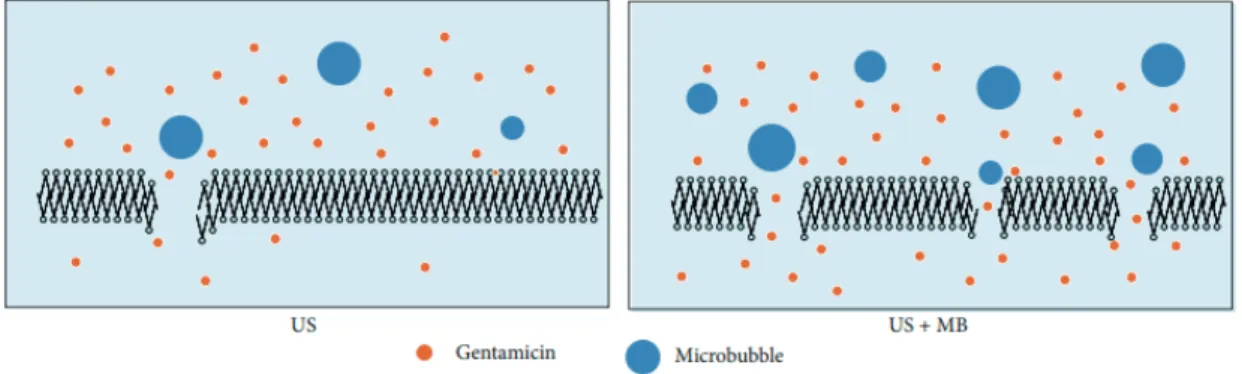
Low frequency ultrasound creates mechanical damage to membranes with cavitation effect. The combined use of microbubble agents that trigger bubble formation with LFU increases the therapeutic efficacy (Zhu et al., 2014). Increased therapeutic efficacy in microbubble use is presented in Figure 2.
36
The Use of Therapeutic Ultrason in Control of Biofilm Infections
3. Results and Suggestions
Therapeutic ultrasound can generate two possible bacterial responses: inducing either bactericidal characteristic or bacterial growth. It has been reported in different studies that the bactericidal effect occurs at low frequency high intensity, induction of bacterial growth occurs at low intensity and low frequency. Therefore, it is recommended to apply ultrasound at high intensity and low frequency to provide bactericidal effect with antibiofilm properties. It is stated that the combined use of ultrasound with antimicrobial agent and/or the addition of agents such as microbubbles that increase the cavitation efficiency to the application environment may increase the treatment effectiveness. Applying combined treatments offers a great advantage in preventing the increase in antibiotic resistance rates as a result of unnecessary and wrong use of antibiotics. Since wrong applications can create unstable cavitations in the tissue and cause hemolysis, necrosis and bleeding, the way and duration of the application of ultrasound is very important in treatment.
Conflict of Interest
Author declares no conflict of interest. References
Bayrakal, V., Baskın, H. (2018). Quorum sensing and biyofilm. Sakarya S, Ed. Biyofilm Enfeksiyonları. 1. Baskı. Ankara, Türkiye Klinikleri, 4-13.
Costerton, J. W., Cheng, K. J., Geesey, G. G., Ladd, T. I., Nickel, J. C., Dasgupta, M., Marrie, T. J. (1987). Bacterial biofilms in nature and disease. Annual Review of Microbiology, 41(1), 435–464.
Erriu, M., Blus, C., Szmukler-Moncler, S., Buogo, S., Levi, R., Barbato, G., Orrù, G. (2014). Microbial biofilm modulation by ultrasound: current concepts and controversies. Ultrasonics Sonochemistry, 21(1), 15–22. Harrison, J. J., Turner, R. J., Marques, L., Ceri, H. (2005). A new understanding of these microbial communities is driving a revolution that may transform the science of microbiology. American Scientist, 93
Hoiby, N., Bjarnsholt, T., Moser, C., Bassi, G. L., Coenye, T., Donelli, G., Hall-Stoodley, L., Holá, V., Imbert, C., Kirketerp-Moller, K., Lebeaux, D., Oliver, A., Ullmann, A. J., Williams, C. (2015). ESCMID guideline for the diagnosis and treatment of biofilm infections 2014. Clin Microbiol Infect, 2015, 21(1), 1-25
Mah, T. F. (2012). Biofilm-specific antibiotic resistance. Future Microbiology, 7(9), 1061–1072.
Percival, S. L., Bowler, P. G. (2004). Biofilms and their potential role in wound healing. Wounds, 16(7), 234-240. Percival, S. L. (2017). Importance of biofilm formation in surgical infection. British Journal of Surgery, 104(2), 85–94.
Stewart, P. S., William Costerton, J. (2001). Antibiotic resistance of bacteria in biofilms. The Lancet, 358(9276), 135–138.
Zhu, H. X., Cai, X. Z., Shi, Z. L., Hu, B., Yan, S. G. (2014). Microbubble-mediated ultrasound enhances the lethal effect of gentamicin on planktonic Escherichia coli. BioMed Research International, 1–7