Coping and Mindfulness
Mediators Between Need Satisfaction and Generalized
Problematic Internet Use
Jale Atas
ßalar and Aikaterini Michou
Bilkent University, Graduate School of Education, Bilkent, Ankara, Turkey
Abstract: Problematic Internet use (PIU) has been posited as the negative outcome of unmet psychological needs in real life. The present study, relying on the cognitive-behavioral model of PIU (Brand, Young, & Laier, 2014; Davis, 2001) and self-determination theory (Deci & Ryan, 2000), investigated the extent to which coping strategies in aversive situations and mindfulness during Internet use serve as mediating mechanisms in the relation between need satisfaction and generalized PIU (GPIU; dependency on multiple functions of the Internet). Path
analysis on a sample of 165 Turkish early adolescents (Mage= 12.88, SD = .83; 49.1% females) found that need satisfaction was negatively
related to PIU via low avoidant coping and high mindfulness in Internet engagement. The findings support the pathways from disadvantageous
social context to GPIU suggested by Brand and colleagues’ (2014) model of GPIU and additionally show that next to avoidant coping, online
mindfulness, an indicator of loss of cognitive control, can be a proximal correlate of GPIU. Interventions for adolescents’ harmonious Internet
use could focus, among others, on adolescents’ need satisfaction, awareness of coping strategies, and development of online mindfulness.
Keywords: need satisfaction, generalized problematic Internet use, coping, online mindfulness, early adolescents
Growing concern about adolescents’ Internet use has led to an increased interest in unveiling the underlying mecha-nisms related to problematic versus harmonious Internet use. Research has shown that chronic frustration of the needs for autonomy (a sense of volition), competence (a sense of effectiveness), and relatedness (a sense of belong-ingness) in real life could lead to obsessive engagement with Internet applications such as online games (Przybylski, Rigby, & Ryan,2010). Alternatively, need satisfaction in real life is related to less engagement in Internet activities (Shen, Liu, & Wang,2013; Yu, Li, & Zhang, 2015) and less Internet
addiction when coping is positive (Li et al.,2016). It seems
that the aversive situation of unmet needs in real life could be compensated for by online activities.
This assumption is theoretically supported by the cogni-tive-behavioral model of pathological Internet use as initially described by Davis (2001) and further enriched by Brand, Young, and Laier (2014). Research in the frame-work of these models provided evidence mostly about the relation of personal dysfunctional factors to problematic Internet use (PIU) through dysfunctional coping. However, the relation of unmet needs due to an unsupportive social environment to PIU through coping has been less investi-gated and the aim of the present study is to contribute to this line of research.
Need Satisfaction and Problematic
Internet Use: Their Possible Mediators
According to Davis (2001), PIU can be divided into specific PIU (SPIU), dependency on a particular function of the Internet, and generalized PIU (GPIU), dependency on multiple functions of the Internet, each of which is the result of different distal and proximal causes. While SPIU is mostly the result of a preexisting psychopathology, GPIU is the result of both psychopathology and an
unsup-portive social context (Caplan, 2002). A less supportive
social context can contribute to the development of GPIU and, therefore, we believe that unmet psychological needs in real life, such as autonomy, competence, and related-ness, can be related more to GPIU than to SPIU. Moreover, taking into account the theoretical model of Brand, Young, et al. (2014), different psychological mechanisms could mediate the relationship between the distal causes and PIU. Especially as far as GPIU is concerned, dysfunctional coping and expectancies of psychological benefits from Internet use, as well as reinforcements of the dysfunc-tional coping and Internet expectancies, mediate the relationship between experiences of unmet psychological needs (e.g., feelings of loneliness) and GPIU. The mediat-ing psychological mechanisms contribute to a loss of
control in the use of the Internet, accompanied by
neuropsychological operations (Brand, Young, et al.,2014).
The aforementioned theoretical model of PIU is supported by some empirical evidence. For example, Brand, Laier, and Young (2014) found that avoidant coping and Internet expectancies mediated the relationship between indicators of psychopathology (e.g., depression), dysfunctional personality (e.g., low self-esteem), and GPIU. Research also showed that Internet communication disor-der, despite the fact that it is a type of SPIU (not considered the result of a pathological social context), is directly asso-ciated with social loneliness and low perceived social sup-port without the mediation of avoidant coping (Wegmann
& Brand, 2016). However, the relationship of unmet
psychological needs– as the result of an unsupportive social
context– to GPIU – as suggested by the theoretical model of
Brand, Young, et al. (2014) – has not been investigated. Is this relationship mediated by avoidant coping?
In the present study, we rely on self-determination theory
(SDT; Deci & Ryan,2000) and we consider a low
percep-tion of need satisfacpercep-tion in real life as an indicator of an unsupportive social context. From the SDT perspective, coping strategies are, among others (e.g., stress appraisals), mediators between need satisfaction and cognitive, behavioral, or emotional outcomes in stressful situations
(Ntoumanis, Edmunds, & Duda, 2009). We assumed,
therefore, that coping mediates the relation between need satisfaction and GPIU.
We also assumed that GPIU, as it is considered the manifestation of a loss of cognitive control (Brand, Young,
et al., 2014), would be accompanied by less online
self-attention and awareness (i.e., mindfulness; Weinstein &
Ryan, 2011). Indeed impulsivity and low self-regulations
skills, features that are related to low mindfulness, are also
related to PIU (Li et al., 2013; Yu, Kim, & Hay, 2013).
However, the relationship between mindfulness and PIU is underexplored (but see Gámez-Guadix & Calvete, 2016). More importantly, mindfulness has been related to more benign stress appraisals and less avoidant coping
(Weinstein, Brown, & Ryan, 2009) and is considered as
one of the protective factors to stress incursion as it is asso-ciated with effective stress processing (Weinstein & Ryan, 2011). For these reasons, we deemed it important to study the relation of mindfulness with GPIU while considering also the relation of mindfulness with coping and, therefore, including both coping in stressful situations and mindful-ness during online activities (i.e., state mindfulmindful-ness) as the mediators in the relation of need satisfaction to GPIU.
The Present Study
The present study, relying on the cognitive-behavioral
model of PIU (Brand, Young, et al., 2014; Davis, 2001)
and SDT (Deci & Ryan,2000), investigated the
relation-ship of social context with GPIU via coping and mindful-ness during Internet use. Our study extends previous research in three ways. Firstly, we investigated the relation-ship of social context, instead of psychopathology or
dysfunctional personality (Brand, Laier, et al.,2014), with
GPIU. Secondly, we assessed not only avoidant coping but also active coping as the mediator between dysfunc-tional social context and GPIU. Thirdly, we considered an indicator of loss of control while being online, that is, online mindfulness, as the proximal correlate of GPIU and there-fore the mediator between coping and GPIU.
Specifically, we hypothesized that adolescent need satisfaction in real life would be positively correlated with active coping and negatively correlated with avoidant
coping (Hypothesis1). We assumed also that active coping
would be positively and avoidant coping negatively related
to online mindfulness (Hypothesis 2) and through it to
GPIU (Hypothesis 3). However, as avoidant coping and
escapism have been widely related to high levels of GPIU, we did not exclude the case where avoidant coping would also be directly and positively related to GPIU. Our final hypothesis was that need satisfaction in real life would be negatively related to GPIU via coping and mindfulness
in online activities (Hypothesis 4) indicating that coping
and online mindfulness are important psychological mechanisms to explain the relation of need satisfaction in real life with GPIU.
Method
Participants and Procedure
A total of 165 students (Mage = 12.88, SD = .83; 49.1%
females) from sixth to eighth grades from a Turkish urban middle school participated in the study. The study was approved by the Turkish Ministry of Education. The parents’ and the principal’s consent was also obtained for students’ participation. Students were informed about the aim of the survey and that their participation was voluntary and anonymous. Questionnaires were administrated dur-ing a class session by a researcher after gettdur-ing the class instructor’s permission. All students completed the survey voluntarily.
Measures
Need Satisfaction
A Basic Need Satisfaction Scale (Deci & Ryan,2000), trans-lated into Turkish by Bacanli and Cihangir-Cankaya (2003), was used to assess participants’ basic need satisfaction in
their real lives, on a5-point Likert-type scale. Seven items
assessed autonomy (e.g., “I generally feel free to express
my ideas and opinions”; α = .60), six items competence
(e.g., “People I know tell me I am good at what I do”;
α = .60), and eight items relatedness (e.g., “I really like the people I interact with”; α = .73).
Coping Strategies
A Coping Strategies Scale developed by Amirkhan (1990) and translated into Turkish by Aysan (1994) was used. The
scale consisted of 11 items for problem-solving (e.g., “Tried
to solve the problem”; α = .84), 11 items for seeking support
(e.g., “Went to a friend for advice on how to change the
situation”; α = .86), and 11 items for avoidance (e.g., “Avoided being with people in general”; α = .71). Responses were indi-cated on a3-point Likert-type scale (1 = never, 3 = always). Mindfulness
Six out of the15 items of the Mindful Attention Awareness
Scale (MAAS; Brown & Ryan, 2003) were adapted and
translated into Turkish to assess participants’ mindfulness
during Internet use (e.g., “I did activities on the net in a
rush without paying attention to what they really are”),
on a5-point Likert-type scale. Principal component analysis
extracted one factor when one item was excluded (Λ= 2.28
and explained variance 45.61%) and therefore, we
com-puted a composite score for mindfulness during Internet use by aggregating the five items (α = .69).
General Problematic Internet use
The Turkish Problematic Internet Use Scale for Adolescents
(PIU-A; Ceyhan & Ceyhan, 2009) was adapted to assess
participants’ PIU, on a 5-point Likert-type scale. The instru-ment included three subscales: negative consequences of Internet use (14 items; e.g., “I am neglecting my daily job [like doing homework, exercise or taking a shower] to spend more time on the Internet.”; α = .87); excessive use (6 items; e.g., “When I use the Internet till the late hours, I sleep less than ever.”; α = .69); and social benefit/social comfort (7 items; e.g., “People in my real life do not respect me as much as people on the net”; α = .77).
Results
Preliminary Analysis
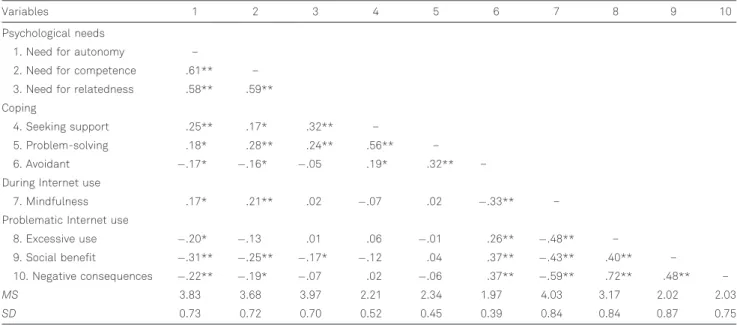
Descriptive statistics and bivariate correlations are
pre-sented in Table 1. A multivariate analysis of variance
(MANOVA) showed no significant gender differences (Wilk’s Λ = .912, F[10, 154] = 1.48, p = .15, multivariate η2= .09).
Main Analysis
We performed path analysis using the EQS 6.1 structural
equation modeling software package (Bentler, 1995) to
investigate the mediation of coping and online mindfulness in the relation of need satisfaction to GPIU. Avoidance coping and online mindfulness were represented by the mean score of the measured variable. Need satisfaction was defined by the mean of autonomy, competence, and relatedness satisfaction as these three subscales were
Table 1. Descriptive and bivariate correlations of the measured variables
Variables 1 2 3 4 5 6 7 8 9 10
Psychological needs
1. Need for autonomy –
2. Need for competence .61** –
3. Need for relatedness .58** .59**
Coping
4. Seeking support .25** .17* .32** –
5. Problem-solving .18* .28** .24** .56** –
6. Avoidant .17* .16* .05 .19* .32** –
During Internet use
7. Mindfulness .17* .21** .02 .07 .02 .33** –
Problematic Internet use
8. Excessive use .20* .13 .01 .06 .01 .26** .48** – 9. Social benefit .31** .25** .17* .12 .04 .37** .43** .40** – 10. Negative consequences .22** .19* .07 .02 .06 .37** .59** .72** .48** – MS 3.83 3.68 3.97 2.21 2.34 1.97 4.03 3.17 2.02 2.03 SD 0.73 0.72 0.70 0.52 0.45 0.39 0.84 0.84 0.87 0.75 Note. *p < .05. **p < .01.
strongly and positively correlated (r = .58–.61). Accordingly, active coping was defined by the mean of problem-solving and seeking support (r = .56), while GPIU by the mean of excessive use, social comfort, and negative
conse-quences (r = .40–.72). We deemed it important to use the
mean of those subscales that were strongly and positively correlated so as to construct a simple model where the important relationships would be highlighted.
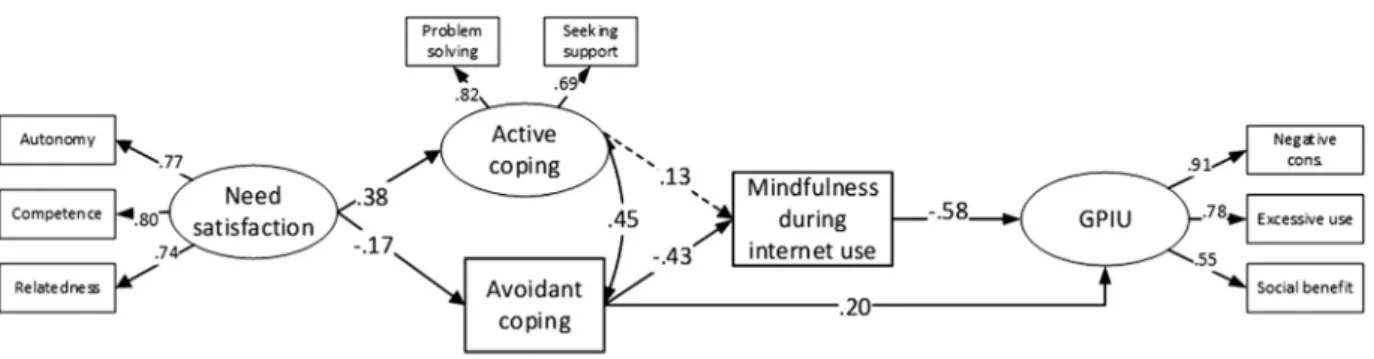
Inspection of Figure 1 shows that most of the
hypothe-sized paths were significant and fit indices were acceptable, CFI = .920, SRMR = .075, RMSEA = .084 (90% CI = .058– .109), although the expected variance-covariance matrix failed to reproduce the observed variance–covariance matrix, S-Bw2 (37, N = 165) = 79.82, p < .01. Specifically,
after controlling for gender differences (not shown in
Figure1), need satisfaction was positively related to active
coping and negatively related to avoidant coping,
confirm-ing Hypothesis1. In the sequel, avoidant coping was
nega-tively related to online mindfulness, partially confirming
Hypothesis 2 as active coping was not related to online
mindfulness. Avoidant coping was also directly and positively related to GPIU, while online mindfulness was negatively related to GPIU. A test of indirect effects showed that mindfulness during Internet use partially mediated the
relation between avoidant coping and PIU (B = 0.41,
SE = .10, z = 4.35, β = .25, p < .01; Hypothesis 3) suggesting that low avoidant coping was associated with low GPIU when online mindfulness was high.
As active coping failed to relate to online mindfulness, we tested a supplementary model with social support and problem-solving being separately represented so as to explore if any of the adaptive strategies related positively to online mindfulness. The fit indices of the supplementary model were acceptable: S-Bw2(33, N = 165) = 73.49, p < .01,
CFI = .924, SRMR = .076, RMSEA = .086 (90% CI = .060– .112). The path from problem-solving to mindfulness was significant (β = .22, p < .01) as were all the other hypothe-sized paths. A test of indirect effects showed that online mindfulness mediated the negative relation between
problem-solving and GPIU (B = 0.18, SE = .08,
z = 2.30, β = .13, p < .01) suggesting that high problem
solving was associated with low GPIU when online mindful-ness was also high.
Finally, concordant with Hypothesis4, a test of indirect
effects showed that need satisfaction was positively associ-ated with online mindfulness through avoidant coping (B =0.18, SE = .10, z = 2.25, β = .12, p < .01), suggesting that the more students satisfied their needs the more likely they were to report mindfulness during Internet use as a result of low avoidant coping. A similar test of indirect effects further showed that need satisfaction was negatively related to GPIU (B = 0.12, SE = .05, z = 2.28, β = .11, p < .01) by means of low avoidant coping and high online mindfulness.
Discussion
In the present study, following the theoretical models of
PIU (Brand, Young, et al.,2014; Davis, 2001), we
investi-gated the relationship between perceptions of social context – as manifested in need satisfaction in real life – and GPIU, by considering coping strategies as the mediating mecha-nism. In particular, we included both active and avoidant coping as mediators of social context to GPIU, trying to show pathways to harmonious Internet use as well. We also tested mindfulness during online engagement, an indicator of loss of cognitive control, as the mediator between coping and GPIU, extending further the existing research on the models of PIU.
The findings showed that need satisfaction in real life was positively and negatively related to active and avoidant
coping, respectively, supporting Hypothesis 1 as well as
theoretical models of PIU (Brand, Young, et al.,2014) and
well-being (e.g., Ntoumanis et al.,2009; Weinstein & Ryan, 2011). It seems that when adolescents have a sense of being effective, are able to choose freely, and are connected to others in their real life, they use active coping strategies such as problem-solving or seeking social support. By con-trast, when they experience less need satisfaction in real life,
Figure 1. The tested model controlling for gender differences (not shown for sake of clarity). The dashed line represents a statistically nonsignificant path.
they use avoidant coping strategies such as self-blaming, wishful thinking, or ignoring problems to a greater extent.
Moreover, avoidant coping was negatively related to online mindfulness indicating that when adolescents use more avoidant coping strategies, they are not fully aware of their present environment or themselves, and do things online in an automatic mode. This result supports the model
of PIU (Brand, Young, et al., 2014), according to which a
positive reinforcement of the avoidant coping during Internet use results in a loss of cognitive control. Research has shown that many Internet applications provide need satisfaction while being online (Peng, Lin, Pfeiffer, & Winn, 2012; Przybylski et al., 2010). This experience of online need satisfaction can be considered the positive reinforcement that strengthens the use of an avoidant coping strategy and therefore the loss of cognitive control.
Interestingly, active coping was not related to online mindfulness, as was initially hypothesized in the present study. It seems that not all the adaptive coping strategies are related to mindfulness during Internet use. Weinstein et al. (2009) found approach coping consisting of active coping, acceptance, positive reinterpretation, and growth to be positively related to university students’ mindfulness. However, in our study active coping consisting of both social support and problem-solving strategies failed to relate positively to online mindfulness. Supplementary analysis, in which social support and problem-solving were represented separately, showed that, while social support did not relate to online mindfulness, problem solving was positively related to online mindfulness and, through it, negatively related to GPIU. This finding suggests a pathway to harmonious Internet use with high problem-solving and high online mindfulness as the mediators between need satisfaction and less GPIU. Future research could clarify the relationship of various functional coping strategies to online mindfulness so as to better describe possible path-ways to harmonious Internet use.
The findings of the present study, concordant with
Hypothesis 3, showed that lower levels of mindfulness
during Internet use partially mediated the relationship between increased avoidant coping and GPIU, while avoidant coping was also directly and positively related to GPIU. This shows that a weakened cognitive control can be related to GPIU but the urge to avoid a stressful situation can also be directly related to GPIU. This can justify the generalized use of Internet applications in a pathological manner. Any application can be chosen if it distracts from a stressful situation. Further research could clarify if such a direct relation exists also between avoidant coping and SPIU when indicators of loss of cognitive control are also considered. As gratification is the main cause of loss of control in SPIU, online mindfulness could fully mediate between coping and SPIU.
More interestingly, this study showed that need satisfac-tion in early adolescents’ real life was positively related to GPIU through high avoidant coping and low online
mindfulness. This finding supports Hypothesis 4 and has
considerable implications for designing interventions for prevention of GPIU.
Our findings suggest that adolescents’ need satisfaction
and awareness of how avoidant and active coping strategies affect an individual’s well-being can be addressed by preventive programs that deal with GPIU. Our findings also suggest that mindfulness during online activities is one of the correlates of harmonious Internet use. The literature reveals that the implementation in school settings of mind-fulness-based practices is associated with increased resili-ence and mitigated risk factors (Gueldner & Feuerborn, 2016); and, enhanced attentional and emotional
self-regula-tion and coping capacity (Meiklejohn et al.,2012).
There-fore, conducting intervention designs in schools aimed at increasing the online mindfulness of young adolescents may contribute to decreasing GPIU.
The study has some limitations, however. Firstly, as the data were collected using self-reports, the responses of early adolescents, even though anonymous, might be affected by social desirability. Secondly, the cross-sectional research design does not establish any causal relationship between the variables, namely, needs satisfaction, coping strategies, online mindfulness, and GPIU. Thirdly, the Cronbach alpha value of need for autonomy and need for competence was relatively low. Finally, the sample was relatively small and the participants were recruited from one middle school in an urban area of Turkey; further research is needed with a bigger sample coming from different areas of Turkey as well as from other countries.
Conclusion
In conclusion, the current study expands our understanding of the psychological mechanisms related to GPIU in early adolescence. Specifically, the findings suggest that early adolescents’ avoidant coping strategies and low online mindfulness mediate the negative relation between need satisfaction in real life and GPIU.
Acknowledgments
The authors thank John O’Dwyer for his valuable feedback
on the manuscript.
References
Amirkhan, J. H. (1990). A factor analytically derived measure of coping: The coping strategy indicator. Journal of Personality
Aysan, F. (1994, April). Validity and reliability of coping strategy scale for university students. In Proceedings of the First
Educational Sciences Congress (pp. 1158–1169). Adana, Turkey:
Cukurova University.
Bacanli, H., & Cihangir-Cankaya, Z. (2003). An adaptation study of psychological need satisfaction scale. In Proceedings of 7th National Psychological Counseling and Guidance Congress
(pp. 37–38). Inonu University, Ankara: Pegem A.
Bentler, P. M. (1995). EQS structural equations program manual. Los Angeles, CA: BMPD Statistical Software.
Brand, M., Laier, C., & Young, K. S. (2014). Internet addiction: coping styles, expectancies, and treatment implications. Fron-tiers in Psychology, 5(1256). doi: 10.3389/fpsyg.2014.01256 Brand, M., Young, K. S., & Laier, C. (2014). Prefrontal control and
Internet addiction: a theoretical model and review of neuropsy-chological and neuroimaging findings. Frontiers in Human Neuroscience, 8(375). doi: 103389/fnhum.2014.00375 Brown, K. W., & Ryan, R. M. (2003). The benefits of being
present: Mindfulness and its role in psychological well-being.
Journal of Personality and Social Psychology, 84(2), 822–848.
doi: 10.1037/0022-3514.84.4.822
Caplan, S. E. (2002). Problematic Internet use and psychoso-cial well-being: Development of a theory-based cognitive-behavioral measure. Computers in Human Behavior, 18,
553–575. doi: 10.1016/S0747-5632(02)00004-3
Ceyhan, A. A., & Ceyhan, E. (2009). Adolescents with Problematic Internet Usage Scale (PIUS-A) development work. In Proceed-ings of 10th National Psychological Counseling and Guidance Congress. Adana, Turkey: Cukurova University.
Davis, R. A. (2001). A cognitive-behavioral model of pathological
Internet use. Computers in Human Behavior, 17, 187–195.
doi: 10.1016/S0747-5632(00)00041-8
Deci, E. L., & Ryan, R. M. (2000). The “what” and “why” of
goal pursuits: Human needs and the self-determination of
behavior. Psychological Inquiry, 11(4), 227–268. doi: 10.1207/
S15327965PLI1104_01
Gámez-Guadix, M., & Calvete, E. (2016). Assessing the relation-ship between mindful awareness and problematic Internet use
among adolescents. Mindfulness, 7, 1281–1288. doi: 10.1007/
s12671-016-0566-0
Gueldner, B. A., & Feuerborn, L. L. (2016). Integrating mindfulness-based practices into social and emotional learning: A case
application. Mindfulness, 7, 64–175. doi:
10.1007/s12671-015-0423-6
Li, D., Li, X., Wang, L., Zhao, L., Bao, Z., & Wen, F. (2013). School connectedness and problematic Internet use in adolescents: A moderated mediation model of deviant peer affiliation and
self-control. Journal of Abnormal Child Psychology, 41, 1231–1242.
doi: 10.1007/s10802-013-9761-9
Li, D., Zhang, W., Li, X., Zhou, Y., Zhao, L., & Wang, Y. (2016). Stressful life events and adolescent Internet addiction: The mediating role of psychological needs satisfaction and the moderating role of coping style. Computers in Human Behavior,
63, 408–415. doi: 10.1016/j.chb.2016.05.070
Meiklejohn, J., Phillips, C., Freedman, M. L., Griffin, M. L., Biegel, G., Roach, A., & Saltzman, A. (2012). Integrating mindfulness training into K-12 education: Fostering the resilience of teachers
and students. Mindfulness, 3, 291–307. doi:
10.1007/s12671-012-0094-5
Ntoumanis, N., Edmunds, J., & Duda, J. L. (2009). Understanding the coping process from a self-determination theory
perspec-tive. British Journal of Health Psychology, 14, 249–260.
doi: 10.1348/135910708X349352
Peng, W., Lin, J., Pfeiffer, K., & Winn, B. (2012). Need satisfaction supportive game features as motivational determinants: An experimental study of a self-determination theory guided
exergame. Media Psychology, 15, 175–196. doi: 10.1080/
15213269.2012.673850
Przybylski, A. K., Rigby, C. S., & Ryan, R. M. (2010). A motivational model of video game engagement. Review of General
Psychol-ogy, 14, 154–166. doi: 10.1037/a0019440
Shen, C., Liu, R., & Wang, D. (2013). Why are children attracted to the Internet? The role of need satisfaction perceived online and perceived in daily real life. Computers in Human Behavior, 29,
185–192. doi: 10.1016/j.chb.2012.08.004
Wegmann, E., & Brand, M. (2016). Internet communication
disor-der: It’s a matter of social aspects, coping, and Internet use
expectancies. Frontiers in Psychology, 7(1747). doi: 10.3389/ fpsyg.2016.01747
Weinstein, N., Brown, K. W., & Ryan, R. M. (2009). A multi-method examination of the effects of mindfulness on stress attribution, coping, and emotional well-being. Journal of Research in
Personality, 43, 374–385. doi: 10.1016/j.jrp. 2008.12.008
Weinstein, N., & Ryan, R. M. (2011). A Self-determination theory approach to understanding stress incursion and responses.
Stress and Health, 27, 4–17. doi: 10.1002/smi.1368
Yu, J. J., Kim, H., & Hay, I. (2013). Understanding adolescents’
problematic Internet use from a social/cognitive and addiction research framework. Computers in Human Behavior, 29,
2682–2689. doi: 10.1016/j.chb.2013.06.045
Yu, C., Li, X., & Zhang, W. (2015). Predicting adolescent problem-atic online game use from teacher autonomy support, basic psychological needs satisfaction, and school engagement: A 2-year longitudinal study. Cyberpsychology, Behavior, and
Social Networking, 18, 228–233. doi: 10.1089/cyber.2014.0385
Received October 17, 2016 Revision received April 17, 2017 Accepted April 24, 2017
Published online October 18, 2017
Jale Atasßalar
Bilkent University
Graduate School of Education 06800 Bilkent, Ankara Turkey
Jale Atasßalar is a PhD candidate in
Curriculum and Instruction at the Graduate School of Education, Bilk-ent University, Turkey. She is a graduate of the Psychological Coun-seling and Guidance Department (BSc and MA) at Hacettepe Univer-sity. Her research interests include problematic Internet use, social and emotional development of adoles-cents, and family therapy.
Aikaterini Michou, BSc (Hons)
University of Athens, MA University of Geneva, PhD University of Athens, is Assistant Professor in the Depart-ment of Educational Sciences at
Bilkent University, Turkey. Her
research interest pertains to the contextual and personal factors that
determine learners’ motivation and in
turn their functioning and well-being.
View publication stats View publication stats