A COMPARATIVE ANALYSIS OF TWO ENGLISH LANGUAGE
TEXTBOOKS WRITTEN FOR ACADEMIC AND GENERAL
PURPOSES
A MASTER’S THESIS
BY
PINAR YILMAZ
THE PROGRAM OF CURRICULUM AND INSTRUCTION İHSAN DOĞRAMACI BİLKENT UNIVERSITY
ANKARA MAY 2019 PI N A R Y IL M A Z 2019
CO
M
P
CO
M
P
PI N A R Y IL M A Z 2019CO
M
P
CO
M
P
PI N A R Y IL M A Z 2019CO
M
P
CO
M
P
PI N A R Y IL M A Z 2019CO
M
P
CO
M
P
PI N A R Y IL M A Z 2019CO
M
P
CO
M
P
PI N A R Y IL M A Z 2019CO
M
P
CO
M
P
PI N A R Y IL M A Z 2019CO
M
P
CO
M
P
PI N A R Y ILM A Z 2019CO
M
P
CO
M
P
PI N A R Y IL M A Z 2019CO
M
P
CO
M
P
PI N A R Y IL M A Z 2019CO
M
P
CO
M
P
PI N A R Y IL M A Z 2019CO
M
P
CO
M
P
PI N A R Y IL M A Z 2019CO
M
P
CO
M
P
PI N A R Y IL M A Z 2019C
OM
P
A COMPARATIVE ANALYSIS OF TWO ENGLISH LANGUAGE
TEXTBOOKS WRITTEN FOR ACADEMIC AND GENERAL
PURPOSES
The Graduate School of Education
of
İhsan Doğramacı Bilkent University
by
Pınar Yılmaz
In Partial Fulfilment of the Requirements for the Degree of Master of Arts
in
Curriculum and Instruction Ankara
İHSAN DOĞRAMACI BİLKENT UNIVERSITY GRADUATE SCHOOL OF EDUCATION
COMPARATIVE ANALYSIS OF TWO ENGLISH LANGUAGE TEXTBOOKS WRITTEN FOR ACADEMIC AND GENERAL PURPOSES
Pınar Yılmaz May 2019
I certify that I have read this thesis and have found that it is fully adequate, in scope and in quality, as a thesis for the degree of Master of Arts in Curriculum and
Instruction.
---
Asst. Prof. Dr. Tijen Akşit (Supervisor)
I certify that I have read this thesis and have found that it is fully adequate, in scope and in quality, as a thesis for the degree of Master of Arts in Curriculum and
Instruction.
---
Asst. Prof. Dr. İlker Kalender (Examining Committee Member)
I certify that I have read this thesis and have found that it is fully adequate, in scope and in quality, as a thesis for the degree of Master of Arts in Curriculum and
Instruction.
---
Prof. Dr. Gölge Seferoğlu, METU (Examining Committee Member)
Approval of the Graduate School of Education
---
ABSTRACT
A COMPARATIVE ANALYSIS OF TWO ENGLISH LANGUAGE TEXTBOOKS WRITTEN FOR ACADEMIC AND GENERAL PURPOSES
Pınar Yılmaz
M.A., Program of Curriculum and Instruction Supervisor: Asst. Prof. Dr. Tijen Akşit
May 2019
The purpose of this study to investigate the possible distinct characteristics of two English language textbooks: one written for English for general purposes (EGP) and one written for English for academic purposes (EAP) purposes using content analysis approach. To this end, a textbook evaluation scheme was used to evaluate chosen two textbooks. Two textbooks under analysis were compared in terms of their content, organization, types of texts, exercises, aims and objectives, levels, skills, topics, situations, target learners, time required, components and number and length of units. These textbooks were found to be different in most of the areas in the evaluation scheme used for analysis.
Key words: English for general purposes, English for academic purposes, textbook evaluation, textbook comparison
ÖZET
GENEL VE AKADEMİK AMAÇLAR İÇİN YAZILMIŞ İKİ İNGİLİZCE DERS KİTABININ KARŞILAŞTIRMASI
Pınar Yılmaz
Yüksek Lisans, Eğitim Programları ve Öğretim Tez Yöneticisi: Dr. Öğr. Üyesi Tijen Akşit
Mayıs 2019
Bu çalışmanın amacı, iki İngilizce ders kitabının olası ayırt edici özelliklerini içerik analizi yöntemi ile araştırmaktır: biri genel amaçlı İngilizce (EGP), diğeri ise akademik amaçlı İngilizce (EAP). Bu amaçla, seçilen iki ders kitabını değerlendirmek için bir ders kitabı değerlendirme şablonu kullanılmıştır. İncelenen iki ders kitabı içerik, organizasyon, metin türleri, alıştırmalar, amaçlar ve hedefler, seviyeler, beceriler, konular, durumlar, hedef öğrenciler, gereken süre, bileşenler ve ünite birimlerin sayısı ve uzunluğu açısından karşılaştırıldı. Bu kitaplar, değerlendirme için kullanılan şablondaki odak alanların birçoğunda farklılık göstermiştir.
Anahtar Kelimeler: Genel amaçlı İngilizce, akademik amaçlı İngilizce, ders kitabi değerlendirme, ders kitabı karşılaştırma
ACKNOWLEDGEMENTS
Foremost, I would like to express my sincere gratitude to my dear advisor, Asst. Prof. Dr. Tijen Akşit for her encouragement, guidance, immense knowledge, and continues support. She has always been more than an advisor to me and has always reminded me that I can achieve it. Without her guidance this thesis would not have been possible. It was a great honor to work under her supervision.
I place on record, my sincere gratitude to all members of Graduate School of Education. But most importantly, I would like to thank Asst. Prof. Dr. Necmi Akşit for his guidance and patience throughout the program.
My heartfelt thanks also go to my precious friend Gamze Genel and her family for their support in every step I take. I appreciate that you have been always there for me when I needed.
I would like to express my deepest appreciation to my family: my father Ayhan Yılmaz and my mother Necla Yılmaz for always supporting me, my sister Zeynep Yılmaz for her help and understanding, my brother Alper Yılmaz, and my lovely cat Kuymak for her endless love.
Finally, but most importantly I owe the greatest gratitude to a special person in my life, Emrah, for his everlasting love and endless support throughout this process. What a gift and mystery it is to grow up with you…
TABLE OF CONTENTS ABSTRACT………iii ÖZET………...iv ACKNOWLEDGEMENTS ...v LIST OF TABLES……....………..xv LIST OF FIGURES………..……….xvi CHAPTER 1: INTRODUCTION ...1 Introduction ... 1 Background... 1 Problem ... 5 Purpose ... 6 Research questions ... 6 Significance ... 7
Definition of key terms ... 8
CHAPTER 2: REVIEW OF RELATED LITERATURE ...9
Introduction ... 9
The context of English for general purposes ... 9
The context of English for academic purposes ...11
Instructional materials in English language teaching ...13
Textbook evaluation scheme ...14
CHAPTER 3: METHOD ... 20
Introduction ...20
Research design ...21
Context and cases...23
Data analysis ...23
Focus area: Contents of the book in terms of scope and sequence ...26
Focus area: Organization of the books and units ...26
Focus area: Types of texts included ...26
Focus area: Exercises contained within the text ...27
Focus areas: Aims and objectives of the books ...28
Focus area: Level of the books ...28
Focus area: Skills addressed ...29
Focus area: Topics covered ...30
Focus area: Situation it is intended for ...30
Focus area: Target learners ...30
Focus area: Time required ...31
Focus area: Components ...31
Focus area: Number and length of units ...31
CHAPTER 4: RESULTS ... 33
Introduction ...33
Pre-use: analysis stage ...33
Reading ...34 Writing ...35 Listening ...35 Speaking ...35 Grammar ...36 Vocabulary ...36 Everyday English ...36 EAP ...37 Reading ...37 Writing ...38 Listening ...38 Speaking ...38 Vocabulary development ...39 Research skills ...39 Review ...39 Comparison ...39 Reading ...40 Writing ...40 Listening ...41 Speaking ...41
Organization of the books and units ...42
EGP ...42
EAP ...44
Types of texts included ...46
EGP ...47
EAP ...47
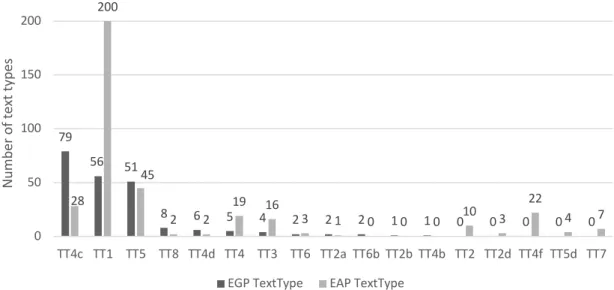
Comparison ...48
Types of texts in reading ...49
EGP ...49
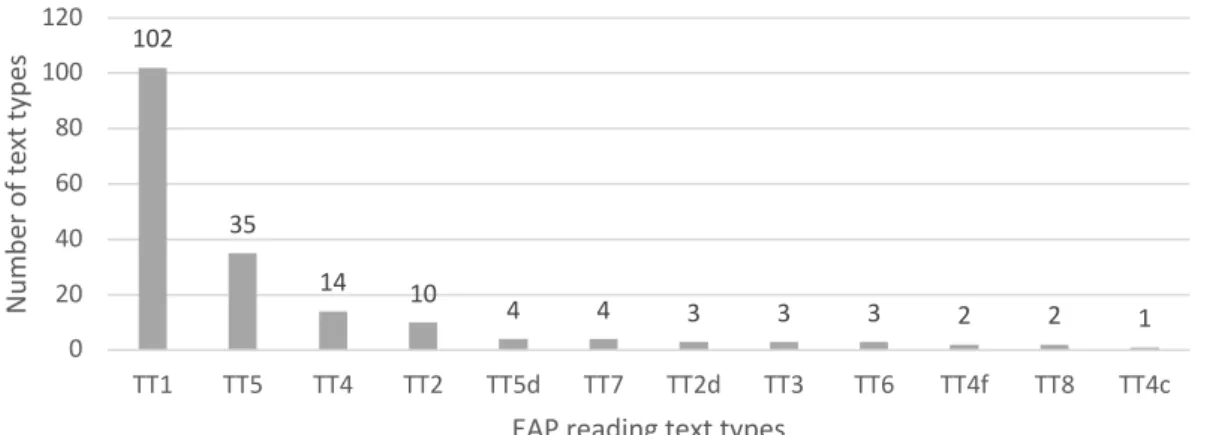
EAP ...50
Comparison ...51
Types of texts in writing ...51
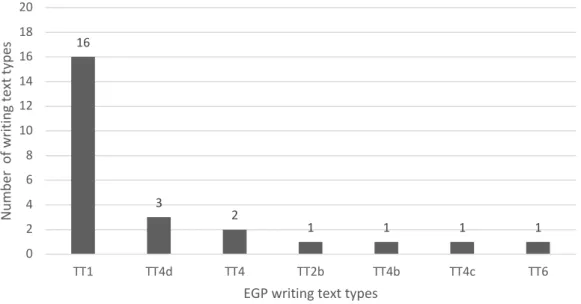
EGP ...52
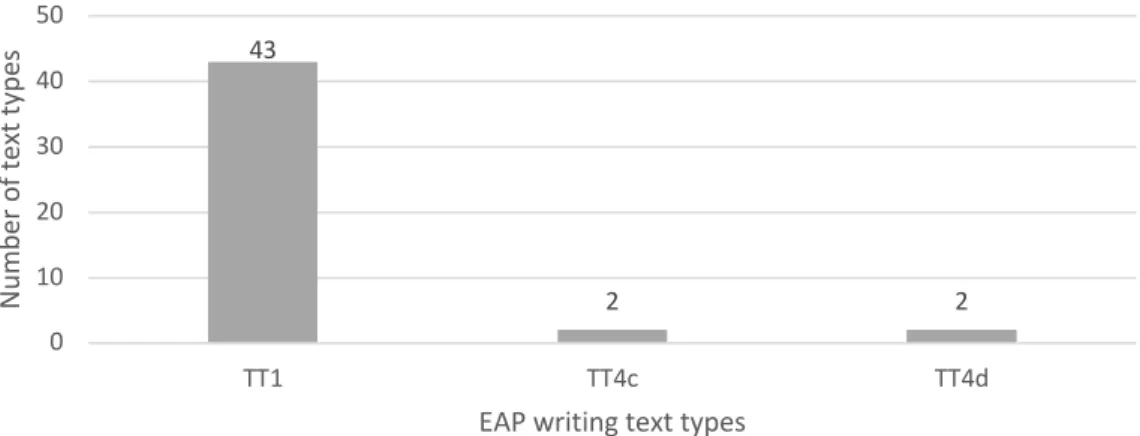
EAP ...52
Comparison ...53
Types of texts in listening...54
EGP ...54
EAP ...54
Comparison ...55
Length of texts in EGP and EAP textbooks ...56
Exercises contained within the text ...57
Reading Exercises ...57
EGP ...57
EAP ...58
Comparison ...59
EAP ...61 Comparison ...62 Listening Exercises ...62 EGP ...62 EAP ...63 Comparison ...64 Speaking Exercises ...65 EGP ...65 EAP ...66 Comparison ...67 Grammar Exercises ...68 EGP ...68 EAP ...68 Comparison ...69 Vocabulary Exercises ...70 EGP ...70 EAP ...71 Comparison ...72
Aims and objectives of the books ...72
EGP ...72
EAP ...73
Comparison ...74
Level of the books ...74
EAP ...75
Comparison ...76
Skills addressed...78
EGP textbook skill distribution ...78
EAP skill distribution ...79
Comparison of skill distribution ...80
Reading skills...81 EGP ...81 EAP ...82 Comparison ...83 Writing skills ...84 EGP ...84 EAP ...85 Comparison ...85 Listening skills ...86 EGP ...86 EAP ...87 Comparison ...88 Speaking skills ...89 EGP ...89 EAP ...90 Comparison ...91 Study Skills ...92
EAP ...93 Comparison ...94 Vocabulary skills ...94 EGP ...95 EAP ...95 Comparison ...96 Topics covered ...96 EGP ...97 EAP ...97 Comparison ...97
Situations it is intended for ...97
Target learners ...98
Time required...98
Components ...99
Number and length of units ...99
EGP ...99
EAP ... 100
Comparison ... 100
CHAPTER 5: DISCUSSION ... 101
Introduction ... 101
Overview of the study ... 101
Contents of the books in terms of scope / sequence and organization of the
books and units ... 103
Types of texts included / Number and length of units ... 104
Exercises contained within the texts ... 105
Aims and objectives of the books ... 109
Skills addressed... 110
Topics covered and situation it is intended for ... 114
Target learners ... 114
Time required and components... 115
Conclusion ... 115
Implications for practice... 118
Implications for future research ... 119
Limitations... 120
REFERENCES……….122
APPENDICES...128
Appendix A: Text types adapted from English K-6 (2001)...128
Appendix B: Reading exercise types adapted from British Council (2018)...129
Appendix C: Writing exercise types adapted from Reid (1993) ...130
Appendix D: Listening exercise types adapted from British Council (2018) ...131
Appendix E: Speaking exercise types adapted from British Council (2018)...132
Appendix F: Grammar exercise types adapted from British Council (2018)...133
Appendix H: Reading learning objectives adapted from Pearson GSE Teacher Toolkit (2017)...135 Appendix I: Writing learning objectives adapted from Pearson GSE Teacher Toolkit (2017)...140 Appendix J: Listening learning objectives adapted from Pearson GSE Teacher Toolkit (2017)...141 Appendix K: Speaking learning objectives adapted from Pearson GSE Teacher Toolkit ...147 Appendix L: Vocabulary subskills adapted from Schmitt (2014) ...154 Appendix M: Study skills emerged from the EAP textbook ...155
LIST OF TABLES
Table Page
1 Richards textbook evaluation scheme: focus areas of the analysis phase……...5
2 Coding sample for analysis phase..………..25
3 Contents of the EGP textbook……….34
4 Representation of grammar points of EGP textbook on the contents page….36 5 Contents of the EAP textbook……….37
6 Organization of the EAP course………..42
7 Organization of the EAP course………..44
8 Components of the both textbook………..……100
LIST OF FIGURES
Figures Page
1 Visual representation of Richards’ Textbook Evaluation Scheme (2015)….4 2 Visual representation of additional frameworks used for Richards textbook
evaluation scheme (2015)………...32 3 Occurrences of text types in the EGP textbook….…..…..…..…..…..…..….47 4 Occurrences of EAP text types……..…..…..…..…..…..…..…..…..……….48 5 Comparison of the occurrences of text types in EGP and EAP textbook…...49 6 Occurrences of reading text types in the EGP textbook…..…..…..…..…….50 7 Occurrences of reading text types in the EAP textbook……..…..…..……...50 8 Comparison of reading text types in the EGP and EAP textbooks…..……...51 9 Occurrences of writing text types in the EGP textbook….…..…..…..……...52 10 Occurrences of writing text types in the EAP textbooks…..…..…..…..……53 11 Comparison of writing text types in the EGP and EAP textbook…..…..…...53 12 Occurrences of listening text types in the EGP textbook………..…..…..….54 13 Occurrences of listening text types in the EAP textbook…..…..…..…..…...55 14 Comparison of listening text types in the EGP and EAP textbook………....56 15 Comparison of text length in the EGP and EAP textbooks…..…..…..……..57 16 Occurrences of reading exercise types in the EGP textbook…..…..…..…....58 17 Occurrences of reading exercise types in the EAP textbook…..…..………..59 18 Comparison of reading exercise types in the EGP and EAP textbook……...60 19 Occurrences of writing exercise types in the EGP textbook…..……..……..61 20 Occurrences of writing exercise types in the EAP textbook…..…..…..……61 21 Comparison of writing exercise types in the EGP and EAP textbook……...62
22 Occurrences of listening exercise types in the EGP textbook….…..……….63 23 Occurrences of listening exercise types in the EAP textbook……..………..64 24 Comparison of listening exercises in the EGP and EAP textbook………...65 25 Occurrences of speaking exercise types in the EGP textbook……..…..…...66 26 Occurrences of speaking exercise types in the EAP textbook….…..…..…...66 27 Comparison of speaking exercise types in the EGP and EAP textbooks…...67 28 Occurrences of grammar exercise types in the EGP textbook….…..…..…...68 29 Occurrences of grammar exercise types in the EAP textbook….…..…..…...69 30 Comparison of grammar exercise types in the EGP and EAP textbooks…...70 31 Occurrences of vocabulary exercise types in the EGP textbook…..…..……71 32 Occurrences of vocabulary exercise types in the EAP textbook…..…..……71 33 Comparison of vocabulary exercises in the EGP and EAP textbook…..…...72 34 Frequency of CEFR levels of the EGP textbook…..…..…..…..…..…..……75 35 Frequency of CEFR levels of the EAP textbook….…..…..…..…..…..…….76 36 Comparison of CEFR levels of the EGP and EAP textbook……..…..……..76 37 Distribution of CEFR levels for five skills……..…..…..…..…..…..……….78 38 Distribution of skills in the EGP textbook…..…..…..…..…..…..…..………79 39 Distribution of skills in the EAP textbook…..…..…..…..…..…..…..………80 40 Comparison of skills distribution in the EGP and EAP textbook….…..…....81 41 Occurrences of reading learning objectives in the EGP textbook……..…....82 42 Occurrences of reading learning objectives in the EAP textbook…..………83 43 Comparison of the occurrences of reading objectives of both textbooks…...84 44 Occurrences of writing learning objectives in the EGP textbook…..…..…..84 45 Occurrences of writing learning objectives in the EAP textbook….…..…...85 46 Comparison of the occurrences of writing objectives of both textbooks…...86
47 Occurrences of listening learning objectives of the EGP textbook……..…..87 48 Occurrences of listening writing objectives of the EAP textbook…..………88 49 Comparison of the occurrences of listening objectives in both textbooks….89 50 Occurrences of speaking learning objectives of the EGP textbook….……...90 51 Occurrences of speaking learning objectives in the EAP textbook….……...91 52 Comparison of the occurrences of speaking objectives in both textbooks….92 53 Occurrences of the study skills in the EGP textbook……..…..…..…..…….93 54 Occurrences of the study skills in the EAP textbook….…..…..…..…..……93 55 Comparison of the occurrences of study skills in both textbooks…..…..…..94 56 Occurrences of the tested vocabulary skills in the EGP textbook…..…..…..95 57 Occurrences of the tested vocabulary skills in the EAP textbook…..………95 58 Comparison of the tested vocabulary skills in the EGP and EAP textbook...96 59 Comparison of the situations that it intended for in both textbooks…..…….98
CHAPTER 1: INTRODUCTION Introduction
Learning English has become a requirement for almost everyone who wants to study in higher education since it is the lingua franca of today’s world. People prefer to learn English for different purposes according to their needs. Some prefer to learn it because of general communication purposes and some prefer to learn it to be
competent in the academia. The focus of this study is to analyze the difference between textbooks that are written for teaching English for general purposes (EGP) and academic purposes (EAP) in terms of their characteristics, similarities and differences within the framework of a textbook evaluation scheme.
This chapter includes an introductory background information about teaching EGP and EAP, the purpose and significance of the study, the problem that is identified and the research questions that shape the study. In the last part of this chapter, the
definition of key terms is presented.
Background
In higher education, English plays a big role since it is the common language that academia uses. “English for Academic Purposes (EAP) refers to the language and associated practices that people need in order to undertake study or work in English medium higher education” (Gillett, 2011, para. 1). According to Gillett (2011), “EAP is often considered to be a branch of ELT (English Language Teaching), although
not all EAP teachers have come through the ELT route” (para. 2). He also states that nowadays students want to learn EAP in order to succeed in higher education. “The overwhelming majority of all academic research is published in English. In recent years the number … has more than doubled” (British Council, 2015, p. 42). Therefore, the need for learning English to succeed in academia has risen up.
As Gillett (2011) states, learning English for a specific purpose can differ based on people’s needs, therefore, teachers should be aware of the specific needs of students. Students’ needs to learn English may vary according to their aims. These needs shape the nature of their learning environment. For example, how advanced a
learner’s English level need to be for a specific need depends on their aims. “In some cases, a very high level of proficiency is not necessarily required, as long as the learners can succeed in their aims” (Gillett, 2011, para, 8). Accordingly, Alexander (2012) states: "learners with a level of proficiency as low as A1 (basic user) on the Common European Framework of Reference for Languages (CEFR) want to study EAP and a number of textbooks have recently been published for this level” (p. 99). However, there is also a debate that argues the opposite. “It is often believed that EAP can only be taught at advanced levels and that lower level students need a course in general English before they start their EAP course” (Gillett, 2012, para. 1).
There are textbooks published for teaching EAP at lower levels; however, what makes them different from textbooks written for teaching EGP has not yet been clearly defined. According to Campion (2016) “there is a lack of up-to-date information concerning the current form of EAP; indeed, much of the literature continues to be largely based on definitions which date back some twenty to thirty
years” (p. 60). Similarly, the distinction between EAP and general English textbooks in terms of their features is not clear. Campion (2016) states that “the blanket
categorisation of ‘General English’ (vs.) EAP unfortunately discounts the potential for a more holistic, illuminating discussion of possible points of difference and similarity” (p. 61).
In teaching EGP, “the aims of students have less to do with passing exams and more to do with broadly improving levels of language ability. In teaching English for academic purposes, however, the teaching and learning context is highly specific” (Alexander, Argent, & Spencer, 2008, p. 2). Considering the importance of English as a dominant medium of today’s academia, learning EAP is based on reaching a specific point to “access a particular community” (Alexander et al., 2008). In the EAP context, “the stakes for the students are high and the time is limited” (p. 18). Considering these arguments, there is further need to investigate the content and the nature of the textbooks teaching EAP; how they differ, if they do, from those written for teaching English for general purposes.
This study uses Richards’ (2015) “Textbook Evaluation Scheme” to investigate the characteristics of two different textbooks within the scope of the scheme’s first phase of “Analysis” stage (Figure 1). The two textbooks were written at the same level of English, one for teaching English for general purposes and the other for teaching English for academic purposes and they were both published by the same publisher.
Figure 1. Visual representation of Richards’ Textbook Evaluation Scheme (2015)
“In the first phase, the contents of the book have to be carefully described in terms of scope and sequence, organization, and the types of texts and exercises contained within” (Richards, 2015, p. 618). Both textbooks written at CEFR A1-A2 level for academic and general purposes as claimed by their authors and publisher are examined through this textbook evaluation scheme by using the first phase that includes the Pre-use, Analysis stage (Figure 1). This textbook evaluation scheme was chosen because compared to other similar schemes explored it includes separate focus areas very clearly distinguishing the stages of textbook analysis (i.e. pre, during and after use). Additionally, each stage in this scheme has clear areas for analysis, which enabled the researcher to focus on the pre-use stage and to follow distinct areas, such as ‘types of texts included’, ‘exercises contained within the text’,
Phase 1 – Pre-use -Analysis
Phase 2 – During use
‘levels of the books’ and ‘skills addressed’ to analyze the textbooks before they are put into practice.
The analysis stage (Table 1) aims to identify a textbook’s aims and objectives, level, skills addressed, topics covered, situations it is intended for, target learner, time required, components, number and length of units, and organization of units. Table 1
Richards textbook evaluation scheme: Focus areas of the analysis phase
Order Analysis phase
1 2 3 4 5 6 7 8 9 10 11 12
Contents of the books in terms of scope and sequence Organization of the books and units
Types of texts included*
Exercises contained within the texts* Aims and objectives of the books Level of the books*
Skills addressed* Topics covered*
Situations it is intended for Target learners
Time required Components
13 Number and length of units
Note. Focus areas shown with asterisk are analyzed using additional framework as
reference.
Problem
There is a debate that English for academic purposes can only be taught to learners who have English level higher than intermediate, however, there are written and published textbooks for teaching English for academic purposes in the market that are targeting lower levels. There seems to be little/no research that compares and contrasts the features of textbooks that are written for teaching English for general
Purpose
Through content analysis approach, this study compares and contrasts the
characteristics of two English language teaching textbooks, both written for students whose level of English is A1-A2 according to the CEFR. One of these textbooks was written for teaching English for general purposes and the other for teaching English for academic purposes. The comparison is based on the first phase of Richards’ (2015) textbook evaluation scheme, using the pre-use analysis stage of the scheme’s first phase (Figure 1).
Research questions
This study aims to answer the following research questions within the scope of the first phase of Richards’ textbook evaluation scheme (2015).
1. What are the characteristics of an A1-A2 level textbook written for teaching English for academic purposes?
2. What are the characteristics of an A1-A2 level textbook written for teaching English for general purposes?
3. What are the similarities between A1-A2 Leveltextbook written for teaching English for academic purposes and A1-A2 level textbook written for teaching English for general purposes?
4. What are the differences between A1-A2 Level textbook written for teaching English for academic purposes and A1-A2 level textbook written for teaching English for general purposes?
Significance
Globalization made communication easier and people started to communicate for various purposes. To understand and to be understood, people started to learn English since it is the lingua franca of today’s world. “English became the language of law, education, and most other aspects of public life” (Crystal, 2003, p. 43).
According to British Council (2013),
English is the world’s common language. English has come of age as a global language. It is spoken by a quarter of the world’s population, enabling a true single market in knowledge and ideas. It now belongs to the world and increasingly to non-native speakers – who today far outnumber native speakers. (p. 3)
In education, students try to learn English as early as possible according to their preferences. Some prefer to learn English so that they can succeed in the academic world. Since there is a need to succeed in higher education, the proposed study is worth conducting because the debate of whether EAP can be taught at lower levels is inconclusive and there is a lack of studies in the relevant literature. This study
intends to contribute to the relevant literature by bringing a perspective regarding the characteristics of textbooks used at lower levels in teaching EGP and teaching EAP.
English competency is important in academia since it is the dominant language that the academic circles use. “At present, domination by English-speaking academic discourse communities means that thousands of international scholars are studying, researching, and teaching in English-medium universities” (Alexander et al., 2008, p. 6). Due to this fact, tendency towards EAP is becoming intensified. For those who want to start learning English even at the lower levels, the characteristics of the published textbooks need investigation. EAP researchers, both higher and secondary
education practitioners, decision makers, and ELT textbook publishers can benefit from the outcomes of this study.
Definition of key terms
Throughout the chapter, the following terms are used:
(EAP) English for Academic Purposes: “English for Academic Purposes is
explained as teaching English with the purpose of studying or conducting research in that language” (Peacock & Flowerdew, 2001, p. 8).
(ELT) English Language Teaching: “The profession of teaching English to
speakers of other languages” (British Council, 2015, p. 9).
(EGP) English for General Purposes: “A branch of English language teaching
(ELT). The type of English that is usually taught in schools and which is not related to a particular study or occupational purpose” (British Council, 2015, p. 8).
Textbook Evaluation Scheme: “It presents a scheme for evaluation which can be
used to draw up a checklist of items relevant to second (or foreign) language teaching” (Williams, 1983, p. 251).
Common European Framework of Reference for Languages: “The CEFR is a
framework published by the Council of Europe in 2001 which describes language learners’ ability in terms of speaking, reading, listening and writing at six reference levels” (ESOL, 2011, p. 4).
CHAPTER 2: REVIEW OF RELATED LITERATURE Introduction
This study compares and contrasts the characteristics of two English language teaching textbooks, both written for students whose level of English is A1-A2 according to the CEFR. One of these textbooks was written for teaching English for general purposes (EGP) and the other for teaching English for academic purposes (EAP). The comparison is based on the first phase of Richards’ (2015) textbook evaluation scheme, which deals with a textbook’s pre-use “analysis” stage. This chapter presents a literature review about the concepts that are significant for the study. First, a review of English for general purposes and academic purposes is presented to provide background information. Second, a general review of the place of instructional materials in English language teaching is provided. Third, some background on the use of textbook evaluation schemes for material evaluation, and relevant research studies on the topic are covered.
The context of English for general purposes
According to the Widdowson, the focus in EGP is mainly on education (1983). However, the level of the education was not defined. According to Popescu (2010), “the age of EGP learners varies from children to adults and learning the English language is the subject of the courses. EGP courses are mostly focused on grammar, language structure and general vocabulary” (p. 51). Therefore, EGP students are not necessarily focusing on an age group. According to Tomlinson (2008), general English is seen as one of the categories about the major textbooks written for
teaching English purposes. Tomlinson (2008) argues that, “…there are significant number of young adults/adults who enroll in ‘General English’ (GE) classes at language schools” (p. 18). Therefore, unlike the common belief, general English courses are taken by adults as well. According to a survey that was conducted between 2001 and 2006, Tomlinson (2008) discovered the basic needs of general English students. “One of the main needs of such GE learners is to improve the four language skills, especially speaking and listening to everyday English” (Tomlinson, 2008, p. 18). Therefore, it can be said that students who seek to learn EGP aim to be competent in everyday life where the spoken language is English. According to Derakhshan, Khalili, and Beheshti, everybody should improve speaking skills since it is a crucial part in communicating (2016).
Tomlinson’s survey results revealed that students who want to learn English for general purposes seek to improve their ‘interaction’ skills as well as ‘vocabulary’ skills (2008). In general English courses, students want to develop their interaction skills in English so that they can communicate easily. “GE students . . . seem to indicate that they would appreciate materials which help them to manage everyday interactions in the English-speaking environment that they are in” (Tomlinson, 2008, p. 21). Therefore, EGP students seek to improve their communication skills so that they can be competent in the English-speaking environment. According to Popescu, “EGP courses are mostly focused on grammar, language structure and general vocabulary” (2010, p. 51).
The context of English for academic purposes
“English for Academic Purposes - refers to the language and associated practices that people need in order to undertake study or work in English medium higher
education” (Gillett, 2011 para. 1). Therefore, it can be inferred that the EAP learners are mostly adults. People want to learn English language as early as possible based on their specific needs. In higher education, students need to learn English to be successful in the international academic sphere where the lingua of franca is English. The internalization process attracts students from all around the world into the universities whose medium of instruction is English (Alexander et al., 2008). Apart from studying the higher education in English, according to British Council (2015), currently, the majority of academic research is published in English and every year the number is increasing rapidly. Therefore, the tendency towards learning English for academic purposes is increasing. According to Gillett (2011),
The main objective of EAP courses is to teach the language, both general academic language and subject specific language as well as language related practices such as summarising and writing introductions. The language of the learners' academic subject and language related study skills will form the main component of the EAP skills classes. (para. 16)
It can be inferred that students who are taking EAP course are concerned with both content learning and writing. As Grünwald and Heinrichs (2015) suggests, “EAP teaching changes English learning process from simple language learning into content learning” (p. 79). According to Smith (2018), in university, students often receive lots of reading texts and it is important to develop certain skills to cope with the materials given.
“EAP is needed not only for educational studies in countries where English is the mother tongue, but also in an increasing number of other countries for use in the
higher education sector” (Jordan, 1997, p. xvii). When it comes to the Turkish context, According to Kırkgöz (2009) in Turkey, those universities which provide English medium education “would offer a one-year English for Academic Purposes (EAP) curriculum to students whose English proficiency was insufficient to enable them to pursue their English-medium classes” (p. 81).
Alexander et al. argues that “the English in EAP is the language of academic discourse and focuses specifically on the vocabulary, grammar and discourse features found in the academic communication, both spoken and written” (2008, p. 18). Therefore, students who want to succeed in higher education develop certain specific skills while learning English for academic purposes. In terms of developing the writing skill, “controlled writing is seen as a useful tool for teaching composition to English language learners…at different levels of English proficiency especially beginner learners of English who are totally new to the language” (Elturki, 2013, para. 3).
According to Chazal, “students need good listening skills to interpret what people are saying in various academic situations. For example, they need to be able to
understand the content of a lecture at the speed it is delivered” (2014, para. 2). In addition, Jordan argues that “in EAP, there is explicit development of student
autonomy and critical thinking at the same time as the language is learned” (1997, p. 19). Therefore, “EAP students work predominantly on reading and writing while listening and speaking are restricted in lectures, discussions and seminar skills” (Jordan, 1997, p. 18). Contrary to high-school education, open ended questions are frequently asked in the academic sphere to promote critical learning. According to
Applegate, Quinn, & Applegate, open-ended type of questions are more helpful when testing the constructive meaning in the answer comparing to the multiple choice type of questions (2002).
In order to be more competent in the academic sphere, writings that are produced should be error free. Therefore, according to Shaw (2014), identifying errors and being able to correct them improve students’ writing skills drastically.
Instructional materials in English language teaching
Instructional materials “… include anything which can be used to facilitate the learning of a language” (Tomlinson, 2003, p. 2). Therefore, contrary to common belief, non-written sources can also be instructional materials in English language teaching. According to Richards (2001),
these may take the form of (a) printed materials such as books, workbooks, work- sheets, or readers; (b) nonprint materials such as cassette or audio materials, videos, or computer-based materials;
(c) materials that comprise both print and nonprint sources such as
self-access materials and materials on the Internet. (p. 251)
In English language teaching, the most common instructional materials are
textbooks. Textbooks are essential for the language classes since they offer a set of instructional guidelines that are ready for teachers to use “and they are considered as a basis of education and the main source of information” (Hamidi, Bagheri,
Sarinavaee, & Seyyepour, 2016, p. 345).
Teachers need textbooks for various reasons. According to McGrath (2006), teachers use textbooks as an instructional material since they offer a structure for teaching and this is time saving. However, many teachers do not have a right to choose the
different individuals or groups other than the teacher who will ultimately use it” (McGrath, 2006, p. 12).
Textbook evaluation scheme
ELT professionals spent too much time on trying to select an appropriate material for their students. Textbook evaluation schemes and checklists help teachers to find a suitable material for both students’ level and needs. According to Miekley (2005), teachers feel under pressure since they were often asked to use a new material over a short period of time. Textbook evaluation schemes make these instant changes easy to adopt since they highlight selected materials’ strengths and weaknesses according to the needs of the curriculum. However, as Miekley (2005) states, there exists a wide variety of textbooks to choose from therefore some educators select one without having it evaluated, which can result in getting away from the needs of both the curriculum and the students.
According to McGrath (2006), there are three basic methods in the literature about textbook evaluation. The first one is called ‘impressionistic’ method which “is concerned to obtain general impression of the material” (p. 25). The second method is called ‘the checklist method’. This method contains a set of a list of items to be confirmed and its ‘systematic’ nature enables researcher to collect information in a short period of time. Since the information is collected in a ‘convenient’ format, it allows researcher to compare the sets of materials that are chosen (McGrath, 2006). The third method about textbook evaluation according to McGrath (2006) is called the ‘in depth method’. McGrath (2006) argues that
In depth techniques go beneath the publisher’s and author’s claims to look at, for instance, the kind of language description, underlying assumptions about learning or values on which the materials are based or, in a broader sense, whether the materials seem likely to live up to the claims that are being made for them. (p. 27)
For researchers who want to use a checklist method for their evaluation, McGrath (2006) offers a set of steps. The first step includes deciding on general categories within a textbook. The second step includes deciding “specific criteria within each category” (McGrath, 2006, p. 41). The third step is about ordering general categories and specific criteria. In the fourth step, the researcher should “decide (on) format of prompts and responses” (p. 41). Overall, as McGrath (2008) argues, textbook “evaluation . . . is not only the evaluation of individual sets of materials against criteria, but also the comparison of different sets of materials against those criteria” (p. 53).
In the relevant literature, there are different point of views regarding when a textbook evaluation should take place. In general, there are three stages in textbook evaluation which are defined as pre-use, during use and after use (Cunningsworth, 1995).
Richards (2015) developed a textbook evaluation scheme to evaluate English
language textbooks. The scheme includes three stages: pre-use, during-use and after-use. In pre-use analysis phase, Richards included 13 focus areas to be used when evaluating an ELT textbook. Some of these focus areas such as Content of the books,
Components, Number and length of units can be followed by using content analysis
approach on readily available textbooks. However, there are other focus areas that can be analyzed through additional frameworks as reference such as Types of texts
and topics covered. These focus areas can be analyzed through additional
frameworks such as taking text types as reference of Board of Studies (2001), exercise types of British Council (2018) for reading, writing, listening, speaking, grammar and vocabulary skills. Schmitt's (2014) vocabulary sub-skills can be used to analyze what kind of vocabulary sub-skill is used in textbooks under analysis. Along with these additional frameworks, Pearson GSE Teacher Toolkit's (2017) learning objectives written for four main skills can be used to analyze levels of the textbooks since it gives users its CEFR levels for each skill and each objective. Topics covered can be analyzed with Academic word list (AWL) highlighter (2013) developed by EAP Foundation to investigate whether the topics used are in general or academic context. As a result, textbook evaluation schemes can need additional frameworks as reference when evaluation a textbooks and framework references mentioned can be used while using Richards (2015) textbook evaluation scheme’s pre-use analysis phase.
Textbook evaluation and analysis studies
In a study, Rahimpour and Hashemi (2011) evaluate three English language textbooks that are used at highschools in Iran. Evaluation is made based on the teachers’ perspectives. Rahimpour and Hashemi (2011) developed a 46-item questionnaire about the parts of the book including, vocabulary, reading, grammar, language functions, and pronunciation practice, and the questionaries were
distributed to fifty teachers that had more than five years of teaching experience. Teachers were asked to reflect on the questions by checking one of the four options. A mixed method was used in this research since the survey data was collected and
quantified. According to the results, textbooks that are taught in high school level do not meet teachers’ expectations.
Hamidi, Bagheri, Sarinavaee, and Seyyepour (2016), conducted a study to
investigate two English language textbooks to show their similarities and differences in terms of subject matters, vocabulary, structure, exercises, illustrations and physical appearance. Researchers compared and contrasted these textbooks’ strengths and weaknesses according to Celce-Murcia’s (1979) checklist. Evaluation was done through four ELT teachers. According to results, no significant difference between the textbooks was found, however, one of the textbooks was found to be better than the other one in some areas.
In Turkey, Aksit, Aksit, and Atasalar (2008), conducted a research study to explore whether the values that the new Turkish curriculum claims to implement are reflected in the textbook written for social studies in grade one. This study uses a conceptual framework to guide the proces of data collection. The conceptual
framework that was used in this study consists of four parts: intended cognitive traits, intended character traits, global awareness and gender roles. The data was coded based on the conceptual framework and results show that in the textbook, there was much less emphasis on memorization and the focus was on the comprehension, therefore, the new curriculum’s point of view was reflected in the textbook. As the new curriculum aims to develop traits such as being respectful to self and others, the examined textbook revealed that it was full of activities that promoted teachers to implement such values. However, the study concluded that there was no emphasis on global matters and the textbook promoted a male gender bias with its representation
of genders through visual implementation. Aksit, Aksit and Atasalar conclude that the textbook analyzed is in accordance with the new curriculum to some extent, however, it was recommended to adopt a “more balanced approach to developing cognitive skills, character traits, global awareness, and gender roles to better
implement the espoused values introduced in the new national curriculum” (Aksit et al., 2008, p. 703).
Another study was conducted with the participation of 100 eighth grade students and 95 English teachers. The purpose of this study was to investiagate whether the chosen textbook was in line “in terms of layout and physical makeup, activities, skills, language type, subject and content, vocabulary and structure and general opinions” (Özeş, 2012, p. 5). Results show that while teachers have negative attitudes towards to the book used, students often have positive and/or neutral. As a result of the research, textbook under analysis “stands out with its shortcomings more on the whole and it cannot be wholeheartedly recommended” (Özeş, 2012, p. 5).
In Iran, Mohammadi & Abdi (2014) conducted a case study to find out the
pedagogical value of the book and whether it corresponds with the students’ needs. For this research, researchers applied questionaries to 105 students and 32 teachers. The research aimed to investigate both positive and negative charachteristics of the chosen textbook. It was found out that positive attributes were more frequent than the negative ones. “After analyzing data, it was shown that although the textbook had some shortcomings, it had met students’ needs and it could be a good book in the hand of a good teacher” (Mohammadi & Abdi, 2014, p. 1148).
In Turkey, Tok (2010) conducted a study to examine the advantages and
disadvantages of an English language textbook used in state primary schools. The research included 46 English teachers from two different cities. “In this research, the course book was evaluated in term of ‘layout and design, activities and tasks,
language type, subject, content and skills and whole aspect” (Tok, 2010, p. 508). The results put forward that the chosen textbook’s negative attributes were far more than the positive ones.
Conclusion
This study compares and contrasts the characteristics of two English language teaching textbooks, both written for students whose level of English is A1-A2 according to the CEFR. One of those textbooks was written for teaching English for general purposes and the other for teaching English for academic purposes. There have been studies that focus on textbook evaluation schemes and their use in ELT. However, there have been little or no study that compares and contrasts the possible distinct characteristics of EGP and EAP textbooks especially using Richards (2015) scheme. This chapter aims to review the relevant literature on the use of textbook evaluation schemes in the field of ELT.
CHAPTER 3: METHOD
Introduction
This study compares and contrasts the characteristics of two English language teaching textbooks, both written for students whose level of English is A1-A2 according to the CEFR and published by the same publisher. One of these textbooks was written for teaching English for general purposes and the other for teaching English for academic purposes. The comparison is based on the first phase of Richards’ (2015) textbook evaluation scheme which deals with a textbook’s pre-use analysis stage (Figure 1).
Figure 1. Visual representation of Richards Textbook Evaluation Scheme (2015) Phase 1 – Pre-use
-Analysis
Phase 2 – During use
This chapter includes an explanation of the research design and the method of the content analysis. Additional information about the context, cases and data analysis is also included.
Research design
The written content of the two textbooks that are used in the current study is analyzed qualitatively by using content analysis approach. As Cohen, Manion and Morrison (2007) suggest, “content analysis can be undertaken with any written material, from documents to interview transcriptions, from media products to personal interviews” (p. 475). Therefore, English language teaching textbooks that are selected for this study will be analyzed qualitatively by using this approach.
The characteristics of two textbooks that are written for teaching English for
different purposes were investigated by using the comparative descriptive case study method. According to Yin (1993), one of the major rationale for using case study design is when the boundaries between a phenomenon and context are not clearly defined therefore, the characteristics of textbooks that are categorized under EGP and EAP need to be investigated with this approach. For this study, two textbooks that are published by the same publisher are chosen as a case since they were written especially for students whose level of English is A1-A2 according to the CEFR. Selected books were written for students who study English for different purposes but have the same CEFR level of English accusation. In sum, through a descriptive comparative case study research design, the researcher uses content analysis to analyze the data (i.e., the written content) of the two textbooks under investigation.
As Yin (1993) states, “a descriptive case study presents a complete description of phenomenon within its context” (p. 5). Therefore, this study aims to define the possible distinct characteristics of two textbooks written for different purposes.
According to Yin (1993), there are basic steps in designing a case study. First, the researcher must define its “case”, in other words “the unit of analysis”. In this research, the two cases are the two English language textbooks that are written for learners whose level are A1-A2 according to CEFR as both textbooks claim. Secondly, as Yin (1993) states, the researcher must decide on whether to conduct a single case study or a multiple case study. This study focuses on two cases (one EGP textbook and one EAP textbook) and seeks an answer for “what” questions in order to define the possible distinct characteristics of two textbooks written for different purposes, so that a comparison can be made between the textbooks. Thirdly,
according to Yin (1993), the researcher should justify how the cases are selected. Yin proposes that a case can be chosen because it is “typical” for a reason. In this study, by making a personal communication with the textbooks’ publisher distributor in Turkey, the textbook written for teaching English for general purposes was identified as the most popular English language teaching textbook used with a wide range of age groups in the Turkish market (Publisher’s representative in Turkey, personal communication, July 5, 2017). That would make this textbook a “typical” case. The other textbook that was selected is also “typical” for this study in the sense that it is at the same level and published by the same publisher but, for the purpose of the study, designed for EAP purposes. Fourthly, Yin argues that the data collection method should be selected to conduct a case study. For this study, the data is the written content available in the textbooks chosen. As content analysis is the best
method to analyze “any written material, from documents to interview
transcriptions” (Cohen, Manion and Morrison, 2007, p. 475) this method was used to analyze the textbooks within the scope of a conceptual framework developed by Richards (2015) (Figure 1).
Context and cases
The study was conducted by examining two different textbooks written for students who are at the same English level according to the CEFR. Both books were
published by the same publisher, one of the most well-known publishers in the area of English language teaching in the world. According to the publishers’ claim both textbooks were written for learners at the A1-A2 level according to the CEFR. The focus of this qualitative research is the chosen textbooks. Through content analysis approach, these textbooks were examined to describe their possible distinct
characteristics. Both textbooks are almost the same in length and the number of units that they consist. They do not include an introductory page, however, they both have a contents page which include the list of sub-skills under the four main skills
(reading, writing, listening, speaking) that they aim to teach. Additional skills that are relevant to the books’ specific objectives are also included in the contents page of each textbook.
Data analysis
Data which is readily available in the two chosen textbooks are analyzed to identify the books’ possible distinct characteristics. A textbook evaluation scheme that was developed by Richards (2015) is used to analyze the data (Table 1). First, the individual textbooks are analyzed one by one, within the scope of Richards’ (2015)
textbook evaluation scheme. Secondly, these textbooks are compared and contrasted with each other to identify any possible shared or distinct characteristics.
Data analysis is done through content analysis. “Data collection and analysis is a
simultaneous activity in qualitative research. “Analysis begins with . . . the first
document read” (Merriam, 1988, p. 119). “Documentary data are particularly good sources for qualitative case studies because they can ground an investigation in the context of the problem being investigated” (Merriam, 1988, p. 109). Considering this, the question of what the possible distinct characteristics of EGP and EAP textbooks is expected to be discovered in the analysis stage. According to the conceptual framework developed by Richards (2015), in the analysis stage there are 13 focus areas that should be used to investigate the actual data. Focus areas (Table 1) that are derived from the framework’s analysis phase are explored while analyzing the chosen textbooks using content analysis approach.
The analysis phase contains 13 focus areas (Table 1). In the analysis phase, focus areas which are shown in Table 1 (see chapter 1) with asterisk were analyzed by using additional frameworks as reference. These areas are analyzed by conducting a content analysis approach using the relevant parts of the books and creating coding categories. “By establishing basic descriptive categories early on for coding, the researcher has easy access to information in the analysis and interpretation stage” (Merriam, 1988, p. 116). Therefore, the conceptual framework and its focus areas enable researcher to analyze and interpret data. “Coding schemes can be developed both inductively and deductively. In studies where no theories are available, you must generate categories inductively from the data” (Zhang & Wildemuth, 2009, p. 321). Therefore, additional frameworks were also used to identify the categorization
of the area under focus. For example, focus area number 4 ‘Exercises contained within the text’ in the evaluation scheme was analyzed using the categorization presented in British Council’s (2018) exercise types. Therefore, a deductive approach was employed. During data analysis, there was a need to add to the categories
derived from additional frameworks as new categories emerged inductively. As Zhang and Wildemuth suggest, in qualitative research, computer programs “common purpose is to assist researchers in organizing, managing, and coding qualitative data in a more efficient manner” (2009, p. 323). Some focus areas such as “contents in terms of scope and sequence” and “number and length of units” are readily available and presented in the textbooks. Therefore, the content analysis is conducted directly on the presented data. Table 2 below illustrates how the coding strategies are used.
Note. R: Reading. W: Writing. L: Listening. S: Speaking. G: Grammar. V: Vocabulary. SS: Study skills. TT: Text type.
GR: Academic-General reading objectives. GW: Academic-General writing objectives. GL: Academic-General listening objectives. GS: Academic-General speaking objectives. REC: Receptive vocabulary. RV: Recording vocabulary. A: Academic. G: General. TaskR: Reading exercise types. TaskW: Writing exercise types. TaskL: Listening exercise types. TaskG: Grammar exercise types. TaskV: Vocabulary exercise types.
According to Richards’ (2015) textbook evaluation scheme, there are 13 steps in the analysis phase (Table 1). These 13 areas were divided into two according to their nature. Focus areas that are shown with asterisk in Table 1 are analyzed through Table 2
Coding sample for analysis phase
Skills Title Page num
ber Text
type length Text Subskill CEFR level Situation intended Exercise Type
R Online Book Club 5 5 TT1 8 GR29 A2 G TaskR4
W Introductions 3 7 TT1 1 GW7 A1 G TaskW2
L Nice to meet you 3 4 TT4c 4 GL13 <A1 A TaskL4
S Places 5 13 3 GS23 <A1 G TaskS6
G Time 5
17 8
Prepositions A1 A TaskG3
V Study habits 1 18 4 REC A TaskV8
additional frameworks and researcher generated codes for easy coding. Below is the detailed description of how each focus area is analyzed and which framework is used for each focus area.
Focus area: Contents of the book in terms of scope and sequence
Both in the EGP and EAP textbook, data was readily available in the content,
therefore, content of each textbook in terms of scope and sequence was analyzed and compared through content analysis approach. The main categories used to organize the content of the book, how each content area is titled, how the content is structured were analyzed.
Focus area: Organization of the books and units
Both in the EGP and the EAP textbook, data was readily available in the content. Therefore, organization of both textbooks were analyzed through the descriptions of both textbook’s in the teacher’s book. Each textbook defines how the organization of each skill is developed in the units, therefore, researcher used these descriptions to analyze the content and compare the findings.
Focus area: Types of texts included
For this focus area, to analyze the types of texts included within the chosen
textbooks, a coding method was created by using Board of Studies’ (2001) text types (Appendix A). Researcher used this framework as a starting list and added on it as new text types were identified in the textbooks under analysis. In both EGP and EAP textbooks, types of texts were identified in reading, writing and listening skills. For the listening skills, audio scripts which are also available in the textbooks are used to
identify the text type used. While identifying the types of texts when some texts did not fall into any of the categories of Board of Studies’ (2001) text types, the
researcher grouped them under the type ‘Radio report’ and added this category to the Board of Studies’ (2001) text types indicating (R) next to the entry to refer to the fact that this category was added to the original list by the researcher.
Focus area: Exercises contained within the text
For this focus area, to analyze exercises contained within the texts in both textbooks, a coding method was created by two additional frameworks. Researcher used the items in these frameworks as a starting list and added on them as new exercise types were identified in the textbooks during analysis. Exercises contained within both textbooks were entered into an MS Excel spreadsheet to analyze their frequency and occurrences in each textbook.
For this focus area, reading exercise types of British Council (2018) is used to define reading tasks. Researcher adapted these types and created a coding strategy
(Appendix B) to ease the process. To identify writing exercise types in both
textbook, researcher used Reid's (1993) writing exercise type definitions and created a coding list accordingly (Appendix C). Similarly, listening exercise types of British Council (2018) is used to define listening tasks. Researcher adapted these types and created a coding strategy (Appendix D) to ease the process. For the speaking tasks, British Council’s (2018) speaking tasks are used and researcher adapted these types and created a coding strategy (Appendix E) to ease the process. For grammar exercise types, British Council’s (2018) grammar exercise types are used and
exercises, British Council’s (2018) vocabulary exercise types were used and researcher generated a coding list accordingly (Appendix G). While identifying the exercise types some exercises did not fall into any of the categories of the used lists (Appendices B to G). Like she did with the text types list (Appendix A), the
researcher added new exercise types to the existing lists for each skill, grammar and vocabulary. She again indicated (R) next to each added entry to refer to the fact that this entry was added to the original list by the researcher.
Focus areas: Aims and objectives of the books
To analyze the aims and objectives in both textbooks, researcher used the claims of both textbooks and conducted a content analysis on the relevant parts. Then, the aims and objectives of each textbook are compared.
Focus area: Level of the books
To analyze the level of the textbooks, researcher used both textbooks’ own claims along with the skill-based objectives and their levels based on Pearson GSE Teacher Toolkit (2017). This toolkit helps users to categorize learning objectives for reading, writing, listening, speaking according to the CEFR levels. It also enables its users to search for grammar subjects and to identify their CEFR level. Researcher used this scale and created a coding list for each skill to identify the level of the textbooks in comparison. Learning objectives for reading (Appendix H), writing (Appendix I), listening (Appendix J), and speaking (Appendix K) were coded with their
descriptions and the CEFR levels. At the end of the coding, each skill objective and their corresponding CEFR level are analyzed to identify the overall level of the textbooks. Then, reading, writing, listening, speaking and grammar sections are
analyzed separately to identify their CEFR levels. While identifying the levels of the books, some learning objectives did not fall into any of the categories of the used lists (Appendices H to K). Like she did with the other categories described above, the researcher added new learning objectives to the existing lists for each skill. She indicated (*) next to each added entry to refer to the fact that this entry was added to the original list by the researcher.
Focus area: Skills addressed
To analyze the skills addressed within both textbooks, six main skills: reading, writing, listening, speaking, grammar and study skills are analyzed. Firstly, their overall frequency in each textbook is identified. Then, four main skills: reading, writing, listening and speaking are analyzed for their subskills which are defined by Pearson GSE Teacher Toolkit (2017). By using this toolkit, researcher created a coding list for reading (Appendix H), writing (Appendix I), listening (Appendix J) and speaking (Appendix K) skills. Researcher used these lists as a starting list and added on them as the need occurred during the analysis of the textbooks.
For vocabulary, the researcher analyzed whether the vocabulary tasks in both textbooks were assessing “productive” or “receptive” skills. For this analysis, researcher used the definitions of “productive” and “receptive” vocabulary by Schmitt (2014) and created a coding strategy accordingly (Appendix L).
To analyze the study skills, researcher created a coding list according to the
additional skills of both textbooks (Appendix M). These study skills were analyzed within each textbook, then compared.