Sosyal Bilimler
Dergisi
ICEBSS
Özel Sayısı
EVALUATION OF ATTRIBUTES OF ONLINE SHOPPING SITES WITH KANO MODEL
Sema BEHDİOĞLU1 Neslihan ÇİLESİZ2 Abstract
In recent years, internet has become more effective in human life and innovations in the field of internet technologies have led to many important changes in daily life. One of these changes is online shopping. Many consumers collect information about various products and services via the internet and it is to buy these products and services. Through online shopping, consumers do not have to go to the store and individuals can reach products easily they want without spending time and effort. In this study, attributes of online shopping sites were analyzed by Kano Model based on the opinions of Dumlupınar University students in the Faculty of Economics and Administrative Sciences. For this purpose, a survey consisting of two sections was applied to the students. The first part of the survey consists of 7 questions. The second partconsists of 25 (positive or negative) couple of questions are used in Kano Model. The evaluation of study data, SPSS for Windows 15.0 software package was used. Then the results were presented in summary of the study and important attributes in the selection of online shopping site and the requirements of providing satisfaction were determined. Keywords: Online Shopping, Kano Model, University Students
ONLINE ALIŞVERİŞ SİTELERİNİN ÖZELLİKLERİNİN KANO MODEL İLE DEĞERLENDİRİLMESİ
Öz
Teknolojinin gelişmesiyle birlikte internet, insan hayatında daha fazla etkili olmaya başlamış ve günlük yaşamda önemli birçok değişikliğe neden olmuştur. Bu değişiklerden biri de internet üzerinden yapılan alışveriştir. Çok sayıda tüketici internet aracılığıyla çeşitli ürün ve hizmetler hakkında bilgi toplama ve bu ürün ve hizmetleri satın alma olanağı bulmaktadır. Online alışveriş sayesinde tüketicilerin mağazaya gitme zorunluluğu ortadan kalkmakta ve bireyler istedikleri ürüne çaba ve zaman harcamadan kolaylıkla ulaşabilmektedir. Bu çalışmada online alışveriş sitelerinin özellikleri, Dumlupınar Üniversitesi İktisadi ve İdari Bilimler Fakültesinde öğrenim gören öğrencilerin görüşlerine dayanarak Kano Model ile analiz edilmiştir. Bu doğrultuda öğrencilere 2 kısımdan oluşan bir anket uygulanmıştır. Anketin ilk bölümü 7 adet sorudan oluşmaktadır. İkinci bölümde ise Kano Modelde kullanılan 25 adet (olumlu-olumsuz) soru çifti bulunmaktadır. Çalışma verilerinin değerlendirilmesinde SPSS for Windows 15.0 paket programı kullanılmıştır. Daha sonra çalışmanın sonuçları özet halinde sunulmuş ve öğrencilerin online alışveriş sitelerini seçerken hangi özelliklere daha çok önem verdikleri ile memnuniyeti sağlayan gereksinimlerin neler olduğu belirlenmiştir.
Anahtar Kelimeler: Online Alışveriş, Kano Model, Üniversite Öğrencileri
1 Dumlupınar University, Faculty of Economics and Administrative Sciences, Econometrics Department, sema. [email protected]
Sosyal Bilimler Dergisi ICEBSS Özel Sayısı Introduction
As one of the most important inventions of human history, the internet is a progressively growing global communication network in which multiple computers are connected to one another. The internet is defined as “a systematic and interactive network systems that enable computer networks and individuals world-wide to exchange information at choice from multiple senders and receivers thus allowing instant communication opportunities” (Leiner, 2004). In other words, the internet is a world-wide computer network enabling its user’s affordable and fast global access to information and documents of distant origin (Aksoy, 2006; Suki et al., 2008). Developments in information and communication technologies, both of which advance each day, have made the internet indispensable for daily life. In the beginning, it was only used for computer experts, scientists and librarians, but now the internet has become one of the essential technologies for ordinary people. While it was initially used as a communication tool, the internet has spread into every aspect of life. With the advances in the internet, online shopping has become an alternative way of selling and buying products and services (Laohapensang, 2009; Bourlakis, 2008). Online shopping is one of the most popular internet applications. In the beginning, the main products sold were consumer durables, but today almost anything can be marketed online (Bourlakis, 2008). Consumers can now access to any product’s videos, pictures, information and features easily through internet clicking to any online shopping website 24/7 and can do online shopping. Online shopping is practical and time-saving. Consumers can do online shopping without leaving their houses or waiting in queues. Online shopping websites are always open and customers can shop at any time they like. Consumers can obtain rich information about products and services free of charge. At the same time, they can compare multiple product choices in terms of price and features to decide one (Javadi et al., 2012). There are numerous reasons for online shopping to be preferred by consumers and businesses. For businesses, learning these reasons is crucial in improving their services and addressing wider masses. Therefore, features of online shopping websites are very important. In this study, it was aimed to evaluate the features of online shopping websites upon the opinions of students at Dumlupınar University, Faculty of Economics and Administrative Sciences. While analysing the opinions of the students, Kano Model, which can analyse consumer needs best, was used.
1. Online Shopping
As the internet advances, consumers increasingly collect information about and purchase various products and services online. While online shopping is advantageous for consumers
Sosyal Bilimler
Dergisi
ICEBSS
Özel Sayısı
shopping has become increasingly widespread. One reason for this proliferation of online shopping is that the number of people with internet access at home or work has significantly increased thanks to personal computers, modemsandonline service subscription (Kurnia and Chien, 2003, Leiner et al, 2004). Recent rapid developments in information and communication technologies have caused the internet to enter daily life substantially and this has changedshopping perception of consumers enormously. Online shopping develops fast similar to the development in traditional retailing sector. Ever changing consumer and life styles tempt more and more consumers into the internet environment (Turan, 2011, Elibol, 2016.).
Online shopping is one of today’s most popular internet applications. While it was first focused on such consumer durables as books in online shopping, almost any product can be marketed online today. For example, in England in 1996, Tesco started the first food online marketing system (Bourlakis, 2008).
The most frequently cited two reasons for online shopping are price and convenience. Shopping without leaving home or office and door to door delivery of the ordered products are very interesting experiences for many consumers (Chen and Chang, 2003). Traditionally, consumers go to a shop to examine the products they want personally and buy it then. The distinctive feature of online shopping is that there is no need for consumers to go to a shop to do these (Laohapensang, 2009). As well as being time saving, online shopping also removes geographical obstacles and enables consumers to access more information at less cost. Moreover, it helps businesses to provide consumers with such a service that is tailored to their personal requests, requirements and demands as well as enabling them to deliver products and services to consumers at lower cost and in shorter time (Turan, 2011).
In 1994, Meyer researched consumers’ personal purchasing reasons and habits. Researching the online shopping habit, Modahl (2001) classified the reasons that drive consumers to do online shopping into three groups. The first reasons were said to be the fact that people started to spend more time at work and that left less time for shopping in the rapidly changing global conditions. The second reason was stated to be the consumers’ desire to communicate with their families, friends and other people. The third reason is that the internet was started to be seen as an entertainment tool (Modahl 2001). In their research, Cop and Oyan (2010) determined that consumers in small residential areas do online shopping due to shopping inconveniences in their settlements.
In a study by Ventura (2002) conducted to determine online shopping tendencies of consumers, it was revealed that consumers use the internet mostly for searching information (33.6%) ande-mail (26.6%) and the level of using the internet for shopping remains low (8%). It was also stated in that research that people mostly use the internet to gain new ideas and experiences and almost 40% of the participants expressed that they follow the latest innovations. In another study by Silkü (2009) carried out on university students about online shopping, it was concluded thatthe students’ online shopping attitudes were negative. No significant difference was found among the participants in terms of age, gender, class, department and the case of internet use. Those who had never shopped online perceived
Sosyal Bilimler Dergisi ICEBSS Özel Sayısı 2. Kano Model
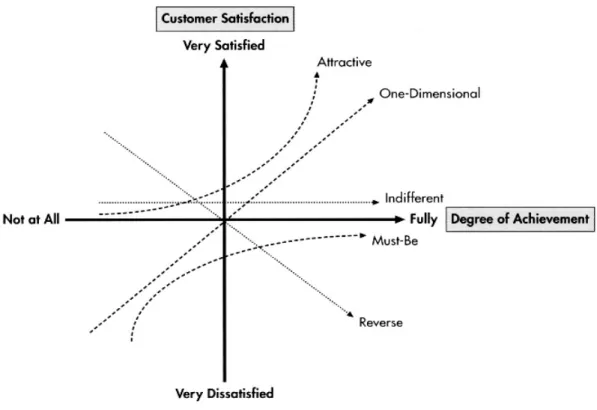
Kano et al. (1984) developed motivation/hygiene quality attributes based on Herzberg et al.’s (1959) two-factor theory. Kano’s model approaches quality dimensions by making subjective use of the perceived concept of satisfaction/dissatisfaction as assessed by customers and the objective concept of whether the use of products and services is satisfactory. Kano’s two-dimensional quality model was initially used for developing measures of the quality of manufactured products (Kano et al., 1984) based on a survey of TV and decorative clocks. In Kano’s theory of attractive quality (Kano et al., 1984), the presence of a certain product attribute does not necessarily imply a higher level of customer satisfaction. The theory postulates that the relationship between a product attribute and customer satisfaction generally depends on the customer’s individual requirements (Matzler et al., 1998). Accordingly, the theory considers both customer assessments of an attribute’s functional characteristics (i.e., their response when a certain attribute is present in the product) and their assessments of the attribute’s dysfunctional characteristics (i.e., their response when the attribute is absent). Based on these assessments, product attributes can be classified into five categories that meet different kinds of customer requirements and therefore influence customer satisfaction differently: basic, performance, advanced, indifferent, and reverse attributes Kano (2001) defined that quality is composed of the following five attributes: Attractive quality element. In this category, the presence of service element results in customer satisfaction. The deficiency however does not result in dissatisfaction because the customer does not usually have experience with the service element. The element falling in this category is corresponded with a motivator factor proposed by Herzberg et al. (1959). One-dimensional quality. When present, customers are satisfied. The intensity of this attribute varies: the higher the quality, the higher the level of satisfaction and vice versa. When absent, custome rs are dissatisfied.
Must-be quality element. The element in this category has to be provided to customers, and its presence does not have a significantly positive impact on customer satisfaction. However, the absence causes customer dissatisfaction.
Indifferent quality (IQ) element. Regardless of affording this element or not, it does not result in satisfaction or dissatisfaction.
Reverse quality. When present, customers are dissatisfied and vice versa. Figure 1 provides a visual map of the Kano Model.
Sosyal Bilimler
Dergisi
ICEBSS
Özel Sayısı
Figure 1. The Kano Model of Satisfaction.
Classification of customer need can be formulated with Kano questionnaire which is shown in Table 1. The first question is to know if the attribute is provided, how a customer feels named functional question. The second (dysfunctional) question refers how a customer reacts without quality attribute.
Table 1: Kano Evaluation Table Dysfunctional Functional
Like Must-Be Neutral Like With Dislike
Like Q A A A O Must-Be R I I I M Neutral R I I I M Like With R I I I M Dislike R R R R Q Kano’s et al. (1984)
(A: Attractive O: One-Dimensional M: Must-Be I: Indifferent R: Reverse Q: Questionable)
Sosyal Bilimler
Dergisi
ICEBSS
Özel Sayısı
The format of the functional and dysfunctional question is as follows: Functional Question: If the service has attribute, how do you feel?
Dysfunctional Question: If the service doesn’t have attribute, how do you feel?
Based on the responses of the Kano questionnaire we customer’ needs can be divided into six categories: must-be attribute, one-dimensional attribute, attractive attribute, indifferent attribute, reverse attribute and questionable attribute (Lee at al, 2008; Xu et al, 2016). InTable 1, Kano Evaluation Table, A is attractive quality-customers will be very happy when they find it in a product. Yet, customers will not dislike a certain product without this quality. O is one dimensional quality-customer will be very happy to see this quality in a product and be disappointed if they don’t. M is must-be quality that customers take for granted and will be very discontented with its absence. I is indifferent quality-quality that is unable to sway satisfaction at all. R is reverse quality-it will arouse bad feelings in customers, so satisfaction comes without it. Q is questionable result, perhaps caused by an incorrect record or testers misunderstanding of the question or even a detective check, which is normally unlikely to happen. Hence, the Q-rate is a measurement for an effective questionnaire, with 2% or below acceptable according to Matzler and Hintterhuber (1998).
3. Materials and Methods
This study attempted to investigate the categorization of online shopping quality attributes and their impact on customer satisfaction by applying Kano model. In this study, a questionnaire composed of two parts was conducted on the students. The first part consisted of 7 questions. In the second part, there were 25 (positive-negative) question pairs used in Kano Model. While evaluating these question pairs, a 5-scale was used: “1 = I like it”, “2 = It is only natural”, “3 = I am fine with it”, “4 = There is nothing I can do” and “5 = I do not like it”. The questionnaire was applied on 125 students at Dumlupınar University, Faculty of Economics and Administrative Sciences.
Based on the data collected from the questionnaire, the results were analyzed. First of all, the quality attributes were divided by the frequencies of responses and to categorize these attributes Kano’s Model was used. The extent of satisfaction and the extent of dissatisfaction for each of the items were calculated with the formula as follows:
Grade = max {M, O, A, I, R, Q}
In addition, the satisfaction and dissatisfaction coefficient were calculated using the following formulas (Matzler et al., 1998):
Sosyal Bilimler
Dergisi
ICEBSS
Özel Sayısı
The satisfaction coefficient ranges from 0 to 1, when it is close to 1 means the attribute makes highly impact on customer satisfaction, while it is close to 0, impacts to customer satisfaction less. Alike, dissatisfaction coefficient ranges from -1 to 0, when it is close to -1 means the attribute makes highly impact on customer satisfaction.
The results were analysed with Kano Model and the data were evaluated with SPSS for Windows 15.0 and MS Excel package programs. The analyses showed which features the students gave more importance while choosing online shopping websites and what the requirements that led to their satisfaction were. In this section, “which features stand out while choosing online shopping websites”and “what the requirements that lead to satisfaction/dissatisfactionare” were examined.
As a result of the questionnaire conducted on 125 students, intersection of each student’s reply to the positive and negative question types using Kano Evaluation Table. Later, the results of the replies obtained from all the students were added to one another to form a frequency table. MS Excel program was used to do the analysis. Using Kano EvaluationTable, which category the product feature would enter was decided according to the merged replies. Also, satisfaction coefficient, which denotes how much increase can be achieved in customer satisfaction by meeting the product feature, and dissatisfaction coefficient, how much dissatisfaction will arise in customers when the product feature isn’t met, were computed according to the formulas (1) and (2).
4. Results and Discussion
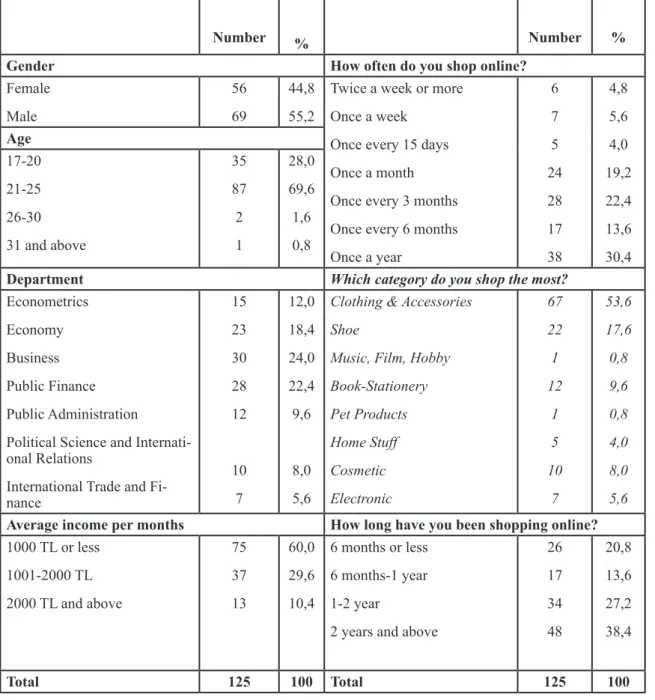
In this study, online shopping quality attributes was classified six (communication quality, brand recognition, marketing activity, interface quality, system quality and information quality) characteristics. Table 2 provides detailed participant demographic information of 125 students at Dumlupınar University, Faculty of Economics and Administrative Sciences. Table 2 provides detailed university student demographic information. For example; 38,4 % of students are shopping online 2 years and more; 27,2% of them are online shopping 1-2 years. Category where students shop most is clothing & accessories (53,6%).
Sosyal Bilimler
Dergisi
ICEBSS
Özel Sayısı Table 2: Demographic Characteristics of the Sample
Number % Number %
Gender How often do you shop online?
Female Male 56 69 44,8 55,2
Twice a week or more Once a week
Once every 15 days Once a month Once every 3 months Once every 6 months Once a year 6 7 5 24 28 17 38 4,8 5,6 4,0 19,2 22,4 13,6 30,4 Age 17-20 21-25 26-30 31 and above 35 87 2 1 28,0 69,6 1,6 0,8
Department Which category do you shop the most?
Econometrics Economy Business Public Finance Public Administration
Political Science and Internati-onal Relations
International Trade and Fi-nance 15 23 30 28 12 10 7 12,0 18,4 24,0 22,4 9,6 8,0 5,6
Clothing & Accessories Shoe
Music, Film, Hobby Book-Stationery Pet Products Home Stuff Cosmetic Electronic 67 22 1 12 1 5 10 7 53,6 17,6 0,8 9,6 0,8 4,0 8,0 5,6
Average income per months How long have you been shopping online?
1000 TL or less 1001-2000 TL 2000 TL and above 75 37 13 60,0 29,6 10,4 6 months or less 6 months-1 year 1-2 year
2 years and above
26 17 34 48 20,8 13,6 27,2 38,4 Total 125 100 Total 125 100
Table 3 shows quality attributes of online shopping sites, satisfaction coefficient, dissatisfaction coefficient and sum of the coefficients. According to the Table 3, to share
Sosyal Bilimler
Dergisi
ICEBSS
Özel Sayısı
and customers do not pay attention to this type of attributes. The one-dimensional attributes were to give importance thoughts and complaints, to provide accurate and smooth service, by to have a phone number can be conducted, to have good reputation, to provide the best price opportunity, to make cargo delivery everywhere, to make timely and accurate delivery, easy to use the site, to have product and brand diversity, to complete the purchase process quickly, to pay attention to the privacy and security of personal information, to surf easily at every point of the site, to send the same product is displayed on the site, to have enough product information and photos, to provide persuasive product information and photos. These attributes are related with satisfaction degree positively and if the needs are fullfilled, the customer satisfaction will be increased; however, if they are not fullfilled, the customer will be dissatisfied. As shown in Table 3, quality attribute with the highest dissatisfaction coefficient was to pay attention to the privacy and security of personal information (-0,73). When this attribute is not fullfilled dissatiffaction will be increased more. Quality attribute with the highest satisfaction coefficient was to make timely and accurate delivery. It is very important attribute for customers and this attribute excessively increases satisfaction.
Sosyal Bilimler Dergisi ICEBSS Özel Sayısı Analysis Results Content A M O R Q I Total Quality Evaluation Satisfaction Coefficient Dissatisfaction Coefficient The Sum of the Coefficients
To share feed back on products after using them
28 18 33 1 6 39 125 I 0,51 -0,43 0,08
To give importance thoughts and complaints
10 22 41 7 6 39 125 O 0,45 -0,56 -0,1 1
To provide accurate and smooth service
11 21 53 5 6 29 125 O O 0,56 -0,64 -0,08
To have a phone number can be conducted
7 36 45 8 4 25 125 O 0,46 -0,71 -0,25
To have good reputation
13 26 47 4 3 32 125 O 0,50 -0,61 -0,1 1 To be well-known 29 14 35 1 8 38 125 I 0,55 -0,42 0,13 To advertise 12 14 16 3 5 75 125 I 0,23 -0,25 -0,02
To be constantly involved in social media
13 10 18 12 2 70 125 I I 0,27 -0,25 0,02
To make a sales campaign
36 8 35 3 3 40 125 I 0,59 -0,36 0,23
Sosyal Bilimler Dergisi ICEBSS Özel Sayısı Kano Model Analysis Results Content A M O R Q I Total Quality Evaluation Satisfaction Coefficient Dissatisfaction Coefficient The Sum of the Coefficients
To provide the best price opportunity
28 12 46 9 0 30 125 O 0,63 -0,50 0,13 To make car go delivery everywhere 15 16 60 8 4 22 125 O 0,66 -0,67 -0,01 Marketing Activity
To make timely and accurate delivery
13 12 66 3 5 26 125 O O 0,67 -0,66 0,01
To give gift vouchers and shopping coupons
27 7 34 1 3 53 125 I 0,50 -0,33 0,17
To have memorable name
16 11 18 4 5 71 125 I 0,29 -0,25 0,04
To have a well-designed back ground and color combination
18 7 16 5 3 76 125 I 0,29 -0,19 0,10
Easy to use the site
21 16 43 7 3 35 125 O O 0,55 -0,51 0,04 Quality
To have product and brand diversity
22 9 42 6 5 41 125 O 0,56 -0,44 0,12
To complete the purchase process quickly
21 11 49 11 3 30 125 O 0,63 -0,54 0,09
Sosyal Bilimler Dergisi ICEBSS Özel Sayısı Kano Model Analysis Results Content A M O R Q I Total Quality Evaluation Satisfaction Coefficient Dissatisfaction Coefficient The Sum of the Coefficients
To pay attention to the privacy and security of personal information
7 16 66 8 5 23 125 O 0,65 -0,73 -0,08
Stability of the system
16 14 34 7 6 48 125 I O 0,44 -0,42 0,02
To surf easily at every point of the site
20 12 43 7 6 37 125 O 0,56 -0,49 0,07
To send the same product is displayed on the site
14 14 60 5 5 27 125 O 0,64 -0,64 0
To have enough product information and photos
14 17 48 7 8 31 125 O 0,56 -0,59 -0,03
To provide persuasive product information and photos
12 28 39 8 3 35 125 O O 0,44 -0,58 -0,14 To send a promoti onal newsletter 14 9 20 8 5 69 125 I 0,30 -0,25 0,05
Sosyal Bilimler
Dergisi
ICEBSS
Özel Sayısı
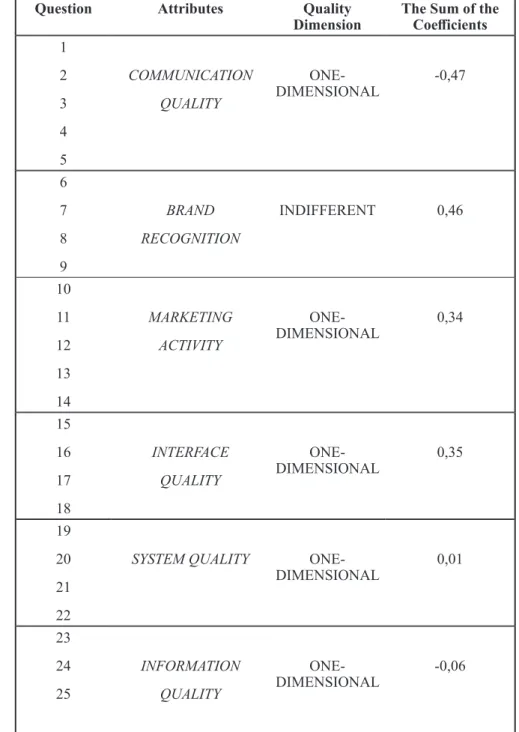
In Table 4, quality attributes was categorized. While communication quality, marketing activity, interface quality, system quality and information quality were one-dimensional quality attributes, brand recognition was indifferent quality attributes.
Table 4: The Categorization of Quality Attrributes
Question Attributes Quality
Dimension The Sum of the Coefficients 1 2 3 4 5 COMMUNICATION QUALITY ONE-DIMENSIONAL -0,47 6 7 8 9 BRAND RECOGNITION INDIFFERENT 0,46 10 11 12 13 14 MARKETING ACTIVITY ONE-DIMENSIONAL 0,34 15 16 17 18 INTERFACE QUALITY ONE-DIMENSIONAL 0,35 19 20 21 22
SYSTEM QUALITY
ONE-DIMENSIONAL 0,01 23 24 25 INFORMATION QUALITY ONE-DIMENSIONAL -0,06
Sosyal Bilimler
Dergisi
ICEBSS
Özel Sayısı
Ifsum of the coefficients is positive, attributes are closer to attractive dimension, if sum of the coefficients is negative attributes are closer to must-be dimension (İlter et al., 2007). As a result, while brand recognition, marketing activity, interface quality and system quality were closer to attractive dimension, communication quality andinformation quality werecloser to must-be dimension.
5. Conclusion
The technique of “Kano Model” was developed in 1980’s by Prof. Noriaki Kano and it is based on perfection. In this model, the benefit a customer gains from purchasing a product or a service is tried to be maximized while total cost and total loss are tried to be minimized. It is a technique used incustomer satisfactionandproduct development process. Kano model reveals the relation betweenthe level of businesses’ meeting customer expectations andconsumer satisfaction. According to Kano model, customer needs are categorized in 3 different groups; namely, basic needs, performance (linear) needs and excitement needs. Kano model states that product and service features have a dynamic structure and in time these features change from neutral to exciting to linear to basic quality feature.
With the developments in technology, the internet has started to be more effective in human life and has caused significant changes in daily life. One of these changes is online shopping. Numerous consumers gather information about various products and services and have the opportunity to purchase them over the internet. Thanks to online shopping, consumers no
longer have to go to a shop and people can get the product they want easily without wasting any effort or time. Also, thanks to the internet, businesses can know who their consumers
are, what they want and when they are ready to buy.
This study aimed to evaluate the features of online shopping websites according to the opinions of the students at Dumlupınar University, Faculty of Economics and Administrative Sciences. While evaluating these opinions, Kano Model was used and the results were presented as a summary.
According to the students at Dumlupınar University, Faculty of Economics and Administrative Sciences, features of online shopping websites about communication,
marketing, system quality, information quality and interface quality of are in “linear needs”
category andthose about brand recognitionare in“neutralneeds”category.
While meeting the needs whose satisfaction coefficient value converges to 1 increases satisfaction more, meeting the needs whose dissatisfaction coefficient value converges to
-1 increases dissatisfaction at such an extent.
Since the needs were determined as linear and neutral as a result of the questionnaire, the sum of satisfaction and dissatisfaction coefficients were checked to determine whether the needs converged more to excitement or basic. It was concluded that brand recognition,
Sosyal Bilimler Dergisi ICEBSS Özel Sayısı REFERENCES
Aksoy, R. (2006). Bir Pazarlama Değeri Olarak Güven ve Tüketicilerin Elektronik Pazarlara Yönelik Güven Tutumları. ZKÜ Sosyal Bilimler Dergisi, 2(4), 79–90.
Bourlakis, M., Papagiannidis, S., Fox, H. (2008). EConsumer Behaviour: Past, Present and Future Trajectories of an Evolving Retail Revolution. International Journal of E-Business
Research, 4(3), July- September, 64-76.
Chen, S.J. & Chang, T.Z. (2003). A Descriptive Model of Online Shopping Process: Some Empirical Results. International Journal of Service Industry Management, 14(5), 556-569. Elibol, H. & Kesici, B. Çağdaş İşletmecilik Açısından Elektronik Ticaret.(file:///C:/Users/ user/Downloads/736-1454-1-SM.pdf). [1.11.2016].
Herzberg, F., & Anyderman, B. (1959), Motivation to Work, Wiley, New York, NY.
İlter, B., ÖZGEN, Ö., & Akyol, B. (2007). Lise öğrencilerinin alışveriş merkezi gereksinimlerinin kano modeli ile sınıflandırılması: İzmir ili uygulaması.
Javadi, M., H., M., Dolatabadi, H., R., Nourbakhsh, M., P., A., & Asadollahi, A., R., (2012), An Analysis of Factors Affecting on Online Shopping Behavior of Consumers, International, Journal of Marketing Studies, 4(5), 81-98.
Kano, N., Seraku, N., Takahashi, N. & Tsuji, S. (1984), Attractive quality and must-be quality, Journal of the Japanese Society for Quality Control, Vol. 14 No. 2, pp. 39-48. Kano, N. (2001), Life cycle and creation of attractive quality, paper presented at the 4th
International QMOD Conference.
Kurnia, S., Chien, A. J. (2003). The Acceptance of Online Grocery Shopping, 16th Bled eCommerce Conference eTransformation, Slovenia.
Laohapensang, O. (2009). Factors Influencing Internet Shopping Behaviour: A Survey of Consumers in Thailand. Journal of Fashion Marketing and Management, 13(4), 501-513. Lee, Y. C., Hu, H. Y., Yen, T. M., & Tsai, C. H. (2008). Kano’s model and decision making trial and evaluation laboratory applied to qualifiers order-winners and improvement: A study of computer industry. Information Technology Journal, 7(5), 702-714.
Leiner, M. B., Cerf, G. V., Clark, D. D., Kahn, E. R., Kleinrock, L., Lynch, C. D., Postel, J., Roberts, G. L., Wolff, S. (2004). Briefn History of the Internet.
Matzler, K., and H.H. Hinterhuber. (1998) How to Make Product Development Projects More Successful by Integrating Kano’s Model of Customer Satisfaction into Quality Function Deployment, Technovation, 18(1), pp. 25-38.
Modahl, M. (2001). Now or never: how companies must change to day to win the battle for internet consumers. Harper Collins 10 East Third Street, 1st ed, New York.
Sosyal Bilimler
Dergisi
ICEBSS
Özel Sayısı
Suki, N.M., Ramayah, T., Suki, N.M. (2008). Internet Shopping Acceptance, ExaminingThe Influence of Intrinsic Versus Extrinsic Motivations., Direct Marketing: An International
Journal, 2(2), 97-110.
Turan, H. A. (2011). İnternet Alışverişi Tüketici Davranışını Belirleyen Etmenler: Planlı Davranış Teorisi (Tpb) İle Ampirik Bir Test, Doğuş Üniversitesi Dergisi, 12 (1), s. 128-143. Ventura, K. (2002). Tüketicilerin Süpermarket / Hipermarketlerden İnternet Üzerinden Alışveriş Yapma Eğilimleri: İzmir Örneği., Yüksek Lisans Tezi, Ege Üniversitesi Sosyal Bilimler Üniversitesi. İzmir.
Xu, R. Y., Zheng, R., Jiang, L. Y., & Yan, H. B. (2016, June). On customer satisfaction of school bus based on Kano model: A case study in Shanghai. In Service Systems and Service