T.C.
ISTANBUL AYDIN UNIVERSITY INSTITUTE OF SOCIAL SCIENCES
THE EFFECT OF DEMARKETING ADVERTISEMENTS ON DECREASING ALCOHOLIC DRINK CONSUMPTION AMONG
TEENAGERS
MBA THESIS Wasiu Abodunrin AHMED
Department of Business Administration Business Administration Program
Thesis Advisor: Assoc. Prof. Dr. Ilkay KARADUMAN
T.C.
ISTANBUL AYDIN UNIVERSITY INSTITUTE OF SOCIAL SCIENCES
THE EFFECT OF DEMARKETING ADVERTISEMENTS ON DECREASING ALCOHOLIC DRINK CONSUMPTION AMONG
TEENAGERS
MBA THESIS Wasiu Abodunrin AHMED
(Y1412.130079)
Department of Business Administration Business Administration Program
Thesis Advisor: Assoc. Prof. Dr. Ilkay KARADUMAN
DECLARATION
I affirm that all data in this report has been gotten and introduced as per scholarly guidelines and moral lead. I further affirm that, as required by the principles, I have completely referred to and referenced all material and results, which are not unique to this report.
FOREWORD
My significant appreciation goes to the Almighty God for His love and grace to be able to carry out this research work. I appreciate Him for making this program possible for me. My heartfelt gratitude goes to my amiable and able supervisor Dr. ilkay KARADUMAN for his brilliant contributions towards the success of this work. I appreciate God in his life and I thank him for his intellectual guidance and encouragement which had helped in the accomplishment of this work. My appreciation also goes to my parents, Mr. and Mrs. Ahmed for their parental guides and for being there always, may God bless you both.
TABLE OF CONTENT
Page
FOREWORD ... iv
TABLE OF CONTENT ... v
LIST OF TABLES ... vii
ÖZET ... viii
ABSTRACT ... ix
1. INTRODUCTION ... 1
1.1 Study Overview ... 1
1.2 Statement of the Problem... 2
1.3 Study Questions ... 4 1.4 Specific Objectives ... 4 1.5 Study Hypotheses ... 4 1.6 Justification ... 5 1.7 Study Scope ... 5 1.8 Definition of Terms ... 5 2. LITERATURE REVIEW ... 6 2.1 Alcohol ... 6
2.1.1 Alcohol in tertiary education ... 6
2.1.2 Advertising and alcoholic ... 8
2.1.3 Alcohol outlet and its impact ... 8
2.1.4 Consumption of alcohol: Nigeria history... 10
2.1.5 Alcohol marketers: world largest ... 11
2.1.6 Youth and drinking advertising behavior ... 12
2.1.7 Impact of advertising ... 13
2.2 Theoretical Issues ... 14
2.2.1 Biological theory... 14
2.2.2 Learning hypothesis ... 15
2.2.3 Tension reduction hypothesis ... 16
2.2.4 Hypothesis of social learning ... 16
2.3 Empirical Review ... 17
2.3.1 Empirical review summary ... 20
3. RESEARCH METHODOLOGY ... 21
3.1 Study Design ... 21
3.2 Population ... 21
3.3 Sample and Sampling Techniques ... 21
3.4 Collection of Data and Study Tools ... 22
3.5 Research Instrument ... 22
3.6 Study Validity ... 22
3.7 Study Reliability ... 23
4. PRESENTATION OF RESULT ... 24 4.1 Demographic Analysis... 24 4.2 Frequency Analysis ... 26 4.3 Reliability Test... 34 4.4 Factor Breakdown ... 34 4.5 Correlation Analysis ... 36 4.6 Regression Analysis... 36
5. CONCLUSION, LIMITATIONS AND POLICY RECOMMENDATIONS . 38 5.1 Summary ... 38
5.2 Conclusion ... 39
5.3 Policy Recommendations ... 39
REFERENCES ... 41
LIST OF TABLES
Page
Table 2.1: Empirical Summary ... 20
Table 4.1: Gender ... 24
Table 4.2: Marital Status ... 24
Table 4.3: Age of Respondent ... 25
Table 4.4: Educational-Qualification ... 25
Table 4.5: How many children do you have? ... 26
Table 4.6: Teenagers consume alcoholic drinks ... 26
Table 4.7: Most teenagers drink alcoholic excessively without parental control .. 27
Table 4.8: Most parent influences their teenagers in alcoholic ... 27
Table 4.9: Do you know if your children take alcoholic drinks ... 27
Table 4.10: Teenagers take the alcoholic drinks mostly in school ... 28
Table 4.11: Producers of alcoholic drinks market their products in different ways to inspire teenager’s consumption ... 28
Table 4.12: Advertisement of alcoholic drink on social media spread its consumption across board regardless of age ... 29
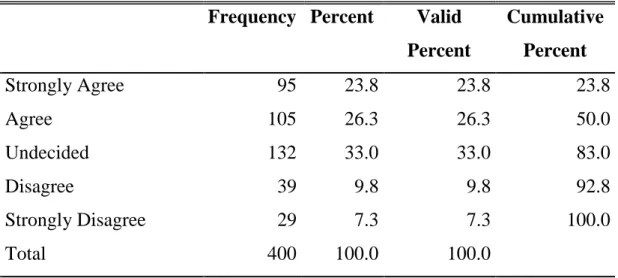
Table 4.13: Youth does not have inhibition regarding to alcoholic consumption, which were earlier restricted by social customs. ... 29
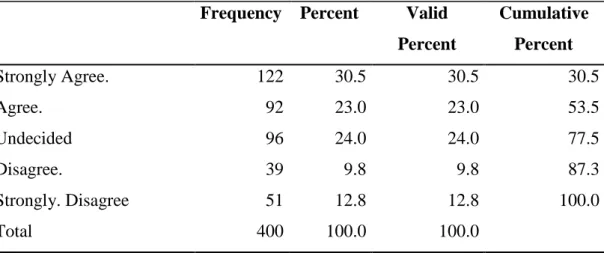
Table 4.14: Alcoholic drinking promotes forgetfulness in teen ... 30
Table 4.15: Demarketing advertisement on alcoholic drink can reduce the consumption of alcoholic drink among teenagers ... 30
Table 4.16: Alcoholic drink causes several changes in form of intoxication which could render teen useless in the society and in tune make them behave badly ... 31
Table 4.17: Advertising of alcoholic products deliberately targeted at young ... 32
Table 4.18: There is restriction in taking alcoholic drinks among teenagers ... 32
Table 4.19: Television alcohol advertising increases the consumption of alcoholic drink among teen ... 33
Table 4.20: Producers reduce the chances of teens failing to get the message by sponsorship of events such as music concerts, sports, etc. to attracting the teens. ... 33
Table 4.21: Reliability Statistics ... 34
Table 4.22: KMO and Bartlett's Test ... 34
Table 4.23: Total Variance Explained ... 35
Table 4.24: Correlations ... 36
Table 4.25: ANOVAa ... 36
THE EFFECT OF DEMARKETING ADVERTISEMENTS ON DECREASING ALCOHOLIC DRINK CONSUMPTION AMONG
TEENAGERS
ÖZET
Bu çalışmada, pazarlama reklamlarının gençler arasında alkollü içecek tüketimini azaltma üzerindeki etkisini incelemiştir. Bununla birlikte, çalışma Nijerya'daki gençler arasında reklamın alkollü içecek tüketimine etkisini özellikle incelemiştir; Nijerya'da gençlere yönelik pazarlama reklamı ile alkollü içki tüketiminin azaltılması arasındaki ilişkiyi belirledi; ve Nijerya’da gençler arasında pazarlama reklamının alkollü içecek üzerindeki etkisini araştırdı. Popülasyonun seçilen unsurlarından elde edilen bu çalışmada birincil veri kaynakları kullanılmıştır. Araştırmada tahmin teknikleri olarak Pearson korelasyonu ve regresyon analizi kullanılmıştır.
Korelasyonun sonucu, tüm değişkenlerin pozitif olarak ilişkili olduğunu ve hepsinin birbirine karşı önemli olduğunu ve regresyon analizinin alkollü içecek reklam araçlarının Gençler arasında Alkollü İçecek Tüketimi üzerinde olumlu ve önemli bir etkiye sahip olduğunu göstermiştir. Reklamın pazarlanması, ADC üzerinde olumlu ve önemli bir etkiye sahiptir ve alkol televizyonun reklamı, gençler arasında alkollü içecek tüketimi üzerinde olumlu ve önemli bir etkiye sahiptir.
Anahtar Kelimeler: Alkollü,içecek, reklam, pazarlama, gençler, içecekler ve
THE EFFECT OF DEMARKETING ADVERTISEMENTS ON DECREASING ALCOHOLIC DRINK CONSUMPTION AMONG
TEENAGERS
ABSTRACT
This study examined the effect of demarketing advertisements on decreasing alcoholic drink consumption among teenagers. However, the study specifically investigated the effect of advertisement on alcoholic drink consumption among teenagers in Nigeria; determined the correlation between demarketing advertisement and decreasing alcoholic drink consumption among teenagers in Nigeria; and examined the impact of demarketing advertisement on alcoholic drink among teenagers in Nigeria. Primary sources of data were used in this study which were sourced from the selected elements of the population. Pearson correlation and regression analysis were used as the estimation techniques in the study.
The result of the correlation depicted that all the variables are positively related and they all are significant against each other while regression analysis showed that advertisement means of alcohol drink has a positive and significant impact on Alcohol Drink Consumption among Teens. Demarketing of advertisement exerts a positive and significant influence on ADC and television advertisement of alcohol has a positive and significant impact on alcohol drink consumption among teens.
Keywords: Alcoholic, advertisement, demarketing, teenagers, drinks, and
1. INTRODUCTION
1.1 Study Overview
There has been continuous worried of alcohol exploitation among teenagers globally and the worried has been strengthened surveying huge size of national youth tests in some part of the world where young people try different things with liquor and critical minorities drink all the time (Gunter et al.2008). The publicizing of alcoholic items and the promoting of items purposely focused at youthful grown-up lawful consumers are among the components accepted to have an influence in making an atmosphere in which liquor utilization is viewed as ordinary and that serves to trigger an enthusiasm for liquor among those legitimately too youthful to even think about purchasing alcoholic items.
Makers of mixed beverages showcase their items in various approaches to motivate utilization of their items both locally and universally. The showcasing of mixed beverages is a vital and long haul try which begins with item advancement and development and utilizations business interchanges to respect the advantages of and evacuate hindrances to utilization. By so doing, mixed beverages spread crosswise over board paying little respect to age. Thomsen (2006) composed that the connection between introduction to alcohol/liquor promoting and savoring propensity cross-sectional examinations, and it has been said that an expanded readiness of liquor interchanges among youngsters may prompt prior drinking, higher utilization and expanded damage, and ought to be tended to through more grounded showcasing guideline. Saffer and Dave (2002) expressed that the whole use on liquor/alcohol promoting is related to more utilization and publicizing orders could altogether decrease utilization. More so, the investigation did in the US on the impacts of liquor publicizing on youth drinking practices, it was discovered that a total preclusion on liquor promoting could lessen month to month levels of youth drinking. Towl (2004) says that liquor utilization is characterized as a center part of understudy culture and is seen as a huge element of tertiary training way of life.
On account of South Africa, the administration executes to expand the adequate oldness of youth individuals to buy liquor which is an unmistakable insight that liquor utilization and misuse is a premier worry in the nation. The resistance of mixed beverage has incited a few youngsters to drop focus on their essential objective(s) for setting out on a specific task either in school or in the general public. Although lacking information on liquor utilization and drinking styles existed in the creating countries (Perdrix, Bovet, Larue, Yersin, Burnand and Paccaud, 1999). More along these lines, developing alcohol drinking is found in creating countries moderately to different components would goad financial development, stress, struggle, accessibility and forceful publicizing. The effect of alcohol in any country is of worry because of its generation and utilization which is expanding in almost all aspects of the creating countries. The utilization is quickly developing in creating countries than in most created countries, generally as liquor businesses may grow quickly in countries with less mechanical foundation as access to making, refining, and generation simple.
1.2 Statement of the Problem
Alcohol drinks was previously earmarked for unusual cases in Nigeria and some other part of the developing nations of the world. Females and teens were ethnically excluded from taking alcoholic drink. Currently, alcohol consumption has witnessed remarkable variations through the structure of socio-economic. Consumption of alcohol is never again solely managed by traditions and customs or for exceptional social affairs/events. Youth does not have inhibition nowadays with respect to alcohol utilization, which were prior confined by social standards. This pattern appears to have contributed fundamentally, where Nigeria is among the 30 nations with most noteworthy per capita of liquor generally.
In any case, Alcohol diminishes the usefulness of the focal sensory system, for example, the spinal rope and the cerebrum, it upsets the progression of interchanges to the mind. Liquor causes a few changes in type of inebriation. Jazzed up Drinking advances carelessness in youngster and its exorbitance may make an individual have obscured vision, slurred discourse, to stun, have hindered response times, disabled hearing and impeded memory (Dlamini, Rugbeer, Naidoo, Metso & Moodley 2012). WHO revealed that liquor/alcohol publicizing can deliver constructive bits of knowledge of savoring all individuals and as a result teenager individuals might be
increasingly vulnerable to having professional drinking frames of mind (Eassys, UK 2018). WHO revealed 2 motivations to accept why publicizing can cause this? Right off the bat, the presentation to alcohol promoting after some time can lead youngsters to see drinking as an ordinary conduct and, accordingly, an action wherein they wish to take an interest. In conclusion, alcohol promoting may arrive at kids and empower liquor utilization a long time before they are lawfully mature enough to buy the item. In an overview with youngsters, the larger part addressed that they accepted liquor promoting can cause liquor utilization. This revelation alongside proof that insignificant consciousness of liquor commercials could be connected to positive convictions about liquor, which is thus related with future aim to drink. In this unique situation, there is nothing unexpected that preferring of liquor notices has additionally risen as a noteworthy factor in understanding potential impacts (Babor, 2003). Evaluating the impact of liquor promoting on young person's drinking practices is an extraordinary issue. Liquor is a grown-up item; up to this point most young customers are as of now mindful of its reality. This fundamentally constrains the potential impacts that liquor promoting could have on expanding by and large utilization. Because of the current notoriety of this item, sponsors center around making an engaging brand as opposed to expanding the all-out market. While new purchasers are not publicists' objective, the intensity of liquor promoting efforts to shape utilization propensities can't be disregarded. Analysis has been coordinated toward liquor promoting, especially in regard to the utilization of picture publicizing, and its potential impact on immature liquor utilization. Considering whether advertising influences teen people’s alcoholic consumption, the imperative know-how is the several factors that attached to the influence of alcohol drinking such as psychological, social, environmental, and family factors. The family factors such as fathers, relatives, and sets of friends can have a substantial inspiration on the teen alcohol consumption. This could lead to behavioral imitation and create positive feature to alcohol intake. Though, this investigation is concentrated on the effects of demarketing advertisements on decreasing alcoholic drink consumption among teenagers.
1.3 Study Questions
This study aimed to offer responses to the requests as stated below
i. How does advertisement affect alcoholic drink consumption among teenagers in Nigeria?
ii. What is the correlation between demarketing advertisement and decreasing alcoholic drink consumption among teenagers in Nigeria?
iii. What is the impact of demarketing advertisement on alcoholic drink among teenagers in Nigeria?
1.4 Specific Objectives
This study tends to examine the following
i. To investigate the effect of advertisement on alcoholic drink consumption among teenagers in Nigeria
ii. To determine the correlation between demarketing advertisement and decreasing alcoholic drink consumption among teenagers in Nigeria
iii. To explore the effect of demarketing advertisement on alcoholic drink among youths in Nigeria
1.5 Study Hypotheses
The following are the hypotheses of the study
Ho1: Advertisement does not have significant effect on alcoholic drink consumption
among teenagers in Nigeria.
Ho2: There exist no significant connection between demarketing and decreasing
alcoholic drink consumption among teenagers in Nigeria.
Ho3: There is no significant impact of demarketing advertisement on alcoholic drink
1.6 Justification
This study is utmost important because the outcome will contribute to the existing literature with demarketing advertisement of alcoholic drink and its effect on the teenagers in FCT Abuja, Nigeria.
It will help to know the extent to which advertisement has affected the rate of consumption of alcoholic drinks among teen. It will contribute and advances the knowledge of the government, management, teenagers, parents, academia and researchers.
Also, the discoveries of this examination will fill in as a kind of perspective source to other researchers who might want to carry out further research on advertisement demarketing and decreasing alcoholic drink consumption among teenagers.
1.7 Study Scope
The study scope focused on Nigerian teenagers in relation to their consumption ability in alcoholic drink. Nigeria as a nation is ranked as the 7th most populous nation, the population is presently valued at 195m where youth has the higher percentage. However, this study shall purposively select the Federal Capital Territory, Abuja being the capital of Nigeria where alcoholic consumption rate cannot be belittled among teen. Questionnaire shall be randomly distributed to a few teens and adults.
1.8 Definition of Terms
Advertisement: This refers to is a showcasing correspondence that utilizes a transparently supported, non-individual message to advance or sell an item, administration or thought.
Alcoholic Drink:This means a beverage that contains ethanol, a kind of liquor delivered by aging of grains, natural products, or different wellsprings of sugar.
Consumption: This is the value of alcoholic goods bought by people.
Teenager: This is a person who falls within the ages of 12-19 years old. A teenager is another word for an adolescent.
2. REVIEW OF THE LITERATURE
2.1 Alcohol
There has been continuous worried about liquor/alcohol utilization among youngsters in Nigeria Kingdom and different nations. This worry has been strengthened by enormous scale overviews of national youth tests that have shown that numerous adolescents explore different avenues regarding liquor and noteworthy minorities drink all the time. While a few signs have risen that increasingly youngsters are beginning to drink later, when they arrive at their mid-adolescents around one out of two expend liquor at any rate every so often. Moreover, developing quantities of adolescent consumers intermittently drink to abundance to the point of inebriation. A couple of components have been recognized as supporting the beginning of liquor utilization among kids and teenagers.
According to World Drink Trends (1995), triple increment in per capita liquor utilization dependent on national deals has been seen in a few of these nations in the course of the most recent two decades, though patterns were steady or diminishing in a few Western nations. Nonetheless, deals information don't for the most part represent the utilization of indigenous mixed beverages or liquor delivered wrongfully, which might be the significant wellspring of liquor devoured in a few creating nations (Kortteinen, 1988). Evaluating home-blend drinking accordingly requires examinations depending on self-revealed information. Such data may likewise respond to inquiries on home-blend utilization designs (Colson and Scudder, 1988). This incorporates the degree to which populaces of consumers move from home-prepared to manufacturing plant made drinks or the other way around, the impact of expense on decision of refreshment, the individual and nation's financial level and the changing dispositions with respect to the status of drinks (Ambler, 1990; Mukolo, 1992).
2.1.1 Alcohol in tertiary education
Alcohol consumption in tertiary institutions places a main strain on students’ academic development. Any student that involves in alcohol consumption assumes to be absent
in class or lose concentration in class which result into poor performance in valuations. Excessive alcohol could cause severe damage to the body including mind. White et al. (2002) opined that student behavior is most likely to change after consumption of intoxicating drinks. Meanwhile, after the drinking of liquor, the drinker may be experiencing sociable feelings but if too much is consumed in due time, one may start having issues in his/her reactions to walking or talking which in turn making an introvert becomes an extrovert or an extrovert becomes introvert. In the event that understudies keep on concentrating on drinking, at that point their examinations can be influenced and inevitably considering will turn into the least of their needs. Their conduct could likewise turn out to be rough and lead to the dismissal of individual property, less than stellar scores, confronting challenges, and partaking in improper exercises. Fields (2008) says understudies under the liquor impact could finish up having their arrangement changed without accomplishing it since liquor habituated understudies for the most part center around beverages than contemplating. Liquor is addictive and makes one turned out to be wiped out both rationally and physically. In some cases, liquor's belongings vanish medium-term, yet some last more and can even end up changeless. Adam, Welch, Pendlebury, and Merrit (2000) stressed that the most widely recognized damages of overwhelming liquor are retention misfortune and remorseful or humiliated about activities during drinking.
Long haul drinking puts individuals in danger of cerebrum harm. Notwithstanding, mind harm can likewise be brought about by weakness status or extreme liver maladies. Moreover, liquor misuse likewise causes malignancy. The maltreatment of liquor is affect the body and can hurt the invulnerable framework, stomach, pancreas, digestive organs, ripeness, bones, lungs, skin and liver. Virginia (2011) recommends that liquor consuming influences the working of the insusceptible framework and debilitates the body's capacity to ward off irresistible sickness. Further momentary savoring results that colds with lengthy haul drinking, liquor could hinder the working of the resistant framework leaving the body defenseless against a few sicknesses. Liquor harms the liver cells bringing about mischief to synapses and and an expanded danger of malignant growth.
2.1.2 Advertising and alcoholic
The connection amid alcohol publicizing and drinking has been viewed by previous researchers in the literature both at micro and macro levels. To view the connection from the angle of advertising restrictions of alcohol consumption, some regional or nations placed restrictions on alcohol advertising (Gunter, Hansen & Touri, 2008). These have would in general appear as halfway confinements that reach out to media, for example, jingle. Different bans are much more firmly focused on and apply to sorts of yield in explicit media, for example, bans on liquor promoting on TV in projects went for adolescents. Research proof into the viability of publicizing bans has commonly discovered that such limitations possibly work when they are either finished or if nothing else extensive. This has been observed to be valid, for instance, in examination into the viability of tobacco publicizing bans. Halfway bans will in general be incapable since sponsors respond to limitations after publicizing in one medium by expanding interest in promoting in other media. With regards to liquor promoting bans have so far been found to have constrained effect upon per capita utilization of alcohol beverages.
2.1.3 Alcohol outlet and its impact
A bigger number of liquor outlets may be normal in more unfortunate to neighborhoods or a neighborhood with a bigger populace of teen (Stewart, 2012). Be that as it may, as the examination portrayed according to Stewart, the levels of destitution and the ethnic foundation of occupants were considered, the thickness of vents is unequivocally identified with brutality paying little mind to status area. Many of the qualities of liquor vent area can be significant. This is anything but difficult to realize that a city with numerous inns and eateries that sell liquor could not quite be the same as one that has less vents. Additionally, it is simple to see that an area that has a bar on each corner and an alcohol store on each square has a totally unexpected condition in comparison to one that has couple of outlets or none by any stretch of the imagination. Different attributes of nature have any kind of effect, as well. For instance, a segment of bars close to a school grounds exhibits an alternate situation from a comparable thickness of bars in an upscale downtown area and furthermore not the same as a comparable thickness in a poor neighborhood. Be that as it may, for each situation, some type of expanded brutality would be relied upon
when contrasted with practically identical zones with less liquor outlets. An investigation of changes in outlet thickness after some time as identified with viciousness in California found that paying little respect to other neighborhood attributes, an expansion in outlets expanded brutality. In areas with many smaller populace and low earnings, the impact was multiple occasions more prominent than for the statewide example of networks (Gruenewald & Remer, 2006).
Liquor use by youngsters, teenagers, and youthful grown-ups under the legitimate drinking age of 21 produces human disasters with disturbing consistency. Vehicle crashes, manslaughters, suicides, and other inadvertent wounds are the four driving reasons for death of 15 to 20-year-olds, what's more, liquor is a factor in a considerable lot of these passing. Undoubtedly, such a significant number of underage consumers kick the bucket in vehicle crashes that this issue, independent from anyone else, is a noteworthy national concern. In connection to the quantity of authorized drivers, youngsters under age 21 who have been drinking are engaged with deadly crashes at double the rate of grown-up drivers (Bonnie & O'Connell, 2004).
Vehicle accidents are the most unmistakable and most desensitizing results of underage drinking; however, they speak to just a little extent of the social toll that underage drinking takes on the present and future of the society. Other harming issues incorporate risky sexual practices that lead to both genuine infection and undesirable pregnancies, accidental wounds, battles, and school disappointments that lead to ejections or withdrawals. For some kids, liquor use starts ahead of schedule, during a basic formative period: in 2002, 19.6 percent of eighth graders were present clients of liquor (use inside the previous 30 days), which can be contrasted and 10.7 percent who smoked cigarettes and 8.3 percent who utilized weed. Among each more established age accomplice of secondary school understudies, the commonness, recurrence, furthermore, power of drinking increment, adding to expanding rates of instructive disappointment, damage, and passing as kids move from evaluation to review. By the time youngsters are seniors in secondary school, very nearly seventy five percent 71.5% report having flushed in the previous year, practically half 48.6% are present consumers, and more than one-quarter 28.6% report having had at least five beverages in succession in the previous 2 weeks. Among 18 to 22-year-olds, 41.4% of full-time school understudies and 35.9 percent of other youthful grown-ups report overwhelming drinking (Bonnie & O'Connell, 2004). Overwhelming adolescence and
high school drinking harm the creating cerebrum and something else meddles with significant formative undertakings. Furthermore, kids and young people who start drinking early are almost certain than others to wind up with liquor issues all through their grown-up lives. The open is mindful of these issues, particularly tanked driving by youngsters. In any case, late overviews show that guardians belittle the pervasiveness and power of liquor use by their very own kids and by the underage populace. In addition, as estimated by media consideration and government consumptions, open worry about high school liquor use has not been remotely comparable with the greatness of the issue. A telling proportion of the current societal reaction is the huge hole in the government's interest in demoralizing illegal medication use among adolescents and in disheartening underage drinking, given that the social harm from underage liquor use far surpasses the damages brought about by illegal medication use. According to Bonnie and O'Connell, (2004) the sum spent on forestalling underage drinking likewise gives off an impression of being not exactly the sum spent on forestalling tobacco use: in monetary 2000, the Office of Smoking and Health, just one of numerous organizations in the Department of Health and Human Services worried about smoking anticipation, spent around $100 million. Furthermore, the states spent significantly more, counting assets created by the understanding that settled the states' Medicaid repayment suits against the tobacco organizations.
2.1.4 Consumption of alcohol: Nigeria history
Generally, liquor utilization depended on sex and age. As noted before, it was mostly devoured by grown-up guys in social commitment and traditions and convention-controlled generation and utilization of privately made mixed beverages (Wolputte and Fumanti, 2010). In a portion of the Africa nations, for example, Ghana, older folks hinder more youthful individuals from liquor utilization (Akyeampong, 1996). Liquor admission isn't viewed as a day by day issue and there exists confinement for its utilization at all utilization roads, for example, religious customs, wedding services, authority enthronements, social celebrations, tyke naming, and so forth that occurred in interims (Ibanga et al., 2005).
Source: CBN, 2017
Even though liquor was not new to the individuals, the impact of the Western brokers promoted the clearance of alcohol and encouraged liquor maltreatment because of the importation, deal and appropriation of exchange soul (Olukoju, 1991). This pattern was supported and prompting the foundation of the primary distillery in 1946 and its first blend in 1949 (Jernigan et al. 2006; Obot, 2006). The development of liquor ventures was incompletely supported by the financial blast of the 1970s and modern advertising that advanced industry created lager and wine as alluring materialistic trifles among the upper and working classes. Simultaneously, conventional mixed drinks were put down (Demehin, 1984). This meant, another pattern, in liquor utilization in the nation. This developing part was similarly versatile through the Nigerian financial emergency in 1980s. An explanation behind this is real brewers had supported a devoted after, guaranteeing that their items become easily recognized names. Also, there was an absence of government administrative approach. The liberal financial strategy of the legislature empowered brewers to embrace self-guideline. These escape clauses with respect to the administration apparently opened entryways for some different examples of liquor utilization to advance.
2.1.5 Alcohol marketers: world largest
The mixed refreshment industry incorporates makers, wholesalers and merchants, purpose of-offer administrators (regardless of whether authorized or not) and friendliness suppliers such as inns or bistros that serve liquor (Jernigan, 2008). Its creation and dissemination arms are unified intimately with agribusiness, trucking, capital products assembling and bundling ventures. Its showcasing wing spends vigorously in the businesses of promoting, game and diversion (counting movies, TV and music). Inside nations there are shifting marks of perpendicular joining of liquor
Average Manufacturing Capacity Utilisation (Per cent)
Sub-Sector
2009
1Annual
2010
1Annual
Q1 Q2 Q3 Q4 Average Q1 Q2 Q3 Q4
Average
Spirit
68.00 64.67 66.33 71.33
67.58 72.19 73.19 73.77 73.39
73.14
Wine
32.50 49.50 49.50 66.00
49.38 44.04 49.69 38.50 38.14
42.59
Malt Liquors and Malt
67.25 67.00 65.50 66.25
66.50 26.42 25.42 23.06 25.09
25.00
creation, dissemination and deals, with an overall pattern towards this energized by monetary advancement and going with provincial and worldwide exchange understandings. At a similar time, there are a couple of instances of national political substances, (for example, the intrinsically commanded three-level framework in the US, or the South African's head brewer to turn off its truckers into free autonomous companies with the finish of politically-sanctioned racial segregation that once in a while apply weight the other way (Jernigan, 2008).
There is additionally developing coordination crosswise over items. In specific, wine advertisers are being purchased up by other segments of the business, while wine is starting to make up for lost time in the advancement of worldwide brand personalities and circulation frameworks. As a California wine specialist as of late commented, 'The wine businesses are not a generation driven corporate as it was customarily; it is quick turning into showcasing motivated businesses (Barry, 2007). Amid the 10 biggest worldwide wine advertisers, in any event three have huge possessions in brew as well as spirits.
Comprehensively, casual generation, exchange furthermore, closeout of liquor is significant, adding up to at any rate 66% of liquor consumption in the Indian, around half in Africa and 33percent in Eastern-Europe and Latin-America (Rehm Rehn, Room, Monteir, Gmel & Jernigan, 2003). As indicated by the liquor business subsidized Global Center on Alcohol Policies marked mixed refreshments indicate 38percent of verified liquor consumption overall (Jernigan, 2008). In any case, global markets for alcoholic drinks are motivated by this globalized heavy drinker refreshments which marks the territorial encouraging crusades and specialist characters (Jernigan, 2001).
2.1.6 Youth and drinking advertising behavior
The present examination is principally worried about the idea of liquor publicizing and the job it plays in molding the liquor utilization of youngsters. Alcohol/liquor related conduct, in any case, can conceivably be impacted by an assortment of variables, of which promoting may be one. Slightly impacts that do exude from publicizing is known inside the more extensive setting of the societal foundation and different encounters of people.
Societal Features
The scope of societal elements reveals connected towards the beginning of liquor utilization amid youngsters. Replicable help has been for the criticalness of parent and friend gathering impacts in this specific situation. Kids were bound to consume liquor if their folks likewise soak up. In their youngsters, peers become particularly significant wellsprings of impact. It isn't just the drinking conduct of others that is compelling here, yet in addition their frames of mind to drinking. Having companions who endorse of drinking may render youngsters and adolescents bound to consume alcohol themselves.
Societal impacts could jerk youngsters to various ways of consuming liquor. Guardians may urge their youngsters to desist from drink while companion gatherings yank them other way. The result will rely on which wellspring of societal impact is most imperative to youngsters presently. In teenagers, complying with friend bunch standards might be a more convincing target than following parental guidelines.
Media Role
Notwithstanding these social impacts, there has been intrigue appeared in the pretended by the broad communications in molding drinking conduct because of youngsters' introduction to intervened instances of liquor utilization. Albeit most enthusiasm here has concentrated because of publicizing messages about liquor, it is conceivable that some impact may spill out of amusement content. Proof rose up out of the US that adolescents that are substantial shoppers of TV and music recordings started to drink increasingly after some time. Nonetheless, presentation to American writing computer programs found to associate with liquor utilization at first, yet then this connection vanished with companion gathering impacts were presented. Other American proof discovered relationship between TV seeing and the desire among young people that they would savor liquor future.
2.1.7 Impact of advertising
Even though the WHO has recognized liquor promoting a huge aspect that could influence the beginning of drinking amid kids and young people, the experimental proof has given increasingly blended outcomes. Presentation to liquor publicizing can promotion recognition with varieties amid youngsters, however whether an immediate connection shows at the beginning of consuming alcohol is an increasingly begging to
be proven wrong point. Any impacts that do happen because of presentation to promoting may be aberrant instead of direct. One speculation is that presentation to liquor promoting can make youngsters consider drinking. Liquor related contemplations may in the long run pave to a choice to begin drinking.
Youngsters are seen to recognize liquor notices as ones that prefer to promote it and it has been uncovered. Enjoying of liquor promotions has, thus, been connected to liquor utilization amid youngsters. Exhibiting affect the connections amid presentation to liquor promoting which the utilization can be testing. Analysts have utilized various strategies to study interfaces between people's presentation to liquor publicizing and liquor utilization. Review thinks about just inquiry participants towards drinking propensities and reviewed presentation to promoting. Such report proof could be inconsistent when participants are welcome to recall definite wordy social narratives. Additionally, factors are essentially between corresponded in reviews and this does not decisively demonstrate causal associations. A few analysts have utilized research center or field analyzes in which situation encompassing introduction to liquor promoting are controlled and constrained by specialists just as, to fluctuating degrees, states of liquor utilization (or proposed utilization). Albeit such examinations are developed to look at cause-impact relations between factors they do as such under exceptionally counterfeit situations that may not win in characteristic alcohol consuming situations. A question mark is remained along these lines about whether such proof can be summed up to this present reality.
2.2 Theoretical Issues 2.2.1 Biological theory
The organic hypothesis centers around a few elements disclosing fixation notwithstanding the human social result. These components incorporate hereditary qualities, mind science and structure and capacity of the cerebrum. According to Horvath et al, (2104), every individual's one of a kind physiology and hereditary qualities add to the reason for enslavement and the natural hypothesis guarantees that people appreciate various things, some more than others to the degree that they can't avoid. Mind working enables a person to oppose certain enticements and driving forces, anyway those with modified cerebrum capacity might be unfit to oppose. The organic hypothesis incorporates the physical part of a dependence on liquor, as well as
extraction frameworks of a physical sort: fever, perspiring, tremors, wheezing, chills, expanded heartbeat rate, tachycardia, unconstrained climaxes, discouragement, distrustfulness, alarm issue and hallucinations. These side effects are physical pointers that enslavement is a natural substance with coming about therapeutic issues (Sremac, 2010). Since compulsion starts through motivating force-based components, incessant liquor use prompts tolerant conduct and proceeded with liquor use to the evasion or end of restraint. The strengthening impacts of almost all medications of maltreatment are ascribed to the capacity to animate the arrival of dopamine from neurons emerging from the brainstem-ventral region" (Naqvi&Bechara, 2009). Besides, other focal segment incorporates the mesolimbic-dopamine framework, which assumes an essential job in going about as the delight synapse of the mind. This mesolimbic framework is the focal part, which persuades fixation and oversees liquor utilization (Naqvi and Bechara, 2009).
2.2.2 Learning hypothesis
Enthusiastic liquor relates to support standards. Since liquor use invigorates the delight focuses of the cerebrum, the individual looks for this inclination over and over, causing uplifting feedback. At the point when a junkie utilizes liquor to defeat negative emotions and withdrawal side effects, it is named negative support (Sremac, 2010). There is much observational help for the learning hypothesis, although it will in general overlook the natural procedures activated by substance misuse. This hypothesis proposes treatment requires more center when making and keeping up social changes. As far as treatment, practices are gained through learning standards, for example, procurement and support and dependent on traditional and operant molding. Old style molding involves matching the joy of an addictive substance with ecological signs that later turned out to be ongoing and can possibly cause ground-breaking yearnings. What we realize can be unlearned also, for the most part through "prompt introduction," which comprises of showing a signal without its blending. This is done with expectations of diminishing the hankering, and at last the enslavement. Another sort of old-style molding is "counter-molding." A case of this idea incorporates taste repugnance, which is marginally more unpredictable than old style molding since the time slipped by between the two pairings is a lot more noteworthy for taste revultion. Notwithstanding, blending liquor with instigated queasiness has been utilized as a conduct technique for liquor dependence. Operant molding includes
an arrangement of remunerations and disciplines to lessen or uphold certain practices. A recovery focus is a case of operant molding, as once the patient has shown forbearance from liquor, they may arrival home to their domestic (Hor.vath et al., 2014).
2.2.3 Tension reduction hypothesis
Butler et al, (2010) discussed the tension decrease and utilization for evaluating day by day work stressors and alcoholic use amongst 106 utilized colleges. The hypothesis depicts in what way a person may devour liquor to lessen straining. Results demonstrated that understudies drink more which leads worked longer hours and when more is consumed day by day strain decrease convictions, although would attempt to abstain from drinking on the off chance that they trusted it may create progressively pressure. Future strain decrease study demonstrates that work environments have thought about including substance misuse anticipation preparing as a major aspect of general preparing to improve specialist wellbeing, decline expenses related with liquor, and to focus on the inspirations related with pressure decrease (Butler et al., 2010).
2.2.4 Hypothesis of social learning
The hypothesis is frequently connected to any social behavioristic methodology and states that liquor reliance creates because of a negative social outcome (for example destitution and joblessness) by demonstrating the conduct of people around them or by watching other people who participate in addictive practices. This hypothesis underlines the job of societal impacts people are presented to, including friend weight and family frameworks. The hypothesis centers around the demonstrating of others including, for example, instructors, guardians or companions as an impact of their basic leadership procedures (Akers, 2011). A few fanatics that fall under the details of the social hypothesis originate from hazardous societal foundations including broken homes, past youth injury, and families with a background marked by unsupportive child rearing. These are hazard factors, which contrarily impact juvenile liquor use (Sremac, 2010). This element are likewise marked social stressors, and the advancement of liquor reliance is clarified because of managing these stressors. This hypothesis additionally recommends that people who will in general control their social support systems have better treatment results thereafter. They learn through
displaying and authorizing related to social jobs and increasing restraint, even though they use this discretion by strengthening their own conduct, which frequently brings about playing the job of others (Akers, 2011).
2.3 Empirical Review
Atkin and Block (1984) investigated the impact of alcohol advertising using different methods of data collected such as interview, questionnaire and magazines. Descriptive analysis was used in the study. It was showed that adverts on television attract greater attention than magazine adverts maybe due to the more intrusive nature and higher complexity of the messages.
Perdrix et al. (1999) studied the patterns of alcohol consumption in the Seychelles islands (Indian Ocean) using in a random sample of 1067 persons aged 25–64 years. The findings revealed that 51.1% of men were regular drinkers and have average intake of 112.1 ml alcohol a day while women have 5.9% regular drinkers and have 49.7 ml alcohol a day. More so, the consumption by regular drinkers on average amounted to 20.7 litres and 1.2 litres respectively per man and woman aged between 25–64 years of the total population.
Austin, Chen and Grube (2006) examined how swaying media messages for alcohol use lead to concurring beliefs and behaviors among teens using computer-assisted, self-administered interviews with youths aged 9-17years. The study result showed that skepticism was negatively associated with positive affect toward alcohol portrayals and positively with the desire to emulate characters portrayed in alcohol advertisements.
Snyder, Milici, and Slater (2006) carried out an examination on the effect of advertising exposure on drinking among US teens. They employed longitudinal panel in media market. Their result shows that teens who saw more alcohol adverts on average consumed more and additional advert result to increase the number of alcohol consumption.
Jernigan (2008) wrote on an overview of the global alcohol industry. The study used frequency analysis. The study found that alcoholic branded beverages are approximately 38% of recorded alcohol consumption globally.
Smith and Foxcroft (2009) studied the connection between alcohol advertising, marketing and portrayal on drinking behavior in young people using systematic review of cohort studies. The findings of the study revealed that little difference exist in drinking frequency at follow-up in baseline drinkers and it was further showed that drinkers and non-drinkers, increased exposure at baseline led to significant increased risk of drinking at follow-up.
Anderson, Bruijn, Angus, Gordon & Hastings (2009) investigated impact of alcohol advertising and media exposure on future adolescent alcohol use. They employed electronic and qualitative methods. Their findings revealed that exposure to advertising and promotion in a variety of ways, including estimates of the volume of media and advertising exposure, ownership of branded merchandise, recall and receptivity, and one study on expenditure on advertisements.
Scarborough, Bhatnagar, Wickramasinghe, Allender, Foster, and Rayner (2011) examined economic burden of ill health based on diet, physical inactivity, smoking, alcohol and obesity in the UK between 2006 and 2007 using data from the UK publications on health. The study revealed that poor diet refers to the behavioral risk factor which posed the highest impact on the budget of the NHS, followed by alcohol consumption, smoking and physical inactivity respectively.
Lin, Casswell, You and Huckle (2011) studied engagement with alcohol marketing and early brand allegiance in relation to early years of drinking in New Zealand. The sample comprised of aged between 13 and 14yrs using regression analysis as the methodology. The analytical results depicted that awareness of increased the chances of being a drinker by 8percent, engagement in marketing increased the chances of being a drinker by 98percent while engagement with traditional marketing increased the odds by 51percent.
Dlamini, et al. (2012) examined the effects of alcohol consumption on student life at a rural campus in Zululand University, South Africa. The study used questionnaire as a source of data using stratified random sampling technique. The study concluded that a place of learning should never allow students to indulge in alcohol consumption and to ensure it is a free zone for alcoholic drinks.
Dumbili and Williams (2016) examined alcohol approaches in Nigeria and their effect on young persons. The study employed an in-depth interview with 19 to 23-years of
age from a Nigerian university. The data were analyzed and revealed that while effective monitoring of alcohol promotions and related marketing strategies must be reinforced, and the regulatory authority may also give serious consideration to more evidence-based regulatory measures.
Smith, Cukier, and Jernigan (2014) studied the regulation of alcohol advertising using content analysis from 2008–2010 in US. The findings showed that advertisements mostly observed to the procedures and laws. Content consistent with the law was, yet, often traditionally positive in terms of aspiring illustrations.
Fisher et al. (2007) evaluated the predictors of initiation of alcohol use among adolescents in United State using questionnaire. The report of the study showed that between 1998/1999, 611girls 19percent and 384boys 17percent initiated alcohol use. Among teens who initiated alcohol use, 149girls 24percent and 112boys 29percent further involved in binge consumption.
Gordon and Harris (2009) investigated the effect of alcohol publicizing on young people's consumption in Scotland. They employed a longitudinal cohort design and regression analysis. The study revealed a significant connection between awareness of and involvement in, alcohol marketing, and drinking behaviors and attitudes to liquor.
2.3.1 Empirical review summary Table 2.1: Empirical Summary
Name & Year Country Title Methodology
Atkin & Block (1984)
US The effect of alcohol advertising
Interview, questionnaire and magazines.
Descriptive analysis was used in the study. Perdrix et al.
(1999)
India Forms of alcohol consumption in the Seychelles islands
Frequency Analysis Austin, Chen and
Grube (2006)
US How swaying media messages for alcohol use lead to
concurring beliefs and behaviors among teens
Computer-assisted, self-administered interviews
Snyder, Milici, and Slater (2006)
US Effect of advertising exposure on drinking among US teens.
Longitudinal panel Jernigan (2008) US An overview of the global
alcohol industry.
The study used frequency analysis. Smith & Foxcroft
(2009)
US Connection between alcohol advertising, marketing and portrayal on drinking behavior in young people
Systematic review
Anderson, Bruijn, Angus, Gordon & Hastings, (2009)
UK Impact of alcohol advertising and media exposure on future adolescent alcohol use.
Electronic and Qualitative methods Scarborough et al.
(2011)
UK Economic burden of ill health based on diet, physical
inactivity, smoking, alcohol and obesity in the UK between 2006 and 2007.
Data Analysis
Lin, Casswell, You and Huckle (2011)
New Zealand studied engagement with alcohol marketing and early brand allegiance in relation to early years of drinking
Interview and Regression Analysis
Dlamini et al. (2012)
South Africa Effects of alcohol consumption on student life at a rural campus
Questionnaire Dumbili and
Williams (2016)
Nigeria Alcohol strategies in Nigeria and their influence on young people.
Interview
Smith, Cukier, and Jernigan (2014)
US the regulation of alcohol advertising
Content Analysis
Fisher et al. (2007)
US The predictors of initiation of alcohol use
Questionnaire Gordon and
Harris (2009)
Scotland Impact of alcohol marketing on young people's drinking
Longitudinal cohort design and regression analysis
3. RESEARCH METHODOLOGY
3.1 Study Design
The study design will be a descriptive survey design. The descriptive survey design will help to gather data from selected groups of people with the use of questionnaire. This technique of investigation contains gathering, analyzing and reporting data source from the participants. Closed-ended form of questionnaire that seeks the participants view was used on the discussion matter.
3.2 Population
This investigation aims to examine the effect of demarketing advertisements on decreasing alcoholic drink consumption among teenagers. The study population shall be all the people living in FCT Abuja, Nigeria. FCT Abuja is selected being the capital of the country where people love to visit due to its commercial nature.
3.3 Sample and Sampling Techniques
According to Yamane (1967), the overall sample size population is given as:
𝑛 = 𝑁 1 + 𝑁(e)2 𝑤ℎ𝑒𝑟𝑒 𝑛 = 𝑜𝑣𝑒𝑟𝑎𝑙𝑙 𝑠𝑎𝑚𝑎𝑝𝑙𝑒 𝑁 = 𝑃𝑜𝑝𝑢𝑙𝑎𝑡𝑖𝑜𝑛 𝑜𝑓 𝐹𝐶𝑇 𝐴𝑏𝑢𝑗𝑎 𝐼 = 𝑎 𝑐𝑜𝑛𝑠𝑡𝑎𝑛𝑡 𝑒 = 𝐿𝑒𝑣𝑒𝑙 𝑜𝑓 𝑠𝑖𝑔𝑖𝑛𝑖𝑓𝑖𝑐𝑎𝑛𝑐𝑒 (𝑇𝑎𝑘𝑒𝑛 𝑡𝑜 𝑏𝑒 0.05) 𝑛 = 3,095,118 1 + 3,095,118(0.05)2 = 3,095,118 1 + 7737.795
=3,095,118 7738.795
= 400 (𝐴𝑝𝑝𝑟𝑜𝑥𝑖𝑚𝑎𝑡𝑒𝑙𝑦) 𝑛 = 400 𝑅𝑒𝑠𝑝𝑜𝑛𝑑𝑒𝑛𝑡𝑠
Four hundred (400) questionnaire shall be used and distributed in the study. The respondents shall be selected randomly from different location to capture the objectives.
3.4 Collection of Data and Study Tools
The tool for the collection information was through questionnaire. The objects used in the survey was formed closed-ended. The formed questions quantify the particular observations to show the objective responses and enable gathering of policy suggestions on the outcome.
3.5 Research Instrument
The instrument was used to collect information which was self-constructed questionnaire which will be ranked with 5-point Likert scale that is, Strongly Agree; Agree; Undecided; Strongly Disagree; and Disagree (D). This questionnaire is sectioned into two stages. Stage 1; shall consist of the demographic characteristics of the respondents (gender, age, status, education etc.) while stage 2; will contain information on respondents’ views about demarketing advertisements on decreasing alcoholic drink consumption among teenagers.
3.6 Study Validity
The study adopted a face, content and constructs validity. The face validity shall measure the content structure of the questions raised in the research questions, while the content validity will be used to measure the ability of the questions in the questionnaire to be answered by the respondents while the construct validity of the tools will be submitted to factor-analysis.
3.7 Study Reliability
The instrument was subjected to a retest technique, whereby the instrument will be administered to the employees of Etisalat Telecommunication Company in Nigeria. Their responses will be analysed using alpha (Cronbach’s alpha), a Cronbach Alpha coefficient above 0.6 will be considered reliable.
3.8 Regression Analysis
Regression shall be employed in this study which serves as an appropriate regression analysis to conduct when there are dependent and independent variables. Regression is an immediate method to manage exhibiting the association between a scalar response and in any event one explanatory factor. The example of one variable is known as clear direct backslide. For more than one variable, the strategy is known as numerous straight regressions. This term is from multivariate straight backslide, where distinctive compared subordinate components are foreseen, rather than a singular scalar variable
Model Stated
ADC = F(AD, DAD, TAD) Where
ADC = Alcohol Drink Consumption among Teens AD = Advertisement means of Alcoholic drink DAD = Demarketing of Alcohol drink
4. PRESENTATION OF RESULT
This segment discusses the information gathered during the survey and interpret the outcome of the analysis to discover the findings and make recommendations.
4.1 Demographic Analysis Table 4.1: Gender
Frequency Percent Valid
Percent Cumulative Percent Male. 241 60.3 60.3 60.3 Female 159 39.8 39.8 100.0 Total 400 100.0 100.0
Source: Writer’s computation (2019)
The table above reveals that 241respondents with 60.3% are male and 159 participants indicating 39.8% are female. Based on this, male respondents are more than the female respondents during the study period.
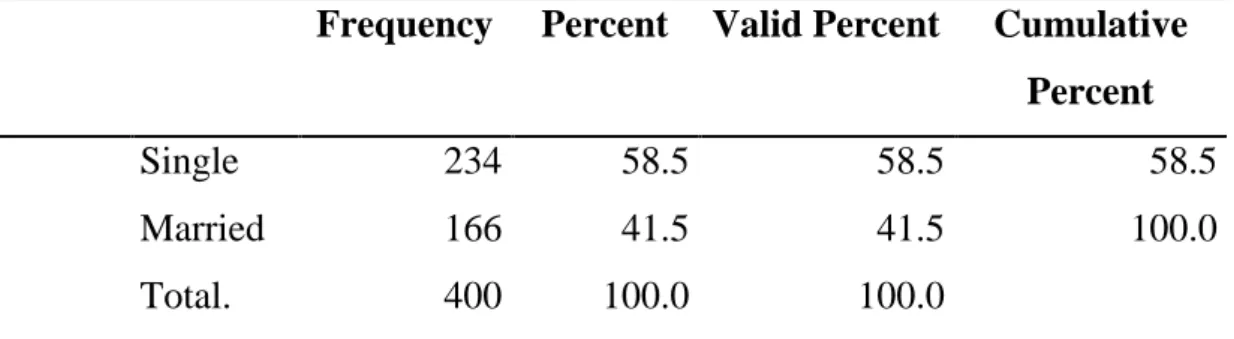
Table 4.2: Marital Status
Frequency Percent Valid Percent Cumulative
Percent
Single 234 58.5 58.5 58.5
Married 166 41.5 41.5 100.0
Total. 400 100.0 100.0
Source: Writer’s computation (2019)
The marital status displayed in Table 4.2 shows 234 respondents are single while 166 respondents are married. This implies that many of the participants are single.
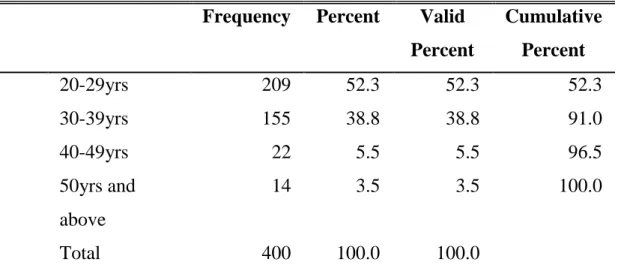
Table 4.3: Age of Respondent
Frequency Percent Valid
Percent Cumulative Percent 20-29yrs 209 52.3 52.3 52.3 30-39yrs 155 38.8 38.8 91.0 40-49yrs 22 5.5 5.5 96.5 50yrs and above 14 3.5 3.5 100.0 Total 400 100.0 100.0
Source: Writer’s computation (2019)
The above indicates the age of the respondents, 209 respondents with 52.3% are between age 20-29years, 155 respondents representing 38.8% are between 30-39years, 22 respondents with 5.5% are between 40-49years while 14 respondents representing 3.5% are 50years above. This implies that age between 20-29years has the higher percentage followed by age between 30-39years, 40-49years and 50years above. Table 4.4: Educational-Qualification
Frequency Percent Valid Percent Cumulative Percent Primary Schl leaving certificate 6 1.5 1.5 1.5 WAEC or GCE or NABTEB or NECO O Level 42 10.5 10.5 12.0
NCE or OND or GCE A level
49 12.3 12.3 24.3
HND or BSC or B.ED 215 53.8 53.8 78.0
MBA or MSC or M.ED 64 16.0 16.0 94.0
None of the above 24 6.0 6.0 100.0
Total 400 100.0 100.0
The Table above displays that 6 respondents with 1.5% are primary school leaving certificate, 42 respondents representing 10.5% are WAEC or GCE or NABTEB or NECO, 49 respondents indicating 12.3% are NCE or OND or GCE A level, 215 respondents with 53.8% are HND or B.Sc or B.ED, 64 respondents with 16.0% are MBA or MSC or M.ED while 24 respondents representing 6.0% are none of the above. This indicates that many of the are HND or BSC or B.ED holder, followed by MBA or MSC or M.ED, NCE or OND or GCE A level, WAEC or GCE or NABTEB or NECO, None of the above and Primary School leaving certificate.
Table 4.5: How many children do you have?
Frequency Percent Valid Percent Cumulative Percent Between 1 to 3 234 58.5 58.5 58.5 Between 3 to 5 18 4.5 4.5 63.0 More than 5 13 3.2 3.2 66.2 Nil 135 33.8 33.8 100.0 Total 400 100.0 100.0
Source: Writer’s computation (2019)
234 respondents indicating 58.5% are between one to three that have children, 18 respondents with 4.5% are between three to five, 13 respondents with 3.2% are more than five children while 135 respondents representing 33.8% have no child which implies that the respondents with between one to three children have higher percentage followed by nil, between three to five and more than five.
4.2 Frequency Analysis
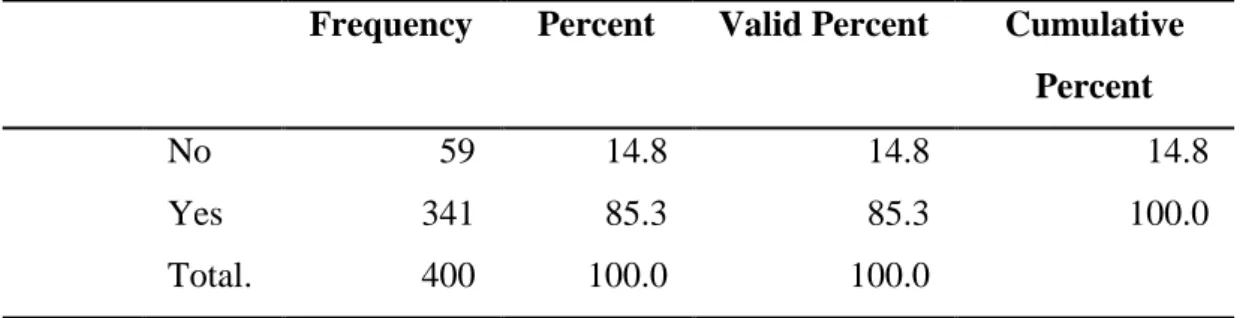
Table 4.6: Teenagers consume alcoholic drinks
Frequency Percent Valid Percent Cumulative Percent
No 59 14.8 14.8 14.8
Yes 341 85.3 85.3 100.0
Total. 400 100.0 100.0
The result of teenagers consumes alcoholic drinks revealed in Table 4.6 shows that 59 respondents with 14.8% are No while 341 respondents accounting for 85.3% are Yes. This connotes that teenagers consumes alcoholic drinks.
Table 4.7: Most teenagers drink alcoholic excessively without parental control Freq-uency Percent Valid Percent Cumulative
Percent
Valid No 34 8.5 8.5 8.5
Yes 366 91.5 91.5 100.0
Total. 400 100.0 100.0
Source: Writer’s computation (2019)
The above table shows that 34 of the respondents indicating 8.5% are No that most teenagers drink alcoholic excessively without parental control while 366 respondents with 91.5% are Yes, which connotes that most of the teenagers drink alcoholic excessively without parental control.
Table 4.8: Most parent influences their teenagers in alcoholic
Frequ-ency Percent Valid Percent Cumulative Percent
No 195 48.8 48.8 48.8
Yes 205 51.3 51.3 100.0
Total. 400 100.0 100.0
Source: Writer’s computation (2019)
Table 4.9 indicates that 195 respondents with 48.8% are No while 205 of the respondents are Yes, indicating that majority of the respondent agreed that most parent influences their teenagers in alcoholic consumption.
Table 4.9: Do you know if your children take alcoholic drinks
Freq-uency Percent Valid % Cumulative %
No 325 81.3 81.3 81.3
Yes 75 18.8 18.8 100.0
Total. 400 100.0 100.0
The above table reveals that 325 of the respondents with 81.3% are No while 75 of the respondents indicating 18.8% are Yes. This infers that many of the respondents do not know if their children take alcoholic drinks.
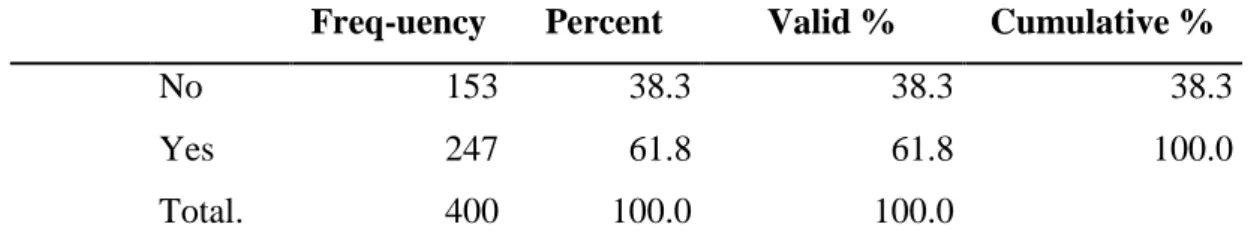
Table 4.10: Teenagers take the alcoholic drinks mostly in school
Freq-uency Percent Valid % Cumulative %
No 153 38.3 38.3 38.3
Yes 247 61.8 61.8 100.0
Total. 400 100.0 100.0
Source: Writer’s computation (2019)
153 respondents with 38.3% are No while 247 respondents representing 61.8% are Yes that teenagers take alcoholic drinks mostly in school. This could be affirmed that teenagers mostly take alcoholic drinks in school.
Table 4.11: Producers of alcoholic drinks market their products in different ways to inspire teenager’s consumption
Frequency Percent Valid % Cumulative % Strongly Agree. 97 24.3 24.3 24.3 Agree 70 17.5 17.5 41.8 Undecided 105 26.3 26.3 68.0 Disagree. 54 13.5 13.5 81.5 Strongly Disagree. 74 18.5 18.5 100.0 Total. 400 100.0 100.0
Source: Writer’s computation (2019)
The table above presents the report of the producers of alcoholic drinks market their products in different ways to inspire teenager’s consumption and the result reveals that 97 respondents which account for 24.3% strongly agreed, 70 respondents with 17.5% agreed, 105 respondents indicating 26.3% are undecided, 54 participants with 13.5% disagreed while 74 respondents indicating 18.5% strongly disagreed to the subject matter. The means that many fairly agree that producers of alcoholic drinks market their products in different ways to inspire teenager’s consumption.
Table 4.12: Advertisement of alcoholic drink on social media spread its consumption across board regardless of age
Frequency Percent Valid % Cumulative %
Strongly Agree. 141 35.3 35.3 35.3 Agree 87 21.8 21.8 57.0 Undecided 76 19.0 19.0 76.0 Disagree. 52 13.0 13.0 89.0 Strongly. Disagree 44 11.0 11.0 100.0 Total. 400 100.0 100.0
Source: Writer’s computation (2019)
Table 4.13 shows that 141 (35.3%) respondents strongly agreed that advertisement of alcoholic drink on social media spread its consumption across board regardless of age, 87 respondents with 21.8% agreed, 76(19.0%) respondents are undecided, 52 (13/0%) disagreed while 44 (11.0) of the participants strongly disagreed. This connotes by the participant of the survey that advertisement of alcoholic drink on social media spread its consumption across board regardless of age.
Table 4.13: Youth does not have inhibition regarding to alcoholic consumption, which were earlier restricted by social customs.
Frequency Percent Valid
Percent Cumulative Percent Strongly Agree 95 23.8 23.8 23.8 Agree 105 26.3 26.3 50.0 Undecided 132 33.0 33.0 83.0 Disagree 39 9.8 9.8 92.8 Strongly Disagree 29 7.3 7.3 100.0 Total 400 100.0 100.0
Source: Writer’s computation (2019)
The table above presents the result of the youth does not have inhibition regarding to alcoholic consumption, which were earlier restricted by social customs and the result reveals that 95 respondents which account for 23.8% strongly agreed, 105 respondents
with 26.3% agreed, 132 respondents representing 33.0% are undecided, 39 respondents with 9.8% disagreed while 29 respondents indicating 7.3% strongly disagreed. The implies that half of the participants agree that youth does not have inhibition regarding to alcoholic consumption, which were earlier restricted by social customs.
Table 4.14: Alcoholic drinking promotes forgetfulness in teen Frequency Percent Valid
Percent Cumulative Percent Strongly Agree. 122 30.5 30.5 30.5 Agree. 92 23.0 23.0 53.5 Undecided 96 24.0 24.0 77.5 Disagree. 39 9.8 9.8 87.3 Strongly. Disagree 51 12.8 12.8 100.0 Total 400 100.0 100.0
Source: Writer’s computation (2019)
Table 4.14 shows that 122 (30.5%) respondents strongly agreed that alcoholic drinking promotes forgetfulness in teen, 92 respondents with 23.0% agreed, 96(24.0%) respondents are undecided, 39 (9.8%) disagreed while 51 (12.8%) of the participants strongly disagreed. This connotes that alcoholic drinking promotes forgetfulness in teen.
Table 4.15: Demarketing advertisement on alcoholic drink can reduce the consumption of alcoholic drink among teenagers
Frequency Percent Valid Percent Cumulative Percent Strongly Agree. 119 29.8 29.8 29.8 Agree 74 18.5 18.5 48.3 Undecided. 79 19.8 19.8 68.0 Disagree 57 14.3 14.3 82.3 Strongly. Disagree 71 17.8 17.8 100.0 Total. 400 100.0 100.0