EVALUATION OF THE ANTIBACTERIAL ACTIVITY AND TOXICITY OF
ISOLATED ARCTIIN FROM THE SEEDS OF CENTAUREA SCLEROLEPIS
CENTAUREA SCLEROLEPIS TOHUMLARINDAN İZOLE EDİLEN ARCTİİN’İN
ANTİBAKTERİYEL AKTİVİTESİ İLE TOKSİSİTESİNİN ARAŞTIRILMASI
Muhittin ARSLANYOLU1 F. Zerrin ERDEMGİL2
1Anadolu University, Faculty of Sciences, Department of Biology, Yunusemre Campus, 26470 Eskişehir, TURKEY.
2Anadolu University, Plant, Drug and Scientific Research Center (AUBIBAM), Yunusemre Campus – 26470 Eskişehir TURKEY
ABSTRACT
A well known anti-cancer lignan arctiin has not been studied for its antibacterial activity based on our literature search. In the present work, the antibacterial and general toxicity of the arctiin from the seeds of Centaurea sclerolepis is studied. Arctiin did not show any significant antibacterial activity against both Gram-positive and Gram-negative bacteria when compared with the positive control agent chloramphenicole. According to results obtained from brine shrimp lethality bioassay, arctiin is non-toxic to brine shrimp nauplii at the concentrations below/equal to 1000 µg/ml. The results of this study may help future studies to promote the development of arctiin as an anticancer drug.
Keywords: Centaurea sclerolepis, Asteraceae, arctiin, brine shrimp lethality bioassay ÖZET
Antikanser aktivitesi oldukça iyi bilinen ve bir lignan olan arctiinin yapılan literature taramasında antibakteriyel aktivitesini bildiren herhangibir çalışmaya rastlanmamıştır. Bu çalışmada Centaurea sclerolepis’in tohumlarından saf olarak elde edilmiş arctiin maddesinin antibakteriyel aktivitesi ve genel toksisitesi çalışılmıştır. Pozitif kontrol kloramfenikol’e gore karşılaştırılması yapıldığında; Gram-negatif ve Gram pozitif bakterilere karşı arctiin’in önemli bir antibakteriyel etkiye sahip olmadığı tespit edilmiştir.
Brine shrimp letalite deney sonuçlarına göre ise arctiin brine shrimp’e karşı 1000 µg/ml eşit veya aşağı değerlerde toksik değildir. Bu çalışmanın sonuçları arctiin’in antikanser ilaç olarak geliştirilmesi yönünde yapılacak araştırmaları destekleyebilir.
Anahtar kelimeler: Centaurea sclerolepis, Asteraceae, arctiin, brine shrimp toksisite testi
INTRODUCTION
The genus Centaurea L. (Family: Asteraceae) comprises approximately of 500 species distributed in Asia, Europe, North Africa and America (1,2). Anatolian peninsula has about 187 Centaurea species, 114 of them being endemic, as aggressively invading weeds (3, 4, 5). Some of the Centaurea species have been used as Turkish folk medicine for the treatment of peptic ulser, malaria, common cold, stomach upset, abdominal pain and herpes infections around lips (6). The constituents of Centaurea are mainly terpenoids, flavonoids, acetylenic compounds and lignans (7, 8).
Centaurea sclerolepis is an endemic species distributed in Eastern Anatolian regions of
Turkey (3). Recently, the isolation, purification and chemical structural analysis of chemical constituents from C. sclerolepis has yielded one steroidal glucoside and two lignans (arctiin and matairesinoside) from the seeds of this plant (9). Arctiin has been found in number of Centaurea species (Centaurea alexandria, C. melitensis, C. sphaerocephala ssp. polyacantha, C. dealbata, C.
nigra, C. schischkinii) as well as Forsythia intermedia, Carduus micropterus, Arctium lappa (10,
11, 12) and it has been shown to influence sex hormone metabolism, protein and steroid biosynthesis. Arctiin has also cytotoxic activity against mammary, colon and pancreatic tumors as well as mouse skin tumors. However, arctiin does not have antiproliferative or cytotoxic effects in prostate cancer PC-3 cells (13, 14, 15).
There is no study concerning the evaluation of antibacterial activity and general cytotoxicity of arctiin compound in current literature. In this study, isolated pure arctiin compound from the seeds of C. sclerolepis (9) assessed for antibacterial activity and general toxicity with brine shrimp lethality bioassay.
MATERIAL AND METHODS Plant Material
The seeds of Centaurea screlopis were collected from East Anatolia, Turkey (B8 Muş, Muş-Bingöl, near Solhan, 1390 m, 38o 57’ N, 41o 02’ E) in July 2003 by Dr. Sezgin Çelik. Voucher
specimens deposited at the Department of Biology with voucher no.Celik 1984, Çanakkale Onsekiz Mart University, Çanakkale, Turkey.
Extraction and Isolation
The seeds (64 g) of the plant were extracted with methanol and then the extract yielded the known dibenzylbutyrrolactone lignan (-)-arctiin as compound 1 after repeated column chromatography on silica gel followed by preparative TLC and semi preparative RP-HPLC. Arctiin identified by comparison of their spectral data and optical rotation values with the data reported in the literature. Arctiin was obtained in very high yield in a pure form (1.6%) as described by Erdemgil et al. (2006). The isolated arctiin was then used in this study for the bioactivity characterization.
Antibacterial microdilution broth assay
Antimicrobial activity of arctiin was tested using the 96-well micro-plate-based broth dilution method (15). Tested microorganism strains; Staphylococcus aureus (B-767), Escherichia
coli (B-3704), Bacillus cereus (NRRL B-3711), Micrococcus luteus (NRRL B-4375), and Pseudomonas aeroginosa (NRRL B-23) were obtained from Anadolu University, the Department
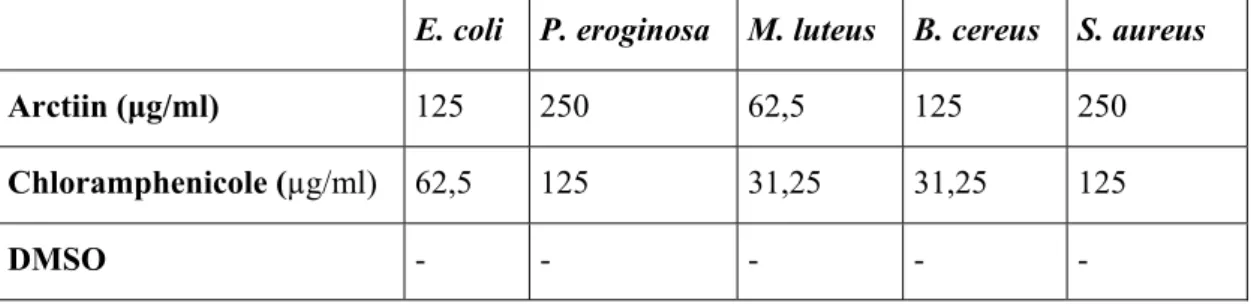
of Biology, Microorganism Culture Collection, Eskişehir/Turkey. Bacterial suspensions were prepared (20 µl) in double strength nutrient broth at the concentration of 5 x 10⁵ CFU/ml. The test compound was dissolved in DMSO to obtain the stock concentration of 1000 µg/ml. The stock solution was diluted in serials of ½ (1000 µg/ml-0.48 µg/ml). After the experimental set up is finished, the plates were incubated at 37oC for 24 hours. Whereas the same amounts of DMSO dilution serial were used as control, chloramphenicole was used as antimicrobial positive control drug. After the determination of the minimum inhibitory concentrations (MIC) of the compound, it was compared with that of chloramphenicole (Table 1). All tests were tripled.
Brine shrimp lethality assay
Bioactive compounds are often toxic to shrimp larvae (Artemia salina); therefore, Brine Shrimp Lethality Assay is in use to monitor different chemicals’ in vivo lethality to shrimp larvae (16, 17, 18, 19). It is known that, A. salina toxicity test results have a correlation with rodent and human acute oral toxicity data. Generally, a good correlation was obtained between A. salina toxicity test and the rodent data. Likewise, the predictive screening potential of the aquatic invertebrate tests for acute oral toxicity in human, including A. salina toxicity test, was slightly better than the rat test for test compounds (20). The method of Meyer et al. (1982) was used to study of the general toxicity of the arctiin compound. Test compound was dissolved in DMSO to
obtain the stock concentration of 1000 µg/ml. The stock solution was diluted in serials of ½ (1000 µg/ml-0.48 µg/ml) (19). Choudhary et al.(2001) suggested that the compound should be prepared by dissolving in DMSO in the suggested maximum volume range of 2 % to prevent possible false effects originated from DMSO’s toxicity to the experimental results. Pure DMSO was used as a positive control for the toxicity assay (data not shown). Fresh eggs of brine shrimp (Artemia salina) purchased from the local pet shop, Eskisehir/Turkey. The eggs hatched in a conical flask containing 300 ml artificial seawater made by dissolving a commercial marine salt in deionised water. The flasks were well aerated with the aid of an air pump, and kept in a water bath at 29-30oC. The nauplii hatched within 48 h. Ten nauplii were transferred with pipetter into each vial containing test compound and artificial sea water. A check count performed after 24 h of exposure at room temperature and the number of alive nauplii was noted. The each concentration of arctiin was tested in three-repeated experiments. Results were analyzed with LC50 program (http://www.cee.odu.edu/model/lc50.php) to determine LC50 values with 95% confidence interval (Table 2) (20, 23).
RESULTS AND DISCUSSION
In the present work, the antibacterial and general toxicity with brine shrimp lethality bioassay of the arctiin from the seeds of C. sclerolepis has been studied. Although arctiin has a well-known anti-cancer activity, there is no known literature report concerning its antibacterial activity but only one report available about its general toxicity (14). According to the obtained MIC values, it is clear that arctiin’s antibacterial activity against bacteria is lower than the positive control chloramphenicole. Whereas arctiin has activity between the ranges of 62,5 – 250 µg/ml against both Gram-positive (S. aureus, M. luteus, B. cereus) and Gram-negative (E. coli, P.
aeroginosa) bacteria, the positive control chloramphenicole was more effective within the ranges
of 31,25 – 125 µg/ml (Table 1). Bacterial growth was inhibited by arctiin in the safe toxicity ranges. Arctiin is reported to be transformed by human and rat intestinal bacteria to different metabolites such as (-)-arctigenin, (-)-enterolactone and butyrolactone derivatives (21). It is possible to assume that studied bacteria may transform the arctiin into compounds with no antibacterial activity. However, the low antibacterial activity against five bacteria, which were used in our experiment, needs to be studied further to investigate whether or not biotransformation of arctiin is the real mechanism underlying for antibacterial activity observed.
Table 1. Results of antibacterial activity* (MIC values) of arctiin derived from Centaurea sclerolepis
E. coli P. eroginosa M. luteus B. cereus S. aureusArctiin (µg/ml) 125 250 62,5 125 250
Chloramphenicole (µg/ml) 62,5 125 31,25 31,25 125
DMSO - - - - -
*MIC values are the average of results from three repeated experiments.
Table 2. Results of brine shrimp lethality bioassay on arctiin derived from Centaurea sclerolepis . Each
dose was tripled. Pure DMSO was used as a positive control for the toxicity assay and the positive controlassay resulted with 100 % mortality (data not shown).
Arctiin
(µg/ml) 1000 500 250 125 62,5 31,25 15,62 7,81 3,9 1,95 0,97 0,48
2% DMSO
Mortality 3 2 1 1 0 0 0 0 0 0 0 0 0
Toxicity Non-toxic
Non-toxic
In our experiment, different concentrations (1000 µg/ml - 0,48 µg/ml) of arctiin did not show any toxiceffect against shrimp larvae (LC50 > 1000 µg/ml) (Table 2). The result of this study seems to be in good agreement with that of Centaurea schischkinii (14). Its well known fact that anticancer drug’s therapeutic doses may produce toxic side effects due to their cytotoxicity and poor selectivity between target and normal cells. Even though arctiin does not have any cytotoxic effect especially to prostate cancer PC-3 human cell line, arctiin was shown to have strong anti-tumor activity (13, 22). It is an interesting point to be noted that a well-known anticancer agent arctiin is also found to be non-toxic as well.
In conclusion, this study underlines that arctiin have slight antibacterial activity as well as general toxicity. Additionally, the lack of general toxicity based on the brine shrimp assay may further support the anticancer therapeutic potential of arctiin (22).
ACKNOWLEDGEMENTS
We would like to thank Dr. Sezgin Çelik for his help in plant collection and determining plant species. We thank MSc. Biyologist Cem Karael for his valuable assistance to set up the experiments and MSc Biyologist Mehmet Taha Yıldız for critical reading of the manuscript.
REFERENCES
1. Bailey, L.H. Manual of Cultivated Plants. MacMillan Publishing Co., Inc. New York, 1026-1027, (1977).
2. Heywood, V.H., Flowering Plants of World, Oxford University Press, UK, 265-268 (1978). 3. Davis, P.H., Flora of Turkey and East Aegean Islands., Vol.2, Edinburgh University Press,
Edinburgh, p.465-585 (1975).
4. Davis, P.H., Mill, R.R., Tan, K., Flora of Turkey and East Aegean Islands (Supplement), Vol.10, Edinburgh University Press, Edinburgh, p.489-501 (1988).
5. Güner, A, Özhatay, N, Ekim, T, Başer, K.H.C. Flora of Turkey and East Aegean Islands. Supplement 2, Vol.11, Edinburgh University Press, Edinburgh,163-164, (2000):
6. Yeşilada, E., Gürbüz, İ., Bedir, E., Tatlı, İ., Khan, I.A., “Isolation of anti-ulcerogenic sesquiterpene lactones from Centaurea solstitialis L. ssp. solstitialis through bioassay-guided fractionation procedures in rats”. Journal of Ethnopharmacology, 95, 213-219 (2004). 7. Bruno, M., Rosselli, S., Maggio, A., Raccuglia, R.A., Napolitano, F., Senatore, F.,
“Antibacterial evaluation of cnicin and some natural and semisynthetic analogues”. Planta
Med., 69, 277-281 (2003).
8. Arif, R., Küpeli, E. and Ergun, F., “The biological activity of Centaurea L. species”, G.U.
Journal of Science, 17(4), 149-164 (2004).
9. Erdemgil, Z., Rosselli, S., Maggio, A.M.,Raccuglia, R.A., Çelik, S., Michalska, K., Kisiel, W., and Bruno, M., “An unusual pregnane derivative and dibenzylbutyrolactone lignans from Centaurea sclerolepis”. Polish J. Chem., 80, 647-650 (2006).
10. Rahman, M.M.A., Dewick, P.M., Jackson, D.E. and Lucas, J.A., “Lignans of Forsythia
intermedia”. Phytochemistry, 29, 1971-1980 (1990).
11. Tundis, R., Statti, G., Menichini, F., Dele Monache, F., “Arctiin and onopordopicrin from
12. Takasaki, M.; Konoshima, T.; Komatsu, K.; Tokuda, H.; Nishino, H., “Anti-tumor-promoting activity of lignans from the aerial part of Saussurea medusa”. Cancer Letters., 158, 53-59 (2000).
13. Zhang, S., Won,Y., Ong, C. and Shen, H., “Anti-Cancer Potential of Sesquiterpene Lactones: Bioactivity and Molecular Mechanisms”, Curr. Med. Chem. - Anti-Cancer Agents, 5, 239-249, (2005).
14. Shoeb, M., Celik, S., Jaspars, M., Kumarasamy, Y., MacManus, S. M., Nahar, L., Thoo-Lind, P. K. and Sarker, S. D., “Isolation, structure elucidation and bioactivity of schischkiniin, a unique indole alkaloid from the seeds of Centaurea schischkinii”,
Tetrahedron, 61, 9001–9006, (2005).
15. Meyer, B.N., Ferrigni, N.R., Putnam,J. E., Jacobsen, L.B., Nichols, E., and Mclaughlin, J.L., “Brine shrimp: a convenient general bioassay for active plant constituents.
Planta Med., 45, 31-34 (1982).
16. Harwig, J. and Scott, P., “Brine shrimp (Artemia salina L.)larvae as a Screening Fungal Toxins”, Appl. Microbial., 21, 1011-1016, (1971).
17. Solis, P.N., Wright, C.W., Anderson, M.M., Gupta, M.P. and Phillipson, J.D., “A Microwell Cytotoxicity Assay Using Artemia salina” . Plant Med., 59, 250-252, (1993). 18. Lewan, L., Andersson, M. and Morales-Gomez, P., “The use of Artemia salina in Toxicity
testing”, ATLA, 20, 297-301, (1992).
19. Zgoda, J.R. and Porter, J.R., “A Convenient Microdilution Method for Screening Natural Products Against Bacteria and Fungi”, Pharm. Microbiol., 39, 221-225 (2001).
20. Choudhary, I.M. and Thomsen, W.J., Bioassay Techniques For Drug Development, Harwood Academic Publishers, 8-10, (2001).
21. Xie, L., Ahn, E., Akao, T., Abdel-hafez, A., Nakamura, N. and Hattori, M., “Transformation of Arctiin to Estrogenic and Antiestrogenic Substances by Human Intestinal Bacteria”, Chem. Pharm. Bull. 51 (4) 378—384 (2003).
22. Saleem , M., Kim, H. J., Ali, M. S. and Lee, Y. S. “An update on bioactive plant lignans”,
Nat. Prod. Rep., 22, 696-716, (2005).
23. Hamilton, M.A., Russo, R.C. and Thurston, R.V., “Trimmed Spearman-Karber Method for Estimating Median Lethal Concentrations in Toxicity Bioassays," Environ. Sci. Technol., 11(7), pp. 714-719 (1977) ; Correction: 12(4), pp. 417, (1978).
Received: 07.07.2006 Accepted: 21.10.2006