■
’
JCñCE Clß^ClC
P': ·· ? π ЛЙІГ’-Ч·· imß *w· .f
:·:^ ^íJS*л'iгı¿τE
of
и ѵ ш а^
і ш е вæ
?
îd
Lsr^-s^
Or 0:i,iCEiJT U'â!V£:?iejTY
DF
THE п Е Ш Ш Е М Е Ы Т С /:;г O F JwAST£ïi o f а о т о'L'AS CF FI'J SüSFi AS A гС-йё^в'^·’ *
'
«· ί i fl·· il ,·ί
/Ö SS
^ Τ 3 8
S9B/^
FOR ERROR CORRECTION STRATEGIES IN EFL DISCOURSE CLASSES
A THESIS
SUBMITTED TO THE INSTITUTE OF HUMANITIES AND LETTERS OF BILKENT UNIVERSITY
IN PARTIAL FULFILLMENT OF THE REQUIREMENTS FOR THE DEGREE OF MASTER OF ARTS
IN THE TEACHING OF ENGLISH AS A FOREIGN LANGUAGE
BY
MELIKE TATLIOGLU AUGUST 1994
І
0 6 6І9е^
Title: Native-speaker teachers' and non-native- speaker teachers' preferences for error correction strategies in EFL discourse
classes
Author: Melike Tatlioglu
Thesis Chairperson: Dr. Arlene Clachar, Bilkent University, MA TEFL
Program
Thesis Committee Members: Dr. Phyllis L. Lim, Ms. Patricia J.
Brenner, Bilkent University, MA TEFL Program This study was designed to determine whether there was a
difference between native-speaker teachers' (NSTs) and non-native-speaker teachers' (NNSTs) (Turkish) preferences for correction
strategies for grammar and pronunciation errors in English as a foreign language (EFL) discourse classes and to discover to what extent these two groups of subjects' preferences were affected by the proficiency level of learners.
There were two parts in the study. In the first part, 10 MA TEFL
1993-1994 students and 10 NSTs of English were employed. These
randomly selected participants were asked to rank 12 strategies along an explicit-to-implicit continuum to provide baseline data for later comparison.
A total of 40 subjects (20 NSTs and 20 NNSTs of English) were employed in the second part of the study. Although NNSTs were randomly selected, NSTs were selected according to their availability at the time of data collection and their willingness to participate in the study. All subjects were asked to fill out a questionnaire to
determine their preferences for 12 error correction strategies for both
grammar and pronunciation errors. Subjects indicated their preferences
three times: once without considering proficiency level, once for
correlations, and MANOVA, were used in order to analyze the data
gathered from the responses to the questionnaire. Results indicate
that there were differences between NSTs' and NNSTs' overall
preferences for 10 out of 12 correction strategies at p<.05. However, when analyzed separately, the two groups' error correction strategy preferences for beginning level learners showed differences at p<.05, whereas, no differences were found between the two groups' correction-
strategy preferences for advanced level learners. NNSTs preferred
explicit correction strategies for beginning level, implicit correction strategies for advanced level. NSTs, on the other hand, preferred
implicit correction strategies for both proficiency levels. Bear's (1985) study suggests that the Turkish education system may still be affected by the traditional approach, which contains elements of behaviorism. This approach looks upon errors as "bad habits", which may explain why NNSTs rely on more explicit strategies in EFL teaching than do NSTs.
INSTITUTE OF HUMANITIES AND LETTERS MA THESIS EXAMINATION RESULT FORM
August 31, 1994
The examining committee appointed by the
Institute of Humanities and Letters for the thesis examination of the MA TEFL student
Melike Tatlioglu
has read the thesis of the student. The committee has decided that the thesis
of the student is satisfactory.
Thesis Title
Thesis Advisor
Committee Members
Native-speaker teachers' and non-native-speaker teachers' preferences for error correction strategies in EFL discourse classes
Dr. Phyllis L. Lim
Bilkent University, MA TEFL Program Dr. Arlene Clachar
Bilkent University, MA TEFL Program Ms. Patricia J. Brenner
We certify that we have read this thesis and that in our combined opinion it is fully adequate, in scope and in quality, as a thesis
for the degree of Master of Arts.
14^
hyllis L. Lim (Advisor) Arlene Clachar (Committee Member) Patricia J. Brenner (Committee Member)improved for the
Institute of Humanities and Letters
Ali Karaosmanoglu Director
ACKNOWLEDGEMENTS
I would like to express my gratitude to my thesis advisor Dr.
Phyllis L. Lim for her assistance in bringing my thesis to completion. I am grateful to Dr. Arlene Clachar and Ms. Patricia J. Brenner for their valuable ideas and guidance.
I owe special thanks to the administrators and my colleagues at Erciyes University.
More than thanks are due to Ms. Safak Turgut, Ms. Aysin Demir, and Mr. Mustafa Demir for their continuous encouragement to attend this program.
I would like to express my deepest gratitude to my dear classmates Ms. Serap Topuz, Ms. Nergiz Turkkollu, and Ms. Sabah Mistik for their warm support, encouragement, and fellowship throughout this program.
My thanks to my other classmates for their friendship and cooperation.
My special thanks to Mr. Gürhan Arslan and Mr. Alpaslan Demiral for their patience and help in the computer lab.
On a personal level, I would like to express my deepest
appreciation to my mother, my father, my sisters Mine and Merve, my grandfather, and my grandmother who have always been with me and
TABLE OF CONTENTS
LIST OF TABLES ... ... x
LIST OF FIGURES ... xii
CHAPTER 1 INTRODUCTION ... 1
Background of the Study ... 1
Statement of the Purpose ...5
Research Questions ...6
Statement of Expectation ...6
Statement of Limitation ...7
Definition of Terms ... 7
Abbreviations ... 8
CHAPTER 2 LITERATURE REVIEW ... 10
History of the Problem ... 10
Two Schools of Thought About Errors... 11
Behaviorism, Contrastive Analysis, and Attitudes to Errors ... 11
Cognitive Approach, Error Analysis, and Attitudes to Errors ... 14
Conceptual Problems Related to Error and Correction... 18
The Concept of Error ... 18
The Concept of Correction ... 19
Conflicting Views on Different Aspects of Error Correction... 21
Should Learner Errors Be Corrected? ... 21
Which Errors Should Be Corrected? ... 23
When Errors Should Be Corrected? ...25
Who Should Correct Errors? ...27
How Should Errors Be Corrected? ...28
Should Proficiency Level Be Considered in Error Correction? ... 29
Explicit Strategies Versus Implicit Strategies In Error Correction? ...31
Error Correction: NSTs Versus NNSTs ...33
Reasons for Differences Between NSTs' and NNSTs' Attitudes to Errors ...37
CHAPTER 3 METHODOLOGY ... 40
Introduction ...40
Subjects ... 41
Materials ...42
Procedures and Data Collection ... 47
Analytical Procedures ...49
CHAPTER 4 ANALYSIS OF DATA ... 52
Data Analysis ... 53
Comparison of NSTs' and NNSTs' Preferences for Error Correction Strategies...53
Results by Proficiency Level of Learners: Beginning Versus Advanced...56
NSTs Versus NNSTs Overall Error Correction Strategy Preferences in Terms of Explicit and Implicit Strategies...61
NSTs Versus NNSTs in Terms of Explicit and Implicit Error Correction Strategies for Beginning and Advanced Levels... 66
Effects of Language Background and Proficiency Level of Learners on Preferences for Explicit Error Correction Strategies...74
CHAPTER 5 CONCLUSION ... 80
Summary of the Study ...80
Discussion of the Findings...80
Limitations of the Study ...84
Implications for Further Research ...84
REFERENCES ...85
APPENDICES ... 91
Appendix A: Chaudron's Taxonomy for Error Correction Strategies...91
Appendix B: Error Correction Questionnaire for Native/Non-Native Speeiker Teachers... 94
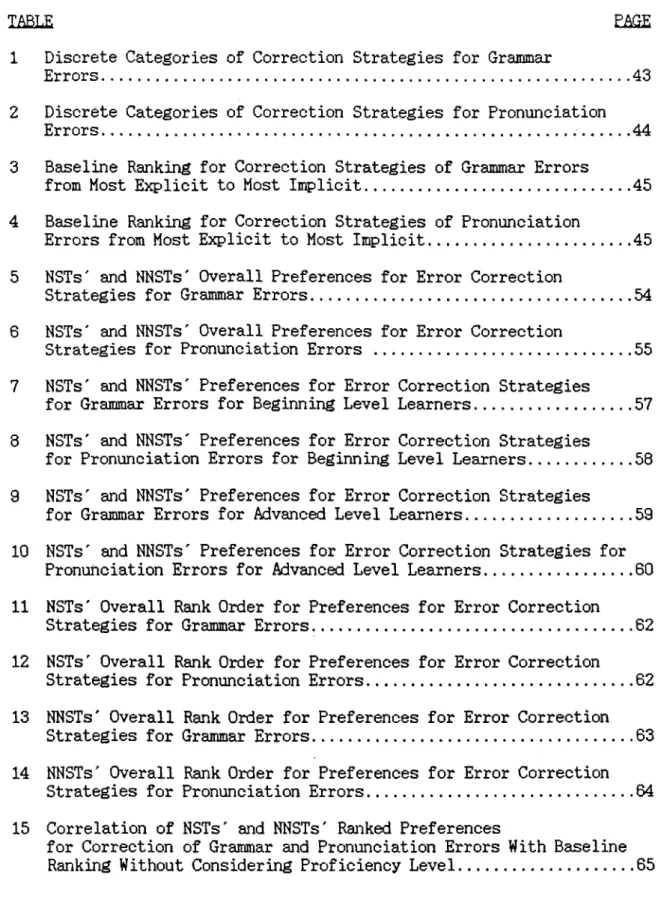
LIST OF TABLES
TABLE EAGE
1 Discrete Categories of Correction Strategies for Grammar
Errors... 43
2 Discrete Categories of Correction Strategies for Pronunciation
Errors... 44
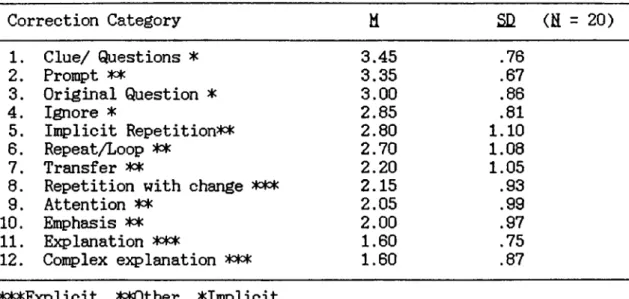
3 Baseline Ranking for Correction Strategies of Grammar Errors
from Most Explicit to Most Implicit... 45
4 Baseline Ranking for Correction Strategies of Pronunciation
Errors from Most Explicit to Most Implicit... 45
5 NSTs' and NNSTs' Overall Preferences for Error Correction
Strategies for Grammar Errors...54
6 NSTs' and NNSTs' Overall Preferences for Error Correction
Strategies for Pronunciation Errors ...55
7 NSTs' and NNSTs' Preferences for Error Correction Strategies
for Grammar Errors for Beginning Level Learners... 57
8 NSTs' and NNSTs' Preferences for Error Correction Strategies
for Pronunciation Errors for Beginning Level Learners... 58
9 NSTs' and NNSTs' Preferences for Error Correction Strategies
for Grammar Errors for Advanced Level Learners... 59 10 NSTs' and NNSTs' Preferences for Error Correction Strategies for
Pronunciation Errors for Advanced Level Learners... 60 11 NSTs' Overall Rank Order for Preferences for Error Correction
Strategies for Grammar Errors...62 12 NSTs' Overall Rank Order for Preferences for Error Correction
Strategies for Pronunciation Errors...62 13 NNSTs' Overall Rank Order for Preferences for Error Correction
Strategies for Grammar Errors...63 14 NNSTs' Overall Rank Order for Preferences for Error Correction
Strategies for Pronunciation Errors...64 15 Correlation of NSTs' and NNSTs' Raaiked Preferences
for Correction of Grammar and Pronunciation Errors With Baseline Ranking Without Considering Proficiency Level... 65
16 NSTs' Rank Order for Preferences for Error Correction Strategies for Grammar Errors for Beginning Level Learners... 67 17 NSTs' Rank Order for Preferences for Error Correction Strategies
for Pronunciation Errors for Beginning Level Learners... 67 18 NNSTs' Rank Order for Preferences for Error Correction Strategies
for Grammar Errors for Beginning Level Learners... 68 19 NNSTs' Rank Order for Preferences for Error Correction Strategies
for Pronunciation Errors for Beginning Level Learners... 69 20 Correlation of NSTs' and NNSTs' Ranked Preferences for
Correction of Grammar and Pronunciation Errors with Baseline
Ranking for Beginning Level ... 70 21 NSTs' Rank Order for Preferences for Error Correction Strategies
for Grammar Errors for Advanced Level Leairners... 71 22 NSTs' Rank Order for Preferences for Error Correction Strategies
for Pronunciation Errors for Advanced Level Learners... 72 23 NNSTs' Rank Order for Preferences for Error Correction Strategies
for Grammar Errors for Advanced Level Learners... 72 24 NNSTs' Rank Order for Preferences for Error Correction Strategies
for Pronunciation Errors for Advanced Level Learners... 73 25 Correlation of NSTs' and NNSTs' Ranked Preferences for
Correction of Grammar and Pronunciation Errors with Baseline
Ranking for Advanced Level... 73 26 Preferences for Explicit Strategies Considering Language
Background of Teachers and Proficiency Level of Learners for
Grammar Errors ... 75 27 Cell Means of Main Effects for Grammar Errors... 75 28 Preferences for Ej?)licit Strategies Considering Language
Background of Teachers and Proficiency Level of Learners for
Pronunciation Errors... 77 29 Cell Means of Main Effects for Pronunciation Errors... 77
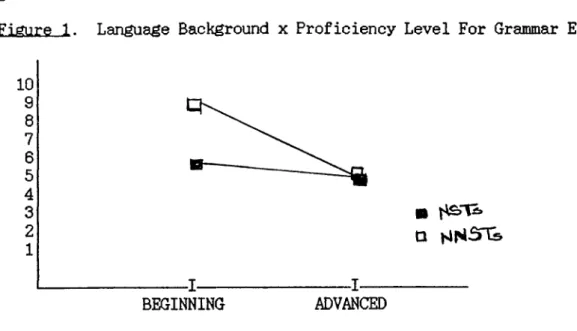
LIST OF FIGURES FIGURE
1 Language Background x Proficiency Level for Grammar Errors...
PAGE
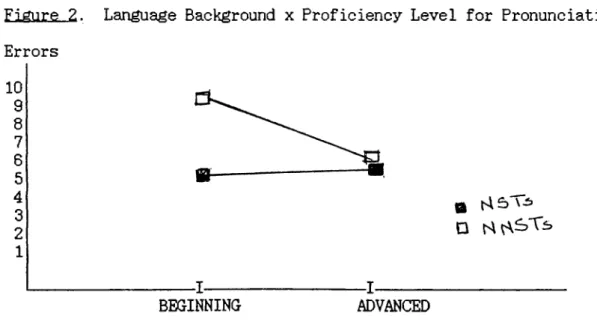
.. .76 2 Language Background x Proficiency Level for Pronunciation
Background of the Study
There has been a great interest in error correction over the years since it presents a universal and permanent problem for teachers in all language classrooms (Walz, 1982). As Chastain (1980) suggests, how to prevent them and how to correct them have been main areas of
professional and practical classroom research for years.
The shift in language teaching approaches from behavioristic to cognitive has greatly affected the attitude toward student errors and
their treatment. Briefly stated, the behavioristic approach, which
considered errors "bad habits" to be avoided, was replaced by an approach in which errors were considered as a natural phenomenon that must occur in learning a first or second language (Long, 1977). It was Corder (1967) who focused attention on error from a language processing
and language acquisition perspective. He introduced the idea that errors are a necessary part of linguistic development and that these errors represent the discrepancy between the grammar of the learner's transitional coipetence and that of the target language. New
approaches to language learning and teaching began to accept making errors as a significant aspect of the learning process used by both children acquiring their mother tongue and by those learning a second language (Allwright, 1975; Rivers, 1982). That is, learners' errors were no longer seen as indications of failure but as important tools to be used in the learning process. A number of studies investigating various aspects of error treatment were conducted (e.g., Allwright,
Hendrickson, 1978; Holley & King, 1971; Hughes & Lascaratou, 1982; Lucas, 1975; McCretton & Rider, 1993). The shift in language learning theories brought about a change in methodology from teacher-centered to learner-centered teaching (Hahn, 1987). With this shift, the concept of how language is learned and the role of errors in the learning process has also changed (Chastain, 1980). However, this shift has
also raised many questions yet to be answered: What is an error? What
is correction? Should errors be corrected? If so which ones? When? By whom? How? Should proficiency level be considered? Do NSTs and NNSTs
react to errors in the same way? (Walz, 1982).
The change in the methodology in language learning introduced a new shape of error correction techniques that teachers use to correct
their students' oral and written errors (Walz, 1982). In his study
Chaudron (1976) categorized a variety of error correction techniques that teachers might use in their discourse classes. The concept Chaudron used for correction covers "Any reaction of the teacher that clearly transforms, disapprovingly refers to, or requires improvement
of the learner's utterance. It is the most common concept used by most
recent researchers and covers the distinction between 'explicit' and 'iiti>licit' corrections. This distinction is mainly based on judgments about the psychological reality of the correction for the teacher or for the student" (p. 31).
Taking this distinction into account, much research has been done on the effectiveness of these strategies and preferences of teachers
Researchers such as Vigil & Oiler (1976) advocated implicit correction, which may be perceived as more positive by students. Holley & Ring (1971) suggested that students might improve their control over language without any correction. In their study, Cathcart & Olsen
(1976) found that students prefer ej^licit correction, whereas teachers prefer more in^licit correction.
Chaudron (1988) also pointed out that the distinction between NSTs and NNSTs has been one of the most common teacher variable used in much research. A variety of studies (Birdsong & Kassen, 1988; Davies,
1983; Hughes & Lascaratou, 1982; James, 1977; Lucas, 1975; McCretton & Rider, 1993; Newbrook, 1990; Sheorey, 1986) investigated the assessment of student error and NSTs/MSTs attitudes toward oral and written
errors. There is evidence from these research studies that suggests that the attitudes of NSTs and NNSTs towards errors are different. NNSTs tend to be more concerned with formal correction than NSTs, whereas NSTs are more tolerant towards students' errors.
There are several reasons that might cause such a difference: the setting where the language is used, the culture, and the different education systems and background (Lado, 1986). Bear (1985) states in his study of language education in Turkey that social, cultural, and historical factors affect language education. He examined the history of foreign language learning in Turkey and found that the educational
system places emphasis on rote learning and memorization. He also
behavioristic approach, for years. From what Bear (1985) has reported on the Turkish educational system, we may assume that the behavioristic approach to learning may affect attitudes of teachers towards error correction and may constitute the reason why teachers may be expected to rely on overt correction of their students' errors. Birdsong and Kassen (1988) have explained that educational background might cause the difference between NSTs and NNSTs attitudes toward learners' errors. That is, if teachers and students share the same linguistic background and learning ei^eriences, they might also share reasons for
error judgment. They also point out that as teachers, we serve in many ways as models for our students, and by our reactions to errors we may
develop standard error evaluation in our students similar to our own. Over time, our students' reactions to errors may begin to take the same
shape as ours. This, in turn, suggests that teachers may teach in the same way as they were taught and correct errors in the same way their errors were corrected when they were students. As Davies (1983) explains, the foreign language teacher's disapproval of learner error
is likely to reflect her teaching experience and her own proficiency in the target language, that is, "teachers may have felt that their own marking abilities were being put on trial, and this may have made them particularly critical, in their anxiety not to overlook an error or underestimate its gravity" (p. 306). Nickel (1973) explained this difference between native-speakers (NSs) and non-native-speakers (NNSs) by stating that NSs may be more tolerant than NNSs because of their
the wide scope of its norms.
Although much research has dealt with the issue of effectiveness of treatment of errors, teachers' and students' preferences for error correction strategies, NSTs' and NNSTs' general attitudes toward
errors, or the error gravity and error hierarchy preferred by teachers, a review of literature carried out at YOK (Higher Education Institution Documentation Center, Turkey), which in Turkey has the most and latest documentation of studies done worldwide since 1983, does not reveal any
study which has investigated possible differences in the preference for ijplicit versus explicit strategies between NSTs and NNSTs. Moreover, the literature reveals that most of the research which compares NSTs' and NNSTs' attitudes toward errors has been carried out in writing
classes. As Chaudron (1988) states, studies on different error
correction strategies used by NSTs and NNSTs in discourse classes are lacking. Also, the literature shows that there is not any known study investigating the effect of proficiency level of learners on error correction strategies preferred by NSTs and NNSTs.
Statement of Purpose
The purpose of the present study was to investigate and compare the preferences of NSTs and NNSTs of English for two types of error correction strategies— explicit and implicit— in Turkish EEL discourse classes and to see to what extent these preferences were affected by the proficiency level of learners.
of various corrective techniques. The way teachers handle errors may be inportant in understanding the role of error treatment in the
teaching of a foreign language, and it may later assist in formulating a methodology of teaching foreign languages based on an understanding of teacher behavior in this context.
It was hoped that determining the error correction strategies preferred by NSTs and NNSTs might prove useful in preparing the ground
for further research that could identify those error correction
strategies that are most likely to be motivating, reinforcing, and/or informative in the teaching of foreign languages and in developing a
standard for error correction. Such research might, in turn, be put to
good use in teacher training.
Research Questions
The following questions were posed in this study: «
1. Is there a difference between Turkish EFL teachers' (NNSTs) and
NSTs' preferences for error correction strategies in Turkish EFL discourse classes?
2. If so, to what extent are these preferences affected by the
proficiency level of the learners?
Statement of Expectation
In this study it was expected that there would be a difference between NSTs' and NNSTs' preferences for error correction strategies with NSTs preferring implicit and NNSTs preferring explicit strategies in EFL discourse classes. The difference was expected to be influenced
Statement of Limitation
The study was limited to NSTs' and NNSTs' preferences for error correction strategies in Turkish EFL discourse classes. NSTs were native English speaker teachers (American and British) and NNSTs were Turkish EFL teachers. NSTs' and NNSTs' preferences in the beginning
level and advanced levels were investigated on the assumption that differences in strategy preferences would be found by comparing these
two levels (Kul, 1992). The study was also limited to pronunciation and grammar errors in discourse classes since these errors are the easiest to correct and the usual ones teachers want to correct (Kul, 1992).
Definition of Terms
The following terms will be used throughout the study:
Error: Any deviation from the rules of the native language model (Corder, 1973).
(For explicit correction and implicit correction strategies,
definitions were selected from baseline data which was obtained from 10 MA TEFL 1993-1994 Program students and 10 NSTs at Bilkent University.)
Ebi>licit correction strategies:
1. Direct correction by the teacher such as teacher's calling attention to the error.
2. Correction that is done directly. The students know instantly where their errors are because the teacher has given them the correct information or told them that the given answer is wrong.
3. When teacher tells the learners they have made a mistake and tells them the correct version.
4. Very obviously correcting an error which a student has made. 5. Obvious correction, pointing out grammar faults.
6. When a teacher corrects or focuses on a student's error, clearly and unambiguously.
Inplicit correction strategies:
1. Teacher indicates that there is an error but lets students self-correct.
2. When teachers make learners aware they have made a mistake without directly telling them why and how.
3. Correction that is done in a way that may not immediately indicate to the students an error or makes the students think about whether or not their answer was correct.
4. Not correcting an error as obviously when a student has made it.
5. Correct the error at a later stage in the classroom or ignore it occasionally.
6. Correction of an error is implied or inferred. Abbreviations
The following abbreviations will be used in the study: NSs NNSs NSTs NNSTs Native-speakers of English Non-native-speakers of English Native-speaking teachers of English Non-native-speaking teachers of English
EFL TL LI L2 FL
English as a foreign language Target language
First language Second language Foreign language
CHAPl’ER 2 LITERATURE REVIEW History of the Problem
Despite a major concern with the students' errors in learning and using sin L2/FL— how to prevent them and how to correct them— little
empirical research has been done on the preferences of NSTs and NNSTs
for error correction strategies in discourse classes. Much research
has dealt with the issue of effectiveness of treatments of errors, teachers' and students' preferences for error correction, the error gravity/hiersirchy, and NSTs' and NNSTs' general attitudes toward learners' errors (Davies, 1983; Holley & King,1971; Lucas, 1975;
McCretton & Rider, 1993; Vigil & Oiler, 1976). However, none of these research studies include information about the specific error
correction strategies that NSTs and NNSTs report using in EFL classes. Furthermore, the effect of students' proficiency level on NSTs' and NNSTs' preferences for error correction strategies has not been taken into account in the growing body of enpirical research that focuses on error correction (e.g., Cathcart & Olsen, 1976; Kul, 1992; Santos, 1988). Prior to discussing the nature and possible treatment of errors employed by NSTs and NNSTs and their general attitudes toward errors, one needs to review the significance of two main theoretical
approaches— namely the behavioristic approach and the cognitive approach— to learning behavior and attitudes of these schools of thought to learner errors.
This chapter of the study is divided into four major sections. The first section reviews the history of two schools of thought about
errors. The second section discusses the conceptual problems related to errors and correction. The third section presents the conflicting views on different aspects of error correction. Finally, NSTs' and NNSTs' attitudes to errors will be discussed.
Two Schools of Thought About Errors
With respect to language learning and learners' errors, there have
been two major schools of thought: the behavioristic approach and the
cognitive approach (Corder, 1967). The former is based on conditioned
learning, which considers language as habit formation. Errors axe seen
as bad habits and are avoided at all costs. The latter is based on
mentalistic theories such as hypothesis testing, interlanguage,
feedback, and experimentation. Errors are considered as a natural part of learning process in this approach (Hahn, 1987; Klassen, 1991).
The changes in language learning approaches have been followed by changes in the attitudes of teachers, students, and researchers toward learners' errors and the treatment of them (Hahn, 1987). These two
language theories and their attitudes toward errors— which may help people understand the reasons of any distinction between NSTs' and NNSTs' attitudes toward errors— are analyzed in the following section. Behaviorism. Contrastive Analysis, and Attitudes to Errors
In the 1920s and 1930s, the dominant school in psychology was behaviorism. Most behaviorist psychologists took a nonintrospective approach to the study of human behavior. These psychologists were interested in only the objectively observed, described, and measured human behaviors without considering the inner motives or innate
mechanisms (Rivers, 1982). Theories of psychology at the time were theories of learning in general; thus, learning theorists of this period focused on habits because much of overt human behavior occurred as repeated actions in similar conditions, that is, in response to a
stimuli. Theorists observed and measured events in order to find how these habits were established (Celce-Murcia, 1991; Ellis, 1985).
Larsen-Freeman & Long (1991) state that the predominant view of learning— that of behaviorism— affected the field of language teaching. Behaviorists accepted language as a system of structurally related elements and language acquisition as a product of habit formation. The repeated association between stimulus and response formed habits which would advance by positive reinforcement. L2 learning was regarded as a process of overcoming the habits of the native language in order to acquire the new habits of the target language (TL).
According to behaviorist theory, errors were the indicators of
nonlearning and would become habits if they were tolerated. The total
agreement was that errors— bad habit formation— should be avoided, and corrected at once (Hahn, 1987; Klassen, 1991). Furthermore, error was
regarded as a sin to be avoided (Brooks, 1960). An error was likely to
arise as a result of the inference of LI knowledge in the L2. Thus, differences between the LI and L2 created learning difficulty, and resulted in errors, while the similarities between LI and L2
facilitated learning (Ellis, 1985).
"The methods the structural linguists as language teachers developed for language learning similarly enphasized overt patterned
behavior of responses to stimuli. This combination of habit-formation techniques became known as the audiolingual approach” (Rivers, 1982, p. 4). The audiolingual method with its emphasis on pattern drills, and the study of all sorts of grammatical generalizations highly influenced FL teaching in the 1950s and 1960s (Lucas, 1975). In accordance with behaviorist learning theory, teaching focused on the external
manifestations of learning rather than on the internal process. The general belief was "practice makes perfect". In this teaching method
learners were viewed as stimulus-response mechanisms whose learning was a direct result of a repetitive practice. Learners could produce
correct responses by skilled training techniques (Richards & Rodgers,
1986). According to the audiolingual method, errors could be minimized
by controlled practice and by not allowing learners to say anything they had not been taught (Harsh, 1982; Lucas, 1975). Teachers were regarded as the main source of language learning. They were required to correct all errors immediately and not to allow learners to repeat their errors (Hendrickson, 1978).
Behaviorists developed a procedure called Contrastive Analysis (CA) in order to define, identify, and distinguish error occurrence on the basis of formal differences between the linguistic systems of the native language and TL (Ellis, 1985; Hahn, 1987; Lennon, 1991).
Ekmekçi (1984) states that CA "attempts to predict the areas of
difficulty by comparing the linguistic system of the learner's native language with that of the target language" (p. 262).
Towards the end of the 1960s, the audiolingualism method was gradually replaced by the mentalistic trend which gave rise to the
cognitive approach which put enphasis on conscious control of phonological, lexical, and grammatical patterns (Carroll, 1963). Cognitive Approach. Error Analysis, and Attitudes to Errors
Recent approaches to language learning and teaching are mostly based on the cognitive view supporting the idea that language is rule governed and learned by hypothesis formation (Walz, 1982). With the
effect of the cognitive approach, errors have been examined from different points of view: "the source of error, the characterization
and classification of error, the effects or gravity of learner error, and the treatment of error in the classroom" (Krahnke & Christison,
1983, p. 643).
Criticisms which were raised against the audiolingual approach focused on the overen^hasis on wearisome mechanistic processes in which learners were not allowed to make any personal contribution. The value of learning by automatic responses in drill, without understanding the critical elements learners were practicing and its relationship to
other features of the language system, was questioned by critics. It
was found that learners had difficulty in adapting the language
material they learned to real communicative situations. As a result,
"the value of learning by trial and error began to be enphasized" (Rivers, 1982, p. 4).
In the mid-sixties, Chomsky (cited in Harsh, 1982) criticized structuralism and its psychological basis as not only insufficient but
also as misconceived. He emphasised the active contribution of the child by lessening the importance of imitation and reinforcement. Chomsky hypothesised that human beings possess innate language abilities in the form of a language acquisition device (LAD) which
proceeds by hypothesis testing. According to Chomsky, children make
hypotheses about the form of the language they are learning. They compare hypotheses with their innate knowledge of possible grammars
based on the principle of Universal Grammar (UG). In this way, the
individual's competence is formed, and this competence makes language use possible. Language use is considered as rule-governed behavior which enables speakers to create new utterances that conform to the rules they have internalized.
With the turn of the tide in linguistics and psychology from behaviorism, linguistic theorists began to be interested in the cognitive psychology. The major areas of concern were perception, memory, thinking, information processing and encoding, and expressing meaning. Psychologists and linguists did not regard language as
separate sets of arbitrary vocal symbols or as habits acquired through conditioning anymore (Ellis, 1985; Harsh, 1982; Larsen-Freeman & Long,
1991; Rivers, 1982).
As a result of the mentalistic trend, the cognitive-code approach to learning, which placed emphasis on explanations of grammatical functioning, arose. This approach has been influenced by the Gestalt theories and those of Chomsky, as opposed to the behaviorist theories of Skinner (Lucas, 1975).
The hypothesis-testing and interlanguage theories which dealt with innate language acquisition device and the interim grammars of learners were introduced by the cognitive theorists, and they slowly began to effect classroom practice. The product of hypotheses the L2 learner was testing about the form of the grammar of the new language was considered as the interlanguage. Teachers who had been trained not to accept students' errors were asked to accept errors in L2 production (Rivers, 1982). Errors were considered as indicators of progress through interim grammars and as guides to the incorrect hypotheses their students had formed (George, 1972; Larsen-Freeman & Long, 1991). Thus, studying these incorrect hypotheses (errors) made by individual learners would reveal to the teacher the strategies these students were using in learning the language (Ellis, 1985; Rivers, 1982).
It was Corder (1967) who focused attention on error from a
language processing and language acquisition perspective. Long and
Sato (cited in Lennon, 1991) note that an important feature of Corder's ideas is that the learner makes a significant cognitive contribution to learning. Corder introduced the idea that errors are significant in that they may represent the differences between the grammar of the learner's transitional coirpetence and that of the TL. He suggested that learners might possess an inbuilt syllabus which determines the grammar acquisition order, and that studying learner error might provide clues to this order.
Teachers and researchers saw that learners' errors were not always predicted by means of CA; that is, there were errors which could not be
explained simply by noting differences between LI and TL (Celce-Murcia & Hawkins, 1985), This situation, in a way, gave rise to the emergence of Error Analysis, a technique which identifies, classifies, and
systematically interprets the learner errors using any of the
principles and procedures provided by linguistics (Crystal, 1980). In
this new trend, attention has shifted from the (product) error to the process (re^ons of errors) (Hahn, 1987). Errors are seen as a clue to what is happening in the mind. As a natural phenomenon, before correct grammar rules are completely internalized, errors must occur in the course of LI or L2 learning. "So errors axe no longer bad but good or natural— just as natural as— errors that occur in learning a first language" (Klassen, 1991, p. 10). Dakin (cited in Hahn, 1987)
summarizes the shift from behaviorism to cognitive approach as follows: The function of the graded syllabus is to prevent mistakes. Only
one structure is introduced at a time, and the successive
structures are so ordered that the learner can precede from one
to the next with limited difficulty. In the cognitive approach,
the syllabus is conceived of as lying within the learner. The behavioristic approach is intended to teach structures. The cognitive approach is intended to get the learner to induce
grammatical rules, together with strategies for their application (pp. 16-17).
There have been significant shifts in learning theory, linguistic theory, and instructional models since 1969. These changes in theories of language learning have not only affected attitudes toward errors but also caused a shift in methodology from teacher-centered to learner-
centered classroom (Celce-Murcia, 1991). As Chastain (1980) and Walz
(1982) note, the concept of how language is learned and the role of errors in the learning process have also changed leaving many questions
yet to be answered; What is an error in language learning? Should errors be corrected? If so, which ones? When? By whom? How? Should proficiency level be considered? Do NSTs and NNSTs react to errors in the same way?
Conceptual Problems Related to Error and Correction The Concept of Error
Error is typically defined as the production of a linguistic form which deviates from the correct TL form. "The correct version, in turn, is often identified as the way native speakers typically produce
the form" (Allwright & Bailey, 1991, p, 84). Although NSs are considered to be the best judges in error identification, there are great problems in defining an error. Even NSs sometimes do not reach a consensus on this issue (Hughes & Lascaratou, 1982).
For Klassen (1991), an error is "a form or structure that a native speaker deems unacceptable because of its inappropriate use" (p. 10). Allwright and Bailey (1991) state that errors eure the deviations and discrepancies of language learners' speech form from the model they are
trying to learn. Chaudron (1976) states that errors are difficult to
identify. One must understand the context of the utterance in the
question and the intent of the lesson in order to identify an error. He defines errors as linguistic norms or contents showing differences
from NS norms or facts and any other behavior noticed by the teacher as needing inprovement. Edmondson (cited in Ellis, 1985) makes a
distinction between T-errors— any discourse act which the teacher treats explicitly or implicitly as erroneous— and a U-error— any
learner utterance which deviates from TL norms. Janicki (cited in Kul, 1992) classifies errors as those related to a learner's performance and errors as those related to a learner's competence. Burt (1975) makes a distinction between global arid local errors. Global errors are the
ones which prevent communication by hindering the hearer from
comprehending some aspect of the message. Local errors, on the other hand, are errors which do not prevent a message from being heard since they only effect a single element of a sentence. George (1972) states
that errors are unwanted forms. Richards (1971) classifies errors in
three groups: influence errors, which are caused by the influence of
the learner's native language on his production of the TL, intralingual errors, which arise within the structure of the TL itself, and
developmental errors, which reflect the strategies by which the learner acquires the language. Corder (1967) also has drawn a distinction between mistakes. which refer to memory lapses, slips of the tongue,
resulting from unintention, and errors. which refer to deviations from
the TL norms that occurred as a result of lack of knowledge. The Concept of Correction
The findings of much research on error correction (e.g., Chastain, 1980; Chaudron, 1988; Hendrickson, 1980) have revealed how coiplex the
error correction area is than it had been imagined before. Supporting
this idea, Allwright and Bailey (1991) mention that error correction has both conceptual and practical complexities in an actual classroom.
Chaudron (1976) points out that one might consider corrections as treatments which succeed in establishing the learner's continuous
correct performance and his or her autonomous ability to correct himself or herself on the item, whereas some might argue that
correction occurs when the teacher is able to get a corrected answer from the learner committing the error from his or her peers. This conception is named "successful correction" (Chaudron, 1976, p. 31). Another conception of correction may consist of "any reaction of the
teacher which clearly transforms, disapprovingly refers to, or demands improvement of the learner's utterance" (Chaudron, 1976, p. 31). Long
(1977) divides error correction into two parts: error correction and
error feedback. According to Long (1977), feedback is error detection
which is designed to promote correction. Correction, on the other
hand, is the expected result of feedback on errors. Gaies (1981)
reports that error correction can be defined in two ways: as teacher
behavior which provides the correct answer and/or as any behavior on the part of the teacher that enables the learners to find and correct their errors.
A number of research studies have shown that most teachers correct errors inconsistently, ambiguously, and in a misleading way (Allwright, 1975; Chaudron, 1976; Long, 1977; Mehan, 1974). Teachers usually face a problem of decision making related to providing an appropriate
correction among a wide range of corrective techniques available for correction (Hendrickson, 1978; Wal2,1982). Chastain (1980) points out that the first problem teachers face is to decide whether or not to correct errors.
Conflicting Views on Different Aspects of Error Correction Should Learner Errors Be Corrected?
A review of literature on error correction reveals a lack, of agreement on the benefits of error correction in L2/FL learning (Walz,
1982). Some researchers do not support the need for correction,
whereas others advocate the usefulness of it.
Holley and King (1971) suggest that students might inprove their
control over language without any correction. In their experimental
study involving American university students who were learning German in America, Holley and King corrected one group of students for oral errors they made in the content of their responses only. They were not corrected for any errors of language form. The researchers reported
that in over 50% of the instances they observed, no correction was
needed for the students to improve their language errors. George
(1972) favors toleration of errors to minimize their occurrence. Gattegno (1972) also advocates that error correction is unnecesssury
since students can use their insights to correct errors. Similarly,
Long (1977) and Krashen (1982) argue that error correction is not a reliable tool in helping students overcome errors. Their argument is that learner errors are part of a natural process of language learning and indicate their natural interlanguage development into more correct and appropriate forms. Krahnke and Christison (1983) also support the idea that an error should be seen as a natural product of acquisition, as a source of information, and should be addressed through input and
In a study designed to determine the effects of differential error correction on the compositions of adult ESL students, Hendrickson
(1977) found that neither correction of all errors nor selective correction made any significant differences in the students' written
proficiency. He systematically corrected a total of 552 compositions
over a 6-week period. He corrected all the errors made by half of his
24 subjects, and corrected global errors for the other half. He found
that error correction, regardless of level of communicative proficiency, did not make any difference in students' written
proficiency over the 6-week correction period,. Researchers such as
Cohen and Robbins (cited in Hendrickson, 1978), and Plann (1977) assert that error correction plays an insignificant role in improving L2
performance. Burt (1975) argues that limiting correction on errors increases self-confidence and motivation of the L2 learners.
However, Kennedy (1973) favors error correction and states that correcting learner errors helps them discover the functions and
limitations of the syntactical and lexical forms of the TL. Seliger
(cited in Hendrickson, 1978) supporting Kennedy's ideas states that error correction is useful for learners since it helps them learn to apply rules and discover the semantic range of lexical items. Vigil and Oiler (1976) also advocate the need for error correction. Their concern
is that fossilization occurs if errors are not corrected. Schmidt and
Frota (cited in Allwright & Bailey, 1991) state: "If a teacher chooses not to treat an error in one learner's utterance, the other learners may assume that the form and function was correct as it stood" (p.l02).
After all these conflicting views, if teachers decide to correct errors, then the question of which types of errors should be corrected arises (Khalil, 1985).
Which Errors Should Be Corrected?
Language teachers, both NSs and NNSs, are uncertain about which errors to correct (Birdsong & Kassen, 1988). Walz (1982) emphasized the lack of consensus as to which errors are the most important and
should be corrected.
With respect to which errors should be corrected, Hendrickson
(1978) cites several competing theories: errors that interfere with
the meaning of a message (Burt, 1975; Hanzeli, 1975); errors that stigmatize the learner from the NSs' perspective (Corder, 1975; Richards, 1973); fossilized errors which are no longer transitional
(Richards, 1973); and errors occurring most frequently (Allwright, 1975; George, 1972; Holley & King, 1971). Hendrickson (1980) claims that errors which inhibit communication, irritate NS listeners, and occur frequently should be the first ones to be corrected. "Mistakes
that occur frequently in students' compositions probably deserve more immediate attention than those that are less frequent" (Hendrickson, 1980, p. 217). Researchers such as George (1972), Hanzeli (1975), and Powell (cited in Hendrickson, 1978) have argued that the priority of correction should be given to errors which impair communication.
Chastain (1980) suggests that errors that inhibit communication should be corrected first and those that irritate NSs should be the next. According to Chastain, performance errors— momentary lapses which do
not reflect a gap in the speaJier's actual competence— should not be corrected since they are not due to a lack, of grammatical knowledge. However, on the issue of irritation, a review of literature reveals contradictions. There is no consensus as to which types of errors hinder communication and irritate NSs. Olsson (1972) and Chastain (1980) suggest that lexical errors prevent communication. In an experimental study, Olsson (1972) investigated which deviations in passive-voice sentences produced by 240 adolescent Swedish learners would most likely to be misinterpreted by native English people. The findings showed that the English people understood nearly 70% of the
1,000 utterances, and generally, semantic errors hindered communication more than syntactic ones. Burt (1975) sees word order to be the most serious hindrance to communication. Ensx (cited in Walz, 1982) regards
grammatical errors more irritating than lexicon ones. Burt and
Kiparsky (1974) and Klassen (1991) claim that global errors which prevent communication should be corrected rather than local errors
which appear in isolated sentences. Hendrickson (1980) notes that
local errors do not need correction since the message is clear and learner's productive communication might be interrupted by correction. Global errors, however, should be corrected since the message may
remain corrupted. Hanzeli (1975) agrees that errors which interfere
with the meaning of a message should be systematically corrected. He
implies that NSs of the target language would have difficulty establishing the criteria to separate communicative errors from noncommunicative errors since these teachers often have learned to
interpret their own students' pidgin. According to Powell (cited in Hendrickson, 1978), the problem of correcting learner errors effecting
the comprehensibility of learners' messages would be a greater dilemma for NNSTs.
As for correcting certain types of errors, Plann (1977) reported that grammatical and morphological errors were not very amenable to
correction. Similarly, Krashen (1982) states that correcting students'
grammar and pronunciation errors can cause frustration for students. A study by Chaudron (1988) presents the general findings of research done by Lucas (1975), Chaudron (1976), Fanselow (1977), Courchene (1980), and Salica (cited in Chaudron, 1988), related to the general rate of error occurrence in the classrooms and the amount of correction
provided for them. The results are: phonological 29%, 54%; content
6%, 90%; grammatical 56%, 49%; lexical 11%, 93%; discourse 34%, 94% (the former figures refer to the rate of error occurrence, the latter refer to the rate of correction). The data reflect an inverse
relationship in that the more the type of error is made the less likely the teacher tends to correct it.
When Should Errors Be Corrected?
As Gorbet (cited in Hendrickson, 1978) points out, one of the most difficult parts of language teaching is to decide on the timings of
correction: when to correct and when to ignore learner errors.
Allwright and Bailey (1991) propose three options to this question: deal with an error immediately (interrupt learner), delay correction
(treatment later on during the lesson). However, they mention that all these options have positive and negative effects.
When students ar-e not able to recognize their own errors, they need the help of someone more proficient in the language than they are
to identify their errors to correct (Corder, 1975; George, 1972).
Allwright (1975) does not advocate immediate correction and argues that giving cues to learners will help them activate their linguistic
competence. As a result, learners can correct their own errors. If
learners cannot correct themselves, then correction should be provided
by the teacher. Vigil and Oiler (1976) do not support immediate
correction, either, and note that the affective correction would turn out to be negative if errors are immediately corrected because it often
involves interrupting the learner in mid-sentence. This may inhibit
the learner's enthusiasm to perform in class. As an alternative, the
correction of errors may be delayed for longer periods of time. Yet,
Long (1977) claims that the increase in the time between the performance of the skill and the correction may result in a less effective correction. Chastain (1980) does not recommend immediate correction and states that learners can be negatively effected and are discouraged from speaking in the future. Moreover, he suggests not
correcting errors when the learner attention is on communicative interaction. Several studies (Chaudron, 1976; Fanselow, 1977; Lucas, 1975) revealed that learner errors were mostly corrected either when they related to the pedagogical focus of the lesson or when they
Who Should Correct Errors?
Three options could be provided to this question: the teacher, the learner making the error (self-correction), or other learners in the classroom (peer correction) (Allwright & Bailey, 1991).
Teachers are traditionally expected to correct errors and provide information about the TL (Allwright, 1975). A study done by Cathcart and Olsen (1976) also supported this belief. In order to determine the teachers' and students' preferences for the type of corrections of oral errors, the researchers administered questionnaires to a total of 188 students in nine ESL cleisses at two community college centers and a university, and 38 ESL teachers at four community centers and a university. The results of the study demonstrated that all students preferred to be corrected by their teachers and showed a tendency for
overt correction. Teachers, on the other hand, preferred to correct
students' errors implicitely.
With the shift from behaviorism to the cognitive approach, the focus moved from teacher correction to self or peer correction (Klassen, 1991). Researches such as George (1972), Corder (1973), Cohen (1975) and Porter (1986) argue that if students are made
conscious of their errors, they may leeorn more from correcting their
own errors than they do in teacher correction. Porter (1986) claims
that teachers should not worry about students miscorrecting each other. His experimental study on corrective feedback showed that learners were able to correct each other's errors eifter they interacted with NSs or
NNS peers may be very helpful and encouraging in language learning process.
Studies have been conducted on the differences between NSs' and NNSs' correction rates (Pica and Doughty, cited in Chaudron, 1988; Porter, 1986). The intuitive belief was that NNSs would not provide
enough correction or provide incorrect feedback. However, the findings
of both research did not support this belief. It was found that NSs
corrected grammatical and lexical errors more frequently than NNSs, and only one-fifth of the low number of corrections were erroneous.
How Should Errors Be Corrected?
After deciding to correct an error and the timing of correction, teachers will have a variety of methods to choose for correction. Chastain (1980) points out that teacher perception of learner error
influences both the approach to teaching and the selection of content,
activities, grading and correction procedures. Because the ways in
which the learner errors are rejected or rebuilt can contribute to the learner's rate and manner of learning, it is important to choose the appropriate correction strategy (Chaudron, 1976).
Dulay, Burt and Krashen (1982) propose that a selective approach to error correction might be useful for students in both cognitive and affective terms. Corder (1967), Gorbet and Valdman (cited in
Hendrickson, 1978), advocate a discovery approach to error correction. They claim that students may develop concepts about the TL and place
these concepts in their long term memories through discovery si>proach. Allwright (1975) thinks that error correction should be systematic and
consistent. It is difficult for leeirners to distinguish major errors
from minor ones when the correction is inconsistent. Holley and King
(1971) and Bosher (1990) put forward the necessity of correction
strategies which do not embarrass or frustrate students. Teachers need
to avoid using such correction strategies. Vigil and Oiler (1976) say that negative correction causes learners' reluctance to take part in communication. Teachers should correct kindly and respectfully. According to Kul (1992), psychological factors should be taken into
consideration as well as correction strategies and teclmiques while correcting learner errors in order not to embarrass learners and discourage them from participating in the lesson.
Should Proficiency Level Be Considered in Error Correction?
One of the important factors effecting error correction is the proficiency level of the learners. Kul (1992) investigated the
relationship between teachers' and students' preferences for error correction strategies in discourse classes in Turkey and the effect of
proficiency level on these subjects' preferences. He used 10 Turkish
EFL teachers who taught English at a language center of a Turkish university and 20 students studying English at the same school.
Kul found that Turkish EFL teachers enployed different types of error correction strategies depending on learners' proficiency level; that is, teachers who taught at elementary levels preferred to correct student errors more explicitely than they did those of advanced level
learners. Elementary level students also preferred to be corrected by
to be corrected each time they committed an error. Both the teachers
and advanced level students preferred implicit correction. Hendrickson
(1980) and Allwright and Bailey (1991) believe that teachers should choose types of error to be corrected for each individual student, depending on the students' proficiency level and tolerance for correction. Hendrickson (1980) states:
I have found that as students' level of proficiency increases,
they become better equipped to correct their own errors. Because
beginning and intermediate students have presumably internalized the foreign language system to a lesser degree than have advanced students, their limited linguistic repertoire is often
insufficient to allow them to locate and find solutions to their
errors. Consequently, less advanced students need specific clues
about their errors (p. 217).
According to Bosher (1990), it is inportant to consider the
proficiency level of the learner, as intermediate and advanced students are more likely to benefit from and be ffiore tolerant of error
correction than students at the beginning level. Makino (1993)
supports the idea that learners' proficiency level should be taken into account in correction. In his study, Makino investigated to what
degree teacher cues helped their students correct their own errors on
EFL written compositions. He used 62 Japanese college students who
were required to correct their errors by themselves, using the hints given by their teachers. The finding of the study revealed that the more detailed the cues to the errors, the higher the ratio of learner
self-correction achieved. He noted that in correcting student errors,
teachers should consider the level of learner proficiency in the language classroom, and if self-correction is used, the less detailed
cues should be given to more advanced learners and the more detailed cues to less advanced learners while making them correct their own errors. Chastain (1980) says that because peer and self correction axe available in the intermediate and advanced levels, errors which impair communication and irritate NSs should be corrected in the beginning levels.
Explicit Strategies Versus Implicit Strategies in Error Correction The studies conducted on the preferences of teachers for error
correction strategies reveal conflicting ideas. Some researchers
advocate ej^licit correction while others advocate implicit correction (Chaudron, 1988).
As Kul (1992) notes, an explicit correction strategy refers to a direct, overt, and open correction in which learners clearly understand that they are corrected. For instance, explanation and giving the correct answer are considered as ej^licit correction strategies;
Teacher: "Where did you go yesterday?" Student: "I go to the bank yesterday." Teacher: "Don't say go, say went." (p. 46)
On the other hand, an implicit strategy refers to a covert, and indirect correction of errors in which learners are not made aware of
correction. For example, giving clues to the learners is considered as
an iir^licit correction strategy (Kul, 1992, p. 46). Teacher: "Where did you go yesterday?"
Student: "I go to the bank."