р, Д Q { Ï Í / Г$.Л.г~, ,ς^ ■[;, р
Abstract
MEASURING READING COMPREHENSION OF EFL STUDENTS
Reading comprehension has traditionally been
measured by multiple-choice tests. This study was done
to find out whether it is possible to supplement this familiar and most popular reading comprehension test technique with other varieties.
The effectiveness of the cloze procedure and retelling as measures of reading comprehension is
investigated in this study. A correlational analysis
between these two types of tests and two external
criteria, teachers' rating of students' reading
comprehension abilities and the results of the BUSEL reading test, was carried out to determine to what extent these two measures correlated with the two outside criteria and revealed students' reading comprehension abilities.
The findings showed that students' performance on
each measure differed from one another. The results
obtained on the cloze task and the retelling procedure showed a low correlation with each other and with the two external criteria implying that each test is unique
in what it measures and there is no significant
similarity in the ability they indicate. Since the low
correlations do not help us to arrive at solid
conclusions about whether all the three tests measure the same ability, it is not possible to say that one
research should be done to find out the effectiveness of these measures by taking into consideration students' learning and test taking strategies, their needs and goals.
MEASURING READING COMPREHENSION OF EFL STUDENTS
A THESIS
SUBMITTED TO THE INSTITUTE OF ECONOMICS AND SOCIAL SCIENCES OF BILKENT UNIVERSITY
IN PARTIAL FULFILLMENT OF THE REQUIREMENTS FOR THE DEGREE OF MASTER OF ARTS
IN THE TEACHING OF ENGLISH AS A FOREIGN LANGUAGE
BY
AYSEL SÜTÇÜ JULY 1991
ш
.su
a :BILKENT UNIVERSITY
INSTITUTE OF ECONOMICS AND SOCIAL SCIENCES MA THESIS EXAMINATION RESULT FORM
July 31, 1991
The examining committee appointed by the
Institute of Economics and Social Sciences for the thesis examination of MA TEFL student
Aysel Sütçü
has read the thesis of the student. The committee has decided that the thesis
of the student is satisfactory.
Thesis title
Thesis Advisor
Committee Members
An Experimental Study of Cloze and Retelling for Measuring Reading Comprehension of EFL Students Dr. James C. Stalker
Bilkent University, MA TEFL Program Dr. Lionel Kaufman
Bilkent University, MA TEFL Program Mr. William Ancker
We certify that we have read this thesis that in our combined opinion it is fully adequate, in scope
and in quality as a thesis for the degree of Master of Arts. ¡dames C.sfalker ' 'y t /// h'-r'i,__ Lionel M. Kaufman V William Ancker
Approved for the
Institute of Economics and Social Sciences
Ali Karaosmanoglu Director
To my mother Mrs. Zehra Sütçü
and father Mr. Kerim Sütçü
LIST LIST 1.0 1.1 1.2 1.3 1.4 1.5 2.0 2 . 1 2 . 2 2.3 2.4 2.5 2.6 OF TABLES OF FIGURES INTRODUCTION
BACKGROUND AND GOALS OF THE STUDY 1.1.1 Background of the Study 1.1.2 Goals of the Study STATEMENT OF RESEARCH TOPIC HYPOTHESIS 1.3.1 Null Hypothesis 1.3.2 Experimental Hypothesis OVERVIEW OF METHODOLOGY ORGANIZATION OF THESIS REVIEW OF LITERATURE INTRODUCTION
AN OVERVIEW OF THE CLOZE PROCEDURE 2.2.1 Frequency of Word Deletion 2.2.2 Scoring
2.2.3 Passage
WHAT CAN CLOZE BE USED FOR? 2.3.1 Cloze and Readability 2.3.2 Cloze and Class Evaluation 2.3.3 Cloze and Reading
ADVANTAGES OF CLOZE TESTS
CRITICISMS OF THE CLOZE PROCEDURE RETELLING I X 1 1 5 5 6 6 7 7 9 10 10 12 13 15 16 16 17 17 21 22 26
2.7 A COMPARISON OF THE CLOZE PROCEDURE AND
RETELLING AS TESTS OF READING COMPREHENSION 28
2.8 SUMMARY 29
3.0 METHODOLOGY
3.1 INTRODUCTION 31
3.2 SUBJECTS 32
3.3 MATERIALS 33
3.3.1 The Cloze Passage 33
3.3.2 Answer Key 35
3.3.3 Check-list 35
3.4 PROCEDURES / DATA COLLECTION 36
3.4.1 Pilot Study 36
3.4.2 Administration of the Cloze Test 38
3.4.3 Retelling 39
3.4.3.1 Training of the Experimenters 39
3.4.3.2 Administration 40 3.5 EXTERNAL MEASURES 40 3.5.1 BUSEL Test 40 3.5.2 Teachers' Ratings 41 3.6 ANALYTICAL PROCEDURE 41 4.0 DATA ANALYSIS 4.1 INTRODUCTION 44
4.2 AN OVERALL PICTURE OF THE SCORES 45
4.2.1 Raw Scores as Converted into Percentages 45
4.2.2 An Interpretation of Raw Scores 47
4.2.2.1 Measures of Central Tendency 48
Frequency Distribution of Scores 50
4.2.2.4 Results 51
4.3 CORRELATIONAL ANALYSIS 51
4.3.1 Pearson Product Moment Correlation 51
4.3.2 The Tetrachoric Correlation 51
4.4 PERCENTILE SCORES 54
4.5 RESULTS 56
4.5.1 The PPMC results 56
4.5.1.1 PPMC Between Cloze Test and Reading
Examination at BUSEL 56
4.5.1.2 PPMC between Cloze and Teacher Rating 57 4.5.1.3 PPMC between Retelling and Teacher Rating 57 4.5.1.4 PPMC between Retelling and Reading
Examination at BUSEL 57
4.5.1.5 PPMC between Cloze and Retelling 58
4.5.1.6 PPMC between Teacher Rating and Reading
Test 59
4.5.2 The Tetrachoric Correlation Results 59
4.5.2.1 Correlation with the Cloze Test 59
4.5.2.2 Correlation with the Retelling Procedure 60 4.5.2.3 Correlation with the BUSEL Reading
Examination 61
4.6 DISCUSSION 62
5.0 CONCLUSIONS
5.1 SUMMARY OF THE STUDY 68
5.2 ASSESSMENT 70
5.2.1.1 PPMC 70
5.2.1.2 The Tetrachoric Correlation 73
5.2.2 An Assessment of the Study 74
5.3 PEDAGOGICAL IMPLICATIONS 77
5.4 IMPLICATIONS AND SUGGESTIONS FOR FURTHER STUDIES 78
BIBLIOGRAPHY 79
APPENDICES
APPENDIX A THE UNMODIFIED PASSAGE AS USED BY
CHAVEZ-OLLER et. al. 83
APPENDIX B THE MODIFIED PASSAGE 85
APPENDIX C THE FRONT PAGE 87
APPENDIX D ANSWER KEY 88
APPENDIX E THE CHECK-LIST FOR THE RETELLING 89
APPENDIX F FREQUENCY DISTRIBUTIONS
FIGURE I THE FREQUENCY DISTRBUTION OF CLOZE SCORES 91 FIGURE II THE FREQUENCY DISTRIBUTION OF RETELLING SCORES 91 FIGURE III THE FREQUENCY DISTRIBUTION OF BUSEL
EXAMINATION SCORES 92
APPENDIX G PERCENTILES AND RAW SCORES
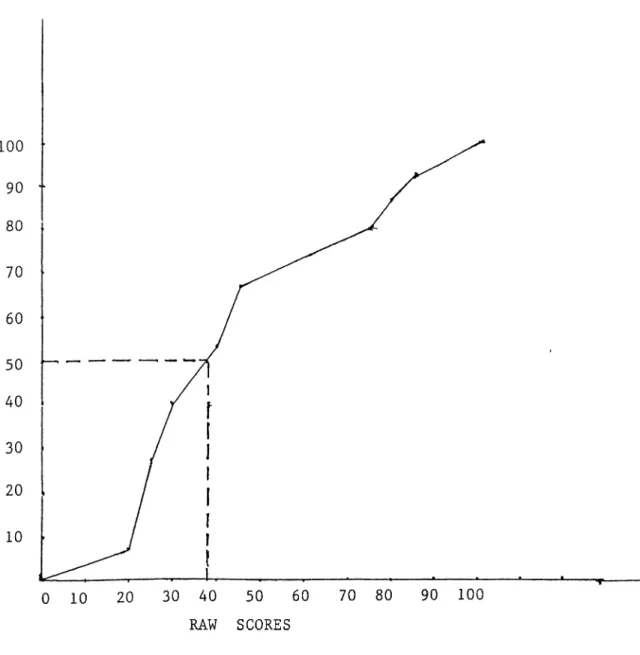
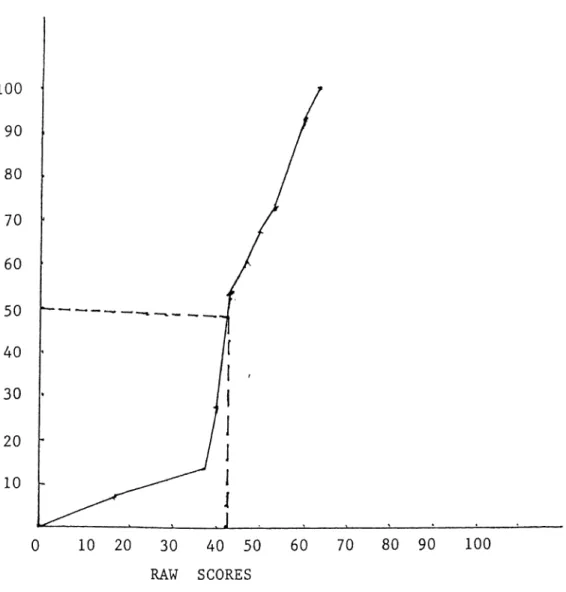
FIGURE I PERCENTILE AND RAW SCORES FOR CLOZE TEST 93 FIGURE II PERCENTILE AND RAW SCORES FOR RETELLING 94
TABLE 2.1 READABILITY LEVELS 17 TABLE 3.1 CLOZE SCORES OBTAINED IN THE PILOT STUDY 38
TABLE 4.1 RATING SCALE AND PERCENTAGES 46
TABLE 4.2 CONVERSION OF RAW SCORES INTO PERCENTAGES 47 TABLE 4.3 AN ILLISTRATION OF MEAN, MEDIAN RANGE AND
STANDARD DEVIATION FOR EACH TEST 48
TABLE 4.4 SCORES ON THE TESTS AND THEIR PERCENTILES 54
TABLE 4.5 PPMC RESULTS OF FOUR VARIABLES 56
TABLE 4.6 THE TETRACHORIC CORRELATION BETWEEN CLOZE
TEST AND TEACHERS' RATINGS 60
TABLE 4.7 THE TETRACHORIC CORRELATION BETWEEN RETELLING
AND TEACHERS' RATINGS 61
TABLE 4.8 THE TETRACHORIC CORRELATION BETWEEN BUSEL
READING EXAMINATION AND TEACHERS' RATINGS 62 TABLE 4.9 SUBJECTS' RANK ACCORDING TO THE TEST RESULTS
AND TEACHERS' RATINGS 66
FIGURE 4,1 STUDENT CATEGORIZATION IN TETRACHORIC CORRELATION
FIGURE 4.2 RATING SCALE USED FOR TEACHER JUDGMENT
52
ACKNOWLEDGEMENTS
I would like to thank to Dr. James Stalker, my
thesis advisor, who gave me invaluable guidance,
encouragement and support throughout my research without which this thesis would have never been completed.
I am also very grateful to Dr. Lionel Kaufman for
giving us guidance on research techniques and
statistical computations as well as patience and support during the writing of this thesis.
My thanks are extended to the MA TEFL program
committee member William Ancker for his contribution and support in carrying out this research.
I must express my gratitude to the BUSEL
administrators and instructors for their cooperation and kindness.
I must also express my deepest gratitude to Dr. James Stalker, Dr. Lionel Kaufman and William Ancker who let us use their computer and the printer in the office.
Finally, my greatest debt is to my parents and sisters who have supported me with their patience, encouragement and understanding during the writing of this thesis.
INTRODUCTION 1.1 BACKGROUND AND GOALS OF THE STUDY 1.1.1 Background of the Study
Testing is an important part of teaching and learning situations. Well-made tests can benefit students, teachers and even administrators by showing how much progress has been done and how future efforts can be directed. They help students pay closer attention to the material, make them review as well as motivate them. While the test is in progress, students have an opportunity to see how well they are able to perform and when the test has been scored and evaluated, they learn something about their strength and weakness. As teachers we can use tests to diagnose our own efforts as well as our students’.
Apart from teaching and learning situations, testing is also necessary for obtaining information about people’s language ability in situations in which universities accept students or organizations hire interpreters or translators. They certainly need dependable measures of language ability. Other reasons, especially in a foreign language environment, are that the person doing the hiring may not be able to conduct interviews, so cannot obtain a direct assessment of the 1anguage ability.
is one of test format varieties used today to assess language proficiency, general reading comprehension, aural and oral language ability and even readers’ IQ (Li, 1986). As well as a testing tool, it is also used as a classroom activity in teaching (Rye, 1982; Brown, 1986). Taylor’s purpose in developing the cloze was to find an accurate way to assess the readability of texts for teaching native speakers to read.
The cloze procedure is put in the category of an indirect testing technique (Morrow, 1979; Carroll; 1980; Hughes, 1986). Because reading is a receptive skill,
it does not necessarily or usually, manifest itself directly in overt behavior. When people write and speak, we see and hear; when they read and listen, there will often be nothing to observe. The task of the tester is to set reading tasks which will result in behavior that will demonstrate their successful completion. (Hughes, 1986, p. 116)
It can be argued that since reading comprehension is not a directly observable behavior, then it can only be indirectly measured and the cloze procedure as an indirect measuring technique seems to be a reasonable alternative among others to evaluate this receptive skill. Besides, researchers have shown that cloze tests correlate fairly highly with various standardized tests of reading comprehension (Anderson, 1976; Brown, 1978). Griffin (1978) argues that if words are deleted from a written passage, we should be able to recover those words provided that we have understood the text.
communicative approaches to language teaching, there has been an interest toward more direct ways of testing. Cloze tests are criticized on the grounds that "the task of completing the test is still essentially usage- based. It does not represent interactive communication and is therefore only an indirect index of potential efficiency in coping with day to day communicative tasks" (Carroll, 1980, pp. 9-10). They are also criticized as lacking "face validity", that is, the task (gap filling) the test demands is not sufficiently similar to any real world authentic situation. In other words, the similarity between the test performance (what the examinee has to do during the test) and the criterion performance (what the examinee would have to do in a "real" situation) that exists in direct tests does not exist in the cloze task.
According to Baker (1989) it is the authenticity of the task which makes a test valid. He considers that there is a strong relationship between validity and authenticity. The degree of similarity between the test and the criterion performance is "the chief factor determining how valid the test is i.e. how confidently decisions could be based on the results" (Baker, 1989, p. 83). By way of an example. Baker says:
consider two ways of assessing a candidate’s ability to explain how to operate a cassette recorder. The direct way is give him the machine and have him give instructions to an inter1ocutor. This method has the drawback of
satisfactorily, then we can be fairly sure that the candidate will be able to carry out this and related tasks in the future. (Baker,
1989, p.9)
From this point of view the cloze is questionable as a test. Baker suggests that cloze tests only be used for assessing language proficiency in a general way in order to place the candidates in a program. He points out that if we do not want our efforts to be futile direct ways should be preferred whenever possible although they may be costly as the assessment procedure needs more time and the participation of more than just one assessor. He further states that "the reasons for preferring indirect tests concern economy and ease of administration but at the cost of reduced confidence in the results" (Baker,
1989, p. 10).
According to Baker’s criteria, then, the techniques of testing post reading skills such as reciting, reflecting, reviewing, retelling and checking one’s own understanding should fall in the category of direct testing because in a real world situation, such as in a history or literature class, students are often required to read and engage in such tasks. In this sense the tasks listed replicate real world tasks. These tasks are direct and a provide a bridge between readers’ receptive and productive skills. Hence they might give us a more accurate picture of
Reading comprehension is usually assessed with a series of passages each followed by multiple-choice questions or a single passage followed by multiple- choice questions. Since it is believed that "these measures represent a very restricted view of reading comprehension" (Johnston, 1983, p. 54), we might wish to add variety to the present approach to measuring reading comprehension. By adding some supplementary approaches with new techniques, we may get a fuller picture of how well a reader comprehends given information.
The goal of this study is to find out whether the cloze procedure or retelling technique can replace or supplement a multiple-choice test and if they seem to measure the same ability. If they can, teachers can test reading improvement on an at-will basis. If they do not seem to measure the same ability, then other variables such as individual characteristics of the testees and the nature of the tests themselves as well as the effect of the interaction between these variables might be responsible because the characteristics learners bring to the learning situation might affect their performance on different types of tests as well.
1.2 STATEMENT OF RESEARCH TOPIC
The primary purpose of this study is to find out how the cloze procedure and the retelling technique correlate with each other and two outside measures, the
ratings of the subjects’ reading comprehension abilities. Basically, the question is how these measures, the cloze test, the retelling technique, and the reading comprehension section of the BUSEL achievement test, correlate with each other in an attempt to determine whether or not the cloze procedure or the retelling technique can substitute or supplement the present widely used multiple-choice reading comprehension tests. In this area a lot of research has been done with cloze tests. Anderson (1976), Brown (1983), Porter (1978), and Alderson (1979) have all investigated whether or not cloze tests measure reading comprehension. Of these researchers, Anderson and Brown found out that cloze is a valid and reliable instrument to be used but Porter’s and Alderson’s findings refute the claims of these researchers. There has also been research on retelling but these investigations were not available to the researcher.
1.3 HYPOTHESIS
1.3.1 Null Hypothesis
There is no significant correlation between the cloze procedure and the two external measures, teachers’ ratings of students’ reading comprehension abilities and the BUSEL reading test. Similarly, there is no significant correlation between the retelling procedure and the outside criteria as pointed out above.
There is a significant correlation between the cloze procedure and the two outside criteria. There is also a significant correlation between the retelling procedure and the external measures stated in 1.3.1. 1.4 OVERVIEW OF METHODOLOGY
This study was carried out at Bilkent University, the School of English Language (BUSEL). Two intermediate level classes took part in the study. One class was used for piloting the cloze and the retelling procedures and the other class was used for actually gathering data for the study. The whole class participated in the cloze test but only 15 randomly selected students participated in the retelling procedure since this procedure required individual testing. So the results obtained from the cloze test for the remaining students were excluded from the study.
The passage used in this study is taken from Chavez-01ler et.al. (1985) where it was used as a cloze task, and the original source was Praninskas (1959) (both cited in Jonz, 1990). This particular passage was chosen because of its non-technical and general topic which was likely to appeal to all students. Although in the original passage deletions had been included in the first and the last sentences, in this study those deletions were restored, that is, the first and the last sentences were left intact as the literature on cloze
procedure generally suggests. The modified passage consisted of 50 deletions and scoring was done according to the any semantically and syntactically acceptable answer method. After the pilot study was done to check the suitability of the passage for the particular level, the cloze test was actually administered to the class from which data were obtained. When the administration of the cloze passage was completed, each teacher interviewed two subjects for the retelling procedure. As the subjects retold what they recalled about the passage, the teacher ticked the check-list which contained a skeleton of the passage and included the main points in the story.
The scores obtained on both of the procedures were converted into percentages for doing statistical calculations. Later the class teachers sharing that particular class were asked to rate the subjects in terms of their reading abilities on a rating scale of "1" to "5". As a second outside criteria, the subjects’ reading comprehension scores from the BUSEL achievement test were obtained. The analysis of data was done by using two types of correlations: the Pearson Product Moment Correlation (PPMC) and the Tetrachoric Correlation. PPMC was done among all four measures, the cloze test, the retelling procedure, the BUSEL test and the teachers’ ratings, to determine whether they indicated the same ability. The latter technique was
to determine whether the test results reflected the teachers’ judgment of the subjects’ reading comprehension abilities.
1.5 ORGANIZATION OF THESIS
This thesis is composed of five chapters. This chapter introduced some background information on why to test, the present issues on how to test followed by some discussion of the cloze test and other testing techniques. It presents the goals and the methodology of the study.
Chapter II is a detailed review of what the cloze procedure is. The construction, scoring, and an interpretation of where the procedure can be used are presented. Advantages and criticism of it are stated followed by an overview of the other testing technique, retelling. This chapter ends with a comparison of these two techniques.
Chapter III contains the methodology of the study: how the data were collected and describes the statistical procedures used in the study.
Chapter IV presents the analysis of the data and interpretation of the results obtained.
Chapter V presents a summary of the study, conclusion and implications.
2.1 INTRODUCTION
Researchers agree that testing reading is difficult (Wood, 1987; Madsen, 1983; Oiler,1979). Wood states that "testing reading is not a perfectly developed process because it is so difficult. We cannot see what is happening when people read" (1987). He further says that since reading comprehension is an internal process and takes place in the brain, we resort to various ways to test it.
One of the most common and popular ways to test reading comprehension is through a reading passage followed by multiple choice questions mainly because they are easy to score and presumably objective. However, researchers note that there are problems with this testing method, the most important being that readers must see what the tester wants them to see, which is often literal, factual information easy to locate in the text without careful reading, and that such tests do not enable the tester to see the influence of the readers’ background information and past experience (Wood, 1987).
This chapter describes and discusses two other testing techniques for assessing reading comprehension, the cloze procedure and the retelling technique.
2.2 AN OVERVIEW OF THE CLOZE PROCEDURE
The cloze procedure, devised by Wilson Taylor in 1953, was originally used for determining the difficulty
level of prose passages for native English readers. The term "cloze" comes from the notion of closure in Gestalt Psychology and refers to the human psychological tendency to complete incomplete patterns or sequences. It is justified on the assumption that a person who is either a native speaker of the language tested or a proficient non-native speaker should be able to anticipate what words belong in the blanks given the contextual clues of the passage. Since its invention it has been for a multitude of purposes. Its applicability to teaching and testing has been pointed out (Rye, 1982). Aitken (1977) says that "cloze tests are valid, reliable second language proficiency tests". Anderson states that "there is a sound theoretical basis also for cloze procedure as a measure of reading comprehension for cloze scores index the correspondence of language habits of writer to those of reader and thus the construct, reading comprehension,
is given operational meaning" (1976, p. 7).
Several other studies have suggested that cloze may be a satisfactory substitute for the TOEFL, for the oral interview (Pike, Hinofotis, ctd. in Hinofotis, 1987), and for the composition writing task (Pike, ctd. in Hinofotis, 1987). Anderson recommends cloze tests as measures of readability and of reading comprehension saying that "they are quick and inexpensive to construct. No training in test construction is required... Instructions are uncomplicated and scoring is easy. The
whole procedure is objective” (1976, p. 7). Before the procedure is further recommended there are several questions that require answering. Which words are deleted in cloze tests? How many words are deleted? In scoring cloze tests, does a word have to be replaced exactly or will a synonym do? Does the technique measure reading comprehension? How is the score on a cloze test i nterpreted?
2.2.1 Frequency of Word Deletion
The most commonly used deletion systems in cloze studies are random deletion and every nth word deletion. According to Anderson (1976) both systems are mechanical and completely objective. Most researchers have preferred to use the more simple every nth procedure rather than a random nth. Oiler (1979) points out that "some discretionary judgement must be used when applying every nth word deletion" (the fixed ratio deletion). Items such as proper nouns, dates and other words that would be excessively difficult to replace should be skipped and the adjacent word should be deleted instead. Cohen’s recommendations for deletion are as follows:
1. A low frequency word may be deleted if this word appears elsewhere in the text, since part of reading skill is recognizing lexical repetition.
2. If a word is a key word without which the passage is less comprehensible, or if the word most probably is a new word to students, or part of an unfamiliar idiom, deleting an adjacent word is recommended.
3. It may also be advisable to avoid deleting part of an idiom, particularly if the idiom is not a common one.
times is acceptable, excessive deletion of function words like "and", and "the" should be avoided. (1980, p.92)
A variety of every nth word deletion frequencies has been employed in attempts to determine the reliability of this procedure by researchers (Alderson, 1978; Porter, 1978), the shortest interval being one in five (every fifth word deleted) and the longest one every one in ten. The most frequently used deletion, however, is one in seven (Rye, 1982). The frequency of deletion usually depends on the difficulty level of the text. If the text is well above the students’ level, it is important to give enough context. One in five can make the passage too difficult for students. It has been shown that performance is affected by the amount of the text on either side of a blank (Oiler, 1979). Alderson, however, found that deletion of every sixth word was not more difficult than one based on the deletion of every twelfth word. The first and the last sentences of the text are usually left untouched.
2.2.2 Scoring
Numerous ways of scoring have been used, but the most common ways to mark the cloze test are either by accepting only the exact word that was deleted, or by accepting any contextually acceptable answer. The acceptable word method has both semantic and grammatical components. At times it is not easy to judge whether a given word is acceptable or not. Cohen’s suggestion is
"give the cloze passage to natives of the target language to fill out. Usually there is a general agreement among them as to acceptable answers. These answers can serve as the basis for an answer key"
(Cohen, 1980, p. 100).
Anderson (1971) compared both acceptable and exact word scoring procedures in his study. He found that the two methods gave the same results. He recommends accepting the exact word because scoring is easier. Stubbs and Tucker (ctd. in Hinofotis, 1987) suggest that the exact word replacement method is as valid as any acceptable word method. They found that with a group of 206 university ESL students cloze tests scored both ways correlated very highly (r= 0.97) with each other. Oiler (1972), Cohen (1980), and Li (1986), however, think that any contextually acceptable answer method is better for EFL / ESL classes. Cohen (1980), defends the acceptable word approach saying that the exact word scoring method "is not psychologically palatable enough to teachers or students. The raw score on cloze using the acceptable word approach is initially low relative to a score on a traditional reading comprehension test but becomes still lower using the exact restoration approach" (p. 90). The results obtained by Sciarone and Schoorl (1989) indicated that the scoring method depends on the number of deletions. If a text has 50 deletions, exact word scoring will give very low marks.
If there are 100 deletions, then it does not matter which is used. As for spelling, Aitken (1977) says that incorrect spelling should not be penalized as long as the word is recognizable. However, the word must be grammatically correct. The wrong verb tense, for example, would not get credit. Each correct or acceptable answer is worth one point.
2.2.3 Passage
By deleting words, the teacher is making the reading task more difficult than it ordinarily would be. It is therefore important to encourage the motivation of students with an interesting passage. The interest value of the passage compensates for the disruption in eye movement and a greater burden on the memory that the deletions will cause. (Rye,
1982, p. 59)
Cohen (1980) points out that the passage to be selected may either be of particular relevance to the students being tested, such as a history passage for students in the humanities, or it may be a passage of general interest. Research demonstrates that familiarity with the subject matter improves performance (Moy, 1975). Furthermore, cloze deletions add to the difficulty of the passage. The research done by Bormuth (1967) suggests that a score of 43 per cent on a cloze is comparable to a score of 75 per cent on a standard multiple choice test of reading comprehension. Rye
( 1982) points out :
the language of the passage should not be beyond the independent reading level of the students before deletions are made from it. If the unmutilatçd language would cause any difficulty, then the further difficulty that
would be caused by deletions would result in the students becoming frustrated and alienated from the task. (p. 60)
As far as the length is concerned, passages should be long enough to allow a deletion of at least 50 words. Research has shown that the shorter the text and the fewer the number of deletions, the less reliable the test results are (Sciarone and Schoorl, 1989). The passage should be long enough to allow a sufficient number of discriminating items, a minimum of 50 deletions at least. A 500-word passage is often given as a minimum. After a passage is chosen and deletions are made, directions should be prepared and a sample item should be given if he students are not familiar with the procedure.
2.3 WHAT CAN CLOZE BE USED FOR ? 2.3.1 Cloze and Readability
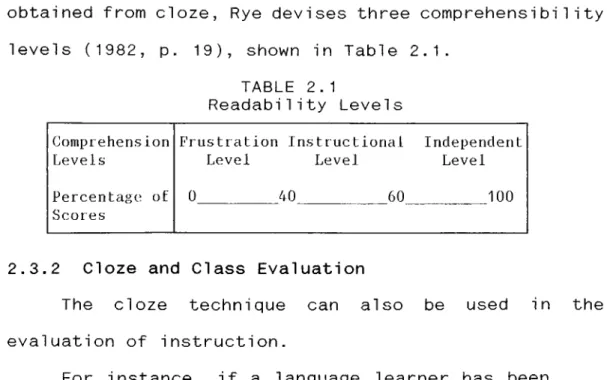
Cloze scores can be used to judge the readability of texts and materials to be selected for instructional use (Rye, 1982; Anderson, 1976; Oiler, 1979). "Cloze procedure can measure the difficulty of a text not in terms of word length or familiarity, or of sentence length, but in terms of a particular student’s understanding of, and response to, the language structure of a text" (Rye, 1982, p. 19). It is further pointed out that cloze is a more reliable technique for measuring the readability of materials than most readability formulas (Oiler, 1979). Using the scores
obtained from cloze, Rye devises three comprehensibility levels (1982, p. 19), shown in Table 2.1.
TABLE 2.1 Readability Levels Comprehension Levels Percentage of Scores
Frustration Instructional Independent
Level Level Level
0 40 60 100
2.3.2 Cloze and Class Evaluation
The cloze technique can also be used in the evaluation of instruction.
For instance, if a language learner has been taught to perform certain speech acts (e.g., ordering a meal at a restaurant, buying a ticket at the station, taking a telephone message, and the like), cloze tests over samples of discourse exemplifying such acts might be appropriate indicators of the effectiveness of the instruction. Or if a student has been asked to study a certain text or article, a cloze text over portions of the text might be an appropriate index of the effectiveness of study. If specific points of grammar have been emphasized in the
instruction, these could be tested specifically with reference to actual usages.
(Oiler, 1979, p. 363)
Similarly, Rye (1982) has also suggested the use of the procedure for classroom activities.
2.3.3 Cloze and Reading
Several researchers have suggested and used cloze technique to test reading comprehension skills (Anderson, 1976; Oiler 1975, 1983; Shohamy, 1984; Aitken, 1977). How does the cloze procedure relate to theories about what reading involves and where reading problems come from? There has been controversy among
reading researchers over what reading skill is. Researchers on one side of the debate (Rivers, Yorio, ctd. in Carrel 1, 1987), assumed that reading was a passive skill, a "bottom-up" process. They thought that reading was mainly a decoding process, that is, in order to understand the author’s intended meaning, the reader has to recognize the letters and words and "build up a semantic representation of the text’s meaning from the smallest textual units at the bottom to the largest at the top" (Carrell, in Devine et. a l ., 1987, p. 24). The only skill unique to reading, the researchers said was that of decoding.
On the other side of the debate, reading is viewed as a rather active process between the reader and the text (Goodman, Smith, ctd. in Carrell, 1987). From a psycholinguistic view point reading comprehension is a "top down" process, that is, the reader is an "active information processor who predicts, and samples only parts of the actual text" (Carrell, 1987, p. 24). In this process the reader not only makes predictions and processes information but also utilizes all his relevant past experiences and background knowledge. After all "The more you know the better you read" (Perfetti, ctd. in Guthrie, 1977, p. 280). This factor does not necessarily have to be separated from reading comprehension. Carrell (1987) also argues that the top down view of second language reading should not replace
the bottom up (decoding view) because efficient and effective second language reading "requires both top- down and bottom-up strategies operating interactively"
(p. 24).
Under the psycholinguistic theory of reading, the task involved in the cloze test is very similar to the task required in proficient reading because to reconstruct the passage the reader needs to make inferences utilizing all the information about the "facts, events, ideas, relationships, states of affairs, social settings and the like that are pragmatically mapped by the linguistic sequences contained in the passage" (Oiler, 1979, p. 43). Rye ( 1982) says that when faced with a blank that is surrounded by syntactic and semantic clues, the students will be guessing and searching "looking for clues that their memory tells them are present, and looking for material that may provide a basis for a guess" (p. 50).
Cloze tests global reading comprehension skills. It tests learner’s awareness of textual constraints, i.e., phrase level, sentence level, and paragraph level dependencies. Successful performance on cloze depends on the interrelation of sentences in the passage (Oiler,
1975). Anderson states that "A subject’s knowledge of syntax, his knowledge of the meaning of words, of the relationship between sentences, of the interdependence of the ideas and so on, are measured by the purely
mechanical procedure of mutilating parts of the passage" (1976, p. 11).
Fries (1963) identifies three layers of language meanings that are dealt with in reading comprehension:
(1) Meanings carried by the lexical items. (2) Meanings carried by the grammatical structures.
(3) Socio-cultural meanings.
Harris (1969) similarly groups abilities needed in reading under three main categories:
(1) Language and graphic symbols. (2) Ideas.
(3) Tone and style.
In practice, he says all these levels of meaning needed to comprehend a passage are "mutually dependent". Anderson states that cloze relates to these three layers of language meanings because to construct a message
...requi res a fami1iarity with the grammatical structure of English, an understanding of lexical meaning and, if the passages selected are concerned with a variety of experiences familiar in a given culture, they reflect to some extent socio-cultural meanings. (1976, p.
18)
So Anderson believes that there is a theoretical basis for believing that cloze scores index reading comprehension.
Rye (1982) points out that many tests examine a very limited range of reading behavior. Cloze requires a wide range of abilities. A survey conducted into the
effectiveness of the two tests used in England and Wales in 1973 suggests that performance on a cloze test
involves the following skills: (1) Recognizing words
(2) Using semantic, syntactic and at times stylistic information to infer and predict.
(3) Drawing meaning from outside the context of the immediate sentence.
(4) Skimming to recap what has been read. (5) Scanning in search of unspecified information that may help the prediction. (Rye, 1982, p.32)
Rye also states that cloze tests supply a context and require the reader to use that context to discover meaning. However, Johnston says that
there is still much to be learned about the cognitive demands of cloze tests, and research effort should be directed toward this end. For example, do different readers use different strategies to answer cloze questions? If they do, how do these strategies affect their responses? (1983, p. 63)
2.4 ADVANTAGES OF CLOZE TESTS
Almost all researchers agree that the cloze procedure avoids many of the difficulties associated with writing questions which might be ambiguous or not understandable on the part of the students. It also helps ensure that the students’ attention is drawn to a wide sample of the passage. In more traditional reading tests the questions asked are inevitably biased to the question writer’s decision concerning what is important. This means that some aspects of the text are examined less closely than others. The deletion of words at
intervals provokes thought and requires inference about a larger proportion of the text (Rye, 1982).
2.5 CRITICISMS OF THE CLOZE PROCEDURE
Several writers have expressed reservations about the cloze procedure. One concern is related to whether cloze tests measure comprehension that ranges beyond the context immediately surrounding a cloze deletion. Alderson (1978) questioned the common assumption that cloze tests are good devices for assessing reading comprehension. He feels that they measure only a small part of what is involved in the reading process. In his study he found out that changing the deletion frequency of the text produces a different test which measures different abilities unpredictably. He concluded that if deleting different words from a text results in a different measure of proficiency, then cloze is very sensitive to the deletion of individual words. "If this is so, then one must ask whether cloze is capable of measuring higher-order skills" (Alderson, 1978, p. 225). He further argued:
Cloze is sentence or indeed clause-bound, in which case one would expect a cloze test to be capable of measuring not higher-order skills, but rather much lower-order ski 11s...as a test, cloze is largely confined to the immediate environment of a blank. The fact that the procedure does not delete phrases or clauses must limit its ability to test more than the immediate environment, since individual words do not usually carry textual cohesion and discourse cohesion, (p. 225)
22
MacGinitie as saying that sometimes the missing words in a cloze can be restored correctly without necessarily understanding the passage. In the same way, Coleman (ctd. in Anderson, 1976) makes the point that "cloze scores do not appear to measure the long range associations in the passage. They are essentially measuring the short-range constraints within phrases and clauses and not the more important ones between sentences or paragraphs" (p. 38). These views are quite contradictory to what Oiler states in "Language Tests at School" (1975) in the following quotations:
Cloze items reflect overall comprehension of a text. (p. 346)
It is difficult to imagine anyone filling in the blanks on a cloze test correctly without understanding the meaning of the text. (p. 346)
In order to give correct responses the learner must operate on the basis of both immediate and long-range contextual constraints. Whereas some of the blanks in a cloze test can be filled by attending only to a few words on either side of the blank, other blanks in a typical cloze passage require attention to longer stretches of linguistic context, (p. 42)
Another concern is related to the validity and reliability of the procedure. Alderson (1978), Porter (1978), and Braley and Raatz (1984) all question the reliability and validity of cloze tests saying that different deletion rates and starting points applied to the same text produce tests which can differ markedly in difficulty, reliability and validity.
Alderson (1978) investigated two variables: the deletion rate variable and the text variable. He found out that changing the deletion frequency of the text produces a different test measuring unpredictable abilities. For example, on the easy text, with semantically acceptable score (SEMAC), deletion rate 8 correlates 0.45 with the criterion (a dictation passage) whereas deletion rate 12 correlates 0.91. Similarly, changing the deletion rate from 6 to 8 with exact score procedure results in 0.77 and 0.56 correlation coefficients with the criterion. Furthermore, the correlation of the difficult text with the criterion (the ELBA test) at deletion rate 6 was not true at deletion rate 8 (0.51 and 0.82 respectively). For the text variable, Alderson found out that three texts at three different levels, easy, medium and difficult, correlated unpredictably with the ELBA test: the correlation coefficients were 0.59, 0.86, and 0.51 respectively with the exact word scoring method (Alderson, 1978, pp. 224-225). Alderson concluded that performance on cloze test is affected by the nature of the text, the deletion rate, and the scoring system, suggesting that these variables have a drastic effect on the validity of the cloze test.
Porter (1978) on the other hand, questioned whether cloze is a reliable indicator. He constructed two tests based on the same text and with the same deletion rate.
differing only at which point the deletions began. The two versions were administered to the same group at an interval of three weeks. He found that the PPMC correlation was not as high as he expected for a pair of quite similar tests (for the exact word scores the correlation he obtained was 0.57 and for the acceptable word scores 0.65). Porter concluded that the relatively low correlations obtained with either scoring method indicate that students’ achievement may vary considerably according to what is deleted. Braley and Raatz (1984) agree with Porter indicating that two cloze tests prepared over the same text with a slight change in deletion rate are not two parallel or equivalent tests as had been assumed by some researchers.
Lado (1986) expressed similar concerns on the issue. He administered a cloze test to a group of native speaker college students. The results showed that 98% of the students failed the test by usual academic standards. He stated:
Whatever the test is measuring is not known well enough by these successful college students to pass at the level of a course grade...The contradiction between their obvious English competence and their failure to do well on the cloze test is unacceptable. Either the test is measuring something other than English competence or the subjects do not know English. The conclusion is obvious: this cloze test has such a heavy non-language factor that it cannot be used validly to assess the English competence of native speaker college students, (p. 132)
Lado further agrees with Alderson and other researchers mentioned above on the issue of whether cloze is a good device for measuring reading comprehension. He states:
This process is quite different from ordinary reading for meaning in which complete text is available and the subject’s task is to anticipate the meaning and thought rather than specific words, (p. 136)
A further issue raised by Farhady (1983) is that the items in a cloze test are not developed by the test developer and therefore they cannot measure what the test developer wants to measure. Farhady says that if we do not know what a cloze test is measuring, we cannot establish its validity because validity is defined as whether a test is measuring what it purports to measure. 2.6 RETELLING
Retelling (or free recall) is another method for testing reading. What it involves is mainly that after reading a passage, the examinee is asked to summarize or retell as much as possible on what he has read and understood. While the examinees retell, the teacher checks what they recall against a checklist. The assumption is that if the examinees have understood what they have read, they should be able to retrieve the information read (Wood, 1987).
Johnston (1983) states that such a procedure is quite time consuming since it requires individual testing. But, by using this procedure, we can learn something about how information is stored and organized
in the memory. We can also make some inferences about the retrieval strategies which the reader uses.
"Patterns of intrusions, distortions and omissions may provide valuable information on specific influences of the individual’s background knowledge" (Johnston, 1983, p. 55).
The problem with this procedure is scoring. According to Johnston the scoring can be done in meaningful and consistent ways. For example, scoring of stories can be done in terms of the presence or absence of the integral elements of the narrative structure. When the examinees are asked to summarize, on the other hand, the extent to which they have been able to assimilate and reconstruct the information may be exami ned.
Recall and retelling involve production skills. So failure to produce information could be due to "production deficits. Alternatively, schema selection or access may be blocked or inappropriate or it may be that the reader simply mi sinterprets the task demands and assuming that the tester has read the passage, gives only a cursory protocol" (Johnston, 1983, p. 55).
Furthermore, it is stated by Johnston that reading comprehension skill and production skills are not very well correlated. As a result, he says, "failure on a reading comprehension assessment task requiring production cannot be clearly attributed to production or
comprehension skills separately" (p. 56). So conclusions such as less fluent readers do not remember information from discourse or they remember less of the information should be drawn cautiously (Johnston, 1983). 2.7 A COMPARISON OF THE CLOZE PROCEDURE AND RETELLING AS TESTS OF READING COMPREHENSION
These two procedures have rather different characteristics although both are said to measure reading comprehension abilities. First of all, cloze is a holistic task. Performance on this task involves grammar and vocabulary knowledge and overall understanding of a passage. In this procedure examinees can spend more time and concentrate more on certain parts and consequently can perform better. The examinees do not have to perform under time constraints, "in real time" (Morrow, 1979). Although cloze integrates discrete language elements that constitute the system, it is not a communicative test because it does not tap the communicative sociocultural and sociolinguistic performance of the learners (Farhady,
1983). It is a test of receptive language competence. It samples a wide range of structural and lexical items in a meaningful context but it does not give any convincing proof that the learner will be able to actually use the language in real situations (Morrow, 1979). In this respect cloze is an indirect test.
Retelling is a relatively new technique. Like cloze, it is a test of productive language performance but requires quite different elements from cloze. In this procedure, the learner has to store information, organize it and be able to recall and retrieve it. In this respect the procedure requires both receptive and production skills. Since the procedure is carried on a one to one basis between the tester and the testee, the testing situation may create more anxiety on part of the testee which can interfere with the test performance and hinder the examinee from giving a full recall protocol. Finally, since this is a novel technique, the examinees may not know what kind of demands the test task makes on them. "Testwiseness" is another factor that distinguishes between this technique from a more fami 1i ar one.
These different characteristics of the two techniques may cause examinees to perform differently on each task.
2.8 SUMMARY
There are many ways to test reading comprehension, three of which are reviewed in this chapter. These are multiple-choice, cloze and retelling. Researchers seem to agree that these ways of measuring reading comprehension vary in what they demand creating controversy over which is "the best" or "the most useful" test. Retelling, the newest candidate in the
field, has yet to be well tested, but seems to be accepted at this point on face validity or directness of measure. In a practical view, perhaps the most important question is do these tests of reading comprehension correlate with each other, rather than do they test reading comprehension.
METHODOLOGY 3.1 INTRODUCTION
Although the use of cloze procedure as a testing device for assessing reading comprehension has been used and justified by several researchers such as Anderson (1976), Shohamy (1984) and Aitken (1977), in recent years with the development of more communicative tests there has been an interest toward using more direct ways of measuring reading comprehension such as retelling a passage, reading aloud and reading and reasoning aloud. The concern of this study is to compare cloze procedure assessment of reading comprehension with retelling. Retelling is designed to help students comprehend as well as to learn and remember what they read by giving their individual interpretations of the passage and is a more direct way to test reading comprehension as opposed to cloze procedure which is an indirect testing technique
(Hughes, 1989).
In this study two techniques of assessing reading comprehension, the cloze procedure and retelling are investigated by correlating the scores obtained on a cloze passage with the scores obtained on the retelling procedure and then the results of both procedures are correlated with two outside measures, the scores the subjects got on the reading comprehension section of the
BUSEL test and teachers' judgment of the subjects'
criteria are supposed to be indicative of the subjects' reading abilities, they might help us to determine whether or not the cloze procedure and the retelling technique can substitute for the present most common way of testing reading comprehension in schools through multiple choice tests because research shows that multiple-choice reading comprehension tests do not in fact measure comprehension reliably (Oiler, 1979; Hughes,
1989). Aslanian (1985) also disfavors such tests
considering that comprehension is a complex phenomenon and cannot be measured by objective tests alone.
After obtaining scores of the two tests, their
results are correlated with each other and then
correlated with the two external measures mentioned above by considering them as independent variables in this study.
3.2 SUBJECTS
This study was carried out at Bilkent University in Ankara, Turkey. Because Bilkent University is an English medium university, the students who enter its various departments through a university entrance exam have to have a good command of English in order to carry out their studies in their departments. At the beginning of each academic year students are given an English proficiency exam by Bilkent University School of English
Language (BUSEL). Then, those students who are not
proficient enough to attend their freshman classes are
given a placement test and are classified into four levels: beginner, elementary, intermediate and
upper-intermediate. It takes students from one to two years
to complete their programs at BUSEL depending on their initial level at the start. Most of the students at the department are Turkish, their age ranging between 17-21. They study English as a foreign language.
This study required two parallel level intermediate classes. One class was treated as a pilot group on whom the instruments used in the experiment were tested and the other class was used to actually administer the test.
Although the whole class, seventeen students,
participated in the piloting and the cloze testing
sessions, two students could not participate in the retelling, so only fifteen students were included in the study.
3.3 MATERIALS
3.3.1 The Cloze Passage
The passage used in this study is taken from Chavez-Oller et al. (1985) where it was used as a cloze task; the original source was Praninskas (1959) (both ctd. in Jonz,
1990). In this passage the every-seventh-word deletion
system has been used (see Appendix A). Brown (1983) and Taylor (1953) also used the every-seventh-word deletion
procedure in their experiments. Different deletion
systems have been tried by researchers in order to answer
questions such as how much context should be left
between cloze items and whether the deletion rate affects the test results. The deletion rate employed is usually between every fifth and tenth word.
The criteria for choosing this particular passage was that its topic ("The Problems College Students Might Encounter in Leaving Home for the First Time") is general and non-technical and would appeal to all college
students. Apart from its content, the pilot study
confirmed that its language level was suitable for the target subjects (see Section 3.3.1) as did the judgment
of two experienced BUSEL teachers. The lexis and the
grammatical structures of the passage had been covered in the BUSEL syllabus.
One slight modification was done. According to the literature, the first and the last sentences of a cloze passage are usually left intact in order to provide some
context and motivation for students. Most researchers
have followed this·procedure. So with the first and the
last sentences intact the modified form of the passage consisted of 50 deletions at a rate of every seventh word (see Appendix B). The scoring of the passage was done
according to any semantically and syntactically
acceptable answers as generated from native speaker
teachers. For each correct item one point was given.
The same passage was used both for the cloze task and the retelling procedure so that the effects of
variables such as readability level and content
concerning the use of two different passages could be eliminated.
The test was printed as a three-page booklet. The
front page contained all the instructions and a practice
example was provided (see Appendix C). Although the
students had had some previous experience with cloze procedure, it was thought that a practice item would help
increase the reliability of the test. Such a front page
design was thought to add face validity so that the test would look professional from the students' perspective.
3.3.2 Answer Key
Before the test was piloted and administered, five native speakers of English were asked to take the test. Two of the native speakers were American and three of them were British. The answers elicited from the native speakers served as the basis for the scoring of any
semantically and syntactically acceptable word
replacement (see Appendix D for the answer key).
Eliciting answers from native speakers has been suggested by Cohen (1980 ).
3.3.3 Check-list
The check-list to be used in the retelling was made over the same passage by two experienced teachers. It covered the important points that made up the skeleton
of the passage. It contained 40 items against which the
students' individual comprehension of the passage was checked during the oral retelling session. The students
were required to cover the items on the check-list
through retelling. If they wanted to do the retelling
in Turkish this was permitted since it was more important to test the comprehension of the passage rather than the students' language ability (see Appendix E for the check list). The subjects' performance in this session was evaluated on the basis of how much of the information
covered on the check-list the subjects were able to
provide. Each item was given one point.
3.4 PROCEDURES / DATA COLLECTION
The study was carried on in three sessions: 1).the piloting of the instruments, 2).the administration of the test, 3). the retelling
3.3.1 Pilot Study
The purpose of this session was to check the reliability of the instruments used in the experiment. After the passage to be used was selected on the basis of the criteria described in section 3.2, it was shown to an experienced intermediate level teacher at the preparatory school to assess the appropriateness of its language content. It was found to be at a suitable level for an intermediate class since the structures and the lexis that the passage contained had all been covered in
the BUSEL program. The passage was further examined
statistically to determine its readability level. In
Chapter II (see p. 16) three comprehension levels were
mentioned. When the percentage of the cloze scores is
between 0 and 40, the passage is at frustration level; between 40 and 60 the passage is considered to be at instructional level and finally when the percentage cloze
score is between 60 and 100, the passage is at
independent level. This means that at the frustration
level the language of the passage is too difficult for students to cope with even if help is available. At the instructional level students will be able to cope with the language to some extent but will need help if they
need to understand the passage more fully. At the
independent level students understand the language well enough to cope with the passage on their own.
The passage was piloted on 15 intermediate level
students. The results obtained are shown in Table I
below. By looking at the table, it can be seen that the
mean of the scores for the 15 subjects is 25, or 50%. This showed that the comprehensibility of the passage was at the instructional level (40% - 60%) which was not too easy for the students to cope with.
38
TABLE 3.1
Cloze Scores Obtained in the Pilot Study
Subjects Scores out of 50 Score Q . "O 1 22 44 2 36 72 3 30 60 4 15 30 5 23 46 6 29 54 7 25 50 8 26 52 9 23 46 10 35 70 11 22 44 12 23 46 13 24 48 14 20 40 15 19 38 mean= 25 mean= 50
After the task was over, teachers interviewed individual subjects to test the check-list that had been prepared by discarding the details of the story and leaving only the main parts that constituted the story. After the interview the check-lists were evaluated. It was found out that not all the items had been mentioned by the subjects and those mentioned changed from one subject to another. This gave an insight for the scoring. It was decided that the highest score obtained would be accepted as 100 and the others would be adjusted accordi ngly.
3.4.2 Administration of The Cloze Test
In this session the second class, the subject group, at the same level as the pilot group, was used. As in
the piloting session the whole class participated in the task, but only fifteen students took part in the retelling. The data for the students who did not participate in the retelling were excluded from the study.
Followed by the distribution of the booklets, the instructions for the task (see Appendix C) were read aloud by the teacher. The practice example which was provided in the booklet was done with the group. Before the task started, the subjects were also told there would be another activity concerning the same passage.
3.4.3 Retelling
3.4.3.1 Training of the Experimenters
since the retelling procedure requires individual interviews, it was conducted by the researcher and seven other teachers, one of whom was the teacher of that class. Teachers were given information on how to conduct the procedure.
The first thing that the teachers were asked to do was to provide the student with a comfortable and relaxing atmosphere. This was done by asking the subjects their names and how they did on the previous task, the cloze test. The next thing the teachers were asked to do was to tell the subjects that they could retell the ’’story" in either language, English or Turkish because the goal of this procedure was to ensure that the students had the maximum opportunity to demonstrate their