İSTANBUL BİLGİ UNIVERSITY INSTITUTE OF SOCIAL SCIENCES COMMUNICATION PhD PROGRAM
FORUM THEATRE
AS A PARTICIPATORY COMMUNICATION SPACE FOR DIALOGUE, COLLABORATON AND SOLIDARITY
Zeynep Kunt 112813003
Assoc. Prof. Nazan Haydari
İSTANBUL 2018
Forum Theatre as a Participatory Communication Space for Dialogue, Collaboration and Solidarity
Diyalog, Birlikte Düşünme ve Dayanışma için Katılımcı İletişim Alanı olarak Forum Tiyatrosu
Tez Danışmanı: Jüri Üyeleri:
Zeynep Feriha Eren Kunt 112813001
Doç. Dr. Nazan Haydari Pakkan İstanbul Bilgi Üniversitesi
Prof. Dr. Asu Aksoy İstanbul Bilgi Üniversitesi Doç. Dr. Erkan Saka İstanbul Bilgi Üniversitesi Doç. Dr. Çiğdem Bozdağ Kadir Has Üniversitesi Doç. Dr. Özden Bademci Maltepe Üniversitesi
Tezin Onaylandığı Tarih: ..
t6.:�:.'1P..��
.... .
Toplam Sayfa Sayısı: ....l.
�
L
... .
�
-Anahtar Kelimeler (Türkçe) Anahtar Kelimeler (İngilizce)
1) Augusto Boal 2) Forum Theatre 3) Participatory Media 4) Health System 1) Augusto Boal 2)Forum Tiyatrosu 3)Katılımcı Medya 4)Sağlık Sistemi
iii
ACKNOWLEDGEMENTS
Throughout my PhD journey, there have been a number of people whom I am thankful for. Firstly, I would like to thank my advisor, Assoc. Prof Nazan Haydari for her guidance for my thesis, her companionship, inspiration and encouragement on this long journey, without whom this “transformation” would not be possible. I am thankful to my dissertation observation committee members, Assoc. Prof Çiğdem Bozdağ and Assoc. Prof Itır Erhart who have contributed to my thesis with their constructive feedback and inputs. I am thankful to Prof Dr Asu Aksoy, for being in my defence committee and as the coordinator for the research project, I have been involved for the last two years: “Plural Heritages of Istanbul: The Case of Istanbul Land Walls”. (https://pluralheritages.ncl.ac.uk/wordpress/) Working for this project as a researcher has provided me with the diverse experience of participatory research -engaging the community involved; employing a multi modal approach with walking ethnographies, co-production activities, videos and photography workshops- that contributed to the participatory research approach I take in my thesis. I thank Assoc. Prof Özden Bademci for being in my defence jury committee. Assoc. Prof Erkan Saka whom I feel thankful for being there, sharing my passion for anthropology and for encouraging me for my digital ethnography publication*, and also for being in my defence committee. Prof Dr Halil Nalçaoğlu, for our discussions that always opened up new perspectives and inspired new areas for exploration, Prof Dr Feride Çiçekoğlu for our discussions and inspiration especially about the documentary film.
Special thanks to the group without whom this thesis would not be possible: the gentle and brave souls, the doctors at the Istanbul Chamber of Medicine- for participating in the Forum theatre group, welcoming me as a researcher and a co-facilitator. Dr Hasan Ali Aktolun, Dr Emel Atik, Dr Ümit Akyüz, Dr Arzu Kellecioğlu, Dr Nesrin Usta, Dr Nilüfer Yalçın, Dr Nilgün Ekşi, Dr Tuğrul Sabuncu, Dr Safiye Ziyalan, and devoting their time to the interviews that enriched this research; Dr Selma Mutlu, Dr Mustafa Sülkü. For the insights on the health system, being generous with their time and support, The Istanbul Chamber of
iv
Medicine active members Director Prof Dr Selçuk Erez, Prof Dr Özdemir Aktan, Dr Nazmi Algan, Dr Arzu Çerkezoğlu. Psychologist Nilgün Sarı, whose psychodrama group at the Chamber has provided me with insights on the other dimensions of role- play.
I will always be thankful to Jale Karabekir, for her companionship and joy all along and making this study possible through sharing her wisdom of forum theatre, her workshops and inviting me to be the co-facilitator of the forum theatre, together.
Last but not least, my family and friends I will not be able to name them all, I thank them for enriching my life. For my mother Selma, for her endless support, encouragement and love and being the reason for my love of theatre. My father Mehmet for sharing his passion for play and being my inspiration to go after research.
I dedicate this thesis to all the doctors who dedicate their lives to keep the Hippocratic Oath alive in every circumstance; to Augusto Boal and the theatre people making earth a better place to live.
*(2014) Digitally Mediated Spiritual Life of Istanbul Based Community: “Rainbow Mandala: an alchemy of Love, Light and Spirit in the New Earth, New Media Studies (Yeni Medya Çalışmaları II, pp 37-49, Taş Mektep Yayıncılık, Istanbul)
v TABLE OF CONTENTS ACKNOWLEDGEMENTS iii TABLE OF CONTENTS v LIST OF TABLES ix ABSTRACT x ÖZET xi INTRODUCTION 1 CHAPTER ONE 10
PARTICIPATION, COMMUNITY BUILDING 10
AND PARTICIPATORY THEATRE 10
1.1. DIFFERENT AXES OF PARTICIPATORY 11
COMMUNICATION 11
1.2. CRITICAL APPROACH TO PARTICIPATION 15
1.3. PARTICIPATORY SPACE OF COMMUNICATION 17
AND COMMUNITY BUILDING 17
1.4. PARTICIPATORY THEATRE 25
1.4.1. Community Theatre 32
1.4.2. Play as an Improvised Worldbuilding Practice 35
CHAPTER TWO 39
vi
2.1. THEATRE AS A REHEARSAL FOR LIFE 48
CHAPTER THREE 51
FORUM THEATRE AS MODEL OF PARTICIPATORY ACTION RESEARCH 51
3.1. PARTICIPATORY ACTION RESEARCH 52
3.2. PROBLEMATISING THE “PARTICIPATORY” CLAIM IN RESEARCH 56 3.3. ART-BASED PARTICIPATORY RESEARCH METHODS 59
3.4. FORUM THEATRE METHODOLOGY 62
3.4.1. FORUM THEATRE METHODS 65
3.4.1.1. Embodiment tools for non-actors 66
3.4.1.2. Image Theatre 67
3.4.1.3. Stories built through play 68
3.4.1.4. The Performance Game 70
3.4.1.5. The Joker system 72
3.5. FORUM THEATRE AS A PRACTICE FOR SOCIAL CHANGE 73
CHAPTER FOUR 78
CASE OF “DR GOOD PHYSICIAN” FORUM THEATRE 78
4.1. AN OVERVIEW: THE CASE OF “DR GOOD PHYSICIAN” FORUM THEATRE 82
4.2. THE FORUM THEATRE WORKSHOPS 87
4.2.1. Exploring power relations through play 91
vii
4.2.1.2. Equilibrium Game 99
4.2.3.Building the characters and the play 102
4.3. THE PERFORMANCE 106
4.4. THE FORUM: SPECT-ACTORS’ INTERVENTIONS 108 4.4.1.The first intervention: Resisting the CEO 109
to conduct good medicine work 109
4.4.2. The second intervention: Warning the CEO 111
about Hippocratic Oath 111
4.4.3. The third intervention: Act as a collective 112 4.4.4. The fourth intervention: Reach out to stakeholders 114 4.4.5. The fifth intervention: Resignation 118 4.4.6. The sixth intervention: The all encompassing 119 Health Association and participatory democracy 119 4.4.7. Spontaneous new scene after the audience interventions 123
CHAPTER FIVE 128
ACTIVATING PARTICIPATION FOR ACTION 128
5.1. FORUM THEATRE AS REHEARSAL PLACE 137
FOR “GOOD MEDICINE PRACTICE” 137
5.2. PLAY AND ROLE-PLAY AS A METHOD FOR COMMUNICATION 139 5.3. IDENTIFYING OPPRESSION THROUGH POWER RELATIONS 146
viii
5.4. THE ART OF “COLLABORATIVE PARTICIPATION” 150
THROUGH ACTING 150
5.5. TOWARDS STRATEGIES FOR TRANSFORMATION 153
THROUGH SOLIDARITY 153
5.6. COMMUNITY PARTICIPATION EXTENDED: 156
PUBLIC DIALOGUE THROUGH SPECT-ACTORS 156
5.7 FORUM THEATRE AT THE INTERSECTIONS 158
OF PARTICITAPORY RESEARCH AND PERFORMANCE 158
5.8 CRITIQUE / LIMITATIONS OF FORUM THEATRE 159
CONCLUSION 163
REFERENCES 170
APPENDIX 179
ix LIST OF TABLES
Table 1.1 Ladder of Participation (Arnstein) Table 3.1. Forum theatre processes
Table 4.1. List of research data
Table 4.2. Dr Good Physician Forum Theatre process Table 4.3. Workshop products: Themes, characters, stories Table 4.4. Google Map game
Table 4.5. Google Map game reflections Table 4.6. Equilibrium game
Table 4.7. Equilibrium game reflections
Table 4.8. Participants’ narrations of “oppression” Table 4.9. Themes for the play plot
Table 5. Relational Map of Forum Theatre as a space of Participation: The Case of Dr Good Physician
x ABSTRACT
This research explores Augusto Boal’s Forum Theatre as a participatory communication space. As an interactive form of performance, forum theatre is practiced with the communities experiencing various forms of oppression. As a methodology, forum theatre provides communities with the participatory tools for dialogue, collaboration and a space to develop potential strategies to understand and overcome their oppressions.
This study explores the potential of forum theatre as a model for participatory action research by focusing on its reciprocal roles: to reveal social knowledge and start a process for transformation both in individual and collective levels. The discussion is drawn from the fieldwork conducted with a group of doctors who voluntarily came together forming a forum theatre group to develop strategies for maintaining the practices of the good medicine. The three-month long forum theater sessions with the doctors have led to the play called The Dr Good
Physician, performed by the doctors for the audience who were colleagues/
“spect-actors”. The audience members became spect-actors by acting out the solution strategies presented on stage. The research investigates all stages of forum theatre in terms of its participatory processes through this fieldwork. It is argued that forum theatre presents as a model of participatory communication and action research by “minimising the hierarchy” imposed on participants and maximising the possibility for “becoming active citizens” in life.
Keywords: Augusto Boal, Forum Theatre, Participatory Media, Health System,
xi ÖZET
Bu tez, Augusto Boal’ın Forum Tiyatrosu metodolojisini katılımcı iletişim alanı olarak incelemektedir. İnteraktif bir performans biçimi olarak, yaşamlarında herhangi bir baskıyla karşıkarşıya olan topluluklarla çalışmalarda yaygın olarak uygulanan forum tiyatrosu topluluklara, diyalog, birlikte hareket etme ve baskıya karşı strateji geliştirilmesi için katılımcı araçlar sunar.
Araştırma metodolojisi ve araştırma konusu olmanın kesişiminde yer alan tiyatro pratiği için örnek oluşturan bu çalışma, forum tiyatrosu süreçlerini, aynı zamanda katılımcı medya ve katılımcı eylem araştırması modeli olarak inceliyor. Tezin saha araştırmasını, iyi hekimlik pratiğini korumak üzere stratejiler geliştirmek için bir araya gelen doktorların oluşturduğu forum tiyatrosu oluşturdu. Doktorlarla üç ay süren forum tiyatrosu çalışmasının sonunda “Dr İyi Hekim” forum tiyatrosu hazırlandı. Doktorlar, oyunu, meslekdaşlarından oluşan bir izleyici-oyuncu (spect-actor) grubu için oynadı. Forum bölümünde ise izleyiciler, sahnede kendi çözüm stratejilerini oynayarak izleyici-oyuncu oldu. Çalışma bu saha araştırması üzerinden forum tiyatrosunun bütün aşamalarını katılımcı süreçler açısından incelemektedir. Forum tiyatrosunun hiyerarşiyi en aza indirgeyen katılımcı iletişim ve eylem araştırması modeli olarak sunduğu olanaklar “aktif yurttaş” kavramıyla bağlantılı olarak tartışılmaktadır.
Anahtar kelimeler: Augusto Boal, Forum Tiyatrosu, Katılımcı Medya, Sağlık
1
INTRODUCTION
It is not necessary to interpret reality: it is necessary to transform it
(Augusto Boal)
In this thesis, I explore Augusto Boal’s Forum Theatre methodology as a participatory communication space and a catalyst for self-expression, collaborative thinking, and solidarity through the case of the forum theatre practice with a group of doctors within the context of Turkey. I trace the relationship between forum theatre and participatory communication as a way of articulating a notion of active and process oriented participation that starts with taking action, leading to a potential transformation both in individual and collective levels. (Boal 2006, Freire 1973) My aim is to illustrate the potentials forum theatre carries as a “participatory medium” exploring the socio-political axes involved in the definition of “participation” (Rodriguez 2011, Carpentier 2016, Mouffe 2005) that can benefit the research practice in the field of communication studies. Through the analysis of the case study of the doctors’ forum theatre, I also position forum theatre as a model for participatory action research.
Forum Theatre is part of the “Theatre of the Oppressed” model Augusto Boal created during the oppressive socio-political circumstances in Brazil in the 1960s. Today, forum theatre methodology is being employed around the world, working with the communities sharing a common struggle involving a form of “oppression”. Designed with the purpose of identifying the power relations beneath these oppressions, forum theatre aims to activate its participants to come up with transformation strategies. To do so, it redefines the functions of the basic components of theatre such as the director, actor, script and audience with the aim of enhancing participation to the degree that the creation of the play becomes a collective narration process and there is no hierarchy. The participatory process is extended to the audience -who are members of the same community, familiar with
2
the same struggles in life- when they are invited to stage to act out their own solution strategies by improvising.
One of the main components of the participatory communication space in forum theatre is “dialogue”. Inspired by Paulo Freire’s methodology of the “Pedagogy of the Oppressed” (1973), Boal, searches for a theatre system that gets rid of the monologue that he associates with a form of oppression. To have a system based on dialogue; Boal demolishes the hierarchy between the stage and the audience. Towards his aim of building a “people’s theatre”, Boal draws from Freire’s book Pedagogy of the Oppressed (1987) that provides learning methods that are “based on dialogue, and are process-orientated, rather than focused on a quantifiable end-result as in the common education system.”
This study is an example of performance at the intersections of research method and object of research (Alexander, 2002; Jackson, 1998; Johnson, 2003; Jones, 1997 cited in Madison et al. 2006). Through the forum theatre process, the knowledge is generated through the interaction of the participants with each other, as well as the interaction with the researcher. The participants of the research, who are seen as data sources in the traditional sense, are now transformed to “data generators”. (Franzen, 2000, p.2) In this respect, performance is initiated with a social purpose and it creates the space for deeper understandings as well as being a pedagogical method (Madison et al. 2006) for “interactive knowledge production” (Pohl et al. 2010, p. 271). In a similar way, performance has been utilised as a catalysor for participation by the ethnographers for a long time (Rouch, MacDougal) as a mean to explore culture, to provoke participants to become active producers of knowledge about their own experiences. Forum theatre adds “taking action” to this equilibrium. However, its use for the communication studies fieldwork practice has been limited so far. Community theatre has been mainly explored (outside of theatre studies) within the framework of “public sphere” discourse of Habermas, Bourdieu. (Kennely 2006, Woodson 2015, Karagül 2015) This study contributes to this space, by exploring forum theatre as a participatory medium investigating the components of self-expression, dialogue and collaborative thinking with a critical approach to power relations, which is at the
3
centre of forum theatre work. I explore forum theatre as an implementation platform of radical participation in relation to the discussions of participation by Carpentier (2011) and Mouffe (2005). Forum theatre space is examined as a unique medium that makes equal access and interaction possible for all participants without the censorship or exclusion caused by the economic or socio-political system.
The personal roots of this research goes back to my childhood and my interest in “play” as a form of communication. I have been interested in the (philosophy of) game and the play features since my childhood, partially inspired through my father’s involvement. At times, it was as though games created the space for communication between us. Later, I participated in an amateur theatre where I experienced the intersection of play space and theatre. I came to see other aspects of role-play and play as an opportunity to challenge the authority and the set-social roles; to discover about oneself and challenge power relations imposed by hierarchy. At the university, as I got involved in visual anthropology, I got interested in the medium of film as a catalysor for research as well as a medium for documentation of ethnographic knowledge. My undergraduate studies in social anthropology and sociology cultivated my interest in participatory modes of communication that evolved with the ethnographic work I have conducted both as a researcher and as a documentary producer (in later years). Exploring visual methods to capture people’s lives and views on camera, I came across different genres/approaches that claim to be participatory and reflexive. Jean Rouch’s ethnographic film “Chronicle of a Summer” (1961) (Chronique d’un été) where he used the camera as a provocative catalyst for participants to reveal their stories, inspired me greatly to explore further about the interaction of the researcher and the participant, and the research process as a transformational experience for both parties involved. The filming process itself was reflected in Rouch’s film with the participants directly talking to the camera revealing their stories as if they were in a psychotherapy session, and the inclusion of their discussions among each other was an innovation at the time, as if including the backstage of the documentary in the documentary. In this practice, the film medium itself was the space that brought participants together, and led them to their transformation through experiencing the
4
filming process. It was not until I started my PhD in Communications, that I realised the foundations of this approach was to be found in Augusto Boal’s Forum Theatre as a space for participation.
This dissertation builds on my experiences in the intersection of art, communication and research practice. It has been a journey where I took this quest further with my investigation in play and participation in ethnography under the interdisciplinary realm of communication studies. I strongly believe that the research praxis of different social disciplines and arts have a lot to offer to enrich the theory and practice together. My attempt in employing “forum theatre” for communication research is an endeavour in this direction, exploring the potential of community “theatre” as a space for participation with its double role: to reveal social knowledge and start a process for transformation.
With this study, I employ a multidisciplinary and multimodal approach that requires different theoretical lenses of participation and communication, Forum Theatre, Participatory Action Research (PAR). This approach is defined as an “experiential knowledge production” or “art-based research” that are in many ways opposing the “scientific approach” that requires comparisons of results in controlled environments with the claim of being “objective” and neglecting self-reflexive input regarding the researcher’s presence and participation in the process. There is an “open endedness of research process” in terms of knowledge production. In other words, the “action needed for this type of research also creates the space that knowledge emerges.” (Schneider and Wright, 2010). The knowledge is generated through the interaction of the participants with each other as well as the interaction with the researcher.
This study is a participatory action research (PAR), in which the control over knowledge production is shared with the participants without any agenda imposition by the researcher, and there is a concern about the impact of research on the participants- preferably an action strategy for the desired transformation. In PAR, theory and action follow each other in a spiral without any imposition for the “solution”. In this respect, I propose to position forum theatre as an effective model for PAR.
5
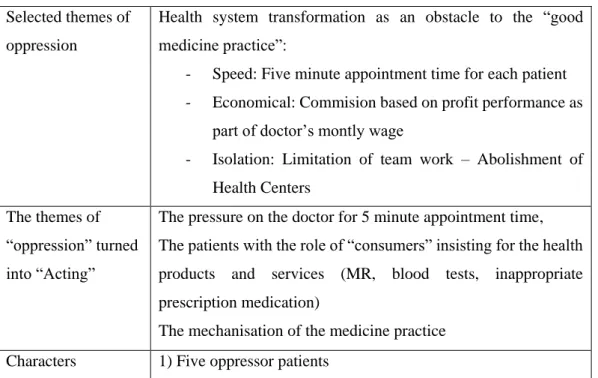
Following this inquiry, I started my exploration of participatory theatre practice in Turkey. I came across practices that focused on interactivity and improvisation focusing on the entertainment aspect (i.e. improvisation theatre, playback theatre), but the social functions I was looking for were realised in the forum theatre practice, which is very limited in Turkey. Meeting with one of the most experienced forum theatre practioners, Jale Karabekir, also a dramaturg and founder of the theatre group Tiyatro Boyalıkuş, was a turning point for my research. Our correspondence provided me with a great opportunity to learn the practice through her workshops, and our discussions throughout this process provided insights for this research. Karabekir has been working with different communities doing forum theatre work. In the summer and fall of 2016, I attended all the workshops Karabekir facilitated related to Theatre of the Oppressed practice. After attending Theatre of the Oppressed workshops to learn about the practice of Forum Theatre, I became a co-facilitator/ researcher for the forum theatre put together by a group of doctors from the Istanbul Chamber of Medicine. It was a three-month long fieldwork, which gave me the opportunity to examine the forum theatre practice from within. The forum theatre workshops with the doctors has led to the play called “Dr Good Physician” focusing on the “oppressions”/ “pressures” of the health system policies on the doctors. At the end of the three months, Dr Good
Physician play was performed with the audience who were colleagues/
“spect-actors”.
Below research questions initiated my inquiry into forum theatre:
1) What do the basics of theatre -play and role-play- has to offer to communications scholars? In what ways these processes can be a catalyst for participation through self-expression and dialogue?
2) In what ways, forum theatre processes can be used as a model for participatory action research? Can forum theatre be a catalyst for data collection and generation/ for social knowledge to be revealed?
3) What role does forum theatre process can play in creating strategies towards change in a community?
6
4) Can forum theatre be a starting point of action for social problems/ oppression(s) shared by a community?
The Dr Good Physician forum theatre process turned out to be a field
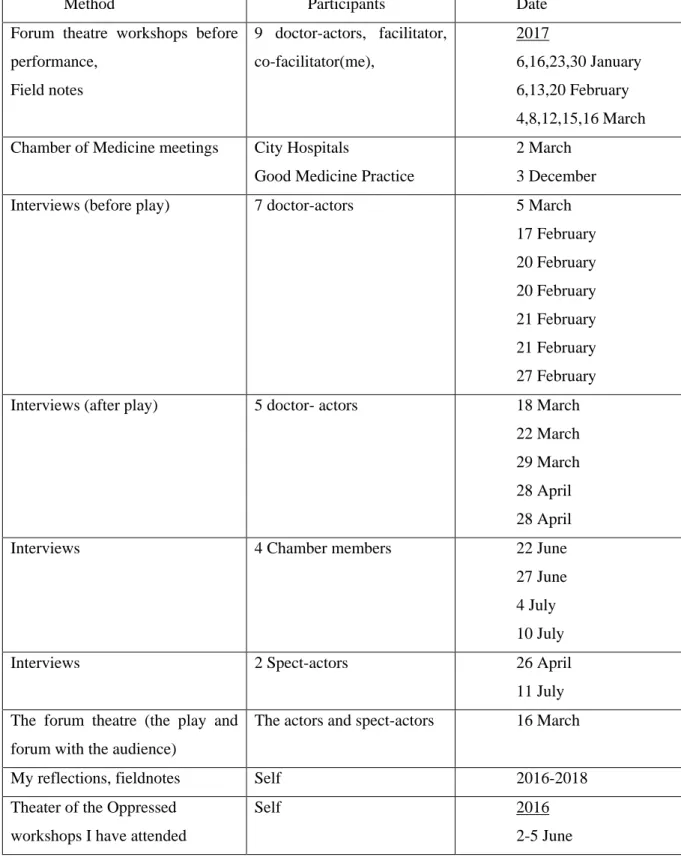
experience that also led me to a deeper understanding about the doctors’ experiences of the health system, which would have not been possible in a formal interview environment. I used interviews as providing complementary data, which I conducted with the doctor participants of the forum theatre before and after their performance of the play. The experiences of the doctors that were portrayed through role-play added other layers of analysis during research in parallel with the action oriented nature of this research.
The first chapter covers the theoretical discussions related to “participation” and participatory theatre. The concept of participation is explored in relation to the works of Nico Carpentier, Clemencia Rodriguez and Chantal Mouffe. This
research draws on the paradigm in communication research that understands communication as a process or “practice” as defined by Nick Couldry (2004, p115), where communication is not confined “to the media or to messages, but to their interaction in a network of social relationships. By extension, the reception, evaluation and use of media messages, from whatever source, are as important as their means of production and transmission.” (Servaes, 2008, p. 23). In the first chapter, I provide a review of the discourse around participation in relation to the power dynamics in play at different socio-political axes. The criteria for
“interaction” and “access” in participation; its degrees from “minimalist” to “maximalist” applications in relation to the political theory (Mouffe, 2005), the criticism of the “participation assumption” by the concept of “empty
participation” (Arnstein, 1969) and “negotiation” (Sjöberg 2017) will be explored. The “community building” practice through networks will be explored in relation to the different models such as “community media”, “civil society media”, “alternative media” and “rhizomatic media”. The social movement approach by citizens taking action in the media networks transforming them to “citizens’ media” will be discussed (Rodriguez, 2011). The review of participatory theatre literature covers the evolution of the terminology of community theatre to set the
7
background to position Augusto Boal’s forum theatre as a space of participatory communication. A short overview of the play literature as an introduction to the “play” compound in forum theatre is also described as a space “for liberation of the social roles and behaviours”, “imagination” and “creativity” that are also crucial functions of forum theatre.
The second chapter explores Augusto Boal’s philosophy in creating forum theatre as part of the Theatre of the Oppressed practice with a historical perspective; including the discussions on its theoretical connections to Paulo Freire’s Pedagogy of the Oppressed, and the emergence of the other theatre of the oppressed methods in response to the needs of the communities. Augusto Boal’s redefinition of the concepts of theatre such as the text, actor, audience and director will be discussed in relation to maximising the participatory processes involved. The demolishing of the division between the stage and the audience, the audience intervention strategy will be explored focusing on the inclusion of community in co-creation of the play. The foundations of forum theatre methodology with its tools to maximise the participatory communication processes for the involved participants will be discussed.
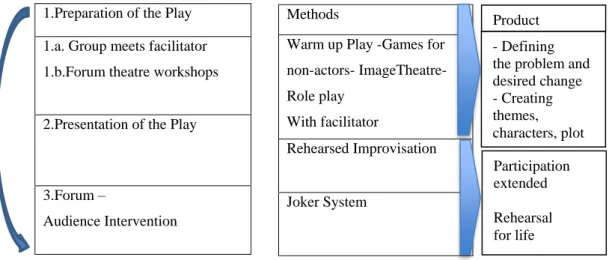
The third chapter discusses forum theatre methodology with its potential to enhance the praxis of Participatory Action Research (PAR). The methodological foundations of this research: Participatory Action Research (PAR) is discussed to ground forum theatre methodology as a model for PAR. The different methods of forum theatre such as the games for non-actors, role-play, improvisation, image theatre, joker system will be explored in terms of their functions for the character, theme and story building. The audience intervention and its joker system is discussed in relation to their functions of extending access, dialogue and interaction. The section ends by selected studies on forum theatre and participatory action research methods involving social issues such as gender, education, health policies. The fourth chapter illustrates the stages of the fieldwork I conducted that constructs the main body of this research. Starting with my involvement in the practice of forum theatre, I discuss the limited sphere of forum theatre practice in Turkey and the efforts of Jale Karabekir, Ebru Gökdağ and Aylin Vartanyan, as
8
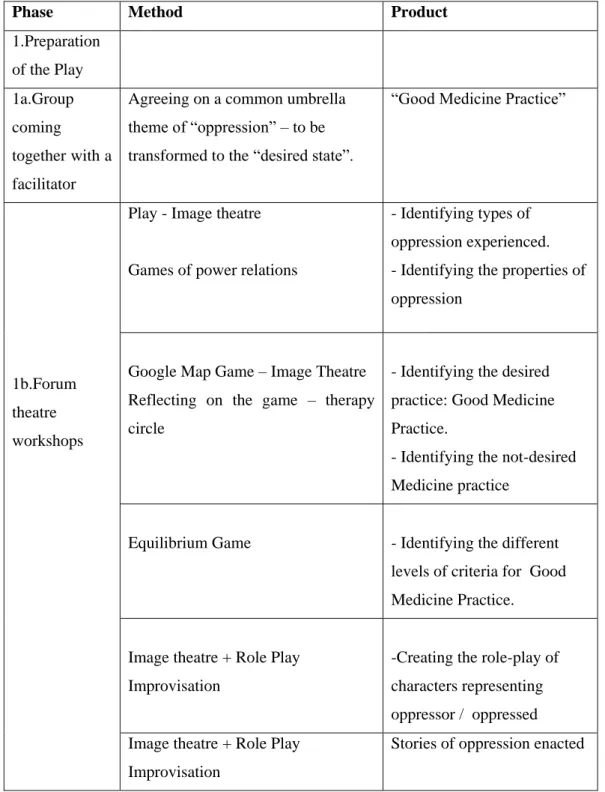
active members of the Theatre of the Oppressed Turkey. I describe my experience of the Theatre of the Oppressed workshops I had, and my meeting with the group of doctors to start a forum theatre with the concern of preserving the good medicine practice under the pressure of current health policies. I give an overview of the health system, confined with the content of the doctors’ forum theatre practice. The conferences I have joined at the Istanbul Chamber of Medicine and my interviews both with the participants and with the active members of Istanbul Chamber of Medicine provide the research with a complementary set of data regarding the health system transformation. I illustrate the theatre workshops with the doctors in detail as this work compose the main body of work for the participants to construct the play, which is designed for non-actors constructing the play without having “the expertise of dramaturgy”. All stages of the forum theatre fieldwork are illustrated with the research data generated in relation to the strategies for the “preservation of the good medicine practice” and the emerging “participatory communication processes” through the selected excerpts from the workshop, play and interview transcripts.
In the fifth chapter, I discuss the case of Istanbul Chamber of Medicine forum theatre as a platform to facilitate participation to come up with the strategies to preserve the “good medicine practice”, coming up with a model that reflects the dynamics of its participatory processes. I examine the interviews conducted by the actors and the spect-actors of the play, and reflect on my observations and experiences throughout this process. I analyse the functions of play, role-play and improvisation in self-reflection and the image work that led to character building and scenes in the workshops. I explore these components in terms of the different kinds of data and experience they provide. The analysis focuses on the double role of providing the process and the space creating potential to “empower” communities and providing space.
In the conclusion, I evaluate the whole research process, and propose a relational map that shows the participatory process forum theatre triggers for its
9
participants. Exploring this model, I propose a new approach in the study of community media including “forum theatre” as a participatory space, drawing from Rodriguez in her quest for the “new direction for the debate on democratisation of communication and the need to find new conceptual framework to how democratic communication happens within alternative media.” (2001, p.18)
I wish for this exploration of the communication space forum theatre opens in terms of dialogue and transformation to be beneficial for future communication fieldwork. This thesis also aims to draw attention to the fact that there is a need for “the culture of participation” to foster in a community/ country in order for social dialogue mechanisms to be established for the benefit of the people. The model I suggest for analysis of participation in forum theatre can later be adapted to any type of participatory community work. I also hope for my thesis to be a contribution to the participatory action research practice in Turkey, which is also limited. The below discussion on participation forms the basis of my research.
10 CHAPTER ONE
PARTICIPATION, COMMUNITY BUILDING AND PARTICIPATORY THEATRE
This chapter covers three distinct domains of theory and research in informing the framework of participatory communication in this research: participation (Carpentier 2011, 2016, Mouffe 2004), participatory theatre (Boal 1985, 2004, Freire 1973) and community/citizen’s media (Carpentier 2016, Rodriguez 2011). I propose that the participatory processes and methods of forum theatre and their influence on its participants can be understood in reference to the multiple axes of participation in relation to its politics and process orientation. The study of participation as a process rather than an end product is important to take into account in exploring the forum theatre as a participatory communication space. As the process starts with the action and transforms its participants during this process, there is a two-way participation: Participation as both a method and an outcome of the participatory process. In this respect community theatre and community media share the common ground of being a vehicle for transformation for the participants involved, that involves the strengthening of the “sense of community”.
“Participation” is a concept widely used with a big sphere of influence with reference to its political structure, hence difficult to draw borders around. As the definition of participation seem to vary among the social studies that have participation in the foreground, it is important to identify the different axes involved in the study of participation, as I attempt to do in this chapter.
11
1.1. DIFFERENT AXES OF PARTICIPATORY COMMUNICATION
“Participatory Communication” as a definition is accompanied by various debates on the means and aims; about the scale, being individualistic or collective, mediated or interpersonal. It is possible to identify common approaches in these definitions as Thomas L. Jacobson1 (2016) suggests in Paulo Freire’s emphasis on dialogical nature of participation and social solidarity. This approach calls for a perception of “reality as a process and a transformation” (Freire 1970) and is far from the linear model of message transmission of mass media to end-receivers. (Dunn 2009)
The task of identifying the participatory communication process in forum theatre calls for an exploration of this process with its different axes. The
intersection of these three domains; forum theatre, community/citizen’s media and participation, provides the framework for understanding this process in relation to the different scales and qualities of participation. I, first, explore the concept of “participation” in relation to Nico Carpentier’s political theory approach that also draws from Chantal Mouffe who critically analyses the socio-political dynamics and power relations in play. This perspective also call for an evaluation of different levels of participation ranging from “minimum” to “maximum” or “empty” to “full”. Although this is not an easily quantifiable scale, Sherry Arnstein’s ladder of participation is an important reference to critically assess the “participatory processes” taken for granted in social relations. Arnstein warns us of the “empty participation” practices that can be manipulative and benefit the powerful “actors” in a community on the ladder of hierarchy.
Another framework for exploring the participatory communication involved in forum theatre is the community/ citizens’ media theories and practices. I focus on the function of participation involved in community media that carries similarities with forum theatre- the process of becoming “a community” around
1 Past-president of the Participatory Communication Research Section of the
12
shared oppression/ pressure points, “strengthening the ties of belonging to a community”. I will illustrate an overview of the evolution of the terminologies ranging from “alternative media” to “self-managed media” in relation to the discussions of “interaction” and “access” components of participation, followed by Clemencia Rodriguez’s “citizen media”2 approach that focuses on the “horizontal communication and dialogue” among various stakeholders.
In many social fields, participation remains structurally undertheorized. Carpentier (2011) draws attention to the politics and power relations in play any time “participation” is at stake. “Democratic theory” has a lot to offer to describe the key characteristics of participation, and to increase the concept’s theoretical foundation. Carpentier defines the key element of participation as “power” - “the distribution of power within society”. He refers to the struggles about the distribution of power in society in fields such as media, the arts, development, and the attempts to make that distribution equal, when he describes what participation is about (2011). An analysis of these fields shows that the perception of participation as a “deep social construction” and “people’s desire to gain some degree of control” over the processes in which they find themselves, which is directly related to the political decision making mechanisms in the macro level. This is why an empty use of the term “participation” (Arnstein,1969) does more harm to people involved as “participants” in any kind of community work, leading to immobility of these communities in taking action.
Carpentier’s quote below is important to note that there is power dynamics in play starting from the relationship between two people:
Participation is seen as a political-ideological concept that is intrinsically linked to power… The balance between people’s inclusion in the implicit and explicit decision-making processes within these fields, and their
2 Clemencia Rodríguez coined the term citizens’ media in her book Fissures in the Mediascape,
“which emerged at the crossroads between Latin American communication and culture scholarship of the 1980s and 1990s and the proposal for a global New World Information and Communication Order (NWICO).”
13
exclusion through the delegation of power is central to discussions on participation in all fields… taking into consideration that at the same time power is an always-present characteristic of social relations. (2011, p.10)
Carpentier’s critical approach in evaluating the quality of participation is important as there is the tendency of perceiving participation as beneficial. The political theory reminds us that the concept of equality should be called to question as a defining criteria for participation. This would be “a situation where the actors involved in (formal or informal) decision-making processes are positioned towards each other through power relationships that are (to some extent) egalitarian” (Carpentier, Dahlgren, & Pasquali, 2014, p. 124). How individuals think about participation is directly influenced by the democratic practices a community experiences. This is where different levels of hierarchy is introduced in social life, which can be taken granted as part of the social system such as a community of people living in a country with high levels of authoritarian tendencies. In this kind of system, the level of participation people have over the decisions directly effecting their lives are in opposite correlation with the level of democracy they experience in the macro - state decision level. This discussion also exists in theorising of a democratic model of government, where the civil freedom is contrasted by tyranny. (Carpenter 2011, Machiavelli 1984, Held 1986, Strauss 1978)
Sherry Arnstein (1969) coins the term “empty participation” for any occasion where the participants are “participating in participation” in relation to the rhetoric of participation (Carpentier 2014) With her words: “There is a critical difference between going through empty ritual of participation and having the real power needed to affect the outcome of the process.” (Arnstein, 1969) When there is a claim in a social project that all sides were considered, it should be investigated who benefits at the end. Some of the development projects of 1970s are examples of this approach that will be mentioned in the second chapter. Arnstein mentions that the idea of citizen participation is celebrated as a value but when it comes to practice to include “the other”, “the disadvantaged” “the oppressed” such are the ethnic, ideological, political “have-nots” it is not as simple. She goes one step
14
further than unrevealing power relations to redistribution of power. Being sceptical of the terms “citizen involvement”, “self-help” and offering to look beyond the misleading rhetoric like absolute control, she calls for discussions of “feasible participation”, equating citizen participation to “citizen power”.
Table1.1. Arnstein Ladder of Citizen Participation (1969, p. 217)
Citizen control Degrees of citizen power
Delegated power Partnership
Placation Degrees of tokenism
Consultation Informing
Therapy No power
Manipulation
Arnstein’s conceptualisation of the “ladder of participation” that draws attention to the different levels of participation is a useful analogy to critically analyse the participation process in society, especially when social policies are said to be shaped around “citizen participation”. These categories are a simplification, however they still are useful analysing participation practices critically. The first two steps on this ladder of participation are “empty participation”. Arnstein calls these categories as the “manipulation” and “therapy”; they are the PR practices and the education or cure of participants by the power holders. Steps 3 and 4 are levels to give voice to participants through “informing” and “consultation”. There is no guarantee that their opinions will be taken into consideration. As the ladder goes up, the degree of participation seems to increase. In the 5th step called “palacation”, the participants advice but still not have control over decision making processes. 6the step is where the negotiation starts with the power holder. 7 is the delegated
15
power, 8th step is the citizens managerial control, which would be the ideal case for
participation. The fact that these groups may not be homogenous groups also add another layer for analysis.
Coming from a communication consultancy background, having worked with many different sectors for eight years, I have observed these different levels of “participation” discourse aiming at the stakeholders of companies or government agents. The moment participants are being presented with options to choose from, the discussion of minimalist and maximalist participation is relevant: “What level of participation is at stake?”, “How will this form of participation effect the participants lives in return”, “What is the benefit of the party that is providing the “options”, how do the results affect them?” These are all questions to be considered in discussions of participation.
1.2. CRITICAL APPROACH TO PARTICIPATION
In forum theatre, the community of people get together in search for the strategies to overcome their shared problems/ oppressions. The aim is to empower the individuals facing oppression on the way to collaborative action strategies. Thus exploring power relations in group dynamics is important. As Natalie Fenton mentions, “participation that leads to democratization, requires the real and material participation of the oppressed and excluded of the victims of the political system Participation in group dynamics brings forward questions about the individual’s needs versus the group’s needs. I find the answer as does Carpentier, in Melucci’s words that participation has a double meaning: “Promoting the needs of an actor as well as identifying with the general interests of the community” (1989, p.174). Here, the word “general interests” should be approached critically taking into accounts of rights of whichever group is the minority in number. Henry Jenkins (2014) identifies participation stating “when we see ourselves as part of a group that is seeking to achieve some shared goals through collective effort.” (p.104) This is a discussion topic for another research, so it will not be explored here in much detail
16
but very useful to keep it as a background concern. This is an important aspect when working with heterogenous communities with conflicting stakeholders, too.
Adopting micro level exploration of the participatory processes in a society is useful in a range of ways. The questioning or rather unquestioning tendency about people’s participation is reflected in micro levels in terms of social relationships. Carpentier suggests that what lies under the different approaches to participation is not an outcome but an “integrated part of this strugglebetween the minimalist and the maximalist variations of democracy”. (2012) While minimalist participation is characterised by the existence of strong power imbalances between the actors (without participation being completely annihilated or reduced to interaction or access), maximalist participation is characterized by the equalization of power relations, approximating Pateman’s (1970) concept of full participation. Although maximalist participation – seen as equalized power relations in decisionmaking – has proven to be very difficult to translate into social practice, it will continue to be a destination aimed at the agenda of participation research.
To explore power relations involved in oppression, democratic theory focuses on the hegemony over the individuals. When the political is linked to the acts of hegemonic institution, the tendency “to differentiate the social from the political” conceals the originary acts of the political institutions, and their reflections in social life are taken for granted. However it is always possible to challenge these perceptions and practices. Mouffe suggests that it is possible to take any of these “taken-for-grantedness of a social ordering and show its political nature.” (2005, p. 17). This investigative approach to the notions of democracy and participation is important to constantly evaluate the power structures on behalf of all the parties involved. Forum theatre also shares this investigative approach to evalute power structures embedded in different forms of oppression. Having a relatively homogenous group sharing the same social problems enables forum theatre practice to utilise “participation” without the clash of interests. It is usually the case, different groups of stakeholders -let alone the smallest social relationship where two people come together- would have an issue of conflicting benefits. The easy way to resolve the conflict would be to ignore the power dynamics underneath
17
the conflict, and go with the social “taken for grantedness” approach described above. Any attempt that claims to have a participatory approach would on the contrary need to make power dynamics visible through the search of negotations which sometimes would never be possible to settle.
Exploring how “participation” has been defined by communication scholars helps to choose between the different lenses to clarify the conceptual framework. This way, the discussion of participation in the field of communication goes beyond its main components of access and interaction.
1.3. PARTICIPATORY SPACE OF COMMUNICATION AND COMMUNITY BUILDING
For the purposes of this thesis, I draw on a new paradigm in media research that understands media as a process or “practice” as defined by Nick Couldry (2004, p. 115) where communication is not confined “to the media or to messages, but to their interaction in a network of social relationships. It is possible to argue that the term “community media” has become popular again with the expanding use of digital media. Here is another aspect of “participatory medium of communication” which is its relation with the “digital media” that needs to be referred in the discussions of participation.
When the interaction social media networks offer are taken for granted as “participatory” spaces of communication, it is important to take into account the limitations of this field when the use is limited to the closed circuit of personal networks. The participatory aspect of digital media is almost taken for granted in reference to its interactive technical capacities. With the increasing social use of digital media, the discourse around “digital communities” and “participation” is growing rapidly in the field of communication. Henry Jenkins coins the term “participatory turn” referring to the “long-standing discussions of “participation” in political theory” to be in rise in contemporary culture, in relation to the “rise of networked computing” as an encouragement for “reimagination of the public sphere.”
18
Henry Jenkins in Convergence Culture (2006, p. 305) defines participation in the digital sphere being critical of the equal inclusion claim. Jenkins refers “to the social and cultural interactions that occur around media” and he questions the impact of the “ expanding access to the means of media production” to “available political identities, tactics, and discourses” being sceptical about the “range of political options available to groups that have historically been disenfranchised from political elites and institutionalized politics.”
Carpentier distinguishes between the participatory processes in the media that has a potential to be mistaken with the kind of “participation” that promotes to uncover the power relations and the decision-making processes. I follow Carpentier’s approach that differentiates participation from “having access to media and interacting… which implies that “audience practices like watching television, surfing on the web, visiting a museum, talking to a neighbour, pressing the red button to initiate the interactive functions of digital television are perceived as necessarily participatory activities.” In this respect, the “participatory” identification we have of digital media today is overrated in terms of the effect of the interaction of users of various social media platforms.
Christian Fuchs in Social Media a Critical Introduction (2004) gives an overview of the “participation” concept in relation to the digital sphere and criticises the actors of the field. He criticisizes Jenkins, of ignoring the political and economic aspect of participatory media, and Carpentier of ignoring the socio-economic aspects of media ownership, although acknowledging him of having “a more advanced approach to participation grounded in political theory”. Similar criticism to “democracy” and “participation” theories could be find elsewehere, too. The hegemony of capital on the democracies left unseen in the discussions. (Zizek, 2000) The poster that French students made in 1968 has this message in a short but effective slogan: “I participate, you participate, they participate, we participate, you participate, they benefit” (Arnstein, p. 216) This is a compact slogan to remind us of the importance of questioning the power relations involved in “participation”.
As mentioned above, the process of participation has been widely discussed in the literaure of “alternative media production”. A wide range of these theories
19
focus on the relationship of medium with “radical politics”, “social empowement” or “critical citizenship”, as political scientist Pippa Norris has named. Downing’s theory of “radical media”, Clemencia Rodríguez’s “citizens’ media”, and Bob Hackett and William Carroll’s notion of “democratic media activism” are among addressiong these theoretical discussions. Community media literature also draw from Paulo Freire’s approach on participation, focusing on injustice acknowledging the impact of Freire’s theory on the domain of participatory communication: (Thomas, 1994, p.51)
Although Freire never really linked his analysis to the use of particular media, it is implicit in his writings that communication, in order to be effective, has to be participatory, dialogic and reciprocal. In fact, the entire enterprise of participatory communication projects, from the organization and production of community radio in Latin America, Australia, and parts of Africa and Asia, through the practices of popular theatre in countries like Brazil, Chile, Jamaica, South Africa, India, and the Philippines utilize[s] Freire’s perspective.
I find it useful to explore the practice of community media in relation to the theoretical framework that emerged in the 1960s and still evolving today through the inclusive definition of the term from “photography, film, graphic arts, theatre, radio, video” to digital platforms. Following the words of AMARC and Panos, the participatory space of communication in this research is “not about doing something for the community, but about the community doing something for itself, i.e., owning and controlling its own means of communication” (AMARC Africa and Panos Southern Africa, 1998). This approach puts the emphasis on the process as well as the end product. As Clemencia Rodriguez (2001) proposes, the focus is not on the use of “communication technology” but “media practice understood in performative sense, where individuals and groups use media to experience the world as they construct it for themselves.” (2011, p24)
Community media studies have stemmed from the efforts towards democratisation of media. In a sense it is a rebellious act against the commercial
20
media and the economic and political structures it imposes. (Algül, 2006) Rennie (2006) argues that that the community media should be seen as a cultural instrument of civil society to preserve itself. With its roots in communication for development, it has been tried to get institutionalised with efforts such as UNESCO’s commission for communication in 19763 with the aim of exploring the inequality of information flow between the first and third world. The McBride report that came out of this commission has identified “access”, “participation” and “self-governance” as the indicators of democratic media. (Rennie, 2006)
Drawing from Chantal Mouffe’s theories of radical democracy and citizenship, Clemencia Rodríguez developed her citizen’s media theory to understand the role of community/alternative media in society. She proposed “citizens’ media” as a term better able to capture processes of social change and democratization facilitated by community media. Rodriguez draws attention to the function of this type of media as going beyond the journalistic needs with “a focus on the communication needs and daily realities of the people in their communities.” Clemencia Rodríguez (2001, p.20) also proposes to avoid dichotomies such as ‘mainstream’ and ‘alternative’ and instead see such media as involved in cultural politics and working to empower communities through actively “intervening and transforming the established mediascape”. This approach defines communication on the basis of their potential to trigger processes of social change, which also have common ground with participatory action research approach as well as forum theatre. With her words: “Referring to "citizens' media" implies first that a collectivity is enacting its citizenship by actively intervening and transforming the established mediascape; second, that these media are contesting social codes, legitimized identities, and institutionalized social relations; and third, that these communication practices are empowering the community involved, to the point where these transformations and changes are possible.” (2001, p.33)
3 In 1984, US have moved out of the UNESCO commission for communication, and
21
Carpentier identifies four main theoretical paradigms that also show that these definitions have large intersection areas, two key aspects being “access” and “participation.” (Carpentier, 2007; Howley, 2010):
(1) Community media, where the importance to community is
emphasised in its purpose to serve community, ensuring community participation and access, inspiring empowerment and fostering local expression (being close to Rodriguez’s definition of citizen’s media.)
(2) Alternative media as proposing alternative discourses which can be positioned in opposition to maimstream media
(3) Civil society media where the socio-political aspect is
reinforced and the role of media as a means for facilitating participation and self-representation in the public sphere (Carpentier, 2007, p.117)
(4) Rhizomatic media as a radical version of alternative and
civil society media, by insisting on the qualities of “elusiveness and contingency” and their “interconnectedness with market and state”.
(Idem, p. 118)
Carpentier also suggests not to get fixed on the labels attributed to community media and isolate related frameworks, but instead utilise them towards a deeper understanding of community media practices and theories. At the same time acknowledging the practices as always being in specific equilibria between the four approaches. (Carpentier, 2016) The “horizontally structured” position of alternative media, “allowing for the facilitation of audience access and
participation within the frame of democratization and multiplicity; carrying the “non-dominant”, (possibly counter-hegemonic) discourses and representations, stressing the importance of self-representation” is important to make note of as well as the non-linear approach of rhizomatic media.As ‘unlike trees or their roots, the rhizome connects any point to any other point …’ (Deleuze and Guattari, 1987, p. 19). The rhizomatic media using Deleuze and Guattri’s (1987) metaphor being the most suitable to describe the “non-linear, nomadic and
22
anarchic” fluidity of the social movements and civil society networks that community media is part of, thus shifting the focus to the “non-media” aspect.
Rodriguez (2001) also explores how citizens, especially poor citizens, act mostly on their own to build peace in place of violence through media. Rodríguez argues that a relocation of the debate on democratization of communication should go beyond “a mere reaccommodation of the same old concepts to a local scale. The new direction for a debate on the democratization of communication should imply finding a new conceptual framework that can capture how democratic communication happens within alternative media”. This involves working towards understanding the needs of these communities and to use media towards this aim, as tools “foster horizontal communication and interaction, dialogue between citizens and local governments, networking, and endless opportunities to resignify life worlds.” (Rodriguez, 2001, p. 233)
The new technologies in audio-visual recording and the digital media has also expanded the reach on the relationship between participation and
communication. The possibilities for interaction the digital sphere has been celebrated to an extent that “medium became the message” (McLuhan) again. Thus it is important to look for a “thick description” of the communication processes involving the people composing the “community” involved in this type of media-socio-economic-political relations realm.
Leunissen (1986) offers to put the structuring notions of the collective identity or the group relations that refer to geography and ethnicity. These structural conceptualisations are put firstly into perspective by introducing the concept of the ‘community of interest’, which extends community “across conurbations, nations and continents” (Lewis, 1993, p.13). A second type of re-conceptualisation is based upon the emphasis of the symbolic construction of community, where Lindlof’s (1988) concept of ‘interpretative community’ and Cohen’s (1989) ‘community of meaning’ are relevant. Cohen for instance pleads for “a shift away from the structure of community towards a symbolic construction of community and in order to do so, takes culture, rather than structure as point of departure” (Cohen, 1989, p. 70). The focus for the defining feature for ‘community’ is on the “direct and
23
frequent contact between the members and the feeling of ‘belonging’ and ‘sharing’”. (Carpentier, Lie, & Servaes, 2008, p. 349) It is important to take into account these meanings of “community” in order to assess the need for the type of community media. The relationship between communication and the actual community transcends ‘ordinary’ oneway communication, where “topics are chosen in the same way, by professional communicators, and targeted towards the apparent needs and interests of the audience” (Berrigan, 1979, p. 7). As illustrated in AMARC’s (World Association of Radio Broadcasters) working definition (especially by the segment stating that Community Media should be “promoting the participation of this community”), relationships between broadcaster and community are defined by the concept of two-way communication. (Carpentier, Lie, Servaes, 2008, p. 350)
In this regard, access by the community and participation of the community are considered key defining factors. Referring to the 1977 meeting in Belgrade, Berrigan (1979, p.18) (partially) links access to the reception of information, education, and entertainment considered relevant by/for the community. Others limit access to mass media and see it as “the processes that permit users to provide relatively open and unedited input to the mass media” (Lewis, 1993, p. 12). Participation is seen here, following Pateman (1972, p71), as a process where the individual members (of a community) have a certain degree of power to influence or determine the outcome of that process.
The applications of this type of communication also changes according to the level of democracy experienced,. Bill Siemering in his work with community media in Africa and Mongolia, found that peacebuilding organizations tend to perceive community media as “loudspeakers for public service announcements” (Siemering 2008). He criticizes these producers with their “understanding of communication technologies to be tools of persuasion and one-way dissemination of information” Instead he offers to rethink the functions of media in terms of communities’ communication and information needs saying:
Instead of conceiving of a medium exclusively as a tool for information or persuasion, we need to uncover and consider each of the varied
24
communication needs of a community cornered by armed violence, and how a community medium can meet those needs.
The communication processes of forum theatre trigger “the performative abilities through which human groups improvise fresh beginnings” (Richards 1992, p. 5). Performance theorists explain that during certain type of performances, a sense of “communitas” emerges among participants (Bell 2008; E. Turner 2005; V. Turner 1988). Edith Turner describes “communitas” as “a sense of sharing an intimacy . . . the gift of togetherness . . . unity, seamless unity” (E. Turner 2005, p. 97–98). Madison describes it as “a moment of utopian unity [where] individual identities come together in a direct and immediate manner” (Madison 2005, p. 159). Performances that provoke “communitas” galvanize collectivity and diminish individuality. The experience of being part of a group, being a “we” intensifies and overwhelms the sense of being an “I.”
Based on Victor Turner’s anthropological work on performance, Richard Schechner defines “spontaneous communitas” as “the dissolution of boundaries shutting people off from each other” (Schechner 2003, p.156). During these exceptional moments when a gathering of people experience “communitas” triggered by performance, the groups’ rules and everyday life codes are suspended, and the group experiences a moment when “everything and anything” can happen (Bell 2008). New rules, new ways to do things can emerge, as performance triggers a moment of “unprecedented potency” (Matthews 2008, p.177). In this sense, performance is spontaneous, unscripted, a sudden empty space of freedom to start new beginnings, to figure out, collectively, new ways to respond to the surrounding conditions.
The community media practice evolved with the need that emerged with the social movements of the time. Just like community theatre, its roots goes back to 1940s, when mainstream practices did not fulfill the need for democratization of communication; the views of the disadvantaged groups were not represented. Different geographies had different practices that emerged with the socio political needs. An example of alternative media in the 1940s is the radio station of the mine
25
workers in Bolivia founded during the workers’ protests. In South America the community media took on the role of the public service. The examples evolved with popular radio, miners radio, peasants radio. In Africa there is a mention of local radio, neighbourhood radio or community radio. (Servaes, 1999, p.259).
As Deirdre Boyle mentions in the late 1960s and early 1970s, video enthusiasts rallied around the notion that community television was an exceptional vehicle to promote the social, political, and cultural change sought by artists and activists, students and futurists and other groups associated of the counter culture. (Boyle, 1997)
Combining the theoretical approach of Rodriguez and Carpentier, I suggest to explore forum theatre as a space of participatory communication in terms of its processes and potentials. This form of communication, starts an action, that would not exist without this interference with the community. There is an all encompassing term – poetics of media (Salazar and Cordova 2008) in which “citizenships” are created and enacted through everyday media/meaning making. (Salazar, 2009)
1.4. PARTICIPATORY THEATRE
The historical roots of participatory approach to theatre takes community in the center and uses theatrical tools to investigate social issues towards the aim of collaborative solutions to shared problems. This section positions Augusto Boal’s Theatre of the Opressed within other participatory/ community theatre forms and approaches to social change. I use the term “community theatre” as a reference to all kinds of theatre where “the purpose is not to create art, but rather to use an artistic or expressive medium, theatre, to investigate problems” and social issues. As Baz Kershaw states this is a “slippery genre” where the “starting point is the nature of the audience and its community.” (Kershaw, 1992, p.5) In this respect, “There is a grounding of the theatrical process in a community's interests; it does not mean that it is intended for a general public, rather it is for a specific public with specific goals.” The terminology is also used interchangeably as “popular theatre”,
26
“intervention theatre”, “radical theatre”, “theatre for social change” associated with a transformation of social reality by using community and individual participation.
The philosophy and principles of popular theatre are closely aligned with Paulo Freire's principles of education where "exchange, participant ownership, reflection and action" (Prentki & Selman, p. 8) are central. Working with groups who have limited resources for self-expression, community theatre is a multi-purposeful communication tool. It is also a catalyst for group communication. I suggest that “community theatre” itself can be used as a method for participatory action research to define the problems of a community in collaboration with the members of the community, whereas social researches conducted with the agenda of improvement for a community, assert ways for development from above and outside the community. These concerns will be explored in detail in chapter 3.
The evolution of theatre terminology is difficult to track down for various reasons explained below. In order to understand how the community theatre has evolved throughout history, it is important to examine the parallel theatre histories in different geographies. Academic research on community theatre mostly covers co-creation techniques as a method for “educational” topics that focus on the “positive transformation” of the participants. Experimenting with forms of staging and actor-audience relationships has a long history that goes back to the 1500s’ tradition of commedia dell'arte. The changes in the form went hand in hand with the content and the targeted audience profile changed to include the “non-theatre audiences” (of workers, farmers...). Community theatre grew out of commitment to a community. Unlike earlier practices of political theatre they can be argued to have a weaker motive for a revolution. The political differences relate to “competing definitions of “community” which may encompass one or several regional, racial or ethnic groups, but usually involve excluding some groups as outsiders.” (Kershaw, 1992)
Use of drama in conflict resolution and conflict transformation have also been explored by variety of scholars. As Joan B Kroc (Institute for International Peace Studies at the University of Notre Dame) mentions “Drama has the potential