İSTANBUL BİLGİ UNIVERSITY
EUROPEAN INSTITUTE
JEAN MONNET CENTRE OF EXCELLENCE
THE STATE OF THE ART ON RADICALISATION:
ISLAMIST AND NATIVIST RADICALISATION IN EUROPE
AYHAN KAYA
WORKING PAPER No: 12
EU/04/2020
EUROPEAN INSTITUTE
JEAN MONNET CENTRE OF EXCELLENCE
STATE OF THE ART ON RADICALISATION:
ISLAMIST AND NATIVIST RADICALISATION IN EUROPE
Ayhan Kaya
Principal Investigator, ERC AdG PRIME Youth Project
European Institute, and the Department of International Relations
İstanbul Bilgi University
Working Paper No: 12
April 2020
DOI: 10.5281/zenodo.3773199
The research for this Working Paper was undertaken as part of a Horizon 2020 research and innovation project called ISLAM-OPHOB-ISM under Grant Agreement ERC AdG 785934.
İstanbul Bilgi University, European Institute, Santral Campus, Kazım Karabekir Cad. No: 2/13
34060 Eyüpsultan / İstanbul, Turkey Phone: +90 212 311 52 60
PREFACE
Radicalism, extremism, terrorism, fundamentalism and violence have recently been interchangeably used by many in academia, media and politics. These terms used to be perceived and defined very differently prior to the 1990s when tremendous political, societal and demographic changes took place all around the world. Focusing on the radicalisation processes of both nativist and Islamist youngsters in Europe, this Working Paper scrutinises the differences between these terms by revisiting the ways they were used in the past. In doing so, the paper tries to reveal the neo-liberal logic of modern state actors in reducing radicalisation to terrorism and extremism. This paper derives from the ongoing EU-funded research for the “PRIME Youth” project conducted under the supervision of the Principal Investigator, Prof. Dr. Ayhan Kaya, and funded by the European Research Council with the Agreement Number 785934.
AYHAN KAYA
Jean Monnet Chair of European Politics of Interculturalism Director, European Institute İstanbul Bilgi University
HORIZON 2020 ERC AdG
“Nativism, Islamophobism and Islamism in the Age of Populism: Culturalisation and
Religionisation of what is Social, Economic and Political in Europe”
This project has received funding from the European Research Council (ERC) under the European Union’s Horizon 2020 research and innovation programme grant agreement no. 785934.
About the ERC Advanced Grant Project: PRIME Youth
This research analyses the current political, social, and economic context of the European Union, which is confronted by two substantial crises, namely the global financial crisis and the refugee crisis. These crises have led to the escalation of fear and prejudice among the youth who are specifically vulnerable to discourses that culturalise and stigmatize the “other”. Young people between the ages of 18 to 30, whether native or immigrant-origin, have similar responses to globalization-rooted threats such as deindustrialization, isolation, denial, humiliation, precariousness, insecurity, and anomia. These responses tend to be essentialised in the face of current socio-economic, political and psychological disadvantages. While a number of indigenous young groups are shifting to right-wing populism, a number of Muslim youths are shifting towards Islamic radicalism. The common denominator of these groups is that they are both downwardly mobile and inclined towards radicalization. Hence, this project aims to scrutinize social, economic, political and psychological sources of the processes of radicalization among native European youth and Muslim-origin youth with migration background, who are both inclined to express their discontent through ethnicity, culture, religion, heritage, homogeneity, authenticity, past, gender and patriarchy. This project has received funding from the European Research Council (ERC) under the European Union’s Horizon 2020 research and innovation programme grant agreement no. 785934.
For more information, please visit the project Website: https://bpy.bilgi.edu.tr
@BilgiERC @BilgiERC
The ERC in a Nutshell
The European Research Council, set up by the EU in 2007, is the premiere European funding organisation for excellent frontier research. Every year, it selects and funds the very best, creative researchers of any nationality and age, to run projects based in Europe. The ERC offers four core grant schemes: Starting, Consolidator, Advanced and Synergy Grants. With its additional Proof of Concept grant scheme, the ERC helps grantees to bridge the gap between grantees’ pioneering research and early phases of its commercialisation.
Biography
Ayhan Kaya, Professor of Political Science
Ayhan Kaya is Professor of Politics and Jean Monnet Chair of European Politics of Interculturalism at the Department of International Relations, İstanbul Bilgi University; Director of the Jean Monnet Centre of Excellence; and a member of the Science Academy, Turkey. He is currently European Research Council Advanced Grantee (ERC AdG, 2019-2024). He received his PhD and MA degrees at the University of Warwick, England. Kaya was previously a Jean Monnet Fellow at the European University Institute, Robert Schuman Centre for Advanced Studies, Florence, Italy, and adjunct lecturer at the New York University, Florence in 2016-2017. He previously worked and taught at the European University Viadrina as Aziz Nesin Chair in 2013, and at Malmö University, Sweden as the Willy Brandt Chair in 2011. He is specialised on European identities, Euro-Turks in Germany, France, Belgium and the Netherlands, Circassian diaspora in Turkey, the construction and articulation of modern transnational identities, refugees in Turkey, conventional and nonconventional forms of political participation in Turkey, and the rise of populist movements and radicalisation in the EU. His recent manuscript is Populism and Heritage
in Europe. Lost in Diversity and Unity (London: Routledge, 2019). His recent edited volume is Memory in
European Populism (London: Routledge, 2019, with Chiara de Cesari). Some of his books are Turkish
Origin Migrants and their Descendants: Hyphenated Identities in Transnational Space (Palgrave, 2018),
Europeanization and Tolerance in Turkey (London: Palgrave, 2013); Islam, Migration and Integration: The
Age of Securitization (London: Palgrave, 2012); Contemporary Migrations in Turkey: Integration or Return (İstanbul Bilgi University Press, 2015, in Turkish, co-edited with Murat Erdoğan), Belgian-Turks, Brussels: King Baudouin Foundation, 2008, co-written with Ferhat Kentel), Euro-Turks: A Bridge or a Breach
between Turkey and the EU (Brussels: CEPS Publications, 2005, co-written with Ferhat Kentel, Turkish version by Bilgi University); wrote another book titled Sicher in Kreuzberg: Constructing Diasporas, published in two languages, English (Bielefeld: Transkript verlag, 2001) and Turkish (İstanbul: Büke Yayınları, 2000). He also translated Ethnic Groups and Boundaries by Fredrik Barth and Citizenship and
Social Classes by T. H. Marshall and Tom Bottomore to Turkish language. He also edited several books on migration, integration, citizenship, and diasporas. Kaya’s publications have been translated to several languages such as French, German, Japanese, Italian, Arabic and Dutch. Kaya was actively involved in two FP7 and three Horizon 2020 projects, and now he is involved in two different Horizon 2020 research projects on migration. Kaya received Turkish Social Science Association Prize in 2003; Turkish Academy of Sciences (TÜBA-GEBİP) Prize in 2005; Sedat Simavi Research Prize in 2005; Euroactiv-Turkey European Prize in 2008, the Prize for the best Text Book given by TÜBA; and also the Prize for excellence in teaching at the Department of International Relations, İstanbul Bilgi University in 2013 and 2017.
E-mail: [email protected] ERC Project: https://bpy.bilgi.edu.tr
Academia.edu: https://bilgi.academia.edu/AyhanKaya
Orcid: https://orcid.org/0000-0003-4431-3220
Researchgate: Ayhan_Kaya3
Twitter: @AyhanKaya14
The State of the Art on Radicalisation:
Islamist and Nativist Radicalisation in Europe
Ayhan Kaya
Principal Investigator, ERC AdG PRIME Youth Project
European Institute, and the Department of International Relations,
İstanbul Bilgi University
Table of Contents
Introduction ... 3
The Global Context: The Rise of Violent Extremism in all Fronts ... 4
History of the term Radicalisation: What makes the difference between extremism and radicalism ... 5
Psychological Elements in Radicalisation ... 8
Problematic aspects of the notion of ‘radicalisation’ ... 10
Neo-liberal forms of governmentality: From Welfarism to Prudentialism ... 11
Islamic Radicalisation: The revival of honour as a response to global injustice ... 13
Nativist Radicalisation: The revival of populist nativism as a response to neo-liberal governance... 16
Changing Institutional Definitions of Radicalism since the 1970s... 21
Conclusion ... 24
Acknowledgements ... 25
The State of the Art on Radicalisation:
Islamist and Nativist Radicalisation in Europe
1Ayhan Kaya
Principal Investigator, ERC AdG PRIME Youth Project, European Institute, and the Department of International Relations, İstanbul Bilgi University, [email protected]
Introduction
There are two terms extremism and radicalism, which are nowadays often being interchangeably used in everyday life as well as in the scientific literature (Moskalenko and McCauley, 2009). This is not a surprise in an age dominated by the populist Zeitgeist (Mudde, 2004) in which a dualist understanding prevails over in conceptualizing and understanding social, economic and political phenomena. Scientific thinking is not also free from this myopic and reductionist inclination. Recent evidence suggests that, beyond the realm of scientific investigations, policymakers, journalists and the general public also use these terms quite flexibly and interchangeably to label various social and psychological phenomena. For instance, research suggests that individuals tend to attribute psychological pathologies to perpetrators of violent actions to deny them any similarity with themselves and protect their distinctiveness (Noor et al., 2019). Such processes may explain the popularity of the term ‘radicalisation’ to designate terrorists (i.e. ‘radicalised’ individuals) in the public sphere, thereby emphasizing a hypothesized psychopathological root to their political action (Mandel, 2009).
The term ‘radical’ comes from the Latin word of radix (root), and radicalisation literally means the process of ‘going back to the roots’. It refers to roots – of plants, or words, or numbers. By extension from botanical, etymological, and mathematical usages, early modern thinkers described radical when they went to foundations, fundaments, first principles, or what was essential (Calhoun, 2011). Indeed, according to a strict interpretation of radicalisation, a person strictly following a traditional recipe for cooking without adding new ingredients could be considered a ‘food radical’. The mainstream definition of radicalism, such as the one given in the Oxford dictionary, sees it as “the beliefs or actions of people who advocate thorough or complete political or social reform.”2 The term ‘radical’ was already in use in the 18th century,
and it is often linked to the Enlightenment and the French and American revolutions of that period. The term became widespread in the 19th century only, when it often referred to a political agenda advocating
thorough social and political reform (Maskaliūnaitė, 2015: 13). ‘Radical’ also stood for representing, or supporting an extreme section of a party (Schmid, 2013).
The term ‘radicalisation’ has been in circulation for centuries. Today, it is only coupled with Islamist aspirations of any kind such as with Salafism, Wahhabism, ISIS, Al Qaida and Boko Haram. Mainly, the negative connotations of the term are being highlighted. However, one could see other connotations of the term in the past. The radicals of the 19th century were the democrats, socialists and liberals who
waged war against royal and imperial powers. The radicals of the 1968 generation were the youngsters who challenged the patriarchal structures of modern societies. In this work, the term ‘radicalisation’ will be discussed as a process that appears as a defensive response of various individuals suffering from social, economic and political forms of exclusion, subordination, alienation and isolation. In this regard, the work in progress challenges the mainstream understanding of radicalisation. In doing so, the paper
1 This paper was prepared in the scope of the ongoing EU-funded research for the “PRIME Youth” project funded by the
European Research Council with the Agreement Number 785934 (ERC AdG, Islam-ophob-ism).
will concentrate on the elaboration of radicalisation processes of Islamic youth and native youth residing in Europe. The main reason behind the selection of these two groups is the assumption that both groups are co-radicalising each other in the contemporary world that is defined by the ascendance of a civilizational political discourse since the war in the Balkans in the 1990s. We assume that the main drivers of the radicalisation processes of these two groups cannot be explicated through the reproduction of civilizational, cultural, and religious differences. Instead, the drivers of radicalisation in both groups are very identical as they are both socio-economically, politically and psychologically deprived of certain elements constrained by the flows of globalization and dominant forms of neo-liberal governance. This work is the state of the art on radicalisation, and it is an interdisciplinary review of the works from psychology, sociology, anthropology and politics.
The current work is an attempt to analyse the diverse meanings of radicalisation to de-construct the mainstream function of the term. After providing a brief historical analysis of different meanings of ‘radicalisation’ through time, the implications and possible functions of our modern understanding of the term will be highlighted. Before proceeding to this analytical part, one needs to understand the current global context in which different kinds of radicalisation processes take place on various fronts. Following the description of the global context, the paper will describe and clarify the semantic differences between
radicalisation and extremism. The elaboration of the two terms will be followed by the explanation of psychological elements in radicalisation as well as the problematic aspects of the term radicalisation. Following the elaboration of different aspects of the processes of radicalisation, the paper will deliberate the neo-liberal forms of governmentality, which are likely to prepare the ground for socio-economically and politically deprived groups to radicalise. The paper will then discuss in detail the radicalisation processes of young Muslims and young natives in the European context where both groups are likely to radicalise for similar socio-economic and psychological matters resulting from the flows of globalization leading to deindustrialization, unemployment, poverty, exclusion, alienation and isolation. The last section of the paper will shortly elaborate the ways in which some international institutions such as the EU, UN, Council of Europe and the Organization of Security and Cooperation in Europe have historically defined the radicalism.
The Global Context: The Rise of Violent Extremism in all Fronts
Politically-motivated violence designates the use of violent means to achieve political objectives. From state terrorism (e.g., the Iranian backed Hezbollah attacks in the 80’s Lebanon) to armed struggle performed by political organizations (e.g., PKK fighters in Turkey), or even display of violence during protests perpetrated by small factions (e.g., Anarchist ‘Black Blocks’ during protests in France), political violence is widespread across cultures and ideologies. To this day, political violence remains a key challenge to governments and state agencies. More specifically, one can identify two main issues that are relevant to policy makers, but still, constitute a theoretical puzzle to social scientists. These are, namely, issues pertaining to the increasingly endogenous nature of terrorist threats such as ‘homegrown terrorism’, and to the parallel rise of antagonistic, violent political factions, literally feeding on each other’s actions as in intergroup co-radicalisation processes, such as between Islamist groups and far-right ones. The neo-liberal age appears to be leading to the Nativisation of Radicalism among some groups of disenchanted native populations while leading to the Islamization of Radicalism among segments of disenchanted migrant-origin populations (Kaya, 2019). The common denominator of these groups is that they are downwardly mobile and inclined towards radicalisation. Existing studies report findings that place the two groups into separate ethno-cultural and religious categories (Keppel, 2017; Roy, 2017). Some social groups belonging to the majority nations are more inclined to express their unhappiness at insecurity and social-economic deprivation through the language of Islamophobia. Several decades ago, Seymour Martin Lipset (1960) stated that social-political discontent is likely to lead people to anti-Semitism, xenophobia, racism, regionalism, supernationalism, fascism, and anti-cosmopolitanism. If Lipset’s timely intervention in the 1950s is transposed to the contemporary age, it could be argued that Islamophobia has become one of the paths followed by the socio-economically and politically dismayed.
An Islamophobic discourse has resonated loudly in the last two decades following 9/11, and its proponents have been heard by both local and international communities. However, their concern has not necessarily resulted from matters related to Muslims. In other words, Muslims have become the most popular scapegoats in many parts of the world, for any troublesome situation. For almost two decades, Muslim-origin migrants and their descendants have been perceived by some sections of the European public as a financial burden, and virtually never an opportunity, for member states. Muslim-origin immigrants tend to be negatively associated with, among many other issues, illegality, crime, violence, drug abuse, radicalism, fundamentalism, and conflict (Kaya, 2015). Islamophobia has certainly become a discursive tactic widely exploited by right-wing populist parties, social movements, and in particular, far-right groups in parts of Europe affected by the financial and refugee crises.
History of the term Radicalisation: What makes the difference between extremism and radicalism
Both extremism and radicalisation have been the focus of extensive research among social sciences in the past decades. A quick google scholar search in January 2020 indicates that there are 282,000 referenced works on extremism and more than 84,000 on radicalisation. Thus, it may be helpful to clarify what is meant by radicalisation and extremism to get a sense of what these concepts respectively cover. First and foremost, most research on terrorism and political violence point to a major aspect of
radicalisation being a process while extremism is theorized as a psychological and ideological state (Kruglanski et al., 2019). One distinction between the two terms, thus pertains to their reference to dynamic or static phenomena. Also, a second emphasis regards causal associations between the two terms. Extremism refers to the extent of one’s beliefs regarding political and ideological matters (including religiosity), while radicalisation is related to the mechanisms that produce, or are caused by extreme beliefs (van den Bos, 2018).
It is generally accepted that extremism is underlined by a host of symptomatic cognitive processes. Accordingly, empirical research points at extremists’ tendencies to dichotomize the world into simple black-and-white Manichean narratives, to oversimplify complex social issues and to display cognitive and moral rigidity in reasoning (van Prooijen and Krouwel, 2015; Baez et al., 2017; Zmigrod et al., 2019). Extremism is also characterized by a sense of moral superiority stemming from the certainty that one holds absolute truth-views over the issues at stake. Thus, extremism can often lead to aggressive and authoritarian responses in the face of contradiction, precisely because extremists think they have a ‘monopoly on truth’ which morally license them to enforce it on others (whose perceptions are, by definition, erroneous; Sabucedo et al., 2018). Here one could see that extremism, as a mindset, can easily be defined, quantified and operationalized across different contexts given that it pertains to attitude or belief-extremity. By contrast, the process of radicalisation is much more dynamic, and thus more likely to be subjected to political use and deformations.
In fact, defining radicalisation has been problematic within social sciences, and especially in psychology (Schmid, 2013). Indeed, while extremity regarding a ‘standard’ belief of reference can be, in principle, assessed using similar measures; the notion of radicalisation itself is influenced by diverse historical, social, political and economic factors that lead to complex conceptualizations. Radicalisation implies direct support or enactment of radical behaviour and therefore begs the question: how does one define radical behaviour? As social sciences have grown ever more interest in understanding and explaining contextual and societal nuances cross-culturally, what appears to be radical or core truth becomes very difficult to answer.
The term radicalisation has a history that spans over more than two centuries hence it went through fluctuations in its meaning over time. According to Bötticher (2017), the term radicalism was first used in medical science, and it was moved into the realm of politics to designate post-glorious revolution progressives in England in the 18th century. It then reached France at the end of the 18th century, referring
term ‘radical’ in their names. The term was later used in Germany in the 19th century with still the same
meaning. In fact, radicalism was at that time a political marker for liberals and left-wing politicians inspired by the philosophy of the Enlightenment and supporting progressive social policies. In line with this ideological tone, radicalism then became, throughout the 19th century, the doctrine advocating
republicanism and emancipation against absolute monarchical regimes in Europe. As such, radicalism comprised of secularism, pro-democratic components, and even equalitarian demands such as egalitarian citizenship and universal suffrage.
This has led political opponents of radicals to portray them as violent revolutionaries, a first attempt to psychologize political opposition for status-quo maintaining purposes (Sartori, 1984). It is from ‘radicalism’ that the verb ‘to radicalise’ was coined to designate the fact of adhering to a radical party, or to the ideas of this party. This was made by an extension of the meaning ‘to make fundamental’ (return to the etymology of the root) or ‘to render extremist’, implying the notion of a process at play. The word radicalisation was derived from this verb as soon as in the 1930s, to name the action of one’s radicalising, especially in relation to radical parties, or more broadly, to left-wing revolutionary movements. This association between radicalisation and left-wing violence was maintained throughout the 1960s to designate civil rights activists and rioters of the May 68 uprisings. It is only from the years 2000 and especially 2010 that the word ‘radicalisation’ started to change in its current meaning as a process leading to violent action in general, especially with regards to Islamist terrorism (Khosrokhavar, 2014).
Focussing on the early 19th century social movements, Craig Calhoun (2011) makes a three-fold
classification of radicalism: philosophical radicalism, tactical radicalism, and reactionary radicalism.
Philosophical radicalism of theorists was concerned with penetrating to the roots of society with rational analyses and programs to understand the structural transformation of the public sphere. Tactical
radicalism of activists was mainly related to their search for immediate change that required the use of violence and other extreme measures to achieve it. Reactionary radicalism of those suffering from the negative effects of modernization was more about their quest for saving what they valued in communities and cultural traditions from eradication by the growth of capitalism. Following this line of thinking, the leaders of the Reformation were radicals as they claimed to take back what was essential to Christianity from the hierarchical structure of the Catholic Church. In philosophy, René Descartes was radical in his attempt to analyse knowledge by thinking through its elementary conditions anew. In everyday life, some radical individuals challenged hierarchical order by judging basic matters for herself/himself - guided by her/his divine inner light, senses and reason (Calhoun, 2011).
Radicalism cannot be understood as a stable ideological position. Ideas that are radical at some point could be liberal or even conservative for another. Liberals and democrats of the 19th century were then
the radicals. It is no longer possible to call them as such. The 1968 generation was also radical in the sense that they challenged the patriarchal and authoritarian socio-political order. The radicals of the 1968 generation were different from the radicals of the 19th century. Similarly, the radicals of the present are
also very different from the previous ones. Departing from the theory of social movements, Craig Calhoun (2011) claims that the defence of tradition by nationalist, nativist, populist and/or religious groups has become a radical stance today. He even continues to suggest that this sort of populism and conservatism “has been important to struggles for democracy, for inclusion in the conditions under which workers and small proprietors live” (Calhoun, 2011: 250).
Group membership plays a very important role in the processes of radicalisation. Radicalisation of a group of people also requires collective action. Charles Tilly (1977) claims that there are four lines of argument in politics to explain the formation of collective action: Marxist approach, Durkheimian approach, Millian approach, and Weberian approach. Accordingly, Marxist approach traces collective action back to solidarity within groups and conflict of interest between groups. Durkheimian approach treats collective action as a response to processes of integration and disintegration in societies. Millian approach explains collective action as a pursuit of individual interest. Finally, Weberian approach portrays collective action as the outgrowth of commitment to certain systems of belief (Tilly, 1977: 5). Hence, the Marxist analysis
describes collective action as a result of detrimental effects of capitalism such as alienation, while Durkheimian analyses designate it as a response to the processes of modernization leading to anomy and anger. The Utilitarian analyses of John Stuart Mill assume that some individuals are interested in what is wrong while some others have their private interest on the side of what is right (Mill, 1950). Whereas Weberian analyses draw our attention to how some individuals become receptive to the belief systems and ideologies advocated by some charismatic leaders who successfully mobilize collectives against the detrimental effects of rapid social change (Tilly, 1977: 42).
Charles Tilly’s elaboration of collective action is also instrumental for social scientists to figure out the distinctive characteristics of mobilization at the present time. He makes distinctions among defensive,
offensive and preparatory mobilization. Defensive mobilization is often bottom-up. A threat from outside induces the members of a group to pool their resources to fight off the enemy. The threat might be capitalism, globalism, injustice, overwhelming taxation, or coercive state power. Tilly classifies the radical food riots, tax rebellions, invasions of fields, and draft resistance in contemporary Europe as defensive forms of mobilization. Decisions to become active citizens and to mobilize politically have posed significant risks for Muslim-origin youth both before and after 9/11. One could also list nativist and Islamist youth mobilizations in the same cluster. Offensive mobilization is often top-down. This could be a political alliance between bourgeois and artisans to produce the Great Reform Bill of 1832 that introduced wide-ranging changes to the electoral system of England and Wales (Tilly, 1977: 34). One could also argue that the new political alliances organized by some European right-wing populist parties among various social groups such as working-class groups, precarious groups, women, and LGBTI groups that generate a growing stream of Islamophobic sentiments, also fall into the same category of offensive mobilization (Kaya, 2019). Eventually, the last category of mobilization according to Tilly (1977), is preparatory mobilization, which is also a top-down one. In this kind of mobilization, the group pools resources in anticipation of future opportunities and threats. For instance, labour unions store some money to cushion hardships that may appear in the future in the form of unemployment, or loss of wages during a strike. This is a kind of proactive mobilization planned for future threats. Accordingly, one could argue that PEGIDA (Patriotic Europeans Against the Islamization of the Occident),3 established first in Dresden,
Germany and then in different European countries, can be named as a preparatory form of mobilization as they seek to protect the Occident from the Muslim ‘invasion’, and prepare their strategy accordingly (Kaya, 2019).
This brief historical overview allows us to make two important observations. First and foremost, the historicity of the notion of radicalism itself seems intertwined with concerns of denouncing threats to the status quo and political ideologies that may bring about change in any kind of form. The plasticity of this notion combined with this strong system justification feature (Jost, 2017) might paradoxically inform us more about the characteristics of groups which use this notion and those of their targets. This leads us to the second point. Seen through these lenses, the use of the term ‘radicalisation’ in the post-9/11, which assumes that violent political action exclusively stems from Islamist groups, might indicate that, indeed, the former left-wing utopias have now lost to Islamism being perceived by individuals as the only viable counter-hegemonic utopia in the face of globalization (Anderson, 1998; Appadurai, 1996).
Consequently, one can see how the issue of defining radicalisation can get problematic and shift according to one’s political interests, such as when institutional definitions do not clarify the ambiguity of the concept. For instance, the UK government defines radicalisation as ‘the process by which people
come to support terrorism and violent extremism and, in some cases, then join terrorist groups’ (HM Government, 2009: 11). In line with this vague conception, the EU currently defines radicalisation in relation to ‘people who regard the use of violence as legitimate and/or use violence themselves in order
3 PEGIDA stands for Patriotische Europäer Gegen Islamisierung Des Abendlandes in German. Although the British media
translate the PEGIDA's name as ‘Patriotic Europeans Against the Islamization of the West, the word Abendland is in fact a rather archaic term for the Occident, which literally means 'evening land', as opposed to the Morgenland or 'morning land', corresponding to the locations of the sunrise and sunset. The nostalgic connotation of the term Occident (Abendalandes) apparently appeal to the supporters of the AfD (Alternative für Deutschland).
to achieve their political objectives which undermine the democratic legal order and the fundamental rights on which it is based’ (European Union Committee of the Regions, 2016: 4). However, one could also see the fact that there are differences between the ways in which the UK and the EU, while the former is based on the understanding of the escalation of violent extremism and terrorism and the latter on the understanding of securing law and order.
Psychological Elements in Radicalisation
It is mostly assumed by ordinary people that violent extremist individuals have certain psychopathological traits that differentiate them from ordinary, normal individuals. However, research does not come across such a scientifically-proven finding. Asta Maskaliūnaitė (2015) reviews very well how the research on the violent Leftists of the 1970s has shown that those engaged in terrorist activities were not different from other politically active people. Based on extensive research on the left-wing Italian terrorists in the 1970s, Franco Ferracuti (1998: 60) underlines that psychiatric studies have not identified any psychopathological characteristics common to the Italian left-wing terrorists. Similarly, Jerrold Post (1998) reveals the same findings in the case of (West) German leftist terrorists. Such scientific studies reveal that those who engage in terrorist activities are more like us than we ordinarily care to admit (Maskaliūnaitė, 2015: 15-16).
Nevertheless, the efforts to try and find some common traits in the “terrorists” have continued at the expense of leading to various forms of profiling regimes. Such attempts are usually applied along three strands: racial-physical, psycho-pathological, and socio-economic characteristics. The racial-physical profiling operates by criminalizing entire communities based on the so-called racial differences. For instance, the New York Police Department (NYPD) report on radicalisation identifies such individuals with the following words:
Individuals, who are attracted to radical thought, usually live, work, play, and pray within these enclaves of ethnic, Muslim communities— communities that are dominated by Middle Eastern, North African, and South Asian cultures. Their gender, age, family’s social status, stage in life as well as psychological factors all affect vulnerability for radicalisation. Fifteen to thirty-five-year-old male Muslims who live in male-dominated societies are particularly vulnerable. These individuals are at an age where they often are seeking to identify who they really are while trying to find the “meaning of life”. This age group is usually very action-oriented (NYPD, 2007: 22).
This strand of research is criticized for its attempt to turn various communities into suspects such as Muslim-origin communities (Maskaliūnaitė, 2015: 16). The second strand of research tries to find common psycho-pathological traits in violent extremist individuals. The psycho-pathological profiling of who can eventually be “radicalised” enough to commit violent acts is promoted by social-psychologists such as Jerrold Post, who claims that people with particular personality traits and tendencies are drawn disproportionately to terrorist careers (Post, 1998: 27). As someone from the same strand of research, Anja Dalgaard-Nielsen (2008) identifies three paths of investigations into individual psychology that could help determine the factors leading to radicalisation: psychodynamic approaches, identity theory, and
cognitive approaches. Following the Freudian tradition of psychoanalysis linking violence to past traumatic events, childhood experiences and other subconscious dynamics, the psychodynamic approaches rely on narcissism, paranoia and absolutist hypotheses. Identity theory claims that ideologies might assist the youngsters in their identity formation processes. To that effect, this strand assumes that joining terrorist groups may act as a strong ‘identity stabilizer’ for the youngsters by providing them with a sense of belonging, worth and purpose in their foundation formative stage. The cognitive theory tends to link cognitive capacity and violence, and hypothesises the potential linkage between cognitive style and individual’s disposition to join a terrorist group (Maskaliūnaitė, 2015: 16-17).
The third strand of research relies on socio-economic characteristics to understand the root causes of radicalisation. According to this strand, the main driver of radicalisation is the perception of grievance – conflicting identities, injustice, oppression, or socio-economic exclusion, for example – which can make
people receptive to extremist ideas. Taarnby (2005) theorized that marginalization, alienation, and discrimination could be possible precursors to radicalisation as they already lack the sense of self-worth that is afforded by social connectedness. Global injustice has become more and more visible in the last three decades through modern networks of communication. Civil war or deep-rooted conflicts, invasion and occupation by foreign military forces, economic underdevelopment, bad governance and corruption penetrating the state at all levels, rapid modernization, de-industrialization and technological developments such as the rise of the internet and social media are all different kinds of factors, which have fostered existing socio-economic inequalities. On top of marginalization and economic deprivation, lack of political opportunities is often added to such a list as well as social exclusion, disaffection of a religious/ethnic minority, wrongful foreign policy, etc (Maskaliūnaitė, 2015: 20). The diaspora groups in different countries may also suffer different socio-economic and political hardships, discrimination, economic or social marginalization.
To circumvent problematic conceptualizations of radicalisation, social psychologists tried to come up with more empirically informed operationalisations. For instance, taking a ‘bottom-up approach’ psychologists have tried to identify the common features of deviant behaviours commonly regarded as radical such as terrorism, substance abuse, homicides, behavioural disorders such as anorexia or even suicide. One way to look at all these apparently very different behaviours is related to the transgressions they imply. In fact, it seems that radical behaviour at large implies going against widely shared norms and concerns (Kruglanski et al., 2014). This has led psychologists to understand radical behaviour as comprising of ‘counterfinality’ (Kruglanski et al., 2019). The principle of counterfinality is a general framework under which various psychological phenomena, including psychological reaction, two-sided communication, effort justification, cognitive dissonance, and the cost heuristic, can be integrated (Schumpe et al., 2018). While helping to reach a given goal, counterfinal behaviour undermines other goals which are important to the vast majority of people (e.g. suicidal behaviour might serve a personal or political goal but does so at the expense of ultimate health consequences, survival instinct and sometimes health consequences for others in case of suicide-bombing).
While this relative definition of radicalisation is helpful for characterizing radical behaviour according to one’s cultural and social context, one could see that even the most refined scientific understanding of the term does not succeed in reaching a parsimonious, reliable quantitative operationalization. Though the counterfinality principle renders possible to define degrees of radicalisation according to the differential weight between one goal served by the behaviour under scrutiny and other socially shared goals in one cultural frame of reference (e.g. supporting a protester group by signing a petition is less radical than attacking law enforcement on behalf of that group), this may become more difficult regarding intergroup behaviour and collective aspects that are prevalent in most conflicts. As Kruglanski et al. put it:
The counterfinality portrayal of radicalism also explains why it is difficult to agree on whether a given behaviour is or is not radical: labelling a behaviour as radical implies that one views the ends sacrificed by the radicalised individual (e.g., observing the sanctity of human lives) as of essential importance, rendering their relinquishment in adopting the counterfinal means irrational and unacceptable. The radicalised individual is hardly likely to share that perception, however; hence they are unlikely to concede their irrationality or extremism. Killing members of an out-group may seem justifiable to the radicalised person in light of her or his cause’s subjective importance, but it may hardly seem so to members of the victimized group […] That is partly the reason why “one man’s terrorist is another man’s freedom fighter” and why perceptions of someone’s radicalism/extremism are in the “eye of the beholder (Kruglanski et al., 2014: 3). There are several different psychological elements to be taken into consideration while trying to understand the psychology of individuals who are becoming radicalised. This literature review is limited to include some of the psychology literature. A more detailed account of the psychology literature will follow this review.
Problematic aspects of the notion of ‘radicalisation’
As we have seen, the term ‘radicalisation’ has been interchangeably used in the media and political discourse with the terms extremism, terrorism, fundamentalism and violence since 9/11. Indeed, radicalisation research was developed in the context of a need to organize the discourse of public authorities (Marchal and Salem, 2018). This entanglement of ideology and scientific expertise can have dramatic unforeseen consequences. In fact, a quick glance at the discourse disseminated by politicians and radicalisation experts in Western countries reveals a conception of radicalisation that is mostly individual, of course, Islamist. Most of the institutional and political interventions about radicalisation are deeply rooted in psychological and theological considerations. These interventions and explanations seem to be far from any kind of structural analysis that might shed light on other aspects of this complex issue. Besides leading to a kind of scientific ‘myopia’ on the subject matter, the notion of radicalisation is not without collective consequences:
It must be recognized that Western policy makers have taken little precautions to amalgamate these terms [radicalisation, extremism, terrorism, Islam] and feed the confusion of the public debate, while abounding in the sense of European public opinion impregnated for several years by assumed Islamophobia, fear migrants and identity anxiety (Marchal and Salem, 2018: 5). This permeability between the political and scientific realm is even more transparent when looking at the content of the ‘ATHENA’ report prepared by the highest scientific institution in France (CNRS) as a response to the 2015 wave of terror attacks. In this report, much is written about politically marked notions as denoted by terms such as ‘bankrupt/fragile state’, ‘forsaken territories’, ‘ungoverned spaces’ or even reference to some kind of ‘hybrid governance’ (CNRS, 2018).
This example is by no means limited to France; similar observations have been made in other countries such as the UK for instance (Brown and Saeed, 2015). Thus, one of the problematic aspects of radicalisation, as used within the public discourse, seems to be its use to legitimize and reinforce previously established systems of securitization and police repression of entire populations with immigrant descent (Rigouste, 2012). But, paradoxically, this conception of radicalisation then further fuels the very phenomenon it is supposed to help combat in the first place. Indeed, the socio-political changes legitimized through a distorted conception of ‘radicalisation’ can generate a sense of threat among identified ‘outgroups’, e.g. populations with a migration background. In turn, the atmosphere brought about by stigmatization progressively drives members of the target groups to actually radicalise as a response (e.g. increased prejudice against native populations) through increased feelings of disconnection from society in general and through relative deprivation (Gurr, 1969; Doosje et al., 2013; van Bergen et al., 2015).
These feelings are all known predictors of religious extremism and support for ideologically-motivated violence because violent extremism is a way for individuals to restore a sense of significance in life and personal control after experiencing different kinds of turmoil (Tilly, 1977, 1986; Kay et al., 2010; Loseman and van den Bos, 2013; van Bergen et al., 2015; Webber et al., 2017). As an illustration, recent investigations show that anti-Muslim hostility in Western Europe increased support for ISIS among minority groups (Mitts, 2019). Misguided political or academic arguments which essentialize specific social groups such as Muslim youth are harmful because of their social consequences (Mc Donald, 2011; Brown and Saeed, 2015; Adam-Troian et al., 2019). Indeed, neo-liberal forms of governmentality coupled with securitisation of migration and Muslim minorities might paradoxically be used to culturalize (or ‘religionize’) the consequences of policy decisions to mask their social-economic underpinnings (Kaya, 2015). Nonetheless, by doing so, Western neo-liberal and/or populist political parties may fuel even further social tension and threats, leading to an actual increase in violent extremism.
In line with this neo-liberal take on radicalisation, if one conceals the structural causes of this phenomenon, then de-radicalisation, or counter-radicalisation policies might be boiled down to security-related policing responses. The neo-liberal parties’ interpretation of radicalisation, in return, mostly result
in cautionary policing policies to be implemented. This is exactly what the French government did after the 2015 terror attacks, by implementing a national military deployment plan and by moving exceptional legal measures under the State of Emergency to facilitate citizens’ surveillance from temporary use directly into common law. Mobilizing the military, or deploying more police forces across the national territory may actually lead to an increased perception of threat by the population in general rendering it more salient and vivid (Orehek and Vazeou-Nieuwenhuis, 2014). As we have seen, threat is likely to lead to extremization. Thus, instead of reassuring citizens and making them feel safe, coercive police responses to structural phenomena such as radicalisation might generate more tensions than necessary. The result of these policies may be seen in recent declarations of the Macron government in France, which aim to promote ‘a society of vigilance’ with apparent support from the population.
Neo-liberal forms of governmentality: From Welfarism to Prudentialism
Radicalisation of different kinds such as Islamic radicalisation and nativist radicalisation seems to be a political response to the neo-liberal forms of governmentality. The quest for new communities in the form of ethno-religious and ethno-national groups is encouraged by the post-social state, which has already given up her major responsibilities of education, health, security and pension services to a multitude of specific actors such as individuals, families, communities, localities, charities and so forth (Inda, 2006: 12) at the expense of global capitalism. The rise of global transactions connecting urban spaces with each other has also created “places and spaces which no longer matter” such as remote rural and mountainous areas as well as lower-educated, working-class, under-class groups that are not equipped with the qualifications required by global capitalism (Rodrigues-Pose, 2018).
Individual actors, families, migrants, excluded and subordinated groups who live in the “places which no longer matter”, as well as the sons and daughters of migrant-origin families who are not well equipped to come to terms with the growing global injustices, are also expected to secure their well-being. The market is believed to be playing a crucial role in assuring the life of the population with respect to prevention of the risks related to old age, ill-health, sickness, poverty, illiteracy, accidents and so forth. Thus, the rationality of the post-social state, or market state, is thus extended to all kinds of domains of welfare, security and health, which were formerly governed by social and bureaucratic state (Inda, 2006: 13). Public provision of welfare and social protection ceases to exist as an indispensable part of governing the well-being of the population. Heteronomous communities of all sorts have become essential in the age of post-social state, because as Jonathan X. Inda (2006) rightfully claimed earlier the post-social form of governmentality requires the fragmentation of the social into a multitude of markets and the new prudentialisms. This implies that individuals are expected to take proper care of themselves within the framework of existing free-market conditions; social welfare state is no longer there to finance and to secure the well-being of the population as the prudent, responsible, self-managing and ethical political subjects are in charge to take over her role. This is what Inda (2006) calls the transition from welfarism to
prudentialism.
As a consequence of this shift from welfarism to prudentialism, social policy now is increasingly based upon the notion of stakeholdership, promoting the idea that individuals can be responsibilised and empowered by social policy to become a part of the club of stakeholders (O’Malley, 2000; and Gilling, 2001). The logic of stakeholdership is to pathologize and blame those who fail to become stakeholders; in other words, those who cannot reposition themselves in accordance with the rules of globalization. From the nineteenth century onwards, being a respectable working person required to be acting in a
prudent way. Being prudent refers to joining insurance schemes, making regular payments in order to insure his/her own life, and that of his/her family members against any possible misfortune (Defert, 1991). Prudence is a modern phenomenon. Prior to the sixteenth century, prudence was socially frowned upon, associated primarily with cowardliness, lowliness, frugality, selfishness, lack of honour, etc. Only from the sixteenth century onwards did prudence gradually emerge to become a sign of wisdom and was accepted as a proper moral obligation (Hacking, 2003: 25-26).
Nikolas Rose states that this new prudentialism uses the technologies of consumption such as advertising, market research and niche marketing to aggravate anxieties about one’s own future and that of one’s loved ones, to encourage us to subdue these risks and to repress our fate by purchasing insurance tailored specifically for our needs and individual situation (Rose, 1999: 159). What is actually promoted here is individual consumption to reduce the risks embedded in everyday life. Active individual citizens must then be responsible for a variety of risks ranging from the risk of sexually acquired diseases to the risk of physical/mental disorder. This kind of prudentialism can actually be considered as a technology of governmentality that responsibilises individuals for their own risks of unemployment, health, poverty, security, crime, and so on. It can be seen as a practice producing individuals who are responsible for their own destiny with the assistance of a variety of private enterprises and independent experts that are the indispensable actors of free market economy. This is something that can be tackled by upper-middle class, highly qualified and cosmopolitan individuals, but certainly not by those unqualified, working-class, under-working-class, even middle-class individuals who live away from the urban centres and in communities that have been going through socio-economic deprivation.
While prudentialism is one side of the neo-liberal forms of governmentality, promotion of communities is the other side. Universal welfare policies are no longer announced and promoted by the nation-states. What we are witnessing over the last three decades is a reconfiguration of welfare policies, which are no longer directed toward ‘society’, but toward ‘communities’:
...it seems as if we are seeing the emergence of a range of rationalities and techniques that seek to govern without governing society, to govern through regulated choices made by discrete and anonymous actors in the context of their particular commitments to families and communities (Rose, 1996: 328).
Furthermore: “...the social may be giving way to ‘the community’ as a new territory for the administration of individual and collective existence, a new place, or surface, upon which micro-moral relations among persons are conceptualized and administered” (Rose, 1996: 331). Rose identifies a strategic shift regarding politics of security. Once again, we are supposed to take responsibility for our own and our family’s situation by insuring ourselves against risks, e.g. through private health insurance, private pensions, gated communities etc. This has been labelled ‘new prudentialism’ where individuals are expected to take care of themselves through various mutual arrangements. and welfare policy becomes something quite different:
In this new configuration, ‘social insurance’ is no longer a key technical component for a general rationality of social solidarity: taxation for the purposes of general welfare becomes, instead, the minimum price that respectable individuals and communities are prepared to pay for insuring themselves against the riskiness now seen to be concentrated within certain problematic sectors (Rose, 1996: 343).
We, hence, need management of what has developed into ‘new territories of exclusion’ and this is being done through various policies of activity for the socio-economically and politically marginalised, so that they can learn to be responsible, make calculated choices and live up to community obligations.
In the neo-liberal ideology, objectives of equality and social justice are no longer concerned with material outcomes, but with opportunity structures. The primary role of social policy is not the distribution of resources to provide for people's needs, but to mitigate risk and to enable people individually to manage risk. Old forms of liberal governance are therefore giving way to what Rose (1999) calls 'advanced liberalism' that is based upon promoting provisioning, prudentialism and an individualistic ethic of responsibility. Post-materialist subjects are constituted as consumers whose capacity for long-term self-sufficiency and responsible self-management is to be promoted, enabled or regulated. Advanced liberalism has a desire to enforce the responsibilities of the poor to sustain themselves. This approach has been aptly characterised as ‘the new paternalism’ (Mead, 1997). Social policy is characterised by a
creeping conditionality not only in the developed world but also in some parts of the developing world. This is also the case in the migration context as well as in the “remote places which no longer matter”. Provision of social benefits for the poor is made conditional upon their willingness to seek employment, undertake training, attend health clinics, and/or send their children to school. Neo-liberal economics is harnessed to an illiberal paternalist social agenda that associates poverty with individual irresponsibility, or with the failure to manage risk. It represents the final challenge to material dependency upon the welfare state, a renewed assault upon the chimera of the dependency culture and an attempt to establish and consolidate an alternative ethical basis for the workfare state era.
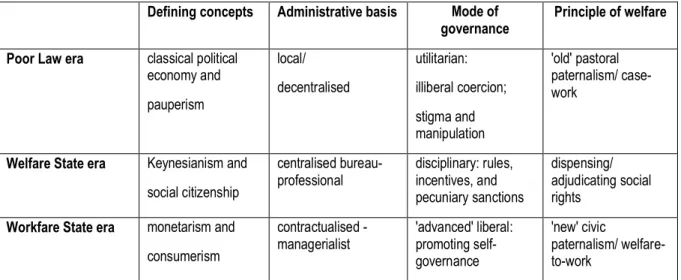
Recent welfare reforms in countries such as the UK, Germany, France, Belgium, the Netherlands, the US and Australia reflect an incremental change in the principles that inform welfare provision. Hartley Dean (2006) presented earlier a schematic account of the evolution of the welfare system in the UK, as a liberal welfare regime being transformed from welfare state to workfare state. Although the table is designed to display the way the liberal state incrementally changes, it could also be extended to portray the other western liberal states (Table 1). In fact, this table is a very eloquent summary of the transition of the modern liberal state from welfarism to prudentialism. Some groups have suffered more than the others in this new matrix of political economy. Migrant-origin youths and those native youths residing in remote places which no longer matter in the age of globalism are the ones who will be magnified in the rest of the paper.
Defining concepts Administrative basis Mode of
governance Principle of welfare Poor Law era classical political
economy and pauperism local/ decentralised utilitarian: illiberal coercion; stigma and manipulation 'old' pastoral paternalism/ case-work
Welfare State era Keynesianism and social citizenship
centralised
bureau-professional disciplinary: rules, incentives, and pecuniary sanctions
dispensing/ adjudicating social rights
Workfare State era monetarism and consumerism
contractualised
-managerialist 'advanced' liberal: promoting self-governance
'new' civic
paternalism/ welfare-to-work
Table 1. A schematic account of the evolution of liberal welfare regime (Source: Dean, 2006: 2)
Islamic Radicalisation: The revival of honour as a response to global injustice
Recently, Islam has come to be, by and large, considered and represented as a threat to the Western way of life. It is frequently believed that Islamic fundamentalism is the source of current xenophobic, racist and violent attitudes directed against Muslim-origin migrants and their children in the west. Right-wing populism has also become widespread, along with the growing stream of Islamophobia (Kaya, 2019). Since September 11, and even earlier than that, culturalist, civilizationalist and religious paradigms dominated the academic and political spheres in trying to understand the causes of radicalisation and extremism in political and societal domains by reducing what is socio-economic, political and psychological in origin to what is ethno-cultural and religious. As will be discussed in detail, radicalisation is perceived in this paper as a process which is constrained by local and global conditions, and extremism as a psychological and ideological state which is more or less based on the confirmation of a Manichean understanding of the world.
Ethno-cultural and religious resurgence may be interpreted as a symptom of existing structural social, economic, political and psychological problems such as unemployment, racism, xenophobia, exclusion,
assimilation, alienation, and anomie. Scientific data uncover that migrant-origin groups tend to affiliate themselves with politics of identity, ethnicity, religiosity and sometimes violence in order to tackle such structural constraints (Clifford, 1987; Gilroy, 1995; and Kaya, 2012). This is actually a form of politics initiated by outsider groups as opposed to the kind of politics generated by ‘those within’ as Alistair MacIntyre (1971) decoded earlier. According to MacIntyre (1971) there are two forms of politics: politics
of those within and politics of those excluded. Those within tend to employ legitimate political institutions (parliament, political parties, the media) in pursuing their goals, and those excluded resort to honour, culture, ethnicity, religion, roots and tradition in doing the same. It should be noted here that MacIntyre does not place culture in the private space; culture is rather inherently located in the public space. Therefore, the main motive behind the development of ethno-cultural and religious inclinations by migrant and minority groups may be perceived as their concern to be attached to the political-public sphere. Similarly, Robert Young (2001) also sheds light on the ways in which the discourse of culturalism has recently become salient. Referring to Mao, Fanon, Cabral, Nkrumah, Senghor and many others, Young (2001) accurately explicates that culture turns out to be a political strategy for subordinated masses to resist ideological infiltrations in both colonial and postcolonial contexts. Thus, the quest for identity, authenticity and religiosity should not be reduced to an attempt to essentialize so-called purity. It is rather a form of politics generated by subordinated subjects. Since the Gulf War in the early 1990s, Islam has become a political instrument for many people in the world to be employed as a self-defence mechanism against different ills such as humiliation, subordination, exclusion, discrimination, injustice and racism. It seems that now religion is replacing the left in the absence of a global leftist movement. Michel de Certeau (1984: 183) reminds us of the discursive similarities between religion and left: religion offering a different
world, and left offering a different future – both offering solidarity. Though Islam and the left similarly promise a different world to their adherents, they radically differ from each other in the sense that the former offers a world that was already experienced in the past and the latter offers a world that is not yet to come. In other words, Islam offers a retrospective world, while the left offers a prospective one. To that effect, one could argue that Islam is no longer simply a religion, but also a counter-hegemonic global political movement, which prompts Muslims to stand up for justice and against tyranny – whether in Palestine, Kosovo, Kashmir, Iraq, Afghanistan, Lebanon, Libya, Yemen, Syria or elsewhere. In other words, Islam is considered by many as a political tool to be instrumentalised to bring justice to the world, a justice that is based on the idea of reproducing the true justice established in the time of the Prophet. Muslim-origin youth in the West have been going through a crisis of home, which can be explained via liminality, that is a detachment from the existing structural positions. While immigrants who are more integrated do not experience a great loss of significance as a result of discrimination, their less integrated peers suffer from isolation, alienation and loss of significance (Lyons-Padilla, 2015). Lately, many young Muslims do not feel that they belong to their countries of settlement where they are bound to question whether they are accepted or not by the majority societies (Lyons-Padilla et al., 2015; Stroink, 2007). During such critical junctures, aversion to the context in the country of settlement seems stronger than attraction to Syria, Palestine, Yemen, or the Middle East in general. In The Rites of Passage, Arthur Van Gennep (1908) used the term liminality to describe the transitory period between two stages of human life. Building on Van Gennep’s work, Victor Turner later elaborated on the functions and attributes of liminality. According to Turner, society was a series of “structure of positions” and “the period of margin or ‘liminality’ was an interstructural situation” (Turner, 1967: 93). In his The Ritual Process: Structure and
Anti-Structure, Turner (1969) gave a clearer definition of liminality, arguing that “liminal entities are neither here nor there, they are betwixt and between the positions assigned and arranged by law, custom, convention and ceremonial” (1969: 95). In this sense, joining an organization might offer a sense of belonging, purpose and the promise of recognition and status for already marginalized Muslim youth feel betwixt and between the positions constrained by social-economic, political and legal arrangements alienating them from their country of settlement (Crenshaw, 2007). As already discussed by van Gennep (1908) and Victor Turner (1967, 1969, 1974) in different contexts, this kind of rite of passage might amplify liminal phase of being stateless and homeless as a sort of disaffiliation with the former structures. This
kind of disaffiliation is then followed by a combative oath that is taken in the form of re-grouping that clears the way for a reconstitution and re-affiliation of community of brotherhood (ihkwaniyya), or umma in a new re-imagined home called Sham (Levant, extending from the Antakya region of Turkey, through Syria, Lebanon, Israel, Palestine, Jordan and round to the Sinai peninsula in Egypt), or khilafa. For instance, such emblematic rituals in Syria foster newly found social bondage and self-identification (Alloul, 2019: 228). Under such circumstances, Syria, or other Muslim countries under perceived siege such as Palestine, Afghanistan and Iraq become a highly symbolic counter-space, or ‘consequential geography’ for staging actual politics against a former home in Europe (Alloul, 2019: 229).
Radicalisation of Muslim-origin youngsters is a reaction to the ways in which they perceive to be subordinated by their countries of settlement. In a way, this is what Didier Bigo (2019) calls ‘the Maze of Radicalisation’, because radicalisation might provide them with an opportunity to build an imagined home away from the one that has become indifferent and alienating. Radicalisation then becomes a regime of justification and an alternative form of politics generated by Muslim youth to protect themselves from day-to-day discrimination. They believe that speaking from the margins might be a more efficient strategy to be heard by the ones in the centre who have lost the ability to listen to the peripheral ones. As Robert Young (2004: 5) points out, it is not that ‘they’ do not know how to speak (politics), “but rather that the dominant would not listen.”
Individuals, or groups, tend to use the languages that they know best in order to raise their daily concerns such as poverty, exclusion, unemployment and racism. If they are not equipped with the language of deliberative democratic polity, then they are inclined to use the languages they assume to know by heart, such as religion, ethnicity and even violence. In an age of insecurity and uncertainty, to use the term by Franz Fanon (1965), the new ‘wretched of the earth’ become more engaged in the protection of their
honour, which, they believe, is the only thing left. In understanding the growing significance of honour, Akbar S. Ahmed (2003) draws our attention to the collapse of what Mohammad Ibn Khaldun (1969), a 14th century sociologist in North Africa, once called asabiyya, an Arabic word which refers to group loyalty,
social cohesion or solidarity. Asabiyya binds groups together through a common language, culture and code of behaviour. Ahmed establishes a direct negative correlation between asabiyya and the revival of honour. The collapse of asabiyya on a global scale prompts Muslims to revitalise honour. Ahmed (2003: 81) claims that asabiyya is collapsing for the following reasons: massive urbanization, dramatic demographic changes, a population explosion, large scale migrations to the West, the gap between rich and poor, the widespread corruption and mismanagement of rulers, rampant materialism coupled with the low premium on education, the crisis of identity, and, perhaps, most significantly new and often alien ideas and images, at once seductive and repellent, and instantly communicated from the West, ideas and images which challenge traditional values and customs.
The collapse of asabiyya implies for Muslims the breakdown of adl (justice) and ihsan (compassion and balance). Global disorder, characterised by the lack of asabiyya, adl and ihsan,seems to trigger the celebration of honour by Muslims. Remaking the past or celebrating honour serves at least a dual purpose for the diasporic communities. Firstly, it is a way of coming to terms with the present without being seen to criticise the existing status quo. The ‘glorious’ past and the preservation of honour is, here, handled by the diasporic subject as a strategic tool absorbing the destructiveness of the present, which is defined by structural outsiderism. Secondly, it also helps to recuperate a sense of the self not dependent on criteria handed down by others – the past is what the diasporic subjects can claim as their own.
As Seniguer (2016) argues, because the concept of ‘radicalisation’ is now widespread within the public discourse, it is subjected to intensive use by both politicians and the media. Thus, Seniguer argues that whether we are now faced with an Islamization of radicalism or radicalisation of Islam depending on one’s theoretical orientation, it remains a pressing issue to be able to go beyond this ‘trap’ and to question the ambiguous notion of radicalisation, its limitations and its effects on societies at large to avoid ‘stalemate’ (Seniguer, 2016). To that effect, there are also similar discussions in sociological literature concerning whether radicalism is being Islamized, or Islam is being radicalised. For instance, while Gilles Kepel (2017)