ISSN 1450-216X Vol.52 No.4 (2011), pp.528-552 © EuroJournals Publishing, Inc. 2011
http://www.eurojournals.com/ejsr.htm
An Empirical Research from Turkey to Determine the Relations
between Leadership Styles and Organizational
Citizenship Behavior
Hasan GülAssistant Professor, Faculty of Economics and Administrative Sciences Karamanoğlu Mehmetbey University, 70100, Karaman - Turkey
E-mail: [email protected].
Tel: +90-338-2262000; Fax: +90-338-2262023 Mehmet İnce
Assistant Professor, Faculty of Economics and Administrative Sciences Karamanoğlu Mehmetbey University, 70100, Karaman - Turkey
E-mail: [email protected] Tel: +90-338-2262000; Fax: +90-338-2262023
Abstract
This study aims at determining the relations between leadership styles and organizational citizenship behaviors. In the context of this study, the relations between characteristics and behaviors of charismatic, transactional and transformational leaders and citizenship behaviors of the employees are determined. The research was studied on 108 people employed in Karaman Governor’s Office and City Financial Department. T-test, one way analysis of variance (ANOVA), correlation and regression analysis’s were used for valuating the data acquired in the study. In the regression analysis, a positive relation was detected between charismatic leadership and organizational citizenship behavior. Keywords: Leadership Styles, Charismatic Leaders, Transactional Leaders,
Transformational Leaders, Organizational Citizenship Behavior
1. Introduction
Gill says, “If change is to take the organization to a voyage from its present situation towards a desirable future and to struggle against every problem occurring throughout the voyage, then change is about leadership as much as management” (Sabuncuoğlu, 2008). The popular opinion is that in spite of being one the most favorite subjects being studied; leadership still keeps its mystery and charm. Leadership which seems to be one of the major subjects of sociology, history, administering sciences and the field of organizational behavior, has always been discussed whether it is a product of social and historical conditions or the history and society were constructed by leaders through “ideal type” which finds its meaning in Weber’s words (Mütercimler, 2006).
Governing societies and organizations, fulfilling the change, stabilizing the presence of organizations depend on effective and efficient usage of the resources. The ones to achieve this are the leaders. Leaders can fulfill individual and organizational goals by setting common goals which are
achievable, developing a prudential charming and clear visions, and revealing concealed talents and potentials. When employees perform extra role behaviors voluntarily for the favor of the organization, the likelihood of achieving these goals will increase. In this concept, the goal of this research is to determine the relations between the types of transactional, transformational and charismatic leadership and citizenship behaviors. Furthermore, another goal is to designate whether demographic characteristics of employees make a significant difference on the perception the leadership behaviors. Relations between especially transformational leadership and citizenship behaviors were studied by this time; but there are not enough researches on relations between transactional and charismatic leadership and citizenship behaviors. Hence, it is targeted to close the gap in this literature with a research performed in public institutions in Turkey.
2. The Concept of Leadership and Basic Types of Leadership
The history of the written sources about leadership lies back to the tablets of Egyptian Hieroglyphics. Ancient Greek philosophers, Plato and Aristotheles, claimed some opinions about leadership, leader characteristics and the education of leaders (Paul and et al., 2002). Despite that its history is as old as the history of humanity; leadership is a tricky concept for people to describe. The famous Islam philosopher Farabi, described the leader as “The Chief of the Rest”. According to him, a leader should be a person who cannot take orders from anyone but himself (Akat and Üner, 1987). According to another description, a leader is stated to be a person who passed through specific steps or was designated; a genius man of society, an ambitious and talented administer (Kaya, 1998). Leadership once again was explained to be a persuasive ability used for directing people for some specific targets and evaluated to be a concept which rose where mind and power meets (Doğan, 2007). Leadership is an art of directing people to follow, and being decisive on their behaviors, thoughts, actions, and words. As Peter Drucker says, leader is the one with his own followers. Even bad leaders have their followers, but this following generally does not last long (Wadsworth, 1999). In this concept, the phenomenon of leadership manifests itself wherever the personal authority is used in order to effect the social groups. Leader is a person who changes and transforms the present structures and systems and who can build a new structure instead.
Leaders are people with the capability of perceiving the time and proactive thoughts and behaviors against the change (Paksoy, 2008). Instead of producing answers to the thought, leaders are the ones to shape them. The impressions that a leader reveals in shaping human psychology, forming image and expectation almost define the end of a work (Doğan, 2007). A leader makes a target for the organization, builds a future image and specifies change strategies for this target (Baltaş, 2001). In this context, leadership is neither a style, a charisma, personal power, an authority nor coming to power. The existence of all of these may contribute the shape of performing leadership. Leadership is the talent to incorporate people to the process of changing and transforming organizations eagerly and voluntary. By this means, the organizational synergy that is made enables to unexpected results. A leader is supposed to have features like having a vision (Doğan, 2007; Maxwell, 2006; Maccoby, 2002), forming a motivation (Hoffer, 1993), creativeness, team working, participation, making decisions and performing them fast, being able to instill self-confidence, being inspirer, determination (Kaya, 1998), confidence (Rosen, 1998) and change agency (Covey, 1997).
2.1. Transactional Leadership and its Characteristics
The research which Burns studied about political leaders in 1978 constitutes the base of transactional leadership which dominated the leadership studies after the World War II (Paul et al., 2002). The type of transactional leadership has become more popular with Path-Goal Theory of House which was born with Burns’ studies and tried to explain why and how the leadership rewards the employees (Elenkov, 2002). Transactional leadership is also referred to as procedural, operational, organizational,
interactional or transactional leadership in the literature. Transactional leadership theory is bound up with the idea that the base of leader-follower relations depend on the exchange or the implied agreement between the leader and the followers (Evans, 1970; Hollander, 1964; House, 1971; House and Mitchell, 1974; Graen and Cashman, 1975; Graen and Scandura, 1987). Transactional leadership symbolizes a type of leadership tied more tightly to history and the traditions. In this type of leadership, leaders use employing methods which make the traditional working activities of the followers become more efficient.
Transactional leaders are the ones who determine the tasks and roles of the inferiors clearly, activate the organizational structure, fulfill the individual needs of the employees by giving rewards to them (Sabuncuoğlu, 2008). These types of leaders provide the liabilities arising from the agreement and the material and spiritual rewards to their followers by explaining role and task conditions very clearly. Behavior of transactional leadership contains that the followers focus on the change, explaining the relations between effort and reward (Walumbwa et al., 2008). Transactional leaders who use the bureaucratic authority and the organizational legality, anticipates that the employees obey as much as they expect that the task are completed, and they relate the performance of the employees with a strict system of reward and punishment (Erdal, 2007). A leader controls the behaviors of the followers by using his power and authority while he satisfies his own wishes and needs at the same time. He uses the organizational resources so that the followers fulfill the desirable roles and performance. He portrays some kind of action and reaction model in control and correction of behaviors (Grundstein, 1999).
Transactional leadership is reactional and aimed at present subjects and problems. An effective transactional leader is always attentive to define the conditional factors and the expectations of the followers correctly, as he cares about the mutual dealing. In short terms, he always tries to impress his followers by making motivating deals. For fulfilling the expectations of the leader also provides profits to the followers (Popper and Zakkai, 1994). Shortly, the transactional leader is exchanging something valuable, entering into a close connection with the others. In other words, the transactional leadership includes the social relations between leader and the group, and satisfaction/reward issues. This type of administration depending on conditional rewarding system, both active and passive administration and complete independence forms the basic elements of this leadership model.
2.2. Transformational Leadership and its Characteristics
Another type of leadership which Burns mentioned on his book named “Leadership” which was published in 1978 is transformational leadership. These types of leadership developed to explain the political and military leadership by Burns were adapted into organizational administration by Burns. Since Bass’ famous book about transformational leadership was published in 1985, researchers (Avolio, Sosik, Jung and Berson, 2003; Avolio and Yammarino, 2002; Piccolo and Colquitt, 2006; Yammarino, Dionne, Chun and Dansereau, 2005) started many researches on this model of leadership, so the transformational leadership has emerged as the subject which has probably been studied the most in 20 years (Cho and Dansereau, 2010; Jung et al., 2009; Paul and et al., 2002; Hinkin and Tracey, 1999). It is because the need and the interest in the field of ethics increased with the scandals occurred in organizations (Jung et al., 2009).
In Bass’ model, transformational leadership is accepted as an effective style of leadership especially in environments characterized with change, suspense and stress (Nemanich and Keller, 2007). Transformational leadership moves beyond the benefits assessed for every individual by a social change, and reflects the cooperation through a common goal meant to increase the motivational, ethical and behavioral expectations which contribute to the followers’ transformations (Simola et al., 2010). According to Burns, transformational leadership occurs when a person or some people enter into connection depending on encouraging their followers of each other towards a higher motivation or morality (Yavuz, 2009). Burns characterizes the transformational leadership as a process in which the employees are motivated with attractive, high ideals, targets and moral values. Yet Bass describes the
transformational leader as the person who determines a definable vision, while indicating the significance of necessity that a leader should be accepted as reliable (Bass, 1990). According to the transformational leadership theory, a leader is someone who changes the needs, beliefs and moral values of his followers. These leaders put in performances beyond the normal expectations (Yagil, 1998).
Transformational leadership is a type of leadership which provides the employees visions, loads them with a charge in order to contribute to these visions and supports the employees to use their talents more efficiently by making some changes in organizational culture. In this concept, transformational leadership is a style of leadership motivating and encouraging the individuals to achieve more than expected (Bolat and Seymen, 2003). Xin and Zhiminig (2007) claim that in spite of intersectional leadership, transformational leadership symbolizes the behaviors which will “fulfill what is beyond the expectations” with its inspirational characteristic beyond its traditional leadership role (Asgari et al., 2008). Transformational leaders have special abilities to start the change and innovation. In that type of leadership, leaders guide their followers to behaviors to improve them by acting like a coach or a mentor and adapting to the needs of their followers (Cho and Dansereau, 2010). Transformational leaders have the characteristics which lead their followers to exceptional performances by actualizing the change and the innovation; regenerate and differentiate their spurs, beliefs, values and capabilities in accordance with the vision of the organization (Goodwin et al., 2000; Rowe, 2001).
The most significant difference separating the transformational leadership form the others is that it aims at the active participation between different followers and the personal values (Jung et al., 2009). Krishnan (2005) argues that transformational leadership enhances the levels of human behavior of both the leader and the followers. It motivates the followers to interiorize the collective priorities beyond the personal benefits. The people who are motivated to fulfill a collective vision tend to contribute to the organizational goals more by immediately aborting their roles about their personal and material benefits. The reason they make these contributions is the promises they make to themselves and the value they think of themselves of the senses leading them to make these contributions (Asgari et al., 2008). The dimensions of transformational leadership has been limited with inspirational motivation, role modeling, encouraging the acceptation of the group goals and team work, expectation of high performance, intellectual stimulation, personal interest, and rewarding (Hardy et al., 2010; Hinkin and Tracey, 1999; Banerji and Krishnan, 2000):
Charisma / Idealized Influence: In a transformational leadership it is significant for the inferiors that a leader has an impressive and spectacular character. Inferiors identify themselves with the leader. Transformational leader is determined, consistent in spiritual and operational phases and takes chances. They reflect their self esteems to their followers and they plan to achieve the goals in frame of the targets they determine for the organization. Transformational leader reflects an image which followers wish to have (Cho and Dansereau, 2010; Yavuz, 2009). In this structure, the admiration and respect to the leader is in a high level. In working life, inferiors think and act in direction of their leader more than the other members (Bass, 1990). Charisma is the most important element of the leadership concept. Bass named that factor “idealized influence” which depends on the confidence, respect and admiration the followers feel for their leader. Charisma is a compulsory element for transformational leadership but not the adequate one (Simons, 1999). It is possible to identify the charismatic behavior of the transformational leaders as guiding, inspiring and reassuring, imposing the mission spirit and motivating the followers. The transformational leaders must prefer to fulfill their followers’ needs to their own needs in order to gain confidence and esteem in the eyes of their followers (Hinkin and Tracey, 1999).
Inspirational Motivation: This dimension (Bass and Avolio, 1995) includes the characteristics of the leader to improve a positive and common vision about the future and to encourage and convince his followers to reach that vision (Cho and Dansereau, 2010). Transformational leaders have to excite their inferiors that they can achieve whatever they are planning. The dimension of inspiration indicates
that the leader activates the followers to show some effort by role modeling, imposing a vision and some symbols and that he carries an exemplary characteristic ethically (Avolio et al., 1999). The leader improves the motivation of the followers using some images and symbols and directs them to the common goals (Scott, 1998; Keçecioğlu, 2003).
Intellectual Stimulation: The behaviors of the leader should direct the followers to rethink the old problems with new methods (Bass and Avolio, 1995; Hardy et al., 2010). Transformational leaders are meant to help their followers to be more creative and more innovational. It is a process to impress their inferiors so that they can realize the organizational problems completely and so that the leaders can enable the followers to solve the problems considering different visions (Erçetin, 2000). The leaders who consider creative thoughts as extremely significant encourage the followers to connect their thoughts which seem to be irrelevant. It is a transforming and differentiating process which contains these new methods, different techniques and new ideas. Intellectual stimulation indicates that the leaders encourage the followers to question the problem solving methods they use (Avolio et al., 1999). It emphasizes questioning and solving the problems before acting and supports the followers to think free (Howell and Avolio, 1993; Podsakoff et al., 1990). Intellectual stimulation which reveals the ethical and normative dimension of the leadership is a dynamic process supporting the followers to perform their contributions, their levels of realization and creativity (Gökkaya, 2003).
Individualized Consideration: The leader recognizes the individual differences of his followers and cares about them for their improvements (Hardy et al., 2010; Avolio et al., 1999). Transformational leader performs an equal approach to all of his inferiors in the organization with individual consideration behavior. Their coaching skills and empathy capabilities are advanced (Yavuz, 2009). Transformational leaders show attention towards the personal needs their inferiors individually for their improvement and success by acting like a consultant or a mentor (Bass and Avolio, 1990). Transformational leader listens to his followers efficiently and respectfully and transfers the duties in the concept of improvement (Töremen and Yasan, 2010). Leaders’ behaviors which encourage the followers, support them, show them respect as humans and confidence, give them opportunities to improve themselves are included in the context of individual consideration (Uyguç et al., 2000). Transformational leaders taking care of the needs of the followers individually and finding solutions to them improve both the followers’ confidence in the leaders and their potentials (Gökkaya, 2003).
Being a Suitable Role Model: Leader should be an exemplary role model consistent with his values being supported by the organization (Hardy et al., 2010). The dimension of being an example explains that the leader should be an example to the followers with his own behaviors. The followers take the leader’s beliefs, values, behaviors and reactions by linking themselves with the leader (House and Shamir, 1993).
Encouragement for the Acceptance of Group’s Goals and Team Work: The behaviors of the leader should encourage the followers to work together and cooperate in direction of a common goal (Hardy et al., 2010). The dimension of forcing the acceptance of the group goals indicates to direct the followers to work for a specific target. Leader shows this behavior in order to encourage the followers to sacrifice themselves for the group and emphasize the collective identity (Podsakoff et al., 1990).
Expectance of High Performance: A leader should impose high expectations to his followers by his behaviors (Hardy et al., 2010). The dimension of the expectation of high performance means that the leader transfers his expectations to his followers and emphasize that he believes and trusts that they can achieve these expectations.
Transformational leadership radiates great hopes to organizations, advanced unions and the whole society with radical changes, the solutions to the radical problems and building new structures (Banerji and Krishnan, 2000). Transformational leadership is a set of capabilities for the leader to start the change actively, to create the perspective to guide this change and to identify the needs for the change (Keçecioğlu, 2003).
There are sufficient evidences and researches showing the useful and positive outputs of the transformational leadership (Judge and Piccolo, 2004). Transformational leadership generally includes being an efficient and charismatic role model, depicting a charming vision, encouraging the acceptance of common goals, setting the expectations of high performances and (Podsakoff, MacKenzie, Moorman and Fetter) providing individual support and intellectual stimulation for the followers. This type of leadership makes significant contributions to improvement of the followers’ performances and to the success of the organization (Walter and Bruch, 2010). In the information age we live in, the type of leadership that societies need seems to approach to the type of transformational leadership. However, transformational leadership includes guiding to the efforts for the change which is desired. These types of leaders are the ones who motivate the followers to perform things beyond their capabilities, determine big targets which are hard to complete and fulfill the change uniting them with these targets (Gül, 2003).
2.3. Charismatic Leadership and its Characteristics
Underlying the charismatic leadership is the concept of charisma. Charisma dates back to the word in Ancient Greek, “charis” and used for the meaning of “gift” given by the Divine Spirit (Marturano and Arsenault, 2008). Charisma which is also mentioned in the bible (Luthans, 1992) includes the supernatural powers (e.g. prophecy, prophesying, healing or exorcizing) given to someone by divine spirit.
The concept of charisma entered the administration literature in 1947 with Weber, the founder of the Burocracy Model. Weber determined the concept of charisma as one of the three types of authorization which he thought as traditional, charismatic and mental-legal (Nur, 1998). In his model, Weber generally tried to find an answer to the question how and why the followers attribute extraordinary characteristics (Yukl, 1999). Weber used this concept in the meaning that they follow him as a result of obligation and necessity because of the followers’ beliefs of their leader’s quality and characteristics. According to Weber, as the behaviors of the leaders are inspirational, exciting and extraordinarily vigorous, they cause the social feelings and belief of companionship to improve (Marjosola and Takala, 2000). There are two reasons to attribute someone with a charismatic ability: believing (1) that someone has extraordinary powers and abilities, (2) that these powers and abilities are caused by supernatural powers (Bradley, 1987).
A lot of politicians and social scientists seemed to make researches about charisma after Weber. The prominent names could be Friedrich (1961), Berger (1963), Friedland (1964), Kanter (1965), Dow (1969), Mc Intosh (1970), Cohen (1972), Bromley ve Shupe (1979), Fine (1982) and Willner (1984) (Yukl, 1994). In his book named “A Comparative Analysis of Complex Organizations” which was published in 1961, Etzioni defined charisma as the ability to use the deep and ubiquitous effect of the normative and ideological tendencies of the people (Yagil, 1998). In the upcoming years, House (1977) provided self esteem in charismatic leadership; Conger and Kanungo (1987) provided attribution approach to the charisma, Meindl (1990) provided social contagiousness approach and Shamir, House and Arthur (1993) provided an identity approach in charismatic leadership, contributing to the improvement of the concept of charismatic leadership.
Charismatic leaders convert the members’ needs, values, sources and desires into collective interests. Hence, the followers are connected with their leader’s missions sincerely. Followers trust in their leader, they appreciate the values and their motivations improve. Charismatic leaders have charismatic powers. This source of power is related directly to the character of the leader. Charisma is closely related to the concept of charm. Charismatic leaders create strong emotional effects on the followers with these attributes. This type of leaders is well aware of their powerful attributions and they invest in them. Nadler and Tushman (1990) described the charismatic leaders as the people who can impose a path that creates visions to their followers, supports them to build up connections, follows the collective goals and feels successful when the predicted goals are achieved.
Charismatic leaders change the needs, values, preferences and desires of the followers. According to Larsson and Rönnmark (1996), both leader and the followers having radical values and expectations in a charismatic leadership are caused by the special culture they have. Charismatic leaders reveal a confidence validating their statues and their abilities. They have great self esteems. They create a very clear image of themselves to society. Even if they fail they never show that. They have advantageous attributes in conflicts between people. Charismatic leaders are the great actors of the leadership stage. They reflect self esteem to the followers and convince them. They can develop extraordinary solutions in extraordinary situations and problems (Erçil, 1997). Charismatic leaders are determined. That is because they are the ones who can effect others with self esteem, courage, their ability to speak and convince, vision and values they have.
Charismatic leaders are the leaders who can transfer their own visions to the followers and transform their individual benefits and expectations into the collective expectations by convincing them about these visions (Goethals et al., 2004). In the organizational literature, positive effects of charismatic leadership on performance indicators are pointed. For example; Howell and Frost (1989) determined that charismatic leadership causes higher performances and higher working satisfactions of the followers (Aslan, 2009).
3. The Concept of Organizational Citizenship Behavior
In administration literature, the number of the researches aiming at determination of the reasons and dynamics of extra role behaviors which contribute to the organizational performance and are results and products of motivations of the employees in their organizations. Organizational citizenship behaviors are very important in terms of organizational efficiency and effectiveness (Ertürk, 2007). The concept of organizational citizenship behaviors was first brought in the literature by Organ et al. in 1983 (Podsakoff et al., 2000; DiPaola and Hoy, 2005). Actually, the origin of the researches of the organizational behaviors emerged with the “satisfaction makes performance” theory by Dennis Organ in 1977. In the researches depending on this theory, examples of organizational citizenship behaviors are arranged as the elements such as having good relationships with the administrators, not complaining about the task, burdening a task even if he doesn’t have to (Yücel and Samancı Kalaycı, 2009). As synonyms for the concept mentioned above terms such as “organizational spontaneity”, “pro-social organizational behavior”, “altruism”, “extra role behavior”, “social organization behavior”, “civil organizational behaviors” and “voluntariness” are used (Mahdiuon et al., 2010; Bolat et al., 2009).
Organ (1998) defined organizational citizenship behavior as “an individual behavior based on voluntariness which is not identified clearly by the formal reward system of the organization directly or indirectly, but helpful with the efficient and effective progress of the organization as a whole”. According to Organ, organizational citizenship behavior contains the activities which an individual improves the process of the organization as a whole (Rubin et al., 2010). Smith, Organ and Near (1983) describe organizational citizenship behaviors the extra role contributions performed by the employees of an office and the professional achievements which are rewarded without an agreement (Asgari et al., 2008). Guatam et al. (2004) also defined organizational citizenship behaviors as voluntary, contextual and extra role behaviors. Greenberg and Baron (2000) identified the concept of organizational citizenship that an individual who performs better than expected by exceeding the obligations which the organization determines formally. As seen in these descriptions, voluntariness and extra role behaviors are building the base of the concept of organizational citizenship behaviors (Bateman and Organ, 1983). With the concept of voluntariness, it is meant to be explained that this behavior is not a behavior which emerges in frame of professional portrayals and is a necessity of the individual role; but it is a behavior style which makes progress depending on the choice of the individual (İşbaşı, 2000). However, extra role behaviors are voluntary behaviors which are generally ignored while fulfilling the necessities of the task and not perceived as obligatory for the inferiors by
the superiors; but benefits to the organization. These behaviors do not have a direct effect on mission success while it makes the social structure of the organization stronger (Taşçı and Koç, 2007).
Citizenship behaviors increase the efficiency of the organization by providing higher performance in terms of quality and quantity (Truckenbrodt, 2000). For organizational citizenship behaviors, examples can be given, such as helping with the backstage works while a task is being done, being proud while representing a public organization, solving the interpersonal conflicts which are not constructive (Abu Elanain, 2010), voluntarily working overtime for the task and the organization when needed and not complaining little inconveniences as a normal part of the organizational life (Moideenkutty, 2009). Podsakoff and MacKenzie (1997) claim that citizenship behaviors can effect the organizational performance in a positive direction by lubricating the machines and reducing the friction and increasing the efficiency.
Organizational citizenship is the behaviors which emerge depending on the preferences of the employees. An individual himself decides whether or not he will perform these active of passive behaviors which are functional for the organization. Organ explained the organizational citizenship behaviors in five different dimensions which are civil virtue, altruism, having consciousness, fairness and courtesy (MacKenzie et al., 1993; MacKenzie et al., 1999; Allison et al., 2001; Asgari et al., 2008). Podsakoff, MacKenzie, Paine and Bachrach (2000) collected organizational citizenship behaviors under seven titles and specified them as helpful behaviors, fairness, organizational loyalty, organizational obedience, individual initiative, civil virtue and self improvement. The dimensions of organizational citizenship behaviors taking place in literature are summarized below:
• Self-sacrifice (altruism, beneficence, generosity): It states that the employees voluntarily and directly help their colleagues (helping with the orientation of the new employee, his overburdened colleague, his sick colleague, with understanding a computer program etc.). Hence, self-sacrifice consists of individual behaviors such as individual beneficence and performing extra role behavior (Barksdale and Werner, 2001; Konovsky and Organ, 1996). It is the voluntary behaviors intended to help the colleagues, customer or the managers as extra role behaviors which are not anticipated in the agreement (Truckenbrodt, 2000).
• Carefulness about the task (consciousness): It states that the employees voluntarily contribute to the progress of the organization by exceeding the obligations about the tasks and the roles such as coming to work early, going late; avoiding long and unnecessary recesses; not wasting the work time (MacKenzie et al., 1993; Allison et al., 2001). Consciousness means that the members of the organization perform voluntary behaviors beyond the minimum roles the organization requires by working hard and without objecting to the rules or disposals (Podsakoff et al., 2000).
• Gentlemanliness (fairness): This includes the behaviors such as tolerating the inevitable inconvenience and strain caused by the work, not complaining about being disturbed by other employees, remaining positive while the work is going bad, not getting angry when other people do not think the way they do, being able to sacrifice for a good team work, and respecting the opinions of other people. Strains emerge inevitably almost every organizational environment. A fair person puts up with those with pleasure and do not make big deal of it (Organ and Ryan, 1995; Köse et al., 2003). Hence, the fairness means to tolerate any kind of negativities potential to create a tension among people in the organization (Özdevecioğlu, 2003; Yoon and Suh, 2003; Podsakoff et al., 2000).
• Courtesy: It contains the behaviors in a proactive quality which the employees anticipate the issues which may cause a problem for other colleagues and make a suggestion for the solution, help them or stop that problem from emerging (Organ and Ryan, 1995; Konovsky and Organ, 1996). At another perspective, courtesy implies the positive interaction between the people connected to each other as a consequence of cooperation (Özdevecioğlu, 2003). Courtesy defines the kindness people do at work (Konovsky and Organ, 1996). Employees try not to
cause any problem to their colleagues avoiding the outrages upon the justice while using the common sources.
• Civil virtue (contributing to the improvement of the organization): It indicates to the loyalty to an organization as a whole at the highest level, and the active and voluntary participation to the organizational life (Podsakoff and Mackenzie, 1994; Organ and Ryan, 1995; Konovsky and Organ, 1996). Even if it is costly for an individual, the behaviors such as the will about joining the administration (joining the meetings, suggesting opinions about the strategy the organization should follow), following up the opportunities and the threats the organization encounters (monitoring the sector and the current changes about it), trying to do the best for the organization (notifying fire, theft, risk of accident or suspicious situations, locking the doors) construct this dimension (Konovsky and Organ, 1996; Podsakoff et al., 2000; Köse et al., 2003). So, civil virtue indicates to the participation to the organizational life with responsibility (Dimitriades, 2007).
• Ownage: Ownage which is approached as another dimension of organizational citizenship behavior contains the behaviors of organizational loyalty and commitment; and it is the behaviors that the employees represents the organization the environment, defend the organization proudly against the third party and try to keep the organizational targets superior to the individual behaviors (Podsakoff et al., 2000).
• Self improvement: It is defined as the activities which the employees try to improve their knowledge, skills and capabilities. This dimension which is also described as self improvement, self education and self training also implies that an individual chooses the path of increasing his knowledge and working skills (Farh et al., 2004).
4. The Relation between Leadership Styles and Organizational Citizenship
Behaviors
Leadership is different from the administration which finds its power in hierarchy and implements that power only with a formal authorization. Leadership is a process of convincing, motivation and imposing the goals sincerely. In this context, a leader should be able to activate the people he manages in terms of emotions and willingness as well as intelligence. On other words, it is possible to mention about the efficient leadership in a condition that the employees participate to the production and/or the service not because they have to, because they are willing beyond the role definitions in a base of willingness. The extra role behaviors based on that voluntariness is considered as a portion of organizational citizenship behaviors (Aslan, 2009; Oğuz, 2010).
The culture of organizational behavior can be created only as result of the opinions, beliefs, attitudes, behaviors and determinations of the leaders. In an organization where the perception of justice is correct and the feeling of confidence is intact, but the idea of inspiring is insufficient, it will not be likely to mention about belonging (Toktamışoğlu, 2002). Hence, for creating the perception of loyalty to the organization and canalizing the creativities of the individuals to improve the work by suggesting new ideas and taking initiative can only be possible by the organizational culture and behaviors characteristics implanted by the leaders. In this context, the characteristics of the leaders have a very significant determinative feature on the opinions, loyalties and the behaviors of the inferiors. Willingness of bearing extra role responsibilities depends on the organization meeting the individuals’ psychological, economical and cultural needs. The headers of the most significant issues affecting the organizational citizenship behaviors of the individuals are trust, value, supporting self improvement and the phenomenon of justice. The organizational culture is the identity of the organization. Leadership is what gives an organization a character and it is effective on choices and decisions of every employee. Such that, it designates the opinions, loyalties, behaviors, commitments and professional satisfactions of the employees and the behaviors of the inferiors ranging from the style and relations of working, communication and sharing, to prices and system of career.
There are a variety of researches in the literature trying to determine the relations between leadership styles and citizenship behaviors. Especially in the researches on the transformational leadership behaviors, this type of leadership seems to create positive effects on various individual and organizational outputs. The relations between transformational leadership and organizational innovation (Jung et al., 2003), military (Bass, Avolio, Jung and Berson, 2003), helpful behaviors (Rafferty and Griffin, 2004), group commitment and concordance, sportive performance (Charbonneau, Barling and Kelloway, 2001), management (Barling, Weber and Kelloway, 1996), organizational commitment (Rafferty and Griffin, 2004), professional satisfaction (Podsakoff et al., 1990) and education (Koh, Steers and Terborg, 1995) are widely discussed by the researchers (Hardy et al., 2010). The findings of the research prove that the transformational leadership has very clear positive effects on organizational outputs. For example; it is well known that the transformational leadership decreases the tendencies to leave the organization, increase the organizational citizenship behaviors (Bycio, Hackett and Allen, 1995) and provides strong organizational commitment (Bycio et al., 1995; Podsakoff et al., 1996). At the same moment, it is claimed that the transformational leadership increases the potentials and performances both individually and organizationally (Ferres and et al., 2002).
Transformational leaders play an efficient role on their roles and behaviors by making them perform better than expected (Podsakoff et al., 1990). One of the most significant indications of over performance of the employees is that they reveal organizational citizenship behaviors (Arslantaş ve Pekdemir, 2007). Transformational leader has a vision severely differentiated from the other people, followers and the current situation (Conger and Kanungo, 1987). As a result of that different and extraordinary vision, the followers identify themselves in their leaders; they take advantage of his opinions and find the motivating power in him to fulfill their own opinions.
Transformational leader realizes the needs, values and the expectations of his followers; and help them with the completion of their attitudinal, behavioral and emotional changes (Shamir and Howell, 1999). The followers show confidence, respect, admiration and commitment; and are motivated to reveal extra role behaviors (Barbuto, 2005). For transformational leadership, it is very important that the employees show performances more than the expectations and exceed their own potentials. The reason for that is that the employees are motivated in that direction (House et al., 1988; Yukl, 1989). Transformational leader enables the followers to have confidence in him, increases the professional satisfaction and he reinforces the organizational citizenship behaviors (Podsakoff et al., 1990). According to Podsakoff et al. (1990), the employees’ accomplishment of the performance the task requires is not as significant as their performance of extra role behaviors or the organizational citizenship behaviors for the transformational leadership. A strong relation was found between transformational leadership and organizational citizenship behaviors (r: 0,724 and p< 0,01), which was studied on 162 employees working at public departments in some ministries in the city of Putra Java, Malaysia, by Asgari et al. (2008). In a research by Cho and Dansereau (2010) with 159 employees working at a bank in South Korea, a positive relation was also found between transformational leadership and organizational citizenship behaviors. In the studies held by Podsakoff et al. (1990) a positive relation between transformational leadership and organizational citizenship behaviors and the expected empirical reinforcement were found (Asgari et al., 2008).
Similar to the relation between transformational leadership and organizational citizenship behaviors, it is expected to find positive relations between charismatic leadership and organizational citizenship behaviors. In spite of the fact that the required literature support about the relation between these two variables could not be reached, it is assumed that charismatic leaders make positive contributions for the employees to perform voluntary extra role behaviors. Especially the charismatic leaders’ characteristics of performing extra ordinary behaviors, caring about the needs of the members and bearing personal risks are assumed to increase employees’ behaviors of bearing the voluntary positive roles, determining the organizational targets and visions, and considering the leader as an example. As the word comes to the transactional leadership, the logic of exchange lies behind this
leadership style as mentioned above as well. Transactional leadership is based on the approach of action-reaction. Hence, as transactional leaders pay attention to mutual exchanges, they always care about the situational factors and the expectations of the followers. They pay attention to identify their needs correctly and meet those needs in time. So, they try to motivate the followers in direction of the benefit procedures and to increase their efficiencies. However, accomplishing the expectations of the leader also provides benefits to the followers (Popper and Zakkai, 1994). In terms, organizational citizenship behaviors in transactional leadership will be able to emerge in the context of conditional rewarding, not the voluntary performance as in the transformational and charismatic leaderships.
5. The Methodology of the Research
5.1. The Aim and the Sample of the Research
The main target of the research is to determine the relationship between transformational and charismatic leadership styles and organizational justice behaviors. Empirical studies densely about the relations between transformational leadership and organizational citizenship behaviors in the literature, but charismatic and transactional leadership were ignored. The lack of the satisfactory evidences about the relations between transactional and charismatic leaderships and organizational citizenship behaviors is building the main reason why this research is being studied. In addition, the effects of age, gender, marital status, education level and seniority of the employees who participated to the research on the perception of the leadership styles and performing the organizational citizenship behaviors are being investigated in the context of this research.
Leadership styles were considered as independent variable, organizational leadership styles were considered as dependable variables and the relations between them were tried to be investigated. Besides, the effects of the employees’ demographic characteristics such as ages, genders on the organizational communication level were studied. The universal set of the research contains the public employees working at Karaman Governor’s Office and City Financial Department. Totally 200 people work at these two public organizations. 150 questionnaire forms were distributed proportional to the number of the employees. The number of acquired questionnaires was 110, and two were excluded from the study as they had mistakes. Hence, the research was evaluated on 108 questionnaires. The sample ratio of the research is designated as n/µ: 108/200: 0,54.
5.2. The Context of the Research and the Scales Applied
In order to collect data during the research a questionnaire form of 43 questions and three parts has been used. In the first part of the questionnaire, there are five questions for the determination of the demographic and personal aspects of the employees like age, gender, marital status etc. The second and third parts consist of statements pertaining to dependent and independent variables such as leadership types and organizational citizenship behavior. On 5 likert scales (1) corresponds to “I definitely do not agree” and (5) to “I definitely agree”.
In order to measure the leadership types in the research, a shortened form of the 33-question-scale that was used by Wang and his friends (2010: 3924-3936) and was adapted from the multifactor leadership questionnaire by Zhu (2002) and Li (2002). The questions concerning the visionary and cultural based leadership which were in the original questionnaire form. This scale consists of 10 questions; 6 of them concerning charismatic, 2 operational, and 2 transformational leadership types. And in order to measure the organizational citizenship behavior, a shortened form of the organizational behavior scale that was developed by Podsakoff and his friends (2000) and Morrison (1994), and adapted by Türker (2006), Yener and Akyol (2009). This entire scale consists of 19 statements. The scale of organizational citizenship consists of 6 lower dimensions. Of the 24 statements, 7 of them evaluates the contribution to organizational development, 5 cooperativeness, 4 self-improvement, 3 possession, 3 attentiveness, and 2 gentlemanliness.
5.3. Research Model and Hypothesis
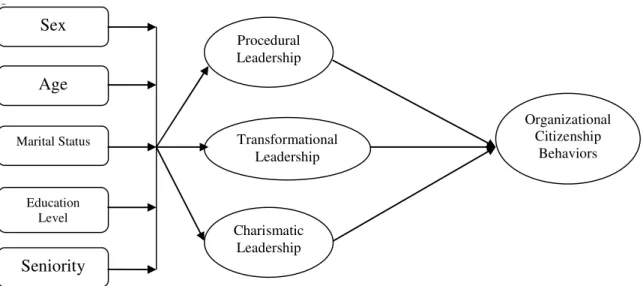
The model in Figure 1 was created in order to evaluate the relation between leadership styles and organizational citizenship behaviors.
Figure 1: Research Model
Figure 1: Research Model
Organizational Citizenship Behaviors Transformational Leadership Sex Age Marital Status Education Level Seniority Procedural Leadership Charismatic Leadership
The hypotheses which will be tested through this model are those below:
H1: The perception of the leadership types by the employees differ in accordance with their sexes.
H2: The perception of the leadership types by the employees differ in accordance with their ages.
H3: The perception of the leadership types by the employees differ in accordance with their marital statuses.
H4: The perception of the leadership types by the employees differ in accordance with their education levels.
H5: The perception of the leadership types by the employees differ in accordance with their length of service.
H6: There is a positive relation between operational leadership and the employees' citizenship behavior.
H7: There is a positive relation between transformational leadership and the employees' citizenship behavior.
H8: There is a positive relation between charismatic leadership and the employees' citizenship behavior.
5.4. The Analysis of the Research Data 5.4.1. The Factor Analyses
Explanatory factor analysis has been used to determine the basic complements of scales. KMO and Bartlett tests have been used to determine whether the variables are suitable or not for factor analyzing. Factor analysis has been decided to used because, the KMO and the Bartlett test results are enable to make factor analysis. Eigen values have been set 1 to calculate factors. Reliability research was made by checking the Cronbach Alpha co-efficient. The lower cut point of the sample factor charges was considered as 0.50.
KMO value was found 0,886. KMO value 0,80-0,90 was identified “very good” for factor analysis. Bartlett Test was found significant. In the factor analysis which has been made after KMO
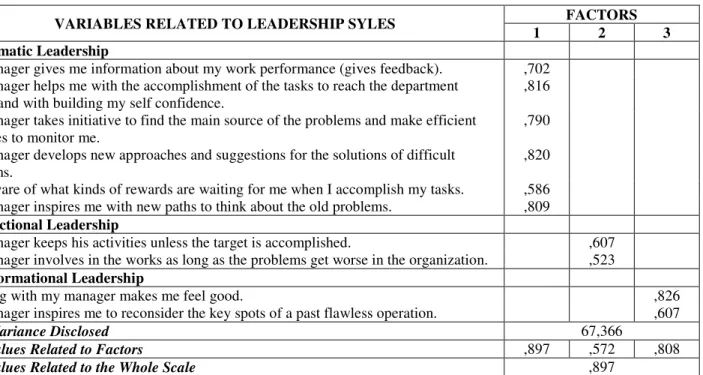
and Barlett tests related to scale of leadership there are three lower dimensions has been found impending drawer, transformational and charismatic. In the research the factor analysis of scales related to leadership kinds and organizational citizenship behavior was made separately. Parameter significance tests were made in the level of specific significance and in the Table 1 the factor loading of level of leadership kinds has been supplied. Every three kinds of leadership factor loadings (3 factors) expected initially were reached. Explained total variance of leadership kinds data is 67,366. The data of drawer, transformational and charismatic leadership’s factor loadings change between 0,523 and 0,847. These rates show that the factors of leadership related with each other very well.
Table 1: Factor Analysis of the Dimensions of Leadership Styles
VARIABLES RELATED TO LEADERSHIP SYLES FACTORS
1 2 3
Charismatic Leadership
My manager gives me information about my work performance (gives feedback). ,702 My manager helps me with the accomplishment of the tasks to reach the department
targets and with building my self confidence.
,816 My manager takes initiative to find the main source of the problems and make efficient
activities to monitor me.
,790 My manager develops new approaches and suggestions for the solutions of difficult
problems.
,820 I am aware of what kinds of rewards are waiting for me when I accomplish my tasks. ,586 My manager inspires me with new paths to think about the old problems. ,809
Transactional Leadership
My manager keeps his activities unless the target is accomplished. ,607 My manager involves in the works as long as the problems get worse in the organization. ,523
Transformational Leadership
Working with my manager makes me feel good. ,826
My manager inspires me to reconsider the key spots of a past flawless operation. ,607
Total Variance Disclosed 67,366
Alfa Values Related to Factors ,897 ,572 ,808
Alfa Values Related to the Whole Scale ,897
The KMO value respected to scale of organizational citizenship behavior has been found 0,870. The Barlett test was significant (2,269; p<0,001). When we analyzed both test results we see that to make analysis of factor to the data related to organizational citizenship behavior is suitability. The six dimensions explain the 77,470 of total variance. The material which constitutes Factor 1 represent “additive of organizational development”, the material which constitutes Factor 2 represent “beneficence”, the material which constitutes Factor 3 represent “self-development”, the material which constitutes Factor 4 represent “ownage”, the material which constitutes Factor 5 represent “take care of job” and the material which constitutes Factor 6 represent “gentlemanliness”. The factor charges of the data of organizational citizenship behavior range from 0.578 and 0.912. These proportions prove that the leadership factors are related to each other on a good level. The Alpha coefficient of the sample (Cronbach Alpha) is 0,903. The value found is a suitable value for the sample confidence.
Table 2: Factor Analysis of the Organizational Citizenship Behaviors
VARIABLES RELATED TO ORGANIZATIONAL CITIZENSHIP BEHAVIORS
FACTORS
1 2 3 4 5 6
Organizational Development Contribution
I help providing coordination between departments. ,778 I attend voluntary to important meetings even if they are not
related to my assignment.
Table 2: Factor Analysis of the Organizational Citizenship Behaviors - continued
I follow changes and improvements related to the institution. ,912 I attend to the assessments about what is good for the institution
and I express my thoughts
,765 I read and follow institutive announcements. ,712 I get responsibilities in finding solutions for institution problem
seven if they are not related to my assignment.
,677 I keep in contact and cooperation with other employees to raise
performance.
,822
Helpfulness
I spend time for solutions of others’ problems. ,877 I help new staff getting used to their job and the workplace
without being asked.
,812 I volunteer doing something even though I am not asked. ,867
I help those having heavy workload. ,787
Self improvement
I use new techniques and improvements during my performance. ,856 I share thoughts and ideas related to new techniques and
improvements with my colleagues with colleagues.
,821
Appropriation
I present the institution as a workplace supporting its employees. ,733 I defend the institution against those having negative thoughts
about the institution.
,724 I value the institution’s benefits above my colleagues’’ and my
benefits.
,746
Professional care
I keep coming to work early and get ready to start working on time.
,784
Gentlemanliness
I exaggerate and overestimate problems related to work or the institution.
,784
I complain about work and the institutions ,884
Total explained variance 77,470
Alpha value of the scale ,903
5.4.2. Demographic Profiles of Respondents
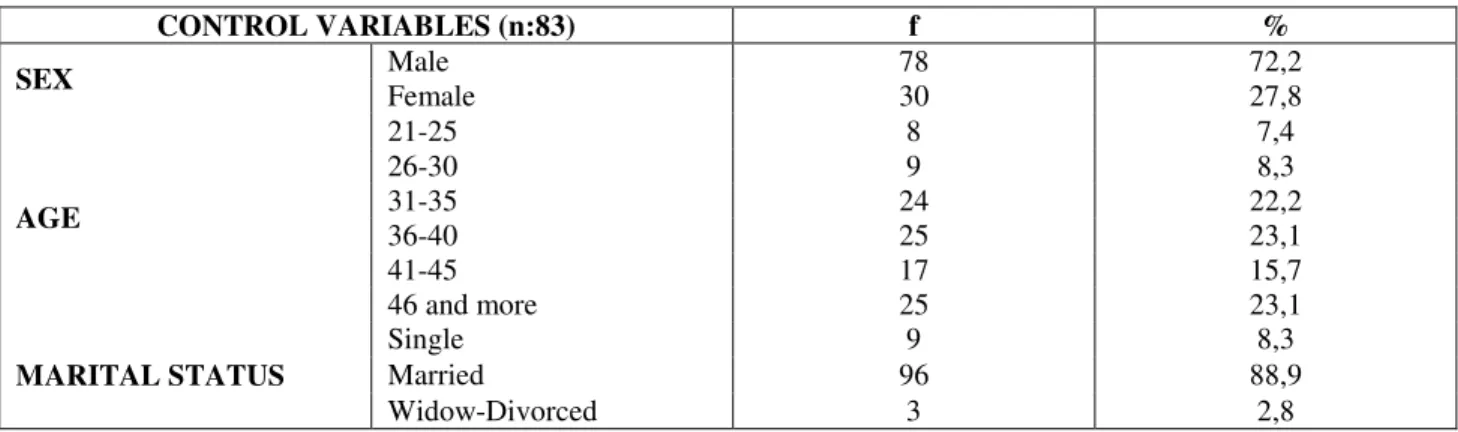
In the research along the analysis of factor and reliability there is a frequency (descriptive statistics) analysis. Table 3 shows the demographic profiles of respondents. % 72,2 of the respondent are male and % 27,8 of the respondent are female.
Table 3: Demographic Information of Respondents
CONTROL VARIABLES (n:83) f % SEX Male 78 72,2 Female 30 27,8 AGE 21-25 8 7,4 26-30 9 8,3 31-35 24 22,2 36-40 25 23,1 41-45 17 15,7 46 and more 25 23,1 MARITAL STATUS Single 9 8,3 Married 96 88,9 Widow-Divorced 3 2,8
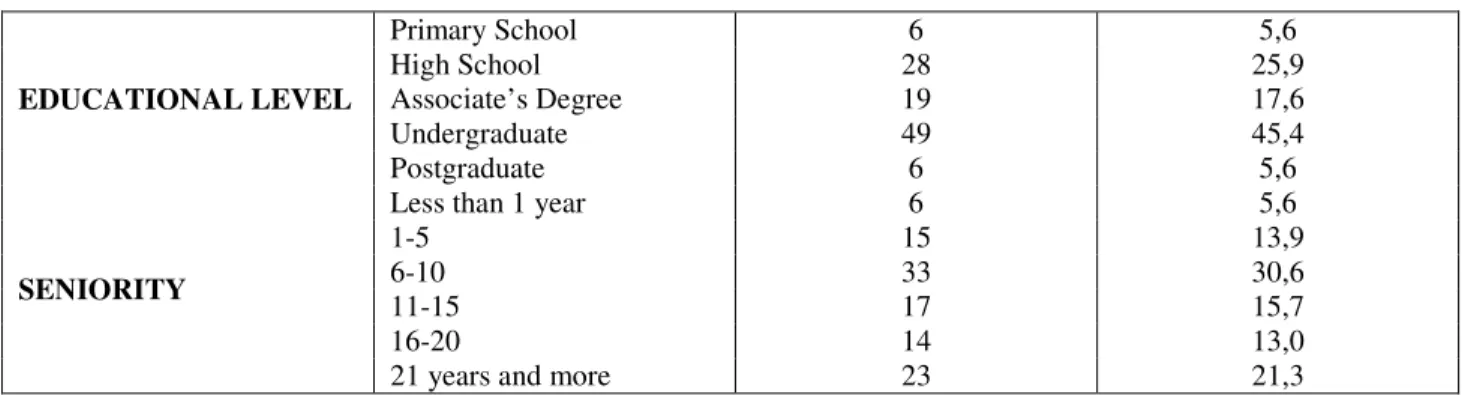
Table 3: Demographic Information of Respondents - continued EDUCATIONAL LEVEL Primary School 6 5,6 High School 28 25,9 Associate’s Degree 19 17,6 Undergraduate 49 45,4 Postgraduate 6 5,6 SENIORITY
Less than 1 year 6 5,6
1-5 15 13,9
6-10 33 30,6
11-15 17 15,7
16-20 14 13,0
21 years and more 23 21,3
Group of age are % 7,4 of the participant 21-25, % 8.3 of the participant 26-30, % 22,2 of the participant 31-35. % 61,9 of the employees are in the 36 and over 36 age group. So, most of the public officers which join the survey are in and over middle age. % 88,9 of respondents are married, % 8,3 of respondents are single and % 2,8 of respondents are widow and divorced. % 5,6 of respondents are primary school graduate, % 25,9 of respondents are high school graduated, % 17,6 of respondents have associate's degree. % 45,4 of respondents are university graduated. Also % 5,6 of respondents have master’s or doctorate degree. % 5,6 of the public officers have less 1 year seniority, % 13,9 of have between 1-5 year seniority, % 30,6 of have between 6-10 year seniority and % 50 of have more than 11 years seniority. So half of the employees have less 10 years seniority and half of them have more 10 years seniority.
5.4.3. Correlation Analysis
In this study the direction of relation between variables has been studied to specify with the Pearson correlation parameter. For the analysis of correlation the correlation parameters of leadership kinds via organizational citizenship behavior have been calculated. In the analysis of correlation the presence various levels of relations between charismatic, drawer and transformational leadership via organizational citizenship behavior has been specified. There is a significant and positive relation has been found at a level of (r: ,533) p<0.01 between the charismatic leadership and organizational citizenship behavior, at a level of (r: ,272) p<0.01 between the organizational citizenship behavior and drawer leadership and at a level of (r: ,494) p<0.01 between the organizational citizenship behavior and transformational leadership. So, these three leadership kinds are related with organizational citizenship behavior. Especially there is a more strong relation between the charismatic leadership and citizenship behavior from the other leadership kinds. When the charismatic leaderships determine a vision prudential, exhibit extraordinary behavior, take a personal risk, challenge the status quo, show awareness for the membership needs, the employees are useful for the organization and they exhibit extra role behavior.
Table 4: Correlations between Leadership Styles and Organizational Citizenship Behaviors
Mean S. D. 1 2 3 4 5 6 7 8 9 SEX 1,2778 ,44999 1 AGE 5,0093 1,52546 -,154 1 MS 1,9444 ,33020 ,105 ,261** 1 EL 3,1944 1,06304 ,218* -,214* -,235* 1 SN 3,8056 1,52523 ,039 ,652** ,071 ,104 1 CHRLD 3,1435 1,08837 -,060 -,161 -,155 -,298** -,305** 1 TRALD 3,4861 ,97025 ,127 ,019 -,002 -,197* -,153 ,625** 1 TFMLD 3,5648 1,12966 -,128 -,147 -,040 -,322** -,153 ,770** ,510** 1 ORGCIT 3,6740 ,79717 -,019 -,191* ,067 -,292** -,159 ,533** ,272** ,494** 1
MS: Marital State; EL: Education Level; SN: Seniority; CHRLD: Charismatic Leadership; TRALD: Transactional Leadership; TFMLD: Transformational Leadership; ORGCIT: Organizational Citizenship.
5.4.4. Findings Related Comparison the Level of Perception of Employee’s Leadership Style via their Demographic Properties
The following table includes the results of t-test which has been made related to compare the level of perception of employee’s leadership styles according to sexuality. In the Table 5 it is seem that there are close average in terms of man and woman employee’s level of perception of charismatic, drawer and transformational leadership styles, there is any significant difference between employees in terms of sexuality. So the Hypostasis 1 has been refused.
Table 5: The Results of the ANOVA Test of the Comparison of the Employees’ Perception Levels of
Leadership Styles versus Sex Variable
Subscales Sex n S.D. t Sig (p)
Charismatic leadership Male 78 3,1838 1,10410 ,618 ,734
Female 30 3,0389 1,05743 ,630
Transactional leadership Female Male 78 30 3,4103 3,6833 ,99265 ,89523 -1,315 -1,377 ,564 Transformational leadership Male 78 3,6538 1,12904 1,325 ,505
Female 30 3,3333 1,11675 1,332
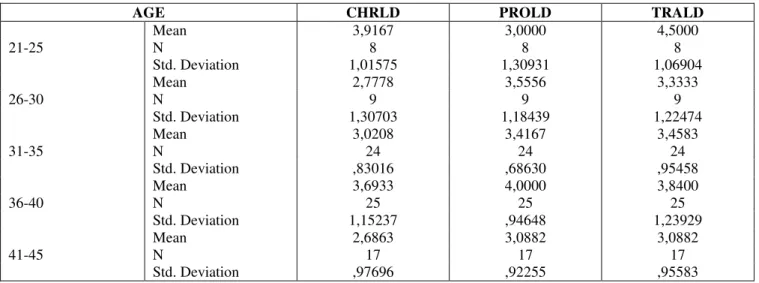
The results of Anova test which has been made in terms of comparison according to level of perception of leadership styles in employees’ age are showed in the following table. When Table 6 has been analyzed there is a significant differences has been found between the age and leadership kinds in employees. There is a significant difference has been found at a level of F = 3,566 and p: 0,05 between the charismatic leadership and age. There is a significant difference has been specified at a level of F = 2,602 and p: 0,29 between the drawer leadership and age. But transformational leadership is different from according to age. So, toward these findings it is clearly understood that Hypostasis 2 has been accepted partially.
Table 6: The Results of the ANOVA Test of the Comparison of the Employees’ Perception Levels of Leadership Styles versus Age Variable
AGE CHRLD PROLD TRALD
21-25 Mean 3,9167 3,0000 4,5000 N 8 8 8 Std. Deviation 1,01575 1,30931 1,06904 26-30 Mean 2,7778 3,5556 3,3333 N 9 9 9 Std. Deviation 1,30703 1,18439 1,22474 31-35 Mean 3,0208 3,4167 3,4583 N 24 24 24 Std. Deviation ,83016 ,68630 ,95458 36-40 Mean 3,6933 4,0000 3,8400 N 25 25 25 Std. Deviation 1,15237 ,94648 1,23929 41-45 Mean 2,6863 3,0882 3,0882 N 17 17 17 Std. Deviation ,97696 ,92255 ,95583
Table 6: The Results of the ANOVA Test of the Comparison of the Employees’ Perception Levels of Leadership Styles versus Age Variable -continued
46 and more Mean 2,9067 3,4400 3,5000 N 25 25 25 Std. Deviation 1,00009 ,91652 1,12731 Total Mean 3,1435 3,4861 3,5648 N 108 108 108 Std. Deviation 1,08837 ,97025 1,12966 F 3,566 2,602 2,258 Sig (p) ,005** ,029* ,054
The results of Anova test which has been made in terms of comparison according to level of perception of leadership styles in public officials’ marital status are showed in the Table 7. When Table 7 has been analyzed a significant difference between marital status and leadership kinds through public officers has not been found. A significant differences has not been found between the charismatic leadership via marital status at a level of F = ,967 and p>0,05; between the drawer leadership and marital status at a level of F = ,967 and p>0,05 and between transformational leadership and marital status at a level of F = ,189 and p>0,05. So, toward these findings Hypostasis 3 has been refused.
Table 7: The Results of the ANOVA Test of the Comparison of the Employees’ Perception Levels of Leadership Styles versus Marital Status Variable
MARITAL STATUS CHRLD PROLD TRALD
SINGLE Mean 3,5370 3,2778 3,7778 N 9 9 9 Std. Deviation 1,17786 ,75462 1,39443 MARRIED Mean 3,1319 3,5260 3,5417 N 96 96 96 Std. Deviation 1,07983 ,99570 1,12312 WIDOW-DIVORCED Mean 2,3333 2,8333 3,6667 N 3 3 3 Std. Deviation ,86603 ,28868 ,57735 Total Mean 3,1435 3,4861 3,5648 N 108 108 108 Std. Deviation 1,08837 ,97025 1,12966 F 1,437 ,967 ,189 Sig (p) ,242 ,384 ,828
The results of Anova test which has been made in terms of comparison according to level of perception of leadership styles in employees’ education levels are showed in the following table. When Table 8 has been analyzed a significant difference between education level and leadership kinds through employees has been found. A significant differences has been found between the charismatic leadership via education level at a level of F = 7,446 and p>0,00. A significant difference has been specified at a level of F = 2,900 and p:0,25 between the drawer leadership and education level. A significant differences has been found at a level of F=7,615 and p : 0,00 between the transformational leadership and education level. So, toward these findings Hypostasis 3 has been accepted.
Table 8: The Results of the ANOVA Test of the Comparison of the Employees’ Perception Levels of Leadership Styles versus Education Level Variable
EDUCATION LEVEL CHRLD PROLD TRALD
PRIMARY Mean 4,6667 4,6667 5,0000 N 6 6 6 Std. Deviation ,51640 ,51640 ,00000 HIGH SCHOOL Mean 3,5179 3,5536 4,0536 N 28 28 28 Std. Deviation 1,05051 1,10838 ,92636 ASSOCIATE’S DEGREE Mean 2,7368 3,3684 3,1316 N 19 19 19 Std. Deviation ,88072 ,72346 1,17665 UNDERGRADUTE Mean 2,8231 3,3265 3,2041 N 49 49 49 Std. Deviation ,99618 ,98187 1,07004 POSTGRADUATE Mean 3,7778 3,6667 4,1667 N 6 6 6 Std. Deviation 1,05760 ,25820 ,68313 Total Mean 3,1435 3,4861 3,5648 N 108 108 108 Std. Deviation 1,08837 ,97025 1,12966 F 7,446 2,900 7,615 Sig (p) ,000 ,025 ,000
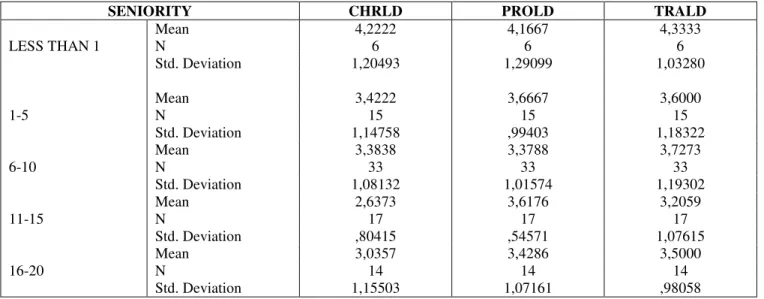
The results of Anova test which has been made in terms of comparison according to level of perception of leadership styles in employees’ seniorities are showed in the Table 9. A significant differences has been found between the charismatic leadership via seniority at a level of F = 3,309 and p>0,08. A significant difference has not been found between drawer leadership and transformational leadership via seniority. So, toward these findings Hypostasis 5 has been accepted partially.
Table 9 The Results of the ANOVA Test of the Comparison of the Employees’ Perception Levels of
Leadership Styles versus Seniority Variable
SENIORITY CHRLD PROLD TRALD
LESS THAN 1 Mean 4,2222 4,1667 4,3333 N 6 6 6 Std. Deviation 1,20493 1,29099 1,03280 1-5 Mean 3,4222 3,6667 3,6000 N 15 15 15 Std. Deviation 1,14758 ,99403 1,18322 6-10 Mean 3,3838 3,3788 3,7273 N 33 33 33 Std. Deviation 1,08132 1,01574 1,19302 11-15 Mean 2,6373 3,6176 3,2059 N 17 17 17 Std. Deviation ,80415 ,54571 1,07615 16-20 Mean 3,0357 3,4286 3,5000 N 14 14 14 Std. Deviation 1,15503 1,07161 ,98058
Table 9 The Results of the ANOVA Test of the Comparison of the Employees’ Perception Levels of Leadership Styles versus Seniority Variable -continued
21 AND MORE Mean 2,7754 3,2826 3,4130 N 23 23 23 Std. Deviation ,91094 ,97498 1,12464 Total Mean 3,1435 3,4861 3,5648 N 108 108 108 Std. Deviation 1,08837 ,97025 1,12966 F 3,309 1,052 1,138 Sig (p) ,008 ,391 ,345
5.4.5. Regression Analysis and Hypothesis Testing
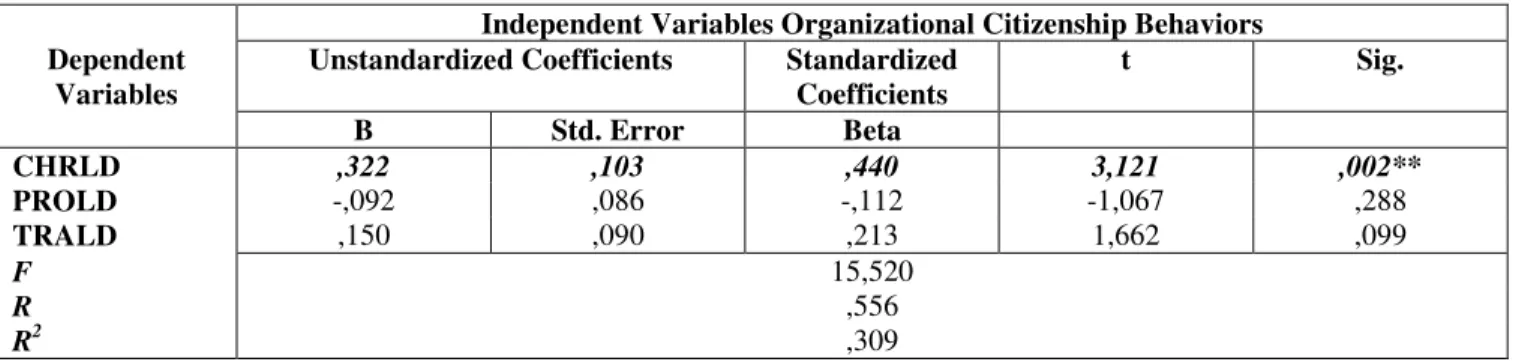
Analysis of regression has been used in order to testing hypothesis as part of researching. Analysis of regression is an analysis which has used two or more predictor variables. Table 10 includes results of analysis about the effect of charismatic, drawer and transformational leadership kinds on the citizenship behaviors for the personnel. In other words testing of the 6th, 7th, and 8th hypothesis which has been developed within researching model, has been reviewed with this analysis of regression. In the model, the kinds of leadership are independent variables; the behaviors of organizational citizenship are dependent variables. The F value in the regression model is a value which shows the significance of model. The model has been setting on the purpose of testing the relationship between leadership kinds and citizenship behaviors. The F value of the model is 15.520; this shows the model is meaningful. As is seen in the table there is a positive relationship between charismatic leadership and organizational citizenship behaviors at a level of (p: ,002**).
Table 10: Regression Analysis on the Effect of Leadership Styles on the Organizational Citizenship Behaviors
Dependent Variables
Independent Variables Organizational Citizenship Behaviors
Unstandardized Coefficients Standardized
Coefficients t Sig. B Std. Error Beta CHRLD ,322 ,103 ,440 3,121 ,002** PROLD -,092 ,086 -,112 -1,067 ,288 TRALD ,150 ,090 ,213 1,662 ,099 F 15,520 R ,556 R2 ,309 ** p < 0,01
As specified in the correlation analysis, the properties of charismatic leaderships cause the employees to exhibit extra role behaviors. The charismatic leadership win someone’s heart when they are interested in special needs, produce at the problems him, the success personnel undertaking a personal risk, to bring into safety for the personnel. When the employees see these offbeat behaviors of leadership, they display the citizen behaviors such as contribute the organizational development, beneficence, self-development, ownage, take care of work and gentlemanliness. They develop behavior which unexpected from them, unanticipated from the formal reward system and contributed positively for the organizational performance such as join a meeting voluntarily in favor of organization which they work, to learn and use new methods related their job, to help to their colleagues, to praise and defense the organization to terries. So, in light of this information H8 has been accepted. By contrast with there is any relationship found between drawer and transformational leadership via citizen behaviors and H6 and H7 has been refused.