Kastamonu Eğitim Dergisi
Kastamonu Education Journal
Eylül 2019 Cilt:27 Sayı:5
kefdergi.kastamonu.edu.tr
Footprints of Lifelong Learners: Occupational Health and Safety Course
Yaşam Boyu Öğrenenlerin Ayak İzleri: İş Sağlığı ve Güvenliği Eğitimi
Buket KİP KAYABAŞ
1, Sinan AYDIN
2Öz
Yaşamboyu öğrenme, bireyin bilgisini, becerisini, yeterliliklerini geliştirmek amacıyla yaşamı boyunca sürdürdü-ğü öğrenme faaliyetlerinin tümünü ifade etmektedir. Bu etkinlikler formal, non-formal ya da informal yapıda olabil-mektedir. Bu bakış açısıyla Anadolu Üniversitesi tarafından hazırlanan e-Sertifika Programları, bireylerin yaşamboyu öğrenme fırsatlarına ulaşabilmesi amacıyla geliştirilmiş ulusal ölçekli bir platformdur.
2016 yılında Aile, Çalışma ve Sosyal Hizmetler Bakanlığı’nın talebiyle Anadolu Üniversitesi tarafından İşveren ve İşveren Vekili İçin İş Sağlığı ve Güvenliği Hizmetleri e-Sertifika Programı hazırlanmıştır. Programın kapsamı Tür-kiye’deki elliden az çalışanı bulunan ve az tehlikeli sınıfta yer alan işletmelerin yöneticilerine yönelik olacak şekilde belirlenmiştir.
Bu araştırmanın amacı, 2016 yılından bu yana yaklaşık 80.000 kişinin katıldığı İş Sağlığı ve Güvenliği e-Sertifika Programı kapsamındaki eğilimleri belirlemektir. Programa katılan kişilerin yaş ortalaması 39 olup, %65,3’ü yükse-köğretim mezunu ve %51,4’ü işverendir. Katılımcıların en fazla yararlandıkları ders çalışma ortamı ders kitabıdır ve %80,7’si bu yapıdaki bir derse tekrar katılacaklarını ifade etmişlerdir.
Anahtar Kelimeler: açık ve uzaktan öğrenme, yaşam boyu öğrenme, açıköğretim, uzaktan eğitim, iş sağlığı ve güvenliği eğitimi
Abstract
Lifelong learning represents all learning activities undertaken throughout a person’s lifetime, with the aim of improving knowledge, skills and competencies. These activities can be undertaken in formal, non-formal as well as informal learning settings. From this point of view, Anadolu University e-Certificate Programs are national scale platform and have been developed as a solution to the need for lifelong learning in Turkey.
In 2016, upon the Ministry of Labour, Social Services and Family’s request, an OHS e-Certificate Program for Employer and the Representative of Employer, who have a workforce of fewer than 50 workers and a workplace that is classified as “less dangerous” has been designed by Anadolu University.
This research is designed to reveal the tendencies within the Occupational Health and Safety e-Certificate Prog-ram, which has almost 80,000 participants since 2016. The average age of participants is 39 and 65.3% are gradu-ates of higher education and 51.4% are employers. Participants have indicated that they are most likely to benefit from the course book during their study; 80.7% of them stated that they will re-participate in such course which is conducted through open and distance learning.
Keywords: open and distance learning, lifelong learning, open education, distance education, occupational he-alth and safety education
1 Anadolu Üniversitesi, Açıköğretim Fakültesi, Uzaktan Öğretim Bölümü, Eskişehir, Türkiye; https://orcid.org/0000-0002-3045-0454
Başvuru Tarihi/Received: 13.08.2018
Kabul Tarihi/Accepted: 18.12.2018
Extended Abstract
Introduction: With the rapid development of technology from the beginning of the 20th century and the same rapid
re-newal, development and updating of information have been preventing the ability of individuals to use their knowledge and skills throughout their whole lives and have been reminding them the need of renewal, development and up e-Certificate date themselves. With the need for individuals to access information constantly, lifelong learning has become a current issue. A learning system should be designed in accordance with the learners’ needs, tendencies and individual characteristics and the activities on this system should be carried out individually. Thus, learners will be able to benefit more from these courses that are not compulsory and easy to participate according to their learning needs and will be able to achieve higher efficiency.
Purpose: The purpose of this study is to investigate the reasons for students to participate in Anadolu University’s
e-Cer-tificate Program within the context of lifelong learning and to determine their levels of satisfaction, their tendencies and the materials they mostly use.
Methodology: In this study, the demographic characteristics of the participants, their frequency of using the learning
mate-rials, the preferences and satisfaction levels have been analyzed using descriptive statistical methods. Primarily, the demograp-hic information about the participants has been obtained from the registration application system. Demograpdemograp-hic information has included age, sex, education and occupation. Afterwards, a questionnaire has been prepared and emailed to the students, who were registered in the program to determine their reasons for participating, their levels of satisfaction and their learning material preferences.
Context: Anadolu University e-Certificate Programs are three-month certificate programs that have three courses through
the Internet, the exams are being conducted under supervision (Mutlu et al., 2007). A protocol on cooperation in course, exami-nation and documentation of Occupational Health and Safety services provided by the employer or the employer’s represen-tative in the workplace was signed on 9 October 2015 between Anadolu University and the Ministry of Labour, Social Services and Family. The employers and employer’s representatives, who have attended the certificate program designed with the cooperation of Anadolu University and Ministry of Labour, Social Services and Family can implement occupational health and safety services in enterprises in less hazardous class with less than fifty workers.
Results and Discussions: When the distribution of participants in terms of their educational level is examined, it is seen that
65.3% of them are university graduates, 24.7% of them are high school graduates and 10% of them are elementary graduates. Anyone who graduated from elementary school, high school or university and who is 18 years old could participate in the program because the e-certificate program does not have any prerequisite for graduation. By estimating that the elementary graduates would also participate in the program and the learning environment would be heterogeneous in terms of educati-onal levels, the contents of the program were designed to target all educatieducati-onal levels. It is believed that the participants are substantially university graduates, which is related to the willingness of those with a higher level of education to make more use of lifelong learning opportunities. However, when the distribution of participants according to their occupational group is examined, it is determined that 51.4% of them work as an employer in a workplace. Employers in the target group are able to implement occupational health and safety services in their workplaces once they are successful at the end of the program. Interestingly, it is found that those who are not employers, but will be employers in the future, have also participated in the e-certificate program. Participants included in the categories of government officer (6.9%), worker (3.8%), salesperson (1.7%) and student (0.8%) were evaluated within this concept. It can be argued that this e-certificate program takes participants one step forward during job applications and the document they have may be a reason to take jobs. 79.3% of them delivered their opinions as: “I am an employer/employer’s representative at the moment. I participated in to support myself and my job”. Yet, 11.8% of participants, even though they are not employers at the moment, stated that they would use the document to carry out the related services in the future when they are employers. 2.1% the lowest rate addresses the interest in the subject area, in other words, the curiosity about the area. When the studies in the field are examined (Kay et al., 2013, p. 761; Seaton et al., 2014, p. 58), it is stated that individuals are most popularly involved in participation in open and distance learning practices due to curiosity about the subject area. Since the e-Certificate program serves a professional area, it can be said that the rea-son for participating is to carry out the related services rather than the curiosity about the subject area. Most of the 53.2% of respondents indicated that they benefit from the course book (Table 6). Then, they stated that they used respectively the video lecturing, pilot test, exercises, one-question-one-answer and discussions. Grainger (2013, p. 36) found that 80% of the students prefer to watch the video lecturing and 4% of them prefer to participate in the discussion forum; similarly Seaton et al. (2014, p. 58) stated that the most preferred learning materials are video lecturing and homework, followed by discussion forums. The participants who used mostly the course books can be identified with their learning habits, which lead them to read rather than watching video lectures or expressing their opinions. Furthermore, Newman&Oh (2014) stated as the educational level of stu-dents gets higher, the variety of used materials increase. 68.5% of the registered people in the Occupational Health and Safety e-Certificate Program are university graduates and they indicated to use all learning materials. Lastly, 85.1% of the participants stated that they were satisfied with the program and they would recommend it to another person. For future research, the students who expressed negative opinions can be interviewed to take their opinions about the obstacles for satisfaction. Mo-reover, 80.7% of the participants stated that they would like to participate in such course again, which designed and conducted through open and distance is learning. Students can be encouraged to participate in the other e-certificate programs offered in different areas and to take advantage of lifelong learning opportunities.
1. Introduction
With the rapid development of technology from the beginning of the 20th century and the same rapid renewal, de-velopment and updating of information have been preventing the ability of individuals to use their knowledge and skil-ls throughout their whole lives and have been reminding them the need of renewal, development and update them-selves. With the need for individuals to access information constantly, lifelong learning has become a current issue.
The concept of lifelong learning has many definitions, but according to some of them lifelong learning is; a process of accomplishing personal, social and professional development throughout the lifespan of individuals, in order to enhance the quality of life of both individuals and their collectives (Dave, 1976, p. 12), offers the education to an indi-vidual throughout their lives (Kulich, 1982, p. 123), helps indiindi-viduals to get the required information to manage their own life (White, 1982, p. 75), personal, planned, unplanned, experience-based development (Holmes, 2002, p. 2), all formal, non-formal or informal learning activities undertaken throughout life with the aim of improving knowledge, skills and competencies of individuals (European Commission, 2002) a whole of individual and institutional learning (Jarvis, 2004, p. 130).
In brief, lifelong learning can be defined as a learning process that includes a lifespan of an individual, in order to help him/her to be successful in social and professional life, to face the problems head-on, to come up with solutions and to access the information with the aim of improving knowledge, skills and competencies.
European Parliament defines lifelong learning as an essential policy for the development of active citizenship, social cohesion and employment, while it is also emphasized that it must be perceived as a process that should be spread to every step of life from birth to death rather than being compulsory (Gündoğan, 2003, p. 3).
The objectives of lifelong learning are (European Commission, 2002):
• To build an education system to ensure that all individuals have an equal and adequate opportunity to access to quality education throughout their lives, considering the needs of individuals,
• To ensure individual adaptation and social integration in innovations that change the professional knowledge, skills and methods rapidly,
• To encourage active participation of individuals in every step of social, cultural and political life and to equip them with the necessary qualifications.
It is emphasized that in the lifelong learning process, an approach is taken where the individuals are at the center, the role of the school has changed and non-formal learning has been more important, the weight of the state in the learning process has decreased, social roles are strengthened, and learning experiences are not limited in a certain amount of time (Güleç et al., 2012, p. 34; Wain, 1993, p. 58).
Lifelong learning covers a wide range of learning processes from structured to unstructured learning experiences (CERI, 2001; OECD, 2004). Learners are in the center in terms of their individual needs, demands, learning styles and characteristics in the lifelong learning process. Individuals experience their learning processes, their own motivation and will have individual learning experiences during their lifetime. Thus, individuals who achieve economic, cultural and social benefits through lifelong learning opportunities will be more participative and active citizens in society.
Although they differ according to the needs and educational policies of the countries, lifelong learning activities are not only constructed with economic concerns and not restricted to the adults; but they also include all formal, non-formal and informal learning opportunities for all learners to help them to become more active citizens in society by considering their social, cultural and professional developments.
One of the most important areas that confirm the lifelong learning approach as an ongoing process throughout an individual’s lifespan is an open and distance learning practices with their characteristics and offered possibilities. Open and distance learning practices remove either all or part of the barriers and restrictions, such as quota in higher education institutions, educational programs that need to be completed, educational levels and age limits. Open and distance learning provides flexibility to learn without preconditions, in addition to this, as a learning philosophy, it maintains openness by providing opportunities for individuals to learn at any age, any time and any place they wish.
The reasons why individuals participate open and distance learning practices vary in a wide variety, depending on the characteristics of the programs and the opportunities they offer. According to researchers, the most popular reason for participating open and distance learning practices is the interest in the subject area (Kay et al., 2013, p. 761; Seaton et al., 2014, p. 58). Similarly, in another study, researchers noted that the main reasons for learners to participate in
these practices are the interest in the course content and the wish to improve their professional skills (Gaebel, 2013, p. 7; Wang & Baker, 2015, p. 17).
However, in open and distance learning practices, learners may not interact with the whole course material. Some learners prefer to watch video lectures, while others may prefer to comment on the discussion forum or to follow up existing discussion topics. The learners would prefer to use different learning materials according to their individual characteristics, learning styles and habits.
Grainger (2013, p. 36) identified that 80% of the students prefer to watch video lectures primarily among other learning materials; only 4% of them participate in the discussion forum. However, Seaton et al. (2014, p. 58) conducted a research on open and distance learning platform to explore the characteristics of the students and their use of course resources; according to this research, the most popular learning environments are video lectures and homework fol-lowed by discussion forums. Another study on demographic characteristics of students conducted by Newman&Oh (2014) suggested that the majority of students are holding a Bachelor’s degree and as the educational level gets higher the more they tend to use materials. Researchers have stated that the students with a master’s degree or Ph.D. use almost all learning materials.
A learning system should be designed in accordance with the learners’ needs, tendencies and individual characteris-tics and the activities on this system should be carried out individually. Thus, learners will be able to benefit more from these courses that are not compulsory and easy to participate according to their learning needs and will be able to achieve higher efficiency. The purpose of this study is to investigate the reasons for students to participate in Anadolu University’s e-Certificate Program within the context of lifelong learning and to determine their levels of satisfaction, their tendencies and the materials they mostly use.
Pupose and Questions
The objectives of this study are to investigate the reasons for students to participate in Anadolu University’s e-Cer-tificate Program within the context of lifelong learning and to determine the materials they mostly use, their levels of satisfaction.
With this general purpose, answers to the following questions are investigated: 1. What are the reasons for participants to participate?
2. Which materials use the participants, mostly and how frequent? 3. What is the satisfaction level of the participants in the program?
2. Methodology
In this study, the demographic characteristics of the participants, their frequency of using the learning materials, the preferences and satisfaction levels have been analyzed using descriptive statistical methods.
Primarily, the demographic information about the participants has been obtained from the registration application system. Demographic information has included age, sex, education and occupation. Afterwards, a questionnaire has been prepared and emailed to the students, who were registered in the program to determine their reasons for parti-cipating, their levels of satisfaction and their learning material preferences.
Demographic information about the participants and questionnaire results have been given in the section of the Results.
The context of the Research
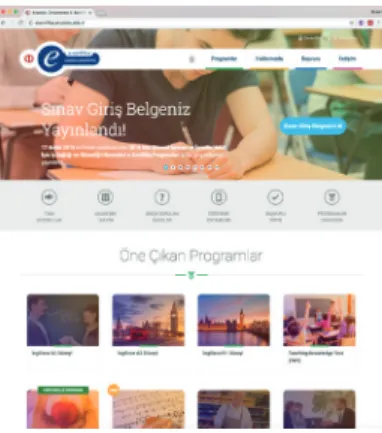
Anadolu University Open Education System is the major attempt in integrating the lifelong learning practices with its system to offer bachelor’s degree and associate degree diplomas, since February 2007, e-Certificate Programs th-rough Internet (http://esertifika.anadolu.edu.tr) (Figure 1). Anadolu University e-Certificate Programs are three-month certificate programs that have three courses through the Internet, the exams are being conducted under supervision (Mutlu et al., 2007).
Figure 1. The Web site of e-Certificate Programs (http://esertifika.anadolu.edu.tr)
Anadolu University’s e-Certificate Programs, which started for the first time in the 2006-2007 spring semester, aim to provide continuous education for three semesters per year and provide current academic content (Mutlu et al., 2014).
Anadolu University’s e-Certificate Programs offer a chance to move one step forward to individuals and businesses. Along with the individuals, who aim for self-improvement and a better career, e-Certificate Programs offer solutions to the problems of businesses that want to work with more qualified staff, but have no time and opportunity to train their staff.
Individuals who did not have a chance to attend university, employees who have completed their university educati-on but want to enhance their knowledge of a different field, entrepreneurs who want to enhance their knowledge and skills in the field of business and economics can benefit from e-Certificate Programs. Besides, institutions and organiza-tions can lead their staffs, who already are spread all over other regions to Anadolu University’s e-Certificate Programs to provide them with a standard education. Institutions and organizations can plan course needs of their employees in an effective, economical and flexible way by taking advantage of e-Certificate Programs.
A protocol on cooperation in course, examination and documentation of Occupational Health and Safety services provided by the employer or the employer’s representative in the workplace was signed on 9 October 2015 between Anadolu University and the Ministry of Labour, Social Services and Family.
The employers and employer’s representatives, who have attended the certificate program designed with the coo-peration of Anadolu University and Ministry of Labour, Social Services and Family can implement occupational health and safety services in enterprises in less hazardous class with less than fifty workers.
The program, to which all 18-years-old can participate, takes place three times a year for 12 weeks, in the spring, summer and winter.
Within the context of the certificate program, a course book has been prepared which will address different age and education levels. The course book includes more case studies are included and the students can get it from the local bu-reau of Open Education Services where the participants live (81 provinces) (Figure 2).
Figure 2. The Coursebook of Occupational Health and Safety Services for Employers and Employer’s Representative
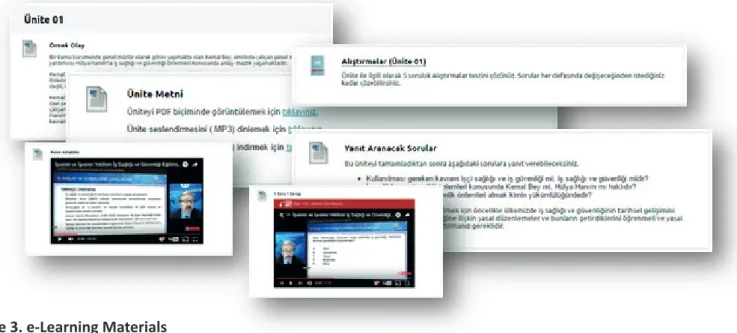
In addition to the course books, pdf files, exercises, case studies, video lectures, one-question-one-answer videos and the records of e-seminars can be found on the e-learning portal (Figure 3). Participants can benefit from the ma-terials by determining the appropriate learning environment for their individual characteristics and learning habits.
Participants, who succeeded in the exam by taking advantage of the course book and e-learning materials for 12 weeks are able to implement occupational health and safety services themselves in the workplaces in less hazardous class with less than fifty workers.
Figure 3. e-Learning Materials Research Group
This study is designed to reveal the tendencies of 79,586 people who attended for 3 semesters of the Occupational Health and Safety e-Certificate Program since its launch.
Table 1. Distributions of Participants by Sex
Participants Female 20,146
Male 59,440
Total 79,586
The demographic characteristics of the study were examined in terms of sex, age, educational level and profession. According to the distribution of participants by sex that was examined, 25.3% were female and 74.7% were male (Table 1). As for the examination of the age distribution, it was determined that the participants were between 18 and 78 years old and that the average was 39.2%.
When the distribution of participants in terms of their educational level is examined, it is seen that 65.3% of them are university graduates, 24.7% of them are high school graduates and 10% of them are elementary graduates. Anyo-ne who graduated from elementary school, high school or university and who is 18 years old could participate in the program because the e-certificate program does not have any prerequisite for graduation.
Table 2. Distributions of Participants by Educational Level
Level % School Type %
Elementary School 10 Elementary School 10
High School 24.7 General High School 16.1
Vocational High School 4.8
Open High School 1.3
Other School Types 1.1
Religious Vocational School 0.8
Anatolian High School 0.6
University Education or Higher 65.3 Bachelor’s Degree 48.3
Associate Degree 11.3
Master Degree 5.3
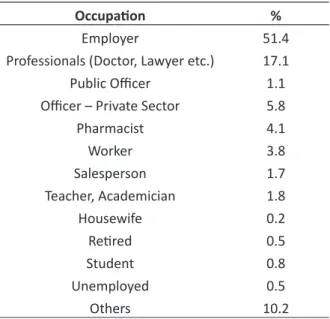
However, when the distribution of participants by profession was examined, 51.4% of them were stated to be employers. Those who attended the program that designed with the cooperation of the Ministry of Labour, Social Services and Family can implement occupational health and safety services in enterprises in less hazardous class with less than fifty workers. For this reason, the target occupational group is the employers who have a workforce of fewer than 50 employees. In fact, it has been determined that those, who are not employers but will be in the future, have also participated in the e-certificate program. Participants included in the categories of officer (6.9%), worker (3.8%), salesperson (1.7%) and student (0.8%) were evaluated within this concept.
Table 3. Distributions of Participants by Occupational Group
Occupation %
Employer 51.4
Professionals (Doctor, Lawyer etc.) 17.1
Public Officer 1.1
Officer – Private Sector 5.8
Pharmacist 4.1 Worker 3.8 Salesperson 1.7 Teacher, Academician 1.8 Housewife 0.2 Retired 0.5 Student 0.8 Unemployed 0.5 Others 10.2 3. Findings
A questionnaire was prepared to determine the reasons for students to participate in the program, their satisfaction levels and preferences of learning materials. It was emailed to 79,589 students, who registered between the years of 2016-2018. 45.79% of people opened and read the email. 16.99% of those who read the email, clicked the link and accessed the questionnaire. 4,470 people participated in the questionnaire on which voluntary participation was based and delivered their opinions.
Table 4. Distribution of Participants by Sex According to Questionnaire
Sex f %
Male 3,585 80.2
Female 885 19.8
Total 4,470
When the distributions of participants who delivered their opinions through questionnaire were examined by sex, it is seen that 19.8% were women and 80.2% were men (Table 4). When the reasons to participate in this program were examined, it is seen that they aimed to carry out occupational health and safety services in their enterprises after being successful and getting a document. 79.3% of them delivered their opinions as: “I am an employer/employer’s representative at the moment. I participated in to support myself and my job”. Additionally, 11.8% of participants, even though they are not employers at the moment, stated that they would use the document to carry out the related services in the future when they will be employers. 2.1% the lowest rate addresses the interest in the subject area, in other words, the curiosity about the area (Table 5).
Tablo 5. Participants’ Reasons For Participating in The Program
What is your reason to participate in the e-Certificate Program? f %
I am an employer/employer’s representative at the moment. I participated in to support myself and my job. 3,545 79.3 I am not an employer/employer’s representative at the moment. I participated to benefit when I become in the future. 530 11.8
I participated in self-improvement. 190 4.3
The learning materials are the course book, video lecturing, trial exam, exercises, discussions, one question-one answer. Participants were asked about the e-learning material the most they use and they thought was the most ben-eficial. Most of the 53.2% of respondents indicated that they benefit from the course book (Table 6). Then, they stated that they used respectively the video lecturing, pilot test, exercises, one-question-one-answer and discussions.
Furthermore, participants indicated that the course book was the most useful learning with 40.7% (Table 6). The course book is followed respectively by video lecturing, trial exam, exercises, one question-one answer and discussions.
Table 6. Participants’ Learning Materials Preferences
Which learning material did you use the most? f %
Course Book 2,390 53.2
Video Lecturing 756 17.0
Trial Exam 744 16.6
Exercises 214 4.7
One Question-One Answer 192 4.3
Discussions 174 3.9
Which learning environment do you think is the most useful?
Course Book 1,818 40.7
Video Lecturing 1081 24.2
Trial Exam 758 17.0
Exercises 305 6.8
One Question-One Answer 284 6.3
Discussions 224 5.0
The e-Certificate Program is offered during 12 week education period after registration. Participants are prepared for the certification exam by making use of the course book and e-learning materials for 12 weeks. When the partici-pants are asked if the duration of the program was sufficient for studying, a significant 81.7% of them stated that it was sufficient (Table 7).
Table 7. Opinions Related to Learning Period of Program
Was the duration of the program sufficient? f %
Yes 3,651 81.7
No 819 18.3
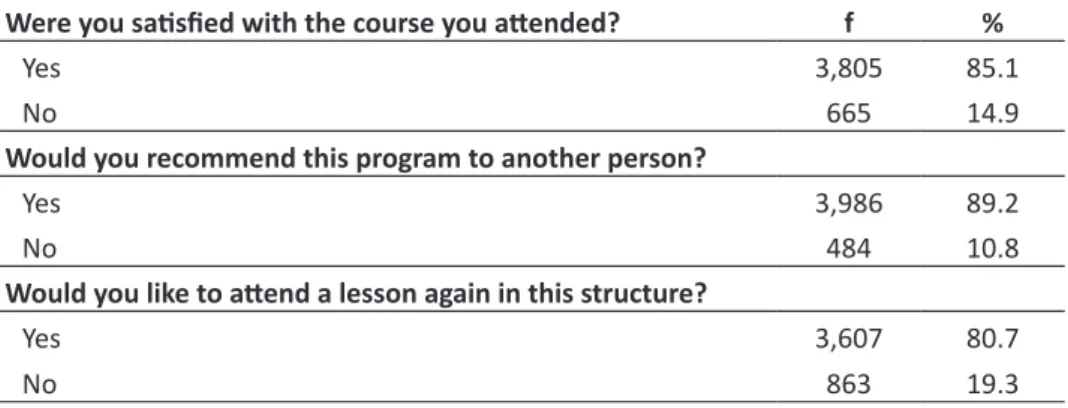
Finally, participants were asked about their satisfaction with the program and 85.1% were satisfied with the prog-ram and 14.9% were not satisfied. 89.2% of the participants stated that they would recommend the progprog-ram to others, and 80.7% stated that they would like to re-participate in such course again which is designed and conducted through open and distance learning (Table 8).
Table 8. Opinions Regarding Participants’ Satisfaction
Were you satisfied with the course you attended? f %
Yes 3,805 85.1
No 665 14.9
Would you recommend this program to another person?
Yes 3,986 89.2
No 484 10.8
Would you like to attend a lesson again in this structure?
Yes 3,607 80.7
4. Results and Discussions
Lifelong learning activities, conducted through open and distance learning, offer opportunities for individuals to become an active citizenship in society by taking into account their social, cultural and professional development. The purpose of this study is to investigate the reasons for students to participate in Anadolu University’s e-Certificate Prog-ram within the context of lifelong learning and to determine the materials they mostly use, their levels of satisfaction.
When the distribution of participants in terms of their educational level is examined, it is seen that 65.3% of them are university graduates, 24.7% of them are high school graduates and 10% of them are elementary graduates. An-yone who graduated from elementary school, high school or university and who is 18 years old could participate in the program because the e-certificate program does not have any prerequisite for graduation. By estimating that the elementary graduates would also participate in the program and the learning environment would be heterogeneous in terms of educational levels, the contents of the program were designed to target all educational levels. It is believed that the participants are substantially university graduates, which is related to the willingness of those with a higher level of education to make more use of lifelong learning opportunities.
However, when the distribution of participants according to their occupational group is examined, it is determined that 51.4% of them work as an employer in a workplace. Employers in the target group are able to implement occupa-tional health and safety services in their workplaces once they are successful at the end of the program. Interestingly, it is found that those who are not employers, but will be employers in the future, have also participated in the e-certi-ficate program. Participants included in the categories of government officer (6.9%), worker (3.8%), salesperson (1.7%) and student (0.8%) were evaluated within this concept. It can be argued that this e-certificate program takes partici-pants one step forward during job applications and the document they have may be a reason to take jobs.
79.3% of them delivered their opinions as: “I am an employer/employer’s representative at the moment. I participa-ted in to support myself and my job”. Yet, 11.8% of participants, even though they are not employers at the moment, stated that they would use the document to carry out the related services in the future when they are employers. 2.1% the lowest rate addresses the interest in the subject area, in other words, the curiosity about the area. When the studies in the field are examined (Kay et al., 2013, p. 761; Seaton et al., 2014, p. 58), it is stated that individuals are most popularly involved in participation in open and distance learning practices due to curiosity about the subject area. Since the e-Certificate program serves a professional area, it can be said that the reason for participating is to carry out the related services rather than the curiosity about the subject area.
Most of the 53.2% of respondents indicated that they benefit from the course book (Table 6). Then, they stated that they used respectively the video lecturing, pilot test, exercises, one-question-one-answer and discussions. Grainger (2013, p. 36) found that 80% of the students prefer to watch the video lecturing and 4% of them prefer to participate in the discussion forum; similarly Seaton et al. (2014, p. 58) stated that the most preferred learning materials are video lecturing and homework, followed by discussion forums. The participants who used mostly the course books can be identified with their learning habits, which lead them to read rather than watching video lectures or expressing their opinions. Furthermore, Newman&Oh (2014) stated as the educational level of students gets higher, the variety of used materials increase. 68.5% of the registered people in the Occupational Health and Safety e-Certificate Program are university graduates and they indicated to use all learning materials.
Lastly, 85.1% of the participants stated that they were satisfied with the program and they would recommend it to another person. For future research, the students who expressed negative opinions can be interviewed to take their opinions about the obstacles for satisfaction. Moreover, 80.7% of the participants stated that they would like to re-participate in such course again, which designed and conducted through open and distance is learning. Students can be encouraged to participate in the other e-certificate programs offered in different areas and to take advantage of lifelong learning opportunities.
Although this study has given a point of view, it is limited to the collected data by the participants who participated in a program. The context of the research can be expanded by examining the tendencies of the participants in other e-certificate programs.
5. References
CERI (2001). Centre for Educational Research and Innovation. Education Policy Analysis. OECD, Paris. Dave, R. H. (1976). Foundations of Lifelong Education. Oxford: Pergamon Press.
European Commission. (2002). European Commision, European Report on Quality of Lifelong Learning, Brussels. (Accessed: April 2018) http://www.aic.lv/bolona/Bologna/contrib/EU/report_qual%20LLL.pdf
Gaebel, M. (2013). MOOCs: Massive Open Online Courses. Belgium, Brussels: EUA Occasional Papers.
Grainger, B. (2013). Massive Open Online Course (MOOC) Report. The University of London Intern’l. Academy, (Accessed: April 2018) http://www.londoninternational.ac.uk/sites/default/files/documents/mooc_report- 2013.pdf
Güleç, İ., Çelik, S. ve Demirhan, B. (2012). Yaşam Boyu Öğrenme Nedir? Kavram ve Kapsami Üzerine Bir Değerlendirme. Sakarya
University Journal of Education, 2(3), 34-48.
Gündoğan, N. (2003). Avrupa Birliği’ne Üye Ülkelerde Bir İstihdam Politikası Aracı Olarak “Yaşamboyu Öğrenme” ve Bazı Örnek Program ve Uygulamalar. Kamu İş 7(2).
Holmes, A. (2002). Lifelong learning. Oxford: Capstone Publishing.
Jarvis, P. (2004). Adult Education and Lifelong Learning: Theory and Practice (3rd ed.). Routledge.
Kay, J., Reimann, P., Diebold, E., & Kummerfeld, B. (2013). MOOCs: So many learners, so much potential. IEEE Intelligent Systems,
28(3), 70–77. DOI:10.1109/MIS.2013.66
Kulich, J. (1982). Lifelong education and the universities: A Canadian perspective. International Journal of Lifelong Education, 1(2), 123–142.
Mutlu, M.E., Özöğüt Erorta, Ö., Kayabaş, İ ve Kip, B. (2007). Açıköğretimde E-Sertifika Programlarının Tasarımı. Akademik Bilişim
2007. Dumlupınar Üniversitesi, Kütahya.
Mutlu, M.E., Özöğüt Erorta, Ö., Kip Kayabaş, B. ve Kayabaş, İ. (2014). Anadolu Üniversitesi Açıköğretim Sisteminde e-Öğrenmenin Gelişimi. İçinde Özkul, A.E., Aydın, C.H., Kumtepe, E.G. ve Toprak, E. (Ed.). Açıköğretimle 30 Yıl (ss. 1-58). Anadolu Üniversitesi Yayınları, ISBN:97975-06-1754-6
Newman, J., & Oh, S. (2014). 8 things you should know about MOOCs. Chronicle of Higher Education, (Accessed: April 2018) http://chronicle.com/article/8-Things-You-Should-KnowAbout/146901/
OECD Observer. (2004). Lifelong Learning, Policy Brief, (Accessed: April 2018)http://www.oecd.org/ dataoecd/17/11/29478789. pdf
Seaton, D. T., Bergner, Y., Chuang, I., Mitros, P. & Pritchard, D. E. (2014). Who does what in a massive open online course?
Com-munication of ACM, 57(4), 58–65.
Wain, K. (1993), Lifelong education: illiberal and repressive?. Educational Philosophy and Theory, 26(1) 58 - 70.
Wang, Y. & Baker, R. (2015) Content or Platform: Why do students complete MOOCs? MERLOT Journal of Online Learning and
Teaching, 11(1), 17-30.