PRO-EUROPEAN lEGISLATIVE BEHAVIORS IN THE 22
ndPERIOD TURKISH GRAND NATIONAl ASSEMBlY:
AlOGIT MODEl
Yrd. Doç. Dr. Harun Ankan
K. Maraş Sütçü Imam Üniv. Iktisadi ve Idari Bilimler Fakültesi
Yrd. Doç. Dr. Mehmet C. Mann
K. Maraş Sütçü Imam Üniv. Iktisadi ve Idari Bilimler Fakültesi
••
•
Yrd. Doç. Dr.Mustafa Çolak
K. Maraş Sütçü Imam Üniv. Iktisadi ve idari Bilimler Fakültesi
! !,
I,
i22. Dönem TBMM Milletvekillerinin Avrupa Birliği'ne Yönelik Yasal Düzenlemelere Katılımı: Bir Logit Model
Özet
Avrupa entegrasyon süreci, aday ülkelerin ekonomik, sosyal ve siyasal mevzuatlannı Birligin politikalan ile uyumlu hale getirmelerini zorunlu kılmaktadır. Aday ülkelerin ulusal hukuk sistemlerinin AB ile uyumlaştınna sürecinin arka planındaki temel unsur, üyelik müzakereleri'nin getirecegi yüksek maliyeti en aza indirme esasına dayanmaktadır. Diger taraftan, Avrupa entegrasyon sürecinin ekonomik ve politik boyutlan, üye ve aday ülkelerin gelişmekte olan bölgeleri için ekonomik fırsatlar sunmasının yanı sıra, wrluklan da beraberinde getirmektedir.
Bu çalışma, 22. Dönem Türkiye Büyük Millet Meclisi Milletvekillerinin Türkiye'nin Avrupa Birligi ile bütünleşme sürecindeki yasal düzenlemelere katılımlannın bölgelere göre nasıl farklılıklar gösterdigini bir logit modeli ile test etmektedir.
Anahtar Kelimeler: Avrupa Birligi, davranış, logit model, milletvekilleri, TBMM, uyum yasalan.
Abstract
Economic and political integration of the European Union (EU) requires the prospective members to make changes in their economic and political structures in line with those of the Union. Most changes are aimed at harmonization of nationallegislative structures with those of the EU to avoid large costs associated with accession process.
The Union's economical and political diniensions also create new opportunities and challenges for regions within the member states and candidate countries, depemling on how well their economic relations are with the Union and future economical and political expectations from the accession.
This paper empirically tests regional effects on the pro-European legislative activities of the representatives in the 22"d Period Turkish Grand National Assembly (TGNA) through a logit modeL.
Keywords: Behaviors, European Union, logit model, memberof parliaments, pro-European legislation, Turkish Grand National Assembly.
34 eAnkara Üniversitesi SBF Dergisi e 60-3
Pro- European
Legislative Behaviors in the 22
ndPeriod Turkish Grand National Assembly:
A Logit Model
Introduction
October 2005 will be a crucial moment along the European integration path. The EU of 25 member states will start an accession talks with Turkey. Since the Ankara Agreement in 1963, the European integration project has elearly taken different directions, but the final destination of an "ever closer" Union seems to have remained constant (ARIKAN/ VASSALLO). Therefore, the EU' s policy towards Turkey has become a potentially important factor in affecting the discussion about the EU' s integration process.
Nevertheless, EU- Turkey relations have been extensively analyzed by
both Turkish and Western scholars with the focus mainıyon political,
economic, cultural and security issues. However, other aspects of relations have been, to a large extent, ignored in the existing literature on EU- Turkey relations. Therefore, this study is aimed to contribute to literature by using a different approach to analyze EU-Turkey relations through the examining of pro-European legislative behaviors of members of Turkish Grand National Assembly (TGNA) on the basis of regional economic and political factorso
in many ways, Turkey's main international and domestic policy issues are being discussed and thus developed at Turkish Grand National Assembly. Therefore, interest group s based on different regions and provinces in the country make every effort to pursue their interests by politically pressuring or convincing representatives, especially ministers in the government (MARIN / ÇOLAK / YOLCU, 2004). Furthermore, members of TGNA need to take into account regional and urban interests of their regions in order to get reelected. Thus, representing and protecting of the regional and urban İnterests by representatives at the Turkish Parliament could be seen as the most efficient
Harun Ankan - Mehmet C. Mann - Mustafa Çolak e Pro-European Legislative Behaviors e 35
political investment for the future (MARIN / ÇOLAK / YOLCU, 2004). This indicates that representatives of TNGA are willing to pursue regional and urban interests of their region as long as their legislative activities create a good image of apolitician to local issues.
This study was conducted to better understand regional differences on the pro-European legislative behaviors of the representatives in the 22nd period
Turkish Grand National Assembly. Some scholars in Turkey argue that westem part of Turkey including the Marmara and Aegean Regions were pro-European, whereas the Central Anatolian region surrounding Ankara and Eastem part of Turkey was nationalistic.! According to this hypothesis, the capital and media in westem regions of Turkey were pro-European, due to their strong organic relations with their European counterparts. On the contrary, Central Anatolia and Eastem part of Turkeyare nationalist and more concemed with national interest and development of a national capitaL.
in this respect, this is probably the fırst study conducted in Turkey to fiıı a gap by empiricaııy testing several hypotheses related to regional effects on the pro-European legislative behaviors of members of TGNA. The fırst section of this study briefly examines views of Turkish political parties on Turkey's EU membership bid. Then, it evaIuates regional effects on the pro-European legislative activities of the representatives in the 22nd Period Turkish Grand
National Assembly (TGNA) through a logit modeL. The last section of the paper introduces some final interpretations about policy approaches of representatives of TGNA over EU- Turkey relations.
Views of Turkish Political Parties on Turkey's EU
Membership Bid
As the experiences of Central and Eastem European Countries (CEECs) in their relations with the EU suggest that political parties have an effect on representatives' attitudes towards the EU's matters. To see how political parties in Turkey may side on the integration debate, it is important to fırst examine general approach of political parties towards Turkish accession to the EU. Joining the EU appears to be the main foreign policyobjective of political
parties represented in the Turkish Parliament. The ruling J ustice and
ı
For example, in the opening speech of the Uludag University' s First National Young Scientists Symposium, held by Uludag University in Bursa on 6-7 May 2004, Professor Dr. Anıl Çeçen supported this contention.36 e Ankara Üniversitesi SBF Dergisi e 60-3
Development Party (AKP) have initiated radical policy reforms in domestic politic in order to meet political expectations of the EU. However, given that some of Party members made public statements which were not compatible with principles of secular democracy, policy reforms initiated by the AKP has created some daubs and concems in the Turkish society (MüFTüLER-BAC, 2004:435). As one Turkish scholar puts it, "certain group s might perceive political reforms to increase freedom of expressions attempt to increase the role of political Islam in Turkey disguised as adjustment to the Copenhagen criteria"
(MüFTüLER-BAC, 2004:435). Although number of policy reforms of AKP
and its Cyprus policy have met some resistance from a number of political actors in Turkey, the Party has successfully legitimized thesereforms by using the EU membership carroL
People's Republic Party (CHP), as an opposition party, has also dec1ared that EU membership is a politicalobjective of the Party. in fact, the Party has
supported the reform packages introduced by the AKP GovemmenL
Nevertheless, some leading figures in the Party have been reluctant to some policy reforms initiat'ed by the Govemment to comply with the accession criteria. For example, they objected to AKP' s flexible approach to the Cyprus issue and some policy reforms granting cultural rights for minorities (KİRİŞCi, 2004: 13). OveralL, despite some policy differences in specific policy issues, the two major Parties have a tendency to support for Turkey' s accession to the EU.
Model of the Study
The study utilized a logit model to determine regional effects on pro-European legislative behaviors of the representatives, due to the nature of data and its better results among several experiments. in a logit model, the dependent variable we attempt to estimate through a matrix of independent variables is categorical and only takes the value of 1, when an event is present
and O otherwise. In this case, the dependent variable is pro-European
legislations, which is defined as 1, if a representative signed at least for one pro-European legislation and O, when he or she did not signed for any act between 2002 and 2004. Theoretically a logit model can be developed from a
Zatent (unobserved) variable approach. This approach assumes that there is an
unobserved variable that ranges from -00 to 00 in values, but it generates y' s.
Those values that are larger than y* can be observed as y= 1 and those that are smaller than y* as y= O (LONG, 1997:40). in our case, one can assume that there is a propensity behind the legislative activities we observe. Representative behavior could be the result of political pressure from or persuasion by hislher party, friends or urban and regional interests he/she served. Thus, all we
Harun Arıkan - Mehmet C. Marın - Mustafa Çolak e Pro-European Legislalive Behaviors e 31
observed may be the act of a representative's sign, but we cannot be sure how he or she was confırmed about that legislation.
Us ing Long (1997:41-45)'s denotations, y* is assumed to be a linear function of a matrix of independent categorical or interval variable s as shown by Equation 1
y* = xifJ+E; (1)
The latent variable y* is linked to the observed binary dependent variable
y
by the equation Yi=1ify*
>
TandYi=Oify*
$T, where Tis a threshold (2) in logit models, the error term E; is assumed to have standard logistic distribution with a mean Oand variancen
2; 3. The choice of this distributionmakes estimations easier. The final equation of the logit model is given by Equation 3.2
Log (PI (l-PJ)=
Po+
Zj=llJixij (3)The left hand side of the equation is log-odds ratio. This model can be estimated by a Maximum Likelihood function (LONG, 1997:52-53).
Table 1 shows all variables in the model, their definitions, and expected effects respectively. Considering that there is not any previous similar study in order to compare the results of this study, there was a difficulty in theorizing about effects of several variables including dummy variables MAN, NORTH and AEGEAN, whereas for other variables we had some expectations. A Study by MARIN et aL. (2004) looked into the effectsof similar variables on the locally-oriented legislative behaviors of representatives in 21st Period TGNA,
but used a negative binomial regression. Accordingly, it is not comparable to this study, but it offers insights regarding possible effects of the independent variables.
2 For more details on derivation of the logit equation see G. S. Maddala, Introduction to Econometrics, Second Editian, MacMillan Publishing Company, New York,
38 e Ankara Üniversitesi SBF Dergisi e 60-3
Table 1. Variables, their definitions and expected effects on the pro-European legislation
Variable Definition Effect
EUSUP MAN AGE COLLEGE CHP EAST MID NORTH SOUTH
Number of the pro-European legislative activities defined as proposals that are aimed at changes in economic, political and institutional structure of Turkey in line with the EU' s requirements
Whether a representati ve is man coded as
ı
or woman coded as OThe age of representative in years
Whether a representative has at least a graduate degree coded as
ı
and O otherwiseWhether a representative is from CHP coded as
ı
and O otherwiseWhether a representative is elected in East or Southeastem Anatolian Region coded as
ı
and O otherwiseWhether a representative is elected in Central Anatolian Region coded as
ı
and O otherwiseWhether a representative is elected in the Black Sea Region coded as
ı
and O otherwiseWhether a representative is elected in the Mediterranean Region coded as
ı
and O otherwise? + + + + ?
AEGEAN Whether a representative is elected in the Aegean Region ?
coded
ı
and OotherwiseLTOT ALLEG Naturallogarithm of the total number of legislative acts + each representative signed for
PERGNP Provincial GNP divided by the population in that + province
Harun Ankan - Mehmet C. Mann - Mustafa Çolak e Pro-European Legislative Behaviors e 39
Data Deseription
Data for this study was obtained from the official website of State Institute of Statistics (DİE)3 and the TGNA, which regularly updates published reports and legislative activities, including 22nd period legislation proposals and
information on representatives' socioeconomic backgrounds as well as acts that they signed for.4 Variables of provincial population and provincial GNP for the
year 2000 were similarly collected from the State Institute of Statistics, whereas all other variables from the TGNA.
To determine the pro-European legislative acts, all legislations each representative signed for were carefully examined and those that were aimed at reforming economical, political and institutional structure of the State in accordance with the EU' s requirements were grouped as the pro-European legislations. Furthermore, total numbers of legislation acts were similarly identified for each representative in order to measure the degree of active efforts in legislative activities. Dummy variables of party membership, sex, age, and education as well as the province and region where each representative was elected were similarly gathered from the two resources.
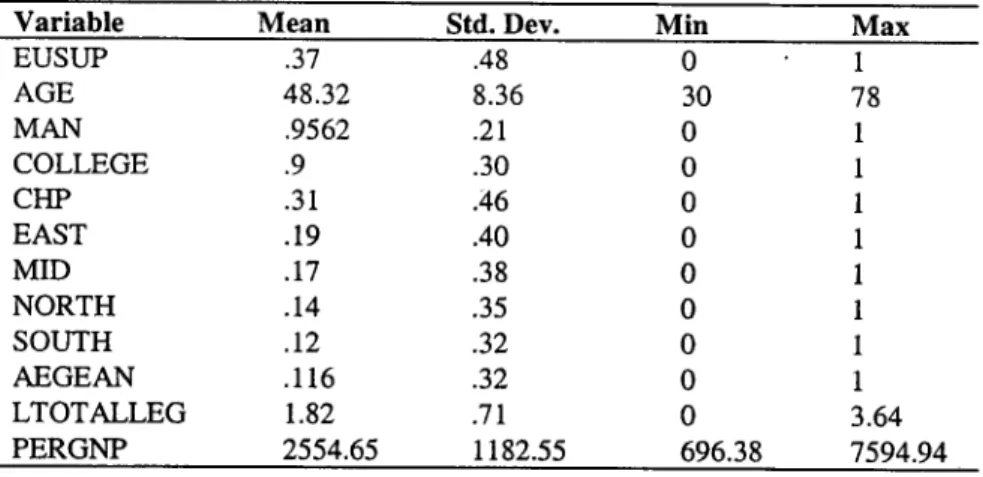
Table 2 provides basic descriptive statistics of all variables in the logit modeL.
Table 2:Descriptive statistics ofvariables
Variable Mean Std. Dev. Min Max
EUSUP .37 .48 O 1 AGE 48.32 8.36 30 78 MAN .9562 .21 O 1 COLLEGE .9 .30 O 1 CHP .31 .46 O 1 EAST .19 .40 O 1 MID .17 .38 O 1 NORTH .14 .35 O 1 SOUTH .12 .32 O 1 AEGEAN .116 .32 O 1 LTOTALLEG 1.82 .71 O 3.64 PERGNP 2554.65 1182.55 696.38 7594.94
40 e Ankara Üniversitesi SBF Dergisi e 60.3
Notice that the average of the representatives was 48.32, while that of total legislative activities was 6.9.
Table 3 show s number of pro-European legislations, their frequencyand percentages. Representatives who were not involved in the process of pro-European legislations make up the largest group with 62.73 % of the population or 345 persons. Conversely, only 190 members signed for one legislations, compared to 15 representatives who supported 2 legislations between 2002 and 2004.
Table 3. The distribution of the Pro-European legislations
Pro-European Legislation Number
O 1 2 Frequency 345 190 15 Percent 62.73 34.55 2.73 Cumulative 62.73 97.27 100.00
Results and Discussions
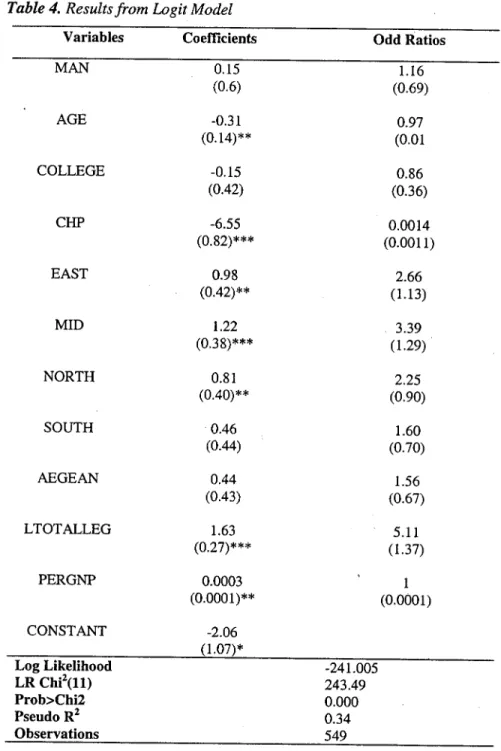
Table 4 shows estimations5 from the logit regression both as logit
coefficients (predicted probabilities) and their transformed form, odd-ratios, which are simply equal to exp(I!i), or p/q
=
ea + bX. Statisticalpackage was used to conduct the statistical analysis. Odd-ratios are easier to interpret; they indicate the odds of success relative to odds of failure. For example in Table 4, the odds of a male tosign for a pro-European legislation are 1.16 times greater than those of a female representative, albeit with a statistically insignificant effeel. In other words, when all other variable are held constant, the odds of a male representative being a pro-European is 16% greater than a female representative. On the other hand, the coefficients in the second column of Table 4 can simply be interpreted as effects of independent factors on the probability of being pro- European.
A negative sign is an indication that the variable under consideration reduces the probability of being pro-European, whereas a positive sign an indication of an increasing probability. Within these variables, only those with statistically significant coefficients desire more attention to discuss, for
4TBMM (Türkiye Büyük Millet Meclisi), http://www.tbmm.gov.tr/
i
if
Harun Arıkan - Mehmet C. Mann - Mustafa Çolak e Pro-European Legislative Behaviors e 41
Table 4. Results from Logit Model Variables Coefficients iJ MAN 0.15 (0.6) i' , İCİ AGE -0.31 (0.14)** COLLEGE -0.15 (0.42) CHP -6.55 (0.82)*** EAST 0.98 (0.42)** MID 1.22 (0.38)*** NORTH 0.81 (0.40)** SOUTH 0.46 (0.44) AEGEAN 0.44 (0.43) LTOTALLEG 1.63 (0.27)*** PERGNP 0.0003 (0.0001)** CONSTANT -2.06 (1.07)* Log Likelihood LR Che(ıı) Prob>Chi2 Pseudo R2 Observations Odd Ratios 1.16 (0.69) 0.97 (0.01 0.86 (0.36) 0.0014 (0.0011) 2.66 (1.13) 3.39 (1.29) 2.25 (0.90) 1.60 (0.70) 1.56 (0.67) 5.11 (1.37) 1 (0.0001) -241.005 243.49 0.000 0.34 549 ii
Note: Values in parentheses are standard deviations and
*
shows statistical significance of42
e Ankara Üniversitesi SBF Dergisi e 60-3their effects on pro-European legislations can not be explained by chance, but rather by a predictable underlying pattem. Accordingly, the
attention will be given to AGE, CHP, LTOTALLEG, PERGNP and regional
dummy variables. But before proceeding further, some explanation should be made about the overall modeL. The last five raw gives Log Likelihood Ratio Chi Square (LR Chi2), a value of 243.49, and another important statistic,
Pseudo R2 with a value of 0.34. The first statistic indicates that at least one
variable is able to explain the variation in the dependent variable, whereas the second one indicates that all factors in the model explain 34% of this variation.
This model correctly predicted 74.15 % of the total representatives who were pro-European and 77.91 % of those who were not pro-Europeans. OveralL, the model predicted 76.50% of the cases accurately. Thus, the model is very useful in explaining the variation in the pro-European legislative activities of the representatives. Several versions of this model with the same variable s were tested for different transformation of the independent variables, specification error and co-linearity, but the model used in this paper yielded the best results.
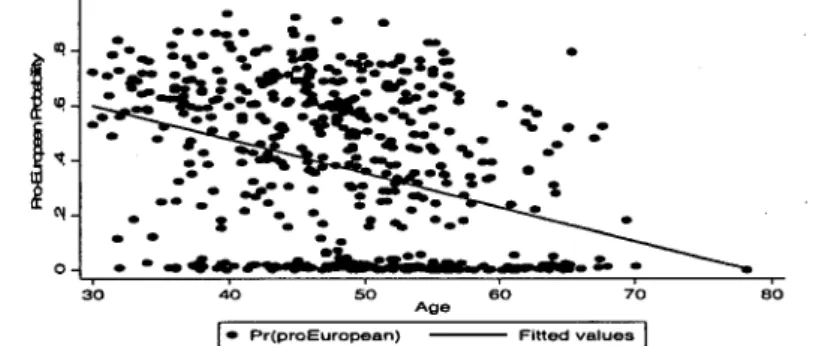
The variable AGE with a statistically significant coefficient of -0.31 indiçate a negative effect on the probability that a representative would sign for a pro-European legislation. That is, holding all other variable s in the equation constant, as representatives got older, the probability that they voted for pro-European legislations were decreased (see Figure 1). The odd of being pro-European was 0.97 to 1, or decreased by %3 with one age. This effect was
i:
•i~
,
.
.
"i ı o 30 40 50 70 60 Agei-Pr(proEuropean) -- Fltted values i
Figure 1.Effect of AGE on being pro-European
statistically significant at 0.05 level, an indication of an underlying reason. There was an expectation that the pro-European legislative activities would decline, as representatives got older.
Harun Arıkan - Mehmet C. Mann - Mustafa Çolak e Pro-European Legislalive Behaviors e 43
A previous study by Marın et aL. (2004) used age and age square and found a statistically significant positive and negative effect respectively on the locally oriented legislative behavior in the 21stTGNA. This suggests that as age
increased, locally oriented legislations also tended to increase but with a dedining rate. Hence, we expected to find a negatiye effect of the age. Though a test showed a need for use of age and age squared in our model, this construction led to another a serious problem, co linearity. in any case, the decrease in pro-Europeanism with age may be contributed to the fact that representatives become more conservative, as they got older.
Besides the dummy variables for regions, legislative activities
(LTOTALLEG), per capita GNP of the provinces where each representative
was elected (PERGNP) and party membership (CHP) were other statistically significant variables. LTOTALLEG was expected to have a po'sitive effect on the probability of being pro-European or pro-European legislative activities based on results from another study that applied similar variables for explaining locally oriented legislative behaviors (MARlN / COLAK / YOLCU, 2004). An active representative that was deeply involved in legislative efforts was also likely to gain knowledge and experience and thus similarly participated more iıı legislation activities related to the EV. Table 4 shows that the odds ration of
pro-Europeanism relative to those of none-pro-Europeanism was 5.11:1.
Moreover, the coefficient of LTOTALLEG was statistically significant at 1% level.
When all other variables were held constant, one unit change in PERGNP increased the odds of beiııg pro-Europeanism by a factor of
ı.
This positive effect was as expected (see Figure 2). We assumed that the representatives from the provinces with higher per capita GNP were more willing to sign for8000
•
•
•
2000 4000 6000 pergnpi.
Pr(proEuropean) -- Fltted valuesi
o
o
44 e Ankara Üniversitesi SBF Dergisi e 60-3
pro-European legislations, because rich provinces were more likely to be open to liberal values. Furthermore, citizens in rich provinces possibly had asimilar lifestyle and values with those in the EU. Perception of positive outcomes from the pro-European legislative activities would encourage local citizens to impose political pressure on their representatives.
To control effects of the party politics and discipline, the dummy variable CHP was used. in the logit model, there were three dummies to estimate party' s effects: AKP, CHP and OTHER that included only 11 members distributed among independents and two other right wing parties. The estimates from the regressions with only CHP and AKP included in the model and with all parties were not much different in terms of their coefficients. Therefore the final regression was run with all parties included in the modeL. Few members with only slight differences from AKP were the justification to just look into effects of CHP, while us ing AKP and OTHER as the base or comparison group. Figure 3 shows the effect of the durmny CHP on being pro- European. Clearly,
-co .~.j~
i'
ci! o o .2 .4 .6 .8 chpi-
Pr(proEuropean) -- Filted valuesi
Figure 3. Effeets of CHP on being pro-European
compared to the representatives in AKP and OTl'İER, those in CHP were less willing to sign for pro-European legislations as shown by adeclining line in Figure3. This was expected in that the previous studies showed asimilar negative effect. Table 4 shows that effect of CHP was statistically significant at
1%level, whereas its relative odds ratio to those of AKP and OTHER was quite smaIler. Thus, a representative with the CHP party membership 99% times signed less for legislations that were related to the EU's reforms.
Finally, the model included six regional dummy variables, the focus of this study, to analyze how regions with different socioeconomic characteristics
!. i
• !
Harun Arıkan - Mehmet C. Marın - Mustafa Çolak e Pro-European Legislalive Behaviors e 45
affected pro-European legislative activities of the representatives. As the Public Choice theory suggests, a representative's political behavior, being pro-European in this case, could be determined by hislher rational to maximize self-interests through acts that as if he/she was promoting self-interests of the electors or region where he/she was sent to the parliament. By these very activities, representatives attempt to ensure next reelection. in one sense, representatives' behavior can be viewed as a good political investment for the future. Whatever the motivation a representatives might have, it was very likely that their decisions to sign for pro-European legislations was influenced by future elections and thus by their efforts to create a perception or image through some legislative activities with determinant effects on the future direction of the region.
Representatives' efforts to be viewed as concerned with and sensitiye person to the regional issues could be a factor in explaining why they might have taken a regional perspective in their legislative activities. Another factor was the fact that various interests groups, including business,labor unions, NGOs and those others deeply concemed with regional problems, could impose political pressure on them to act according to region al interests. Based on the previous literature review, we assumed that western regions with highest per capita income would be more concemed with economical benefits of the pro-European legislative reforms, as they had more intensiye economic relations with the EV' s member states. in this line, a similar argument could be made for the poor region s of East, Southeastem and Black Sea. Citizens from these regions could view progress toward the accession as creation of some potential economic benefits, such as free movement of people, some financial aids from
EV budged, and expectation of new jobs created by the movement of the
foreign capital into their regions. On the other hand, there are soıne political outcomes of the pro-European legislative activities that might be viewed sensitiye and dangerous by some regions for several reasons, including such as undermining of the national sovereignty and values, whereas an opportunity by other regions to improve democracy in the country.
Vsing the dummy WEST as the base category for comparison, based on
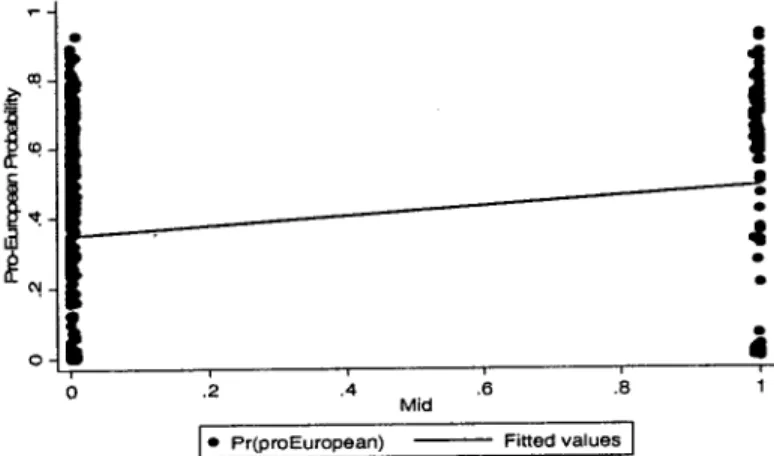
the previous literature we expected to find a negative sign for the dumrnies Mill and SOUTH, whereas a positive effects for EAST. On the other hand, the directions of the remaining variables were not known with certainty. Compared to the dummy WEST, Mill was found to have a statistically significant positive effect on the being pro-European. A representative that was from the Central Anatolian Region had a odd ratio of 3.39 in comparison to that of Westem regions (see Figure 4), which meant that the odd ratios ofbeing pro-European
46 e Ankara Üniversitesi SBF Dergisi e 60-3
•
•
<xli
.~ .J~
~~•
•
ın
ol
~~•
•
i
•
o•
o .2 .4 .6 .8 Midi.
Pr(proEuropean) -- Fiııed valuesi
Figure 4. The effect o/the dummy M/D on being pro-European
for the Central Anatolian representatives was 339% more greater than those from the Westem region of the country. This effect was not as expected. Considering that Mill was less prosperous than WEST and weaker in terms of its economic relations with the EU, one of the explanations for a positive coefficient was related to the potential political outcomes, as they might have considered Turkish accession to be good for the region and for country at large. This may be related to the perception in which Turkey' s accession progress towards the EU would result in improvements in human rights and. democracy in Turkey. Another plausible explanation for a positive effect of Mill might be related to their preferences over Turkey' s place in the changing Europe. Since the foundation of the new Republic, political elite attempted to transform the Turkish society and to establish a modern westernized secular state. Hence, there has always been a vision or an ideal type of society in the minds of the Turkish political elite. Therefore, according to Turkish political elite, such ideal society and state could be progressively formed through close relations with the European institutions and adaptations of the western values. Indeed, joining the EU has always been regarded as the acceptance of 'Turkey' s European identity' by the West (REDMOND, 1993).
i i
i
Harun Arıkan - Mehmet C. Marın - Mustafa Çolak e Pro-European Legislalive Behaviors e 41
f
North
i.Pr(proEuropean} - F~led valuesi
-.
~.
~i
~e~..
o.
m ~~ı
"!,
e..
'"
oi
•
o .2 .4 ,6 ,8 1•
J...
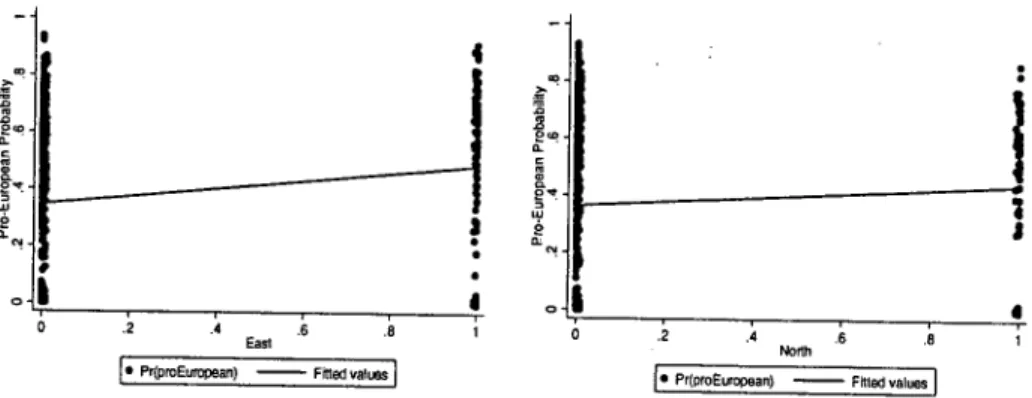
.6 .8 Fmecı values i .2 .4 i , , , i , iFigure 5. Effects of the dummies EAST
! and NORTH on being pro-European
, i i • ii ,i i ;~ i
i
;~ i , ii :1 iiSimilarly, the dummies EAST and NORTH had a positive and
statistically significant effect on being pro-European (see Figure 5 and Table 4). Compared to the westem parts of the country, these regions have lower per capita income and their economies are relatively less integrated with that of Europea. in this respect, the business community in the westem regions of Turkey might have more intensiye organic relations with the European business community. Thus, we assumed that representatives from these two regions were more likely to sign for the pro-European legislations on the basis of smaIler economic advantages and political outcomes that support democratization and improvement of human rights regime in Turkey. Other two regional dummies AEGEAN and SOUTH also have positive coefficients, but are not statistically significanL By implications, effects of these two dummies are not different from the base category, WEST. Besides, these two regions are also ranked second and third respectively after the west in per capita income (DPT, 2000:70). Thus, economies and lifestyles in WEST, AEGEAN and SOUTH are alike in many respects. This suggests that if economic factors were involved in contributing to the positive coefficients of EAST and NORTH, they were more related to smaIl advantages such as creation of new jobs and the freedom to move freely in a search for better jobs in the European countries, rather than the
improvement of relationships with the European business community.
Furthermore, given that these regions are relatively le ss developed,they would qualify for huge financial funding from EU structural and agricultural funds. A second explanation for these positive effects could be political reasons involving the future place of Turkey in Europe. Unfortunately, we were not able to determine whether political or economic factors were more weighted in the positive effects of EAST and NORTH.
48 e Ankara Üniversitesi SBF Dergisi e 60-3
Conclusions
The results from this studyare interesting in that they did not support one of the well-known economic arguments supported by some scholars in Turkey. This argument suggests that due to an intensiye economic interaction between
the westem part of Turkeyand the EU, relatively more developed westem
regions in Turkey would benefit more from the accession process of Turkey with the EU through alignment of Turkish legal structure with those of the EU
norms. Accordingly, representatives from these regions in TGNA were
expected to be more active in initiating legislative changes to comply with EU norms. However, the results showed that the poor regions of Black Sea and Eastem part of Turkey had statistically significant effects on pro-European legislations. A similar result was also found for Central Anatolian Region. These results indicate that there might be both political and economical motivations behind regional effects on pro-European legislative activities. Considering relatively the lower per capita income and economic structures of
Eastem, Southeastem and Black Sea regions, economic effects seem to be
mostly related to the perceived benefits from EU's economic programs.
Therefore, it would be not totally wrong to argue that representatives from these regions have been strongly supportive of the Turkish accession on the grounds economic gains. Their positive behaviors could be explained by the fact that representatives from these regions are just forced by the voters' desire to enter the EU. OveralL, the results from this study is not well-suited with the
assumption that Westem regions with more intensiye relations with the
European economy would impose more pressure on the TGNA's
representatives to initiate and support for legislative reforms in comply with the EU' s standards.
It appears that the political factors have also played an important role in
explaining pro-European behaviors of members of TNGA. This might be
related to' the perceived effects of Turkey' s accession to the EU on
democratization process in the country, as well as perception of the Turkish political elites in relation to the future vision of Turkey in the European integration. All these factors at some extent carried a weight in Central Anatolian, Black Sea and Eastem Anatolian Regions in contributing to the positive effect on the pro-European legislative activities. However, there was a difficulty to identify political and economic factors into separate components. Further studies that use mare detailed data may help to answer these questions.
i "
-I,
, i
Harun Ankan - Mehmet C. Mann - Mustafa Çolak e Pro-European Legislalive Behaviors e 49
References
ARıKAN, Harun i VASSALLO, Francesca (2004), "Turkey's EU Membership: Implications for the Future Direction of the EU Integration Process," paper presented at the Conference
on Turkey's Accession Process to the European Union: Legal, political, social and
cultural aspects of integration (Istanbul, 20 September 2004).
DIE (Devlet Istatistik Enstitüsü), http://www.die.gov.tr/
DPT (2000), Uzun Vadeli Strateji ve Sekizinci Beş Yıllık Kalkınma Planı 2001-2005(Ankara),
www.dpt.gov.tr
DPT (2003), Türkiye'nin Avrupa Birliği'ne Katılım Sürecine Ilişkin 2003 Yılı /lerleme Raporu
(Ankara), www.dpt.gov.tr
KiRişCI, Kemal (2004), "The Domestic Politics of Negotiating Pre-Accession: Challenges and Consequences of EU-Turkish Relations,'" Presented at Second Pan-European
Conference, Standing Group on EUPolitics (Bologna, 24-26 June 2004).
LONG J. Scott (1997), Reggression Models for Categorical and Limited Dependent Variables
(Thousand Oaks: Sage Publications).
MARIN, Mehmet C.I ÇOLAK, Mustafa i YOLCU, Tuğba (2004)"Yerel Çıkann Ulusal Düzeydeki Temsilinin Ekonometrik Bir Modeli," Uludağ Üniversitesi I. Ulusal Genç Bilim Adamları
Sempozyumu:DeğişenDünyada Türkiye'nin Önemi,6-7 Mayıs 2004 (Bursa).
MÜFTÜLER-BAC, Meltem (2004), "The New Face of Turkey: The Domestic and Foreign Policy Implications of November 2002 Elections," East European Quarterly, 37/4:421-439.
REDMONO, John (1993) The Next Mediterranean Enlargement of the European Community:
Turkey, Cyprusand Malta (Darmouth: Aldershot Publication).