ANALYSIS OF FEMALE STAR IMAGES IN POPULAR MAGAZINES IN THE 1960s:
THE CASE OF TÜRKAN ŞORAY
ZEYNEP ÇİĞDEM KARABEKİROĞLU
ANALYSIS OF FEMALE STAR IMAGES IN POPULAR MAGAZINES IN THE 1960s: THE CASE OF TÜRKAN ŞORAY
A THESIS SUBMITTED TO THE GRADUATE SCHOOL
OF
THE UNIVERSITY OF BAHCESEHIR BY
ZEYNEP ÇİĞDEM KARABEKİROĞLU
IN PARTIAL FULFILLMENT OF THE REQUIREMENTS FOR THE DEGREE OF MASTER OF ARTS
IN
THE DEPARTMENT OF FILM AND TELEVISION
ABSTRACT
ANALYSIS OF FEMALE STAR IMAGES IN POPULAR MAGAZINES IN THE 1960s: THE CASE OF TÜRKAN ŞORAY
Karabekiroğlu, Zeynep Çiğdem
M.A. Department of Film and Television Supervisor: Assoc. Prof. Süheyla Kırca Schroeder
September 2006, 117 pages
This study covers the 1960s during when Turkish movie industry Yeşilçam had its golden age. Directors and producers made over two hundred films per year in this period. What I would like to do is to analyze how female star images were constructed by popular magazines in the 1960s. I will try to find out how private life of a star influences the representation of his/her image in popular magazines. The magazines that will be analyzed in this thesis are Ses (1961-1967) and Artist (1960-(1961-1967). These magazines will be essential for studying the ways that the ‘star image’ was constructed and explaining how fame was produced through the written media. The case study will focus on Türkan Şoray, an actress who earned a distinctive reputation as a ‘star’ in this period.
Keywords: Yeşilçam, Cinema, Popular Magazines, Star, Star Image,
ÖZET
1960’LARDA POPÜLER DERGİLERDE YILDIZ İMAJININ İNCELENMESİ: ÖRNEK İNCELEME TÜRKAN ŞORAY
Karabekiroğlu, Zeynep Çiğdem
Yüksek Lisnas, Film ve Televizyon Bölümü Tez Yöneticisi: Doç. Dr. Süheyla Kırca Schroeder
Eylül 2006, 117 sayfa
Bu çalışma, Yeşilçam’ın 1960’larda Türk sinema endüstrisindeki altın yıllarını kapsamaktadır. Yönetmenler ve yapımcılar 1960lar’da yılda iki yüz üzerinde film yapmışlardır. Benim bu tezde yapmak istediğim 1960lar’da popüler dergilerde yıldız imajının nasıl oluşturulduğunu incelemektir. Ayrıca bu tezde bir yıldızın özel yaşamının onun popüler dergilerdeki sunumunu nasıl etkilediğini bulmayı amaçlıyorum. Bu çalışmada incelenecek dergiler Ses (1961–1967) ve Artist’tir (1960–1967). Bu dergiler yıldız imajının nasıl yansıtıldığı ve şöhretin yazılı medyada nasıl üretildiğini anlamak için önemlidir. İncelemem Türk sinemasında yıldız olarak önemli bir yere sahip olan Türkan Şoray üzerine odaklanmaktadır.
Anahtar Kelimeler: Yeşilçam, Sinema, Popüler Dergiler, Yıldız,
This thesis dedicated to
My dear grandgrandmother Keşfiye Arkan, My dear grandmother Ülkü Arkan
and
ACKNOWLEDGMENTS
I would like to thank my uncle and my contemporary art teacher Onur Eroğlu to persuade me to finish my master in this field. I would like to express my deepest gratitude to my supervisor Süheyla Kırca Schroeder for her invaluable contribution. I would also like to thank jury members, Savaş Arslan and Tül Akbal for their great supports and their valuable feedbacks during my thesis. It was my pleasure to study with them.
I would like to thank Tunga Yılmaz and Lida Erdoğan for their assistance in writing my thesis. And at the end I would like to express my greatest appreciation to Kaya Arslan for his support in Cyprus.
TABLE OF CONTENTS ABSTRACT... iii ÖZET... iv DEDICATION... v ACKNOWLEDGMENTS... vi
TABLE OF CONTENTS... vii
LIST OF TABLES... ix
LIST OF FIGURES... x
CHAPTERS INTRODUCTION... 1
1. STAR... 6
1.1 Meaning of Star and Stardom... 6
1.1.1 Star... 6
1.1.2 Stardom... 8
1.2 Star System... 11
1.3 Star Image... 12
1.3.1 Power of the Star System... 14
2. YEŞİLÇAM... 18
2.1 Female Stars in Yeşilçam 1920-1970... 18
2.2 Yeşilçam in the 1960s... 24
2.2.1 Yeşilaçm Melodrama... 30
2.2.2 Woman in Yeşilçam Melodrama... 33
3. POPULAR MAGAZINES... 38
3.2 Magazines, Stars and Fans... 39 3.2.1 Popular Magazines in Turkey:
Ses and Artist... 43 4. REPRESENTATIONS OF TURKISH FEMALE STARS IN POPULAR MAGAZINES IN THE 1960s: THE CASE OF TÜRKAN ŞORAY... 47 4.1 Representations of Turkish Female Stars in Popular
Magazines in the 1960s... 48 4.2 Analysis of Türkan Şoray in Magazines... 51 4.2.1 1960-1962 Period: Rising of Türkan Şoray to Stardom... 52 4.2.2 1963-1964 Period: Türkan Şoray’s Relationship with Rüçhan Adlı... 59
4.2.3 1965-1967 Period: Establishment of “Şoray Rules”... 68 CONCLUSION ... 77 FIGURES ... 83 REFERENCES ... 113
LIST OF TABLES
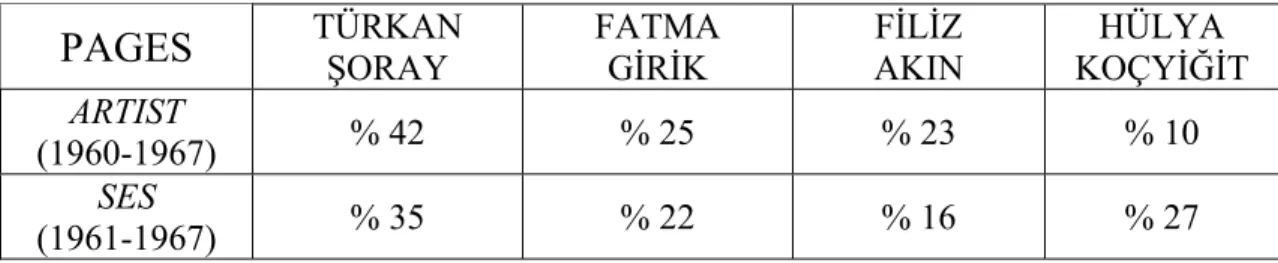
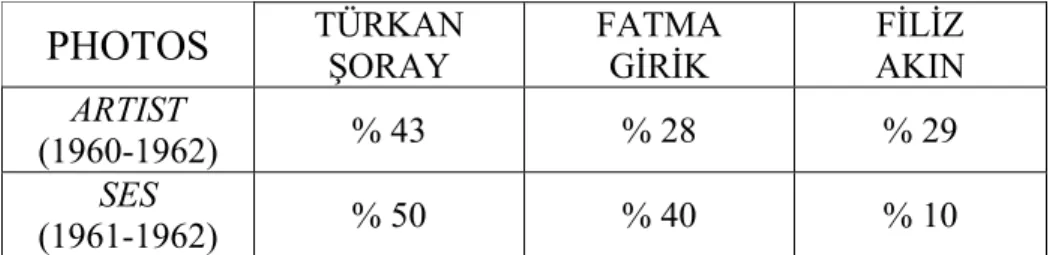
Table 1: The number of Turkish films, 1960-1968... 27 Table 2: Percentage of Şoray, Girik, Akın and Koçyiğit
photos, 1960-1967... 49 Table 3: Percentage of articles on Şoray, Girik, Akın
and Koçyiğit, 1960-1967... 49 Table 4: Percentage of pages about Şoray, Girik and Akın
and Koçyiğit, 1960-1967... 49 Table 5: Percentage of Şoray, Girik and Akın
photos, 1960-1962... 53 Table 6: Percentage of articles on Şoray, Girik and Akın,
1960-1962... 53 Table 7: Percentage of pages about Şoray, Girik and Akın,
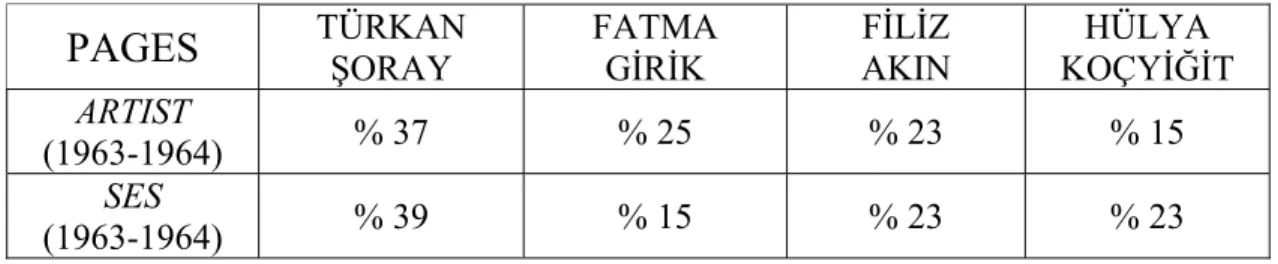
1960-1962... 53 Table 8: Percentage of Şoray, Girik, Akın and Koçyiğit
photos, 1963-1964... 60 Table 9: Percentage of articles on Şoray, Girik, Akın
and Koçyiğit, 1963-1964... ... 60 Table 10: Percentage of pages about Şoray, Girik, Akın
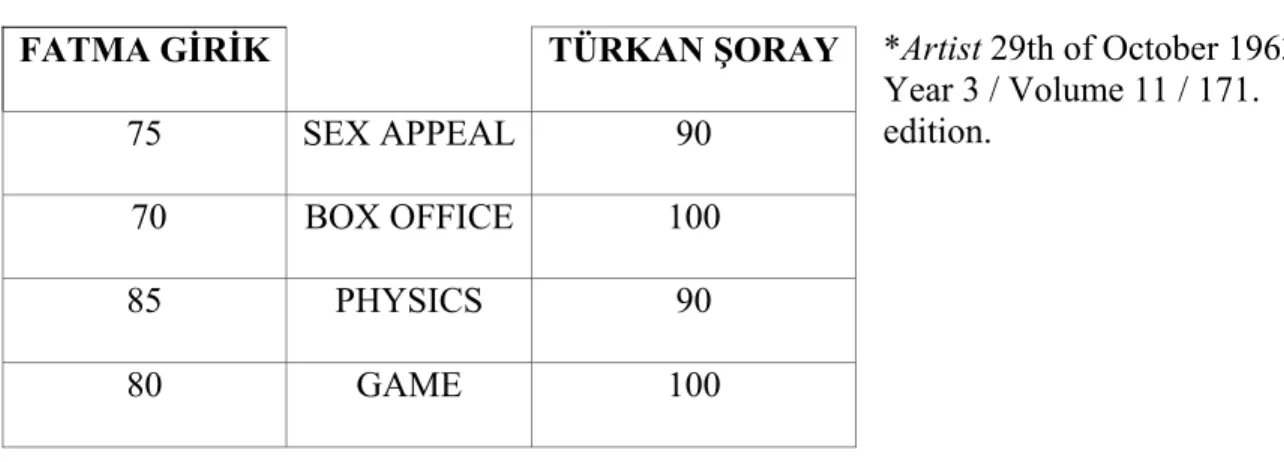
and Koçyiğit, 1963-1964... 60 Table 11: Comparison Fatma Girik and Türkan Şoray... 64
Table 12: Percentage of Şoray, Girik, Akın and Koçyiğit
photos, 1965-1967... 69 Table 13: Percentage of articles on Şoray, Girik, Akın
and Koçyiğit, 1965-1967... 69 Table 14: Percentage of pages about Şoray, Girik, Akın
and Koçyiğit, 1965-1967... 69 Table 15: The number of films that Şoray, Girik, Akın, Koçyiğit made 1960-1967... 76
LIST OF FIGURES
Figure 1: Artist – 10 November 1960... 84
Figure 2: Artist – 10 November 1960... 85
Figure 3: Artist – 8 December 1960... 86
Figure 4: Artist – 14 June 1961... 87
Figure 5: Karnaval – 1962... 88
Figure 6: Karnaval – 1962... 89
Figure 7: Artist – 12 September 1961... 90
Figure 8: Artist – 1 August 1961... 91
Figure 9: Artist – 16 July 1963... 92
Figure 1o: Artist – 8 January 1963... 93
Figure 11: Artist – 8 January 1963... 93
Figure 12: Artist – 8 January 1963... 94
Figure 13: Artist – 8 January 1963... 94
Figure 14: Artist – 14 June 1961... 95
Figure 15: Ses – 1 August 1964... 96
Figure 16: Artist – 28 October 1963... 97
Figure 17: Artist – 28 October 1963... 98
Figure 18: Artist – 7 July 1964... 99
Figure 19: Ses – 26 October 1963... 100
Figure 20: Ses – 26 October 1963... 101
Figure 22: Artist – 12 November 1963... 103
Figure 23: Artist – 12 November 1963... 104
Figure 24: Artist – 13 January 1964... 105
Figure 25: Artist – 16 November 1965... 106
Figure 26: Ses – 20 November 1965... 107
Figure 27: Artist – 23 August 1965... 108
Figure 28: Ses – 19 November 1965... 109
Figure 29: Ses – 19 November 1966... 110
Figure 30: Ses – 19 November 1966... 111
INTRODUCTION
The aim of this thesis is to analyze the ways in which female star images are depicted in popular magazines in the 1960’s. Magazines were analyzed to understand how star images were produced, circulated and consumed, and what they revealed about the cultural life of Turkey in the 1960’s. Ses (1961-1967) and Artist (1960-1967) magazines are analyzed to study representations of female stars and how stardom is produced through the written media. I argue that the private life of a star influences his/her career as well as the representation of his/her image in popular magazines. In my analysis, I aim to illustrate the changes in stars’ private life influence the image of a star by concentration on Türkan Şoray.
Some of these popular magazines used stars’ private lives for advertising, with the purpose of increasing their sales. One of the main reasons magazines used star images as an advertisement technique was that the public was overtly interested in their private lives. Society kept up with their lifestyles through popular magazines. Every detail about them would always appear in these popular magazines. Stars are very much considered as manufactured products of the popular culture, and are presented to the society as symbols of its culture, dreams, images, and prejudices. For young people, or those belonging to the middle or lower class, stars symbolized a better life, and portrayed a perfect world that is both desirable and dependable. In other words, stars mirror society; they are what society is, and reflect what society wants to believe in.
The study covers the period of the 1960s. Yeşilçam had its golden years in the 1960s and the early 1970s of the Turkish movie industry. During this period (the 1960s),
directors and producers made more than two hundred films annually. I prefer to focus on the 1960s because not only does it prove to be the most astonishing era for Turkish modern history but also because these years defined a milestone for Turkish Cinema. From 1960 to 1970, there were four female stars that dominated the film screen due to their popularity, and had been accepted and therefore produced by society. These female stars were Fatma Girik, Türkan Şoray, Filiz Akın and Hülya Koçyiğit.
For the case study, I will concentrate on Türkan Şoray, an actress that can best be described as the finest example of a movie star in 1960s in Turkey. She had a distinctive place in Turkish cinema because her celebrity was widespread over many years. Her image, media coverage about her, and her appearances in films deploy the political economy of stardom, questions of performance, and the effect on stardom upon convergence between the film industry and other entertainment industries in 1960s Turkish popular culture. I will analyze star images and stardom through Şoray because the study of her through popular magazines will trace the historical evolution of modern fame. Stars are one of the most dynamic elements of contemporary culture who perform vital social functions and generate a variety of values and knowledge. In addition, Şoray fits all the aspects of star and star theories. She fits the typical concept of star and stardom in Turkey. Until her emergence as a star, no individual or personality had received such interest and the public attention. Therefore, she became the object of popular magazines in Turkey in the 1960s.
There are a number of studies that analyze representations of female identity and female sexuality in the media in general as well as in film studies. In the field of advertisement, for example, Lockeretz and Courtney’s work (1971) analyzes the roles portrayed by
women in magazine advertising. Accordingly, general advertisements were not used in women’s magazines because those publications described women as housewives. Losco and Venkatesan did similar research (1975), entitled Women in Magazine Ads: 1959-71. These studies used content analysis to see the social changes of woman throughout these years in print advertisement. Waddell also studied (2002) the use of female sexuality in advertising. By analyzing the images and texts, this article was more about the sexuality of women and how the advertisements used female sexuality. These studies concentrate on society, women’s place in society, cultural life and gender issues.
Another important concept of my study is ‘star’. Therefore, I will review studies which focus on the star system and stars. For example, Hugh Look’s article (1999), called The Author as Star, looked at the system of star. The majority of questions related to the research included how authors become stars, and stars become authors, and the role of advertising and media. Beltran’s study (2002) is about Jennifer Lopez’s fame and how media built up on her celebrity. This shows a parallelism with my study, but Beltran looks at her stardom through representation of her body and her ethnicity in the media. Buckley’s research (2000) is about Gina Lollobrigida who was a star in the 1950s, in Italy. This research is more about Lollobrigida’s life, and her place in Italian culture. The difference between my thesis and Buckley’s is that Buckley looked at Lollobrigida’s films to analyze her stardom; whereas, I will look at popular magazines to see how Turkish female stars were represented, with a focus on Türkan Şoray. Feasey’s study (2004), called Stardom and Sharon Stone: Power as Masquerade, looked at stardom through Stone. Jackie Stacey combines film theory with discursive contexts and original audience research, in order to investigate how female spectators understood
Hollywood stars in the 1940s and 1950s (1994). Further research about star images was undertaken by Barry King who looked at the role of the actor as a re-presenter of signs. He argues that stardom was a strategy of performance that was an adaptive response to the limits and pressures exerted upon acting in mainstream cinema.
There are also Turkish researchers who study Turkish cinema, melodrama, and star studies. For example, Filiz Çiçek focuses on both the hegemonic and the negotiated elements of male and female roles in Turkish melodramatic films from 1965-1975. Nezih Erdoğan (1998) on the other hand, examines the dynamics that Turkish popular cinema describes a national identity and the discourse of the national identity in 1965 to 1975. Serpil Kırel’s work (2005) includes the dynamics that created Yeşilçam; the social, economic, political and cultural life in the 1960s, and the relationship between Yeşilçam and spectators, producers, directors, stars and script writers in Yeşilçam. Seçil Büker’s and Canan Uluyağcı’s work (1993) is about Türkan Şoray’s life. Other studies about Türkan Şoray were done by Atillla Dorsay (2003). These studies are more like a biography of Şoray. However my study focuses on the representation of star images in the popular magazines in the 1960s, in order to understand the place of stars and how magazines build up star images. My argument is that, a star’s life effects her/his image in popular magazines.
My thesis consists of four chapters. The first chapter discusses the meaning of ‘star’ and ‘stardom’. In order to analyze the concept of stardom, we should begin by understanding society and contemporary culture, both in local and global sense. The second chapter is about the popular Yeşilçam film industry, the platform in which films were produced by and for the stars in the 1960s. In this chapter, social, political, economic and cultural
changes in the 1960s are analyzed, followed by an examination of the female stars of Yeşilçam, and melodramas. In the third chapter, popular magazines are assessed in order to see the role of magazines in the creation of stardom in the 1960s. The last chapter includes an analysis of the representation of Turkish female stars in popular magazines in the 1960s, and the case study about Türkan Şoray. In this chapter, articles and photographs are analyzed to see the importance of Türkan Şoray and how was she represented as a star in magazines in the 1960s.
I will deploy a qualitative approach to analyze written texts and images, as well as content analysis. I will divide Türkan Şoray’s career as a star into three periods. In accordance with the developments in different time periods of Türkan Şoray’s life, I will analyze repercussions of these developments on her coverage in Ses and Artist. These time periods are: 1960 to 1962 when her stardom started, 1963 to 1964 when she was with Rüçhan Adlı, and the last period is 1965 to 1967 when she started to create “Şoray Rules” (with Rüçhan Adlı). This study addresses these periods (1960 to 1962, 1962 to 1965 and 1965 to 1967) and the changes in Şoray’s life, how her private life influenced her image and the treatment of her image in popular magazines. I look at how much space popular magazines devoted to Türkan Şoray. Also, I examine the number of photographs and articles published about her throughout the period of the 1960s, in comparison to those of other stars (Fatma Girik, Filiz Akın and Hülya Koçyiğit).
CHAPTER 1 STAR
1.1 MEANING OF STAR AND STARDOM
Although there are several vocabulary meanings, star and stardom suggest a series of different meanings that could provide us a theoretical framework in which we can understand, and then clarify some basic concepts of popular culture and mass communication. Generally speaking, stars and stardom are understood as the system of stars in popular culture and mass communication; they are both culturally and socially constructed concepts. That is, they are products of cultural and social codes, in accordance with the society’s likes and dislikes.
In this chapter, I am going to emphasize the ‘film star’, which means a well-known film actor or actress, but also the culturally and socially constructed concepts in order to provide a theoretical framework to understand the basic aspects of popular culture and society.
1.1.1 Star
The word star has an assortment of uses as a noun, an adjective and a verb. According to the Oxford English Dictionary, the primary meaning of ‘star’ as a noun is “a fixed luminous point in the night sky which is a large, remote, incandescent body like the sun”. Another meaning suggests, “A stylized representation of a star, often used to indicate a category of excellence”. One of the meanings refers to stars as, “a famous or
talented entertainer or sports player”. The last one is “an outstanding person or thing in a group”.
The American Heritage Dictionary defines ‘star’ as a noun, where the person is an artistic performer or athlete whose leading role or superior performance is acknowledged. As an intransitive verb, the meaning of star is, playing the leading role in a theatrical production, or according to the Oxford English Dictionary “(of a film, play, etc.) have (someone) as a principal performer. In addition (of a performer) have a principal role in a film, play, etc”.
These meanings are clarified by a series of sources and theorists. Those definitions that appear alongside the preliminary definitions of star suggest several aspects of the concept, but fail to comprehend the entire context, including its social and cultural features. However, most of the studies investigating star regard ‘star’ not only as an individual, but also as a system of signs. Apart from its vocabulary meanings, as a product of culture, a star could imply distinct meanings in popular culture and mass communication studies.
Any researcher who focuses on stars must deal with the cultural and social process in which a star, through utilization of their individual characteristics, is born or created. In other words, it is the duty of the researcher to clarify how an image of a person or their particular characteristics can be turned into a new pattern. It is a social and cultural process. According to Büker and Uluyağcı, stars cannot be deprived of the society where she/he was born and created. Stars represent the hope of society directly and indirectly (1993:11). As Hinerman stated in his article, in investigating the phenomenon of
stardom, we are not dealing with particular characteristics such as talent, beauty, charisma etc. but with a complexity of cultural processes (2000:205).
Celeste indicates, “A social construction, flattened into a text that has multiple meanings and that can be read as cultural product” (2005:29). For example, in the article National Body: Gina Lollobrigida and the Cult of the Star in the 1950s, Bukley underlines the social and cultural aspects of star through his analysis of Edgar Morin and he says that
The sociologist Edgar Morin wrote in his pioneering work Les Stars that: ‘The star is a distant being, unattainable and astral. In other words, a star is destined to radiate his or her light on to the public, for in reality [the star] is nothing than the sun [to its public]’. Alexander Walker added to Morin’s statement, saying that: ‘Stars…are the direct or indirect reflection of the needs drives and dreams of…society’. Stars are, therefore, a collective group of people whose lives arouse a considerable degree of interest and whose presence and activities both reflect and influence the wider population. They are not ‘private’ individuals but people whose lives are wholly or partly exposed to scrutiny of the public (2000:527).
The variety of stars necessitates analysis of star characteristics through different perspectives. For example, for semiotics stars are at issue, they have an effective role in the meaning of the film. Therefore, for this type of research stars are one of the narration tools of the film.
1.1.2 Stardom
The Oxford English Dictionary defines star, as the state or status of being a famous or talented entertainer or sports player. However, in star studies, the term ‘stardom’ is conferred to denote dialectic between on/off screen presences (Ellis 1982).
Stardom might be described as a system in which stars belong; a cultural system and a mass communication area in which stars are the pillars, in which they are legitimate and institutionalize the star system.
Stardom is presented as a source of identity and meaning in popular culture. In accordance with the social and cultural aspects, Dyer indicates, “Stardom is an image of the way stars live” (1986:39), and therefore refers to a system of signs in which stars are recognized and identified. For instance, Barry King points out that stardom is a strategy of performance that is an adaptive response to the limits and pressures exerted upon acting in mainstream cinema (Feasey, 2004:199).
In today’s cultural studies, there are various approaches to stardom. Geraghty in his article, Re-examining Stardom, defines three kinds of film stars;
• The star as celebrity indicates someone whose fame rests overwhelmingly on what happens outside the sphere of his or her work and who is famous for having a lifestyle.
• The star as performer is defined by his or her work, drawing upon the element of performance as a demonstration of skills.
• The third kind is, star as professional (2000:187).
The star-as-performer is often associated with the high cultural values of theatrical performance, even when that performance takes place within the Hollywood film industry. Therefore, the more actors are known only for their performance, the more cultural capital and artistic value they are likely to be given.
The approach of this thesis will be the first one, star as celebrity. Stardom in Turkish popular culture deploys that stars are celebrities whose lives are the subjects of public curiosity. According to Geraghy, reference must be made to the way the star circulates in society. The division between stars' public and private lives, therefore tends to become the focus of star studies. Geraghty claims that:
The concept of star-as-performer has become a way of re-establishing film star status through a route which makes its claim through the film text rather than appearances in newspapers (2000:192).
As Beltran indicates in her article, The Hollywood Latina Body as Site of Social Struggle: Media Constructions of Stardom and Jennifer Lopez’s “Cross-over Butt”, star studies scholars tend to define a star as a film actor who becomes the object of public fascination to extent that their off-screen lifestyles and personalities equal or surpass ability in importance. In her article she quotes Gredhill, stating:
According to Gredhill ‘stars off-screen lifestyles and personalities or surpass acting in importance’. The opportunity to attain star status generally comes with being cast in psychologically or romantically compelling lead roles in films, as well as through being given star treatment publicity in the entertainment media. Stardom also is much more than media representation; it is a dynamic process of production activity on the part of media industries, media texts that make up star images, and audience reaction (Beltran, 2002:74).
In light of Gledhill’s words, studying the star system gains importance both in understanding the social and cultural codes through the media representation of stars as well as through the dynamism of production activities of the mass communication and popular culture industries. In this context, stardom within the contemporary star system
refers to the making up of stars in the production process, particularly in the film industry.
1.2 STAR SYSTEM
The star system may have begun with the development of movies, but it did not stop there. In Hinerman’s article, Star Culture, stardom and the star system have been crucial to processes that are the development of multinational business practices coupled simultaneously with industry’s desire to reach large audiences. It is essential to the function of modern communications technologies (2000:204) including mass media, television, magazines, and cinema.
The star is one of the factors, which give audiences an idea about the subject of the film. Generally, people judge films according to their stars. With regard to the role of the star upon determining people’s movie preferences, Segula states that:
Before everything in film, star will be most liked. It is natural function of stars. It is more than enough to show off to follow them. And also stars have the film sold, which is the main reason for star’s existence. Their shows, images, voices, films, and also their memories make them valuable (1997: 219-220).
Bordwell claims that creating a rough character prototype for each star, which is adjusted to the particular needs of the role, is one of the functions of the star system (1985:157). Spectators can easily understand the type of the film by looking at the cast list. Thus, spectators generally decide to watch films according to the cast.
Due to the strong linkage between the preferences of spectator and the star, stars are presented to the society in a way society requires through mass communication tools.
This process can work from the opposite side, which is to mean the need within the society for a new star is “invented”. Even though the power of the society is remarkable in acceptance of new created star in the society; society sometimes cannot freely take a decision to accept a new star. They may accept what they are presented. However, within the process of creation of a star, the ultimate decision always belongs to society. They might sometimes not decide who will be the star, but ultimately they will decide whether the new star will make it or not. A starlet is not a star unless society accepts her/him.
Drake’s analysis of the emergence of the U.S. star system is consistent with the argument that stardom is the product of society:
Richard De Cordoba, in his article, Picture Personalities, examines previous histories of the star system and gives more credence to the view that stars are the product of vast machinery. However, he cautions against taking this view to the extreme. He explains, [The star system does not produce stars the way that a factory produces goods. The system is rationalized. But it is not geared toward producing a standardized product in the usual sense of the word. It produces a product that is in fact highly individuated—the individual star.] The star system is complex and involves many elements, which may sometimes seem opposed. For example, although the star is an individual, what can be known about the star is limited by the system that makes them a star (2005:8-9).
1.3 STAR IMAGE
In today’s popular understanding, the image is something that is created. Therefore, image and stardom are two convergent concepts, and “star image” emerges out of this context as a specific subject in star studies.
Stardom is the creation of image through fictitious identities, though popular culture products. These fictitious identities most of all are created through fiction can make some trouble. Dyer said that, “spectators take the mixed fiction coming from mass communication tools and interpret this fiction according to his/her needs” (1987:5). Dyer employed a sociological approach to stardom in order to discuss star performers as industrial, ideological and cultural products through notions of stars as social phenomena, stars as images and stars as signs. According to him, a star is an actor or actresses whose private life takes on as much significance as his or her acting roles. The image of the star consists of everything that is publicly available about a performer. According to star studies, a star’s image is not just made of on screen performances, but is made up multimedia and inter-textual materials such as film reviews, fan magazines and gossip publications that depict the actors life off screen (1986:2-3).
Richard Dyer has proposed the term “star text” which is a term coined to point to the idea that the film star is larger than just the roles played in movies. It includes all forms of their image in popular culture. Dyer explains that a “star image is a constructed personage in media texts,” (1997), not just in films but also in all forms of media. The star text includes star filmography, and other forms of media in which her image appeared, such as fan magazines, books, and television interviews.
Producers make an assessment regarding prospective reaction of societies for the new star candidate. If a producer believes in the potential of a candidate, he may consider investing more time and energy on the candidate to create a new star. Given that existence of a star is an essential component in the marketing and advertisement strategy
of a movie, this fact renders the star as the element that sells the film. Stars have a currency, which runs beyond the institution of cinema. According to Cook and Bernink:
The difference between the other actresses and the stars are; stars are used for increasing the financial of the film and the spectators want her/him…Most investigators suggest that stars were introduced as marketing devices for independent producers (1999:34).
1.3.1 Power of the Star Image
Dyer discusses the relationship between character and star image and points out that “star image or persona may either ‘fit’ the fictional character or work to produce a disjuncture which may have ideological significance” (1986:145). Thus, it is possible to argue that star image carries powerful cultural connotations such as identification and fictional codes of the character. There is no star without individualism and mass reproduction. Everyone can potentially occupy the role of the star, but a star cannot be everyone. A star is singular (Celeste, 2005:35) but very powerful. In most cases, within the star system, it is “the star” that saves the day. It is the “star”, and his/her image that is sold in films. In such a system and business that depends on stars, they are the most powerful players. In a star system, the survival of the industry is possible if stars exercise power over the audience to allow them to pay money for tickets. This works almost in the same manner in the popular media industry, in the sense that the huge sales and circulation numbers of popular magazines come along with the power of stars. As Alberoni points out:
Stars are considered as a part of a group of people whose institutional power is very limited or non-existent while whose doings and way of life arouse a considerable and sometimes even a maximum degree of interest (1972:75).
Members of this group are popular people and well known in the society, such as singers, directors, etc. Stars preserve their power as far as their charisma based on their own capabilities. It is not easy to describe the correlation between power and capability because there is no concrete proof for that (Jarvie, 1982:149).
As I mentioned above, stars have the power to allow people to consume. As Dyer suggests, “Stars become consumption for consumer society” (1986:45). The consumer society of this age focuses on making money in order to be able to spend and consume more.
The power of the stars works as the main medium of identification among society. The more power stars have on society, the more society tends to identify themselves with the stars. Society identifies and idolizes stars through sociological, psychological and socio-psychological processes in which the audience tries to adopt star life-styles, characteristics, and in more cases, their physical appearance, clothes, or make up. Moreover, society tends to become and live as stars do. Since people aim to imitate star lifestyles, they have a tendency to copy how and what stars wear, the sports they participate in, where they go, and how they dine.
Each star has an image in the public mind and given that stars are being considered as God or Goddess in societies, this image has mostly been accepted by the majority of society. According to Celeste, “to desire the stars is to have great ambitions, to seek
nothing short of immorality, or the other side of time (2005:33)”. Stars have power, which stems from their relationship with other stars, films and spectators. This power relationship is sort of a love affair. Celeste claims that to love a star is to love an image of singularity. On the other hand, it is rarely seen that the lover is satisfied with this image (2005:31).
Spectators admire the image of the star rather than its real character. People admire the image of the star, which was created by mass production companies for their appearances before the public. Producers are familiar with the needs of the spectator, so these stars have been projected by mass communication tools in a way that society desires to see. Indeed, as an image, stars become evident on the stage or in the narrative by reflecting the story of the role onto the world (Celeste, 2005:32).
In the power relations of the star system, society is both the subject and the exerciser of power. The power of society should be conceived in the star studies. As stated by Hinerman, the audience determines celebrity, the only way to understand fame, therefore, is to understand those who emulate the famous, and how they do so (2000:200).
According to Kapferer, being a star is not something that is coincidental. A star might be namely a project that combines a number of elements such as physics, personality and the immediate needs of the society (1990:223). There is a new relationship that begins with the star and the spectator. This relationship has unwritten rules about what a star does or does not do. As mentioned above, although producers create stars, spectators give the power to and accept this star. If the audience ignores a starlet or star-candidate,
there is no possibility to promote his/her as a star. In such cases, producers and directors look for different alternatives to find candidates and to demonstrate these candidates to the electorate (spectators) who are to choose one of them. A star candidate is looking for a personality. She should use her body and she should accept everything that the stars refused to make (Büker,Uluyağcı, 1993:11). According to Morin;
Makeup is one of the important things for the star candidate. Makeup has the power to create a new meaning to a face; on the other hand, it destroys the meaning of the face. By the help of makeup, a candidate star can constitute a personality for herself (1960:40).
As a result, the star is often used as a symbol to indicate work that is well done. Stars affect consumers, influencing them to see certain films, to purchase certain products and services by their image in advertisements, and the products used in their films.
Stardom is notoriously hard to define but easy to recognize in actors and pop stars. Obviously, the star must have ‘star quality,’ but in itself that is not sufficient (although essential). Full stardom only happens when that quality is widely recognized by the public and rewarded by attention and by purchase of their output (Look, 1999:13).
As outlined in the introduction, this thesis is about the female star images in popular magazines of the 1960s. In those years, female stars emerged from the Turkish cinema, so it is important to look at the Turkish cinema and the female stars in those years.
CHAPTER 2 YEŞİLÇAM
This chapter of the thesis is going to focus on Yeşilçam. It consists of four parts. The first one is about the female stars in Yeşilçam from 1920-1970. The second is about Yeşilçam in the 1960s. It is important to look at the female stars and Yeşilçam in 1960s because this will provide information about the stars, society, economy the influence of these factors upon magazines. The third chapter is about melodramas, which society preferred to watch in the 1960s. The last chapter is about Yeşilçam and the women in Yeşilçam.
2.1 FEMALE STARS IN YEŞİLÇAM 1920-1970
The beginning of Turkish cinema goes back to the period where the country was struggling during World War I. Following this period, Turkish cinema started to develop and this progress created chances for female characters. Being a star stipulates attaining popularity in mass culture in a short time. To make this possible, it was necessary to achieve adaptation to the technology and techniques of the new century.
In the history of Turkish cinema, there are lots of actresses or stars who could build a successful career in cinema, from old times to the present. While some were forgotten, these people maintain the shine of stardom. They have given all of their efforts towards developing the Turkish film sector and have made Turkish cinema a precious art. Some of them had their own rules and restrictions.
In 1923, Muhsin Ertuğrul directed Ateşten Gömlek, which was the first film with a Turkish female character. Before that time, Russian women and some representatives of minorities played the female roles. Some examples include Madam Kalitea (who was one of the first foreign national women in Turkish cinema, acted in Mürebbiye (Ahmet Fehim, 1919) and was the first woman who was kissed on-screen), Matmazel Blanche (who acted in Binnaz, the film directed by Ahmet Fehim in 1919), Anna Mariyeviç (who acted in İstanbul’da Bir Facia Aşk by Muhsin Ertuğrul in 1922).
The first Turkish woman characters were Bediha Muvahhit (Ayşe) and Neyyire Neyyir (Kezban) who acted in Ateşten Gömlek (1923 Muhsin Ertuğrul). As Özgüç noted
Bediha Muvahhit’s and Neyyire Neyyir’s appearances on the screen as Muslim women opened a new era in Turkish cinema. However, they were not dominant figures in male oriented films. Because at that time the major picture characters were always male, those were leading figures of narrative (2000).
From 1930-1940 Cahide Sonku was the first woman movie star of the Turkish cinema. Sonku’s importance was not only attributable to being a star for a long time but also to her being Turkey's first female director and producer. Ertuğrul presented its first rural drama to the Turkish cinema with the film called Bataklı Damın Kızı Aysel (Muhsin Ertuğrul, 1935). In that film, narrative was established through the female character. She had a scarf on her head and later on, this would become a fashion among the girls. After this film she acted in a role in a tale of bar women in Şehvet Kurbanı (Muhsin Ertuğrul, 1940). In addition, with this role she displayed the vamp-face of women to the spectators. Sonku was a beautiful and talented woman. As Büker and Uluyağcı wrote in their book, “she looked like the westernized woman that the republic ideology describes. Spectators named her as our Greta Garbo (1993:19)”. She had an important place in
Turkish cinema because she opened the doors for women to become stars. She had been the only female star in Turkish cinema for 18 years.
Between 1940 and 1950, a new generation of actresses such as Ayla Karaca, Hümaşah Hican, Nedret Güvenç, Gülistan Güzey and Sezer Sezin existed. Indeed Sezer Sezin became a matter of primary importance among others with her physical advantages, films and talent. Özgüç named this period as the Starless Years (2000:33).
From 1950-1960, there was an increase in the number of films which alternately increased the number of actors and actresses. Directors and producers tried to find new faces; some of them were liked by the society such as Sezer Sezin, Muhterem Nur, Neriman Köksal, Belgin Doruk, Fatma Girik, Leyla Sayar and Türkan Şoray. Muhterem Nur - known as the second star of Turkish cinema, usually played in poor, unlucky young woman roles. Therefore, she became the star for the rural part of the society. As Özgüç noted, “she was the most photogenic woman in the cinema (2000)”. Besides that, it is noteworthy to mention Neriman Köksal, who was the first and the longest-term vamp woman of Turkish cinema. In Turkish cinema, Neriman Köksal played a femme fatale character (which means an attractive woman who leads men into difficult or doomed situations), in Fosforlu Cevriye (Aydın Arakon, 1959). She was very beautiful, and dangerous. She looked masculine by speaking, acting, and drinking alcohol like men, but at the same time, she was an attractive woman.
As Özgüç noted, “Leyla Sayar brought a new woman character to Turkish cinema, the unforgettable sexual object of the 1960s (2000)”. To define the term sexual object, we should look at the article of Laura Mulvey (who was a feminist film critic) which was
called Visual Pleasure and Narrative cinema. Mulvey indicates that mainstream films presented images of women who were produced simply for the gratification of male viewers. Laura Mulvey asserts that in a world ordered by sexual imbalance, pleasure in looking has been organized around a split between the "active male" and the "passive female" as they are represented in narrative cinema. We are informed that the determining male gaze projects its fantasy onto the female figure in such a way as to display strong visual and erotic impact (Mulvey, 1975: 27). However, during that period, female sexuality in Turkey was still regarded as non-existent. If existing at all, it was attributed to femme fatale characters, or vamp personalities. That is why in the 1960s, it was impossible for any actress to be a star as they deployed “the female sexuality” on-screen. Then, it is clearly understandable why Belgin Doruk might be the first of a series of women stars in Turkish Cinema always playing “innocent” or asexual characters. Belgin Doruk was characterized with her well-known “little lady” roles as the most beautiful woman in the film industry. Her sexuality had never shown in her films and she was always shown as a baby doll (Özgüç, 2000:36). Her private life was always a subject for the magazines. Doruk had attracted the attention of the film makers after winning beauty pageants. In those years, there were lots of female actresses in Turkish cinema who gained fame through beauty contests. Some examples are Belgin Doruk as mentioned before, Filiz Akın and Hülya Koçyiğit. These contests were one of the ways to reach the film acting level.
The period from 1960 to 1970 was that of the four great stars. In the 1960s, there were many female actresses in the cinema sector, but the news media utilized four great stars: Fatma Girik, Türkan Şoray, Filiz Akın and Hülya Koçyiğit. First, we saw Fatma Girik
who played roles that were more masculine, and her roles continued in this manner. Generally, she acted in films based on stories in villages. According to Özgüc:
Girik is a different type of Neriman Köksal because Girik was symbolizing a girl who devoted her life to help her people unless somebody made her angry. She played her roles and portrayed characters very persuasively (2000:37).
Secondly, in the 1960s we saw Türkan Şoray who started to stand in the foreground and could play every kind of role very successfully. As Nazlı Eda Noyan wrote in her thesis;
The name of the star was so meaningful in terms of "star's image's career". As "sultan of Turkish cinema", Türkan Şoray is known to be the honorable virgin or faithful woman in her films which are supposed to be romantic or legitimate love stories through 1960s or 1970s (1998:60).
Şoray was a woman that everybody could fall in love with. Everybody tried to imitate her. According to Özgüç, “Şoray was a fetish woman (2000:41)”. She created the interest of the male and female spectators by her feminine and puerile roles. As Kırel wrote in her book, “the reason for her stardom was her acting, on the other hand another reason could be her swarthiness, because in the period of black and white films, a good female character was always swarthy (2005:87)”.
Then Filiz Akın came to the stage with her European style and her long blonde hair. She looked like a city lady.As Silan wrote in her book;
Her story was like a fairy tale. She was the first innocent blonde woman in the Turkish cinema. Until her performances, all the blonde women were played in bad roles. She was always seemed like a college girl (2004:208).
It is not so true to say that she was the first innocent blonde woman in Turkish cinema, because Cahide Sonku was also a blonde. Nevertheless, generally woman with blonde hair were depicted as bad characters in films.
Finally, Hülya Koçyiğit joined the cinema sector as a star. When she won beauty pageants, producers and directors discovered her. She acted as a pure and innocent girl in her films. She was the fragile woman of Yeşilçam. In addition, with Susuz Yaz (Metin Erksan, 1963) she became one of the four great stars.
“According to Dorsay, Girik, Şoray, Akın and Koçyiğit were on the agenda for a long time because of the increase in film production (Kırel, 2005:91)”. On the other hand, being on the agenda for a long time could be negative for the stars, because society could get bored of seeing their faces all the time.
As outlined before, there were different types of female stars. Some of them were more masculine, some were more close to the rural class, and some were like a little lady. Society loved them and saw them as stars for different reasons. They sometimes played in different roles. As Justice Daniel wrote in his article:
If the star was perceived as a girl -good, cute, and wholesome- she was likely to be embraced into narratives of ethnic assimilation... If, however, the star more closely fit the category of woman -strong, uncontrollable, vampish- her representation more often followed a trajectory of fascination, fear, and discomfort (:2004:247).
In the 1960s, stars acted in popular films; on the other hand, they also acted in the realistic films. As Kırel said, “they started their careers with films that had social content (2005:206)”. Türkan Şoray acted in Otobüs Yolcuları (Ertem Göreç, 1961),
Acı Hayat (Metin Erksan, 1963), and Hülya Koçyiğit in Susuz Yaz (Metin Erksan,
1963)
In the 1960s, the common aspect of popular women stars was being with the men who had power in business life. As Kırel wrote in her book, “to be a star in cinema, you have to be with a powerful man (2005:98)”. Good examples of this argument were Türkan Şoray with Rüçhan Adlı, Filiz Akın with Türker İnanoğlu, and Fatma Girik with Memduh Ün. In the 1960s, stars gained power from society and this reflected the competition between producers, because stars knew that society wanted them and that producers needed them. As a result of this, the star prices increased.
Being a star in Turkish cinema has many rules. For example stars generally did not play in bad roles, they have right to choose the male actor and the script, they did not prefer to make love in their films (it could change according to director and the script). They usually did not show their full naked body, their character in films generally portrayed honorable woman. Society loved these stars and accepted them with their rules and their private life. For example, Fatma Girik had a forbidden love affair with director Memduh Ün, and Türkan Şoray with Rüçhan Adlı. Although these two men were married to other women, society accepted this.
2.2 YEŞİLÇAM IN THE 1960s
Cinema has been one of the crucial components of social and cultural life. One should not examine cinema independent of society. Films were made according to social events. In other words, cinema is the major kingdom of popular culture. In particular, cinema gained more importance after the military intervention on 27 May 1960. Because of the
military intervention, there were some movements in social, economic and political life in the 1960’s. According to Özön,
The 1960 military intervention and the 1961 constitution exposed every problem of Turkey that constraint, pressure and police-governmental methods had tried to prevent (1985:363).
Due to the revolutionary impact of the social movement in the 1960s, people became freer and had more liberty to exercise fundamental human rights in the context of democratization. Turkish filmmakers started to polarize their views and the social, economic, and aesthetic aspects of the society through films.
In the 1960s universities, state radio and television became autonomous. New corporations were established through five year developmental planning. The aim of this planning was to assist the private sector in development. This was a mixed economy. Due to the new sectors, that of industry and service, population in the urban areas increased. As an outcome, the construction sector developed. People in rural areas migrated to urban areas. They could not afford to buy homes. Therefore, they built their own slum houses. People who lived in these slum houses created their own culture which named as arabesque culture.
As the urban population had been increasing dramatically, popular culture mediums such as radio, magazines, photo novels and newspapers became a vital part of daily life. By the 1960s, there emerged a series of different types of magazines such as Ses and Artist, which were popular and published in an American style that was distinguished with its visual features. Along with these popular magazines, such journals as Yön,
Aksiyon, Sol and Devrim dominated the political and social scene, and directed the ideological debate of the era.
The 1960s were remarkable not only in Turkish modern history, but could also be referred to as the turning point for Turkish Cinema. During the era, as mentioned before, Turkish society witnessed a series of economical and social changes such as social mobilization and migration form countryside to urban areas. At that time, the rate of migration to cities from villages was at such a high rate, that this development in the population structure of cities led to the occurrence of new social classes (Derman, 2001:223). All these changes became a subject for films. The 1960s genres and subgenres directly reflected these changes. The first examples of films about the class struggle emerged in these years. A number of films such as Gurbet Kuşları (Halit Refiğ, 1964) about the migration were also made in 1960s. For the first time, Turkish cinema saw the politicization process. However, the dominant genre was melodrama, which was very much appropriate to present the stereotype female character and conventional female stardom.
By the 1960s, cinema was to be seen as a new domain of intellectual debates along with other artistic activities such as theatre, literature, and music. Cinema started to be used as a medium of communication in expressing the ideas on social, economic, cultural, and aesthetic issues. Directors and producers made more than two hundred films per year (see table 1). A cinematic image of national harmony and unity was demanded by a series of filmmakers and intellectuals. Erdoğan stated, “The 1960s were the most brilliant period of Yeşilçam”.
Yeşilçam cinema industry was mostly based on the star system (Özön, 1985:369), where the films were made due to the popular stars. Even the name of the star was written above as smashing headlines, in greater size than the name of the movie. To render the interest of society, producers produced their films with the star who society wanted to see and liked. Kırel noted that, “stars were the reflection of the needs and the dreams of the society directly and indirectly (2005:75)”.
Table 1: The number of Turkish films, 1960 - 1968
YEAR NUMBER OF
FILMS
BLACK / WHITE COLOR
1960 68 68 --- 1961 116 116 --- 1962 127 127 --- 1963 125 124 1 1964 178 177 1 1965 214 212 2 1966 238 238 --- 1967 206 199 7 1968 177 153 24 1968 229 173 56 (Scognamillo, 1998:191)
For Yeşilçam it was possible to say that Yeşilçam was sort of an imitation of the Hollywood star system and some of the themes of Yeşilçam were similar to the Hollywood film industry. The best example of imitation was the female stars of Hollywood cinema that put heavy make up on their faces all the time. In films, Yeşilçam female stars -even when they were suffering from fatal diseases and were desperately sick- continued to apply heavy make up on their faces while they were in bed. Another example is the advertisement methods of female stars both in Hollywood and in the Yeşilçam industry.
As Halit Refiğ said, our cinema was not born in our dramatic sources; West and Hollywood films affected our cinema. The taste of the Turkish society was a mix of American cinema, Ortaoyunu, Karagöz and Hacivat (Kırel, 2005:185).
According to this explanation of Refiğ, Kırel named Yeşilçam as a narrator cinema; on the other hand she named Meddah as a storyteller (2005:279).
In addition the influence of westernization process in Turkey was very strong. This effected popular magazines which were oriented to Turkish society by imitating the lifestyles of Hollywood stars. Society started to copy their dress codes, life style, food and music.
The subject of Yeşilçam generally came from literary, which were liked by the society. As Kırel said in her book, “popular cinema had an intensive relationship with popular literature” (2005:226). Yeşilçam not only used novels but also it copied foreign films especially Hollywood films. Producers and directors preferred to use the literary and foreign films because in the 1960s, there were lots of films produced and it was difficult to find new subjects. For this reason they preferred to use novels and foreign films that the society had enjoyed previously. Another example of the difficulty to find new subjects is scripts. When we look at the scripts, they were all similar and they were modeled the same in Yeşilçam. Yeşilçam was also based on dialog, and this could possibly be attributed to the habit of listening to the radio. As mentioned before radio was one of the important instruments from 1950 to 1960.
The popular films that Yeşilçam produced became part of the daily life of society. As Noyan noted, “these movies answered the needs of the consumer” (1998:21). The
primary goal of a film production is based on a profit-oriented approach aim to make money. On the other hand, producers and directors are aware that they are obliged to consider and satisfy the demands of consumers (spectators) needs, because money will come from demand and interest of people. According to Erdoğan:
Films are made by money coming from the people, so they must be made for the people, one way, or another. Since it is impossible to reach and to identify the characteristics of Turkish people, demands and needs of people must be developed within Yeşilçam, which already formed its audience (1998:262).
During these years, some producers began to give more importance to films which were dealing with social issues, such as migration. On the other hand, some of the directors’ preferred to shoot the melodramas based on same narratives. As a result of this, a new type of cinema, called “National cinema”, appeared. Metin Erksan, Halit Refiğ and Atıf Yılmaz were some of the members of this cinema. Their main focus was on the cultural needs of society. Otobüs Yolcuları (Ertem Göreç, 1961), Acı Hayat (Metin Erksan, 1963), Susuz Yaz (Metin Erksan, 1963), and Karanlıkta Uyuyanlar (Metin Erksan, 1964) were good examples of national cinema. Yusuf Kaplan argues:
A nation has to develop its own cinematography, its own film language by relying on its own visual culture, narrative traditions, and capacity for artistic experiments. Turkish filmmakers have proved that they are beginning to discover a distinctive way of story-telling which will enable them to create a truly national cinema (1996: 661).
The genres, which touch spectators’ heart, especially women spectators, were preferred more. The type of melodrama (which means sensational play with exaggerated
characters and exciting events), gains importance in cinema, and directors and producers work hard at melodrama.
2.2.1 Yeşilçam Melodrama
Çiçek who was interested in both the hegemonic and the negotiated elements of male and female roles in Turkish melodramatic films from 1965-1975 defined melodrama as “an extravagantly sentimental or emotionally exaggerated drama or play; formerly, a romantic interspersed with music” (2005:1). Melodrama was the first genre coming to mind when the subject was Yeşilçam. In melodramas, the audience wants to see certain places, certain themes, certain characters, and even certain endings in certain movies.
Yeşilçam, rising in 60’s, started to fall down with the changing socio-economic and historical conditions after the first half of the 70’s. Moreover sharing the melodramatic codes such as ‘love, coincidence, prevented heterosexual coupling, missed opportunities, expression of feelings and thoughts by music (Akbulut, http://cim.anadolu.edu.tr/?page=abs_info&id=86).
The concepts of Yeşilçam melodrama are always the same. A rich boy falls in love with a poor girl, she tells him a lie about her life, and the parents of the boy do not want this girl and slander her. Alternatively, the rich boy and the girl marry but the ex-lover of the boy slanders the bride and it turns out to be an issue of honor rather than matter of love. Boy leaves girl and it continues. Nevertheless, in the end of the film there will be a happy ending. Bad things happen and the bad characters are deservedly punished, while good ones achieve happiness. In other words, the melodrama told the tale of rural/urban and rich/poor oppositions. These kinds of melodramas mostly focused on love affairs,
sexuality and parenthood. The subject is usually an impossible love affair between the poor boy and the rich girl or vice versa.
Erdoğan referred to melodrama as a “fairy tale” (1998:265) and their point as being a heartbreaker full of tears. As Kırel said, “a good film makes people cry (2005:273)”. Although spectators know the subject of the film and the type of the Yeşilçam films, as Scognamillo said, “They fall in this artificial set of game” (1998:15).
One of the characteristics of melodrama’s are the conflicts, between good and bad, rich and poor, ugly and beautiful, west and east, cultured and uncultured. These conflicts are the key parts of the narrative. The actual subject of melodramas is impossible love stories. These impossibilities occur because of the different conditions of the man and woman, who are supposed to fall in love.
As Erdoğan said,
Yeşilçam exploits melodramas in articulating the desires aroused not only by class conflict but also by rural/urban and eastern/western oppositions. Immigration from rural areas to big cities is still a social phenomenon with significant economic and cultural consequences (1998:265).
Turkish cinema is utilized to clarify the contradictions between the desires of west and east. As Çiçek wrote in her article, “melodramas with love stories then; bring the individual face to face with the collective: sexual freedom versus virtue, economic freedom versus loss of control which threatens to compromise the patriarchal power structure” (2005:2).
Another characteristic of melodramas are the messages relayed that must be “relevant in a clear and visual way to the audience” (Sarıkartal: 90). Everything is shown to the spectator; he knows who the bad people are and sees the misfortunes. Everything is clear and there is no question in the spectator’s mind about the narrative or the characters. In other words, in melodramas, spectators know everything about the characters and it does not change during the film.
In melodramas, there are always misfortunes. But these misfortunes are dissolved at the end. There is always a happy ending. All the misfortunes disappear and the lovers unite once again. It could be argued that the audience wants to see what it believes on the screen.
In Sarıkartal’s article called Voice of Contraction, there is a part from the Gredhill’s book of Signs of Melodrama:
He explains the construction of star personae; physical being, dress and actions can be conceived as externalized expressions of personalized moral forces; gestures can be considered as a link between ethical forces and personal desires. Body and face are used as a way of reaching the audience; gesture reveals what words conceal, the language of the face cannot be suppressed or controlled…the goal of personification is the production of clear psychic and moral identities; making the world morally legible is more important than triumph of the virtuous (2003:83).
In melodramas, spectators can fully identify and establish empathy with the character, because in melodramas, everything is clear and spectators know about narrative more than the characters in the film. Spectators come to cinema to forget their problems, feel the fairytale, identify with the character and feel the same things that the character does,
such as; falling in love, being betrayed, having a life struggle and so on. Spectators fall into the narrative and sometimes forget that she/he was watching a film. Yeşilçam melodrama has an effect on the emotions of the spectator not on their logic. Melodramas are watched to escape from reality. In other words, people watch films and the melodrama genre to distract their minds from their problems.
So which types of people prefer to watch melodramas? The type of melodrama was generally for people who were from the provinces and those coming to towns from villages. Michael Booth, quoted by Çiçek, wrote that, “melodrama itself is essentially entertainment for the industrial working class…its basic energy was proletarian” (2005:1). In my opinion, melodramas were generally close to the women spectators because as outlined before, the content of melodramas were about love, sexuality, class distinction and parenthood. This was so that they could easily identify with the female star character and distract themselves from real life. As in Morey’s article, Affect and stardom in a domestic Melodrama, Ann Cvetkovich is quoted as suggesting, “Female melodrama is potentially radical because it at least provides its (female) audience with satisfaction of being able to locate a remedy for suffering” (2004:101).
As a result by watching melodramas, people could escape from real life, identify with the character (laughed and cried with the character) and at the end, the spectator feels satisfied.
2.2.2 Woman in Yeşilçam Melodrama
It is important to remember the importance of the woman character in Yeşilçam melodrama in the 1960s. In the beginning of the cinema, for instance, the male hero
traditionally makes things happen, while the female is the reward for the completion of the task. The female role or a female narrative is often confined to domesticity. According to Sarıkartal;
A female star of Yeşilçam is forced to solve a great dilemma without getting any support from the narrative; on one hand, it has to maintain a line of action in accordance with traditional moral values; on the other hand it is expected to exemplify a new identity for woman in a modernizing society (2003:88).
As in real life, women were suppressed and they were put in a position where they found themselves obliged to struggle with the difficulties that constantly arise in their lives. As time passes, women’s place changed in society and Turkish films were apparently affected by this change as well. In the beginning a woman’s place was in the home, but after the 1961 constitution, she gained power in society. However, in melodramas, it was not possible to realize all these developments. “Being a star in Yeşilçam melodramas, beauty was a precondition to take the first step to join that sector” (Derman, 2001:48). There were lots of similar narratives about ugly and uncivilized women, during which this woman fell in love with the handsome and civilized man. First, the man did not really consider her to be important and did not take good care of her. His only goal was to abuse women and then leave. However, in most narratives, after a woman is abused, she disappears and eventually returns in a totally new, different and attractive image. The man fails to realize that she was the one he abused. Then it is time for the man to fall in love with this new modern woman. At the end, the man comprehends that indeed the one he had abused and the new attractive lady, were same person. Since the man realized how beautiful and sexy she was, he continued to love her. As a result, being beautiful came on the scene as the first important thing in narrative.
Another possibility was that the rich man used the poor and uncivilized woman, and then in time, he went into financial decline and became poor. Meanwhile, the poor woman becomes rich. At the end, she helps him and he understands that he mistreated the poor woman. He refuses to marry the rich woman. In the end, as usual, the woman and man become equal, both in terms of beauty and financially.
Feminist film critic Laura Mulvey’s article, called Visual Pleasure and Narrative Cinema, indicates that mainstream films presented images of women who were produced simply for the gratification of male viewers. Cinema as a system of representation poses the question of the form and manner in which the collective subconscious structures ways of seeing and the pleasure of looking (1975). According to Mulvey, there are three kinds of visual pleasure. The first is that the woman is the object of looking, so the spectator takes pleasure from looking at the object of desire. The second is that as the film proceeds the woman in the film is possessed and controlled by the leading male figure. And the third one is a look of a male spectator that imitates the first two. Woman is an image and the man is the one who views the image. Therefore, the star image became an object of desire. (1997:38)
In Yeşilçam melodramas, sexuality of the female star was shown in a very innocent light. Desire was about love, not about sexuality. Spectators never had a chance to see a woman star’s naked body. All the relationships were based on sentiments and were separate from sex. On the other hand, in Yeşilçam melodrama, the camera does not show the woman’s full naked body, but relays the expression of desire by using close-ups of the eyes and lips. This happens consistently in Şoray films.
In melodramas, lots of women characters acted vivaciously and had the talent to stay innocent and virtuous. According to Dorsay, women characters must be both feminine and a family-oriented as a mother. She had to combine these two different types in one body (1997:59). On one hand, in Yeşilçam cinema, the good female character achieves a happy ending while the bad female character is punished. As Modleski stated, “bad and good characters would never be happy together (1988:90)”. At the end of the melodramas good characters, which are the stars of the film, always win.
In Yeşilçam melodramas, female characters created a perception that women need protection and to be taken care of by male characters. Marriage would be a way of protection for female characters. For example in some narratives, the rich man abused women both sexually and emotionally, and in the end, the woman becomes pregnant. In this case, she is coerced into marrying another male character to protect her honor in society.
According to Abisel, “the female characters in these melodramas give up their passions, dreams, benefits, money, business and sometimes their lives. It is because their only desire is having a family” (1994:194). Related to this understanding, female characters would rather give priority to their honor rather than satisfy their desires.
In the 1960s, the melodramatic elements in the popular Yeşilçam films paved the way to the emergence of four different female stars whose films are always melodramatic. Their films are popular because they are widely liked by society and fit the star position in Yeşilçam. These female stars are Fatma Girik, Türkan Şoray, Filiz Akın and Hülya Koçyiğit. In Dorsay’s book entitled Sümbül Sokağın Tutsak Kadını, he writes:
These four female stars (Fatma Girik, Türkan Şoray, Filiz Akın, Hülya Koçyiğit) create one person by the combination of four of them. Because one of them looks like a child, the other one seems more masculine, one is more feminine and the one seems like a gentlewoman. Features of these four women exemplify the different faces of one woman (2003:17).
However, there were distinctions between them; they could play all kind of characters in their films.
These female stars of Yeşilçam melodrama were close to society. In addition, society used to follow their lifestyles and developments of their lives via the popular magazines. Every detail about them would always be in these popular magazines.