BAŞKENT UNIVERSITY
INSTITUTE OF SCIENCE AND ENGINEERING
ANALYSIS OF CRYPTOCURRENCIES
GÖRKEM ULUSOY
MASTER OF SCIENCE THESIS
ANALYSIS OF CRYPTOCURRENCIES
KRİPTO PARALARIN ANALİZİ
GÖRKEM ULUSOY
Thesis Submitted
in Partial Fulfillment of the Requirements for the Degree of Master of Science in Department of Computer Engineering
at Başkent University
This thesis, titled: “Analysis of Cryptocurrencies” has been approved in partial fulfillment of the requirements for the degree of MASTER OF SCIENCE IN COMPUTER ENGINEERING, by our jury, on 13 /12 /2018
Chairman (Supervisor) : Prof. Dr. A. Ziya AKTAŞ
Member : Prof. Dr. Mehmet R. TOLUN
Member : Prof. Dr. İbrahim AKMAN
APPROVAL
/ 12 /2018
Prof. Dr. Ö. Faruk ELALDI
BAŞKENT ÜNİVERSİTESİ FEN BİLİMLERİ ENSTİTÜSÜ YÜKSEK LİSANS TEZ ÇALIŞMASI ORİJİNALLİK RAPORU
Tarih: 16 / 12 / 2018 Öğrencinin Adı, Soyadı: Görkem ULUSOY
Öğrencinin Numarası: 21710542
Anabilim Dalı: Bilgisayar Mühendisliği Ana Bilim Dalı
Programı: Bilgisayar Mühendisliği Tezli Yüksek Lisans Programı Danışmanın Unvanı/Adı, Soyadı: Prof. Dr. A. Ziya AKTAŞ
Tez Başlığı: Analysis of Cryptocurrencies
Yukarıda başlığı belirtilen Yüksek Lisans tez çalışmamın; Giriş, Ana Bölümler ve Sonuç Bölümünden oluşan, toplam 52 sayfalık kısmına ilişkin, 16 / 12/ 2018 tarihinde şahsım tarafından Turnitin adlı intihal tespit programından aşağıda belirtilen filtrelemeler uygulanarak alınmış olan orijinallik raporuna göre, tezimin benzerlik oranı %16’dır.
Uygulanan filtrelemeler: 1. Kaynakça hariç 2. Alıntılar hariç
3. Beş (5) kelimeden daha az örtüşme içeren metin kısımları hariç
“Başkent Üniversitesi Enstitüleri Tez Çalışması Orijinallik Raporu Alınması ve Kullanılması Usul ve Esaslarını” inceledim ve bu uygulama esaslarında belirtilen azami benzerlik oranlarına tez çalışmamın herhangi bir intihal içermediğini; aksinin tespit edileceği muhtemel durumda doğabilecek her türlü hukuki sorumluluğu kabul ettiğimi ve yukarıda vermiş olduğum bilgilerin doğru olduğunu beyan ederim.
Öğrenci İmzası:……….
Onay … / 12 / 2018
ACKNOWLEDGEMENTS
I would like to thank Prof. Dr. A. Ziya AKTAŞ not just for his critical remarks and valuable guidance during the whole period of my research but also for his moral support, that helped me a lot during my hard times.
Also, I must state my very deep gratitude to my wife for providing me with unfailing support and continuous encouragement throughout my years of study and through the process of researching and writing this thesis. This accomplishment would not have been possible without her.
Finally, I would like to thank my parents for supporting me spiritually throughout writing this thesis and my life in general.
i ABSTRACT
ANALYSIS OF CRYPTOCURRENCIES
Görkem ULUSOY
Başkent University Institute of Science and Engineering Department of Computer Engineering
During recent years Cryptocurrencies is one of the exciting discussion topics. Unfortunately, there is not yet a reliable reference on this topic.
During this study cryptocurrencies will be investigated including their production techniques and operations. Existing cryptocurrency types will be compared; their strengths and weaknesses will be discussed as well.
Security of cryptocurrencies are analyzed and their possible effects to the daily life and future of humanity will also be debated.
Thus, the major objective of this study is to provide a road map to those who are working and researching in this field.
KEY WORDS: BITCOIN, Cryptocurrency, Cryptocurrency Mining, Cryptography,
ETHEREUM, Hacking
Supervisor: Prof. Dr. A. Ziya AKTAŞ Başkent University Department of Computer
ii ÖZ
KRİPTO PARALARIN ANALİZİ
Görkem ULUSOY
Başkent Üniversitesi Fen Bilimleri Enstitüsü Bilgisayar Mühendisliği Anabilim Dalı
Kripto paralar konusu son yıllarda çeşitli çevrelerde tartışma konusu yapılmaktadır. Ancak bu konuda yeterli ve geçerli bir kaynak henüz elimizde yoktur.
Bu çalışma ile kripto paraların ne oldukları, nasıl üretildikleri incelenip, işleyiş yöntemleri karşılaştırılacaktır. Bunu yaparken piyasada mevcut olan kripto para örneklerinin güçlü ve zayıf yönleri tartışılacaktır.
Çalışmada kripto paraların güvenilirlikleri ve güvenlik açıkları konusuna da ayrıca yer verilecek, kripto paraların insanlığı günümüzde ve gelecekte nasıl etkilediği ve etkileyeceği de kısaca irdelenecektir.
Böylece bu konuda çalışma ve uygulama yapacak kişilere bir yol haritası oluşturulması tezin temel amacıdır.
ANAHTAR SÖZCÜKLER: BITCOIN, ETHEREUM, Hack, Kripto Para, Kripto Para
Madenciliği, Kriptografi
Danışman: Prof. Dr.A. Ziya AKTAŞ Başkent Üniversitesi, Bilgisayar Mühendisliği
iii TABLE OF CONTENTS
1 INTRODUCTION ... 1
1.1 Statement of the Problem ... 1
1.2 Literature Survey ... 1
1.3 Organization of the Study ... 5
2 CRYPTOCURRENCIES AND RELEVANT CONCEPTS ... 6
2.1 What is Cryptocurrency (CC)? ... 6
2.2 The Production and the Basic Mechanism of Cryptocurrencies ... 6
2.3 What are Miners Doing? ... 7
2.4 Current Cryptocurrencies (CCs) Examples ... 9
2.5 Properties of Cryptocurrencies ... 10
2.5.1 Revolutionary properties ... 10
2.5.2 Transactional properties ... 10
2.5.3 Monetary properties ... 13
2.6 Cryptocurrencies: Beginning of a New Economy ... 13
3 CRYPTOLOGY AND CRYPTOCURRENCIES ... 15
3.1 Cryptography for Cryptocurrency ... 15
3.2 What is MD5 and why no longer in use? ... 16
3.3 The reason of why Bitcoin uses SHA256 ... 16
3.4 Cryptography of Ethereum ... 16
3.5 Role of Merkle Trees in CCs ... 17
3.5.1 Security of SHA256 and Bitcoins ... 18
3.6 Strength of cryptography and brute force ... 19
3.6.1 Brute Force to SHA 256 ... 20
4 COMPARISONS FOR CONSENSUS MECHANISMS OF THE AVAILABLE CRYPTOCURRENCIES ... 23
4.1 General ... 23
4.2 What is the Proof of Work (PoW)? ... 23
4.3 What is Trustless and Distributed Consensus? ... 25
4.4 Proof of Work (PoW) and Mining ... 26
4.5 Definition of Proof of Stake (PoS) ... 27
4.6 The Reason of Why Ethereum Wants to use PoS ... 28
4.6.1 How are forgers selected? ... 28
4.7 What is Ethereum Casper? ... 29
iv
4.7.2 Is it a safer system than PoW? ... 34
4.8 Other Consensus Algorithm Types ... 35
4.8.1 Delegated Proof of Stake (DPoS) ... 35
4.8.2 Proof of Authority (PoA) ... 35
4.8.3 Proof of Weight ... 36
4.8.4 Byzantine Fault Tolerance (BFT) ... 36
4.8.5 Directed Acyclic Graphs (DAGs) ... 37
4.8.6 Proof-of-Importance (PoI) ... 38
4.8.7 Proof of Capacity(PoC) or Proof of Space(PoSpace) ... 39
5 DISCUSSIONS, SUMMARY AND CONCLUSIONS ... 40
5.1 Discussions ... 40
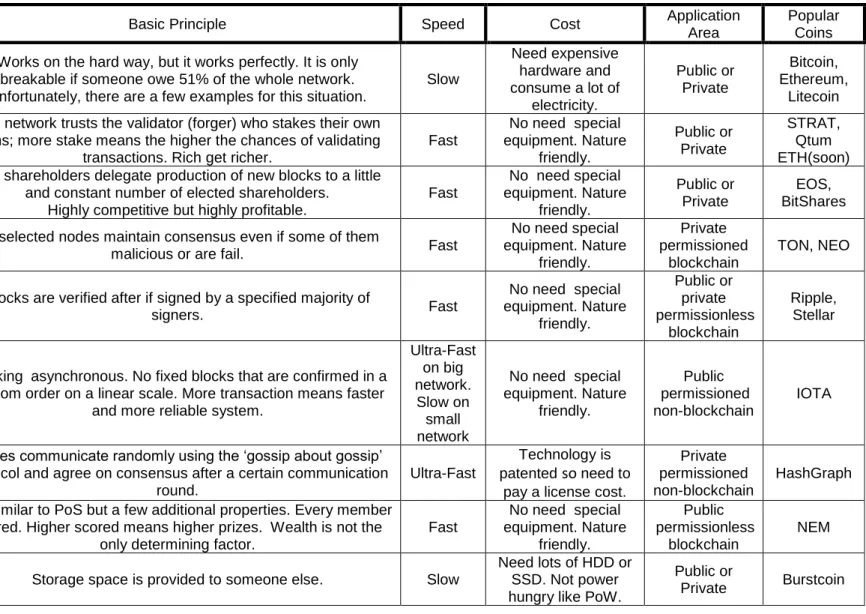
5.1.1 Comparison of consensus mechanisms against each other ... 40
5.1.2 CCs in Our Daily Lives ... 40
5.1.3 The risks of CCs ... 44
5.1.4 Possible weaknesses of CCs ... 45
5.1.5 Domestic (Turkish) Cryptocurrency attempts ... 46
5.2 Summary ... 47
5.3 Conclusions ... 47
v LIST OF FIGURES AND TABLES
List of Figures
Page Figure 2.1 Centralized vs decentralized network and nodes 6 Figure 2.2 A summary of Cryptocurrency, Blockchain operation
Figure 2.3 Summary of CCs main properties Figure 3.1 Logic of the Markle tree
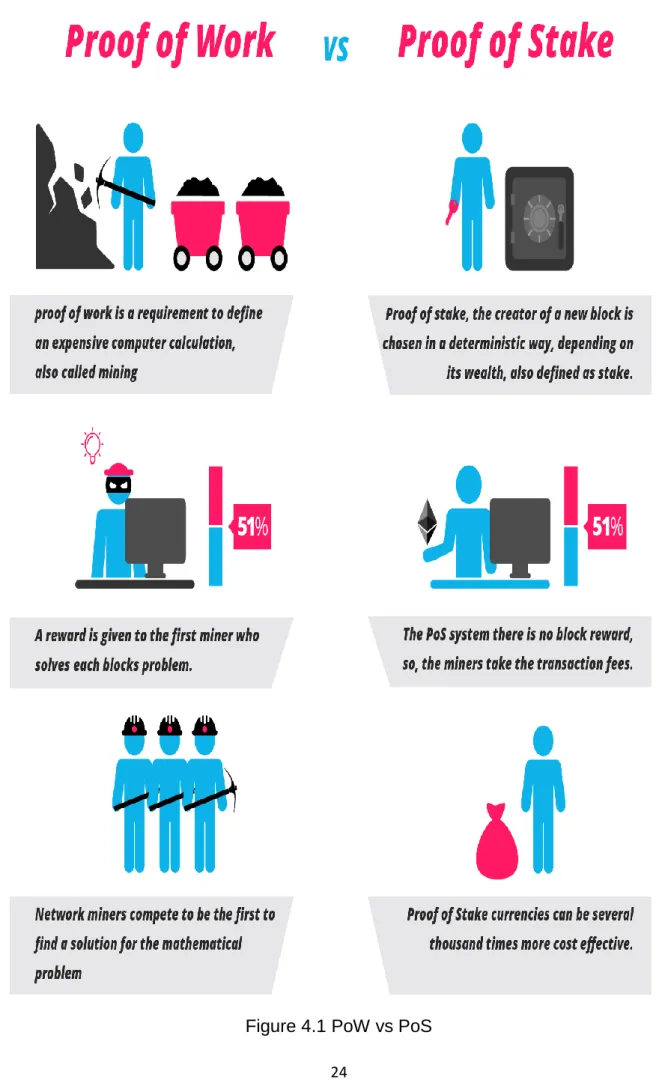
Figure 4.1 PoW vs PoS
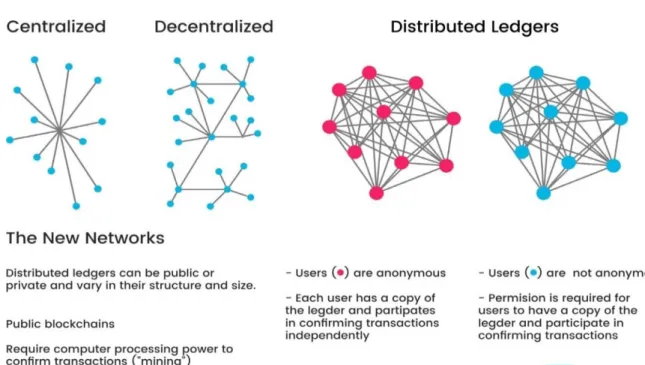
Figure 4.2 Centralized Network vs Decentralized Network and distributed ledgers
Figure 4.3 Payment systems process capacity per second
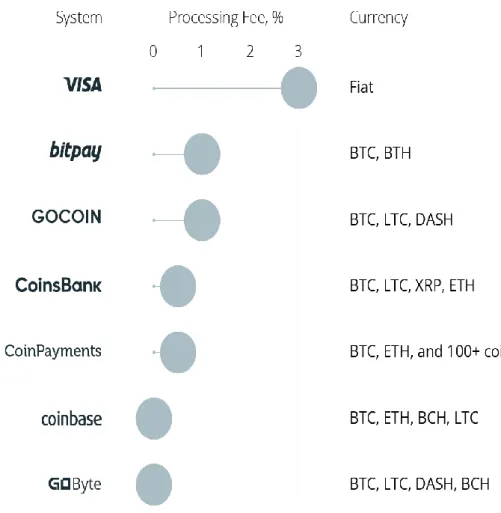
Figure 4.4 Proof of Work(PoW) vs Proof of Stake(PoS) summary Figure 5.1 Visa and CC based payment systems commissions
8 12 18 24 25 31 33 43 List of Tables Page
Table 2.1 Cryptocurrencies prices and market volumes 11
Table 3.1 The crack time by key length 20
vi
LIST OF ABBREVIATIONS
BFT Byzantium Fault Tolerance
BTC Bitcoin
CC Cryptocurrency
DAG Directed Acyclic Graph
DAO Decentralized Autonomous Organization
DPOS Delegated Proof of Stake
ETH Ethereum
FBA Federated Byzantine Agreement
FIPS U.S. Federal Information Processing Standard
ICO Initial Coin Distribution
MD5 Message-Digest Algorithm 5
NIST National Institute of Standards and Technology / USA
NSA National Security Agency
P2P Peer to Peer
PBFT Practical Byzantine Fault Tolerance
PoA Proof of Authority
PoC Proof of Capacity
PoI Proof of Importance
PoS Proof of Stake
PoSpace Proof of Space
PoW Proof of Work
SHA Secure Hash Algorithm
SHS Secure Hash Standard
XMR Monero
1 1 INTRODUCTION
1.1 Statement of the Problem
Today cryptocurrencies(CCs) forms of money have turned into a global focal point which is being discussed very widely. Yet, banks, governments and various private organizations and individuals know about their value.
In the year 2018, it would be difficult to find any organization on the globe that is not dealing with cryptocurrencies.
However, individuals including investors, advisors, researchers, and developers, are having an extremely limited information and knowledge about cryptocurrencies. In this study the following questions are tried to be answered:
➢ What are cryptocurrencies?
➢ How cryptocurrencies emerged as a side product of digital cash? ➢ How miners create coins and confirm transactions?
➢ Security of CCs.
➢ Mechanism types of blockchain and implementations. ➢ What will wait CCs and us in today and in the future?
1.2 Literature Survey
Going over the literature on the last two decades, one would summarize the results in this section.
Lamport et al.[1982] discussed a technique that reliable computer systems will handle malfunctioning components that give conflicting output to different parts of the system. A similar technique was implemented by the Byzantine generals against
2
the vulnerability of the army or traitors many years ago which is now named as Byzantium Fault Tolerance (BFT)1.
Wang et al.[2004] published a technical paper. This is the first publication about MD5 collision. It meant MD5 was no longer secure algorithm.
Tao et al.[2006] wrote an article about Collision Attack on an earlier algorithm MD5. The authors stated some attacks to MD5 in their research. Their article was not directly related to Cryptocurrencies, but it was directly related to the algorithm which is later replaced by SHA.
Black et al.[2006] had also discussed weakness of MD5 algorithm.
Ciampa[2008] had discussed the cracking methods of some algorithms in his book. Dougherty[1](*) wrote a paper where he discussed weaknesses of MD5 algorithm. Nakomoto[2] published a white paper in the Bitcoin official web site. Nakamoto is unknown inventor of Bitcoin. This white paper includes some researches about Peer to Peer(P2P) cash system and its mechanisms. This white paper is very important because it was the first research paper before the cryptocurrencies born. It summarized the mechanism of Bitcoin.
Martin and Tokutami[3] studied password cracking. They examined hashed or not hashed, salted or not salted passwords. They discussed some attacking methods such as Brute force, dictionary attack and rainbow tables attack. They discussed how much time it takes to crack a password with these attacks and they explained details of these attacking methods.
Bertoni et al.[2012] called themselves as “Keccak Team” and they are the creator of the Keccak algorithm. In their article they gave technical details about Keccak and SHA. SHA-3 is a subset of the broader cryptographic primitive family Keccak
1 Byzantium Fault Tolerance (BFT), MD5 Algorithm, Collision Attack etc. are relevant terms and
they are presented in detail in the following chapters.
3
algorithm. Also, it is important because SHA3 is the latest member of the Secure Hash Algorithm (SHA) family of standards, released by NIST on August 5, 2015. Ethereum uses Keccak algorithm to hash.
Garay J. et al. [2014] analyzed the mechanism of the Bitcoin. They proposed another mechanism to Bitcoin which they called Byzantine agreement(BA).
According to Bonneau et al.[2015] Bitcoin is “renaissance of new ideas in designing a practical cryptocurrency”. Also, according to them this innovation touches many areas without Cryptocurrencies.
Evans[2015], describes what Bitcoin and blockchain are. He also mentioned Blockchain Management System(BMS). He mentioned Bitcoin(BTC) with different name which is XBT. Probably the reason of it, commodities’ such as Gold, silver, platinum etc have ISO codes and they started with X(example: XAU/Gold, XAG/Silver, XPT/Platinum).
Heilman et al.[2015] presented an eclipse attack to Bitcoin network. They explained details of their attack and at the end they proposed countermeasures for make the eclipse attack harder.
Viglione[2015] discussed the impacts of social technologies identified with administration on cross-country contrasts in Bitcoin costs. Also, he compared approaches of different countries toward Bitcoin with graphics and some statistical methods.
Bitfury Group Ltd.[4] published a whitepaper about Proof of Work and Proof of Stakes. They are the top two mechanisms of mining and transaction confirmation methods of cryptocurrencies. The authors explained these methods one by one and later they compared these methods and gave some CC examples.
Rosic[5] defined a lot of technical terms and explained the mechanism of the blockchain system and how cryptocurrencies emerged. Moreover, he explained a few most popular cryptocurrencies. Also, one can find how crypto currencies effect our daily lives in this article.
4
Rosic[7] had an article about benefits of the cryptocurrencies. He claimed that there are some positive aspects of cryptocurrencies.
Baird[2016] in his article mentioned a new system, named “The Swirlds hashgraph consensus algorithm”. He suggested it to replicate state machines with guaranteed Byzantine fault tolerance.
Gencer et al.[2016] proposed a new design for Bitcoin that is Byzantium Fault Tolerance (BFT) and they called it Bitcoin-NG(New Generation). At the end of their works they concluded that it is possible to upgrade Bitcoin.
Barski [2017] dealt with hashing, hacking, cracking, security and cryptograph of cryptocurrencies. This presentation was at Chicago Ethereum Meetup in 2017. In his presentation he gave and explained a lot of information about security of CCs. Sompolinsky et al.[2017] published an article about Serialization of Proof-of-work Events: Confirming Transactions via Recursive Elections (SPECTRE) which is another sub branch of DAG like Tangle. They discussed a new framework system which can satisfies general requirements of cryptocurrency.
Gilad et al.[2017] introduced a new Cryptocurrency that is called Algorand in their article. In this article they discussed their technique which is Byzantium Agreements consensus technique. They thought Algorand uses first of its kind of a new technology that fulfills the promise of blockchain.
NEM Foundation[2018] published a technical whitepaper on NEM giving technical details about NEM also they developed Proof of Importance(PoI) method and they implemented it in NEM2.
Popov[2018] discussed about the other mechanism of a cryptocurrency named Tangle. Tangle is the sub branch of Directed Acyclic Graphs(DAG) and the most popular implementation is IOTA. According to him the Tangle is next evolutionary step of the blockchain technology. Because usual blockchain which uses the Proof
5
of Work mechanism is getting slower as it grows as well as the transaction fees are increasing. On the other hand, Tangle mechanism is getting faster as it grows. Larimer[2018] published a white paper on EOS3 giving its technical details. He developed Delegated Proof of Stakes method and he implemented it in EOS. Magas[8] published an article about Ethereum’s new Casper protocol update and what will change in the mining industry with this update.
Magas[9] published another article. In this article she compared traditional payments methods such as Visa, Mastercard with CCs and discussed possibility of traditional payments methods replaceable with CCs.
1.3 Organization of the Study
The thesis starts with a brief introduction and literature reviews. Second chapter defines what Cryptocurrencies and their basic mechanisms are. Also, how they are produced and the logic behind the production process named mining are discussed. Next chapter, namely Chapter 3, gives some information about the strength of Cryptocurrencies and their most common algorithms. Also, theoretically investigate the strength of these algorithms to well-known attacks. Fourth Chapter is about the definition of the different consensus mechanisms of cryptocurrencies. Their advantages and disadvantages are also discussed. In the last Chapter under Discussion part needs and the risks of Cryptocurrencies are discussed. Also, some examples about domestic Cryptocurrency projects are given. Then a brief Summary and Conclusions are given at the end of the chapter.
6
2 CRYPTOCURRENCIES AND RELEVANT CONCEPTS
2.1 What is Cryptocurrency (CC)?
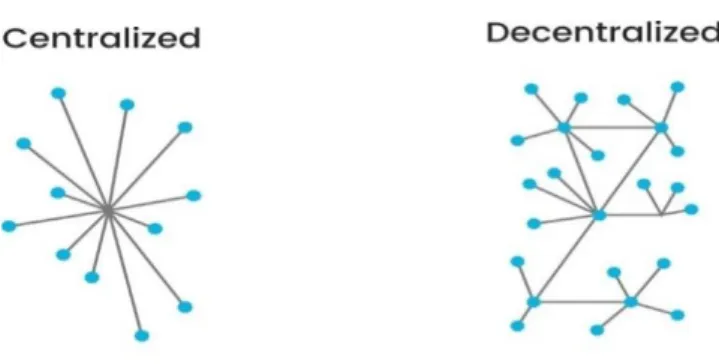
One may refer Rosic [5] to answer the question of what cryptocurrency is? Take the money in a bank account. It is just a piece of data in a database that can be changed under certain conditions. Thus, money is a verified entry in a database of accounts, balances and transactions. It may be said that cryptocurrency appeared as a side product of trial on Peer to Peer (P2P) money transaction system which is later named as Bitcoin[2]. S. Nakamoto did not intend to invent a currency while working on Bitcoin in late 2008. He was only trying to invent decentralized digital cash system which does not require to build a server room as a centralized entity. It is similar to a Peer-to-Peer (P2P) network for file sharing. Centralized and decentralized network differences are in Figure 2.1[6].
Figure 2.1 Centralized vs decentralized networks and nodes
This idea created cryptocurrency as a digital cash. Nakamoto proved to achieve a consensus without a central authority or central server system. Cryptocurrencies are a part of solution.
2.2 The Production and the Basic Mechanism of Cryptocurrencies
As noted by Rosic[5], cryptocurrencies are produced by miners. But how miners create coins and confirm transactions need to explain. Cryptocurrency such as Bitcoin comprises of a network of associates. Each associate has a record of the entire historyfall things considered and in this manner the equalization of each record is realized. A transaction is a record that says, “Joe gives some BTC to Jane“ and is signed by Joe‘s private key. It is basicfpublic keykcryptography, nothing special at all. After signed, transaction is communicated in the network, sent from
7
one companion to each other associates. Figure 2.2 summarizes the process given by Rosic[5].
The transaction is communicated very quickly by the entire network. Confirmation is a basic idea in cryptocurrencies. For whatever length of time that a transaction is unverified, it is pending and can be manufactured. At the point when a transaction is affirmed, it is an unchangeable reality. It is never again forgeable, it cannot be switched. It is a piece of an unchanging record of chronicled transactions which is called blockchain4.
Just minersfcan affirm transactions. This is miners’ role in afcryptocurrency-network also known as blockchain. They takeftransactions, sign them as substantial and broadcast them in thefnetwork. After aftransaction is affirmed by a miner, each peer needs to add it to its database. It has progressed toward becoming a piece of the blockchain.
For this activity, the miners get awarded with a token of the cryptocurrency and this is named block rewards. Thus, the miner’s action is the absolute most vital piece of cryptocurrency-system.
2.3 What are Miners Doing?
Essentially everybody can be a miner. Suppose somebody creates a lot of peers and produces fake transactions. The systemfwould then failkimmediately. Then, Nakamoto decided that the miners need to contribute some work.
One does not have to understand insights about SHA 256 Algorithm. It is just an imperative that one has to understand the premise of a cryptologic riddle the miners contend to explain.
Bitcoins or some of other altcoins must be produced if miners solve a cryptographic riddle. This is part of the consensus no peer in the network can break.
4Blockchain constantly creating summary of records, called blocks, which are associated and tied down using cryptography
8 Fi g u re 2 .2 A S u m m a ry o f Cry p to cu rr e n cy and B lockch a in o p e ratio n
9
One then needs some hardware to solve these cryptographic puzzles. At the beginning CPUs5 could do it. But over time, as the transaction traffic increases CPUs cannot handle all the transactions. Miners discovered GPUs6 could do 10-15 times better job than the CPUs. Then, some companies invented ASIC7 Machines to solve these puzzles. ASIC is a special CPU, it is invented only to solve a specific algorithm. They cannot do anything without it. But now, some of the cryptocurrency algorithms could solve ASIC and some of them can solve only GPUs and CPUs. One may name Monero (XMR) as an interesting example. One of the largest ASIC company named Bitmain invented an ASIC machine, to mine Monero algorithm named Cryptonight. One should note that ASICs cause a centralized network. Then, some big companies collect most of the ASICs in the world. Centralized network means it could be manipulated: thus, it is not so secure. Then Monero’s developer updated their algorithm to CryptonightV7 on 5th April 2018 to resist ASICs. Now ASICs cannot mine Monero. Cryptonight ASICs became totally useless; because the algorithm has changed. Only CPUs and GPUs can solve the algorithm, so it is more secure and more decentralized. Everybody can solve this algorithm even at their home with their own computers.
On 20th October 2018 Monero updated its algorithm again and new algorithm is named CryptonightV8. The Monero’s developers promised to update the algorithm every 6 months so ASIC companies can create new ASIC machine but after a few months it becomes useless.
2.4 Current Cryptocurrencies (CCs) Examples
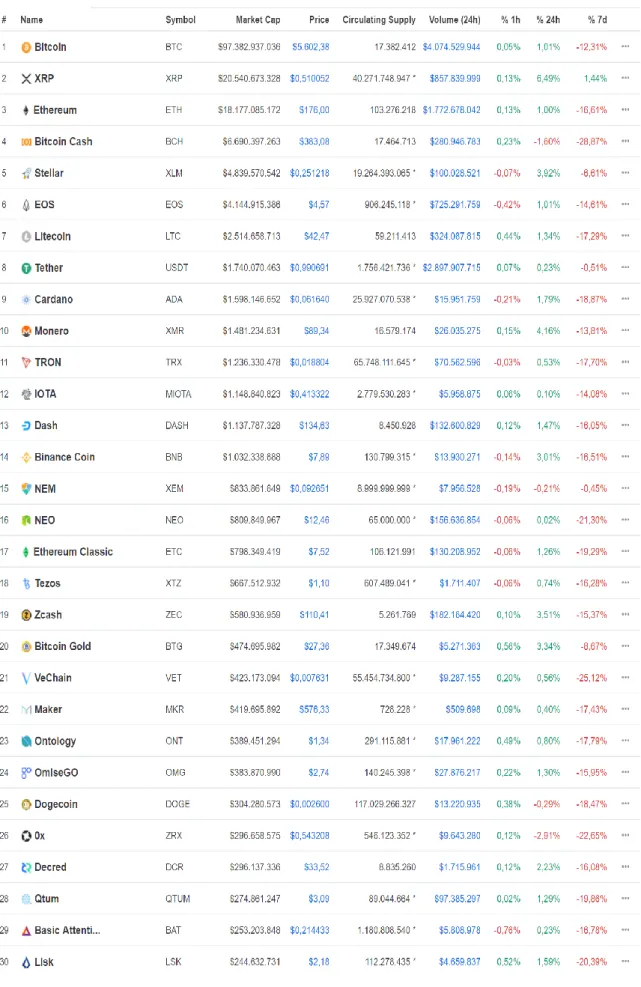
Nowadays there are almost over 2081 cryptocurrency examples circulating in the crypto markets. Probably there are lot more CC’s that do not circulate in the markets yet. Table 2.1 lists the most popular 30 CCs in the CC markets with their update (18.11.2018 16:30 (GMT +3) price and volume data [10].
As noted above, there are over 2081 CCs available in the CC markets. Some of their supplies still are produced by miners. Some of them already produced maximum of supply and they are just circulating. Most famous CC example is
5 CPU: Central Processing Unit 6 GPU: Graphical Processing Unit
10
Bitcoin(BTC). Today (November 2018) there are 17,382,412 BTC supply is circulating in the world. The rest of them are still producing. Maximum 21 Million BTC can be produced. Another most popular CC is Ethereum(ETH). Now there are over 103 million ETH supply that is circulating, and its production is still in progress. From another category IOTA is another most popular CC. IOTA is different from BTC or ETH. Because it is not produced by miners. It’s all supply was just created at the beginning by its developer and now it is just circulating and trading. Also, IOTA does not have transaction fee and it has a vision: IOTA wants to become the main currency at the e-commerce.
2.5 Properties of Cryptocurrencies
2.5.1 Revolutionary properties
Bitcoin, as a decentralizedknetwork ofkpeers which keep an agreement about records and parities, is more a cash than the numbers one find in his/her financial balance. What are these numbers more than sections in a database which can be changed by individuals nobody sees and by rules nobody knows?
Actually, CCs are sections about token in decentralized consensus databases. They are called cryptocurrencies in light of the fact that the agreement
keeping process is anchored by solid cryptography8. Cryptocurrencies are based on cryptography that is, they are not based on any people or simply trust but rather by math.
2.5.2 Transactional properties
Five of transactional properties of CCs are summarized below [5]:
a) Irreversible: After affirmation, a transaction cannot be moved back. By no one. Not the sender, not the bank, not Nakamoto, not the miner. No one. If one sends cash, he/she send it. Period. Nobody can help one after his/her transaction. If one sent his/her assets to a fraud or if a programmer stole them from your PC, one cannot move back the procedure. There is not any security measure. .
8 Cryptographyis the practice and study of method for secure communication in the asset of third
11
12
b) Pseudonymous9: Neither transactions nor accounts are related with identities.
Everybody just has a Wallet ID.
c) Quick and global: Transactions are communicated almost immediately in the network and are affirmed in several minutes perhaps in a moment or two. Since they occur in a worldwide network of PCs, they are totally unconcerned of one’s physical area. It doesn't make a difference if you send Bitcoin to anybody in the world. d) Secure: CC balances are secured by an open key cryptography system. Just the owner of the private key can send cryptocurrency. Cryptography and large numbers make it hypothetically impossible to crack this design.
e) Permissionless: One does not need to demand that anybody utilize cryptocurrency. It is only a product that everyone can download for free. After one installed it, one can receive and send Bitcoins or any other cryptocurrencies. Nobody can anticipate. There is no guard. These properties are summarized in Figure 2.3 [5].
Figure 2.3 Summary of CCs’ main properties
13 2.5.3 Monetary properties
There are two basic monetary properties [5]:
a) Limited supply: Most CCs constrain the supply of the coins. For example in BTC, the supply to this date might change as indicated by number of the miners, transactions and intensity of the new equipment. All CCs control the supply of the coins by a calendar written in their code.
b) No debt but bearer: The Fiat-Money10 on one’s financial balance is made by liability, and the numbers, one sees on his/her record speak to only liabilities. It is an arrangement of IOU11. Cryptocurrencies will not speak to obligations. They simply speak to themselves. They are cash as hard as gold coins.
In order to comprehend the revolutionary effect of cryptocurrencies one has to think about both of these properties. Bitcoin as a permissionless, irreversible and pseudonymous methods for installment is an attack on the control of banks and governments over the money related transactions of their natives. One cannot obstruct somebody to use cryptocurrency or one cannot boycott somebody to get a payment, one cannot cancel or roll back a transaction[Viglione, 2015].
As cash with a restricted, controlled supply that is not alterable by an administration, a bank or some other central organization, cryptocurrencies assault the extent of the monetary approach.
2.6 Cryptocurrencies: Beginning of a New Economy
Rosic has noted that [5] for the most part because of its revolutionary properties cryptocurrencies have turned into a win their innovator, S. Nakamoto, did not expect to hope for it. Cryptocurrencies are kind of a digital gold. They are secure from any political intervention[Viglione, 2015].
10Fiat money is currency that an administration has pronounced to be legitimate delicate, however it isn't
upheld by a physical product. The estimation of fiat cash is gotten from the connection among free market activity as opposed to the estimation of the material that the cash is made of. Verifiably, most monetary forms depended on physical products, for example, gold or silver, yet fiat cash depends entirely on the confidence and credit of the economy.
11An IOU (abbreviation from the expression "I owe you") is generally a casual report recognizing obligation.
An IOU contrasts from a promissory note in that an IOU is certifiably not a debatable instrument and does not determine reimbursement terms, for example, the season of reimbursement.
14
While cryptocurrencies are more used for payments, they are used as a method for speculation on the markets. CCs brought forth an extraordinarily powerful, quickly developing business sector for financial specialists and investors evenfspeculators. Exchanges such as Bittrex, Binance, Btctürk etc. enable the trade of a lot of CCs. In the meantime, the praxis of Initial Coin Distribution (ICO12), for the most part encouraged by Ethereum's smart contracts to gather a huge number of dollars. The account of "the DAO13 “ has in excess of 150fmillion US dollars.
In this rich ecosystem of CCs and tokens, one experiences excessive volatility. It is commonfthat a CC gainsf20% a day or sometimes 200%. just to lose the same rate at the following day. If one is lucky, his/her coins can be valued thousands of times in a short time. So, you can be rich in shortcut or poor!
We already presented some of the most popular cryptocurrencies of today as given in Table 2.1[10] but some new born cryptocurrencies may make you rich in a shorter time than the well knowns.
12ICO: It can be considered as an alternative mass fund that emerged as a different from the
traditional financial system. ICOs are usually an event that lasts a week or more. and people are able to get new coins on the market in exchange for already known crypto coins (Bitcoin, Ethereum etc.).
13DAO ( Decentralized Autonomous Organization): It is an enterprise managed through rules coded
as computer programs called smart conventions. DAO's financial transaction registration and program rules are kept on a block chain. There are several examples of this business model. The precise legal situation of such commercial organizations is unclear.
15 3 CRYPTOLOGY AND CRYPTOCURRENCIES
3.1 Cryptography for Cryptocurrency
a) Definition of cryptography
Cryptography is a technique for sending mystery messages. One individual encodes a message utilizing a type of key and algorithm and just the other individual at the other end can decode it if he/she knows the encryption key.
b) What in the world does it have to do with cryptocurrency
Most cryptocurrencies do not include the sending of any mystery messages. All their data including transactions in cryptocurrencies like Bitcoin is open and subsequently there is no compelling reason to send "concealed messages" between parties. Nonetheless, some newer CCs like XMR or ZEC actually try to dissemble details of transaction. They use cryptography to hide information.
c) Purpose of cryptography with cryptocurrency
According to Barski[2017], a portion of the devices that were created for customary cryptography end up having other helpful capacities. Two most critical of these are hashing and digital signatures. In this way, despite the fact that neither of these include the sending of covered messages they are as yet thought to be types of cryptography. Hashing is utilized by cryptocurrencies to effectively confirm the uprightness of information. It is a strategy for taking a lot of information and systematically speaking to it as a short number that is hard to recreate. Hashing is utilized intensely to keep up the structure of blockchain information, which holds individuals' record balances. Likewise, it is utilized to encode individuals' record addresses and as a feature of the way toward encoding transactions between records. At long last, hashing is utilized to create math perplexes that make "block mining" conceivable, a key element in numerous cryptocurrencies. Hashing makes substantial utilization of block figures, an innovation that was initially utilized for customary cryptography.
Digital signatures enable a man to take a touch of mystery data they possess and to demonstrate they claim that data, without uncovering it. Cryptocurrencies enable
16
clients to sign monetary transactions with these digital signatures to demonstrate to the network that the proprietor of a record holding cash consented to a transaction to spend that cash. Digital signatures, as utilized by cryptocurrencies, advanced from "Elliptic Curve Cryptography" which again is an innovation that initially was utilized to make "covered messages" as a major aspect of conventional cryptography.
3.2 What is MD5 and why no longer in use?
MD5 algorithm was designed in 1991 and published in 1992. In 1993, first weaknesses were detected, then greater weaknesses in 1996. It took 8 years for these weaknesses to become into real collisions by Wang[2004]. Seven years later, in 2011, one can create MD5 collisions at will and much more efficiently than with Wang[2004]'s original method, but preimage and second-preimage resistances of MD5 are still as good as ever.
3.3 The reason of why Bitcoin uses SHA256
As noted by Wang[2004], Black[2006], Daugherty[1], Ciampa[2009] and Tao[2013], MD5 is not a secure algorithm since 2000s. So, it replaced by SHA.
Bitcoin utilizes a hashing algorithm named SHA256 (likewise named SHA2– 256) for arranging block information, for the block mining algorithm, and as a feature of the procedure for encoding/decoding transactions and client accounts (client accounts additionally utilize another hashing algorithm called RIPEMD-160). Bitcoin utilizes the ECDSA (elliptic curve algorithm) for digital signatures.
3.4 Cryptography of Ethereum
One may refer Barski et al. [2017] to understand the security of Ethereum. Bertoni[2012] also explained the logic of SHA 3 algorithm.
Ethereum, instead of SHA2, uses another hash algorithm that is SHA3 to arrange block data, as part of the mining algorithm, and for encoding transactions and user accounts, more specifically, a variant of SHA3 called SHA3-Keccak is used. ETH still uses ECDSA for digital signatures, as with Bitcoin.
17
If one sends cash to an Ethereum address that does not exist, one loses it forever. The reason is briefly explained below [Barski, 2017]:
Cryptocurrencies utilize hashing as a feature of the way toward producing account addresses. On account of ETH, these record addresses are 40 character long, and hypothetically any 40-character string could be a legitimate ETH wallet address, contingent upon the consequence of the hashing step. The Ethereum network has no real method for knowing whether a specific address was mistyped, and consequently it will give you a chance to send cash to a nonsense account address. For example, “0x0000000000000000000000000000000000000000” if one asks it to. Theoretically this is a correct Ethereum address format, but it does not mean it belongs to someone. In the event that one does this, his/her cash basically falls into a "black hole" and no one will ever have the be able to rescue it again.
Gratefully, this issue has been lessened to some degree by means of another component named "mixed-case checksum address encoding" that will enable projects to create a mistake for most types of mistyped address.
3.5 Role of Merkle Trees in CCs
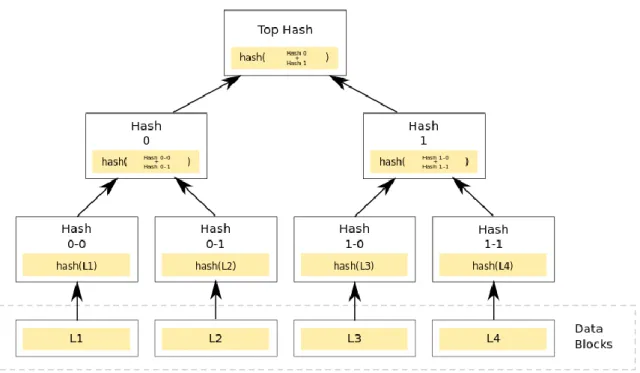
One may refer Barski[2017] to see importance of Merkle trees in cryptocurrencies. Merkle trees are a strategy including hashing that enables one to demonstrate to someone else that a large volume of document contains a little bit of information, without the other individual requiring a full duplicate of this information. Figure 3.1 shows the logic of the Markle tree by leaf to root[19].
One should keep in mind that Merkle trees enable cryptocurrencies to run effectively on obliged equipment gadgets like mobile phones and permit smart contracts (some portion of the Ethereum system) to associate with vast information structures. Since both mobile phones and smart contracts are probably going to assume a major job later on, we will probably hear much more about Merkle trees in the years to come. The only known way to understand the security of a cryptographic algorithm is to leave it under close examination of hundreds of cryptographers for several years and see what comes out. So, the right perspective here is historical.
18
Figure 3.1: Logic of the Markle tree
3.5.1 Security of SHA256 and Bitcoins
SHA-256 was first published in 2001; ten years later in 2011, we still have no clue whatever on the slightest hint of a weakness. This would be suggestive that SHA-256 is indeed robust, and collisions for SHA-SHA-256 are not just right around the corner. It seems that collisions are not a real danger for Bitcoin -- it rather relies on preimage resistance, for which not only SHA-256 is rock solid, but even MD5 would still be reliable.
However, it is not so reliable to make statistics on a single measure. In 2007, it was estimated that there was a relatively high risk that the attacks on MD5 could be transported to SHA-1 and then SHA-256/512 -- this prompted NIST(National Institute of Standards and Technology) to organize the SHA-3 competition. It turned out that attacks on SHA-1 have somehow stopped progressing, and there is no attack on SHA-2. Whether this is because SHA-2 is really strong, or because all the cryptographers are busy trying to break the SHA-3 candidates, is not known.
19 3.6 Strength of cryptography and brute force
“Strong cryptography” or “cryptographically strong” are general terms connected to cryptographic systems or parts that are considered very impervious to cryptanalysis. The expression "cryptographically strong" is regularly used to depict an encryption algorithm, and suggests, in contrast with some other algorithm, more prominent protection from attacks. In any case, it can likewise be utilized to depict hashing and exceptional identifier and filename creation algorithms.
The Secure Hash Algorithms are a family of cryptographic hash functions published by the National Institute of Standards and Technology (NIST), as follows:
SHA-0 is a retronym14 “applied to the original version of the 160-bit hash function published in the year 1993 and named ‘SHA’. It was withdrawn shortly after publication due to a secret "significant flaw" and replaced by the a little revised version SHA-1.” [Tao et al., 2013]
SHA-1 “is a 160-bit hash function which similar the former MD5 algorithm. This was designed by the National Security Agency (NSA) to be part of the Digital Signature Algorithm. Cryptographic weaknesses were spotted in SHA-1, and the standard was no longer approved for most cryptographic uses after 2010.”
SHA-2 “is a family of two similar hash functions, with different block sizes are, known as SHA-256 and SHA-512. They differ in the word size: SHA-256 uses 32-bit words and SHA-512 uses 64-bit words. There are also truncated versions of each standard, known as SHA-224, SHA-384, SHA-512/224 and SHA-512/256. These were also designed by the NSA.” [Tao et al., 2013 and Bertoni et al., 2012]
SHA-3[Bertoni et al., 2012] “is a hash function formerly called Keccak, chosen in the year 2012 after a public contest between non-NSA designers. It supports the same hash lengths as SHA-2, and its internal design differs remarkably from the other members of the SHA family.”
14Retronym: A retronym is a more current name for a current thing that separates the first frame or
form from a later one. It is in this manner a word made to separate between two kinds, while already (before there were two composes) no elucidation was required.
20
The related standards are FIPS PUB 180 (original SHA), FIPS PUB 180-1 (SHA-1), FIPS PUB 180-2 (SHA-1, SHA-256, SHA-384, and SHA-512). NIST has updated Draft FIPS Publication 202, SHA-3 Standard separate from the Secure Hash Standard (SHS).
3.6.1 Brute Force to SHA 256
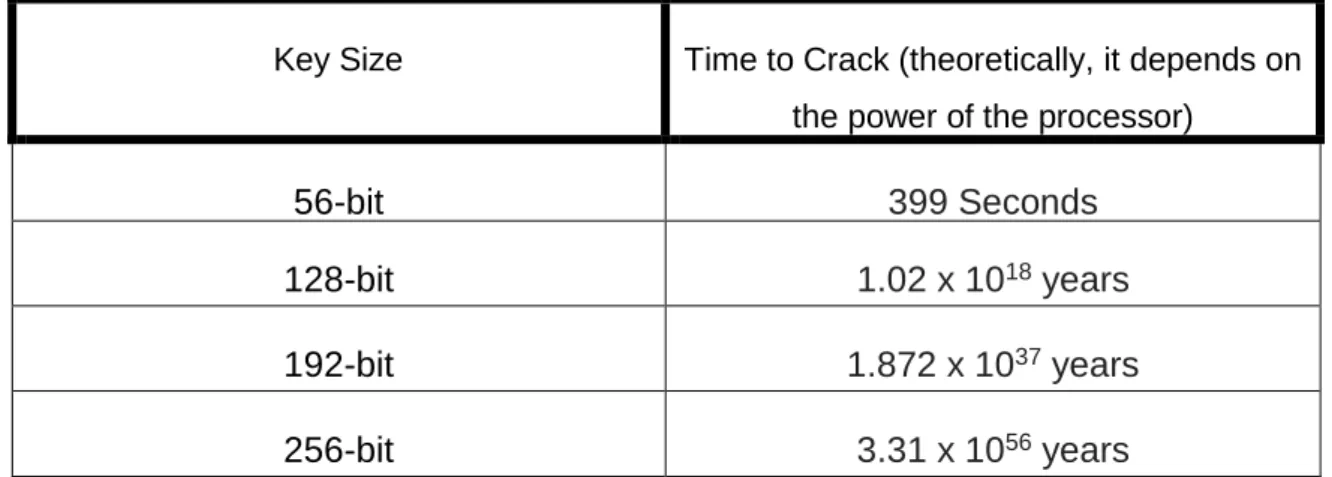
Referring to Martin and Tokutami[3], it may be stated that breaking the hash algorithm is identical to spotting a collision in the hash algorithm. That implies that one does not have to discover the secret word itself; one simply need to discover a yield of the hash work that is equivalent to the hash of a substantial secret word. Finding an impact utilizing a birthday attack takes O(2n/2) time, where n is the yield length of the hash function in bits. Table 3.1 shows the crack time by key length. “SHA-2 has a yield size of 512 bits, so spotting a collision would take O(2256) time. There are no rationale attacks given on the algorithm itself (presently none are known for the SHA-2 hash family).”
Table 3.1 Crack time by key length
Key Size Time to Crack (theoretically, it depends on the power of the processor)
l56-bitl l399 Secondsl
l128-bitl l1.02 x 1018 yearsl
l192-bitl l1.872 x 1037 yearsl
l256-bitl l3.31 x 1056 yearsl
This is the thing that itftakesftobreakfthefalgorithm. In order to understand for whatf 2256 lmeans: fCurrently itfis believedfthat thefnumberfof.atomsfin.thefuniverse.is roughly 1080 which is more or less equal 2266. Assuming 32-bytefinput (which is reasonable for this scenario – 20fbytes salt15 + 12fbytes password = 32byte) Let’s
15Salts: In cryptography, a salt is irregular information that is utilized as an extra contribution to a
21
assume that one computerftakes .~0,22s.(~2-2s).for.65536 (=216) computations. So, 2256fcomputations wouldfbe donefin 2240 * 216 computations which would theoretically take: 2240 * 2-2 = 2238 ~ 1072seconds ~ 3,17 * 1064 years
It implies a large number of years. Also, it doesn't improve with the quickest equipment on the planet figuring a large number of hashes in parallel. No humanity innovation even quantum PCs will have the capacity toksplitkthisknumber intol somethinglworthy .
So, brute-forcing to SHA-256 is totally useless. The.next.question.is.what.about dictionary-wordslattacks. For the purpose of revoke weak passwords, .rainbow. .tables16 were used usually. A.rainbow.table.is.usually just a data table which includes lprecomputedlhashlvalues. The mainkidea is--if oneklwereklableklto precomputefandfstorefevery possiblefhash alongfwith itsfinput, then it wouldftake onefO(1)fcomplexity to lookfupfa givenfhash andfrevoke a legitimatefpreimage for it. This is only possiblefin theory sinceftherefis nofstorage devicefthat couldfstore suchfenormous amountsfoffdata. “This quandary is known as memory-time tradeoff.”
“Salts are a countermeasure to make such rainbow tables possible. In order to discourage attackers from precomputing a table for a specific salt it is recommended to apply per-user salt values. Since users do not use safe or completely random passwords, it is still astonishing how successful one can get if the salt is known and one just iterate over a large dictionary of common passwords in a simple trial and error scheme.“
Salts are used to safeguard passwords. Historically a password was stored in plaintext on a system, but over time additional safeguards developed to protect a user's password against being read from the system. A salt is one of those methods.
identified with the idea of nonce. The essential capacity of salts is to protect against word reference assaults or against its hashed comparable, a pre-figured rainbow table attack.
16Rainbow Tables: a string made up of a string and its hash match. To do a mixed-cracking
operation, the string to be tested is normally weighed, the hashes are compared, and the experiment can continue with the next test string. This method is inefficient when processing time is required.
22
Typical password choices are generally of low entropy, whereas completely random values would contain a maximum of entropy.
The low entropy of average passwords makes it conceivable that there is a moderately highkpossibility of one of one’s clients utilizing a secret word from a generally little database of normal passwords. In the event that one googleffor them, one will wind up discovering downpour joins for such secret phrase databases, frequently inkthekgigabyte measure classification. Beingkeffective withksuch an instrument is for the most part in the scope of minutes to days if the assailant is not confined in any capacity. This is the reason by and large simply hashing and salting is not sufficient, you have to set up other well-being systems also. One should utilize a misleadingly backed off entropy-inducing technique, for example, PBKDF2(Password-Based Key Derivation Function 2) depicted in PKCS#5(Public-Key Cryptography Standards 5). One ought to apply a sitting tight period for a given client before they may retry entering their secret word. A decent plan is to begin with 0.5s and after that multiplying that timefforfeach fizzled endeavor. As a rule, clients do not see this and do not flop significantly more regularly than three times by and large. In any case, it will astoundingly back off any vindictive untouchable attempting to attack your application.
23
4 COMPARISONS FOR CONSENSUS MECHANISMS OF THE AVAILABLE CRYPTOCURRENCIES
4.1 General
In this chapter the mainkdifferences between Proof of Work(PoW), Proof of Stake(PoS) and the other methods such as Proof of Capacity, Proof of Authority and some others are explained.
Meaning of mining, or the process of producing new CCs that are released through the network. Moreover, what will change concerning mining methods if the Ethereumkcommunity chooses to pass from “work(PoW)” to “stake(PoS)”? Figure 4.1[6] explains the main differences of the PoW and PoS.
4.2 What is the Proof of Work (PoW)?
One may refer Nakamoto [2], Bitfury Group Limited [4] and Rosic [6] for defining Proof of Work. PoW is the most common blockchain consensus algorithm. Confirmation of work is a convention that has the fundamental objective of preventing digital assaults, for example, a distributed denial-of-service(DDoS) attack which has the reason for debilitating the assets of a PC system by sending various phony solicitations.
The Proof of work(PoW) idea existed even before Bitcoin; however, Nakamoto connected this method to his computerized currency upsetting the manner in which customary transactions are set.
Today, Proof of Work may be the greatest idea behind the Nakamoto’s Bitcoin white paper[2] – published back in 2008 because it allows trustless and distributed consensus. The most popular PoW implementations are Bitcoin, Ethereum, Litecoin, Dogecoin, and many others. The advantage of PoW is it is working perfectly; but disadvantages are it is working slow and killing the planet because it uses too much electricity!!
24
25
4.3 What is Trustless and Distributed Consensus?
A trustless and distributed consensus system implies that if one need to send as well as get cash from somebody one does not have to trust in outsider administrations. Figure 4.2 explains the distributed ledgers[6].
When one utilizes conventional techniques for installment, one has to trust in an outsider to set his/her transaction (e.g. Visa, Mastercard).
The basic model to clarify this conduct more readily isftheffollowing: ifkJanefsent Morgan $500, the trusted third-party service would debit Jane’s account and credit Morgan’s one, so unfortunately, they bothfhave toftrust thisfthird-party that it iskto goingfdo thefrightfthing[6].
“With BTC and a couple of other cryptocurrencies, everybody has a duplicate of the ledger (blockchain), so nobody hosts to trust in third gatherings, since anybody can specifically confirm the data composed.”[6]
26 4.4 Proof of Work (PoW) and Mining
Going further, proof of work is a prerequisite to characterize a costly PC
estimation, additionally called mining, that should be performed keeping in mind the end goal to make another gathering of trustless transactions (the alleged block) on a distributed ledger named blockchain (Nakamoto[2], Bitfury Group Limited[4] and Rosic[6]).
Mining operates with two purposes:
a) To check the authenticity of a transaction, or prevent double spending;
b) To produce new coins/tokens by rewarding miners named block reward for executing the task a.
When one wants to make a transaction, this is what happens behind the stage: ➢ Transactions are packaged together into a block; Miners confirm that
transactions inside each block are legitimate;
➢ Miners confirm that transactions for every legitimate blocks;
➢ A reward is given to the main digger who takes care of every block issue; ➢ Confirmed transactionslare kept in thefpublic lblockchain.
“This ‘mathematical puzzle’ has a key element: asymmetry. The work must be decently hard on the requester side yet simple to check for the network. This thought is otherwise called a CPU cost work, client puzzle, computational puzzle or CPU estimating capacity.”[6]
“All the network miners contend to be the first to discover an answer for the mathematical puzzle that worries the applicant block, an issue that cannot be settled in different routes than through savage power so that basically requires an enormous number of attempts.”[6]
At the point when a miner at last finds the correct solution, one reports it to the entire network in the meantime, getting a cryptocurrency prize (the reward).
From a specialized perspective, mining process is an activity of converse hashing: it decides a number, so the cryptographic hash calculation of block information results in under a given limit.
27
“This limit, called difficulty of mining, is the thing that decides the aggressive idea of mining: all the more processing force is added to the network. The higher this parameter increments, expanding likewise the normal number of computations expected to make another block. This technique likewise expands the expense of the block creation, forces miners to enhance the productivity of their mining systems to keep up a positive monetary equalization. This parameter refresh ought to happen around each 14 days, and another block is created every 10 minutes.”[6]
The critical thing one has to comprehend is that now Ethereum developers wants to utilize another consensus system called Proof of Stake (PoS).
4.5 Definition of Proof of Stake (PoS)
Proof of stake(PoS) is an alternative algorithm to approve transactions based and accomplish the distributed consensus. (Bitfury Group Limited[4] and Rosic[6]) It is still an algorithm, and the objective is the to create an equivalent algorithm of the proof of work. Yet the procedure to achieve the objective is completely different. Proof of Stake(PoS) opinion waskfirst appeared onfthe Bitcointalkfforumfin the yearf2011. Butftheffirst cryptocurrency to use this method waslPeercoinfinf2012, togetherfwith lNxt, Qora, Nubits, ShadowCash, BlackfCoin and NavfCoin.
“Not at all like the Proof-of-Work, where the calculation rewards miners who take care of mathematical puzzles with the objective of approving transactions and making new blocks, with the proof of stake, the maker of another block is picked deterministically, contingent upon its riches, likewise named as stake.”[6]
No block rewards, likewise, all the cryptocurrencies are already made first and foremost, and their number never shows signs of change. This implies in the PoS mechanism therekis nokblockfreward, along these lines, the miners get the transaction fees. Along these lines PoS system miners are called forgers.
The most popular PoS implementations are Decred, Ethereum(soon), Peercoin and many others. The main advantages of PoS; attacks are more expensive, more decentralized and more energy efficient[21] but disadvantage is Nothing at Stake but what does it mean? The normal contention against proof of-stake is the Nothing
28
at Stake issue. The worry is that since it costs validators no computational capacity to help a fork not at all like PoW, validators could vote in favor of the two sides of each fork that occurs. Forks in PoS could then be significantly more typical than in PoW, which a few people stress could hurt the validity of the currency.
4.6 The Reason of Why Ethereum Wants to use PoS
As noted by Rosic[6], “the Ethereum community and its creator, Vitalik Buterin, are planning to do a hard fork17 passing from proof of work to proof of stake. In any case, why they would like to change from one to the other? In a distributed consensus-based on the proof of Work, miners need high volume of electricity energy[21]. One Bitcoin transaction need the same amount of electricity as powering 1.57 American households for one day (data from 2015). Also, these electricity costs are paid with Fiat currency, prompting a steady descending weight on the advanced currency esteem. In a recent research, experts argued that Bitcoin transactions may consume as much electricity as Denmark by 2020.”
Developerskare entirely stressed over this issue, and thefEthereumfcommunity needs to misuse the proof of stake(PoS) strategy forfa morefgreener and less expensivefdistributed type offconsensus.
4.6.1 How are forgers selected?
We again refer to Rosic[6] as follows; “If Casper (the new PoS protocol) will be executed, there will obtain a validator pool. Clients can participate this pool to be chosen as the forger. This procedure will be accessible through a component of calling the Casper contract and sending Ether – or the coin who support the Ethereum network – together with it. ‘You automatically get inducted after some time,’ clarified Buterin himself on a post published on Reddit.com. ‘There is no priority scheme for getting inducted into the validator pool itself; anyone can join in
17 Hard fork is a term associated with Blockchain technology. It simply means that all nodes or
users must switch to the most current version of the protocol software. In other words, hardfork is a permanent separation from the previous version of the block. Hard Fork is often used to fix important vulnerabilities in older versions of the software, to add new functionality, or to reverse operations.
29
any round they want, irrespective of the number of other joiners,’ he added. ‘The reward of each validator will be somewhere around 2-15%’, but he is not sure yet.” Likewise, Buterin contended thatfthere willfbe no forced point of confinement onfthe quantity of activefvalidators (or forgers), however it will be controlled monetarily by cuttingfthe interestfrate if there are excesses of validators and expanding thefreward if therefare excessivelyffew.
4.7 What is Ethereum Casper?
Magas[8] noted that on May 8th, 2018 a new version of Ethereum was released under the name “Casper”. The new tool introduced under the name of “Hybrid Casper's Cute Finishing Tool” ends the major mining problems such as high electricity consumption[21], not everyone has equal access to mining equipment, centralization of mineral pools and growing ASIC market. This step taken by the Ethereum developers is, of course, part of the network's transition from PoW algorithm to PoS. Many people think that this change in the Ethereum network will be the biggest change the network has seen so far.
a) Energy consumption and commissions
The year of 2017 was a very important year for crypto money because the crypto money market showed both growth in popularity and value. But 2017 showed us something else: neither Bitcoin nor Ethereum can take action as fast as they can compete with the nominal money. In addition to low processing speeds, the amount of electricity consumed to make mining was a source of concern. Electricity consumed by miners has become quite a controversy especially in recent times, sometimes consuming more electricity than electricity consumed by a country [8]. Today, the developers of the foremost crypto money, unfortunately, have not been able to solve the scaling problem. Especially Ethereum is very weak in scaling despite having a very serious number of miners. In fact, from a theoretical standpoint, the more people mining in a crypto network, the more capacity the network has to have. But when we come to practice, we see that all the miners on the network are trying to pass a single block process at the same time, the production process becomes more complex and the network capacity remains at the same level. This means that even if the number of miners on a network increases
30
by a thousand times, a block on the network will still be produced in ten seconds and the electricity consumption will increase on top.
Difficulty in scaling means having trouble with the commission. Miners prefer transactions where they can get higher commissions because they get their revenues here. This can cause small-scale transactions that do not promise much on a commission basis, for days, perhaps even forever, to wait.
A new problem emerged. The ASIC model mines, which are quite powerful, are not only threatening the market but also the decentralization of networks. One of the mine pools that use ASICs entirely can create a significant portion of the hash power on the network on its own, which can make the network more centralized.
b) Ethereum Archipelago
Many people in the crypto money sector are aware of the problems I have mentioned above. In the last few months that, a fork outbreak started in Bitcoin and many people started to build a new version of Bitcoin. People create their own versions because they are aware of the reasons mentioned above and want to solve these problems. In this 'fork season' some developers chose ASIC while others opt to stay centerless.
The leading developers in the industry are trying to solve these problems, and the solutions that the Ethereum developers put forward are welcome. The Ethereum team is trying to combine certain scales of both PoS and PoW algorithms.
Casper is the name of the new protocol to be derived from both algorithms. This new protocol makes Blockchain much simpler as it completely changes the policies followed to create blocks on the Ethereum network.
Ethereum developers are now very confident that the PoW system lies at the root of all the problems that crypto money in the market is experiencing. Also, in a network using PoW algorithm, Blockchain can provide limited performance, and the processing capacity of a Blockchain running on this system is not very impressive either. Figure 4.3 shows the process speeds of some of the cryptocurrencies and the well-known payment systems which are Paypal and Visa[15]. For this reason, the Ethereum team wants to leave the PoW algorithm and switch to PoS. The difference between these two algorithms is that the users receive physical computers that consume electricity in the PoW system and process the blocks in a way that is proportional to the cost they make. In the PoS system, the digital coins in the system become a kind of digital computers and process the blocks. In the PoS
31
system, the income to be received from a block is determined by the amount of coins the block verifiers have, not by the processing power.
. Figure 4.3 Payment systems process capacity per second
c)Sharding
In addition to the PoS algorithm presented in the Casper protocol, there is a new technological development: the crushing process named sharding. In the break sense, the nodes on the network contain only part of the distributed records, and the mathematical codes underlying the nodes ensure that the system is transparent and clear. The founder of the Ethereum network, Vitalik BUTERIN, likened this fracture process to a different island belonging to a single group, namely the archipelago: “Imagine that Ethereum has been split into thousands of islands. Each island can do its own thing. Each of the islands has its own unique features and
32
everyone belonging on that island, i.e. the accounts, can interact with each other and they can freely indulge in all its features. If they want to contact with other islands, they will have to use some sort of protocol.”
In other words, we can say that the main Blockchain of Ethereum will be broken into various 'parts', that is, it will be broken. All of the parts that will be separated will be connected to the main Blockchain as well as being connected. The purpose of the fracture process is to ensure that operations can be carried out in parallel. Because of this system, each node can pass its own part, while other nodes can continue to work in parallel. We have mentioned above that there is no increase in network capacity no matter how many miners on the network, and that this is a problem. This is exactly the problem that this break-up event solves. Thanks to this system, the network capacity and the processing speed can increase very seriously. At the same time, the problem of scalability is solved.
d) Miners and Validators: Rescue Rangers
The transactions in the 'parts' mentioned above will be implemented by the verifiers in the Casper system as well as the miners. The authenticators will ensure the legitimacy of the operations in the Casper system with the coins they have. If a verifier finds a block that he thinks it should be added to the Blockchain, he will approve the block by depositing a certain amount of the block into the block. If this block is added to Blockchain, the verifier will also receive a prize, which will be awarded at the initial deposit. If a block they add to the block cannot be added to the Blockchain, they will have wasted their coin.
Another task of the verifiers is to create a checkpoint every fifty blocks. These points will ensure that Blockchain is on the right track and will increase the security of the network. According to Vlad Zarhfir, one of the Ethereum developers, there is no reason to attempt any attack on the network's authenticators. He said that ““It's as though your ASIC farm burned down if you participated in a 51 percent attack.
33
34 4.7.1 What can we expect from Casper?
Casper is expected to appear in the end of the 2018. Updating will be done via hard fork so that the system will not be compatible with previous versions of the Ethereum software. Casper, which emerged as a scalability solution, offers several solutions to both developers and casual users, as well as being a really important update for Blockchain. Ethereum developers have been working the network for three years to make the network much more decentralized, efficient and competitive, and these efforts are beginning to yield fruit slowly.
In the case of increased network capacity, more processing can be swapped out faster, which allows large companies to build complex structures on the network and to develop ecosystems.
There are still many questions to be asked about exactly how such a new reward system will be implemented, but most of these questions will only be answered in the coming months.
4.7.2 Is it a safer system than PoW?
Referring to Rosic[6]“Any PC system needs to be free from the likelihood of hacker attacks, particularly if the system is identified with cash. Anyway, the fundamental issue is: proof of stake is more secure than proof of work? Specialists are stressed over it, and there are a few cynics in the community. Utilizing a Proof-of-Work system, bad actors are removed on account thanks to technological and economic disincentives. Actually, programming an attack to a PoW network is extremely costly, and you would require more cash than you can have the capacity to steal. Rather, the basic PoS algorithm must be as hack proof as conceivable on the grounds that, without particularly punishments, a proof of stake-based network could be less expensive to attack. To get over this issue, Buterin created the Casper protocol, designing an algorithm that can use the set some circumstances under which a bad validator might lose their whole deposit.”
35 4.8 Other Consensus Algorithm Types
In the following some other consensus algorithms which are not popular as PoW and PoS, are summarized.
4.8.1 Delegated Proof of Stake (DPoS)
DPoS is the idea of D. Larimer[2018] who is the creator of EOS which is one of the top 5 popular CCs. In DPoS, CC holders do not vote on the legitimacy of the blocks themselves. However, they vote to choose agents to do the approval for their benefit. There are for the most part between 21– 100 chosen elected delegates in a DPoS system. The representatives are rearranged intermittently and given a request to convey their blocks in. Having few representatives enables them to arrange themselves effectively and make assigned schedule vacancies for each agent to distribute their block. If delegates constantly miss their blocks or distribute invalid transactions, the stakers vote them out and supplant them with a superior representative. In DPoS, miners can work together to make blocks as opposed to contending like in PoW and PoS. By halfway bringing together the production of blocks, DPoS can run requests of size quicker than most different consensus algorithms. EOS is set to be the main blockchain with block times < 1 second! It is obviously faster than Bitcoin's 10-minute block times.
The most popular DPoS implementations are EOS, Steemit, BitShares. The main advantages of DPoS; cheap and fast transactions, scalable and energy efficient but disadvantage is partially centralized.
4.8.2 Proof of Authority (PoA)
Proof of Authority[12] is a consensus algorithm where transactions are approved by confirmed accounts, sort of like the "admins" or "administrators" of the system. These records are the expert that different hubs get their fact from. PoA has high throughput and is upgraded for private networks.
The most popular PoA implementations are POA.Network, Ethereum Kovan testnet. The main advantages of PoA; scalable and high throughput but disadvantage is it is a centralized system.