RESEARCH ARTICLE
111
GENDER ESTIMATION WITH CONVOLUTIONAL NEURAL NETWORKS USING FINGERTIP IMAGES
Kerem SIRMA1, Pakize ERDOĞMUŞ2
1Düzce University, Computer Engineering, Düzce, [email protected], ORCID:0000-0003-2902-1617 2Düzce University, Computer Engineering,, Düzce, [email protected], ORCID:0000-0003-2172-5767
Received Date: 29.05.2020 Accepted Date: 10.08.2020
ABSTRACT
Bringing several innovations to our daily life, the importance of artificial intelligence technology has been increasing day by day and has created new fields for researchers. Gender classification is also an important research topic in the field of artificial intelligence. Studies on gender prediction from face, body, and even fingerprint images have been done. Also, today, biometric recognition systems have reached levels that can determine people's fingerprints, face, iris, palm prints, signature, DNA, and retina. In this study, various models were trained and tested on gender classification from fingertip images. In the, a ready dataset was not used and finger images were collected from more than 200 people. Rotation, cutting, and background reduction are applied to the collected images and made ready for the training. 4 different network models were set in the fieldwork. Data augmentation and transfer learning were used in these models. Working in a limited area, the model we created has achieved high-performance results, for all that the quality and angles of each image are different. The model proposed in this study has a performance rate of 86.39%.
Keywords: Gender Prediction, Deep Learning. Fingertip 1. INTRODUCTION
Increasing the scope areas of deep learning applications, which are the sub-branch of machine learning, are a natural result of the rise in big data formation. Speech recognition, object recognition, emotion analysis, and image classification are some of the areas of deep learning. Researchers are trying to create human-like computer models by developing artificial learning techniques, which are a vast area of research [1, 2].
In this study, the answer to the question of whether sex discrimination can be made from fingertip images, which has not been done before and is a difficult task, was sought. CNN structures provide very good results in estimating gender, especially from facial images. Methods were developed and tests were carried out on how successful they could be in solving this problem.
One of the main challenges here is that many obstacles and noises can lead to wrong conclusions. Shooting finger images in the right light conditions and with a quality camera will ensure accurate extraction of features and increased predictive accuracy at the same rate. However, since more than
Sırma, K. and Erdoğmuş, P., Journal of Scientific Reports-A, Number 45, 111-125, December 2020.
112
200 people used different finger images, and all were taken from mobile phones with different angles and different quality cameras, the study will result in high-performance reductions. To avoid these problems, the loss was minimized by applying rotation, cropping, and background reduction. Apart from these processes, no filtering, blurring processes have been applied to produce results that are close to natural life and reality.
While collecting the data, the participants were explained the purpose of the study and the personal data would be protected. It is clearly stated that the data will be uploaded to environments such as Kaggle for the benefit of the researchers and the identity information will not be shared for the protection of personal data. The data was sent to the author only by mail and in a compressed form. It was not uploaded to any server except the Kaggle environment and no information was shared with third parties. For gender classification, 2110 finger images were studied.
Apart from the basic model created in the study, methods such as transfer learning, data enhancement, and combined forms of these methods are used. The results are compared with each other. To achieve the best results, hyperparameters such as learning rate, optimization method, mini-batch size, and maximum epoch number were changed and tests were repeated.
In the literature, generally, Adience data set containing facial images have been used for gender classification studies [3, 4]. Due to its ease of use, high predictive power, and graphics card-supported parallel operation, Convolutional Neural Networks (CNN) are among the methods that remain up-to-date in pattern classification [5, 6, 7]. Besides, CNN architecture was first used in a large training set of ImageNet. One of the most common problems that researchers who prefer CNN for Problem-solving are the preparation of a problem-specific data set. With the high number of layers of CNN, a training set containing adequate patterns for the problem needs to be established by the researchers. The ImageNet dataset, for example, is the result of one million images being tagged with one of 1000 classes. A CNN trained using this set, prepared as a result of large studies, can make high-accuracy predictions.
In the absence of sufficient data, the problem arises how to use CNN with high-performance rates. “Transfer learning” or “knowledge transfer” approach is used to solve this problem. Information transfer is the realization of information transfer from a trained ANN (Artificial Neural Network) network with ImageNet or a data set that has proven educational success. Transfer learning with AlexNet was attempted in this study. This method has become an important research topic with the development of deep learning methods. Transfer learning is similar to the human learning model, as in classical ANN models. People also use the solution of problems they have experienced before to solve a problem they have not encountered before while learning [8, 9].
2. LITERATURE REVIEW
There is no study in the literature that uses artificial intelligence and fingertip images together. For this reason, there is no data set as in the study. However, there are studies that stand out with the similarity of purpose and method.
Similar to the study, Illouz et al. [10] designed a CNN that can predict gender from handwriting. English and Hebrew handwriting was used by 405 participants and a total of 810. They achieved a minimum accuracy of 71.05% and a maximum accuracy of 78.95%.Baek et al. [11] aimed to make a
Sırma, K. and Erdoğmuş, P., Journal of Scientific Reports-A, Number 45, 111-125, December 2020.
113
gender prediction by using the whole-body image, unlike many facial images and gender estimation studies. Since factors such as shade, clothing, and accessories will affect performance, they use infrared cameras and focus only on body shape. Liu et al. [12] intended to estimate gender from human gait and used SVM instead of SoftMax. They increased the accuracy rate of 87.10% with VGG16 to 89.62% using SVM. Akbulut et al. [13] have performed gender recognition from facial images with deep learning. As a method of deep learning, Local Receptive Fields – Extreme Learning Machine (lRF-ELM) and Convolutional Neural Networks (CNN) were used. The experiments were carried out in a facial dataset created for age and gender recognition. Viedma et al. [14] are a CNN design that estimates gender from iris images by comparing them to VggNet and ResNet. Using the GFI-UND data set, they achieved an average success rate of 75% with ResNet and VggNet. However, they have achieved an 85% success rate by using fewer layers with their own designed network. Morera et al. [15] designed a CNN using the IAM data set with English handwriting and the KHATT data set with Arabic handwriting and achieved an average success rate of 68.90% in the gender prediction success rate. Afifi [16] has developed a model that makes gender estimation with 11.000 hand images. It reached this number by combining many data sets. With 30 epoch and 0.0001 learning rate, it reached 87% in the palm and 91% in the dorsal view of the hand. Although the total number of images is not unique, a hand has many images from various angles. In the data set prepared for this study, each finger is unique. Barbosa et al. [17] designed a temporary biometric system using nail images. The deep learning algorithm was not used, and it was seen in the tests performed that recognition was successful after 1 week and failed after 2 months depending on the shape of the nail. According to the number of data used in the model created in the study was studied with very little data. This study is a precursor to a new biometric recognition system. Ceyhan et al. [18] propose a new method based on ANN model to estimate genders from fingerprints with their study. Modeling operations were obtained by obtaining fingerprints, analyzing the obtained fingerprint images in different dimensions, calculating the peaks, and finding the fingerprints average peak values of individuals. These attributes were then combined into the model. In the study, preparation, adjustment of the model structure, and finally testing of the model were discussed. The results of the proposed model have a 72% success rate.
3. MATERIAL AND METHOD
In the study, many CNN models were designed and the results were compared. The created models are discussed under this title. Layer numbers and hyperparameter values of each model were constantly changed to find the optimum value. Several preprocessing methods were applied to the data.
While the value of the trained model was found to be able to make the most accurate estimation, the number of layers was increased from 3 to 9, and then the hyperparameter adjustments were made. Hyperparameter experiments were made with the model that has 7 convolution layers. First, the mini-batch size was increased from 16 to 64 and the tests were repeated for each value. After the best result was obtained with a value of 32, the learning rate was tried for 0.01,0.001 and 0.0001.
Optimization algorithms were changed after finding the best result layer number, Learning rate, and mini stack size. Training and testing were repeated after each change. Sgdm (Stochastic Gradient Descent with Momentum), Adam (Derived from Adaptive Moment Estimation), and RmsProp (Root Mean Square Propagation) methods have been tried. When Stochastic Gradient Descent with Momentum is used to train a neural network, ‘solverName’ should be specified as 'sgdm'. An
Sırma, K. and Erdoğmuş, P., Journal of Scientific Reports-A, Number 45, 111-125, December 2020.
114
independent variable called 'InitialLearnRate' is used to determine the initial value of the α learning rate [19]. Sgdm algorithm has given the fastest and highest accuracy rate in terms of education-test. The tests made with the sgdm algorithm tried to find the number of epochs that achieved the best prediction success. For this, 6,10,12,15 and 20 epoch values were tried. In all tests, it is aimed to minimize the loss and to have the highest estimation success. Also, the pre-processes applied to the data before training given in Figure 1.
Sırma, K. and Erdoğmuş, P., Journal of Scientific Reports-A, Number 45, 111-125, December 2020.
115
Figure 1. General flow diagram.
3.1. Base Model
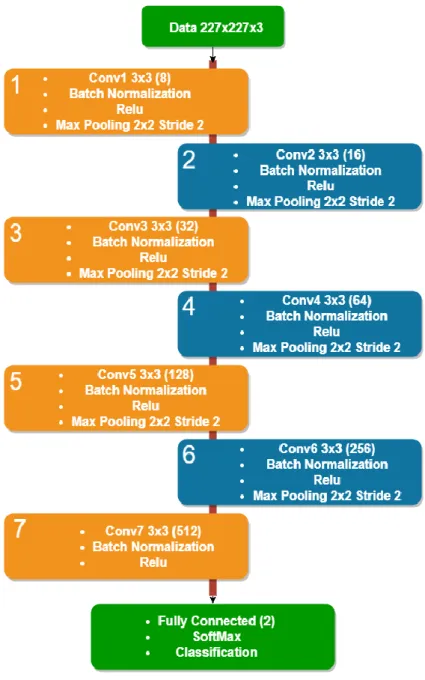
The model prepared for the study consists of 7 convolution layers and 2 fully connected layers. Among these layers, layers such as maximum pooling layer, ReLu, and batch normalization are used. Figure 2 shows the proposed CNN model.
Sırma, K. and Erdoğmuş, P., Journal of Scientific Reports-A, Number 45, 111-125, December 2020.
116
The sequence of processing and the properties of the layers are as follows:
● Random pictures of 227x227x3 size were cut from the pictures of different sizes at the input.
● In the first convoluted Layer, 8 3x3 filters were applied to the images which were converted to 227x227x3 size. Images that then passed through the batch normalization and ReLu layer were processed at a maximum pooling layer of 2x2 size with 2 strides.
● In the second convolution layer, 16 filters of 3x3 size were applied to the data, and ReLu, 2 stride maximum pooling, and batch normalization layers of 2x2 size were applied.
● 32 filters of 3x3 size were applied to the data from the third convolution layer and ReLu, 2 strides, 2x2 maximum pooling, and batch normalization layers were applied.
● 64 filters of 3x3 size were applied to the data reaching the fourth convolution layer and ReLu, 2 strides 2x2 maximum pooling, and batch normalization layers were applied.
● In the fifth convolution layer, 128 filters of 3x3 size were applied and ReLu, 2 strides 2x2 maximum pooling, and batch normalization layers were applied.
● In the sixth convolution layer, 256 filters of 3x3 size were applied and ReLu, 2 strides 2x2 maximum pooling, and batch normalization layers were applied.
● The seventh convolution layer applied 512 filters in 3x3 size and ReLu, 2 strides 2x2 size maximum pooling, and batch normalization layers were applied. At the end of this layer, 4608 parameters enter the fully connected layer.
● Data from the fully connected layer has been prepared for the training process by connecting SoftMax to the output of the fully connected layer with 2 connections and classification layers to its output. Of the parameters used in the training, the important ones for this study were that the learning rate is 0,001, mini-batch size is 32 and the maximum epoch is 15. 70% of the data was used for training and 30% for testing. The data allocated for the test is different from the data used in training.
3.2. Model with Data Augmentation
It is the model created with the same parameters by applying data augmentation operations to the Basic Model. For data enhancement, there are techniques such as rotating the image at the desired angle, rotating it on the horizontal or vertical axis, changing color, or adding noise [20]. When generating new images, the random rotation range is specified as [20, -20] degrees. The angle of rotation is randomly selected within the specified range. Also, the horizontal and vertical translation interval applied to the specified input image is specified as [5, -5]. Translation distance is measured in pixels. Random rotation operations are performed on the horizontal and vertical axis at the specified intervals.The reproduced sample images are shown in figure 3.
Sırma, K. and Erdoğmuş, P., Journal of Scientific Reports-A, Number 45, 111-125, December 2020.
117
Figure 3. Original and Reproduced Images. 3.3. Model with Transfer Learning
In this model, a transfer learning approach, defined as the transfer of previously trained Evolutionary Neural Network models, was applied to classify genders. It was based on the AlexNet model. The network was retrained with the data set created by changing the 3 layers at the end of this previously trained network. AlexNet has 5 convolution and 3 fully connected layers. In the study, these layers were used as the transfer feature extraction layer. The structure of the new model is given in Figure 4.
Sırma, K. and Erdoğmuş, P., Journal of Scientific Reports-A, Number 45, 111-125, December 2020.
118
3.4. Transfer Learning and Data Augmentation Applied Model
The data learning process applied to the base model and the transfer learning model with AlexNet were combined and a new model was created. Instead of the last 3 layers of AlexNet, the parameters defined in the ‘Model with Data Augmentation’ section have been added by adding the fully connected, SoftMax, and classifier layers of the base model.
4. EXPERIMENTAL EVALUATION
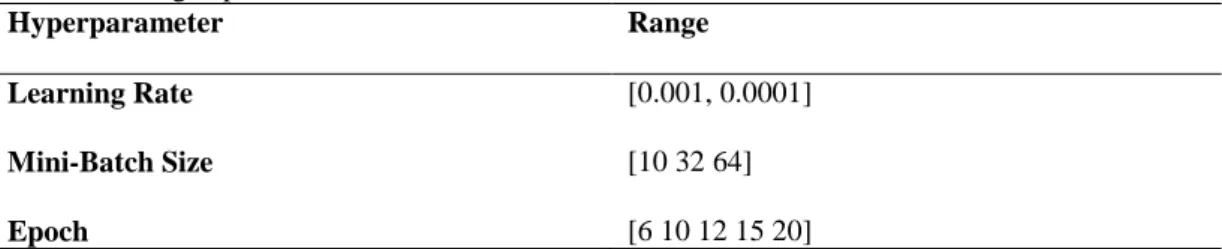
When designing machine learning models based on data such as CNN, the algorithms or techniques used in the model require some parameters that the designer must decide on. The researcher decides what parameters will be such as mini-batch size, epochs, learning rate, and shuffle. In general, the choice of preferences for these parameters initially is not clear and precise; problem, dataset, etc. It varies depending on such factors. Therefore, what to choose is left to the person who designed the network. Parameters that vary depending on the problem, dataset, and similar factors are expressed as hyperparameters [22]. Most models take a long time to train; some models last for days. For this reason, the training process is tried to be shortened as much as possible by changing the hyperparameters and finding optimum values. Hyperparameters that are constantly changed in this study are given in Table 1.
Table 1. Changed parameters and values.
Hyperparameter Range
Learning Rate [0.001, 0.0001]
Mini-Batch Size [10 32 64]
Epoch [6 10 12 15 20]
Apart from the parameters, layer numbers and filter numbers have been changed to achieve the best success rate. The best results yielded a model consisting of 7 convolution layers and 2 fully connected layers. Among these layers, layers such as maximum pooling, ReLu, and batch normalization are used. The training and performance results of the proposed model are given in Figure 5.
Sırma, K. and Erdoğmuş, P., Journal of Scientific Reports-A, Number 45, 111-125, December 2020.
119
Training has been completed in 15 epochs and 690 iterations. 46 iterations have occurred in each epoch. Training and tests have been completed in 2 hours and 16 minutes.
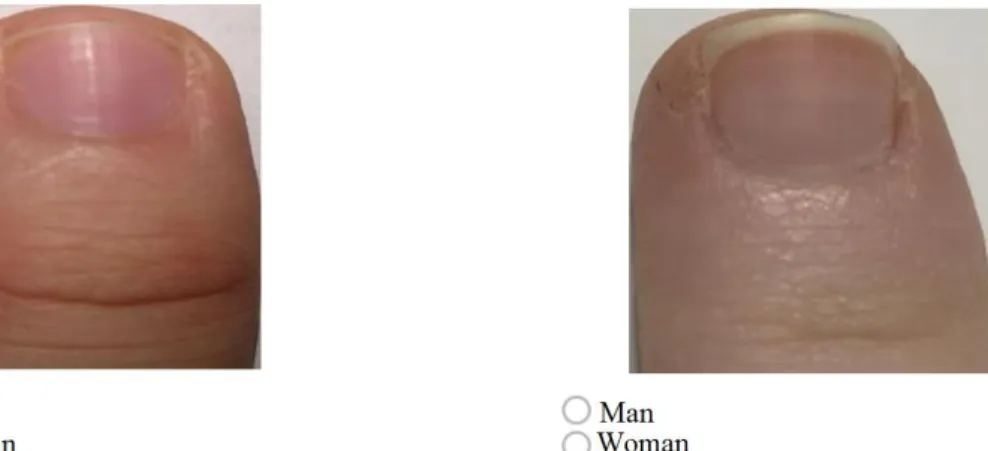
To understand whether the results are better than real people's estimates, a questionnaire with 100 different fingertip images was applied to 100 people and they were asked to guess their gender. Participants were able to reach an average of 55.34% accuracy rate. The proposed model was able to predict better with an accuracy rate of 86.34%. The sample survey image is given in Figure 6.
Figure 6. Question samples from the applied questionnaire.
In Figure 6, the top left image belongs to a man and the other 2 images belong to 2 different women. While 80% of the participants were able to answer the male finger in the picture correctly, no one was able to answer the other 2 questions correctly. Values such as average values of the survey, the number of participants, and best estimate results are graphically shared in Figure 7.
Sırma, K. and Erdoğmuş, P., Journal of Scientific Reports-A, Number 45, 111-125, December 2020.
120
Figure 7. The predicted success of participants.
As the chart shows, 100 participants received an average score of 55.34. As there were no correct answers to all of the questions, only 1 person was able to gather the closest prediction success to the CNN model by answering 65 of the questions correctly. As it is known that the proposed model achieved 86.39% estimated success, it was proved by this survey that it produced much better results than a human being.
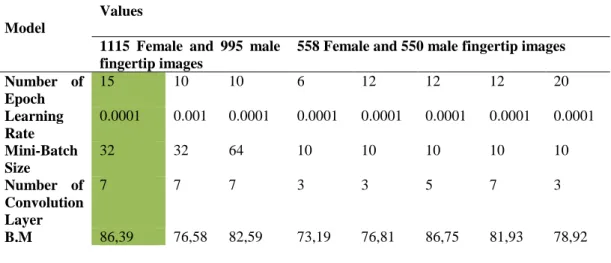
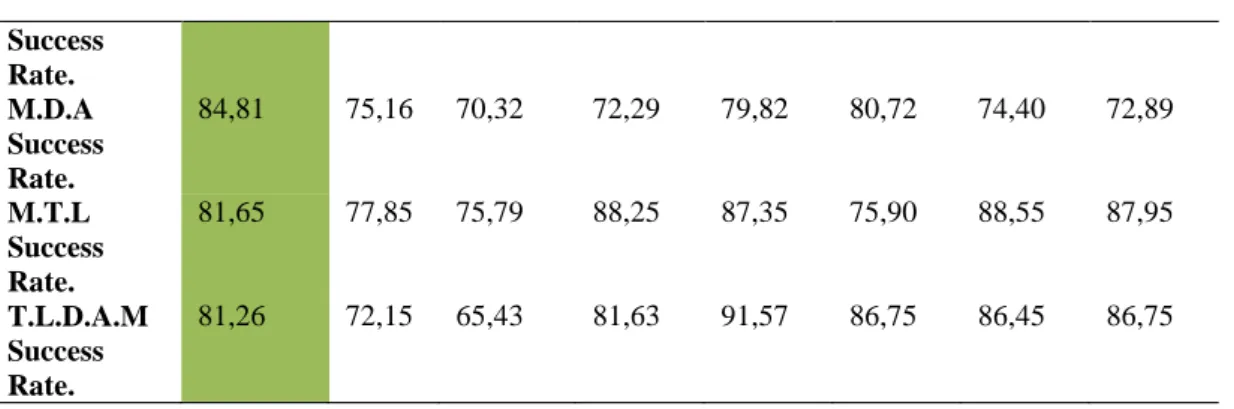
Because the collected images were constantly changing, tests were conducted with different data sizes. As a result, the effect of data size on the success rate has also been analyzed. The relation of the number of the epoch, learning rate, mini-batch size, convolution layer numbers with data size was examined with 4 different models. B.M (Base Model), M.D.A (Model with Data Augmentation), M.T.L (Model with Transfer Learning), T.L.D.A.M (Transfer Learning and Data Augmentation Applied Model). Different tests and success rates were shared in Table 2.
Table 2.Effects of Data, Layer and Hyperparameter values on the results.
Model
Values
1115 Female and 995 male fingertip images
558 Female and 550 male fingertip images Number of Epoch 15 10 10 6 12 12 12 20 Learning Rate 0.0001 0.001 0.0001 0.0001 0.0001 0.0001 0.0001 0.0001 Mini-Batch Size 32 32 64 10 10 10 10 10 Number of Convolution Layer 7 7 7 3 3 5 7 3 B.M 86,39 76,58 82,59 73,19 76,81 86,75 81,93 78,92
Sırma, K. and Erdoğmuş, P., Journal of Scientific Reports-A, Number 45, 111-125, December 2020.
121
The model, which was suggested with full data, obtained the best results with 15 epochs, 0.000.1 learning rate, and 32 mini-batch sizes. In this model, 7 convolution layers have been used and the number of filters has increased gradually to 16,32,64,128,256 and 512, and gradually deepened. As a result of the tests carried out with these values, 86.32% success rate was obtained. The model, which has been applied data augmentation with fewer data sets, has achieved a maximum success of 80.72% with 12 epochs, 0.0001 learning rate, and 10 mini-batch sizes. In this model, 5 convolution layers are used and the number of filters is gradually increased. The model, which was subjected to the Transfer Learning process and used a small amount of data, achieved 88.55% success.7 The convolution layer was used and the number of filters in the proposed model was used. Both the transfer learning process and the data increment process gave the best result with fewer data. In this model, 3 convolution layers were used and 91.57% prediction accuracy was achieved. It can be seen that in studies using less data, the models that increase data yielded better results but did not show the same performance when the original data size was increased. In tests performed with the maximum number of data, all the fitting processes were performed and results with close or better results were found with the tests performed with a small number of data.
In the learning process steps, to analyze whether the color data is important and if it is important, the images were converted to black and white format, and the convolution layer numbers were changed and tests were performed with B.M and M.D.A. In the tests, 995 male and 1115 female fingertip images were used. Mini-Batch size was 32, the learning rate was 0.001, and the epoch was 12. The result of the tests was shared in Table 3.
Table 3. Effect of Black and White Color Conversion on Results.
Model Success Rate (%) 3 Conv. Layer 5 Conv. Layer 7 Conv. Layer B.M 67,88 70,09 77.85 M.D.A 64,24 58,86 57,65 Success Rate. M.D.A Success Rate. 84,81 75,16 70,32 72,29 79,82 80,72 74,40 72,89 M.T.L Success Rate. 81,65 77,85 75,79 88,25 87,35 75,90 88,55 87,95 T.L.D.A.M Success Rate. 81,26 72,15 65,43 81,63 91,57 86,75 86,45 86,75
Sırma, K. and Erdoğmuş, P., Journal of Scientific Reports-A, Number 45, 111-125, December 2020.
122
It was determined that the reason that success rates were lower than the tests performed with color images was due to factors such as henna, nail polish on women's nails, and the difference of colors in the nail flesh.
5. CONCLUSION
Today, the increasingly popular areas of biometric recognition and deep learning have provided researchers with different areas of study. The study also analyzed the performance of CNN models in estimating gender from fingertip images, which yielded very good performance results in estimating gender from facial images. To increase the success rate, layer numbers, filter numbers, and hyper-parameter values have been modified and tested. Four different models were produced and each model was able to detect better than real person estimates.
There has been no previous study of fingertip images in the literature. But some studies show similarities in purpose and technique. For example, Antipov et al. [23] after designing a CNN, they reduced the number of filters in the network's convolution layers and the size of the fully connected layer. These layer and filter reductions achieved both speed and memory gain. Accordingly, there was a negligible decrease in the rate of performance. However, in this study, because the number of data is low and the image sizes are low, the number of filters in each layer was gradually increased and the best estimate success rate was tried to be found. Juefei-Xu et al. [24] instead of using facial images entirely, they blur some areas. Blurring outside the periocular region has made them better use of high-frequency details in the periocular region. In the study, the participants were asked only for fingertip images because they had already been studied in a narrow area and no blurring was applied to a specific part of the fingertip used.
In the literature, some studies use ready-made datasets such as Adience, IMDB, WIKI [25, 26], as well as studies that combine many databases and obtain a new dataset [27, 28]. In this study, the data were collected from the participants one by one, and a new data set was created. The data set has been uploaded to Kaggle for researchers who want to research on this topic [29].
The basic model proposed in the study consists of 7 convolution layers and 2 fully connected layers. Among these layers, 86.39% success was achieved by using layers such as maximum pooling, ReLu, and batch normalization. A transfer learning model was created by removing the last 3 layers of AlexNet architecture and adding the fully connected layer, softMax, and classifier layers in the basic model instead of these layers. With this model, a success rate of 81.65 was achieved. When data enhancement is applied to Transfer Learning model, the success rate decreased and became 81.65%. This data was 84.81% when data increase was applied to the basic model.
According to the results obtained, it has been proven that the proposed model can be used for the gender recognition problem from the fingertip images. Also, even though the original training and test data are limited, it has been demonstrated that CNN structures are a very effective method for solving this problem, with all models created above 80% success. In future researches, it is recommended to increase the success rate with different deep network architectures by expanding the data set created in this study. The method proposed in this study can be used in new biometric recognition systems or as a filter for preprocessing in the existing biometric recognition systems.
Sırma, K. and Erdoğmuş, P., Journal of Scientific Reports-A, Number 45, 111-125, December 2020.
123 REFERENCES
[1] Apaydın, E., (2004), Introduction to Machine Learning (Adaptive Computation and Machine Learning). MIT Press
[2] Bishop, C. M., (2006) Pattern Recognition and Machine Learning. Springer Science + Business Media.
[3] Levi G. and Hassncer, T., (2015), “Age and gender classification using convolutional neural networks,” IEEE Comput. Soc. Conf. Comput. Vis. Pattern Recognit. Work., vol. 2015-Octob, pp. 34–42, doi: 10.1109/CVPRW.2015.7301352.
[4] Eidinger, E., Enbar, R., and Hassner, T.,(2014), “Age and gender estimation of unfiltered faces,” IEEE Trans. Inf. Forensics Secur., vol. 9, no. 12, pp. 2170–2179, , doi: 10.1109/TIFS.2014.2359646.
[5] Cengil, E., Çinar, A., and Güler, Z., (2017), “A GPU-based convolutional neural network approach for image classification,” in International Artificial Intelligence and Data Processing Symposium (IDAP).
[6] Abdulkadir, S., Akbulut, Y., Guo, Y., and Bajaj, V., (2017) “Classification of amyotrophic lateral sclerosis disease based on convolutional neural network and reinforcement sample learning algorithm,” Heal. Inf Sci Syst.
[7] Girshick, R., Donahue, J., Darrell, T., and Malik, J., (2014), “Rich feature hierarchies for accurate object detection and semantic segmentation,” Proc. IEEE Comput. Soc. Conf. Comput. Vis. Pattern Recognit., pp. 580–587, doi: 10.1109/CVPR.2014.81.
[8] Jialin Pan, S., and Yang, Q., (2010) “A Survey on Transfer Learning,” IEEE Trans. Knowl. Data Eng., vol. 22, pp. 1345–1359.
[9] Koçer, B., (2012) “Transfer Öğrenmede Yeni Yaklaşımlar,” Selçuk University.
[10] Illouz, E., David, E. and Netanyahu, N.S., (2019), “Handwriting-Based Gender Classification Using End-to-End Deep Neural Networks,” vol. 11141, no. October, pp. 613–621, doi: 10.1007/978-3-030-01424-7_60.
[11] Baek, N. R., Cho, S. W., Koo, J. H., Truong, N. Q. and Park, K. R.,(2019), “Multimodal Camera-Based Gender Recognition Using Human-Body Image With Two-Step Reconstruction Network,” IEEE Access, vol. 7, pp. 104025–104044, doi: 10.1109/access.2019.2932146. [12] Liu, T., Ye, X. and Sun, B., (2019), “Combining Convolutional Neural Network and Support
Vector Machine for Gait-based Gender Recognition,” Proc. 2018 Chinese Autom. Congr. CAC 2018, pp. 3477–3481, doi: 10.1109/CAC.2018.8623118.
Sırma, K. and Erdoğmuş, P., Journal of Scientific Reports-A, Number 45, 111-125, December 2020.
124
[13] Akbulut, Y., Şengür, A. and Ekici, S., (2017), “Gender recognition from face images with deep learning,” Int. Artif. Intell. Data Process. Symp., pp. 1–4.
[14] Viedma, I. and Tapia, J., (2018), “Deep Gender Classification and Visualization of Near-Infra-Red Periocular-Iris images,” IEEE 3rd Int. Conf. Image Process. Appl. Syst. IPAS, pp. 73–78, 2018, doi: 10.1109/IPAS.2018.8708857.
[15] Van De Wolfshaar, J., Karaaba, M. F. and Wiering, M. A., (2015), “Deep convolutional neural networks and support vector machines for gender recognition,” Proc. - 2015 IEEE Symp. Ser. Comput. Intell. SSCI 2015, pp. 188–195, doi: 10.1109/SSCI.2015.37.
[16] Afifi, M., (2019), “11K Hands: Gender recognition and biometric identification using a large dataset of hand images,” Multimed. Tools Appl., vol. 78, no. 15, pp. 20835–20854, doi: 10.1007/s11042-019-7424-8.
[17] Barbosa, I.B., Theoharis, T., Schellewald, C. and Athwal, C., (2013)., “Transient biometrics using fingernails,” IEEE 6th Int. Conf. Biometrics Theory, Appl. Syst. BTAS 2013, doi: 10.1109/BTAS.2013.6712730.
[18] Ceyhan E.B. and Sağıroğlu, Ş., (2019), “A New Intelligent System for Predicting Gender from Fingerprint,” Düzce Univ. J. Sci. Technol., vol. 4, pp. 25–36, doi: 0.29130/dubited.457914. [19] Liu, X., Li , J., Pan, J.-S., and Hu, C. (2017). Deep convolutional neural networks-based age and
gender classification with facial images. 2017 First International Conference on Electronics Instrumentation & Information Systems (EIIS).Matlab Documentation. (2019). MathWorks. [20] Er, M. B:, (2019), “Emotıon Analysıs In Turkısh Musıc Wıth Machıne Learnıng,” Maltepe
University.
[21] Vishwesh, S., (2019), “PyTorch for Beginners: Image Classification using Pre-trained models,” https://www.learnopencv.com/pytorch-for-beginners-image-classification-using-pre-trained-models/ (accessed May 26, 2020).
[22] Çarkacı, N.,(2018), “Derin Öğrenme Uygulamalarında En Sık kullanılan Hiper-parametreler,” https://medium.com/deep-learning-turkiye/derin-ogrenme-uygulamalarinda-en-sik-kullanilan-hiper-parametreler-ece8e9125c4 (accessed May 26, 2020).
[23] Antipov, G., Berrani, S. A. and Dugelay J.L., (2016), “Minimalistic CNN-based ensemble model for gender prediction from face images,” Pattern Recognit. Lett., vol. 70, pp. 59–65, doi: 10.1016/j.patrec.2015.11.011.
[24] Juefei-Xu, F., Verma, E., Goel, P., Cherodian, A. and Savvides, M., (2016) “DeepGender: Occlusion and Low Resolution Robust Facial Gender Classification via Progressively Trained Convolutional Neural Networks with Attention,” IEEE Comput. Soc. Conf. Comput. Vis. Pattern Recognit. Work., pp. 136–145, doi: 10.1109/CVPRW.2016.24.
Sırma, K. and Erdoğmuş, P., Journal of Scientific Reports-A, Number 45, 111-125, December 2020.
125
[25] Karakaş, E., (2019), “Derin Sinir Ağlarının Füzyonu ile Yüz İmgelerinden Yaş Grubu ve Cinsiyet Sınıflandırma,” Atatürk University.
[26] Kabasakal B. and Sumer, E., (2018), “Gender recognition using innovative pattern recognition techniques,” 26th IEEE Signal Process. Commun. Appl. Conf. SIU 2018, pp. 1–4, doi: 10.1109/SIU.2018.8404306.
[27] Nistor, S. C., Marina, A. C., Darabant, a. S. and Borza, D.,( 2017), “Automatic gender recognition for ‘in the wild’ facial images using convolutional neural networks,” Proc. - 2017 IEEE 13th Int. Conf. Intell. Comput. Commun. Process. ICCP 2017, pp. 287–291, doi: 10.1109/ICCP.2017.8117018.
[28] Afifi, M., (2019), “11K Hands: Gender recognition and biometric identification using a large dataset of hand images,” Multimed. Tools Appl., vol. 78, no. 15, pp. 20835–20854, doi: 10.1007/s11042-019-7424-8.
[29] Sırma, K., (2020), “Fingertip Images,” https://www.kaggle.com/keremsirma/fingertip-images/ (accessed Aug 1, 2020).
![Figure 4. Transfer learning application with AlexNet [21].](https://thumb-eu.123doks.com/thumbv2/9libnet/4354239.72596/7.892.138.746.694.1019/figure-transfer-learning-application-alexnet.webp)