The effect of fermentation process on bioactive properties, essential oil
composition and phenolic constituents of raw fresh and fermented sea fennel
(Crithmum maritimum L.) leaves
Mehmet Musa Özcan*,1,+, Nurhan Uslu1, Gilles Figueredo2, Fahad Al Juhaimi3, Kashif Ghafoor3,
Elfadıl E Babiker3, Omer N Alsawmahi3, Mustafa Mete Özcan4, Isam A & Mohamed Ahmed3 1Department of Food Engineering, Faculty of Agriculture, Selçuk University, 42031 Konya, Turkey
2Lexva Analytique 7 rue Henri Mondor Biopole Clermont-Limagne 63360 Saint beauzire France
3Department of Food Science & Nutrition, College of Food and Agricultural Sciences, King Saud University, Riyadh-Saudi Arabia 4Karapınar Aydoğanlar High Vocational College, Selçuk University, Konya,Turkey
E-mail: +[email protected]; [email protected]
Received 07 January 2019; revised 13 August 2019
The influence of fermentation on antioxidant activity, total phenol, total flavonoid and phenolic compounds of sea fennel and also volatile compounds of sea fennel essential oil was investigated and compared with fresh samples. Antioxidant activity, total fenolic and flavonoid contents decresed from 89.79 to 63.13%; from 259.58 to 77.92 mg/100 g; from 2114.67 to 390.50 mg/100 g, respectively. Twenty-six and thirty-three components of sea fennel oils were identified in raw and fermented sea fennel, accounting to about 99.99% and 99.44% of the total oil, respectively. The raw and fermented sea fennel leaves contained 22.31 and 1.32% sabinene, 12.08% and 7.45% limonene, 10.30% and 11.61% β-phellandrene, 8.59% and 9.17% (Z)-β-ocimene, 7.08% and 3.55% α-pinene, 28.36% and 42.05% γ-terpinene, 2.57% and 8.64% terpinene-4-ol, respectively. Dominant phenolic compounds were (+)-catechin, gallic acid, 3,4-dihydroxybenzoic acid and p-coumaric acid. Generally, all of the phenolic compounds reduced the effect of microorganisms during,. However, essential oil contents of sea fennel were not effected from fermentation process.
Keywords: Antioxidant activity, Brine oil constituents, Fermentation, Flavonoid, GC/MS, HPLC, Phenolic compounds, Sea fennel IPC Code: Int. Cl.19: A61P 17/18, C11B 7/00, A23F 3/08, C12G 3/05, C07D 471/04, A61K 38/00, C08G 65/40, A61K 8/97
Sea fennel, known as maritime rock, deniz rezenesi (in Turkish) and rock samphire (Crithmum maritimum L.), belongs to the family of Apiaceae1. It is a salt-tolerant plant and widely grown inmaritime rocks and more rarely sandy beaches in Mediterranean countries and Atlantic coasts2. Sea fennel has several usage areas such as culinary, medicine and cosmetics because of the content of the nutrients and phytochemicals. Additionally, it has appetizer, tonic, carminative and diuretic effects3. The leaves of sea fennel contain various bioactive compounds which can be utilised aromatic, antimicrobial and insecticide purposes4. The aerial parts of sea fennel are generally used as a pickling herb5,6. In the Mediterranean region, fresh or fermented leaves are consumed as salad with yoğurt7. Sabinene, γ-terpinene, thymol methyl ether, dillapiol, α-pinen, p-cymol, apiole, cis-ß-ocimene and terpinen-4-ol are the key constituents of sea fennel leaves8. In recent years, Medicinal and
aromatic plants have taken attention due to its bioactive substance. Limited studies were carried out on bioactive properrties and volatile compounds of fresh and fermented sea fennel7,8. The aim of current study was to determine the influence of fermentation on total phenol, antioxidant activity, phenolic constituents of sea fennel extract and volatile compounds of essential oil of sea fennel was investigated.
Material and methods Materials
Sea fennels (aerial parts) collected from Muğla (Bodrum) province in Turkey were brought to laboratory in paper bags under cool conditions.
Methods
Fermentation process
Sea fennel (aerial parts) was fermented in 10% brine in a jar (1 L) at 24oC for 45 days.
—————— *Corresponding author
Chemical properties
The titratable acidity , pH and salt contents of brine were carried out according to method of Sanchez et al.9.
Essential oil content
Fresh and fermented sea fennels (leaves+stems) were cut into small pieces. The essential oil contents of samples were determined using Clevenger apparatus for 5 h.
Sample extraction process and identification of constituents
Aerial parts of sea fennel cut into small pieces were extracted according to method stated by Talhaoui et al.10. After methanol:water mixture (80/20, v/v) (10 mL) was added on the sample (0.5 g), the extracts concentrated by vacuum was completed to 25 mL by methanol,and filtered with 0.45 µm filter.
The essential oil were analysed on a AGILENT gas chromatograph Model 7890, coupled to a AGILENT MS model 5975, equipped with a DB5 MS column (20 m X 0,18 mm, 0,18 µm), programming from 50°C (3.2 min) to 300°C at 8°C/mn, 5 min hold.
Total phenolic content
The total phenol content (as mg gallic acid equivalent (GAE)/100 g) of samples was determined by using the Folin-Ciocalteu (FC) reagent according to method stated by Yoo et al.11.
Total flavonoid content
Total flavonoid contents were analsed by using colorimetric method according to method stated by Hogan et al.,12. The absorbance was recorded at 510 nm with a spectrophotometer.
Antioxidant activity
The free radical scavenging activities of extracts were determined at 517 nm in a spectrophotometer using DPPH (1,1-diphenyl-2-picrylhydrazyl) according to method stated by Lee et al.13.
Phenolic compounds
The phenolic compounds were determined by HPLC (Shimadzu-HPLC), equipped with a PDA detector and an Inertsil ODS-3 (5 µm; 4.6×250 mm) column.
Statistical Analyses
Results were analysed for mean±standard deviation (MSTAT C) and statistical significance by analysis of variance14.
Results and discussion
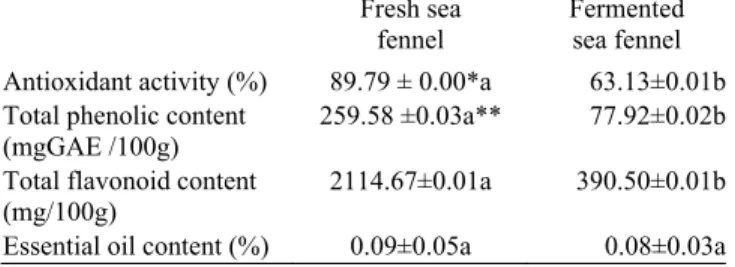
The bioactive properties of fresh and fermented sea fennel are presented in Table 1. Antioxidant activity, total phenolic and total flavanoid contents were decreased from 89.79 to 63.13%; from 259.58 to 77.92 mg/100 g and from 2114.67 to 390.50 mg/100 g respectively with fermentation process (p<0.05). After fermentation, titratable acidity, pH and salt content of sea fennel brine were determined as 0.13%, 4.78 and 5.53 g/100 mL, respectively. A major reduction in the contents of antioxidant, phenolic and flavonoid can be due to fermantation. In previous studies, fermentation increases the antioxidant activity of foods, which is explained by (i) the enzymatic cleavage of the cell wall and facilitation of the extraction of antioxidants; (ii) depolymerization high molecular weight phenolic compounds by lactic acid bacteria and releasing simple phenolics15; (iii) the liberation of free forms resulting in the hydrolysis of phenolic glycosides16. In contrast, Othman et al.17 found that phenolic compounds were degraded and antioxidant activity decreased after fermentation. Therefore, phenolic, flavanoid and antioxidant contents vary depending on many factors such as activity of microorganisms, temperature, pH, fermentation time, food, cultivation environment, presence of inhibitor and aerobic conditions with fermentation process15. Total polyphenol and flavonoid contents of sea fennel ranged from 7.16 mg GAE/g; 4.77 mg CE/g in vegetative period to 8.27 mg GAE/g; 3.45 mg CE/g in flowering period, respectively4. Aerial parts of raw and fermented sea fennel (Crithmum maritimum L.) collected from Muğla (Bodrum) province contained 0.079% and 0.090% essential oil, respectively. The essential oil contentes of sea fennel changed between 0.17% and 0.85% [2, 18-22]. An important change was not observed in essential oil content with fermentation process. Leaves (61.8%) and flowers (61.0%) of sea fennel exhibited better antioxidant activity than stems (13.0%)3. The amount of total phenolics varied between 12.4-12.8 mg GAE/200 mL in stems;
Table 1 — Some physicochemical properties of fresh and fermented sea fennel
Fresh sea
fennel Fermented sea fennel Antioxidant activity (%) 89.79 ± 0.00*a 63.13±0.01b Total phenolic content
(mgGAE /100g)
259.58 ±0.03a** 77.92±0.02b Total flavonoid content
(mg/100g) 2114.67±0.01a 390.50±0.01b Essential oil content (%) 0.09±0.05a 0.08±0.03a
33.7-35.3 mg GAE/200 mL in leaves; 21.2-22.6 mg GAE/200 mL in flowers of sea fennel, while total flavonoid contents were found between 22.9-27.1 mg RE/200 mL in stems; 54.4-57.2 mg RE/200 mL in leaves; 48.0-40.7 mg RE/200 mL in flowers of sea fennel23. In another study, total polyphenol and flavonoid contents ranged between 4.1 and 14.1 mg
GAE/g; 2.9 and 6.7 mg CE/g, respectively24.
In addition, titratable acidity, pH and salt content in brine of sea fennel were between 0.17-0.18 (5, lactic acid), 4.47-4.50 and 8.65-9.18%, respectively25. Özcan26 reported that fresh leaves and stems of sea fennel in 8% salt and 8% salt+1% yogurt+1% sugar (saccharose) were fermented for 25 days, and the 8% salt+1% yogurt+1% sugar samples were superior to the 8% salt brines samples for final product quality.
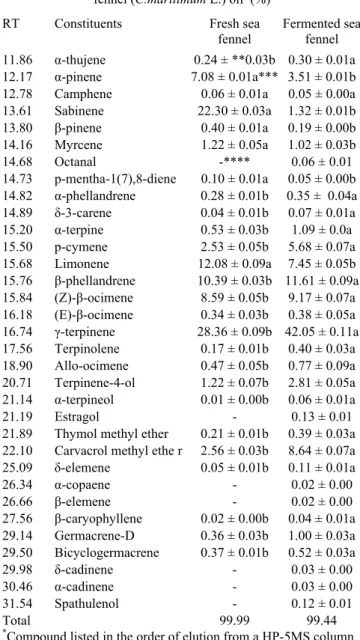
The chemical composition of fresh and fermented sea fennel (C. maritimum L.) essential oil are given in Table 2. It was observed important changes in the constituents of fresh and fermented sea fennel oils. Twenty-six and thirty-three components were identified in fresh and fermented sea fennel, accounting to about 99.99% and 99.44% of the total oil, respectively (Table 2). The fresh and fermented sea fennel leaves contained 22.31 and 1.32% sabinene, 12.08% and 7.45% limonene, 10.30% and 11.61% β-phellandrene, 8.59% and 9.17% (Z)-β-ocimene, 7.08% and 3.55% α-pinene, 28.36% and 42.05% γ-terpinene, 2.57% and 8.64% terpinene-4-ol, respectively (p<0.05). During fermentation, while sabinene, limonene, α-pinene contents of sea fennel leaves are decreased, β-phellandrene, (Z)-β-ocimene, γ-terpinene, carvacrol methyl ether and terpinene-4-ol contents had increased. These increases and decreases in essential oil components of the sea fennel are probably due to biochemical activities during fermentation. In sea fennel leaves collected from two different location in Turkey 32 and 36% γ-terpinene, 21 and 22% β-phellandrene and 9 and 13% sabinene were found21. The essential oil of sea fennel was characterized as sabinene (26.9%), limonene (24.2%) and γ-terpinene (19.3%)20. Barroso et al.27 reported that sea fennel (Crithmum maritimum L.) oil collected from Costa de Caparica in Portugal contained 7-42% sabinene and 26-55% γ-terpinene. Sea fennel oil contained 37% γ-terpinene, 29% methyl thymol, 10% p-cymene and 8% β-pinene18. In another investigation, the main components of the sea fennel aerial parts were γ-terpinene (39.3%), methylcarvacrol (21.6%) and p-cymene (11.8%), while the major compounds
of roots oil were terpinolene (36.9%), dillapiole (26.8%) and γ-terpinene (21.9%)19. Jallali et al.24 observed that essential oil yield of C. maritimum varied from 0.07% to 0.34%. Houta et al.2 reported that the essential oil of sea fennel mainly contained dillapiole (2.39-41.35%), thymyl methyl ether (20.13-34.75%), p-cymene (4.83-22.08%) and γ-terpinene
(22.54-43.29%). According to Mekinic et al.3,
essential oil yields of flowers, leaves and stems of sea fennel were 2.44, 0.55 and 0.19%, respectively.
Table 2 — Chemical composition of fresh and fermented sea fennel (C.maritimum L.) oil*(%)
RT Constituents Fresh sea fennel
Fermented sea fennel 11.86 α-thujene 0.24 ± **0.03b 0.30 ± 0.01a 12.17 α-pinene 7.08 ± 0.01a*** 3.51 ± 0.01b 12.78 Camphene 0.06 ± 0.01a 0.05 ± 0.00a 13.61 Sabinene 22.30 ± 0.03a 1.32 ± 0.01b 13.80 β-pinene 0.40 ± 0.01a 0.19 ± 0.00b 14.16 Myrcene 1.22 ± 0.05a 1.02 ± 0.03b 14.68 Octanal -**** 0.06 ± 0.01 14.73 p-mentha-1(7),8-diene 0.10 ± 0.01a 0.05 ± 0.00b 14.82 α-phellandrene 0.28 ± 0.01b 0.35 ± 0.04a 14.89 δ-3-carene 0.04 ± 0.01b 0.07 ± 0.01a 15.20 α-terpine 0.53 ± 0.03b 1.09 ± 0.0a 15.50 p-cymene 2.53 ± 0.05b 5.68 ± 0.07a 15.68 Limonene 12.08 ± 0.09a 7.45 ± 0.05b 15.76 β-phellandrene 10.39 ± 0.03b 11.61 ± 0.09a 15.84 (Z)-β-ocimene 8.59 ± 0.05b 9.17 ± 0.07a 16.18 (E)-β-ocimene 0.34 ± 0.03b 0.38 ± 0.05a 16.74 γ-terpinene 28.36 ± 0.09b 42.05 ± 0.11a 17.56 Terpinolene 0.17 ± 0.01b 0.40 ± 0.03a 18.90 Allo-ocimene 0.47 ± 0.05b 0.77 ± 0.09a 20.71 Terpinene-4-ol 1.22 ± 0.07b 2.81 ± 0.05a 21.14 α-terpineol 0.01 ± 0.00b 0.06 ± 0.01a 21.19 Estragol - 0.13 ± 0.01
21.89 Thymol methyl ether 0.21 ± 0.01b 0.39 ± 0.03a 22.10 Carvacrol methyl ethe r 2.56 ± 0.03b 8.64 ± 0.07a 25.09 δ-elemene 0.05 ± 0.01b 0.11 ± 0.01a 26.34 α-copaene - 0.02 ± 0.00 26.66 β-elemene - 0.02 ± 0.00 27.56 β-caryophyllene 0.02 ± 0.00b 0.04 ± 0.01a 29.14 Germacrene-D 0.36 ± 0.03b 1.00 ± 0.03a 29.50 Bicyclogermacrene 0.37 ± 0.01b 0.52 ± 0.03a 29.98 δ-cadinene - 0.03 ± 0.00 30.46 α-cadinene - 0.03 ± 0.00 31.54 Spathulenol - 0.12 ± 0.01 Total 99.99 99.44
*Compound listed in the order of elution from a HP-5MS column **mean±standard deviation
***Values in eachrow with different letters are significantly different (p<0.05)
Limonene, terpinene and sabinene were the main compounds of sea fennel essential oil28. It was observed that the major essential oil components compared to litereture were mostly the same while the amounts were different. The highest increasing was observed in γ-terpinene and carvacrol methyl ether during fermentation.
Phenolic compositions of fresh and fermented sea fennel samples are given Table 3. The main flavonoids were (+)-catechin and quercetin in fresh sample. Fermentatiton process generally caused the degredation of phenolic compounds. The highest decrease was observed in catechin content (from 31.58 to 15.47 mg/100 g), followed by p-coumaric acid (from 15.77 to 0.29 mg/100 g) (p<0.05). While 1,2-Dihydroxybenzene, trans-cinnamic acid and isorhamnetin contents increase during fermentation, other constituents decreased. In fermentation process, the amount and structure of phenolic compounds showed changes based on especially pH changes15. The quercetin content of sea fennel decreased from 13.48 to 5.37 mg/100 g. Moreover, the reduction in gallic (23.71 to 21.38 mg/100 g), 3,4-dihydroxybenzoic (21.73 to 16.22 mg/100 g), syringic (11.04 to 7.24 mg/100 g) and caffeic (10.33 to 7.23 mg/100 g) acids were determined during fermentation. Only 1,2-dihydroxybenzene amount of sea fennel increased from 13.83 to 24.62 mg/100 g with fermentation process. Coumaric and ferulic acid contents were 0.09-0.12 and 0.15-0.18 mg/g in stems, 0.36-0.38 and 0.57-0.77 mg/g in leaves, 0.29-0.31 and 0.23-0.28 mg/g in flowers of sea fennel23. Epicatechin amounts
of stems, leaves and flowers were found as 0-0.35; 0.84-1.16 and 0.26-0.35 mg/g, respectively. The extraction process, plant parts, harvest time, climatic factors and fermantation seem to be reason for the differnces observed in the phenolic composition of sea fennel.
Conclusion
Sea fennel is a significant source of antioxidants, phenolic and flavonoid compounds. The fermentation caused a major reduction in antioxidant, phenolic and flavonoid values. The highest increasing was observed in γ-terpinene and carvacrol methyl ether during fermentation. Gallic acid, 3,4-dihydroxybenzoic acid and p-coumaric acid were the major phenolic acids in fresh sea fennel. While 1,2-dihydroxybenzene, trans-cinnamic acid and isorhamnetin contents increase during fermentation, other constituents decreased. In addition, the main flavonoids were (+)-catechin and quercetin in fresh sample. Fermentatiton process generally caused the degredation of phenolic compounds.
Acknowledgement
The authors would like to thank the Dean of Scientific Research at King Saud University for funding this study through King Saud University (RG-1439-016). Also, authors thank to Mr Nazmi Büyük to help about sea fennel collection.
References
1 Meot-Duros L & Magne C, Antioxidant activity and phenol content of Crithmum maritimum L. leaves, Plant Physiol
Biochem, 47 (2009) 37–41.
2 Houta O, Akrout A, Najja H, Neffati M & Amri H, Chemical composition, antioxidant and antimicrobial activities of essential oil from Crithmum maritimum cultivated in Tunisia,
J Essential Oil Bearing Plants, 18 (6) (2015) 1459–1466.
3 Mekinic IG, Blazevic I, Mudnic I, Burcul F, Grga M, Skroza D, Jercic I, Ljubenkov I, Boban M, Milos M & Katalinic V, Sea fennel (Crithmum maritimum L.): phytochemical profile, antioxidative, cholinesterase inhibitory and vasodilatory activity, J Food Sci Technol, 53(7) (2016) 3104–3112. 4 Jallali I, Megdiche W, M’Hamdi B, Oueslati S, Smaoui A,
Abdelly C & Ksouri R, Changes in phenolic composition and antioxidant activities of the edible halophyte Crithmum
maritimum L. with physiological stage and extraction
method, Acta Physiol Plant, 34 (2012) 1451–1459.
5 Males Z, Zuntar I, Nigovic B, Plazibat M & Vundac VB, Quantitative analysis of the polyphenols of the aerial parts of rock samphire–Crithmum maritimum L, Acta Pharm, 53 (2003) 139–144.
6 Renna M & Gonnella M, The use of the sea fennel as a new spice-colorant in culinary preparations, Int J Gastronomy
Food Sci, 1 (2012)111-115.
7 Senatore F, Napolitano F & Özcan M, Composition andantibacterial activity of the essential oil from Crithmum Table 3 — Phenolic compounds of fresh and fermented sea fennel
Phenolic compounds (mg/100 g) Fresh sea fennel Fermented sea fennel Gallic Acid 23.71±0.69*a 21.38±1.25b 3,4-Dihydroxybenzoic Acid 21.73±1.34a** 16.22±0.58b (+)-Catechin 31.58±1.98a 15.47±0.00b 1,2-Dihydroxybenzene 13.83±1.41b 24.62±0.23a Syringic Acid 11.04±0.11a 7.24±0.02b Caffeic Acid 10.33±0.04a 7.23±0.35b Rutin trihydrate 8.41±1.80a 2.16±0.44b
p-Coumaric Acid 15.77±0.72a 0.29±0.04b
trans-Ferulic Acid 6.92±0.97a 2.19±0.66b
Apigenin 7 glucoside 6.31±0.73a 1.88±0.79b Resveratrol 2.03±0.35a 0.46±0.06b Quercetin 13.48±0.66a 5.37±0.46b
trans-cinnamic acid 0.55±0.06b 1.18±0.09a
Naringenin 2.71±0.53a 1.49±0.08b Kaempherol 4.07±0.74a 3.78±0.47b Isorhamnetin 2.19±0.37b 3.62±0.78a
maritimum L.(Apiaceae) growing wild in Turkey, Flav Fragr J, 15 (2000) 186–189.
8 Pateira L, Nogueira T, Antunes A, Venancio F, Tavares R & Capelo J, Two chemotypes of Crithmum maritimum from Portugal, , Flav Fragr J, 14 (1999) 333–343.
9 Sanchez AH, De Castro A, Lopez-Lopez A, Cortes-Delgado A, Beato VM & Montano A, Retention of color and volatile compounds of Spanish-style green table olives pasteurized and stored in plastic containers under conditions of constant temperature, LWT-Food Sci Technol, 75 (2917) 685-691. 10 Talhaoui N, Gomez-Caravana AM, Leon L, De la Rosa R,
Segura-Carretero A & Fernandez-Gutierrez A, Determination of phenolic compounds of ‘Sikitita’ olive leaves by HPLC-DAD-TOF-Ms. Comparison with its parents ‘Arbequina’ and‘Picual’ olive leaves, LWT-Food Sci Technol, 58 (2014) 28-34.
11 Yoo KM, Lee KW, Park JB, Lee HJ & Hwang IK, Variation in major antioxidants and total antioxidant activity of Yuzu (Citrusjunos SiebexTanaka) during maturation and between cultivars, J Agric Food Chem, 52 (2004) 5907–5913. 12 Hogan S, Zhang L, Li J, Zoecklein B & Zhou K,
Antioxidant properties and bioactive components of Norton (Vitis aestivalis) and Cabernet Franc (Vitis vinifera) wine grapes, LWT - Food Sci Technol 42 (2009) 1269–1274. 13 Lee SK, Mbwambo ZH, Chung HS, Luyengi L, Games EJC
& Mehta RG, Evaluation of the antioxidant potential of natural products, Comb Chem High Throughput Screen, 1 (1998) 35-46.
14 Püskülcü H & İkiz F, Introduction to Statistic. Bilgehan Press. p333. Bornova. İzmir, Turkey (1989). (in Turkish) 15 Hur SJ, Lee SY, Kim Y-C, Choi I & Kim G-B, Effect of
fermentation on the antioxidant activity in plant-based foods,
Food Chem, 160 (2014) 346–356.
16 Vattem DA, Shetty K, Ellagic acid production and phenolic antioxidant activity in cranberry pomace (Vaccinium
macrocarpon) mediated by Lentinus edodes using a
solid-state system, Process Biochem, 39(3) (2003) 367–379. 17 Othman NB, Roblain D, Chammen N, Thonart P & Hamdi M,
Antioxidant phenolic compounds loss during the fermentation of Chétoui olives. Food Chem, 116(3) (2009) 662–669.
18 Senatore F & De Feo V, Essential oil of a possible new chemotype of Crithmum maritimum L. Growing in campania (Southern Italy), Flav Fragr J, 9 (1994)305-307.
19 Nguir A, Besbes M, Jannet HB, Flamini G, Harzallah-Skhiri F & Hamza MA, Chemical Composition, Antioxidant and Anti-acetylcholinesterase activities of Tunisian Crithmum
maritimum L essential oils, Mediterranean J Chem, 1(4)
(2011) 173-179.
20 Başer KHC, Özek T, Demirci B, Sarıtaş Y, Essential oil of
Crithmum maritimum L. from Turkey, J Essent Oil Res, 12
(2000) 424-426.
21 Özcan MM, Pedro LG, Figueiredo AC & Barroso JG, Constituents of the essential oil of sea fennel (Crithmum maritimum L.) growing wild in Turkey, J Med Food, 9 (2006) 128-130. 22 Özcan M, Akgül A, Başer KHC, Özek T & Tabanca N,
Essential oil composition of sea fennel (Crithmum maritimum L.) from Turkey, Nahrung/Food 5 (2001) 353-356.
23 Pereira CG, Barreira L, Neng N, Nogueira JMF, Marques C, Santos TF, Varela J & Custodio L, Searching for new sources of innovative products for the food industry within halophyte aromatic plants: In vitro antioxidant activity and phenolic and mineral contents of infusions and decoctions of Crithmum
maritimum L., Food Chem Toxicol, 107 (2017) 581-589.
24 Jallali I, Zaouali Y, Missaoui I, Smeoui A, Abdelly C & Ksouri R, Variability of antioxidant and antibacterial effects of essential oils and acetonic extracts of two edible halophytes: Crithmum maritimum L. and Inula crithmoïdes L., Food Chem, 145 (2014) 1031–1038.
25 Mucuk O, Akgül A & Özcan M, Composition and Pickling of Sea Fennel (Crithmum maritimum L.), Gıda, 27(6) (2002) 469-474.
26 Özcan M, The use of yogurt as starter in rock samphire (Crithmum maritimum L.) fermentation, Eur Food Res
Technol, 210(2000) 424-426.
27 Barroso JG, Pedro LG, Figueiredo C, Pais MSS, Seasonal variation in the composition of the essential oil of Crithmum
maritimum L., Flav Fragr J, 7 (1992) 147-150.
28 Kulisic-Bilusic T, Blažević I, Miloš MDM, Pifat G, Evaluation of the antioxidant activity of essential oils from caper (Capparis spinosa) and sea fennel (Crithmum maritimum) by different methods, Food Biochem, 34 (2010) 286-302.