Dergi web sayfası:
www.agri.ankara.edu.tr/dergi www.agri.ankara.edu.tr/journalJournal homepage:
TARIM BİLİMLERİ DERGİSİ
—
JOURNAL OF AGRICUL
TURAL SCIENCES
21 (2015) 538-545
Characterization of Autochthonous Grapevine Cultivars (Vitis vinifera
L.) from the Aegean Region of Turkey Using Simple Sequence Repeats
(SSRs)
Burçak İŞÇİa, Yıldız DİLLİb
aEge University, Faculty of Agriculture, Department of Horticulture, 35100, Izmir, TURKEY bManisa Viticulture Research Station, 45040, Manisa, TURKEY
ARTICLE INFO
Research Article
Corresponding Author: Burçak İŞÇİ, E-mail: [email protected], Tel: +90 (232) 311 26 32 Received: 21 May 2014, Received in Revised Form: 30 June 2014, Accepted: 13 October 2014
ABSTRACT
Thirty-six autochthonous grapevine cultivars from the Aegean region of Turkey in addition to standard cultivars Cabernet Sauvignon and Merlot (Vitis vinifera L.) were fingerprinted using SSR markers to assess their genetic relationships. Eleven SSR primers produced successful amplifications and yielded 37 polymorphic bands. The number of bands per primer changed between 2 and 6 while the number of polymorphic bands was between 2 and 3.6. Dice genetic similarity coefficients ranged between 0.296 and 0.882 among the genotypes. The UPGMA dendrogram showed two main groups. The first group was composed of Sultan Dimriti, Veyis and Güvercin Gözü cultivars. A large number of sub-groups were placed in the second group which included the majority of autochthonous cultivars. The genetic differences among the autochthonous cultivars and reference cultivars were clearly observed. The results showed that cultivars Siyah Razakı and Parmak (0.96) were the most similar ones. Synonyms were identified for İnek Memesi and Ufak Dimrit cultivars. In addition, homonymous cultivars were detected. SSR markers have proved to be an efficient tool for fingerprinting grapevine cultivars and conducting genetic diversity studies.
Keywords: Vitis vinifera L.; Autochthonous grapevine cultivars; Molecular marker; Simple sequence repeat (SSRs)
Ege Bölgesi Yerel Asma Çeşitlerinin (Vitis vinifera L.) Basit Tekrar
Dizileri (SSRs) ile Karakterizasyonu
ESER BİLGİSİ
Araştırma Makalesi
Sorumlu Yazar: Burçak İŞÇİ, E-posta: [email protected], Tel: Tel: +90 (232) 311 26 32 Geliş Tarihi: 21 Mayıs 2014, Düzeltmelerin Gelişi: 30 Haziran 2014, Kabul: 13 Ekim 2014
ÖZET
Türkiye᾽nin Ege bölgesinde yetiştirilen otuz altı yerel asma çeşidi ile standart çeşitlerden Cabernet Sauvignon ve Merlot arasındaki genetik ilişkiler SSR markörleri kullanılarak belirlenmiştir. Kullanılan 11 SSR primeri başarılı amplifikasyonlar vermiş ve toplam 37 polimorfik bant üretmiştir. Bant sayısı primer başına 2 ile 6 arasında ve polimorfik bant sayısı 2
1. Introduction
Turkey is geographically located in the gene centre for grapevines and it is the place of its initial cultivation, viticulture and winemaking undertaken since 6000−5000 BC (Alleweldt & Possingham 1988). The country is composed of several regions and each region possesses local cultivars which are different in color, taste, shape etc. Synonymous are also widely used in these regions. Correct identification of these cultivars is of great importance in cultivar standardization and determination of total cultivar numbers (Ergül et al 2006; Hizarci et al 2012).
The Aegean region plays an important role in Turkish viticulture. Ecological conditions and geographical location of the region creates excellent environment for viticulture. Its production constitutes 33% of the total vineyard area and 43% of the country’s grape production. The region is rich in grape germplasm that a number of autochthonous cultivars originated in the area which should be incorporated into grape-breeding programs. Current plant genetic sources are decreasing as a result of environmental and other pressures. Identification of grapevine varieties using molecular techniques and assessment of the accurate naming is crucial for breeding purposes, the international exchange of genetic resources and in grapevine saplings certification systems (Dilli 2008). Several studies have been done on genetic variation within grapevines using different molecular marker systems. Genetic marker analysis is used for the selection of plants in plant breeding programs with desired characteristics (Brown & Kresovich 1996;
Özcan et al 2001). Simple sequence repeat (SSR) markers have been widely used to determine the genetic diversity within grapevine cultivars (De Mattia et al 2009; Leao et al 2009). SSR markers have also been used for the correct identification of synonyms and homonyms in breeding studies (Thomas & Scott 1993; Bowers et al 1996; Scott et al 2000; Costantini et al 2005). Taken together with their co-dominant nature and reproducibility, SSR’s are associated with specific genetic regions which enable the correct identification of grape cultivars and an assessment of the accuracy of plant names, which are crucial in breeding studies, determining international genetic resource changes and grapevine saplings certification systems (Regner & Wiedeck 2006). SSR primers of core set, VVS2, VVMD5, VVMD7, VVMD27, VrZAG62 and VrZAG79 have been recommended for the direct comparison of results from different laboratories (This et al 2004). The International Grape Community has focused on the development of SSR markers and the construction of several genetic maps covering most of the grapevine genome (Vezzulli et al 2008). It is important to identify the genetic potential of local grapevines in order to conserve them within national and international contexts and to incorporate into breeding programs. This will help to improve viticulture and to increase its contribution to the Turkish national economy
In this study, genetic relationships among autochthonous grape cultivars from the Aegean region and two standard cultivars were assessed by using SSR markers. The results would be useful for the selection and more efficient utilization of local germplasm within grape breeding programs.
ile 3.6 arasında değişmiştir. Genotipler arasındaki Dice genetik benzerlik katsayıları 0.296 ile 0.882 arasında değişim göstermiştir. UPGMA dendrogramında iki ana grup ortaya çıkmıştır. Birinci grup Sultan Dimriti, Veyis ve Güvercin Gözü çeşitlerinden oluşmuştur. Yerel çeşitlerin büyük kısmının yer aldığı ikinci grup çok sayıda alt gruptan oluşmuştur. Yerel asma çeşitleri ve referans çeşitler arasındaki genetik farklılıklar açıkça gözlenmiştir. En yüksek (0.96) genetik benzerliğin Siyah Razakı ve Parmak çeşitleri arasında olduğu belirlenmiştir. İnek Memesi ve Ufak Dimrit çeşitlerinin birbirinin sinonimi olduğu tespit edilmiştir. Ayrıca homonim çeşitlerin varlığı da ortaya çıkarılmıştır. Sonuçlar, SSR markörlerinin asma çeşitlerinin parmak izi ve genetik çeşitlilik çalışmalarında etkin bir araç olduğunu göstermektedir. Anahtar Kelimeler: Vitis vinifera L.; Yerel üzüm çeşitleri; Moleküler markör; Basit tekrar dizileri (SSRs)
2. Material and Methods
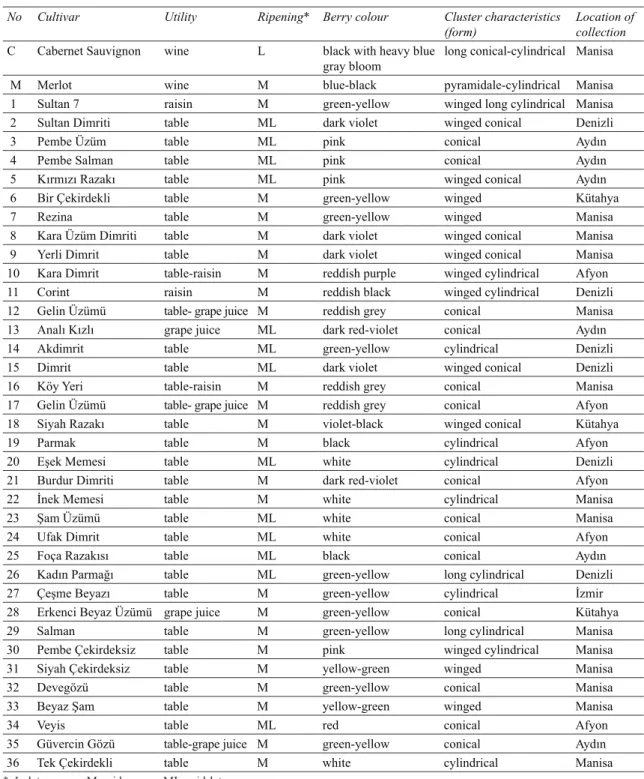
2.1. Plant materialLeaf samples of the 36 autochthonous grapevine cultivars plus two reference cultivars Cabernet Sauvignon and Merlot (Vitis vinifera L.) as reference were either collected from different parts of the Aegean region or supplied by Manisa Viticulture and Research Station. Some important ampelographic traits of these cultivars described based on International Union for the Protection of New Varieties of Plants (UPOV) guidelines are given in Table 1.
2.2. DNA extraction
High quality genomic DNA was extracted from young leaf tissues using the CTAB method modified by Lodhi et al (1994). RNAse treatment was performed on the eluted DNA samples. Concentration and purity of the DNA were determined by NanoDrop® ND-1000 spectrophotometer readings. The DNA was
diluted to a working concentration of 10 ng µL-1.
2.3. SSR analysis
Eleven SSR markers employed in the “European
Project GENRES #08”, and “2nd Edition of the
OIV Descriptor list for grape varieties and Vitis species” (VIVC 2007; GENRES 2014; OIV
2014) were used in Polymerase Chain Reaction (PCR) amplifications. These primers were VVS3, VVS1, VVS4 and VVS2 (Thomas & Scott 1993), VVMD5, VVMD6 and VVMD7 (Bowers et al 1996), VVMD17 and VVMD28 (Bowers et al 1999), and VrZAG29 and VrZAG79 (Sefc et al 1999). PCR was performed in a final volume of 25 μL containing 5-10 ng of DNA template, 1x PCR reaction buffer (Fermentas, Life Sciences),
1.5 mM MgCl2 (Fermentas, Life Sciences), 0.2
mM for each dNTP, 0.5 µM each primer, 0.25 Unit Taq DNA polymerase (Fermentas, Life Sciences) and milliQ water. The reactions without DNA were included as negative controls. Amplification was performed using PTC-100TM (MJ Research
Inc.) thermocycler with 2 min initial denaturation/
activation step, followed by 40 cycles at 92
°C for 30 s, 52–56 °C for 1 min and 72 °C for 2 min with a final extension step of 7 min at 72 °C. A DNA ladder (100 bp) was used for the approximate quantification of the bands. Amplified DNA fragments were separated on 6% (w/v) polyacrylamide gel (Promega Silver Staining kit) which were silver stained to observe the bands then, the images were recorded by scanning.
2.4. Genetic analysis
The bands (alleles) were scored as present (1) or absent (0) across all the genotypes. Estimates of genetic similarity between pairs were calculated using Dice coefficient (Sneath & Sokal 1973) which were used for SAHN cluster analysis using unweighted pair group method of arithmetic averages (UPGMA) and a dendrogram was generated using the NTSYS (version 2.0 ) statistical package program (Rohlf 1998).
3. Results and Discussion
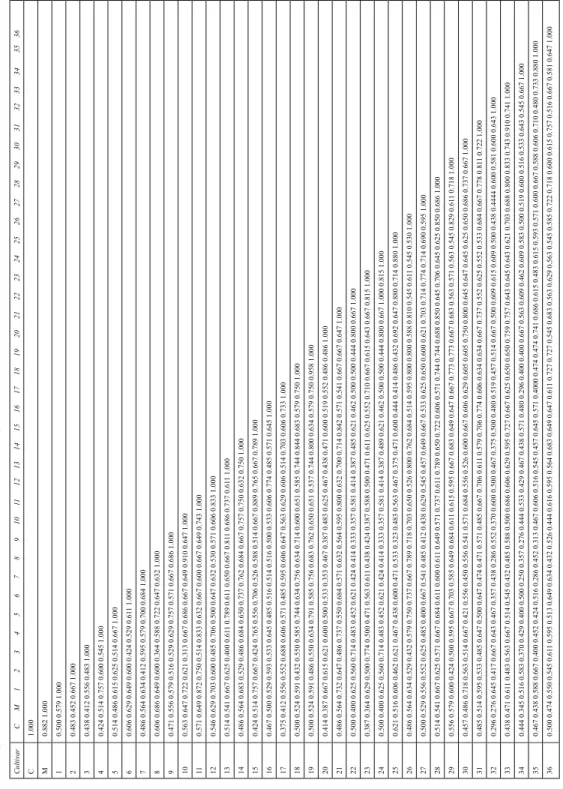
SSR analysis was performed to determine the genetic diversity among the 38 grapevine cultivars, comprising 36 autochthonous cultivars from the Aegean region and two reference cultivars in this study. Eleven SSR primers were used which generated a total of 37 alleles. All loci were polymorphic. The microsatellite markers used in our study have been proven as very useful for cultivar identification. Genetic similarities based on Dice coefficients ranged between 0.296 and 0.882 (Table 2). The most informative locus was VVMD7 based on the number of alleles generated (6 alleles) and probability of identity values whereas the least informative locus was VVS2 which generated only 2 alleles.
To elucidate the genetic relationship among the cultivars a UPGMA dendrogram was generated (Figure 1). Two European cultivars Cabernet Sauvignon and Merlot formed an out group that they were separated from the Turkish local cultivars which clearly shows the genetic differences. Local cultivars were classified into two main groups. In the first one, Sultan Dimriti, Veyis and Güvercin
Table 1- Basic descriptive characteristic of 36 autochthonous and 2 standard grapevine cultivars
Çizelge 1- Otuzaltı yerel ve 2 standart üzüm çeşidinin temel tanımlayıcı karakterleri
No Cultivar Utility Ripening* Berry colour Cluster characteristics
(form) Location of collection C Cabernet Sauvignon wine L black with heavy blue
gray bloom long conical-cylindrical Manisa
M Merlot wine M blue-black pyramidale-cylindrical Manisa
1 Sultan 7 raisin M green-yellow winged long cylindrical Manisa
2 Sultan Dimriti table ML dark violet winged conical Denizli
3 Pembe Üzüm table ML pink conical Aydın
4 Pembe Salman table ML pink conical Aydın
5 Kırmızı Razakı table ML pink winged conical Aydın
6 Bir Çekirdekli table M green-yellow winged Kütahya
7 Rezina table M green-yellow winged Manisa
8 Kara Üzüm Dimriti table M dark violet winged conical Manisa
9 Yerli Dimrit table M dark violet winged conical Manisa
10 Kara Dimrit table-raisin M reddish purple winged cylindrical Afyon
11 Corint raisin M reddish black winged cylindrical Denizli
12 Gelin Üzümü table- grape juice M reddish grey conical Manisa
13 Analı Kızlı grape juice ML dark red-violet conical Aydın
14 Akdimrit table ML green-yellow cylindrical Denizli
15 Dimrit table ML dark violet winged conical Denizli
16 Köy Yeri table-raisin M reddish grey conical Manisa
17 Gelin Üzümü table- grape juice M reddish grey conical Afyon
18 Siyah Razakı table M violet-black winged conical Kütahya
19 Parmak table M black cylindrical Afyon
20 Eşek Memesi table ML white cylindrical Denizli
21 Burdur Dimriti table M dark red-violet conical Afyon
22 İnek Memesi table M white cylindrical Manisa
23 Şam Üzümü table ML white conical Manisa
24 Ufak Dimrit table ML white conical Afyon
25 Foça Razakısı table ML black conical Aydın
26 Kadın Parmağı table ML green-yellow long cylindrical Denizli
27 Çeşme Beyazı table M green-yellow cylindrical İzmir
28 Erkenci Beyaz Üzümü grape juice M green-yellow conical Kütahya
29 Salman table M green-yellow long cylindrical Manisa
30 Pembe Çekirdeksiz table M pink winged cylindrical Manisa
31 Siyah Çekirdeksiz table M yellow-green winged Manisa
32 Devegözü table M green-yellow conical Manisa
33 Beyaz Şam table M yellow-green winged Manisa
34 Veyis table ML red conical Afyon
35 Güvercin Gözü table-grape juice M green-yellow conical Aydın
36 Tek Çekirdekli table M white cylindrical Manisa
Gözü were clustered separately from the remaining cultivars. The second one was the largest (33 cultivars) and the most complex cluster. The high level of within-group variation and the simple genetic structure observed in the dendrogram suggested a complex history of development of cultivars in the Aegean region. Dice genetic similarity coefficients showed that the cultivars Siyah Razakı and Parmak (0.96), Kara Üzüm Dimriti and Kara Dimrit (0.91),
Siyah Çekirdeksiz and Beyaz Şam (0.91), Corint and Dimrit (0.90), Veyis and Güvercin Gözü (0.88), İnek Memesi, Ufak Dimrit and Foça Karası (0.88) were the most similar. We found a relatively high level of genetic diversity among the cultivars in comparison with similar studies (Yüksel 2008).
İnek Memesi and Ufak Dimrit cultivars were placed in group 2 which were synonyms (Figure 1 and Table 2). These cultivars have multiple names Figure 1- UPGMA dendrogram based on Dice genetic similarity coefficients for 36 autochthonous and 2 standard grapevine cultivars
Şekil 1- Dice genetik benzerlik katsayısına göre otuzaltı yerel ve 2 standart üzüm çeşidi için elde edilen UPGMA dendrogram (C, Cabernet Sauvignon; M, Merlot; 1, Sultan-7; 2, Sultan Dimriti; 3, Pembe Üzüm; 4, Pembe Salman; 5, Kırmızı Razakı; 6, Bir Çekirdekli; 7, Rezina; 8, Kara Üzüm Dimriti; 9, Yerli Dimrit; 10, Kara Dimrit; 11, Corint; 12, Gelin Üzümü; 13, Analı Kızlı; 14, Akdimrit; 15, Dimrit; 16, Köy Yeri; 17, Gelin Üzümü; 18, Siyah Razakı; 19, Parmak; 20, Eşek Memesi; 21, Burdur Dimriti; 22, İnek Memesi; 23, Şam Üzümü; 24, Ufak Dimrit; 25, Foça Razakısı; 26, Kadın Parmağı; 27, Çeşme Beyazı; 28, Erkenci Beyaz Üzümü; 29, Salman; 30, Pembe Çekirdeksiz; 31, Siyah Çekirdeksiz; 32, Devegözü; 33, Beyaz Şam; 34, Veyis; 35, Güvercin Gözü; 36, Tek Çekirdekli).
Table 2- Dice genetic similarity coefficients for
36 autochthonous and 2 standard grapevine cultivars
Çizelge 2- Otuzaltı yer
el ve 2 standart üzüm çeşidi için Dice genetik benzerlik katsayısı
Cultivar C M 1 2 3 4 5 6 7 8 9 10 1 1 12 13 14 15 16 17 18 19 20 21 22 23 24 25 26 27 28 29 30 31 32 33 34 35 36 C 1.000 M 0.882 1.000 1 0.500 0.579 1.000 2 0.483 0.452 0.667 1.000 3 0.438 0.412 0.556 0.483 1.000 4 0.424 0.514 0.757 0.600 0.545 1.000 5 0.514 0.486 0.615 0.625 0.514 0.667 1.000 6 0.606 0.629 0.649 0.600 0.424 0.529 0.61 1 1.000 7 0.486 0.564 0.634 0.412 0.595 0.579 0.700 0.684 1.000 8 0.606 0.686 0.649 0.600 0.364 0.588 0.722 0.647 0.632 1.000 9 0.471 0.556 0.579 0.516 0.529 0.629 0.757 0.571 0.667 0.686 1.000 10 0.563 0.647 0.722 0.621 0.313 0.667 0.686 0.667 0.649 0.910 0.647 1.000 11 0.571 0.649 0.872 0.750 0.514 0.833 0.632 0.667 0.600 0.667 0.649 0.743 1.000 12 0.546 0.629 0.703 0.600 0.485 0.706 0.500 0.647 0.632 0.530 0.571 0.606 0.833 1.000 13 0.514 0.541 0.667 0.625 0.400 0.61 1 0.789 0.61 1 0.650 0.667 0.81 1 0.686 0.737 0.61 1 1.000 14 0.486 0.564 0.683 0.529 0.486 0.684 0.650 0.737 0.762 0.684 0.667 0.757 0.750 0.632 0.750 1.000 15 0.424 0.514 0.757 0.667 0.424 0.765 0.556 0.706 0.526 0.588 0.514 0.667 0.889 0.765 0.667 0.789 1.000 16 0.467 0.500 0.529 0.593 0.533 0.645 0.485 0.516 0.514 0.516 0.500 0.533 0.606 0.774 0.485 0.571 0.645 1.000 17 0.375 0.412 0.556 0.552 0.688 0.606 0.571 0.485 0.595 0.606 0.647 0.563 0.629 0.606 0.514 0.703 0.606 0.733 1.000 18 0.500 0.524 0.591 0.432 0.550 0.585 0.744 0.634 0.756 0.634 0.714 0.600 0.651 0.585 0.744 0.844 0.683 0.579 0.750 1.000 19 0.500 0.524 0.591 0.486 0.550 0.634 0.791 0.585 0.756 0.683 0.762 0.650 0.651 0.537 0.744 0.800 0.634 0.579 0.750 0.958 1.000 20 0.414 0.387 0.667 0.615 0.621 0.600 0.500 0.533 0.353 0.467 0.387 0.483 0.625 0.467 0.438 0.471 0.600 0.519 0.552 0.486 0.486 1.000 21 0.486 0.564 0.732 0.647 0.486 0.737 0.550 0.684 0.571 0.632 0.564 0.595 0.800 0.632 0.700 0.714 0.842 0.571 0.541 0.667 0.667 0.647 1.000 22 0.500 0.400 0.625 0.560 0.714 0.483 0.452 0.621 0.424 0.414 0.333 0.357 0.581 0.414 0.387 0.485 0.621 0.462 0.500 0.500 0.444 0.800 0.667 1.000 23 0.387 0.364 0.629 0.500 0.774 0.500 0.471 0.563 0.61 1 0.438 0.424 0.387 0.588 0.500 0.471 0.61 1 0.625 0.552 0.710 0.667 0.615 0.643 0.667 0.815 1.000 24 0.500 0.400 0.625 0.560 0.714 0.483 0.452 0.621 0.424 0.414 0.333 0.357 0.581 0.414 0.387 0.489 0.621 0.462 0.500 0.500 0.444 0.800 0.667 1.000 0.815 1.000 25 0.621 0.516 0.606 0.462 0.621 0.467 0.438 0.600 0.471 0.533 0.323 0.483 0.563 0.467 0.375 0.471 0.600 0.444 0.414 0.486 0.432 0.692 0.647 0.880 0.714 0.880 1.000 26 0.486 0.564 0.634 0.529 0.432 0.579 0.750 0.737 0.667 0.789 0.718 0.703 0.650 0.526 0.800 0.762 0.684 0.514 0.595 0.800 0.800 0.588 0.810 0.545 0.61 1 0.545 0.530 1.000 27 0.500 0.529 0.556 0.552 0.625 0.485 0.400 0.667 0.541 0.485 0.412 0.438 0.629 0.545 0.457 0.649 0.667 0.533 0.625 0.650 0.600 0.621 0.703 0.714 0.774 0.714 0.690 0.595 1.000 28 0.514 0.541 0.667 0.625 0.571 0.667 0.684 0.61 1 0.600 0.61 1 0.649 0.571 0.737 0.61 1 0.789 0.650 0.722 0.606 0.571 0.744 0.744 0.688 0.850 0.645 0.706 0.645 0.625 0.850 0.686 1.000 29 0.556 0.579 0.600 0.424 0.500 0.595 0.667 0.703 0.585 0.649 0.684 0.61 1 0.615 0.595 0.667 0.683 0.649 0.647 0.667 0.773 0.773 0.667 0.683 0.563 0.571 0.563 0.545 0.829 0.61 1 0.718 1.000 30 0.457 0.486 0.718 0.563 0.514 0.667 0.421 0.556 0.450 0.556 0.541 0.571 0.684 0.556 0.526 0.600 0.667 0.606 0.629 0.605 0.605 0.750 0.800 0.645 0.647 0.645 0.625 0.650 0.686 0.737 0.667 1.000 31 0.485 0.514 0.595 0.533 0.485 0.647 0.500 0.647 0.474 0.471 0.571 0.485 0.667 0.706 0.61 1 0.579 0.706 0.774 0.606 0.634 0.634 0.667 0.737 0.552 0.625 0.552 0.533 0.684 0.667 0.778 0.81 1 0.722 1.000 32 0.296 0.276 0.645 0.417 0.667 0.643 0.467 0.357 0.438 0.286 0.552 0.370 0.600 0.500 0.467 0.375 0.500 0.480 0.519 0.457 0.514 0.667 0.500 0.609 0.615 0.609 0.500 0.438 0.4444 0.600 0.581 0.600 0.643 1.000 33 0.438 0.471 0.61 1 0.483 0.563 0.667 0.514 0.545 0.432 0.485 0.588 0.500 0.686 0.606 0.629 0.595 0.727 0.667 0.625 0.650 0.650 0.759 0.757 0.643 0.645 0.643 0.621 0.703 0.688 0.800 0.833 0.743 0.910 0.741 1.000 34 0.444 0.345 0.516 0.583 0.370 0.429 0.400 0.500 0.250 0.357 0.276 0.444 0.533 0.429 0.467 0.438 0.571 0.480 0.296 0.400 0.400 0.667 0.563 0.609 0.462 0.609 0.583 0.500 0.519 0.600 0.516 0.533 0.643 0.545 0.667 1.000 35 0.467 0.438 0.588 0.667 0.400 0.452 0.424 0.516 0.286 0.452 0.313 0.467 0.606 0.516 0.545 0.457 0.645 0.571 0.4000 0.474 0.474 0.741 0.686 0.615 0.483 0.615 0.593 0.571 0.600 0.667 0.588 0.606 0.710 0.480 0.733 0.880 1.000 36 0.500 0.474 0.550 0.545 0.61 1 0.595 0.513 0.649 0.634 0.432 0.526 0.444 0.616 0.595 0.564 0.683 0.649 0.647 0.61 1 0.727 0.727 0.545 0.683 0.563 0.629 0.563 0.545 0.585 0.722 0.718 0.600 0.615 0.757 0.516 0.667 0.581 0.647 1.000
associated with the area of their origin. Synonyms detected in this study were lower than those previously reported (Ergül et al 2006; Karataş et al 2007; Şelli et al 2007; Tangolar et al 2009). Genotypes grown under the same name of Dimrit in three different areas (Afyon, Denizli and Manisa provinces) were found in the two main groups on the dendogram. Sultan Dimriti (0.63) was clustered separately from the remaining other Dimrit genotypes. The second main cluster was further divided into two subgroups. The first subgroup included Ufak Dimrit (0.88). The second group was further divided into two subgroups comprising Kara Üzüm Dimriti (0.91), Yerli Dimrit (0.81), Kara Dimrit (0.91) and Akdimrit (0.82), the second subgroup in the second main cluster comprised Dimrit (0.88) and Burdur Dimriti (0.84). Our results showed that Dimrit genotypes from different locations were different from each other which indicate an important genetic variation which are good example of homonymous cultivars. They have been cultivated in different environments for long times, and those transferred to the Manisa Viticulture and Research Station could be inappropriately named. Changes in genetic background of these cultivars probably are caused by somatic mutations which could be due to effects of continuous vegetative reproduction and environmental factors. Turkey is a very rich in terms of homonymous grape cultivars. Because they have long history of cultivation since ancient tradition of grape cultivation in Anatolia which began approximately 7000–8000 years ago (Karataş et al 2007; Yüksel 2008).
4. Conclusions
The results showed that the gene pool of cultivated local grapes surveyed in the Aegean region has a significant amount of genetic variation. SSR analysis revealed better characterization of the grape germplasm grown in the region and would aid future germplasm management of cultivar numbers and breeding efforts. Characterization of genotypes will also contribute to the other viticulture activities such as plant propagation and nursery management.
Acknowledgements
We thank Manisa Viticulture Research Station for supplied grapevine cultivars.
References
Alleweldt G & Possingham J V (1988). Progress in grapevine breeding. Theoretical and Applied Genetics
75: 669−673
Bowers J E, Dangl G S, Vignani R & Meredith C P (1996). Isolation and characterization of new polymorphic simple sequence repeat loci in grape (Vitis vinifera L.). Genome 39: 628-633
Bowers J E, Dangl G S & Meredith C P (1999). Development and characterization of additional microsatellite DNA markers for grape. American
Journal of Enology and Viticulture 50(30): 243−246
Brown S M & Kresovich S (1996). Molecular characterization for plant genetic resource conservation. In: Paterson AH, ed. Genome mapping
in plants. Austin, Texas: R.G. Landes Company, 85–9
Costantini L, Monaco A, Vouillamoz J F, Forlani M & Grando M S (2005). Genetic relationships among homonymous Vitis vinifera cultivars from Campania (Italy). Vitis 44: 25–34
De Mattia F, Lovicu G, Tardaguila J, Grassi F, Imazio S, Scienza A & Labra M (2009). Genetic relationships between Sardinian and Spanish viticulture: the case of ‘Cannonau’ and ‘Garnacha’. The Journal of
Horticultural Science & Biotechnology 84: 65-71
Dilli Y (2008). Characterization of some important grape varieties, types and clones in the Aegean region by using icrosatellite (SSR) markers. PhD Thesis, Ege University, İzmir, 112 p (In Turkish)
Ergül A, Kazan K, Aras S, Çevik V, Çelik H & Söylemezoğlu G (2006). AFLP analysis of genetic variation within the two economically important Anatolian grapevine (Vitis vinifera L.) varietal groups.
Genome 49: 467−475
GENRES (2014). Information System Genetic Resources. http://www.genres.de/vitis/ (2013) (Erişim tarihi: 1.05.2014)
Hizarci Y, Ercişli S, Yüksel C & Ergül A (2012). Genetic characterization and relatedness among autochthonous grapevine cultivars from Northeast Turkey by Simple Sequence Repeats (SSR). Journal of Applied Botany
Karataş H, Değirmenci D, Velasco R, Vezzulli S, Bodur Ç & Ağaoğlu Y S (2007). Microsatellite fingerprinting of homonymous grapevine (Vitis vinifera L) varieties in neighboring regions of South-East Turkey. Scientia
Horticulturae 114: 164–169
Leao P C S, Riaz S, Graziani R, Dangl G S & Motoike S Y (2009). Characterization of a Brazilian grape germplasm collection using microsatellite markers.
American Journal of Enology and Viticulture 60:
517−524
Lodhi M A, Ye G N, Weeden N F & Reisch B I (1994). A simple and efficient method for DNA extraction from grapevine cultrivars and Vitis species. The Journal of Plant Molecular Biology Reporter 12: 6-13
OIV (2014). Descriptor list for grape varieties and Vitis species. 2nd Edition of the OIV. http://www.oıv.int: (Erişim tarihi: 01.05.2014)
Özcan S, Gürel E & Babaoğlu M (2001). Plant Biotechnology- Genetic Engineering and Its Applications. S.Ü. Foundation Publications pp. 456 (Turkish)
Regner F & Wiedeck E (2006). Identification of white Riesling clones by genetic markers. Vitis 39: 103−107 Rohlf F J (1998). NTSYS-pc numerical taxonomy and
multivariate analysis system. Version 2.02. Exeter Publications Setauket, New York
Sefc K M, Regner F, Turetschek E, Gloessl J & Steinkellenr H (1999). Identification of microsatellite sequences in
Vitis riparia and their applicability for genotyping of
different Vitis species. Genome 42: 367-373
Scott K D, Eggler P, Seaton G, Rosetto M, Ablett E M, Lee L S & Henry R J (2000). Analysis of SSRs derived from grape ESTs. Theoretical and Applied Genetics 100: 723-726
Sneath P H A & Sokal R R (1973). Numerical Taxonomy. Freeman, San Francisco.
Şelli F, Bakır M, İnan G, Aygün H, Boz Y, Yaşasın A S, Özer C, Akman B, Söylemezoğlu G, Kazan K & Ergül A (2007). Simple sequence repeat-based assessment of genetic diversity in ‘Dimrit’ and ‘Gemre’ grapevine accessions from Turkey. Vitis 46(4): 182-187 Tangolar S G, Soydam S, Bakır M, Karaağaç E, Tangolar
S & Ergül A (2009). Genetic analysis of grapevine cultivars from the eastern Mediterranean region of Turkey based on SSR markers. Tarım Bilimleri
Dergisi – Journal of Agricultural Sciences 15: 1−8
This P, Jung A, Boccacci P, Borrego J, Botta R, Costantini L, Crespan M, Dangl G S, Eisenheld C, Fererira-Monterio F, Grando S, Ibanez J, Lacombe T, Laucou V, Magalhaes R, Meredith C P, Milani N, Peterlunger E, Regner F, Zulini L & Maul E (2004). Development of a standard set of microsatellite reference alleles for identification of grape cultivars. Theoretical and Applied Genetics 109: 1448-1458
Thomas M R & Scott N S (1993). Microsatellite repeats in grapevine reveal DNA polymorphisms when analyzed as sequence-tagged sites (STSs). Theoretical and Applied Genetics 86: 985−990
Vezzulli S, Michela T, Giuseppina C, Angelica J, Dustin C & Andrey Z (2008) A reference integrated map for cultivated grapevine (Vitis vinifera L.) from three crosses based on 283 SSR and 501 SNP-based markers. Theoretical and Applied Genetics 117(4): 499-511
VIVC (2007). Vitis International Variety Catalogue (http://www.vivc.de) (Erişim tarihi: 01.05.2014) Yüksel C (2008). SSRs (Simple Sequence Repeats) based
genetic characterization of Manisa, İzmir, Muğla and Kütahya grapevine germplasms. MSc. Thesis, Ankara University Biotechnology Institute, pp. 50 (In Turkish)