GRADUATE SCHOOL OF NATURAL AND APPLIED SCIENCES
MASTER OF ARCHITECTURE
NOVEMBER 2017
INVESTIGATION OF IMMATERIAL TECTONIC EXPRESSION IN ARCHITECTURE
Supervisor: Assist. Prof. Dr. Murat SÖNMEZ Beyza Nur BATI
Department Of Architecture
ii
Approval of Graduate School of Natural and Applied Sciences
……….. Prof. Dr. Osman EROĞUL Director
I certify that this thesis satisfies all the requirements as a thesis for the degree of Master of Architecture.
……….
Prof. Dr. Tayyibe Nur ÇAĞLAR
Head of Department
Thesis Supervisor: Assist. Prof. Dr. Murat SÖNMEZ ...
TOBB University Of Economics And Technology
Jury Members: Assist. Prof. Dr. Pelin GÜROL ÖNGÖREN (Chair) ...
TOBB University Of Economics And Technology
Assoc. Prof. Dr. Adnan AKSU ...
Gazi University
Prof. Dr. Ertuğrul Rufayi TURAN ... Ankara University
The thesis entitled “INVESTIGATION OF IMMATERIAL TECTONIC
EXPRESSION IN ARCHITECTURE”, by Beyza Nur BATI, 154611012, the
student of the degree of Master of Architecture, Graduate School of Natural and Applied Sciences, TOBB ETU, which has been prepared after fulfilling all the necessary conditions determined by the related regulations, has been accepted by the jury, whose signature are as below, on 02.11.2017.
Assoc. Prof. Dr. Namık Günay ERKAL ... TED University
iii
DECLARATION OF THE THESIS
I hereby declare that all information in this document has been obtained and presented in accordance with academic rules and ethical conduct. I also declare that, as required by these rules and conduct, I have fully cited and referenced all material and results that are not original to this work. And this thesis is prepared in accordance with TOBB ETU Graduate School of Natural and Applied Sciences thesis writing rules.
TEZ BİLDİRİMİ
Tez içindeki bütün bilgilerin etik davranış ve akademik kurallar çerçevesinde elde edilerek sunulduğunu, alıntı yapılan kaynaklara eksiksiz atıf yapıldığını, referansların tam olarak belirtildiğini ve ayrıca bu tezin TOBB ETÜ Fen Bilimleri Enstitüsü tez yazım kurallarına uygun olarak hazırlandığını bildiririm.
iv
ABSTRACT
Master of Architecture
INVESTIGATION OF IMMATERIAL TECTONIC EXPRESSION IN
ARCHITECTURE
Beyza Nur BATI
TOBB University of Economics and Technology Institute of Natural and Applied Sciences
Department of Architecture
Supervisor: Assist. Prof. Dr. Murat SÖNMEZ Date: November 2017
According to the statements within the scope of this study, all creations are based on the two domains of reality: the superior and the inferior. Though these two concepts may seem to be opposed to each other, the inferior reality is a reflection of the superior reality, indeed; such as the ontological inquiries and their manifestations or the physical manifestation of the spiritual. Similarly, it can be said that, architecture, which creates material situations, is built into its immaterial philosophy. So, it can be talked about immaterial concepts perceived within the material situations created in architecture. These immaterial situations are efforts of basing creations on theoretical foundations seeking for superior qualities and, builds on an intellectual journey into the inner worlds of universal realities. In this negotiation, it does not mean that the material is indeed gone or is ignored. On the contrary, materials come out as perceptional situations reflected upon, and thus, going beyond their initial and simple meanings. Therefore, for field of architecture or other disciplines, an immaterial creation involves depth of thinking, interpretations and implications other than those we see directly. From this perspective, the creative act of architecture is discussed related with how the recognition of the creation is established with the tools used.
v
Immaterial tectonics, by challenging the learned or habitual senses, are regarded as a search for quality or expansion of intellectual background towards the essence of creation/space and the superior. This discussion relies on contrasting sensations and offers a reexamination to reach active and creative results of architecture as a deliberate deviation from the existing architectural behavior. Immaterial tectonics is a perceptual architecture that seeks for darkness as well as light; emptiness as well as forms, actions as well as images; essence of material as well as the material and it is an expression of the attempt to rediscover the depths that exist in its meaning.
Keywords: Thinking the immaterial, Immaterial practice, Immaterial tectonic
expression, Tectonic as the act of creation of architect, Meaning and expression in architectural creations.
vi
ÖZET
Yüksek Lisans Tezi
MİMARLIKTA MADDESİ OLMAYAN TEKTONİK İFADELERİN İNCELENMESİ
Beyza Nur BATI
TOBB Ekonomi ve Teknoloji Üniveritesi Fen Bilimleri Enstitüsü
Mimarlık Anabilim Dalı
Danışman: Yrd. Doç. Dr. Murat SÖNMEZ Tarih: Kasım 2017
Bu çalışmanın kapsamındaki söylemlere göre bütün yaratılar gerçekliğin iki haline dayanır: üst nitelikli olan ve alt nitelikli olan. Bu iki kavram birbirlerine karşıt gibi görünselerde, alt nitelikte olan gerçeklik üst nitelikli olanın yansımasıdır; varlığın ya da var etmenin ne olduğunun sorgusu ve bunların tezahürü ve ya manevi olanın fiziksel gösterimi gibi. Benzer şekilde, madde kökenli durumlar yaratan mimarlığın da maddesi olmayan felsefesinin içine inşa edildiği söylenebilir. Bu yüzden mimarlıkta yaratılan madde kökenli/ materyal durumlar için, algılanan maddesi olmayan kavramlardan söz edilebilir. Bu maddesi olmayan durumlar, yaratıları, üst nitelikleri arayan kuramsal temeller üzerine oturtma çabasıdır ve evrensel gerçekliklerin içsel dünyasına yapılan fikirsel gezintilere dayandırılır. Oluşturulmaya çalışılan tartışmada madde gerçek anlamda yok olmuş ya da önemsenmiyor değildir. Aksine, madde, üzerine derinlemesine düşünülen, bu yüzden de onun ilk ve basit anlamlarını aşan algısal durumlar yaratarak ortaya çıkar. Dolayısıyla, mimarlık alanında veya başka bir disiplin için, maddesi olmayan bir yaratıda doğrudan gördüklerimizden başka, düşünsel derinlikler, yorumlar ve kurgular vardır. Bu kapsamda, mimarlığın yaratma
vii
eylemi, kullandığı araçlarla, yaratının farkındalığını nasıl kurduğu ile ilgili olarak tartışılmıştır. Maddesi olmayan tektonikler, öğrenilmiş veya alışılmış duyulara meydan okuyarak yaratının/mekanın özüne, üst derece olana yönelik nitelik arayışlarının veya düşünsel alt yapının açılımları olarak ele alınmıştır. Bu tartışma tezat duyumlara dayanır ve var olan mimari davranıştan bilinçli bir sapma olarak, mimarlığın aktif ve yaratıcı sonuçlarına gidebilmek için yeni bir okuma önerir. Maddesi olmayan tektonikler, ışık kadar karanlığı, biçim kadar boşluğu, imgeler kadar eylemleri; malzeme kadar maddesel özü arayan algının mimarlığıdır ve anlamında var olan derinlikleri yeniden keşfetme girişiminin ifadesidir.
Anahtar Kelimeler: Maddesi olmayan üzerine düşünmek, Maddesi olmayanın
üretimi, Maddesi olmayan tektonik ifade, Mimarın yaratma eylemi olarak tektonik, Mimari yaratılarda anlam ve anlatım.
viii
ACKNOWLEDGEMENTS
I would like to express my appreciation to my advisor Assist. Prof. Dr. Murat Sönmez for the patient guidance, constant support, constructive criticism and suggestions regarding this study.
I also thank the faculty members of TOBB Economics and Technology University Department of Architecture for their valuable comments and contributions.
I would like to convey my deepest thanks to my friends and parents for their great support, in particularly, to my dad Muammer Batı for teaching me the value of knowledge and the other special personal reasons that are beyond the possibilities of acknowledgement.
ix TABLE OF CONTENTS Sayfa ABSTRACT ... iv ÖZET ... vi ACKNOWLEDGEMENTS ... viii TABLE OF CONTENTS ... ix LIST OF FIGURES ... x 1. INTRODUCTION ... 1
2. THINKING THE IMMATERIAL ... 7
2.1 Derivation of the Being from Materials ... 7
2.2 Derivation of the Being from the Immaterial ... 8
3. IMMATERIAL PRACTICE ... 13
3.1 Drawing Forth Of An Idea ... 14
3.2 Designing As An Intellectual Process ... 15
3.3 Forming As A Means Of Expression ... 17
4. IMMATERIAL ARCHITECTURE ... 27
4.1 Space As A Subject Of Architecture ... 28
4.2 Beyond The Limits Of Materials ... 38
4.3 Technique Revealing Out The Expressive Potentials ... 44
5. CONCLUSION ... 53
REFERENCES ... 59
x
LIST OF FIGURES
Sayfa
Figure 3.1: Kazimir Malevich, White on White, Oil on Canvas, The Museum of
Modern Art, New York, 1918, (Heckert, 2015, p. 66). ... 19
Figure 3.2: John Cage, 4' 33'' (Url 1) ... 21
Figure 3.3: Donald Judd's untitled work, Chinati Foundation in Marfa, (Url 2) ... 22
Figure 3.4: Fred Sandback, Sculpture, Dia, Chelsea, 1998 (Url 3) ... 23
Figure 3.5: Frank Stella, Die Fahne Hoch!, Enamel on Canvas, Whitney Museum of American Art, New York, 1959 (Meyer, 2010, p. 48) ... 24
Figure 4.1: Herzog & De Meuron, Eberswalde Technical School Library, Eberswalde, Germany, Project 1994-1996, realization 1997-1999 (Url4). ... 30
Figure 4.2: Tadao Ando, Church of the Light, Osaka, Japan, 1999 (Url 5). ... 34
Figure 4.3: Peter Zumthor, Bruder Klaus Field Chapel, Cologne, Germany, 2007 (Url6, Url7). ... 37
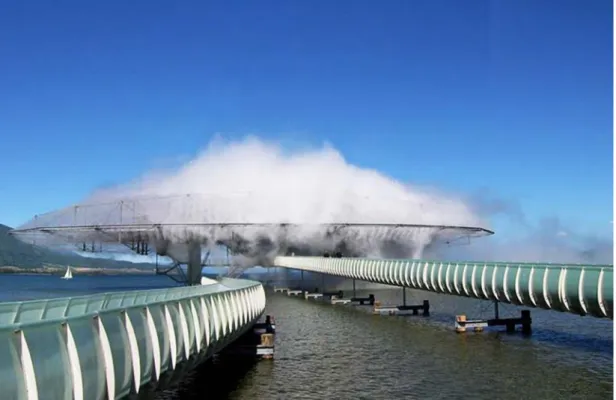
Figure 4.4: Diller & Scofidio, Blur Building, for 2002 Swiss Expo, Yverdon-les-Bains, Switzerland (Url 8). ... 40
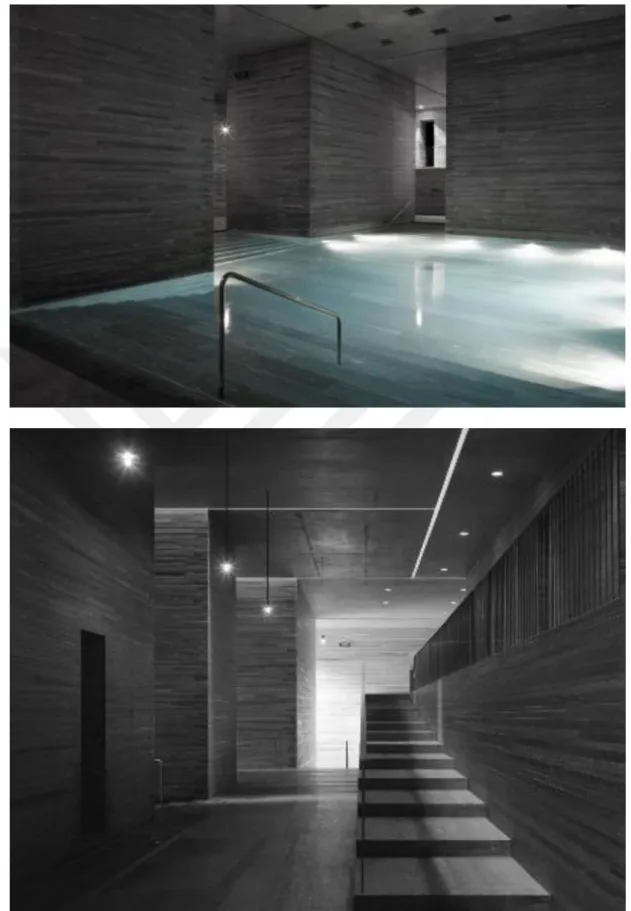
Figure 4.5: Peter Zumthor, Thermal Baths in Vals, Graubünden, Switzerland, 1996 (Url 9) ... 41
Figure 4.6: Herzog, Jacques & Pierre de Meuron, Dominus Winery, Yountville, California, USA, realization 1996-1998 (Url 10, Url 11) ... 43
Figure 4.7: Dan Graham, Rooftop Urban Park Project, DIA Center, 1991(Url 12) 44 Figure 4.8: Le Corbusier, Villa Savoye, Poissy, France , 1929 (Url 13, Url 14) .... 47
Figure 4.9: Mies van der Rohe, Farnsworth House, Designed by in 1945 and constructed in 1951 (Url 15) ... 50
Figure 4.10: Eisenman, House 2, Hardwick, Vermont, 1969 - 1970 (Url 16) ... 51
Figure 5.1: Reading Between the Lines, Church by Gijs Van Vaerenbergh, Belgium, 2011 (Url 17, Url 18) ... 54
Figure 5.2: Enric Mirrales and Carme Pinos, Igualada Cemetery, Spain, completed in 1994 (Url 19) ... 55
Figure 5.3: Christo and Jeanne Claude, Wrapped Reichstag, Berlin, 1971-95 (Url20) ... 56 Figure 5.4: Le Corbusier, Notre Dame du Haut, Ronchamp, France, 1954 (Url21) 58
1
1. INTRODUCTION
Throughout history, architectural creations can be considered to be furnished by several intellectual and physical layers. Technological, substantial, structural, cultural-aesthetic, economic, political layers have been added to the simple/ essential state of the space, which we can take, particularly, as the subject of architecture. While each layer added on the essential/simple space furnishes such space, it also removes it away from its original qualities or the conditions of its being. It can be said that it causes a perception of a conventional space. Way of production and perception of architecture has become apparent, material and known. Modernism has considered space as a rationalist and functionalist volume arising from accumulation of knowledge with a formalist attitude. Even the resolutions belonging to the structure have come to be obtained from situations based on the known.
This study negotiates the formation, essence, and root of the architectural creation instead of the architecture which is built on today's great amount of information accumulated throughout the history. Instead of the production condition of space and related architectural perceptions of contemporary architecture in which knowledge and content have fallen into place, this discusssion aims to the evaluation of the architectural design field through a different perspective; acquisition of new intellectual tools for the theoretical criticism area and finding different ranges of ideas and production in the design area. It offers a discussion of inner, spiritual and metaphysical profundity and thinking on other possibilities for creating spaces by getting free yourself of the learned knowledge.
In order to define, even in an obscure way, the essential/simple state of architectural creations, mainly space, which is the primary reason for the existence of these creations, it was investigated how these got form and evolved in thoughts, away from the conditions for the physical being. This research is questions the perception of the world that stems from the material. With the act of creation, which we have acquired at the end of this questioning, forms of perception justifying the physical conditions
2
come out. These forms of perception involve the idea of the creator and explanations about the superior. So, the essence and the uniqueness of a creation that is independent of all the layers covering the creation can be perceived today.
It is, in fact, the material architecture that is built within the philosophical negotiations over immaterial through the material itself. It is because philosophy deals with the material from its beginning and existence. This shows that this method enables the idea of rejection of all learned information and the formation of a physical reality from a natural reality, hence, being open to all expression potentials with which it is described.
In this study, the negotiations about architectural creations or essential/simple state of a space does not involve the reasons for primary and structural spatial productions meeting the needs of human beings such as accommodation and protection. The study is focused on the effect of ideas or metaphysical expressions of the human beings, intended to understand and explain themselves and their surroundings with space's process of becoming entities, beyond the physical requirements.
In this context, structure of thesis progresses as follows;
First, it is necessary to negotiate, clarify, and understand the implications of how the human's creation is formed of thought and the material. It is important to know how an architectural creation and its fundamental element, space, is created and comes into existence in the most essential and pure form. This understanding can be related to the humankind's opinions about the creation or existence of himself, the world, and the universe. Our thoughts on how we see and perceive the physical world are related to the material on the one hand, and on the other hand, how the material is created or exists. For this reason, the idea has always existed for the explanation of the material that, there is a superior construing and justifying and ascribing a meaning to it the essence obtained from those forms the source for the physical realities we perceive in the world. Our ideas and perceptions about the creator have used the act of creation and the material, and they also have led to several implications on how the creation comes into being.
Here, the act of creation brings a perspective to our way of perceiving the material world. Today, there is a concept of reality negotiated over the things we see and perceive in the material world. But the negotiations made in the history of philosophy
3
have based all creations on a type of reality perceived on the unseen and transcendent. There is a tendency to reason all these physical realities with an "essence" outside the sensation, which cannot be directly acquired by the human being. For example, in Islamic philosophy, the absolute being is the reason for everything we perceive in the physical world and manifestations of the essences/samples originating from that, thus, they are only the shadows of the supreme reality (Rustom, 2014). Or with another example, through a Platonist point of view, all the things we perceive in the material world are modelled on eternal, immaterial and ideal forms (Platon, 2015). It is understood that in the material world created or existed, the things we perceive through our senses are, indeed, inferior and bear traces of the superior.
It can be said that for the humankind, explaining the material and immaterial as getting into relation with the transcendent/ leaving traces from the transcendent, re-formation of the material or the physical being is an implication derived from the questioning of the creation of the superior or the creator itself. Just as philosophical expressions define the material as the shadow of the transcendent on a common ground, to seek for the transcendent in material situations created by the human being as a creator, is pursuing the shadow. The architect or the artist also processing, transforming, and positioning the material with the conscience, get closer to the transcendent in this way. Pursuing the shadow is building an idea of Immaterialism by using the material which is the reflection of the creator. In this way, the artist or architect get closer to the creator through its creation or space and progress towards a physical transcendence. The simple state of the creation or the essential space is the result of the references to the physically transcendent and to the search of the human being, pursuing the shadow, to immaterialize the material.
As the act of creation is understood within the context of material or immaterial conditions, the human being is deemed to have seen himself to be related to/close to the superior or the creator. For the human being who sees the transcendent as the creator of himself or the universe, who makes judgements at the end of the questions on how it creates and who sees the material as the reflection of it, the organization/formation of the space as a conscious action is the process of the acceptance of the architecture as a creator. When we set out a situation where the architecture can also be accepted as a creator, we can talk about an architecture creating ultimate realities instead of an architecture creating physical conditions. An ultimate
4
reality is a state of being a part of the transcendent, the actual reality. When the human being understands the superior, the creation comes into existence as a result of his recognition of its creative power and the desire to create something like that. This has led his use and transformation of the material as a tool of creation. Therefore; the creative act of architecture is shaped on the basis of the idea to present the creation with its most basic and essential state by organizing, shaping, and transforming the material. Thanks to the actions consciously developed by the architect, there will be a concept away from the directly sensed, in other words, from the secondary reality, a concept which makes the human being question the things and reach the superior.
The Renaissance period was a new term in which the human brain's perhaps the most unique feature could be extensively externalized to see the potentials of people, to realize that they have no boundaries in the fields of art, such as painting, music, literature, and architecture (Şentürk, 2016). The concept of architecture considered as a problem today, which is built on piles of information, must have recovered from its burdens thanks to this new period which is interested in the works passed through the intellectual stages. Architect who value intellectual production more than producing over the materials1 is now free to explore every possible expression. Plato, whose
works had been explored at that period, and his views were influential and the theories he establishes on the material, and the act of creation must have influenced the field of architecture on the basis of these two concepts. In this regard, architects seek for the superior in any type of interest that will pass through the intellectual filter.
The architect's designer/creator profile, representing the creator and bringing both himself and the others closer to trancencendence with his space, can be basically related with organization of the material. Architectural tectonics can be seen as the tool for reaching the superior to be the reorganization of the material with the idea of creation. The architect reflects the universe, himself, and his act of creation in the tectonic expressions of the representation of the transcendent. It can be said that tectonic expression is the result of the humankind's perception of the world and the
1 In the Middle ages, arts and architecture were ‘confined to the artisan’s guilds, in which the painters were sometimes associated with the druggists who prapared their paints, the sculptors with the goldsmiths, and the architects with the masons and carpenters’ (Kristeller, 1990, p. 176). However, in the scope of this study, attitude of an architect to production is consider like Alberti’s specification ‘It is quite possible to project whole forms in the mind without recourse to the material’ (On the Art of Building in Ten Books, 1988, p. 7).
5
existential references it makes. Tectonic, by its definition, is a concept questioning the poetic situations in the creation's way of formation, indeed. Such that, Mallgrave refers to this concept with expressions like the ‘art of space creation’ (Introduction of Style in the Technical and Tectonic Arts, Or, Practical Aesthetics, 2004, p. 48). On the other hand, tectonic, in an architectural creation, is a visual thing with a scene. This scene is established through the internal relationship between the subject, technique, and material of architecture.
The concept of space, which is suggested by Semper to be the essence of architecture, can be deemed to be the subject of architecture. Here, space must be considered to be a connection, bond or a relation instead of mass. So that, space has arisen as a concept related to the situations internally adopted by the individual, which cannot be explained with the terms he senses. The essential space is created with the same process. Thus, it involves the immaterial in its experiences.
It can be said that the matter of architecture is the material, which is frequently thought over. Here, the ideas that are mostly related to form and less related to the material, are rejected. An architectural consciousness is obtained that examines the qualitative features of materials and turns them into quantitative features. New meanings of the material are found by focusing on qualities like permeability, lightness, and mobility instead of durability, permanence, and heaviness. In this way, the structures can derive from invisible, floating, flying materials that may have even become a part of the everyday life. If the material can find an appropriate answer to the reason for its presence there, it melts in the whole of the creation, and it even becomes invisible.
There should be an idea to build a structure that will mostly free the creator's own design idea, which will be released from the structure building techniques, and even be designed and get integrated into the whole. Semper's Bekleidung theory is one of the best method for the development of such situation. This theory, which prioritizes the conditions for the structure to exist in the horizontal dimension, instead of the concept of focusing on the building facade due to the concerns about enclosure and protection, enables considering the periphery and the load-bearer as separate from each other (Semper, 2004). In the future, the load-bearer will get integrated to the holistic idea of design and remain as an element that does not produce any detail or, thus, disturb the individual's perception, which will keep its function confidential in the
6
experiences of the creation. It can be said that this will actually enable the creation of an identity for each new structure and reveal out the fictional potentials of the creation.
As a result, it could be said that; immaterial tectonic expressions create the ultimate reality where the transcendent, the actual reality is questioned, and which exceeds five senses and contains hermeneutical depth for the individual. The way of generating, such as Semper’s suggestion, overcomes structural problems and becomes open to all expression possibilities. ‘Material’, as the tool for architectural creations, is the basic element of physical being. On the other hand, if such tool relates its existence to reasons, it melts within the wholesome being and becomes ‘immaterial’. The things that exist in result is the spatial saturation of the void which creates a deep satisfaction on the perception.
7
2. THINKING THE IMMATERIAL
This part of the article negotiates the material, and thus, the immaterial through philosophy. Because philosophy is a unique space to discuss the material from the beginning, without the burden of information or other ideas on it, and in this way, negotiation of the conditions for the existence of architectural creations can be based on the theoretical foundations to obtain from here. The question ‘what is matter?’ can be start the discussion and form the relationship between the idea and the existential roots of the creation. That the idea of matter is a kind of concept limited to what we sense or what arises out of our sensations to become matters is the field of research and inquiry in this study. Is the material a kind of concept limited to what we sense or what arises out of our sensations to become materials? The theoretical framework of the study consists of these questions: how the factual situations exist or what causes them to exist and the relationship between them and the roots of creations.
Architecture, also, creates factual situations. In order to found a base for the creative actions of architecture, discourses on existence or creation have been studied. The most basic question of creation seeks to find out what the being, formation, and existence mean. Since the Greek philosophy, these inquiries made to reach reality have gained different dimensions, and religious philosophers have become followers of these questions with new interpretations. It can be said that in general terms, the human being's process of questioning this reality is a process of purification and simplification. It can also be seen as the process of getting rid of the effects of the usual senses and the daily life. The reality that architecture will try to achieve shall also be the progress from the concrete and visible; the objective reality of the senses to the virtual and the invisible; to the totally mental-spiritual and transcendental.
2.1 Derivation of the Being from Materials
It can be said that it is necessary to understand the relationship between appearance and reality in order to make sense of the physical conditions around and to find out what is
8
actually exists. This phrase is, for example, for Thales, regarded as a pioneer of Greek philosophy; is deemed to be a journey from the unity to the multiplicity, as substances deriving from the material. For Anaximandros, the unit here is that an indefinite, quantitatively unlimited material essence is the basis of the first existence, which is an uncertain being not identical to any sensory material, an abstract principle. For Anaximenes, the reality behind the appearance, the unity behind the multiple, which can be comprehended by mind, bases the whole universe to a single known material, claiming that everything has derived from air (Cevizci, 2009). From here we can see that they think the matters are derived from an abstract or concrete material.
It can be said when the discourses on existence regard the unity behind all factual realities as a material, a permanent and unchangeable structure, the phenomenon of change in the material cannot be explained. However, Herakleitos explained the process of existence with the concept of regular change and regarded unity more as the unity of the order which the model, i.e., the things changed with (Sarı, 2016). According to him, fire is archetypal form of the matter because fire reflects the transition from change and unity to the multiplicity the best, experiencing the process by burning and destroying (Alova, 2008). We can say that as fire is a moving thing or a movement itself, that is, it is the process of transition from unity to multiplicity, it is actually at a point where the action participates to existence.
In order to found objectivity on a theoretical base, we can say that the first ways of thinking were on "existence" as there were no thoughts about creation from nothing or the possibility that the material world could be a beginning for the time, as well (Cevizci, 2009). This, in fact, causes the material world to be explained through the visible. By incorporating an action to existence with the concept of the process that is integrated into the material, the way is opened for the development of the concepts of 'creation, bringing into being.
2.2 Derivation of the Being from the Immaterial
Parmenides can be seen as a transition point for discourses that seek answers to questions on being not in the material but in the superior. We can say that the existence tries to solve the question that is previously put forward, which is; How does the primary ‘one’ turn into the multiple? Starting to look at the being from the perspective of multiplicity, and rejecting the formation and change, he defended the concept of an essential being (Cevizci, 2009). In this sense of being, the essence is adopted as the
9
true expression of the being, whereas the change is just the appearance (Sunar, 1971). So, multiplicity is the world of appearance for him.
According to Parmenides, it has no parts; it is indivisible, continuous, whole, homogenous, complete, immovable, and infinite (Sunar, 1971). By ascribing such qualities, he glorifies the original "one" being. It is a way of designing the existence of a reality other than the one addressing the senses. It suggests the absolute unity and reality of the One. Multiplicity and change are solely illusions.
In the school of Elea, these views of Parmenides were discussed, and ultimately in the Ancient Greek philosophy, it was found to have a great influence on the questions about the being, which is apparent from the fact that the following discourses developed from the questioning of his views.
Plato, who later deals with the problems of metaphysics, adopts the view of the school of Elea, however, also believes that one can only have assumptions about the world of appearances, which is not totally unreal but creates an absolute illusion.
When we look at Plato's thoughts on being, we can say that he has a four-level understanding of reality. Ahmet Cevizci explains this understanding as follows; the most real and valid things for the being are the general ideas. The beings and qualities in this world are the perfect replicas of the ideas. There are ideal beings or selves dealt by mathematics which comes one level below. The sensational world, on the other hand, shows the total of the changing individual beings, which are the shadows of ideas. The lowest level consists of the images or illusions of the sensory individual beings, which are generated in liquid or sunny contexts. In terms of reality, the world of ideas is the world that actually exists, whereas the world of phenomena is a reflection, shadow or copy of it. For this reason, self-existing ideas come out as phenomena's sources for being. Transcendent ideas inherently come into the world thanks to their examples m or individual copies trying to like their originals (Felsefe Tarihi, 2009).
Ideas are non-changing, immaterial, eternal and everlasting essences or patterns and the visible objects are just pale copies of them. Just like the ‘One’ of Parmenides, they have an eternal-everlasting and non-changing existence. For Plato, an idea is not an existing thing, it is a thing that exists in reality that is completely real and the thing
10
that is truly what it is (Cevizci, 2009). An idea is not a concept about something but the essence, the nature of that.
Regarding the ideas as the things that actually exist, opens the way of idealism in Greek philosophy, which has mostly got shaped through a materialist point of view until today. Now, the being will no longer be explained with the visible only, but it will turn into a superior concept envisaged in mind. It can be said that just as the relative assumes the absolute and the missing assumes the perfect, the immaterial is a prerequisite for the material. This means that each sensed being must be interpreted through a superior being, which is beyond the perception of the five-senses. From this point of view, there has to be a perfect absolute. This perfect absolute is an immaterial and irreducible reality, the existence of which must be pre-assumed for the existence and recognition of the world. This does not mean to say that, as phenomena exist, the absolute has to exist, too; on the contrary, it means to say that the phenomenon can exist by means of and for the absolute being only. Similarly, Plato's approach claims that as there is a phenomenon, there also has to be the idea, as its prerequisite. Although it is possible to design a world consisting of ideas, it is not possible to speak of the existence of the world of phenomena without the existence of the world of ideas.
Just like the discourses of Plato, any religion, whether it be Islamism, Christianity, Judaism, Buddhism, or Hinduism, discusses the being on the basis of the idea of a ‘supreme being’ that is beyond the senses. While the question regarding the identity of this supreme being remains the same, the explanations may change. Coomaraswamy explains this as the mountain metaphor where all the ways lead to a single summit; all the major religions in the world have valid claims that must be respected and comparatively understood in order to find the reality. While these claims show differences at the base of the mountain, they are all gone when looking at the top of the mountain and reach a single supremacy (Coomaraswamy, 1979).
For example, according to some pioneer Turkish Islamic philosophers and Sufis like Al-Farabi and Ibn-Arabi, the being exists from the ‘Absolute Being’ and its reflections. Two different expressions are used to describe this approach; Wahdat al-wujud, the unity of the being and unity of the visible. The being here is a single body, the God's body. And everything that exists joins a state of body necessarily. Because nothing in this order can avoid the God's Body, there is no way of existence that is not based on that. God's Body is essential and anything other than that is dependent on it for
11
‘ontological need’ (Rustom, 2014). The one being here, like the ‘one’ of Parmenides, is superior; infinite, complete, and does not need anything; and it is needed for being.
Plato stands out in Islamic philosophy with his certain qualities and his principles have been comprehensively discussed by many philosophers. For example, from Plato's point of view, ‘form’ is ‘mithal’, which is a term referring to likeness and similitude (Akkach, 2005). For example, Alam al-Mithal mean ‘the world of similitudes’ or the ‘realm of images’; timthal, which is derived from mithal, means statue or image and the timthal of a thing means the shadow of that thing (Koliji, 2016). Here the word ‘mithal’ evokes the sense of being the shadow of a superior reality the emergence of which is strongly felt. It is like in the case of reflections of the true reality put forward as ideas or essences by Plato.
The being can be assumed to have a specific philosophical form of division. Plato makes this division as ‘sensible’ and ‘intelligible’ , muslim philosophers continue this division as ‘al-hissi’ and ‘al-akli’ (Akkach, 2005). The common idea here is that when the intelligible is somehow materialized and reduced to five-senses, it always remains as inferior. But still, the actions performed within the framework of these questions are the questioning of the being and creation. In this regard, it results in being in search of the esoteric knowledge, which means certain values go beyond objectification in a single visual.
In this context, there are two different states of being in all this discourse; the superior and the inferior. Though these may seem like two different concepts, the inferior can be thought as the reflection or shadow of the superior, indeed. For example, the material world exists due to the superior called as the essence, core, idea, or creator. It must be sensible (visible, audible, etc) to know these superior qualities, however, these senses must be the tools for understanding the reality. Understanding the reality requires getting rid of all the limitations of our senses, which cause us to have physical concerns. The architectural creations, which are inseparable parts of the sensible world, must be considered concerning the duality that emerges here: theoretical knowledge trying to understand and explain the essence and the manifestation of the creation. With this kind of approach, the creator (architect, artist) seeks to leave the traces of the superior on the missing and weak material.
12
Even if it is started from a mystical or metaphysical point of view as a method of thinking, by this method it can be attained a deeper understanding and the point of unity in the physical stance of reality. As in the Neoplatonist discourses, which are based on the Plato philosophy and greatly influence the first Christianity and the mystic philosophy that developed in the Muslim countries, it can be suggested a way of creative production that blurs the sharp line between superior and inferior, transforms the duality into a single union. This way of production can be explained by emphasizing the power of an unique essence to shape a matter. The essence which can be defined as the main unit of something, the point of origin or cause, is the key of existence. Formation begins with the knowledge of it, and the creation forms in other dimensions of human horizon and then finds physical existence. Forming is therefore a completely immaterial process, and the form exists by being released from the material.
It is an important debate how the evaluations about explanation of entity or existence effect in the field of architecture. Ideas that describe the object as a reflection of the creator or a perfect idea make consideration inevitable for generating architecture and architect. Architecture is a form of creation. When we regard the architecture as a creator, speaking of him as a person creating things from materials would certainly mean underestimating his actions. On the other hand, relating it to the superior would not mean to disuse material, a physical non-being, but to reach more creative situations and fictions by using such physical states as a ladder. This will not mean that matters are shaped by ideal forms like Plato said, but to say matters are related with the intellectual. So, at this point where the inferior meets the superior, we will see the immaterial architecture. It is because architecture will create factual conditions again but will bear superior features. So, the concept of the immaterial that will be defined here will refer to the world of ideas, the intellectual process in some ways. Isn't this process necessary for defining the being accurately, indeed? Then, architecture must also be subjected to these processes for the interpretation of its creations. In this way, the architecture will recover from the sense of secondary in the view of the being governed by philosophy.
13
3. IMMATERIAL PRACTICE
The reflection of all physical conditions, the superior, and the view it is a shadow of can find a match in architecture and in the situations it generates. Architecture both has material conditions and an immaterial intellectual process that will make one question the superior. According to Vitruvius, who claims that these two states cannot be separated from each other;
“Architects who have aimed at acquiring manual skill without scholarship have never been able to reach a position of authority to correspond to their pains, while those who relied upon theories and scholarship were obviously hunting the shadow, not the substance" (Mimarlık Üzerine On Kitap, 2015, p. 4).
It can be claim that the immaterial architecture, which stands at the point where the matter of architecture and the theoretical and intellectual process are integrated, supports this view and it is the way of perceive physical world of architects and to move their creations beyond the material. Being in search of the shadow here should not be perceived as being limited to a theory. Instead, it should be regarded as the questions asked to ascribe a meaning to the future creations of architects. Then, architecture can be seen as a creative action reinforced with theories. In such view, the creations are neither ideas nor material manifestations; they are what the immaterial tectonic expression created.
Thinking of architecture as creating from matters and physical conditions would resemble the views claiming that the matters have derived from materials, which is the most primitive way of thinking in philosophy. Progressing toward Platonist views, the creation of conditions that can be intellectually perceived gives us superior manifestations. When we grasp an essence, we grasp a form and we do so not via our senses, but we abstract it via our intellect. While our senses are able to process physical things, our intellects are able to process or grasp forms which are immaterial and thus this process of abstraction via our intellect would have to be an immaterial, nonphysical operations. In here, Plato's argument refers to the nature of our intellect is immaterial.
14
Transfering this argument of Plato to the field of design is obviously influenced by the reshaping of the idea of matter with the translations of work pieces before the reform area in late Medieval age and the development of the ways of immaterial thinking. With the influence of Plato's argument, claiming that Plato claims that all the things we perceive in the material world are modelled on eternal, immaterial, and ideal forms (Timaios, 2015) and only the intellect can comprehend ideal forms, each new creation has started to be discussed within the framework of this view. The Renaissance period was a new term in which the human brain's perhaps the most unique feature could be extensively externalized to see the potentials of people, to realize that they have no boundaries in the fields of art, such as painting, music, literature, and architecture (Şentürk, 2016). Designing has been featured as a creative and intellectual action like drawing the ideas. It can be said that architecture turned into a less-pressurized field from solid ways of creation to solid object production depending on the condition of the immaterial ideas It turned into a great but a useful challenge for its creator (the architect) because that person now has to face his creation based on the simplest state of thought, and not through any background knowledge.
3.1 Drawing Forth Of An Idea
Before the fifteenth century, artists and architects whose commissions could not be defined exactly could also study associated with manual labor, "painters were sometimes associated with the druggists who prepared their paints, the sculptors with the goldsmiths, and the architects with the masons and carpenters" (Kristeller, 1990, p. 176). Architects worked as an artisan also as a construction supervisor. Since the Italian Renaissance, architects who have more determined their status did not conduct buildings but they possess drawings which were used before as a minor part of a building production. It is possible to say, architectural drawings require more focus on immaterial imagery or mental abstraction.
Tom Porter writes that potential buildings were developed from “architectural forms contained within the library of the existing built environment, using other buildings as full-size models or specimens which could be studied and then modified or refined.” by medieval architects like their ancient counterparts (Porter, 1997, p. 10). That means, rather than to generate fully original idea, there were inspiring greatly experimented information. Since architectural drawing was approved as a necessary part of
15
architecture, architects were more conscious of the visual and liberal creations as a distinct figure who is associated with intellectual rather than manual labor (Hill, 2006). Architectural expression techniques and architectural abstraction have liberated intellect. It has saved human intellect from to be limited to the knowledge of past structures and released unlimited design field. In other words, that the intellectual production can be defined by a consciousness has removed design field’s dependence of matter. In addition, the term architecture has reached largely today's context. Modern architecture has started with architectural drawing giving the same suggestion that “Architecture results not from the accumulated knowledge of a team of anonymous craftsmen but from the individual artistic creation of an architect in command of drawing who conceives a building as a whole at a remove from construction.” (Hill, 2006, p. 33).
Now, there is no accumulated knowledge obtained from the surrounding physical conditions. The architect is now alone with his ideas and will experience the means of creation by drawing his ideas. In this regard, the theoretical place of design and immaterial expression on creations has started to become clear. Before something becomes concrete, it comes into existence with a flawless system, in an ideal and immaterial way, first in mind of architect and then his/her expression. Thereby, the creations are not derived from the matter, but derived from the superior and an exact expressions. The architect saves his/her creation from simplification as well as he/she creates the world of ideas by moving away from the knowledge of physical existence conditions. It can be said that architectural drawing is not only a method of production and the abstraction of thinking, but also architect’s attempt to make ideal, immaterial and perfect his/her own position and production.
3.2 Designing As An Intellectual Process
Architectural drawing has brought a new meaning to the process of production of an architectural work and the content of architecture thanks to Italian Renaissance to a large extent. In this process, it could be mentioned exactly what is called design anymore. "The term design comes from the Italian ' disegno ' meaning drawing, suggesting both the drawing of a line on paper and the drawing forth of an idea." (Hill, 2006, p. 33). Italian Renaissance propose that an idea should be conceived and drawn before built. Even, in the middle of the sixteenth century, to build is not considered
16
only the artistic imagination “but also the capacity for artistic imagination with the expression ‘idea’, so that the term approximated the word immaginazione.” (Panofsky, 1968, p.62).
Stressing the supremacy of the intellect, disegno is relevant with the idea of architecture not the matter of building. Leon Battista Alberti states that “It is quite possible to project whole forms in the mind without recourse to the material.” (On the Art of Building in Ten Books, 1988, p. 7). It created a thought that ideas are superior to matter. Jonathan Hill support this idea by saying that “Sometimes, a building is not the best means to explore architectural ideas. Consequently, architects, especially famous ones, tend to talk, write and draw a lot as well as build.” (Hill, 2006, p. 37). He mentions Serlio and Andrea Palladio as early exponents, Le Corbusier and Rem Koolhaas as more recent ones. Accordingly, rise of the architectural publications influenced the architect’s experience and understanding of buildings. Carpo writes:
“Medieval master masons (builder) imitated buildings that they had only heard about. In order to see his model with his eyes, the medieval master mason necessarily had to visit the original site. For the Renaissance architect, it was often enough to visit the bookseller on the corner of his street…. For many Renaissance architects, the Pantheon and the Colosseum were not spaced in Rome. They were spaces in books.” (Architecture in the Age of Printing: Orality, Typography and Printed, 2001, pp. 41-46).
It is understandable that the architectural creation process is now in a clear distinction into two as the architectural design and building production. This process is developed, either individually or collectively, by the architectural research and expression process as drawing, writing, and building. And the relationship between them is multi-directional. A drawing can lead to a building, a text may result in a painting, or can be built for writing. Indeed, when we look at the history of architecture we see that searching for the borders of architecture, questioning, and testing came out with drawing and writing as well as with raising a building. This actually shows how architecture has turned into an intellectual process. Contemporary architects follow this process, as well. Words and illustrations are more unlimited than the physical designs, and they can be the intersection points of the immaterial ideas in their process of turning into the material. Wigley says the following on this topic;
“Paper . . . occupies a liminal space between the material and the immaterial. This allows it to act as a bridge across the classical divide between material and idea. Drawings are seen as a unique form of access to the thoughts of the people that make them. Indeed, they are simply
17
treated as thoughts. It is as if the materiality of the medium is transformed by the quasi-immateriality of the support rather than simply exposed by it. A certain way of looking at paper, or rather a certain blindness to it, allows physical marks to assume the status of immaterial ideas” (Paper, Scissors, Blur, 1999, p. 11).
As a conclusion, in the term of disegno the concept of ‘ideas are superior to matter’ is latent. Plato’s theory whose Italian Renaissance was inspired greatly is an influential to develop this concept. He implies the relationship between an idea and a thing. The establishment of this relationship is the way ideas get shaped as coming into existence as "things" that are born from the superior, and creating from the beginning. This aslo indicates that creator (architects, artists) do not need materials in order to generate. In relation to that, Leona Battista Alberti states “It is quite possible to project whole formsin the mind without recourse to the material” (Alberti, 1988, p. 7). It can be summarised all these discourse with Adrian Forty’s statement:
“The pervasiveness of ‘design’ is to do with the polarities it set up: ‘design’ provided a means of creating opposition between ‘building’ and all that implied on the one hand, and everything in architecture that was non-material on the other hand…In other words ‘design’ concerns what is not construction” (Forty, 2000, p. 137).
3.3 Forming As A Means Of Expression
The term "form" has two different meanings in architectural discourse. Forty writes “There is in ‘form’ an inherent ambiguity, between its meaning ‘shape’ on the one hand, and on the other ‘idea’ or essence: one describes the property of things as they are known to the senses, the other as they are known to the mind.” (Words and Buildings: A Vocabulary of Modern Architecture, 2000, p. 149). Here, the duality is resolved at the point where the immaterial architecture stands. Hence, the sensible state of form will be formed by intellectual states. Platon's assumption that the ideas are synonymous with geometric forms and his statement "straight lines and circles, and the plane or solid figures which are formed out of them by rulers and measurers of lathes and the − turn angles" (Philebus, 1975, p. 51), for example, is again a case where these two meanings are integrated. The purity of a geometrical shape depends on the purity of thought. For example, in early 20th century, Le Cobusier mentions of the beauty of the primary forms we see in light, in his experiences of purism in art and architecture and in his Neo-Platonist statements (Corbusier, 1927, s. 31).
18
As mentioned by the priest, Marsilio Ficino in the greatest openings of the Neo-Platonist school:
"Now, let's talk about this stone. Do you see it? An ill-shaped piece of a stone, it does not represent anything. Still, there is an idea, a form trapped inside it. It just needs a sculptor to remove out what is unnecessary slowly and consciously; then, this stone would come into being as an extraordinary statue, that is, it would come out as a free being. So, my friends, we draw or shape with our mind, not with our hands." (Cündioğlu, 2012, p. 55)
And in this way, we can discuss the idea and concept not as an abstract thing, but through references that are accessible to everybody. The creator (the artist, architect) understands the world in a manner and can describe it to the extent it envisages. Mind brings quality to the creation. A direct relation can be established with the question, which intellectual problems occupy the mind of each creator.
Converting ideas into physical situations, i.e., forming, is the exact point where the immaterial production stands. Here, the creation process completely starts with an intellectual and immaterial process. It can be said that there are different essences for each designer in this process. If it were not so, there would not be so diverse design fields or so many unique creations in each of these fields. Originality is actually satisfied with the essences that are formed in the mind of each individual. Immaterial creations are the results of the creative world of the ones seeking for the reality, aiming to reach a pure quality, and who know that they can find these not in the physical environment but in intellectual approaches. That's why the materials to make that creation known are just mediators; they go beyond the simple meanings, and they change and transform.
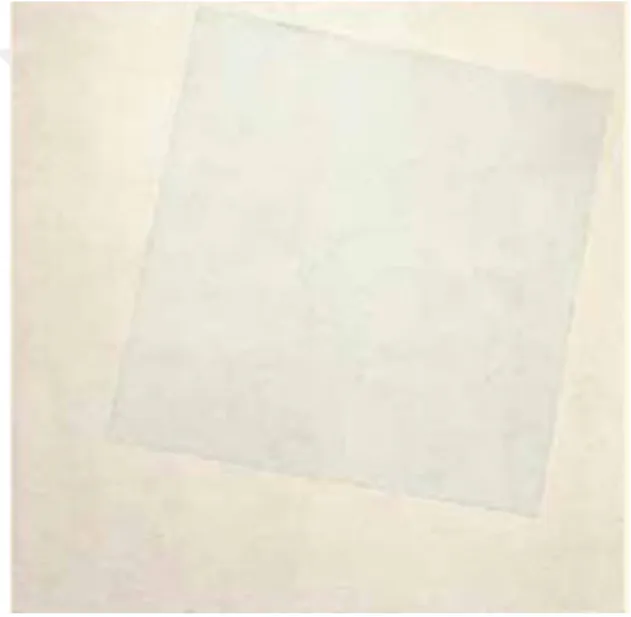
As an example, ‘White on White’ which is one of the well-known example of Kazimir Malevich’s works is apparently simple oil-on-canvas painting consisting of just a white square with an angle. It was initially marked the limits of visual art. However, contemporary artists examined as a new context the implication of their radical decision (Rose, 1965). Malevich’s decisions about painting have been stated in his book ‘The Non-Objective World’ in 1959. According to him there were no more likenesses of reality, no idealistic images but it was filled with the spirit of non-objective sensation which pervades everything (Malevich, 1959). Therefore he describes his most known composition ‘Black Square on White’ (1913) as the ‘zero degree’ of painting that is the total abandonment of representation (Meyer, 2010). In
19
the essence, Malevich’s minimal forms were created by his intellectual norms which are, beyond the formal concerns, to “search for the transcendent, universal, absolute” (Rose, 1965). In Malevich’s writing ‘God is Not Cast Down’ (1920) his explanation; “that nothingness was God. . . . God exists as nothingness as non-objectivity” supports this remark. So, what he takes as an example from the transcendent is the concept of nothingness. He reaches transcendental manifestations by getting closer to nothingness. That he searched for nothingness can be seen in ‘White on White’ in which it is hard to perceive white color on white canvas and he reached the peak of painting art by its immaterial expressions (Figure 3.1).
Figure 3.1: Kazimir Malevich, White on White, oil on canvas, The Museum of Modern Art, New York, 1918, (Heckert, 2015, p. 66).
20
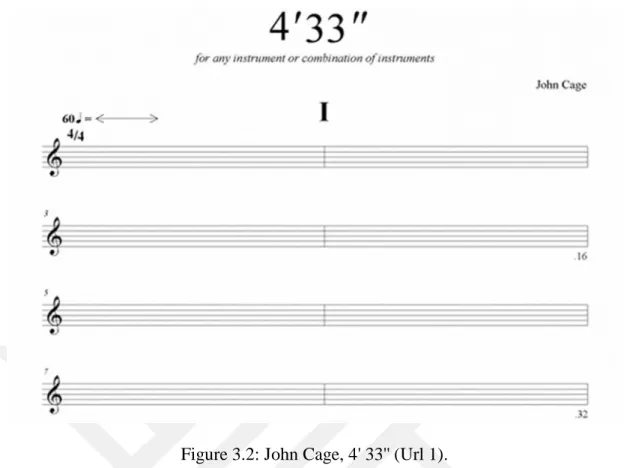
As another example, we can talk about John Cage's music, where the traditional components are eliminated from the creation and where the creator of the future creation will come out in a different meaning. John Cage eliminates traditional instruments, notation, and composition from his music. He deals with composition as an experimental action. In his lecture, he defines ‘Composition as Process Part II: Indeterminancy’, he criticizes that conductor beats time so as to unify performance and sounds should be arisen from actions’ own centers without considering space and time (1961). He says that “It is indeed astonishing that music as an art has kept performing musicians so consistently beating time together like so many horseback riders huddled together on one horse” (Composition as Process Part 2: Indeterminancy, 1961). He suggests a variety of a performance rather than working as a mechanical system. According to him, composition is indeterminate with respect to its performance therefore, it is unique and cannot be repeated (1961). His music made from temporary thing’s sounds complete uncertainty was overtaken. His most known piece, 4'33", he created a ‘silence’ that focused attention on the music of incidental sounds in a performance environment (Figure 3.2). It just “required the composer to sit in front of the piano for the allotted time without striking a chord, dashing the audience’s expectation of a well-wrought work; instead, the restless movements, coughs and whispers of the listeners became the work’s focus.” (Meyer, 2010). Here, music is the joint composition of the composer, audience, and space. When he made 0'00" he did not use even one note. In his concert, he had vegetables which he cut up, then he put the cut-up vegetables into a blender, made juice, and then he drinks the juice in this composition (Fetterman, 2010). Thereby his performance is emptied of feeling and allusion. Michael Nyman called this situation experimental music that brings radical shift in the methods and functions of notation, the specialized symbols we call musical notation may no longer represent sounds (Nyman, 1999). As we can understand, the immaterial doesn't mean "not using any instrument" here, but the change and transformation of the sounds creating the music. It is the point which goes beyond a simple sense and leads to the discovery of new meanings.
21
Figure 3.2: John Cage, 4' 33'' (Url 1).
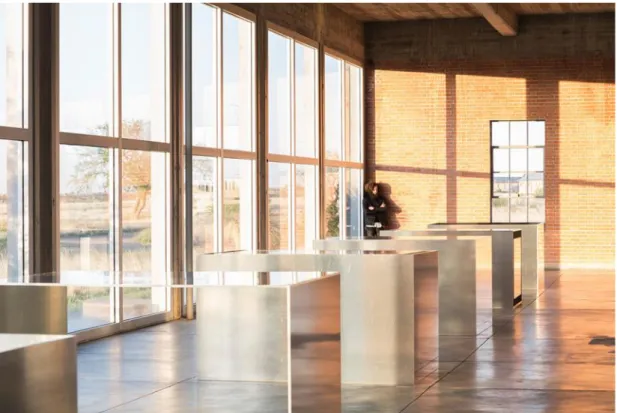
Donald Judd, is another example who tries to discover transcendent meaning to matter related with the essence. For him, there is main theme, an essence he calls as the "specific object". That's why this object is “less neutral, less containers, more defined, not undeniable, and unavoidable” (Judd, Specific Objects, 1965). In order to produce definite qualities, particular forms are used in his works. He aims to eliminate metaphor and make them as lucid and specific as fully objective unity. He emphasizes the physical and perceptual qualities specific to materials. In his sample in Chinati Foundation, he puts 100 rectangular aluminum boxes in this space which used to be a barrak. In this space, boxes and the floor create reflections when it receives light from its two sides with long and continuous windows. As the space contains the boxes, the boxes get to contain the space, too (Figure 3.3). At this space, where the creation and space are intertwined, the perception of matter has gone out of its simple meaning and seeks for other perceptions. The case here is not an illusion or a visual complexity. On the contrary, he defends to think iconically and to focus on ideas about things with direct observation which make to see an artwork clearly. He says that "it isn't necessary for a work to have a lot of things to look at, to compare, to analyze one by one, to contemplate. The things as a whole, its quality as a whole, is what is interesting, the
22
main things are alone and are more intense, clear and powerful.” (Judd, Specific Objects, 1965).
Figure 3.3: Donald Judd's untitled work, Chinati Foundation in Marfa, (Url 2).
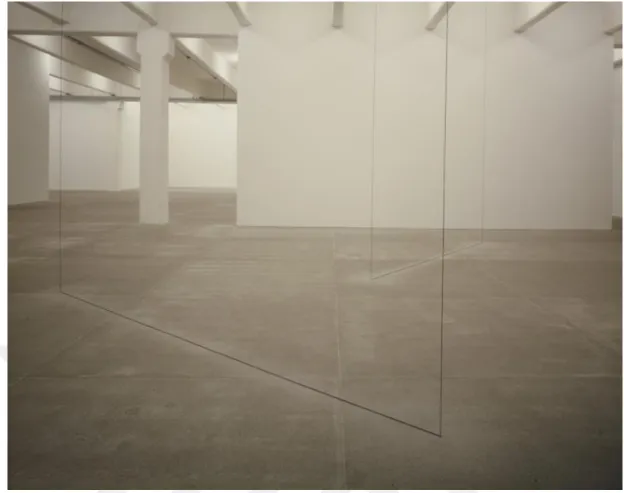
In 1997 Fred Sandback installed Sculpture in DIA Center. This statue consists of numerous walls spaced in various angles independent of each other and of the space. These walls consist of frames made out of strings, which is unusual (Figure 3.4). Is a strong physical existence really necessary to call it a wall? Even without mass, the idea of the wall has come to be known through those strings. Its space is predetermined for being a wall but the concept of the wall is never defined. The wall, already, must be a non-being in reality. The mind can produce an infinite number of perceptions for this kind of existence.
There is something we need to see here. In fact, all these creations cannot be explained by their formal features. Their expressions gain meaning in intellectual profundity. Therefore, it is necessary to know, or at least, to understand their intellectual background. The cases where such immaterialism is perceived can be clearly recognized in the examples above. That's why these situations are the intellectual interests of some breadth and variety beyond the forms. When evaluating such kind of creations with their appearances or their visible features, explanations always remain insufficient.
23
Figure 3.4: Fred Sandback, sculpture, Dia, Chelsea, 1998 (Url 3).
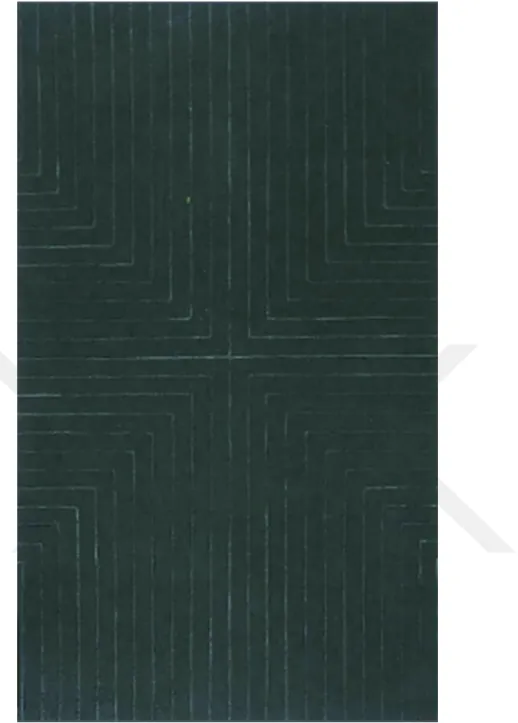
Bruce Glaser questioned to Donald Judd and Frank Stella that “Some would claim that the visual effect is minimal, that you are just giving us one color or a symmetrical grouping of lines. A nineteenth century landscape painting would presumably offer more pleasure, simply because it’s more complicated.” (Questions to Stella and Judd, 1966). For both Judd and Glasser were not thinking it is more complicated. Frank Stella's answer was that nineteenth century works had got only deep space and the way it is painted which are made painting seen how it's done and read that figures in the space. He wanted the feeling to be painting people cannot avoid the fact that it is supposed to be entirely visual (Figure 3.5). Judd answered that “If my work is reductionist it is because it does not have the elements that people thought should be there.” (Glaser, 1966). In fact, it is a way of getting rid of habits. It is the creating, forming of the invisible, not the visible.
24
Figure 3.5: Frank Stella, Die Fahne Hoch!, enamel on canvas, Whitney Museum of American Art, New York, 1959 (Meyer, 2010, p. 48).
However , this situation created will certainly not remain as a feat of ideation. It must become sufficient to be something else, as well. Ideas will not remain solely as ideas but will be followed by feeling, discovering, and making inferences. This will be provided with the sensibility of the reserved impersonality of the creation. Only an anonymity prioritizing the creation will be in issue then. This is not only about the change and transformation of materials but it is as if it had recovered from the identity of the creator and existed itself. The creator has a minimum degree of self-expression, whereas the creation's experiences involve the new and unexpected. According to
25
Allen Leepa trying to get to the very nature of the experience ‘clarity of idea, precision of means, standardization of elements, and impersonality of statement’ are the essential aspects of it (Minimal Art and Primary Meanings , 1968).
In fact, one of the foremost features of a creation can be said to be its meaning. Comprehension, or caring about the essence requires keeping the physical aspect at a minimum level. Here, the situation perceived to be easy, simple, or plain hides the complexity of its intellectual structure, indeed. This challenges the beholder to experience a layered and complex aesthetic response; however, it will produce some kind of inquiries, which will lead to the enrichment of its intrinsic world. In this respect, the immaterial refers to the realm of ideas. It may not directly say, like Plato, matter is modelled on ideal forms, but it is appropriate to mention situations in which the immaterial is associated with the intellectual. In these situations, the thought that the ideas are superior to the materials is emphasized. Such that, the creation comes into being not as the material we know to be the correct expression for reflecting an idea, but as a completely different sensation shaped by an idea.
27
4. IMMATERIAL ARCHITECTURE
Architectural creations are primarily considered through their physical state and solidness, stableness and safety conditions. As these conditions are directly associated with the matter in general, it requires architecture to be considered on the basis of the matter. This is why the profession of architecture has always felt the pressure to derive from the solid matter, to be a solid practice. However, even in the discussion on what the starting point for architecture is, we see a situation which does not directly create a form of material situation, but an interior space where the outer stays out, a situation where the human isolates himself and his life. What architecture describes is a defined space which creates its own atmosphere in the infinite space. When material and structural features are questioned, it is started to discuss its qualifications of the essence with the conditions of its existence. Thus, in this debate the response of discussion of space is structured tectonic expressions that are the conceptual counterpart of man's conscious, transformative actions towards matter.
Where we do not regard architecture as a solid profession creating solid situations, if we consider that architecture is inspired by the aforementioned intellectual process and that is inspired by the more transcendental qualities, like the creations of the God, we can say that the creative act of architecture is tectonic. As an origin in Greek, the word tectonic derives from the word “tekton,” meaning builder or carpenter. And it alludes to the art of construction in general. As an origin in Greek, tectonic derives from the word “tekton,” meaning builder or carpenter and it alludes to the art of construction in general (Frampton, 1995, p. 3). In this poetic connotation of the term "tekton," the carpenter assumes the role of the poet. Over time, the meaning of this term has changed. Then the role of "tekton" led to the emergence of "architekton," meaning master builder (Frampton, 1995). According to Adolf Heinrich Borbein (in his 1982 philological study) tectonic becomes the art of joining that tends construction or making of an artisanal or artistic product that can be building or object (Frampton, 1995). As it means creating or building a tectonic product and bears such poetic
28
meaning, it can be said that tectonic is based on application of the ideas and judgment over production
This is a tectonic, visual thing with a scene in architecture as well as the poetic feature of the term. Just like in Aristotelian and Kantian philosophies, this scene is inspired by the term 'architectonique' (Lefebvre, 2014), which is in a scientific relationship with individual or groups of information belonging to a certain system order. The components forming this scene are the subject, method, and matter of architecture, and there is interdependence among those. The concept of space, which is expressed as the essence of modern architecture by Semper, can be considered as the subject of architecture. Space is generally considered as the extension of the body in modern architecture. Talking about the concept of space, not as a mass but as a relation, creates an immaterial sensation. Matter of the architecture can be considered as a reality of material which is often over-thought. In Renaissance, buildings were more related to the form, less related to the matter presented by the ideas. But then the classical view that says the form is independent from the material, has lost its validity. It was begun to investigate qualities of materials and how to quantify the qualities of materials. The method of architecture is very diverse, in fact. It can even present a new method for the relationship it will build with the space and the matter for each structure. It can be said that the method is related with considerations of tectonic qualities or tectonic formation. Architects or creator generate their production in a process. This process is effected by the frame of immaterial thought and design. In here, Semper always develops exemplary methods with his innovative explanations. The ‘Bekleidung Theory’, which defends that each scene can go beyond the learned methods and generate unique forms, will be a good example of this.
4.1 Space As A Subject Of Architecture
"Manipulation of space," which is one of the important concepts of modern architecture, leads the practices (views and research) and productions of the architects to the same point, being an immaterial and intellectual approach to space. Because this is the most comprehensive and effective concept of space to obtain information about and understand the true nature of the physical universe. It involves a process like discovery, organization, and creation. Each spatial existence is the result of an intellectual process and the material combination of the elements producing that.