Issues
ISSN: 2146-4138
available at http: www.econjournals.com
International Journal of Economics and Financial Issues, 2015, 5(2), 493-500.
Financial Integration, Financial Dependence and Employment
Growth
Nurullah Gur
*Faculty of Business and Management Sciences, Istanbul Medipol University, Beykoz, Istanbul, Turkey. *Email: [email protected] ABSTRACT
In this paper we analyse the effect of financial integration on employment growth. The results show that financial integration increases employment growth relatively more in financially dependent industries when we use de jure measure of financial integration. Using de facto measures of financial integration, we find that international portfolio equity investments and foreign direct investments increase employment growth disproportionately more in industries that are heavily dependent on external finance. But, external debt has no significant effect on employment growth. We also find that the positive effect of financial integration on employment growth disappears in countries with underdeveloped financial system and extractive institutions.
Keywords: Financial Integration, External Finance, Employment
JEL Classifications: E24, G15, G28, O16
1. INTRODUCTION
Unemployment is a major headache for policymakers. Policymakers seek ways to increase employment growth in order to spread prosperity, reduce inequality, and thus make both themselves and voters happy. What kind of policy reforms should policymakers implement in order to create new employment opportunities? Many scholars have suggested that policy reforms such as relaxing entry and labour market regulations and trade openness increase employment performance of countries.1 What about financial
integration as a financial market policy? Does financial integration increase employment growth?
In theory, financial market policies might increase employment growth by solving financial market imperfections and providing new external finance opportunities (Acemoglu, 2001; Wasmer and Weil, 2004; Pagano and Pica 2012). This paper contributes to the literature on the effects of financial integration by examining whether financial integration increases employment growth. While there is a vast literature on the effects of financial integration on
1 For entry regulations see Bertrand and Francis (2002) and Ciccone and Papaioannou (2008). For labour market regulations see Besley and Burgess (2004), Botero et al. (2004) and Micco and Pages (2007). For trade openness see Dutt et al. (2009).
economic growth, productivity, and macroeconomic volatility, there is a big gap in the literature on the effect of financial integration on labour market. To the best of our knowledge, this is the first paper that investigates the effect of financial integration on employment growth by a cross-industry, cross-country (difference-in-difference) approach.
It has been expected that financial integration might be beneficial by augmenting domestic savings, reducing the cost of capital, improving allocation of capital and generating technological spillovers. Financial integration could increase investments and capacity utilization by improving financial intermediation. If this is the case, financial integration might increase employment growth. On the other hand, if easing financial constraints allow firms to invest more in capital-intensive technologies and thereby increase output and productivity but not employment, new external financing opportunities provided by financial integration will produce jobless economic growth (Pagano and Pica, 2012). It has been also argued that financial integration might cause financial instability and crises (Prasad et al., 2003; Schmukler, 2008; Obstfeld, 2009; Kose et al., 2010). Therefore, financial integration might not ease financial constraints and solve credit market perfections, and hence financially constrained firms could not provide new job opportunities. In this case, financial integration
could not increase employment growth and even it might reduce employment growth. Therefore, it is an empirical question whether financial integration increases employment growth.
Following Kose et al. (2009), we use not only de jure measure of financial integration, but also de facto measures. As Obstfeld (2009) underlines, both de jure and de facto measures have pros and cons. While de jure measure of financial integration is related to capital account liberalisation policies, de facto measures give us the level of international capital flows. Policy restrictions cannot fully stop capital flows. Even if policy restrictions remain unchanged, de jure measures might not also capture the degree of enforcement of capital controls. Consequently, de facto measures might provide more accurate picture of the level of financial integration in a country. But, it is important to note that de facto measures suffer more from endogeneity problem than de jure measures.2
Since the components of international capital flows are different in terms of volatility and their effects, we use three de facto measures of financial integration: international portfolio equity investments, foreign direct investments (FDI), and external debt. FDI is less volatile than international portfolio equity investments and external debt (Prasad et al., 2003). FDI not only reduces domestic firms’ financing constraints (Harrison et al., 2004), but also generates technological spillovers (Borensztein et al., 1998; Javorcik, 2004). International portfolio equity investments increase the depth of domestic financial markets and improve corporate governance of domestic firms (Levine, 2001; Kose et al., 2009; Bekaert et al., 2005). Although external debt increases external financing opportunities, it might not be as effective as international equity investments and FDI. External debt flows might also lead to inefficient capital allocation due to moral hazard problems (Kose et al., 2009).
To disentangle the effect of financial integration from other policies and business environment indicators, we use Rajan and Zingales’ (1998) empirical methodology. The main motivation of this methodology is that the effect of the financial system is more pronounced in some industries than in others. If financial integration reduces credit market imperfections and provides more external financing opportunities, financial integration should disproportionately help industries with high dependence on external finance. At the end this paper examines whether financial integration increases employment growth relatively more in financially dependent industries. Endogeneity is less problematic in this approach. First, controlling country and industry fixed effects helps us to mitigate omitted variable bias. Second, since there are few reasons to think that labour market performance of a specific industry affects the level of financial integration in a country, reverse causality is also less likely. Therefore, while this methodology does not eliminate endogeneity problem completely, it helps us to address some endogenity issues.
When we use de jure measure of financial integration, our results show that financial integration increases employment growth relatively more in industries with high dependence on external finance. On the other hand, consisted with Kose et al. (2009) and
2 For more details see Obstfeld (2009) and Gur (2013).
Gur (2013), our results of de facto measures are mixed. We find that while international portfolio equity investments and FDI increase employment growth disproportionately more in industries that are heavily dependent on external finance, external debt has no such effect. We also find that this positive effect on financial integration disappears in countries with underdeveloped financial system and extractive institutions. This result suggests that countries should first improve their domestic financial system and the quality of institutions to reap benefits of financial integration.
The rest of this paper is organized as follows. Section 2 reviews the previous literature. In Section 3, we describe our empirical methodology. Section 4 describes our data. In Section 5, we present our results. In Section 6 we conclude.
2. LITERATURE REVIEW
This paper is related to two strands of literature. First, this paper is related to theoretical papers analysing the effects of financial markets on employment. Acemoglu (2001) proposes a model in which credit market imperfections hinder the emergence of new innovating firms and lead to a rise in unemployment. In his model, financial development (FD) channels more money to the innovative entrepreneurs. The emergence of new innovating firms creates new jobs and compensates for the jobs losses in incumbent inefficient firms. Wasmer and Weil (2004) develop a job creation and destruction model in where new entrepreneurs should find credit before they start up their firms and demand labour force. Their model shows credit market imperfections reduce firm entry by increasing searching costs for banks and reducing market liquidity. Low firm entry depresses labour demand, which in turn reducing employment growth.
In a more recent theoretical paper, Pagano and Pica (2012) focus on how FD affects employment. First they analyse an economy with one industry. According to this model, FD increases either total employment or labour productivity. This effect depends on the elasticity of labour supply. The extent to which a rise in the equilibrium wage leads to an increase in the labour supply depends on the elasticity of labour supply. By raising wages, FD will lead firms to substitute capital for labour, and thus increase labour productivity. But, if labour supply is wage elastic, FD will increase employment. Secondly, Pagano and Pica (2012) posit an economy that consists of two industries: a strong industry (with greater profitability and productivity) and a weak industry (with lower profitability and productivity). Their model shows that well-developed financial institutions allow the strong industry to expand their labour capacity and redirect labour from the weak industry to the strong one.3
3 In their empirical part, Pagano and Pica (2012) find that financial development increases employment growth relatively more in industries that rely heavily on external finance. This positive effect of financial development holds only in non-OECD countries. In the time of banking crises, financially more dependent industries experience a sharper contraction in employment growth in countries with developed financial systems. On the other hand, their results show that the effects of financial development on labour productivity and real wages are not statistically significant.
Second, our paper is related to the empirical papers that examine the effects of financial integration on economic outcomes. The evidence regarding the impact of financial integration on economic growth and total factor productivity (TFP) is at best controversial. In cross-country studies, some papers identify a positive effect (Quinn, 1997; Bekaert et al., 2005), whereas others conclude that the effect is negative or insignificant (Edison et al., 2002). Kose et al. (2009) find that portfolio equity liabilities and FDI increase TFP growth, while external debt has a negative effect on TFP growth. Their results also show that the negative effect of external debt on TFP growth reduces in economies with developed FD level and high institutional quality.
There are also some studies that examine the effects of financial integration by using international industry level data. Vlachos and Waldenström (2005) show that there is no significant effect of financial integration on the value added growth rate of financially dependent industries. On the other hand, Prasad et al. (2007) and Eichengreen et al. (2011) find that financial integration increases growth relatively more in industries that are heavily dependent on external finance. But, they also show that the positive effect of financial integration is limited to countries with high FD and institutional quality.
While there are so many papers on financial integration and growth, there are few papers that examine the effect of financial integration on labour market. Using industry level data and a de
jure financial integration measure, Chari et al. (2012) find that
average wages increase after financial integration. But, they show that there is no significant change in the growth rate of employment following financial integration. Using data on 21 industrial countries, Feldmann (2013) find that financial integration has no statistically significant effect on unemployment. Using firm level data for three developed and two developing economies, Hijzen et al. (2013) examine the effect of cross-border firm acquisitions on labour market outcomes. They find that foreign-owned firms employ more workers than domestic firms.
3. EMPIRICAL METHODOLOGY
Our empirical methodology is based on Rajan and Zingales’s (1998) cross-industry, cross-country (difference-in-difference) approach. They hypothesize that there are some technological reasons that explain different rates of dependence on external financing between industries, and these differences persist across countries. As Rajan and Zingales (1998) and Ilyina and Samaniego (2011) underline, initial project scale, the requirement for continuing investment, the gestation period and the cash harvest period differ between industries. Some industries need more working capital to buy their production technologies every period before the production process. Industries with higher initial project scale, longer gestation and harvest period and higher requirement for continuing investment depend more on external finance than other industries. While some industries can fund all necessary investments with their internal cash flows, some industries need to get external funds in order to cover their investment expenditures. For example, chemical, petroleum and machinery industries are naturally depend more on external financing. Therefore, it is
expected that the effect of the financial system is relatively stronger in industries with high dependence on external finance.
This approach uses US micro-level data to derive the typical external financial dependence of a given industry. There are mainly two reasons that explain why this approach uses US as a benchmark for industry structure. First of all, the US provides us rich and high quality industry level data. Secondly, it has been accepted that the US financial system is relatively frictionless. The supply of external financing will be elastic, when financial markets work relatively less friction. In this environment, differences in the actual use of external funds reflect mostly the demand of external finance. We estimate the following regression equation to test whether financial integration increases employment growth relatively more in financially dependent industries:
EG=αlnEic+δc+ +γi β(FI EXTFNINc* i)+εic (1)
where the dependent variable (EG) is the annualized growth rate of employment in industry i in country c during 1980-1989;
lnEic is the initial log of employment in industry i in country c; δc and γi are country and industry dummies respectively; FIc denotes the level of financial integration in country c; EXTFINi denotes industry i’s need for external finance, and error term is denoted by εic.4 As usual, initial employment level is added in order to
control for a convergence effect: industries with a higher initial employment level will grow more slowly. Including country and industry dummies controls country and industry fixed effects. Since we include country and industry dummy variables, it is not necessary to add any neither industry nor country specific variables that might affect employment growth. We just need to add only explanatory variables that vary both with industry and country. As usual, we exclude the US, which is our benchmark country, from the regressions. If β is positive and significant, this suggests financial integration increases employment growth relatively more on industries that are technologically more dependent on external finance.
4. DATA
We use industry and country level data sets from different sources. Our industry level data on employment growth is taken from the Industrial Statistics of the United Nations Industrial Development Organization (UNIDO). This database provides data for 28 manufacturing industries at the level of three-digit International Standard Industrial Classifications. Previous literature focuses mainly on value-added growth and employment growth over the period 1980-1989, because this database has a wider coverage in the 1980s than the 1990s. The sample size of UNIDO reduces too much because of missing observations for several countries and industries. Therefore, as in the previous papers, we focus on employment growth over the period 1980-1989.5 Following
4 Following the previous literature that uses this methodology; heteroskedasticity-adjusted robust standard errors are used. But, our results are robust to use clustered standard errors.
Ciccone and Papaioannou (2009), we drop countries with data for less than ten industries and also countries with less than five years of data in the 1980s.
We use the Chinn-Ito index (KOPEN) as a de jure measure of financial integration. Chinn and Ito (2006) introduced this index. KOPEN is constructed by using IMF’s Annual Report on Exchange Arrangements and Exchange Restrictions, which provides details about the restrictions on international financial transactions. This index ranges from −1.84 to 2.48. Higher values imply higher financial integration. As in Kose et al. (2009) and Gur (2013), our paper also uses three different de facto financial integration measures: international portfolio equity investments, FDI and foreign debt. International portfolio equity investment includes international financial investments in which ownership of shares of companies and mutual funds are below the 10% threshold. FDI is defined as controlling at least 10% of ownership in a firm in a country by a firm or entity centralized on another country. Foreign debt is the sum of portfolio debt securities, plus bank loans and deposits and other debt instruments. De facto measures of financial integration are taken from Lane and Milesi-Ferretti (2007). Following the previous literature, we use the stock of foreign assets and liabilities because the flows suffer more from measurement error and tend to be more volatile (Lane and Milesi-Feretti, 2001, 2007; Vlachos and Waldenström, 2005; Kose et al. 2009). We use the stock of foreign assets and liabilities relative to gross domestic product (GDP) for each de facto financial integration indicators because financial integration means not only the ability of foreigners to invest in a country, but also the ability of residents to invest abroad.6 To smooth out the effect of fluctuations, we
use average of the stock of foreign assets and liabilities over the period 1980-1989.7 PORT is the stock of portfolio equity assets and
liabilities as a share of GDP. FDI is the foreign direct investment asset and liabilities as a share of GDP. DEBT is the stock of foreign debt assets and liabilities as a share of GDP.
We use the share of private credit by deposit money banks and other financial institutions to GDP as a measure of FD. This variable is from the FD and structure database, which is collected by Beck et al. (2010). We use an index of labour regulation (LR), which is constructed by Botero et al. (2004). As a proxy for institutional quality, we use the rule of law data from the International Country Risk Guide database.8
This index ranges from 0 to 6. Higher values indicate better quality of institutions. Regulation of entry (ER) is the amount of time required by an entrepreneur to complete the legal procedures for starting a new business. This data is taken from Djankov et al. (2002). As a proxy of human capital (HC), we use average years of schooling of the population (HUMAN). It is taken from Barro and Lee (2001). To control the level of economic development, we use real GDP per capita. This variable is from the Penn World Tables.
Our proxies for industry characteristics are from different industry level database of the US. External financial dependence (EXTFIN)
6 Our results are robust when we also use stock of liabilities. Results are available upon request.
7 Our results are robust to use use initial values of financial integration variables.
8 This variable is taken from Ciccone and Papaioannou (2009).
is defined as the share of investment that is not financed through internal cash flows. A firm’s dependence on external finance is calculated as capital expenditures minus cash flow from operations divided by capital expenditures. The industry level measure is the median value of dependence on external finance for US firms belonging to the same industry. EXTFIN is taken from Ilyina and Samaniego (2011). We use a proxy of industry contract intensity (CONT), which is formulated by Nunn (2007). It is computed as the weighted average of relation specificity of all intermediate inputs used in industry i. Job reallocation (JOB) is calculated as the sum of job creation and job destruction in industry i. Entry rate (ENTRY) is calculated as the number of new firms divided by average number of firms in industry i. JOB and ENTRY are taken from Micco and Pages (2007). Original source of ENTRY is Dunne et al. (1988). Original source of JOB is Davis and Haltiwanger (1999). HC intensity is computed as the sum of total wages and salaries divided by total employees. HC is from Ilyina and Samaniego (2011).
5. RESULTS
5.1. Main Results
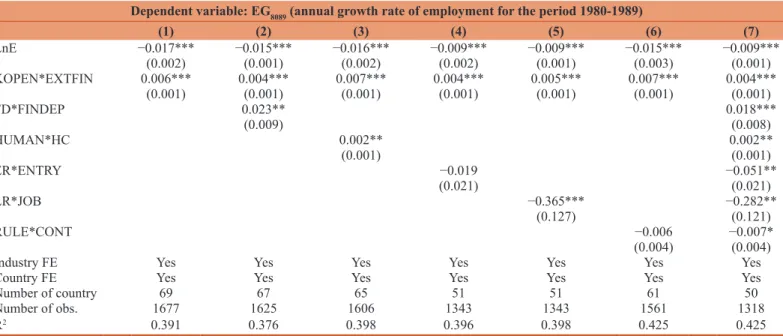
First, we use our de jure financial integration measure. As seen in column (1) of Table 1, the coefficient of interaction term between KOPEN and external financial dependence (KOPEN*EXTFIN) is positive and statistically significant at 1%. This implies that financial integration increases employment growth relatively more in industries that need more external finance. Starting from column (2), we investigate the strength of the effect of KOPEN*EXTFIN when we control interaction terms between other industry structure proxies and business environment indicators that have been used in the previous literature. As mentioned above, Pagano and Pica (2012) show that FD increases employment growth more in industries that are highly dependent on external finance. Therefore, we also include an interaction term between FD and industry external finance dependence (FD*EXTFIN). As expected, the estimated coefficient on FD*EXTFIN is positive and statistically significant. The coefficient for KOPEN*EXTFIN is still positive and significant after controlling FD*EXTFIN. Ciccone and Papaioannou (2009) find that HC increases employment growth relatively more in HC intensive industries. To control this, we include an interaction term between HC and the HC intensity of US industries (HUMAN*HC). As seen in column (3), our result for HUMAN*HC is consistent with Ciccone and Papaioannou (2009). The effect of KOPEN*EXTFIN remains same even after controlling for HUMAN*HC. Klapper et al. (2006) find that entry regulations reduce the creation of new firms relatively more in industries with naturally high entry rates. To control this effect, we include an interaction term between entry regulations and US industry entry rate (ER*ENTRY). Column (4) shows that the estimated coefficient on ER*ENTRY is negative, but it is not statistically significant. The sign and significance of KOPEN*EXTFIN is unchanged.
In another empirical study, Micco and Pages (2007) find that stringent labour market regulations reduce job flows more in industries that require a higher level of job reallocation. Therefore,
we include an interaction term between labour market regulation and industry job reallocations (LR*JOB). Column (5) shows that employment growth in industries with higher job reallocation is relatively slower in countries with stringent labour market regulations. The effect of LABOUR*JOB is statistically significant at the 1% level. We have a similar result for KOPEN*EXTFIN after including LR*JOB. Nunn (2007) finds that contract enforcement increases export relatively more in industries with high contract intensity. We add an interaction term between rule of law and industry contract intensity (RULE*CONT) in order to control for its possible effect on employment growth, expecting that RULE*CONT will be positive. However, the results in
column (6) show that the sign of RULE*CONT is negative, but not statistically significant. The nature and significance level of our main interaction term remains the same. In the last column, we control all relevant interaction terms simultaneously. Column (7) demonstrates the robustness of the effect financial integration persists despite the inclusion of these other interaction terms. As a next step, we use our de facto measures of financial integration. In Table 2 we interact three de facto measures of financial integration with external financial dependence. First, we add an interaction term between international portfolio equity investments and dependence on external finance (PORT*EXTFIN).
Table 1: De jure measure, financial dependence and employment growth
Dependent variable: EG8089 (annual growth rate of employment for the period 1980-1989)
(1) (2) (3) (4) (5) (6) (7) LnE −0.017*** −0.015*** −0.016*** −0.009*** −0.009*** −0.015*** −0.009*** (0.002) (0.001) (0.002) (0.002) (0.001) (0.003) (0.001) KOPEN*EXTFIN 0.006*** 0.004*** 0.007*** 0.004*** 0.005*** 0.007*** 0.004*** (0.001) (0.001) (0.001) (0.001) (0.001) (0.001) (0.001) FD*FINDEP 0.023** 0.018*** (0.009) (0.008) HUMAN*HC 0.002** 0.002** (0.001) (0.001) ER*ENTRY −0.019 −0.051** (0.021) (0.021) LR*JOB −0.365*** −0.282** (0.127) (0.121) RULE*CONT −0.006 −0.007* (0.004) (0.004)
Industry FE Yes Yes Yes Yes Yes Yes Yes
Country FE Yes Yes Yes Yes Yes Yes Yes
Number of country 69 67 65 51 51 61 50
Number of obs. 1677 1625 1606 1343 1343 1561 1318 R2 0.391 0.376 0.398 0.396 0.398 0.425 0.425 Robust standard errors are reported in parentheses. ***, [**] and (*) denote statistically significant at 1, [5] and (10) percent levels, respectively. FD: Financial development
Table 2: De facto measures, financial dependence and employment growth
Dependent variable: EG8089 (annual growth rate of employment for the period 1980-1989)
(1) (2) (3) (4) (5) (6) LnE −0.016*** −0.010*** −0.016*** −0.009*** −0.015*** −0.009*** (0.002) (0.001) (0.002) (0.001) (0.002) (0.001) PORT*EXTFIN 0.223*** 0.097** 0.004*** (0.062) (0.047) (0.001) FDI*EXTFIN 0.047*** 0.033** (0.016) (0.016) DEBT*EXTFIN 0.001 0.000 (0.001) (0.001) FD*EXTFIN 0.023*** 0.023*** 0.029*** (0.008) (0.007) (0.008) HUMAN*HC 0.002** 0.002** 0.002** (0.001) (0.001) (0.001) ER*ENTRY −0.053** −0.052** −0.059*** (0.021) (0.021) (0.021) LR*JOB −0.282** −0.278** −0.281** (0.121) (0.121) (0.122) RULE*CONT −0.007* −0.007* −0.007* (0.004) (0.004) (0.004)
Industry FE Yes Yes Yes Yes Yes Yes
Country FE Yes Yes Yes Yes Yes Yes
Number of country 67 50 68 50 68 50
Number of obs. 1651 1318 1668 1318 1668 1318
R2 0.388 0.425 0.399 0.425 0.397 0.423
Robust standard errors are reported in parentheses. ***, [**] and (*) denote statistically significant at 1, [5] and (10) percent levels, respectively. FD: Financial development, FDI: Foreign direct investments
Column (1) and (2) of Table 2 show that the estimated coefficient on PORT*EXTFIN is positive and statistically significant at 1%. Second, we add an interaction term between FDI and dependence on external finance (FDI*EXTFIN). Our results in Column (3) and (4) show the estimated coefficient for FDI*EXTFIN is also positive and statistically significant. Lastly, we add an interaction term between foreign debt and dependence external finance (DEBT*EXTFIN). Last two columns of Table 2 show that DEBT*FINDEP is positive, but it is not statistically significant. As discussed above, external debt flows are more volatile and less efficient at allocating capital than international portfolio equity investments and FDI. Therefore, these results suggest that international portfolio equity investments and FDI increase employment growth relatively more in financially dependent industries.
5.2. Robustness Check
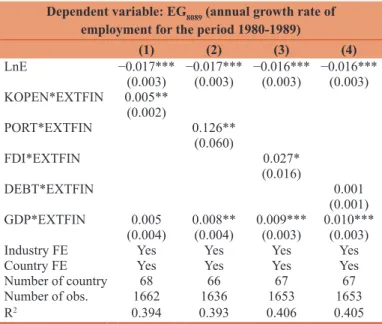
It can be argued that the effect of financial integration simply captures the effect of economic development. To control this we add an interaction term between GDP per capita and external financial dependence (GDP*EXTFIN). Column (1) of Table 3 shows that the effect of KAOPEN*EXTFIN is positive and still statistically significant at %1 even after including GDP*EXTFIN. Next three columns of Table 3 also confirm our previous results. Portfolio equity investments and FDI still increase the employment growth of financially dependent industries, even after the level of economic development interacted with external financial dependence is accounted for.
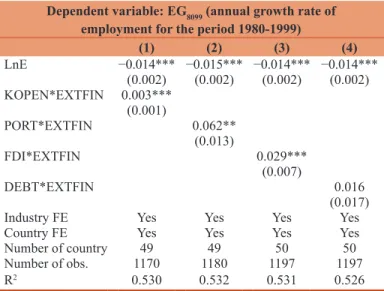
In our benchmark results we use employment growth over 1980s because the UNIDO database has wider coverage in the 1980s. As a robustness check, we extend this time period. In Table 4 we use annual employment growth over the period between 1980 and 1999 period as our dependent variable. When we use de jure measure of financial integration, our results show that financial
integration increases employment growth relatively more in industries that are heavily dependent on external finance. When we use de facto measures, our results show that international portfolio equity investments and FDI increase employment growth disproportionately more in financially dependent industries while external debt has no such effect. In sum, changing the time period does not affect the robustness of our results.
5.3. Country Heterogeneity
Following the previous literature, it is important to examine whether the effect of financial integration is uniform across countries. In this section, we allow heterogeneity across countries. Bekaert et al. (2005) and Kose et al. (2009) find that countries with developed financial markets and high institutional quality benefit more from financial integration. On the other hand, Prasad et al. (2007) show that financial integration is beneficial for countries with developed financial markets, but it is harmful for financially underdeveloped countries. Eichengreen et al. (2011) and Gur (2013) find that financial integration has positive effects only in countries with developed financial system and better economic institutions.
A well-functioning domestic financial system and inclusive institutions are necessary to channels international capital flows to the best uses.9 Countries with poor domestic financial system and
institutional environment can only attract international investors who are risk acceptant/loving and short-termist. Country experiences and academic studies show that attracting speculative hot money flows is not beneficial especially for developing countries.
To check whether the positive effect of financial integration kicks in only once FD and the quality of institutions pass a threshold, we follow the strategy used by Prasad et al. (2007), Eichengreen et al. (2011) and Friedrich et al. (2013). We create a dummy variable (FUD), which takes value of one if the country is below the median level of FD. Then we include a separate triple interaction between financial integration, an industry’s dependence on finance and this dummy variable. To test the second threshold effect, we first create a dummy variable (IUD) that takes value one if the country is below the median level of institutional quality. Then we include a separate triple interaction between financial integration, an industry’s dependence on finance and this dummy variable. As we show from the first four columns of Table 5, de jure financial integration measure, international portfolio equity investments and FDI increase employment growth of financially dependent industries relatively more in countries with developed financial markets, but these positive effects disappear for financially underdeveloped countries. The effect of external debt is not statistically significant neither for financially developed countries nor for financially underdeveloped countries. Column (5) shows
9 In their seminal book, Acemoglu and Robinson (2012) contrast extractive institutions with inclusive ones. Extractive institutions refer to inefficient legal system, poor rule of law, high corruption, lack of property rights and no check and balances on the government. On the other hand, inclusive economic and political institutions refer to efficient legal system, strong rule of law, low corruption, strong protection of property rights and sufficient check and balances on the government.
Table 3: Controlling economic development interacted with financial dependence
Dependent variable: EG8089 (annual growth rate of employment for the period 1980-1989)
(1) (2) (3) (4) LnE −0.017*** −0.017*** −0.016*** −0.016*** (0.003) (0.003) (0.003) (0.003) KOPEN*EXTFIN 0.005** (0.002) PORT*EXTFIN 0.126** (0.060) FDI*EXTFIN 0.027* (0.016) DEBT*EXTFIN 0.001 (0.001) GDP*EXTFIN 0.005 0.008** 0.009*** 0.010*** (0.004) (0.004) (0.003) (0.003) Industry FE Yes Yes Yes Yes Country FE Yes Yes Yes Yes Number of country 68 66 67 67 Number of obs. 1662 1636 1653 1653 R2 0.394 0.393 0.406 0.405 Robust standard errors are reported in parentheses. ***, [**] and (*) denote statistically significant at 1, [5] and (10) percent levels, respectively. FDI: Foreign direct investments, GDP: Gross domestic product
Table 4: Additional sensitivity test
Dependent variable: EG8099 (annual growth rate of employment for the period 1980-1999)
(1) (2) (3) (4) LnE −0.014*** −0.015*** −0.014*** −0.014*** (0.002) (0.002) (0.002) (0.002) KOPEN*EXTFIN 0.003*** (0.001) PORT*EXTFIN 0.062** (0.013) FDI*EXTFIN 0.029*** (0.007) DEBT*EXTFIN 0.016 (0.017) Industry FE Yes Yes Yes Yes Country FE Yes Yes Yes Yes Number of country 49 49 50 50 Number of obs. 1170 1180 1197 1197 R2 0.530 0.532 0.531 0.526 Robust standard errors are reported in parentheses. ***, [**] and (*) denote statistically significant at 1, [5] and (10) percent levels, respectively, FDI: Foreign direct investments
that industries that rely strongly on external finance benefit relatively more from de jure financial integration in countries with inclusive industries. But, we find no such effect for countries with low institutional quality. Column (6) indicates the sectoral employment growth effect of international portfolio equity investment is positive and statistically significant for countries with inclusive institutions. But, the coefficient of PORT*EXTFIN goes in the opposite direction and insignificant for countries with low institutional quality. Column (7) shows that the effect of FDI is positive for countries with inclusive institutions. On the other hand, the effect of FDI is negative and statistically significant for countries
with low institutional quality. As seen in column (8) we can make same interpretation for external debt. These results suggest that FDI and external debt reduce employment growth of financially dependent industries in institutionally underdeveloped countries.
6. CONCLUSION
Given the high level of global unemployment in recent years, an issue that is now high on the agenda of policymakers is the creation of new employment opportunities. Policymakers should provide new ways of external funding opportunities to increase employment growth. In theory, financial integration is expected to augment domestic savings, to reduce the cost of external capital and to improve allocation of capital. Thus financial integration might increase employment growth. Using Rajan and Zingales’s (1998) methodology, our paper examines whether financial integration increases employment growth relatively more in industries that are highly dependent on external finance.
When we use de jure measure of financial integration, our results show that financial integration increases employment growth relatively more in financially dependent industries. However, our results are less clear when we use de facto measures of financial integration. We find that while international portfolio equity investments and FDI increase employment growth disproportionately more in financially dependent industries, external debt has no such effect. We also find that the positive effect of financial integration disappears and the effect turns negative in some cases when FD and institutional quality are low. This result underlines the importance of carefully sequencing
Table 5: Heterogeneity
Dependent variable: EG8089 (annual growth rate of employment for the period 1980-1989)
FD Institutional development (1) (2) (3) (4) (5) (6) (7) (8) LnE −0.017*** −0.017*** −0.016*** −0.016*** −0.017*** −0.017*** −0.016*** −0.017*** (0.003) (0.003) (0.003) (0.003) (0.003) (0.003) (0.003) (0.003) KAOPEN*EXTFIN 0.006** 0.219** (0.003) (0.063) 0.006*** (0.002) PORT*EXTFIN 0.230*** (0.065) FDI*EXTFIN 0.046*** 0.056*** (0.017) (0.019) DEBT*EXTFIN 0.001 0.020*** (0.002) (0.005) KOPEN*EXTFIN*UD 0.002 0.001 (0.004) (0.004) PORT*EXTFIN*UD 0.052 −0.182 (0.121) (0.117) FDI*EXTFIN*UD −0.023 −0.061** (0.030) (0.027) DEBT*EXTFIN*UD −0.010 −0.020*** (0.006) (0.005)
Industry FE Yes Yes Yes Yes Yes Yes Yes Yes
Country FE Yes Yes Yes Yes Yes Yes Yes Yes
Number of country 69 67 68 68 69 67 68 68
Number of obs. 1677 1651 1668 1668 1677 1651 1668 1668 R2 0.391 0.381 0.400 0.398 0.391 0.388 0.401 0.403 Robust standard errors are reported in parentheses. ***, [**] and (*) denote statistically significant at 1, [5] and (10) percent levels, respectively. FDI: Foreign direct investments
policies of financial integration with financial and institutional development. Therefore, adopting policy measures that try to correct market failures and externalities arising from financial integration is crucial.
REFERENCES
Acemoglu, D. (2001), Credit market ımperfections and persistent unemployment. European Economic Review, 45(4-6), 665-679. Acemoglu, D., Robinson, J.A. (2012), Why Nations Fail? The Origins of
Power, Prosperity, and Power. London: Profile Books.
Barro, R.J., Lee, J.W. (2001), International data on educational attainment: updates and ımplications. Oxford Economic Papers, 53(3), 541-563. Beck, T., Demirguc-Kunt, A., Levine, R. (2010), Financial ınstitutions
and markets across countries and over time: the updated financial development and dtructure database. World Bank Economic Review, 24(1), 77-92.
Bekaert, G., Harvey, C.R., Lundblad, C. (2005), Does financial liberalization spur growth? Journal of Financial Economics, 77(1), 3-55.
Bertrand, M., Francis, K. (2002), does entry regulation hinder job creation? evidence from the French retail ındustry. Quarterly Journal of Economics, 117(4), 1369-1414.
Besley, T., Burgess, R. (2004), Can labor regulation hinder economic performance? Evidence from India, Quarterly Journal of Economics, 119(1), 91-134.
Borensztein, E., De Gregorio, J., Lee, J.W. (1998), How does foreign direct ınvestment affect economic growth? Journal of International Economics, 45(1), 115-135.
Botero, J., Djankov, S., La Porta, R., de-Silanes, F.L., Shleifer, A. (2004), The regulation of labor. Quarterly Journal of Economics, 119(4), 1339-1382.
Chari, A., Henry, P.B., Sasson, D. (2012), Capital market ıntegration and wages. American Economic Journal Macroeconomics, 4(2), 102-32. Chinn, M.D., Ito, H. (2006), What matters for financial development?
Capital controls, ınstitutions, and ınteractions. Journal of Development Economics, 81(1), 163-192.
Ciccone, A., Papaioannou, E. (2008), Entry Regulation and Intersectoral Reallocation. Universtat Pompeu Fabra, Mimeo.
Ciccone, A., Papaioannou, E. (2009), Human capital, the structure of production, and growth. Review of Economics and Statistics, 91(2), 66-82.
Davis, S., Haltiwanger, J. (1999), Gross job flows. İn: Ashenfelter, O., Card, D. editors. Handbook of Labor Economics. Vol. 3B. Amsterdam: North-Holland. p2711-2805.
Djankov, S., La Porta, R., de-Silanes, F.L., Shleifer, A. (2002), The regulation of entry. Quarterly Journal of Economics, 117(1), 1-37. Dunne, T., Roberts, M.J, Samuelson, L. (1988), Patterns of firm entry and
exit in U.S. manufacturing ındustries. Rand Journal of Economics, 19(4), 495-515.
Dutt, P., Mitra, D., Ranjan, P. (2009), International trade and unemployment: theory and cross-national evidence. Journal of International Economics, 78(1), 32-44.
Edison, H.J., Levine, R., Ricci, L., Slok, T. (2002), ınternational financial ıntegration and economic growth. Journal of International Monetary and Finance, 21(6), 749-776.
Eichengreen B., Gulapelli, R., Panizza, U. (2011), Capital account liberalization, financial development, and ındustry growth: a synthetic review. Journal of International Money and Finance, 30(6), 1090-1106.
Feldmann, H. (2013), Capital account liberalization and unemployment in ındustrial countries. Applied Economics Letters, 20(6), 566-571.
Friedrich, C., Schnabel, I., Zettelmeyer, J. (2013), Financial ıntegration and growth – Why ıs emerging europe different? Journal of International Economics, 89(2), 522-538.
Gur, N. (2013), Does financial ıntegration ıncrease exports? Evidence from international industry-level data. Emerging Markets Finance and Trade, 49(s5), 112-129.
Harrison, A.E., Love, I., McMillan, M.S. (2004), Global capital flows and financing constraints. Journal of Development Economics, 75(1), 269-301.
Hijzen, A., Pedro S.M., Thorsten, S., Richard, U. (2013), Foreign-owned firms around the world: a comparative analysis of wages and employment at the micro-level. European Economic Review, 60, 170-188.
Ilyina, A, Samaniego, R. (2011), technology and financial development. Journal of Money, Credit and Banking, 43(5), 899-921.
Javorcik, B.S (2004), does foreign direct ınvestment ıncrease the productivity of domestic firms? In search of spillovers through backward Linkages. American Economic Review, 94(3), 605-627. Klapper, L., Laeven, L., Rajan, R. (2006), Entry Regulation as a barrier
to entrepreneurship. Journal of Financial Economics, 82(3), 591-629. Kose, M.A, Prasad, E.S., Rogoff, K., Wei, S.J. (2010), Financial
globalization and economic policies. İn: Rodrik, D., Rosenzweig, M., editors. Handbook of Development Economics, Vol. 5. Amsterdam: North-Holland. p4283-4362.
Kose, M.A., Prasad, E.S., Terrones, M.E. (2009), Does openness to ınternational financial flows raise productivity growth? Journal of International Money and Finance, 28(4), 554-580.
Lane, P.R., Milesi-Ferretti, G.M. (2001), The external wealth of nations: measures of foreign assets and liabilities for ındustrial and developing countries. Journal of International Economics, 55(2), 263-294. Lane, P.R., Milesi-Ferretti, G.M. (2007), The external wealth of nations
mark ıı: revised and extended estimates of foreign assets and liabilities, 1970–2004. Journal of International Economics, 73(2), 223-250.
Levine, R. (2001), International financial liberalization and economic growth. Review of International Economics, 9(4), 339-363. Micco, A., Pages, C. (2007), The Economic Effects of Employment
Protection: Evidence From International Industry Level Data. Inter-American Development Bank Working Paper No. 592, Washington DC.
Nunn, N. (2007), Relationship-specificity, ıncomplete contracts and the pattern of trade. Quarterly Journal of Economics, 122(2), 569-600. Obstfeld, M. (2009), international finance and growth in developing
countries: what have we learned? IMF Staff Papers, 56(1), 63-111. Pagano, M., Pica, G. (2012), Finance and employment. Economic Policy,
27(69), 5-55.
Prasad, E.S, Rajan, R., Subramanian, A. (2007), Foreign capital and economic growth. Brookings Papers on Economic Activity, 38(1), 153-209.
Prasad, E.S., Rogoff, K., Wei, S.J., Kose, M.A. (2003), Effects of Financial Globalization on Developing Countries: Some Empirical Evidence. IMF Occasional Papers No. 220, Washington DC.
Quinn, D. (1997), The correlates of change in ınternational financial regulation. American Political Science Review, 91(3), 531-551. Rajan, R., Zingales, L. (1998), Financial dependence and growth.
American Economic Review, 88(3), 559-587.
Schmukler, S.L. (2008), The benefits and risks of financial globalization. İn: Ocampoa, J.A., Stiglitz, J.E., editors. Capital Market Liberalization and Development. New York, NY: Oxford University Press. p48-75. Vlachos, J., Waldenstrom, D. (2005), International financial liberalization
and ındustry growth. Journal of Finance and Economics, 10(3), 263-284.
Wasmer, E., Weil, P. (2004), The macroeconomics of labor and credit market ımperfections. American Economic Review, 94, 944-963.