Kafkas Univ Vet Fak Derg
RESEARCH ARTICLE
17 (1): 113-116, 2011
DOI:10.9775/kvfd.2010.2542
Determining the Scientific Contribution of the Studies with Cats
and Dogs in Veterinary Science in the Concept of Animal Ethics
Serdar İZMİRLİ *
* Department of History of Veterinary Medicine and Deontology, Faculty of Veterinary Medicine, Selcuk University, TR-42075 Konya - TÜRKİYE
Makale Kodu (Article Code): KVFD-2010-2542
Summary
This study was conducted to give information about cats and dogs in the use of scientific research and the contributions to the science. The “ISI Web of Science” database was used and the study investigated companion animals in a 10 year period from 1997-2006. It was found that there where 4.405 publications made in the world by scientists related to dogs and cats in veterinary science. The proportion of cats and dogs investigated in these publications where 30% and 70%, respectively. In this time period 99 studies were conducted about cats and dogs, in Turkey. The proportion of studies which were made in Turkey has been consisted the whole of 2.24% at the world. The 27% of these were by cats and 73% of those were with dogs. The average citations of the studies on cats and dogs were 4.00 and 4.13, respectively, in the world. Although the studies relatively appeared similar in proportion in the world, the averages of dogs (1.90) was approximately double of the averages of cats (0.96), in Turkey.
Keywords: Animal ethics, Cat, Dog, Publication, Veterinary science
Veteriner Bilimleri Alanında Kedi ve Köpeklerle Yapılan
Çalışmaların Bilime Katkısının Hayvan Kullanım Etiği Kapsamında
Belirlenmesi
Özet
Bu araştırma pet hayvanlarının (kedi ve köpek) bilimsel çalışmalarda hangi düzeyde kullanıldığını ve bilime katkılarını belirlemek amacıyla gerçekleştirilmiştir. Çalışmada “ISI Web of Science” veri tabanından yararlanılmış ve 1997-2006 yılları arası araştırılmıştır. Veteriner bilimleri alanında dünyada 4.405 çalışmanın yapıldığı ve bu çalışmaların %30’unun kedilere ve 70’inin ise köpeklere ait olduğu bulunmuştur. Belirtilen tarihlerde Türkiye’de kedi ve köpekle ilgili 99 çalışma yapılmış ve bu rakam tüm dünyada yapılan çalışmaların %2.24’ünü oluşturmuştur. Bu çalışmaların %27’si kediler, %73’ü ise köpeklerle yapılmıştır. Dünyada kedilerle yapılan çalışmaların aldığı ortalama atıf sayısı 4.00 olurken, köpeklerle yapılan çalışmaların ortalama atıf sayısı 4.13 olarak belirlenmiştir. Dünyada kedi ve köpekle yapılan çalışmaların ortalama atıf sayıları birbirine yakın değerlerde bulunmuşken Türkiye’de köpeklerle yapılan çalışmaların aldığı ortalama atıf sayısı 1.90 ve kedilerle yapılan çalışmaların ortalama atıf sayısı 0.96 olarak bulunmuştur.
Anahtar sözcükler: Hayvan kullanım etiği, Kedi, Köpek, Yayın, Veteriner bilimleri
INTRODUCTION
The survey 1 found that 26% and 31% of households Despite humans owning dogs and cats, companion
owned cats and dogs, respectively in UK, in 2007. The animals are also used in research. Dogs are used proportion of Canadian households who have at least in cardiovascular research 3, organ transplantation,
one dog or cat was 56%, otherwise there are 8.5 million diabetes mellitus, open heart surgery, ulcerati ve colitis, cats and 6 million dogs which make up 36% and 32% in pharmacology and toxicology specialities 4. In 1973,
Canadian households 2. more than 195.000 dogs were used in research in the
İletişim (Correspondence)
+90 332 2232694114
Determining the Scientifi c ...
USA. This number had decreased to 89.420, in 1995. However, in 1973, it was reported that more than 66.000 cats were used in research, in USA. This number had also decreased to 29.569, in 1995 5 .
It was thought that public concern had increased about animal welfare whilst they are used in scientific research 6,7. People also wanted to minimize the pain
and distress of animals in experimental process 6.
Furthermore, it can be asserted 7 that 3R (replacement,
reduction, refi nement) principles have improved the welfare of animals used in experiments.
According to the increased public interest, the aim of this study was to raise the level of awareness of animal welfare and ethics by undertaking a comparati ve study of publications that lists animal researches using cats and dogs. This study compares dogs and cats used in the cause of veterinary science in Turkey and the world, in 1997-2006. However, it was also aimed to introduce the mean citations of the studies between these species in both case and research studies. Consequently, the publishments of dogs and cats at this period were be presented.
MATERIAL and METHODS
The database of ISI (“Isi Web of Science”, founded in 1997) which is used in this study was established in USA, in 1958, by Dr. Eugen Garfield. Today, ISI has 3 main indexes and SCI Science Citati on Index is one of them. The citation rate is one of the important criteria of journals that are indexed by ISI 8.
Fig 2. The number of scientific studies related to
dogs and cats in veterinary science in Turkey
Şekil 2. Türkiye’de veteriner bilimler alanında
köpek ve kediyle yapılan bilimsel çalışma sayıları
In this study, ISI “Web of Science” had used to present the data about the studies which are related to dog and cat. Dogs and cats were selected for this research because these animals are most friendly to humans. They are also used in the experiments which has been discussed in the science community and the public. The study covered a ten-year period from 1997 - 2006.
RESULTS
From 1997 to 2006, 4.405 publicati ons worldwide were published by scientists using dogs and cats in veterinary science. The proportion of cats and dogs investi gated in these publications where 30% and 70%, respecti vely. The publications related to dogs and cats between 1997-2006 are shown in Fig. 1. There were 99 studies were made with cats and dogs in Turkey also, at the same period. The percentage of studies (27% cats and 73% dogs) are similar with the world’s study proportions
(Fig. 2). The proportion of cats and dogs investi gated in
these publications between Turkey and the world, was 2.3% and 2.0% Turkey/World proporti on, respecti vely.
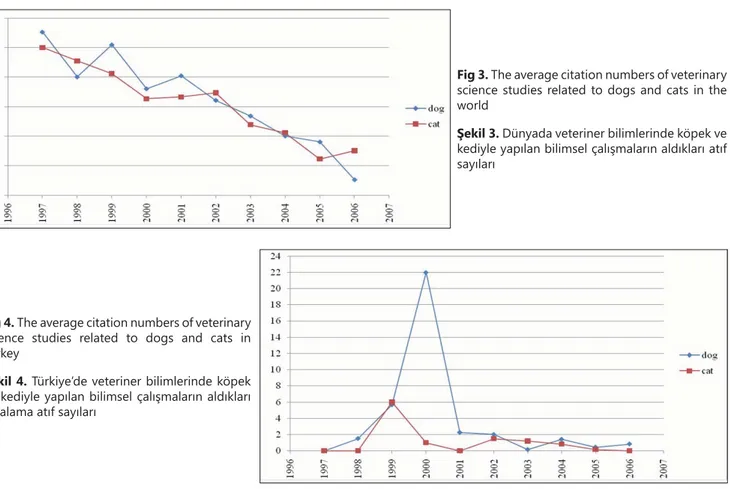
It was also determined the average citati on numbers using cat and dog studies in veterinary science (Fig. 3
-4). It is important because citation is evaluated one of the criteria of the scientific studies valuableness. For this reason, it was compared the average citati ons between cats and dogs in the World and Turkey. When the mean citations were compared between dogs and cats at the 10 years period (Fig. 3) in the world, it was highlighted that there is no great differences about the citations.
Fig 1. The number of scientific studies related to
dogs and cats in veterinary science in the world
Şekil 1. Dünyada veteriner bilimleri alanında
115 İZMİRLİ
Between 1997-2006, the publication with dogs had took 4.13 average citation and the publication with cats had took 4.00 citation. However, the average citations publicati ons mentioning dogs and cats were diff erent in Turkey. Publications related to dog studies were twice as many as those relating to cat studies, between 1997 - 2006.
When the publications were investigated in terms of their variety and citations, it was found that case publications were much more than research publications (Table 1). However, research publications has taken more citations than case publications. In 1997, 46 dog publications were research studies, although 70 publications were research studies, in 2006. Nevertheless, for the cats, there is no important difference between 1997 (23 research
Fig 4. The average citation numbers of veterinary
science studies related to dogs and cats in Turkey
Şekil 4. Türkiye’de veteriner bilimlerinde köpek
ve kediyle yapılan bilimsel çalışmaların aldıkları ortalama atıf sayıları
publications) and 2006 (21 research publicati ons). The average citations found in the year 2006 was 4.95 and 2.17 in proportion for cats and dogs, respecti vely.
DISCUSSION
The proportion of scientific procedures which were made by dogs 0.3% and cats 0.07% has been appear in Great Britain 9, in 2000 and also 0.26% in dogs and
cats 0.02%, in 2005 10. According to Home Office 10 dogs,
cats, horses and non-human primates, aff orded special protection by the Act, and there has been a 27% decrease in the combined use of these animals for regulated procedures, since 1995. Publications that related to
Fig 3. The average citation numbers of veterinary
science studies related to dogs and cats in the world
Şekil 3. Dünyada veteriner bilimlerinde köpek ve
kediyle yapılan bilimsel çalışmaların aldıkları atıf sayıları
Table 1. Distribution of the publications in case and research which were given in abstracts in the database in
1997 and 2006, and their citation averages in the world
Tablo 1. 1997 ve 2006 yıllarında vaka analizi ve araştırma makalesi (veri tabanında özetleri yayımlananlar)
olarak yayımlanan çalışmaların dağılımı ve aldıkları ortalama atıflar
Years Citations Case Cat Research Case Dog Research 1997 NoS AoC 56 5.94 23 10.95 128 5.11 46 12.5 2006 NoS AoC 63 1.39 21 4.95 212 1.43 70 2.17
116
Determining the Scientifi c ...
dogs and cats showed Zhao 11 an annual decline of an
average of 1.76% and 3.35%, respectively, from 1995 to 2005. Additionally, workshops and congresses (for example; World Congress on Alternatives & Animal Use in the Life Sciences) concerning animal alternati ve methods instead of animal use in scientific studies in the world and it was also seen tendency to dicreases in generally, in the animal uses at the scientific researches, in European Union and developed countries 12-14. Scientists and the
general public alike are discussing animal ethics with a focus on 3Rs principles especially reduction. There has been increasing pressure 7 the public against animal
experimentation for testing and research purposes. Das et al.15, concurs that there has been some decrease
in animals used in scientific research. According to the present study, publishment’s which are related to dogs has increased when it was compared between, 1997 to 2006. Furthermore, in 1997, 46 dog publicati ons were research studies, although 70 publications were research studies, in 2006. However, there is no important diff erence between 1997 (23 research publications) and 2006 (21 research publications) for the cats publicati ons. Home Office 9,10 and Zhao 11 found a decline at the companion
animals’ studies or publications and a decline in the proportion of using companion animals in the whole animal studies despite it have not found any decrease in the present study related to dog research studies.
However, citation is used to evaluate 16 the scientific
studies for the criteria. Furthermore, the citati on rates is one of the important criteria of journals that are indexed by ISI 8. In the present study, it was found that
the publications using dogs had cited 4.13 average and the publications using cats had cited average 4.00 in the world. A large number of citations contained research studies of both cats and dogs. For example, research studies published in 1997, indicated that cat research studies were taken 10.95 average citation, and also dog research studies were taken 12.5 average citati on. These figures demonstrate that research studies on cats and dogs cited more than case publicati ons (Table 1).
This study demonstrates that the number of studies which were conducted by using cats and dogs shows an increase both in Turkey and in the world. Worldwide studies with cats were cited four times more in Turkey while dogs’ studies were cited double than in Turkey. These figures introduce that the studies which were made with cats and dogs in Turkey produce a less effect in scientific community when compared with studies in world. It was also found that the research studies were taken more citation than case studies in the world both cats and dogs.
Despite the general pressure on the experiments and 3R principles (one of them is “reduce”) to decrease the
use of animals at the context of animal ethics, the fi gures
(Table 1) show that scientists have tendency to practice
research studies on cats and especially on dogs. For this reason, it can be asserted that these high citati ons about the research papers in both cats and dogs, particularly in dogs, lead to experimental studies with dogs. Thus, it may be adduce that this situation creates a controversial point at the context of animal ethics.
REFERENCES
1. Murray JK, Browne WJ, Roberts MA, Whitmarsh A, Gruff ydd-Jones TJ: Number and ownership profiles of cats and dogs in the UK. Vet Rec,
166 (6): 163-168, 2010.
2. Perrin T: The Business of urban animals survey: The facts and
statistics on companion animals in Canada. Can Vet J, 50 (1): 48-52, 2009.
3. NHMRC: Nhmrc guidelines on the care of dogs used for
scientific purposes. 2009. htt p://www.nhmrc.gov.au/_fi les_nhmrc/ file/health_ethics/animal/ea24_guidelines_care_of_cats.pdf. Accessed: 03.03.2010.
4. Bate M: The dog as an experimental animal. ANZCCART News, 10
(1): 1-8, 1997.
5. Crawford RL: A review of the animal welfare enforcement report data
1973 through 1995. Animal Welfare Informati on Center Newslett er, 7
(2): 1-12, 1996.
6. Fenwick N, Griffin G, Gauthier C: The welfare of animals used in
science: How the “Three Rs” ethic guides improvements. Can Vet J, 50
(5): 523-530, 2009.
7. Obora S, Kurosawa T: Implementation of the three rs in biomedical
research - has the turn of the century turned the tide?. Atla-Altern Lab
Anim, 37 (2): 197-207, 2009.
8. Asan A: SCI-Expanded, SSCI, AHCI and impact factor. Proceedings of 3. National Symposium, Turkey, pp. 221-263, 2005.
9. Home Office: Statistics of scientific procedures on living animals,
Great Britain (2000). htt p://www.archive.offi cial-documents.co.uk/ document/cm52/5244/524402.pdf.2001. Accessed: 03.03.2010.
10. Home Office: Statistics of scientific procedures on living animals,
Great Britain (2005). http://www.homeoffice.gov.uk/rds/pdfs06/ spanimals05.pdf. 2006. Accessed: 03.03.2010.
11. Zhao S, Liu E, Chu Y, Zheng H, Kitajima S, Morimoto M: Numbers
of publications related to laboratory animals. Scand J Lab Anim Sci, 34 (2):81-86, 2007.
12. De Greve P, De Leeuw W: Developments in alternatives and animal
use in Europe, proceedings of the 2nd world congress on alternatives
and animal use in the life sciences, Nedherlands, pp. 127-136, 1996. 13. Eddy-Kulpa J, Snyder M, Stokes W: A review of trends in animal
use in the United States (1972-2006). Proceedings of the 6th World Congress on Alternatives & Animal Use in the Life Sciences –Review progress made toward the 3Rs, Tokyo-Japan, pp. 163-165, 2008. 14. Spielmann H, Grune B, Liebsch M, Seiler A, Vogel R: Mission and
accomplishments of ZEBET, the national centre for alternati ves in Germany at the BfR (Federal Institute for Risk Assesment). Proceedings
of the 6th World Congress on Alternatives & Animal Use in the Life Sciences - Review progress made toward the 3Rs, Tokyo-Japan, pp.
41-46, 2008.
15. Das RG, Fry D, Preziosi R, Hudson M: Planning for reduction. Atla-Altern Lab Anim, 37 (1): 27-32, 2009.
16. Garfield E, Welljams-Dorof A: Of Nobel class: A citati on perspective