Yılmaz SEÇİM
Yasar Dogu Secondary School, Karatay, Konya, TURKEY. e-mail: [email protected]
The Chemical Qualities of Some Milky Desserts Produced Empirically and
Consumed in the Centre of Konya Province
Yılmaz SEÇİM
1, Gürkan UÇAR
2 1. Yasar Dogu Secondary School, Karatay, Konya, TURKEY.2. Selcuk University, Faculty of Veterinary, Department of Food Hygiene and Technology, Selcuklu, Konya, TURKEY.
Abstract: Eight milky desserts prepared for the consumption in Konya, and milky desserts made by empirical production were examined in terms of pH, viscosity, dry matter, ash, sugar, and fat. The average pH, viscosity, dry matter, ash, sugar and fat values of milky desserts offered for sale on the market were determined between 6.66-6.94, 9.36-85.00, 36.55-48.98, 0.35-0.78, 24.26-27.69, 2.25-4.62, respectively. The values of milky desserts produced experimentally were determined 6.76-6.92, 13.40-106.40, 29.98-45.84, 0.48-0.82, 21.62-26.78, 2.42-4.90, respectively. In terms of some chemical features, important differences were found in the samples of milky desserts. It was identified that in terms of the amounts of pH, sugar and fat, there are no differences. It was identified that the production formulas of milks desserts were not standardized, and production conditions and the differences of raw material being used have influence on this situation.In addition, basing on the chemical quality of milky desserts in the research both in Turkey and in the World, it was reported that there were a small number of researches. Due to the differences in production techniques and the lack of standard in Turkey, it has been aimed to determine the chemical quality of milky desserts in market and produced by experimentally.
Key words: Chemical, Milky dessert, Quality.
Konya İl Merkezinde Tüketime Sunulan ve Deneysel Olarak Üretilen Bazı Sütlü
Tatlıların Kimyasal Kalitesi
Özet:Konya piyasasında tüketime sunulan 80 adet sütlü tatlı ve deneysel amaçlı üretimi yapılan sütlü tatlılar pH, viskozite,
yüzde kuru madde, kül, şeker ve yağ yönünden incelenmiştir. Piyasada satışa sunulan sütlü tatlıların pH, viskozite, yüzde kuru madde, % kül, % şeker ve % yağ ortalama değerleri sırasıyla 6.66-6.94, 9.36-85.00, 36.55-48.98, 0.35-0.78, 24.26-27.69, 2.25-4.62 arasında tespit edildi. Deneysel olarak üretilen sütlü tatlılara ait değerler sırasıyla 6.76-6.92, 13.40-106.40, 29.98-45.84, 0.48-0.82, 21.62-26.78, 2.42-4.90 olarak tespit edildi. Sütlü tatlı örneklerinde bazı kimyasal özellikler bakımından önemli derecede farklılık tespit edildi. Sütlü tatlı numunelerinin tümünde pH, şeker ve yağ miktarı bakımından fark olmadığı belirlendi. Sütlü tatlıların üretim reçetelerinin standart olmadığı ve üretim koşulları ile kullanılan ham maddelerin farklı olmasının etkili olduğu belirlendi. Gerek Türkiye de gerekse de dünyada yapılan literatür taramalarında sütlü tatlıların kimyasal kalitesi üzerine az sayıda araştırma bulunduğu tespit edilmiştir. Türkiye de sütlü tatlıların yapım tekniklerinin farklı olması ve bir standardın olmaması nedeniyle bu çalışmada piyasadan temin edilen ve deneysel olarak üretilen sütlü tatlıların bazı kimyasal kalitelerini tespit etmek amaçlanmıştır.
84
INTRODUCTION
ilky desserts are the fixed taste of traditional Turkish cuisine. It is known that some milky desserts (rice pudding, gullac, kazandibi, keskul, chicken breast pudding) come from Ottoman Empire to present and are in the palace tables. Although there have been some changes in the preparation of milky desserts from past to present, they are still indispensable taste of Turkish desserts. Milky desserts like chocolate pudding, souffle, profiterole came from French cuisine to Turkish cuisine. But, they took part in Turkish consumption habit; their consumption began to increase day-by-day as it was being produced both at home with traditional methods and pastry shop (Paulus, 1978; Alisarlı et al., 2002; Isın, 2008).
Milky desserts are the products cooked with milk prepared in accordance with its technology by mixing not only basic nutrients like sugar, flour, starch, egg, rice but also tasty and other additives accepted in Turkish nutrient codex (Ozalp and Kaymaz, 1992; Aksu and Ergun, 1996; Tekinsen, 2000).
The researches about chemical qualities of milky desserts are limited in the world and in Turkey. As a result, it was detected that chemical qualities of desserts were different and, it doesn’t have any standard, different production ways in different countries, and it doesn’t have a constant production scheme.
MATERIALS and METHODS
Milky desserts like rice pudding, chicken breast pudding, kazandibi, chocolate pudding, gullac, profiterole, keskul and souffle, as all offered for consumption in the city centre of Konya, were used as a material. The samples were collected from different candy store and supermarkets in Konya. A
total of 80 units from each of 10 desserts were brought to laboratory ın aseptic conditions in the cold chain. Milky desserts produced experimentally in the form of 3 recurrences (Sevinc, 2005; Candas, 2006; Aymelek, 2011) were informed in the kitchen of Konya Hotel and Tourism High School. They were brought to the laboratory with the cold chain and analysed in terms of microbiological features.
Determination of dry material and the percentage of ash rate with gravimetric method, the findings of the percentage of fat rate with gerber method, determination of the percentage of total sugar rate with Luff Schaorl method were all undertaken according to the AOAC (1995).
The Finding of Viscosity
Measurements of viscosity were stated by viscosimetry (AND-SV-10-Wave vibrio) at 25oC (AOAC
Int., 1995). 1Cp =1m Pa/sec=0.001 P/sec
The Measurements of pH Values of Milky Desserts’ Examples
After taking the examples for microbiological analysis, pH values of milky desserts examples were determined at 25oC with electronic pH metre
(Inolap-series WTW pH 720) (Marshall, 1992).
Statistical Analysis
Samples were compared by t-test using SSPS program for statistical evaluation (Petrie and Watson, 1999).
RESULTS
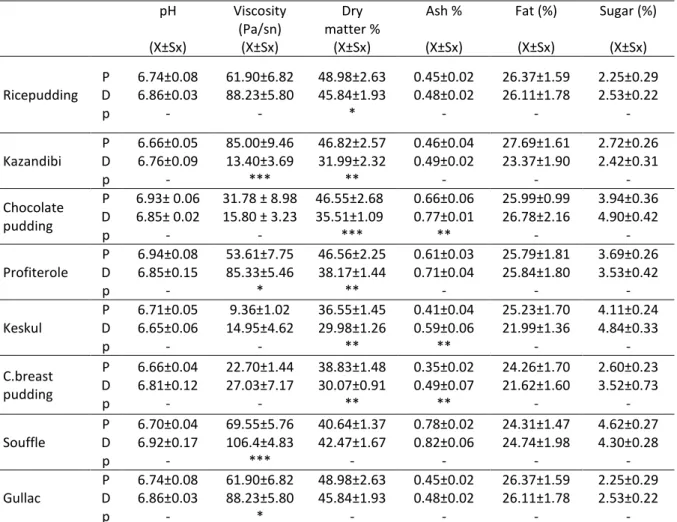
The values of chemical composition, pH and the percentage viscosity of desserts sold in the market and desserts produced experimentally were showed in Table 1.
85
Table 1. The comparison of desserts sold in market and produced experimentally in terms of chemical qualities. Tablo 1. Piyasada satılan ve deneysel olarak üretilen tatlıların kimyasal yönden karşılaştırılması.
pH (X±Sx) Viscosity (Pa/sn) (X±Sx) Dry matter % (X±Sx) Ash % (X±Sx) Fat (%) (X±Sx) Sugar (%) (X±Sx) Ricepudding P D p 6.74±0.08 6.86±0.03 - 61.90±6.82 88.23±5.80 - 48.98±2.63 45.84±1.93 * 0.45±0.02 0.48±0.02 - 26.37±1.59 26.11±1.78 - 2.25±0.29 2.53±0.22 - Kazandibi P D p 6.66±0.05 6.76±0.09 - 85.00±9.46 13.40±3.69 *** 46.82±2.57 31.99±2.32 ** 0.46±0.04 0.49±0.02 - 27.69±1.61 23.37±1.90 - 2.72±0.26 2.42±0.31 - Chocolate pudding P D p 6.93± 0.06 6.85± 0.02 - 31.78 ± 8.98 15.80 ± 3.23 - 46.55±2.68 35.51±1.09 *** 0.66±0.06 0.77±0.01 ** 25.99±0.99 26.78±2.16 - 3.94±0.36 4.90±0.42 - Profiterole P D p 6.94±0.08 6.85±0.15 - 53.61±7.75 85.33±5.46 * 46.56±2.25 38.17±1.44 ** 0.61±0.03 0.71±0.04 - 25.79±1.81 25.84±1.80 - 3.69±0.26 3.53±0.42 - Keskul P D p 6.71±0.05 6.65±0.06 - 9.36±1.02 14.95±4.62 - 36.55±1.45 29.98±1.26 ** 0.41±0.04 0.59±0.06 ** 25.23±1.70 21.99±1.36 - 4.11±0.24 4.84±0.33 - C.breast pudding P D p 6.66±0.04 6.81±0.12 - 22.70±1.44 27.03±7.17 - 38.83±1.48 30.07±0.91 ** 0.35±0.02 0.49±0.07 ** 24.26±1.70 21.62±1.60 - 2.60±0.23 3.52±0.73 - Souffle P D p 6.70±0.04 6.92±0.17 - 69.55±5.76 106.4±4.83 *** 40.64±1.37 42.47±1.67 - 0.78±0.02 0.82±0.06 - 24.31±1.47 24.74±1.98 - 4.62±0.27 4.30±0.28 - Gullac P D p 6.74±0.08 6.86±0.03 - 61.90±6.82 88.23±5.80 * 48.98±2.63 45.84±1.93 - 0.45±0.02 0.48±0.02 - 26.37±1.59 26.11±1.78 - 2.25±0.29 2.53±0.22 - P: The examples of milky desserts produced in market, D: The examples of milky desserts produced experimentally, p: The importance level. *P<0.05, **P<0.01, ***P<0.001,- not important.
DISCUSSION and CONCLUSION
It was stated that there were differences between the examples of milky desserts obtained from market and produced experimentally in terms of some chemical qualities.
It was noted that the pH rate of milky dessert examples were between 6.66-6.94 on average in the market examples as they varied between 6.65-6.92 in those produced experimentally. The values are similar to 6.00-6.50, as reported by Ekemen (2002). Difference of examples between pH of two groups was not important. (Table 1).
It was determined that the values of viscosity were between 9.36-85.00 Pa/sec on averagein the
market samples, while they varied between 13.40-106.4 Pa/sec in those produced experimentally. The level of significance of difference between the two groups was P<0.001 in the samples of kazandibi and souffle, while it was P<0.05 in the samples of profiterole and gullac (Table 1). Perhaps, this difference resulted from the quantity and variety of materials used from the way and time of protection of desserts after production.
It was determined that the values of percentage of dry material in the marketed samples varied between 36.55% - 48.98% on average while the values varied in 29.98%- 45.84% in those samples produced experimentally. It was observed that the dry material of milky desserts marketed were higher
86 than those produced experimentally except for the samples of souffle, and there were important differences statistically (Table 1). It was noted that the samples of milky desserts, especially marketed ones, were in parallel with the values reported by Ayok (2002) who noted that on average, the percentage rates of dry materials were 38.45% in the samples of kazandibi, 33.59% in keskul, 34.56% in chicken breast pudding, and 33.46% in rice pudding. It was detected that the present values of samples marketed were lower than the values (56.9%-78.4% in kazandibi) reported by Demirag et al. (1999). It was noted that the rates of dry material of milky desserts produced experimentally were similar to those rates reported previously (Dasthi et al., 2001; Ayok, 2002). The raw materials used for the production of milky desserts affect the percentage of dry material quantity of desserts. Because the milky dessert production couldnot be made in the standard way, it was considered that the difference could be related to the values of dry material.
It was noted that the percentage of ash values of milky desserts was 0.35%-0.78% in the samples marketed while it was between 0.48%-0.77% in those produced experimentally. Generally, it was observed that the milky desserts produced experimentally had higher ash quantity than the milky desserts marketed. There was a marked difference (P<0.01) in the examples of chocolate pudding and keskul among groups studied (Table 1). It is likely that, this difference resulted from the difference of quantities of some raw materials used in keskul and chicken breast pudding. It was stated that the data achieved was lower than the percentage (0.6%) of ash quantity in kazandibi (Demirag et al., 1999), 0.78% in pudding like rice pudding (Dasthi et al., 2001), 0.64% in kazandibi, 0.52% in keskul, 0.63% in chicken breast pudding (Ayok, 2002), as all produced in a research-based settings. The reason of this difference might result from nonstandard conditions at the time of the analysis made by researchers. Moreover, it is thought that the ash in these nutrients, absorbing the
humidity quickly may cause differences of ash quantities as the milky desserts include more alkali nutrients.
When the percentage of sugar quantities in the samples was analysed, it was noted that on average, they varied between 24.26%-27.69% in the samples marketed, while the range varied between 21.62%-26.78% in those produced experimentally. When the data obtained were analysed, no difference was observed between the two groups in milky dessert samples. It was determined that the present data obtained experimentally were similar to the values noted by Ayok (2002), but they were higher than the values reported previously (Demirag et al., 1999; Dasthi et al., 2001). It was determined that its reason was due to the glucose, changing the quantity of total sugar. The glucose appeared as a consequence of starch hydrolysation in the milky desserts (Ayok, 2002).
When the percentage of fat values of milky desserts were analysed, it was observed that the values varied between 2.25%-4.62% in the samples marketed while they ranged between 2.42%-4.90% in thesamples produced experimentally. When the present data were analysed, no difference was observed between the two groups in the samples concerned. It was determined that the findings of Ayok (2002) were 2.19% in kazandibi, 2.60% in chicken breast pudding, 3.82% in keskul, and 3.33% in rice pudding and it was seen that these data were somewhat similar to (just 5% lower than) the values in the samples of kazandibi, as reported by Demirag et al. (1999). It is considered likely that its reason originated from using different methods at the time of the production and difference of raw materials used.
In conclusion, It was concluded that; i) the samples of milky desserts and the production receipts were not standard, ii) there was difference between the production conditions, iii) the raw materials included within the pudding were different, and iv) the preparation techniques may
87 lead to different consequences between the samples marketed and those produced experimentally; especially in terms of the values of dry material, ash and viscosity.
REFERENCES
Aksu H., Ergün Ö., 1996. Çeşitli hazır pasta ürünlerinde ve sütlü tatlılarda Bacillus cereus’un varlığı. Türk Veteriner Hekimler Dergisi, 8, 55-57.
Alişarlı M., Sancak YC., Akkaya L., Elibol C., 2002. Bazı sütlü tatlıların mikrobiyolojik kalitelerinin belirlenmesi. Türk Veterinerlik ve Hayvancılık Dergisi, 26, 975-982.
AOAC International, 1995. Official Methods of Analyzis 16th Ed; 58, Virginia.
Aymelek O., 2011. Lezzet Yolculuğu, 1. Baskı, Yakamoz Yayınevi, İstanbul
Ayok S., 2002. Bursa il merkezinde tüketime sunulan sütlü tatlı çeşitlerinden sütlaç, keşkül, kazandibi ve tavukgöğsünde mikrobiyolojik ve kimyasal özelliklerinin saptanması. Uludağ Üniversitesi, Fen Bilimleri Enstitüsü.
Candaş G., 2006. Gönül Candas’ın Mutfağından. 10. Baskı. Ankara, Arkadaş Yayınevi.
Dasthi B., Khafalawi MS., 2001. Nutrient content of some traditional Kuwaiti dishes: proximate composition and, pytate content. Food Chemistry, 74, 169-175.
Demirag K., Altug T., 1999. Formulation and quality evalution of reduced sugar and reduced calorie kazandibi. Journal of Food Quality, 22, 101-108. Ekemen R., 2002. Ankara garnizonundaki birliklerde tüketilen sütlü tatlıların mikrobiyolojik kalitesi. Ankara Üniversitesi, Sağlık Bilimleri Enstitüsü, Ankara.
Fenton PA., Dobson KW., 1993. Unusually severe food poisoning from vanilla slices. The Journal of Hygiene, 93, 377-380.
Işın PM., 2008. Gülbeşeker Türk Tatlıları Tarihi. 2. baskı, 359, Yapı Kredi Yayınları, İstanbul. Marshall RT., 1992. Standard method for the
examination of dairy products. 16 ed., APHA 1015, Washington
Ozalp E., Kaymaz Ş., 1992. Süt ürünleri teknolojisi, Ankara Üniversitesi, Veteriner Fakültesi, Besin Hijyeni ve Teknolojisi Anabilim Dalı Ders Notları. Paulus K., 1978. Ready-to-serve foods: definitions, applications, quality requirements, how ready are ready-to-serve foods? Proceedings of an International Symposium on Ready-to-serve Foods, Basel.
Petrie A., Watson P., 1999. Statistics for veterinary and animal science. Alden Pres, Oxford and Northampton.
Sevinç Ü., 2005. Ümit Ustanın Ağız Tadıyla. 1. Baskı, İkram Yayınevi, İstanbul.
Tekinşen OC., 2000. Süt ürünleri teknolojisi. Selçuk Üniversitesi Basımevi, Konya.
Teknik Proje Daire Başkanlığı., 2000. Sütlü Tatlı Teknik Şartnamesi. No: KKKTEKŞ-T-487 A.