THE IMPACT OF GROUP AUTONOMY ON LEARNERS’ SPEAKING SKILL IN ENGLISH: A TASK-BASED SOCIAL CONSTRUCTIVIST
PERSPECTIVE
Alişen Demirtaş
Ph.D. DISSERTATION
DEPARTMENT OF ENGLISH LANGUAGE TEACHING
GAZI UNIVERSITY
INSTITUTE OF EDUCATIONAL SCIENCES
ii
COPYRIGHT AND CONSENT TO COPY THE DISSERTATION
All rights of this dissertation are reserved. It can be copied 6 months after the date of delivery on the condition that reference is made to the author of the dissertation.
AUTHOR:
Name : Alişen
Last Name : DEMİRTAŞ
Department : English Language Teaching
Signature :
Date of delivery : October, 2015
DISSERTATION:
Title of dissertation in Turkish: Grup Özerkliğinin İngilizce Öğrenenlerin Konuşma Becerisine Etkisi: Görev Temelli Sosyal Oluşturmacı Bir Bakış Açısı
Title of dissertation in English: The Impact of Group Autonomy on Learners’ Speaking Skill in English: A Task-Based Social Constructivist Perspective
iii
DECLARATION OF CONFORMITY TO ETHICS
I declare that I have complied with the scientific ethical principles within the process of typing the dissertation that all the citations are made in accordance with the principles of citing and that all the other sections of the study belong to me.
Name and last name of the author: Alişen DEMİRTAŞ Signature of the author:
iv
Jury Approval Page
We certify that the dissertation entitled “The Impact of Group Autonomy on Learners’ Speaking Skill in English: A Task-Based Social Constructivist Perspective” prepared by Alişen DEMİRTAŞ has been unanimously / by majority of votes found satisfactory by the jury for the award degree of doctorate of philosophy in the subject matter of English language teaching at Gazi University, Department of English Language Teaching.
Supervisor: Assoc. Prof. Dr. İskender Hakkı SARIGÖZ
ELT Department, Gazi University ...
Chairman:PAssoc. Prof. Dr. Paşa Tevfik CEPHErof. Dr. Abdulvahit ÇAKIR (Danışman) ELT Department, Gazi University ...
Member: Assist. Prof. Dr. Neslihan ÖZKAN Doç. Dr. Arif SARIÇOBAN
ELT Department, Ufuk University ...
Member: Assist. Prof. Dr. Hüseyin ÖZDaSİSToç. Dr. Paşa Tevfik CEPHE ELT Department, Hacettepe University ...
Member: Assist. Prof. Dr. Gültekin BORANDaSİSToç. Dr. Paşa Tevfik CEPHE ELT Department, Gazi University . ...
Date of dissertation defense: 09/10/2015
I certify that this dissertation has complied with the requirements of degree of Doctorate of Philosophy in the subject matter of English Language Teaching.
Prof. Dr. Servet Karabağ
Director of Institute of Educational Sciences
v
GRUP ÖZERKLİĞİNİN İNGİLİZCE ÖĞRENENLERİN KONUŞMA
BECERİSİNE ETKİSİ: GÖREV TEMELLİ SOSYAL OLUŞTURMACI
BİR BAKIŞ AÇISI
(Doktora Tezi)
Alişen Demirtaş
GAZİ ÜNİVERSİTESİ
EĞİTİM BİLİMLERİ ENSTİTÜSÜ
Ekim 2015
ÖZ
İngilizcenin yabancı dil olarak öğretildiği ülkelerde öğrencilerin İngilizce konuşma becerisini geliştirmek maksadıyla yapılan ders içi faaliyetlerden edinilen bilgi ve becerilerin ders sonrasında pekiştirilmesi ve kullanılması için çalışma yapma imkanı verecek ortam sınırlıdır. Diğer taraftan öğrencilerin öğrenme sorumluluğunun kendilerine ait olduğu gerçeği benimsememe durumu da söz konusu olduğu vakit İngilizce öğrenme çalışmaları sonuçsuz kalmaktadır. Bu durum öğretmenin öğrencilere sınıfta mümkün olduğu kadar hedef dilde doğal konuşma ortamı yaratacak görevler vermesi kadar öğrencinin de ders dışında öğrenmenin devam etmesi için çaba göstermesini sağlayacak bir anlayışı kazandırmasını gerektirmektedir. İngilizce öğretmenlerinin, öğrencilerini bir yabancı dilin nasıl öğrenileceği konusunda eğitme yoluyla öğrencilerindeki öğrenme özerkliğini geliştirerek, ve öğrenciler için anlam ifade eden, güncel yaşamları ile ilgili ve ortak çalışma yapabilecekleri görevler vererek bu süreci kolaylaştıracağı düşünülmektedir. Burada, öğrencilere anlamlı gelen görevlerin öğrencinin daha önceki bilgisi ile yeni öğrenilen arasında bir köprü oluşturması yani yapılandırmacı bir görev üstlenmesi ve diğer öğrencilerle birlikte hareket etme gerekliliğini oluşturması önemlidir. Grupla çalışan öğrenciler kendi öğrenmeleri ile birlikte gruptakilerin de öğrenmelerinin sorumluluğunu, yani grup öğrenme özerkliğini kazandıracak bu yapılandırmacı görevleri kolaylıkla
vi
yürütebilir. Sadece sınıfta değil sınıf dışında da grupla öğrenme sorumluluğunu üstlenen öğrenciler kendi değerlendirmelerinin yanı sıra gruptaki diğer öğrencilerin de değerlendirmesini yapabilirler. Hedef dilde iletişim kurmak için fırsat yaratma isteği olan bu öğrenme özerkliğine sahip grup üyelerinin konuşma becerilerini geliştirme ihtimalleri de yüksektir. Araştırmacı, öntest-sontest deneysel desende karma yöntemli bir yapıdaki bu çalışma ile, özerk öğrenme, yapılandırmacı ve görev temelli yaklaşımlardan oluşan bir bağlamda grup özerkliğinin yabancı dil öğrenenlerin konuşma becerilerine etkisi olup olmadığını belirlemek için kullanılan yöntemleri içeren bir yaklaşımı sorgulamayı amaçlamıştır. Türkiye’de bir devlet üniversitesinden katılımcılara uygulanan bir anket ve testlerden elde edilen nicel veriler ile geriye dönük grup tartışması ve öğrenme günlüklerinden elde edilen nitel veriler bu varsayımların hayata geçirilip geçirilemeyeceğini belirlemek için değerlendirilmiştir. Araştırmada elde edilen veriler; özerk öğrenme, güncel ve interaktif görevler ve grupla çalışma prensiplerinin, başarılı uygulanması halinde, yabancı dil öğrenenlerin konuşma becerilerini geliştirmede etkili olacağını göstermiştir.
Bilim Kodu :
Anahtar Kelimeler: öğrenen özerkliği, sosyal yapılandırmacılık, görev temelli öğretim, yabancı dil İngilizcede konuşma becerisi
Sayfa Adedi : xvi + 198 sayfa
vii
THE IMPACT OF GROUP AUTONOMY ON LEARNERS’ SPEAKING
SKILL IN ENGLISH: A TASK-BASED SOCIAL CONSTRUCTIVIST
PERSPECTIVE
Ph.D. Thesis
Alişen Demirtaş
GAZI UNIVERSITY
INSTITUTE OF EDUCATIONAL SCIENCES
October 2015
ABSTRACT
In countries where English is taught as a foreign language, the setting to use and reinforce the knowledge and the skill obtained via in-class activities during English hours at school is limited in order to enhance speaking skill in the target language. Moreover, the aim of learning English becomes doomed to failure in the event that learners do not feel responsible of their own learning. This necessitates language teacher to assign learners some tasks that create maximum opportunities to use the target language in class, and to improve learner autonomy for their individual efforts to keep on learning the foreign language out of the classroom. It is considered that foreign language teachers are able to facilitate this process through enhancing learner autonomy as well as learners’ speaking skills with the help of learner training on how to learn a foreign language and of the authentic tasks that learners can perform in group work format. Here, tasks that are meaningful to learners are supposed to serve as a tool for interaction and as a bridge between the prior knowledge of learners and the new one, which means constructive tasks. Groups of learners can easily work on these constructivist tasks that would lead them to take the responsibility of their own learning as well as of the group learning, that is, group autonomy. In addition to these opportunities, teachers may lead the learners to become able
viii
to make the most of these opportunities efficiently through learner training. Then, the second half of the cake comes by groups of learners who have the responsibility of their learning to keep on learning out of the classrooms as well as of their own assessment and the learners’ in the group. Members of these autonomous groups that are willing to create more opportunities to interact with each other are more likely to improve their speaking skill in the target language. The author in this study aimed to investigate an approach in which ways are used to clarify whether there was an impact of group autonomy on learners’ speaking skills in a theoretical frame based on a combination of autonomous learning, task based approach, and social constructivism through a mixed-method pattern in a pretest, post-test experimental design. The quantitative data obtained from a questionnaire and tests and the qualitative data from the retrospective group discussion and learning logs of 335 participants in a state university in Turkey served to clarify whether the assumptions in the study were able to find a chance to survive. Findings through the research indicated that the successful implementation of autonomous learning principles, authentic and interactive task, and group work turns out to be very effective in enhancing foreign language learners’ speaking skills.
Science Code:
Keywords : learner autonomy, social constructivism, task-based instruction, speaking skill in English as a foreign language
Page Number: xvi + 198 pages
ix
TABLE OF CONTENTS
ÖZ………...v
ABSTRACT………..……….………….……….vii
TABLE OF CONTENTS………...………..………....ix
LIST OF TABLES ……….………..……….xvi
LIST OF FIGURES ……….………..………..xvii
LIST OF ABBREVIATIONS……….xviii
CHAPTER 1….………..…….………...1
INTRODUCTION….………..……...………...1
Introduction….………..….……….………...1
Background to the Study………...1
Statement of the Problem………...4
Aim of the Study………...………...5
Significance of the Study……….………..…….….……..5
Research Questions………..…….…….….……..6
Limitations and Scope of the Study……….………...7
Definition of Terms.……….………..……….…...8 Terms...………..…..………..…..…...8 Abbreviations………….………..……….…...10 Conclusion………….……….………….………...……10 CHAPTER 2………...………..………..……...13 REVIEW OF LITERATURE………….………..……...13 Introduction….……….……….………..……...13 Autonomy………...………...14
Autonomy and Learner.……….………...…….………..………..14
Learner Autonomy…………..……….………….………..………..…...15
x
History of Learner Autonomy in Foreign Language Education…….…20
Significance of Learner Autonomy for Foreign Language Education...22
Implementing Learner Autonomy..….…………..…...……….24
Fostering Learner Autonomy….………..……...26
Stage1: Raising Awareness……….30
Learner Training for Raising Awareness………...31
Language Learning Strategies……….…...33
Communication Strategies…….……..…….………..36
Strategy Instruction for Learner Training…..……….….37
Learning Styles for Learner Training………...…..…...40
Stage2: Changing Attitudes………....…42
Activities to Change the Attitudes of Learners …………42
Stage3: Transferring Roles……….43
Activities to Transfer Roles……….44
Assessment in order to Transfer Roles……..………..…...45
Means and Ends for Learner Autonomy ………...…...46
In-class Practices...46
Alternative Assessment...49
The European Language Portfolio ………51
Feedback and Reflection ….………...…………52
Technology ….………..………..…………...………...54
Autonomy and Teacher ………..……..…….…...58
Teacher Autonomy………..………...……….………59
Teacher Roles in Autonomous Learning Setting………...59
Teacher Training towards Teacher Autonomy…………..………..61
Autonomy and Tasks …..………..………...…………62
Tasks………..………...62
Task Types………...………..………..……….63
Task Use in Language Classroom….….…...……….65
Task-based Language Teaching…..……….…………...…...67
Autonomy and Context …..………..………..…69
xi Constructivism……….………..……..………71 Social Constructivism….…..………...…...73 Social Interactionism…..……….……76 Group Work………..………...77 Features of Groups …..…….……….……….…79
Classroom Climate in Group Process ……….…...……….…..…81
Group Interaction and Autonomous Learning…...……….…….83
Work Analysis in Groups………..……….……….86
Developing Group Learning……….………..…….…...87
Group Formation…..……….…..92
Benefits of Group Work …….…..…..………..……..93
Autonomous Learning in Groups ………...………….……..94
Learner Autonomy and Speaking Skill……….…...………….……....94
Speaking………..………..……….……….….95
Speaking and Interactivity………..……….…….…..97
Modes of Communication ………..………...…..…...…98
Integrating Three Modes: Interactive Model …….…………...99
Speaking in Foreign Language Learning………...………….…101
Assessing Speaking………...……..………..…………...…...102
Speaking Assessment in Large Classes………...104
Language Proficiency versus Speaking Proficiency………...106
Conclusion ……….……….….………...…...107 CHAPTER 3...……...113 METHODOLOGY...……...113 Introduction...113 Research Design...113 Participants ………..……….115 Instruments...………..……….…. 116
Instrument (1) Group Autonomy Questionnaire….………....…...116
Instrument (2) Test of Speaking in English….………...……….117
Instrument (3) Group Discussion..…….…………..………....117
xii
Instrument (5) Assessment Rubrics for Speaking ……….…...……….119
Data Collection Process.………..………..119
Period 1 – Questionnaire and Test of Speaking in English.………...…119
Period 2 – Group Discussion, Learner Logs, and Peer-assessment…..120
Period 3 – Achievement Test and Questionnaire..………..122
Experimental Teaching Program….…..………..122
Pillars of the Program……….………..123
Stages of the Program……...………..125
Stage 1 Raising Awareness….…..…………...………..127
Stage 2 Changing Attitudes….……..………….………...127
Stage 3 Transferring Roles….……..……….…………....128
Assessment during the Program………..129
Data Analysis Process………..…………..………....131
Analysis of the Quantitative Data……….………...131
Analysis of the Qualitative Data…………..……….………132
CHAPTER 4………..………133
FINDINGS AND DISCUSSION ………..……...133
Introduction...……...133
Quantitative Findings from Group Autonomy Questionnaire...…….134
Participants’ Attitude towards Learning English..…….………134
Participants’ Learning Styles and Strategies...………..……..140
Participants’ Attitude towards Autonomy and Group Work...143
Quantitative Findings from Tests’ Results on Speaking Skills ..…..…145
Qualitative Findings from Group Discussions..………….……….148
The Most Frequently Used Strategies by Participants……...…149
Strategies to Be Worked On ……….………...149
Qualitative Findings from Learner Logs ..………...………..150
Positive Reflections after Group Work………….………...151
Negative Reflections....……….……..151
Reflections on Both Directions….……..……….……..152
Conclusion.………..………...152
xiii
CONCLUSIONS AND SUGGESTIONS………..……….…….153
Introduction………..………..153
Summary of the Study...153
Conclusions………154
Conclusions related to Findings on Group Autonomy………...156
Conclusions related to Findings on Speaking Skill……….158
Implications...159
Suggestions for Further Study ...159
REFERENCES ...160
APPENDICES ...174
APPENDIX A. Group Autonomy Questionnaire..……….………175
APPENDIX B. Audioscript of Listenings in Tests of Speaking………181
APPENDIX C. Assessment Rubrics on Speaking Ability………...183
APPENDIX D. Self-Assessment Form………..………..…184
APPENDIX E. Unit Themes and Research Topics for Courses……...185
APPENDIX F. Teaching Program Brochure for Teachers……….………...191
xiv
LIST OF TABLES
Table 3.1 Study teaching program and techniques.…….…………..……….126
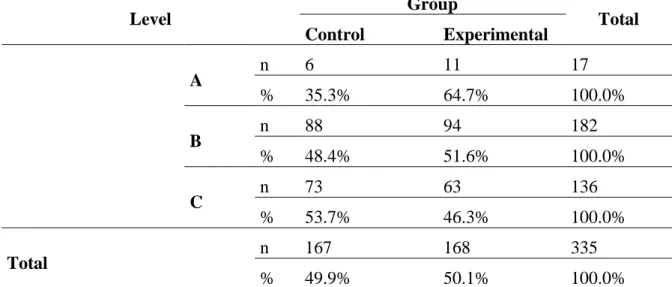
Table 4.1 Comparison of students in terms of their levels of English………134
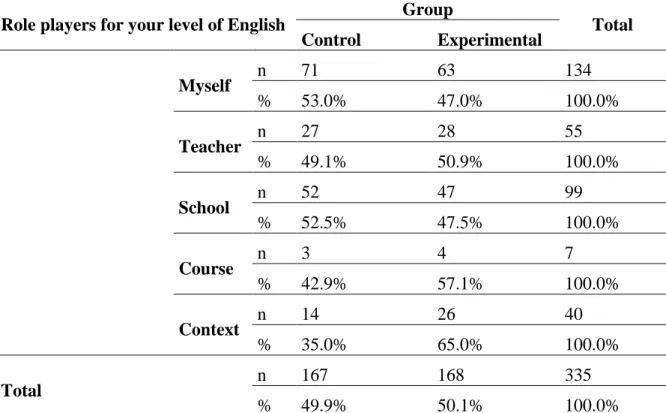
Table 4.2 Effective factor at the level of English of participants...135
Table 4.3 Goals of the participants to learn English...136
Table 4.4 Planning of the participants to learn English...137
Table 4.5 Amount of time spent by participants to learn English...138
Table 4.6 Preferred styles by participants while studying English……….138
Table 4.7 Evaluation preference of participants in terms of their level of English...139
Table 4.8 Motivation level of participants to study English...140
Table 4.9 Independent samples t-test results of groups in terms of learning styles, language learning and communication strategies measured before the experiment………...141
Table 4.10 Paired t-test results of experimental groups in terms of learning styles, language learning and communication strategies measured before and after the experiment...142
Table 4.11 Independent t-test results of control and experimental groups in terms of the learner autonomy and groupwork measured before the experiment...143
Table 4.12 Paired t-test results of experimental groups in terms of the attitude towards the learner autonomy and groupwork measured before and after the experiment...144
Table 4.13 Independent samples t-test results of control and experimental groups in terms of speaking skill measured before the experiment…………...146
Table 4.14 Independent samples t-test results of control and experimental groups in terms of speaking skill measured after the experiment...146
Table 4.15 Paired samples t-test results of control group measured after the experiment..147
Table 4.16 Paired samples t-test results of autonomous groups of learners measured after the experiment……….148
xv
LIST OF FIGURES
Figure 2.1 Components of learner autonomy.………..……….19
Figure 2.2 Teacher and learner control in learner autonomy…..……….……….44
Figure 2.3 Social constructivist model of the teaching - learning process.………...74
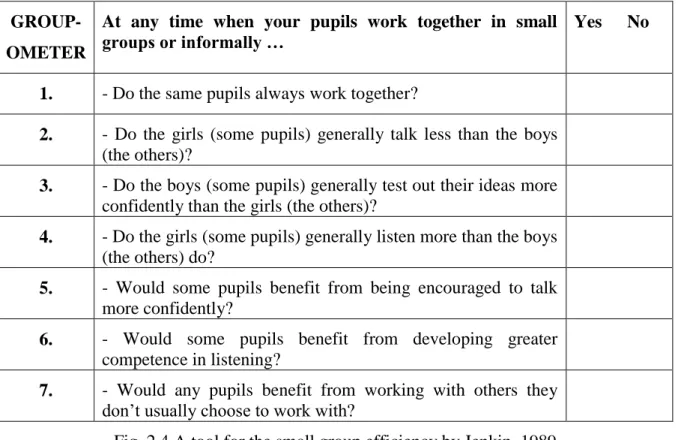
Figure 2.4 A tool for the small group efficiency ………..87
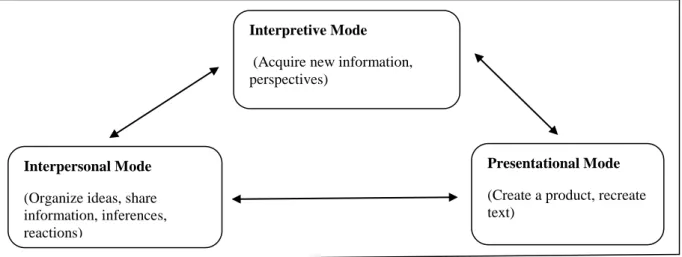
Figure 2.5 Integrating the three modes of communication………...99
Figure 2.6 Learner-group format………104
Figure 2.7 Peer-assessment scales against the speaking ability……...……….105
Figure 3.1 Procedures of the research in successive phases...………..………..114
xvi
LIST OF ABBREVIATIONS
CEFR Common European Framework of Reference CLT Communicative language teaching
EFL English as a foreign language ELT English language teaching ESL English as a second language FLE Foreign language education FLL Foreign language learning
L2 Second language
LA Learner autonomy
LLS Language learning strategies
LS Learning styles
LT Learner training
SILL Strategy Inventory for Language Learning TBLT Task-based language teaching
TEFL Teaching English as a foreign language TL Target language
1
CHAPTER 1
INTRODUCTION
Introduction
The aim in this chapter is to provide a framework for the study on the impact of group autonomy on foreign language learners‘ speaking skills from a task-based social constructivist perspective.
At the outset of the chapter, the background reveals the study content such as the purpose of the experiment, the design and the interpretation of the results. The subsequent parts include the reasons why autonomy in groups should be emphasized in foreign language education through the aim of the study, statement of the problem as well as the significance of the study. In the following parts, the aim is to give an overview what ways were used to clarify whether there is an impact of group autonomy on learners‘ speaking skills. Limitations of the study are also described concisely in this chapter.
The last section of the chapter is devoted to defining some principal terminology regarding the study such as autonomy, learner autonomy, learner training, language awareness, language learning strategies, teacher autonomy, group autonomy, speaking skill, social constructivism, task-based learning.
Background to the Study
While investigating the history of learner autonomy, Smith (2008b) noted that the notion was first developed in the early 1970s by Henri Holec at CRAPEL as ―ability to take charge of one‘s own education‖ (p. 6). With the development of self-access systems, autonomy-oriented classroom practices such as Leni Dam‘s in 1973, and the entry of new
2
‗centres‘ the focus in books and reports seemed to be mainly on self-access learning up to the 1990s. For instance, Kohonen (1992) used the term ‗self-direction‘ as ‗an attitude to learning‘ in varying levels from other-directed to self-directed learning. Smith (2008a) also stated that the beginning of unification around the term ‗autonomy‘ in book and reports was from 1995 onwards. As an example, Benson (2001) proposed learner autonomy (LA) as a pre-condition for effective learning of a foreign or second language. He defined LA as ―the capacity to take control over one‘s own learning‖ (p.47) similar to Smith (2008a) who labeled LA as to be able to self-direct one‘s own learning. Besides, due to the facts that all knowledge is socially constructed through the use of communicative and interactive tasks as the central units for the planning and delivery of instruction (Richards and Schmidt, 2010), that the language is social and learning best happen interactively (Benson, 2001; Nunan, 1989b), and that the ability to use a second language is an indicator for the proficiency in this language (Liskin-Gasparro cited in Shrum and Glisan, 2010), the language teachers are supposed to create maximum opportunities to use the target language in the classroom (Yaman, 2014) as well as to guide learners in order to sustain a similar interactive setting out of the class. To support this, Sarıgöz (2008) stated that building learning communities in ‗synergy‘ necessitated such a ―classroom management that could develop cooperative interaction in the classroom‖ (p.57). For foreign language learning settings, Van Lier (1996) went further and explained that the class hours were the only chance that learners were busy with the language. By maintaining the idea that the language development occurred between lessons rather than during the lesson, Van Lier (1996) proposed that the students must be involved with the language amid lessons over and above in lessons. To formulate this context, Larsen-Freeman (2000) proposed teachers to teach how to learn a language that aimed to build autonomy among the learners.
When glanced at the literature, building autonomy was considered as a process in which control over and responsibility for the learning situation was gradually shifted from teacher to learner (Littlewood, 1996; Van Esch and St. John, 2003; Van Lier, 1996). Little (1996) gave his support in favor of group work as a means of developing learner autonomy. Group work in this study was more than the cooperative language learning approach, which was described by Gabler and Schroeder (2003, p. 88) as ―a special subset of peer-group
3
techniques‖ or by Kessler (1992) as ―a group learning activity organized so that learning is reliant on the collectively prearranged change of information among learners in groups‖ (p.8), even by Larsen-Freeman (2000, p. 164) as ―learning students from each other in groups‖ but it was an expectation that creating an efficient, authentic foreign language learning environment with autonomous learners would become a solution to the never-ending problem of practice opportunity in learning a foreign language through the use of group dynamics, communicative aspects of group, and tasks that ―present language learning in the form of a problem-solving negotiation between knowledge that the learner holds and new knowledge‖ (Candlin and Murphy cited in Larsen-Freeman, 2000, p. 144) in order to build group autonomy. As Larsen-Freeman (2000) composed in a corresponding way, cooperative learning groups could easily work on tasks from a task-based approach to language instruction, for instance. Yet cooperative learning was similar to learner strategy training as well in that both require language to teach other skills in addition to teaching language. Among the others, Scharle and Szabo (2000, p. 1) offered a number of activities that help learners become conscious of the importance of their part and develop the abilities to become autonomous on three stages;
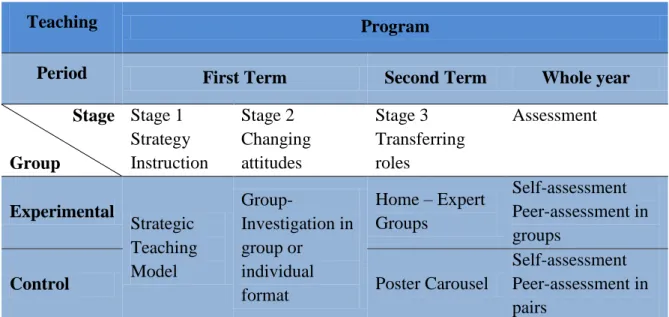
Stage1: Raising awareness Stage2: Changing attitudes Stage3: Transferring roles
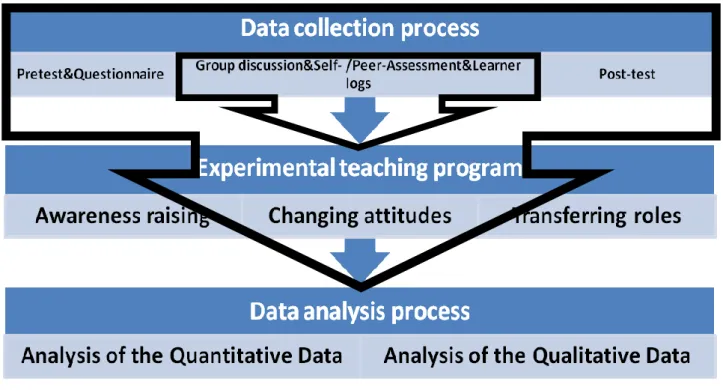
These stages became the roadmap for the researcher to conduct this study. Following the pre-test and questionnaire to clarify the linguistic needs and to correlate the levels of English use of the participants, awareness raising activities on learning styles, language, language learning, and language learning and communication strategies were carried out from the beginning of the work to the end. Along with two subsequent stages, self- and peer-assessment activities were also used to support to reach the endpoint of this transfer for learners to take charge of their own progress as well as to validate the change in learners‘ speaking skill level within their success in the pre- and post-tests‘ results. Finally, these results were analyzed to start a discussion about the impact of group autonomy on foreign language learners‘ speaking skill and to suggest some educational implications.
4
Along the study, it was aimed to find out whether helping learners become autonomous and creating an interactive and authentic environment were effective to improve learners‘ speaking ability in a foreign language. It was thought that the maximum use of target language in and out of class for the foreign language learners through constructivist tasks would lead them to take the responsibility of their own learning.
Statement of the Problem
Nobody would deny that the most frequent problem faced by the foreign language learners is to be unable to use the target language in a meaningful and authentic way out of the class due to the fact that there is always a very limited opportunity (Yaman, 2014) for them to do this. Almost only opportunity to practice the target language is found within the boundaries of the classroom and with very restricted time if the teacher‘s approach to foreign language instruction is based on communicative principles. Otherwise, they might have the difficulty to put into action what they have learned in class even though they find this chance. Practice in the target language during in-class activities might not lead to its authentic use in the real world sufficiently however they are willing. While emphasizing the significance of authenticity in language classes, Van Lier (1996) claimed that a friendly greeting was not considered a friendly greeting once it was received in the strange language. He explained this situation as a psychological or cultural gap that might account for difficulties with group work and various kinds of communicative activities with many students.
In addition to these inadequate speaking conditions of foreign language learners, mainly related to the context, another unconstructive issue in improving speaking skill in the target language could be the learners, themselves. Learners may be very enthusiastic to speak in the foreign language. However, having the will to do something would not either to succeed it. Learners might act as the passive receivers from the teacher in the classroom and from the media such as TV broadcasting, or films in the target language out of the class. Among the others, Üstünlüoğlu (2009) and Scharle and Szabo (2000) handled this large-scale educational problem, specifically in terms of the foreign language education. According to them, learners do not take duty for their learning although they have the ability, and teachers, themselves, take on most of the responsibilities, by perceiving their
5
students incapable of fulfilling their responsibilities. Therefore, learners also had to be skillful enough to carry out the tasks in the right way and aware of their responsibility for their own learning.
Aim of the Study
To enhance the speaking skill of foreign language learners in the target language, creating maximum opportunities through authentic tasks leading to the effective use of the target language in and out of the classroom was one of the key tasks for the language teachers in the experiment. Therefore, forming in-class groups of learners able to manage their learning, willing to create more opportunities to interact with each other, that is, responsible for their own learning with the capacity of planning the experience process, deciding how to carry out the task at hand, and evaluating themselves through group dynamics and synergy, which pointed to autonomous groups (Dickinson, 1987; Shapiro, 2002) seemed to be the best option in order to overcome this inability of speaking in the target language, which established the aim of this study.
Significance of the Study
Through the study on the impact of group autonomy on the speaking skill in foreign language, it was expected to contribute to the debates on the authentic and effective foreign language use in groups of language learners in an autonomous way as well as on the impact of the interactivity among the autonomous learner group members to help enhance the learners‘ speaking skill in the target language. Besides, the members of the autonomous groups who had the responsibility for their learning were also expected to lead to keep on learning out of the classrooms towards the life-long learning and to get used to live together socially and in peace and democracy.
In the preface to their book ‗A framework for freedom’, Van Esch and St. John (2003) likened researchers on learner autonomy to the travelers that ―do not follow well-beaten tracks, but forge paths towards horizons they have set their sights on‖ and added that ―those seeking personal autonomy discover new frontiers, beyond the familiar, and on the way, find the treasure of learning that lies hidden within‖ (p. vii). The author of this study
6
also set off on a journey beyond the cutting edge hopefully to find the hidden treasure of learner autonomy in groups, to highlight its importance, and to fill the research gap in this research field. To address and achieve these objectives, the following research questions were formulated:
Research Questions
In this study, the focus was mainly on two questions by investigating the ways to overcome the problems related to the foreign language learners‘ speaking skill;
1. Can a group exercise or develop autonomy within itself?
2. Can group autonomy help to increase the learners‘ speaking skills?
In order to find answers to them, the following questions guided the study. The sub-questions in the first group were related to the learning styles, language learning and communication strategies used by the participants, and attitude of the participants towards the learner autonomy and group work to clarify the difference between the experimental groups of learners and the control group as listed below;
1.1 Is there a significant difference of learning styles, language learning and communication strategy use between autonomous groups of learners (experimental group) and learners that are exposed to traditional instruction (control group)?
1.2 Is there a significant difference of learning styles, language learning and communication strategy use of learners in the experimental group before and after the experiment?
1.3 Is there a significant difference of attitude towards learner autonomy and group work between learners in the experimental group and learners in the control group before the experiment?
1.4 Is there a significant difference of attitude towards learner autonomy and group work of learners in the experimental group before and after the experiment?
Within the second group, it was sought for the difference related to the speaking skills between the two groups;
7
2.1 Is there a significant difference of speaking ability between learners in the experimental group and learners in the control group before the experiment?
2.2 Is there a significant difference of speaking ability between learners in the experimental group and learners in the control group after the experiment?
2.3 Is there a significant difference of speaking ability of learners in the experimental group before and after the experiment?
2.4 Is there a significant difference of speaking ability of learners in the control group before and after the experiment?
Limitations and Scope of the Study
The scope of this experimental study was formed by a theme on the impact of group autonomy on the speaking skill in foreign language for the students at Gülhane Military Medical Academy in Turkey.
One of the limitations against this study is related to the duration of the process, which occupied two educational terms, to enhance autonomy in participants in this study. Growing autonomy in individual (Candy cited in Thanasoulas, 2000; Murray, 1999) as well as ability to use a foreign language and competence in speaking (Alderson and Bachman cited in Luoma, 2004) lasts too much. The uncertainty in time limit would be an issue to criticize.
Another boundary that affected the participants unfavorably was the curricular intensity of the participants‘ subject matters on medicine. This intensity kept their foci away from other subjects such as English even though they were aware of the significance of learning English for their future careers.
One restriction for the researcher was based on the rarity of the studies on autonomous groups of learners, which was the reason for not being seen among the well-beaten tracks, despite the redundancy of the studies on individual autonomy. Therefore, other research out of these limitations may be conducted for any other groups of learners in different settings.
8 Definition of Terms
Terms
Autonomy, also Learner autonomy - in language learning, the ability to take charge of one‘s own learning and to be responsible for decisions concerning the goals, learning processes, and implementation of one‘s language learning needs. This is not necessarily the same as independence, however, since we can freely choose to do what others want us to do.
Constructivism, also Social constructivism - a social and educational philosophy based on the beliefs that:
1. knowledge is actively constructed by learners and not passively received. 2. cognition is an adaptive process that organizes the learner‘s experiential world. 3. all knowledge is socially constructed.
Language awareness - a movement that developed in Britain in the 1980s which sought to stimulate curiosity about language and to provide links among the different kinds of language experiences children typically encountered in school, e.g. in science, in literature, and in foreign language classes. In this study, it is used to refer to the knowledge about language and language learning through learner training.
Learner-centred approach - in language teaching, a belief that attention to the nature of learners should be central to all aspects of language teaching. In learner-centred approaches, course design and teaching often become negotiated processes, since needs, expectations, and student resources vary with each group.
Learner training - in language teaching, procedures or activities that seek to raise learners‘ awareness of what is involved in the processes of second language learning, help learners become more involved in and responsible for their own learning , and help learners develop and strengthen their language learning strategies.
Learning centre - a location within a classroom or school which contains a variety of different learning resources for independent learning.
Learning log - the use of a notebook or book in which students write about experiences both in and out of school or record responses and reactions to learning and to learning
9
activities. Learning logs provide students with an opportunity to reflect on learning, and are usually shared with the teacher on a regular basis but not graded.
Learning resources - those materials and other sources of learning that are used in a language programme, such as books, computers, DVDs and CDs.
Learning strategy - an intentional or potentially intentional behaviour carried out with the goal of learning. A number of broad categories of learning strategies have been identified, including cognitive strategies such as analyzing the target language; metacognitive strategies, which include being aware of one‘s own learning; social strategies such as seeking out friends who are native speakers of the target language or working with peers in a classroom setting; and resource management strategies such as setting aside a regular time and place for language study.
Learning style - a particular way of learning preferred by a learner. Learners approach learning in different ways, and an activity that works with a learner whose learning style favours a visual mode of learning, may not be as successful with a learner who prefers auditory or kinesthetic modes of learning. Teachers are hence encouraged to try to recognize different learning styles among their learners.
Learning to learn - the acquisition of attitudes, learning strategies and learning skills that will be applied in future learning situations and make future learning more effective. Study skills and learning strategies are examples of the domain of learning to learn.
Speaking skill - the ability to build and share communication through spoken and non-verbal symbols.
Target language - in language teaching, the language which a person is learning, in contrast to a first language or mother tongue.
Task-based language teaching, also task-based instruction, task-based learning - a teaching approach based on the use of communicative and interactive tasks as the central units for the planning and delivery of instruction. Task-based language teaching is an extension of the principles of Communicative language teaching and an attempt by its proponents to apply principles of second language learning to teaching.
10 Abbreviations
CEFR Common European Framework of Reference CLT Communicative language teaching
EFL English as a foreign language ELT English language teaching ESL English as a second language FLE Foreign language education FLL Foreign language learning L2 Second language
LA Learner autonomy
LLS Language learning strategies LS Learning styles
LT Learner training
SILL Strategy Inventory for Language Learning TBLT Task-based language teaching
TEFL Teaching English as a foreign language TL Target language
Conclusion
Language has played an important role in human life. It has been needed and used almost at every minute and place in contact with the people in the society. It has come out from a need such as giving a message, at the opposite side receiving it, and served to reflect of being a part of this interaction. Therefore, it has been a social activity happening in an authentic setting. To emphasize this actuality, Chomsky (cited in Trask 2007) introduced a comprehensible distinction: he suggested that; ―an individual language might itself be viewed either as a set of rules and principles in the minds of speakers; his I-language (intentional, internal and individual), or as a set of possible sentences in society; his E-language (external)‖ (p. 130).
Because of these specific features of language, it is meaningless to alienate it from the social and interactive environment while teaching it in the classroom. The only thing
11
expected to take into consideration is to create such an authentic environment that the learners should need to use in order to communicate. For this to happen, tasks selected by the instructor could be very helpful to practice the target language but they might not be sufficient to trigger the learners if they are not motivated to achieve them. Therefore, for those self-motivated learners that are aware of what and how to learn a foreign language, creating an authentic and social setting through interactive tasks becomes a must. To facilitate the interaction among the learners of target language beyond the class time, there seems a need of forming autonomous class groups that take their responsibilities for their own learning through group dynamics. Accordingly, autonomous learners willing to interact with the people around for communicative purposes would mostly create opportunities even in places where the target language is not their native language. From this point of view, it is possible to assert that speaking ability in a foreign language could be enhanced when the learners interact in in-class autonomous groups where the target language is spoken meaningfully.
In this study, researcher aimed to see whether this assertion would find a chance to survive. To reach this goal, the author attempted to implement the suggested language learner training and autonomous learning activities in group or individual formats through authentic tasks in the frame of a constructivist approach in order to answer the research questions.
12
Anything that a child should do and can do, and we do for them takes away an opportunity to learn responsibility.
Gene Bedley
―Self-education is, I firmly believe, the only kind of education there is.‖
13
CHAPTER 2
REVIEW OF LITERATURE
Introduction
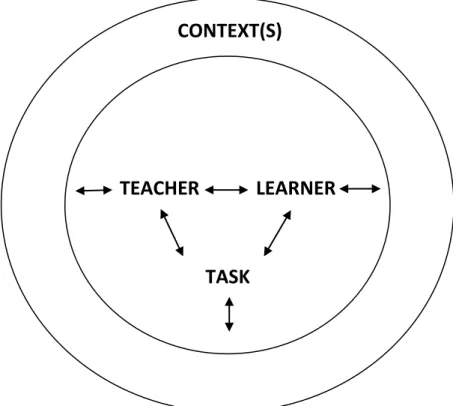
In order to help to guide language teachers in their professional practice, Williams and Burden (1997) offered four key factors that influence the learning process; learner, teacher, task and context. They claimed that these factors brought interaction to the teaching-learning process in such a way that teacher preferred tasks matching their beliefs about teaching and learning. The task was therefore the crossing point between the teacher and learners to interact with each other within teacher‘s values and beliefs, and the learners‘ reaction influenced by the characteristics of the learners and the feelings towards the teacher. The three elements; teacher, learner and task were in a dynamic balance in a context in which the learning took place. Williams and Burden (1997) described ‗context‘ as ―the emotional environment such as, trust and belonging; the physical environment; the whole school culture; the wider social environment; the political surroundings and the cultural background‖ (p. 44). They proposed this process in four elements as a framework of social interactionism, essentially constructivist approach, with key elements of learning and education in a humanist approach emphasizing the whole person and the affective aspects of learning.
To satisfy the concern about a comprehensive approach to search for the impact of group autonomy on learners‘ speaking skill in English in a task-based social constructivist perspective through this study, author considered the term ‗autonomy‘ as the stem cell and studied in the same study frame as Williams and Burden‘s approach to foreign language learning and teaching process.
14
To submit the literature review on autonomy, the researcher also drew on four key factors; learner, teacher, task, and context in an interbedded frame after presenting autonomy theoretically and in practice at the outset of this chapter. It was thought that this approach would help compose a comprehensive revealment of the writings. Subsequently, the review was tied up with the speaking skill in English as a foreign language part to which it was aimed to turn up and to enhance.
Autonomy
In political environments the term ‗autonomy‘ was mainly used to refer ‗the right of an organization, country, or region to be independent and govern itself, or self-government and sovereignty‘.
The term also denoted a good deal of personal distinctiveness such as ‗self-sufficiency, behaviour as of the will or one's actions, the ability to make your own decisions without being controlled by anyone else for the individuals, or the capacity to be one's own person, to live one's life according to reasons and motives that are taken as one's own and not the product of manipulative or distorting external forces‘, as well as social states‘ description like ‗independence or freedom to determine one's own actions, or a chance to do what she thinks best‘ in the referential meaning (Christman, 2014; Hornby and Ruse, 1991; Oxford ESL Dictionary; Stanford Encyclopedia of Philosophy).
On the other hand, Trask (2007) described ‗autonomy‘ as ―the view that the human language faculty is independent of general mental and cognitive abilities‖ (pp. 27-28) among the key concepts in language and linguistics. He argued the debates on first and second language learning as well as language disability.
From the statements above, it would not be overstated if we claim that autonomy in all senses plays a leading role in people‘s lives as well as in their lifelong education.
Autonomy and Learner
The findings showed that the autonomy in learners embraced the learning process such an extent that it had a deep impact on each step of the whole procedure and that the success of
15
the learning was seen as bound to it as both a tool and a goal (Benson, 2001; Holec, 1981; Kohonen, 1992; Littlewood, 1996; Smith 2008a). Consequently, the terms ‗autonomy‘ and ‗learner‘ were mostly pronounced mutually to state one of the cornerstones in education as they were going to be used along this study.
Learner Autonomy
Due to its invaluable provision to education procedure perhaps, the term ‗learner autonomy‘ (LA) had numerous approaches to be expressed its meaning. The most frequently referred description of the term was made by Holec (1981) who defined LA as ―ability to take charge of one‘s own education‖ (p. 3). Altman (cited in Dickinson, 1987), on the other side, emphasized the context and described LA as ―the situation in which the learner is totally responsible for all of the decisions concerned with his learning and the implementation of those decisions‖ (p. vii). He also added that; ―there was no involvement of a ‗teacher‘ or an institution in full autonomy and the learner was independent of specially prepared materials‖ (ibid. p. 11). To emphasize that the learning responsibility belonged principally to the learner, Scharle and Szabo (2000) defined ‗autonomous learners‘ as ―learners who accept the idea that their own efforts are crucial to progress in learning, and behave accordingly‖ (p. 3). According to them, when autonomous learners did their homework or answered a question in class, they were not doing that to please the teacher, or to get a good mark. They were simply making an effort to learn something. More comprehensively, Stefanou, Perencevich, DiCintio, and Turner (2004) moved toward and claimed that learning itself had an autonomous nature, and it was an active, self-constructed, and self-intentional process. Finally, Wang (2010) recalled that LA was ‗the desirable goal of the education‘.
To demonstrate plainly autonomy classification from a broader educational and social source, Finch (2000) provided five categories by Benson and Voller;
1. situations in which learners study entirely on their own
2. a set of skills which can be learned and applied in self-directed learning 3. an inborn capacity which is suppressed by institutional education 4. the exercise of learners’ responsibility for their own learning
16
After all, there was a remarkable degree of consensus on the basic definition LA by Holec (1981), which denoted that autonomy entails learners taking more control over their learning.
Besides defining LA in different statements and contexts, there used to be some terms that had similar meanings such as ‗learning to learn‘, ‗self-directed learning‘, ‗individualization‘, ‗learner independence‘. Especially, the terms ‗learner autonomy, learning to learn, and self-directed learning‘ were used either to define each other, or to replace in the literature on education. Learner autonomy was a problematic term because it was widely confused with self-instruction. It was also a slippery concept because it was notoriously difficult to define precisely. The rapidly expanding literature debated, for example, whether learner autonomy should be considered as capacity or behaviour; whether it was characterised by learner responsibility or learner control; whether it was a psychological phenomenon with political implications or a political right with psychological implications; and whether the development of learner autonomy depended on complementary teacher autonomy.
Holec (1981), for instance, considered ‗learning to learn‘ as a component of LA in the process of teaching. He also regarded LA as an instrument to perform and maintain effective self-directed learning supported by three main skills related to self-management, self-monitoring and self-assessment of this process.
Another example was Kohonen (1992) that mixed these terms. Kohonen (1992) described direction as ‗an attitude to learning‘ in varying levels from other-directed to self-directed learning. He clarified those levels in the following quote that showed clearly the mixture of the related terms;
―There are various degrees of self-direction. To the extent that the learner is able to undertake learning tasks without direct teacher control he or she displays various degrees of autonomy. A fully autonomous learner is totally responsible for making the decisions, implementing them and assessing the outcomes without any teacher involvement. The development of such independence is a question of enabling learners to manage their own learning. They need to gain an understanding of language learning in order to be able to develop their skills consciously and to organize their learning tasks‖ (p. 23).
Kumaravadivelu (2006) also used three terms in one description;
―It (autonomy) involves helping learners learn how to learn, equipping them with the metacognitive, cognitive, social, and affective strategies necessary to self-direct their own learning, raising the consciousness of good language learners about the language learning
17
strategies (LLS) they seem to possess intuitively, and making the strategies explicit and systematic so that they are available to improve the language-learning abilities of other learners as well‖ (p. 206).
From the same perspective, Smith (2008b) suggested that the idea of LA was new, but referred to in the field of English language teaching (ELT), previously, as ‗individualization‘, then ‗learner independence‘. According to Van Esch and St. John (2003), at the outset of those years,
―…a lot of efforts were made to attune the process of learning a foreign language to the personal needs, interests, and capacities of the learner (…) the changed perspectives to the individual and social dimensions of learning and especially learning a foreign language, offered fertile soil for the development of a new focus in the 80s: the autonomy of the learner‖ (p. 11).
Smith (2008a) defined LA as the ability to self-direct one‘s own learning while Williams and Burden (1997) took that issue from a broader frame and referred to LA as a component of education ―concerned not just with theories of instruction, but with learning to learn, developing skills and strategies to continue to learn, with making learning experiences meaningful and relevant to the individual, with developing and growing as a whole person‖ (p. 44).
As a different approach, Richards and Schmidt (2010) discriminated learning to learn from the other two terms and stated as the acquisition of attitudes, learning strategies and learning skills that would be applied in future learning situations and made future learning more effective. They proposed study skills and learning strategies as examples of the domain of learning to learn as well as of learner autonomy in fact.
Learner Autonomy and Foreign Language Education
Including more than 1,700 references in the bibliography by Reinders (2013), it would not be exaggerated to declare that LA in FLE was one of the most considered issues in latest years. The anecdote from Phil Benson would help justify this assertion. To revise his well-known book on autonomy in language learning for the second edition, Benson (2011) admitted ‗a failure of a kind‘ to try to read everything written on autonomy since 2000 by being unaware of ‗what that would mean‘ in his own words. Forcing to be selective, he said, three hundred new references were only the tip of the iceberg of references that could have been included.
18
To explain the main reason for this frequency of involvement, it would be a good idea to touch on its most referred definition. Holec (1981) defined LA as ―ability to take charge of one‘s own education‖ (p.3). As it was emphasized in that short and comprehensible definition, the learning responsibility was led to the shoulders of the learner rather than the teacher, which should be, normally, the aim in effective formal education. According to Dickinson (1987), the key element in definitions of LA was the idea that autonomy was ―an attribute of learners, rather than learning situations‖ (p. 11) while Little (1991) stated LA as being not a particular method. LA could be handled one of the stepping stone on the way to learn a foreign language. Dickinson (1995) allocated autonomy a motivating role not only in general education but also in language learning by suggesting that autonomous learners became more highly motivated and that autonomy leaded to better, more effective work. Here, Dickinson (1995) described autonomy from a different angle such as ―an attitude towards learning in which the learner is prepared to take, or does take, responsibility for his own learning by decision making about one's own learning‖ (p.169). The reason to understand autonomy as a capacity or attitude here was to be able to imagine learners retaining learning autonomy in a teacher-directed classroom setting as well as in self-access learning centres.
Littlewood (1996) also claimed that the term ‗autonomy‘ concurred well with several of the central pedagogical preoccupations since language learning required the active involvement of learners, learner centered methods, and the goal of helping learners to become independent from their teachers in their learning and use of language. While defining an autonomous person, some basics that make up LA were identified by Littlewood (1996), ―one who has an independent capacity to make and carry out the choices which govern his or her actions‖ to conclude that, ―if so, the capacity to be autonomous necessitates two main components: ability and willingness‖ (p. 428).
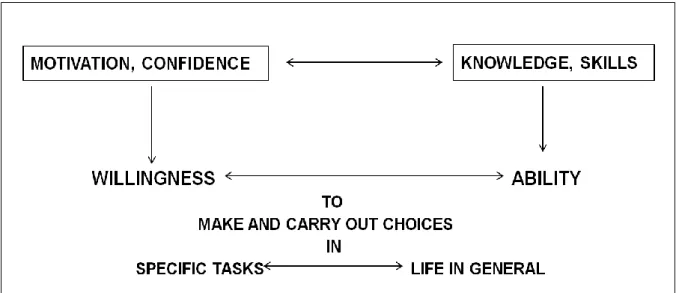
Littlewood (1996) put the learners‘ ability and willingness to make choices independently at the core of the notion of autonomy and claimed that language learning required the active involvement of learners. He discussed that ―a person may have the ability to make independent choices but feel no willingness to do so or, a person may be willing to exercise independent choices but not have the necessary ability to do so‖ (p. 428). As shown in the diagram in Figure 2.1, Littlewood (1996) divided two main components into
19
two subcomponents. According to him, ―ability depends on possessing both knowledge about the alternatives from which choices have to be made and the necessary skills for carrying out whatever choices seem most appropriate‖ while ―willingness on having both the motivation and the confidence to take responsibility for the choices required‖ (p. 425). He suggested that all of these four components were needed to be present together if a person was to be successful in acting autonomously.
Fig. 2.1 Components of learner autonomy by Littlewood, 1996
As for another basic definition, Benson (2001) explained LA as ―the capacity to take control over one‘s own learning‖ (p. 47). According to him, LA was an attribute of the learners approach to the learning process and a pre-condition for effective learning. Little (2004) put flesh on the bones of Holec‘s definition and claimed that taking charge of one‘s learning was to have, and to hold, the responsibility for all the decisions concerning all aspects of this learning, i.e.:
- determining the objectives;
- defining the contents and progressions; - selecting methods and techniques to be used; - monitoring the procedure of acquisition; - evaluating what has been acquired (p.16).
To explain the support between autonomy and language learning, Little (2004) stated that autonomous learners are stimulated by their intrinsic motivation when they accept
20
responsibility for their learning and give themselves to increase the skills of insightful self-regulation in learning. Consequently, their learning was well-organized and valuable. In this respect, Sarıgöz (2008) revealed the change of focus from the teacher- centered tradition towards the individualistic approaches which ―place the learners in the active zone of foreign language lessons with increasing freedom and autonomy‖ through taking the needs of the learner groups into account. (Sarıgöz, 2008) also restated that building learning communities in ‗synergy‘, energy generated by individuals working together to exercise social models of teaching necessitated such a ―classroom management that can develop cooperative interaction in the classroom‖ (p.57).
While describing better language learners, Kumaravadivelu (cited in Wang, 2011) handled the autonomy notion from an opposite angle;
- Autonomy is not independence, that is, learners have to learn to work cooperatively with their teachers, peers, and the educational system;
- Autonomy is not context-free, that is, the extent to which it can be practiced depends on factors such as learners‘ personality and motivation, their language learning needs and wants, and the educational environment within which learning take place; and
- Autonomy is not a steady state achieved by learners, that is, autonomous learners are likely to be autonomous in one situation, but not necessarily in another, and they may well very well choose to look for teacher direction at certain stages in their learning (p. 274).
History of Learner Autonomyin Foreign Language Education
A project on social practices during the development of LA in language education was initiated by Smith (2008a) as ‗the autonomy movement‘ with the belief that ―insights from the past can help teachers navigate their own way‖ (pp. 6-9). He focused on a thirty-five year period up to 2006 to bring together the records of practical work in the field of autonomy.
In that project, Smith (2008a) claimed that the notion was first developed in the early 1970s by Henri Holec. His findings included varying layers of history under the titles, ‗Published writings‘, ‗International‘ and ‗Local‘ initiatives. As major findings in the upper layer of ―Books, reports and journal special issues‖ Smith (2008a) noted that;
- publication in relation to learner autonomy has at least a 30-year history, i.e. the concept has been in at least some kind of ‗mainstream‘ for a long period of time;
- Although the earliest publications were mainly French in origin, and/or associated with the Council of Europe, there was an early strand of work in the field of ‗individualisation‘ in the
21
UK which was later to join up with autonomy. Indeed, the very first publication on the list was an Anglo-French collaboration;
- The focus in books and reports up to the 1990s seems to have been mainly on adult learners and self-access learning.
- Holec 1988 appears to have been an important first step in bringing together reports of practice in diverse settings such as in ‗internationalising‘ autonomy;
- From 1989 onwards, the entry of new ‗centres‘ where publication is concerned are seen – Trinity College Dublin, CILT, Hong Kong;
- From 1995 onwards there is a sudden rise in number of books / reports published per year and the beginning of unification around the term ‗autonomy‘ in book and reports;
- Any centre to periphery movement in globalization of learner autonomy seems, from this timeline, to have had an unconventional aspect. It appears that the Council of Europe / non-native speaker language teachers in Continental Europe may have had far more of a role to play than, for example, the British Council or IATEFL. Hong Kong was an important centre for the dissemination of ideas from 1994 onwards;
- 1997 witnessed ‗autonomy triumphant‘, in the sense that all titles of books published in that year had ‗autonomy‘ as a component (p. 6).
Results from the International initiatives made available multiple details of international conferences, associations, projects. Some were:
- 1971: CRAPEL, the Rüschlikon meeting and the Modern Languages Project, and Council of Europe level thinking on lifelong learning generally;
- Until 1991 only the Council of Europe and the Nordic Workshops had emerged as important international networks concerned specifically with learner autonomy, the IATEFL Learner Independence SIG;
- In 1993 a new centre of international activity emerges: the AILA Scientific Commission on Learner Autonomy;
- The 1994 conference in Hong Kong may have been a defining moment in the ‗internationalization‘ or ‗globalization‘ of learner autonomy: It brought together interested parties from Europe, Asia and Australia/New Zealand, and linked the ‗worlds‘ of modern language education and ELT;
- The Autonomy 2000 conference in Bangkok and subsequent AILA conferences in Tokyo (1999) and Singapore (2002) helped to confirm the ‗rise of Asia‘ in the world of autonomy; a spread to Spain is reflected in the 1997 Nordic workshop being held there; in 2003 a new Australia/New Zealand based association (ILA) was formed – but without ‗autonomy‘ in the title. Still there was little apparent interest in learner autonomy in the USA, despite the 2005 AILA conference being held there (pp. 7-8).
‗Local‘ initiatives included:
- 1972: learner autonomy theory developed at CRAPEL as a response to a particular practical problem. Thus, when self-access systems began to be developed out of existing language labs, the need arose for enhanced understanding of what it means to be able to self-direct one‘s own learning;
- 1973: Autonomy-oriented classroom practice can develop as a response to difficult circumstances. Leni Dam‘s practice developed originally as a way to cope with apparently unmotivated teenagers. This theme is repeated in other autobiographical accounts. Much discussion in the field, though, presents things the other way round, as a question of constraints hindering the promotion of autonomy rather than autonomy-oriented practice being a means for teachers and learners to address constraints;