THE INFLUENCE OF THE ECONOMIC INTEREST GROUPS IN TURKISH FOREIGN POLICY
DURING THE JDP GOVERNMENT PERIOD (2002-2011): THE CASES OF TÜSİAD AND MÜSİAD
A Master’s Thesis
by
CEREN YILDIZ
Department of International Relations İhsan Doğramacı Bilkent University
Ankara July 2011
THE INFLUENCE OF THE ECONOMIC INTEREST GROUPS IN TURKISH FOREIGN POLICY
DURING THE JDP GOVERNMENT PERIOD (2002-2011): THE CASES OF TÜSİAD AND MÜSİAD
Graduate School of Economics and Social Sciences of
İhsan Doğramacı Bilkent University
by
CEREN YILDIZ
In Partial Fulfilment of the Requirements for the Degree of MASTER OF ARTS
in
THE DEPARTMENT OF INTERNATIONAL RELATIONS İHSAN DOĞRAMACI BİLKENT UNIVERSITY
ANKARA July 2011
I certify that I have read this thesis and have found that it is fully adequate, in scope and in quality, as a thesis for the degree of Master of Arts in International Relations.
---Asist. Prof. Pınar İpek Supervisor
I certify that I have read this thesis and have found that it is fully adequate, in scope and in quality, as a thesis for the degree of Master of Arts in International Relations.
---Asist. Prof. Nur Bilge Criss Examining Committee Member
I certify that I have read this thesis and have found that it is fully adequate, in scope and in quality, as a thesis for the degree of Master of Arts in International Relations.
---Asist. Prof. Lerna Yanık Examining Committe Member
Approval of the Graduate School of Economics and Social Sciences
---Prof. Erdal Erel
ABSTRACT
THE INFLUENCE OF THE ECONOMIC INTEREST GROUPS IN TURKISH FOREIGN POLICY
DURING THE JDP GOVERNMENT PERIOD (2002-2011): THE CASES OF TÜSİAD AND MÜSİAD
Yıldız, Ceren
M.A., International Relations Supervisor: Assist. Prof. Pınar İpek
July 2011
This thesis analyzes the influence of the economic interest groups in Turkish foreign policy during the two Justice and Development Party (JDP) governments with a special focus on the role of TÜSİAD and MÜSİAD. The foreign policy of the JDP government is analyzed by looking at foreign policy developments during the JDP governments and the changes and continuities in Turkish foreign policy. To evaluate TÜSİAD and MÜSİAD’s influence on the JDP’s foreign policy further general characteristics of TÜSİAD and MÜSİAD and their export orientations are discussed. Consequently, the relationship between the JDP government foreign policy preferences and TÜSİAD’s and MÜSİAD’s foreign policy preferences are analyzed in light of the neo-Gramscian approach. The argument here is that MÜSİAD with its ties with the JDP government based on identity and material interests is a new ‘hegemonic project’ and under the dominance of global neo-liberal capitalist order MÜSİAD and the JDP seems to form a new ‘historical bloc’ at domestic level.
Keywords: Turkish foreign policy, Justice and Development Party (JDP), TÜSİAD, MÜSİAD, Neo-Gramscianism
ÖZET
EKONOMİK ÇIKAR GRUPLARININ AKP HÜKÜMETLERİ DÖNEMİNDE TÜRK DIŞ POLİTİKASINA ETKİSİ (2002-2011):
TÜSİAD VE MÜSİAD ÖRNEKLERİ
Yıldız, Ceren
Yüksek Lisans, Uluslararası İlişkiler Bölümü Tez Yöneticisi: Yrd. Doç. Dr. Pınar İpek
Temmuz 2011
Bu tez, devlet-toplum ilişkisi çerçevesinde, ekonomik çıkar gruplarının –TÜSİAD ve MÜSİAD örneklerini kullanarak– Adalet ve Kalkınma Partisi (AKP) hükümetleri döneminde Türk dış politikasına etkisini incelemektedir. AKP hükümetinin dış politika anlayışı, bu dönemdeki dış politika gelişmeleri ve Türk dış politikasındaki devamlılıklar ve değişikliklere bakılarak analiz edilmiştir. TÜSİAD ve MÜSİAD’ın AKP’nin dış politikasına etkisini değerlendirmek için, TÜSİAD ve MÜSİAD’ın karakteristik özellikleri ve ihracat yaptığı bölgeler tartışılmıştır. Sonuç olarak, AKP hükümetinin dış politika tercihleri ile TÜSİAD ve MÜSİAD’ın dış politika tercihleri neo-Gramskici yaklaşımı ışığında analiz edildi. Bu tezde MÜSİAD ve AKP hükümetinin ortak kimlik ve maddi çıkarlara dayanarak yeni bir ‘hegemonya projesi’ oluşturduğu ve küresel neo-liberal kapitalist düzenin hâkimiyetinde MÜSİAD ve AKP’nin ulusal düzeyde yeni bir ‘tarihsel blok’ oluşturdukları savı tartışılıyor.
Anahtar Kelimeler: Türk dış politikası, Adalet ve Kalkınma Partisi (AKP), TÜSİAD, MÜSİAD, Neo-Gramskici yaklaşım
ACKNOWLEDGEMENTS
First of all, I would like to express my sincere appreciation to my supervisor, Assist. Prof. Dr. Pınar İpek, for her remarkable contributions, guidance, patience and encouragement through the research.
I wish to thank Assist. Prof. Dr. Nur Bilge Criss and Assist. Prof. Dr. Lerna Yanık for spending their valuable time to read my thesis and participating my thesis committee.
I am also indebted to Scientific and Technological Research Council of Turkey (TÜBİTAK) for funding me through my graduate study.
I would also like to thank all my friends especially Zeynep Sungur, Duygu Yavuz and Ayşe Sezgin who always supported and encouraged me during the preparation of my thesis.
I want to thank Alican Efe for his support, patience and faith in me during the difficult days I encountered while preparing my thesis. He has always been helpful to me for overcoming pessimism and showed me the reasons to be hopeful.
Lastly, I would like to express my special thanks to my mother, Nermin Türkoğlu, for her endless love and compassion.
TABLE OF CONTENTS
ABSTRACT...iii ÖZET...iv ACKNOWLEDGEMENTS... v TABLE OF CONTENTS...vi CHAPTER 1: INTRODUCTION... 1CHAPTER 2: THEORETICAL FRAMEWORK ... 5
2.1 Liberalism ... 5
2.2 Constructivism ... 9
2.3. Neo-Gramscianism... 13
CHAPTER 3: THE FOREIGN POLICY OF THE JDP GOVERNMENT ... 18
3.1. General Characteristics of the Foreign Policy of the JDP Government... 19
3.1.1 Transformation of the JDP... 19
3.1.2 Motives behind the Foreign Policy of the JDP Government ... 22
3.1.3 The ‘Strategic Depth’ Doctrine of Ahmet Davutoğlu... 24
3.2 Foreign Policy Developments during the JDP Governments (2002 – 2011)... 26
3.2.1 Bilateral Relations... 26
3.2.2 Economic Considerations and Turkish Foreign Policy... 31
3.3 Continuities and Discontinuities in Turkish Foreign Policy under the JDP Government... 40
CHAPTER 4: ECONOMIC INTEREST GROUPS IN TURKEY: THE CASES OF TÜSİAD AND MÜSİAD ... 46
4.1. The Historical Background of the Economic Interest Groups in Turkey ... 47
4.2. General Characteristics of TÜSİAD ... 49
4.3. General Characteristics of MÜSİAD ... 53
4.4. Export Orientations of TÜSİAD and MÜSİAD and Turkish Foreign Policy. 61 CHAPTER 5: CONCLUSION... 66
CHAPTER 1
INTRODUCTION
Since the Justice and Development Party (JDP) government came into power in 2002, there have been significant developments in domestic politics, foreign relations and economy in Turkey, while these developments have initiated different assessments by policy-makers and academic circles. The reason why this period has become a particular area of interest is the controversial Islamic background of the JDP and the debate on its relatively successful foreign policy as well as its management of the economy.
Within this framework, this thesis addresses an important issue which is the role of the economic interest groups in Turkish foreign policy. Accordingly, the research question is in what terms and how the business interest groups in Turkey influenced the foreign policy of the JDP government. There have been discussions about and research on whether there is a shift from the Western-oriented Turkish foreign policy to the Eastern-oriented Turkish foreign policy during the JDP government. The overall assumption lately has been that Turkey followed a pro-Western foreign policy and generally acted with the West until the JDP government.
However, the increasing emphasis on the Middle East, Africa and Asia in Turkish foreign policy vision and the efforts to establish closer relations with these countries in these regions should be assessed carefully. Moreover, the interaction between the Turkish economy and foreign policy should be taken into consideration. Therefore, the business organizations’ role should also be questioned in order to comprehend the developments and the so-called shift in Turkish foreign policy during the JDP government era between 2002-2011.
TÜSİAD and MÜSİAD are the selected cases for the business organizations in Turkey. These organizations are selected because they are the representative groups of companies with considerably different characteristics in Turkey’s private sector. While TÜSİAD represents the big business circles and has a clear preference over the political issues as the advocator of liberal democracy and free-market economy, MÜSİAD has generally been perceived as a counter organization against TÜSİAD, because MÜSİAD embodies the small and medium-sized enterprises. Furthermore, TÜSİAD represents the European model in terms of economic, political and social features, whereas MÜSİAD embraces the Eastern-Asian model, which is combined or reinterpreted on the basis of Islam as an alternative way to unite the businessmen in a particular organization in order to represent their economic interests within their ideological perspective (Buğra 1998, 522). Thus, the cases of MÜSİAD and TÜSİAD will be analyzed in a comparative way, given their differences, to assess whether these organizations’ preferences have an influence on foreign policy, and if any, in what terms this divergence might affect Turkish foreign policy during the JDP government.
In the second chapter, a theoretical review based on the liberal, constructivist and neo-Gramscian theories of international political economy will be made in order
to describe the role of the economic interest groups in foreign policy theoretically. Thus, a theoretical background will be utilized to assess to what extent and how business groups overall in state-society relations have an influence. In this regard, building on such theoretical framework, the findings in Chapter 2 and Chapter 3 will be discussed in the conclusion to seek a conceptual and theoretical explanation for the research question in this thesis.
In the third chapter, the foreign policy of the JDP government will be analyzed within the framework of transformation of the JDP, the causes of the transformation in the Turkish foreign policy, and the foreign policy developments during the two JDP governments by looking at the bilateral relations of Turkey. Then, an analysis of the JDP’s foreign policy will be followed by an assessment of the influence of the economic considerations in Turkish foreign policy. Lastly, the continuities and the discontinuities in Turkish foreign policy under the JDP government will be examined to analyze to what extent economic considerations have been influential.
In the fourth chapter, the selected cases of TÜSİAD and MÜSİAD will be examined to assess the mutually reinforcing relationship between the economic considerations of the business interest groups, their identities and the foreign policy of the JDP government. The export orientation of MÜSİAD and TÜSİAD will be empirically investigated to explore the influence of these business interest groups’ preferences in the JDP government’s foreign policy between 2002-2011.
To conclude, the argument here is that economic considerations have been playing an important role in the JDP’s foreign policy orientation. Combining the JDP government’s foreign policy vision with its economic considerations and the MÜSİAD’s economic interests as a newly emerging Anatolian business class, it
seems that there has been a reciprocal relationship between MÜSİAD and the JDP government. The JDP government has been trying to establish closer economic relations with neighboring countries and regions in order to legitimize its grounds in domestic politics and to overcome the economic difficulties, especially the current account deficit. In parallel with the JDP’s efforts, MÜSİAD has preferred to trade with the countries in the Middle East, Africa, and the post-Soviet regions due to its need for new export markets. Thus, their foreign policy preferences show a complementary characteristic with each other. As discussed in detail in the conclusion, the neo-Gramscian perspective in international political economy (IPE) seems to explain more plausibly the influence of business groups on foreign policy within the framework of state-society relationship.
CHAPTER 2
THEORETICAL FRAMEWORK
2.1 Liberalism
In the literature of political economy some scholars do not accept that there is a liberal theory of political economy. The reason behind this is the separation of the economic domain and political domain in the liberal tradition. The assumption is that each domain operates according to their own rules and logic. Although this is a common view among the liberal thinkers, indeed this is an ideological stand and either explicitly or implicitly they deal with both economic and political affairs. Therefore, disregarding this ideological position, it can be said that there is a liberal theory of political economy.
According to Gilpin there is a liberal economic theory, which is fundamentally based on free market and minimal state and liberal political theory,
which is committed to individual liberty and equality (1987, 27). However, in most of the studies, these political and economic values of liberalism have been taken into consideration as a whole. The basis of liberalism initially takes its reference point from its belief about the cooperative nature of human beings. In economic terms, liberalism assumes that human beings are, by nature economic animals (Gilpin 1987, 27). The market was born as a result of the need for satisfaction of human needs and once it starts to perform, then it has its own logic and rules of functioning. The involvement level of politics within liberal theory differentiates according to different scholars of liberal political economy. Although all types of economic liberalism are devoted to the market mechanism, there are different variants that shape the interactions between economics and politics, or the market and government. Here, the relationship between state-society in the liberal political economic theory will be explored.
In classical liberalism, the level of analysis or the basis of society is individuals be it either a consumer, a firm or a household. Individuals are supposed to act as rational creatures within the market mechanism. Thus, the motive of individuals as rational beings is to maximize their profit or to meet certain needs at the lowest possible cost in return. The American school of liberal international political economy (IPE) assumes economics as an empirical science of maximizing behavior and they believe that this behavior is ruled by a set of economic laws which are free from personal and political norms, and values (Gilpin 1987, 29). The first of these rules is that there should be no government intervention into the market and the role of state should be at minimum level. This means that the state is responsible for establishing the necessary legal framework and infrastructure for economic and financial activities, and then the market will operate within its own structure
(invisible hand). Minimal interference is the best way for the society to regulate itself. To the contrary, some liberals think that the autonomous character of state is being undermined by the struggle among private interest groups. However, according to interventionist liberals, in some cases which the market cannot deal with such as unemployment, the state should have some particular domain to regulate it.
The effect of globalization both in liberal theory and in practice cannot be ignored in this study. The reason why globalization is so crucial lies in the changing role of the state and economic affairs in the current environment. With the increasing level of economic globalization, the idea that state is the only actor both within domestic and international affairs has started to be questioned, because there have been various different actors, which have been engaging and participating in policy-making procedures. For instance, the state is encountering more difficulty in managing economic affairs and also the social groups, who are influenced by the government’s decisions, are more willing to take part in the decision-making procedures. Thus, both domestically and internationally different actors such as civil society, interest groups and business associations have started to work with the government.
Within this framework, the term ‘governance’ needs to be explained. In the global sense, the central authority (government or state) started to diffuse through sub-national, transnational and supranational actors. On the other hand, in domestic terms, governance is being reshaped around civil society, interest group organizations or business associations.
Accordingly, the liberal perspective captures complexities between different social actors and policy dimensions both at the domestic level and the global level. Liberal scholars and policy makers approach the IPE through a bottom-up analysis,
which encompasses the individual consumer, firm or entrepreneur, civil society organizations and interest groups. Liberal democracies are the most appropriate regimes to develop such a dialogue between the state and social groups within the state. The reason is that democracies rely on the participation of the society into the decision-making process not just through free elections, but also through declaring opinions as individuals, civil society organizations and various interest organizations, business associations and academicians. Thereby, the society can influence both domestic policy-making and foreign policy-making. Thus, the interaction between domestic and international affairs plays a significant role in liberal IPE.
While government needs their support for the maintenance of its legitimacy, interest groups need the government in order to open the way for their profit maximization and protection of their interests via legislation, agreements or just rational foreign policies. Particularly, business groups operating or trading in foreign markets are more likely to be involved in or to monitor foreign policy making closely. According to Atlı, business communities gained an increasing importance in foreign policy formulation in the era of economic interdependence, thus, governments cannot make foreign policy decisions without consulting to business communities (Atlı 2011, 124).
The famous ‘two-level game theory’ of Robert Putnam stresses that international reconciliation is a ‘two-level game’, because on the one side there are international interests and obligations, and on the other side there are domestic interplays among the different social actors within the state. Putnam specifies that when a state is more autonomous from domestic pressures, its bargaining power could be weaker in international affairs. (Putnam 1988, 449). Because one of the principles of democracy is the representation of the interests of different social
groups, thus, they have the right to pressurize the government in order not to jeopardize their interests and rights through a disadvantageous agreement unlike in a dictatorship.
Consequently, in this study, I will examine to what extent interest groups, specifically business interest groups have been engaging in foreign policy making as well as the ways that the state responds to their interests and concerns. TÜSİAD and MÜSİAD are the selected cases to examine how they have been involved in foreign policy making to protect their interests and increase their profit in light of the arguments of the liberal perspective in IPE.
2.2 Constructivism
Constructivism is a social theory which deals with the interaction between agents (states) and structures (the international system) in IPE. It took its place in international relations (IR) and IPE due to the changes in the global political economy in the 1970s and 1980s. According to Bill Dunn this is because at those times, the end of the long boom period in the global economy, the US defeat in Vietnam and the dissolution of the Soviet Union weakened traditional IR and IPE thinking, so that new ways of conceptualizing IR and IPE were required (Dunn 2009, 48-49). In other words, the changing nature of the world system due to the economic, political, social and cultural changes around the world, led to new quests to understand how and explain why. Thus, constructivism as a critique of mainstream approaches found its place in IR and IPE.
Alexander Wendt who is a prominent scholar in the school of constructivism pointed out two fundamental principles: “(1) that the structures of human association are determined primarily by shared ideas rather than material forces, and (2) that the identities and interests of purposive actors are constructed by these shared ideas rather than given by nature” (1999, 1). Constructivism in IR emerged as a critique against mainstream IR thinking especially against the realist tradition. What constructivists primarily challenged is the assumption of rationality (positivism) in conventional IR theories. What is meant by rationality is that the world has its own rules independent from the human beings and as a result there are certain laws in politics and economics as in the case of natural sciences. Constructivists denied this presumption ontologically, epistemologically and methodologically. Thus, the starting point for the constructivists is that ‘rationality’ is not something given by nature, on the contrary ideas, norms, values and identities matter (Dunn 2009, 49). As a result, nonmaterial or normative issues such as ideas, norms, and values respectively have influence on the formation of people’s identities, then on their interests and then on how they behave. That is to say that constructivist are committed to ‘ideas’, accordingly, reality and what is accepted as knowledge are considered as socially constructed. Also, the sense of identity and interests of actors which are shaped by ideas are constituted as social facts. Unlike realists, constructivists perceive social facts and the attributed meanings to objects as the product of inter-subjective beliefs. That is to say that, social facts exist because people believe that they exist and objects are meaningful because people give them meaning. Constructivists differentiate social facts from material facts. They do not deny the existence of material facts, but they emphasize that meanings of material facts and their construction rely on ideas and how they are interpreted.
In the mainstream theories of IPE, rationalism and materialism are the founding assumptions as the positivist ones. This means that the behavior of individuals, states or other actors is determined by material realities like power capabilities, economic wealth, and the level of technology. Nonetheless, constructivists are committed to normative elements like ideas, values and rules; and also to how preferences are formulated and the making and decision-implementing procedure. Whereas mainstream theories assume that rational choice is the motive behind individual preferences, constructivists take beliefs, traditions, ideologies and identities into consideration while trying to understand how preferences are formulated. Some scholars criticize this approach by claiming that even though choices of political actors are influenced by ideas, culture and identities; economic actors are still rational human beings which pursue material interests (Cohn 2010, 115). Although there has been a dialogue between constructivism and mainstream approaches, the main aim of constructivism is to ‘deconstruct’ what is accepted as given by the mainstream theories. By that way, they foresee a change in the existing social structures and relationships (Cohn 2010, 115).
In IPE, the interpretation of the material facts of foreign economic relations varies according to different national identities. In their study, Peter Katzenstein and others found that domestic political structure is one of the factors explaining the different national reactions to international economic events (1977). Furthermore, the influence of domestic producers and the society on foreign policy has been studied. Accordingly, trade policies of a country are also determined by the country’s position in the international system as well as domestic pressures. Within this perspective, Peter Gourevich and others study domestic political structure both as a consequence and as a cause of foreign policy making, because globalization and interdependence
have transformed domestic structures and enforced government authorities to share their power with other societal actors (1988).
Similarly, after the dissolution of the Soviet Union, scholars studied distinct policies of the newly established states. They have found that while some former Soviet republics perceive being economically dependent on Russia as a threat to their national security, some of them used this dependency as a tool for establishing closer relations with Russia (Cohn 2010, 116). What is important about these studies is that although there have been the same material realities associated with the world economy, the meaning they attributed to relations with Russia differentiated with respect to their perceptions. Thus, defining people or states as rational is not enough to understand the world where different actors react to similar incidents in different ways. At that point how the interests of different actors are formulated through which normative factors turn into a matter of perspective. In other words, interests and preferences of different actors are shaped by their ideas, values and norms. As Dunn says “the construction of interests is not pre-given, but it is worth investigating” (Dunn 2009, 50).
Within this framework, each social group has its own and unique background which shape their values, norms and identities, so that how they behave, what their interests are and what kind of policies they expect from the government are shaped according to their normative attributions. In any country there are different social groups, who think that they belong to different identity affiliations such as, ethnic groups, religious/sectarian groups, lingual groups, minority groups or business groups. Thus, interests of each social group differ due to their distinct character. While an ethnic group demands autonomy from their state, a religious group demands the right to worship according to their sectarian beliefs. Social groups’
preferences show differences both in domestic and foreign policy-making. To exemplify, a minority group in a country expect or demand to establish closer relations with their mother country, a business group demands to establish closer relations with the countries which are easier and profitable to carry out export-import in line with its interests. Thus, the different identities of different actors have different reflections on both their preferences and government policies.
Consequently, in this study I will examine to what extent identities, values and normative rules of different business groups shape their preferences. Business groups are expected to present similar preferences in foreign policy making given their common interest of profit maximization. Thus, TÜSİAD and MÜSİAD are purposefully selected as cases to examine any influence of their different identities and potentially their consequent divergent preferences on foreign policy.
2.3. Neo-Gramscianism
Gramscianism in IPE which is based on the writings of Antonio Gramsci (1891-1937, Italy) emerged in the 1980s. Based on his Marxist background, Gramsci combined economics, politics, ideology and culture according to the necessities of the Italian political environment of his times. Gramscian perspective’s most preeminent contribution is the re-definition of hegemony in world politics. This was done against the realist illustration of hegemony which can solely be measured through the material power of a predominant state. For Gramscians, hegemony can best be explained through class-based terms. They do not consider the hegemon as an actor, which sustains its position solely via coercion. Rather, in order to be a
hegemon and sustain hegemony, the dominant class needs the ‘consent’ of the subordinate classes via shared values, ideas and material interest. According to Gramsci although coercion is a powerful means, ideas can be more powerful in order to keep the masses under control (Gramsci 1971). To give an example, the bourgeoisie suggests some concessions for the subordinate class of workers such as, labor unions, in order to guarantee their support and maintain the order as it is. This is ensured by providing consent through ‘intellectual hegemony’. Intellectual hegemony refers to the production and promulgation of an ideology or a worldview by the dominant class to make the subordinates support and legitimize their interests. Cox specifically characterizes ‘intellectual hegemony’ as “necessarily involved concessions to subordinate classes in return for acquiescence in bourgeois leadership, concessions which could lead ultimately to forms of social democracy which preserve capitalism while making it more acceptable to workers and the petty bourgeois” (Cox 1993, 51). Education and the media are the most prominent tools to diffuse these ideas and values to the society (Balaam & Veseth 2008, 74).
The term ‘historic bloc’ is an integral part of intellectual hegemony. It has been used by Gramscians for the coherence between state power and the ideas leading the society and the economy. It is very difficult to subvert the bourgeoisie’s historic bloc, since both power of ideas and physical power are in collaboration with the existing order or with the hegemon. To challenge capitalism, Gramsci highlights the importance of building a ‘counter-hegemony’ which refers to ‘an alternative ethical view of society’ to be constituted by the subordinate classes (Cohn 2010, 112). Thus, the understanding of structuralism has been deepened by Gramsci and he has developed a more comprehensive analysis of class relations both between the core and the periphery and within the core itself (Balaam & Veseth 2008, 74).
Gramsci mainly highlighted the domestic order; however, Robert Cox as the foremost neo-Gramscian scholar turned this domestic level study into the systemic level and applied Gramsci’s ideas into IPE.1 For instance, post-World War II ideas
created the economic and financial institutions (International Monetary Fund (IMF), General Agreements of Tariffs and Trade (GATT) and World Bank (WB)) as well as the United Nations which have been promoting liberal ideals both in the economy and the politics as a dominant ideology. Thus, Cox defines this as a ‘transnational historic bloc’, which is composed of multinational corporations (MNCs), international banks, business groups and international economic organizations transferring national class relations into the global level (Cohn 2010, 113). However, the linkages between the national and global weaken the possibility to form a global counter-hegemony due to the division among the workers employed by MNCs whose interests lie on transnational capital. At that point civil society is expected to take the lead in challenging the defects within the global liberal order. As Cohn points out “as part of a counter-hegemony, civil society is part of a bottom-up process in which disadvantaged people try to displace the capitalist order” (Cohn 2010, 113).
The criticisms coming from some Marxist scholars emphasize that neo-Gramscians undervalue the role of economics while stressing too much on ideology and culture. Another criticism is to what degree it is acceptable to adapt Gramsci’s analysis of domestic politics into the international or the transnational field. However, Gramscian analysis has significant substance about the term intellectual hegemony. That is because the definition of hegemony in realist and liberal literature
1 For literature on neo-Gramscianism see Cox, Robert. 1981. “Social Forces, States and World Orders: Beyond International Relations Theory,” Millenium: Journal of International Studies 10(2): 126-155; Cox, Robert. 1983. “Gramsci, Hegemony and International Relations: an Essay on Method,”
Millenium: Journal of International Studies 12(2): 162-175; Cox, Robert. 1987. Production, Power, and World Order: Social Forces in the Making of History. New York: Columbia University Pres;
Bieler, Andreas. 2002. “The Struggle over EU Enlargement: a Historical Materialist Analysis of European Integration,” Journal of European Public Policy 9(4): 580-581.
is state-centric which does not stray from some specific historical periods. By contrast, Gramscians’ culture-based approach to hegemony focuses on the role of ideas that social groups utilize for their legitimacy and authority. This approach also broadens the spectrum of agents constituting hegemony from state to non-state actors like MNCs and international financial institutions.
Gramscianism does not question all of the mainstream IR theories, but realist structuralism is particularly criticized. In relation to Orthodox Marxism, Gramscians are committed to notions of reciprocity and interrelation among the social forces against determinism. Robert Cox argues that “ideas have to be understood in relation to material circumstances. Material circumstances include both the social relations and the physical means of production” (Cox 1993, 56). In other words, Cox on the one hand, tried to formulate the interactions between material capabilities, ideas and institutions, on the other hand between the state, social and world order (Dunn 2009, 83). The emphasis, among the neo-Gramscians, is mainly on ideological autonomy and consent, civil society and notions of hegemony (Dunn 2009, 83). The main aim is to determine how socio-economic forces influence and cause some sort of action or behavior in order to understand the world and to find a way to change it.
According to Gramscians, although there is an interaction between the social forces and the state, this remains at the level of interactions between the dominant class within the state and with the state itself. As orthodox Marxists see the state as the instrument of the bourgeoisie to preserve their interests, in neo-Gramscians the dominant class and the state are complementary elements of the production and reproduction of the dominant ideology or the existing system. In domestic policy-making, the same process is in operation. While the state is using the dominant class, the dominant class is using the state in return, to mutually guarantee the maintenance
of the system for their benefit. In foreign policy making, the decisions are made in accordance with the dominant systemic ideology which is the best way to protect the interests of hegemony. That is to say, the state and the dominant business class have been collaborating with the global values and culture of liberal ideology by cooperating with the international financial organizations, MNCs, in the areas of free trade and financial transactions. Thus, foreign policies of states overlap with the interests of the bourgeois business class.
CHAPTER 3
THE FOREIGN POLICY OF THE JDP GOVERNMENT
After Justice and Development Party (JDP) came into power following the November 2002 national elections, the foreign policy of JDP became an important area of study both in the academic and the policy-making circles. The reason why it has become a popular research area lies at the new discussion about whether there has been a transformation in Turkish foreign policy or not. Thus, prior to examination of the role of economic interest groups, namely TÜSİAD and MÜSİAD in Turkish foreign policy, we have to clarify the discussion on the transformation in Turkish foreign policy. In this chapter, first the general characteristics of the JDP government’s foreign policy will be explained by looking in detail at the transformation of JDP, the reasons for such a transformation and then the doctrine of ‘strategic depth’ introduced by Ahmet Davutoğlu (then chief foreign policy advisor and the minister of foreign affairs during the second JDP government between 2009-2011). Second, foreign policy developments during the JDP government between 2002-2011 will be summarized by exploring the influence of Davutoğlu’s ‘strategic
economic considerations in foreign policy making. In the final section, the changes and continuities in the Turkish foreign policy during the JDP government period will be analyzed to elaborate the extent of the influence of economic considerations.
3.1. General Characteristics of the Foreign Policy of the JDP
Government
3.1.1 Transformation of the JDP
Since JDP gained a victory in the November 2002 national elections, both JDP and Turkey have been going through an important political and economic change and transformation starting from the post-modern coup of February 28, 19972. This was followed by a political and an economic crisis at the beginning of
the 2000s. For some scholars, this new period is defined as a turning point in the political history of Turkey due to the radical changes which occurred in Turkey’s social, economic, political and legal structures. Since there is a close relationship between the transformation of JDP and the transformation of foreign policy, to assess how the domestic political environment enforced JDP’s transformation, as a party coming from Islamist roots is important. Thus, in order to grasp the foreign policy of JDP precisely, how the period of post-February 28 has reshaped the JDP should be analyzed.
2 February 28, 1997 post-modern coup refers to the process which led to the resignation of prime minister Necmettin Erbakan of Welfare Party and end of the coalition government due to the decisions which were grounded on the anti-secularist behaviors of Welfare Party taken by the Turkish Military in a National Security.
There are two main political incidents which caused a change in the political attitudes and behavior of the JDP leaders. The first one is the conflict between the secularists and the Islamists in the 1990s. From this conflict, Islamic politicians understood that secularism in Turkey has a rooted power both in society and in politics. In addition, such tensions are not welcomed by the majority of the voters who expect peace, order and stability. By that way, JDP understood that their power, despite their majority in the parliament, can easily be challenged by the national and international actors and social forces. The second driving force is the volatile nature of the Turkish electoral system since the 1990s. For instance, once the previous coalition government had a significant support such as 54 percent of the votes, then it lost its support and reduced its votes to 15 percent just in three years. JDP knew that they could not get the support of the people only with religious causes. Thus, moderation of their traditional Islamist views turned out to be a necessary condition for the JDP leaders in order to stay in politics (Ayata 2004, 248-249).
According to Ayata, a new political discourse which focuses on human rights issues, civil society and democracy has emerged among the moderate Islamic politicians, writers, intellectuals and scholars after the February 28, 1997 Coup. The importance of this new discourse for Turkish foreign policy has two bases. First, the Islamic politicians and intellectuals started to favor establishing a new dialogue with the West on the issues of human rights, civil society and democracy. Second, how Turkey has been dealing with these issues especially in the cases of religious and ethnic demands became challenging (Ayata 2004, 243).
The shift from the old Islamist tradition called ‘National Outlook’ (Milli Görüş) to the new discourse is fundamentally the product of the February 28 Coup. While the first generation political Islamist tradition saw the West and its principles
of democracy and free market economy as the enemies of the Muslim world, the new moderate Islamists started to favor liberal democracy and its means such as civil society and human rights (Ayata 2004, 244). By that shift with their emphasis on liberal economic and political values JDP took its place in the center of the political spectrum in the eyes of the public.
The new Islamist discourse takes its basic ideas from the liberals. Firstly, Islamist intellectuals question the legitimacy of the regime by taking courage from the demands for a new democratic constitution by the liberals. Secondly, Islamist politicians criticize the regime as a republic, which does not have a democratic spirit in essence. Thirdly, both liberals and Islamists share the same criticism against the Kemalism as the official ideology of the state. Fourthly, again both sides have strong opposition against the role of the military in Turkish politics. Lastly, the Islamists have been supported by the liberals, since they have an increasing interaction with European and American journalists, politicians, intellectuals, and institutions (Ayata 2004, 253-254). However, this shift of discourse was met with suspicion both by the public and the international community.
Nevertheless, according to Fuller, JDP avoids having a formal tie with Islam and accepts secularism as a precondition for democracy and freedom. Besides, JDP defines itself as a conservative democratic party rather than as Islamist in order not to form a strong reaction by the secularist segments of the society. On the contrary, Fuller himself defines JDP as an evolved and transformed Islamist party (Fuller 2008, 103-107).
3.1.2 Motives behind the Foreign Policy of the JDP Government
There are six explanations for what causes change in the foreign policy in the course of the JDP government in the literature about JDP’s foreign policy,. These explanations or approaches are not mutually exclusive, but inter-related. The most common cause is considered as ‘Europeanization’. There are various studies about the influence of the EU-Turkey relations on Turkey’s domestic and foreign policy.3 The principle of ‘EU conditionality’ to meet the negotiation and accession criteria has encouraged Turkey to make some reforms for further democratization and settlement of political disputes within democratic mechanisms that eventually became an important driving force for the transformation of both domestic and foreign policy (Aydın & Açıkmeşe 2007, 268).
The second explanation, attributed by the constructivist international relations theorists, argues that there is a change in the Turkish political tradition due to the changes in the definition of the state’s identity both internally and externally. The explanation of the motives behind this change has some variations in the constructivist literature. While some scholars emphasize the change in foreign policy culture, some of them draw attention to the redefinition of the national security concept with the end of the Cold War era (Bozdağlıoğlu 2003, 87; Bilgin 2005, 184).
The third explanation links changes in the Turkish foreign policy tradition to the influence of the domestic political developments. According to Bilgin, while JDP was rising to power, a new kind of business elite together with a new political agenda, which is an important force reshaping Turkish foreign policy, was also rising (2005, 178). Furthermore, the impact of the democratization process, increasing role
of civil society and interests groups influencing Turkish foreign policy cannot be disregarded (Kirişçi 2009, 36). The changing role of the military is also considered as one of the important factor explaining the changing nature of domestic and foreign policy (Aydınlı, Özcan & Akyaz 2006).
The fourth reason is the geopolitical factors driven by change in the international political conjuncture after the end of the Cold War (Karaosmanoğlu 2000, 199). The preeminent work on the geopolitical factors was done by Ahmet Davutoğlu in his book ‘Strategic Depth’ published in 2001. In this publication, Davutoğlu explains the factors which could make Turkey more powerful in international politics and prescribes new ways of dealing with foreign policy issues (Davutoğlu, 2010). The content of the book and the concepts will be summarized in the next section.
The fifth driving force came from the concept of ‘soft power’ of Joseph Nye. He defines ‘soft power’ as “the ability to set the political agenda in a way that shapes the preferences of others” (Nye 2002, 5). He associates the ability to shape preferences with ‘intangible power resources’ like culture, ideology and institutions based on shared values. The transformation of Turkish foreign policy is largely attributed to the soft power of Turkey which is based on its historical and cultural heritage of the Ottoman Empire. Davutoğlu, in his book, also attributes to the soft power of Turkey in its surrounding region. However, for Kirişçi, whether soft power is the cause of change in the Turkish foreign policy or is the outcome of this change is not obvious (Kirişçi 2009, 37).
The last explanation is related with the economic factors and the developments in Turkish political economy. Ayata emphasizes the emergence of a new business class which has close relations with the JDP. This new business elite
has been supporting the government and the EU-Turkey integration process since the EU is an important market for export goods. Accordingly, this new business class wants some of Turkey’s foreign policy problems including Cyprus to be resolved for the sake of EU membership (Ayata 2004, 250-257). According to Kirişçi, for the last couple of years, economic considerations for instance export markets, investment opportunities, tourism, energy supplies and so on, have been shaping Turkish foreign policy such that, “foreign policy has become a domestic issue, not just for reasons of democratization, identity and civil society involvement, but also because of employment and wealth generation” (Kirişçi 2009, 39). In the later section of this chapter, economic factors within the framework of foreign policy will be further analyzed.
3.1.3 The ‘Strategic Depth’ Doctrine of Ahmet Davutoğlu
‘Strategic depth’ is a doctrine introduced and developed by Ahmet Davutoğlu, who is the minister of foreign affairs in the second JDP government between 2009-June 2011. It is based on geo-political factors combined with liberal elements. Davutoğlu developed this framework in order to meet the necessities of Turkey in the post-Cold War international political conjuncture and make Turkey a central power in the region. The primary emphasis is on Turkey’s geographical location. In this respect, Turkey has a unique geography as having a central position and in a center of attraction in its surrounding region. Turkey is at the center of the Middle East, the Balkans, the Caucasus, the Central Asia, the Caspian, the Mediterranean, the Gulf and the Black Sea region. Thus, after the end of the Cold
War, Turkey should leave its peripheral position aside and should seek a new position in the region.
In addition to geography, Turkey’s history is another feature. In the center of these regions, Turkey has an Ottoman history which once had been ruling over some of those territories such as the Middle East and the Balkans. It is argued that together with history, cultural heritage of Turkey with its multi-cultured structure both as a Western and an Eastern country can make Turkey a central power in the region . Based on these features, Davutoğlu identified five basic foreign policy principles which would make Turkey both a regional and a global power. These are:
1. There should be a balance between security and democracy in a country in order to establish an area of influence around its environs
2. ‘Zero problem policy with neighbors’
3. To develop relations with the neighboring regions and beyond
4. Multi-dimensional and pro-active foreign policy, meaning that relations with other global actors should be complementary with each other rather than competitive.
5. Rhythmic diplomacy
Accordingly, Davutoğlu argues that, following these principles Turkey can realize its ambition to be a regional power. This success will be the outcome of both state policies and the activities of civil society, business organizations and various other organizations under the guidance of this new foreign policy vision (Davutoğlu 2010, 17- 97).
3.2 Foreign Policy Developments during the JDP Governments
(2002 – 2011)
3.2.1 Bilateral Relations
In this section, the influence of Ahmet Davutoğlu’s ‘strategic depth’ doctrine and other explanations for any change in the foreign policy of the JDP government will be explored by looking into the bilateral relations with other countries and other major developments in economic relations.
3.2.1.1 Turkey-EU Relations
EU membership has been a major goal in Turkish foreign policy since the Ankara Agreement was signed in 1963. However, there has been a divergence on support for EU membership in domestic politics. While political groups driven by Kemalist ideology supported the full membership of Turkey to the EU, the Islamist and nationalist political groups saw the EU as a Christian club and a threat against the Turkish culture and identity. When the JDP came into power, it started to follow a pro-European policy towards EU membership, because it separated ways with the traditional Islamist orientation and left aside the identity politics of the past. The reason behind this is that EU has been perceived as the guarantee of democracy and pluralism and in that way, the role of the military in the Turkish politics will be deteriorated (Robins 2007, 292). Thus, “in the initial years of the JDP government, reform packages on the rule of law, human rights and the market economy were
approved by parliament so as to satisfy the Copenhagen Criteria. Between 2002 and 2004, 17 legal reform packages were passed” (Dikici Bilgin 2008, 413).
Similarly, during the first JDP government period, for the EU membership path, JDP supported the Annan Plan prepared for the resolution of the Cyprus question, but the Plan was not approved due to the Greek Cypriot opposition. Nevertheless, the compromising attitude of the JDP government and the changing policy towards Cyprus made the U.S. work for the removal of the isolation of the Turkish part of the island (Dikici Bilgin 2008, 413).
In the following years and especially during the second JDP government period, the active negotiation and the harmonization process; however, did not last long due to the EU’s double-standard attitude towards Turkey such as, not treating Turkey on equal terms with the other candidate countries as well as the negative coalition of Germany and France against Turkey’s membership on the basis of Turkish culture and identity. Thus, JDP expanded its ground in the sphere of foreign policy by following multi-dimensional vision to maintain its legitimacy in domestic politics (Dikici Bilgin 2007 413; Öniş 2011, 57).
3.2.1.2 Turkey-U.S. Relations
Turkey’s relations with the U.S. have had a strong geopolitical and historical background since the beginning of the Cold War. When we look into JDP government era; however, with the crisis on March 1, 2003 Bill (Tezkere Krizi), Turkey-U.S. relations deteriorated. Similarly, in 2007 Turkey-U.S. relations got tense again because of the challenges of PKK terror and Armenian resolution. According
to Davutoğlu, the 2003 crisis was not a breakdown, but a process because the territorial integrity and political unity of Iraq was the primary concern of Turkey at those times not just for the sake of national interests, but also for the sake of regional and global interests (2008, 89). In the following years there was a considerable improvement in relations with the U.S.; and the U.S. started to be more sensitive to the concerns of Turkey about the PKK (Dikici Bilgin 2007, 414).
3.2.1.3 Turkey – Middle East/Neighboring Country Relations
Since the establishment of the Turkish Republic relations with the Middle East has not been the top priority or a major focus area in Turkish foreign policy. Whereas some scholars explain this lack of focus with the Westernization of Turkey and the Islamic character of the Middle Eastern countries, some scholars like Danforth explains it with pragmatic concerns of Turkey. For example, during the Motherland Party (ANAP) government led by Prime Minister Turgut Özal, he tried to open up towards the Middle East with the ‘neo-Ottomanist principle’; however, domestic security issues became an obstacle to take the initiative (Danforth 2009, 86). Since the Özal era between 1983-1993, a remarkable increase in the relations with the Middle Eastern countries has been observed during the second JDP government period.
Accordingly, there are some different interpretations of the changing nature of Turkish foreign policy towards the Middle East. For Davutoğlu, it is a new opportunity for Turkey to be more powerful and prevalent in the region, because Turkey shares the similar identity and culture with the Middle Eastern countries.
Furthermore, there is an Ottoman legacy in those territories which also creates a common historical background. By using these advantages, both sides will have a chance to resolve the security issues with cooperation. That is to say that, Turkey should follow an active foreign policy in the Middle East, if not the Middle East will be active in Turkish politics as in the case of Kurdish question (Davutoğlu 2010, 129-142; 247-289; 323-453).
Fuller also supports this vision and also evaluates the Middle Eastern policy of Turkey as the product of an independent and pretentious foreign policy orientation. Besides, he prescribes that Turkey should develop friendly relations with all its neighbors and improve its position as a central country in the region between the West and the East. To strengthen its position, Turkey should actively deal within the region if a crisis occurred both on its own behalf and the region’s interests (Fuller 2008, 156).
According to Yeşilyurt and Akdevelioğlu, following an effective foreign policy in the region improved the image of Turkey in the Arab world in a positive way. There are three Turkey images in the eyes of the Arab world. The first one is that Turkey has relatively developed representative democratic institutions which let JDP as an Islamist oriented party, come into power. The second image is that Turkey was relatively successful to overcome a serious economic crisis. The last one is that by starting with the membership negotiations with the EU, Turkey showed that it has the potential to represent the Muslim world in the West like in the case of the Alliance of the Civilizations (Yeşilyurt & Akdevelioğlu 2009, 407). However, the authors criticize the notion that Turkey has been following an independent foreign policy by using its soft power, because they claim that the soft power lost its main meaning and now it is being used to characterize a moderate Islamic country. In
other words, Turkey was presented as a Muslim country which was relatively successful, thanks to its neo-liberal transformation, to integrate with the global system, to the other Muslim countries with different regimes. According to their argument, Turkey has been following an independent foreign policy only to the extent of being a part of the Great Middle East Project of the U.S. Therefore, they argue that the increasing influence of Turkey in the Middle East should be analyzed within this framework (Yeşilyurt 2009, 408-409).
Consequently, we can sum up the importance of bilateral relations with different countries or regions in relation to the six explanations for any change in the foreign policy of the JDP government. The six explanations about what causes change in Turkish foreign policy cannot be evaluated separately from each other, because all of them are inter-connected. ‘Europeanization’ through increasing relations with the EU has paved the way for further democratization in the Turkish policy making procedure. By that way, various different social actors have gained, directly or indirectly, access both to the domestic and foreign policy decision making procedure. These different social actors include civil society organizations, interest groups and newly emerged business elite class as well.
The changing nature of international political conjuncture after the end of the Cold War, the redefinition of state’s internal and external identity, and security concepts respectively, have been influencing Turkish foreign policy as well as changes in other countries’ foreign policy visions. In such an environment, between the different regions, Turkey’s geopolitical importance has become another variant which determines Turkish foreign policy.
Nevertheless, among all these inter-related explanations, it can be argued that economic considerations lie at the core of the new foreign policy orientation of the
JDP government. The newly emerged elite business class in Anatolia (Anatolian Tigers-MÜSİAD) is the major supporter of the conservative JDP government unlike the secular and liberal TÜSİAD. This new class demands and seeks export markets for their goods and investment opportunities. Although the EU has been a major export market for Turkish businessmen, Middle Eastern countries, some African states, Russia and some Central and Far East Asian countries started to gain importance to meet the new market demands of the new business class in terms of exportation, investment, tourism and also energy issues.
3.2.2 Economic Considerations and Turkish Foreign Policy
The changes in the global economic context are an important factor in the changing perceptions of the foreign policy makers. According to Öniş, the global financial crisis of 2008-2009 paved a shift from the West to the East or BRIC countries (the country group involving Brazil, Russia, India and China) (Öniş 2011, 59). He states that in comparison to the previous economic crisis, which occurred in the semi-periphery in the 1990s, the crisis of 2008-2009 occurred in the center which means in the West. By that way, the crisis triggered a change in the direction of the economic axis of the global system from the West to the East or from the North to the South (Öniş 2011, 55). In other words, BRIC countries became the rising economic powers due to the global financial crisis (Öniş & Güven 2010, 14). On the other hand, the West especially the EU became one of the losers and so that it lost its appeal as a source of economic benefits. Accordingly, for Turkey, regions in the East
or the South became more important for expanding trade and investment relations (Öniş 2011, 55).
Another benefit of the 2008-2009 crisis that Turkey also has faced is the change in the global governance structure, which is the replacement of 8 with G-20. Thus, Turkey had a chance to be more active in the post-crisis global economic environment in contrast to its passive role as a peripheral partner before the crisis (Öniş 2011, 55). Furthermore, the increasingly developed structure in the Turkish banking and financial system made Turkey less dependent on the international financial institutions’ assistance. This was used by the government as an indicator of national strength and autonomy. Öniş, even claims that the reason behind a more independent and assertive foreign policy lies on the independence from the international financial institutions in the economic sphere (2010, 12).
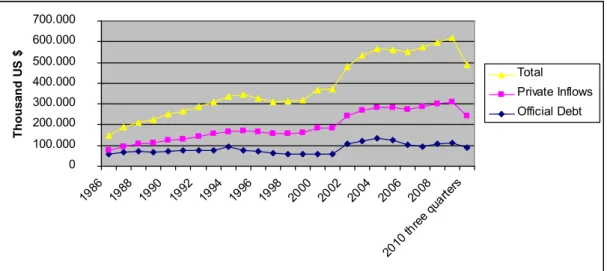
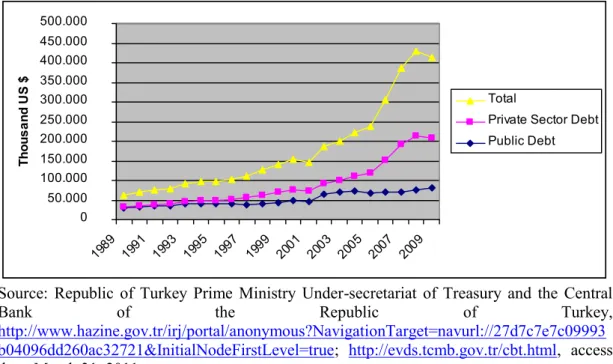
However, while there has been a decrease in the rate of official debt of Turkey, the share of the private inflows (portfolio investments, limited FDI mostly in the form of privatization and merger & acquisition) has been increasing (see Figure 1).4 Furthermore, the private sector debt and public debt have been increasing,
despite the decline in official debt (see Figure 2). Thus, the increasing autonomy in the Turkish financial system from the international financial institutions, as Öniş argues, should be analyzed carefully. Given the constant increase, particularly in the relative ratio of private sector to public sector debt in the total external debt, the vulnerability of the Turkish financial system should be considered. For example, between 2002-2009, the private sector debt increased 330%, whereas public debt at the same period increased 25%.
It is important to note that since the liberalization of financial market in Turkey in 1989 during the government of Prime Minister Turgut Özal, the transformation of state-business relations has started, because in the previous era of the Republic the business was dependent on state particularly in terms of accessing financial resources given the closed nature of the capital market. As Buğra states “financial dependence of the private sector on state subsidies has been too significant to enable businessmen to acquire an autonomous social position” (Buğra 1994, 51).
Thus, since 2002 the impact of the open economy and liberal capital market has been more observable in terms of the access of private sector to global financial resources as it is evident in the increase of private sector debt in Figure 2. In other words, Turkish economy continues to have its chronic problem of current account deficit and the consequent dependency to attract portfolio investment, FDI or debt into its capital account.
Figure 1 – Turkey’s official debt and private inflows values by years
0 100.000 200.000 300.000 400.000 500.000 600.000 700.000 1986 1988 1990 1992 1994 1996 1998 2000 2002 2004 2006 2008 2010 three quart ers Th ou sa nd U S $ Total Private Inflows Official Debt
Source: Republic of Turkey Prime Ministry Under-secretariat of Treasury,
http://www.hazine.gov.tr/irj/portal/anonymous?NavigationTarget=navurl://27d7c7e7c09993 b04096dd260ac32721&InitialNodeFirstLevel=true / Statistical data about public debt, access date: March 31, 2011.
Figure 2 – Turkey’s public and private sector external debt by years 0 50.000 100.000 150.000 200.000 250.000 300.000 350.000 400.000 450.000 500.000 1989 1991 1993 1995 1997 1999 2001 2003 2005 2007 2009 Th ou sa nd U S $ Total
Private Sector Debt Public Debt
Source: Republic of Turkey Prime Ministry Under-secretariat of Treasury and the Central
Bank of the Republic of Turkey,
http://www.hazine.gov.tr/irj/portal/anonymous?NavigationTarget=navurl://27d7c7e7c09993 b04096dd260ac32721&InitialNodeFirstLevel=true; http://evds.tcmb.gov.tr/cbt.html, access date: March 31, 2011.
Another major consequence of the 2008-2009 crisis is that the increasing efforts of Turkey to find new markets, when the EU, as the major trade and investment partner of Turkey, was struggling with economic difficulties (Öniş 2011, 58-59). According to Babacan, although new trade relations have softened the negative impact of the 2008-2009 financial crisis, the current account deficit problem of Turkey still continues largely because of its trade deficit (Babacan 2011, 154-155). He continues with that the current imparities in bilateral trade urge Turkey to find new trade partners and regions (Babacan 2011, 155). Thus, Turkey’s efforts to establish closer relations with the Middle East should be analyzed according to the urge in overcoming the current account deficit. In other words, the active foreign policy of the government should be assessed in light of the increasing private sector debt (see Figure 2) and the vulnerability to sustain private inflows (see Figure 1),
which in turn increases the motivation to gain access to new markets. Thanks to the global financial crisis, small and medium-sized business in Turkey, which is called ‘Anatolian tigers’, has been relatively transnationalized. Therefore, the civil society organizations and the interest group associations, which represent the newly rising Anatolian business class such as MÜSİAD, have become the central forces in Turkish foreign policy initiatives (Öniş & Güven 2010, 2-3; 13). Therefore, in contrast to the previous periods, foreign policy decisions are not just taken by the politicians and diplomats any more, rather economic and civil society forces have an influence to an extent in the decision-making procedures (Öniş 2011, 56; Kirişçi 2009, 42).
The active foreign policy orientation of JDP has significant positive returns in domestic politics as well. While the Turkish economy was suffering from the consequences of the global financial crisis (contraction of output and rising unemployment), foreign policy activism caused the government to maintain its popularity among the people (Öniş 2011, 57). Despite the deteriorating relations with the U.S. and Israel, stagnation in the EU integration process, improving relations with the neighboring states served the populist discourse of the JDP government and pleased the conservative political base of its supporters. While the relations with the West were getting conflictual, Turkey started to resolve its bilateral problems with Syria, Iraq and Iran. Although some politicians, scholars and intellectuals attribute this situation to the conservative Islamist orientation of JDP, there are other scholars who emphasize the economic factors (Kutlay 2009, 1). Accordingly, the rapprochement period with the neighbors derives from economic interests. For Kutlay, “the economic instruments, mainly trade and investment projects are used as facilitators in foreign policy” (Kutlay 2009, 1). In order to develop bilateral relations
with the neighbors and provide stability in the region, trade and investment are the most effective tools. For example, declining share of trade with the EU especially during the 2008-2009 crisis and increasing share of trade with the Near and Middle East was highlighted by Kutlay to support his argument (Kutlay 2009, 2).
Kutlay explains this trend with the neo-functionalist theory which implies the interaction between economic and political integration (Kutlay 2011, 69). The argument is that if there is integration in low politics such as in some economic sectors, it would lead to a political integration. Such initiatives are generally supported by the interests groups in a pluralist society, because in that way they would get much benefit due to the decreasing transaction costs and increasing economies of scale (Kutlay 2011, 70). Therefore, via economic integration, political conflicts would be resolved as a spillover effect. Although Turkish initiatives do not show the exact elements of the neo-functionalist theory, in practice increasing bilateral economic relations could create a healthier environment to discuss and resolve the political disagreements.
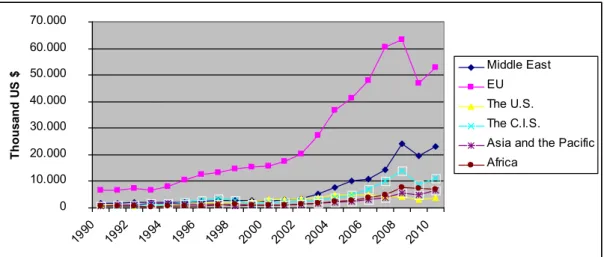
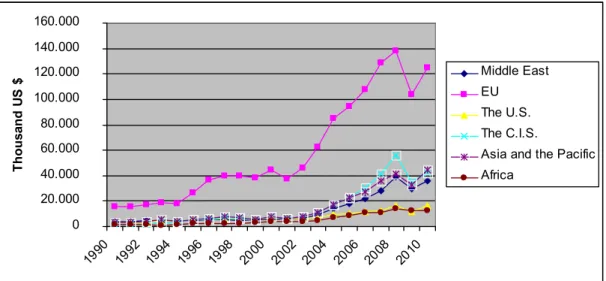
Despite fluctuations, there has been an increasing tendency in Turkey’s exports. After Turkey became member of the Customs Union in 1995, exports to the EU has dramatically increased as it can be seen in the Figure 3. On the other side, since 2002 when the JDP government came into power, we observe a clear increase in exports to the Middle Eastern countries (see Figure 3). Moreover, in comparison to the previous periods, there has been an increase in exports to the African, C.I.S. and Asian and the Pacific countries. Although the latter regions do not present a dramatic increase in exports, the increasing tendency cannot be ignored when we consider the increasing demand of the newly emerging business class for new markets in exportation, investment, tourism and also energy sectors. Accordingly, these efforts