ATOMIC AMBITIONS: A ROLE‐THEORETIC ANALYSIS OF BRAZILIAN
AND INDIAN QUESTS FOR NUCLEAR CAPABILITY
A Master’s Thesis
by
BENJAMIN A. REIMOLD
Department of
International Relations
İhsan Doğramacı Bilkent University
Ankara
September 2014
To my Parents
ATOMIC AMBITIONS: A ROLE‐THEORETIC ANALYSIS OF BRAZILIAN
AND INDIAN QUESTS FOR NUCLEAR CAPABILITY
Graduate School of Economics and Social Sciences of İhsan Doğramacı Bilkent University byBENJAMIN A. REIMOLD
In Partial Fulfillment of the Requirements for the Degree ofMASTER OF ARTS
inTHE DEPARTMENT OF
INTERNATIONAL RELATIONS
IHSAN DOĞRAMACI BILKENT UNIVERSITY
ANKARA
September 2014I certify that I have read this thesis and have found that it is fully adequate, in scope and in quality, as a thesis for the degree of Master of Arts in International Relations. ‐‐‐‐‐‐‐‐‐‐‐‐‐‐‐‐‐‐‐‐‐‐‐‐‐‐‐‐‐‐‐‐‐‐‐‐‐‐‐‐‐‐‐‐‐‐‐‐‐‐‐ Assist. Prof. Dr. Özgür Özdamar Supervisor I certify that I have read this thesis and have found that it is fully adequate, in scope and in quality, as a thesis for the degree of Master of Arts in International Relations. ‐‐‐‐‐‐‐‐‐‐‐‐‐‐‐‐‐‐‐‐‐‐‐‐‐‐‐‐‐‐‐‐‐‐‐‐‐‐‐‐‐‐‐‐‐‐‐‐‐‐‐ Assist. Prof. Dr. Paul Williams Examining Committee Member I certify that I have read this thesis and have found that it is fully adequate, in scope and in quality, as a thesis for the degree of Master of Arts in International Relations. ‐‐‐‐‐‐‐‐‐‐‐‐‐‐‐‐‐‐‐‐‐‐‐‐‐‐‐‐‐‐‐‐‐‐‐‐‐‐‐‐‐‐‐‐‐‐‐‐‐‐‐ Assist. Prof. Dr. Şebnem Udum Examining Committee Member Approval of the Graduate School of Economics and Social Sciences ‐‐‐‐‐‐‐‐‐‐‐‐‐‐‐‐‐‐‐‐‐‐‐‐‐‐‐‐‐‐‐‐‐‐‐‐‐‐‐‐‐‐‐‐‐‐‐‐‐‐‐ Prof. Dr. Erdal Erel Director
iii
ABSTRACT
ATOMIC AMBITIONS: A ROLE‐THEORETIC ANALYSIS OF BRAZILIAN
AND INDIAN QUESTS FOR NUCLEAR CAPABILITY
Reimold, Benjamin A. MA, Department of International Relations Supervisor: Assist. Prof. Dr. Özgür Özdamar September 2014
This thesis uses role theory to investigate the motivations of national leaders considering the acquisition of nuclear weapons. The correlation between expressed roles and proliferation decisionmaking is examined in the cases of Brazil and India within the framework of a most similar systems design. The material and ideational sources of Brazilian and Indian national role conceptions are traced using a model developed by Marijke Breuning (2011). In the Brazilian case, the expressed national role conceptions are found to be inconsistent with acquisition of nuclear weaponry, whereas in the Indian case, nuclear explosives were seen as powerful symbols consistent with the role conceptions of national
iv
leaders. The insights yielded by role theory in these cases provide a valuable addition to the existing nonproliferation literature.
Key Words: Nuclear Proliferation, Role Theory, Nuclear Weapons, Brazil, India
v
ÖZET
ATOMİK DÜŞLER: BREZİLYA’NIN VE HİNDİSTAN’IN NÜKLEER SİLAH
ARAYIŞINI ROL TEORİSİYLE ANLAMAK
Reimold, Benjamin A. Yüksek Lisans, Uluslararası İlişkiler Bölümü Tez Yöneticisi: Yrd. Doç. Dr. Özgür Özdamar Eylül 2014Bu çalışma, Rol Teorisi aracılığıyla ülkelerin liderlerinin nükeer silahlanma konusundaki motivasyonlarını araştırmaktadır. Çalısmanın vakası olarak seçılen Brezilya ve Hindistan örnekleri üzerinden, bu ülke liderlerinin benimsediği roller ve bu rollerden kaynaklanan nükleer silahlanma kararları arasındaki bağları incelemıştır. Bu analizde seçilen iki vaka birbiriyle en cok benzeyen sistemleri arastırma metoduyla karşılaştırılmıştır. Marjike Breuning (2011) tarafından geliştirilen modele göre liderlerin rol kavrayışlarının hem maddi hem de düşünsel katmanları değerlendirilmiştir. Bu çalışmayla, Brezilya vakasında liderler tarafından ifade edilen milli rol kavrayışlarının, nükleer silahlanma politikası ile uyusmadigi bulunmustur. Aksine, Hindistan vakasında, nükleer patlayıcıların bir statü sembolü olarak algılandığı ve liderlerin benimsediği milli
vi
rol kavrayışlarıyla tutarlı olduğu saptanmiştir. Bu çalışmayla Rol Teorisi’nin bu vakalardaki gözlemlerinin nükleer silahların yayılması literatürene katkı sağladığı savunulmuştur.
Anahtar Kelimeler: Nükleer Sılahların Yayılması, Rol Teorisi, Nükleer Silah,
vii
ACKNOWLEDGMENTS
I am very grateful to the following people for their investment in my academic progress and success:
First and foremost, I am indebted to my advisor Dr. Özgür Özdamar for agreeing to supervise this thesis and guide me during the writing process. I have learned much from his knowledge of current scholarship in International Relations and his obvious passion for understanding the mindsets of world leaders ever since my first class at Bilkent in Fall 2011. I deeply appreciate his patience and support though many meetings to hash out the structure and content of this thesis over the past year. I am also grateful to my thesis committee members Dr. Paul Williams and Dr. Şebnem Udum for agreeing to be on this panel and for their insights and constructive feedback. This thesis would not have been written were it not for the loving support of countless family and friends on both sides of the Atlantic. I will be eternally grateful for my Turkish classmates and friends, who made me feel more than at home during my time in Ankara. You welcomed me in and gave me a window into your language and culture, accepting me when I was unable to communicate and waiting patiently for me to catch up. I would like to extend a special thanks
viii to Ali Kök, Furkan Çimen, Fatih Bilge Atar, and the rest of the breakfast gang for many wonderful memories. Many thanks also to Can Oğuz, whose friendship has been a constant for me since my first week in Turkey. Our faithful department secretary Fatma Yılmaz has taken care of me so well and I am very grateful for all that she does to keep our department running smoothly. I am so appreciative of my colleagues in the Department of International Relations, who have always challenged me with their insights and passion for the field. I am especially grateful to Sercan Canbolat, Toygar Halistoprak, Mine Nur Kuçuk, Erkam Sula, Daniel Thames, and Haig Shishmanian for their friendship, support, and help in my development as a student, an academic, and as a person. Thank you for sharpening me as only iron can do.
ix
TABLE OF CONTENTS
ABSTRACT……….iii ÖZET………v ACKNOWLEDGEMENTS………..……… vii CHAPTER 1: INTRODUCTION……….……….………..……….1 CHAPTER 2: LITERATURE REVIEW………...……….8 2.1. Introduction………8 2.2 Historical Development………...8 2.3 Structure and agency: diversity of perspectives in role theory………...13 2.4 Evaluation……….27 2.5 Conclusion and Contributions………..………30 CHAPTER 3: METHODOLOGY………...32 3.1. Introduction……….32 3.2. Model and Hypothesis………...………32 3.3. Research Design………47 3.4 Case Study Structure……….….50 CHAPTER 4: BRAZIL: A BRIDGE FROM THE "WEST" TO THE "REST?"…………...53 4.1. Case Study Structure………..………53x 4.2. General Foreign Policy Outlook………...55 4.3. Brazilian Foreign Policy: Thematic Content……….59 4.4. Brazilian Nuclear Policy: Material Inputs………..71 4.5. Ideational sources of Brazilian role conceptions………..88 4.6. National Role Conceptions in Brazilian Foreign Policy……….96 CHAPTER 5: INDIA: "WE HAVE A BIG BOMB NOW"………116 5.1. Case Study Structure………...116 5.2. General Foreign Policy Outlook………118 5.3. Indian Nuclear Policy: Material Inputs……….145 5.4. Ideational Sources of Indian Role Conceptions………...156 5.5. National Role Conceptions in Indian Foreign Policy………164 CHAPTER 6: CONCLUSIONS AND IMPLICATIONS……….………184 BIBLIOGRAPHY……….…………..195
1
CHAPTER 1:
INTRODUCTION
The role of nuclear weapons in world politics has been a popular topic ever since the possibility of a super weapon harnessing the power of the atom was first introduced. In today’s international relations (IR) literature, the topic of nuclear proliferation has fluctuated in importance, with many scholars warning of “cascades” of states acquiring nuclear weapons and of the dangers of acquiring civilian nuclear capabilities. Why do some states seek nuclear weapons? While there are many diverse answers to this question, the current state of understanding nuclear proliferation has been hindered by a limited understanding of the symbolism of nuclear weapons and a state‐centric approach to nuclear decisionmaking that obscures the complex processes behind the choice to go nuclear. At first glance, there does not seem to be much of a puzzle when it comes to nuclear proliferation—most scholars conclude that states that feel threatened or isolated may turn to nuclear weapons as a means to balance external threats or solve their security dilemmas. Most of the literature addresses the issue from
2
this framework. Yet the vast majority of threatened states do not turn to nuclear weapons for their security. Still more puzzling, the number of states that possess the technical capabilities to produce nuclear weaponry is large and growing, yet the number of nuclear‐armed states has remained low. Argentina and Brazil renounced their nuclear ambitions and imbedded their nuclear industries in both regional and international safeguards regimes. In fact, a greater number of states have given up nuclear weapons in the past 25 years (South Africa, Kazakhstan, Ukraine, and Belarus) than have acquired them (North Korea, Pakistan). Surely there must be a deeper and more detailed explanation for why some states decide that the long and expensive road to nuclear armament is worth the hardship.
Additionally, there are significant obstacles to studying nuclear decisionmaking from a practical point of view as well. First, there are a limited number of cases—only nine states (the US, Russian Federation, China, UK, France, Israel, India, Pakistan, and North Korea) have acquired a nuclear weapons capability. Second, the unique characteristics and situation of each state make comparative study difficult. Scott Sagan (2011) points out that the reasons for some states’ decisions to pursue nuclear weapons programs are still unclear, even though each case is very high‐profile. He highlights the difficulty of even establishing when each state started exploring the possibility of a nuclear weapons program and in what year these plans were abandoned (Sagan, 2011, p. 227). The secrecy surrounding nuclear weapons programs hinders scholars’ efforts to gather even these very basic facts for comparative study.
3
Realist perspectives appear to be well‐suited to approach the proliferation puzzle, since they all focus on how states seek to help themselves through acquiring power and advantage vis‐à‐vis other states through material capabilities. Classical realist perspectives focus on external pressures that states interpret as threats to their survival. Acquiring nuclear weapons, therefore, is a rational means to maximize power in an uncertain world (Morgenthau, 1948). Lewis Dunn and Herman Kahn, for example, lists deterrence of nuclear‐armed rivals as key reasons for many states’ interest in nuclear weapons programs (1976, p. vii). Quests for regional status are also listed as contributing factors, but the origins of these desires are usually not examined in detail. According to realists, states see nuclear weapons as “playing‐field levelers”—acquiring atomic weaponry allows states to compensate for weaknesses in their conventional capabilities (Pakistan, North Korea).
In contrast, neorealists’ emphasis on structural factors seems more apt at explaining why certain states choose to “go nuclear” while others seem to seek other means of securing themselves. Structural realist scholars trace nuclear decisions to world system dynamics, namely the balance of power (polarity), great power politics, and security dilemmas (Mearsheimer, 1990; Waltz, 1981). Structural realists differ in their understandings of the implications of these dynamics, but all base their analysis on their basic understanding of the state as a comparable unit. Neorealism’s parsimonious approach regards domestic politics, individual leaders, and regime types as irrelevant for the behavior of states in the anarchic world system. States’ behavior boils down to ensuring their survival in response to the constant defining force of anarchy. This focus on the security dilemma and the “individualistic pursuit of security” (Jervis, 1982)
4
leads structural realists to view states as seekers of self‐help in a zero‐sum environment. From this perspective, states are seen as jostling for position with respect to each other; seeking relative advantages vis‐à‐vis other states and threatening to use force if necessary. One state’s development of nuclear weapons will cause other states to feel threatened and trigger them developing their own weapons programs in a chain‐like response. Thus realist accounts of proliferation focus on assessment of states’ technical capabilities since it is assumed that in the absence of security guarantees, states will seek to convert their technical capacity into nuclear weapons.
Challenging these assumptions, Etel Solingen points out many “dogs that didn’t bark”—states that didn’t turn to nuclear weapons even while facing security vulnerabilities according to the realist criteria (2007, p. 25). Egypt, Japan, South Korea, and Taiwan all were threatened by nuclear armed neighbors and regional rivals, yet refrained from establishing nuclear weapons programs. The realist response is that states that have powerful alliances or nuclear guarantees may not feel a need to develop nuclear weapons, yet North Korea, Iraq, Israel, and Pakistan all pursued nuclear weapons programs while having security guarantees with the US and USSR. On the flipside, when Libya, South Africa, Argentina, and Brazil each decided to formally renounce nuclear weapons, security guarantees from nuclear powers did not play a role in any of those nations’ decisions (Solingen, 2007, p. 25). This has occurred at the same time as a developing norm of non‐use of nuclear weapons has been observed by an emerging group of scholars, led by Nina Tannenwald (1999). Tannenwald’s concept of “nuclear taboo” traces the formation of this norm through
5
investigating the decisions of US policymakers through the end of the Cold War (1999).
This more complex picture of the proliferation issue leads to the research question of this thesis—why do some states pursue nuclear weaponry, while other states do not, even if they possess the technical capability to acquire them? This thesis investigates the underlying motivations behind the choice to “go nuclear”. In framing the issue of proliferation in terms of a choice, this thesis answers this question through interrogating the mindsets of national leaders and the domestic processes surrounding them. In doing so, any investigation of nuclear proliferation must enter the “black box” of the state to interrogate the dynamics unseen by the approaches described above (Hudson, 2005, p. 2). Domestic dynamics have a profound impact on a country’s foreign policy behavior, and policymakers play an integral role in the international trajectories of their nations. The perspectives offered by the Foreign Policy Analysis (FPA) subfield address these motivations and domestic processes through methodologically rigorous approaches. This thesis utilizes role theory to shed light on these dynamics and seeks to explain proliferation using a broader perspective.
First developed in the disciplines of sociology, social psychology, and anthropology (Neiman & Hughes, 1951; Sarbin & Allen, 1968; Turner, 1956), role theory was introduced to international relations and FPA by Kal Holsti in his seminal work on national role conceptions (NRC) (1970). Holsti postulated that national leaders understand their country’s foreign policy in terms of fulfilling a role within a social environment with other states. This role conception is
6 formed in the minds of policymakers as they draw on both domestic sources and external prescriptions from other states. As such, role theory models the links between the domestic processes and mindsets of leaders on the one hand, and the prescriptions of the international system on the other. This ability to place domestic dynamics in the context of the tensions between structure and agency makes role theory a promising framework of analysis for investigating the puzzle of nuclear proliferation. This thesis investigates the relationship between national role conception and proliferation policy. In defining national role conception as the independent variable of analysis, the sources of this NRC are also explored in depth. This is accomplished through the use of an model developed by Marijke Breuning (2011). The links between the independent variable and proliferation policy, the dependent variable in this analysis, are investigated through tracing what decisions related to nuclear weaponry are made by national policymakers in the study. This plan is applied to two cases in a comparative most similar systems design (MSSD) format. Brazil and India were chosen for this analysis based on their merits as comparable cases. As will be shown in the pages to follow, Brazil and India can be considered comparable cases based on their similar capabilities, history of non‐alignment, desire for great power status/permanent membership on the United Nations Security Council (UNSC), and the level of development of their nuclear industries. In the case of Brazil, the military government of 1965‐ 1985 considered acquiring nuclear weaponry, yet in the end, Brazil formalized its rejection of nuclear weapons and entered the Nuclear Nonproliferation Treaty
7
(NPT) as a non‐nuclear weapons state (NNWS). India, on the other hand, first detonated a nuclear test device in 1974, but did not move to weaponize the technology until after a second series of tests in 1998. India and its rival Pakistan both remain outside the NPT regime. The different policy outcomes in these cases allow the dynamics which led to this divergence to be investigated.
The structure of the thesis is as follows: first, the existing role theory literature is reviewed and this thesis’ contribution placed in the context of that literature. Next, the research design, variables and hypothesis, theoretic model, and methodology are established in detail. The model is applied to two cases, Brazil and India, identifying the sources of national role conceptions in each case and tracing the relationship between these NRCs and the actual policy pursued by the national leaders. In the final section the model is applied to the unfolding case of Iran’s nuclear program and the broader implications and significance of
8
CHAPTER 2:
LITERATURE REVIEW
2.1. Introduction Role theory has received little attention in the discipline of IR as a whole, but it has been experiencing a resurgence recently as Constructivist‐influenced perspectives become more common‐place in IR. As more scholars focus on the importance of identity and non‐material factors in international politics, role theory has recaptured the attention of many outside of its traditional realm of FPA. This literature review will begin with an overview of the historical development of role theory and an outline of its basic concepts, and then proceed to a discussion of some of the major divisions and differences within role theory scholarship. Finally, the current study’s contribution and placement in this literature will be discussed.
2.2 Historical Development
Before its introduction to the study of international relations, role theory experienced a long development in other social science disciplines, namely
9
sociology, social psychology, and anthropology (Neiman & Hughes, 1951; Sarbin & Allen, 1968; Turner, 1956). The idea of using the concept of ‘role’ to capture the relationship individuals have with a larger social group gained traction within international relations scholarship after K. J. Holsti’s seminal work adapted the role‐based approach to the problem of describing the foreign policies of states (1970). Holsti’s study identified 17 roles through analyzing statements made by foreign policy decision makers from 71 nations. According to Holsti, the sources of these roles are mainly geopolitical and material factors, rather than ideational or cultural. When ideational sources of role conceptions do appear in Holsti’s analysis, they appear almost exclusively in the context of the bipolar Cold War climate. Overall, Holsti’s work paved the way for role theory to be picked up by others as a theoretical tool in FPA.
Prompted by this initial effort, the first decades of role theory works in international relations focused mainly on adapting the theoretical terminology and frameworks present in sociological role theory to the study of international relations. Although this process resulted in a rich theoretical vocabulary able to characterize a wide variety of non‐material sources of foreign policy, role theory as a framework for analysis never caught the attention of the greater international relations scholarship. Role theory’s theoretic framework was solidified through the publication of Role Theory and Foreign Policy Analysis, edited by Stephen G. Walker (1987). Walker (1987) sets four key questions that a “robust” theory of roles should ask:
5. What is a role?
6. What are its sources?
10
8. Why are these conditions relevant?
Borrowed from the language of the theatre, the concept of role has proved to be a rich cornerstone on which to build the theoretical vocabulary of role theory. Generally, role theory scholars define role as behavior stemming from a normative understanding of a certain pattern. Holsti defined the term role as behavior (both decisions and actions), informed by the “norms and expectations cultures, societies, institutions, or groups attach to particular positions” (1970, p. 239). Phillipe G. Le Prestre defines role as “expected behavior based on certain rules” (1997, p. 4). Bruce Biddle takes a slightly different definition, stating that roles are shared, normative, expectations that prescribe behavior (1986).
Holsti draws a line of distinction between role and role behavior or
performance, where the former is the actor’s ideal conceptualization, while the
latter is the actual enaction of that conception. Generally in the context of international politics, role performance refers to foreign policy decisions and behavior. According to role theory, the source of positions which form the basis for role performance is twofold: role prescriptions, or normative projections on the position from culture and social institutions, and role conceptions, the actor’s own understanding of the position and appropriate behavior. Holsti states that the resulting social behavior is a “combination of self‐defined goals and norms of conduct, a variety of situational variables, and social norms and expectations” (1970, p. 239). In making this observation, Holsti gave importance to norms and social interaction in international politics before the constructivist turn in IR decades later. In role theory, the actor’s own agency to create role conceptions is
11
dubbed the “ego”, while the normative role of external factors is summarized as the “alter”, both terms stemming from social psychology.
In the real world, actors often find themselves having the opportunity to perform more than one role in a given situation. When these positions contradict each other, the result is interrole conflict (Barnett, 1993; Cronin, 2001; Tewes, 1998). Barnett (1993) looks at the role conflict that arises when states are members of institutions with conflicting or inconsistent role requirements. He uses the example of the ‘Arab states system’ with its conflict over respect for sovereignty on the one hand and Pan‐Arabic attempts at unification on the other. Cronin (2001) argues that superpowers face tension between the role of hegemon and that of great power, between the demands of leadership of the international system and of exercising superior material capability. He looks at the example of the US‐UN relationship with respect to the handling of Iraq between 1991‐1999 and finds that the United States sometimes chooses to submit itself to UN procedure, while in other cases choosing for more unilateral action, behavior he attributes to role conflict inherent in the position of being a superpower.
Finally, Tewes (1998) examines Germany’s attitude towards EU
enlargement in Central and Eastern Europe (CEE) in the post‐Cold War period. He describes how Germany’s role within the EU of pushing for deeper integration was challenged by the prospect of eastern expansion. Tewes chronicles how Germany under Helmut Khol’s leadership attempted to resolve this role conflict through first denial, then through oscillating between the
12
conflicting roles, then finally by attempting to link the two contradictory roles into a role merger (Tewes, 1998, p. 127).
Another key aspect of role theory is the audience. The audience observes the process of role formation and enaction and may passively or actively interact with the performance, as long as the actor’s behavior is public and observable (Thies, 2013, p. 35). The response of the audience, either negative or positive, serves as feedback that helps to shape future role behavior. According to Sarbin and Allen (1968, p. 534) , the audience validates the appropriateness of the role while giving cues on expected patterns of behavior. This is reinforced through positive and negative feedback in response to the actor’s role enaction, with the audience tending to reward stable role behavior over time.
The process of settling into a ‘proper’ role is known as role location. Based on what it infers from the audience, as well as its own perceptions of the prescriptions and expectations associated with the position, the actor locates the role and deems it appropriate for the situation. Thies (2012, 2013) equates role location with state socialization and views determination of roles as a bargaining process involving the actor’s perceptions of the positions of both self and other. In contrast, Walker (1981, 1987) views this process through the lens of exchange theory. According to Walker, the distance between role conceptions and structural cues is directly related to the level of stability and ambiguity of the role location process. When the actor’s role conception and the cues from the audience are consistent with one another, the role location process is relatively smooth and the structure tends to reward actors with conceptions consistent with its cues. When significant inconsistencies exist between the two, however,
13
the role location process becomes one of conflict as the audience seeks to force the actor into an appropriate role through punishment or aggression.
With a few notable exceptions (e.g. Walker, 1987), most studies that used role theory during this period were located strictly within FPA and did not attempt to dialogue with wider theoretical debates in IR. Those that did engage, did so almost exclusively within a narrow structural realist framework (Walker, 1979, 1987, 1992; Wish, 1980). These studies were produced overwhelmingly by American scholars grounded in the use of cognitive approaches to foreign policy analysis. This group received company with the advent of Constructivism. With Wendt’s oft‐cited article on the social construction of anarchy (1992), role theory was adopted by a new series of scholars attempting to account for ideas, identity, and other social factors in the foreign policy of states. Responding to Wendt’s challenge to develop an empirical framework which incorporated social constitution of actors at its core, academics began using role theory to discuss questions of identity in foreign policy. Whereas American scholars tended to focus on cognitive (and therefore more unit‐level) approaches, these mainly European scholars tended to have a more structural or systemic focus. In the next section, the major divisions between these two camps will be explored with respect to their definition of role, relationship with the structure‐agency debate, and methodology. After this, a third group of works motivated by integrating role theory into IR theory will be presented.
14
2.3 Structure and agency: diversity of perspectives in role theory
In the years since Holsti first introduced the language of roles to the discipline of foreign policy analysis, scholars have developed a wide variety of perspectives on how roles explain different aspects of international politics. Although an initial group of scholars began to both expound Holsti’s theoretical framework and apply it to specific cases in international politics (e.g. Shih, 1988), the impact of role theory was not really felt outside of the scope of FPA. Constructivism brought a renewed interest in the role of identity, culture, and social interaction to a wider audience in IR (Checkel, 1998; Weldes, 1996; Wendt, 1992, 1999), and provided an impetus for a new wave of norms‐based role theory scholarship (Thies & Breuning, 2012). The current state of role theory in IR can be divided into two rough camps based on their relationship to IR theory: one group of role theory scholars have studied foreign policy at the state‐level while remaining within the traditional bounds of FPA, while the other has been more open to incorporating constructivist insights on national identity and the importance of ideology and norms in foreign policy decision making. This trend follows wider trends within the FPA discipline as a whole (Kaarbo, 2003). In the following sections, these groupings will be explored further. Structuralist Perspectives In his seminal study, Holsi identified 17 distinct role conceptions through an analysis of statements uttered by the foreign policy makers of 71 different states. The sources of Holsti’s role conceptions are mainly geographic and material factors, rather than ideational or cultural. The only exceptions are the ideational motives expressed by mainly Communist‐bloc states, yet these
15
sources are assigned no meaning outside the bipolar framework of the Cold War. After introducing the concepts of role tension and role conflict, Holsti pairs roles he deems to be incompatible to look for the signs of the stress actors caught between contradictory role conceptions. Holsti focused on states’ relationships with the Cold War conflict (satellite, non‐aligned, faithful ally, etc.) as their main role in the international system. With the end of the climate of bipolarity, states began to express their identities in new ways outside of the old Cold War framework. Perhaps anticipating how his work might be misused, Holsti warned that “careless use of these terms may hide more than they explain about a government’s foreign policies” (1970, p. 308). Overall, Holsti’s contribution remains relevant today—he introduced the theoretical language still in use—but remains limited by the historical context of when it was written.
Wish (1980) followed Holsti in producing a large‐n sample of NRCs, looking not just at relationships with superpowers, but at more regional relationships as well. Her study attempted to categorize a wide variety of national role conceptions, not just “the perceptions of the superpowers (Wish, 1980, p. 535). These conceptions were then compared with actual foreign policy behavior using the Comparative Research on the Events of Nations (CREON) data set. Wish came to many similar conclusions as Holsti using a wider sample of data while focusing more on role performance rather than the sources of role conceptions. Wish’s major contribution to the role theory literature was the finding that leaders from the same state had more similarity in role conceptions with respect to each other when compared with those of other states.
16
Although Wish’s key finding seemed to indicate the importance of domestic sources of national role conception, subsequent studies concentrated on other, more structural dimensions of role theory. Walker (1987) seeks to merge role theory with structural realism in connection with Waltz’s Theory of
International Politics (1979). Walker understands the self‐help nature of the
Waltzian international system to emphasize foreign policy behavior of states as the primary means for advancing domestic policy goals. Following Waltz’s separation of levels of analysis, Walker proposes four mechanisms to describe the interaction between unit and structure. First, the previously mentioned exchange process incorporates the cues and response of the audience to the actor’s role conceptions. Second, the role location process describes the actor’s incorporation of cues and its own internal perceptions to arrive at a shared set of role expectations. Third, Walker proposes a process of role conflict to explain what happens when these shared expectations break down. Finally, Walker theorizes that an institution‐building process formalizes the expectations formed through the previous processes, informing future role conceptions. Walker then tests these propositions through a study of states seeking aid in the context of the Cold War. He observed that states that provided aid did so when it was beneficial for their own domestic contexts. When aid was denied, the would‐be recipient would either turn to another source or continue to persist in asking for assistance. Walker saw at the heart of the patron‐client relationship a drive for each state to pursue its own domestic policy goals. When these goals became unachievable due to negative pushback from other states in the system, he observed a type of negotiation, which he modeled using a modified version of exchange theory. Walker identifies five basic roles states can play in the
17
international system: consumer, producer, belligerent, facilitator, and provocateur. In the end, Walker showed how a closer connection between role theory and other perspectives (most significantly IR theory) could result in important insights. Yet the roles he identified remain chained to the Cold War context he was attempting to explain, and his focus on structure prevented his analysis from benefiting from a more detailed focus on domestic factors affecting the role location process. Other studies would fill in the domestic gaps, providing additional insights.
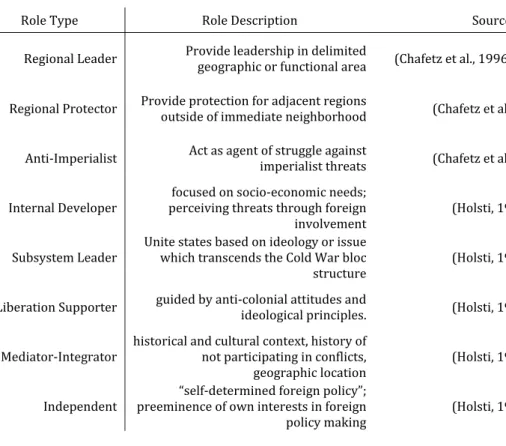
For example, Chafetz, et al. examine the decisions of the Belorussian and Ukrainian governments to give their inherited Soviet nuclear weapons back to the newly‐formed Russian Federation using a role theory‐based framework. The authors looked at statements by decision makers at the highest level concerning foreign and defense policy to determine their national role conceptions. According to the authors, roles give actors “a stable sense of identity” (Chafetz, Abramson, & Grillot, 1996, p. 733). Chafetz, et al. took the original list of roles identified by Holsti (1970) and categorized them as “roles that guide states toward, roles that guide states away from, and roles that are indeterminate with respect to compliance with the nuclear non‐proliferation regime” (1996, p. 733). They identify four roles which tend to lead towards seeking nuclear weapons: regional leader, global system leader, regional protector, and anti‐imperialist. Chafetz, et al. hypothesized that Belarus would be likely to return their nuclear weapons easily because the Belorussian NRCs they identified were not associated with nuclear proliferation. In contrast, the Ukraine would consider retaining a nuclear deterrent in keeping with Ukrainian leaders’ perception of their nation’s role as a leader in the region and balancer against Russian
18
influence. After concluding their analysis, Chafetz, et al. acknowledge that the roles they identified neither predict nor explain policy decisions regarding nuclear weapons—they conclude that there must be a “third factor” or variable which contributes to a desire for nuclear weapons (1996, p. 749). Chafetz, et al. have been criticized for conflating role and identity, at times using both terms interchangeably (Kaarbo, 2003). This conflation has the potential to obscure the subtle yet important differences between identity and other sources of role, and the role itself. In addition, Kaarbo points out that this enables other scholars to reinvent the “role wheel” with a focus on identity, missing the potential
contributions of a more rigorous role theory (2003).
Philippe G. Le Prestre’s important edited volume, Role Quests in the Post‐
Cold War Era (1997), provides a comprehensive example of a role theory based
analysis of post Cold War policy making. Through individual chapters on the USA (Chotard, 1997; Le Prestre, 1997), Russian Federation/USSR (Thibault & Levesque, 1997), China (Beylerian & Canivet, 1997), Japan (MacLeod, 1997b), Canada (Donneur & Alain, 1997), Germany (LeTourneau & Rakel, 1997), France (Thumerelle & Le Prestre, 1997), and the UK (MacLeod, 1997a), the authors of
Role Quests examine how these states experienced the dynamic conditions in
international politics from 1989‐1993. All the authors used a unified methodolgy (rare for edited volumes), yet each author was given enough discrecion to develop their own interpretation—a strategy which contributes to the success of the authors’ analysis. In his introduction to the book Le Prestre describes the methodology and identifies the three central variables of the study: identity, status, and role. Yet because each individual author defines these terms slightly differently based on the state they are studying, distinguishing the
19
conceptual differences between status, identity, and role is difficult and the relationship between them is unclear. This makes it difficult to compare cases to each other given discrepencies in the understanding of role used by the authors. Rather than identifying a single formulaic pathway for the development of national roles, Le Prestre deems identity and status as two “poles of influence” which comprise internal and external determinants on the expressed roles. According to Le Prestre, the balance of contribution from identity and status may vary from state to state. However, as Kuzma points out in her review article (1998), Le Prestre et al. fail to show role theory as capable of producing foreign policy insights that other existing FPA approaches are not already making with a higher level of detail. While the scope of the work done by Le Prestre et al. is certainly impressive, their work falls short of taking advantage of the rich social aspect of role theory, opting instead for a more structural variant. More recent work in this camp of role theory includes Walker, Malici, and Schafer’s edited volume (2011). Walker et al. advocate for the merging of cognitive approaches to FPA borrowed from behavioral psychology with Waltzian structural IR theory. Walker proposes a “binary role theory” to explain the exercise of social power (foreign policy behavior) and cognitive power (bounded rationality). He deems his conceptualization as “binary” because in realism all power is distributed as either symmetrical or asymmetrical, and interests either as vital or secondary. According to Walker, role location is a process of both “navigation and construction. The interactions of Ego and Alter communicate, define, construct, and alter a definition of the social self‐in‐ situation” (Walker et al., 2011, p. 270). According to the authors, the relationship
20
between Ego and Alter is a recursive (two‐way) system seeking equilibrium. That is, the system tends towards stability as Ego and Alter resolve their diametrical oppositions through an adaptive, recursive relationship.
Walker et al.’s major contribution to the literature is their conceptualization of this process of role location as a recursive interaction of Ego and Alter. For Walker, Ego is the cognitive dimension of the decision maker’s own viewpoint; Alter represents the material, geographic, and structural dictations of the system on the actor’s available options. While significant for its attempt to incorporate behavioral and structural theories of foreign policy analysis, Walker et al. leave the sources of decision makers’ own identity conceptions unexplored. Identity components such as culture, history, and nationalism are assumed to be incorporated in individual leaders’ cognitive processes. This enables Walker, et al. to connect their structural role theory to a cognitive theory of leader’s operational codes. Ultimately, Walker, et al. portray role theory as a flexible and relevant tool for viewing both micro and macroscopic processes in international politics.
Overall, without a proper treatment of the ideational sources of role conceptions, structurally‐focused role theory approaches have limited insights for a world no longer defined by the Cold War conflict. From a more theoretical perspective, the continued focus on structural factors comes at the expense of incorporating social identities in the analysis. When compared with other FPA perspectives that are more grounded in models of domestic politics, these behavioral models seem to have much more predictive power. Yet for other scholars, role theory’s value comes from its inclusion of socialization processes, norms, and ideational variables to the study of foreign policy and international
21 politics. In the next section, this group of scholars will be introduced, as well as several recent attempts to use role theory to connect FPA with wider discourses in IR theory. Agent‐Centered Perspectives More recent role theory research has moved away from limited structural perspectives and towards a more agent‐centered approach. Rather than focusing on how role conceptions are “handed down” by the rigidity of the international system, these scholars have focused more on the actors’ own NRCs and their ideational and material sources. However, this stream within role theory would benefit from lessons learned in FPA about the nature of the international‐domestic foreign policy nexus and the cognitive processes of leaders. Overall, constructivist scholars have been ‘rediscovering’ role theory as a methodologically rigorous tool for studying the interaction between agency and structure, a key focus of the constructivist paradigm.
In her chapter of Harnisch, Frank, and Maull’s edited volume (2011), Marijke Breuning locates current role theory scholarship within the wider theoretical discussion about the relationship between agency and structure, while remaining committed to empirical efforts to identify generalities in international politics through hypothesis testing, falsification, and methodological consistency. A focus on roles, according to Breuning, holds great promise because at a fundamental level constructivism understands foreign policy behavior as both being a product of a socialization process as well as having a socially‐interpreted meaning. Role theory in turn, offers the
22
constructivist paradigm an empirical toolkit capable of identifying patterns in complex cases without oversimplification. Breuning points out how constructivist work on identity and self‐image largely ignores previous work on those topics within role theory. She observes that like most role theorists, constructivist scholars are attempting to view states’ behavior not just as the consequence of their material capabilities, but rather understand the perspective of decision‐makers and their interpretations of their social context.
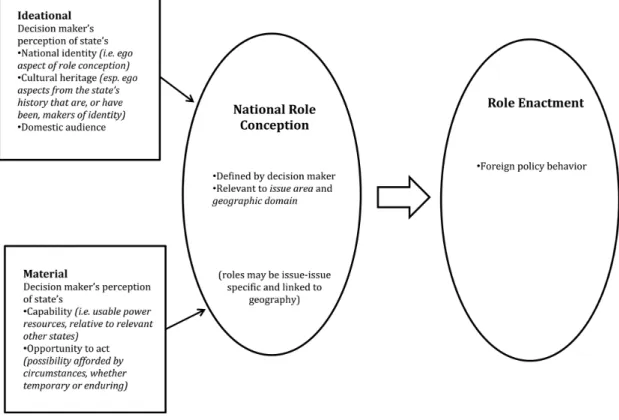
Breuning pieces together a comprehensive framework for understanding the agency‐structure problem centered around the national role conception. She views the national role conception as defined by policymakers and relevant to specific issues and geographic contexts. She classifies the sources of role conceptions as ideational and material. Ideational sources of role include the decision maker’s perception of the state’s identity, cultural heritage, and domestic audience. Material sources summarize the decision maker’s assessment of capability and opportunity to act. These sources feed into a national role conception, which is then enacted through actual foreign policy behavior.
First and foremost, the phrase “decision maker’s perception” is important because the actor in question has cognitive agency to determine the relative importance of these various inputs to the role conception. In addition, even seemingly‐easily quantified concepts like material capability prove difficult for researchers to nail down objectively, let alone complex variables like culture, history, and national identity. This brings together a focus on the agency of the actor in question with a cognitive model present to describe the role conception process.
23
Bruening sees the inputs of an actor’s national role conception as twofold: she breaks them down into the decision maker’s own perceptions of the state’s identity and of material capabilities. The decision maker’s perception of their state’s unique identity, cultural heritage, formative events in history, and domestic audience all contribute to the ideational sources of national role conceptions. Structural sources of role conception contain the decisionmaker’s perception of the state’s usable power resources, (i.e. material capabilities) as calculated relative to other relevant states and the opportunity to act given their perception of their circumstances (both in the long and short‐term) (Breuning 2011, p. 26).
Some role theory scholars concentrate their efforts on the interaction between structural and unit levels, while others place the decision maker at the heart of their analysis. Aggestam (2004) compares the role statements of three states, Britain, France, and Germany, with regards to both domestic and supranational levels of analysis. She defines role conception as a collection of norms that catalog expected behavior, a ‘road map’ used by policy makers to simplify the decisionmaking process. Aggestam breaks her analysis into two sections: a focus on the relationship between policymakers’ understanding of national identity and foreign policy behavior, and a section on ‘Europeanization’, or the effects of state socialization on individual national foreign policies. She further develops a framework for analyzing these structural role prescriptions in the context of the prospect of a single European Union foreign policy in her chapter of Elgström and Smith’s edited volume (Aggestam, 2003). Generally, the contributers to Elgström and Smith (2003) look at ideas, norms and their institutional acceptance. The authors remain well within realm of constructivist
24
high‐level theorizing and rarely investigate individual decision makers or unit‐ level processes. Yet in this social environment, change clearly occurs through such unit‐level processes. Overall, Elgström and Smith and their contributers would have benefited from devoting more attention to the unit‐level sources of norm development in the European Union context.
In contrast, Bruening (1995) focuses directly on the unit level through her emphasis of the centrality of decison makers. Breuning uses a similar systems design to compare the Netherlands, Belgium and Great Britain with respect to their foreign aid policies. She organizes her research typologies according to two questions actors face: first, does the international environment generally constrain them or present opportunities for action, and second, is the international environment essentially orderly or anarchic in nature? This yields four different role conceptions for comparison: Good Neighbor (constraint and orderly environment), Merchant (constraint and anarchic environment), Power Broker (opportunity and anarchic environment), and Activist (opportunity and orderly environment). Breuning specifies that these roles are issue specific, in this case referring to each nation’s foreign aid policy. Breuning looks for evidence of these role conceptions through content analysis of parliamentary debate on the issue. She then examined the relative size and type (bilateral vs. multilateral) of each states’ foreign assistance budget. In her analysis, Breuning assumes that “individual differences between decision makers who represent the same state are bounded by parameters defined by their commonalities” (1995, p. 253) and finds that national decision makers consistently emphasize the same reasons for foreign assistance regardless of party. Overall, Bruening’s analysis emphasizes the centrality of decision makers to a role theory‐based research
25
program and the importance of the role concept for tracing the rhetoric of decision makers to the actual policy actions.
Within the camp of scholars influenced by Wendt’s work on identity formation through interaction, two subgroups can be identified. Some scholars, including Catalinac (2007) and Walker, et al. (2011), incorporate elements of Wendt’s identity theory while continuing to focus on the resulting foreign policy behavior in keeping with the FPA research program. Others, including Trondal (2001), Tewes (1998), Aggestam (2003, 2004), and Brittingham (2007) use role theory as a tool to explore the foreign policy implications of identity.
Trondal (2001) uses role theory in an attempt to bridge the constructivist‐institutionalist divide. According to Trondal, organization theory is focused on the structural constraints of the behavior of individuals in an institutional setting. Constructivism, on the other hand, puts central features of the self as variables, such as identity, role conception, norms, etc. Trondal states that constructivism is mainly abstract and theoretical in nature, lending itself well to integrative efforts with other existing perspectives in IR She investigates the role conceptions of national government officials who participate in EU committees, asking whether they personally consider their role primarily issue‐ area expert, national representative, or supranational agent. Through these interviews with decision makers, Trondal observes a ‘logic of appropriateness’ in how policy makers display different roles based on their institutional contexts.
Like Trondal’s study (2001), Catalinac (2007) turns to a form of role theory in order to substantiate the abstract constructivist framework she is using to explain why Japan reacted differently to international calls for its participation the 1991 and 2003 Iraq Wars. Catalinac examined decision
26
makers’ rhetoric regarding the question of Japanese involvement in the conflict and summarized the statements into three roles expressed during this debate: Pacifist, Pragmatic Multilateralist, and Centrist. She only views role statements directly associated with the Iraq war decision, looking at both the content of the statements and the level of contestation of the referent identity in the context of the statement.
While Catalinac is concerned with a single decision point, Brittingham (2007) takes a broader look at identity and nationalism through a role‐based perspective in his article on Chinese nationalism. Brittingham defines role as “identity mobilized in a specific situation” (2007, p. 16), and therefore treats Chinese nationalism as a role or specific manifestation of Chinese identity. This seems to contradict his claims that Chinese nationalism can be understood as a reactive response to international events rather than domestic political manipulation.
Overall, while constructivist perspectives in role theory have successfully shifted the focus from structural treatments of role to more identity‐based accounts, this literature suffers from a lack of methodological consistency. There is very little agreement even on what constitutes a role—is role a grouping of associated norms (e.g. Catalinac 2007), is it a mobilization of self‐identity (e.g. Brittingham 2007), or understood best in a social context (eg. Trondal 2001)? Without much methodological consistency, it is difficult to find common points of reference with the other strands in the role theory literature. Although there are quite a few constructivists who have used role theory as part of their own interest in identity, there are few constructivist scholars interested in engaging the whole of the role theory literature and advancing it as a valid methodology.
27
In response to these trends, a third group of role theory scholars has been advocating for more fundamental integration of role theory with IR theory.
Integrationist Perspectives
This group of role theorists seeks to integrate role theory and IR theory through developing methodological consistency and engaging concepts within the realm of IR theory instead of remaining confined to the more narrow scope of FPA. While remaining focused on foreign policy behavior of states, these scholars are interested in questions also being addressed by IR theory. The contributors to the recent (2012) special issue of Foreign Policy Analysis suggest several avenues regarding this integration. Thies (2012, 2013) has pursued a focus on the socialization of states, Harnisch (2012) explores interactionist perspectives on foreign policy learning, and Bengsson and Elgström (2012) focus on the mutually‐constitutive tension between agency and structure in the role performance of actors and its change over time. Overall, Thies and Bruening (2012) call for a return to the methodological rigor of earlier role theory scholarship with an openness to the constructivist emphasis on identity. Similarly, they advocate a more nuanced understanding of role theory which would better incorporate the agency‐structure paradigm, while retaining the sound empirical methodology which allows for scholars to give policy‐relevant advice (2012, pp. 2–3).
28
2.4 Evaluation
This brief survey of the role theory literature has shown the diversity and richness of role‐based perspectives in international relations. In this section, trends previously identified in the literature and the present survey’s contribution and placement will be explored. Overall, the role theory literature has experienced trends towards a balanced understanding of the identity and systemic contributions to role conceptions while at the same time deepening connections with IR theory.
Culture and national identity are important sources of the role conceptions of policy makers. Wish (1980) observed that leaders from the same state have more similar role conceptions than with the leaders of other states. Hudson and Sampson postulate that leaders are successful when “they articulate a vision of the nation’s role in world affairs that corresponds to deep, cultural beliefs about the nation” (1999, p. 669). In effect, a nation’s culture and history are crucial sources of its role conception set. Shih’s (1988) analysis of Chinese political and philosophical thought is an impressive example of how culture and history can be incorporated into a role‐theoretical analysis. Shih criticizes Holsti’s “inductive” typology as being devoid of the “richness of human cultures” (1988, p. 600), and argues that national role conceptions are cultural and historical products. Shih identifies a collection of contributions to Chinese identity, and postulates that which ones rise to the top at any particular time is more a result of leadership style and “domestic balance of power” than international structure (1988, p. 626). Overall however, culture and national identity have been somewhat haphazardly incorporated into role theory
29
analyses, and the literature would benefit from studies using a more robust methodology to investigate their contributions.
One problem with many works in the role theory literature is that they are too broad, either focusing on many states and many issue contexts (Holsti, 1970; Wish, 1980), or focusing on only a single state in many foreign policy contexts (Catalinac, 2007; Shih, 1988). Studies based around comparing multiple states with respect to a single issue tend to have much more significant insights (Breuning, 1995; Chafetz et al., 1996; Maull, 1990).
On a related note, Breuning identifies four broad areas of weakness for further empirical research in role theory. First, she suggests incorporating prospect theory’s understanding of decision makers’ perspectives and insights on decision framing by leaders. Leaders often use their experience and opinions surrounding prior events to frame their opinions about the current issue at hand. This may involve the use of analogies, a phenomenon explored by (Chafetz et al., 1996). Second, investigating the relationship between general ideas held by citizens and the role conceptions of leaders shows promise as another area of future research. Shih’s work on the ideological and cultural sources of Chinese political thought (1988) is an important example but falls short of sketching out the connections specific leaders make with these ideas as they are held by the general population. Future role theory scholarship would benefit from investigating how widely role conceptions held by the decisionmaking elite are shared by their average citizens.
Bruening identifies adaptation and change of role conceptions over time as a third area for further research in role theory. What sort of factors lead to change in national role conceptions? How much agency do individual leaders
30
have to be role innovators, and what sort of pushback do they experience from their societies? A fourth area for further research is investigating how decision makers hold multiple roles simultaneously. Holsti tallies the number of roles expressed by different states in his study (1970) and Breuning (1995) finds that analyzing the role conceptions of a small group of states with respect to a single issue to be fruitful. Focusing on multiple role conceptions, whether they are acted upon or not, gives role theorists access to the process of decision‐making and the how different streams of thought are reflected in the debate surrounding foreign policy. In addition, two states’ foreign policy behavior may be identical, but they may be acting from completely different role conceptions—focusing on multiple role conceptions helps identify these and other subtleties. 2.5 Conclusion and Contributions
In conclusion, role theory has experienced a wide variety of different usages in the study of international politics. Beginning with Holsti’s adaptation of the role‐based perspective from social psychology, role theory has experienced several waves of scholarship focusing on both structural and ideational sources of roles. Many early works in role theory scholarship viewed roles through the lens of the Cold War dynamic, while subsequent studies took a less structural and more domestic approach. This shift was paralleled by a growing interest in identity in IR after the end of the Cold War and the advent of constructivism. While a few studies attempted to connect role‐based work to broader trends in IR theory, generally the insights of role theory did not reach beyond a limited FPA‐focused audience. The continued importance of culture,
31
cognitive processes of decision makers, and a renewed interest in the relationship between agency and structure will ensure that role theory remains a relevant option for scholars seeking to explain the dynamics of state behavior in the international system for many years to come.
In light of this evaluation, the contribution of this current study will be now be explored. On the one hand, the question of nuclear weapons has long been dominated by structurally‐focused approaches, so external role prescriptions regarding nuclear weapons policy must be taken into account. On the other hand, the contribution of identity has been underexplored so far in the literature, with the most obvious example being the conflation of identity and role by Chafetz, et al. in their piece on nuclear weapons acquisition. The connection between nuclear weapons and identity has been explored in other disciplines (e. g. Abraham, 1998, 2009), but understudied in IR and FPA. This study attempts to contribute to both the fleshing‐out of identity as a source of role conception while at the same time bridging a role theory‐based analysis with wider trends in IR theory.
This thesis seeks to contribute to the role theory and nuclear proliferation literature through tracing the material and ideational sources of national role conceptions. Additionally, it will identify policymakers’ dissatisfaction with the international hierarchical status quo, with a special focus on factors which contribute to policymakers expressing roles conceptions in confrontational or oppositional ways. The thesis employs the model proposed by Breuning in her 2011 book chapter on role theory, a model which follows the role formation process starting with material and ideational sources of national role
32 conceptions and connecting these conceptions to actual foreign policy behavior. This model is explained in more detail in the following section, which describes the methodology of this the thesis.
33
CHAPTER 3
METHODOLOGY
3.1. IntroductionIn this chapter, the thesis methodology is established. This project will use a most similar systems design to compare two historical cases of nuclear proliferation using role theory. After discussing various role‐based typologies already present in the literature, I propose my own modified version of Holsti’s identified roles through investigating the statements of policymakers where possible. The application of this typology to the cases and the overall structure of the case study analysis will be outlined, with emphasis placed on locating decision makers’ role conceptions in the wider context of their states’ foreign policy, history, and societal norms.
34
3.2. Model and Hypothesis
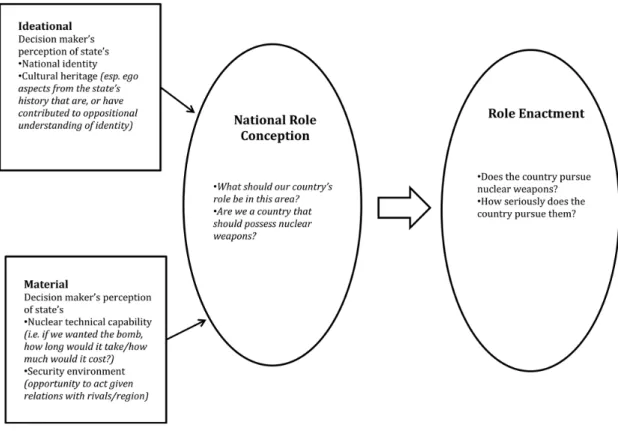
This section introduces the theoretical model and hypothesis of the thesis. This study uses a model based on a role theory framework developed by Marijke Breuning (2011). Her framework incorporates both material and ideational inputs of the national role conceptions held by policymakers. Breuning’s model captures the essence of role theory’s position between structural and agent‐ focused approaches by highlighting the mechanics of role conceptions in the minds of decision makers. This cognitive model is displayed in Figure 1 below:
Figure 1: Breuning model of national role conception process (Breuning, 2011)
According to Breuning, the sources of policy makers’ national role conceptions can be grouped into two categories: ideational and material (2011). Ideational sources consist of the decision maker’s perception of their state’s identity, cultural heritage, and public opinion (Breuning, 2011, p. 26). Of special
35 interest is the decision maker’s perception of key events and phenomena in their state’s history which have contributed to an understanding of national identity for some segment of the population. The material sources of role conception, on the other hand, consist of the decision maker’s perception of their state’s relative power capabilities with respect to other states and their understanding of their state’s “opportunity to act”, or their perception of a particular environment surrounding a decision (both temporary and enduring) (Breuning, 2011, p. 26).
In her chapter, Breuning emphasizes that national role conceptions can be linked to particular foreign policy issues and or specific geographies (2011, p. 32). This point makes the model flexible and applicable to describe and yield explanatory power to a wide variety of foreign policy events. Nuclear proliferation as a foreign policy phenomenon is no exception. The next section will present a modified version of Breuning’s model specific for nuclear proliferation.
Proliferation‐Specific Model
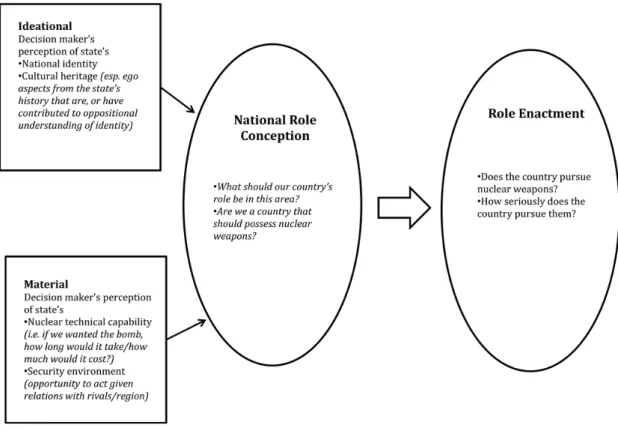
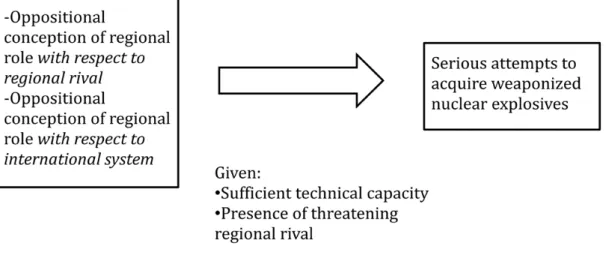
In the proliferation‐specific model, decision makers are faced with two crucial questions: What should be our country’s role in this policy area, and Are we
a country that should possess nuclear weapons? In answering these questions,
leaders turn to two sources of input: their perception of their state’s material capabilities, and their perception of the ideational factors of national identity, culture, history, and domestic audience. This is displayed visually in Figure 2 below:
36 Figure 2: Role‐based framework for nuclear decisionmaking process showing ideational and material inputs, based on (Breuning, 2011) The ideational inputs consist of the leader(s)’ perceptions of their state’s national identity, culture and history. Specifically, the model characterizes how key decision makers view the identity of their state in two key areas: the trajectory of their state’s history and content of their state’s cultural heritage. Furthermore, the model investigates the extent to which these perceptions are colored by an oppositional attitude towards other states and ethno‐religious identities. The model asks questions such as: How do elites make reference to past periods of grandeur in their state’s history? What type of language do elites use to refer to the state’s traditional enemies? How do elites desire for their state’s culture and history to be perceived by the world? The model answers these questions through investigating policy makers’ references to culture and history in significant speeches and memoirs (when available).