Energy spectrum for two-dimensional potentials in very high magnetic fields
Z. Gedik and M. BayindirDepartment of Physics, Bilkent University, Bilkent 06533 Ankara, Turkey ~Received 10 March 1997; revised manuscript received 29 May 1997!
A method, analogous to supersymmetry transformation in quantum mechanics, is developed for a particle in the lowest Landau level moving in an arbitrary potential. The method is applied to two-dimensional potentials formed by Diracdscattering centers. In the periodic case, the problem is solved exactly for rational values of the magnetic flux~in units of flux quantum! per unit cell. The spectrum is found to be self-similar, resembling the Hofstadter butterfly@Phys. Rev. B 14, 2239 ~1976!#. @S0163-1829~97!06436-9#
In recent years, the energy spectrum of two-dimensional electron systems have attracted great interest, because of the relevance of the problem to the magnetotransport properties1 and in particular to the quantum Hall effect.2 It is believed that the physics of the integer quantum Hall effect is gov-erned by the interaction of electrons with a disordered poten-tial, which leads to a localization of the eigenfunctions. Ob-served conductance steps can be explained by a sequence of localization-delocalization transitions. Quantization of the Hall conductance due to periodic potentials has also been studied.3,4In this case, the presence of steps is explained by the gaps in the energy spectrum.
There are two opposite approaches to the problem of an electron moving in a periodic potential: the tight-binding and the nearly-free-electron methods. In the first approach, the magnetic field is introduced via Peierls substitution, where the matrix elements are multiplied by exp@(iq/\c) *A•dl#.5 On the other hand, in the case of nearly free electrons, the Landau-level structure is essential, and the lattice potential is introduced via intra- and inter-Landau-level scattering matrix elements. The duality between the position and the momen-tum in quanmomen-tum mechanics leads to similarities between the two methods. In the presence of a magnetic field, the secular equations for the two limits, the tight-binding and the nearly-free-electron approach, with certain approximations, are identical.6 The characteristic feature of the problem is that the secular determinant for the limit of infinite crystals can be reduced to a finite determinant, when the magnetic flux per unit cell is a rational number in units of the flux quantum. The tight-binding case was studied by Azbel’7 and Hofstadter,8 who showed that the system has a complicated self-similar spectrum.
In this work, an approach is developed for a particle in the lowest Landau level moving in an arbitrary potential. The method is used to obtain the energy spectrum in the presence of Diracd potentials. The difficulty with the Diracd poten-tial is that, even if the inter-Landau-level couplings are small and can be neglected, there is a strong intra-Landau-level mixing. The formalism developed in this study leads to an eigenvalue problem where the coupling between distant sites become negligibly small. Moreover, since the problem is for-mulated in real space, the distribution of Dirac d potentials can be arbitrary. In spite of the sharpness of the potential, the assumption that a particle is confined into a single Landau level is consistent with the result that shifts in energy
eigen-values are very small in comparison to inter-Landau-level separation. The method can be used for any potential, as far as the particle is confined into the lowest Landau level. After presenting the method, the case of Diracd scattering centers will be solved for periodic distribution.
The Hamiltonian for a particle of mass m and charge q, moving in two dimensions in the presence of magnetic field
B5¹3A, perpendicular to the plane and potential V, is
given by H5H01V, where H05 1 2m
S
p2 q cAD
2 . ~1!Using the symmetric gauge A512B3r and complex coordi-nates z5X1iY5
A
qB/2\c(x1iy), where r5(x,y), theun-perturbed Hamiltonian can be written as H05a†a, where a†52]/]z1z*/2. Since@a,a†#51, the energy eigenvalues are given by En5\v(n11/2), where v5qB/2mc ~q is
as-sumed to be positive! and n50,1,2, . . . . The ground-state wave functions are of the form f (z)e2uzu2/2. Here f (z) is any analytic function of z. A basis for the infinitely degenerate ground state is formed by
fm~z,z*!5
zm
A
pm!e2uzu2/2
, ~2!
with m50,1,2, . . . . When the magnetic field is very high the particle is confined into the lowest Landau level. This is a good approximation as long as the potential is small in com-parison to Landau-level splitting\v. The problem is reduced to the diagonalization of the matrix V, whose entries are given by
^
muVum8&
5E E
fm*~z,z*!V~z,z*!fm~z,z*!d2z, ~3! where d2z5dx dy. Let A and B be defined byAm,zz*5fm*~z,z*!
A
V~z,z*!,~4! Bzz*,m5
A
V~z,z*!fm~z,z*!.Therefore V5AB. For positive V(z,z*), A5B†. Now con-sider the operator V˜5BA. Any eigenvalue E associated with the eigenketuc˜
&
of the operator V˜5BA is also an eigenvaluePHYSICAL REVIEW B VOLUME 56, NUMBER 19 15 NOVEMBER 1997-I
56
of the operator V5AB, except when Auc˜
&
50. The corre-sponding ket is given by uc&
5E21/2Auc˜&
. Similarly, any eigenvalue E associated with the eigenketuc& of the operatorV5AB is also an eigenvalue of the operator V˜5BA, except
when Buc
&
50, and the corresponding ket is given byuc˜
&
5E21/2Buc&
. Therefore it is enough to diagonalize V˜,instead of V, to find the energy eigenvalues, except for the ground state. This method is analogous to supersymmetric quantum mechanics pioneered by Witten.9Substitution of A and B yields
^
zz*uV˜uz8
z8
*&
5S
V~z,z*! pD
1/2 ezz8*2uzu2/22uz8u2/2 3S
V~z8
p,z8
*!D
1/2 . ~5!When V(z,z*) is negative, V˜5BA is not Hermitian, but the eigenvalues are still real. The method can be applied to any problem in the lowest Landau level, but its advantages will be demonstrated for the potential
V~r!5V0
(
i d~r2ri!. ~6!
In this case, z and z
8
become discrete variables, and the matrix to be diagonalized is^
iuV˜u j&
5V0p eziz*j2uziu
2/22uz
ju2/2. ~7!
It is interesting to note that the matrix elements are very similar to those of the tight-binding problem. Phase is noth-ing but the usual Peierls factor.
^
iuV˜u j&
and^
muVum8&
have the same spectrum except for the ground state. Let Nibe thenumber of impurities and N be the number of states, both of which go to infinity, so that Ni/N→r. Hence V˜ and V have
Ni and N eigenvalues, respectively. The larger one has
uNi2Nu zero eigenvalues. If Ni,N, N2Nieigenvalues of V
will be zero. V˜ filters the nonzero eigenvalues of V. How-ever, if V˜ itself gives zero eigenvalues, the situation must be examined carefully to distinguish the zero eigenvalues from the extra zeros. Once V˜ is diagonalized, the eigenfunctions of
V can be constructed by acting A on the eigenvectors of V˜.
The impurities can be distributed in an arbitrary way. The problem of an electron in a magnetic field interacting with point impurities has been discussed extensively in the literature.10–15It has been shown that the zeros of the wave function can be adjusted to coincide with the locations of the scatterers if the concentration of the scatterers is low enough. This corresponds to the Ni,N case discussed above. The
presence of N2Nienergy eigenvalues unaffected by the im-purities is a direct consequence of the dimensionality of the matrix to be diagonalized. Furthermore, the method gives the full energy spectrum for any distribution of impurities. It must be noted that Diracdpotentials have some peculiarities in two dimensions. They do not cause scattering, irrespective of their strength. However, in the presence of a magnetic field energy and length scales are introduced, and they lead to nontrivial spectra.
For regularly distributed impurities the problem can be handled by introducing periodic solutions. For simplicity the square lattice case will be investigated. Generalization to an arbitrary lattice is straightforward. Now, the impurity posi-tions are given by rmn5d(m,n), where m and n are integers and d is the lattice constant. The matrix elements become
^
mnuV˜um8
n8&
5V0 p expF
2p f f0S
~m2m8
!21~n2n8
!2 2 1i~mn8
2nm8
!DG
, ~8!wherefis the magnetic flux passing through a unit cell~or flux per impurity!, andf0is the flux quantum~note that the ratio of the area of the system to the number of states isp!. When f/f0 is a rational number the system becomes peri-odic. Letf/f05a5p/q, where p and q are relatively prime integers then
^
mnuV˜um8
n8&
is left invariant under 2q trans-lations along lattice axes. If p is even, the matrix elements become periodic with period q instead of 2q. In any case, as long asais rational, the eigenvectorsunk&
have the property that^
Rtunk&
5^
0tunk&
eik•R, ~9!where R fixes the 2q32q ~or q3q) unit cell andtdenotes the position of the impurity in the cell. Here n is an integer
~band index! and k is a two-dimensional vector. Hence the
problem is reduced to determination of the coefficients
^
0tunk&
, which satisfy(
t V˜tt8~k!^
0t8
unk&
5Enk^
0tunk&
, ~10!where V ˜ tt8~k!5
(
R^
RtuV˜u0t8&
eik•R. ~11!Given the flux ratio a, the energy eigenvalues Enk can be found by diagonalizing 4q234q2 matrix V˜tt8(k). However, this does not imply that there will be 4q2 energy bands. If the problem is formulated in the Landau gauge, the addi-tional symmetry can be seen easily. It turns out that unit cell has dimensions 13q, and hence there will be q bands. The symmetric gauge leads to a simple formulation of the prob-lem but in the meantime some symmetries are obscured.
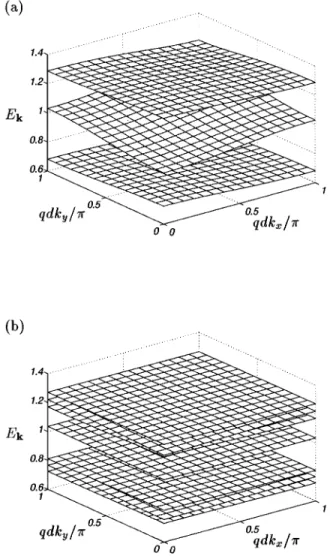
In Fig. 1 energy bands for a543 anda5 10
7 are plotted. There are three and seven energy bands, respectively. Using the relationuc
&
5E21/2Auc˜&
, it is possible to find the corre-sponding eigenfunction c~r! of the original problem. Sincec~r! belongs to the lowest Landau level it must be in the
form of f (z)e2uzu2/2, where f (z) is any analytic function. Analytic functions are determined by their zeros. Consider-ing the translational invariance of the system one expects to have regularly distributed zeros. Figure 2 shows the contour plots of uc~r!u fora52. This value of the flux ratio is very special in that all of the matrix elements
^
mnuV˜um8
n8&
be-come real, and the problem reduces to a tight-bindingtem. For this particular case, energy eigenvalues Ek and
eigenfunctions ck can be found explicitly in terms of the theta function
u3~zut!5
(
n52`
`
exp~pitn2!exp~2npiz!, ~12!
which vanishes at z5(l11/2)1(m11/2)t, where l and m are any integers. It can be shown that
Ek5 V0 p u3
S
kxA
2pU
2iD
u3S
kyA
2pU
2iD
~13! and ck~z,z*!5ce2uzu 2/2 u3S
z1ikx iA
2pU
iD
u3S
z2kyA
2pU
iD
, ~14! where d is the lattice constant and c is chosen to normalizeck(z,z*) properly.ck(z,z*) has regularly distributed zeros.
For k50, the zeros of the two u3 functions coincide, and they become double zeros. For kÞ0, they shift by an amount
2ikx and ky, respectively.
Figure 3 shows energy~measured in units of V0/p! ver-sus the flux ratio for the square lattice. Here the labels n and
k have been suppressed, i.e., Enkvalues have been projected
on to the energy axis. The energy spectrum is found to be self-similar, i.e., the same pattern is repeated with a different size and in a slightly distorted shape. With increasing flux ratio, the spectrum is squeezed since the amplitude of the matrix elements decreases with distance in a Gaussian way. In conclusion, a method for the evaluation of the energy spectrum of a particle in the lowest Landau level, moving in an arbitrary potential, has been developed. The problem of Diracdscattering centers has been solved for demonstration. The periodic case was found to have a self-similar spectrum. The method is very general, since it can be applied not only to any distribution of impurities but any potential, as far as the particle is confined into the lowest Landau level. For the random distribution of scatterers,16 the calculated density of states is in perfect agreement with the analytic result of FIG. 1. Energy bands over one-quarter of the magnetic Brillouin
zone for~a! a543 and ~b!a5 10
7. The energy eigenvalues Ek are
plotted in units of V0/p.
FIG. 2. Contour plots of uck(r)u fora52. Zeros are marked
with *. ~a! kx5ky50, ~b! kx5
A
p/2 and ky50, ~c! kx50 and ky5A
p/2, and ~d! kx5ky5A
p/2.FIG. 3. Energy eigenvalues vs magnetic flux ~in units of flux quantum! per unit cell for square lattice.
Brezin, Gross, and Itzykson.17For a continuous potential, the matrix elements are labeled by continuous indices, and hence the proposed approach may not be as practical as it is in the Dirac dtype potential case.
This work was partially supported by the Scientific and Technical Research Council of Turkey under Grant No. TBAG-AY/123. One of the authors ~Z.G.! is grateful to O. Tekman for helpful conversations.
1D. Pfannkuche and R. R. Gerhardts, Phys. Rev. B 46, 12 606 ~1992!.
2T. Chakraborty and P. Pietila¨inen, The Quantum Hall Effects: Fractional and Integral~Springer-Verlag, Berlin, 1995!. 3P. Streda, J. Phys. C 15, L1299~1982!.
4D. J. Thouless, M. Kohmoto, M. P. Nightingale, and M. den Nijs, Phys. Rev. Lett. 49, 405~1982!.
5R. E. Peierls, Z. Phys. 80, 763~1933!. 6
D. Langbein, Phys. Rev. 180, 633~1969!.
7M. Ya. Azbel’, Zh. Eksp. Teor. Fiz. 46, 435~1964! @Sov. Phys. JETP 19, 292~1964!#.
8D. Hofstadter, Phys. Rev. B 14, 2239~1976!.
9E. Witten, Nucl. Phys. B 188, 513~1981!. 10R. E. Prange, Phys. Rev. B 23, 4802~1981!. 11T. Ando, J. Phys. Soc. Jpn. 52, 1740~1983!.
12Y. Avishai and R. M. Redheffer, Phys. Rev. B 47, 2089~1993!. 13D. Huang and G. Gumbs, Phys. Rev. B 47, 9597~1993!. 14R. Brako and Z. Crljen, Phys. Rev. B 47, 13 568~1993!. 15K. Ishikawa, N. Maeda, and K. Tadaki, Phys. Rev. B 51, 5048
~1995!.
16Z. Gedik and M. Bayindir~unpublished!.
17E. Bre´zin, D. J. Gross, and C. Itzykson, Nucl. Phys. B 235, 24 ~1984!.