INTRODUCTION
Th e migration of leukocytes from the vascular compart-ment into the infl ammation area requires a series of complex interactions between leukocytes and endothelium. Th ese intercellular interactions depend on the presence of the che-moattractant gradient created by a large family of molecules called chemokines (chemotactic cytokines), along with the cell adhesion molecules expressed on the surfaces of endothelial cells and leukocytes [1]. Under the normal physiological con-ditions, chemokines selectively divert leukocyte subtypes to all tissues and organs [2]. Ulcerative colitis (UC) and Crohn’s dis-ease (CD) are two chronic infl ammatory bowel disdis-eases (IBD), characterized by the altered levels and types of chemokines resulting in improper leukocyte aggregation in the target tissue.
To date, more than 40 chemokines have been discovered. So far, the only member of the identifi ed CX3C chemokine
family is fractalkine (FKN-CX3CL1). FKN shows dual charac-teristics, acting both as a chemokine and as an adhesion mol-ecule [3,4].
FKN is expressed during an infl ammatory process and therefore takes place in the pathogenesis of numerous infl am-matory conditions including cardiovascular, renal, rheuma-tologic and allergic diseases [3,5-7]. FKN expression on the endothelial and epithelial cells of the human bowel mucosa questioned the role of FKN regulation in mucosal immune response in IBD [8,9].
CX3CR1 is the specifi c receptor of FKN. CX3CR1 is expressed on the surface of CD4+ and CD8+ T cells, CD14+
monocytes and macrophages, and CD16+ NK cells [4,10].
CX3CR1 is highly expressed on the cytotoxic T-lymphocytes. CX3CR1-expressing cells are bound to FKN with high affi nity regardless of the presence of endothelial adhesion molecules such as selectin and integrin. To date, several gene variations have been identifi ed on the CX3CR1 encoding gene.
Among these, V249I (rs3732379) and T280M (rs3732378) polymorphisms are more common than the other genetic variations. Th ese polymorphisms are implicated in athero-sclerosis, coronary artery disease, and susceptibility to HIV
*Corresponding author: Erkan Yurtcu,
Department of Medical Biology, Medical School, Baskent University, Baglica Etimesut-Ankara 06530, Turkey. Tel: +90 312-246666/6680. Fax: +90 312-2466689. E-mail: [email protected]
Submitted: 19 February 2015 / Accepted: 13 March 2015
Fractalkine receptor polymorphism may not be
associated with the development and clinical course of
ulcerative colitis
Hale Gokcan1, Erkan Yurtcu2,*, Haldun Selcuk3, Feride I. Sahin4
1Department of Gastroenterology, Ankara Yüksek İhtisas Research and Training Hospital, Ankara, Turkey, Departments of 2Medical Biology, 3Gastroenterology, 4Medical Genetics, Medical School, Baskent University, Ankara, Turkey
ABSTRACT
Fractalkine (CX3C), a chemokine expressed by epithelial cells within normal and infl amed colorectal mucosa, induces leukocyte adhesion and migration via fractalkine receptor. Th e aim of this study was to investigate two single nucleotide polymorphisms of the fractalkine receptor gene as a risk factor both for the development and clinical fi ndings of ulcerative colitis. In this study, 51 patients with ulcerative colitis (UC) and 80 controls were recruited. Genotypes of fractalkine receptorc.745G>A (V249I) and c.839C>T (T280M) polymorphisms were identifi ed by restriction fragment length polymorphism analyses after polymerase chain reaction.Genotype distribution and allele frequencies of V249I and T280M were not statistically signifi cantly diff erent between UC and control groups (p>0.05). No statistically signifi cant relationship was found between fractalkine receptor polymorphisms and clinical fi ndings of UC. We observed no signifi cant diff erence in fractalkine receptor polymorphism between patients and control group and no genotype-phenotype relation. Th erefore, we concluded that fractalkine receptor polymorphisms may not contribute to the molecular pathogenesis of UC.
KEY WORDS: Fractalkine; CX3CR1 polymorphism; ulcerative colitis
infection. Th ey also infl uence CD phenotype and localiza-tion [11-13].
In this study, we aimed to determine the CX3CR1 poly-morphisms and their correlation with clinical fi ndings in patients with UC.
MATERIALS AND METHODS
Study population
A total of 51 UC patients attending the Department of Gastroenterology and Hepatology, Baskent University Ankara Hospital, were enrolled in the study. Th e diagnosis of UC was made on the basis of previously defi ned clinical guidelines, according to endoscopic, radiologic and histopathological cri-teria. Th ese criteria were also used as a tool for patient selec-tion [14-17]. Patients with indeterminate colitis were excluded from the study. Control group was composed of 80 healthy subjects attending the gastroenterology outpatient clinic with dyspeptic complaints. Informed consent was obtained from all study participants.
Demographic data and medical history of patients (gen-der, age, age at diagnosis, follow-up duration of the disease, localization of the colonic involvement and extraintestinal involvement (musculoskeletal system, skin, eye, hepatobiliary system)) were recorded.
Genotyping
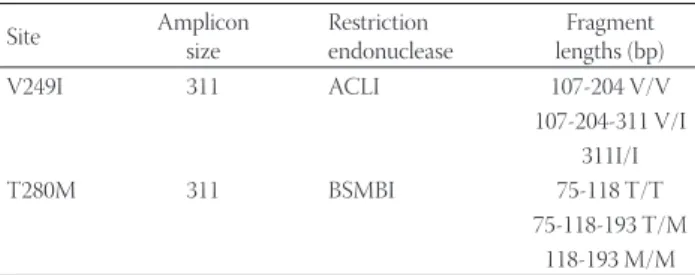
Venous blood sample was obtained from each par-ticipant. Genomic DNA was extracted using commer-cially available kit (High Pure PCR Template Kit, Roche Diagnostics GmbH, Mannheim, Germany). Genotypes were determined by polymerase chain reaction (PCR)–restric-tion fragment length polymorphism (RFLP) method. Two regions, each of which contained a single nucleotide poly-morphism (SNP) site of the fractalkine receptor gene, were amplifi ed. Primers for the PCR amplifi cation were forward: 5’AGAATCATCCAGACGCTGTTTTCC3’, and reverse: 5’CACAGGACAGCCAGGCATTTCC3’. Th e size of ampli-con, restriction endonuclease, and predicted fragment lengths are shown in Table 1. After restriction enzyme digestion geno-types were evaluated.
CX3CR1 polymorphism genotyping and clinical
correlations
Th e association between V249I and T280M polymor-phisms with the clinical fi ndings (gender, age, age at diag-nosis and follow-up duration of the disease, location of the intestinal involvement, intestinal involvement type, perianal involvement and extraintestinal involvement) in patients was examined.
Statistical methods
Independent two-sample t test was used to compare two groups and one-way analysis of variance was used for compar-ison of more than two groups. All analyses had a confi dence interval of 95. Variants in the analyses were grouped among themselves according to their characteristics. Diff erence in allele frequencies of CX3CR1 polymorphisms between IBD patients and the control group was determined using universe ratio signifi cance test. Th e value of p<0.05 was considered statistically signifi cant. Statistical analyses were performed in SPSS 17.0 and MINITAB 13.0 statistical software programs (SPSS Inc., Chicago, IL).
RESULTS
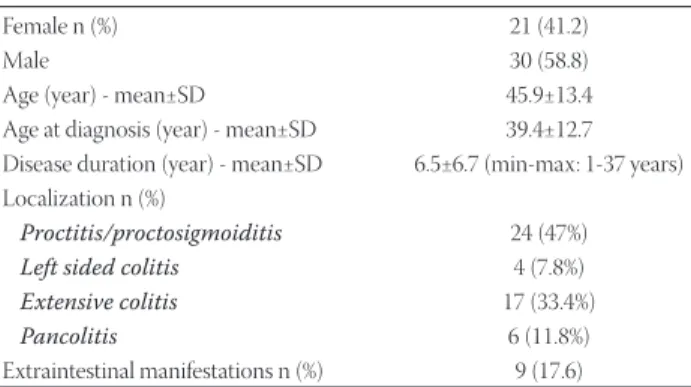
Study group consisted of 30 males (58.8 ) and 21 females. Mean age of patients was 45.9±13.4.Th e mean age was39.4±12.7 years at the time of diagnosis and patients were followed-up during the period from 1 to 37 years (mean 6.5±6.7).Twenty-four patients had proctitis or proctosigmoid involvement, while nine (17.6) patients had extraintestinal involvement. Th e most common extraintestinal involvement was the musculoskeletal system (arthritis, ankylosing spon-dylitis, other spondyloarthropathies). Other extraintestinal involvements were as follows: one patient with aphthous stomatitis, one patient with dry eye, while hepatobiliary tract was aff ected in two patients (primary sclerosing cholangi-tis). Clinical and demographic characteristics of patients are shown in Table 2.
Th e distribution of the c.745G>A (V249I) and c.839C>T (T280M) genotypes and the allele frequencies were not dif-ferent between the patients and controls. For V249I polymor-phism 22 (32.8) patients were heterozygous, while 3 (4.5) patients were homozygous. A total of 12 (17.9) patients were heterozygous for T280M polymorphism.
For both polymorphisms (V249I and T280M), no statis-tically signifi cant diff erence was observed for gender (p=0.16 and p=0.5 respectively), age (p=0.8 and p=0.1 respectively), age at diagnosis (p=0.8 and p=0.07 respectively), follow-up dura-tion of the disease(p=0.9 and p=0.8 respectively),localizadura-tion of colonic involvement(p=0.9 and p=0.2 respectively), and
TABLE 1. Amplicon size, restriction endonuclease and fragment
lengths Site Amplicon size Restriction endonuclease Fragment lengths (bp) V249I 311 ACLI 107-204 V/V 107-204-311 V/I 311I/I T280M 311 BSMBI 75-118 T/T 75-118-193 T/M 118-193 M/M
extraintestinal involvement (p=0.7 and p=0.2, respectively). Genotype distributions and allele frequencies of FKN receptor polymorphisms were shown in Table 3 and Table 4, respectively.
DISCUSSION
Both chemokines and their receptors participate in the pathogenesis of infl ammatory disease by navigating circu-lating leukocytes and T cells to infl ammatory sites. At the molecular level, they orchestrate tissue- and cell type-specifi c traffi cking as well as retention of leukocytes. Previous studies showed the role of FKN and its receptor system in the devel-opment of infl ammatory diseases. Rapid recruitment and inappropriate retention of leukocytes, particularly T-cells at the site of infl ammation is a sign of chronic infl ammatory dis-orders such as CD and UC [18,19].
Due to an increased release of FKN from intraepithelial cells, there is an increased number of CX3CR1+ T cells both in peripheral blood and intestinal lamina propria of IBD patients. Increased FKN production in the mucosa causes migration
of a large number of CX3CR1+ leukocytes to the infl amma-tion site [8,11,20,21]. It was also demonstrated that the level of expression of FKN receptors is much higher on Th 1 cells in comparison to Th 2 cells as a response to FKN. [22]. Recently, two common SNPs, V249I and T280M, were identifi ed in the FKN receptor encoding gene. Both polymorphisms are located in the transmembrane domains of the receptor, caus-ing a reduction in cell adhesion and possibly leadcaus-ing to the decreased signaling and chemotaxis [23,24].
Although various data about the genotype-phenotype relationship between FKN receptor polymorphisms and CD have been reported, there are no reports about this rela-tionship for UC. In a study conducted on the sample of CD patients, Brand et al. determined that 33 of participants were heterozygous, while 8.9 were homozygous for V249I poly-morphism. On the other hand, these percentages for T280M polymorphism were 23.3 and 4.4, respectively. Authors observed that intestinal stenosis and ileocolonic involvement occurred more frequently in patients with T280M and V249I homozygous polymorphism than in heterozygous patients and wild type. Ileal involvement (89 ileocolonic, 11 ileal) was also observed in T280M homozygous patients [11].
In another study that was conducted on CD patients, Sabate et al found that heterozygosity and homozygosity for V249I polymorphism were 37.4 and 8.8, while the frequency for T280M polymorphism was18.1 and 1.3, respectively. In this study, T280M homozygous genotype was observed in three patients, with two of them having been diagnosed with stenosis. V249I polymorphism was detected in patients with fi brostenosis [13].
In contrast to previous studies exploring the role of FKN in CD, in our study we aimed to determine FKN receptor polymorphism frequency and its correlation with clinical presentation in UC patients. We found 5.9 homozygous and 43.1 heterozygous patients for the V249I polymorphism and 23.5 heterozygous patients for the T280M polymorphism. Frequency distributions of both polymorphisms were similar to those in the control group (Table 3 and Table 4).
Our sub-group analyses revealed that neither V249I nor T280M polymorphisms were associated with clinical signs of UC.
So far, several hundreds of genes residing within the 163 genetic risk loci have been identifi ed for IBD [25]. Although both CD and UC are infl ammatory bowel diseases that share some genetic susceptibility loci, there are actually some diff er-ences [26]. Among these loci, 30 are CD-specifi c and 23 are UC-specifi c, whereas 110 are associated with both disease phenotypes [27]. According to this genetic background, reg-ulation of mucosal immune cells is diff erent in UC from CD. Th e molecular mechanism of CD depends on the Th 1/Th 17 balance [28,29]. FKN receptor is particularly expressed on
TABLE 2. Demographic and clinical characteristics of the study
population
Female n (%) 21 (41.2)
Male 30 (58.8)
Age (year) - mean±SD 45.9±13.4 Age at diagnosis (year) - mean±SD 39.4±12.7 Disease duration (year) - mean±SD 6.5±6.7 (min-max: 1-37 years) Localization n (%)
Proctitis/proctosigmoiditis 24 (47%)
Left sided colitis 4 (7.8%)
Extensive colitis 17 (33.4%)
Pancolitis 6 (11.8%)
Extraintestinal manifestations n (%) 9 (17.6)
TABLE 3. The CX3CR1 polymorphism distribution in UC patients
Genotypes UC (n=51) Control (n=80) p V249I (n (%)) VV VI II 26 (51.0) 22 (43.1) 3 (5.9) 49 (61.25) 28 (35.0) 3 (3.75) 0.491 T280M (n (%)) TT TM MM 39 (76.5) 12 (23.5) -52 (65.0) 28 (35.0) -0.179
TABLE 4. Allele frequencies of V249I and T280M polymorphisms
in patient and control subjects
Genotypes UC (n=51) Control (n=80) p V249I (n (%)) V I 74 (72.55) 28 (27.45) 126 (78.75) 34 (21.25) 0.76 0.23 T280M (n (%)) T M 90 (88.24) 12 (11.76) 132 (82.50) 28 (17.50) 0.84 0.11
Th 1 cells. However, it has been shown that molecular mecha-nisms of UC mainly depend on Th 2 cells [22,30]. As indicated by Th omson et al, genetic factors seem to be somewhat less signifi cant for UC than they are for CD [28]. Our results are consistent with the results of the study published by Th omson et al. According to these data, clinical signs of UC may not be related to FKN receptor polymorphism.
CONCLUSION
In conclusion, in this study we tried to determine the possible involvement of FKN receptor polymorphism in UC pathogenesis and its relation with clinical outcomes. So far, no studies on the relationship between FKN receptor polymor-phisms and clinical signs of UC have been published. In our study, we found that FKN receptor polymorphism and gen-otype-phenotype relation is not statistically signifi cant in UC patients. Th erefore, these polymorphisms of FKN may not contribute to the molecular pathogenesis of UC. However, limited number of patients enrolled to this study may be the major limitation of this study. Th erefore, further studies with larger groups are required in order to determine the precise role of the FKN receptor polymorphisms in disease pathogen-esis and its relation to clinical outcomes in patients with UC.
DECLARATION OF INTERESTS
Th e authors declare no confl ict of interests.
ACKNOWLEDGEMENTS
Th is study was approved by the Baskent University Institutional Review Board (Project no: KA08/148) and sup-ported by the Baskent University Research Fund.
REFERENCES
[1] Proudfoot AE, Power CA, Rommel C, Wells TN. Strategies for chemokine antagonists as therapeutics. Semin Immunol 2003;15(1):57-65. DOI: 10.1016/S1044-5323(02)00128-8.
[2] Van Buul JD, Hordijk PL. Signaling in leukocyte transendotelial migration. Arterioscler Th romb Vasc Biol 2004; 24:824-833. DOI: 10.1161/01.ATV.0000122854.76267.5c.
[3] Bazan JF, Bacon KB, Hardiman G, Wang W, Soo K, Rossi D, et al. A new class of membrane-bound chemokine with a CX3C motif. Nature 1997;385(6617):640-644. DOI: 10.1038/385640a0.
[4] Imai T, Hieshima K, Haskell C, Baba M, Nagira M, Nishimura M, et al. Identifi cation and molecular characterization of frac-talkine receptor CX3CR1, which mediates both leukocyte migration and adhesion. Cell 1997;91(4):521-530. DOI: 10.1016/ S0092-8674(00)80438-9.
[5] Muehlhoefer A, Saubermann LJ, Gu X, Luedtke-Heckenkamp K, Xavier R, Blumberg RS, et al. Fractalkine is an epithelial and endo-thelial cell-derived chemoattractant for intraepiendo-thelial lymphocytes in the small intestinal mucosa. J Immunol 2000;164(6):3368-3376. DOI: 10.4049/jimmunol.164.6.3368.
[6] Furuichi K, Wada T, Iwata Y, Sakai N, Yoshimoto K, Shimizu M, et al. Upregulation of fractalkine in human crescentic glomerulone-phritis. Nephron 2001; 87(4):314-320. DOI: 10.1159/000045936. [7] Robinson LA, Nataraj C, Th omas DW, Howell DN, Griffi ths R,
Bautch V, et al. A role for fractalkine and its receptor (CX3CR1) in cardiac allograft rejection. J Immunol 2000;165(11):6067-6072. DOI: 10.4049/jimmunol.165.11.6067.
[8] Imaizumi T, Yoshida H, Satoh K. Regulation of CX3CL1/fractalkine expression in endothelial cells. J Atheroscler Th romb 2004; 11(1):15-21. DOI: 10.5551/jat.11.15.
[9] Chapman GA, Moores KE, Gohil J, Berkhout TA, Patel L, Green P, et al. Th e role of fractalkine in the recruitment of monocytes to the endothelium.Eur J Pharmacol 2000;392(3):189-195. DOI: 10.1016/ S0014-2999(00)00117-5.
[10] Combadiere C, Salzwedel K, Smith ED, Tiff any HL, Berger EA, Murphy PM. Identifi cation of CX3CR1. A chemotactic receptor for the human CX3C chemokine fractalkine and a fusion coreceptor for HIV-1. J Biol Chem 1998; 273(37):23799-23804.DOI: 10.1074/ jbc.273.37.23799.
[11] Brand S, Haufbauer K, Dambacher J, Schnitzler F, Staudinger T, Pfennig S, et al. Increased expression of the chemokine frac-talkine in Crohn’s disease and association of the fracfrac-talkine receptor T280M polymorphism with a fi brostenosing dis-ease phenotype. Am J Gastroenterol 2006; 101(1):99-106. DOI: 10.1111/j.1572-0241.2005.00361.x.
[12] McDermott DH, Fong AM, Yang Q, Sechler JM, Cupples LA, Merrell MN, et al. Chemokine receptor mutant CX3CR1-M280 has impaired adhesive function and correlates with protection from cardiovascular disease in humans. J Clin Invest 2003; 111(8):1241-1250. DOI: 10.1172/JCI16790.
[13] Sabate JM, Ameziane N, Lamoril J, Jouet P, Farmachidi JP, Soulé JC, et al. Th e V249I polymorphism of the CX3CR1 gene is associated with fi brostenotic disease behavior in patients with Crohn’s disease. Eur J Gastroenterol Hepatol 2008; 20(8):748-755. DOI: 10.1097/ MEG.0b013e3282f824c9.
[14] Dignass A, Eliakim R, Magro F, Maaser C, Chowers Y, Geboes K, et al. Second European evidence-based consensus on the diag-nosis and management of ulcerative colitis part 1: defi nitions and diagnosis. J Crohns Colitis 2012;6(10):965-990. DOI: 10.1016/j. crohns.2012.09.003.
[15] Annese V, Daperno M, Rutter MD, Amiot A, Bossuyt P, East J, et al. European Crohn’s and Colitis Organisation.European evidence based consensus for endoscopy in infl ammatory bowel disease. J Crohns Colitis 2013;7(12):982-1018. DOI: 10.1016/j.crohns.2013.09.016. [16] Magro F, Langner C, Driessen A, Ensari A, Geboes K, Mantzaris GJ,
et al. European Society of Pathology (ESP); European Crohn’s and Colitis Organisation (ECCO). European consensus on the his-topathology of infl ammatory bowel disease. J Crohns Colitis 2013;7(10):827-851. DOI: 10.1016/j.crohns.2013.06.001.
[17] Tontini GE, Vecchi M, Pastorelli L, Neurath MF, Neumann H. Diff erential diagnosis in infl ammatory bowel disease colitis: state of the art and future perspectives. World J Gastroenterol 2015;21(1):21-46. DOI: 10.3748/wjg.v21.i1.21.
[18] Th omas S, Baumgart DC. Targeting leukocyte migration and adhe-sion in Crohn’s disease and ulcerative colitis. Infl ammopharmacology 2012; 20(1):1-18. DOI: 10.1007/s10787-011-0104-6.
[19] Nishimura M, Kuboi Y, Muramoto K, Kawano T, Imai T. Chemokines as novel therapeutic targets for infl ammatory bowel disease. Ann N Y Acad Sci 2009; 1173:350-356. DOI: 10.1111/j.1749-6632.2009.04738.x.
[20] Sans M, Danese S, de la Motte C, de Souza HS, Rivera-Reyes BM, West GA, et al. Enhanced recruitment of CX3CR1+ T cells by mucosal endothelial cell-derived fractalkine in infl ammatory bowel disease. Gastroenterology 2007; 132(1):139-153. DOI: 10.1053/j. gastro.2006.10.010.
[21] Kobayashi T, Okamoto S, Iwakami Y, Nakazawa A, Hisamatsu T, Chinen H, et al. Exclusive increase of CX3CR1+CD28-CD4+ T cells in infl ammatory bowel disease and their recruitment as intraepi-thelial lymphocytes. Infl amm Bowel Dis 2007; 13(7):837-846.DOI: 10.1002/ibd.20113.
[22] Babakurban ST, Erbek SS, Terzi YK, Arslan F, Sahin FI.Fractalkine receptor polymorphism and chronic tonsillitis.Eur Arch Otorhinolaryngol 2014; 271(7):2045-2048. DOI: 10.1007/ s00405-014-2908-7.
[23] Moatti D, Faure S, Fumeron F, Amara Mel-W, Seknadji P, McDermott DH, et al. Polymorphism in the fractalkine receptor CX3CR1 as a genetic risk factor for coronary artery disease. Blood 2001; 97(7):1925–1928. DOI: 10.1182/blood.V97.7.1925.
[24] Courivaud C, Bamoulid J, Loupy A, Deschamps M, Ferrand C, Simula-Faivre D, et al. Infl uence of fractalkine receptor gene poly-morphisms V249I-T280M on cancer occurrence after renal trans-plantation. Transplantation 2013; 95(5):728–732. DOI: 10.1097/ TP.0b013e31827d61cb.
[25] Fransen K, Mitrovic M, van Diemen CC, Weersma RK. Th e quest for genetic risk factors for Crohn’s disease in the post-GWAS era. Genome Med 2011;3:13.
[26] Duerr RH, Taylor KD, Brant SR, Rioux JD, Silverberg MS, Daly MJ, et al. A genome-wide association study identifi es IL23R as an infl ammatory bowel disease gene. Science 2006; 314(5804):1461-1463. DOI: 10.1126/science.1135245.
[27] Jostins L, Ripke S, Weersma RK, Duerr RH, McGovern DP, Hui KY, et al. Host-microbe interactions have shaped the genetic architec-ture of infl ammatory bowel disease. Naarchitec-ture 2012;491(7422):119-124. DOI: 10.1038/nature11582.
[28] Th ompson AI, Lees CW. Genetics of ulcerative colitis. Infl amm Bowel Dis 2011; 17(3):831-848. DOI: 10.1002/ibd.21375.
[29] Mannon PJ, Fuss IJ, Mayer L, Elson CO, Sandborn WJ, Present D, et al. Anti-IL-12 Crohn’s Disease Study Group: Anti-interleukin-12 antibody for active Crohn’s disease. N Engl J Med 2004;351:2069– 2079. DOI: 10.1056/NEJMoa033402.
[30] Gálvez J. Role of Th 17 Cells in the Pathogenesis of Human IBD. ISRN Infl amm 2014;2014:928461. DOI: 10.1155/2014/928461.