Bulgarian Chemical Communications, Volume 48, Number 1 (pp. 21– 26) 2016
Nutrient contents and physicochemical properties of well waters in Meric (Maritsa)
river basin at Turkish Thrace
P. Ozkahya
1, B. Camur-Elipek
2*1Mugla Sitki Kocman University, Faculty of Fisheries and Aquatic Sciences, Mugla / Turkey
2Trakya University, Faculty of Science, Department of Biology, Hydrobiology Section, 22030 Edirne / Turkey
Received August 9, 2014, Revised October 30, 2015
Although the demand for clean drinking water has increased with growing world population, groundwater is declining due to global warming and pollution. Water wells which provide drinking/domestic water have various features and differ in terms of water quality. While they include dissolved material at different ratios, some features (especially nutrient contents such as nitrite, nitrate, phosphate and sulphate from agricultural areas or animal/human wastes) can be set as a limit for their usage.
Turkish Thrace includes Meric-Ergene River Basin within three provinces (Edirne, Tekirdag, Kirklareli) and a lot of industrial and agricultural activities related to water are performed in the basin. Therefore, domestic water wells are also used for different aims in the area. In this study, some nutrients (SO4, o-PO4, NO2-N, NO3-N) and physicochemical
properties (depth and water level, temperature, pH, conductivity, salinity, dissolved oxygen, and total hardness) of well waters in Edirne province which is located in Meric (Maritsa) River Basin were investigated to determine the utilization suitability of the waters used by humans for drinking, irrigation, livestock and poultry watering or other purposes. It was found that nitrate contents of the waters exceed 50 mg/L in 65% of the wells, and nitrite values exceed the acceptable levels for usage in 50% of the wells. Furthermore, it was observed that 44% of the investigated wells display very hard water characteristics. Consequently, these features limit the well waters usage as sources for drinking, irrigation and/or other purposes. In this study, the nutrient content of well waters in Meric-Ergene River Basin and Turkish Thrace was also evaluated based on previous studies and the harmfulness of some nutrients in drinking waters for living things and environment was discussed.
Key words: water wells, nutrients, physicochemical features, Meric (Maritsa) river basin.
INTRODUCTION
Water wells are man-made holes to get water from underground and they are made by digging or drilling in underground aquifers. They can be used to access water for drinking, irrigation of agricultural areas, and other domestic chores conducted by the people. These wells have a lot of varying features from depth to water volume and they have different water quality. They include dissolved material at different rations and it is very important to determine these values. Their water quality determines the utilization field such as irrigation, drinking, and others. Especially, when the water is used for drinking of humans, livestock and poultry, these living things can tolerate minerals in the water according to species, age, and physiological conditions of their bodies [1]. Therefore we have to know the physicochemical properties (especially nutrient contents such as nitrite and nitrate) and their quality levels in well
waters. In addition, factors such as hardness, pH, salinity of water resources, rations of some parameters such as nitrite, nitrate, phosphate and sulphate, which are used as fertilizers in agricultural areas or animal/human wastes, can set a limit to their usage.
Especially nitrites and nitrates occur by decomposition of organic matter from living things [2]. Therefore, the presence of these nutrients in water resources may sign bacterial contamination [2]. The water resources contain nitrites and nitrates at different concentrations but excessive increase of these nutrients in the water bears some risks for human health. Furthermore, oxyhemoglobine in blood can be changed to methemoglobine after nitrite enters the body or nitrate changes to nitrite and this situation may lead to cancer or toxic effects of nitrite [3]. Also, reduced products of nitrate can change to N-nitroso compounds in the stomach which cause cancer in humans and animals [4]. Other parameters of waters can also limit their usage by living things. For example, although no direct effects of hard water to human health are
P.Ozkahya, B. Camur-Elipek: Nutrient contents and physicochemical properties of well waters in Meric (Maritsa) river …
reported, hard waters are not suitable for using because of undesired taste on the tongue and soap remainder on the skin. The water has neutral pH value which is preferred for drinking purposes because low pH values may lead to corrosion while high pH values may require purification [5].
Turkish Thrace includes the cities Edirne, Tekirdag, Kırklareli and some parts of Istanbul and Canakkale provinces. Edirne and Tekirdag are the most important provinces in Meric-Ergene River Basin in Turkish Thrace. Industrial and agricultural activities related to water, and animal husbandry for livestock and poultry are very common in this area. Therefore, domestic water wells are used for many aims in these two provinces. The aim of this study is to determine nutrient contents such as nitrogen, sulphate and phosphate and some physicochemical properties of well waters in Edirne province, which are used by humans for drinking, irrigation, livestock and poultry watering or other purposes, and to assess their qualities and usage fields. Up to now, there is no detailed study on nutrient contents and physicochemical features of water wells in Edirne province. In Turkish Thrace, there are only two studies which were performed as MsC theses on well waters in Tekirdag province, and one PhD thesis on well waters in Tekirdag (one locality) and Istanbul (two localities) [6-8]. Thus, along with determining usage fields of well waters in Edirne province in terms of nutrient contents and some physicochemical properties, it was also aimed to assess the qualities of well waters in Turkish Thrace including Meric-Ergene River Basin by evaluation all studies performed in the area.
MATERIAL AND METHOD
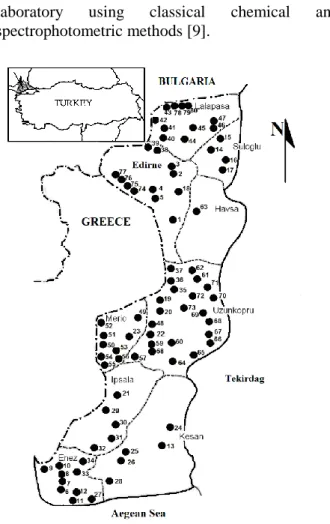
In this study, a total of 80 water wells in Edirne province including 9 different districts (Edirne city center, Lalapasa, Suloglu, Havsa, Uzunkopru, Meric, Ipsala, Kesan, and Enez) were sampled between April 2009 and May 2010 (Figure 1). Water samples were taken from the wells using a Nansen water sampler. Some features (depth and water level of well, temperature, pH, dissolved oxygen, and conductivity) were measured at the sampling site utilizing a Nansen water sampler supplied with thermometer, pH meter, oxygen meter and conductivity meter, while others (salinity by Mohr-Knudsen method, total hardness by EDTA titration, and nutrients (SO4, o-PO4, NO2-N, NO3-N
by spectrophotometry) were analysed in the
laboratory using classical chemical and spectrophotometric methods [9].
Fig. 1. Sampling localities in Edirne province and
location of Meric-Ergene River Basin inTurkish Thrace.
RESULTS AND DISCUSSION
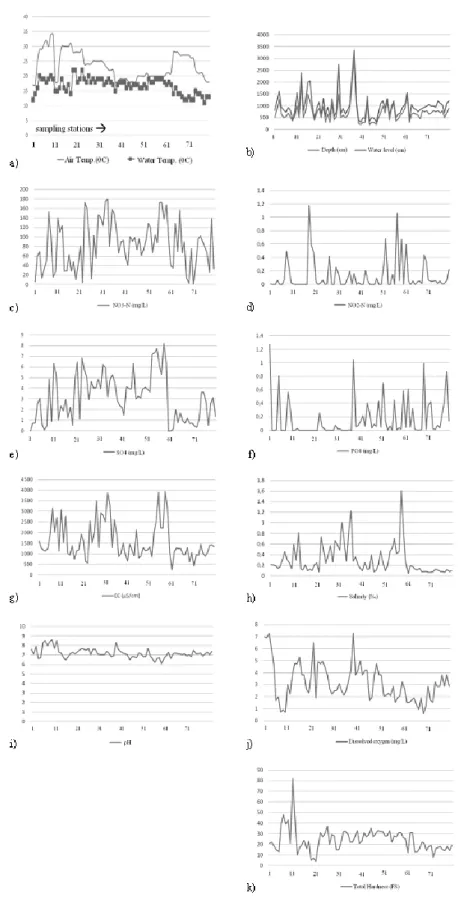
The measured features of the water wells are presented in Figure 2. The measured air and water temperature at the sampling stations are presented in Figure 2a; and the depths of water wells and the level of the water at the wells sampled are shown in Figure 2b.
According to the results, the nitrogen values range between different concentrations in the wells studied (Fig 2c, d). Because of the circulation in the world, nitrogen can be found at different levels in the environments of soil and water or in living things. Although the concentration of nitrate in water resources is naturally low, it can reach high levels because of agricultural activities and contamination from wastes of animals or humans. It is reported that high amounts of nitrate or nitrite taken by consuming food or water can cause toxic situations in humans and animals.
P.Ozkahya, B. Camur-Elipek: Nutrient contents and physicochemical properties of well waters in Meric (Maritsa) river …
Fig. 2. Values of the measured parameters of the sampled water wells (a. nitrate values (NO3-N) in mg/L; b. nitrite
values (NO2-N) in mg/L; c. sulphate values (SO4) in mg/L; d. ortho-phosphate values (o-PO4) in mg/L); e. conductivity
values (EC) in µS/cm; f. salinity values in ‰; g. pH values; h. dissolved oxygen values in mg/L; i. depth of wells and water levels in cm; j. air and water temperature values of the sampling stations in 0C; k. total hardness values in Fr0).
In many countries, nitrate and nitrite levels are limited for drinking waters to 10-50 mg/L and a few mg/L, respectively. It has been reported that nitrate level should not exceed 45 ppm in drinking water for humans and 445 ppm for animals [10]. Nitrate amounts exceeding 125 ppm in animals can lead to chronical toxic situations; while those exceeding 500 ppm can lead to acute poisoning [11]. In well waters which are located near wastewater resources or agricultural areas, nitrate and nitrite levels may reach dangerous levels for humans or animals.
Vaclav et al. [12] reported that the maximum value of nitrate for children is 15 mg/L and that for adults is 50 mg/L. Since nitrate is reduced to nitrite in the stomach of babies, and nitrite oxidizes haemoglobin to methaemoglobin, it causes “methemoglobinemia” (called blue baby syndrome) [12, 13]. It has been reported that the usage of well waters contaminated with nitrate>10 mg/L leads to methaemoglobineamia in babies [13]. Furthermore, continuous usage of these waters can lead to cancer, thyroid disorder and diabetes [13].
The high values of nitrate in drinking waters are generally related to the usage of fertilizers and wastes. Gormley and Spalding [14] reported that a total of 183 out of 216 wells have exceeded 10 mg/L nitrate concentration because of fertilization and animal wastes. Kross et al. [15] studied nitrate levels in well waters and reported that they are not suitable for usage because of having nitrate concentrations higher than 10 mg/L. It was also found that nitrate concentrations were very high (higher than 15 mg/L) in the deepest wells because of anthropogenic reasons [15]. It was reported by Katkat [8] that 19% of the well waters in Tekirdag province (Turkish Thrace) are not proper for human usage because of high nitrate contents (exceeding 45 mg/L); Ucar [6] reported that a total of 20% of the well waters in the area are contaminated by nitrite. A total of three water wells in Turkish Thrace (one of them in Tekirdag and the others in Istanbul) were sampled by Omurtag [7] who reported that two wells are not suitable for usage according to nitrate levels. In our study, it was found that the nitrate amounts range between 0.766 mg/L and 180.241 mg/L and it was observed that 88% of them exceeded 10 mg/L and 65% of them exceeded 50 mg/L (Fig 2c). According to this, it follows that the area studied is under serious threat by nitrate amounts. Especially, agricultural activities which have been performed extensively in this area may lead to this contamination because of fertilizer usage. In well waters, the amounts of nitrate can be in high levels. If these are caused by
ammonia and nitrite, precautions should be taken. The presence of nitrite tells about biological pollution and ammonia leads to an increase in bacteria in the water source [2]. Nitrate, which is also important for the health of animals, can be reduced to nitrite in the stomach and high levels of nitrate may rarely lead to death [16]. In our study, nitrite values under the analysable limit were observed in 38% of the wells, while the highest value was 1.175 mg/L (Fig 2d).
According to the evaluations of other nutrients, it was found that the sulphate amounts range between 0.00-8.2 mg/L (Fig 2e). According to ITASHK, EPA and WHO, sulphate concentrations should be below 250 mg/L [17]. The ortho-phosphate values in the studied area range between 0.00-1.26 mg/L (Fig 2f). These are very low levels according to SKKY [18] and keep the water at first quality level. Sulphate can be reduced to toxic sulfide in the stomach of animals [16]. If some cows drink water containing high level of sulphate in hot and dry periods, they can face health problems while high amounts can be tolerated in cold periods [16].
In our study, a range of conductivity levels between 240 µS/cm and 3950 µS/cm with 1556 µS/cm on average was found (Fig. 2g). Especially in wells located near the sea, conductivity levels are higher than in the other areas. The high values lead to limitation of their usage. It was reported that the high conductivity levels are due to the high salinity of these water sources [19]. It was also reported that conductivity and nitrate ions have positive correlations. While conductivity levels range between 50 – 1500 µS/cm in natural surface water resources, this parameter has different ranges in ground waters [5]. The conductivity level in ground water resources can reach that of sea water - 50 000 µS/cm [5]. Salinity levels range between 0.041‰ and 1.608‰ in the area studied (Fig 2h). The salinity can be related to conductivity. It was found that the pH values range between 6.1 and 8.6 (Fig. 2i) i.e., the waters have alkaline character in the area near to the sea. In 78% of them the water has first quality level for pH contents [18]. Dissolved oxygen values ranged between 0.5 and 7.3 mg/L (Fig 2j). It was measured as 1.1-3.0 mg/L at most places, which shows that these levels are typical for underground waters because the atmosphere is a very important source of dissolved oxygen for waters [8]. According to SKKY [18], only 7% of the sampled waters have first quality level for dissolved oxygen. Also, it was observed that the lowest values of dissolved oxygen are registered in the deepest wells. The temperature values ranged
P.Ozkahya, B. Camur-Elipek: Nutrient contents and physicochemical properties of well waters in Meric (Maritsa) river …
between 10-22 0C (water) and 17-34 0C (air) (Fig.
2a). Total hardness ranged between 4.4 and 82 FS0
(Fig. 2k). According to these results, 44% of the sampled water wells were found to have hard water quality. Especially in the areas which are close to the sea (in the south of the studied area), the highest total hardness values were registered. The usage of these waters for animals causes some health problems like gases in stomach and urinary calculus [20]. But non-saline hard water does not harm animals [1]. Insufficient water, unpleasant taste of water and content of high dissolved substances in the water cause water-related health problems in animals, which can lead to stress [1, 16].
Edirne and Tekirdag provinces are located in the Meric-Ergene River Basin which is a very important water resource of Turkish Thrace. Therefore, for monitoring water quality in the area, both surface waters and underground waters are very important to provide sustainable usage of the basin. However, excessive agricultural and industrial activities, and increasing settlements in the area can lead to the limitation of the resources. As a result of this study, high levels of nitrate rations were found in the wells of the area studied. Usage of fertilizers for agricultural activities, wastewaters from houses and animal sheds which are close to the wells, may have caused this situation.
CONCLUSION
In this study the features limiting the well waters in Meric River Basin in Turkey for use as sources for drinking, irrigation and/or other purposes for living things were determined. Also, the nutrient contents of well waters in Meric-Ergene River Basin and Turkish Thrace based on previous studies on the harmfulness of some nutrients in drinking waters for living things and environment were discussed. Both this study and the previous studies on water wells in Meric-Ergene River Basin show that the basin is under very huge threat in terms of nitrogen pollution. The people who use these waters should be educated how to prevent negative effects for animals. Similar studies should be conducted in other countries and the water environments should be periodically monitored.
Acknowledgements:The findings of this study were obtained from the first author’s MsC thesis which has been supported by Trakya University Research Fund with TUBAP-2009/23 Project.
REFERENCES
1. B. Cemek, S. Cetin, D. Yildirim, Tarim Bilimleri Arastirma Dergisi, 4 (1), 57 (2011).
2. S. Agaoglu, M. Alisarli, S. Alemdar, S. Dede, Yuzuncuyıl Univ. Vet. Fak. Derg., 18 (2), 17 (2007). 3. B. Narayana, K. Sunil, Eurasian J. Anal. Chem., 4
(2), 204 (2009).
4. U. Erdogan, A. Kavaz, Akademik Gıda, 7 (1), 47 (2009).
5. D. Durhasan, MsC Thesis, Cukurova Univ., Adana, 2006.
6. S. Ucar, MsC Thesis, Trakya Univ., Edirne, 1990. 7. G.Z. Omurtag, J. Fac. Vet. Univ. Istanbul, 18 (2), 9
(1992).
8. G. Katkat, MsC Thesis, Trakya Univ., Edirne, 2000. 9. O. Egemen, U. Sunlu, Su Kalitesi, Water Quality,
Ege Univ. Su Urunleri Fak. Yayin no 14, Izmir, 1999. 10. C.S. Bruning-Fann, J.B. Kaneene, Vet. Hum.
Toxicol., 35 (3), 237 (1993).
11. H. Yavuz, S. Kaya, F. Akar, Ankara Univ. Vet. Fak. Derg., 40, 16 (1993).
12. B. Vaclav, P. Vladimir, S. Jaroslav, U. Jaroslav, in: Environmental Health Perspectives, 1989, p.83. 13. L. Knobeloch, B. Sanla, A. Hogan, J. Postle, H.
Anderson, Environmental Health Perspect, 108, 675 (2000).
14. J.R. Gormley, R.F. Spalding, Ground water, 17 (3), 291 (1979).
15. B. C. Kross, G.R. Hallbe, R. Bruner, R. Cherryholmes, K. Johnson, American Journal of Public Health, 83 (2), 270 (1993).
16. J.M. Sweten, F.C. Faries, J.G.H. Loneragen, J.C. Reagor, in: Encylopedia of Water Science, (ed.) B.A. Steward and Terry A. Howell. Dekker, Inc. Newyork-Basel, 2003.
17. B. Ileri, B., O. Gunduz, A. Elci, C. Simsek, M. Alparslan, 7th Ulusal Cevre Muh. Kongresi (yasam cevre teknoloji) 24 -27 October 2007 / Izmir-Turkey, 2007.
18. Anonymous, in: SKKY: Su Kirliligi Kontrolu Yonetmeligi (Administration of Water Pollution Control). T.C. Cevre ve Orman Bakanligi 31 Aralık 2004/25687 sayılı Resmi Gazete, Basbakanlik Basımevi, Ankara/Turkey, 2004.
19. M. Kaplan, S. Sonmez, S. Tokmak, Tr. J. of Agriculture and Forestry, 23, 309 (1999).
20. F. Boysan, B. Sengorur, SAU Fen Bilimleri Dergisi,