Clinical Science
Incidence, risk factors, and outcomes of perioperative
acute kidney injury in noncardiac and nonvascular surgery
Murat Biteker, M.D.
a,*
, Akın Dayan, M.D.
b, Ahmet _Ilker Tekkes‚in, M.D.
c,
Mehmet M. Can, M.D.
d, _Ibrahim Taycı, M.D.
e, Erkan _Ilhan, M.D.
f, Gu¨lizar S‚ahin, M.D.
ga
Medipol University, Faculty of Medicine, Department of Cardiology, Istanbul, Turkey;bDepartment of Family Medicine, Haydarpas‚a Numune Education and Research Hospital, Istanbul, Turkey;cDepartment of Cardiology, Dr. Siyami Ersek Cardiovascular and Thoracic Surgery Research and Training Hospital, Istanbul, Turkey; dDepartment of Cardiology, Bagcılar Education and Research Hospital, Istanbul, Turkey; eDepartment of Internal Medicine, Haydarpas‚a Numune Education and Research Hospital, Istanbul, Turkey;fDepartment of Cardiology, Van Ercis‚ State Hospital, Van, Turkey;
g
Department of Nephrology, Haydarpas‚a Numune Education and Research Hospital, Istanbul, Turkey
KEYWORDS: Perioperative acute kidney injury; Noncardiac surgery; Outcome Abstract
BACKGROUND: The aim of this study was to determine the incidence rate, identify the risk factors, and describe the clinical outcome of perioperative acute kidney injury (AKI) in patients undergoing noncardiac, nonvascular surgery (NCS).
METHODS: A total of 1,200 adult consecutive patients undergoing NCS were prospectively evalu-ated. Patients with pre-existing renal dysfunction were excluded. The primary outcome of this study was perioperative AKI defined by the RIFLE (risk, injury, failure, loss of function, and end-stage kid-ney disease) criteria.
RESULTS: Eighty-one patients (6.7%) met the AKI criteria. Multivariate analysis identified age, di-abetes, revised cardiac risk index, and American Society of Anesthesiologists physical status as inde-pendent predictors of AKI. Patients with AKI had more cardiovascular (33.3% vs 11.3%, P, .001) complications and a higher in-hospital mortality rate (6.1% vs 0.9%, P5 .003) compared with patients without AKI.
CONCLUSIONS: Several preoperative predictors are found to be associated with AKI after NCS. Per-ioperative AKI is an independent risk factor for outcome after NCS.
Ó 2014 Elsevier Inc. All rights reserved.
Perioperative acute renal failure remains a leading cause of morbidity and mortality in patients undergoing sur-gery.1–4 The incidence varies between 1% and 36%
depending on the type of surgery and the definition of renal failure.5–9Most of the previous studies used the term acute renal failure, which is a nonspecific description of an acute decrease in renal function, and they considered patients to have acute kidney injury (AKI) only when a deterioration in renal function requiring postoperative dialysis was docu-mented. However, AKI has now replaced the term acute re-nal failure. To address the lack of a universal definition for AKI, a collaborative network of international experts estab-lished the Acute Dialysis Quality Initiative and devised the
The authors declare no conflict of interest.
* Corresponding author. Tel.:190-216-414-4502; fax: 190-216-336-0565.
E-mail address:[email protected]
Manuscript received May 17, 2012; revised manuscript March 17, 2013
0002-9610/$ - see front matterÓ 2014 Elsevier Inc. All rights reserved. http://dx.doi.org/10.1016/j.amjsurg.2013.04.006
RIFLE (risk, injury, failure, loss of function, and end-stage kidney disease) definition and staging system for AKI.10 Although it has been shown that there is an AKI risk asso-ciated with noncardiac and nonvascular surgeries, rela-tively few data are available regarding the incidence, risk factors, and effect on the outcome of perioperative AKI for these surgeries.11–13Therefore, we aimed to determine the incidence, risk factors, and outcome of perioperative AKI using the RIFLE criteria in patients with previously normal renal function undergoing noncardiac, nonvascular surgery.
Methods
Study population
The study population consisted of 1,200 consecutive patients older than 18 years who underwent noncardiothora-cic, nonvascular surgery between January 2010 and Febru-ary 2012 at Haydarpas‚a Numune Education and Research Hospital, which is a tertiary medical center in Istanbul, Turkey. Written informed consent was obtained from each patient before entry into the study. We received study approval from our local institutional review board. The following variables were recorded on admission: age, sex, body mass index, preoperative medications, American So-ciety of Anesthesiologists (ASA) physical status,14and co-morbidities. The Revised Cardiac Risk Index (RCRI) was used for the prediction of cardiac risk based on 6 prognostic factors: high-risk type of surgery (defined as intraperitoneal, intrathoracic, or suprainguinal vascular procedures), ische-mic heart disease, congestive heart failure, history of cere-brovascular disease, insulin therapy for diabetes, and preoperative serum creatinine .2.0 mg/dL.15 One point was assigned for each of the prognostic factors. Anesthetic management, monitoring, and other aspects of perioperative management were at the discretion of the attending physi-cian. Electrocardiography (12-lead) and cardiac biomarkers (creatine kinase-MB and troponin I) were evaluated 1 day before surgery; immediately after surgery; and on postoper-ative days 1, 3, and 7. All serum creatinine measurements were performed preoperatively, daily for 7 days after sur-gery, and on request thereafter. Standard transthoracic echo-cardiography was performed in all patients using the Vivid Three System (Vivid 3 pro; GE Vingmed, Milwaukee, WI) before surgery. Left ventricle ejection fraction was measured using the modified Simpson rule.
Standard, 2-dimensional M-mode and Doppler echocar-diographic measurements were obtained in all patients. Patients presenting for surgery requiring only local anes-thesia or monitored anesanes-thesia care and day case surgical procedures were excluded. Emergent surgical cases, pa-tients with an ASA classification of 5 (moribund, not expected to live 24 hours irrespective of operation), and patients with pre-existing renal dysfunction (serum creat-inine level greater than 1.6 mg/dL for men and greater than
1.4 mg/dL for women or preoperative dialysis-dependent renal failure) were also excluded. Vascular and intratho-racic surgery is not performed in our institution. In our study patients, major gastrointestinal surgery (laparotomy, advanced bowel surgery, and gastric surgery), major gyne-cologic cancer surgery (abdominal hysterectomy and ooph-orectomy for cancer), major open or transurethral urologic surgery (cystectomy, radical nephrectomy, and total pros-tatectomy), head and neck surgery, and hip or knee arthroplasty were included. Cardiac risk assessment, pre-operative preparation, drug therapy, and postpre-operative follow-up were completed according to current American College of Cardiology/American Heart Association guide-lines.16 Patients were followed up by the study team until discharge after surgery. Preoperative risk factors and labo-ratory test results were measured and evaluated for their as-sociation with the occurrence of in-hospital perioperative adverse events and AKI. All pre- and postoperative compli-cations were systematically registered and classified during the study period.
Definition of outcomes
The primary outcome of this study was perioperative AKI defined by the RIFLE criteria using the maximal change in serum creatinine and estimated glomerular filtration rate during the first 7 postoperative days com-pared with baseline values before surgery.10The glomeru-lar filtration rate was estimated by using the Chronic Kidney Disease Epidemiology Collaboration formula.17
Secondary outcome measures included the postoperative length of stay in the hospital, perioperative cardiovascular and noncardiovascular events, acute ischemic stroke, and mortality. To assess the effect of perioperative AKI on the length of stay, the mean length of stay was calculated for patients without complications and for those experiencing AKI. The perioperative cardiovascular events were defined as the occurrence of severe arrhythmias requiring treat-ment, acute heart failure, acute coronary syndrome (non-fatal acute myocardial infarction or unstable angina), pulmonary thromboembolism, nonfatal cardiac arrest, and arterial thromboembolism. Perioperative myocardial in-farction was defined according to the universal definition of myocardial infarction.18Arterial thromboembolic events were defined as any symptomatic systemic embolism ex-cept cardioembolic stroke confirmed by arteriography, magnetic resonance angiography, spiral computed tomog-raphy imaging, or Doppler studies.
Noncardiovascular complications were lobar pneumonia confirmed by a chest radiograph and requiring antibiotic therapy, respiratory failure requiring intubation for more than 2 days or reintubation, wound infection, bacteremia, and major and minor bleeding. Major bleeding was defined as fatal or life threatening, bleeding at a critical location (retroperitoneal, intracranial, intraocular, or intraspinal), the necessity of acute medical diagnostic procedures or
medical intervention or repeat surgery, or the administra-tion of at least of 2 U packed red blood cells. Minor bleeding was defined as all other reported bleeding events not meeting criteria for a major bleed that did not require hospital admission or transfusion. Acute ischemic stroke was defined as rapidly developing clinical signs of focal disturbance of cerebral function lasting more than 24 hours or leading to death with no apparent cause other than that of a vascular origin.19A focal disturbance lasting less than 24 hours was classified as a transient ischemic attack and was excluded from the study. Cases of in-hospital mortality because of cardiac or noncardiac causes were also recorded.
Statistical analysis
Data were analyzed using SPSS for Windows (version 15; SPSS Inc, Chicago, IL). The continuous variables were expressed as mean 6 standard deviation and were com-pared between groups by using the 2-tailed Student t test. Nonparametric tests were also used when necessary (Mann-Whitney U test). The Fisher exact (chi-square) test was used to compare categoric variables. Statistical differences among groups were tested by using 1-way anal-ysis of variance and Kruskal-Wallis tests for parametric and nonparametric variables, respectively. Kaplan-Meier methods were used to estimate the rates of death and car-diovascular and noncarcar-diovascular complications after sur-gery. Univariate and multivariate logistic regression analyses were applied to determine crude and adjusted odds ratios (ORs) and 95% confidence intervals (CIs) for the relationship between AKI and adverse events. For all analyses, P , .05 was considered statistically significant.
Results
Of the 1,200 patients (mean age 65.7613.9 years) who underwent noncardiac surgery, 81 patients (6.7%) experi-enced the primary outcome of AKI. The baseline clinical and demographic characteristics are summarized inTable 1, and the perioperative characteristics are presented inTable 2in patients with and without AKI. The 2 groups were compara-ble in terms of sex, tobacco use, body mass index, chronic obstructive pulmonary disease, history of cerebrovascular disease, and type of surgical procedure.
Predictors of acute kidney injury
Patients with AKI were older (72.8 6 11.3 vs 65.2 6 13.9 years, P , .001); had diabetes (58% vs 23.1, P , .001), heart failure (38.2% vs 9%, P, .001), hypertension (71.6% vs 54.4%, P , .001), atrial fibrillation (30.9% vs 12.2%, P , .001), and coronary artery disease (45.6% vs 25.2%, P , .001) more frequently; and had higher ASA and RCRI scores. Patients who had perioperative AKI had higher values of C-reactive protein but lower levels
of albumin and hemoglobin at presentation. Univariate analysis showed a significant association between age, dia-betes, coronary artery disease, atrial fibrillation, hyperten-sion, heart failure, ASA status, RCRI, hemoglobin, albumin, left ventricle ejection fraction, and perioperative AKI (Table 3). On multivariate logistic regression analysis, age (OR5 1.14; 95% CI, 1.11 to 1.37; P 5 .004), diabetes mellitus (OR 5 1.53; 95% CI, 1.19 to 3.46; P , .001), RCRI (OR5 1.58; 95% CI, 0.75 to 4.22; P 5 .032), and ASA physical status (OR 5 1.69; 95% CI, 0.99 to 2.86; P5 .047) remained as independent predictors of AKI.
Effect of acute kidney injury on secondary
outcomes
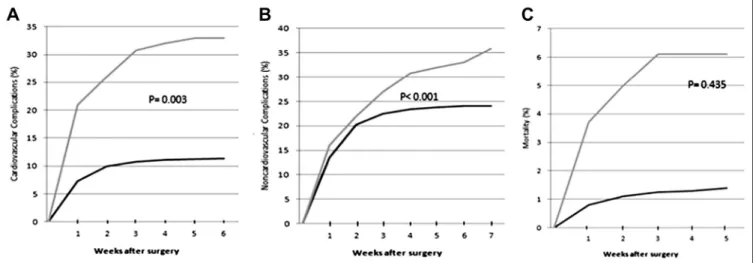
The distribution of in-hospital perioperative adverse events and postoperative length of stay data is summarized inTable 4in patients with and without AKI. The postoper-ative length of stay was significantly prolonged in patients who experienced postoperative AKI (10.36 9.2 vs 8.1 6 7.6 days, P , .001). The most common cardiovascular complications were acute coronary syndrome, acute heart failure, and arrhythmia, and the most common noncardiac complications were minor bleeding, wound infection, and lobar pneumonia. Cardiovascular complications occurred in 27 patients (33.3%) with AKI and in 127 patients (11.3%) without this complication (P , .001) (Fig. 1A). Noncardiovascular complications occurred in 29 patients (35.8%) with AKI and 270 patients (24.1%) without AKI (P5 .435). Although the overall noncardiovascular compli-cation rates were similar in the 2 groups, Kaplan-Meier analysis showed that the rate of noncardiovascular compli-cations was similar in the 2 groups during the first 2 weeks after surgery (22.2% vs 20.3%, P5 .456), but thereafter the rate of noncardiovascular complications was higher in patients with AKI (13.6% vs 3.8%, P, .001) (Fig. 1B). Pa-tients with perioperative AKI had a greater incidence of in-hospital mortality (6.1% vs 0.9%, P5 .003) (Fig. 1C) but a similar incidence of stroke (2.5% vs 1.7%, P5 .351) com-pared with those who never developed AKI. After the adjustment for age, sex, comorbidities, and clinical risk indicators, perioperative AKI remained as a significant pre-dictor for cardiovascular adverse events (OR5 3.56; 95% CI, 1.13 to 8.52, P, .001) and mortality (OR 5 3.83; 95% CI, 1.09 to 13.40; P 5 .036). Perioperative AKI was not a predictor of noncardiovascular complications within the first 2-week period of surgery, but it was an independent predictor of noncardiovascular complications after the first 2 weeks of surgery (OR 5 1.83; 95% CI, 1.09 to 3.46; P5 .036).
Comments
In this single-center, prospective study of consecutive patients with preoperative normal renal function who un-derwent noncardiac and nonvascular surgery, we found that
the incidence of perioperative AKI was 6.7%. Age, diabetes mellitus, RCRI, and ASA physical status independently predicted AKI. Perioperative AKI was strongly and inde-pendently associated with perioperative outcomes, postop-erative length of stay, and in-hospital mortality. Previous clinical studies have largely investigated risk factors and outcomes of acute renal failure occurring during the periop-erative period in cardiac and vascular surgery, with rates up to 40% depending on how it is defined.20–23 Most of
these studies defined acute renal failure as the deterioration of renal function sufficient to require dialysis and focused on patients without pre-existing renal insufficiency. How-ever, data regarding AKI in a noncardiovascular surgery population are very limited. Kheterpal et al24 investigated the incidence and risk factors for postoperative acute renal failure after major noncardiac surgery among patients with previously normal renal function. They evaluated adult pa-tients in a prospective, observational, and single-center study Table 1 Baseline clinical and demographic characteristics
All patients (N5 1,200) AKI (1) (n5 81) AKI (2) (n5 1,119) P value Demographics Age 65.756 13.90 72.786 11.31 65.246 13.93 ,.001 Male 634 (52.8) 45 (55.5) 589 (52.6) .611
Body mass index 28.226 11.39 27.286 3.60 28.296 11.75 .874
Medical history Current smoking 145 (12.1) 10 (12.3) 135 (12) .544 Diabetes mellitus 306 (25.5) 47 (58) 259 (23.1) ,.001 Hypertension 667 (55.6) 58 (71.6) 609 (54.4) ,.001 Atrial fibrillation 162 (13.5) 25 (30.9) 137 (12.2) ,.001 Hyperlipidemia 440 (36.7) 33 (40.7) 407 (36.4) .423 Heart failure 130 (10.8) 31 (38.2) 99 (9) ,.001
Coronary artery disease 320 (26.7) 37 (45.6) 283 (25.2) ,.001
History of cerebrovascular disease
89 (7.4) 7 (9) 82 (7.3) .663
Chronic obstructive pulmonary disease
139 (11.6) 10 (12) 129 (11.5) .824
Malignancy 199 (16.6) 12 (14.8) 187 (16.7) .758
NYHA functional class
1 741 (61.8) 48 (59.2) 705 (63) .326
2 423 (35.3) 29 (35.8) 384 (34.3)
3 36 (3) 4 (4.9) 30 (2.6)
4
Revised cardiac risk index
0 160 (13.3) 3 (3.7) 157 (14) ,.001 1 542 (45.2) 17 (20) 525 (46.9) 2 339 (28.3) 22 (27) 317 (28.3) 3 145 (12.1) 36 (44.4) 109 (9.7) 4 14 (1.2) 3 (3.7) 11 (1) ASA status ASA I 188 (17.5) 2 (2.4) 186 (16.6) ,.001 ASA II 600 (50) 35 (43.2) 575 (51.3) ASA III 296 (24.7) 30 (37) 266 (23.7) ASA IV 97 (8.1) 14 (17.3) 83 (7.4) Laboratory C-reactive protein (mg/dL) 1.966 3.38 2.086 2.86 1.956 3.41 .003 Mean platelet volume (fL) 8.806 5.56 8.526 1.08 8.816 5.75 .734
Hemoglobin (g/dL) 12.386 1.86 11.876 2.03 12.416 1.85 .007
White blood count (!103cells/mL)
8.556 4.84 8.676 3.09 8.546 4.94 .304
Fasting glucose (mg/dL) 108.876 38.3 108.326 38.88 108.496 37.90 .228
Creatinine (mg/dL) 1.226 1.36 1.216 1.33 1.226 1.39 .329
Albumin (g/dL) 3.826 0.59 3.696 0.59 3.836 0.59 .018
Left ventricle ejection fraction 58.526 8.75 49.776 13 59.156 8.05 ,.001 Values are given as mean6 standard deviation or number (percentage) unless otherwise indicated.
undergoing major noncardiac surgery with a preoperative creatinine clearance of 80 mL/min or greater calculated us-ing the Cockcroft-Gault formula.25They found a 0.8% inci-dence and 7 independent preoperative predictors (age, emergent surgery, liver disease, body mass index, high-risk surgery, peripheral vascular occlusive disease, and chronic obstructive pulmonary disease necessitating chronic bron-chodilator therapy) of postoperative acute renal failure, which was defined as a calculated creatinine clearance of 50 mL/min or less within the first 7 postoperative days.
Although the incidence and predictors of postoperative acute renal failure were identified in this preliminary study, the effect of renal failure on cardiac and noncardiac outcomes were not investigated. A second study performed by the same investigators revealed a 1% incidence of AKI
defined as an increase in serum creatinine of at least 2 mg/ dL or acute renal failure necessitating dialysis and showed that the development of AKI was associated with an 8-fold increase in all-cause 30-day mortality.26 Abelha et al27,28 studied postoperative AKI, which was defined by Acute Kidney Injury Network criteria29 in 2 different retrospec-tive studies. In the first study, 1,166 patients with no previ-ous renal insufficiency who were admitted to the intensive care unit after noncardiac surgery were evaluated.28 Multi-variate analysis identified ASA physical status, RCRI score, high-risk surgery, and congestive heart failure as preopera-tive determinants for postoperapreopera-tive AKI, which was de-tected in 7.5% of the patients. Patients who developed AKI had a longer length of stay in the hospital and a higher 6-month mortality rate. In the second study, 1,200 patients
Table 3 Univariate and multivariate analyses of risk factors for AKI
Variable
Univariate analysis Multivariate analysis
OR
95% Cl
P value OR
95% Cl
P value
Lower Upper Lower Upper
Age 1.050 1.028 1.071 .000 1.141 1.113 1.370 .004
Diabetes mellitus 1.869 4.014 10.459 .000 1.534 1.193 3.459 ,.001
Hypertension 0.748 1.285 3.472 .003 0.827 0.406 1.685 .601
Atrial fibrillation 1.163 1.933 5.298 .000 0.217 0.574 2.691 .581
Heart failure 1.854 3.901 10.461 .000 0.410 0.166 1.010 .052
Coronary artery disease 0.910 1.572 3.925 .000 1.690 0.818 3.489 .156 Revised cardiac risk index 1.010 2.128 3.542 .000 1.585 0.755 4.227 .032 ASA physical status 1.046 2.160 3.750 .000 1.686 0.993 2.862 .047
Hemoglobin 20.157 0.757 0.965 .012 0.910 0.758 1.091 .309
Albumin 20.365 0.488 0.987 .042 1.696 0.935 3.077 .082
LVEF 20.077 0.909 0.943 .000 0.965 0.927 1.004 .081
AKI5 acute kidney injury; ASA 5 American Society of Anesthesiologists; CI 5 confidence interval; LVEF 5 left ventricle ejection fraction; OR 5 odds ratio.
Table 2 Perioperative characteristics
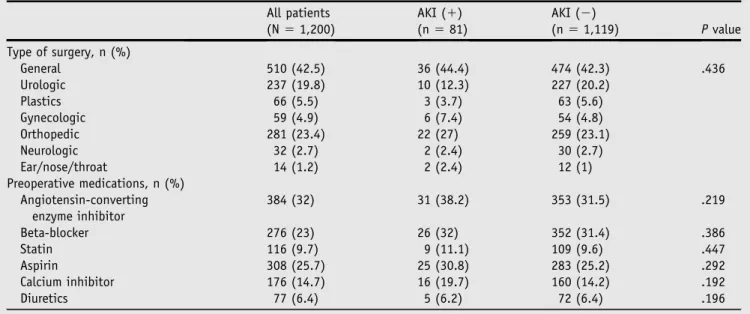
All patients (N5 1,200) AKI (1) (n5 81) AKI (2) (n5 1,119) P value Type of surgery, n (%) General 510 (42.5) 36 (44.4) 474 (42.3) .436 Urologic 237 (19.8) 10 (12.3) 227 (20.2) Plastics 66 (5.5) 3 (3.7) 63 (5.6) Gynecologic 59 (4.9) 6 (7.4) 54 (4.8) Orthopedic 281 (23.4) 22 (27) 259 (23.1) Neurologic 32 (2.7) 2 (2.4) 30 (2.7) Ear/nose/throat 14 (1.2) 2 (2.4) 12 (1) Preoperative medications, n (%) Angiotensin-converting enzyme inhibitor 384 (32) 31 (38.2) 353 (31.5) .219 Beta-blocker 276 (23) 26 (32) 352 (31.4) .386 Statin 116 (9.7) 9 (11.1) 109 (9.6) .447 Aspirin 308 (25.7) 25 (30.8) 283 (25.2) .292 Calcium inhibitor 176 (14.7) 16 (19.7) 160 (14.2) .192 Diuretics 77 (6.4) 5 (6.2) 72 (6.4) .196
admitted to the postoperative anesthesia care unit after ma-jor noncardiac surgery were retrospectively analyzed.29 Pa-tients with AKI (9.6%) stayed longer in the postoperative anesthesia care unit, had a 9-fold increased risk of mortality during hospitalization, and had a 4-fold risk of mortality at 6 months after discharge. Unfortunately, none of these 4 studies examined the effect of perioperative AKI on cardiac or noncardiac outcomes. In a recent, observational single-center study, Licker et al30showed that AKI occurred in ap-proximately 7% of patients undergoing lung cancer resec-tion and was associated with a 3- to 4-fold higher risk of cardiopulmonary complications.
The previously mentioned studies and our study showed that the incidence of AKI after adult noncardiac surgery
varies from 0.8% to 10% largely because of nonuniform definitions of AKI and is highly dependent on pre-existing renal function and the type of surgery. Our study also showed that the presence of perioperative AKI is associated with a 3- to 4-fold increased risk of cardiovascular adverse events and in-hospital mortality. Another finding of our study is that noncardiac complications were not more common in patients with AKI during the first 2 weeks after surgery, but thereafter the rate of noncardiovascular com-plications was higher in patients with AKI. This could be partly because of the older age and higher prevalence of preoperative comorbidities in patients with perioperative AKI, and it is also partly presumed to be because of the prolonged length of stay in these patients.
Figure 1 Kaplan-Meier curves for the cardiovascular complications (A), noncardiovacular complications (B), and in-hospital mortality (C) after noncardiac, nonvascular surgery in patients with (thin line) and without perioperative AKI (bold line).
Table 4 Association of AKI with adverse perioperative outcomes All patients (N5 1,200) AKI (1) (n5 81) AKI (2) (n5 1,119) P value Cardiovascular complications 154 (12.8) 27 (33.3) 127 (11.3) ,.001
Acute coronary syndrome 40 (3.3) 9 (11.1) 31 (2.8) ,.001
Acute heart failure 35 (2.9) 7 (8.6) 28 (2.5) .002
Severe arrhythmia 26 (2.2) 4 (4.9) 22 (2) .076
Pulmonary embolism 19 (1.6) 4 (4.9) 15 (1.3) .012
Nonfatal cardiac arrest 10 (0.8) 2 (2.5) 8 (0.7) .094
Arterial thromboembolism 24 (2) 5 (6.1) 19 (1.7) .019 Noncardiovascular complications 299 (24.9) 29 (35.8) 270 (24.1) .435 Wound infection 81 (6.7) 6 (7.4) 75 (6.7) .807 Respiratory failure 14 (1.2) 2 (2.5) 12 (1.1) .258 Lobar pneumonia 21 (1.8) 3 (3.7) 18 (1.6) .165 Bacteremia 13 (1.1) 1 (1.2) 12 (1.1) .892 Minor bleeding 128 (10.7) 12 (14.8) 116 (10.3) .196 Major bleeding 42 (3.5) 5 (6.1) 37 (3.3) .198 Stroke 21 (1.8) 2 (2.5) 19 (1.7) .351 Length of stay (d) 8.26 8.1 10.36 9.2 8.16 7.6 ,.001 Mortality 16 (1.3) 5 (6.1) 11 (0.9) .003
Although our study cohort included a heterogeneous group of patients and procedures, it reflects practice and outcomes at a single institution and may not be replicable in other settings. Patients undergoing emergent surgery, high-risk surgery (vascular surgery), and thoracic surgery were not included. Because long-term follow-up after discharge was not performed, complications that may have developed after discharge in some patients may lead to an underestimation of their incidence. Our study cannot establish a causal relation between AKI and cardiac or noncardiac complications. In conclusion, perioperative AKI is associated with a prolonged length of stay in the hospital, increased cardiovascular/noncardiovascular ad-verse events, and increased in-hospital mortality in this cohort of patients undergoing noncardiothoracic, nonvas-cular surgery.
Acknowledgments
The authors thank Fethiye Nihan Demiray, for her invaluable assistance with statistical analysis of the data.
References
1. Zhu M, Li Y, Xia Q, et al. Strong impact of acute kidney injury on sur-vival after liver transplantation. Transplant Proc 2010;42:3634–8. 2. Che M, Li Y, Liang X, et al. Prevalence of acute kidney injury
follow-ing cardiac surgery and related risk factors in Chinese patients. Neph-ron Clin Pract 2011;117:c305–11.
3. Li SY, Chen JY, Yang WC, et al. Acute kidney injury network classi-fication predicts in-hospital and long-term mortality in patients under-going elective coronary artery bypass grafting surgery. Eur J Cardiothorac Surg 2011;39:323–8.
4. Borthwick E, Ferguson A. Perioperative acute kidney injury: risk fac-tors, recognition, management, and outcomes. BMJ 2010;341:c3365. 5. Shaw A. Update on acute kidney injury after cardiac surgery. J Thorac
Cardiovasc Surg 2012;143:676–81.
6. Parolari A, Pesce LL, Pacini D, et al. Monzino Research Group on Cardiac Surgery Outcomes. Risk factors for perioperative acute kidney injury after adult cardiac surgery: role of perioperative management. Ann Thorac Surg 2012;93:584–91.
7. Katagiri D, Doi K, Honda K, et al. Combination of two urinary bio-markers predicts acute kidney injury after adult cardiac surgery. Ann Thorac Surg 2012;93:577–83.
8. Brienza N, Giglio MT, Marucci M. Preventing acute kidney injury af-ter noncardiac surgery. Curr Opin Crit Care 2010;16:353–8. 9. Patel UD, Garg AX, Krumholz HM, et al. Pre-operative serum brain
natriuretic peptide and risk of acute kidney injury after cardiac surgery. Circulation; 2012 Feb 9 [Epub ahead of print].
10. Bellomo R, Ronco C, Kellum JA, et al. ADQI Workgroup. Acute renal failureddefinition, outcome measures, animal models, fluid therapy and information technology needs. The second international consensus conference of Acute Dialysis Quality Initiative (ADQI) Group. Crit Care 2004;8:R204–12.
11. George TJ, Arnaoutakis GJ, Beaty CA, et al. Acute kidney injury in-creases mortality after lung transplantation. Ann Thorac Surg 2012;94: 185–92.
12. Portal AJ, McPhail MJ, Bruce M, et al. Neutrophil gelatinase–associ-ated lipocalin predicts acute kidney injury in patients undergoing liver transplantation. Liver Transpl 2010;16:1257–66.
13. Yalavarthy R, Edelstein CL, Teitelbaum I. Acute renal failure and chronic kidney disease following liver transplantation. Hemodial Int 2007;11:S7–12.
14. American Society of Anesthesiologists. New classification of physical status. Anesthesiology 1963;24:111.
15. Lee TH, Marcantonio ER, Mangione CM, et al. Derivation and pro-spective validation of a simple index for prediction of cardiac risk of major noncardiac surgery. Circulation 1999;100:1043–9.
16. Fleisher LA, Beckman JA, Brown KA, et al. ACC/AHA 2007 guidelines on perioperative cardiovascular evaluation and care for noncardiac surgery: a report of the ACC/AHA Task Force on Prac-tice Guidelines (Writing Committee). Circulation 2007;116: e418–99.
17. Levey AS, Stevens LA, Schmid CH, et al. CKD-EPI (Chronic Kidney Disease Epidemiology Collaboration). A new equation to estimate glo-merular filtration rate. Ann Intern Med 2009;150:604–12.
18. Thygesen K, Alpert JS, White HD. Universal definition of myocardial infarction. Eur Heart J 2007;28:2525–38.
19. WHO MONICA Project-Principle Investigators (prepared by Tunstall Pedoe H): The World Health Organization MONICA Project (Moni-toring of Trends and Determinants in Cardiovascular Disease): a major international collaboration. J Clin Epidemiol 1988;41:105–14. 20. Wijeysundera DN, Karkouti K, Dupuis JY, et al. Derivation and
vali-dation of a simplified predictive index for renal replacement therapy after cardiac surgery. JAMA 2007;297:1801–9.
21. Mehta RH, Grab JD, O’Brien SM, et al. Society of Thoracic Surgeons National Cardiac Surgery Database Investigators. Bedside tool for pre-dicting the risk of postoperative dialysis in patients undergoing cardiac surgery. Circulation 2006;114:2208–16.
22. Mangano CM, Diamondstone LS, Ramsay JG, et al. Renal dysfunction after myocardial revascularization: risk factors, adverse outcomes, and hospital resource utilization. The Multicenter Study of Perioperative Ischemia Research Group. Ann Intern Med 1998;128:194–203. 23. Tuttle KR, Worrall NK, Dahlstrom LR, et al. Predictors of ARF after
cardiac surgical procedures. Am J Kidney Dis 2003;41:76–8. 24. Kheterpal S, Tremper KK, Englesbe MJ, et al. Predictors of
postoper-ative acute renal failure after noncardiac surgery in patients with pre-viously normalrenal function. Anesthesiology 2007;107:892–902. 25. Cockcroft DW, Gault MH. Prediction of creatinine clearance from
serum creatinine. Nephron 1976;16:31–41.
26. Kheterpal S, Tremper KK, Heung M, et al. Development and validation of an acute kidney injury risk index for patients undergoing general sur-gery: results from a national data set. Anesthesiology 2009;110:505–15. 27. Abelha FJ, Botelho M, Fernandes V, et al. Determinants of
postoper-ative acute kidney injury. Crit Care 2009;13:R79.
28. Abelha FJ, Botelho M, Fernandes V, et al. Outcome and quality of life of patients with acute kidney injury after major surgery. Nefrologia 2009;29:404–14.
29. Levin A, Kellum JA, Mehta RL. Acute Kidney Injury Network (AKIN). Acute kidney injury: toward an integrated understanding through development of a research agenda. Clin J Am Soc Nephrol 2008;3:862–3.
30. Licker M, Cartier V, Robert J, et al. Risk factors of acute kidney injury according to RIFLE criteria after lung cancer surgery. Ann Thorac Surg 2011;91:844–50.