ANALYTICAL LETIERS, 32(4), 827-840 (1999)
THE IDENTIFICATION AND QUANTITATIVE ANALYSIS OF THE VERY TOXIC 2,3,7;8-TETRACHLORDIBENZO-P-DIOXIN INTHE
PRESENCE OF POLYCHLORINATED DIBENZODIOXINS (PCDDs) AND POLYCIILORINATED DIBENZOFURANS (PCDFs)
CONTAl\tINATED SOIL SAMPLES
Kcy Words: Polichlorodibeiızodioxins, Toxic Materials, GC-MS, TCDD, PCDD, PCDf'
M. Pehlivan*
Selçuk University, Faculty of Education, Department of Chemistıy, 42090 Konya, Turkey
E. Pehlivan
Selçuk University, Faculty of Arts and Sciences, Department ofClıemistıy, 42079 Konya, Turkey
M. A. Özler
Muöla University, Faculty of Arts and Sciences, Department ofChemistıy, Mugla, Turkey
H. Barlas
Istanbul University, Faculty of Engineering, Environmental Department, Istanbul, Turkey
*To whoın correspondence slıould be addressed. 827
• - •
-ABSTRACT
This researclt' describes the nature and extent of 2,3,7,8- tetrachlorodibenzo-p-dioxin (2,3,7,8-TCDD) contamination in the soil samples from a waste cable incineration plant. The samples are collected at different placcs in the nearest and far away points of the soil around the incineration plant. A procedure which is described for the selective separation of 2,3,7,8-TCDD from ali other PCDDs and PCDFs fractionated on Alumina Woelm B Super I in such a manner that all P.CDDs and PCDFs are eluted prior to 2,3,7,8-TCDD. This
r
procedure allows mor· 'sensitive quantitative determination of 2,3,7,8-TCDD in the soil samples.
INTRODUCTION
\Ve have recently published a procedure 1 which allows the selective determination of PCDDs and PCDFs on the roadside of moto rways. Polychlorinated dibenzo-p-dioxins (PCDDs) and polychlorinated dibenzofurans (PCDFs) have been identified as by products in industrial compounds, formed during the combustion processes in the municipal incinerators, in the waste cable buming processes and in the production of some chlorinated aromatic compounds27
Problems conceming the correct determination and interpretation of soil pollution have been considered to be important due to toxic effects. Some of the PCDDs and PCDFs have extremely toxic properties and they are a risk to human health. The most toxic compound appears to be the 2,3,7,8-substituted te trachlordibenzodioxin 810
•Due to its potential bioaccumulation and resistance to metabolism, this halogenated compound has received much scientific attention. üne ofthe scnsitive signs of2,3,7,8-TCDD toxicity in animals is the loss ofbody weight. Although doses are low, it leads to embryotoxicity1112 If a low detection
PEHLIVAN ET AL. 828
•
•
2,3,7,8-TETRACHLORDIBENZO-P-DIOXIN 829
limit is desired, the quantitative detemıination of 2,3,7,8-TCDD in soil samples
containing a large amount of TCDDs and TCDFs is diffic ult. Jn this study,
2,3,7,8-TCDD determination in soil samples coming from the chlorine source of a waste cable incineration plant is described.
The most toxic isomer of PCDDs is 2,3,7,8-TCDD and it has a structural fomıula shown in Fig. l13
EXPERil\1ENTAL
Equipment
1
1. Gas Chromatography (GC;HP): Hewlett-Packard GmbH, Gennany.
2. Mass Spectrometer .(M
.
. S 'ı-IP 5970 B): Hewlett-Packard GmbH.
3. Bio-Beads S-X3 G I chromatography: Bio Rad, Germany.
4. CapiUary Colwnn (Chrompack, CP-Sil 88): Compack Intemational, Holland.
Chemicals
1. 13C-PCDD/PCDFstandards: Promochemie GmbH, Germany.
2. Nitrogen Gas, Helium Gas: Fa. Messer, Germany.
3. Organic Solvents: Dichloromethane, Cyclohexane, Hexane, Acetone, Benzene, Toluenes (all ofnanograd purity): Promochemie.
4. Kieselgel-Silica Woelm 63-Active, Na2SO-ı, Conc. H2SO-ı, AgNO 3, Alumina B
Super 1, Woelm Pharma Eschwege: Promochemie.
Experimental Procedure
The analytical methods developed for the determination of PCDDs and PCDFs and 2,3,7,8-TCDD in the various soil samples entail a sequence of fıve operations:
1. Extraction of PCDD and PCDF from the soil samples
2. Preliminary separation of PCDDs and PCDFs from the major matrix constituents
2,3,7,8-TETRACHLORDIBENZO-P-DIOXIN 835
•
cıvOvcı
cı o cı
FIG.I. The structural formula of2,3,7,8-TCDD
3. Detection of PCDDs and PCDFs in the cleaned-up sample extract 4. Preliminary separation of2,3,7,8-TCDD froın the PCDDs and PCDFs 5. Detection of 2,3,7,8-
·
T-.
..CDD
Extraction, Separa'tion and Detection of the PCDDs and PCDFs
To obtain.a:p; re PCDDs and PCDFs fraction free of other compounds, the
extract is subjected to a clean-up procedure using the method below:
l\lethod
The PCDD/PCDF isomers of the soil sanıples, were isolated and
concentrated by chronıatographic techniques in the following sequence:
Soil Sample
,ı
13 C-PCDD/PCDFstandards Soxhlet Extraction Column Chromatography,ı
GC/MS Analysis (Selected Ion Monitoring)
The following adsorbents were utilised for the column chromatographic separation:
PEHLIVAN ET AL.
830
1- Kieselgel % 44 H2SO.ı (2.5 X 60 cm)
2- Macro Alumina B Super 1 (2.5 X 60 cm) 3- Mix Column (2 X 30 cm)
4- Bio-Beads S-X3 Gel Chromatography (3 X 60 cm)
5- Mini Alumina 8 Super l (0.7 X l l cm)
in the separation technique, known amounts of 13C-PCCD/PCDF
standards were injected to the soil samples, and these samples were then extracted in a Soxhlet type extractor. The total PCDD/PCDF isomers of the sample were first isolated and t en concentrated by passing the extract thro1:1gh columns packed with Kieselge(% 44 H2SO.ı, Macro Alumina 8 Super l, Mix.
1
Column, Bio Beads S-X3 Gel Chromatography, Mini Alumina B Super l columns, all of wlıich • are "basically chromatographic separation procedures. Quantitative determinati5>ns were then performed by recording the spectra of ali PCDD/PCDF extracts on a GC/MS instrument.
Separation of2,3,7,8-TCDD
The GC/MS analyses of the clean-up fraction containing the PCDDs and PCDFs don't allow a correct quantitative detennination of 2,3,7,8-TCDD. For that reason, the eluant is evaporated and the residue is dissolved in 5 mi of benzene. This solution is injected onto a column fılled with 3 g Alumina Woelm 8 Super 1 and 2.5 g Na2SO-ı, prewaslıed with 50 mi of hexane. This column is
eluted with 35 mi of 20 % dichlorometlıane in hexane mixture. This fraction
contains all PCDDs and PCDFs except 2,3,7,8-TCDD. Then tlıe column is eluted
with 30 mi 50 % dichloromethane in hexane mixture and 2,3,7,8-TCDD is
obtained. Tlıis eluant is evaporated to 4 mi and dried in a nitrogen atınosphere and 10 µI benzene is added.
Detection of2,3,7,8-TCDD
The final solution was analysed on a GC/MS instrument under the following experimental conditions: A CP Sil 88 capillary column was eınployed,
832 PEHLIV AN ET AL.
and helium was used asa carrier gas, and the temperature ofthe chromatographic separation was progranımed as follows: 130 °C for 1 min. and raised from 130 uc to 240 °c at a rate of 15 °ctmin. The capillaıy column was directly connected to a mass-selective detector in order to achieve effıcient chromatographic separation.
The quantitative evaluation was accomplished by the use of mass- fragmentograms obtained from GC/MS analyses in the following manner:
The "response factor" of the 2,3,7,8-TCDD isomer was calculated from the mass fragmentogram peak of the 13C-2,3,7,8-TCDD stantlar obtained
..
experimentally. Then, quantitative calculation was carried out utilising the mass 1
fragmentogram of th.e isomer and its response factor.
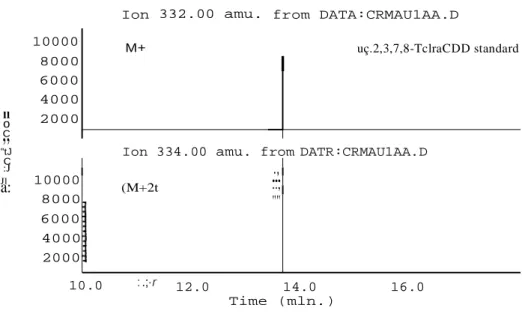
The "m/z ( { d (M+2f" ions of ali the TCDD isomers, and 2,3,7,8- TCDD isomer d 13C-2,3,7,8-TCDD obtained from the analyses of the soil samples are illustrated in Fig.2, Fig. 3 and Fig. 4.
The Suitability ofThe Method
in the beginning ofthe analysis, 13C-2,3,7,8-TCDD;;tandard was injected to the soil sample to determine how muclı 13C-2,3,7,8-TCDDstandard will be lost during the chromatograplıic separation. lf there is some decrease in the amount of 13C-2,3,7,8-TCDDstandard, the same ratio will be considered in our sample. For this, a dcfinite amount of 13C-l,2,3,4-TCDD comparison sample was injected to the concentrated sample after clıromatograplıic steps. Then GC-MS analysis of 13C-2,3,7,8-TCDD standard and 13C-1,2,3,4-TCDD comparison sample was done together. The obtained mass fragmentogram was given in Fig. 5. Then, the arca and peak lıeight of the mass fragmentogram of 13C-2,3,7,8- TCDD standard and 13C-I,2,3,4-TCDD comparison sample were compared witlı eaclı otlıer. As seen in Fig.5, tlıere wasn't any loss. This result proves tlıe reliability of this method for the quantitative dete ination of 12C-2,3,7,8-TCDD in soil samples. Tlıe difference between peak Iıeights is smaller tlıan tlıe
2,3,7,8-TET RACHLORDIBENZO-P-DIOXIN 833 40000 30000 20000 10000 40000 30000 20000 10000
Ion 320.00 amu. from DATA:CRMAUlA.D
Ion 322.00 amu. from DATA:CRMAUlA.D
.
N11.0 _ 12.0 13.0 14.0
Time Cm1n.) 15.0
16.0 17.0
FIG. 2. Thc
massfragmcııtogramı
ofM'
and (M+2t ions oftetraCDDs2000 1500 1000 500
Ion 320.00 amu. from DATA:CRMAUlAA.D
Ion 322.00 amu. from DATA:CRMAUlAA.D 2000 1500 1000 (M+ıt
.
",..
_,
' N 12.0 14.0 T1me (mt n.) 16.0FIG. 3. Thc massfragıncntograms of
M'
aııd (M+2t ion., of 2,3,7,8-tctıaCDDTetraCDD
(M+2♦,
!
§
834 PEHLIV AN ET AL.
14000
12000
.
-
.
.
.
-
13C-2,3,7,8-TCDD-+
-
13C-1,2,3,4-TCDD
(M+ıt
o,,
Ion 332.00 amu. from DATA:CRMAU1AA.D 10000 8000 6000 4000 ll 2000 C
"tJ Ion 334.00 amu. from DATR:CRMAU1AA.D
C :J
a
Jl:
10000 8000 6000 4000 2000 10.0 : .;·r 12.0 14.0 16.0 Time (mln.)FIG. 4. Thc masıfragmentogramı of and (M+2t ions of 13C-2,3,7,8-tctraCDD standard
Ion
334 . 00
amu .
10
12
14
16
18
20
22
TimeFIG . 5. The massfragmentograms of (M+2l lons of uC-2,3,7,8-tetraCDD standard and uC-1,2,3,4-tetraCDD comparison sample
(M+2t
.
.
.
,.
.., ""2,3,7,8-TET RACHLORDIBENZO-P-DIOXIN 835 difference between peak areas. For that reason, quantitative calculations were done by using the peak heiglıts.
RESULTS AND DISCUSSION
The aim of the present study is to find the specifıc concentration of 2,3,7,8-TCDD in the PCDDs and PCDFs contaminated soil samples. \Ve report on the GC/MS properties of chlorinated PCDDs and PCDFs and we also present an analytical method for 2,3,7, TCDD.
Some of the PCDDs and PCDFs have extraordinary toxic properties, and
!
have been the subject of rri ch interest. They are now generally associated with the conıbustion processes when organic materials and a chlorine source are present. _The isomer analyses of PCDDs and PCDFs contaminated soil samples exhibited the known broad spectrum of toxic dioxin and foran isomers. Because of the extreme toxicity of the 2,3,7,8-TCDD isomer, very sensitive analytical techniques are required. The separation, identification and quantification of 2,3,7,8-TCDD has become very important.
An extract from the soil sample was cleaned up for PCDDs and PCDFs analyses. Total concentration of PCDDs and PCDFs obtained for the different soil samples after GC/MS analyses are given in Tables l and 2. The PCDDs and PCDFs results reported in these Tables are the emission from the waste cable incineration planı to the soil for 12 months accumulation.
The PCDDs and PCDFs samples extracted from tlıe soil sample were fractionated as described in the reference l. The separation of 22 mass fragmentograms of(M+) and (M+2f isomers ofTCDDs homologous group from PCDDs and PCDFs arc shown in Fig. 2. In this figure, the most toxic TCDD congener substituted 2,3,7,8-TCDD is shown as the dark black peak. This fraction containing ali PCDDs and PCDFs was fractionated on Alumina \Voelm
836 PEHLIV AN ET AL.
TABLE 1
The Contribution oflndividual Congeners of Ali PCDD/PCDF (ng/g) in The Different Soil Samples
Sam le 1 Sam le2 Sam le3
Total TetraCDD 20.50 13.00 9.00 -2,3,7,8-TetraCDD 0.63 0.55 0.27 Total PentaCDD 37.80 21.00 10.40 -1,2,3,7,8-PentaCDD 2.92 2.04 1.29 Total HexaCDD
..
41.60 24.40 21.30 -1,2,3,4,7,8-HexaCDD 2.39 1.98 1.62 -1,2,3,6,7,8-HexaCDD 4.79 2.83 2.59 -1,2,3,-7,8,9-HexaCDD 3.59 2.26 1.83 Total HeptaCDD 66.80 43.30 42.50 -1,2,3,4,6,7,8-HeptaCDD 34.01 23.30 23.00 Total OctaCDD 63.80 16.20 50.00 Total PCDD 230.50 118.00 141.20 Total TetraCDF 154.00 52.40 45.10 -2,3,7,8-TetraCDF 24.73 6.85 6.41 Total PentaCDF 218.70 92.20 66.70 -1,2,3,7,8-PentaCDF 50.73 13.65 10.42 -2,3,4,7,8-PentaCDF 16.62 7.03 4.62 Total HexaCDF 201.70 l 14.00 101.40 -1,2,3,4,7,8-HexaCDF 46.26 16.29 20.20 -1,2,3,6,7,8-HexaCDF 27.91 13.33 13.76 -1,2,3,7,8,9-HexaCDF 3.99 3.70 2.90 -2,3,4,6,7,8-HexaCDF 5.88 6.67 6.52 Total HeptaCDF 357.60 102.10 l 10.50 -1,2,3,4,6,7,8-HeptaCDF 201.39 65.40 74.40 -1,2,3,4,7,8,9-HeptaCDF 59.03 18.20 21.90 Total OctaCDF 179.00 40.20 45.00 Total PCDF 1111.00 409.70 376.702,3,7,8-TET RACHLORDIBENZO-P-DIOXIN 837
TABLE2
The Contribution oflndividual Congeners of Ali PCDD/PCDF (ng/g) in The Different Soil Samples
Sam le 4 Sam le 5 Sam le 6
Total TetraCDD 90.60 1.04 0.65 -2,3,7,8-TetraCDD 0.28 0.03 0.02 Total PentaCDD 13.10 2.57 1.55 -1,2,3,7,8-PentaCDD 0.88 0.17 0.08 Total HexaCDD 15.70 3.16 1.90 -1,2,3,4,7,8-HexaCDD 0.95 0.21 0.10 -1,2,3,6,7,8-He aCDD 1.77 0.37 0.19 -1,2,3,7,8,9_- HexaCDD 1.15 0.24 0.10 Total HeptaCDD - . 16.80 5.60 3.04 -1,2,3,4,6,7,8-HeptaCDD 10.90 3.29 1.56 Total OctaCDD 17.30 5.26 2.71 Total PCDD 72.50 17.71 9.05 Total TetraCDF 38.30 6.49 3.01 -2,3,7,8-TetraCDF 4.50 096 0.43 Total PentaCDF 55.20 9.97 5.30 -1,2,3,7,8-PentaCDF l 1.95 1.46 0.76 -2,3,4,7,8-PentaCDF 3.29 0.69 0.35 Total HexaCDF 42.90 10.95 5.84 -1,2,3,4,7,8-HexaCDF 9.21 2.44 1.31 -1,2,3,6,7,8-HexaCDF 5.32 1.40 0.69 -1,2,3,7,8,9-HexaCDF 1.06 0.32 0.13 -2,3,4,6,7,8-HexaCDF 2.48 0.61 0.24 Total HeptaCDF 50.40 15.63 7.75 -1,2,3,4,6,7,8-HeptaCDF 30.46 8.19 4.14 -1,2,3,4,7,8,9-HeptaCDF 7.35 2.68 1.07 Total OctaCDF 28.40 10.51 5.42 Total PCDF 215.20 53.55 27.32
838 PEHLIV AN ET AL.
• B Super 1 column and 2,3,7,8-TCDD is separated from the others and the fragmentograms of(M ), (M+2f 2,3,7,8-TCDD are shown in Fig. 3.
The adsorption behaviour of 2,3,7,8-TCDD on the Alumina Woelm B Super 1 shown in Fig. 3, differs significantly from all other PCDDs and has not been obtained by other chromatographic techniques, such as HPLC.
The "response factor" of the Tetra-CDD isomer was calculated from the fragrnentogram peaks of the 13C-standards obtained experimentally. Then, quantitative calculation was carried out utilising the mass-fragmentogram of the isomer and its response f or. 13C
12 -2 ,3,7,8-TCDD intemal stand ds are shown in Fig.4. The retention time of M+ and (M+2f mass fragmentograms is
/
seen approximately as_-1 .7 minutes. Meanwhile a 5 ng 13C
12 -2 ,3,7,8-TCDD injected sample giv s·identical results. The quantitative values in Fig. 2 were calculated from the response factors which were obtained from the values of peak height and abundance values as given in Tables 1 and 2.
The determination of 2,3,7,8-TCDD can't be analysed witlıout possibility of its selective loss during clean-up. The (M+), (M+2f mass fragmentograms of 13C-2,3,7,8-TCDDas an intemal standard is shown in Fig.4. The retention tinıe of tlıe native 2,3,7,8-tetraCDD is the same as tlıat of tlıe labelled standard. The isotope ratio (320/322) agrees with tlıe labelled standard.
The total PCDD and PCDF values were over 1 ng/kg as seen in the Table 1. These toxic amounts are quite big for human healtlı. This pollution affects foods, and the food chain is the primary patlıway of human exposure to PCDF. PCDF is easily dissolved in fatty oil and is stored in human fatty tissues3 The human population is exposed to variable mixtures of polychlorinated dibenzo-p- dioxins and dibenzofurans from tlıe environment. The persistence in man of tlıe most toxic substance, 2,3,7,8-TCDD, suggested a half-life of several years. The distribution of various PCDDs and PCDFs was measured in rat tissues. Amounts of the applied dose to rats of over 1 ng/kg can give degeneration of liver tissue, losses of weight, tumors on the liver, lung and nose9
2,3,7,8-TET RACHLORDIBENZO-P-DIOXIN 839 should reveal that chlorinated aromatic compounds such as 2,3,7,8-substituted TCDD are a potential risk to the public and tlıe environment.
We lıave demonstrated tlıat the soil samples can be analysed for 2,3,7,8- TCDD very effectively at low levels of detection witlı tlıis technique. According to our experience the described procedures can also readily be applied to the other industrial products and corresponding waste samples.
ACKNOWLEDGJ\IENT
\Ve are grateful to SeiçJk University Researclı Foundation for supporting this·research project.
REFERENCES
1. M. Pehlivan and A.D. Bedük, Ana/. Lell., 25 (11), 2107-2122 (1992).
2. H.R. Buser, Clıemosplıere, 16 (4), 713-732 (1987).
3. G. Choudhary, L.H. Kelty and C. Rappe, Butterworth Publislıers, 165-181 (1983).
4. T. Zacharewski, M. Harris, S. Safe, H. Thoma, G. Hausschulz, E. Knorr and O. Hutzinger, Clıemosplıere, 18 (1-6), 381-387 (1989).
5. T.O. Tieman, M.L. Taylor, J.H. Garret, G.F. Vanness, J.G. Solch, O.A. Dels and D.J. Wafel, Clıemosplıere, 12 (4-5), 595-606 (1983).
6. K. Ballschmiter, W. Zoller, Ch. Scholz and A. Notrodt, Clıemosplıere, 12 (4-
5), 585-594 (1983).
7. J. Casanovas, R. Muro, E. Eljarrat, J. Calxach and J. Rivera, Freseniııs J.
Ana/. Clıenı., 348, 167-170 (1994).
8. C.T. Curtis and H.A. Hattemer-Frey, Clıemosplıere, 16 (10-12), 2331-2342
(1987).
840 PEHLIV AN ET AL.
10. D.G. Patterson, J.S. Holler, W.T. Belser, E.L. Boozer, C.R. Lapeza and L.L. Noedham, Clıemosplıere, 16 (4), 935-936 (1987).
11. M. van der Berg, M. van Greevenbroek and K. Olie, C/ıemosp/ıere, 15 (4),
509-518 (1986).
12. R. Krowke, Clıenıosplıere, 15 (9-12), 2011-2012 (1986). 13. Sachstand Dioxine, Umweltbundesamt, (1984).
Received: March 27, 1998 Accepted: November 11, 1998