MEAN-SHIFT ANALYSIS FOR IMAGE AND
VIDEO APPLICATIONS
a thesis
submitted to the department of electrical and
electronics engineering
and the institute of engineering and science
of bilkent university
in partial fulfillment of the requirements
for the degree of
master of science
By
Halil ˙Ibrahim C¨uce
May, 2005
I certify that I have read this thesis and that in my opinion it is fully adequate, in scope and in quality, as a thesis for the degree of Master of Science.
Prof. Dr. Ahmet Enis C¸ etin (Supervisor)
I certify that I have read this thesis and that in my opinion it is fully adequate, in scope and in quality, as a thesis for the degree of Master of Science.
Assoc. Prof. Dr. Ezhan Kara¸san
I certify that I have read this thesis and that in my opinion it is fully adequate, in scope and in quality, as a thesis for the degree of Master of Science.
Asst. Prof. Dr. U˘gur G¨ud¨ukbay
Approved for the Institute of Engineering and Science:
Prof. Dr. Mehmet B. Baray
Director of the Institute Engineering and Science ii
ABSTRACT
MEAN-SHIFT ANALYSIS FOR IMAGE AND VIDEO
APPLICATIONS
Halil ˙Ibrahim C¨uce
M.S. in Electrical and Electronics Engineering Supervisor: Prof. Dr. Ahmet Enis C¸ etin
May, 2005
In this thesis, image and video analysis algorithms are developed. Tracking mov-ing objects in video have important applications rangmov-ing from CCTV (Closed Cir-cuit Television Systems) to infrared cameras. In current CCTV systems, 80% of the time, it is impossible to recognize suspects from the recorded scenes. There-fore, it is very important to get a close shot of a person so that his or her face is recognizable. To take high-resolution pictures of moving objects, a pan-tilt-zoom camera should automatically follow moving objects and record them. In this thesis, a mean-shift based moving object tracking algorithm is developed. In ordinary mean-shift tracking algorithm a color histogram or a probability den-sity function (pdf) estimated from image pixels is used to represent the moving object. In our case, a joint-probability density function is used to represent the object. The joint-pdf is estimated from the object pixels and their wavelet trans-form coefficients. In this way, relations between neighboring pixels, edge and texture information of the moving object are also represented because wavelet coefficients are obtained after high-pass filtering. Due to this reason the new tracking algorithm is more robust than ordinary mean-shift tracking using only color information.
A new content based image retrieval (CBIR) system is also developed in this thesis. The CBIR system is based on mean-shift analysis using a joint-pdf. In this system, the user selects a window in an image or an entire image and queries similar images stored in a database. The selected region is represented using a joint-pdf estimated from image pixels and their wavelet transform coefficients. The retrieval algorithm is more reliable compared to other CBIR systems using only color information or only edge or texture information because the joint-pdf based approach represents both texture, edge and color information. The proposed method is also computationally efficient compared to sliding-window
iv
based retrieval systems because the joint-pdfs are compared in non-overlapping windows. Whenever there is a reasonable amount of match between the queried window and the original image window then a mean-shift analysis is started.
Keywords: Mean-shift tracking, FLIR imagery, saliency detection, color
¨
OZET
RES˙IM VE V˙IDEO UYGULAMALARI ˙IC
¸ ˙IN
ORTALAMA DE ˘
GER KAYMASI ANAL˙IZ˙I
Halil ˙Ibrahim C¨uce
Elektrik ve Elektronik M¨uhendisli˘gi, Y¨uksek Lisans Tez Y¨oneticisi: Prof. Dr. Ahmet Enis C¸ etin
Mayıs, 2005
Bu tezde imge ve video uygulamaları i¸cin analiz yazılımları geli¸stirilmi¸stir. Videoda hareketli nesnelerin takibi ve izlenmesi ¨onemli uygulamaları olan bir problemdir. ¨Orne˘gin, kapalı devre televizyon sistemi kullanan g¨uvenlik uygula-malarında izleme yapan kameranın hareketli nesneye otomatik olarak odaklan-ması ¸cok ¨onemlidir. C¸ ¨unk¨u olay ¸cıkabilecek yerlere yerle¸stirilen her kamerayı izleyen bir g¨uvenlik g¨orevlisi yoktur. Hırsızlık olaylarında yapılan kayıtların %80’inde su¸c i¸sleyenler tanınacak d¨uzeyde de˘gildir. Bu kayıtlardaki ki¸silerin y¨uzleri 20-30 olu¸smakta ve bu su¸cluları tanımak m¨umk¨un olmamaktadır. Ayrıca enfraruj kameralarda da otomatik takip ¨ozelli˘gi faydalı bir ¨ozelliktir. Bu tezde hareketli nesneleri otomatik olarak takip edebilecek bir algoritma geli¸stirilmi¸stir. Geli¸stirilen algoritma ve yazılım ortalama de˘ger kayması metoduna dayalıdır. An-cak literat¨urde belirtilen metodlardan farklı olarak imgecikler arasındaki ili¸skiler de g¨oz ¨on¨une alınmı¸stır ve standart metodlardan daha ¨ust¨un bir izleme yazılımı olu¸sturulmu¸stur. Hareket eden nesnenin kom¸su imgecikleri, kenar ve doku bil-gisi arasında ki ili¸skiler, y¨uksek-bant s¨uzge¸c i¸slemi sonucu elde edilen dalgacık katsayılarının kullanılması nedeniyle g¨oz ¨on¨une alınmı¸stır. Dalgacık d¨on¨u¸s¨um¨u katsayıları kenar bilgilerini de i¸cerdi˘ginden algoritma sadece renk histogramı kul-lanan algoritmalara g¨ore daha dayanıklıdır.
Bu tez ¸cer¸cevesinde ortalama de˘ger kaymasına dayalı bir i¸cerik tabanlı imge sorgulama metodu da geli¸stirilmi¸stir. B¨oyle bir sistemle sayısal video ya da imge kaydı yapılan bir ortamdan sorgulama yapmak m¨umk¨un olacaktır. Kul-lanıcı sorgulama yapaca˘gı t¨urden bir resmi ya da resim par¸casını sisteme gire-cek sistem de sorgulanan resime benzer ya da onu i¸ceren resimleri veri ta-banından getirecektir. Sorgulama penceresinin i¸cindeki resim par¸casından ortak-olasılık yo˘gunluk fonksiyonu dalgacık d¨on¨u¸s¨um¨u ve ger¸cek imgecikler kullanılarak olu¸sturulmaktadır. Hem renk, hem de kenar yo˘gunlu˘gu bilgisi kullanıldı˘gından
vi
sorgulama i¸slemi sadece renk bilgisi kullanan sorgulamalara g¨ore daha g¨uvenlidir. Arama i¸slemi veritabanındaki resimlerin ¨uzerinden kayan bir pencere ¨uzerinden de˘gil de ortalama de˘ger kayması kullanılaca˘gından normalden hızlı olmaktadır.
Anahtar s¨ozc¨ukler : Ortalama de˘ger kayması takibi, FLIR resim galerisi,
Acknowledgement
I would like to express my gratitude to my supervisor Prof. Dr. Ahmet Enis C¸ etin for his instructive comments in the supervision of the thesis.
I would like to express my special thanks and gratitude to Assoc. Prof. Dr. Ezhan Kara¸san and Asst. Prof. U˘gur G¨ud¨ukbay for showing keen interest to the subject matter and accepting to read and review the thesis.
Contents
1 Introduction 1
1.1 Review of Object Tracking Methods . . . 2
1.2 Mean Shift Tracking in CBIR . . . 3
1.3 Organization of the Thesis . . . 4
2 Mean-Shift Object Tracking in FLIR Imagery 6 2.1 Forward Looking Infrared Systems . . . 7
2.2 Mean-Shift Object Tracking . . . 9
2.3 Image Feature Selection . . . 10
2.4 Simulation Examples . . . 15
3 Mean-Shift Tracking in CBIR 22 3.1 Image Content Descriptors . . . 23
3.1.1 Color . . . 24
3.1.2 Texture . . . 26
3.1.3 Shape . . . 27 viii
CONTENTS ix
3.1.4 Spatial Information . . . 27
3.2 Similarity Measures . . . 27
3.3 Indexing Methods . . . 28
3.4 User Interaction . . . 29
3.5 Mean-Shift Analysis in CBIR . . . 29
3.5.1 Modelling of User interest . . . 31
3.5.2 Similarity Measure . . . 39
3.5.3 Image Partition . . . 40
3.5.4 Mean-Shift Tracking . . . 41
3.6 Experimental Results . . . 43
List of Figures
2.1 A comparison between the night vision camera and FLIR image. . 8 2.2 FLIR image of a plane. . . 11 2.3 High-pass filtered version of the above plane image. The cut-off
frequency of the filter is π/2. . . . 12 2.4 High-pass filtered version of the above plane image. The cut-off
frequency of the high-pass filter is π/4. . . . 12 2.5 A FLIR image from the web page: www.dii-llc.com. . . 13 2.6 (a) Histogram of the highpass image shown in Figure 2.2, (b)
high-pass histogram of the moving car in Figure 2.5. Mean values of high-pass histograms are very close to zero. The variance of the histogram in part (b) is higher than the variance of the histogram in part (a). In the above plots, histograms are shifted by 100. . . 14 2.7 Frequency response of the high-pass filter at cut-off π/4. . . . 15 2.8 The Bhattacharya coefficients of the ordinary mean-shift (dotted)
and the proposed method (solid) for image sequence 1. . . 17 2.9 The iteration number of the proposed tracking method. . . 18 2.10 Tracking the car on the parking lot: (a) frame 1, (b) frame 3, (c)
frame 5, and (d) frame 9. . . 18 x
LIST OF FIGURES xi
2.11 Tracking the walking man with ordinary mean-shift: (a) frame 1, (b) frame 5, (c) frame 10, (d) frame 15, (e) frame 20, and (f) frame 25. 19 2.12 Tracking the walking man with the proposed mean-shift method
using both image and high-pass filter information: (a) frame 1, (b) frame 5, (c) frame 10, (d) frame 15, (e) frame 20, and (f) frame 25. 20 2.13 Tracking the plane in the airport. Ordinary mean-shift tracker
fails: (a) frame 1, (b) frame 3, (c) frame 6, and (d) frame 10. . . . 21 2.14 Tracking the plane in the airport with the proposed mean-shift
method: (a) frame 1, (b) frame 3, (c) frame 6, and (d) frame 10. . 21 3.1 Flow diagram of the proposed CBIR system. . . 30 3.2 User interest in a query image. . . 34 3.3 Pixels whose histograms entries are larger than 0.005 are colored
in blue to show the effect of background reduction. . . 36 3.4 Wavelet sub-images of the beetle image. . . 38 3.5 Image partition. . . 40 3.6 The sub-block with the highest similarity measure (blue rectangle). 41 3.7 The localization of candidate region by mean-shift tracking
algo-rithm after image partition (red rectangle). . . 42 3.8 The developed software to test image retrieving. . . 44 3.9 Set representation of retrieving process. . . 44 3.10 (a) Beetle example image with user interest. (b) Hit 1 with 0.99
similarity measure. (b) Hit 2 with 0.40 of similarity measure. (c)-(f) Other hits with 0.39, 0.30 and 0.29 respectively. . . 47
LIST OF FIGURES xii
3.11 (a) Flower example image with user interest. (b) Hit 1 with 0.74 similarity measure. (b) Hit 2 with 0.74 of similarity measure. (c)-(f) Other hits with 0.54, 0.48 and 0.46 respectively. . . 48 3.12 (a) Human face example image with user interest. (b) Hit 1 with
0.91 similarity measure. (b) Hit 2 with 0.90 of similarity measure. (c)-(f) Other hits with 0.89, 0.88 and 0.79 respectively. . . 49 3.13 (a) Turkish flag example image with user interest. (b) Hit 1 with
0.99 similarity measure. (b) Hit 2 with 0.40 of similarity measure. (c)-(f) Other hits with 0.39, 0.30 and 0.29 respectively. . . 50 3.14 (a) Turkish flag example image with user interest. User interest is
modelled by background reduction. (b) Hit 1 with 0.67 similarity measure. (b) Hit 2 with 0.40 of similarity measure. (c)-(f) Other hits with 0.32, 0.31 and 0.31 respectively. . . 51 3.15 (a) Bird example image with user interest. (b) Hit 1 with 0.94
similarity measure. (b) Hit 2 with 0.93 of similarity measure. (c)-(f) Other hits with 0.92, 0.87 and 0.77 respectively. . . 52 3.16 (a) Bird example image with user interest. User interest includes
edge information .(b) Hit 1 with 0.90 similarity measure (b) Hit 2 with 0.87 of similarity measure. (c)-(f) Other hits with 0.86, 0.83 and 0.70 respectively. . . 53
List of Tables
2.1 The number of frames tracked successfully by the ordinary mean-shift and the proposed scheme. . . 16 3.1 Similarity measures for the most similar sub-block after image
par-tition and iterations of the mean-shift tracking algorithm. . . 43 3.2 Recall and Precision values for the example image categories. . . . 45 3.3 The number of the relevant and irrelevant images in top five for
the example image categories. . . 45
Chapter 1
Introduction
In this thesis, image and video analysis algorithms based on mean-shift analy-sis [1] is developed. Mean-shift analyanaly-sis was applied to moving object tracking in video [2], image segmentation [2], image filtering [1], and Content Based Image Retrieval (CBIR) [23]. In above applications moving objects or image windows, or images are characterized by a probability density function (pdf) estimated from image pixel values. The estimated pdf is basically a normalized and smoothed version of the color histogram in color images, and gray level histogram in gray level images including infrared images.
Obviously, a color histogram of an object does not uniquely represent a given image object or a region. However, it is an efficient way of representing a given object because it is a one-dimensional function. In addition, it allows a given object change its shape over time in video. For example, a walking person changes its shape in video. On the other hand, his or her clothes and their colors do not change. Therefore, the color histogram can be used to characterize a walking person in video and many tracking algorithms using the color histogram were developed in the literature. On the other hand, color or gray level histogram completely loses the relation between the pixels. Therefore, the color histogram (gray-level histogram) will not be an effective way of representing the object when the background has the same colors or similar colors (gray levels) as the moving object. This causes problems in tracking and the object can be lost by
CHAPTER 1. INTRODUCTION 2
the tracking algorithm. Similarly, unrelated images having the same colors as the image to be queried can be retrieved by the content based image retrieval system. In this thesis, a joint-pdf estimated from image pixels and their wavelet trans-form coefficients are used for object tracking and content based image retrieval. Since wavelet transform coefficients are obtained using a high pass filter wavelet coefficients capture the texture and edges in a given object or an image region. Additional information coming from the wavelet domain is essential to distinguish a moving object from the background. A special emphasis is given to gray-level Forward Looking Infrared (FLIR) images.
Similarly, a given query image is better described by using both the ac-tual pixel values and corresponding wavelet coefficients representing the high-frequency content of the queried image. This leads to better results in CBIR applications.
In the next section we review the current object tracking methods. In Sec-tion 1.2, image processing algorithms used in content based image retrieval sys-tems are reviewed
1.1
Review of Object Tracking Methods
The object tracking problem in video is defined as finding the location of a given blob in the current frame. Usually, the blob is specified in the previous frame or in an initial image frame. The object is tracked in the video by keeping track of the locations of the blob over the video consisting of image frames.
The most straightforward approach of finding a given object in the current frame is based on correlating the pixels of the blob with the current image:
g(n, m) =X
k,l
It(k, l) ∗ It−1(n + k, m + l) (1.1)
where It(k, l) represent the current image pixels, It−1 are the pixels of the blob in
CHAPTER 1. INTRODUCTION 3
correlation function produces a maximum when the two objects overlap. Mean absolute deviation can be also used instead of correlation providing a computa-tionally more efficient version of the correlation tracker. One of the main problems with this approach is that the object may change its shape while moving due to rotation, arm and leg movements, and/or bending etc. Another problem is that it is a brute force approach. The correlation function has to be estimated in a window and its maximum has to be determined in the window. The direction of the moving object cannot be estimated until the last step of maximum detection. In mean-shift tracking the blob to be tracked is placed on the current image and a weight for each pixel is computed. The weights are simply the ratio of the probabilities of estimated histogram etc. For example, if the current pixel is not a part of the blob then its probability is zero and the corresponding weight is zero. If the current pixel is part of the original blob then the corresponding weight is a nonzero value. The first iteration of the mean shift procedure is completed by computing the center of mass of weights. The next iteration starts by placing the blob on the center of mass. It is proven by Comaniciu and Meer that this process converges. As described above the contribution of this thesis is the use of multi-dimensional joint-pdf instead of the color only based pdf estimated from the color histogram.
Recently, particle filtering [6] based moving object trackers are developed. However, particle filtering is computationally more expensive then mean shift tracking procedure. Particle filtering based approach also uses the probability density function to describe an object. It should be pointed out that the joint-pdf approach proposed in this thesis can be also used in particle filtering based tracker as well.
1.2
Mean Shift Tracking in CBIR
Content based image retrieval may find applications in video surveillance systems, medical image retrieval, and image-similarity based Internet browsing, etc. In
CHAPTER 1. INTRODUCTION 4
CBIR systems, the user selects a portion of a given image or the entire image and tries to retrieve similar images from an image database [13]-[21]. In some systems the user sketches or paints an image of the object that he wants to retrieve [22]. In this thesis, we focus on image retrieving for image based queries.
The brute force approach is based on correlating the query image with images in the database to find similar images. If image sizes are different then the smaller image is correlated with other images in sliding windows. The mean-shift method was also used in content based image retrieval by Koubaroulis, Matas and Kittler [23]. Each image in the database is divided into non-overlapping windows and whenever there is some partial match the mean shift process is started and if the amount of match increases after mean-shift iterations then the image is accepted as a match. This approach is computationally more efficient than the brute force approach because the search windows do not overlap as in sliding window based approaches. As in standard mean-shift tracking the queried image is modelled using a color histogram or its smoothed versions estimated from the image pixels.
In this thesis, we use not only the color histogram but also the joint-pdf estimated from the image pixels and their wavelet coefficients. This approach produces more reliable retrieval results because both color, texture and edges are taken into account by the joint-pdf. The computational cost increases due to the use of a multi-dimensional pdf instead of a marginal color based pdf estimates. However the increase is not high because the dynamic range of wavelet coefficients is not high, e.g., wavelet coefficients corresponding to flat regions are zero due to high pass filtering.
1.3
Organization of the Thesis
The thesis is organized as follows: Chapter 2 includes mean-shift tracking of moving objects using multi-dimensional histogram in FLIR imagery and gives simulation examples. In Chapter 3, the methods used in content-based image
CHAPTER 1. INTRODUCTION 5
retrieval systems are discussed. A CBIR method based on the color histogram and the corresponding image wavelet coefficients by using the mean-shift analysis is proposed and experimental results are presented. Finally, the thesis is concluded in Chapter 4.
Chapter 2
Mean-Shift Object Tracking in
FLIR Imagery
Moving object tracking in video is a critical task in many applications including surveliance in CCTV systems, vision based human-computer interection, and infrared imaging [2, 4, 3, 7, 8, 9]. Recently tracking the mean shift method became popular (see e.g., in [5]) and Yilmaz et al. [7] combined kernel tracking with global motion compensation for forward-looking infrared (FLIR) imagery.
The mean shift algorithm tracks objects in image sequences by using proba-bility distributions describing the object. This means that the image data has to be represented as a probability distribution. In regular video, pdfs are estimated from color histograms to characterize the object. In FLIR videos, the ordinary mean shift method relies on the intensity distributions or smoothed histograms of the target region. It then estimates the location of the target in an itera-tive manner in the next image frame by comparing the intensity distributions. Since the original mean-shift method [2] is based only on the one-dimensional histograms constructed from the image intensity values it completely misses the texture information of the object. One-dimensional histograms approximating probability density functions (pdf) do not incorporate spatial relation of the im-age intensity values. This produces problems especially in small targets in FLIR
CHAPTER 2. MEAN-SHIFT OBJECT TRACKING IN FLIR IMAGERY 7
sequences [7, 8] because the number of target intensity values are relatively small compared to large targets. In order to achieve a more realistic target modelling two-dimensional histograms or estimates of the two-dimensional probability den-sity functions (pdf) are used to model targets in [7, 8]. In addition, the authors used an estimate of the pdf of the local standard deviation of the target region to highlight the low contrast between the target and the background in FLIR images. In [11], edges of the object are highligted by including an additional bit in the histogram characterizing the object. If there is a significant change in consecutive pixels then the additional bit is set to 1.
In this this, the two-dimensional image data is processed using a highpass fil-ter to capture object features including edges on the object [12]. Let the random vector [x, xh] represent the original and highpass filtered version of the original image x. In this article, the histogram or the pdf of this vector is estimated and the tracking is carried out using the composite histogram which characterizes the object not only from the image pixels but also from the pixels of the high-pass filtered image. The main advantage of this approach over the regular intensity value based tracking is that the first entry captures the intensity information of the target and the second entry captures (i) the pixel intensity variation infor-mation, and (ii) hightlights the contrast between the target and the background around the edges of the target.
2.1
Forward Looking Infrared Systems
Forward Looking Infrared (FLIR) is a night vision system that is used in many applications. FLIR systems have superior feature over the conventional night vi-sion systems. It was originally developed for military purposes but today several civil applications such as law enforcement, fire fighting, governmental and com-mercial operations use these systems. FLIR was first used by military forces to identify the opposite forces. FLIR units measure the amount of infrared energy emitted by objects. Human eye does not see infrared energy but FLIR system senses and interprets that energy and converts to an image in complete darkness.
CHAPTER 2. MEAN-SHIFT OBJECT TRACKING IN FLIR IMAGERY 8
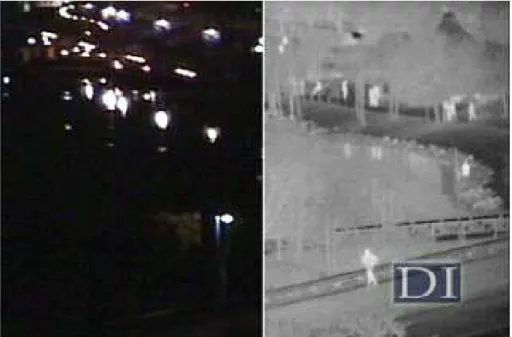
Figure 2.1: A comparison between the night vision camera and FLIR image. FLIR systems do not provide a perfect image like the traditional night vision systems. It produces sufficient image to distinguish objects. Conventional night vision systems improve image quality by processing visible night. Therefore they need a minimal amount of available light to produce acceptable images. At that point, FLIR systems become more important under the conditions of very low visibility and full darkness as seen in Figure 2.1. FLIR can be an effective system for surveillance aims without using special lighting equipments since it measures thermal energy. It is also significant system for military forces. It has been adopted to aircrafts, naval vessels and ground vehicles during the last decade. Recently, its handheld versions have been manufactured.
FLIR systems are widely used in many areas as mentioned above. Therefore, motion detection and object tracking in FLIR system became a challenging task for researchers in recent years.
CHAPTER 2. MEAN-SHIFT OBJECT TRACKING IN FLIR IMAGERY 9
2.2
Mean-Shift Object Tracking
Mean-shift tracking algorithm is an iterative scheme based on comparing the histogram of the original object in the current image frame and histogram of candidate regions in the next image frame. The aim is to maximize the correlation between two histograms.
Let x represent an image x : Z2− > {0, 1, 2, ..., N −1} where N is the dynamic
range of the pixel values. Let O represent the support of an object. Let yo be the
center of mass of the support O which is a subset of Z2. The histogram of the
object O in image frame n is defined as follows
hO(`) =
X
(n1,n2)∈O
(δ(x(n1, n2) − `) (2.1)
where x(n1, n2) is the value of the (n1, n2)-th pixel of the image x, δ(.) is the
discrete Dirac-delta function, and ` = 0, 1, 2, ..., N −1. The histogram is smoothed and normalized in several ways in [2]. In our work, an ordinary low-pass FIR filter is used to smooth the histogram.
In mean-shift tracking algorithm, histograms of regions are compared to each other using the Bhattacharya coefficient:
ρ(hO, h) =
X
`
q
hO(`)h(`) (2.2)
In the next image frame, the histogram of the same region is estimated and the following weights w(n1, n2) for each pixel in the region O in the (n+1)st frame
are computed. w(n1, n2) = N −1X `=0 v u u thO(`) h(`) (δ(x(n1, n2) − `) (2.3)
where h(`) represents the histogram of the region O in (n+1)st image frame of of the video. After this step, the center of mass yt of the weights are determined
by: yt= P n1,n2 x(n1, n2)w(n1, n2) P n1,n2 w(n1, n2) . (2.4)
CHAPTER 2. MEAN-SHIFT OBJECT TRACKING IN FLIR IMAGERY 10
The histogram of the region centered at yt is computed and compared it to the
original histogram using the Bhattacharya coefficient. If
ρ(hO, hyo) < ρ(hO, hy1), (2.5)
then the first candidate region for the object in the (n+1)-st image frame is determined as the region centered at (yo+y1)/2. The above procedure is repeated
until a satisfactory convergence level is reached. In practice, the average number of iterations is 5.
If a background subtraction based moving object detection method is used to determine the moving blobs in the image then the initial starting point of the iterations can be the blob determined by the background subtraction algo-rithm [10]. Mean-shift tracking iterations improve the accuracy of the detected region obtained using background subtraction.
2.3
Image Feature Selection
The efficiency of the mean-shift tracking algorithm depends on how representative the choice of random variables discriminating an object. The original algorithm is implemented in color image sequences and it uses color information. In in-frared image sequences there is only the intensity information and the histogram constructed from the intensity information may not be satisfactory to distinguish objects. In a FLIR image there may be image regions with similar intensity histograms and this makes tracker to loose the moving object.
The ultimate goal is to find a sufficient statistic whose distribution chracterizes the moving object in a unique manner. Since ordinary and FLIR images have no underlying statistical random process, it is almost impossible to define a sufficient statistic.
By using a high-pass filtered version of the image together with the actual image pixels the aim is to increase the discriminating capability of the mean-shift tracker. Pixels of the high-pass filtered image can capture structure on the
CHAPTER 2. MEAN-SHIFT OBJECT TRACKING IN FLIR IMAGERY 11
Figure 2.2: FLIR image of a plane. moving object including the edges.
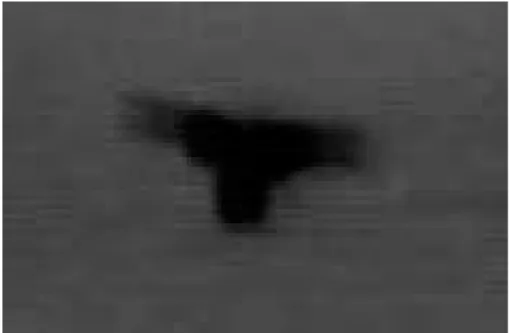
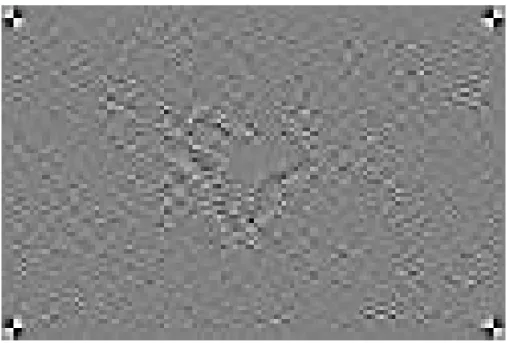
In Figure 2.2, FLIR image of a plane is shown. The image shown in Figure 2.3 is a high-pass filtered version of this image. A high-pass filter with cut-off fre-quency at π/2 is used. This image does not clearly reflect the edges of the object. In Figure 2.4, another high-pass filter with cut-off π/4 is used. This image clearly shows the edges. Therefore, it is necessary to use a high-pass filter with a lower cut-off frequency to extract the image structure.
High-pass information can be incorporated into the histogram. Since the dimension of the data is doubled compared to pixel-only histograms, the dynamic range of the new histogram is N2. In order to reduce the range the highpass
filtered image is quantized to 4 levels, and this leads to a 4xN size histograms. As it can be seen from the above images high-pass filtering captures (i) the pixel intensity variation information, and (ii) hightlights the contrast between the target and the background around the edges of the target. This makes the tracking algorithm more robust. Otherwise the histogram of the object shown in Figure 2.2 essentially contains a single peak around the mean value of the object region and this is not enough to uniquely determine the object.
CHAPTER 2. MEAN-SHIFT OBJECT TRACKING IN FLIR IMAGERY 12
Figure 2.3: High-pass filtered version of the above plane image. The cut-off frequency of the filter is π/2.
Figure 2.4: High-pass filtered version of the above plane image. The cut-off frequency of the high-pass filter is π/4.
CHAPTER 2. MEAN-SHIFT OBJECT TRACKING IN FLIR IMAGERY 13
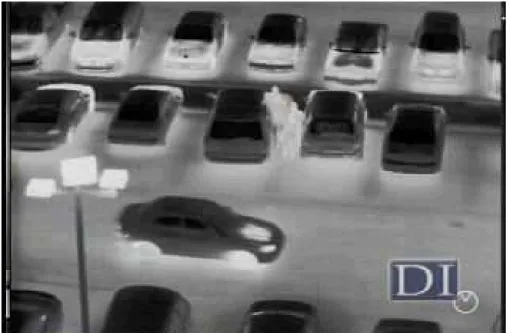
Figure 2.5: A FLIR image from the web page: www.dii-llc.com.
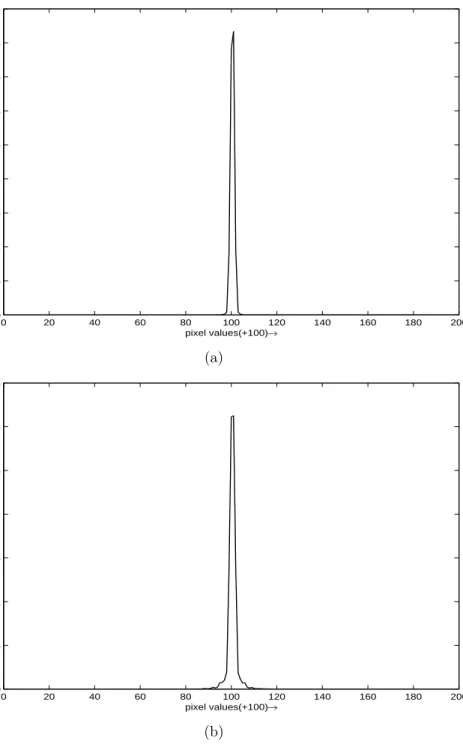
In Figure 2.5, another FLIR image is shown. This image sequence is down-loaded from the web page: www.dii-llc.com/FLIR multimedia.html. In this image there are edges within the object as well. Therefore it is important to include these features in the histogram characterizing the object in a unique manner. The highpass histograms of the plane in Figure 2.2 and the moving car in Figure 2.5 are shown in Figure 2.6-a and 2.6-b, respectively. The dynamic range of the graph in Figure 2.6-b is higher than Figure 2.6-a. As it can be seen from these graphs high-pass information provides additional information about the moving object. A composite histogram describing both regular pixel values and pixel values of the high-pass filtered image can be constructed in several ways. The easiest approach is to concatenate the normalized histograms of two images. In this case, the dynamic range of the concatenated histogram is 2N. One can also create a two-dimensional data set by combining the pixels of the two images. In this case, the dimension of the data is doubled compared to a pixel-only his-togram, therefore the dynamic range of the new histogram is theoretically N2.
However, actual dynamic range of the high-pass filtered image is much smaller than dynamic range of intensity pixels. Quantized version of the high-pass fil-tered image pixels can be used. It is experimentally observed that 4 to 8 levels are found satisfactory , and this leads to a 4xN to 8xN size histograms. The
CHAPTER 2. MEAN-SHIFT OBJECT TRACKING IN FLIR IMAGERY 14 0 20 40 60 80 100 120 140 160 180 200 0 0.05 0.1 0.15 0.2 0.25 0.3 0.35 0.4 0.45 pixel values(+100)→ normalized histogram (a) 0 20 40 60 80 100 120 140 160 180 200 0 0.05 0.1 0.15 0.2 0.25 0.3 0.35 pixel values(+100)→ normalized histogram (b)
Figure 2.6: (a) Histogram of the highpass image shown in Figure 2.2, (b) highpass histogram of the moving car in Figure 2.5. Mean values of high-pass histograms are very close to zero. The variance of the histogram in part (b) is higher than the variance of the histogram in part (a). In the above plots, histograms are shifted by 100.
CHAPTER 2. MEAN-SHIFT OBJECT TRACKING IN FLIR IMAGERY 15 0 0.5 1 1.5 2 2.5 3 3.5 0 0.1 0.2 0.3 0.4 0.5 0.6 0.7 0.8 0.9 1 Normalized frequence→ Magnitude
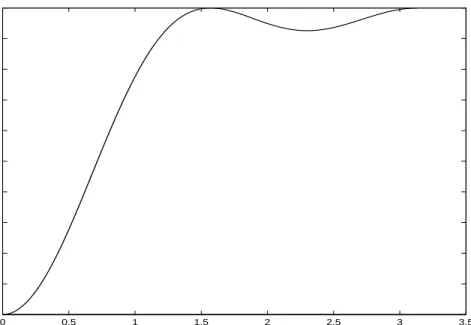
Figure 2.7: Frequency response of the high-pass filter at cut-off π/4. second approach provides a more robust description of the object. This comes at the expense of additional computation. However, in both cases, the compu-tational complexity does not increase drastically with the additional high-pass information in both approaches.
2.4
Simulation Examples
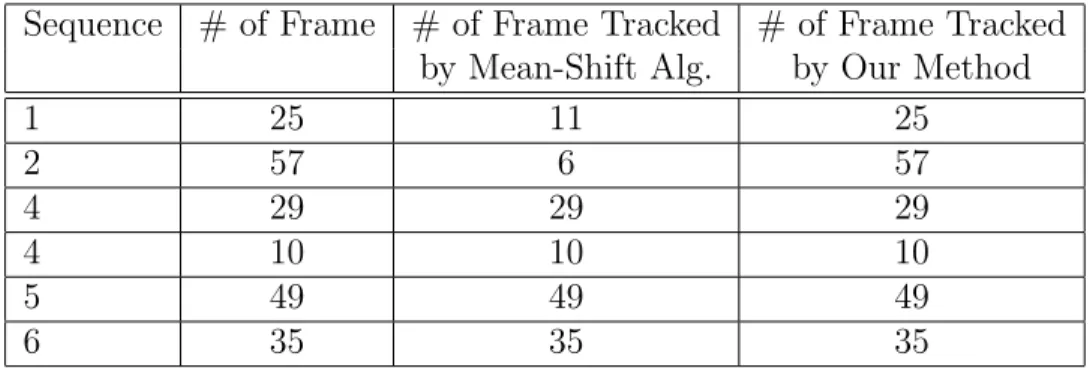
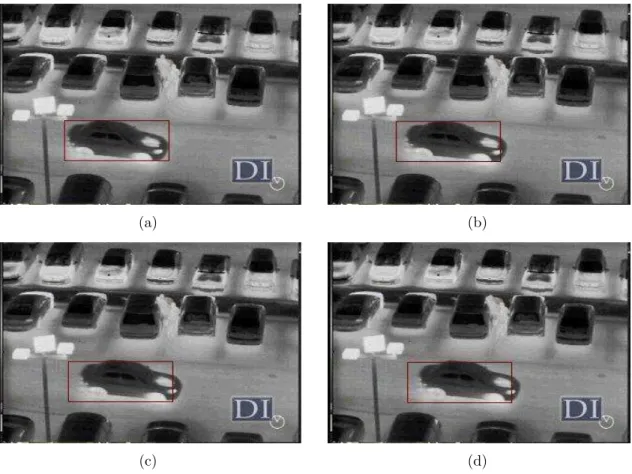
The proposed tracking method was developed by MATLAB 6.5. It is tested for six FLIR image sequences downloaded from Internet. Due to military nature of FLIR imaging we could not get permission to use other image sequences in this thesis. The ordinary mean-shift tracking tracks the targets in four sequences successfully. Our method tracks them as well. But the ordinary mean-shift algorithm fails for the image sequences 1 and 2. Table 2.1 gives the number of frames tracked successfully by the ordinary mean-shift tracking and our method. The car in the parking lot (Figure 2.5) from image sequence 4 can be also tracked very easily by both trackers using image pixels, and image and high-pass filtered image pixels because the background is not cluttered in this scene, either.
CHAPTER 2. MEAN-SHIFT OBJECT TRACKING IN FLIR IMAGERY 16
Table 2.1: The number of frames tracked successfully by the ordinary mean-shift and the proposed scheme.
Sequence # of Frame # of Frame Tracked # of Frame Tracked by Mean-Shift Alg. by Our Method
1 25 11 25 2 57 6 57 4 29 29 29 4 10 10 10 5 49 49 49 6 35 35 35
A couple of images showing the tracking is shown in Figure 2.10.
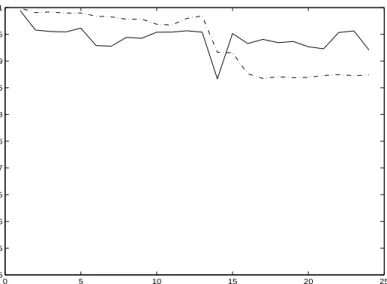
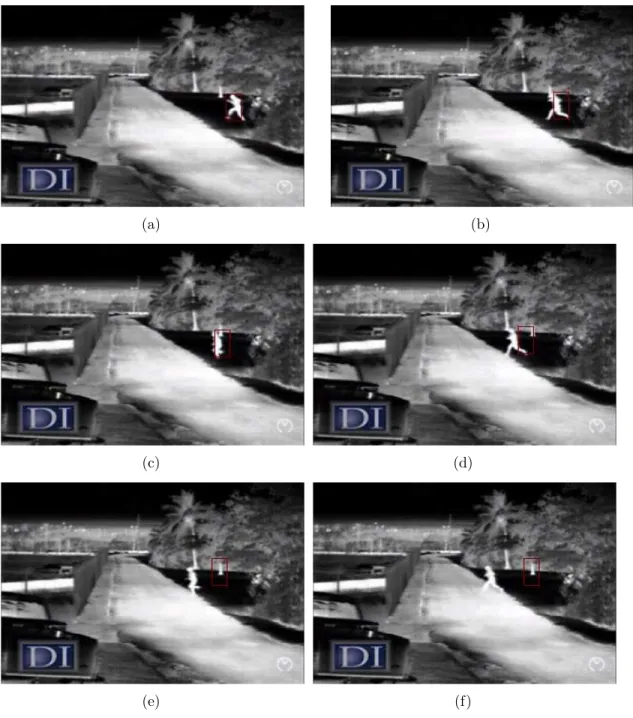
In Figure 2.11, the IR image of a walking man is shown. In this case, the ordinary mean-shift tracker fails to track the object as shown in Figure 2.11. It is clear that gray-scale pixel histogram is not enough to uniquely characterize the walking man in this case. On the other hand, the tracker using both the FLIR pixel and high-pass information successfully tracks the object as shown in Figure 2.12. The Bhattacharya coefficients are drawn in Figure 2.8 for both trackers in case of sequence 1 tracking. The Bhattacharya coefficient decreases (dotted) in Figure 2.8 when the ordinary mean-shift loses the tracking but the proposed method keeps the tracking.
The tracking of the plane in an airport (sequence 2) is the second example. In Figure 2.13, the ordinary mean-shift tracker fails to track the plane at frame 6. But the prosed mean-tracker continues to track the plane at frame 10 as seen in Figure 2.14.
In Figure 2.7 the frequency response of the FIR high-pass filter used in filter-ing the image is shown. This image is filtered both horizontally and vertically using the filter shown in Figure 2.7 to obtain the high-pass filtered image. The computational cost of filtering operation is low because the FIR filter has only 7 nonzero coefficients. To obtain the high-pass histogram there is no need to filter
CHAPTER 2. MEAN-SHIFT OBJECT TRACKING IN FLIR IMAGERY 17 0 5 10 15 20 25 0.5 0.55 0.6 0.65 0.7 0.75 0.8 0.85 0.9 0.95 1 frames→ ρ
Figure 2.8: The Bhattacharya coefficients of the ordinary mean-shift (dotted) and the proposed method (solid) for image sequence 1.
the entire image frame. Only a window around the moving object is sufficient be-cause means-shift tracker performs a local search to determine the next location of the object.
Another issue in the tracking based on mean-shift is the number of iterations. For example, iteration values per frame are depicted in Figure 2.9 for image sequence 1. The peak and average value is 7 and 2.95, respectively. These may be used to compute the required processing power in a real-time application.
CHAPTER 2. MEAN-SHIFT OBJECT TRACKING IN FLIR IMAGERY 18 0 5 10 15 20 25 0 1 2 3 4 5 6 7 frames→ number of iterations
Figure 2.9: The iteration number of the proposed tracking method.
(a) (b)
(c) (d)
Figure 2.10: Tracking the car on the parking lot: (a) frame 1, (b) frame 3, (c) frame 5, and (d) frame 9.
CHAPTER 2. MEAN-SHIFT OBJECT TRACKING IN FLIR IMAGERY 19
(a) (b)
(c) (d)
(e) (f)
Figure 2.11: Tracking the walking man with ordinary mean-shift: (a) frame 1, (b) frame 5, (c) frame 10, (d) frame 15, (e) frame 20, and (f) frame 25.
CHAPTER 2. MEAN-SHIFT OBJECT TRACKING IN FLIR IMAGERY 20
(a) (b)
(c) (d)
(e) (f)
Figure 2.12: Tracking the walking man with the proposed mean-shift method using both image and high-pass filter information: (a) frame 1, (b) frame 5, (c) frame 10, (d) frame 15, (e) frame 20, and (f) frame 25.
CHAPTER 2. MEAN-SHIFT OBJECT TRACKING IN FLIR IMAGERY 21
(a) (b)
(c) (d)
Figure 2.13: Tracking the plane in the airport. Ordinary mean-shift tracker fails: (a) frame 1, (b) frame 3, (c) frame 6, and (d) frame 10.
(a) (b)
(c) (d)
Figure 2.14: Tracking the plane in the airport with the proposed mean-shift method: (a) frame 1, (b) frame 3, (c) frame 6, and (d) frame 10.
Chapter 3
Mean-Shift Tracking in CBIR
Content-based image retrieval (CBIR) is a method to search images from a database of images according to the user’s interest. It uses visual contents of image in searching. CBIR has been an active and challenging research area since 1990s. A significant progress has been made in both theoretical research and practical applications during the last decade.
Early methods were usually based on textual annotations of images. In other words, images were first annotated with text and then searched using text-based approach in database management systems. However, most text-based image retrieval systems require manual annotation of images since automatic generation of descriptive texts for a wide spectrum of images is not feasible. It is obvious that manual image annotation is expensive task for large databases and often subjective. As a result, CBIR by using traditional database management systems is not sufficient to support different queries.
In the 1990s, advances in the Internet and new digital image sensor tech-nologies drastically increased the volume of digital images produced by scientific, educational, medical, industrial and other applications for users. Therefore the difficulties of text-based retrieval became more severe. An efficient management of quickly increasing visual information became an urgent problem. Several re-searchers from the different areas such as computer vision, database management,
CHAPTER 3. MEAN-SHIFT TRACKING IN CBIR 23
human-computer interaction etc. worked on the field [24]-[28]. Then research on CBIR has developed rapidly. The number of publications on the methods for vi-sual infirmation extraction, organization, indexing and user query has increased. Similarly, a large number of CBIR system has been developed by universities, governments, companies and hospitals.
CBIR systems use the visual contents of an image such as color, shape, texture and spatial layout to describe and index the image. Next sections explain these image content descriptors.
3.1
Image Content Descriptors
Image usually consists of both visual and semantic content. General image con-tent includes color, texture, shape and spatial relationships etc. Semantic concon-tent is obtained by textual annotation or complex inference procedures based on visual content. This section focuses on general contents descriptions.
A successful visual content descriptor should be robust against the variances on image such as the variation of the illuminant of scene. However, there is a tradeoff between the robustness and the discriminative power of visual features. The discrimination of the essential differences is reduced while increasing robust-ness.
A visual content descriptor can be local or global. A local descriptor uses the visual features of regions and objects to describe the image where a global descriptor uses the visual features of the whole image. An image is often divided into parts in the local visual descriptors. The image is simply cut into tiles of equal size and shape. This simple partition does not guarantee perceptually meaning regions but gives the global features of the images at a lower resolution. More complex methods are used to obtain semantically meaningful objects such as bird, car, etc. Some methods widely used to extract color, texture, shape, and spatial information from are introduced briefly.
CHAPTER 3. MEAN-SHIFT TRACKING IN CBIR 24
3.1.1
Color
Color is widely used for image retrieval systems. The three-dimensional values of color has obviously higher discriminator feature when compared to gray values of the image. Firstly, color space that will be used in CBIR systems should be determined before selecting an appropriate color descriptor. Therefore color space is introduced first before color descriptors.
Color space: Each pixel of the image is represented by a point in a 3D color
space. RGB, Munsell, CIE L*a*b, CIE L*u*v and HSV are used commonly in CBIR systems.
RGB space is widely used as a color space to display and print image. It consists of three color components: red, green and blue. A color in RGB space is produced by adding them together. RGB space is device independent and perceptually non-uniform.
The CIE color space is device independent. It can be considered as per-ceptually uniform. They include a luminance or lightness component and two chromatic. The transformation of RGB space to CIE space is given in [29].
HSV space is widely used in computer graphics. It has the three color compo-nents: hue, saturation and value. The hue is invariant to the illumination changes and camera direction. So it is more suitable for object retrieval.
Color moments: Color moments are widely used in several CBIR systems.
The mean (the first order) and variance (the second order) and skewness (third order) have been proven to be efficient and effective for the representation of color distributions of an image [30]. The color moment method has better performance when both CIE color spaces are used. The use of third moment besides the mean and variance improves the overall performance of image retrieval.
Color histogram: The color histogram is the effective way to represent the
color content of an image, if all the processed data is unique. The extraction of the color histogram is simple and it is quite effective in characterizing of local and
CHAPTER 3. MEAN-SHIFT TRACKING IN CBIR 25
global distribution of an image. It is also robust to changes in the view angle, occlusion and rotation.
The histogram is distribution of the number of pixels for each quantized bins, which can be defined separately or jointly for each component, since any pixel in the image has three components in certain color space such as red, green and blue in RGB space and hue, saturation and value in HVS. It is clear that it has more discriminative power if more bins is used in the color histogram. However, the use of large number of bins increases the computational cost. It also makes difficult to build efficient indexes for image database. A very fine bin quantization does not improve the retrieval performance in many applications. A way to reduce the number of bins is to use the clustering methods to determine the K best colors in a given space for a set of images. Each of these best colors are taken as a histogram bin. Another way is to use the bins which have the largest pixels numbers since a small number of histogram bins contain the majority of pixels in an image [31]. This reduction does not degrade the performance of histogram matching.
The histogram comparison saturates the discrimination when database has large number of image. The joint histogram method is proposed in [32]. In addition, color histogram does not take account into spatial information. Thus very different image may have similar the color histograms. Therefore several method to incorporate the color histogram with spatial information are proposed to increase the discrimination power. A simple approach is to divide an image into small areas and extract the histograms of these small areas. Increasing the number of areas increase the spatial information. but also it increases the computational cost and memory requirement.
Color coherence vectors: A proposed method is to use the spatial information
in the histogram extraction [33]. Each histogram bins is divided into two types. It is coherent if it belongs to a large colored region or incoherent if it does not. Color coherence vectors method has better performance than color histograms for image retrieval especially when images have mostly uniform colors and mostly texture regions.
CHAPTER 3. MEAN-SHIFT TRACKING IN CBIR 26
Color correlogram: The color correlogram [34] is used to characterize both
the color distribution of pixels and the spatial correlation of pairs of colors. The color histogram has three dimension. The first and second dimension are used for the colors of any pixel pairs. The third one is used for their spatial distance. The size of the color correlogram is very large when all possible combinations of color pairs. Its simple version called the color autocorrelogram is often used to reduce this large size.
Invariant color features: Color varies with change of illumination, the surface
orientation and the view angle of camera. Therefore these changes may decrease the performance of image retrieval system and should be considered. However, these changes are not considered in the most of the color descriptors given above. Recently invariant color descriptions have been proposed in [35, 36]. The discrimi-nation power is decreased when this method is applied to provide the independent color representation.
3.1.2
Texture
Texture is a significant property of images. There are many texture represen-tations in pattern recognition and computer vision. The texture representation has basically two categories: structural and statistical. Structural methods in-clude morphological operator and adjacency graph to describe texture by identi-fying structural primitives and their placement rules. Statistical methods include Fourier power spectra, co-occurrence matrices, shift invariant component analy-sis, Tamura feature, Wold decomposition, Markov random field, fractal model and multi-resolution filtering methods such as Gabor and wavelet transform. All of methods are used to characterize texture by the statistical distribution of the im-age intensity. The details of imim-age retrieval by the texture are not given because they are out of scope of this thesis.
CHAPTER 3. MEAN-SHIFT TRACKING IN CBIR 27
3.1.3
Shape
The shape features of objects or regions are used in many CBIR systems. The shape features are usually described after images have been segmented into re-gions or objects when it is compared to color and texture features. However, robust image segmentation is difficult. Therefore use of shape features has some limitations except some special applications. The shape descriptions method can be divided into two categories: boundary-based and region-based methods. The boundary-based methods includes rectilinear shapes, polygonal approximations, finite element models, Fourier-based shape descriptors . The region-based meth-ods are statistical moments.
3.1.4
Spatial Information
Regions and objects with similar color and texture properties can be distinguished by using spatial constraints. For example, a region of sky and ocean may be blue and have same color distribution and texture. But their spatial locations on the image are different. Therefore spatial information of region or object can be used in CBIR systems. The most popular representation of spatial relationships is the 2D strings [37]. Besides the 2D strings, spatial quad-tree [38] and symbolic image [39] are also used to represent the spatial information.
3.2
Similarity Measures
Content-based image retrieval systems calculate visual similarities between a query image and images from database. The retrieval result consists of mul-tiple image ranked from top to bottom according to their similarity measures with the query image. There are many similarity measures used in CBIR studies. Some of them are given below. D(I, J) donates the distance measure between the query image and I and the image J from the database. fi(I) is number of
CHAPTER 3. MEAN-SHIFT TRACKING IN CBIR 28
Minkowski-Form distance: The Minkowski-Form distance is suitable to
mea-sure distance between two images if each dimension of feature vector is indepen-dent from others. The distance Lp is defined as:
D(I, J) = (X
i
|fi(I) − fi(J)|p)1/p (3.1)
The L1, L2 is called Euclidean distance. The Minkowski-Form distance is widely
used as a metric in CBIR systems.
Quadratic form distance: The Minkowski distance takes account into all bins
of the color histogram completely independently and does not consider the certain pairs of bins corresponding to features. The Quadratic Form Distance is propsed to solve this problem:
D(I, J) =
q
(FI− FJ)TA(FI− FJ) (3.2)
where A = [aij] is a similarity matrix and aij donates similarity between bin i
and j. FI and FJ are vectors which lists all entries of fi(I) and fi(J). It is widely
used in the histogram-based retrieval systems.
Mahalanobis distance: It can be used when each dimension of image feature
vector is dependent on each other and has different importance. Its definition is:
D(I, J) =
q
(FI− FJ)TC−1(FI− FJ) (3.3)
where C is the covariance matrix of the feature vectors.
3.3
Indexing Methods
Another critical issue in CBIR is effective indexing and fast searching of images based on visual features. Because the feature vectors are usually large sized with multiple dimensions. Therefore they are not appropriate for the well-known indexing schemes. In general, a size reduction is applied before implementing efficient indexing scheme. The size reduction methods and indexing schemes are not detailed since CBIR in this thesis is index free.
CHAPTER 3. MEAN-SHIFT TRACKING IN CBIR 29
3.4
User Interaction
The user interaction with CBIR systems is important. The flexibility for user in CBIR systems can be obtained by involving the user to the retrieval procedure. The interface consists of two parts: query specification and a result presentation. Query specification can be done in many ways. These are category browsing, query by concept, query by sketch and query by sample.
• Category browsing is to browse in the database according to the category of
the images. By this reason, images in the database are classified according to their semantic and visual contents.
• Query by concept is to retrieve images according to the conceptual
descrip-tion.
• Query by sketch allows the user to draw a sketch of an image with a tool
(graphical editing).
• Query by example allows the user to define a query on an example
im-age. The CBIR system converts this query into its feature representation internally.
3.5
Mean-Shift Analysis in CBIR
The proposed CBIR system is based on the color histogram for the local region. In fact the mean-shift tracking uses the color histograms. Therefore it is efficiently used to localize the candidate region for an image in database. The region speci-fied by the user (target region) is searched on the database images by comparing the color histograms. The color histogram involving background effect reduction and edge information is first computed to extract the features of user interest. A search method is applied to the images in database. The search method can be divided into two categories. The first one is processes which are performed to localize the candidate region similar to the target region for an image from
CHAPTER 3. MEAN-SHIFT TRACKING IN CBIR 30 Example by User Feature Extraction Pick up an Image from Database Image Partition Mean-Shift Tracking Similarity Measure Ranking Process End of Database? Print Results
CHAPTER 3. MEAN-SHIFT TRACKING IN CBIR 31
database. These processes are image partition, the histogram computation for sub-blocks in the image partition, evaluation of similarity measure and the mean-shift tracking algorithm. Their details can be found in the following sections. A similarity measure is assigned to the image after all these processes in the first category are performed. That similarity measure is input to the second category that handles the ranking of the database images. At the end of search, the best similar five images are given to user as searching result. The flow chart of retrieval system is shown in Figure 3.1.
3.5.1
Modelling of User interest
A user interest (target) region is chosen before modelling the target. The model of the target is represented by the joint-color histogram. Background reduction and use of edge information are considered in the construction of the histogram. The edge information of the target region is extracted by using wavelet coefficients and represented in the histogram with color distribution. The details of the histogram computation are given in the following sections.
3.5.1.1 Histogram or Kernel Density Estimation
Statisticians developed many ways of estimating the probability density function of a random variable from observed data [40]. The easiest way is to construct the histogram H of the data and normalize the area under the histogram to one. The paper by Dorin Comaniciu and Peter Meer [2] followed the approach studied by statisticians. This approach is called the kernel density estimation. The kernel density estimate at the observation xi is defined by
f (x) = 1 n n X i=1 KW(x − xi) (3.4)
where n is the observed data points or the number of pixel values in an image or an image region, and xi represent a sample from some unknown density f, or in
CHAPTER 3. MEAN-SHIFT TRACKING IN CBIR 32 is defined as follows: KW(x) = 1 q |W |K(W −0.5x) (3.5)
where K(z) is the d-variate kernel function with compact support satisfying the regularity constraints as described in [40], and W is a symmetric positive definite d d bandwidth matrix. For the radially symmetric kernel, the function K(z) becomes
K(z) = ck(||z||2) (3.6)
where c is a normalization constant. If one assumes a single global spherical bandwidth, W = h2I, the kernel density estimator becomes
f (x) = 1 n(h)d n X xi=1 K(x − xi h ) (3.7)
A widely used choice for the function K is Gaussian function.
The aim of using a d-variate kernel function is to smooth the histogram. This is especially useful when the number of observed data n is small or, equivalently, image region is a small region. Obviously the histogram may be very jagged if the observed image region is small. For example, xi = 200 and xj = 202 may
be observed in a 20 by 20 image region but xi = 201 may not have observed
and the value of histogram for xi = 201 will be h(201) = 0. However, if a
Gaussian smoothing function is used then f (201) will be nonzero. The parameter
h defined above controls the variance of the function K. By changing the value
of h a smoother or sharper pdf is estimated. In the extreme case, the function
K becomes an impulse and the pdf estimate is simply the normalized histogram H(x). This approach is fine but it is computationally expensive. Because the pdf
estimate is iteratively updated for each observed data point.
We do not follow this approach in our work. We cannot assume a specific underlying probability density for images. Therefore, the aim is simply to smooth the histogram so that the value of the estimate for 201 becomes nonzero in the above example.
There are more computationally efficient ways of smoothing data in electrical engineering: namely low-pass filtering. We can smooth the histogram by simply
CHAPTER 3. MEAN-SHIFT TRACKING IN CBIR 33
using a discrete low-pass filter. The narrower the bandwidth of the low-pass filter or smaller the cut-off frequency of the low-pass filter the smoother the estimated pdf. At the other extreme, when the impulse response of the filter is a Dirac-delta function then the probability density estimate is simply the histogram.
The computational cost of this approach is a one-dimensional discrete con-volution whose cost is determined by the impulse response of the low-pass filter. As a rule of thumb, the narrower the bandwidth of the low-pass filter the longer the impulse response. Hence the computational cost increases. But this cost is negligible compared to the kernel density smoothing process used by statisticians and [2].
In our work, Finite-extent Impulse Response (FIR) filters are used. Example low-pass filters are presented in Section 3.5.1.4. Recursive Infinite-extent Impulse Response (IIR) filters have non-symmetric impulse responses therefore they are not used in smoothing
3.5.1.2 Color Histogram Construction
Figure 3.2 shows a region of interest in an image selected by the user. The region of interest is called the target region from now. The RGB color space is used to extract the color feature of the selected target region. Because a color conversion from the RGB to another color space does not drastically improve the retrieval performance [41]. Another reason is that the developed CBIR system combines the color histogram and the mean-shift tracking algorithm. Since the original the mean-shift algorithm uses the RGB space, the fusion of the retrieval based on the color histogram and mean-shift tracking algorithm is simplified. The color histogram is not constructed separately for each color components in this thesis. The joint-color histogram is used to characterize the target region. The color components in the RGB space vary between 0 and 255 in an image. The dimension of the color histogram is 2553 when the original color component values are taken
account during the histogram computation. This is not an efficient method by the reason of the computational cost and large memory requirement. It also decreases
CHAPTER 3. MEAN-SHIFT TRACKING IN CBIR 34
a
b
( n 10 , n20 )
Figure 3.2: User interest in a query image.
the discriminative power of retrieval system for similar images that have different illumination, viewing angles and compression loss, etc. Therefore most of the CBIR systems use the quantized values of color components. In this thesis, the color component values are quantized by a fixed constant Q. As a result, the dimension of the color histogram reduces to (255/Q)3 = N3. For instance, it
is 4096 when Q equals to 16. A method using the quantized color component values in the color histogram extraction is mostly known as N-bin histogram extraction [2].
The position (n10, n20) is the center of the target region with width a and
height b. Let ht be the color histogram of the target region. The size of the
histogram is N3 since the joint-color histogram is used. Equation 3.8 is used to
construct the N-bins joint-color histogram.
ht[k] = 1 C n20X+b2 n2=n20−b2 n10X+a2 n1=n10−a2 δ[∆(n1, n2) − k] for k = 1, 2, .., N3 (3.8)
where δ is the discrete Dirac-delta function and C is the normalization constant and equals to ab. The index ∆(n1, n2) is derived from the quantized color values
CHAPTER 3. MEAN-SHIFT TRACKING IN CBIR 35
by using the following formula.
∆(n1, n2) = Rq(n1, n2) + NGq(n1, n2) + N2Bq(n1, n2) (3.9)
where Rq(n1, n2), Gq(n1, n2) and Bq(n1, n2) are the quantized values of R, G and
B at the pixel location (n1, n2), respectively. The quantization is performed by
Equation 3.10. Rq(n1, n2) = ¹R(n 1, n2) Q º Gq(n1, n2) = ¹G(n 1, n2) Q º (3.10) Bq(n1, n2) = ¹B(n 1, n2) Q º
where b•c is called the largest integer less than •. After this step, the ht is
smoothed by using a FIR low-pass filter defined in Section 3.5.1.1.
3.5.1.3 Reduction of Background Effect on Histogram
The background information is automatically captured while selecting the target region or especially the object using rectangular window as seen Figure in 3.2. The background information is important for two reasons. First, the performance of the mean-shift tracking is decreased due to the background colors in the color histogram of the target region. Second, it is very difficult to model an object at its boundary. However, the effect of the background on the color histogram can be reduced and this improves the discriminative power of retrieving and the tracking performance of the mean-shift algorithm.
An easy way to reduce weight of the background information in the color histogram is to estimate the color histogram of background and modify the tar-get histogram. In Figure 3.2, a rectangular block is chosen by user. The color histogram for this block obviously contains the object and background informa-tion. A new extended block is virtually defined to estimate the color histogram of background. The size of the extended block is 10% larger than the size of the block originally selected by the user. Then the color histogram hb is computed
CHAPTER 3. MEAN-SHIFT TRACKING IN CBIR 36
Figure 3.3: Pixels whose histograms entries are larger than 0.005 are colored in blue to show the effect of background reduction.
for the region between two blocks by using exactly same method for the target region. Then target color histogram is updated according to hb. A set weights
to modify the target color histogram ht is defined as follows:
αk= min(
ˆ
hb
hb[k]
, 1) (3.11)
where ˆhb is the smallest nonzero entry of the hb. Then each entry of ht is
multiplied by the weight corresponding to this entry:
ˆht[k] = αkht[k] for k = 1, 2, .., N3 (3.12)
where ˆhtis updated the target histogram. The weight reduction makes the target
histogram ˆht non-normalized. Thus re-normalization is performed:
C = N3 X k=0 ˆht[k] (3.13) ˜ht[k] = 1 Cˆht[k] for k = 1, 2, .., N 3 (3.14)
where ˜ht is the normalized histogram in which the effect of the background is
CHAPTER 3. MEAN-SHIFT TRACKING IN CBIR 37
Pixels whose histogram entries are larger than 0.005 are colored in blue. As seen in Figure 3.3, the background information around the beetle image within the user’s rectangle is reduced. The color histogram mostly contains the color information of the beetle.
This approach may have some disadvantages in some cases. For example, if there are similar colors on the background around the target region, this meaning-ful information will be reduced by the method discussed above in the histogram. As a result, the retrieval performance of the CBIR system is reduced.
3.5.1.4 Incorporation of Edge Information to Color Histogram
In this section, we describe how a joint-pdf including edge information is esti-mated from a given image region x(n1, n2). Edge information can be extracted
by using wavelet coefficients. In order to obtain the wavelet coefficients the image is processed by a filterbank with following low-pass and high-pass filters:
hl[n] = {0.25, 0.5, 0.25} (3.15)
and the impulse response of the high-pass filter is
hh[n] = {−0.25, 0.5, −0.25}. (3.16)
The filters are complementary with cut-off frequencies at π/2. Or,
hl[n] = {−1/32, 0, 9/32, 1/2, 9/32, 0, −1/32} (3.17)
and the corresponding high-pass filter is given by
hh[n] = {1/32, 0, −9/32, 1/2, −9/32, 0, 1/32} (3.18)
Both filters are related with Lagrange family of wavelets [42]. The image is processed in a separable manner by the filterbank and four wavelet sub-images
xll(n1, n2), xlh(n1, n2), xhl(n1, n2), and xhh(n1, n2) are obtained as shown in Figure
3.4. Due to decimation by a factor of two after each filtering operation the wavelet subimages are quarter size versions of the original image.
CHAPTER 3. MEAN-SHIFT TRACKING IN CBIR 38
Figure 3.4: Wavelet sub-images of the beetle image.
If the pixel x(n1, n2) is part of a horizontal edge then coefficients near
|xlh(n1/2, n2/2)| and |xhh(n1/2, n2/2)| take high values compared to flat
ar-eas in which wavelet coefficients are close to zero. Similarly, when the pixel
x(n1, n2) is part of a vertical edge then wavelet coefficients xhl(n1/2, n2/2) and
xhh(n1/2, n2/2) take high values compared to flat areas in which wavelet
coeffi-cients are close to zero. We construct a sub-image from the high-band wavelet subimages as follows:
xa(n1, n2) = |xlh(n1, n2)| + |xhl(n1, n2)| + |xhh(n1, n2)| (3.19)
The subimage xa(n1, n2) covers both horizontal and vertical edges, i.e., when the
pixel x(n1, n2) is part of an edge then the subimage pixels around xa(n1/2, n2/2)
take high values compared to flat areas because the subimage xa is constructed
from the wavelet coefficients.
A joint-pdf representing a given image region can be estimated from the image
x(n1, n2) and the corresponding subimage xaby adding an extra dimension. This
joint-pdf will represent not only the gray scale information but also the high-frequency content of the region because the subimage xais obtained by using the
CHAPTER 3. MEAN-SHIFT TRACKING IN CBIR 39
The additional dimension for the subimage increases the size of the joint color histogram depending on the quantization level of the subimage. Another way to add edge information into the joint color histogram is to determine the state of a pixel. In other words, the edge pixels are separated from non-edge pixels while constructing the color histogram. This method doubles the dimension of the histogram. Let E(n1, n2) be the edge binary state of pixel at (n1, n2). The
construction of the joint-histogram is modified as follows:
ht[k] = 1 C X n2 X n1 δ[E(n1, n2)N3+ ∆(n1, n2) − k] for k = 1, 2, .., 2N3 (3.20)
and E(n1, n2) is found by:
E(n1, n2) = 1 , xa(n1/2, n2/2) > T 0 , otherwise (3.21)
where T is a treshold used to determine the status of the pixel at (n1, n2) to
be on edge or not. In this case, the wavelet domain information is inherently quantized to a single bit (or two levels). Higher quantization levels leading to longer ht functions can be used. The joint-histogram defined in Equation 3.20
can be smoothed by using a low-pass filter.
3.5.2
Similarity Measure
Similarity measures used in CBIR systems are discussed in Section 3.2. In this thesis, the Bhattacharya coefficient is used to measure the similarity between the target and candidate histogram. The Bhattacharya coefficient is a divergence type measure and has a simple geometric interpretation and used in mean-shift track method by converting to distance to determine the convergence state. It is simply the cosine of the angle between two unit vectors. The sample estimate of the Bhattacharya coefficient between two histograms ht and hc is defined as
ρ = Nh X k=1 q ht[k]hc[k] (3.22)
where Nh is the size of histograms instead of N3 or 2N3. Because the size of the
CHAPTER 3. MEAN-SHIFT TRACKING IN CBIR 40
Figure 3.5: Image partition.
ρ is 1.0 when ht and hc are equal to each other. Its minimum is 0 if there is no
intersection between both histograms. It gives a value between 0 and 1 in other cases.
3.5.3
Image Partition
The candidate region in an image from database, which is the most similar to the target region, is initially unknown. Before performing the mean-shift track-ing algorithm, the approximate location of candidate regions is determined by a method based on sub-block technique where image is divided into sub-blocks as shown in Figure 3.5. The size of sub-blocks is equal to the size of user’s block. Let W and H are width and height of an image respectively. The number of sub-blocks Ns:
Ns =
W.H
a.b . (3.23)
After this step, the color histogram or joint-histogram of each sub-block (from left to right, from top to bottom) is evaluated according to the methods expressed in Sections 3.5.1.2-4. Then similarity measures between the target region and the sub-blocks are computed. The sub-block with the largest similarity measure